Cambridge A Level Psychology 9698 — 2016 Oct/Nov Paper 2 · Variant 1
9698/21/O/N/16 · 70 marks · ≈79 min
The question paper and its mark scheme, free to read here and free to download. This is Cambridge’s own paper, exactly as it was sat.
Question paper4 pages

Mark scheme11 pages
Answers below. Sit the paper first if you are practising.
Paper as text
Question paper, page 1
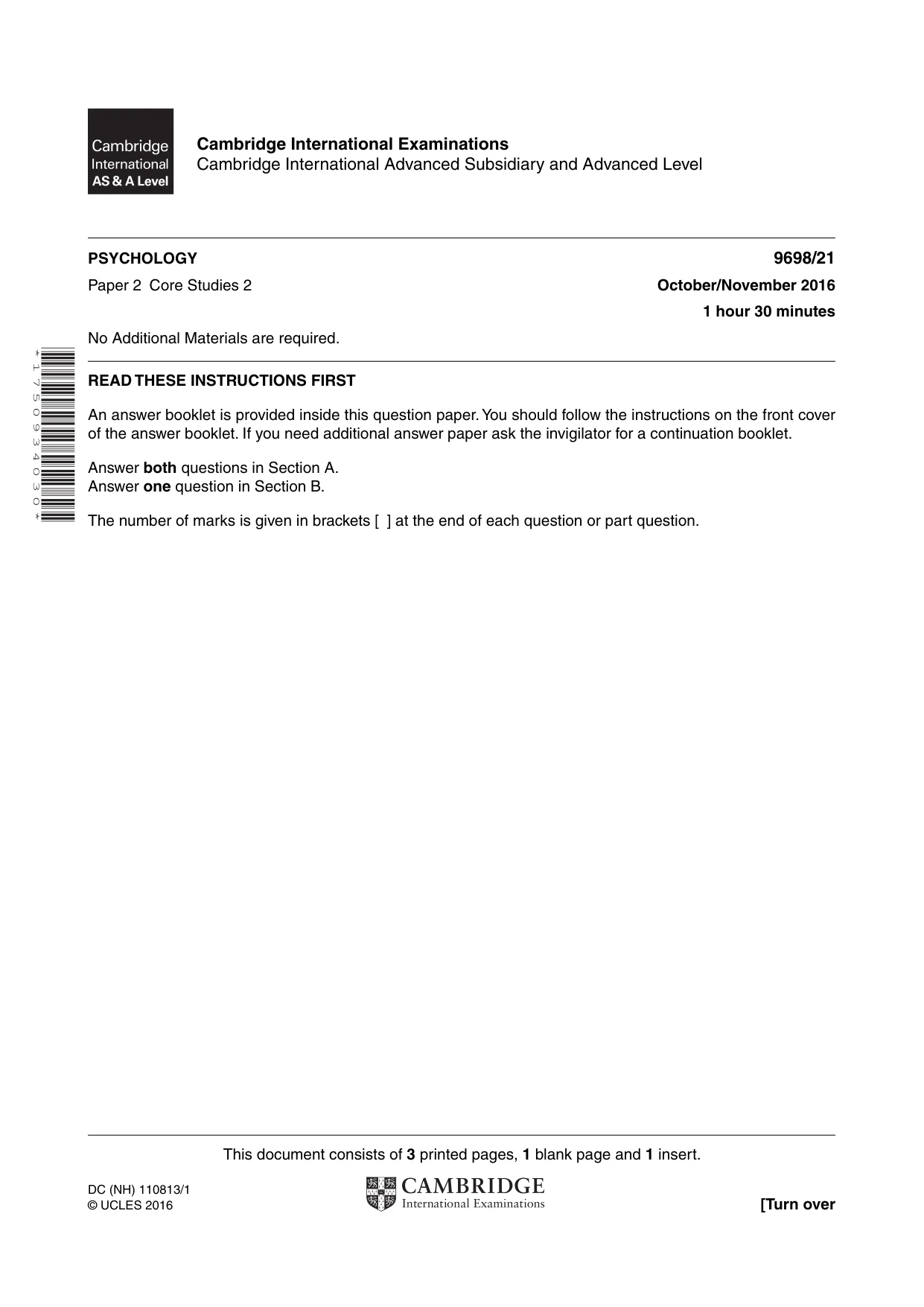
This document consists of 3 printed pages, 1 blank page and 1 insert. DC (NH) 110813/1 © UCLES 2016 [Turn over * 1 7 5 0 9 3 4 0 3 0 * PSYCHOLOGY 9698/21 Paper 2 Core Studies 2 October/November 2016 1 hour 30 minutes No Additional Materials are required. READ THESE INSTRUCTIONS FIRST An answer booklet is provided inside this question paper. You should follow the instructions on the front cover of the answer booklet. If you need additional answer paper ask the invigilator for a continuation booklet. Answer both questions in Section A. Answer one question in Section B. The number of marks is given in brackets [ ] at the end of each question or part question. Cambridge International Examinations Cambridge International Advanced Subsidiary and Advanced Level
Question paper, page 2
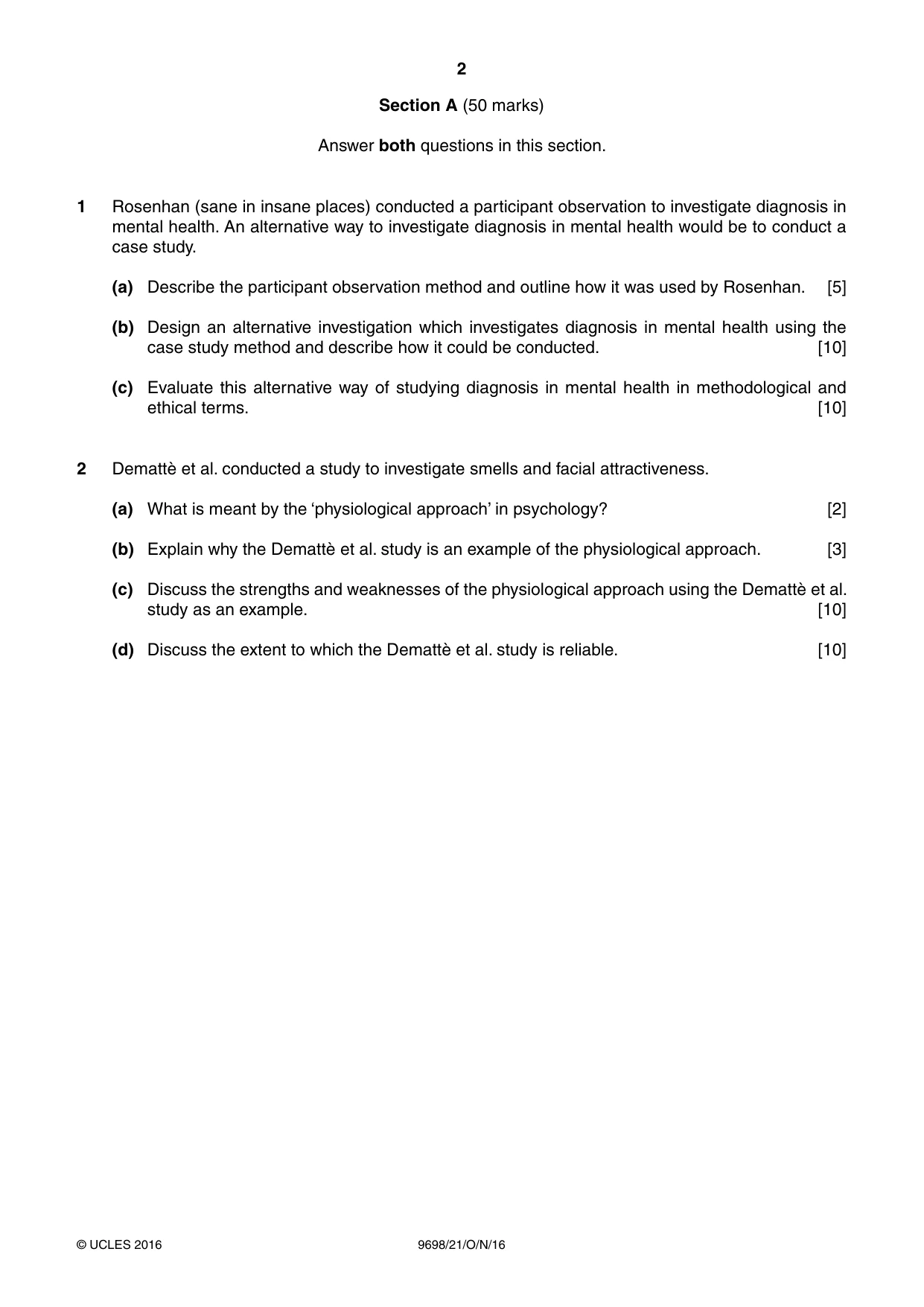
2 9698/21/O/N/16 © UCLES 2016 Section A (50 marks) Answer both questions in this section. 1 Rosenhan (sane in insane places) conducted a participant observation to investigate diagnosis in mental health. An alternative way to investigate diagnosis in mental health would be to conduct a case study. (a) Describe the participant observation method and outline how it was used by Rosenhan. [5] (b) Design an alternative investigation which investigates diagnosis in mental health using the case study method and describe how it could be conducted. [10] (c) Evaluate this alternative way of studying diagnosis in mental health in methodological and ethical terms. [10] 2 Demattè et al. conducted a study to investigate smells and facial attractiveness. (a) What is meant by the ‘physiological approach’ in psychology? [2] (b) Explain why the Demattè et al. study is an example of the physiological approach. [3] (c) Discuss the strengths and weaknesses of the physiological approach using the Demattè et al. study as an example. [10] (d) Discuss the extent to which the Demattè et al. study is reliable. [10]
Question paper, page 3
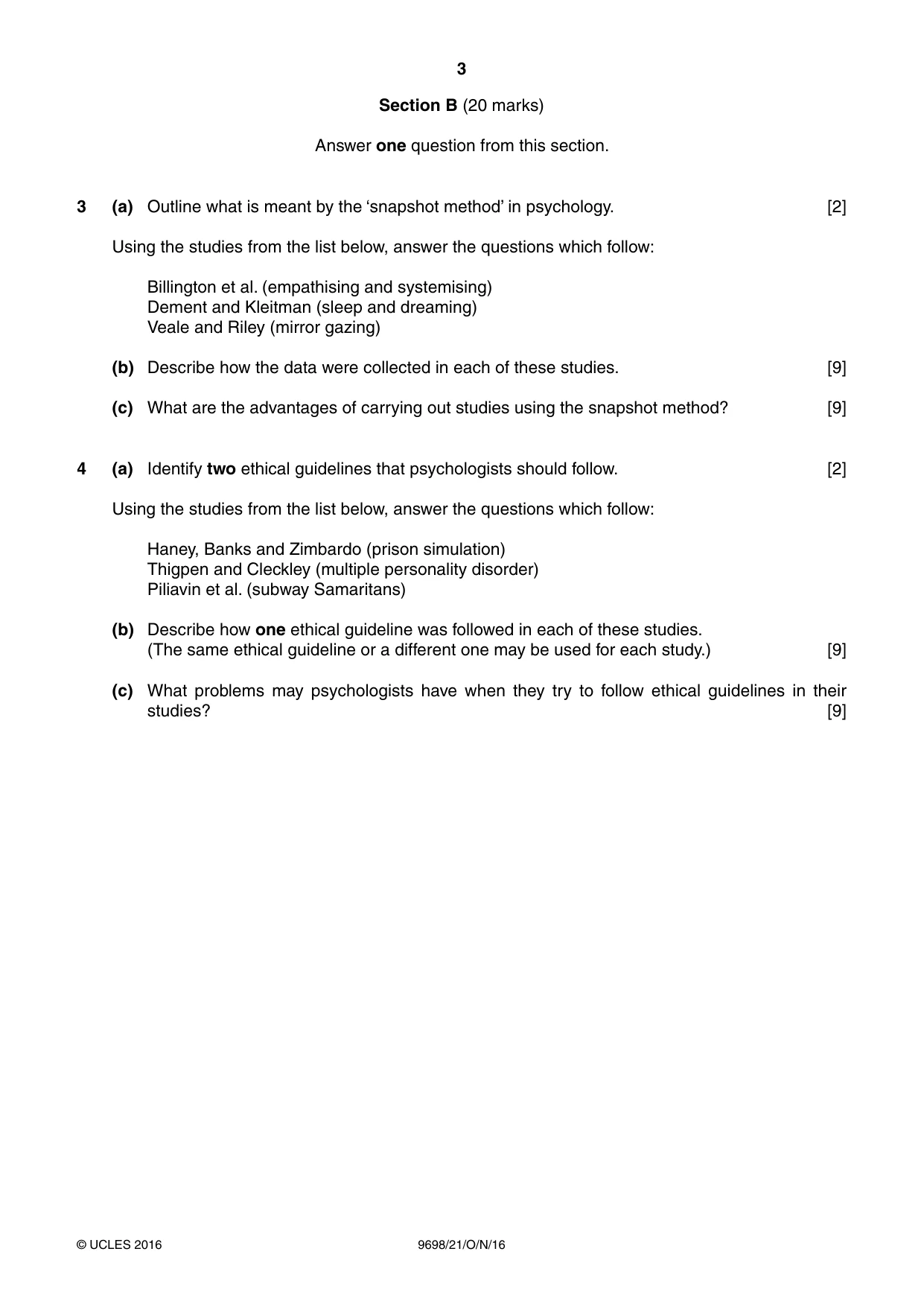
3 9698/21/O/N/16 © UCLES 2016 Section B (20 marks) Answer one question from this section. 3 (a) Outline what is meant by the ‘snapshot method’ in psychology. [2] Using the studies from the list below, answer the questions which follow: Billington et al. (empathising and systemising) Dement and Kleitman (sleep and dreaming) Veale and Riley (mirror gazing) (b) Describe how the data were collected in each of these studies. [9] (c) What are the advantages of carrying out studies using the snapshot method? [9] 4 (a) Identify two ethical guidelines that psychologists should follow. [2] Using the studies from the list below, answer the questions which follow: Haney, Banks and Zimbardo (prison simulation) Thigpen and Cleckley (multiple personality disorder) Piliavin et al. (subway Samaritans) (b) Describe how one ethical guideline was followed in each of these studies. (The same ethical guideline or a different one may be used for each study.) [9] (c) What problems may psychologists have when they try to follow ethical guidelines in their studies? [9]
Question paper, page 4
4 9698/21/O/N/16 © UCLES 2016 BLANK PAGE Permission to reproduce items where third-party owned material protected by copyright is included has been sought and cleared where possible. Every reasonable effort has been made by the publisher (UCLES) to trace copyright holders, but if any items requiring clearance have unwittingly been included, the publisher will be pleased to make amends at the earliest possible opportunity. To avoid the issue of disclosure of answer-related information to candidates, all copyright acknowledgements are reproduced online in the Cambridge International Examinations Copyright Acknowledgements Booklet. This is produced for each series of examinations and is freely available to download at www.cie.org.uk after the live examination series. Cambridge International Examinations is part of the Cambridge Assessment Group. Cambridge Assessment is the brand name of University of Cambridge Local Examinations Syndicate (UCLES), which is itself a department of the University of Cambridge.
Mark scheme, page 1
® IGCSE is the registered trademark of Cambridge International Examinations. This document consists of 11 printed pages. © UCLES 2016 [Turn over Cambridge International Examinations Cambridge International Advanced Subsidiary and Advanced Level PSYCHOLOGY 9698/21 Paper 2 Core Studies 2 October/November 2016 MARK SCHEME Maximum Mark: 70 Published This mark scheme is published as an aid to teachers and candidates, to indicate the requirements of the examination. It shows the basis on which Examiners were instructed to award marks. It does not indicate the details of the discussions that took place at an Examiners’ meeting before marking began, which would have considered the acceptability of alternative answers. Mark schemes should be read in conjunction with the question paper and the Principal Examiner Report for Teachers. Cambridge will not enter into discussions about these mark schemes. Cambridge is publishing the mark schemes for the October/November 2016 series for most Cambridge IGCSE®, Cambridge International A and AS Level components and some Cambridge O Level components.
Mark scheme, page 2
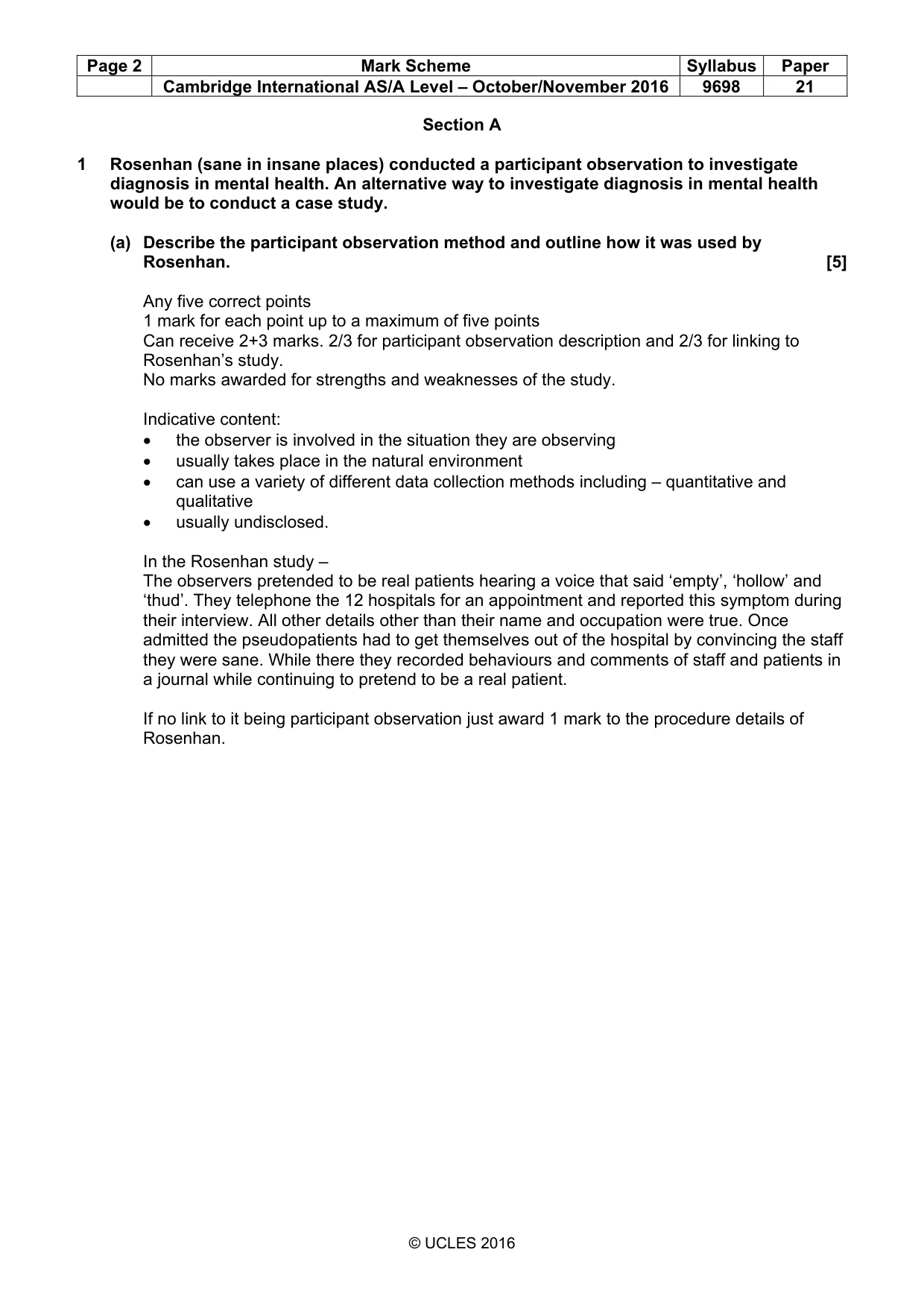
Page 2 Mark Scheme Syllabus Paper Cambridge International AS/A Level – October/November 2016 9698 21 © UCLES 2016 Section A 1 Rosenhan (sane in insane places) conducted a participant observation to investigate diagnosis in mental health. An alternative way to investigate diagnosis in mental health would be to conduct a case study. (a) Describe the participant observation method and outline how it was used by Rosenhan. [5] Any five correct points 1 mark for each point up to a maximum of five points Can receive 2+3 marks. 2/3 for participant observation description and 2/3 for linking to Rosenhan’s study. No marks awarded for strengths and weaknesses of the study. Indicative content: • the observer is involved in the situation they are observing • usually takes place in the natural environment • can use a variety of different data collection methods including – quantitative and qualitative • usually undisclosed. In the Rosenhan study – The observers pretended to be real patients hearing a voice that said ‘empty’, ‘hollow’ and ‘thud’. They telephone the 12 hospitals for an appointment and reported this symptom during their interview. All other details other than their name and occupation were true. Once admitted the pseudopatients had to get themselves out of the hospital by convincing the staff they were sane. While there they recorded behaviours and comments of staff and patients in a journal while continuing to pretend to be a real patient. If no link to it being participant observation just award 1 mark to the procedure details of Rosenhan.
Mark scheme, page 3
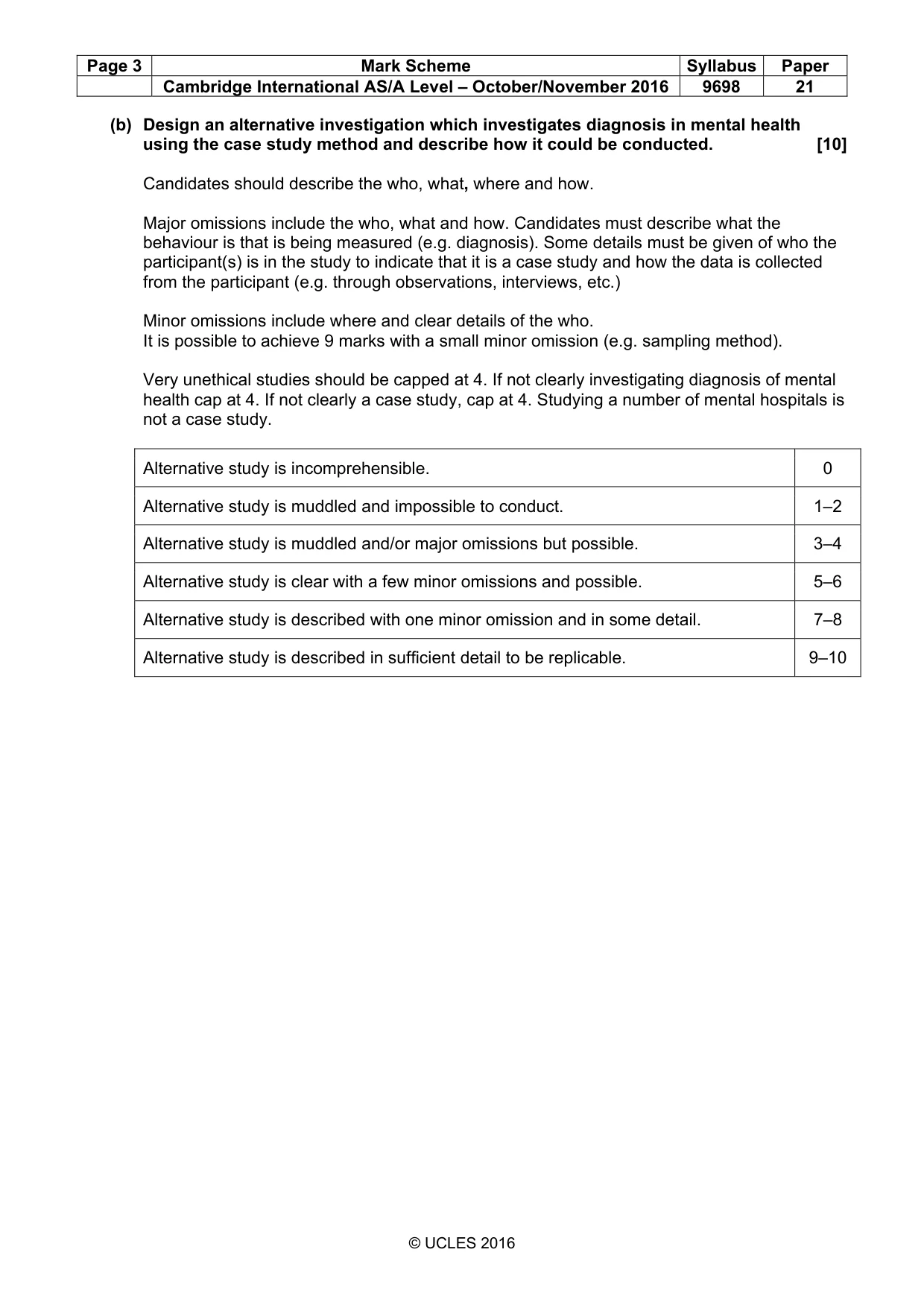
Page 3 Mark Scheme Syllabus Paper Cambridge International AS/A Level – October/November 2016 9698 21 © UCLES 2016 (b) Design an alternative investigation which investigates diagnosis in mental health using the case study method and describe how it could be conducted. [10] Candidates should describe the who, what, where and how. Major omissions include the who, what and how. Candidates must describe what the behaviour is that is being measured (e.g. diagnosis). Some details must be given of who the participant(s) is in the study to indicate that it is a case study and how the data is collected from the participant (e.g. through observations, interviews, etc.) Minor omissions include where and clear details of the who. It is possible to achieve 9 marks with a small minor omission (e.g. sampling method). Very unethical studies should be capped at 4. If not clearly investigating diagnosis of mental health cap at 4. If not clearly a case study, cap at 4. Studying a number of mental hospitals is not a case study. Alternative study is incomprehensible. 0 Alternative study is muddled and impossible to conduct. 1–2 Alternative study is muddled and/or major omissions but possible. 3–4 Alternative study is clear with a few minor omissions and possible. 5–6 Alternative study is described with one minor omission and in some detail. 7–8 Alternative study is described in sufficient detail to be replicable. 9–10
Mark scheme, page 4
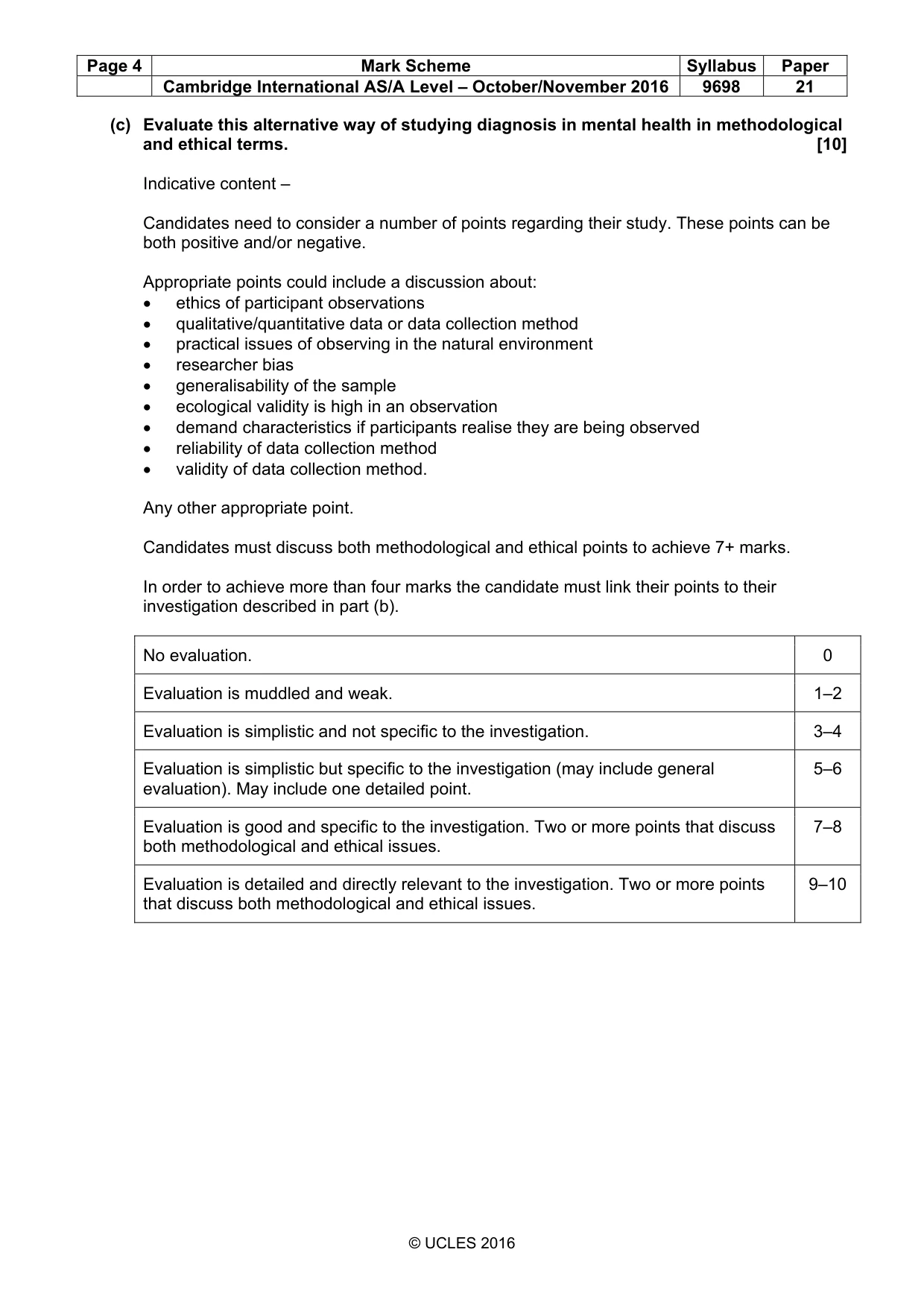
Page 4 Mark Scheme Syllabus Paper Cambridge International AS/A Level – October/November 2016 9698 21 © UCLES 2016 (c) Evaluate this alternative way of studying diagnosis in mental health in methodological and ethical terms. [10] Indicative content – Candidates need to consider a number of points regarding their study. These points can be both positive and/or negative. Appropriate points could include a discussion about: • ethics of participant observations • qualitative/quantitative data or data collection method • practical issues of observing in the natural environment • researcher bias • generalisability of the sample • ecological validity is high in an observation • demand characteristics if participants realise they are being observed • reliability of data collection method • validity of data collection method. Any other appropriate point. Candidates must discuss both methodological and ethical points to achieve 7+ marks. In order to achieve more than four marks the candidate must link their points to their investigation described in part (b). No evaluation. 0 Evaluation is muddled and weak. 1–2 Evaluation is simplistic and not specific to the investigation. 3–4 Evaluation is simplistic but specific to the investigation (may include general evaluation). May include one detailed point. 5–6 Evaluation is good and specific to the investigation. Two or more points that discuss both methodological and ethical issues. 7–8 Evaluation is detailed and directly relevant to the investigation. Two or more points that discuss both methodological and ethical issues. 9–10
Mark scheme, page 5
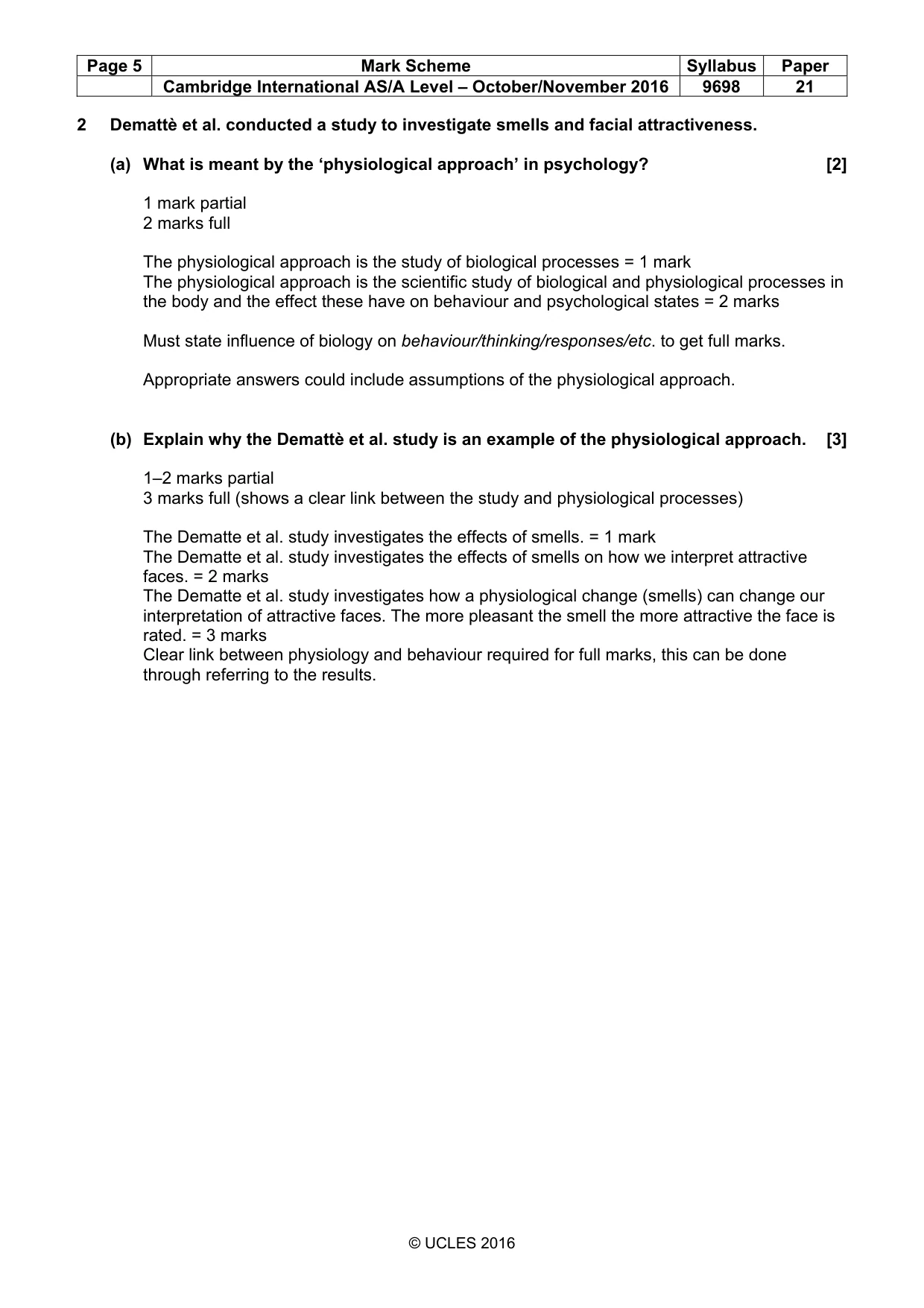
Page 5 Mark Scheme Syllabus Paper Cambridge International AS/A Level – October/November 2016 9698 21 © UCLES 2016 2 Demattè et al. conducted a study to investigate smells and facial attractiveness. (a) What is meant by the ‘physiological approach’ in psychology? [2] 1 mark partial 2 marks full The physiological approach is the study of biological processes = 1 mark The physiological approach is the scientific study of biological and physiological processes in the body and the effect these have on behaviour and psychological states = 2 marks Must state influence of biology on behaviour/thinking/responses/etc. to get full marks. Appropriate answers could include assumptions of the physiological approach. (b) Explain why the Demattè et al. study is an example of the physiological approach. [3] 1–2 marks partial 3 marks full (shows a clear link between the study and physiological processes) The Dematte et al. study investigates the effects of smells. = 1 mark The Dematte et al. study investigates the effects of smells on how we interpret attractive faces. = 2 marks The Dematte et al. study investigates how a physiological change (smells) can change our interpretation of attractive faces. The more pleasant the smell the more attractive the face is rated. = 3 marks Clear link between physiology and behaviour required for full marks, this can be done through referring to the results.
Mark scheme, page 6
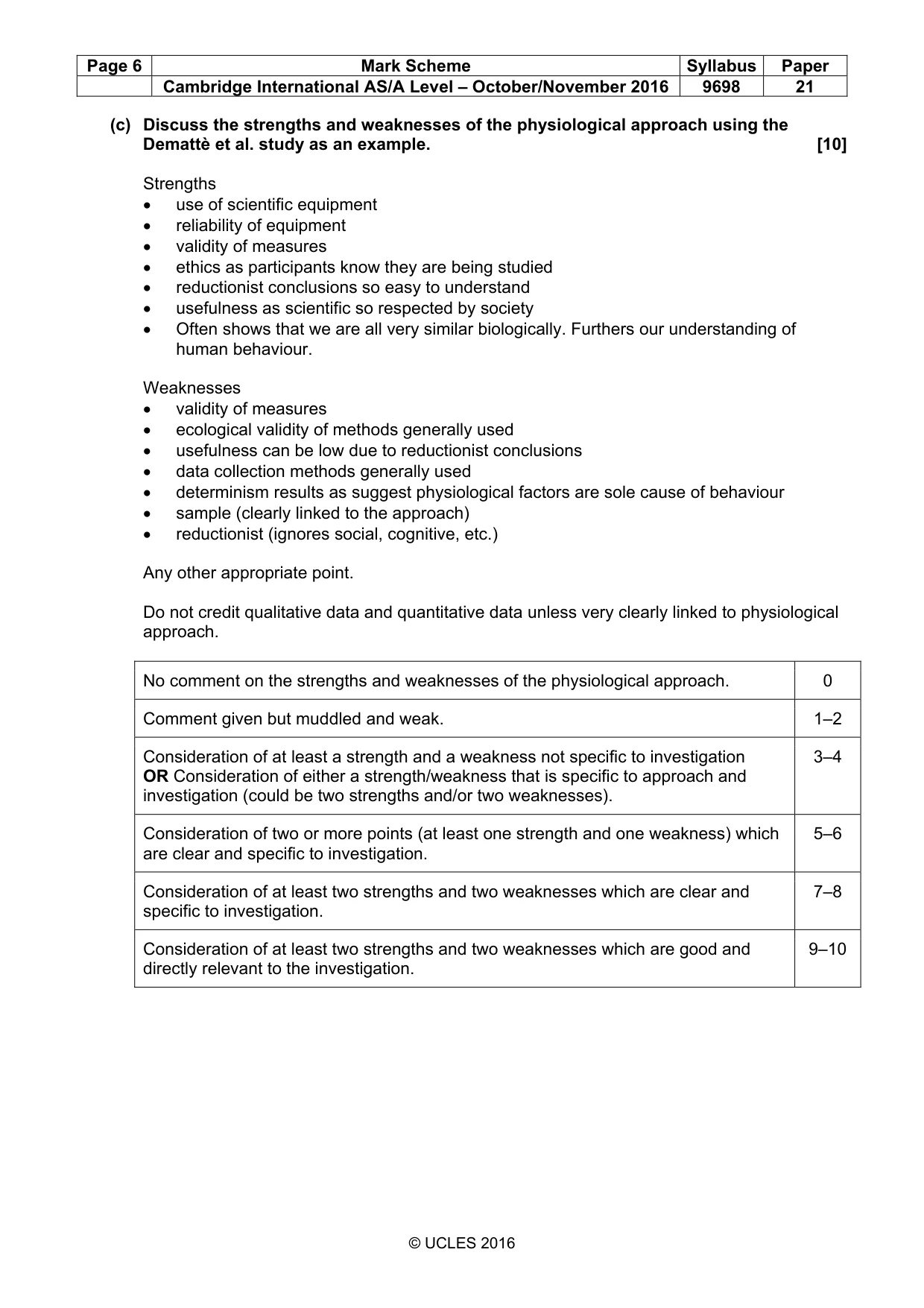
Page 6 Mark Scheme Syllabus Paper Cambridge International AS/A Level – October/November 2016 9698 21 © UCLES 2016 (c) Discuss the strengths and weaknesses of the physiological approach using the Demattè et al. study as an example. [10] Strengths • use of scientific equipment • reliability of equipment • validity of measures • ethics as participants know they are being studied • reductionist conclusions so easy to understand • usefulness as scientific so respected by society • Often shows that we are all very similar biologically. Furthers our understanding of human behaviour. Weaknesses • validity of measures • ecological validity of methods generally used • usefulness can be low due to reductionist conclusions • data collection methods generally used • determinism results as suggest physiological factors are sole cause of behaviour • sample (clearly linked to the approach) • reductionist (ignores social, cognitive, etc.) Any other appropriate point. Do not credit qualitative data and quantitative data unless very clearly linked to physiological approach. No comment on the strengths and weaknesses of the physiological approach. 0 Comment given but muddled and weak. 1–2 Consideration of at least a strength and a weakness not specific to investigation OR Consideration of either a strength/weakness that is specific to approach and investigation (could be two strengths and/or two weaknesses). 3–4 Consideration of two or more points (at least one strength and one weakness) which are clear and specific to investigation. 5–6 Consideration of at least two strengths and two weaknesses which are clear and specific to investigation. 7–8 Consideration of at least two strengths and two weaknesses which are good and directly relevant to the investigation. 9–10
Mark scheme, page 7
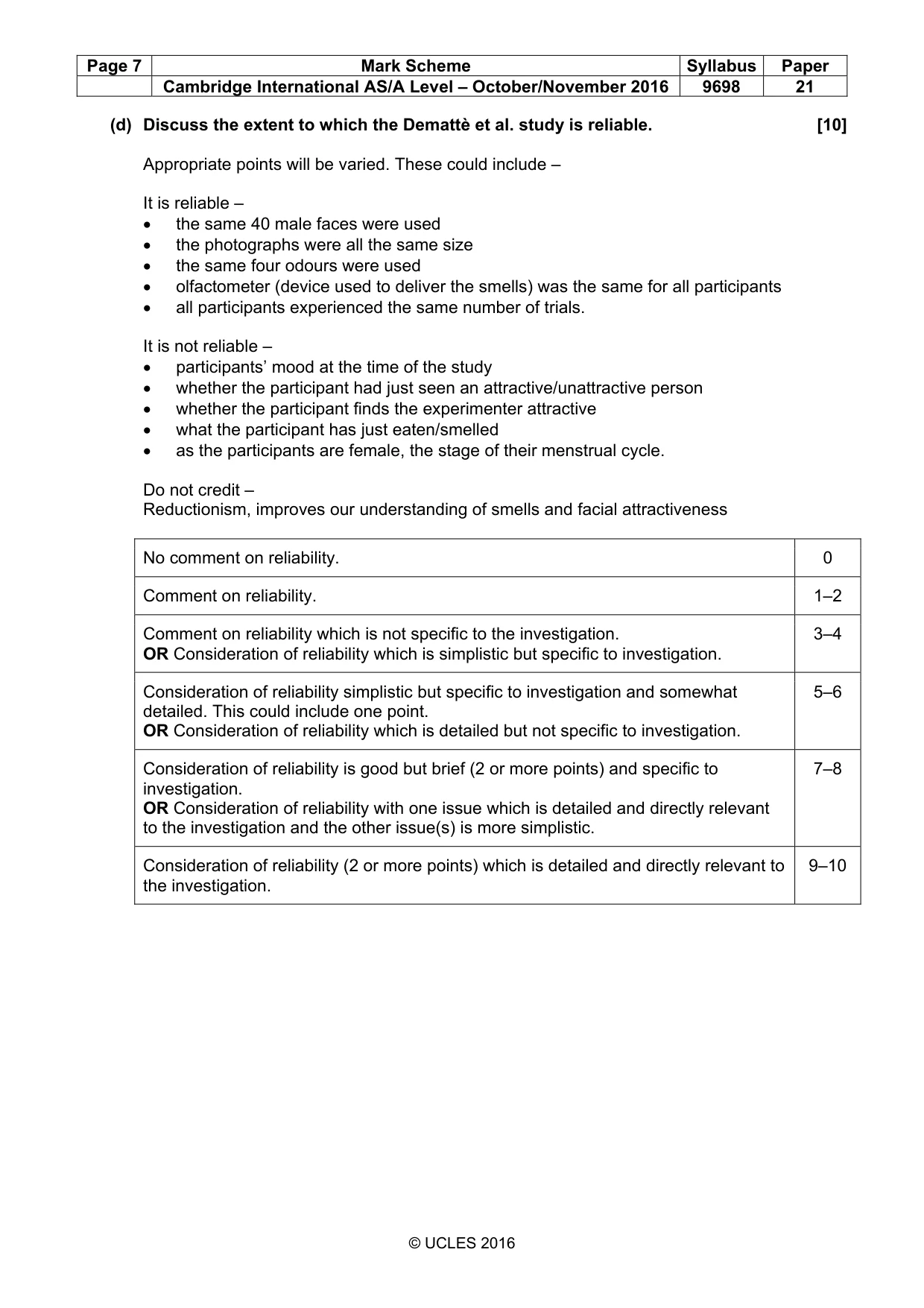
Page 7 Mark Scheme Syllabus Paper Cambridge International AS/A Level – October/November 2016 9698 21 © UCLES 2016 (d) Discuss the extent to which the Demattè et al. study is reliable. [10] Appropriate points will be varied. These could include – It is reliable – • the same 40 male faces were used • the photographs were all the same size • the same four odours were used • olfactometer (device used to deliver the smells) was the same for all participants • all participants experienced the same number of trials. It is not reliable – • participants’ mood at the time of the study • whether the participant had just seen an attractive/unattractive person • whether the participant finds the experimenter attractive • what the participant has just eaten/smelled • as the participants are female, the stage of their menstrual cycle. Do not credit – Reductionism, improves our understanding of smells and facial attractiveness No comment on reliability. 0 Comment on reliability. 1–2 Comment on reliability which is not specific to the investigation. OR Consideration of reliability which is simplistic but specific to investigation. 3–4 Consideration of reliability simplistic but specific to investigation and somewhat detailed. This could include one point. OR Consideration of reliability which is detailed but not specific to investigation. 5–6 Consideration of reliability is good but brief (2 or more points) and specific to investigation. OR Consideration of reliability with one issue which is detailed and directly relevant to the investigation and the other issue(s) is more simplistic. 7–8 Consideration of reliability (2 or more points) which is detailed and directly relevant to the investigation. 9–10
Mark scheme, page 8
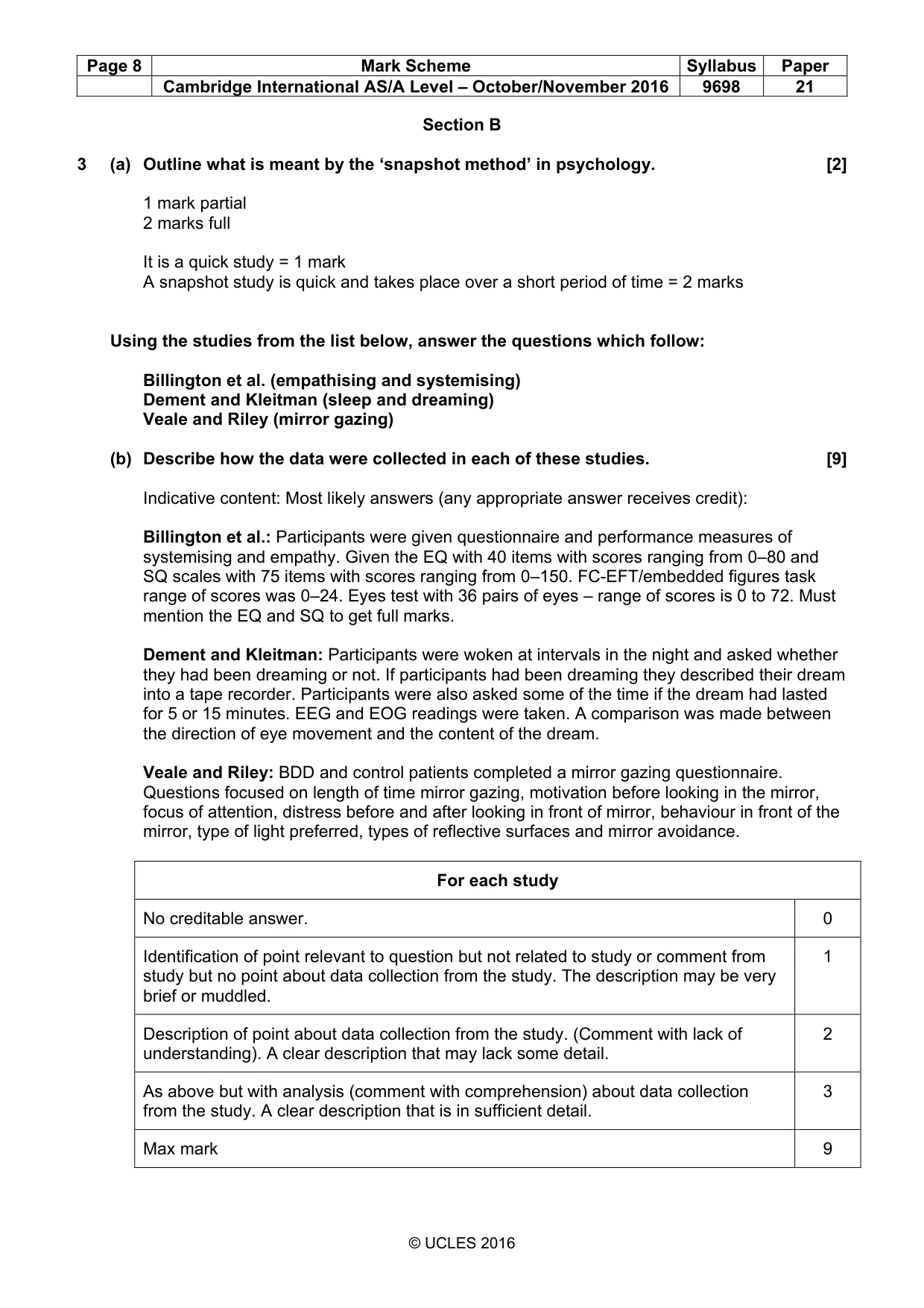
Page 8 Mark Scheme Syllabus Paper Cambridge International AS/A Level – October/November 2016 9698 21 © UCLES 2016 Section B 3 (a) Outline what is meant by the ‘snapshot method’ in psychology. [2] 1 mark partial 2 marks full It is a quick study = 1 mark A snapshot study is quick and takes place over a short period of time = 2 marks Using the studies from the list below, answer the questions which follow: Billington et al. (empathising and systemising) Dement and Kleitman (sleep and dreaming) Veale and Riley (mirror gazing) (b) Describe how the data were collected in each of these studies. [9] Indicative content: Most likely answers (any appropriate answer receives credit): Billington et al.: Participants were given questionnaire and performance measures of systemising and empathy. Given the EQ with 40 items with scores ranging from 0–80 and SQ scales with 75 items with scores ranging from 0–150. FC-EFT/embedded figures task range of scores was 0–24. Eyes test with 36 pairs of eyes – range of scores is 0 to 72. Must mention the EQ and SQ to get full marks. Dement and Kleitman: Participants were woken at intervals in the night and asked whether they had been dreaming or not. If participants had been dreaming they described their dream into a tape recorder. Participants were also asked some of the time if the dream had lasted for 5 or 15 minutes. EEG and EOG readings were taken. A comparison was made between the direction of eye movement and the content of the dream. Veale and Riley: BDD and control patients completed a mirror gazing questionnaire. Questions focused on length of time mirror gazing, motivation before looking in the mirror, focus of attention, distress before and after looking in front of mirror, behaviour in front of the mirror, type of light preferred, types of reflective surfaces and mirror avoidance. For each study No creditable answer. 0 Identification of point relevant to question but not related to study or comment from study but no point about data collection from the study. The description may be very brief or muddled. 1 Description of point about data collection from the study. (Comment with lack of understanding). A clear description that may lack some detail. 2 As above but with analysis (comment with comprehension) about data collection from the study. A clear description that is in sufficient detail. 3 Max mark 9
Mark scheme, page 9
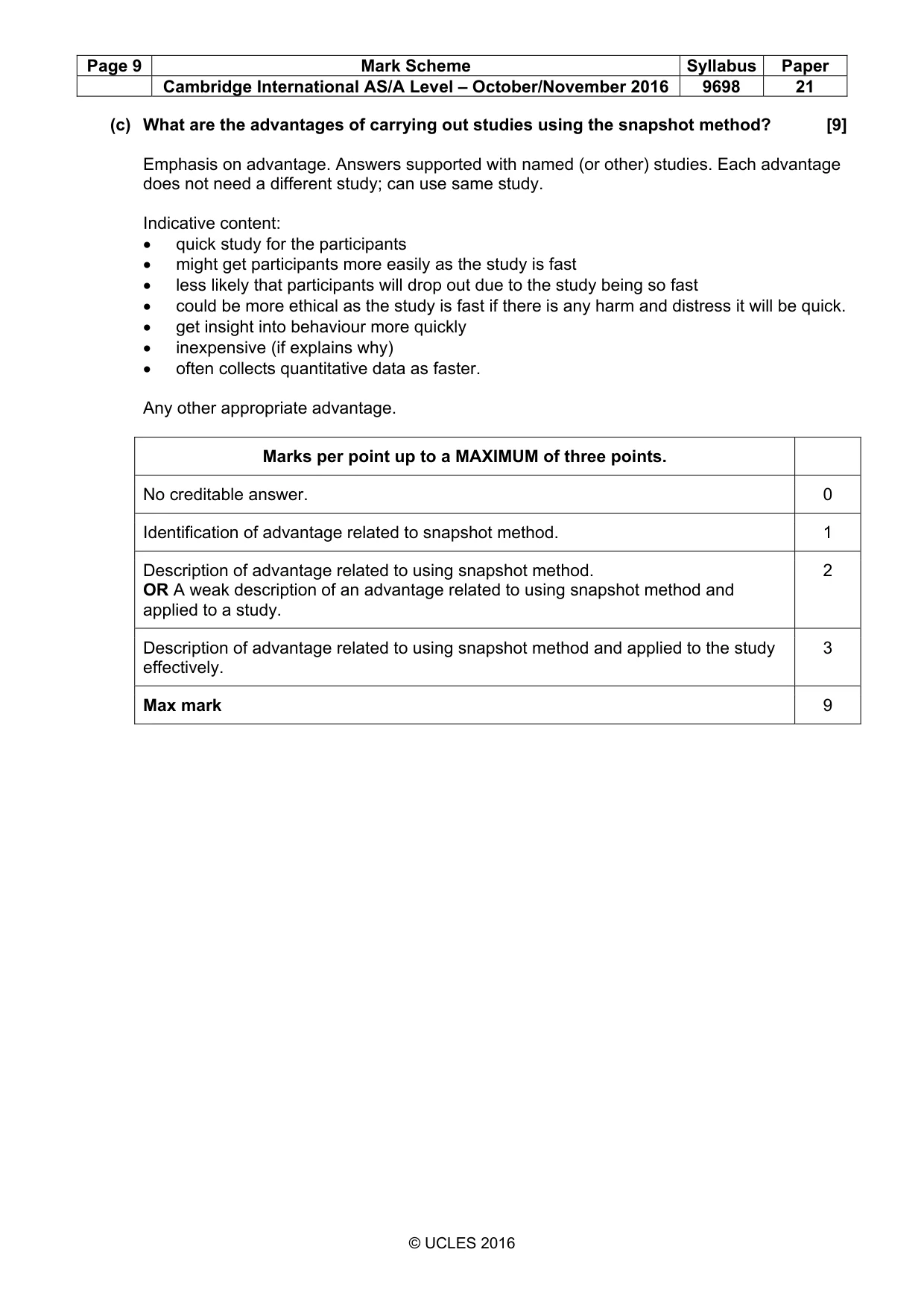
Page 9 Mark Scheme Syllabus Paper Cambridge International AS/A Level – October/November 2016 9698 21 © UCLES 2016 (c) What are the advantages of carrying out studies using the snapshot method? [9] Emphasis on advantage. Answers supported with named (or other) studies. Each advantage does not need a different study; can use same study. Indicative content: • quick study for the participants • might get participants more easily as the study is fast • less likely that participants will drop out due to the study being so fast • could be more ethical as the study is fast if there is any harm and distress it will be quick. • get insight into behaviour more quickly • inexpensive (if explains why) • often collects quantitative data as faster. Any other appropriate advantage. Marks per point up to a MAXIMUM of three points. No creditable answer. 0 Identification of advantage related to snapshot method. 1 Description of advantage related to using snapshot method. OR A weak description of an advantage related to using snapshot method and applied to a study. 2 Description of advantage related to using snapshot method and applied to the study effectively. 3 Max mark 9
Mark scheme, page 10
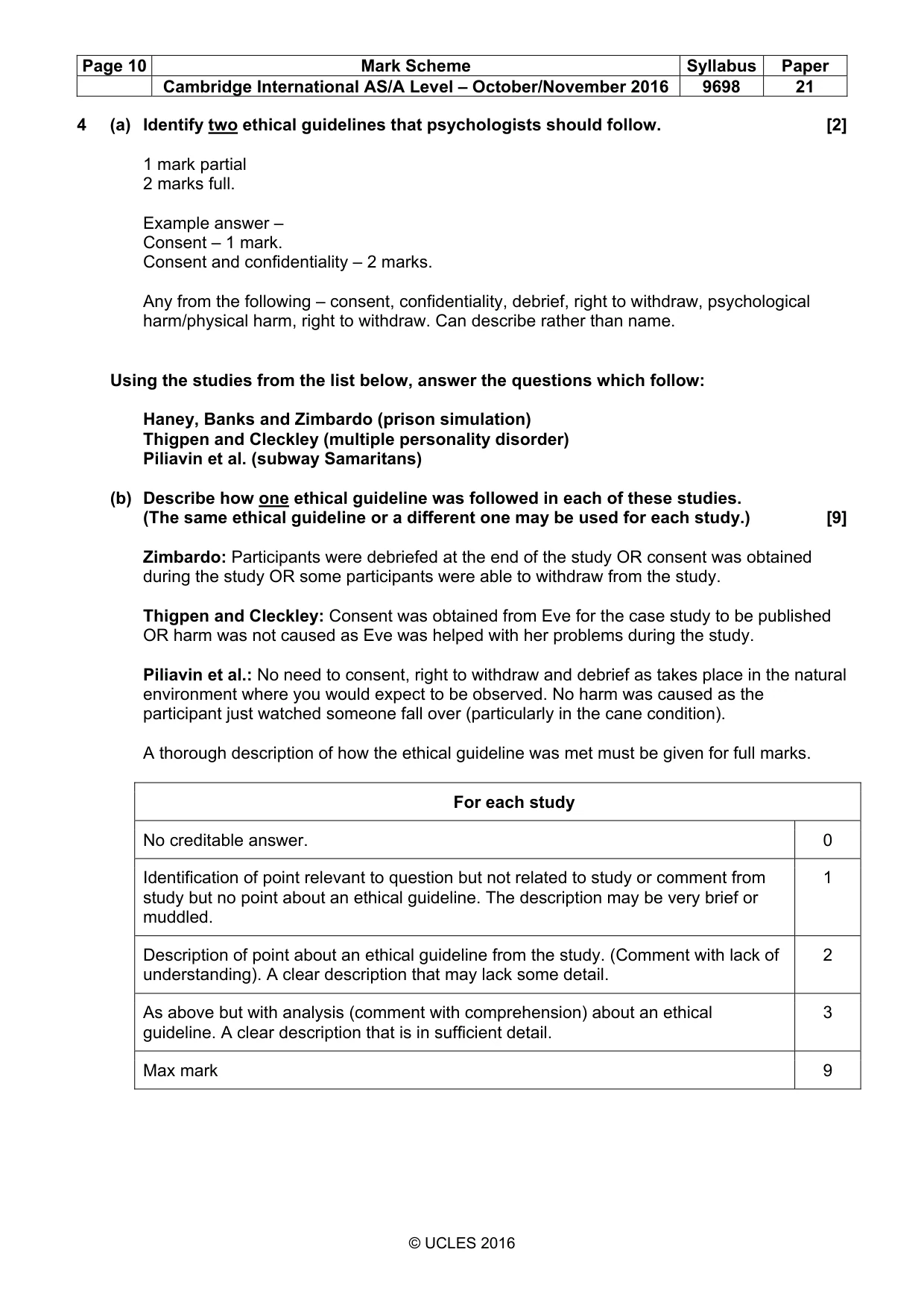
Page 10 Mark Scheme Syllabus Paper Cambridge International AS/A Level – October/November 2016 9698 21 © UCLES 2016 4 (a) Identify two ethical guidelines that psychologists should follow. [2] 1 mark partial 2 marks full. Example answer – Consent – 1 mark. Consent and confidentiality – 2 marks. Any from the following – consent, confidentiality, debrief, right to withdraw, psychological harm/physical harm, right to withdraw. Can describe rather than name. Using the studies from the list below, answer the questions which follow: Haney, Banks and Zimbardo (prison simulation) Thigpen and Cleckley (multiple personality disorder) Piliavin et al. (subway Samaritans) (b) Describe how one ethical guideline was followed in each of these studies. (The same ethical guideline or a different one may be used for each study.) [9] Zimbardo: Participants were debriefed at the end of the study OR consent was obtained during the study OR some participants were able to withdraw from the study. Thigpen and Cleckley: Consent was obtained from Eve for the case study to be published OR harm was not caused as Eve was helped with her problems during the study. Piliavin et al.: No need to consent, right to withdraw and debrief as takes place in the natural environment where you would expect to be observed. No harm was caused as the participant just watched someone fall over (particularly in the cane condition). A thorough description of how the ethical guideline was met must be given for full marks. For each study No creditable answer. 0 Identification of point relevant to question but not related to study or comment from study but no point about an ethical guideline. The description may be very brief or muddled. 1 Description of point about an ethical guideline from the study. (Comment with lack of understanding). A clear description that may lack some detail. 2 As above but with analysis (comment with comprehension) about an ethical guideline. A clear description that is in sufficient detail. 3 Max mark 9
Mark scheme, page 11
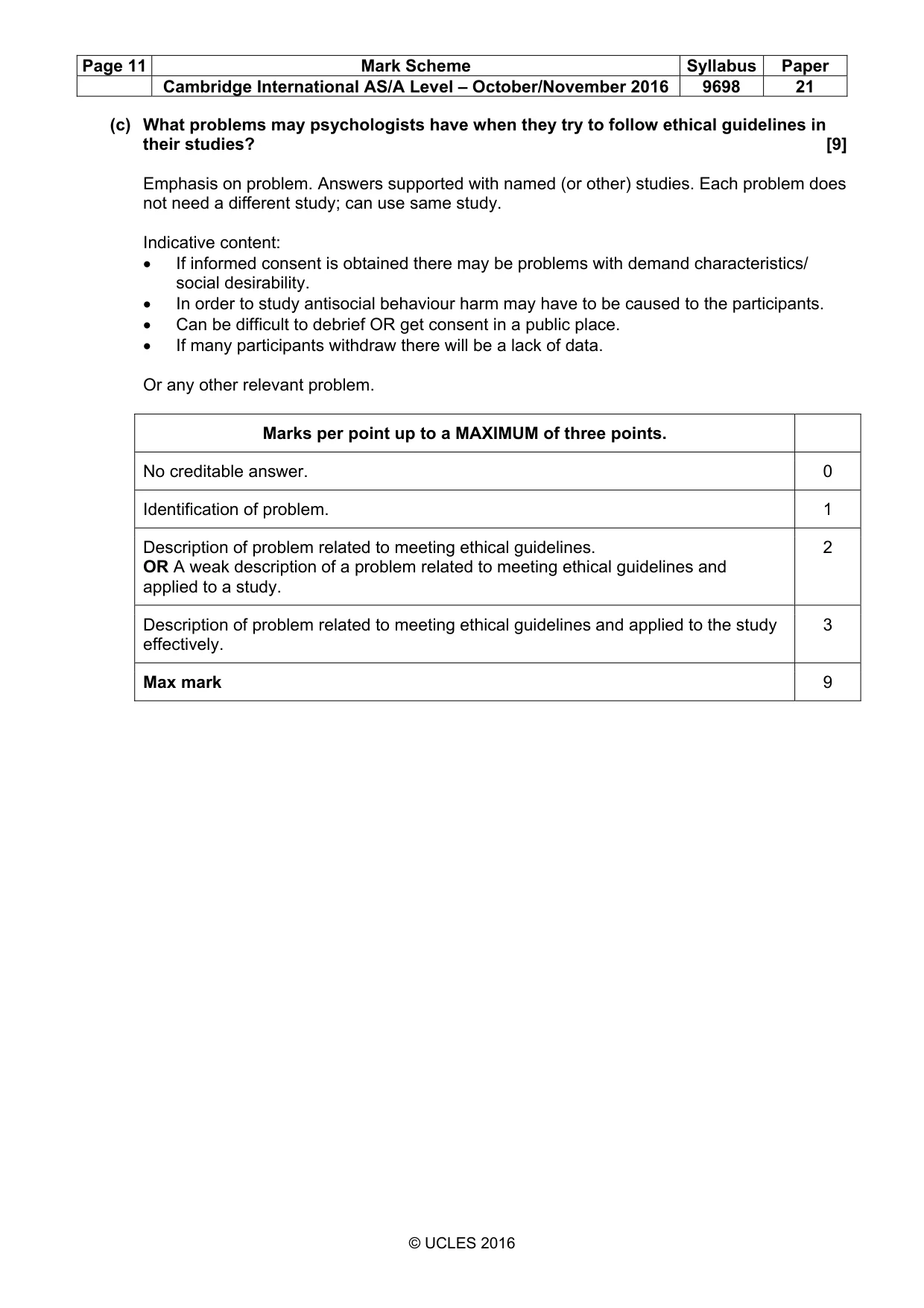
Page 11 Mark Scheme Syllabus Paper Cambridge International AS/A Level – October/November 2016 9698 21 © UCLES 2016 (c) What problems may psychologists have when they try to follow ethical guidelines in their studies? [9] Emphasis on problem. Answers supported with named (or other) studies. Each problem does not need a different study; can use same study. Indicative content: • If informed consent is obtained there may be problems with demand characteristics/ social desirability. • In order to study antisocial behaviour harm may have to be caused to the participants. • Can be difficult to debrief OR get consent in a public place. • If many participants withdraw there will be a lack of data. Or any other relevant problem. Marks per point up to a MAXIMUM of three points. No creditable answer. 0 Identification of problem. 1 Description of problem related to meeting ethical guidelines. OR A weak description of a problem related to meeting ethical guidelines and applied to a study. 2 Description of problem related to meeting ethical guidelines and applied to the study effectively. 3 Max mark 9
What you needed in this session
Cambridge’s own grade thresholds for 2016 Oct/Nov, Paper 2 · Variant 1. A higher threshold means an easier paper — the bar moves with how the cohort did.