Cambridge A Level Psychology 9698 — 2017 Oct/Nov Paper 2 · Variant 2
9698/22/O/N/17 · 4 questions · 70 marks · ≈79 min
The question paper and its mark scheme, free to read here and free to download. This is Cambridge’s own paper, exactly as it was sat.
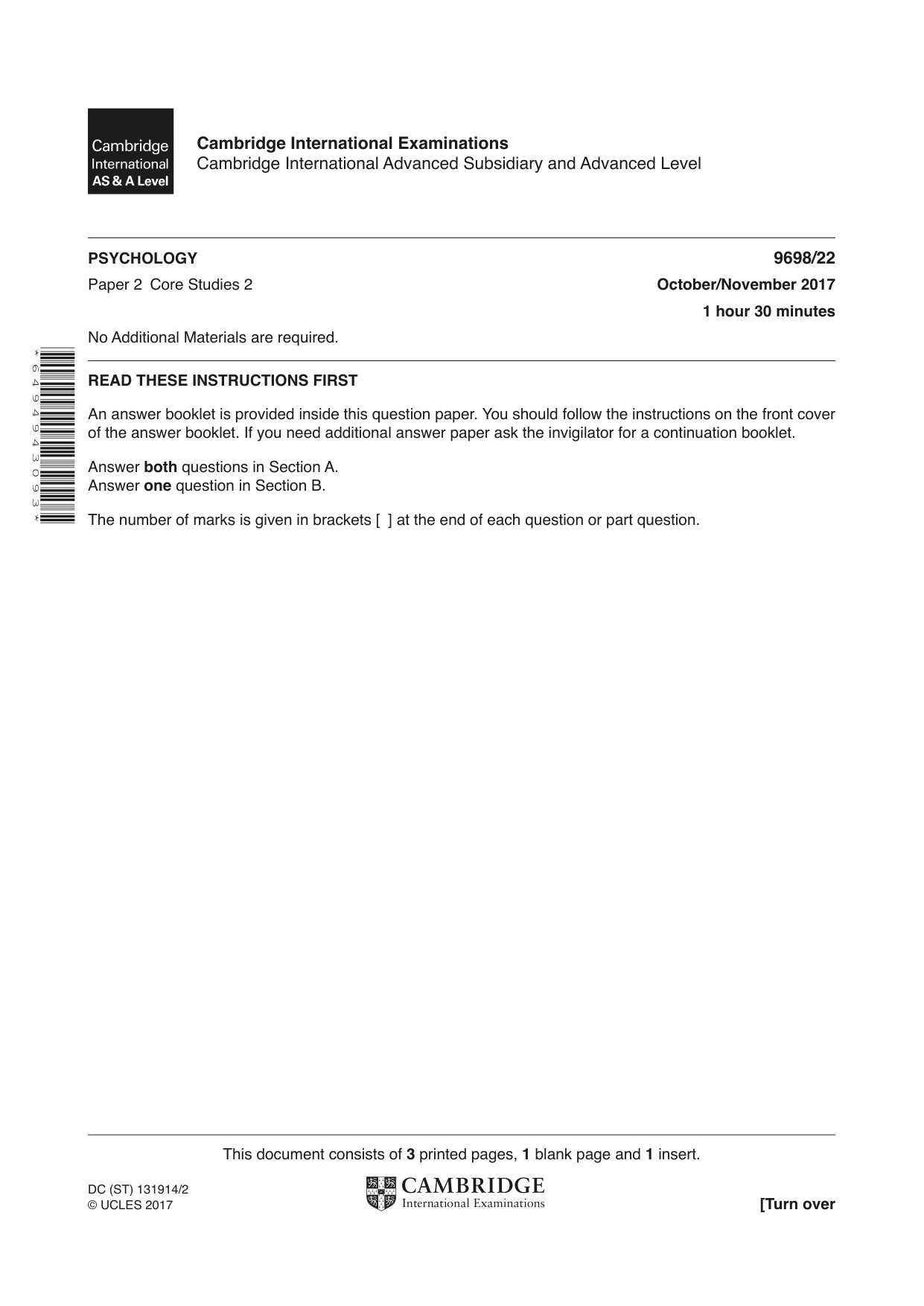
Question paper4 pages

Mark scheme12 pages
Answers below. Sit the paper first if you are practising.

Questions as text
Q1 · Veale and Riley used the snapshot method to investigate body dysmorphic disorder (BDD)
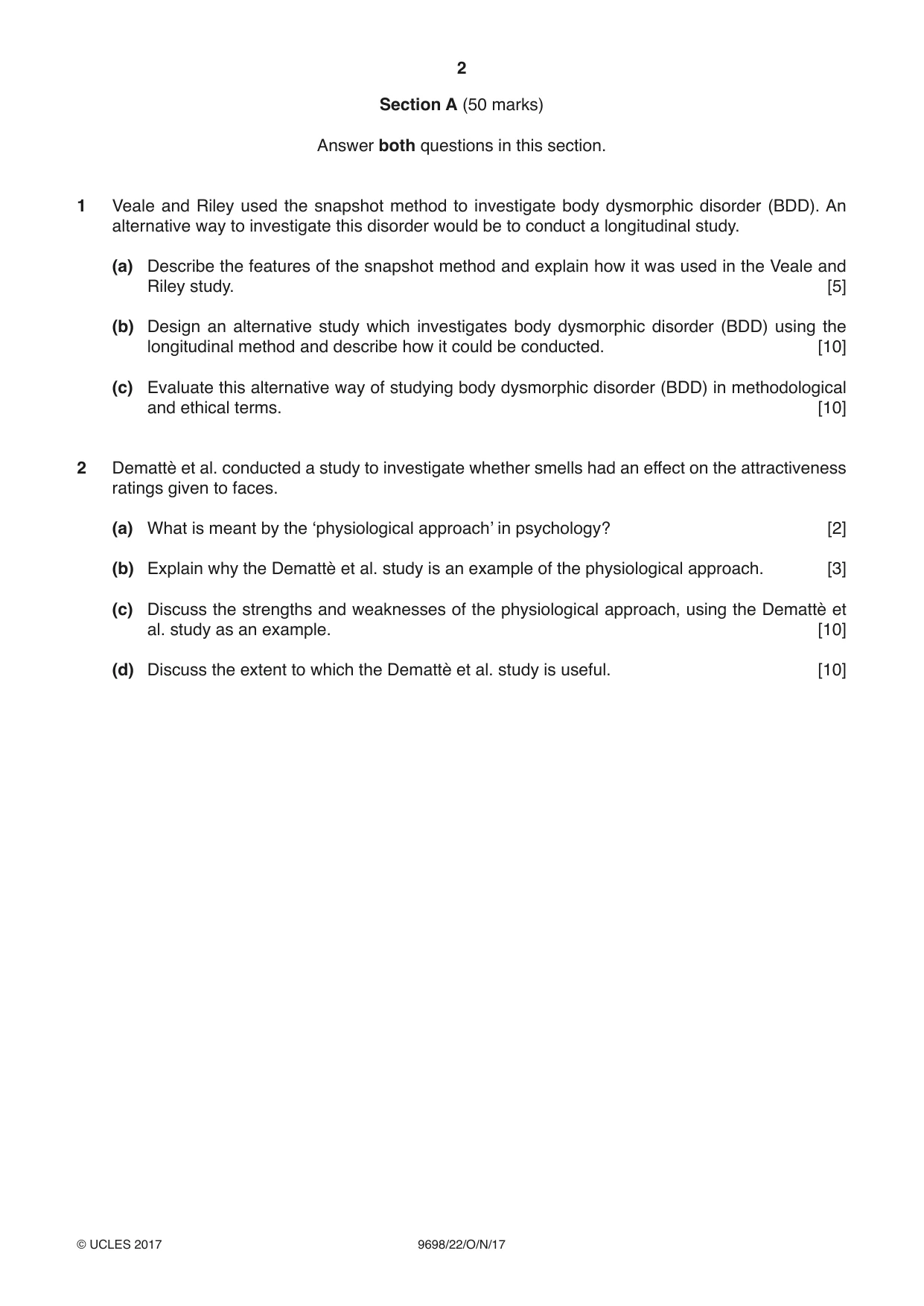
1 Veale and Riley used the snapshot method to investigate body dysmorphic disorder (BDD). An alternative way to investigate this disorder would be to conduct a longitudinal study. (a) Describe the features of the snapshot method and explain how it was used in the Veale and Riley study. [5] (b) Design an alternative study which investigates body dysmorphic disorder (BDD) using the longitudinal method and describe how it could be conducted. [10] (c) Evaluate this alternative way of studying body dysmorphic disorder (BDD) in methodological and ethical terms. [10]
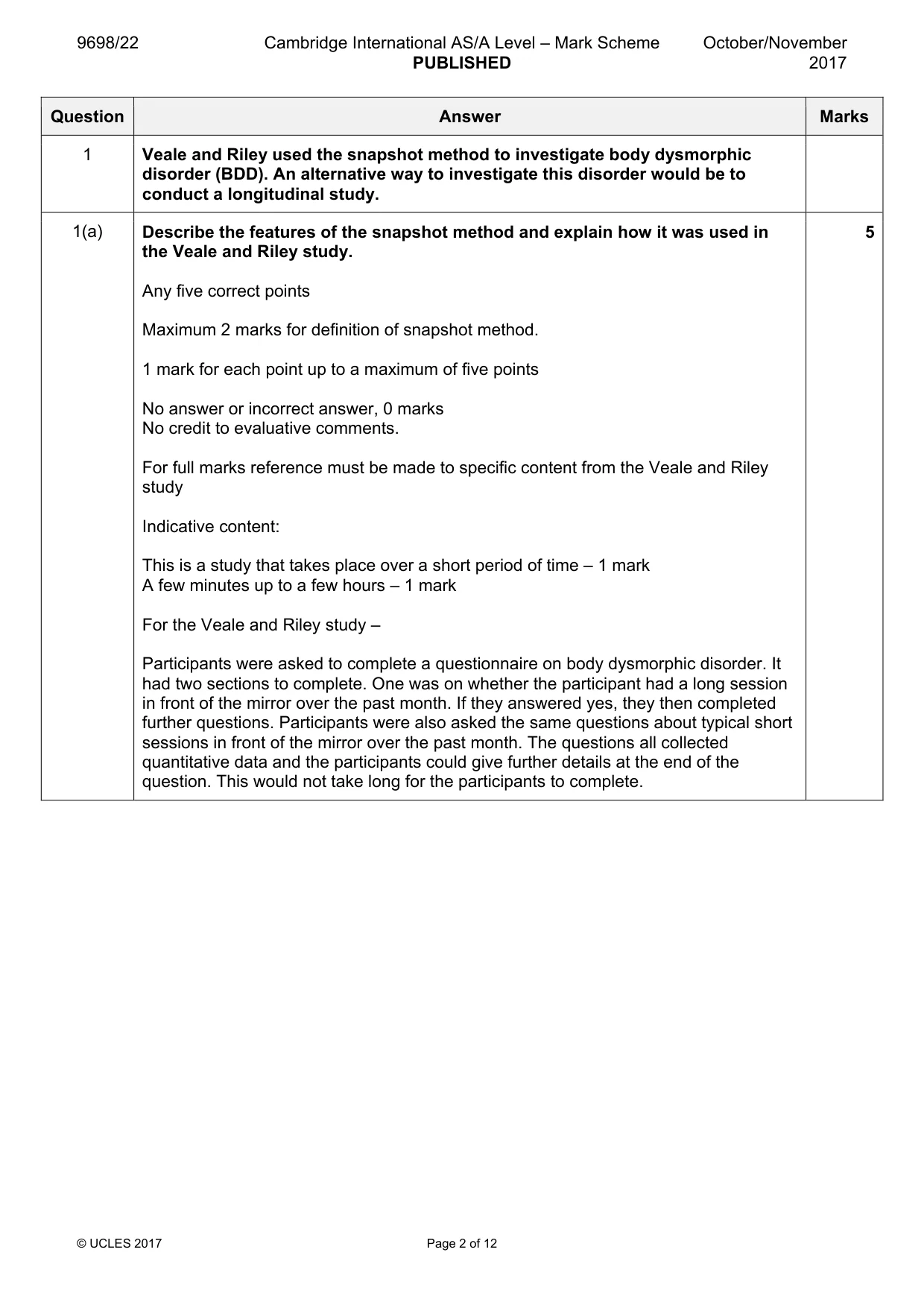
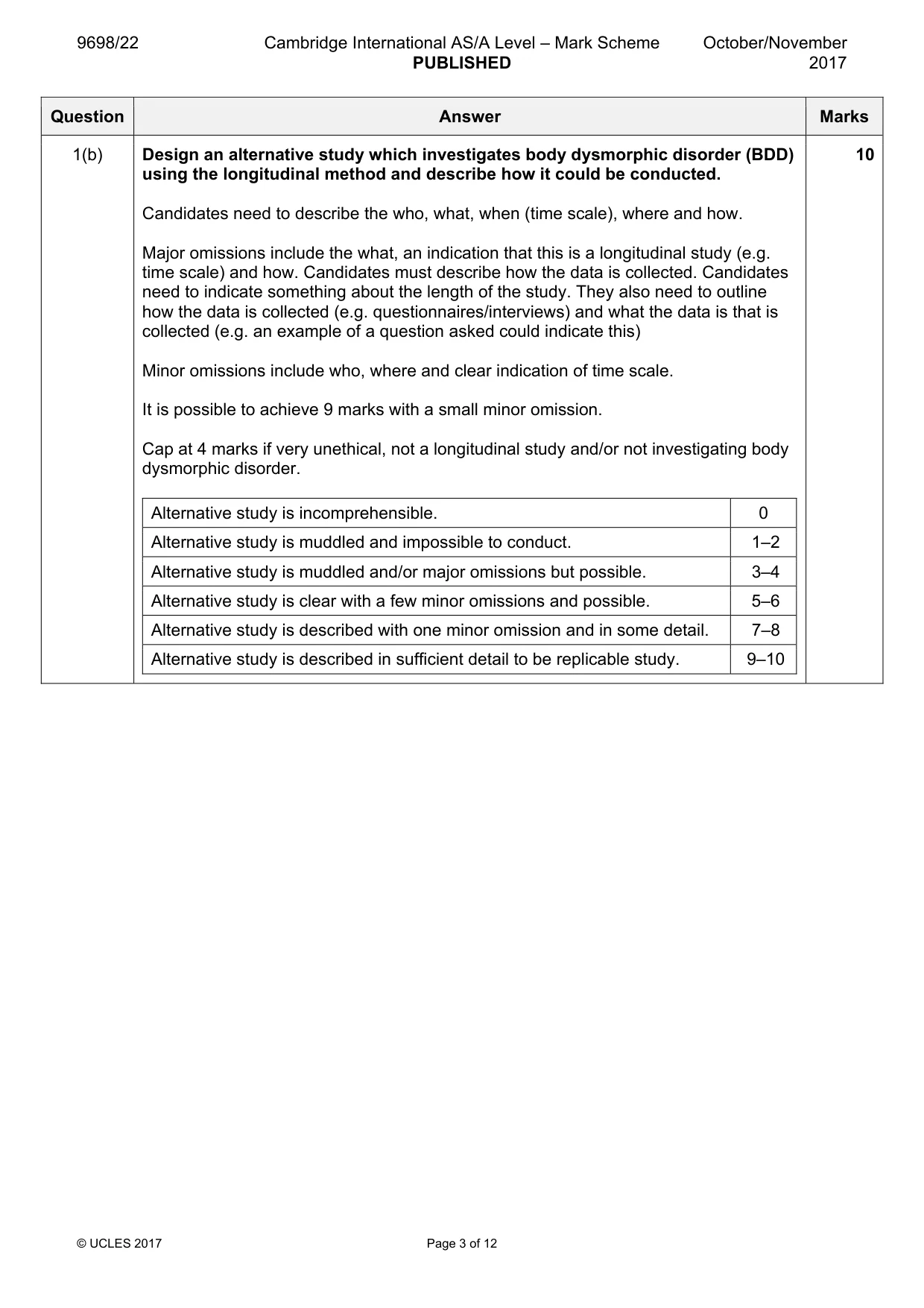
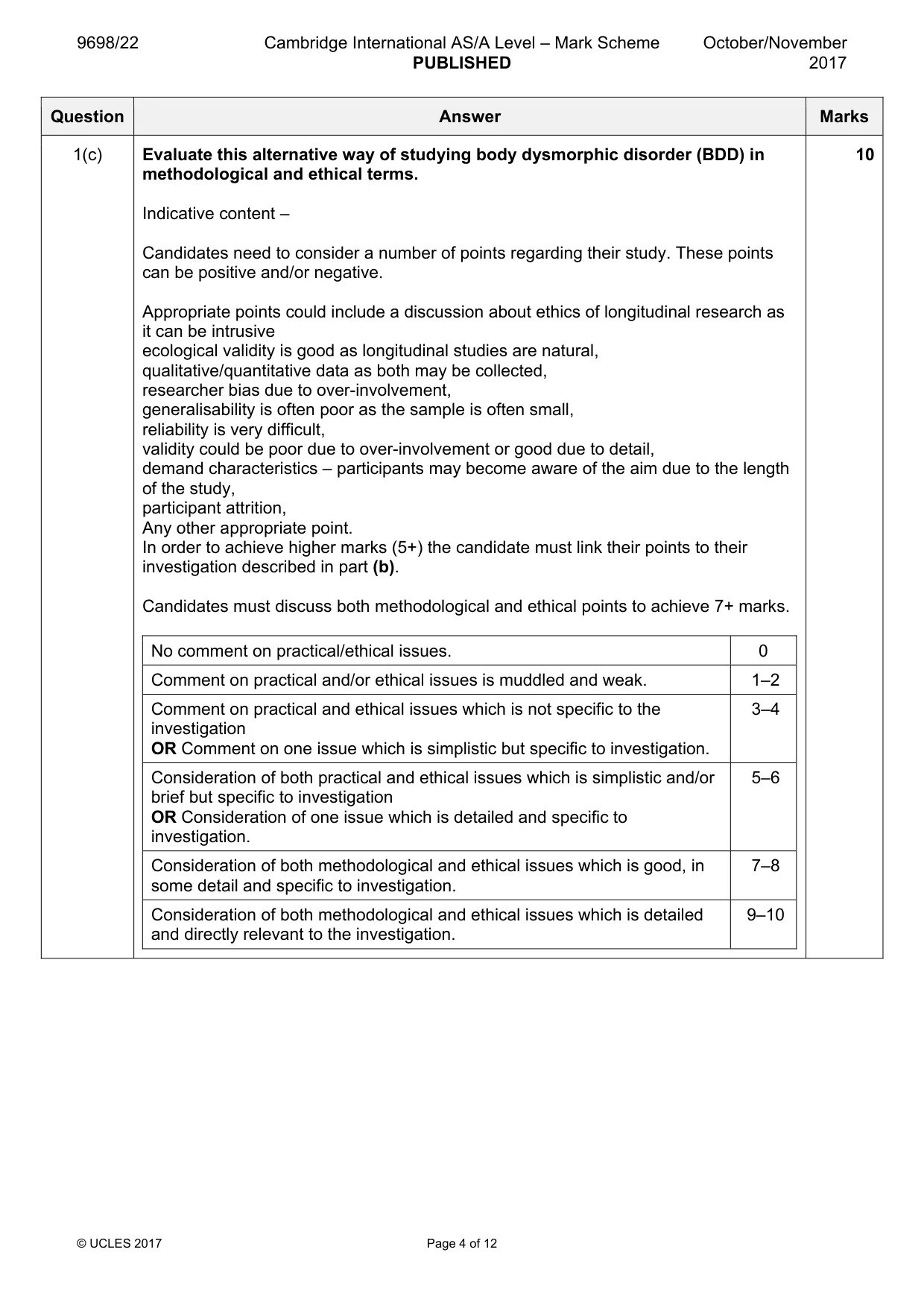
Mark scheme: Question Answer Marks 1 Veale and Riley used the snapshot method to investigate body dysmorphic disorder (BDD). An alternative way to investigate this disorder would be to conduct a longitudinal study. 1(a) Describe the features of the snapshot method and explain how it was used in 5 the Veale and Riley study. Any five correct points Maximum 2 marks for definition of snapshot method. 1 mark for each point up to a maximum of five points No answer or incorrect answer, 0 marks No credit to evaluative comments. For full marks reference must be made to specific content from the Veale and Riley study Indicative content: This is a study that takes place over a short period of time – 1 mark A few minutes up to a few hours – 1 mark For the Veale and Riley study – Participants were asked to complete a questionnaire on body dysmorphic disorder. It had two sections to complete. One was on whether the participant had a long session in front of the mirror over the past month. If they answered yes, they then completed further questions. Participants were also asked the same questions about typical short sessions in front of the mirror over the past month. The questions all collected quantitative data and the participants could give further details at the end of the question. This would not take long for the participants to complete. 1(b) Design an alternative study which investigates body dysmorphic disorder (BDD) 10 using the longitudinal method and describe how it could be conducted. Candidates need to describe the who, what, when (time scale), where and how. Major omissions include the what, an indication that this is a longitudinal study (e.g. time scale) and how. Candidates must describe how the data is collected. Candidates need to indicate something about the length of the study. They also need to outline how the data is collected (e.g. questionnaires/interviews) and what the data is that is collected (e.g. an example of a question asked could indicate this) Minor omissions include who, where and clear indication of time scale. It is possible to achieve 9 marks with a small minor omission. Cap at 4 marks if very unethical, not a longitudinal study and/or not investigating body dysmorphic disorder. Alternative study is incomprehensible. 0 Alternative study is muddled and impossible to conduct. 1–2 Alternative study is muddled and/or major omissions but possible. 3–4 Alternative study is clear with a few minor omissions and possible. 5–6 Alternative study is described with one minor omission and in some detail. 7–8 Alternative study is described in sufficient detail to be replicable study. 9–10 1(c) Evaluate this alternative way of studying body dysmorphic disorder (BDD) in 10 methodological and ethical terms. Indicative content – Candidates need to consider a number of points regarding their study. These points can be positive and/or negative. Appropriate points could include a discussion about ethics of longitudinal research as it can be intrusive ecological validity is good as longitudinal studies are natural, qualitative/quantitative data as both may be collected, researcher bias due to over-involvement, generalisability is often poor as the sample is often small, reliability is very difficult, validity could be poor due to over-involvement or good due to detail, demand characteristics – participants may become aware of the aim due to the length of the study, participant attrition, Any other appropriate point. In order to achieve higher marks (5+) the candidate must link their points to their investigation described in part (b). Candidates must discuss both methodological and ethical points to achieve 7+ marks. No comment on practical/ethical issues. 0 Comment on practical and/or ethical issues is muddled and weak. 1–2 Comment on practical and ethical issues which is not specific to the 3–4 investigation OR Comment on one issue which is simplistic but specific to investigation. Consideration of both practical and ethical issues which is simplistic and/or 5–6 brief but specific to investigation OR Consideration of one issue which is detailed and specific to investigation. Consideration of both methodological and ethical issues which is good, in 7–8 some detail and specific to investigation. Consideration of both methodological and ethical issues which is detailed 9–10 and directly relevant to the investigation.
Question 2
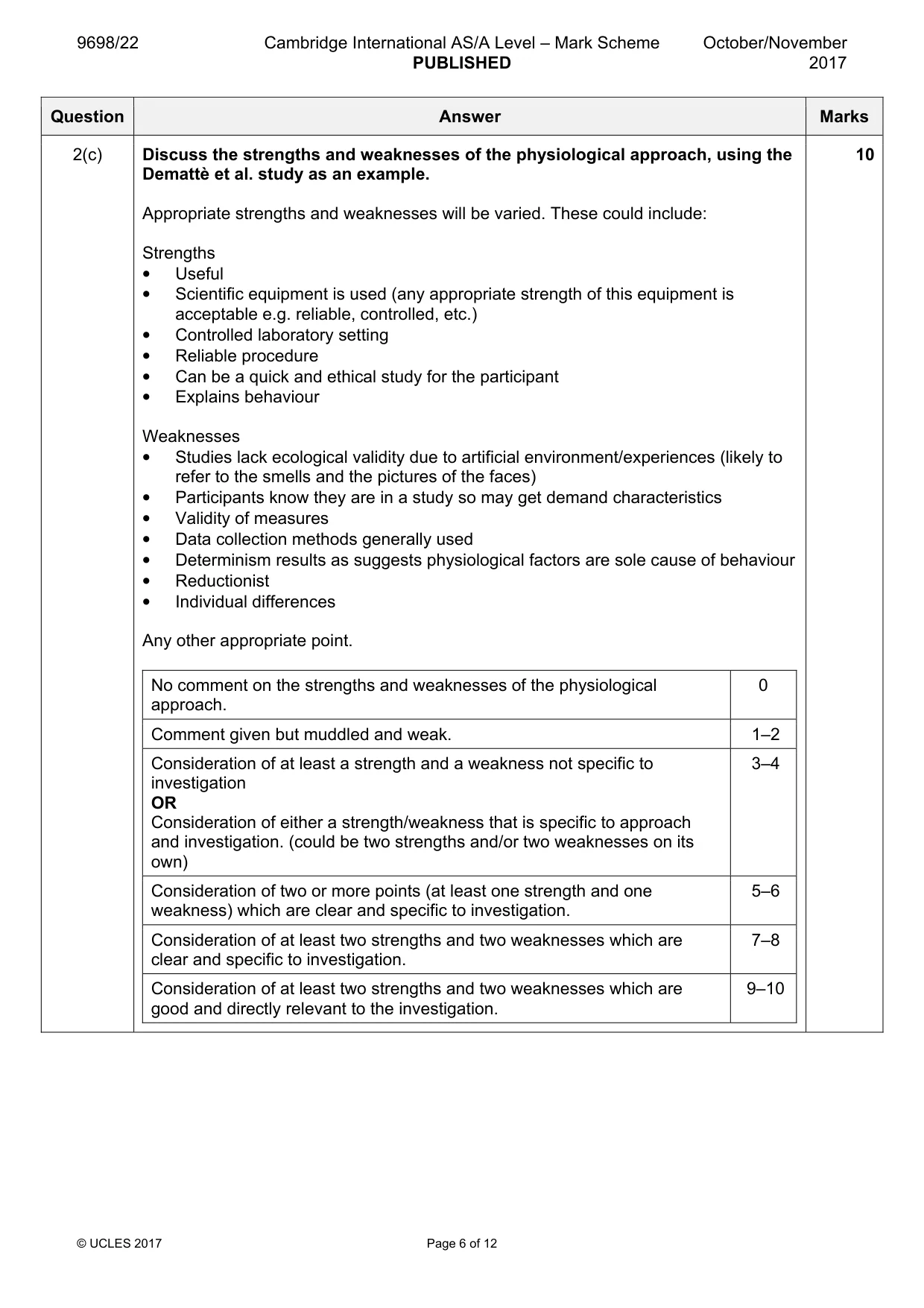
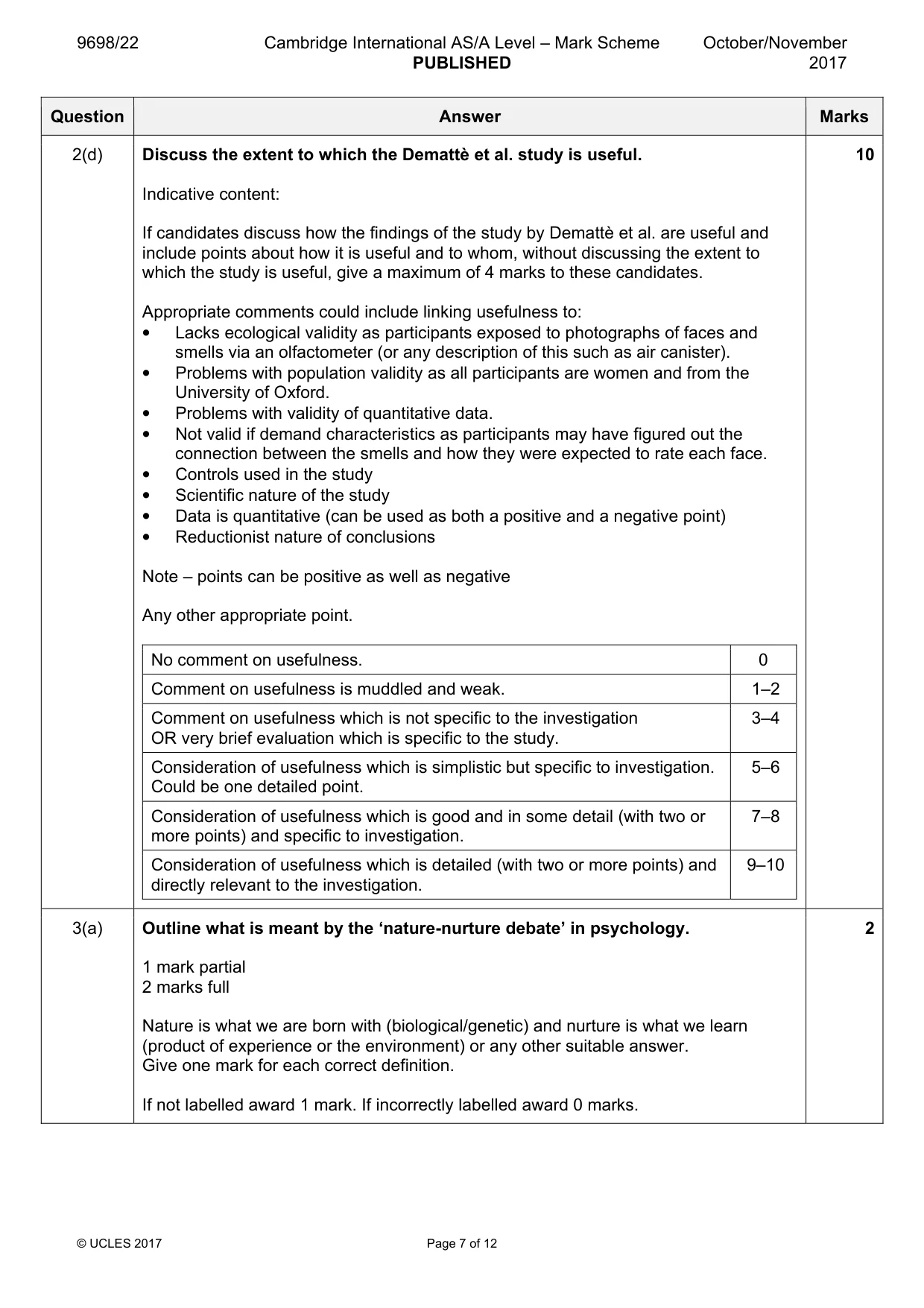
2 Demattè et al. conducted a study to investigate whether smells had an effect on the attractiveness ratings given to faces. (a) What is meant by the ‘physiological approach’ in psychology? [2] (b) Explain why the Demattè et al. study is an example of the physiological approach. [3] (c) Discuss the strengths and weaknesses of the physiological approach, using the Demattè et al. study as an example. [10] (d) Discuss the extent to which the Demattè et al. study is useful. [10]
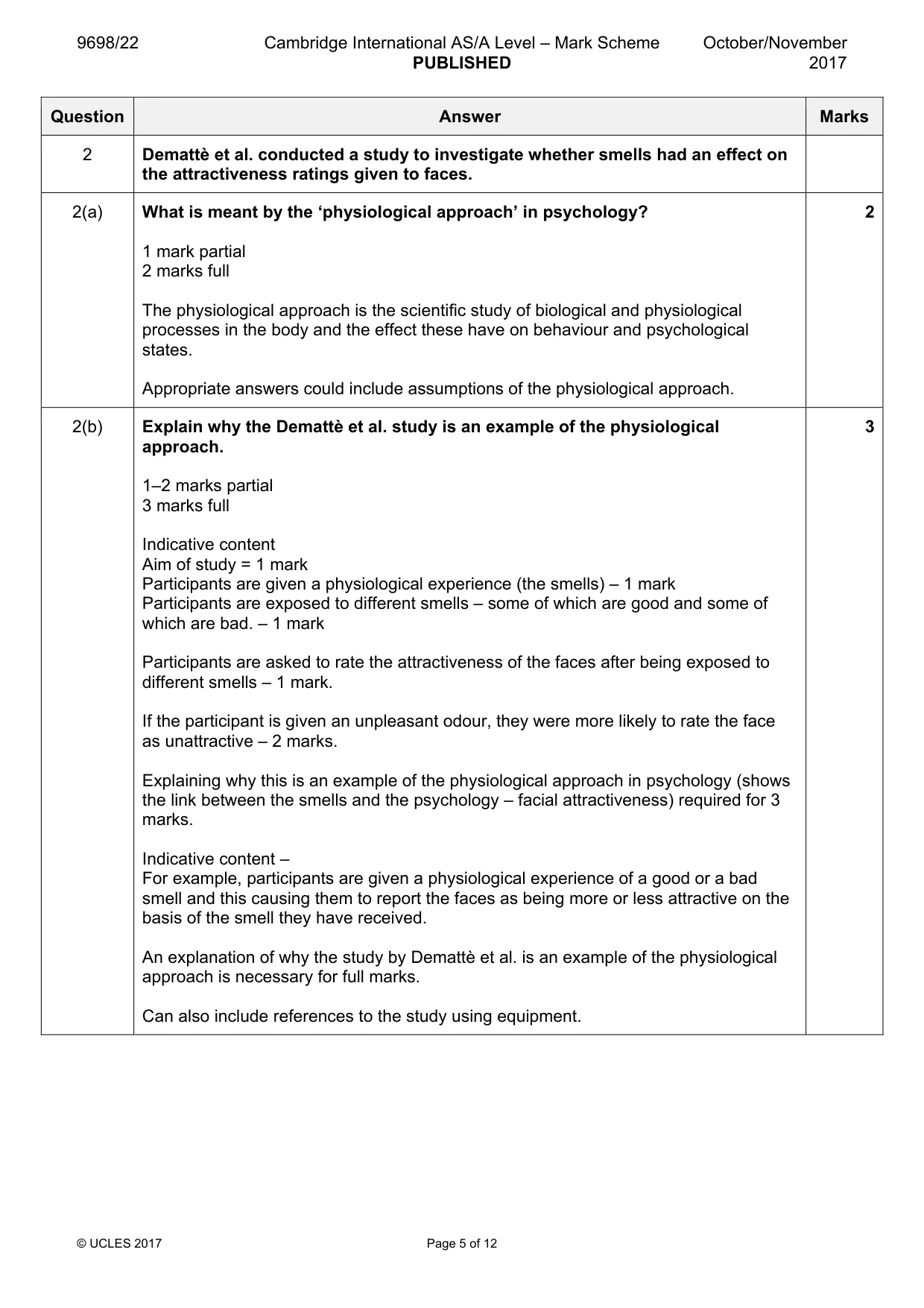
Mark scheme: 2(a) What is meant by the ‘physiological approach’ in psychology? 2 1 mark partial 2 marks full The physiological approach is the scientific study of biological and physiological processes in the body and the effect these have on behaviour and psychological states. Appropriate answers could include assumptions of the physiological approach. 2(b) Explain why the Demattè et al. study is an example of the physiological 3 approach. 1–2 marks partial 3 marks full Indicative content Aim of study = 1 mark Participants are given a physiological experience (the smells) – 1 mark Participants are exposed to different smells – some of which are good and some of which are bad. – 1 mark Participants are asked to rate the attractiveness of the faces after being exposed to different smells – 1 mark. If the participant is given an unpleasant odour, they were more likely to rate the face as unattractive – 2 marks. Explaining why this is an example of the physiological approach in psychology (shows the link between the smells and the psychology – facial attractiveness) required for 3 marks. Indicative content – For example, participants are given a physiological experience of a good or a bad smell and this causing them to report the faces as being more or less attractive on the basis of the smell they have received. An explanation of why the study by Demattè et al. is an example of the physiological approach is necessary for full marks. Can also include references to the study using equipment. 2(c) Discuss the strengths and weaknesses of the physiological approach, using the 10 Demattè et al. study as an example. Appropriate strengths and weaknesses will be varied. These could include: Strengths • Useful • Scientific equipment is used (any appropriate strength of this equipment is acceptable e.g. reliable, controlled, etc.) • Controlled laboratory setting • Reliable procedure • Can be a quick and ethical study for the participant • Explains behaviour Weaknesses • Studies lack ecological validity due to artificial environment/experiences (likely to refer to the smells and the pictures of the faces) • Participants know they are in a study so may get demand characteristics • Validity of measures • Data collection methods generally used • Determinism results as suggests physiological factors are sole cause of behaviour • Reductionist • Individual differences Any other appropriate point. No comment on the strengths and weaknesses of the physiological 0 approach. Comment given but muddled and weak. 1–2 Consideration of at least a strength and a weakness not specific to 3–4 investigation OR Consideration of either a strength/weakness that is specific to approach and investigation. (could be two strengths and/or two weaknesses on its own) Consideration of two or more points (at least one strength and one 5–6 weakness) which are clear and specific to investigation. Consideration of at least two strengths and two weaknesses which are 7–8 clear and specific to investigation. Consideration of at least two strengths and two weaknesses which are 9–10 good and directly relevant to the investigation. 2(d) Discuss the extent to which the Demattè et al. study is useful. 10 Indicative content: If candidates discuss how the findings of the study by Demattè et al. are useful and include points about how it is useful and to whom, without discussing the extent to which the study is useful, give a maximum of 4 marks to these candidates. Appropriate comments could include linking usefulness to: • Lacks ecological validity as participants exposed to photographs of faces and smells via an olfactometer (or any description of this such as air canister). • Problems with population validity as all participants are women and from the University of Oxford. • Problems with validity of quantitative data. • Not valid if demand characteristics as participants may have figured out the connection between the smells and how they were expected to rate each face. • Controls used in the study • Scientific nature of the study • Data is quantitative (can be used as both a positive and a negative point) • Reductionist nature of conclusions Note – points can be positive as well as negative Any other appropriate point. No comment on usefulness. 0 Comment on usefulness is muddled and weak. 1–2 Comment on usefulness which is not specific to the investigation 3–4 OR very brief evaluation which is specific to the study. Consideration of usefulness which is simplistic but specific to investigation. 5–6 Could be one detailed point. Consideration of usefulness which is good and in some detail (with two or 7–8 more points) and specific to investigation. Consideration of usefulness which is detailed (with two or more points) and 9–10 directly relevant to the investigation.
Q3 · Outline what is meant by the ‘nature-nurture debate’ in psychology
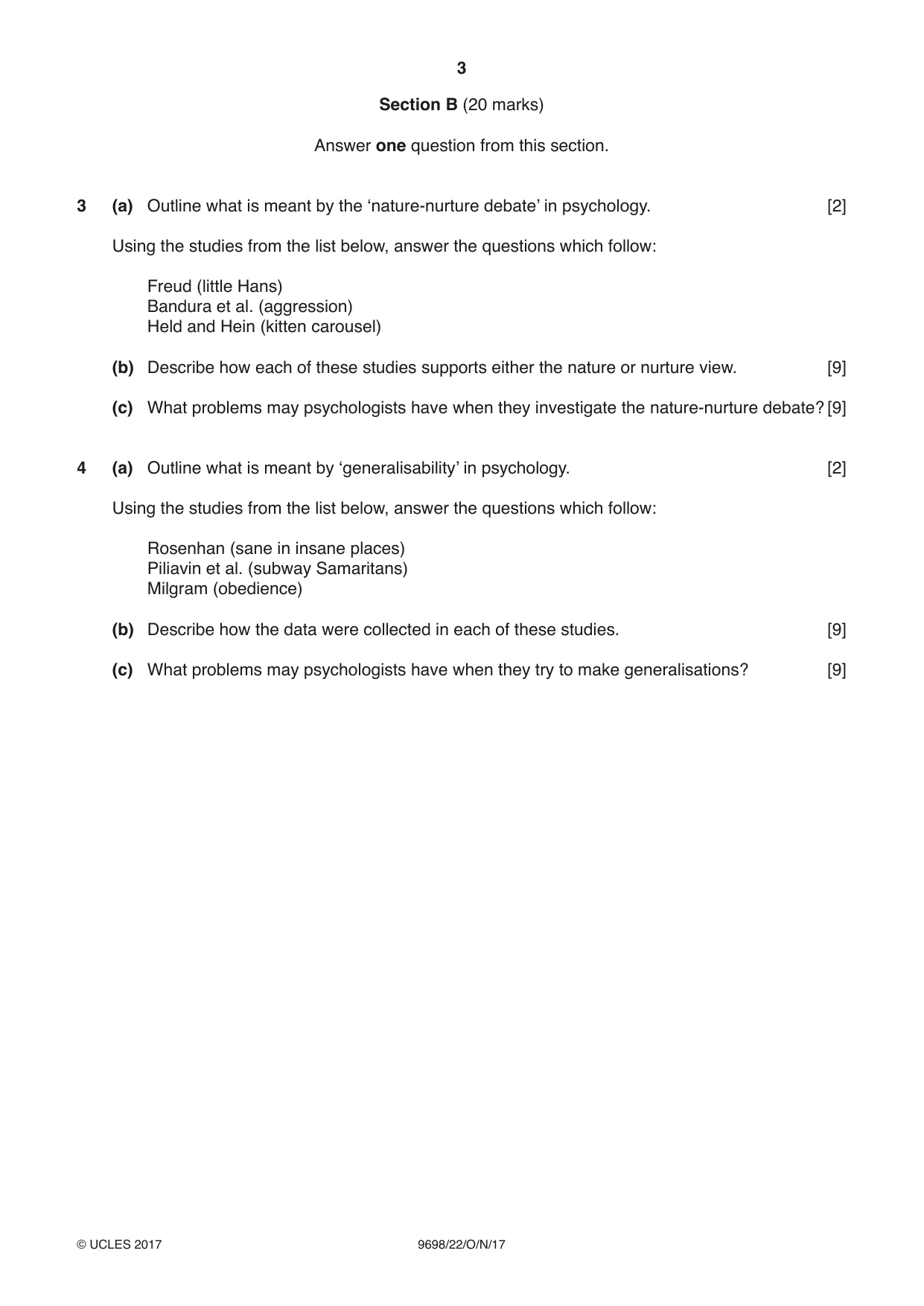
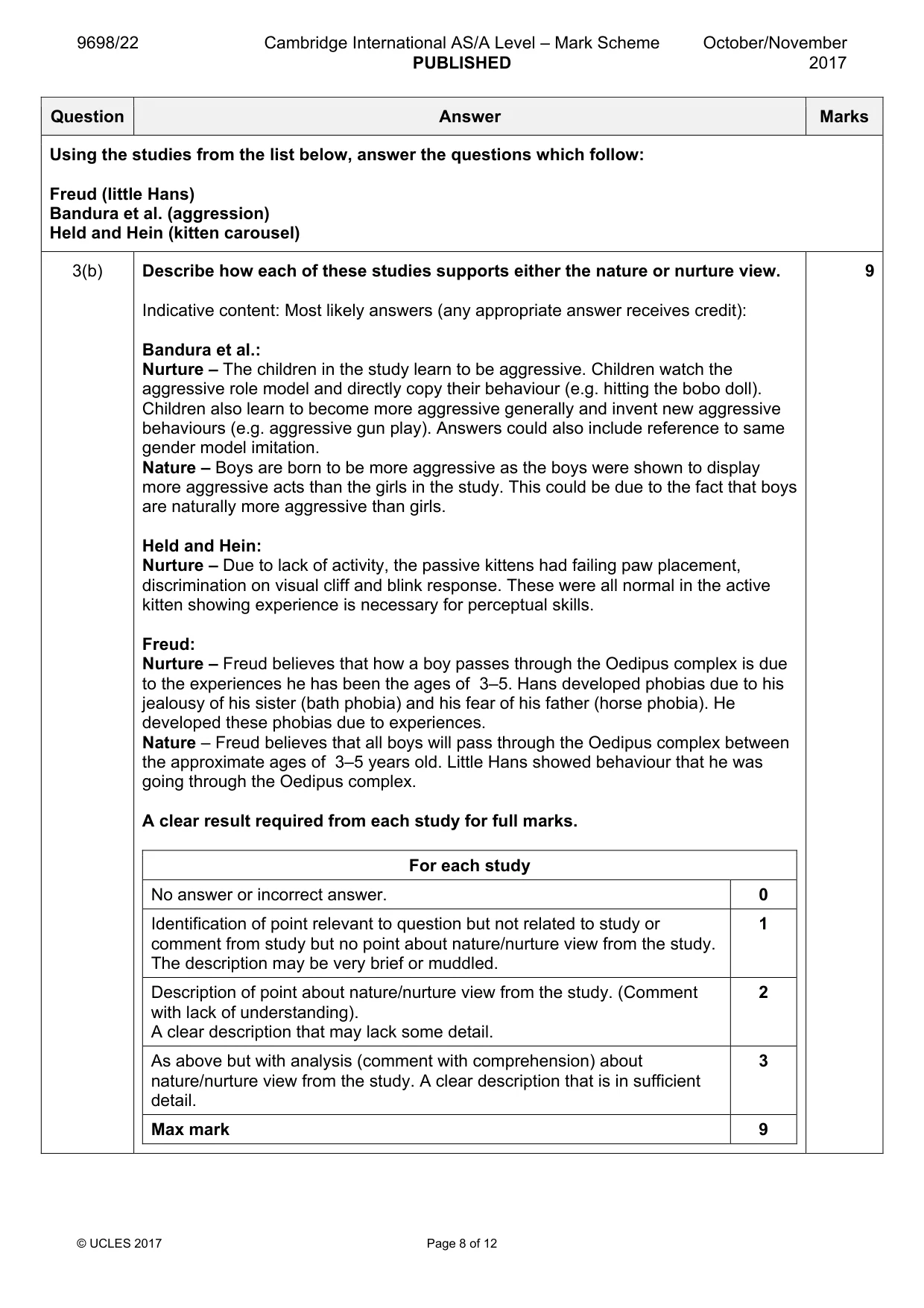
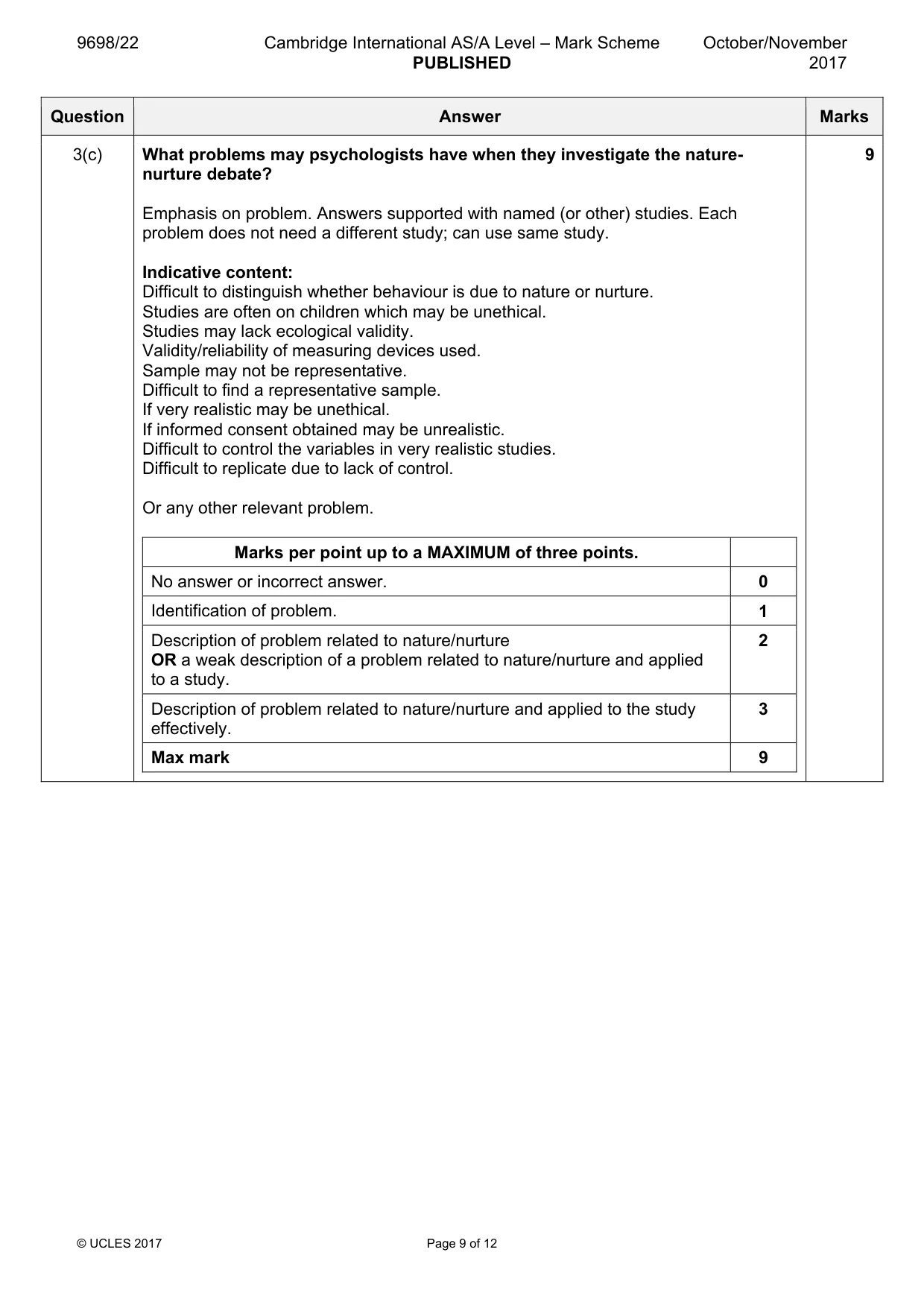
3 (a) Outline what is meant by the ‘nature-nurture debate’ in psychology. [2] Using the studies from the list below, answer the questions which follow: Freud (little Hans) Bandura et al. (aggression) Held and Hein (kitten carousel) (b) Describe how each of these studies supports either the nature or nurture view. [9] (c) What problems may psychologists have when they investigate the nature-nurture debate? [9]
Mark scheme: 3(a) Outline what is meant by the ‘nature-nurture debate’ in psychology. 2 1 mark partial 2 marks full Nature is what we are born with (biological/genetic) and nurture is what we learn (product of experience or the environment) or any other suitable answer. Give one mark for each correct definition. If not labelled award 1 mark. If incorrectly labelled award 0 marks. Using the studies from the list below, answer the questions which follow: Freud (little Hans) Bandura et al. (aggression) Held and Hein (kitten carousel) 3(b) Describe how each of these studies supports either the nature or nurture view. 9 Indicative content: Most likely answers (any appropriate answer receives credit): Bandura et al.: Nurture – The children in the study learn to be aggressive. Children watch the aggressive role model and directly copy their behaviour (e.g. hitting the bobo doll). Children also learn to become more aggressive generally and invent new aggressive behaviours (e.g. aggressive gun play). Answers could also include reference to same gender model imitation. Nature – Boys are born to be more aggressive as the boys were shown to display more aggressive acts than the girls in the study. This could be due to the fact that boys are naturally more aggressive than girls. Held and Hein: Nurture – Due to lack of activity, the passive kittens had failing paw placement, discrimination on visual cliff and blink response. These were all normal in the active kitten showing experience is necessary for perceptual skills. Freud: Nurture – Freud believes that how a boy passes through the Oedipus complex is due to the experiences he has been the ages of 3–5. Hans developed phobias due to his jealousy of his sister (bath phobia) and his fear of his father (horse phobia). He developed these phobias due to experiences. Nature – Freud believes that all boys will pass through the Oedipus complex between the approximate ages of 3–5 years old. Little Hans showed behaviour that he was going through the Oedipus complex. A clear result required from each study for full marks. For each study No answer or incorrect answer. 0 Identification of point relevant to question but not related to study or 1 comment from study but no point about nature/nurture view from the study. The description may be very brief or muddled. Description of point about nature/nurture view from the study. (Comment 2 with lack of understanding). A clear description that may lack some detail. As above but with analysis (comment with comprehension) about 3 nature/nurture view from the study. A clear description that is in sufficient detail. Max mark 9 3(c) What problems may psychologists have when they investigate the nature- 9 nurture debate? Emphasis on problem. Answers supported with named (or other) studies. Each problem does not need a different study; can use same study. Indicative content: Difficult to distinguish whether behaviour is due to nature or nurture. Studies are often on children which may be unethical. Studies may lack ecological validity. Validity/reliability of measuring devices used. Sample may not be representative. Difficult to find a representative sample. If very realistic may be unethical. If informed consent obtained may be unrealistic. Difficult to control the variables in very realistic studies. Difficult to replicate due to lack of control. Or any other relevant problem. Marks per point up to a MAXIMUM of three points. No answer or incorrect answer. 0 Identification of problem. 1 Description of problem related to nature/nurture 2 OR a weak description of a problem related to nature/nurture and applied to a study. Description of problem related to nature/nurture and applied to the study 3 effectively. Max mark 9
Q4 · Outline what is meant by ‘generalisability’ in psychology
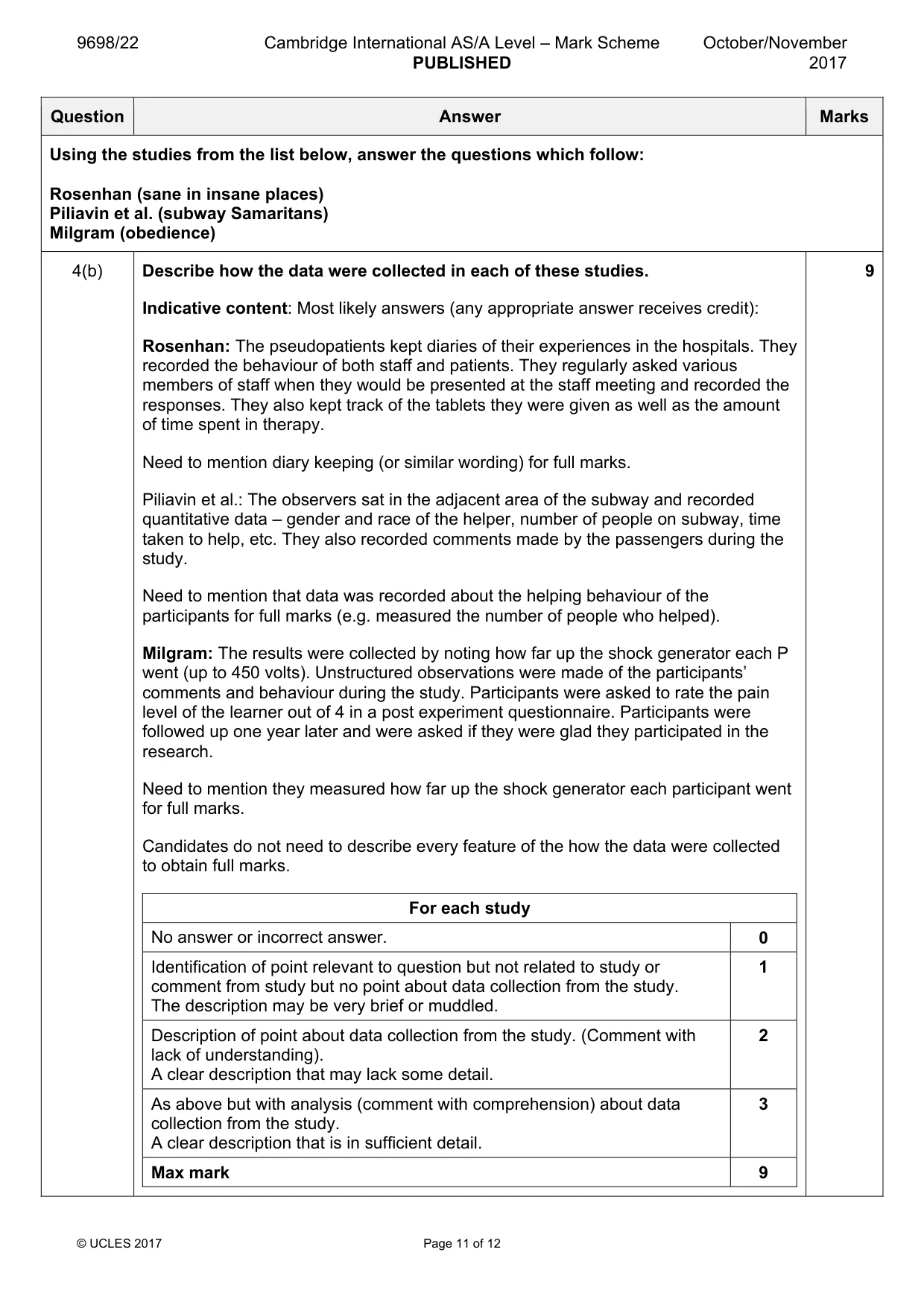
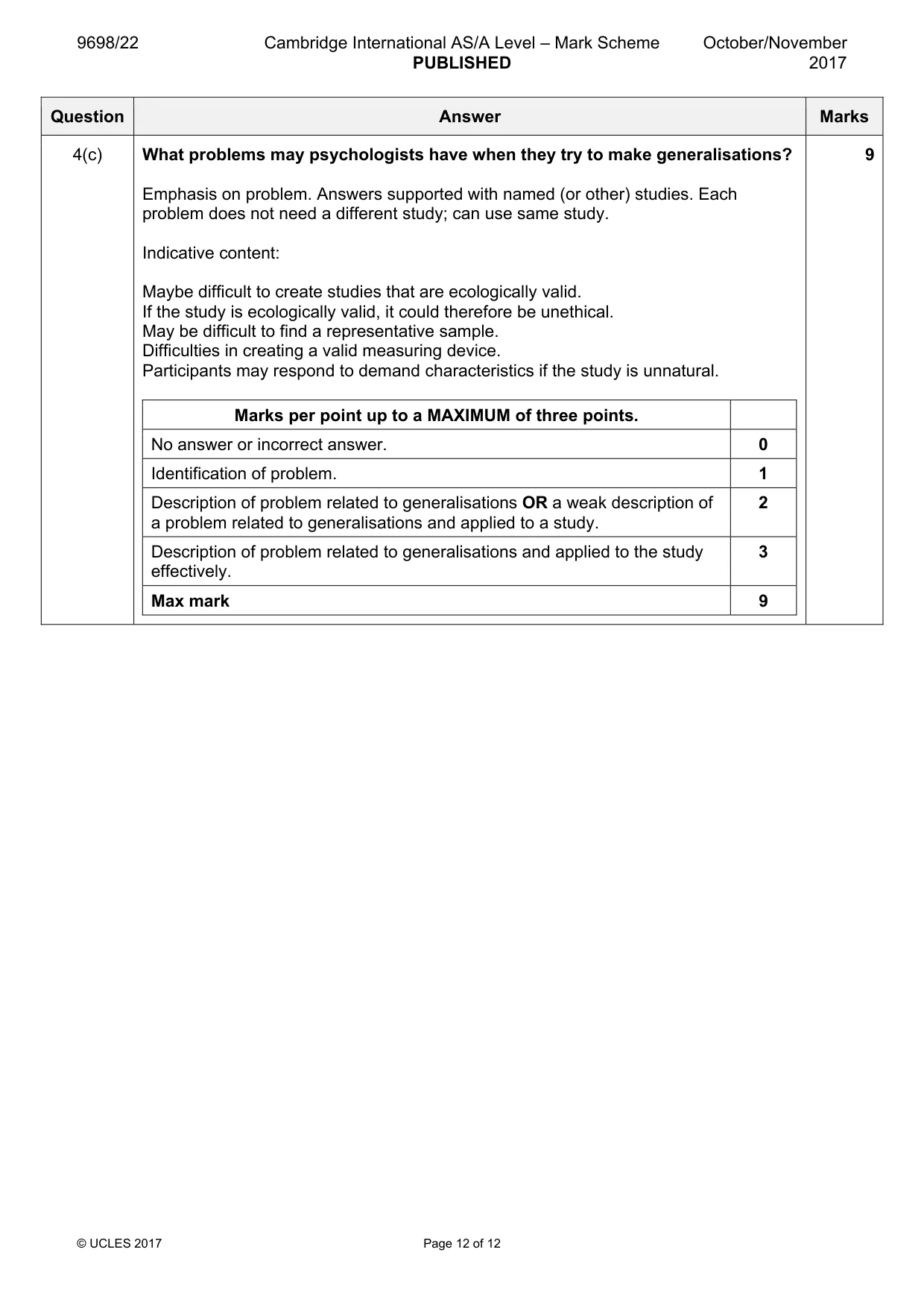
4 (a) Outline what is meant by ‘generalisability’ in psychology. [2] Using the studies from the list below, answer the questions which follow: Rosenhan (sane in insane places) Piliavin et al. (subway Samaritans) Milgram (obedience) (b) Describe how the data were collected in each of these studies. [9] (c) What problems may psychologists have when they try to make generalisations? [9]
Mark scheme: 4(a) Outline what is meant by ‘generalisability’ in psychology. 2 1 mark partial, 2 marks full Generalisations are possible where the study is realistic or has a good sample – 1 mark The extent to which one group’s results can be applied to the target population – 2 marks The extent to which the situation in the study is realistic and similar to everyday life – 2 marks. Using the studies from the list below, answer the questions which follow: Rosenhan (sane in insane places) Piliavin et al. (subway Samaritans) Milgram (obedience) 4(b) Describe how the data were collected in each of these studies. 9 Indicative content: Most likely answers (any appropriate answer receives credit): Rosenhan: The pseudopatients kept diaries of their experiences in the hospitals. They recorded the behaviour of both staff and patients. They regularly asked various members of staff when they would be presented at the staff meeting and recorded the responses. They also kept track of the tablets they were given as well as the amount of time spent in therapy. Need to mention diary keeping (or similar wording) for full marks. Piliavin et al.: The observers sat in the adjacent area of the subway and recorded quantitative data – gender and race of the helper, number of people on subway, time taken to help, etc. They also recorded comments made by the passengers during the study. Need to mention that data was recorded about the helping behaviour of the participants for full marks (e.g. measured the number of people who helped). Milgram: The results were collected by noting how far up the shock generator each P went (up to 450 volts). Unstructured observations were made of the participants’ comments and behaviour during the study. Participants were asked to rate the pain level of the learner out of 4 in a post experiment questionnaire. Participants were followed up one year later and were asked if they were glad they participated in the research. Need to mention they measured how far up the shock generator each participant went for full marks. Candidates do not need to describe every feature of the how the data were collected to obtain full marks. For each study No answer or incorrect answer. 0 Identification of point relevant to question but not related to study or 1 comment from study but no point about data collection from the study. The description may be very brief or muddled. Description of point about data collection from the study. (Comment with 2 lack of understanding). A clear description that may lack some detail. As above but with analysis (comment with comprehension) about data 3 collection from the study. A clear description that is in sufficient detail. Max mark 9 4(c) What problems may psychologists have when they try to make generalisations? 9 Emphasis on problem. Answers supported with named (or other) studies. Each problem does not need a different study; can use same study. Indicative content: Maybe difficult to create studies that are ecologically valid. If the study is ecologically valid, it could therefore be unethical. May be difficult to find a representative sample. Difficulties in creating a valid measuring device. Participants may respond to demand characteristics if the study is unnatural. Marks per point up to a MAXIMUM of three points. No answer or incorrect answer. 0 Identification of problem. 1 Description of problem related to generalisations OR a weak description of 2 a problem related to generalisations and applied to a study. Description of problem related to generalisations and applied to the study 3 effectively. Max mark 9
What you needed in this session
Cambridge’s own grade thresholds for 2017 Oct/Nov, Paper 2 · Variant 2. A higher threshold means an easier paper — the bar moves with how the cohort did.