Cambridge A Level Psychology 9698 — 2017 Oct/Nov Paper 2 · Variant 3
9698/23/O/N/17 · 4 questions · 70 marks · ≈79 min
The question paper and its mark scheme, free to read here and free to download. This is Cambridge’s own paper, exactly as it was sat.
Question paper4 pages
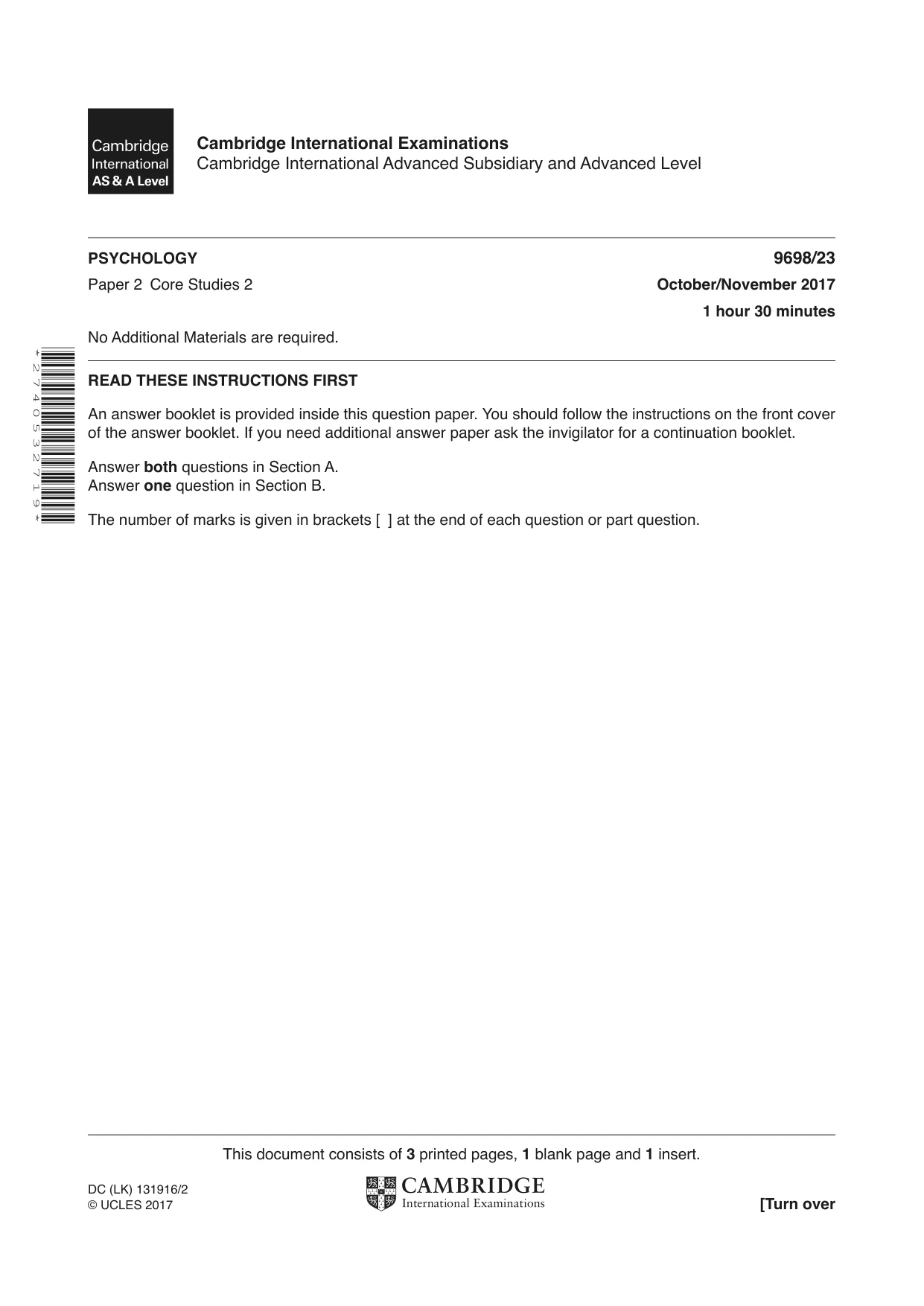
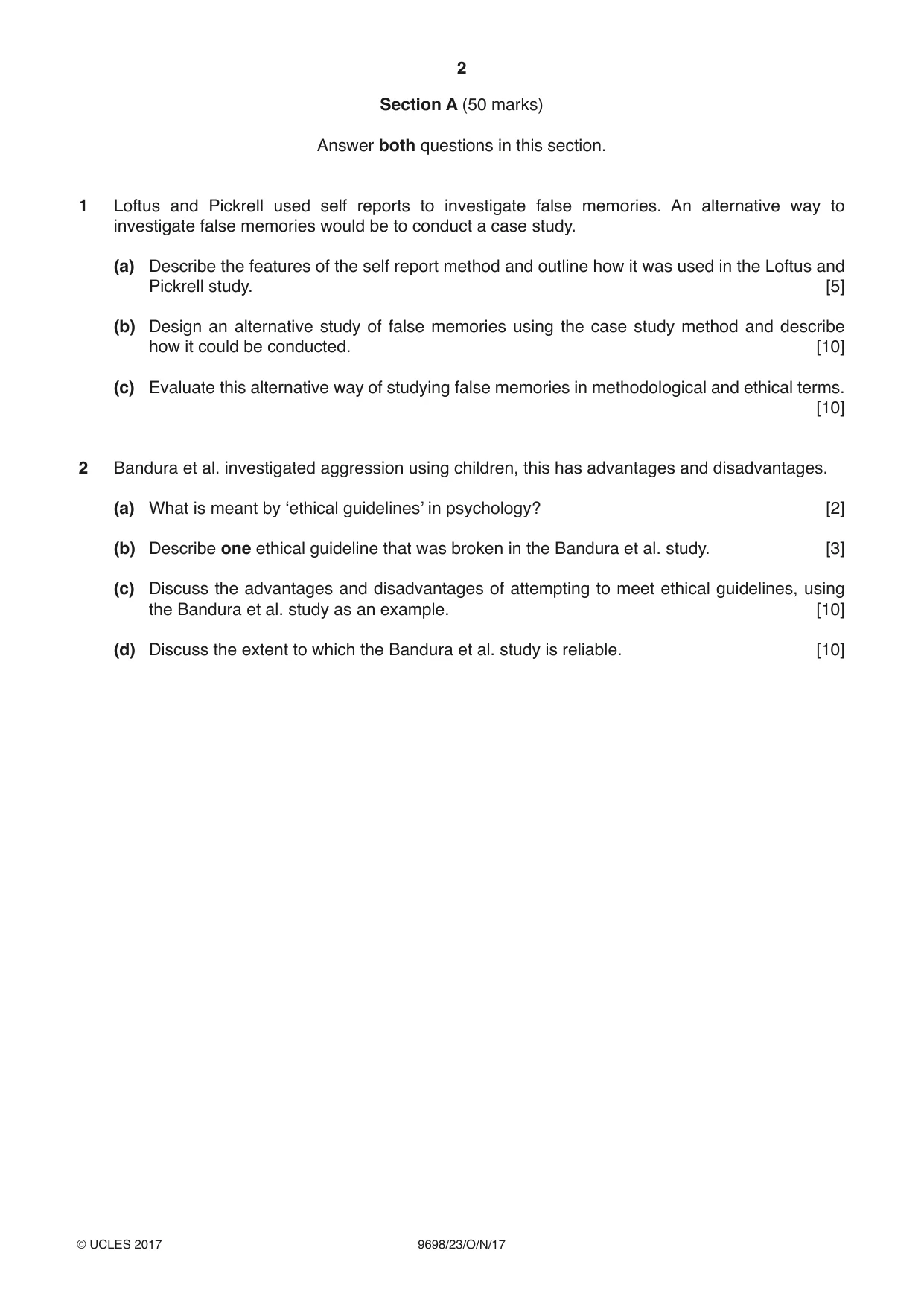
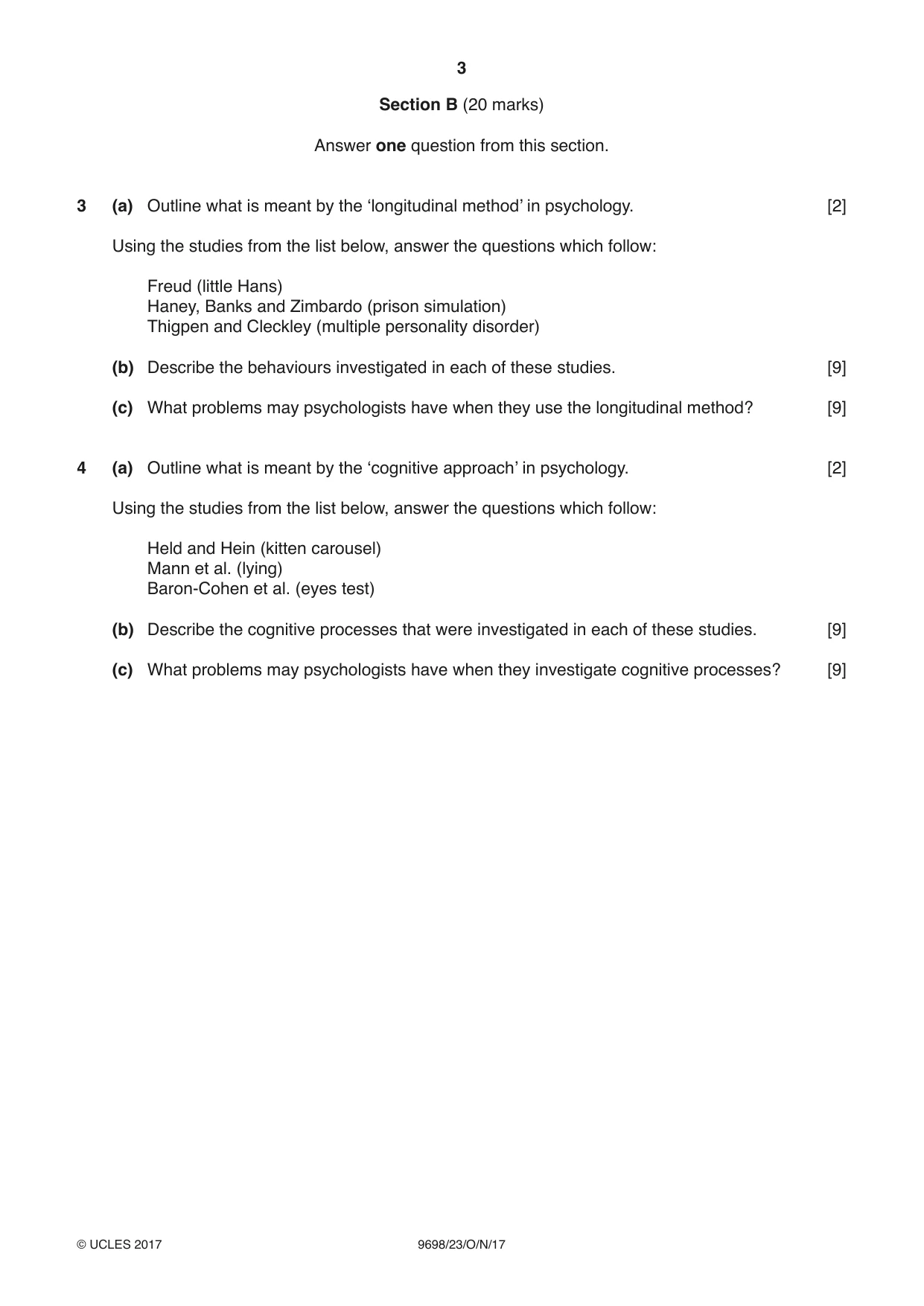

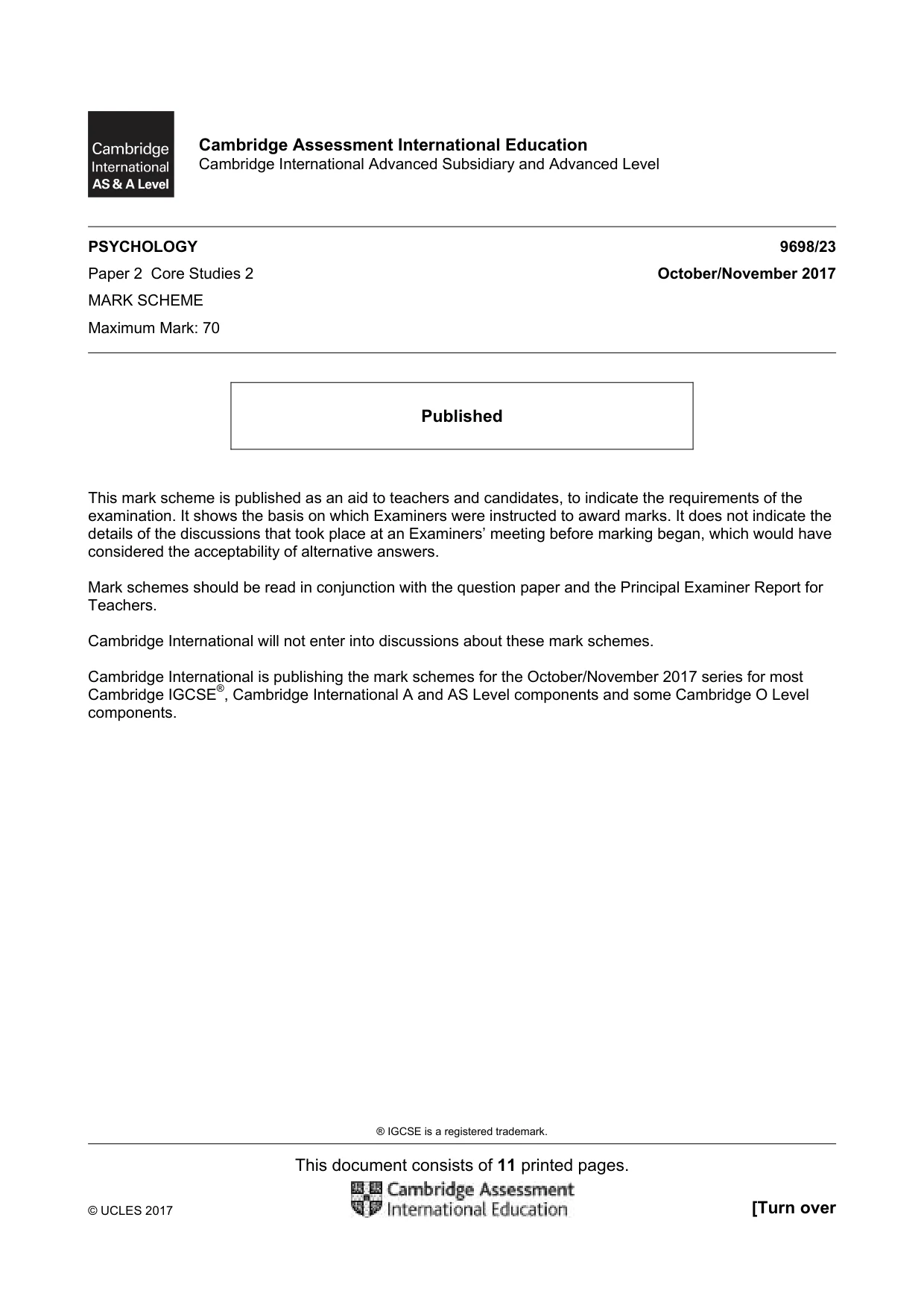
Mark scheme11 pages
Answers below. Sit the paper first if you are practising.
Questions as text
Q1 · Loftus and Pickrell used self reports to investigate false memories
1 Loftus and Pickrell used self reports to investigate false memories. An alternative way to investigate false memories would be to conduct a case study. (a) Describe the features of the self report method and outline how it was used in the Loftus and Pickrell study. [5] (b) Design an alternative study of false memories using the case study method and describe how it could be conducted. [10] (c) Evaluate this alternative way of studying false memories in methodological and ethical terms. [10]
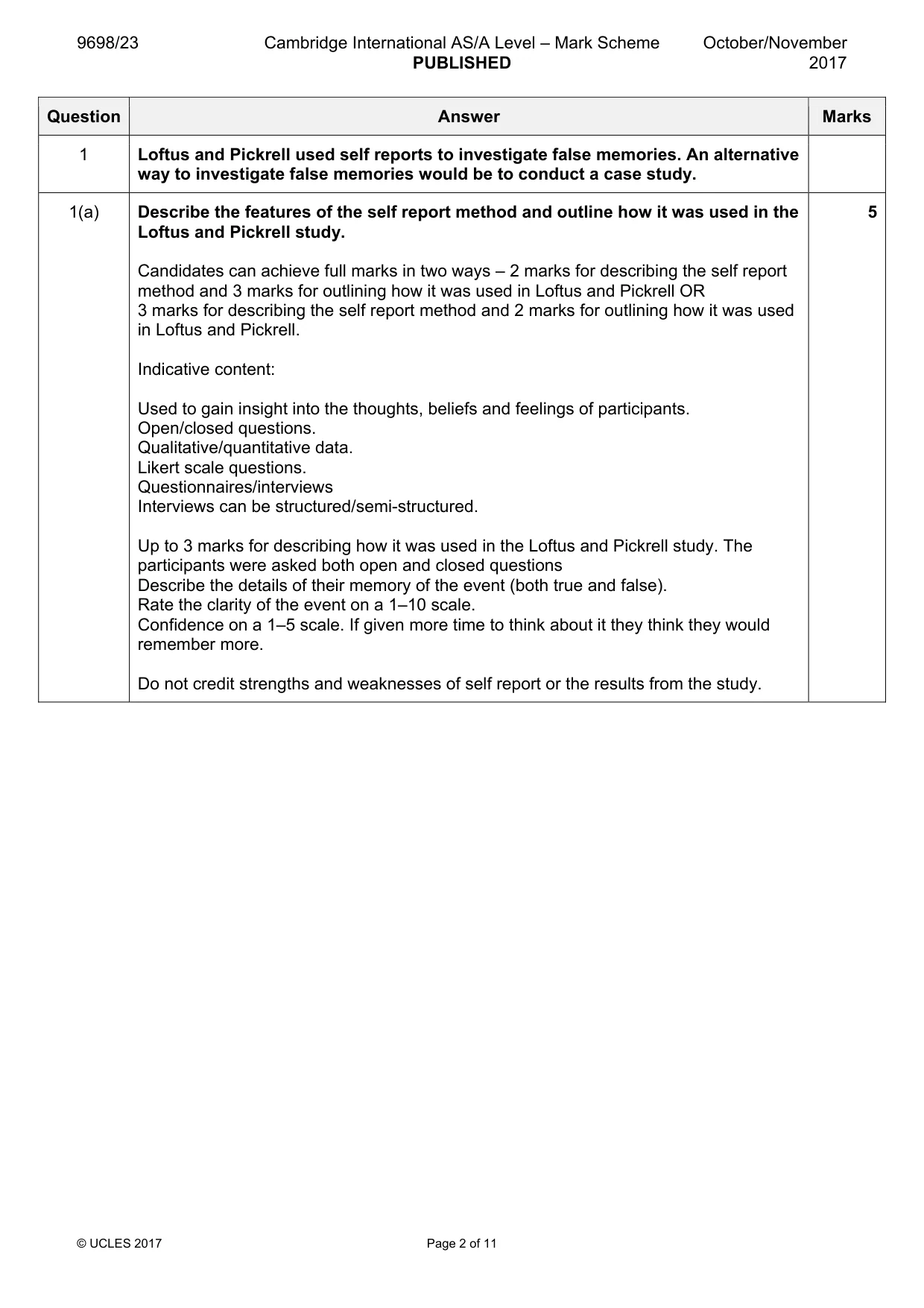
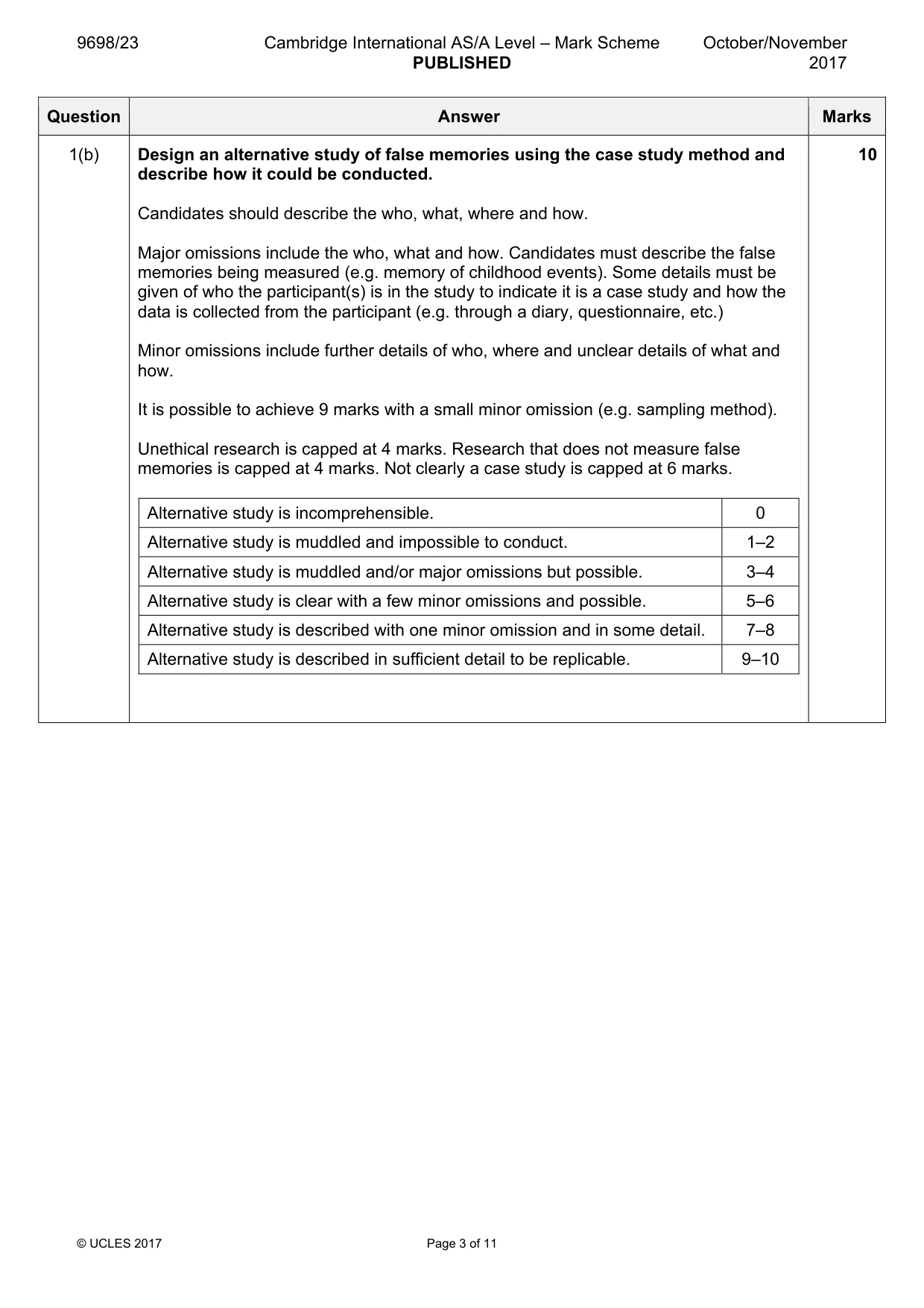
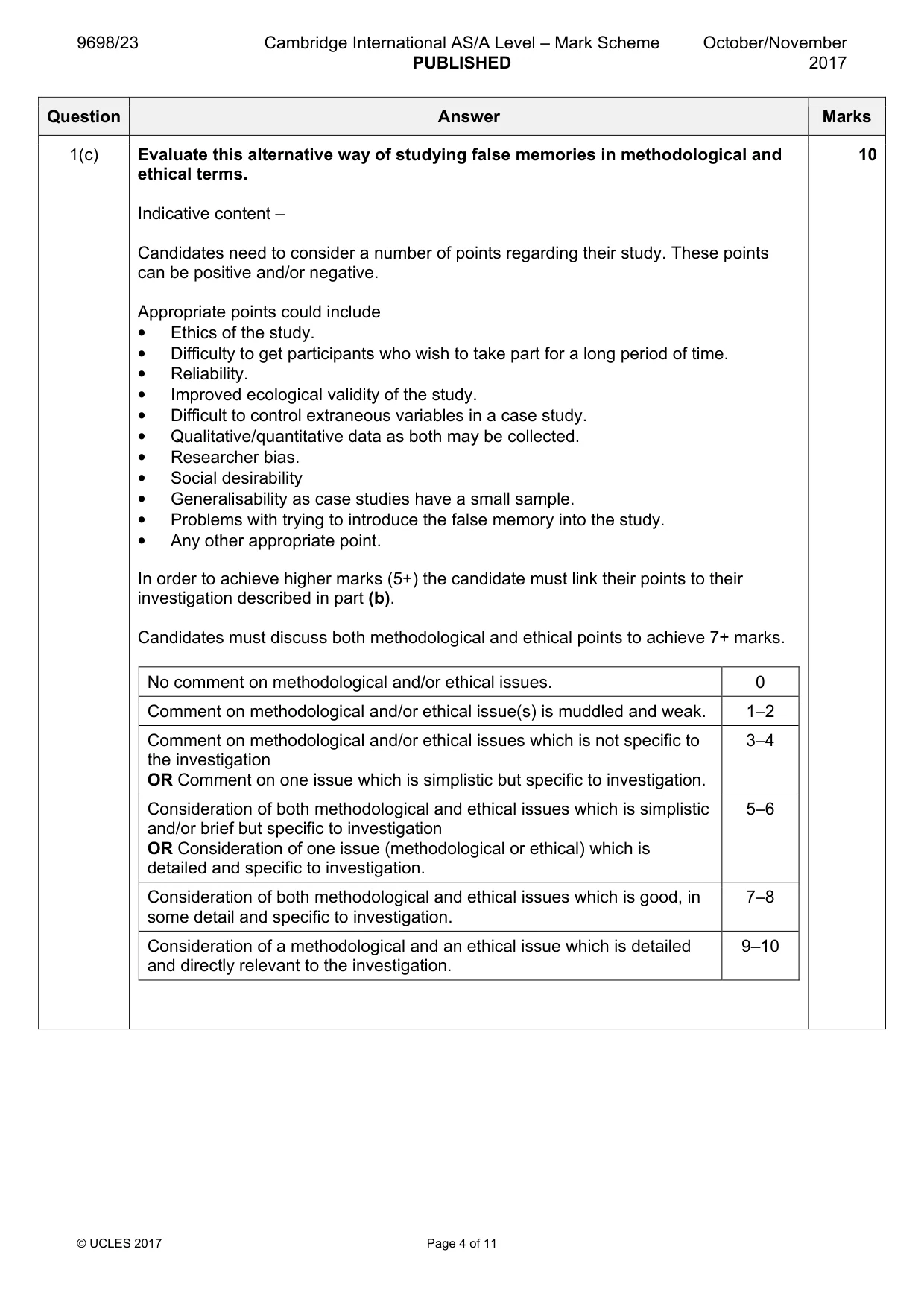
Mark scheme: Question Answer Marks 1 Loftus and Pickrell used self reports to investigate false memories. An alternative way to investigate false memories would be to conduct a case study. 1(a) Describe the features of the self report method and outline how it was used in the 5 Loftus and Pickrell study. Candidates can achieve full marks in two ways – 2 marks for describing the self report method and 3 marks for outlining how it was used in Loftus and Pickrell OR 3 marks for describing the self report method and 2 marks for outlining how it was used in Loftus and Pickrell. Indicative content: Used to gain insight into the thoughts, beliefs and feelings of participants. Open/closed questions. Qualitative/quantitative data. Likert scale questions. Questionnaires/interviews Interviews can be structured/semi-structured. Up to 3 marks for describing how it was used in the Loftus and Pickrell study. The participants were asked both open and closed questions Describe the details of their memory of the event (both true and false). Rate the clarity of the event on a 1–10 scale. Confidence on a 1–5 scale. If given more time to think about it they think they would remember more. Do not credit strengths and weaknesses of self report or the results from the study. 1(b) Design an alternative study of false memories using the case study method and 10 describe how it could be conducted. Candidates should describe the who, what, where and how. Major omissions include the who, what and how. Candidates must describe the false memories being measured (e.g. memory of childhood events). Some details must be given of who the participant(s) is in the study to indicate it is a case study and how the data is collected from the participant (e.g. through a diary, questionnaire, etc.) Minor omissions include further details of who, where and unclear details of what and how. It is possible to achieve 9 marks with a small minor omission (e.g. sampling method). Unethical research is capped at 4 marks. Research that does not measure false memories is capped at 4 marks. Not clearly a case study is capped at 6 marks. Alternative study is incomprehensible. 0 Alternative study is muddled and impossible to conduct. 1–2 Alternative study is muddled and/or major omissions but possible. 3–4 Alternative study is clear with a few minor omissions and possible. 5–6 Alternative study is described with one minor omission and in some detail. 7–8 Alternative study is described in sufficient detail to be replicable. 9–10 1(c) Evaluate this alternative way of studying false memories in methodological and 10 ethical terms. Indicative content – Candidates need to consider a number of points regarding their study. These points can be positive and/or negative. Appropriate points could include • Ethics of the study. • Difficulty to get participants who wish to take part for a long period of time. • Reliability. • Improved ecological validity of the study. • Difficult to control extraneous variables in a case study. • Qualitative/quantitative data as both may be collected. • Researcher bias. • Social desirability • Generalisability as case studies have a small sample. • Problems with trying to introduce the false memory into the study. • Any other appropriate point. In order to achieve higher marks (5+) the candidate must link their points to their investigation described in part (b). Candidates must discuss both methodological and ethical points to achieve 7+ marks. No comment on methodological and/or ethical issues. 0 Comment on methodological and/or ethical issue(s) is muddled and weak. 1–2 Comment on methodological and/or ethical issues which is not specific to 3–4 the investigation OR Comment on one issue which is simplistic but specific to investigation. Consideration of both methodological and ethical issues which is simplistic 5–6 and/or brief but specific to investigation OR Consideration of one issue (methodological or ethical) which is detailed and specific to investigation. Consideration of both methodological and ethical issues which is good, in 7–8 some detail and specific to investigation. Consideration of a methodological and an ethical issue which is detailed 9–10 and directly relevant to the investigation.
Question 2
2 Bandura et al. investigated aggression using children, this has advantages and disadvantages. (a) What is meant by ‘ethical guidelines’ in psychology? [2] (b) Describe one ethical guideline that was broken in the Bandura et al. study. [3] (c) Discuss the advantages and disadvantages of attempting to meet ethical guidelines, using the Bandura et al. study as an example. [10] (d) Discuss the extent to which the Bandura et al. study is reliable. [10]
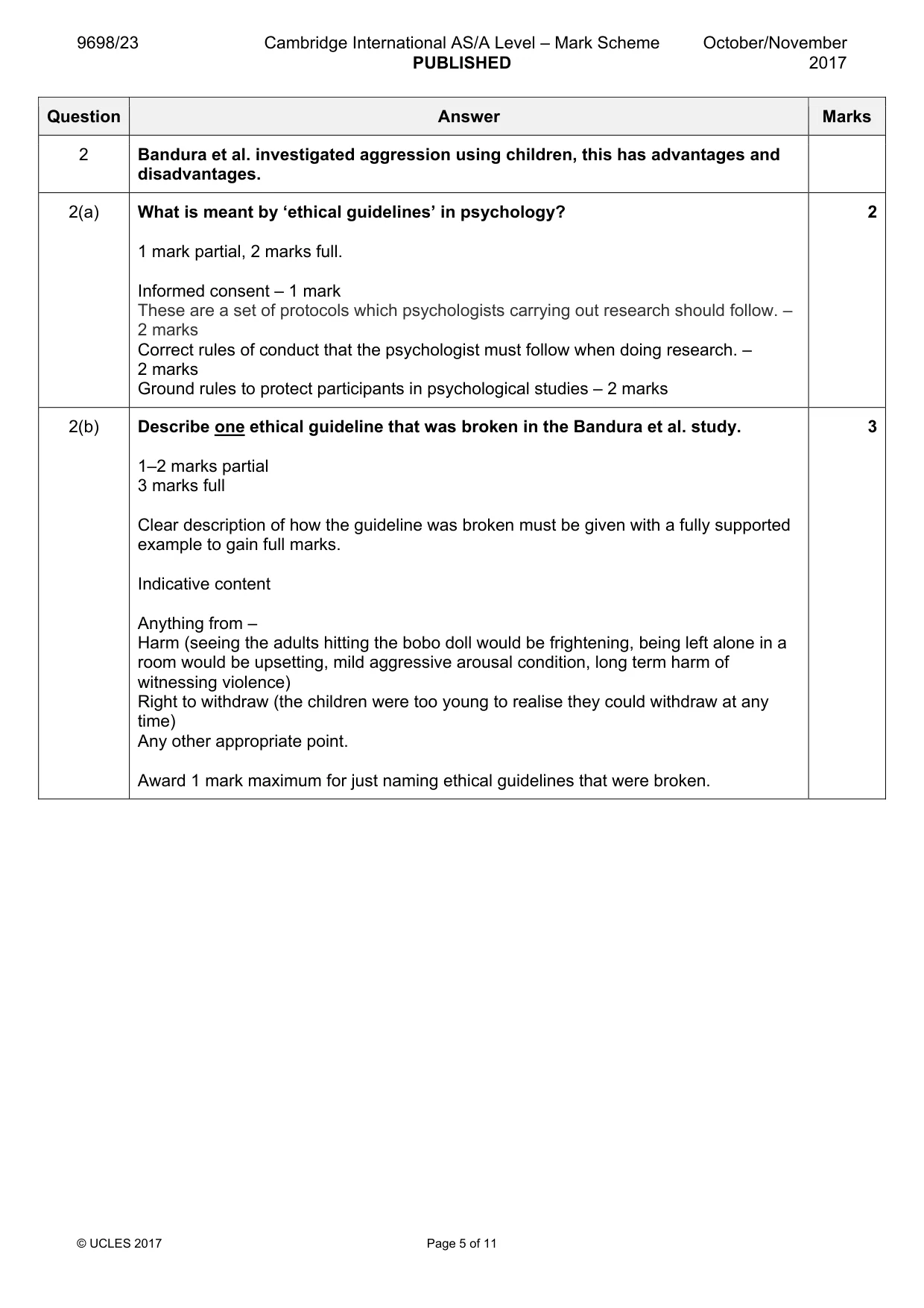
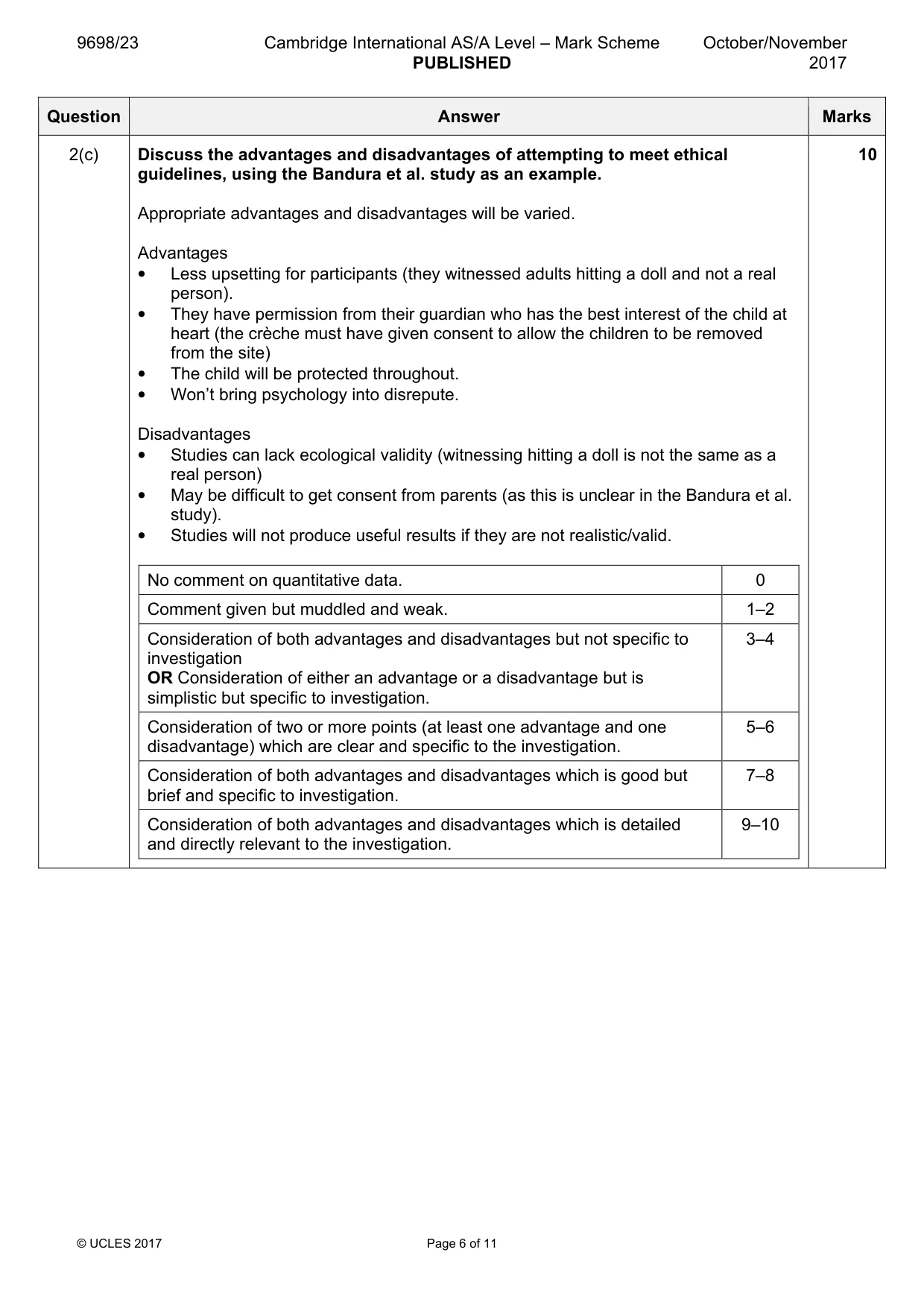
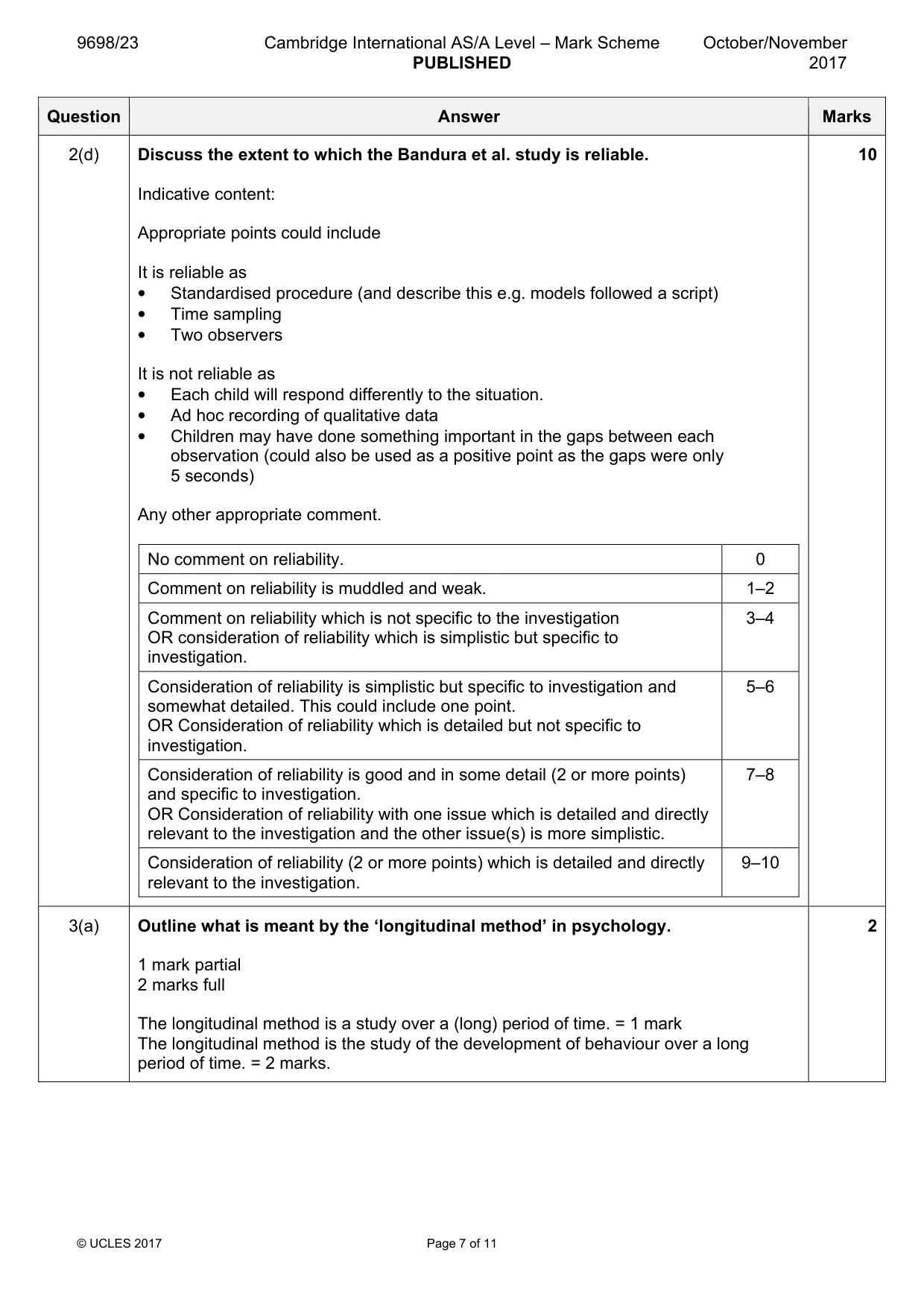
Mark scheme: 2(a) What is meant by ‘ethical guidelines’ in psychology? 2 1 mark partial, 2 marks full. Informed consent – 1 mark These are a set of protocols which psychologists carrying out research should follow. – 2 marks Correct rules of conduct that the psychologist must follow when doing research. – 2 marks Ground rules to protect participants in psychological studies – 2 marks 2(b) Describe one ethical guideline that was broken in the Bandura et al. study. 3 1–2 marks partial 3 marks full Clear description of how the guideline was broken must be given with a fully supported example to gain full marks. Indicative content Anything from – Harm (seeing the adults hitting the bobo doll would be frightening, being left alone in a room would be upsetting, mild aggressive arousal condition, long term harm of witnessing violence) Right to withdraw (the children were too young to realise they could withdraw at any time) Any other appropriate point. Award 1 mark maximum for just naming ethical guidelines that were broken. 2(c) Discuss the advantages and disadvantages of attempting to meet ethical 10 guidelines, using the Bandura et al. study as an example. Appropriate advantages and disadvantages will be varied. Advantages • Less upsetting for participants (they witnessed adults hitting a doll and not a real person). • They have permission from their guardian who has the best interest of the child at heart (the crèche must have given consent to allow the children to be removed from the site) • The child will be protected throughout. • Won’t bring psychology into disrepute. Disadvantages • Studies can lack ecological validity (witnessing hitting a doll is not the same as a real person) • May be difficult to get consent from parents (as this is unclear in the Bandura et al. study). • Studies will not produce useful results if they are not realistic/valid. No comment on quantitative data. 0 Comment given but muddled and weak. 1–2 Consideration of both advantages and disadvantages but not specific to 3–4 investigation OR Consideration of either an advantage or a disadvantage but is simplistic but specific to investigation. Consideration of two or more points (at least one advantage and one 5–6 disadvantage) which are clear and specific to the investigation. Consideration of both advantages and disadvantages which is good but 7–8 brief and specific to investigation. Consideration of both advantages and disadvantages which is detailed 9–10 and directly relevant to the investigation. 2(d) Discuss the extent to which the Bandura et al. study is reliable. 10 Indicative content: Appropriate points could include It is reliable as • Standardised procedure (and describe this e.g. models followed a script) • Time sampling • Two observers It is not reliable as • Each child will respond differently to the situation. • Ad hoc recording of qualitative data • Children may have done something important in the gaps between each observation (could also be used as a positive point as the gaps were only 5 seconds) Any other appropriate comment. No comment on reliability. 0 Comment on reliability is muddled and weak. 1–2 Comment on reliability which is not specific to the investigation 3–4 OR consideration of reliability which is simplistic but specific to investigation. Consideration of reliability is simplistic but specific to investigation and 5–6 somewhat detailed. This could include one point. OR Consideration of reliability which is detailed but not specific to investigation. Consideration of reliability is good and in some detail (2 or more points) 7–8 and specific to investigation. OR Consideration of reliability with one issue which is detailed and directly relevant to the investigation and the other issue(s) is more simplistic. Consideration of reliability (2 or more points) which is detailed and directly 9–10 relevant to the investigation.
Q3 · Outline what is meant by the ‘longitudinal method’ in psychology
3 (a) Outline what is meant by the ‘longitudinal method’ in psychology. [2] Using the studies from the list below, answer the questions which follow: Freud (little Hans) Haney, Banks and Zimbardo (prison simulation) Thigpen and Cleckley (multiple personality disorder) (b) Describe the behaviours investigated in each of these studies. [9] (c) What problems may psychologists have when they use the longitudinal method? [9]
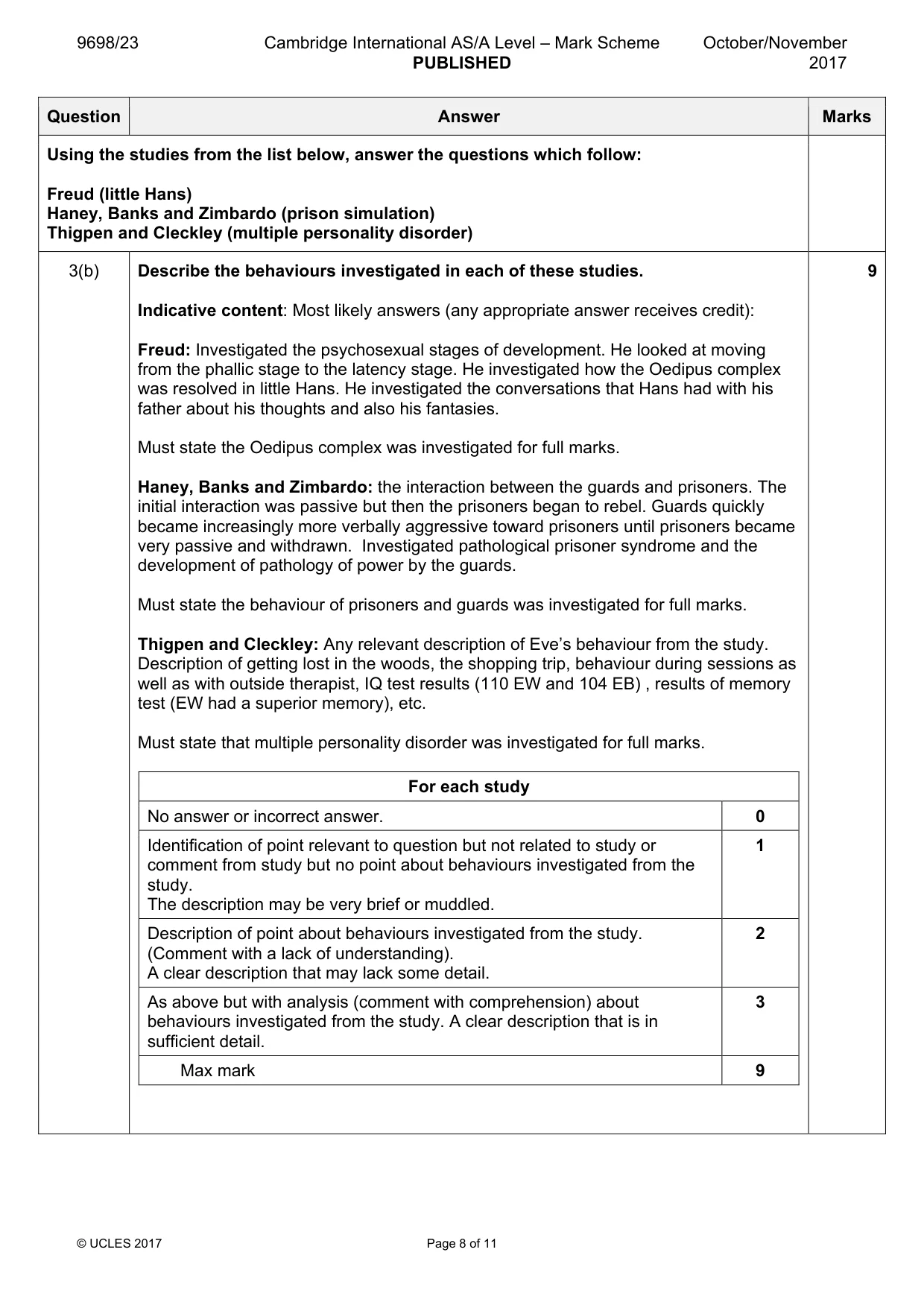
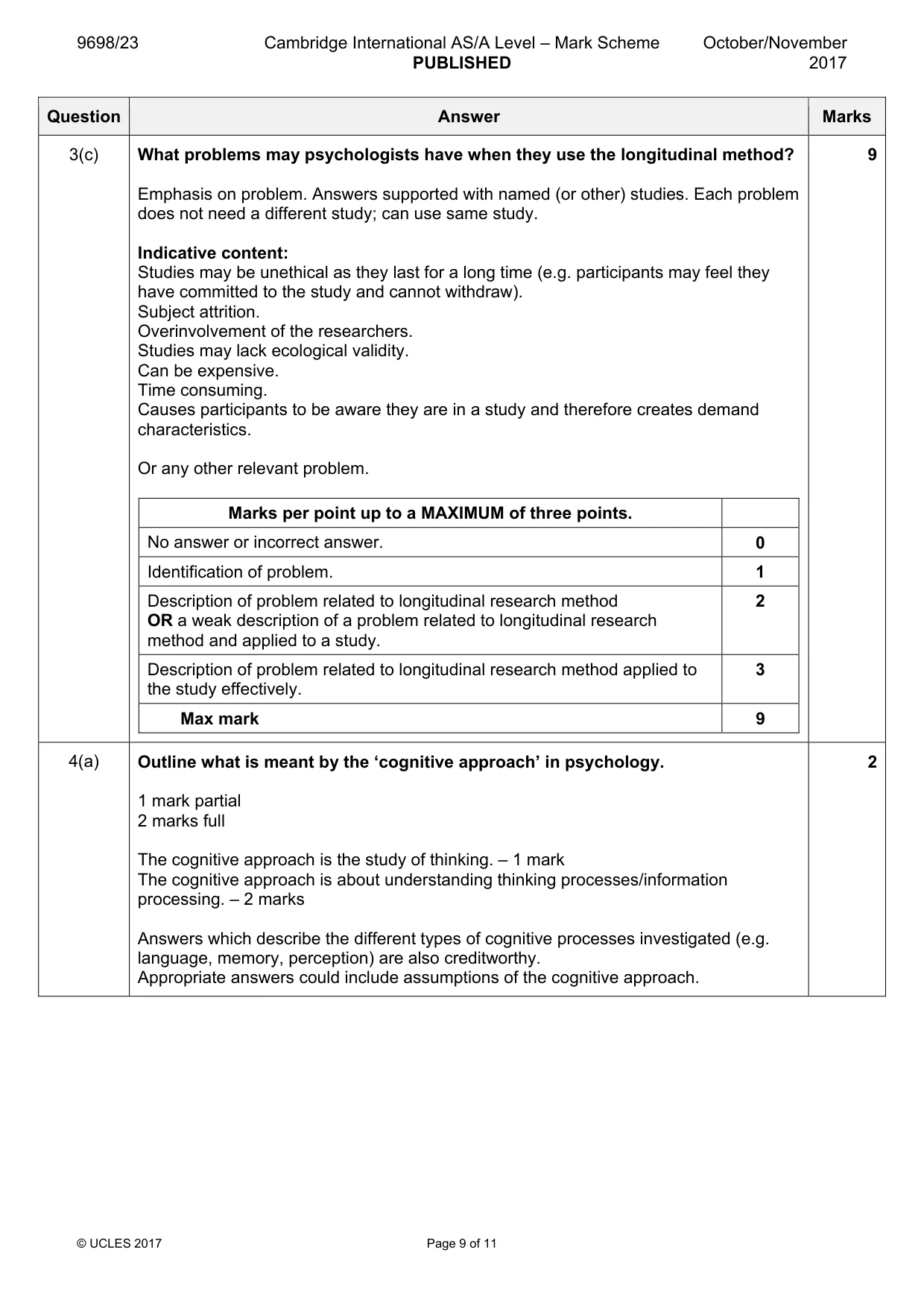
Mark scheme: 3(a) Outline what is meant by the ‘longitudinal method’ in psychology. 2 1 mark partial 2 marks full The longitudinal method is a study over a (long) period of time. = 1 mark The longitudinal method is the study of the development of behaviour over a long period of time. = 2 marks. Using the studies from the list below, answer the questions which follow: Freud (little Hans) Haney, Banks and Zimbardo (prison simulation) Thigpen and Cleckley (multiple personality disorder) 3(b) Describe the behaviours investigated in each of these studies. 9 Indicative content: Most likely answers (any appropriate answer receives credit): Freud: Investigated the psychosexual stages of development. He looked at moving from the phallic stage to the latency stage. He investigated how the Oedipus complex was resolved in little Hans. He investigated the conversations that Hans had with his father about his thoughts and also his fantasies. Must state the Oedipus complex was investigated for full marks. Haney, Banks and Zimbardo: the interaction between the guards and prisoners. The initial interaction was passive but then the prisoners began to rebel. Guards quickly became increasingly more verbally aggressive toward prisoners until prisoners became very passive and withdrawn. Investigated pathological prisoner syndrome and the development of pathology of power by the guards. Must state the behaviour of prisoners and guards was investigated for full marks. Thigpen and Cleckley: Any relevant description of Eve’s behaviour from the study. Description of getting lost in the woods, the shopping trip, behaviour during sessions as well as with outside therapist, IQ test results (110 EW and 104 EB) , results of memory test (EW had a superior memory), etc. Must state that multiple personality disorder was investigated for full marks. For each study No answer or incorrect answer. 0 Identification of point relevant to question but not related to study or 1 comment from study but no point about behaviours investigated from the study. The description may be very brief or muddled. Description of point about behaviours investigated from the study. 2 (Comment with a lack of understanding). A clear description that may lack some detail. As above but with analysis (comment with comprehension) about 3 behaviours investigated from the study. A clear description that is in sufficient detail. Max mark 9 3(c) What problems may psychologists have when they use the longitudinal method? 9 Emphasis on problem. Answers supported with named (or other) studies. Each problem does not need a different study; can use same study. Indicative content: Studies may be unethical as they last for a long time (e.g. participants may feel they have committed to the study and cannot withdraw). Subject attrition. Overinvolvement of the researchers. Studies may lack ecological validity. Can be expensive. Time consuming. Causes participants to be aware they are in a study and therefore creates demand characteristics. Or any other relevant problem. Marks per point up to a MAXIMUM of three points. No answer or incorrect answer. 0 Identification of problem. 1 Description of problem related to longitudinal research method 2 OR a weak description of a problem related to longitudinal research method and applied to a study. Description of problem related to longitudinal research method applied to 3 the study effectively. Max mark 9
Q4 · Outline what is meant by the ‘cognitive approach’ in psychology
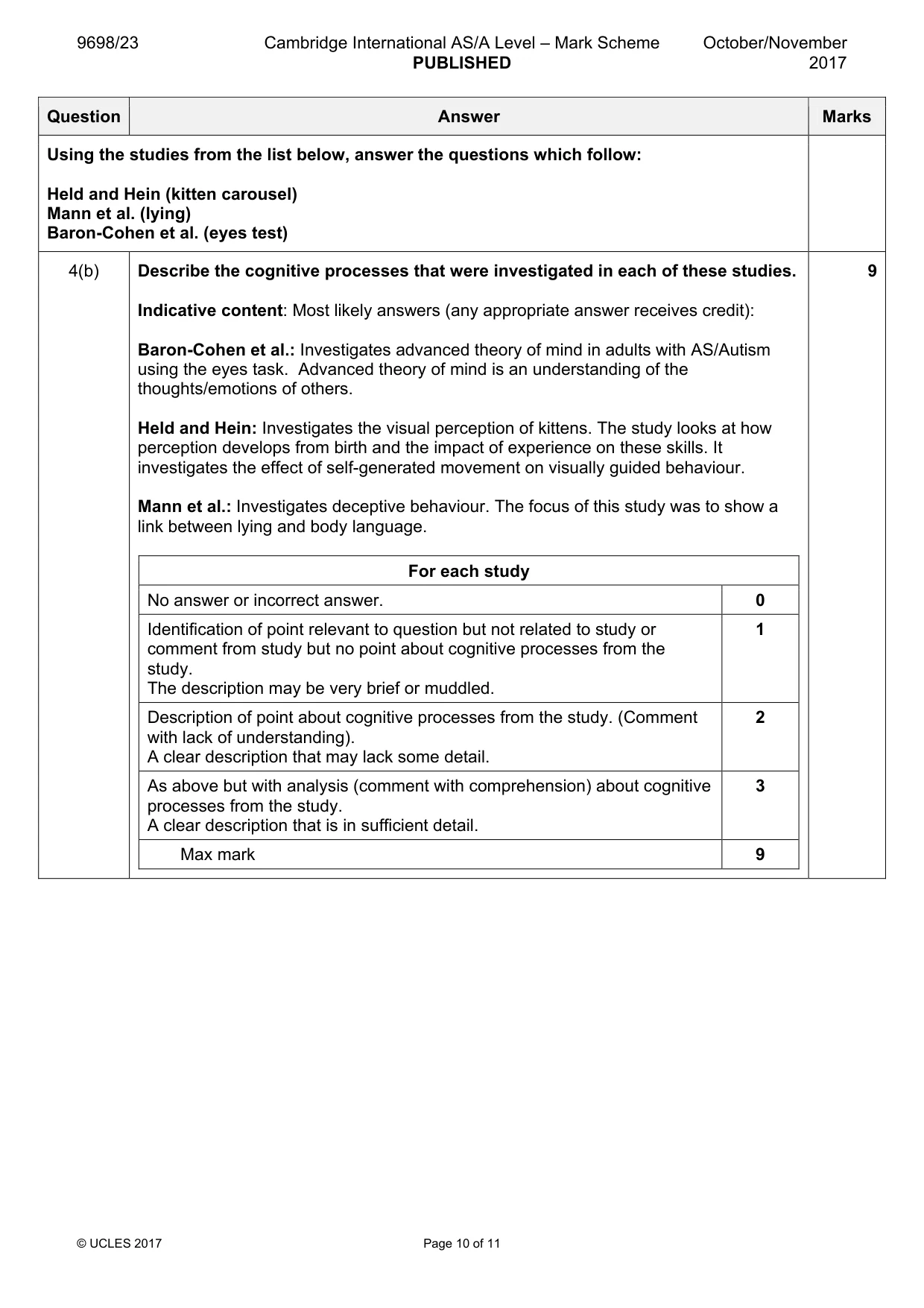
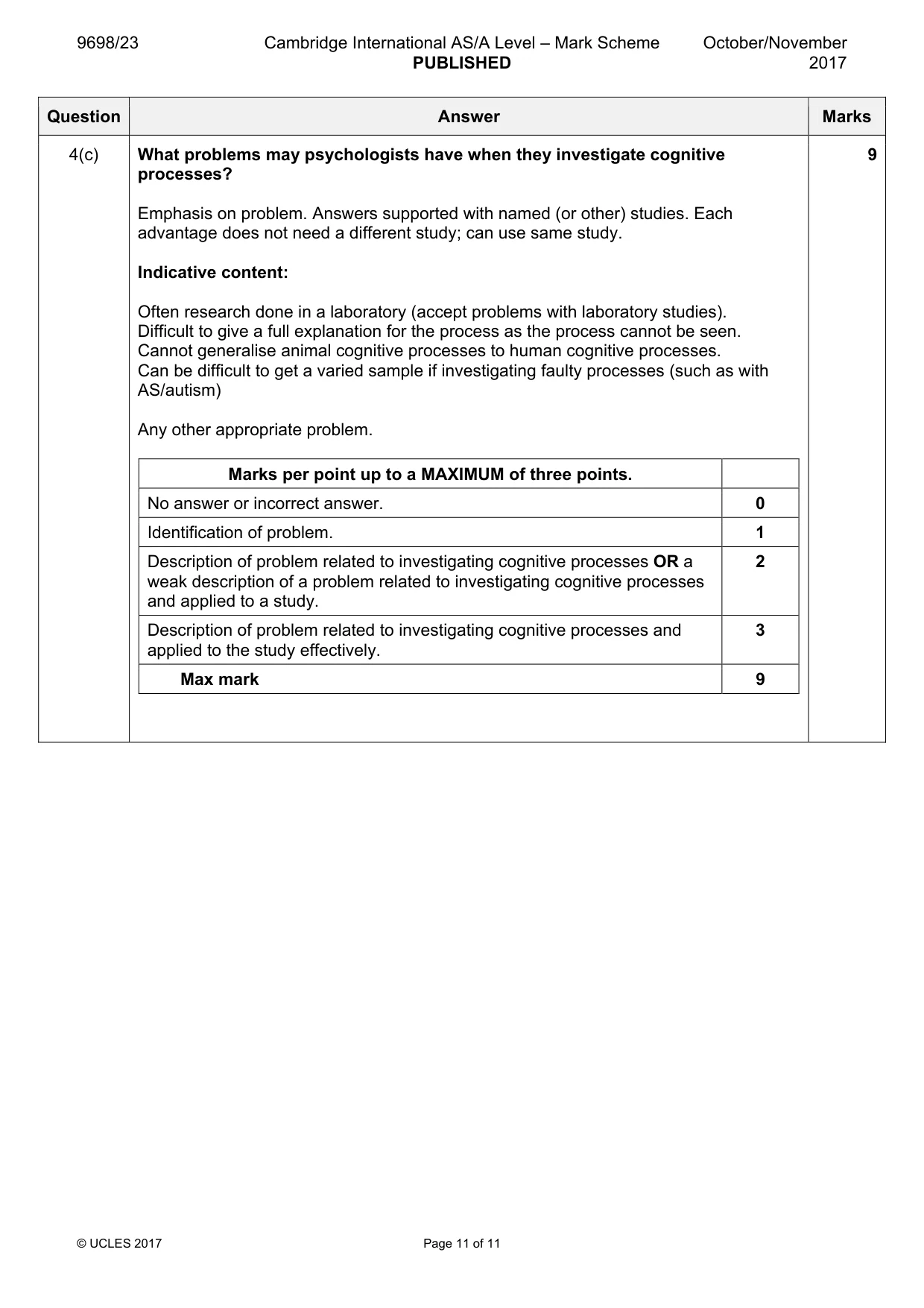
4 (a) Outline what is meant by the ‘cognitive approach’ in psychology. [2] Using the studies from the list below, answer the questions which follow: Held and Hein (kitten carousel) Mann et al. (lying) Baron-Cohen et al. (eyes test) (b) Describe the cognitive processes that were investigated in each of these studies. [9] (c) What problems may psychologists have when they investigate cognitive processes? [9]
Mark scheme: 4(a) Outline what is meant by the ‘cognitive approach’ in psychology. 2 1 mark partial 2 marks full The cognitive approach is the study of thinking. – 1 mark The cognitive approach is about understanding thinking processes/information processing. – 2 marks Answers which describe the different types of cognitive processes investigated (e.g. language, memory, perception) are also creditworthy. Appropriate answers could include assumptions of the cognitive approach. Using the studies from the list below, answer the questions which follow: Held and Hein (kitten carousel) Mann et al. (lying) Baron-Cohen et al. (eyes test) 4(b) Describe the cognitive processes that were investigated in each of these studies. 9 Indicative content: Most likely answers (any appropriate answer receives credit): Baron-Cohen et al.: Investigates advanced theory of mind in adults with AS/Autism using the eyes task. Advanced theory of mind is an understanding of the thoughts/emotions of others. Held and Hein: Investigates the visual perception of kittens. The study looks at how perception develops from birth and the impact of experience on these skills. It investigates the effect of self-generated movement on visually guided behaviour. Mann et al.: Investigates deceptive behaviour. The focus of this study was to show a link between lying and body language. For each study No answer or incorrect answer. 0 Identification of point relevant to question but not related to study or 1 comment from study but no point about cognitive processes from the study. The description may be very brief or muddled. Description of point about cognitive processes from the study. (Comment 2 with lack of understanding). A clear description that may lack some detail. As above but with analysis (comment with comprehension) about cognitive 3 processes from the study. A clear description that is in sufficient detail. Max mark 9 4(c) What problems may psychologists have when they investigate cognitive 9 processes? Emphasis on problem. Answers supported with named (or other) studies. Each advantage does not need a different study; can use same study. Indicative content: Often research done in a laboratory (accept problems with laboratory studies). Difficult to give a full explanation for the process as the process cannot be seen. Cannot generalise animal cognitive processes to human cognitive processes. Can be difficult to get a varied sample if investigating faulty processes (such as with AS/autism) Any other appropriate problem. Marks per point up to a MAXIMUM of three points. No answer or incorrect answer. 0 Identification of problem. 1 Description of problem related to investigating cognitive processes OR a 2 weak description of a problem related to investigating cognitive processes and applied to a study. Description of problem related to investigating cognitive processes and 3 applied to the study effectively. Max mark 9
What you needed in this session
Cambridge’s own grade thresholds for 2017 Oct/Nov, Paper 2 · Variant 3. A higher threshold means an easier paper — the bar moves with how the cohort did.