Cambridge A Level Psychology 9698 — 2015 Oct/Nov Paper 1 · Variant 1
9698/11/O/N/15 · 80 marks · ≈90 min
The question paper and its mark scheme, free to read here and free to download. This is Cambridge’s own paper, exactly as it was sat.
Question paper4 pages
Mark scheme13 pages
Answers below. Sit the paper first if you are practising.
Paper as text
Question paper, page 1
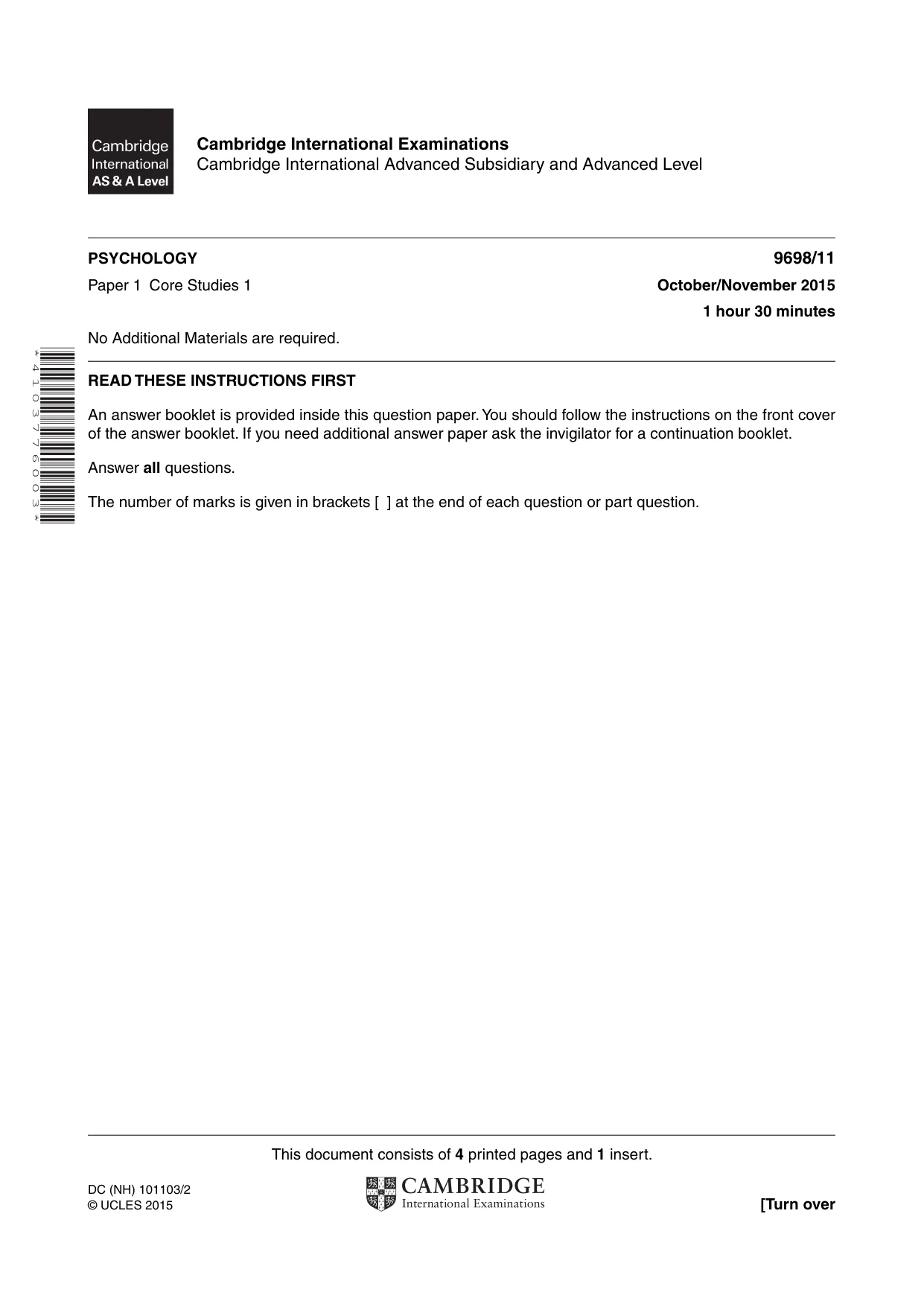
This document consists of 4 printed pages and 1 insert. DC (NH) 101103/2 © UCLES 2015 [Turn over * 4 1 0 3 7 7 6 0 0 3 * PSYCHOLOGY 9698/11 Paper 1 Core Studies 1 October/November 2015 1 hour 30 minutes No Additional Materials are required. READ THESE INSTRUCTIONS FIRST An answer booklet is provided inside this question paper. You should follow the instructions on the front cover of the answer booklet. If you need additional answer paper ask the invigilator for a continuation booklet. Answer all questions. The number of marks is given in brackets [ ] at the end of each question or part question. Cambridge International Examinations Cambridge International Advanced Subsidiary and Advanced Level
Question paper, page 2
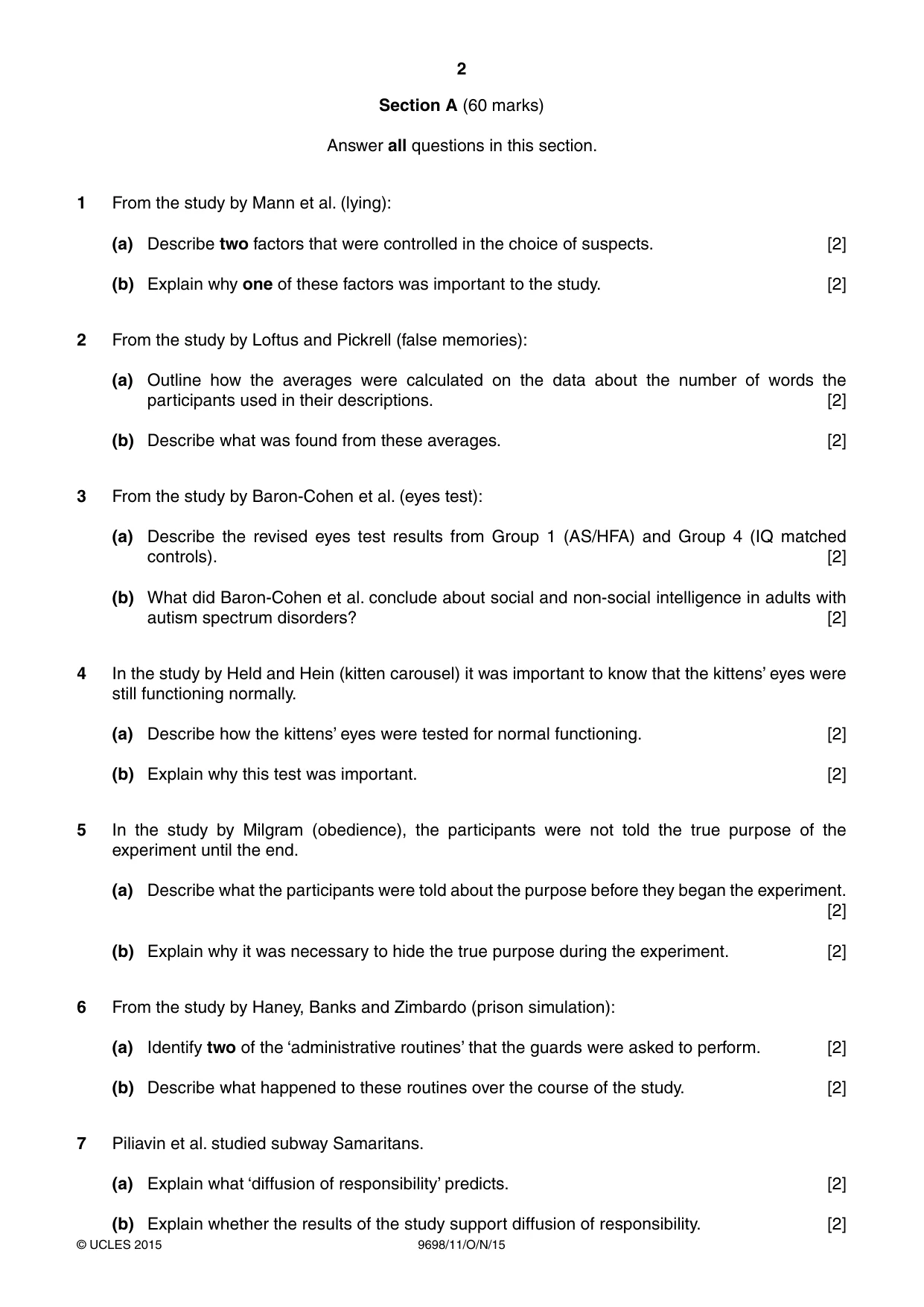
2 9698/11/O/N/15 © UCLES 2015 Section A (60 marks) Answer all questions in this section. 1 From the study by Mann et al. (lying): (a) Describe two factors that were controlled in the choice of suspects. [2] (b) Explain why one of these factors was important to the study. [2] 2 From the study by Loftus and Pickrell (false memories): (a) Outline how the averages were calculated on the data about the number of words the participants used in their descriptions. [2] (b) Describe what was found from these averages. [2] 3 From the study by Baron-Cohen et al. (eyes test): (a) Describe the revised eyes test results from Group 1 (AS/HFA) and Group 4 (IQ matched controls). [2] (b) What did Baron-Cohen et al. conclude about social and non-social intelligence in adults with autism spectrum disorders? [2] 4 In the study by Held and Hein (kitten carousel) it was important to know that the kittens’ eyes were still functioning normally. (a) Describe how the kittens’ eyes were tested for normal functioning. [2] (b) Explain why this test was important. [2] 5 In the study by Milgram (obedience), the participants were not told the true purpose of the experiment until the end. (a) Describe what the participants were told about the purpose before they began the experiment. [2] (b) Explain why it was necessary to hide the true purpose during the experiment. [2] 6 From the study by Haney, Banks and Zimbardo (prison simulation): (a) Identify two of the ‘administrative routines’ that the guards were asked to perform. [2] (b) Describe what happened to these routines over the course of the study. [2] 7 Piliavin et al. studied subway Samaritans. (a) Explain what ‘diffusion of responsibility’ predicts. [2] (b) Explain whether the results of the study support diffusion of responsibility. [2]
Question paper, page 3
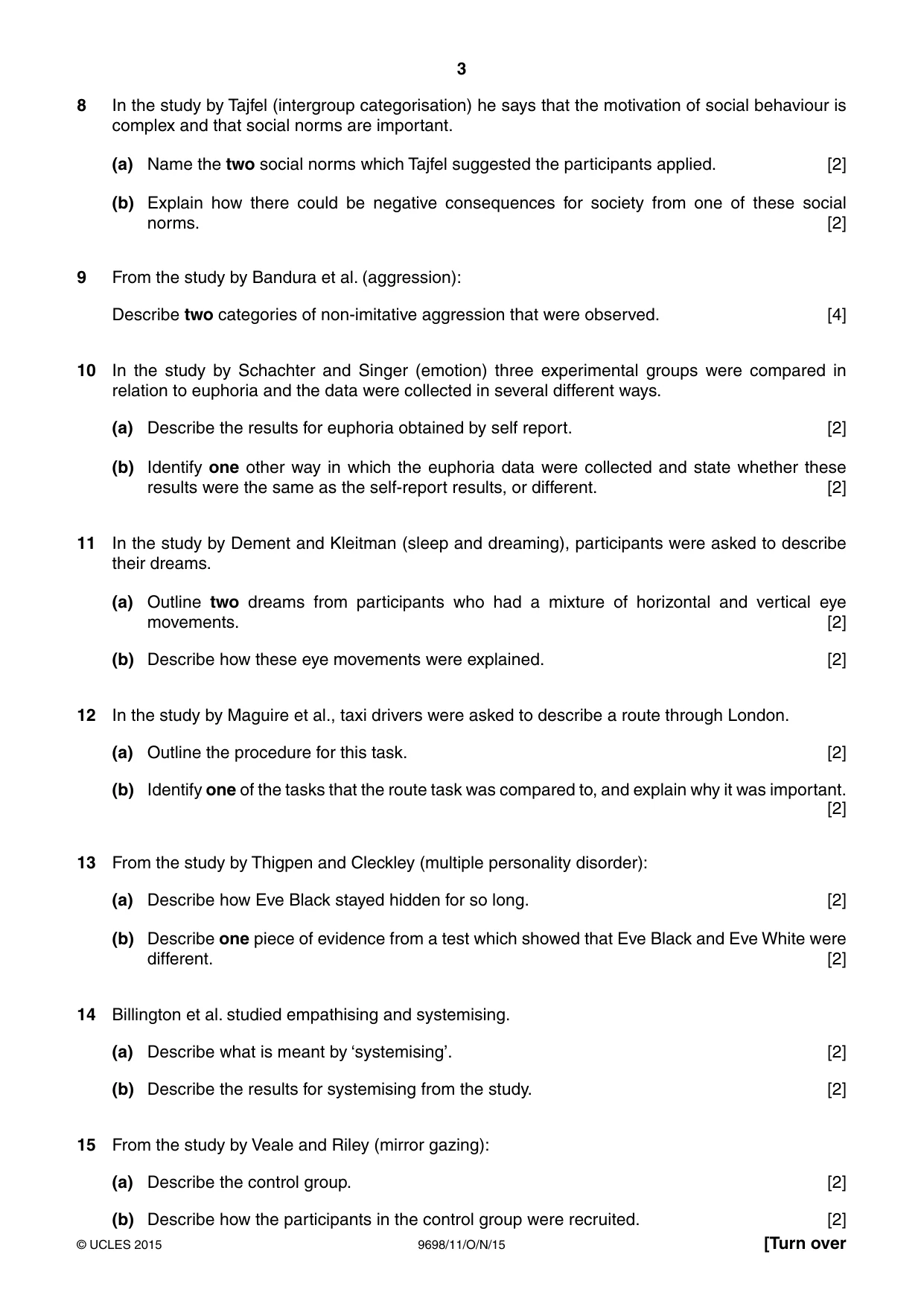
3 9698/11/O/N/15 © UCLES 2015 [Turn over 8 In the study by Tajfel (intergroup categorisation) he says that the motivation of social behaviour is complex and that social norms are important. (a) Name the two social norms which Tajfel suggested the participants applied. [2] (b) Explain how there could be negative consequences for society from one of these social norms. [2] 9 From the study by Bandura et al. (aggression): Describe two categories of non-imitative aggression that were observed. [4] 10 In the study by Schachter and Singer (emotion) three experimental groups were compared in relation to euphoria and the data were collected in several different ways. (a) Describe the results for euphoria obtained by self report. [2] (b) Identify one other way in which the euphoria data were collected and state whether these results were the same as the self-report results, or different. [2] 11 In the study by Dement and Kleitman (sleep and dreaming), participants were asked to describe their dreams. (a) Outline two dreams from participants who had a mixture of horizontal and vertical eye movements. [2] (b) Describe how these eye movements were explained. [2] 12 In the study by Maguire et al., taxi drivers were asked to describe a route through London. (a) Outline the procedure for this task. [2] (b) Identify one of the tasks that the route task was compared to, and explain why it was important. [2] 13 From the study by Thigpen and Cleckley (multiple personality disorder): (a) Describe how Eve Black stayed hidden for so long. [2] (b) Describe one piece of evidence from a test which showed that Eve Black and Eve White were different. [2] 14 Billington et al. studied empathising and systemising. (a) Describe what is meant by ‘systemising’. [2] (b) Describe the results for systemising from the study. [2] 15 From the study by Veale and Riley (mirror gazing): (a) Describe the control group. [2] (b) Describe how the participants in the control group were recruited. [2]
Question paper, page 4
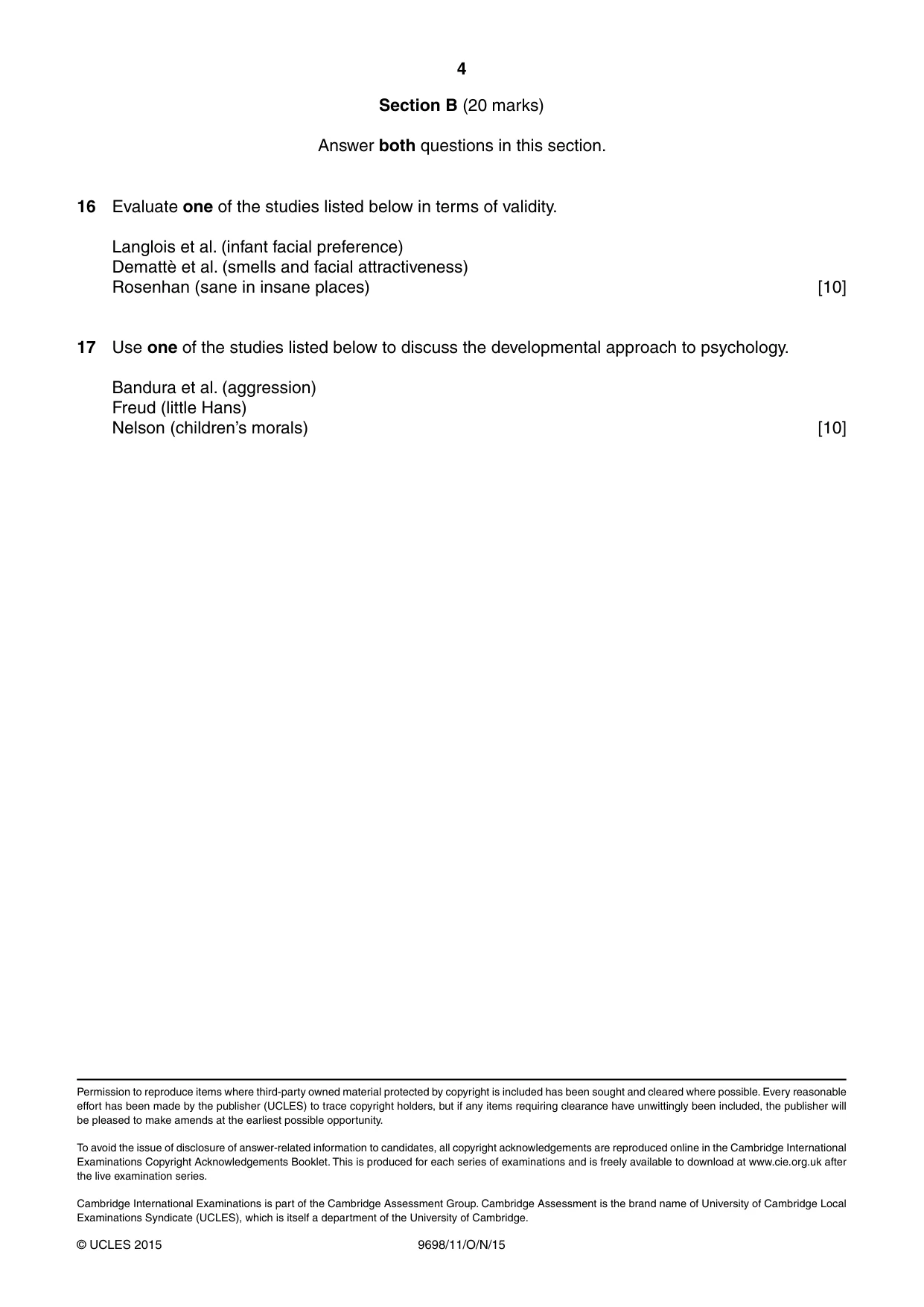
4 9698/11/O/N/15 © UCLES 2015 Permission to reproduce items where third-party owned material protected by copyright is included has been sought and cleared where possible. Every reasonable effort has been made by the publisher (UCLES) to trace copyright holders, but if any items requiring clearance have unwittingly been included, the publisher will be pleased to make amends at the earliest possible opportunity. To avoid the issue of disclosure of answer-related information to candidates, all copyright acknowledgements are reproduced online in the Cambridge International Examinations Copyright Acknowledgements Booklet. This is produced for each series of examinations and is freely available to download at www.cie.org.uk after the live examination series. Cambridge International Examinations is part of the Cambridge Assessment Group. Cambridge Assessment is the brand name of University of Cambridge Local Examinations Syndicate (UCLES), which is itself a department of the University of Cambridge. Section B (20 marks) Answer both questions in this section. 16 Evaluate one of the studies listed below in terms of validity. Langlois et al. (infant facial preference) Demattè et al. (smells and facial attractiveness) Rosenhan (sane in insane places) [10] 17 Use one of the studies listed below to discuss the developmental approach to psychology. Bandura et al. (aggression) Freud (little Hans) Nelson (children’s morals) [10]
Mark scheme, page 1
® IGCSE is the registered trademark of Cambridge International Examinations. CAMBRIDGE INTERNATIONAL EXAMINATIONS Cambridge International Advanced Subsidiary and Advanced Level MARK SCHEME for the October/November 2015 series 9698 PSYCHOLOGY 9698/11 Paper 1 (Core Studies 1), maximum raw mark 80 This mark scheme is published as an aid to teachers and candidates, to indicate the requirements of the examination. It shows the basis on which Examiners were instructed to award marks. It does not indicate the details of the discussions that took place at an Examiners’ meeting before marking began, which would have considered the acceptability of alternative answers. Mark schemes should be read in conjunction with the question paper and the Principal Examiner Report for Teachers. Cambridge will not enter into discussions about these mark schemes. Cambridge is publishing the mark schemes for the October/November 2015 series for most Cambridge IGCSE®, Cambridge International A and AS Level components and some Cambridge O Level components.
Mark scheme, page 2
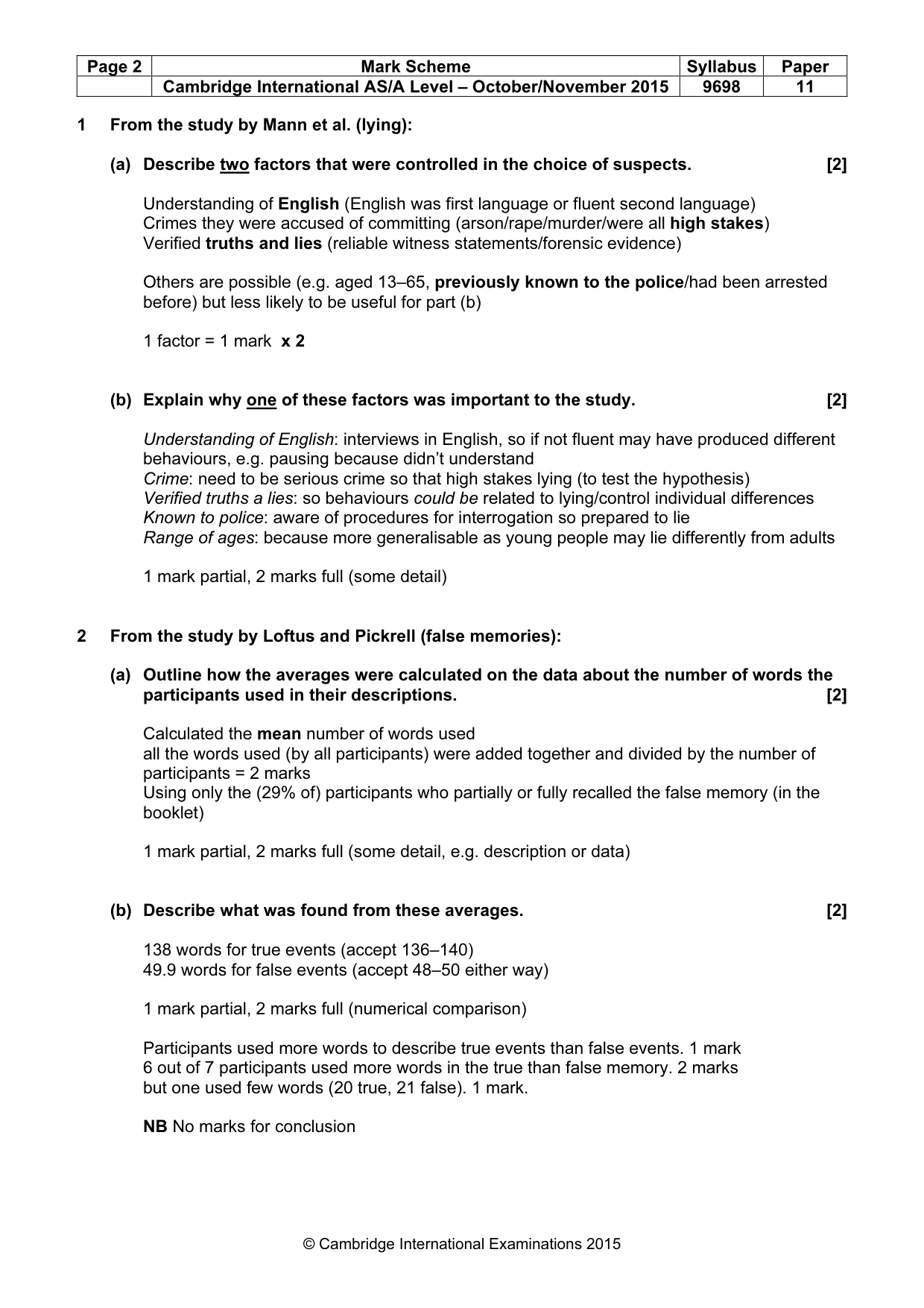
Page 2 Mark Scheme Syllabus Paper Cambridge International AS/A Level – October/November 2015 9698 11 © Cambridge International Examinations 2015 1 From the study by Mann et al. (lying): (a) Describe two factors that were controlled in the choice of suspects. [2] Understanding of English (English was first language or fluent second language) Crimes they were accused of committing (arson/rape/murder/were all high stakes) Verified truths and lies (reliable witness statements/forensic evidence) Others are possible (e.g. aged 13–65, previously known to the police/had been arrested before) but less likely to be useful for part (b) 1 factor = 1 mark x 2 (b) Explain why one of these factors was important to the study. [2] Understanding of English: interviews in English, so if not fluent may have produced different behaviours, e.g. pausing because didn’t understand Crime: need to be serious crime so that high stakes lying (to test the hypothesis) Verified truths a lies: so behaviours could be related to lying/control individual differences Known to police: aware of procedures for interrogation so prepared to lie Range of ages: because more generalisable as young people may lie differently from adults 1 mark partial, 2 marks full (some detail) 2 From the study by Loftus and Pickrell (false memories): (a) Outline how the averages were calculated on the data about the number of words the participants used in their descriptions. [2] Calculated the mean number of words used all the words used (by all participants) were added together and divided by the number of participants = 2 marks Using only the (29% of) participants who partially or fully recalled the false memory (in the booklet) 1 mark partial, 2 marks full (some detail, e.g. description or data) (b) Describe what was found from these averages. [2] 138 words for true events (accept 136–140) 49.9 words for false events (accept 48–50 either way) 1 mark partial, 2 marks full (numerical comparison) Participants used more words to describe true events than false events. 1 mark 6 out of 7 participants used more words in the true than false memory. 2 marks but one used few words (20 true, 21 false). 1 mark. NB No marks for conclusion
Mark scheme, page 3
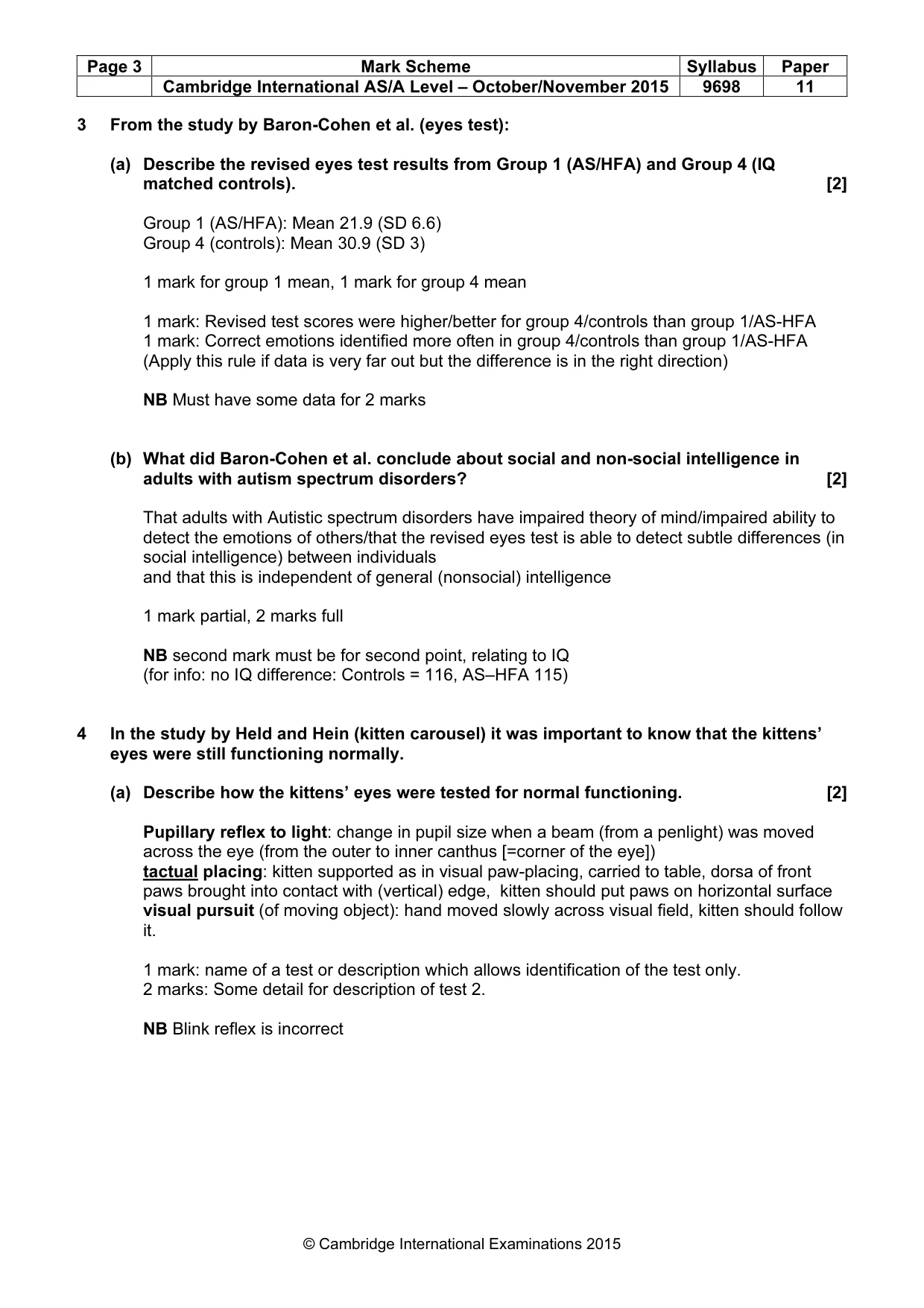
Page 3 Mark Scheme Syllabus Paper Cambridge International AS/A Level – October/November 2015 9698 11 © Cambridge International Examinations 2015 3 From the study by Baron-Cohen et al. (eyes test): (a) Describe the revised eyes test results from Group 1 (AS/HFA) and Group 4 (IQ matched controls). [2] Group 1 (AS/HFA): Mean 21.9 (SD 6.6) Group 4 (controls): Mean 30.9 (SD 3) 1 mark for group 1 mean, 1 mark for group 4 mean 1 mark: Revised test scores were higher/better for group 4/controls than group 1/AS-HFA 1 mark: Correct emotions identified more often in group 4/controls than group 1/AS-HFA (Apply this rule if data is very far out but the difference is in the right direction) NB Must have some data for 2 marks (b) What did Baron-Cohen et al. conclude about social and non-social intelligence in adults with autism spectrum disorders? [2] That adults with Autistic spectrum disorders have impaired theory of mind/impaired ability to detect the emotions of others/that the revised eyes test is able to detect subtle differences (in social intelligence) between individuals and that this is independent of general (nonsocial) intelligence 1 mark partial, 2 marks full NB second mark must be for second point, relating to IQ (for info: no IQ difference: Controls = 116, AS–HFA 115) 4 In the study by Held and Hein (kitten carousel) it was important to know that the kittens’ eyes were still functioning normally. (a) Describe how the kittens’ eyes were tested for normal functioning. [2] Pupillary reflex to light: change in pupil size when a beam (from a penlight) was moved across the eye (from the outer to inner canthus [=corner of the eye]) tactual placing: kitten supported as in visual paw-placing, carried to table, dorsa of front paws brought into contact with (vertical) edge, kitten should put paws on horizontal surface visual pursuit (of moving object): hand moved slowly across visual field, kitten should follow it. 1 mark: name of a test or description which allows identification of the test only. 2 marks: Some detail for description of test 2. NB Blink reflex is incorrect
Mark scheme, page 4
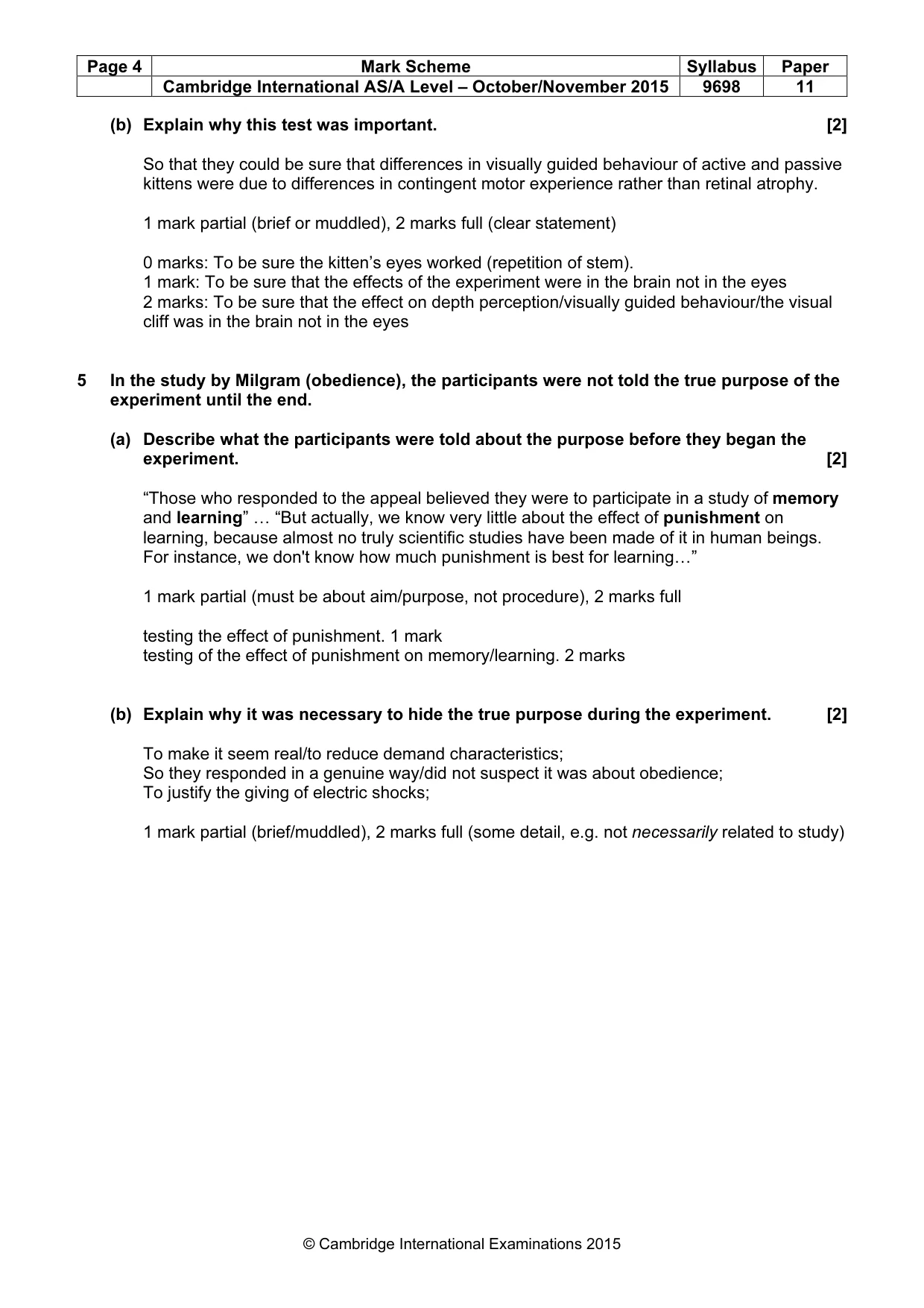
Page 4 Mark Scheme Syllabus Paper Cambridge International AS/A Level – October/November 2015 9698 11 © Cambridge International Examinations 2015 (b) Explain why this test was important. [2] So that they could be sure that differences in visually guided behaviour of active and passive kittens were due to differences in contingent motor experience rather than retinal atrophy. 1 mark partial (brief or muddled), 2 marks full (clear statement) 0 marks: To be sure the kitten’s eyes worked (repetition of stem). 1 mark: To be sure that the effects of the experiment were in the brain not in the eyes 2 marks: To be sure that the effect on depth perception/visually guided behaviour/the visual cliff was in the brain not in the eyes 5 In the study by Milgram (obedience), the participants were not told the true purpose of the experiment until the end. (a) Describe what the participants were told about the purpose before they began the experiment. [2] “Those who responded to the appeal believed they were to participate in a study of memory and learning” … “But actually, we know very little about the effect of punishment on learning, because almost no truly scientific studies have been made of it in human beings. For instance, we don't know how much punishment is best for learning…” 1 mark partial (must be about aim/purpose, not procedure), 2 marks full testing the effect of punishment. 1 mark testing of the effect of punishment on memory/learning. 2 marks (b) Explain why it was necessary to hide the true purpose during the experiment. [2] To make it seem real/to reduce demand characteristics; So they responded in a genuine way/did not suspect it was about obedience; To justify the giving of electric shocks; 1 mark partial (brief/muddled), 2 marks full (some detail, e.g. not necessarily related to study)
Mark scheme, page 5
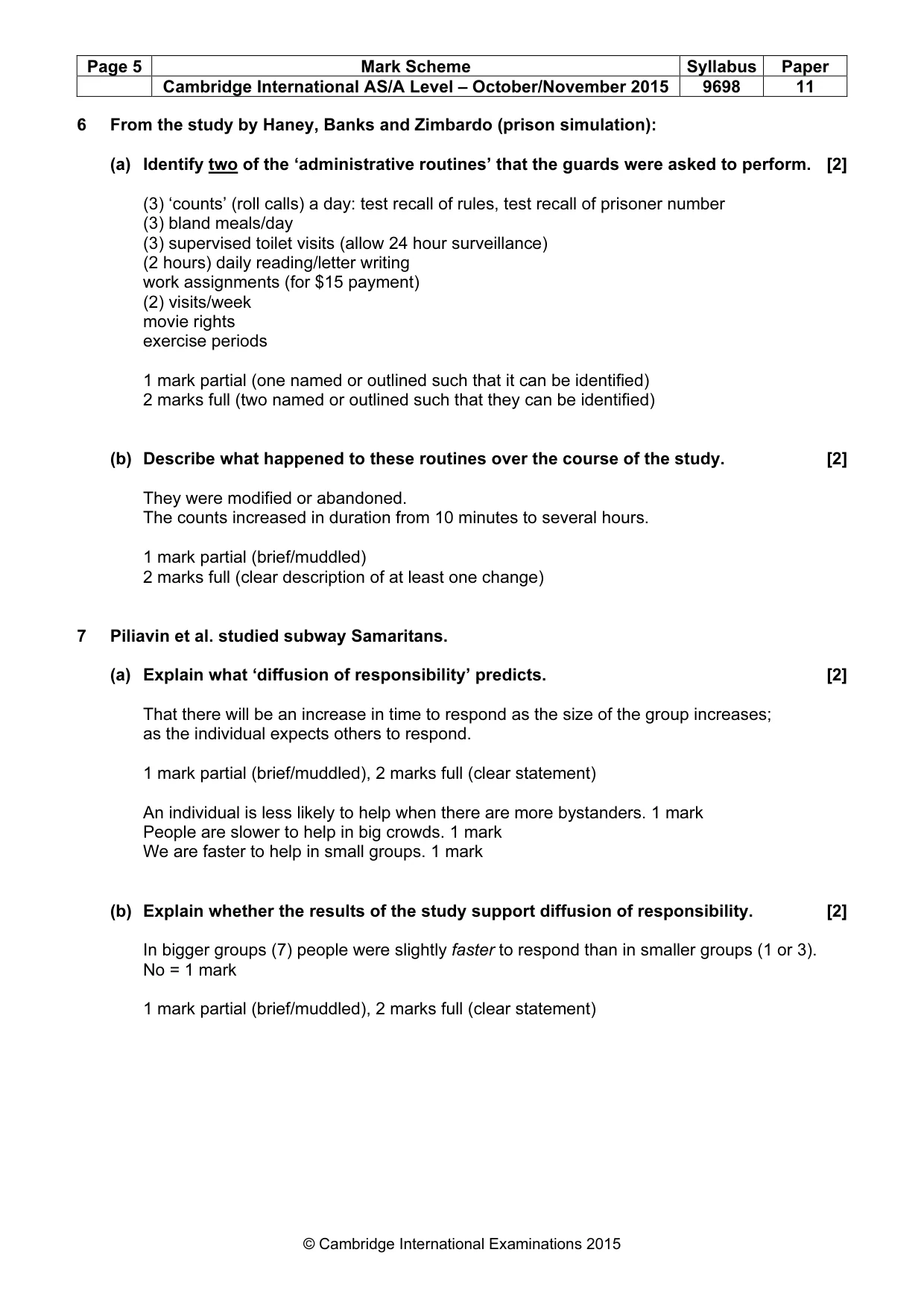
Page 5 Mark Scheme Syllabus Paper Cambridge International AS/A Level – October/November 2015 9698 11 © Cambridge International Examinations 2015 6 From the study by Haney, Banks and Zimbardo (prison simulation): (a) Identify two of the ‘administrative routines’ that the guards were asked to perform. [2] (3) ‘counts’ (roll calls) a day: test recall of rules, test recall of prisoner number (3) bland meals/day (3) supervised toilet visits (allow 24 hour surveillance) (2 hours) daily reading/letter writing work assignments (for $15 payment) (2) visits/week movie rights exercise periods 1 mark partial (one named or outlined such that it can be identified) 2 marks full (two named or outlined such that they can be identified) (b) Describe what happened to these routines over the course of the study. [2] They were modified or abandoned. The counts increased in duration from 10 minutes to several hours. 1 mark partial (brief/muddled) 2 marks full (clear description of at least one change) 7 Piliavin et al. studied subway Samaritans. (a) Explain what ‘diffusion of responsibility’ predicts. [2] That there will be an increase in time to respond as the size of the group increases; as the individual expects others to respond. 1 mark partial (brief/muddled), 2 marks full (clear statement) An individual is less likely to help when there are more bystanders. 1 mark People are slower to help in big crowds. 1 mark We are faster to help in small groups. 1 mark (b) Explain whether the results of the study support diffusion of responsibility. [2] In bigger groups (7) people were slightly faster to respond than in smaller groups (1 or 3). No = 1 mark 1 mark partial (brief/muddled), 2 marks full (clear statement)
Mark scheme, page 6
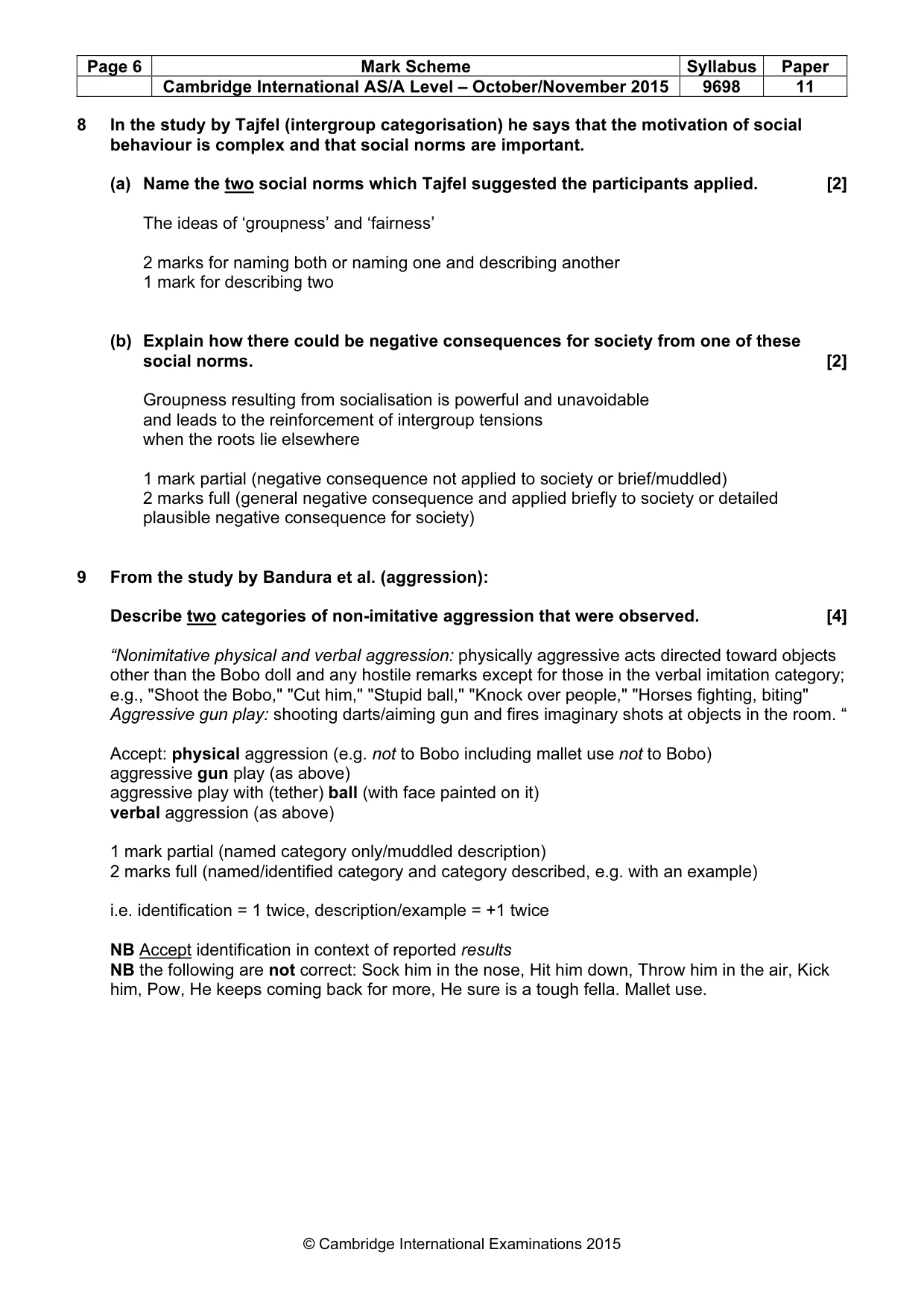
Page 6 Mark Scheme Syllabus Paper Cambridge International AS/A Level – October/November 2015 9698 11 © Cambridge International Examinations 2015 8 In the study by Tajfel (intergroup categorisation) he says that the motivation of social behaviour is complex and that social norms are important. (a) Name the two social norms which Tajfel suggested the participants applied. [2] The ideas of ‘groupness’ and ‘fairness’ 2 marks for naming both or naming one and describing another 1 mark for describing two (b) Explain how there could be negative consequences for society from one of these social norms. [2] Groupness resulting from socialisation is powerful and unavoidable and leads to the reinforcement of intergroup tensions when the roots lie elsewhere 1 mark partial (negative consequence not applied to society or brief/muddled) 2 marks full (general negative consequence and applied briefly to society or detailed plausible negative consequence for society) 9 From the study by Bandura et al. (aggression): Describe two categories of non-imitative aggression that were observed. [4] “Nonimitative physical and verbal aggression: physically aggressive acts directed toward objects other than the Bobo doll and any hostile remarks except for those in the verbal imitation category; e.g., "Shoot the Bobo," "Cut him," "Stupid ball," "Knock over people," "Horses fighting, biting" Aggressive gun play: shooting darts/aiming gun and fires imaginary shots at objects in the room. “ Accept: physical aggression (e.g. not to Bobo including mallet use not to Bobo) aggressive gun play (as above) aggressive play with (tether) ball (with face painted on it) verbal aggression (as above) 1 mark partial (named category only/muddled description) 2 marks full (named/identified category and category described, e.g. with an example) i.e. identification = 1 twice, description/example = +1 twice NB Accept identification in context of reported results NB the following are not correct: Sock him in the nose, Hit him down, Throw him in the air, Kick him, Pow, He keeps coming back for more, He sure is a tough fella. Mallet use.
Mark scheme, page 7
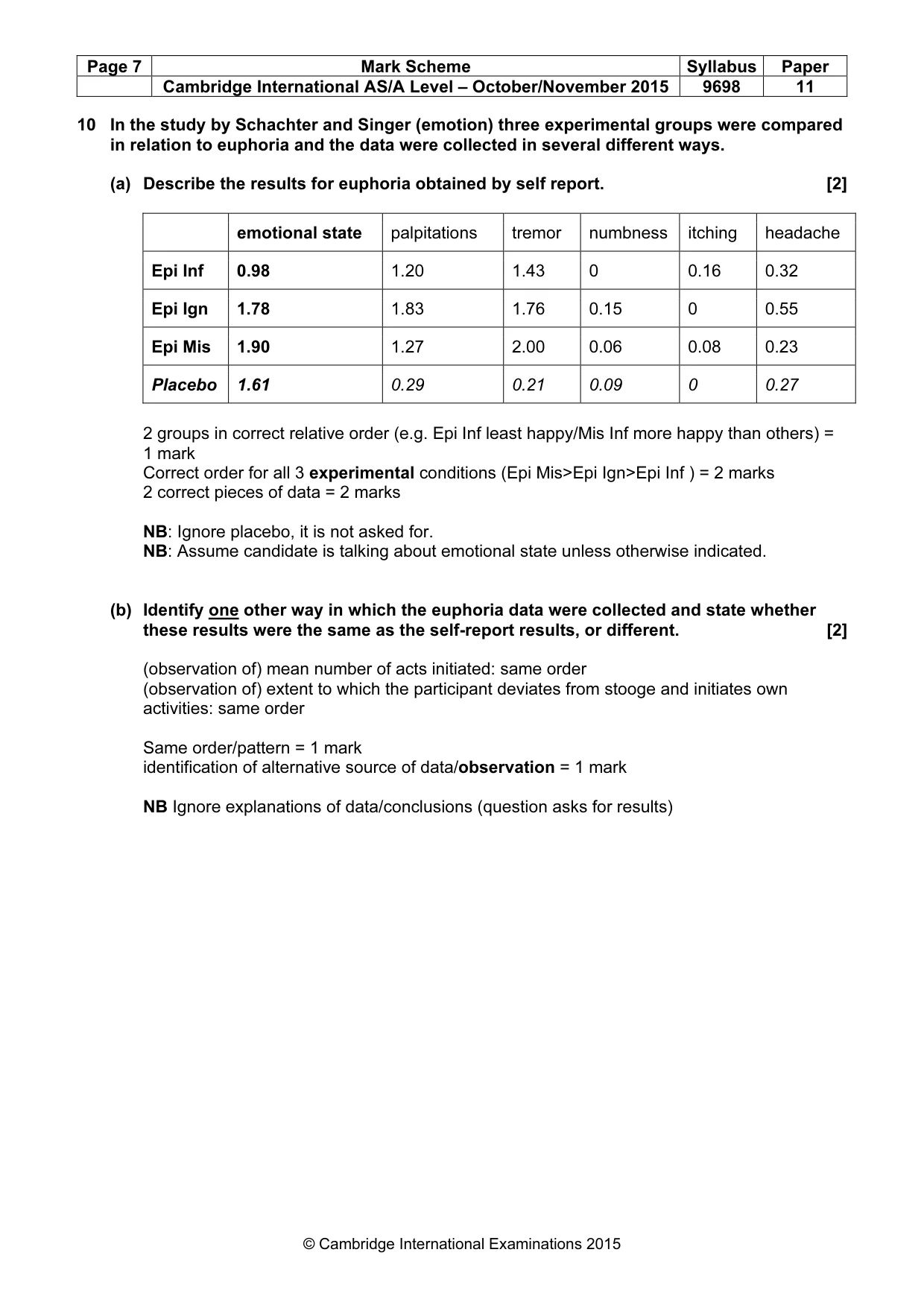
Page 7 Mark Scheme Syllabus Paper Cambridge International AS/A Level – October/November 2015 9698 11 © Cambridge International Examinations 2015 10 In the study by Schachter and Singer (emotion) three experimental groups were compared in relation to euphoria and the data were collected in several different ways. (a) Describe the results for euphoria obtained by self report. [2] emotional state palpitations tremor numbness itching headache Epi Inf 0.98 1.20 1.43 0 0.16 0.32 Epi Ign 1.78 1.83 1.76 0.15 0 0.55 Epi Mis 1.90 1.27 2.00 0.06 0.08 0.23 Placebo 1.61 0.29 0.21 0.09 0 0.27 2 groups in correct relative order (e.g. Epi Inf least happy/Mis Inf more happy than others) = 1 mark Correct order for all 3 experimental conditions (Epi Mis>Epi Ign>Epi Inf ) = 2 marks 2 correct pieces of data = 2 marks NB: Ignore placebo, it is not asked for. NB: Assume candidate is talking about emotional state unless otherwise indicated. (b) Identify one other way in which the euphoria data were collected and state whether these results were the same as the self-report results, or different. [2] (observation of) mean number of acts initiated: same order (observation of) extent to which the participant deviates from stooge and initiates own activities: same order Same order/pattern = 1 mark identification of alternative source of data/observation = 1 mark NB Ignore explanations of data/conclusions (question asks for results)
Mark scheme, page 8
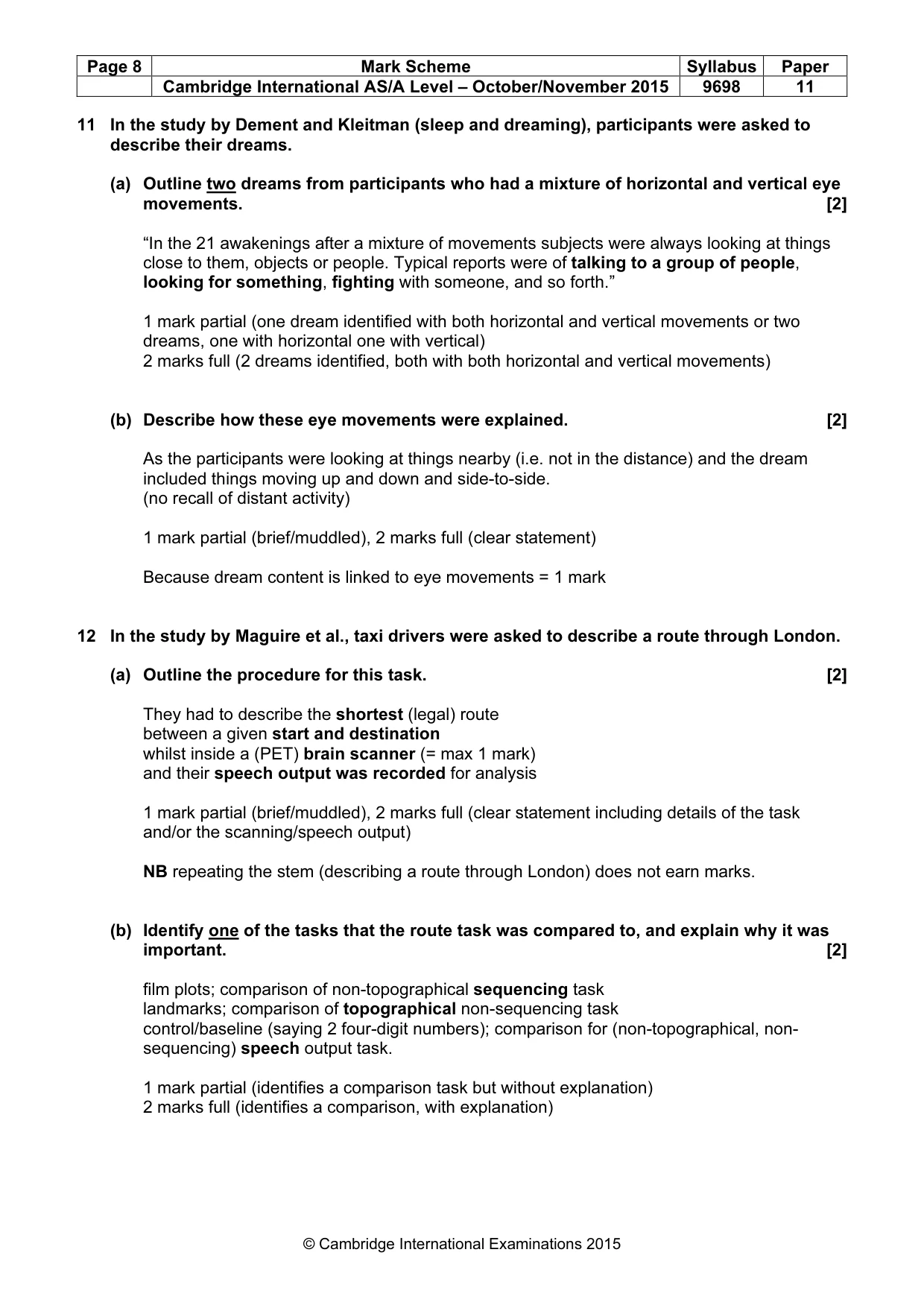
Page 8 Mark Scheme Syllabus Paper Cambridge International AS/A Level – October/November 2015 9698 11 © Cambridge International Examinations 2015 11 In the study by Dement and Kleitman (sleep and dreaming), participants were asked to describe their dreams. (a) Outline two dreams from participants who had a mixture of horizontal and vertical eye movements. [2] “In the 21 awakenings after a mixture of movements subjects were always looking at things close to them, objects or people. Typical reports were of talking to a group of people, looking for something, fighting with someone, and so forth.” 1 mark partial (one dream identified with both horizontal and vertical movements or two dreams, one with horizontal one with vertical) 2 marks full (2 dreams identified, both with both horizontal and vertical movements) (b) Describe how these eye movements were explained. [2] As the participants were looking at things nearby (i.e. not in the distance) and the dream included things moving up and down and side-to-side. (no recall of distant activity) 1 mark partial (brief/muddled), 2 marks full (clear statement) Because dream content is linked to eye movements = 1 mark 12 In the study by Maguire et al., taxi drivers were asked to describe a route through London. (a) Outline the procedure for this task. [2] They had to describe the shortest (legal) route between a given start and destination whilst inside a (PET) brain scanner (= max 1 mark) and their speech output was recorded for analysis 1 mark partial (brief/muddled), 2 marks full (clear statement including details of the task and/or the scanning/speech output) NB repeating the stem (describing a route through London) does not earn marks. (b) Identify one of the tasks that the route task was compared to, and explain why it was important. [2] film plots; comparison of non-topographical sequencing task landmarks; comparison of topographical non-sequencing task control/baseline (saying 2 four-digit numbers); comparison for (non-topographical, non- sequencing) speech output task. 1 mark partial (identifies a comparison task but without explanation) 2 marks full (identifies a comparison, with explanation)
Mark scheme, page 9
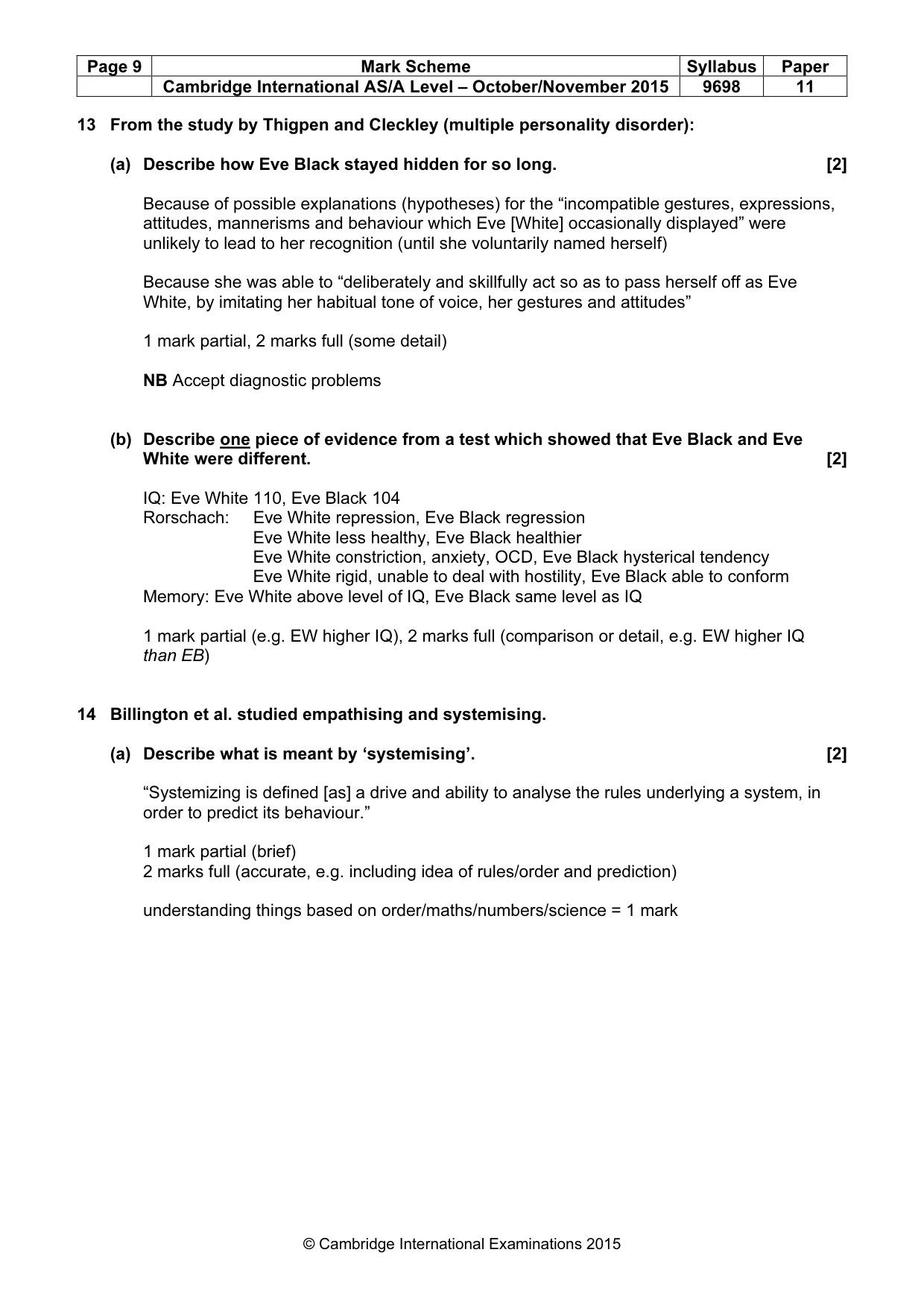
Page 9 Mark Scheme Syllabus Paper Cambridge International AS/A Level – October/November 2015 9698 11 © Cambridge International Examinations 2015 13 From the study by Thigpen and Cleckley (multiple personality disorder): (a) Describe how Eve Black stayed hidden for so long. [2] Because of possible explanations (hypotheses) for the “incompatible gestures, expressions, attitudes, mannerisms and behaviour which Eve [White] occasionally displayed” were unlikely to lead to her recognition (until she voluntarily named herself) Because she was able to “deliberately and skillfully act so as to pass herself off as Eve White, by imitating her habitual tone of voice, her gestures and attitudes” 1 mark partial, 2 marks full (some detail) NB Accept diagnostic problems (b) Describe one piece of evidence from a test which showed that Eve Black and Eve White were different. [2] IQ: Eve White 110, Eve Black 104 Rorschach: Eve White repression, Eve Black regression Eve White less healthy, Eve Black healthier Eve White constriction, anxiety, OCD, Eve Black hysterical tendency Eve White rigid, unable to deal with hostility, Eve Black able to conform Memory: Eve White above level of IQ, Eve Black same level as IQ 1 mark partial (e.g. EW higher IQ), 2 marks full (comparison or detail, e.g. EW higher IQ than EB) 14 Billington et al. studied empathising and systemising. (a) Describe what is meant by ‘systemising’. [2] “Systemizing is defined [as] a drive and ability to analyse the rules underlying a system, in order to predict its behaviour.” 1 mark partial (brief) 2 marks full (accurate, e.g. including idea of rules/order and prediction) understanding things based on order/maths/numbers/science = 1 mark
Mark scheme, page 10
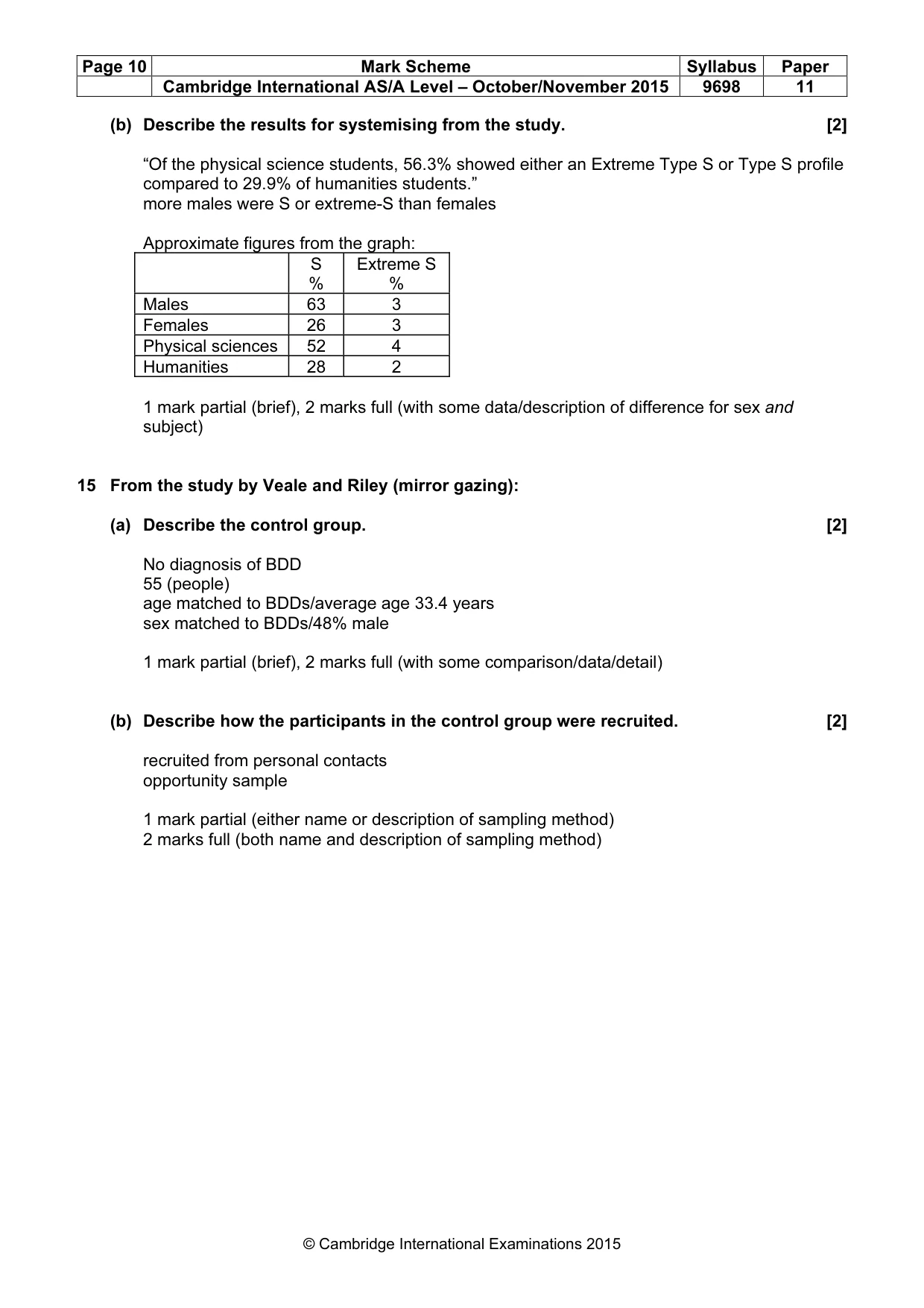
Page 10 Mark Scheme Syllabus Paper Cambridge International AS/A Level – October/November 2015 9698 11 © Cambridge International Examinations 2015 (b) Describe the results for systemising from the study. [2] “Of the physical science students, 56.3% showed either an Extreme Type S or Type S profile compared to 29.9% of humanities students.” more males were S or extreme-S than females Approximate figures from the graph: 1 mark partial (brief), 2 marks full (with some data/description of difference for sex and subject) 15 From the study by Veale and Riley (mirror gazing): (a) Describe the control group. [2] No diagnosis of BDD 55 (people) age matched to BDDs/average age 33.4 years sex matched to BDDs/48% male 1 mark partial (brief), 2 marks full (with some comparison/data/detail) (b) Describe how the participants in the control group were recruited. [2] recruited from personal contacts opportunity sample 1 mark partial (either name or description of sampling method) 2 marks full (both name and description of sampling method) S % Extreme S % Males 63 3 Females 26 3 Physical sciences 52 4 Humanities 28 2
Mark scheme, page 11
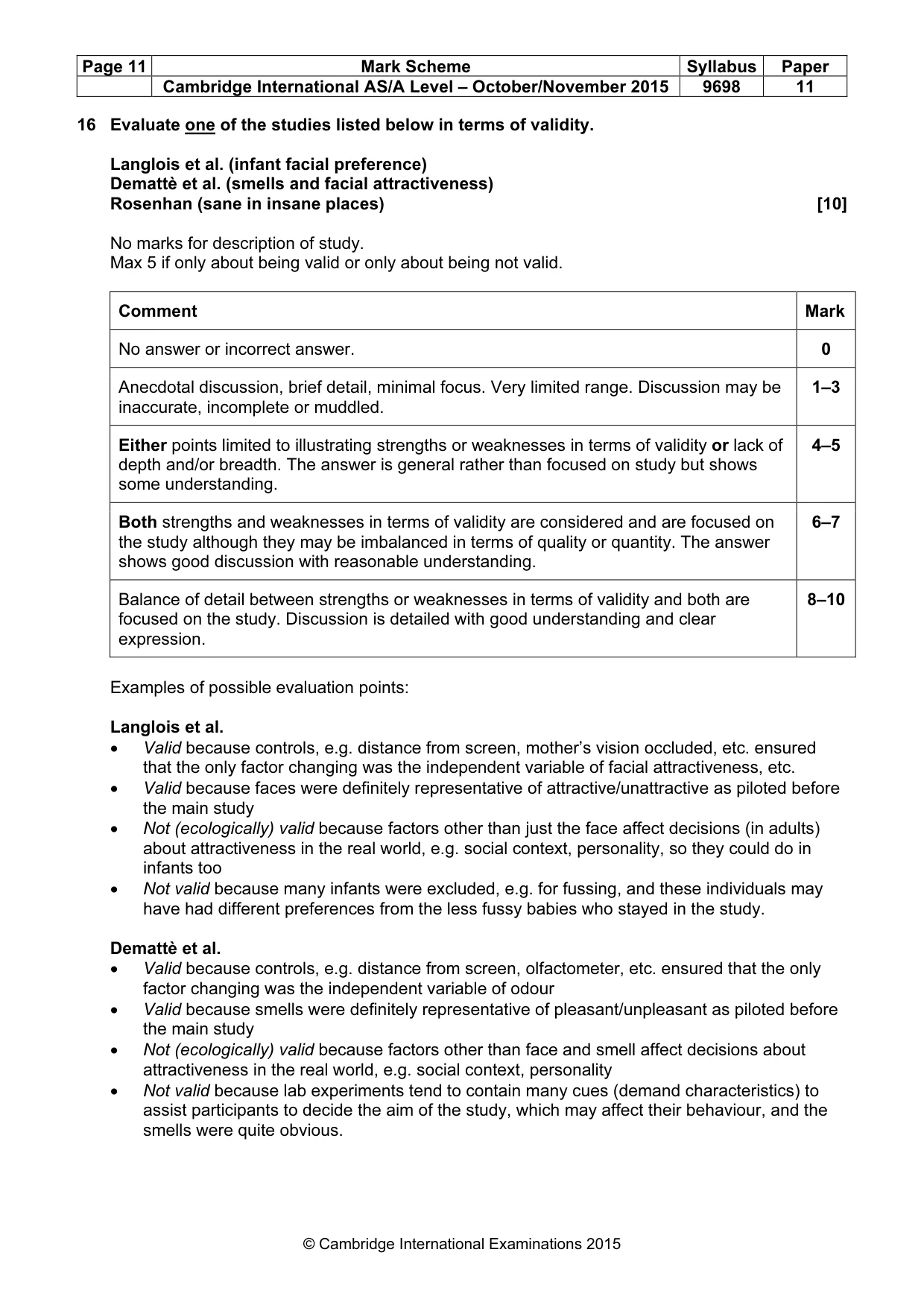
Page 11 Mark Scheme Syllabus Paper Cambridge International AS/A Level – October/November 2015 9698 11 © Cambridge International Examinations 2015 16 Evaluate one of the studies listed below in terms of validity. Langlois et al. (infant facial preference) Demattè et al. (smells and facial attractiveness) Rosenhan (sane in insane places) [10] No marks for description of study. Max 5 if only about being valid or only about being not valid. Comment Mark No answer or incorrect answer. 0 Anecdotal discussion, brief detail, minimal focus. Very limited range. Discussion may be inaccurate, incomplete or muddled. 1–3 Either points limited to illustrating strengths or weaknesses in terms of validity or lack of depth and/or breadth. The answer is general rather than focused on study but shows some understanding. 4–5 Both strengths and weaknesses in terms of validity are considered and are focused on the study although they may be imbalanced in terms of quality or quantity. The answer shows good discussion with reasonable understanding. 6–7 Balance of detail between strengths or weaknesses in terms of validity and both are focused on the study. Discussion is detailed with good understanding and clear expression. 8–10 Examples of possible evaluation points: Langlois et al. • Valid because controls, e.g. distance from screen, mother’s vision occluded, etc. ensured that the only factor changing was the independent variable of facial attractiveness, etc. • Valid because faces were definitely representative of attractive/unattractive as piloted before the main study • Not (ecologically) valid because factors other than just the face affect decisions (in adults) about attractiveness in the real world, e.g. social context, personality, so they could do in infants too • Not valid because many infants were excluded, e.g. for fussing, and these individuals may have had different preferences from the less fussy babies who stayed in the study. Demattè et al. • Valid because controls, e.g. distance from screen, olfactometer, etc. ensured that the only factor changing was the independent variable of odour • Valid because smells were definitely representative of pleasant/unpleasant as piloted before the main study • Not (ecologically) valid because factors other than face and smell affect decisions about attractiveness in the real world, e.g. social context, personality • Not valid because lab experiments tend to contain many cues (demand characteristics) to assist participants to decide the aim of the study, which may affect their behaviour, and the smells were quite obvious.
Mark scheme, page 12
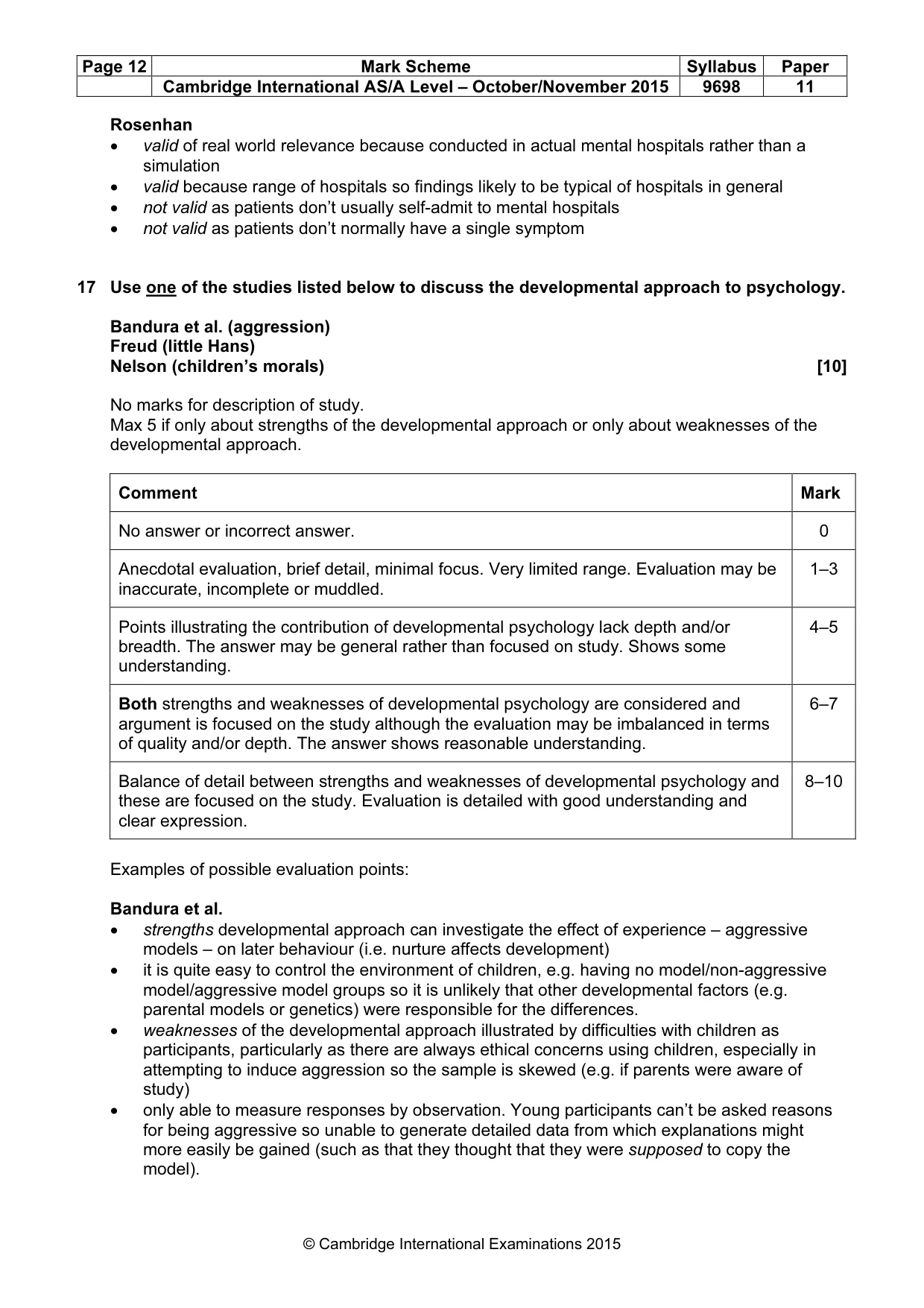
Page 12 Mark Scheme Syllabus Paper Cambridge International AS/A Level – October/November 2015 9698 11 © Cambridge International Examinations 2015 Rosenhan • valid of real world relevance because conducted in actual mental hospitals rather than a simulation • valid because range of hospitals so findings likely to be typical of hospitals in general • not valid as patients don’t usually self-admit to mental hospitals • not valid as patients don’t normally have a single symptom 17 Use one of the studies listed below to discuss the developmental approach to psychology. Bandura et al. (aggression) Freud (little Hans) Nelson (children’s morals) [10] No marks for description of study. Max 5 if only about strengths of the developmental approach or only about weaknesses of the developmental approach. Comment Mark No answer or incorrect answer. 0 Anecdotal evaluation, brief detail, minimal focus. Very limited range. Evaluation may be inaccurate, incomplete or muddled. 1–3 Points illustrating the contribution of developmental psychology lack depth and/or breadth. The answer may be general rather than focused on study. Shows some understanding. 4–5 Both strengths and weaknesses of developmental psychology are considered and argument is focused on the study although the evaluation may be imbalanced in terms of quality and/or depth. The answer shows reasonable understanding. 6–7 Balance of detail between strengths and weaknesses of developmental psychology and these are focused on the study. Evaluation is detailed with good understanding and clear expression. 8–10 Examples of possible evaluation points: Bandura et al. • strengths developmental approach can investigate the effect of experience – aggressive models – on later behaviour (i.e. nurture affects development) • it is quite easy to control the environment of children, e.g. having no model/non-aggressive model/aggressive model groups so it is unlikely that other developmental factors (e.g. parental models or genetics) were responsible for the differences. • weaknesses of the developmental approach illustrated by difficulties with children as participants, particularly as there are always ethical concerns using children, especially in attempting to induce aggression so the sample is skewed (e.g. if parents were aware of study) • only able to measure responses by observation. Young participants can’t be asked reasons for being aggressive so unable to generate detailed data from which explanations might more easily be gained (such as that they thought that they were supposed to copy the model).
Mark scheme, page 13
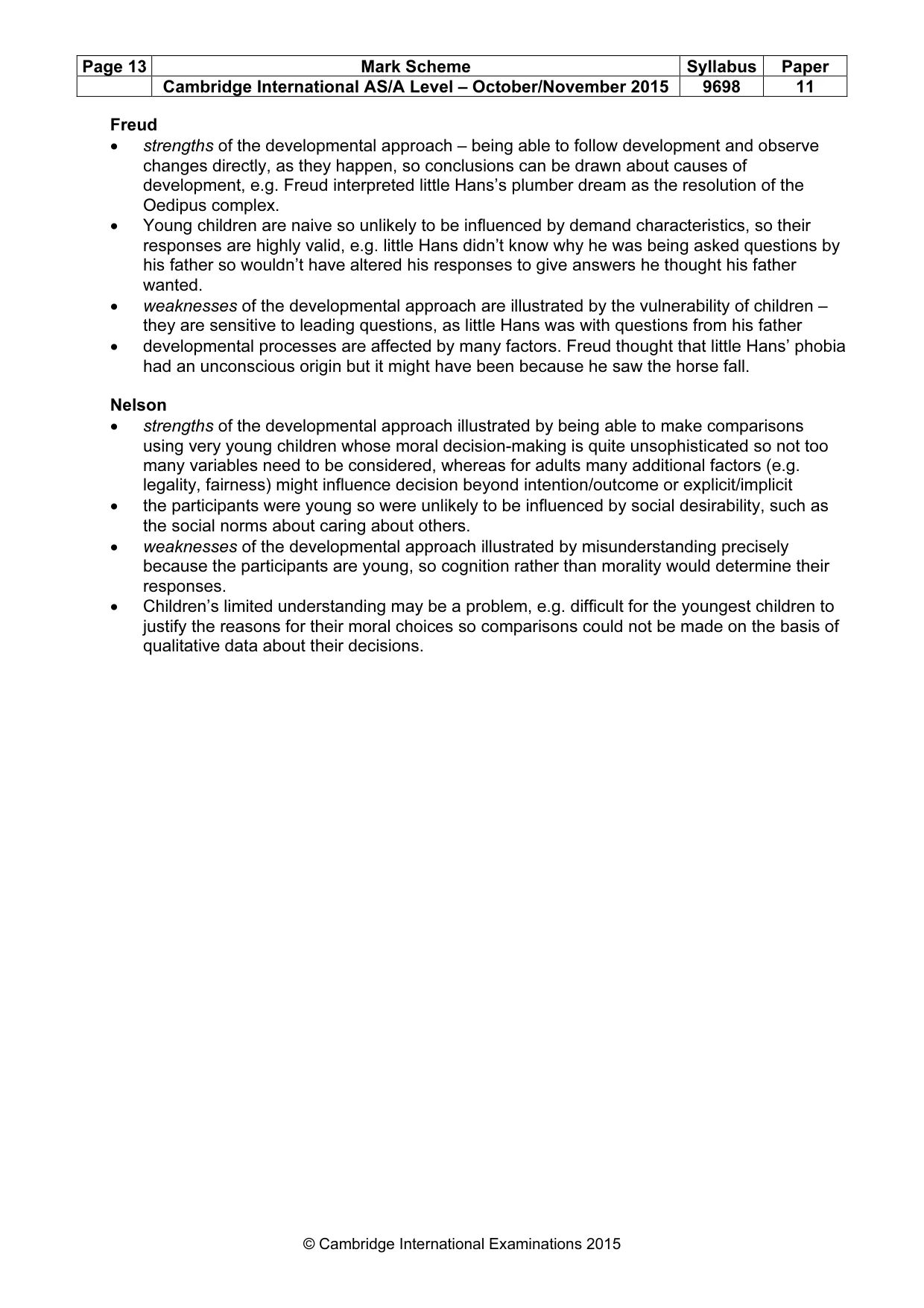
Page 13 Mark Scheme Syllabus Paper Cambridge International AS/A Level – October/November 2015 9698 11 © Cambridge International Examinations 2015 Freud • strengths of the developmental approach – being able to follow development and observe changes directly, as they happen, so conclusions can be drawn about causes of development, e.g. Freud interpreted little Hans’s plumber dream as the resolution of the Oedipus complex. • Young children are naive so unlikely to be influenced by demand characteristics, so their responses are highly valid, e.g. little Hans didn’t know why he was being asked questions by his father so wouldn’t have altered his responses to give answers he thought his father wanted. • weaknesses of the developmental approach are illustrated by the vulnerability of children – they are sensitive to leading questions, as little Hans was with questions from his father • developmental processes are affected by many factors. Freud thought that little Hans’ phobia had an unconscious origin but it might have been because he saw the horse fall. Nelson • strengths of the developmental approach illustrated by being able to make comparisons using very young children whose moral decision-making is quite unsophisticated so not too many variables need to be considered, whereas for adults many additional factors (e.g. legality, fairness) might influence decision beyond intention/outcome or explicit/implicit • the participants were young so were unlikely to be influenced by social desirability, such as the social norms about caring about others. • weaknesses of the developmental approach illustrated by misunderstanding precisely because the participants are young, so cognition rather than morality would determine their responses. • Children’s limited understanding may be a problem, e.g. difficult for the youngest children to justify the reasons for their moral choices so comparisons could not be made on the basis of qualitative data about their decisions.
What you needed in this session
Cambridge’s own grade thresholds for 2015 Oct/Nov, Paper 1 · Variant 1. A higher threshold means an easier paper — the bar moves with how the cohort did.