Cambridge A Level Psychology 9698 — 2018 May/June Paper 1 · Variant 1
9698/11/M/J/18 · 80 marks · ≈90 min
The question paper and its mark scheme, free to read here and free to download. This is Cambridge’s own paper, exactly as it was sat.
Question paper4 pages
Mark scheme21 pages
Answers below. Sit the paper first if you are practising.
Paper as text
Question paper, page 1
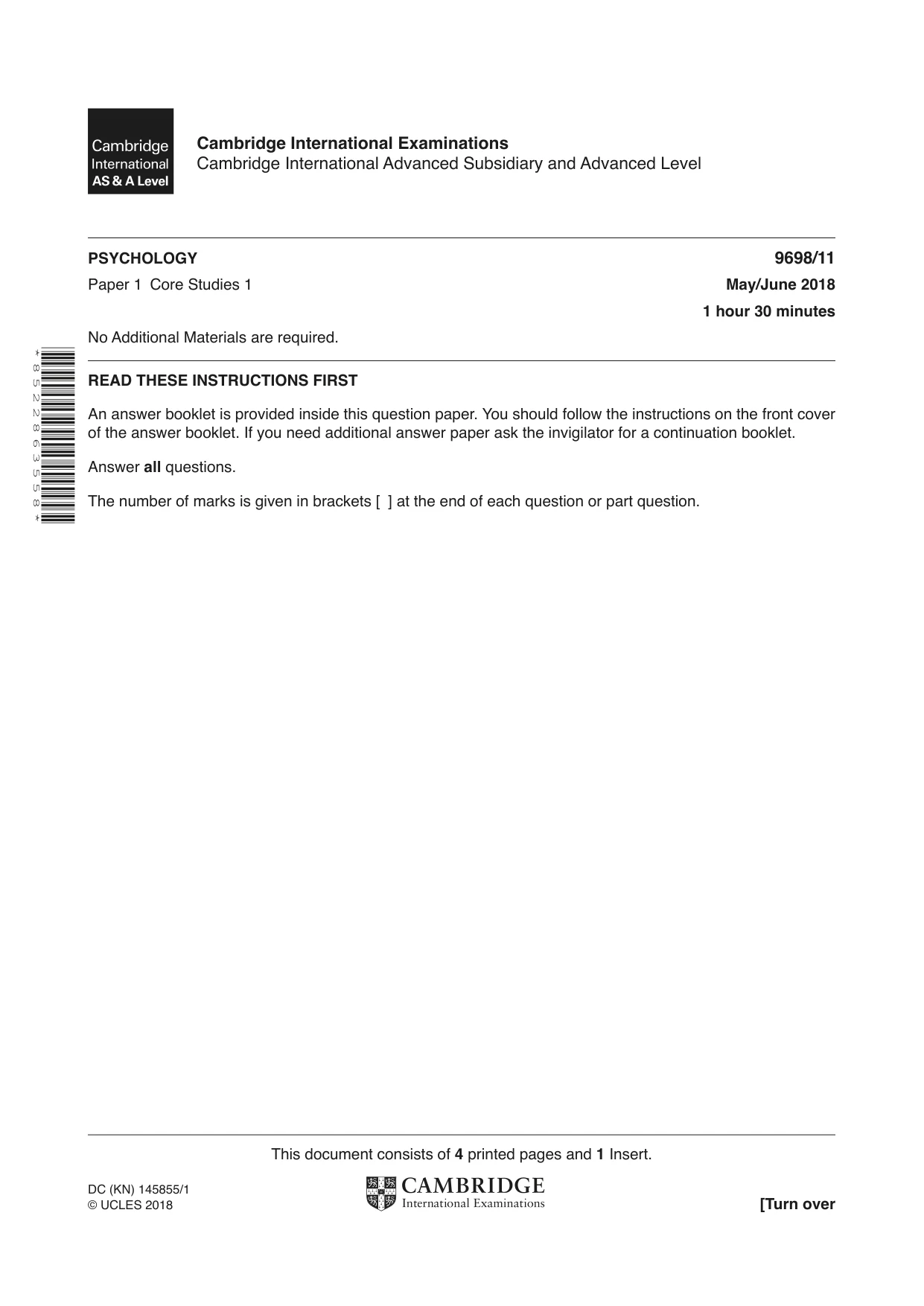
* 8 5 2 2 8 6 3 5 5 8 * This document consists of 4 printed pages and 1 Insert. DC (KN) 145855/1 © UCLES 2018 [Turn over PSYCHOLOGY 9698/11 Paper 1 Core Studies 1 May/June 2018 1 hour 30 minutes No Additional Materials are required. READ THESE INSTRUCTIONS FIRST An answer booklet is provided inside this question paper. You should follow the instructions on the front cover of the answer booklet. If you need additional answer paper ask the invigilator for a continuation booklet. Answer all questions. The number of marks is given in brackets [ ] at the end of each question or part question. Cambridge International Examinations Cambridge International Advanced Subsidiary and Advanced Level
Question paper, page 2
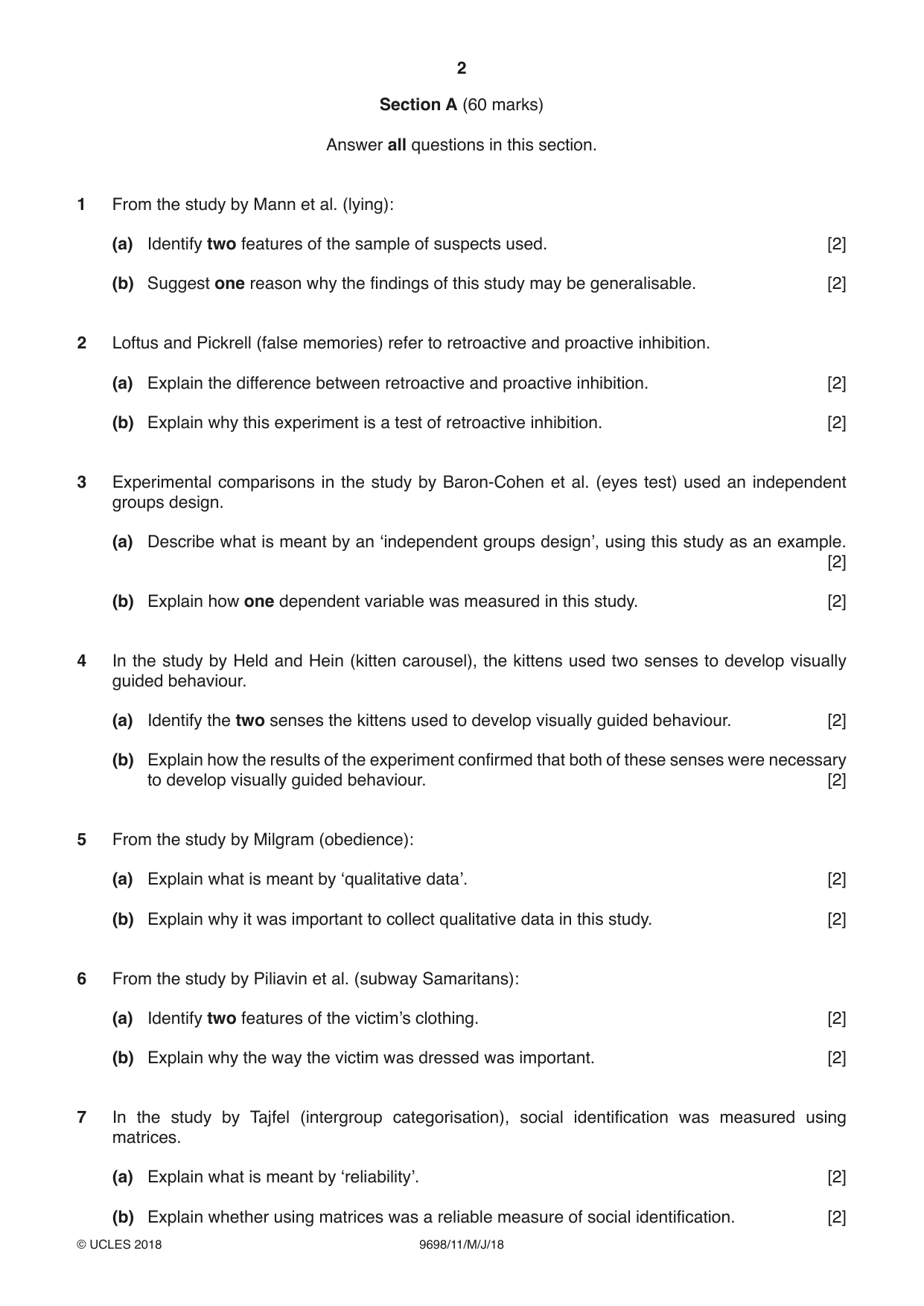
2 9698/11/M/J/18 © UCLES 2018 Section A (60 marks) Answer all questions in this section. 1 From the study by Mann et al. (lying): (a) Identify two features of the sample of suspects used. [2] (b) Suggest one reason why the findings of this study may be generalisable. [2] 2 Loftus and Pickrell (false memories) refer to retroactive and proactive inhibition. (a) Explain the difference between retroactive and proactive inhibition. [2] (b) Explain why this experiment is a test of retroactive inhibition. [2] 3 Experimental comparisons in the study by Baron-Cohen et al. (eyes test) used an independent groups design. (a) Describe what is meant by an ‘independent groups design’, using this study as an example. [2] (b) Explain how one dependent variable was measured in this study. [2] 4 In the study by Held and Hein (kitten carousel), the kittens used two senses to develop visually guided behaviour. (a) Identify the two senses the kittens used to develop visually guided behaviour. [2] (b) Explain how the results of the experiment confirmed that both of these senses were necessary to develop visually guided behaviour. [2] 5 From the study by Milgram (obedience): (a) Explain what is meant by ‘qualitative data’. [2] (b) Explain why it was important to collect qualitative data in this study. [2] 6 From the study by Piliavin et al. (subway Samaritans): (a) Identify two features of the victim’s clothing. [2] (b) Explain why the way the victim was dressed was important. [2] 7 In the study by Tajfel (intergroup categorisation), social identification was measured using matrices. (a) Explain what is meant by ‘reliability’. [2] (b) Explain whether using matrices was a reliable measure of social identification. [2]
Question paper, page 3
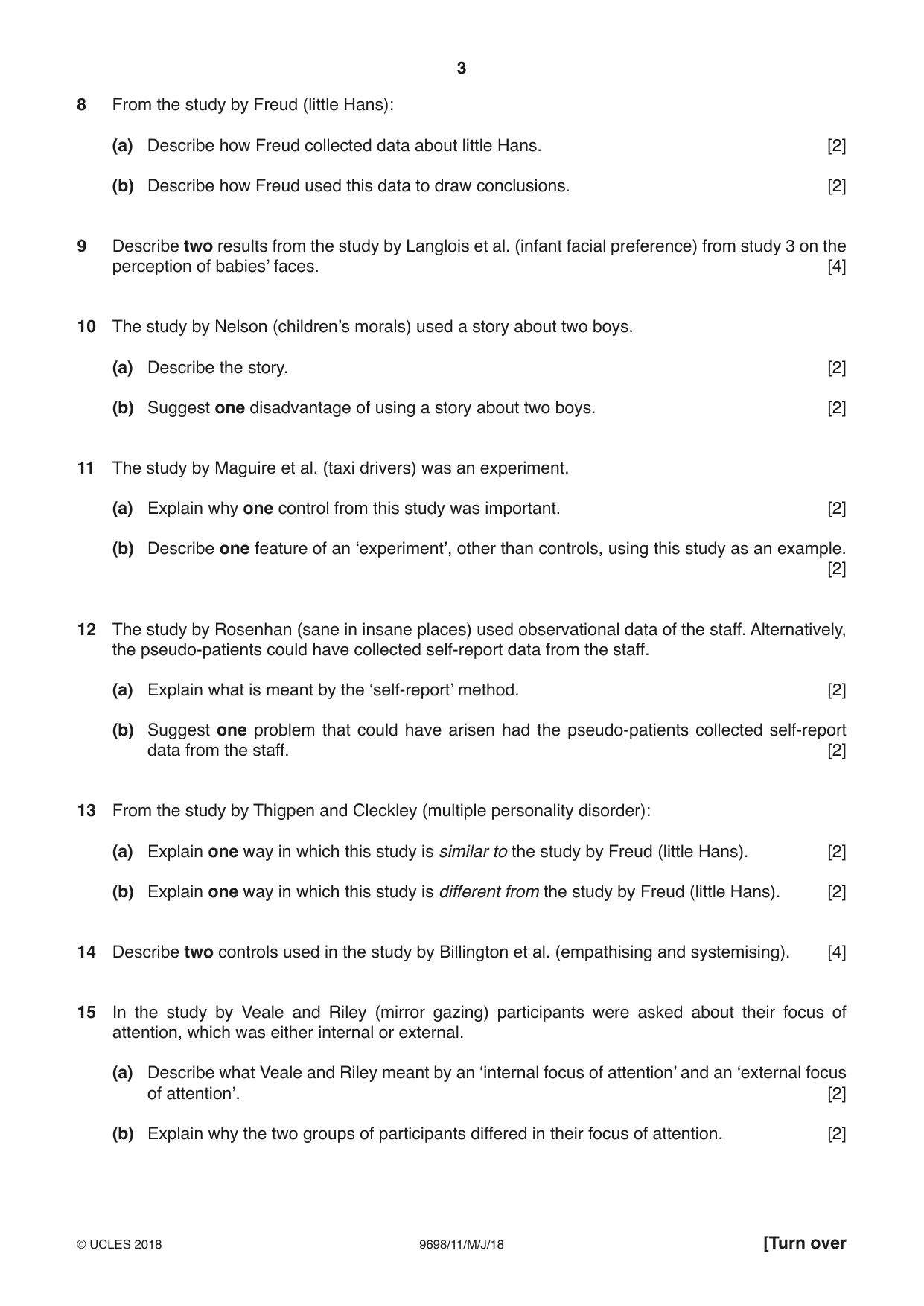
3 9698/11/M/J/18 © UCLES 2018 [Turn over 8 From the study by Freud (little Hans): (a) Describe how Freud collected data about little Hans. [2] (b) Describe how Freud used this data to draw conclusions. [2] 9 Describe two results from the study by Langlois et al. (infant facial preference) from study 3 on the perception of babies’ faces. [4] 10 The study by Nelson (children’s morals) used a story about two boys. (a) Describe the story. [2] (b) Suggest one disadvantage of using a story about two boys. [2] 11 The study by Maguire et al. (taxi drivers) was an experiment. (a) Explain why one control from this study was important. [2] (b) Describe one feature of an ‘experiment’, other than controls, using this study as an example. [2] 12 The study by Rosenhan (sane in insane places) used observational data of the staff. Alternatively, the pseudo-patients could have collected self-report data from the staff. (a) Explain what is meant by the ‘self-report’ method. [2] (b) Suggest one problem that could have arisen had the pseudo-patients collected self-report data from the staff. [2] 13 From the study by Thigpen and Cleckley (multiple personality disorder): (a) Explain one way in which this study is similar to the study by Freud (little Hans). [2] (b) Explain one way in which this study is different from the study by Freud (little Hans). [2] 14 Describe two controls used in the study by Billington et al. (empathising and systemising). [4] 15 In the study by Veale and Riley (mirror gazing) participants were asked about their focus of attention, which was either internal or external. (a) Describe what Veale and Riley meant by an ‘internal focus of attention’ and an ‘external focus of attention’. [2] (b) Explain why the two groups of participants differed in their focus of attention. [2]
Question paper, page 4
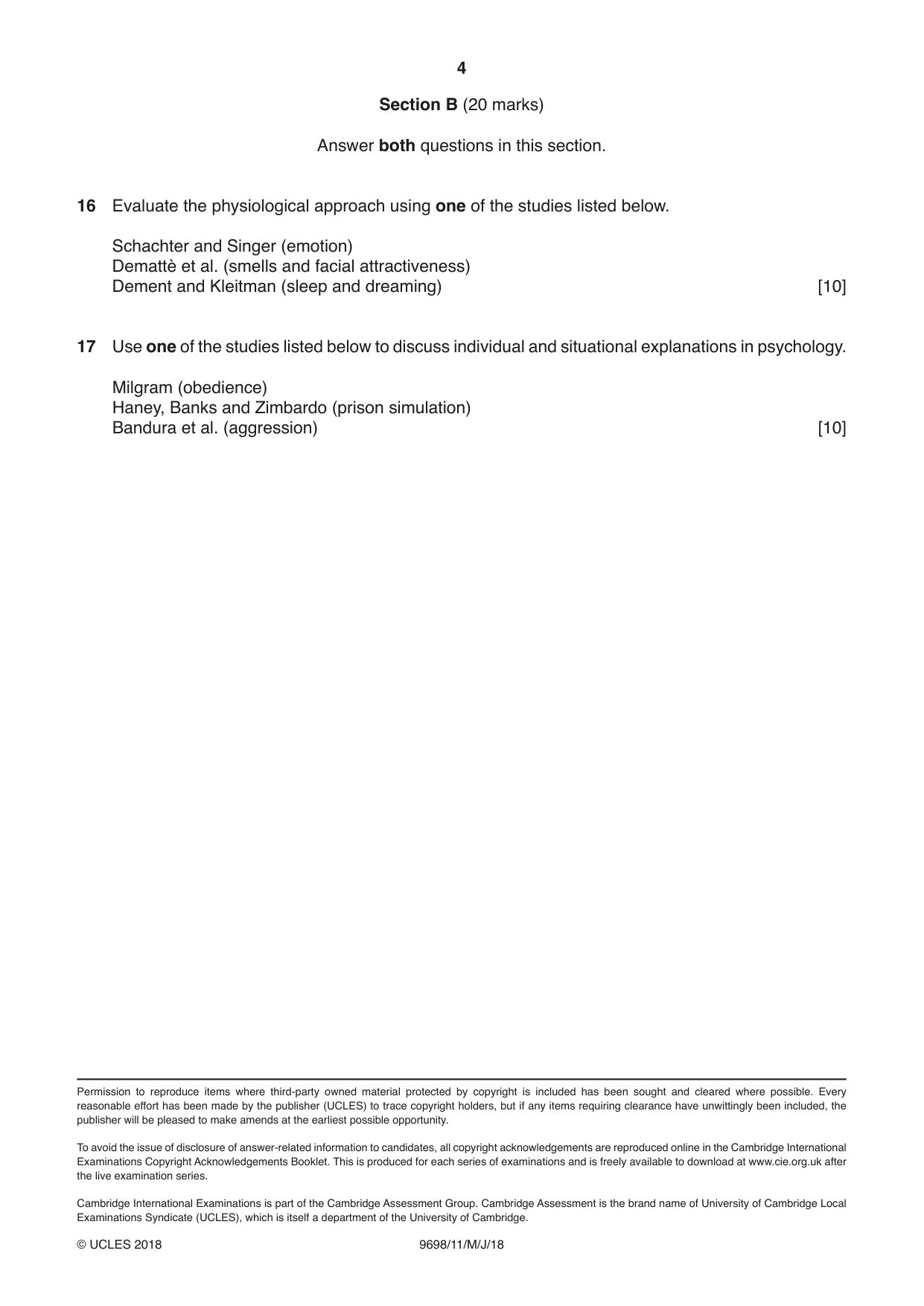
4 9698/11/M/J/18 © UCLES 2018 Permission to reproduce items where third-party owned material protected by copyright is included has been sought and cleared where possible. Every reasonable effort has been made by the publisher (UCLES) to trace copyright holders, but if any items requiring clearance have unwittingly been included, the publisher will be pleased to make amends at the earliest possible opportunity. To avoid the issue of disclosure of answer-related information to candidates, all copyright acknowledgements are reproduced online in the Cambridge International Examinations Copyright Acknowledgements Booklet. This is produced for each series of examinations and is freely available to download at www.cie.org.uk after the live examination series. Cambridge International Examinations is part of the Cambridge Assessment Group. Cambridge Assessment is the brand name of University of Cambridge Local Examinations Syndicate (UCLES), which is itself a department of the University of Cambridge. Section B (20 marks) Answer both questions in this section. 16 Evaluate the physiological approach using one of the studies listed below. Schachter and Singer (emotion) Demattè et al. (smells and facial attractiveness) Dement and Kleitman (sleep and dreaming) [10] 17 Use one of the studies listed below to discuss individual and situational explanations in psychology. Milgram (obedience) Haney, Banks and Zimbardo (prison simulation) Bandura et al. (aggression) [10]
Mark scheme, page 1
IGCSE™ is a registered trademark. This document consists of 21 printed pages. © UCLES 2018 [Turn over Cambridge Assessment International Education Cambridge International Advanced Subsidiary and Advanced Level PSYCHOLOGY 9698/11 Paper 1 Core Studies 1 May/June 2018 MARK SCHEME Maximum Mark: 80 Published This mark scheme is published as an aid to teachers and candidates, to indicate the requirements of the examination. It shows the basis on which Examiners were instructed to award marks. It does not indicate the details of the discussions that took place at an Examiners’ meeting before marking began, which would have considered the acceptability of alternative answers. Mark schemes should be read in conjunction with the question paper and the Principal Examiner Report for Teachers. Cambridge International will not enter into discussions about these mark schemes. Cambridge International is publishing the mark schemes for the May/June 2018 series for most Cambridge IGCSE™, Cambridge International A and AS Level and Cambridge Pre-U components, and some Cambridge O Level components.
Mark scheme, page 2
9698/11 Cambridge International AS/A Level – Mark Scheme PUBLISHED May/June 2018 © UCLES 2018 Page 2 of 21 Generic Marking Principles These general marking principles must be applied by all examiners when marking candidate answers. They should be applied alongside the specific content of the mark scheme or generic level descriptors for a question. Each question paper and mark scheme will also comply with these marking principles. GENERIC MARKING PRINCIPLE 1: Marks must be awarded in line with: • the specific content of the mark scheme or the generic level descriptors for the question • the specific skills defined in the mark scheme or in the generic level descriptors for the question • the standard of response required by a candidate as exemplified by the standardisation scripts. GENERIC MARKING PRINCIPLE 2: Marks awarded are always whole marks (not half marks, or other fractions). GENERIC MARKING PRINCIPLE 3: Marks must be awarded positively: • marks are awarded for correct/valid answers, as defined in the mark scheme. However, credit is given for valid answers which go beyond the scope of the syllabus and mark scheme, referring to your Team Leader as appropriate • marks are awarded when candidates clearly demonstrate what they know and can do • marks are not deducted for errors • marks are not deducted for omissions • answers should only be judged on the quality of spelling, punctuation and grammar when these features are specifically assessed by the question as indicated by the mark scheme. The meaning, however, should be unambiguous. GENERIC MARKING PRINCIPLE 4: Rules must be applied consistently e.g. in situations where candidates have not followed instructions or in the application of generic level descriptors.
Mark scheme, page 3
9698/11 Cambridge International AS/A Level – Mark Scheme PUBLISHED May/June 2018 © UCLES 2018 Page 3 of 21 GENERIC MARKING PRINCIPLE 5: Marks should be awarded using the full range of marks defined in the mark scheme for the question (however; the use of the full mark range may be limited according to the quality of the candidate responses seen). GENERIC MARKING PRINCIPLE 6: Marks awarded are based solely on the requirements as defined in the mark scheme. Marks should not be awarded with grade thresholds or grade descriptors in mind.
Mark scheme, page 4
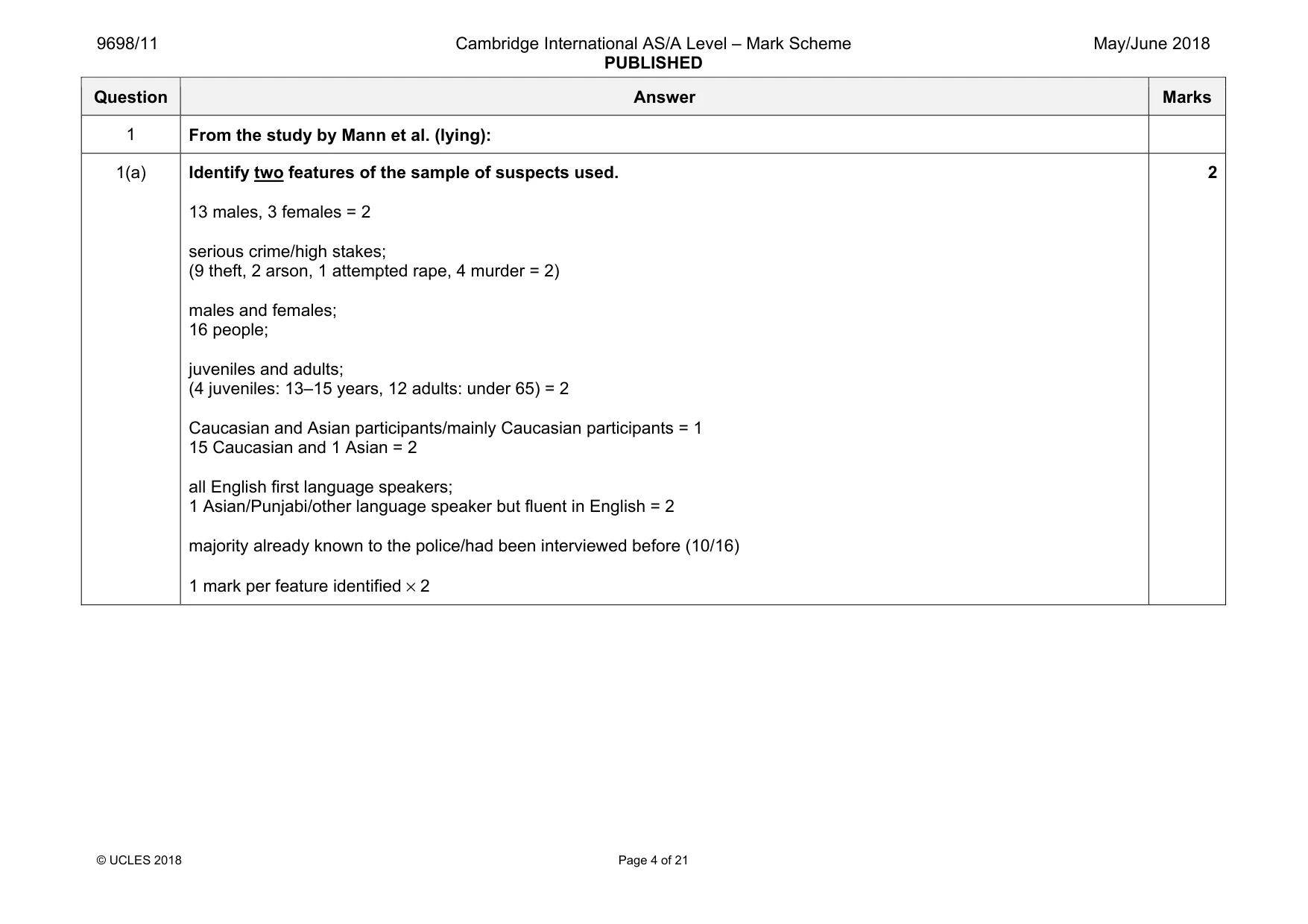
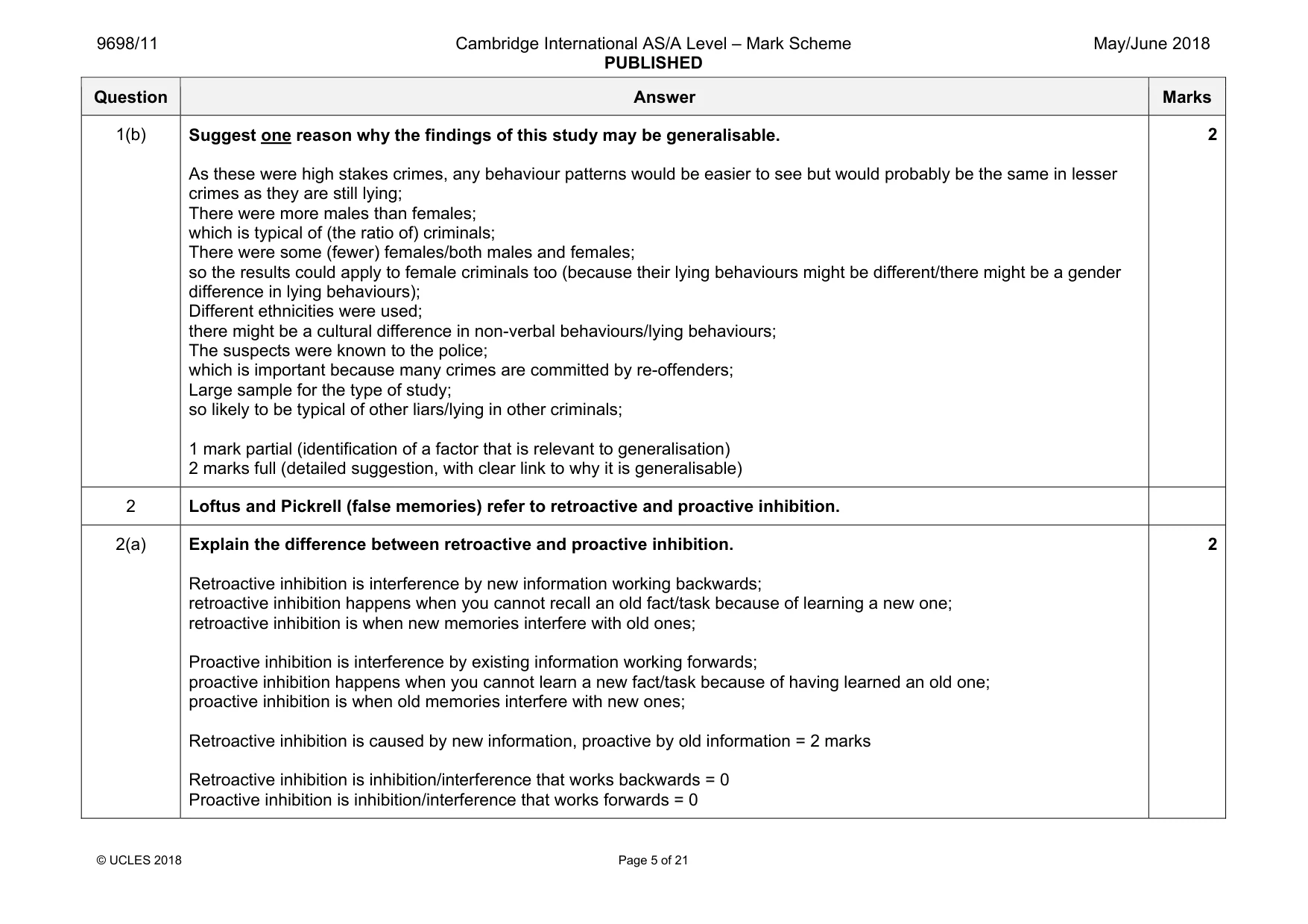
9698/11 Cambridge International AS/A Level – Mark Scheme PUBLISHED May/June 2018 © UCLES 2018 Page 4 of 21 Question Answer Marks 1 From the study by Mann et al. (lying): 1(a) Identify two features of the sample of suspects used. 13 males, 3 females = 2 serious crime/high stakes; (9 theft, 2 arson, 1 attempted rape, 4 murder = 2) males and females; 16 people; juveniles and adults; (4 juveniles: 13–15 years, 12 adults: under 65) = 2 Caucasian and Asian participants/mainly Caucasian participants = 1 15 Caucasian and 1 Asian = 2 all English first language speakers; 1 Asian/Punjabi/other language speaker but fluent in English = 2 majority already known to the police/had been interviewed before (10/16) 1 mark per feature identified × 2 2
Mark scheme, page 5
9698/11 Cambridge International AS/A Level – Mark Scheme PUBLISHED May/June 2018 © UCLES 2018 Page 5 of 21 Question Answer Marks 1(b) Suggest one reason why the findings of this study may be generalisable. As these were high stakes crimes, any behaviour patterns would be easier to see but would probably be the same in lesser crimes as they are still lying; There were more males than females; which is typical of (the ratio of) criminals; There were some (fewer) females/both males and females; so the results could apply to female criminals too (because their lying behaviours might be different/there might be a gender difference in lying behaviours); Different ethnicities were used; there might be a cultural difference in non-verbal behaviours/lying behaviours; The suspects were known to the police; which is important because many crimes are committed by re-offenders; Large sample for the type of study; so likely to be typical of other liars/lying in other criminals; 1 mark partial (identification of a factor that is relevant to generalisation) 2 marks full (detailed suggestion, with clear link to why it is generalisable) 2 2 Loftus and Pickrell (false memories) refer to retroactive and proactive inhibition. 2(a) Explain the difference between retroactive and proactive inhibition. Retroactive inhibition is interference by new information working backwards; retroactive inhibition happens when you cannot recall an old fact/task because of learning a new one; retroactive inhibition is when new memories interfere with old ones; Proactive inhibition is interference by existing information working forwards; proactive inhibition happens when you cannot learn a new fact/task because of having learned an old one; proactive inhibition is when old memories interfere with new ones; Retroactive inhibition is caused by new information, proactive by old information = 2 marks Retroactive inhibition is inhibition/interference that works backwards = 0 Proactive inhibition is inhibition/interference that works forwards = 0 2
Mark scheme, page 6
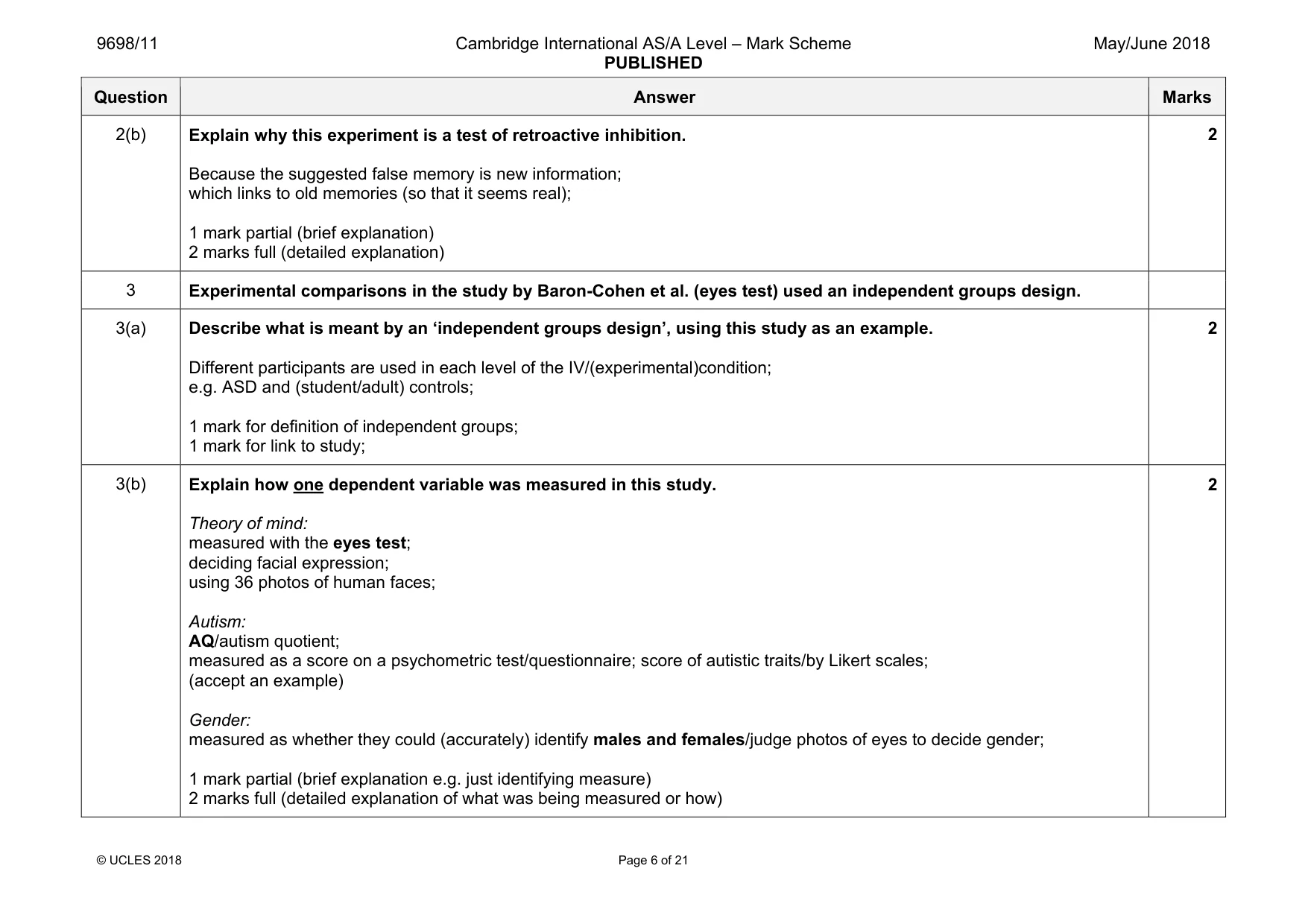
9698/11 Cambridge International AS/A Level – Mark Scheme PUBLISHED May/June 2018 © UCLES 2018 Page 6 of 21 Question Answer Marks 2(b) Explain why this experiment is a test of retroactive inhibition. Because the suggested false memory is new information; which links to old memories (so that it seems real); 1 mark partial (brief explanation) 2 marks full (detailed explanation) 2 3 Experimental comparisons in the study by Baron-Cohen et al. (eyes test) used an independent groups design. 3(a) Describe what is meant by an ‘independent groups design’, using this study as an example. Different participants are used in each level of the IV/(experimental)condition; e.g. ASD and (student/adult) controls; 1 mark for definition of independent groups; 1 mark for link to study; 2 3(b) Explain how one dependent variable was measured in this study. Theory of mind: measured with the eyes test; deciding facial expression; using 36 photos of human faces; Autism: AQ/autism quotient; measured as a score on a psychometric test/questionnaire; score of autistic traits/by Likert scales; (accept an example) Gender: measured as whether they could (accurately) identify males and females/judge photos of eyes to decide gender; 1 mark partial (brief explanation e.g. just identifying measure) 2 marks full (detailed explanation of what was being measured or how) 2
Mark scheme, page 7
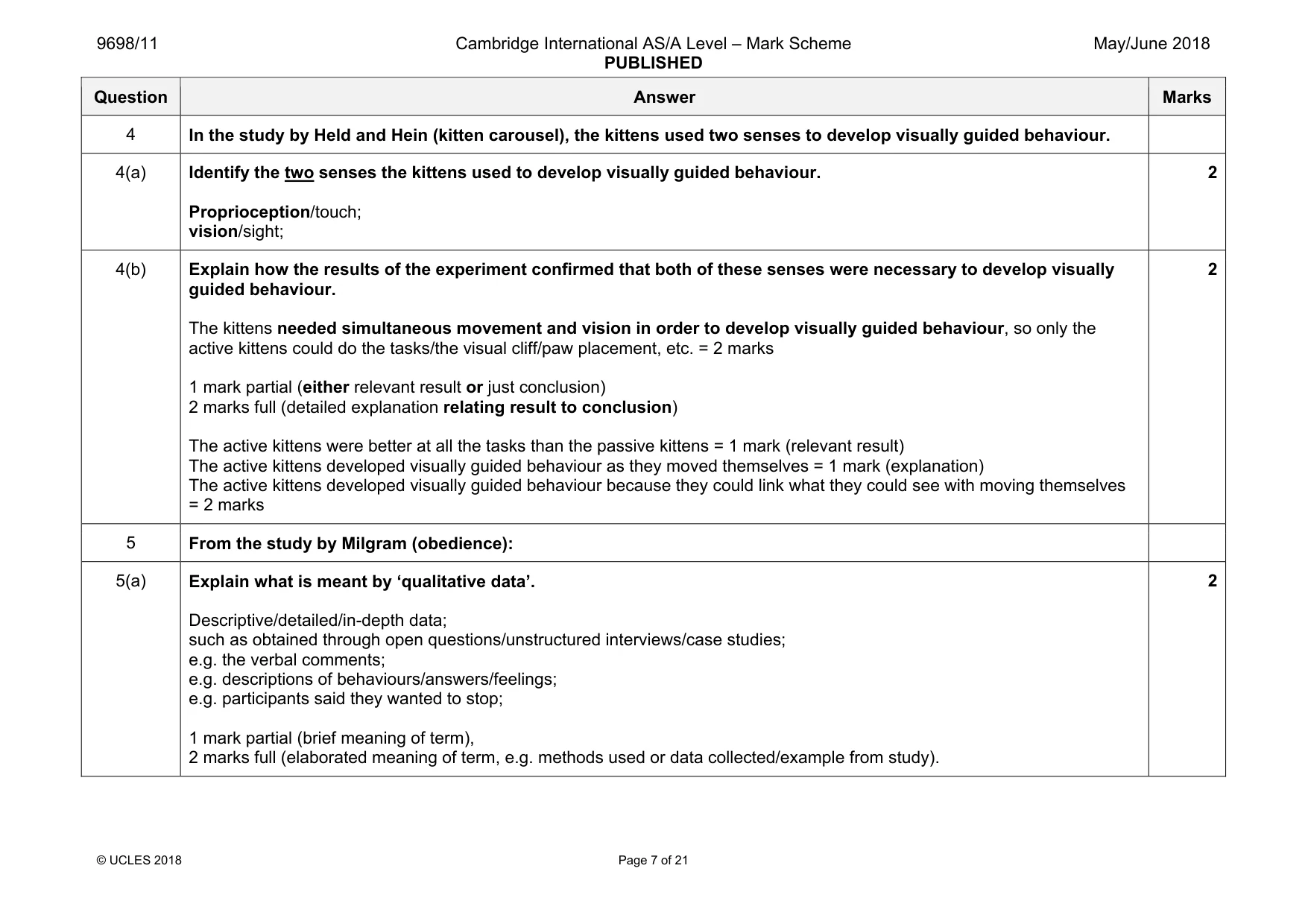
9698/11 Cambridge International AS/A Level – Mark Scheme PUBLISHED May/June 2018 © UCLES 2018 Page 7 of 21 Question Answer Marks 4 In the study by Held and Hein (kitten carousel), the kittens used two senses to develop visually guided behaviour. 4(a) Identify the two senses the kittens used to develop visually guided behaviour. Proprioception/touch; vision/sight; 2 4(b) Explain how the results of the experiment confirmed that both of these senses were necessary to develop visually guided behaviour. The kittens needed simultaneous movement and vision in order to develop visually guided behaviour, so only the active kittens could do the tasks/the visual cliff/paw placement, etc. = 2 marks 1 mark partial (either relevant result or just conclusion) 2 marks full (detailed explanation relating result to conclusion) The active kittens were better at all the tasks than the passive kittens = 1 mark (relevant result) The active kittens developed visually guided behaviour as they moved themselves = 1 mark (explanation) The active kittens developed visually guided behaviour because they could link what they could see with moving themselves = 2 marks 2 5 From the study by Milgram (obedience): 5(a) Explain what is meant by ‘qualitative data’. Descriptive/detailed/in-depth data; such as obtained through open questions/unstructured interviews/case studies; e.g. the verbal comments; e.g. descriptions of behaviours/answers/feelings; e.g. participants said they wanted to stop; 1 mark partial (brief meaning of term), 2 marks full (elaborated meaning of term, e.g. methods used or data collected/example from study). 2
Mark scheme, page 8
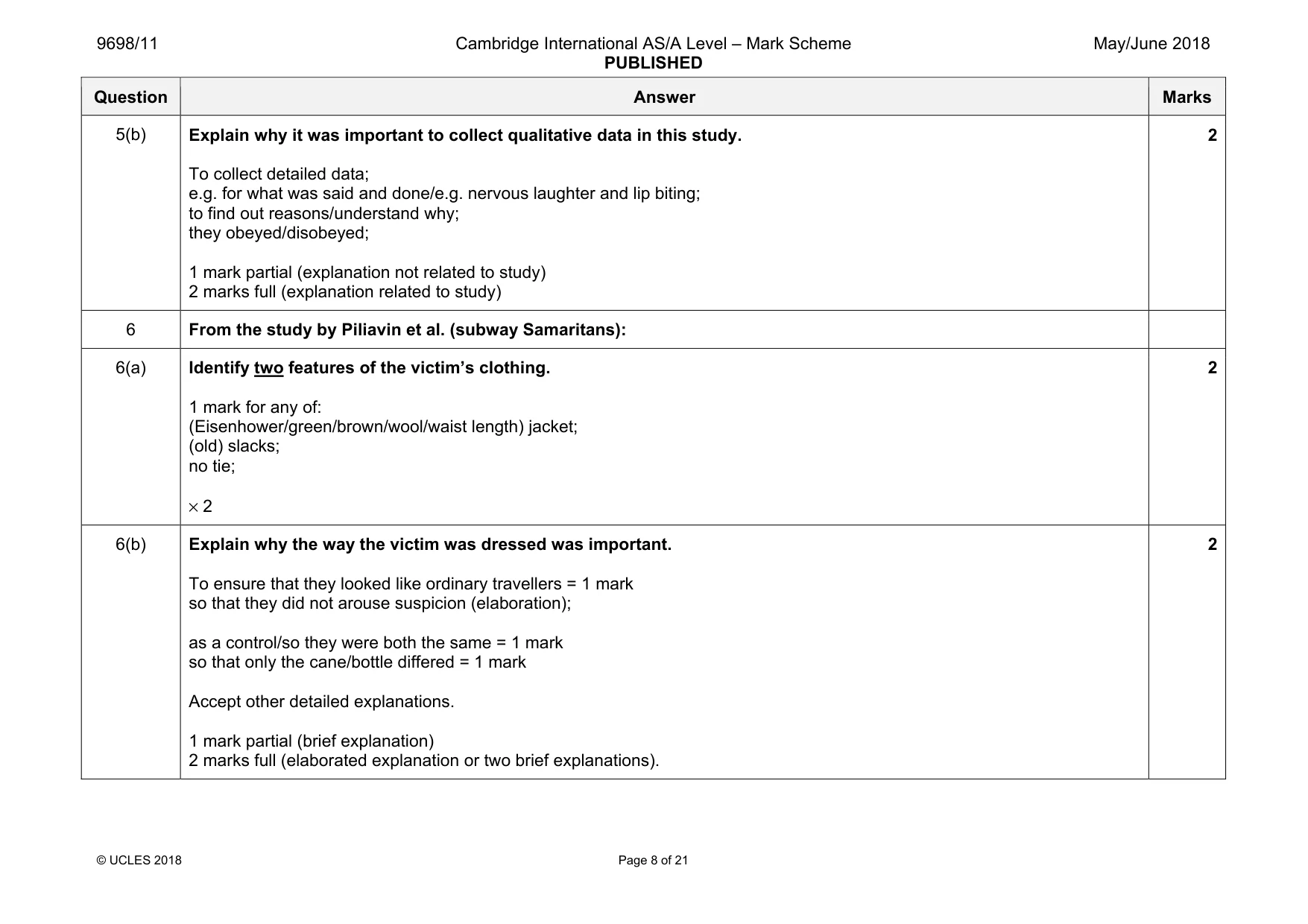
9698/11 Cambridge International AS/A Level – Mark Scheme PUBLISHED May/June 2018 © UCLES 2018 Page 8 of 21 Question Answer Marks 5(b) Explain why it was important to collect qualitative data in this study. To collect detailed data; e.g. for what was said and done/e.g. nervous laughter and lip biting; to find out reasons/understand why; they obeyed/disobeyed; 1 mark partial (explanation not related to study) 2 marks full (explanation related to study) 2 6 From the study by Piliavin et al. (subway Samaritans): 6(a) Identify two features of the victim’s clothing. 1 mark for any of: (Eisenhower/green/brown/wool/waist length) jacket; (old) slacks; no tie; × 2 2 6(b) Explain why the way the victim was dressed was important. To ensure that they looked like ordinary travellers = 1 mark so that they did not arouse suspicion (elaboration); as a control/so they were both the same = 1 mark so that only the cane/bottle differed = 1 mark Accept other detailed explanations. 1 mark partial (brief explanation) 2 marks full (elaborated explanation or two brief explanations). 2
Mark scheme, page 9
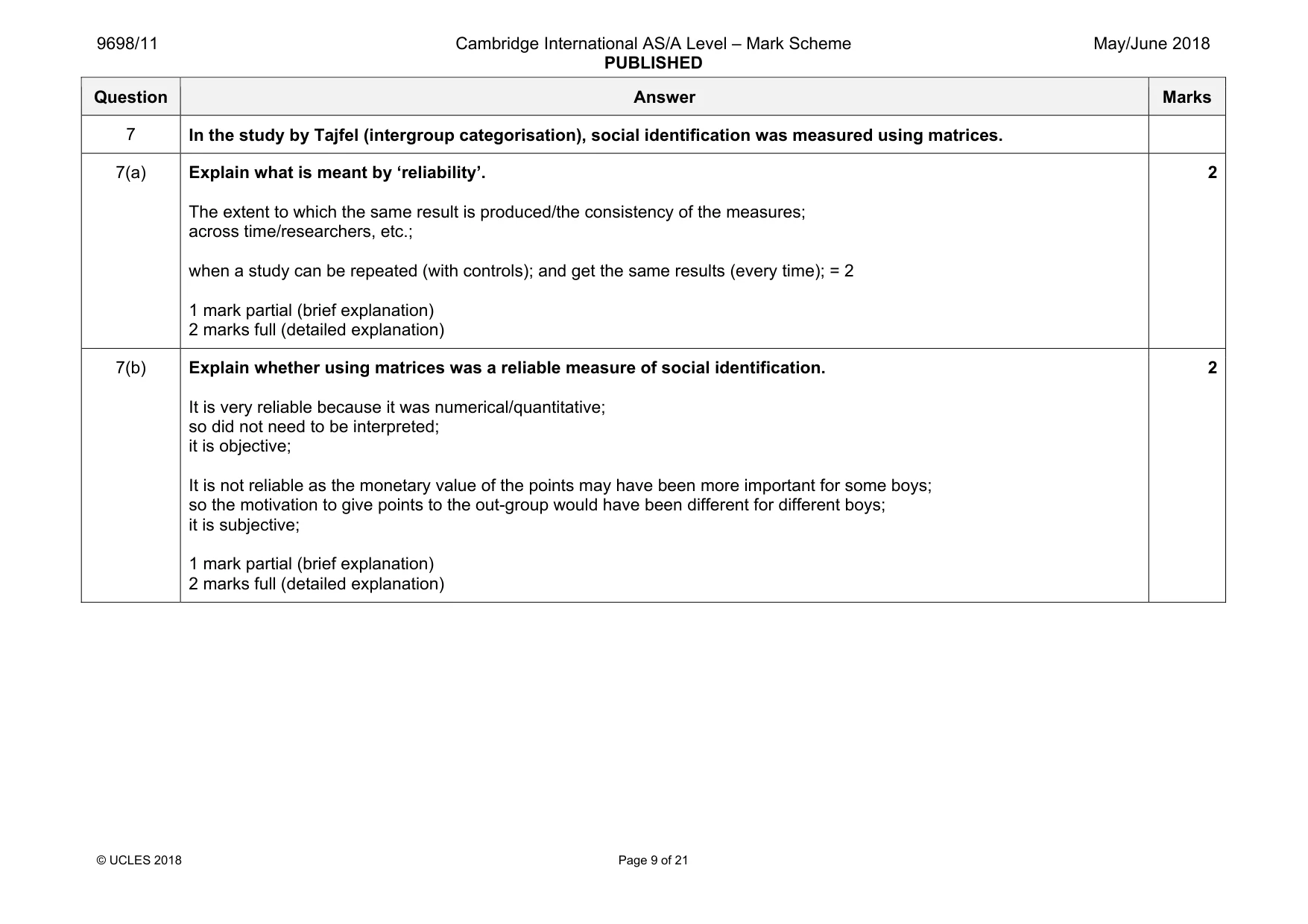
9698/11 Cambridge International AS/A Level – Mark Scheme PUBLISHED May/June 2018 © UCLES 2018 Page 9 of 21 Question Answer Marks 7 In the study by Tajfel (intergroup categorisation), social identification was measured using matrices. 7(a) Explain what is meant by ‘reliability’. The extent to which the same result is produced/the consistency of the measures; across time/researchers, etc.; when a study can be repeated (with controls); and get the same results (every time); = 2 1 mark partial (brief explanation) 2 marks full (detailed explanation) 2 7(b) Explain whether using matrices was a reliable measure of social identification. It is very reliable because it was numerical/quantitative; so did not need to be interpreted; it is objective; It is not reliable as the monetary value of the points may have been more important for some boys; so the motivation to give points to the out-group would have been different for different boys; it is subjective; 1 mark partial (brief explanation) 2 marks full (detailed explanation) 2
Mark scheme, page 10
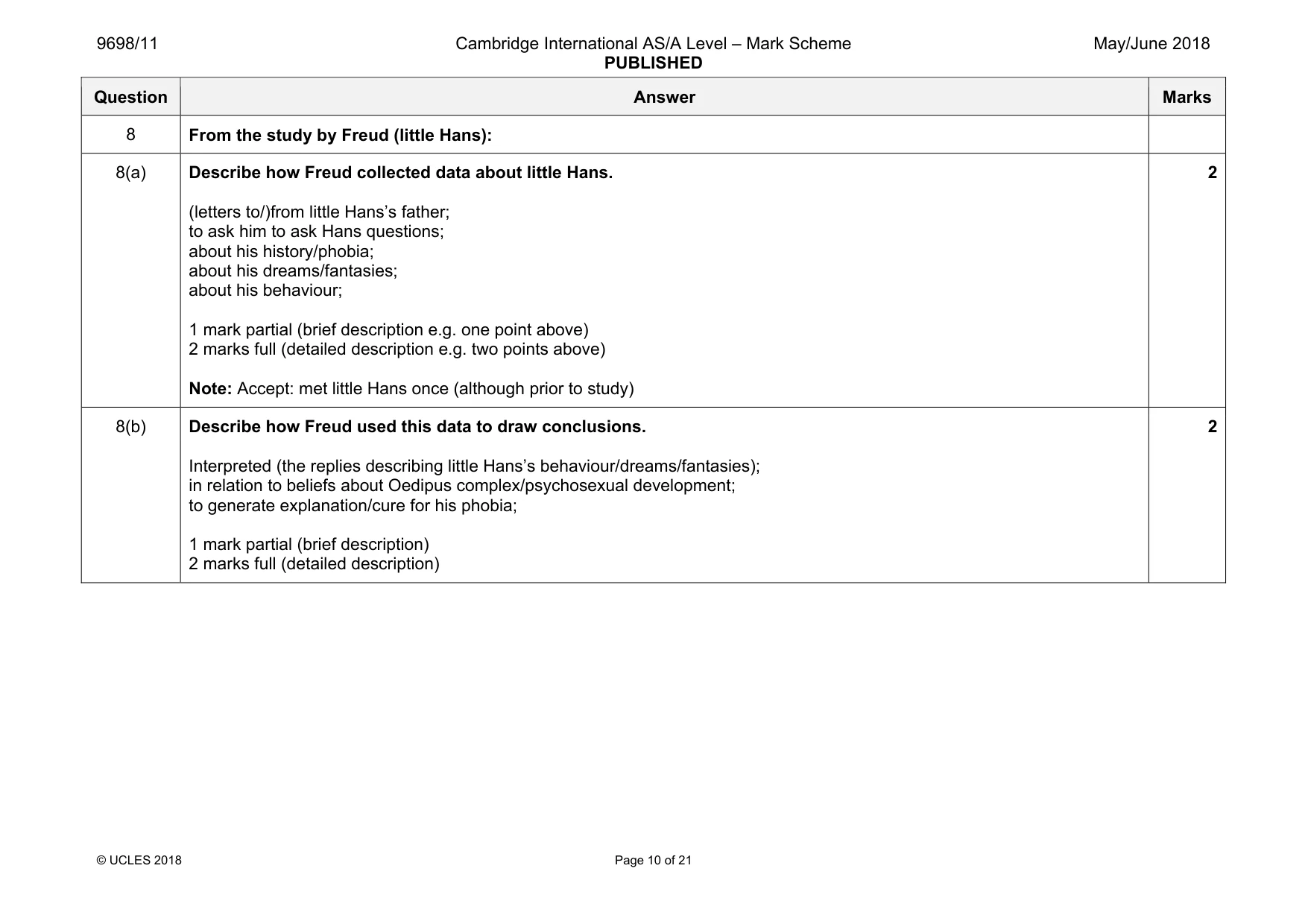
9698/11 Cambridge International AS/A Level – Mark Scheme PUBLISHED May/June 2018 © UCLES 2018 Page 10 of 21 Question Answer Marks 8 From the study by Freud (little Hans): 8(a) Describe how Freud collected data about little Hans. (letters to/)from little Hans’s father; to ask him to ask Hans questions; about his history/phobia; about his dreams/fantasies; about his behaviour; 1 mark partial (brief description e.g. one point above) 2 marks full (detailed description e.g. two points above) Note: Accept: met little Hans once (although prior to study) 2 8(b) Describe how Freud used this data to draw conclusions. Interpreted (the replies describing little Hans’s behaviour/dreams/fantasies); in relation to beliefs about Oedipus complex/psychosexual development; to generate explanation/cure for his phobia; 1 mark partial (brief description) 2 marks full (detailed description) 2
Mark scheme, page 11
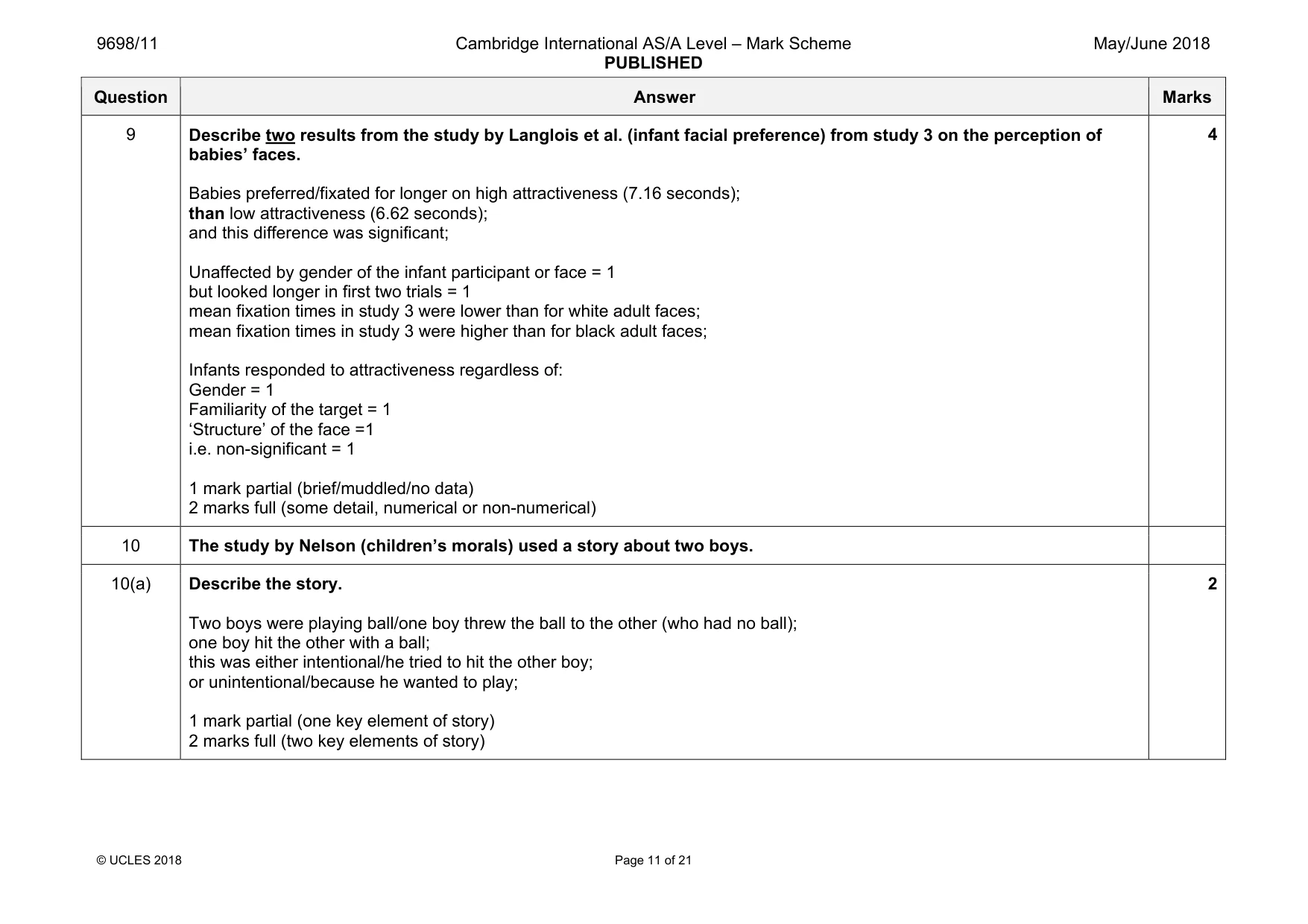
9698/11 Cambridge International AS/A Level – Mark Scheme PUBLISHED May/June 2018 © UCLES 2018 Page 11 of 21 Question Answer Marks 9 Describe two results from the study by Langlois et al. (infant facial preference) from study 3 on the perception of babies’ faces. Babies preferred/fixated for longer on high attractiveness (7.16 seconds); than low attractiveness (6.62 seconds); and this difference was significant; Unaffected by gender of the infant participant or face = 1 but looked longer in first two trials = 1 mean fixation times in study 3 were lower than for white adult faces; mean fixation times in study 3 were higher than for black adult faces; Infants responded to attractiveness regardless of: Gender = 1 Familiarity of the target = 1 ‘Structure’ of the face =1 i.e. non-significant = 1 1 mark partial (brief/muddled/no data) 2 marks full (some detail, numerical or non-numerical) 4 10 The study by Nelson (children’s morals) used a story about two boys. 10(a) Describe the story. Two boys were playing ball/one boy threw the ball to the other (who had no ball); one boy hit the other with a ball; this was either intentional/he tried to hit the other boy; or unintentional/because he wanted to play; 1 mark partial (one key element of story) 2 marks full (two key elements of story) 2
Mark scheme, page 12
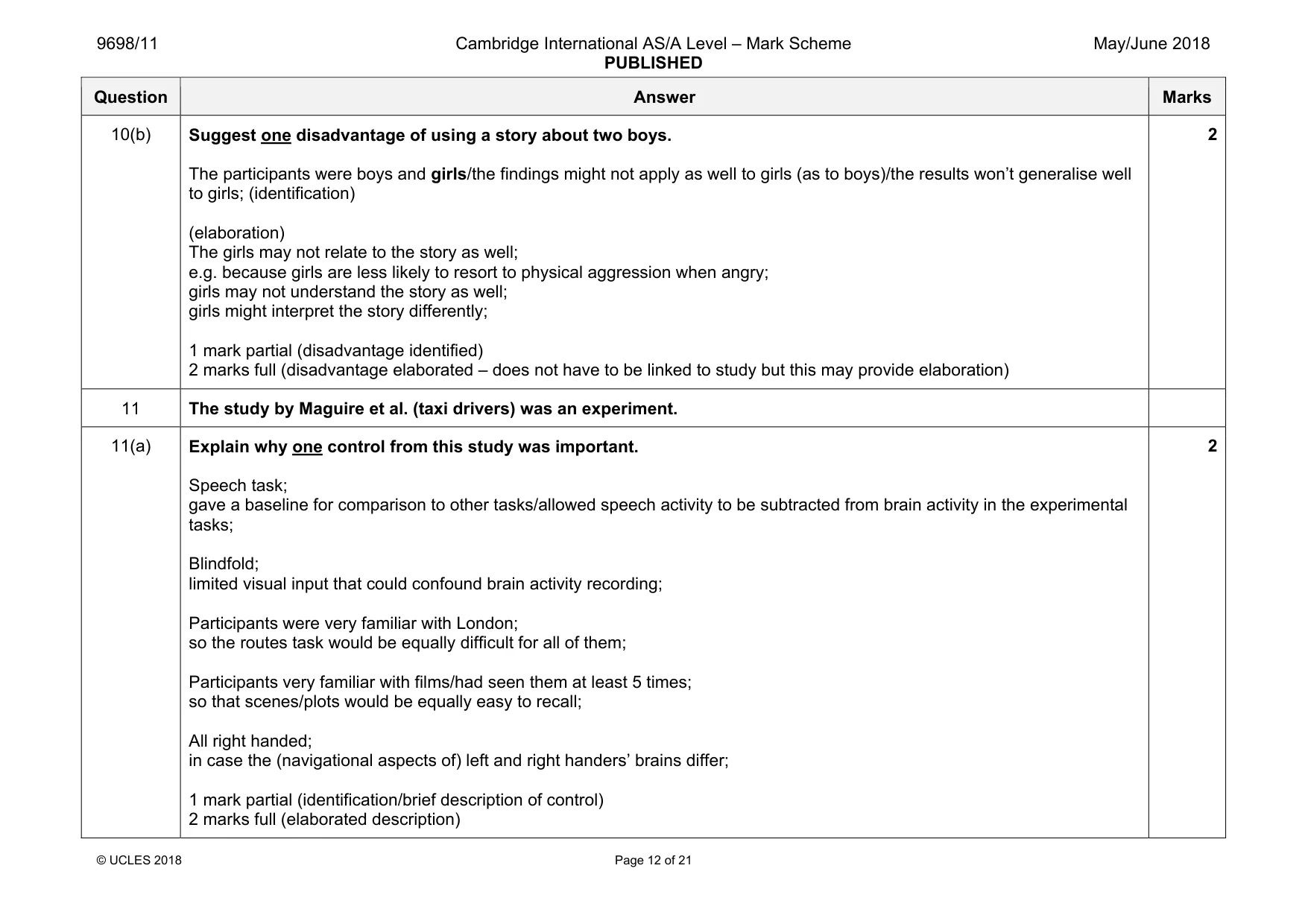
9698/11 Cambridge International AS/A Level – Mark Scheme PUBLISHED May/June 2018 © UCLES 2018 Page 12 of 21 Question Answer Marks 10(b) Suggest one disadvantage of using a story about two boys. The participants were boys and girls/the findings might not apply as well to girls (as to boys)/the results won’t generalise well to girls; (identification) (elaboration) The girls may not relate to the story as well; e.g. because girls are less likely to resort to physical aggression when angry; girls may not understand the story as well; girls might interpret the story differently; 1 mark partial (disadvantage identified) 2 marks full (disadvantage elaborated – does not have to be linked to study but this may provide elaboration) 2 11 The study by Maguire et al. (taxi drivers) was an experiment. 11(a) Explain why one control from this study was important. Speech task; gave a baseline for comparison to other tasks/allowed speech activity to be subtracted from brain activity in the experimental tasks; Blindfold; limited visual input that could confound brain activity recording; Participants were very familiar with London; so the routes task would be equally difficult for all of them; Participants very familiar with films/had seen them at least 5 times; so that scenes/plots would be equally easy to recall; All right handed; in case the (navigational aspects of) left and right handers’ brains differ; 1 mark partial (identification/brief description of control) 2 marks full (elaborated description) 2
Mark scheme, page 13
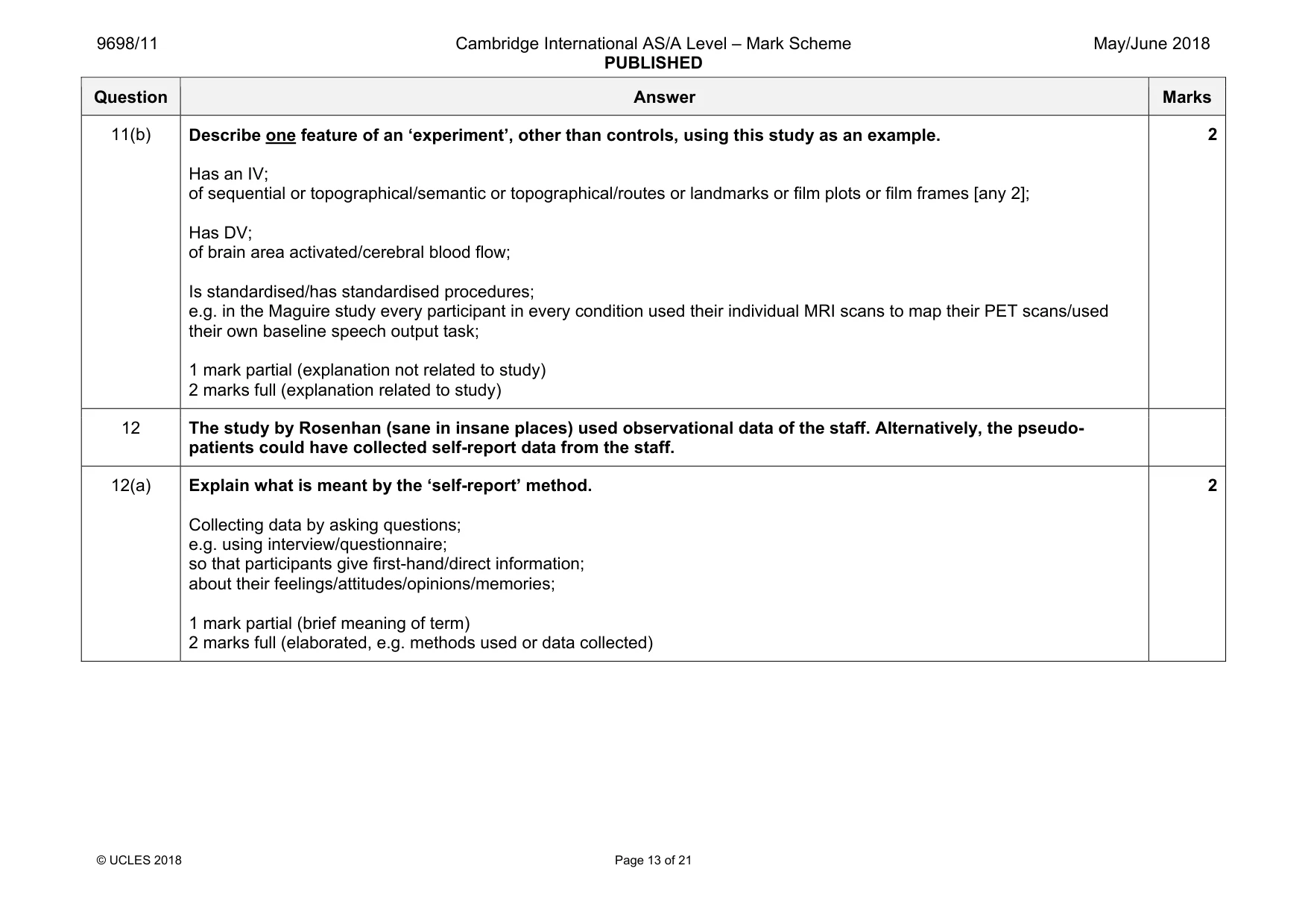
9698/11 Cambridge International AS/A Level – Mark Scheme PUBLISHED May/June 2018 © UCLES 2018 Page 13 of 21 Question Answer Marks 11(b) Describe one feature of an ‘experiment’, other than controls, using this study as an example. Has an IV; of sequential or topographical/semantic or topographical/routes or landmarks or film plots or film frames [any 2]; Has DV; of brain area activated/cerebral blood flow; Is standardised/has standardised procedures; e.g. in the Maguire study every participant in every condition used their individual MRI scans to map their PET scans/used their own baseline speech output task; 1 mark partial (explanation not related to study) 2 marks full (explanation related to study) 2 12 The study by Rosenhan (sane in insane places) used observational data of the staff. Alternatively, the pseudo- patients could have collected self-report data from the staff. 12(a) Explain what is meant by the ‘self-report’ method. Collecting data by asking questions; e.g. using interview/questionnaire; so that participants give first-hand/direct information; about their feelings/attitudes/opinions/memories; 1 mark partial (brief meaning of term) 2 marks full (elaborated, e.g. methods used or data collected) 2
Mark scheme, page 14
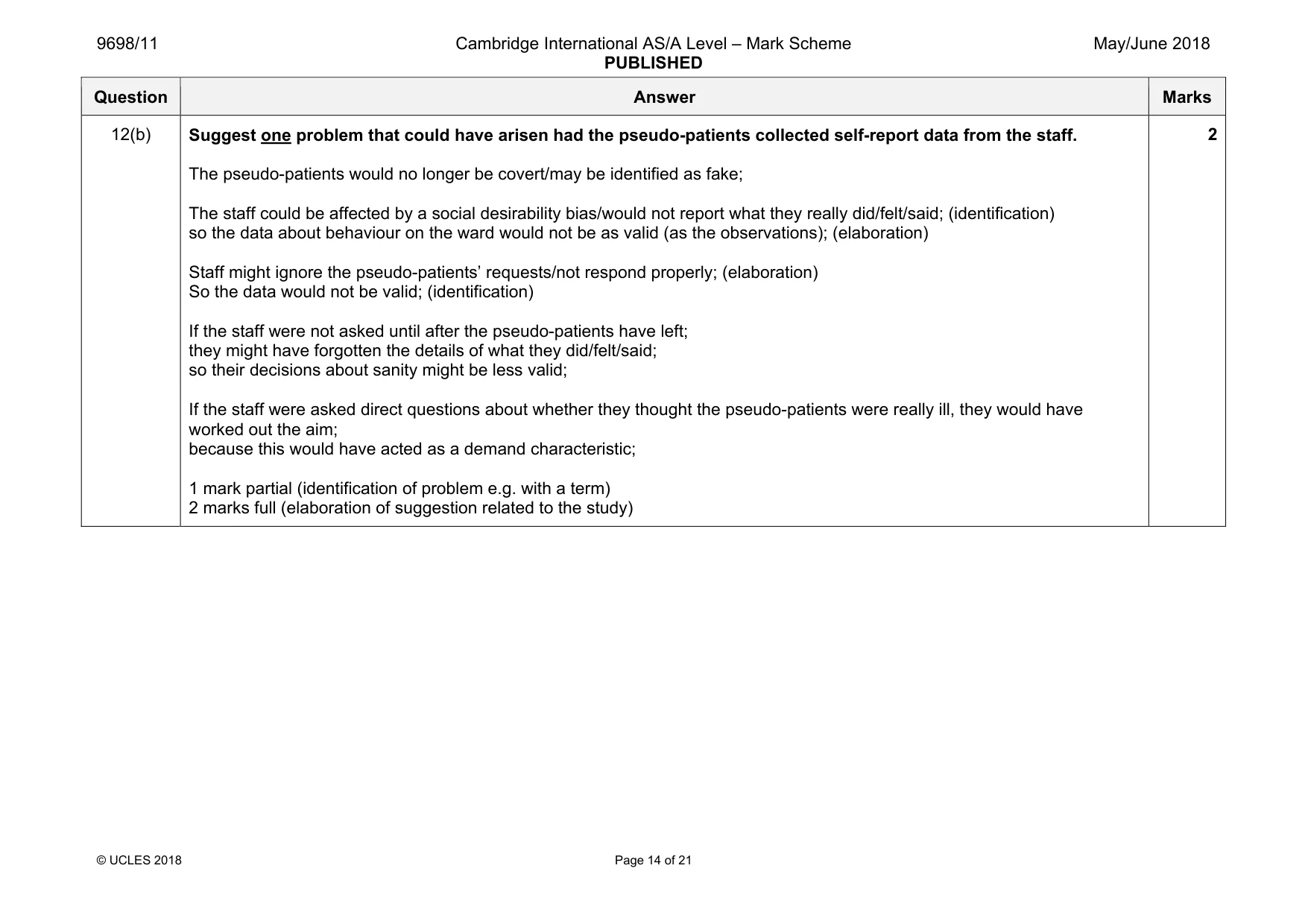
9698/11 Cambridge International AS/A Level – Mark Scheme PUBLISHED May/June 2018 © UCLES 2018 Page 14 of 21 Question Answer Marks 12(b) Suggest one problem that could have arisen had the pseudo-patients collected self-report data from the staff. The pseudo-patients would no longer be covert/may be identified as fake; The staff could be affected by a social desirability bias/would not report what they really did/felt/said; (identification) so the data about behaviour on the ward would not be as valid (as the observations); (elaboration) Staff might ignore the pseudo-patients’ requests/not respond properly; (elaboration) So the data would not be valid; (identification) If the staff were not asked until after the pseudo-patients have left; they might have forgotten the details of what they did/felt/said; so their decisions about sanity might be less valid; If the staff were asked direct questions about whether they thought the pseudo-patients were really ill, they would have worked out the aim; because this would have acted as a demand characteristic; 1 mark partial (identification of problem e.g. with a term) 2 marks full (elaboration of suggestion related to the study) 2
Mark scheme, page 15
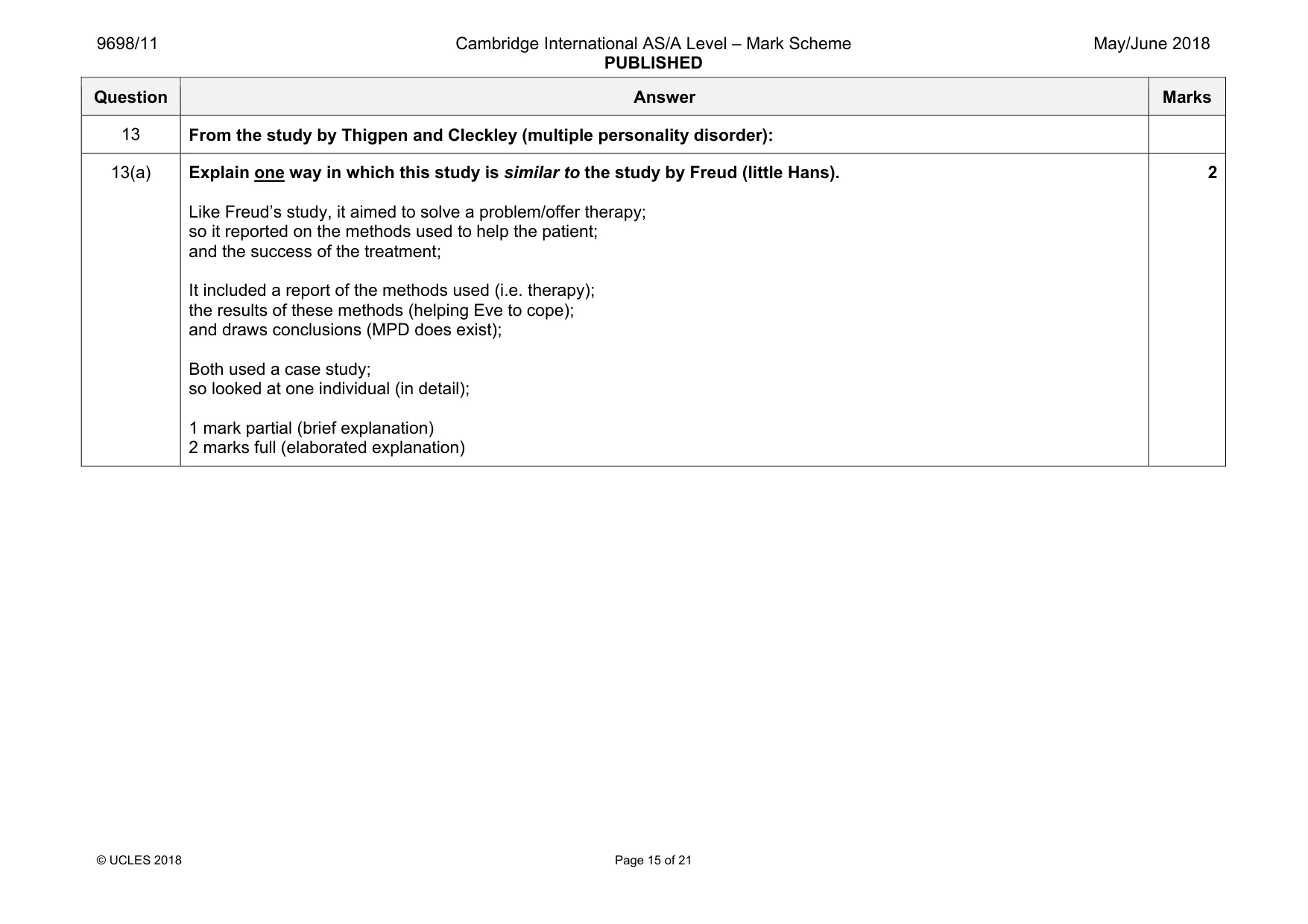
9698/11 Cambridge International AS/A Level – Mark Scheme PUBLISHED May/June 2018 © UCLES 2018 Page 15 of 21 Question Answer Marks 13 From the study by Thigpen and Cleckley (multiple personality disorder): 13(a) Explain one way in which this study is similar to the study by Freud (little Hans). Like Freud’s study, it aimed to solve a problem/offer therapy; so it reported on the methods used to help the patient; and the success of the treatment; It included a report of the methods used (i.e. therapy); the results of these methods (helping Eve to cope); and draws conclusions (MPD does exist); Both used a case study; so looked at one individual (in detail); 1 mark partial (brief explanation) 2 marks full (elaborated explanation) 2
Mark scheme, page 16
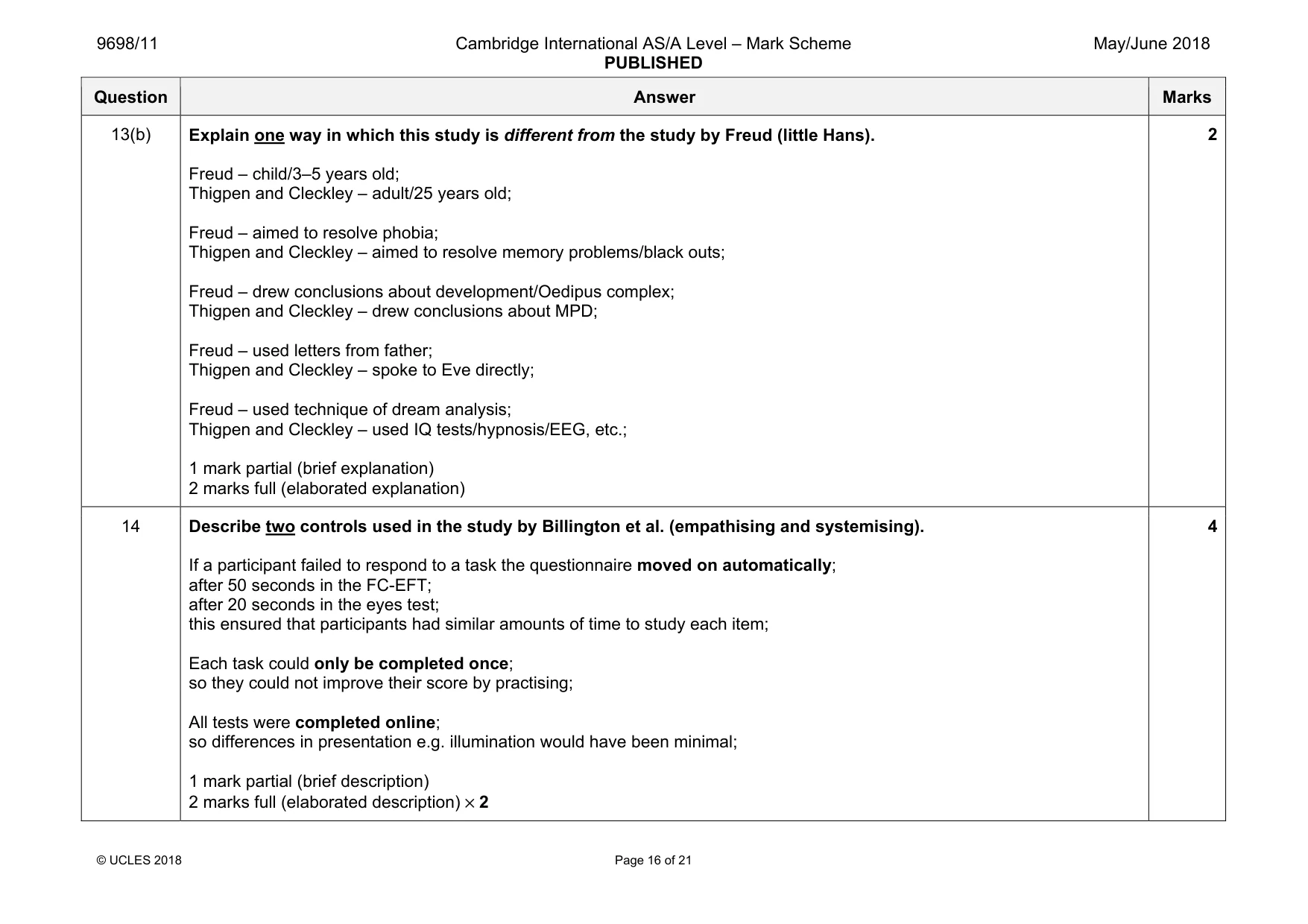
9698/11 Cambridge International AS/A Level – Mark Scheme PUBLISHED May/June 2018 © UCLES 2018 Page 16 of 21 Question Answer Marks 13(b) Explain one way in which this study is different from the study by Freud (little Hans). Freud – child/3–5 years old; Thigpen and Cleckley – adult/25 years old; Freud – aimed to resolve phobia; Thigpen and Cleckley – aimed to resolve memory problems/black outs; Freud – drew conclusions about development/Oedipus complex; Thigpen and Cleckley – drew conclusions about MPD; Freud – used letters from father; Thigpen and Cleckley – spoke to Eve directly; Freud – used technique of dream analysis; Thigpen and Cleckley – used IQ tests/hypnosis/EEG, etc.; 1 mark partial (brief explanation) 2 marks full (elaborated explanation) 2 14 Describe two controls used in the study by Billington et al. (empathising and systemising). If a participant failed to respond to a task the questionnaire moved on automatically; after 50 seconds in the FC-EFT; after 20 seconds in the eyes test; this ensured that participants had similar amounts of time to study each item; Each task could only be completed once; so they could not improve their score by practising; All tests were completed online; so differences in presentation e.g. illumination would have been minimal; 1 mark partial (brief description) 2 marks full (elaborated description) × 2 4
Mark scheme, page 17
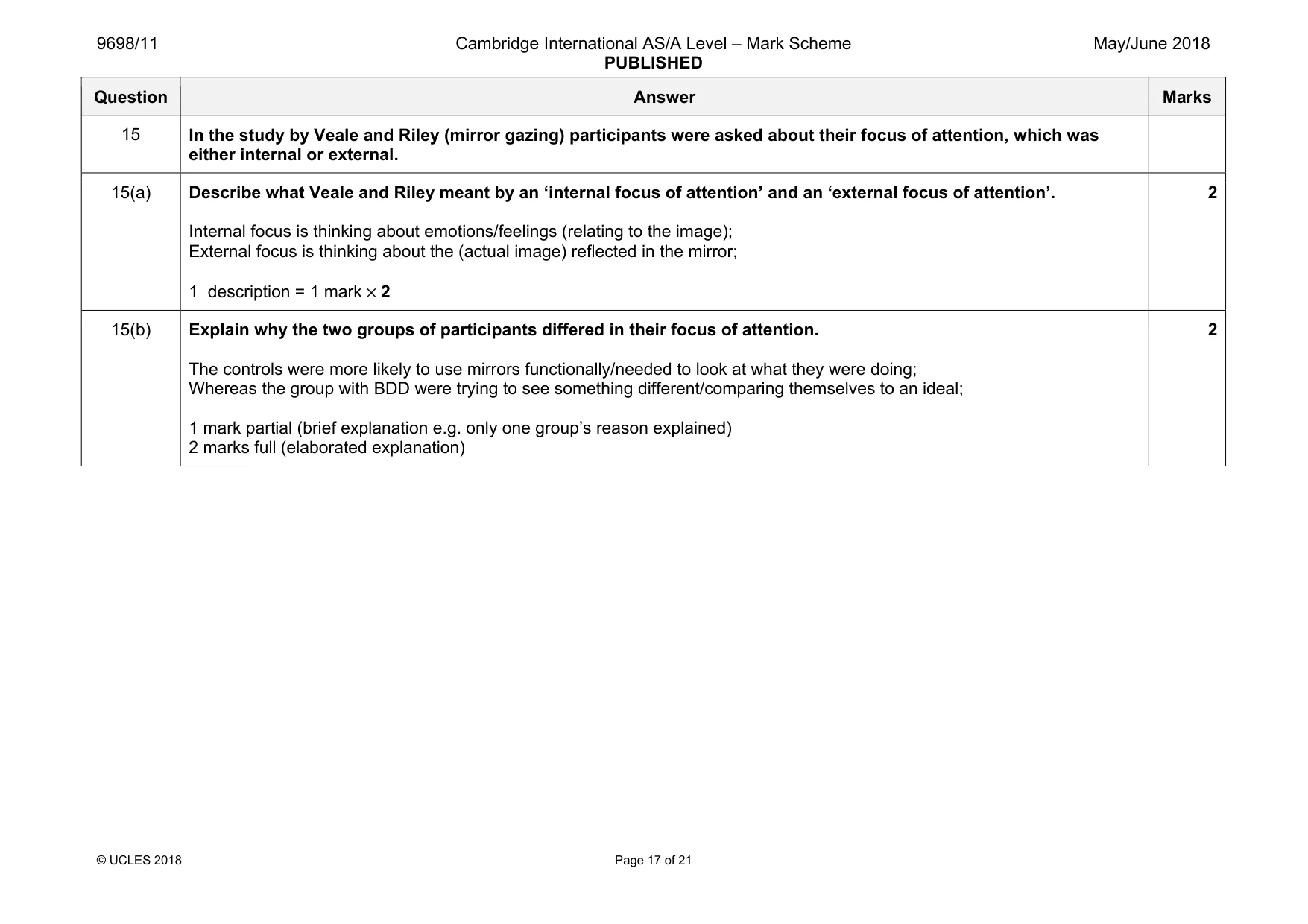
9698/11 Cambridge International AS/A Level – Mark Scheme PUBLISHED May/June 2018 © UCLES 2018 Page 17 of 21 Question Answer Marks 15 In the study by Veale and Riley (mirror gazing) participants were asked about their focus of attention, which was either internal or external. 15(a) Describe what Veale and Riley meant by an ‘internal focus of attention’ and an ‘external focus of attention’. Internal focus is thinking about emotions/feelings (relating to the image); External focus is thinking about the (actual image) reflected in the mirror; 1 description = 1 mark × 2 2 15(b) Explain why the two groups of participants differed in their focus of attention. The controls were more likely to use mirrors functionally/needed to look at what they were doing; Whereas the group with BDD were trying to see something different/comparing themselves to an ideal; 1 mark partial (brief explanation e.g. only one group’s reason explained) 2 marks full (elaborated explanation) 2
Mark scheme, page 18
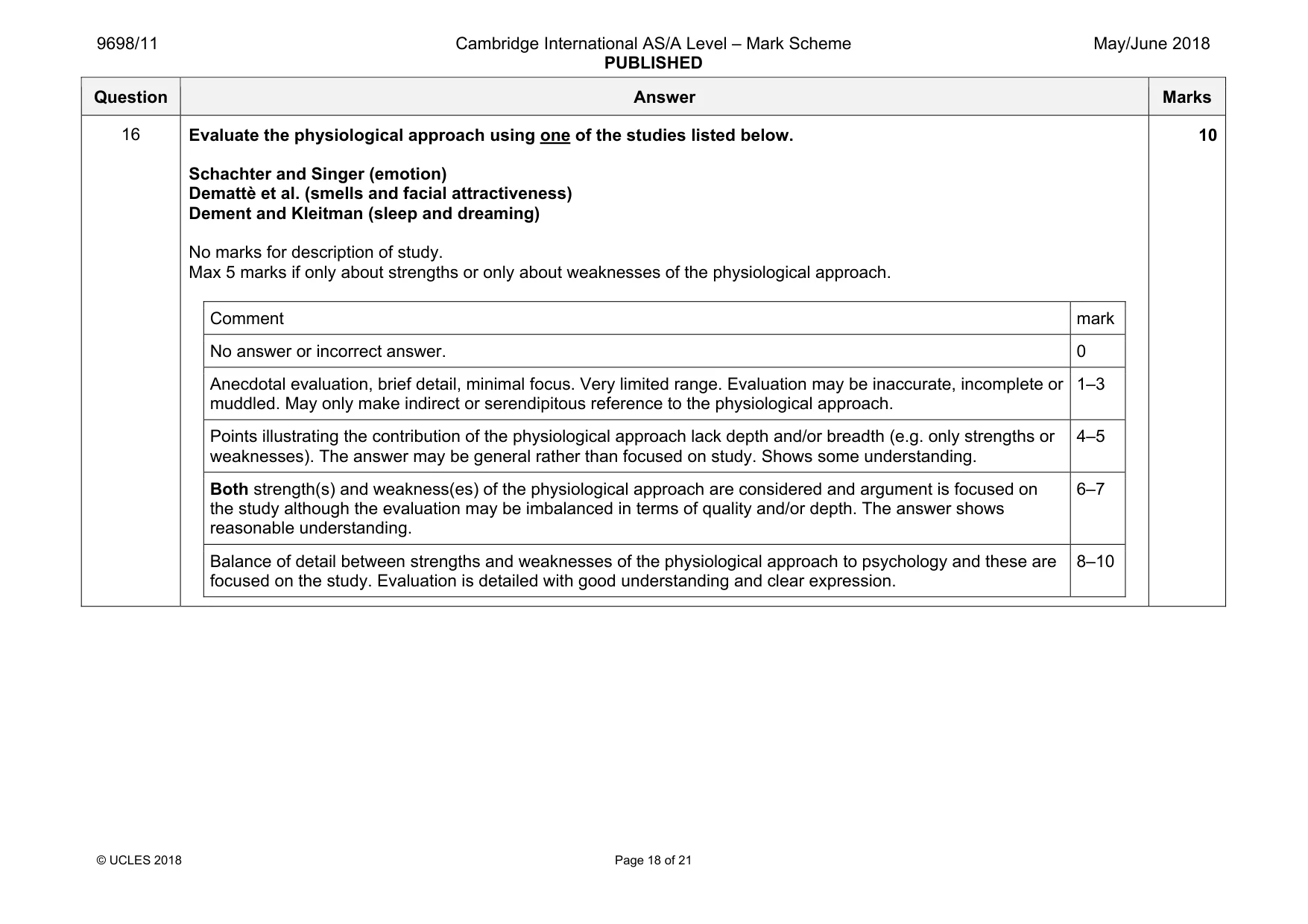
9698/11 Cambridge International AS/A Level – Mark Scheme PUBLISHED May/June 2018 © UCLES 2018 Page 18 of 21 Question Answer Marks 16 Evaluate the physiological approach using one of the studies listed below. Schachter and Singer (emotion) Demattè et al. (smells and facial attractiveness) Dement and Kleitman (sleep and dreaming) No marks for description of study. Max 5 marks if only about strengths or only about weaknesses of the physiological approach. Comment mark No answer or incorrect answer. 0 Anecdotal evaluation, brief detail, minimal focus. Very limited range. Evaluation may be inaccurate, incomplete or muddled. May only make indirect or serendipitous reference to the physiological approach. 1–3 Points illustrating the contribution of the physiological approach lack depth and/or breadth (e.g. only strengths or weaknesses). The answer may be general rather than focused on study. Shows some understanding. 4–5 Both strength(s) and weakness(es) of the physiological approach are considered and argument is focused on the study although the evaluation may be imbalanced in terms of quality and/or depth. The answer shows reasonable understanding. 6–7 Balance of detail between strengths and weaknesses of the physiological approach to psychology and these are focused on the study. Evaluation is detailed with good understanding and clear expression. 8–10 10
Mark scheme, page 19
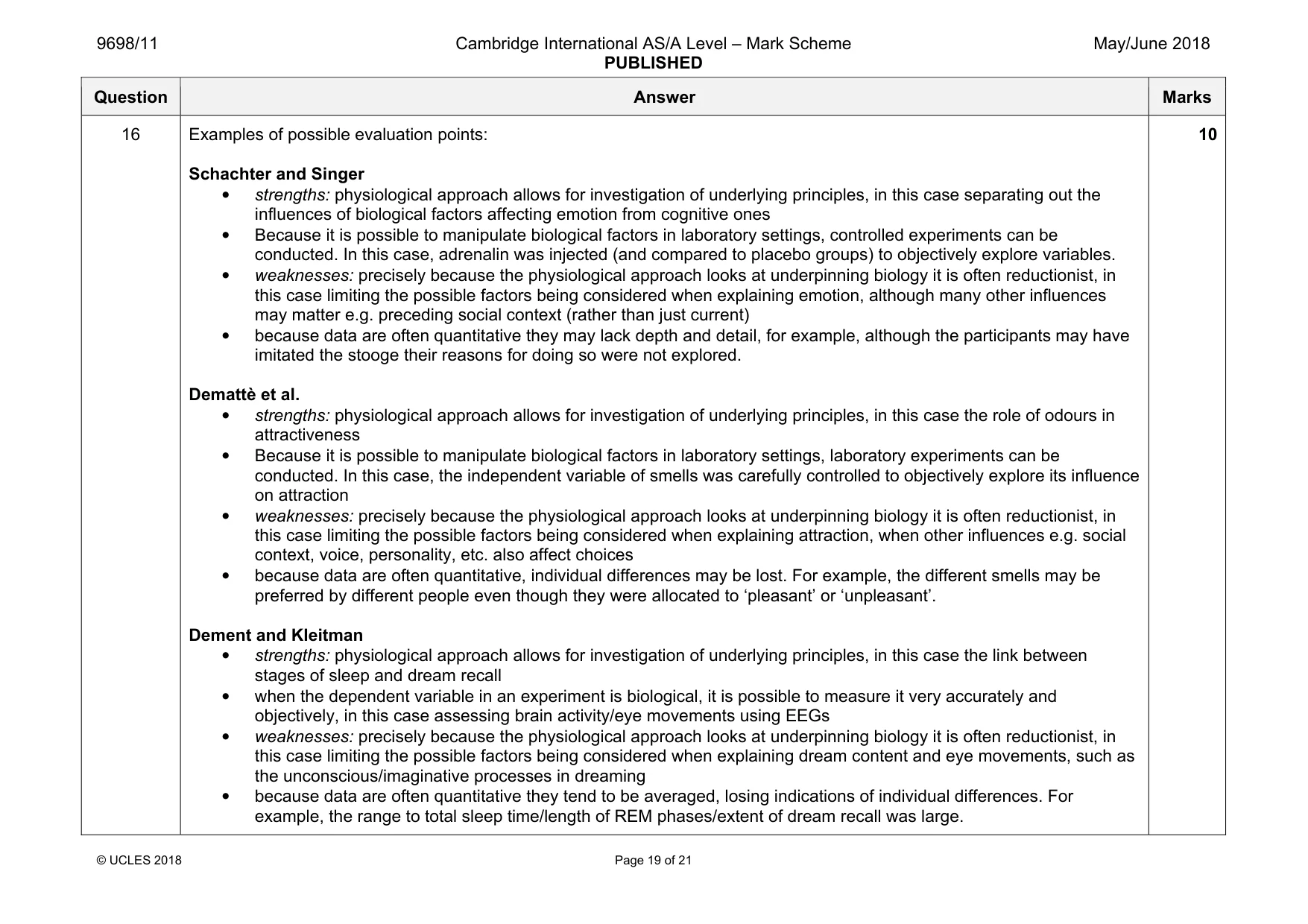
9698/11 Cambridge International AS/A Level – Mark Scheme PUBLISHED May/June 2018 © UCLES 2018 Page 19 of 21 Question Answer Marks 16 Examples of possible evaluation points: Schachter and Singer • strengths: physiological approach allows for investigation of underlying principles, in this case separating out the influences of biological factors affecting emotion from cognitive ones • Because it is possible to manipulate biological factors in laboratory settings, controlled experiments can be conducted. In this case, adrenalin was injected (and compared to placebo groups) to objectively explore variables. • weaknesses: precisely because the physiological approach looks at underpinning biology it is often reductionist, in this case limiting the possible factors being considered when explaining emotion, although many other influences may matter e.g. preceding social context (rather than just current) • because data are often quantitative they may lack depth and detail, for example, although the participants may have imitated the stooge their reasons for doing so were not explored. Demattè et al. • strengths: physiological approach allows for investigation of underlying principles, in this case the role of odours in attractiveness • Because it is possible to manipulate biological factors in laboratory settings, laboratory experiments can be conducted. In this case, the independent variable of smells was carefully controlled to objectively explore its influence on attraction • weaknesses: precisely because the physiological approach looks at underpinning biology it is often reductionist, in this case limiting the possible factors being considered when explaining attraction, when other influences e.g. social context, voice, personality, etc. also affect choices • because data are often quantitative, individual differences may be lost. For example, the different smells may be preferred by different people even though they were allocated to ‘pleasant’ or ‘unpleasant’. Dement and Kleitman • strengths: physiological approach allows for investigation of underlying principles, in this case the link between stages of sleep and dream recall • when the dependent variable in an experiment is biological, it is possible to measure it very accurately and objectively, in this case assessing brain activity/eye movements using EEGs • weaknesses: precisely because the physiological approach looks at underpinning biology it is often reductionist, in this case limiting the possible factors being considered when explaining dream content and eye movements, such as the unconscious/imaginative processes in dreaming • because data are often quantitative they tend to be averaged, losing indications of individual differences. For example, the range to total sleep time/length of REM phases/extent of dream recall was large. 10
Mark scheme, page 20
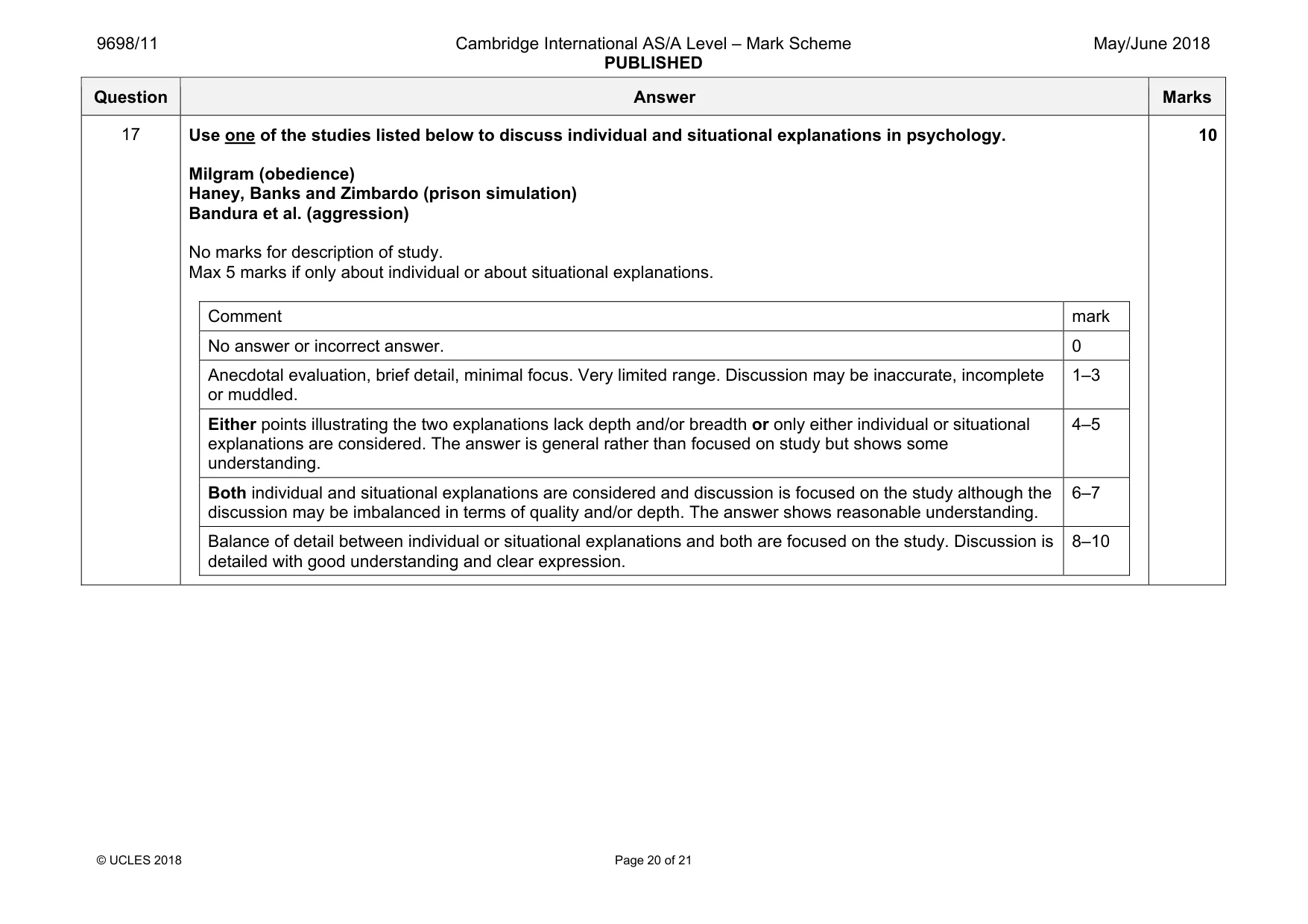
9698/11 Cambridge International AS/A Level – Mark Scheme PUBLISHED May/June 2018 © UCLES 2018 Page 20 of 21 Question Answer Marks 17 Use one of the studies listed below to discuss individual and situational explanations in psychology. Milgram (obedience) Haney, Banks and Zimbardo (prison simulation) Bandura et al. (aggression) No marks for description of study. Max 5 marks if only about individual or about situational explanations. Comment mark No answer or incorrect answer. 0 Anecdotal evaluation, brief detail, minimal focus. Very limited range. Discussion may be inaccurate, incomplete or muddled. 1–3 Either points illustrating the two explanations lack depth and/or breadth or only either individual or situational explanations are considered. The answer is general rather than focused on study but shows some understanding. 4–5 Both individual and situational explanations are considered and discussion is focused on the study although the discussion may be imbalanced in terms of quality and/or depth. The answer shows reasonable understanding. 6–7 Balance of detail between individual or situational explanations and both are focused on the study. Discussion is detailed with good understanding and clear expression. 8–10 10
Mark scheme, page 21
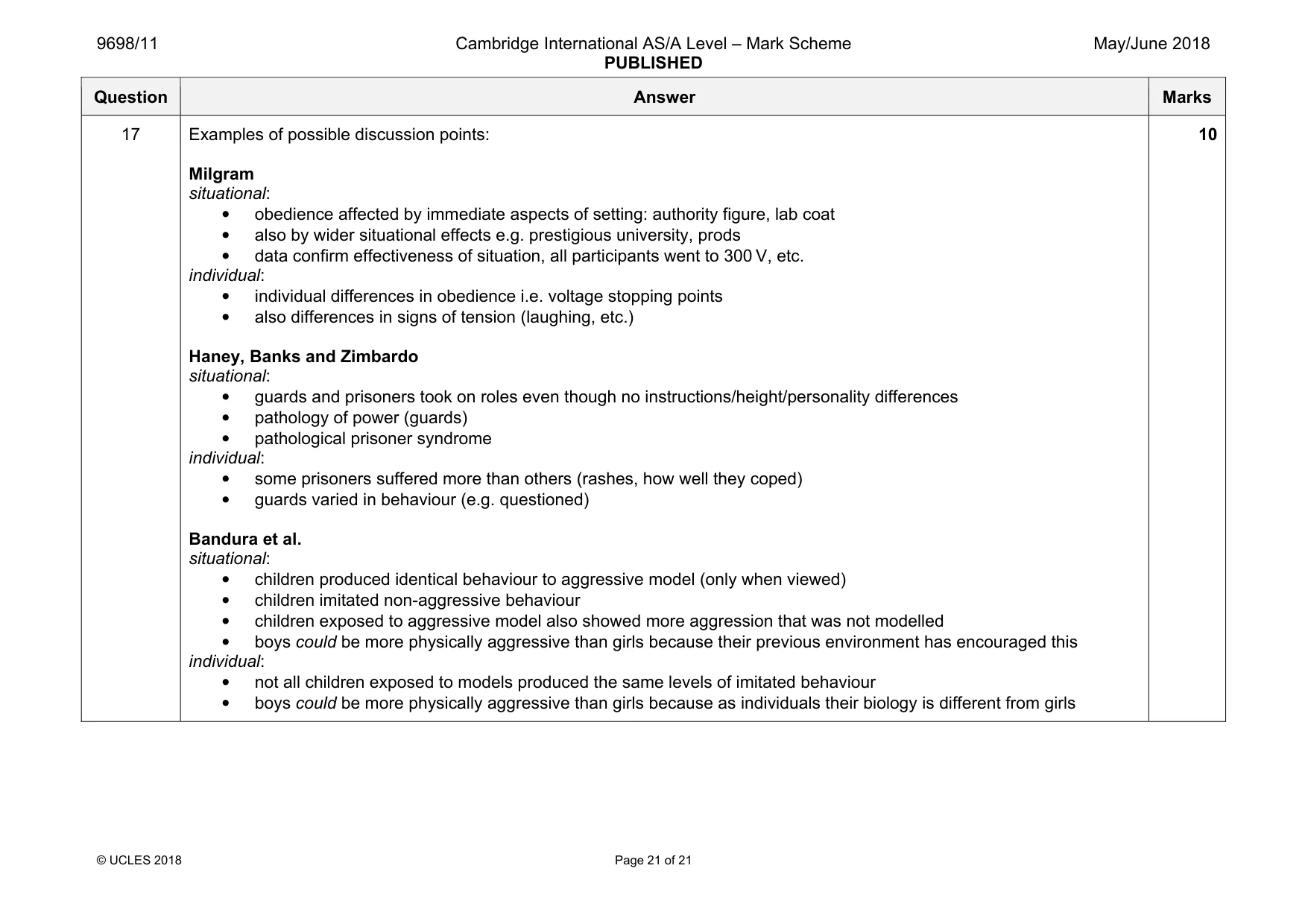
9698/11 Cambridge International AS/A Level – Mark Scheme PUBLISHED May/June 2018 © UCLES 2018 Page 21 of 21 Question Answer Marks 17 Examples of possible discussion points: Milgram situational: • obedience affected by immediate aspects of setting: authority figure, lab coat • also by wider situational effects e.g. prestigious university, prods • data confirm effectiveness of situation, all participants went to 300 V, etc. individual: • individual differences in obedience i.e. voltage stopping points • also differences in signs of tension (laughing, etc.) Haney, Banks and Zimbardo situational: • guards and prisoners took on roles even though no instructions/height/personality differences • pathology of power (guards) • pathological prisoner syndrome individual: • some prisoners suffered more than others (rashes, how well they coped) • guards varied in behaviour (e.g. questioned) Bandura et al. situational: • children produced identical behaviour to aggressive model (only when viewed) • children imitated non-aggressive behaviour • children exposed to aggressive model also showed more aggression that was not modelled • boys could be more physically aggressive than girls because their previous environment has encouraged this individual: • not all children exposed to models produced the same levels of imitated behaviour • boys could be more physically aggressive than girls because as individuals their biology is different from girls 10
What you needed in this session
Cambridge’s own grade thresholds for 2018 May/June, Paper 1 · Variant 1. A higher threshold means an easier paper — the bar moves with how the cohort did.