Cambridge A Level Psychology 9698 — 2015 Oct/Nov Paper 1 · Variant 2
9698/12/O/N/15 · 80 marks · ≈90 min
The question paper and its mark scheme, free to read here and free to download. This is Cambridge’s own paper, exactly as it was sat.
Question paper4 pages
Mark scheme13 pages
Answers below. Sit the paper first if you are practising.
Paper as text
Question paper, page 1
This document consists of 4 printed pages and 1 insert. DC (NH) 101104/2 © UCLES 2015 [Turn over * 1 2 8 9 3 3 4 6 9 8 * PSYCHOLOGY 9698/12 Paper 1 Core Studies 1 October/November 2015 1 hour 30 minutes No Additional Materials are required. READ THESE INSTRUCTIONS FIRST An answer booklet is provided inside this question paper. You should follow the instructions on the front cover of the answer booklet. If you need additional answer paper ask the invigilator for a continuation booklet. Answer all questions. The number of marks is given in brackets [ ] at the end of each question or part question. Cambridge International Examinations Cambridge International Advanced Subsidiary and Advanced Level
Question paper, page 2
2 9698/12/O/N/15 © UCLES 2015 Section A (60 marks) Answer all questions in this section. 1 Mann et al. (lying) analysed some behaviours using total times and some as frequencies. (a) Identify two of the behaviours analysed using total times. [2] (b) Describe the difference in results between these two behaviours. [2] 2 Loftus and Pickrell suggested that a false memory may ‘evolve’ from fragments of memory, that is, from other information. (a) What sources of information did Loftus and Pickrell say participants may already have, and include in their false memory? [2] (b) How did Loftus and Pickrell explain the inclusion of this information into the memory of the false event? [2] 3 Baron-Cohen et al. hoped that the revised eyes test would be better at detecting differences than the original eyes test. (a) What did they hope would change about the distribution of scores? [2] (b) In what way was the revised test better at detecting differences than the original test? [2] 4 In the study by Held and Hein, a piece of apparatus called the ‘kitten carousel’ was used. (a) Describe the different movements made by the active kitten that the carousel reproduced for the passive kitten. [2] (b) Describe the difference in experience between the active and passive kittens. [2] 5 In the study by Milgram (obedience) a ‘shock generator’ was used. (a) Describe what the participant saw when they pressed a switch on the shock generator. [2] (b) Explain why these events were important to the study. [2] 6 In their study, Haney, Banks and Zimbardo used various sources of information to design the prison simulation. (a) Who did the researchers ask about the design of the prison? [2] (b) Explain why a realistic simulation of a prison was important to the study. [2] 7 From the study by Piliavin et al. (subway Samaritans): (a) Describe the critical area of the subway car. [2] (b) State how many people left the critical area and explain why they might have done so. [2]
Question paper, page 3
3 9698/12/O/N/15 © UCLES 2015 [Turn over 8 Tajfel studied intergroup categorisation: (a) Describe what is meant by validity. [2] (b) Explain one reason why this study is valid. [2] 9 In the study by Bandura et al., some of the participants were initially rated for aggression by two independent observers. (a) Explain why the children’s pre-existing levels of aggression were rated. [2] (b) The aggression scores given to each participant by the two observers were correlated. Explain why this was done. [2] 10 Freud reported that little Hans believed all animate objects (living things) had a ‘widdler’ (penis) like he did but that inanimate (non-living) ones did not. (a) Explain what this belief led little Hans to expect. [2] (b) Outline and explain one dream or fantasy relating to little Hans’s widdler. [2] 11 Demattè et al. studied smells and facial attractiveness. (a) Name and describe one ethical guideline. [2] (b) Explain how this ethical guideline was followed in this study. [2] 12 From the study by Rosenhan (sane in insane places): (a) Explain why the pseudo-patients were nervous on admission to the hospitals. [2] (b) Suggest why the nervousness of the pseudo-patients might have been important to the study. [2] 13 In the study by Thigpen and Cleckley (multiple personality disorder), IQ tests were conducted. (a) What were the results of the IQ tests for the two personalities? [2] (b) Explain, for one personality, why her score may have been lower than her actual IQ. [2] 14 From the study by Billington et al. (empathising and systemising): (a) Describe the sex ratios of the student participants who were studying physical sciences and humanities. [2] (b) Suggest how you could increase the performance of girls on system-related tasks. [2] 15 From the study by Veale and Riley (mirror gazing): (a) Describe how data were gathered about long mirror sessions. [2] (b) In the questionnaire for short sessions, the participants were not asked about distress after resisting mirror gazing. Explain why this omission was important. [2]
Question paper, page 4
4 9698/12/O/N/15 © UCLES 2015 Permission to reproduce items where third-party owned material protected by copyright is included has been sought and cleared where possible. Every reasonable effort has been made by the publisher (UCLES) to trace copyright holders, but if any items requiring clearance have unwittingly been included, the publisher will be pleased to make amends at the earliest possible opportunity. To avoid the issue of disclosure of answer-related information to candidates, all copyright acknowledgements are reproduced online in the Cambridge International Examinations Copyright Acknowledgements Booklet. This is produced for each series of examinations and is freely available to download at www.cie.org.uk after the live examination series. Cambridge International Examinations is part of the Cambridge Assessment Group. Cambridge Assessment is the brand name of University of Cambridge Local Examinations Syndicate (UCLES), which is itself a department of the University of Cambridge. Section B (20 marks) Answer both questions in this section. 16 Evaluate one of the studies listed below in terms of its contribution to the physiological approach to psychology. Schachter and Singer (emotion) Maguire et al. (taxi drivers) Demattè et al. (smells and facial attractiveness) [10] 17 Use one of the studies listed below to discuss the use of snapshot data in psychology. Langlois et al. (infant facial preference) Nelson (children’s morals) Dement and Kleitman (sleep and dreaming) [10]
Mark scheme, page 1
® IGCSE is the registered trademark of Cambridge International Examinations. CAMBRIDGE INTERNATIONAL EXAMINATIONS Cambridge International Advanced Subsidiary and Advanced Level MARK SCHEME for the October/November 2015 series 9698 PSYCHOLOGY 9698/12 Paper 1 (Core Studies 1), maximum raw mark 80 This mark scheme is published as an aid to teachers and candidates, to indicate the requirements of the examination. It shows the basis on which Examiners were instructed to award marks. It does not indicate the details of the discussions that took place at an Examiners’ meeting before marking began, which would have considered the acceptability of alternative answers. Mark schemes should be read in conjunction with the question paper and the Principal Examiner Report for Teachers. Cambridge will not enter into discussions about these mark schemes. Cambridge is publishing the mark schemes for the October/November 2015 series for most Cambridge IGCSE®, Cambridge International A and AS Level components and some Cambridge O Level components.
Mark scheme, page 2
Page 2 Mark Scheme Syllabus Paper Cambridge International AS/A Level – October/November 2015 9698 12 © Cambridge International Examinations 2015 Section A (60 marks) 1 Mann et al. (lying) analysed some behaviours using total times and some as frequencies. (a) Identify two of the behaviours analysed using total times. [2] gaze aversion and pauses 1 mark per behaviour × 2. (b) Describe the difference in results between these two behaviours. [2] longer pauses during deceptive than during truthful clips eye contact/gaze aversion equal for deceptive and truthful clips only the difference in truth/lying pauses was significant (at p ≤ 0.05) 1 mark partial (basic difference even if 'unmatched', i.e. each idea can be used independently) 2 marks full (correct difference, does not have to be numerical) 1 mark the pauses differed 1 mark no difference in gazing 2 marks pauses differed, gazes didn't 1 mark they gazed for longer than they paused (in both truth telling and lying) NB This is correct but irrelevant to the aims 2 marks they paused for longer when lying than when telling the truth but their gazing times didn’t differ between truths and lies 2 Loftus and Pickrell suggested that a false memory may ‘evolve’ from fragments of memory, that is, from other information. (a) What sources of information did Loftus and Pickrell say participants may already have, and include in their false memory? [2] Experienced events: knowledge about being lost stories about others being lost visiting a mall people once seen in a mall Imagined events 1 mark per each piece of information. NB do not credit "true memories" of being lost in a mall, i.e. claims of real examples (b) How did Loftus and Pickrell explain the inclusion of this information into the memory of the false event? [2] The old memories become linked to (confounded with) the new suggestion so that the memory that the false event was a mere suggestion deteriorates and may become embellished with real memories 1 mark partial (brief/muddled); 2 marks full (some detail).
Mark scheme, page 3
Page 3 Mark Scheme Syllabus Paper Cambridge International AS/A Level – October/November 2015 9698 12 © Cambridge International Examinations 2015 3 Baron-Cohen et al. hoped that the revised eyes test would be better at detecting differences than the original eyes test. (a) What did they hope would change about the distribution of scores? [2] To remove the ceiling effect, so that the (normal) scores were not all clustered at the top of the range 1 mark partial (brief/muddled); 2 marks full (clear statement). NB question is not about the revised version (number of choices) but about the results. (b) In what way was the revised test better at detecting differences than the original test? [2] so it could discriminate smaller (individual) differences not just detect extreme differences in performance because there were more questions 1 mark partial (brief/muddled); 2 marks full (clear statement). NB word descriptors, number of choices and opposites can only be used as elaboration of a correct point. 4 In the study by Held and Hein, a piece of apparatus called the ‘kitten carousel’ was used. (a) Describe the different movements made by the active kitten that the carousel reproduced for the passive kitten. [2] kitten A could move (in a circle) in either direction (around the central axis) = b–b kitten A could move up and down (bend its legs) = a–a kitten A could turn around (in either direction) where it was standing = c–c/d–d 1 movement = 1 mark × 2. NB accept left/right movements. NB toward/away from centre no marks. NB forwards OR backwards OR both = 1 mark. (b) Describe the difference in experience between the active and passive kittens. [2] The active kitten felt movement and saw visual changes at the same time, the passive kitten saw visual changes without simultaneous movement. 1 mark partial; 2 marks full. NB this question is asking about the difference in kittens’ experience, not the effect of that difference on their behaviour.
Mark scheme, page 4
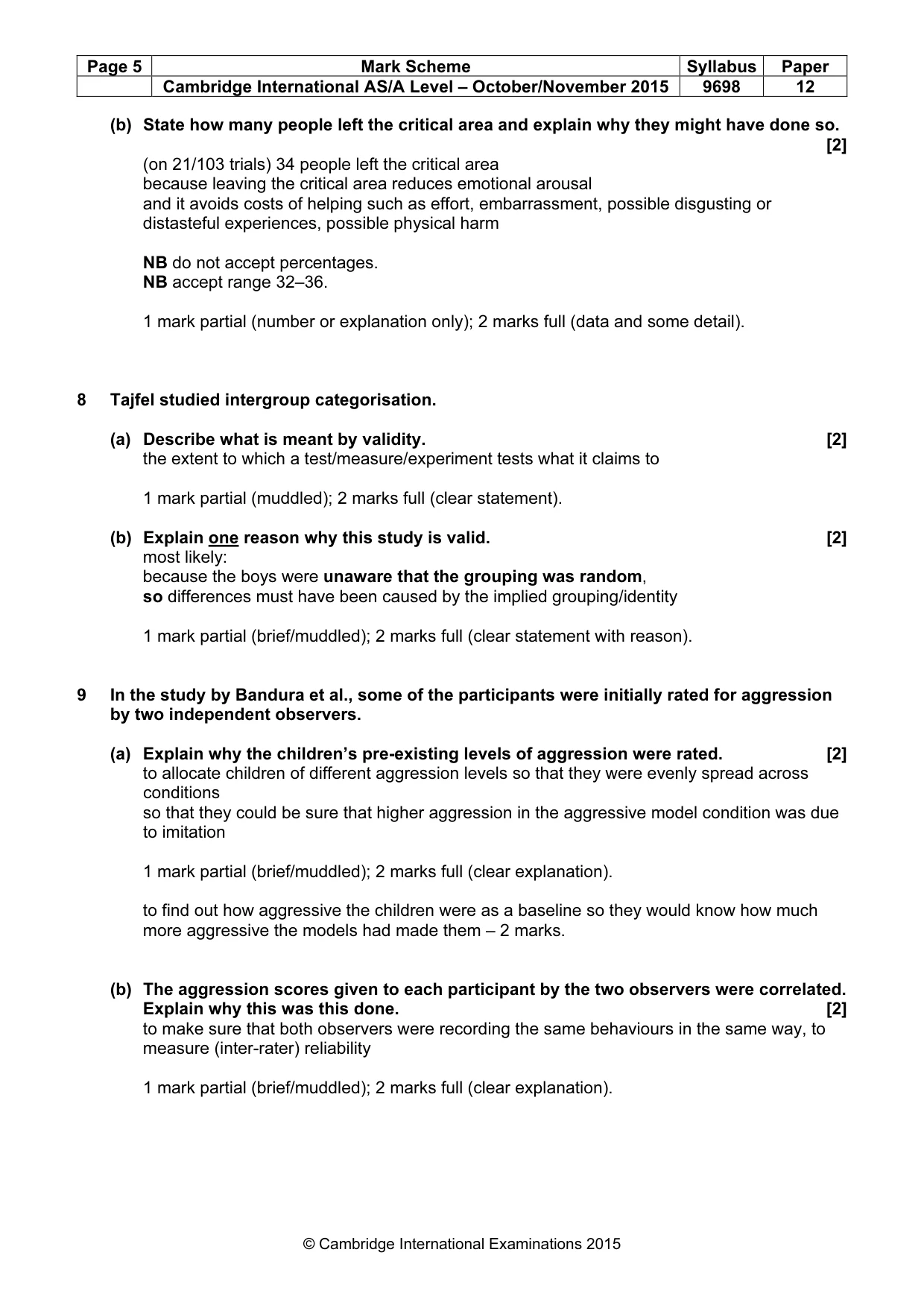
Page 4 Mark Scheme Syllabus Paper Cambridge International AS/A Level – October/November 2015 9698 12 © Cambridge International Examinations 2015 5 In the study by Milgram (obedience) a ‘shock generator’ was used. (a) Describe what the participant saw when they pressed a switch on the shock generator. [2] a (bright red) light came on and a sign (labelled ‘voltage energiser’) flashed – 2 marks the voltage meter increased. – 1 mark 1 mark partial (one change); 2 marks full (two changes or one detailed). NB the buzzing cannot be seen, nor can the effect on the learner. (b) Explain why these events were important to the study. [2] So that the participant would believe that they were responsible for shocking the learner So that they would believe that the shocks were increasing So that they would be aware of the shock intensity 1 mark partial (basic); 2 marks full (expansion). 6 In their study, Haney, Banks and Zimbardo used various sources of information to design the prison simulation. (a) Who did the researchers ask about the design of the prison? [2] former inmates, correctional personnel (any named prison staff) 1 mark per source, × 2. prison warders and prison governors – 2 marks. (b) Explain why a realistic simulation of a prison was important to the study. [2] for “creating and maintaining a psychological state of imprisonment” to make the situation realistic for the prisoners and guards to make the results generalisable/applicable to real prisons to increase (ecological) validity 1 mark partial (brief); 2 marks full (some expansion). 7 From the study by Piliavin et al. (subway Samaritans): (a) Describe the critical area of the subway car. [2] door to the adjacent car 13 seats standing room pole beside which the victim fell 1 mark partial (brief); 2 marks full (some detail). NB Allow 1 or 2 marks for a labelled/annotated diagram containing brief or detailed information.
Mark scheme, page 5
Page 5 Mark Scheme Syllabus Paper Cambridge International AS/A Level – October/November 2015 9698 12 © Cambridge International Examinations 2015 (b) State how many people left the critical area and explain why they might have done so. [2] (on 21/103 trials) 34 people left the critical area because leaving the critical area reduces emotional arousal and it avoids costs of helping such as effort, embarrassment, possible disgusting or distasteful experiences, possible physical harm NB do not accept percentages. NB accept range 32–36. 1 mark partial (number or explanation only); 2 marks full (data and some detail). 8 Tajfel studied intergroup categorisation. (a) Describe what is meant by validity. [2] the extent to which a test/measure/experiment tests what it claims to 1 mark partial (muddled); 2 marks full (clear statement). (b) Explain one reason why this study is valid. [2] most likely: because the boys were unaware that the grouping was random, so differences must have been caused by the implied grouping/identity 1 mark partial (brief/muddled); 2 marks full (clear statement with reason). 9 In the study by Bandura et al., some of the participants were initially rated for aggression by two independent observers. (a) Explain why the children’s pre-existing levels of aggression were rated. [2] to allocate children of different aggression levels so that they were evenly spread across conditions so that they could be sure that higher aggression in the aggressive model condition was due to imitation 1 mark partial (brief/muddled); 2 marks full (clear explanation). to find out how aggressive the children were as a baseline so they would know how much more aggressive the models had made them – 2 marks. (b) The aggression scores given to each participant by the two observers were correlated. Explain why this was this done. [2] to make sure that both observers were recording the same behaviours in the same way, to measure (inter-rater) reliability 1 mark partial (brief/muddled); 2 marks full (clear explanation).
Mark scheme, page 6
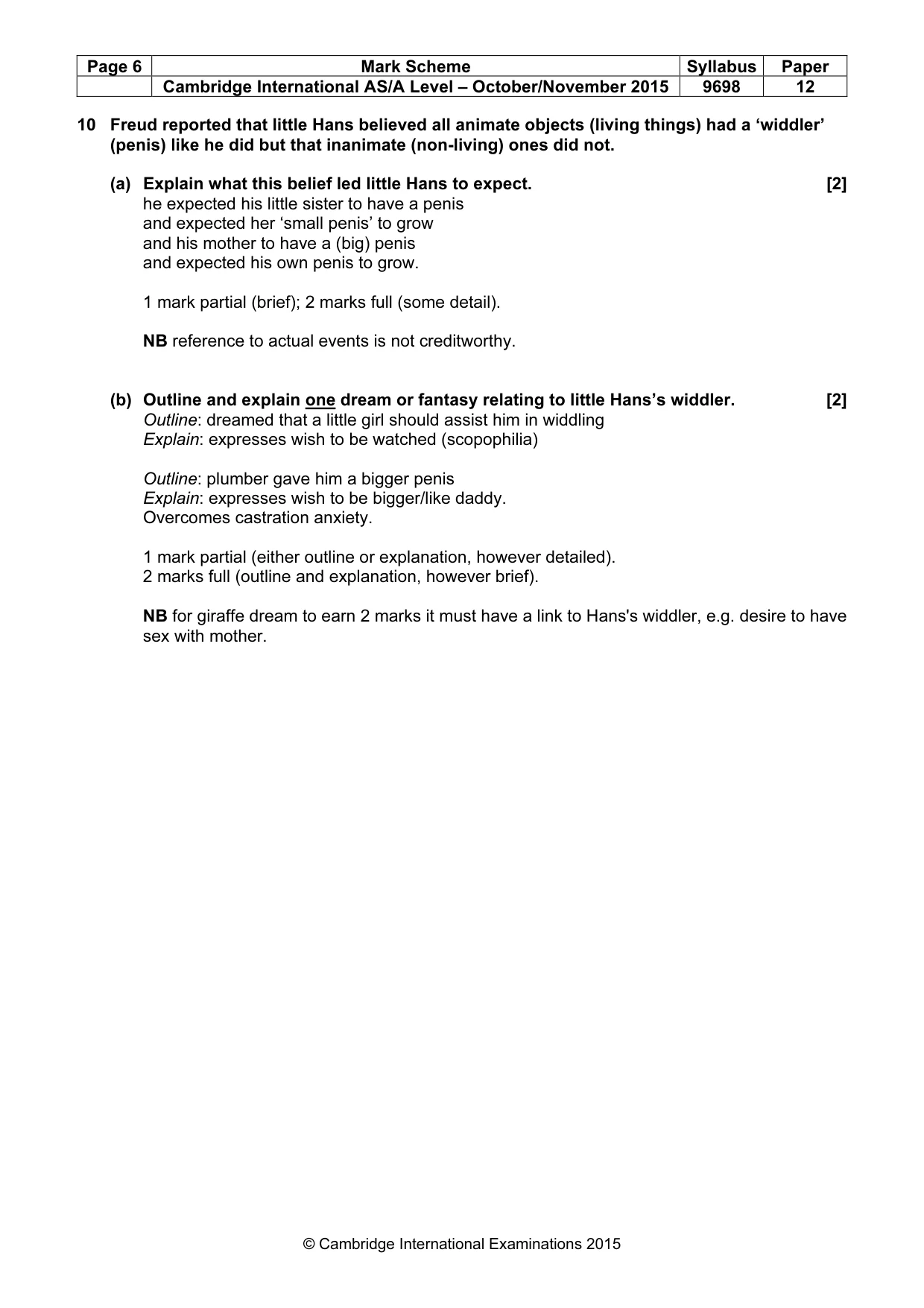
Page 6 Mark Scheme Syllabus Paper Cambridge International AS/A Level – October/November 2015 9698 12 © Cambridge International Examinations 2015 10 Freud reported that little Hans believed all animate objects (living things) had a ‘widdler’ (penis) like he did but that inanimate (non-living) ones did not. (a) Explain what this belief led little Hans to expect. [2] he expected his little sister to have a penis and expected her ‘small penis’ to grow and his mother to have a (big) penis and expected his own penis to grow. 1 mark partial (brief); 2 marks full (some detail). NB reference to actual events is not creditworthy. (b) Outline and explain one dream or fantasy relating to little Hans’s widdler. [2] Outline: dreamed that a little girl should assist him in widdling Explain: expresses wish to be watched (scopophilia) Outline: plumber gave him a bigger penis Explain: expresses wish to be bigger/like daddy. Overcomes castration anxiety. 1 mark partial (either outline or explanation, however detailed). 2 marks full (outline and explanation, however brief). NB for giraffe dream to earn 2 marks it must have a link to Hans's widdler, e.g. desire to have sex with mother.
Mark scheme, page 7
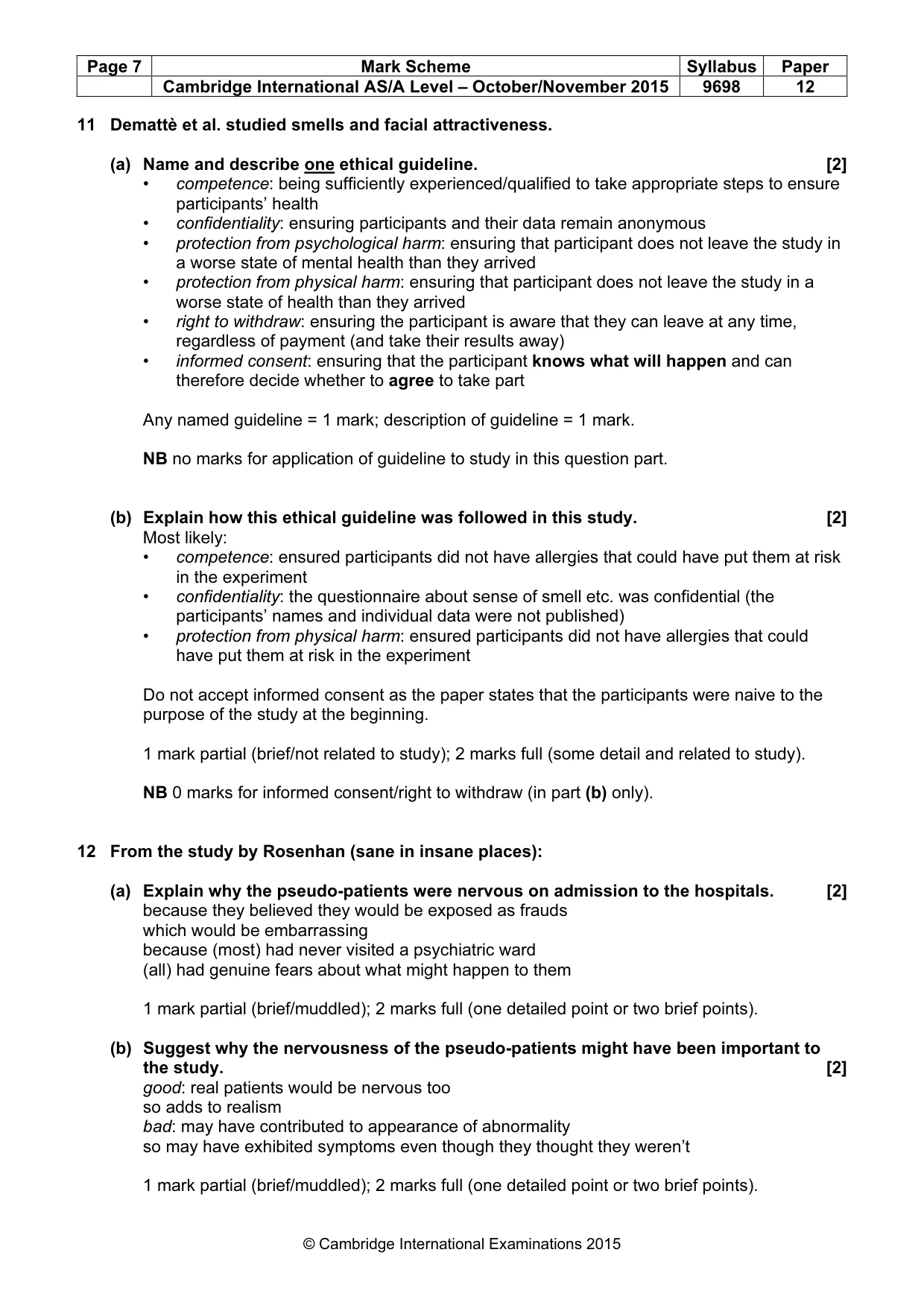
Page 7 Mark Scheme Syllabus Paper Cambridge International AS/A Level – October/November 2015 9698 12 © Cambridge International Examinations 2015 11 Demattè et al. studied smells and facial attractiveness. (a) Name and describe one ethical guideline. [2] • competence: being sufficiently experienced/qualified to take appropriate steps to ensure participants’ health • confidentiality: ensuring participants and their data remain anonymous • protection from psychological harm: ensuring that participant does not leave the study in a worse state of mental health than they arrived • protection from physical harm: ensuring that participant does not leave the study in a worse state of health than they arrived • right to withdraw: ensuring the participant is aware that they can leave at any time, regardless of payment (and take their results away) • informed consent: ensuring that the participant knows what will happen and can therefore decide whether to agree to take part Any named guideline = 1 mark; description of guideline = 1 mark. NB no marks for application of guideline to study in this question part. (b) Explain how this ethical guideline was followed in this study. [2] Most likely: • competence: ensured participants did not have allergies that could have put them at risk in the experiment • confidentiality: the questionnaire about sense of smell etc. was confidential (the participants’ names and individual data were not published) • protection from physical harm: ensured participants did not have allergies that could have put them at risk in the experiment Do not accept informed consent as the paper states that the participants were naive to the purpose of the study at the beginning. 1 mark partial (brief/not related to study); 2 marks full (some detail and related to study). NB 0 marks for informed consent/right to withdraw (in part (b) only). 12 From the study by Rosenhan (sane in insane places): (a) Explain why the pseudo-patients were nervous on admission to the hospitals. [2] because they believed they would be exposed as frauds which would be embarrassing because (most) had never visited a psychiatric ward (all) had genuine fears about what might happen to them 1 mark partial (brief/muddled); 2 marks full (one detailed point or two brief points). (b) Suggest why the nervousness of the pseudo-patients might have been important to the study. [2] good: real patients would be nervous too so adds to realism bad: may have contributed to appearance of abnormality so may have exhibited symptoms even though they thought they weren’t 1 mark partial (brief/muddled); 2 marks full (one detailed point or two brief points).
Mark scheme, page 8
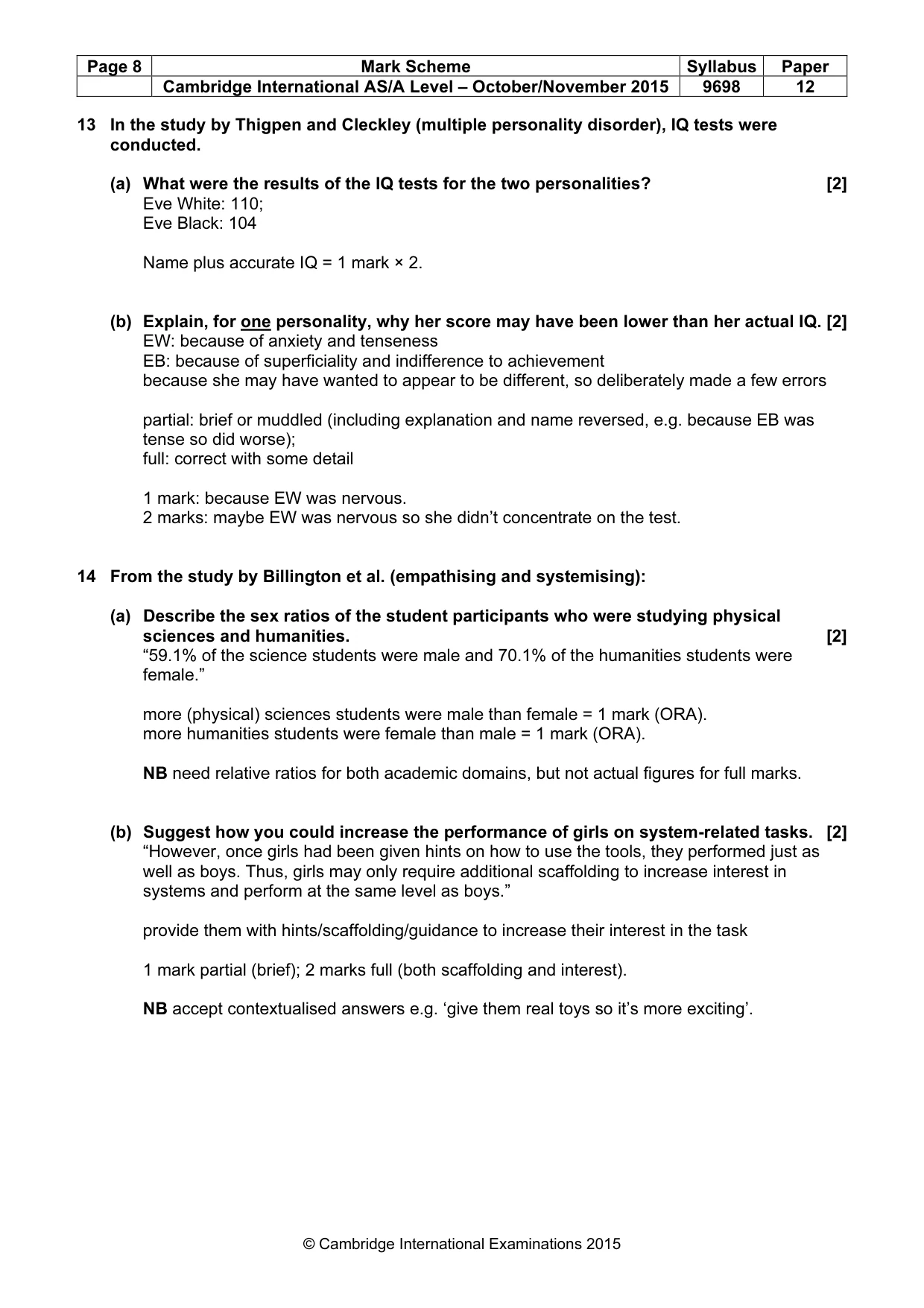
Page 8 Mark Scheme Syllabus Paper Cambridge International AS/A Level – October/November 2015 9698 12 © Cambridge International Examinations 2015 13 In the study by Thigpen and Cleckley (multiple personality disorder), IQ tests were conducted. (a) What were the results of the IQ tests for the two personalities? [2] Eve White: 110; Eve Black: 104 Name plus accurate IQ = 1 mark × 2. (b) Explain, for one personality, why her score may have been lower than her actual IQ. [2] EW: because of anxiety and tenseness EB: because of superficiality and indifference to achievement because she may have wanted to appear to be different, so deliberately made a few errors partial: brief or muddled (including explanation and name reversed, e.g. because EB was tense so did worse); full: correct with some detail 1 mark: because EW was nervous. 2 marks: maybe EW was nervous so she didn’t concentrate on the test. 14 From the study by Billington et al. (empathising and systemising): (a) Describe the sex ratios of the student participants who were studying physical sciences and humanities. [2] “59.1% of the science students were male and 70.1% of the humanities students were female.” more (physical) sciences students were male than female = 1 mark (ORA). more humanities students were female than male = 1 mark (ORA). NB need relative ratios for both academic domains, but not actual figures for full marks. (b) Suggest how you could increase the performance of girls on system-related tasks. [2] “However, once girls had been given hints on how to use the tools, they performed just as well as boys. Thus, girls may only require additional scaffolding to increase interest in systems and perform at the same level as boys.” provide them with hints/scaffolding/guidance to increase their interest in the task 1 mark partial (brief); 2 marks full (both scaffolding and interest). NB accept contextualised answers e.g. ‘give them real toys so it’s more exciting’.
Mark scheme, page 9
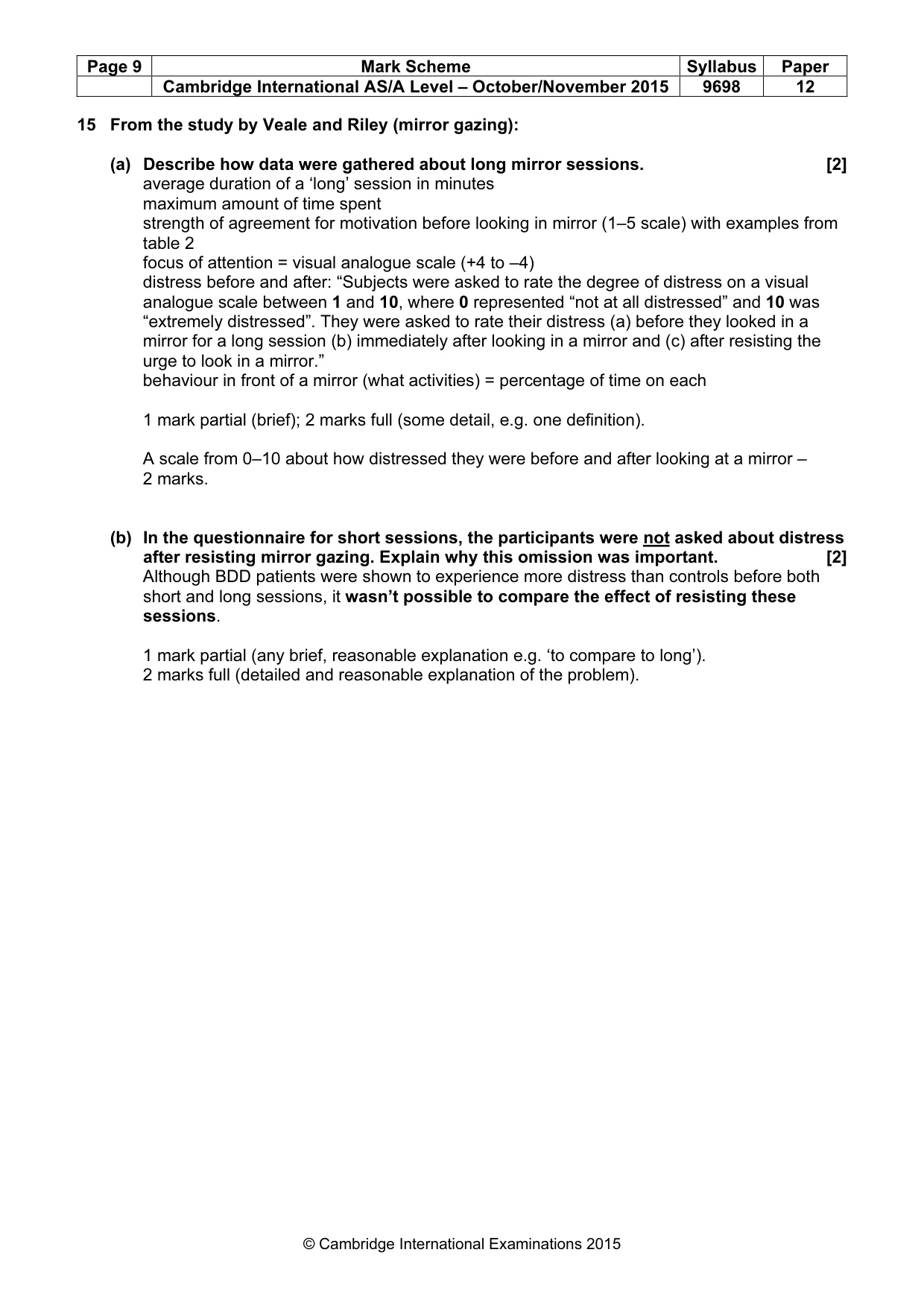
Page 9 Mark Scheme Syllabus Paper Cambridge International AS/A Level – October/November 2015 9698 12 © Cambridge International Examinations 2015 15 From the study by Veale and Riley (mirror gazing): (a) Describe how data were gathered about long mirror sessions. [2] average duration of a ‘long’ session in minutes maximum amount of time spent strength of agreement for motivation before looking in mirror (1–5 scale) with examples from table 2 focus of attention = visual analogue scale (+4 to –4) distress before and after: “Subjects were asked to rate the degree of distress on a visual analogue scale between 1 and 10, where 0 represented “not at all distressed” and 10 was “extremely distressed”. They were asked to rate their distress (a) before they looked in a mirror for a long session (b) immediately after looking in a mirror and (c) after resisting the urge to look in a mirror.” behaviour in front of a mirror (what activities) = percentage of time on each 1 mark partial (brief); 2 marks full (some detail, e.g. one definition). A scale from 0–10 about how distressed they were before and after looking at a mirror – 2 marks. (b) In the questionnaire for short sessions, the participants were not asked about distress after resisting mirror gazing. Explain why this omission was important. [2] Although BDD patients were shown to experience more distress than controls before both short and long sessions, it wasn’t possible to compare the effect of resisting these sessions. 1 mark partial (any brief, reasonable explanation e.g. ‘to compare to long’). 2 marks full (detailed and reasonable explanation of the problem).
Mark scheme, page 10
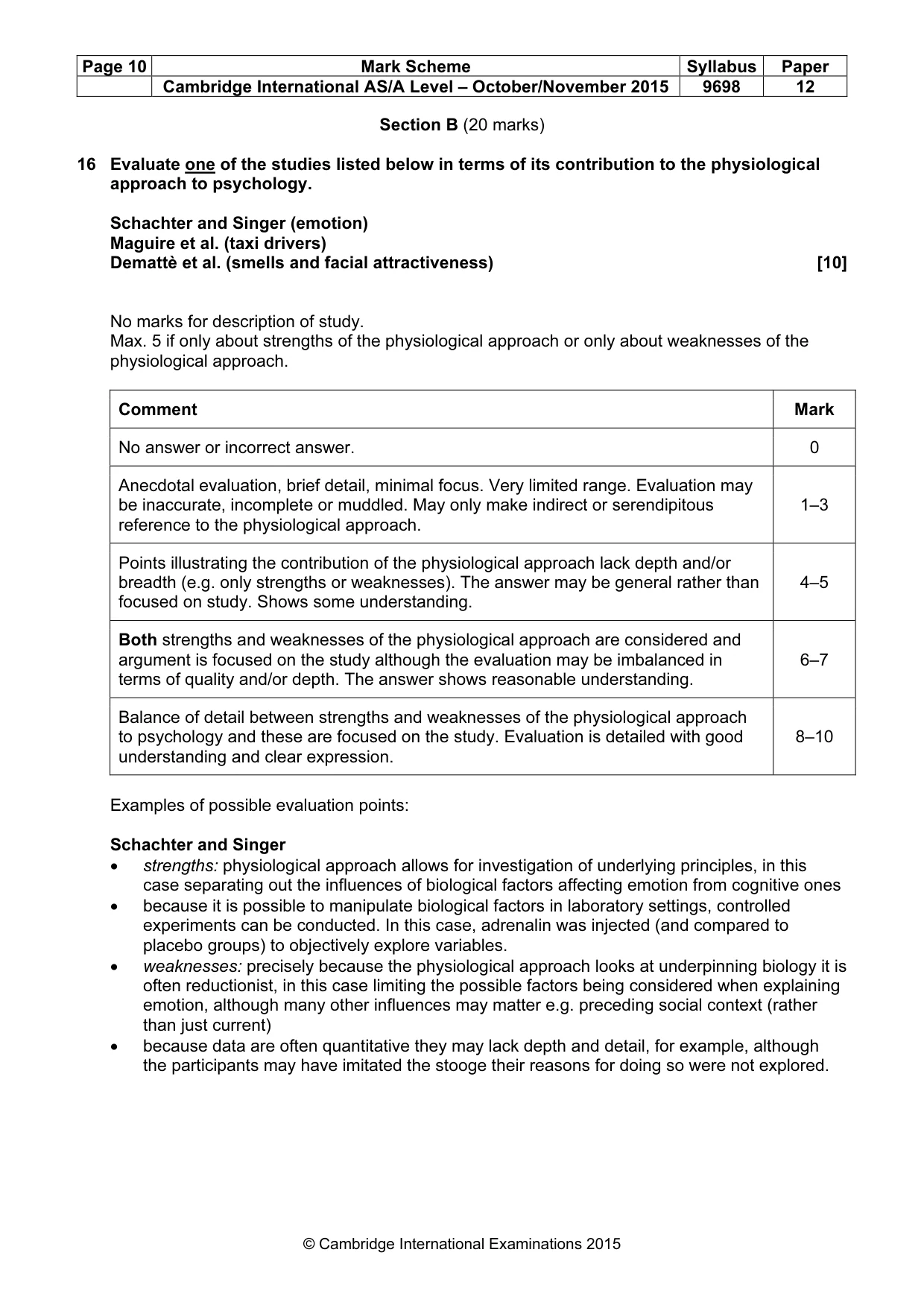
Page 10 Mark Scheme Syllabus Paper Cambridge International AS/A Level – October/November 2015 9698 12 © Cambridge International Examinations 2015 Section B (20 marks) 16 Evaluate one of the studies listed below in terms of its contribution to the physiological approach to psychology. Schachter and Singer (emotion) Maguire et al. (taxi drivers) Demattè et al. (smells and facial attractiveness) [10] No marks for description of study. Max. 5 if only about strengths of the physiological approach or only about weaknesses of the physiological approach. Comment Mark No answer or incorrect answer. 0 Anecdotal evaluation, brief detail, minimal focus. Very limited range. Evaluation may be inaccurate, incomplete or muddled. May only make indirect or serendipitous reference to the physiological approach. 1–3 Points illustrating the contribution of the physiological approach lack depth and/or breadth (e.g. only strengths or weaknesses). The answer may be general rather than focused on study. Shows some understanding. 4–5 Both strengths and weaknesses of the physiological approach are considered and argument is focused on the study although the evaluation may be imbalanced in terms of quality and/or depth. The answer shows reasonable understanding. 6–7 Balance of detail between strengths and weaknesses of the physiological approach to psychology and these are focused on the study. Evaluation is detailed with good understanding and clear expression. 8–10 Examples of possible evaluation points: Schachter and Singer • strengths: physiological approach allows for investigation of underlying principles, in this case separating out the influences of biological factors affecting emotion from cognitive ones • because it is possible to manipulate biological factors in laboratory settings, controlled experiments can be conducted. In this case, adrenalin was injected (and compared to placebo groups) to objectively explore variables. • weaknesses: precisely because the physiological approach looks at underpinning biology it is often reductionist, in this case limiting the possible factors being considered when explaining emotion, although many other influences may matter e.g. preceding social context (rather than just current) • because data are often quantitative they may lack depth and detail, for example, although the participants may have imitated the stooge their reasons for doing so were not explored.
Mark scheme, page 11
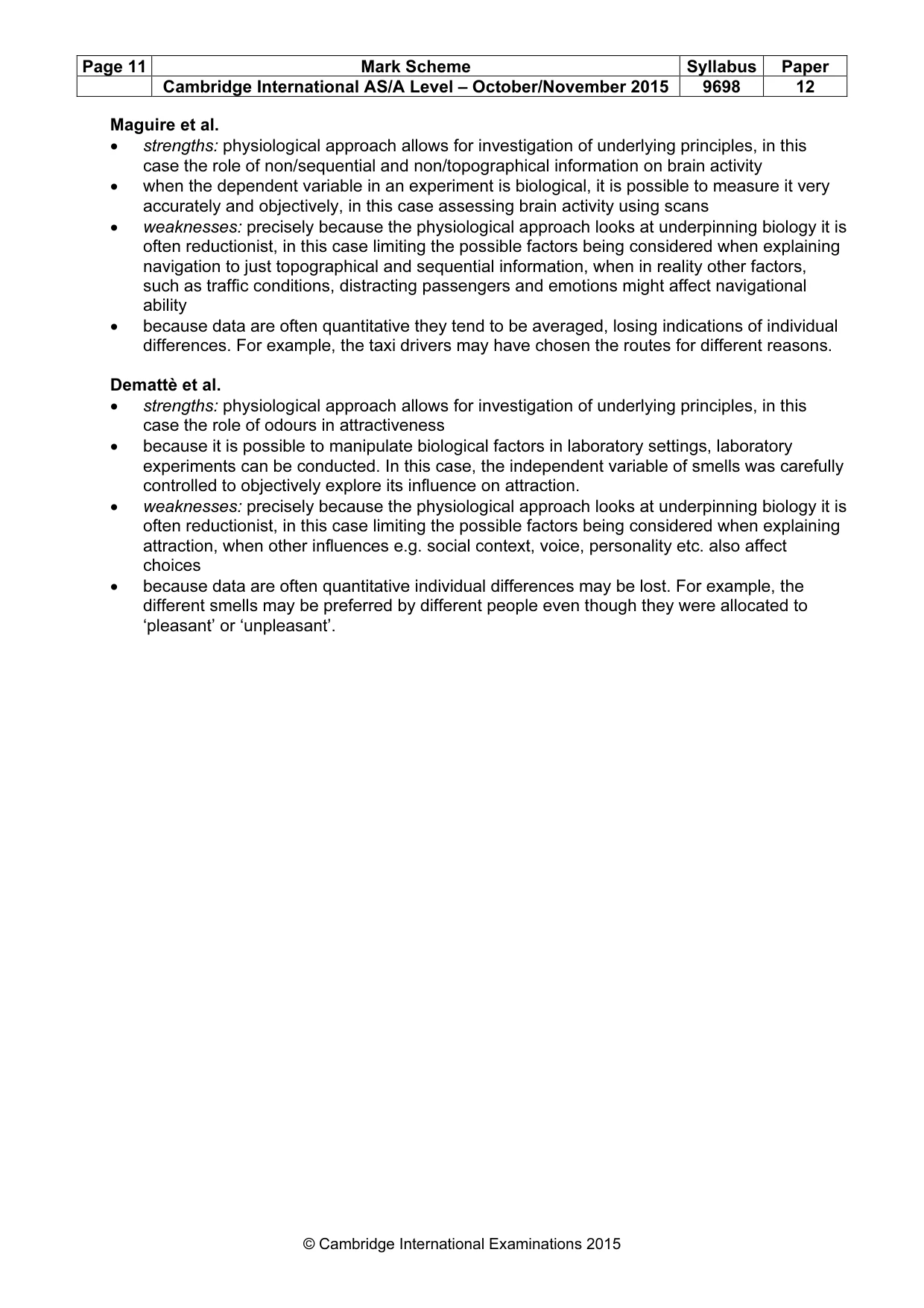
Page 11 Mark Scheme Syllabus Paper Cambridge International AS/A Level – October/November 2015 9698 12 © Cambridge International Examinations 2015 Maguire et al. • strengths: physiological approach allows for investigation of underlying principles, in this case the role of non/sequential and non/topographical information on brain activity • when the dependent variable in an experiment is biological, it is possible to measure it very accurately and objectively, in this case assessing brain activity using scans • weaknesses: precisely because the physiological approach looks at underpinning biology it is often reductionist, in this case limiting the possible factors being considered when explaining navigation to just topographical and sequential information, when in reality other factors, such as traffic conditions, distracting passengers and emotions might affect navigational ability • because data are often quantitative they tend to be averaged, losing indications of individual differences. For example, the taxi drivers may have chosen the routes for different reasons. Demattè et al. • strengths: physiological approach allows for investigation of underlying principles, in this case the role of odours in attractiveness • because it is possible to manipulate biological factors in laboratory settings, laboratory experiments can be conducted. In this case, the independent variable of smells was carefully controlled to objectively explore its influence on attraction. • weaknesses: precisely because the physiological approach looks at underpinning biology it is often reductionist, in this case limiting the possible factors being considered when explaining attraction, when other influences e.g. social context, voice, personality etc. also affect choices • because data are often quantitative individual differences may be lost. For example, the different smells may be preferred by different people even though they were allocated to ‘pleasant’ or ‘unpleasant’.
Mark scheme, page 12
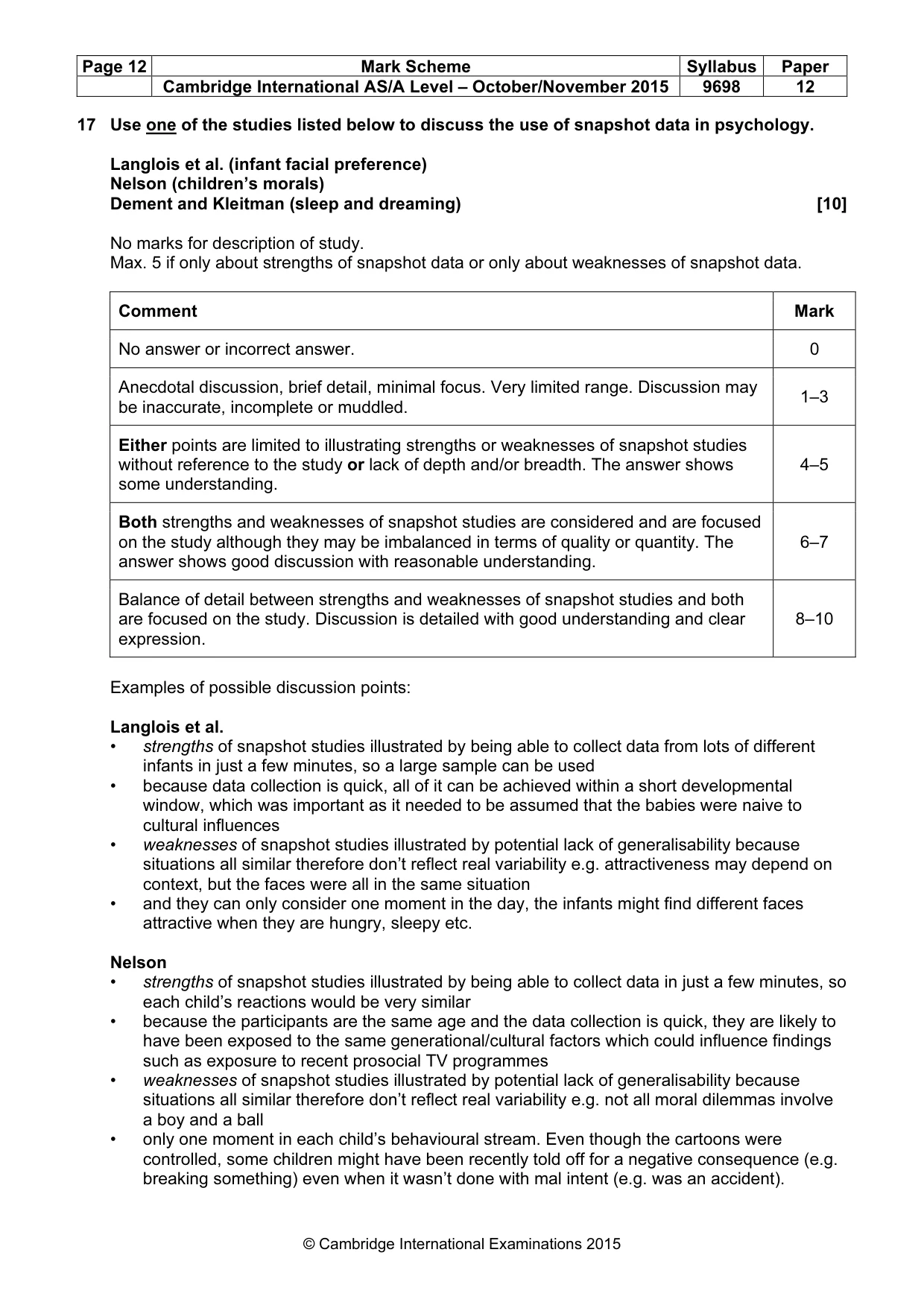
Page 12 Mark Scheme Syllabus Paper Cambridge International AS/A Level – October/November 2015 9698 12 © Cambridge International Examinations 2015 17 Use one of the studies listed below to discuss the use of snapshot data in psychology. Langlois et al. (infant facial preference) Nelson (children’s morals) Dement and Kleitman (sleep and dreaming) [10] No marks for description of study. Max. 5 if only about strengths of snapshot data or only about weaknesses of snapshot data. Comment Mark No answer or incorrect answer. 0 Anecdotal discussion, brief detail, minimal focus. Very limited range. Discussion may be inaccurate, incomplete or muddled. 1–3 Either points are limited to illustrating strengths or weaknesses of snapshot studies without reference to the study or lack of depth and/or breadth. The answer shows some understanding. 4–5 Both strengths and weaknesses of snapshot studies are considered and are focused on the study although they may be imbalanced in terms of quality or quantity. The answer shows good discussion with reasonable understanding. 6–7 Balance of detail between strengths and weaknesses of snapshot studies and both are focused on the study. Discussion is detailed with good understanding and clear expression. 8–10 Examples of possible discussion points: Langlois et al. • strengths of snapshot studies illustrated by being able to collect data from lots of different infants in just a few minutes, so a large sample can be used • because data collection is quick, all of it can be achieved within a short developmental window, which was important as it needed to be assumed that the babies were naive to cultural influences • weaknesses of snapshot studies illustrated by potential lack of generalisability because situations all similar therefore don’t reflect real variability e.g. attractiveness may depend on context, but the faces were all in the same situation • and they can only consider one moment in the day, the infants might find different faces attractive when they are hungry, sleepy etc. Nelson • strengths of snapshot studies illustrated by being able to collect data in just a few minutes, so each child’s reactions would be very similar • because the participants are the same age and the data collection is quick, they are likely to have been exposed to the same generational/cultural factors which could influence findings such as exposure to recent prosocial TV programmes • weaknesses of snapshot studies illustrated by potential lack of generalisability because situations all similar therefore don’t reflect real variability e.g. not all moral dilemmas involve a boy and a ball • only one moment in each child’s behavioural stream. Even though the cartoons were controlled, some children might have been recently told off for a negative consequence (e.g. breaking something) even when it wasn’t done with mal intent (e.g. was an accident).
Mark scheme, page 13
Page 13 Mark Scheme Syllabus Paper Cambridge International AS/A Level – October/November 2015 9698 12 © Cambridge International Examinations 2015 Dement and Kleitman • strengths of snapshot studies illustrated by being able to collect data in just a few days, so each person’s reactions would be very similar, e.g. no differences like whether it was the participant’s holiday time or not • also because participants are likely to be similar unlike studies which take a long time when generational/cultural differences may influence findings whereas Dement and Kleitman’s participants are likely to have all had similar cultural influence e.g. from the belief that ‘we all need 8 hours sleep’. • weaknesses of snapshot studies illustrated by potential lack of generalisability because situation is time limited so doesn’t reflect real variability e.g. when we are stressed/overworked/jetlagged etc. our sleep and dreaming patterns are disrupted • only one moment in each individual’s behavioural stream. Even though they were comparing manipulations such as waking after 5/15 minutes, some participants might have just had a very busy day.
What you needed in this session
Cambridge’s own grade thresholds for 2015 Oct/Nov, Paper 1 · Variant 2. A higher threshold means an easier paper — the bar moves with how the cohort did.