Cambridge A Level Psychology 9698 — 2017 May/June Paper 1 · Variant 1
9698/11/M/J/17 · 80 marks · ≈90 min
The question paper and its mark scheme, free to read here and free to download. This is Cambridge’s own paper, exactly as it was sat.
Question paper4 pages
Mark scheme
No mark scheme is in the library for this paper.
Paper as text
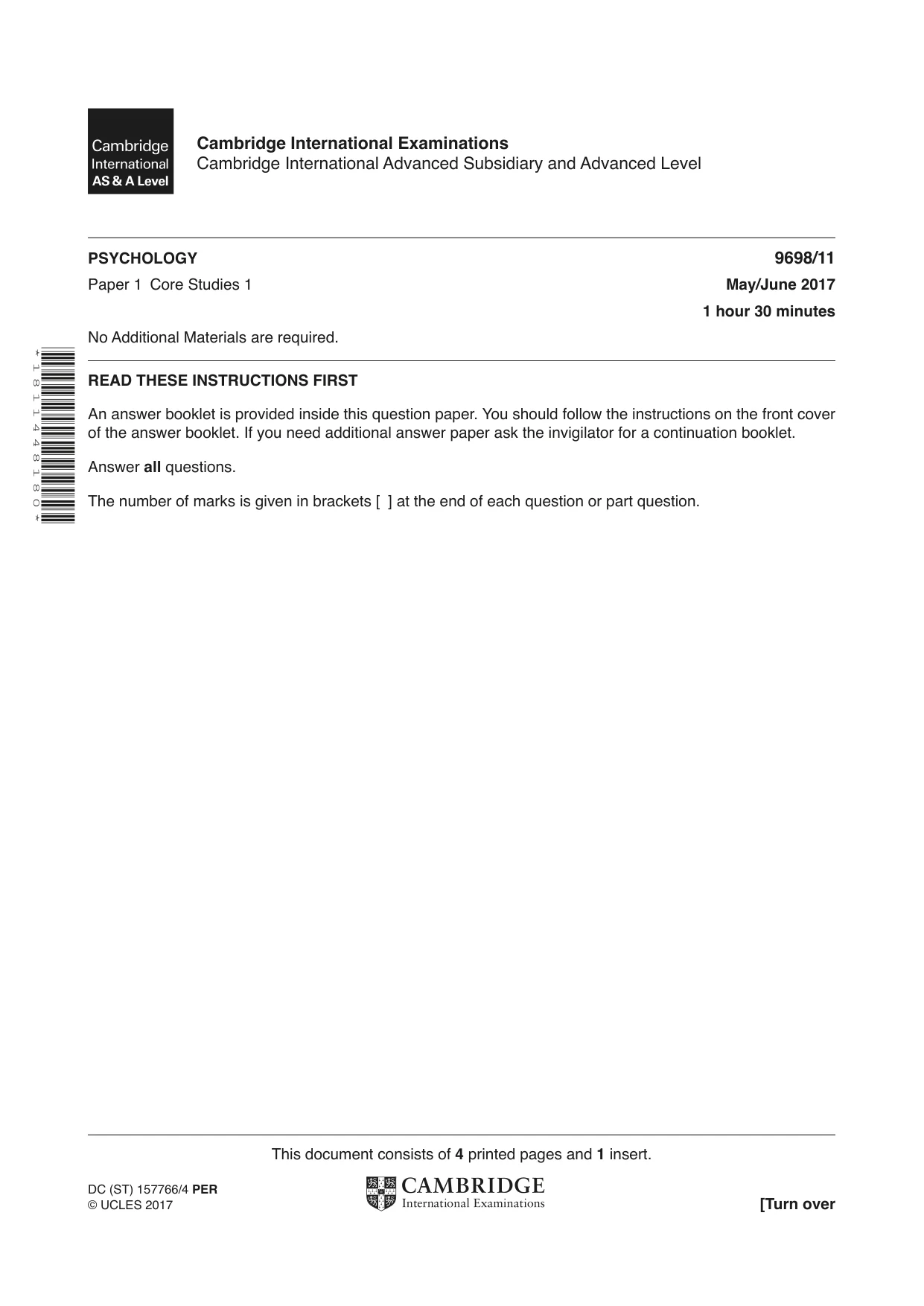
Question paper, page 1
* 1 8 1 1 4 4 8 1 8 0 * This document consists of 4 printed pages and 1 insert. DC (ST) 157766/4 PER © UCLES 2017 [Turn over PSYCHOLOGY 9698/11 Paper 1 Core Studies 1 May/June 2017 1 hour 30 minutes No Additional Materials are required. READ THESE INSTRUCTIONS FIRST An answer booklet is provided inside this question paper. You should follow the instructions on the front cover of the answer booklet. If you need additional answer paper ask the invigilator for a continuation booklet. Answer all questions. The number of marks is given in brackets [ ] at the end of each question or part question. Cambridge International Examinations Cambridge International Advanced Subsidiary and Advanced Level
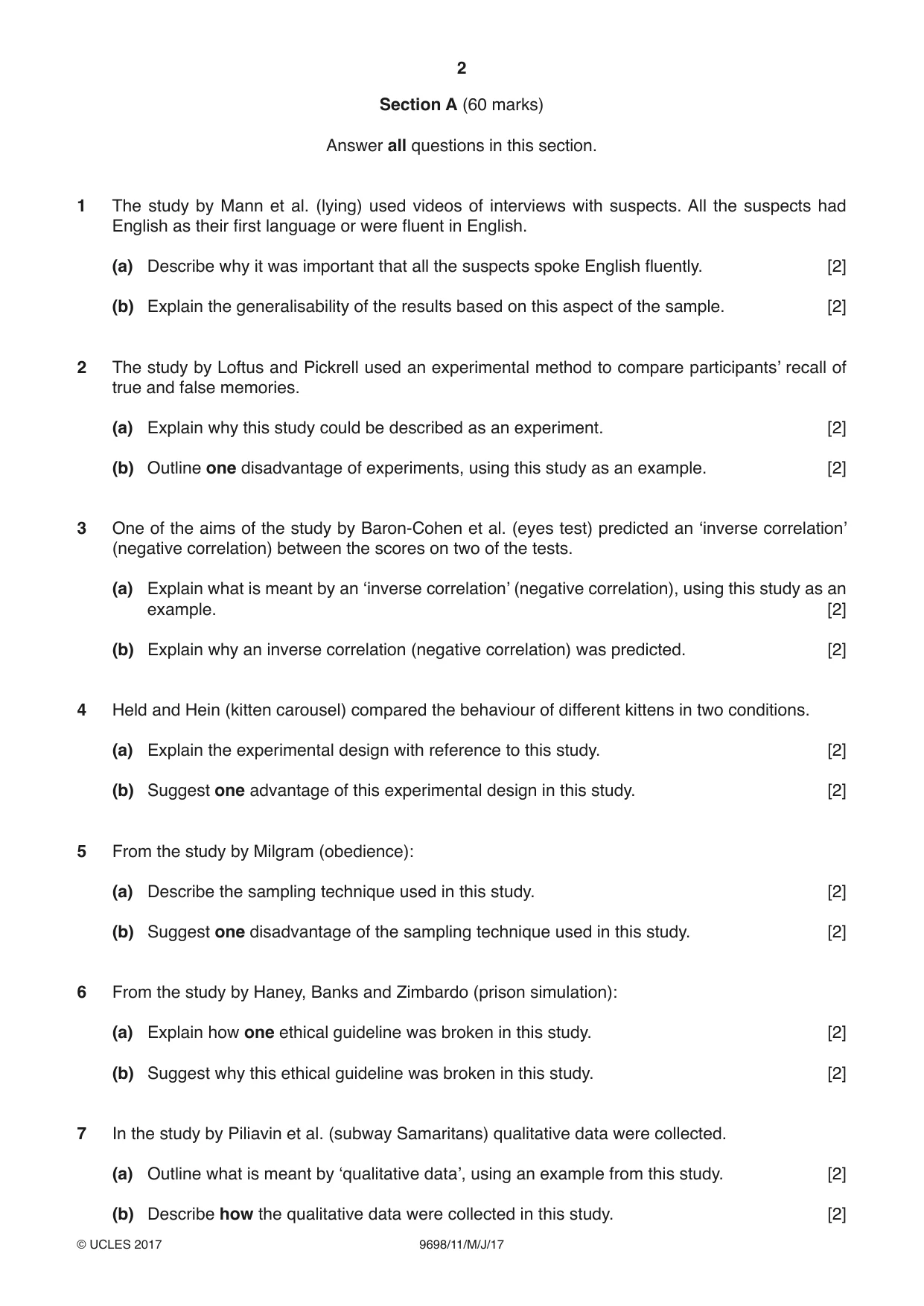
Question paper, page 2
2 9698/11/M/J/17 © UCLES 2017 Section A (60 marks) Answer all questions in this section. 1 The study by Mann et al. (lying) used videos of interviews with suspects. All the suspects had English as their first language or were fluent in English. (a) Describe why it was important that all the suspects spoke English fluently. [2] (b) Explain the generalisability of the results based on this aspect of the sample. [2] 2 The study by Loftus and Pickrell used an experimental method to compare participants’ recall of true and false memories. (a) Explain why this study could be described as an experiment. [2] (b) Outline one disadvantage of experiments, using this study as an example. [2] 3 One of the aims of the study by Baron-Cohen et al. (eyes test) predicted an ‘inverse correlation’ (negative correlation) between the scores on two of the tests. (a) Explain what is meant by an ‘inverse correlation’ (negative correlation), using this study as an example. [2] (b) Explain why an inverse correlation (negative correlation) was predicted. [2] 4 Held and Hein (kitten carousel) compared the behaviour of different kittens in two conditions. (a) Explain the experimental design with reference to this study. [2] (b) Suggest one advantage of this experimental design in this study. [2] 5 From the study by Milgram (obedience): (a) Describe the sampling technique used in this study. [2] (b) Suggest one disadvantage of the sampling technique used in this study. [2] 6 From the study by Haney, Banks and Zimbardo (prison simulation): (a) Explain how one ethical guideline was broken in this study. [2] (b) Suggest why this ethical guideline was broken in this study. [2] 7 In the study by Piliavin et al. (subway Samaritans) qualitative data were collected. (a) Outline what is meant by ‘qualitative data’, using an example from this study. [2] (b) Describe how the qualitative data were collected in this study. [2]
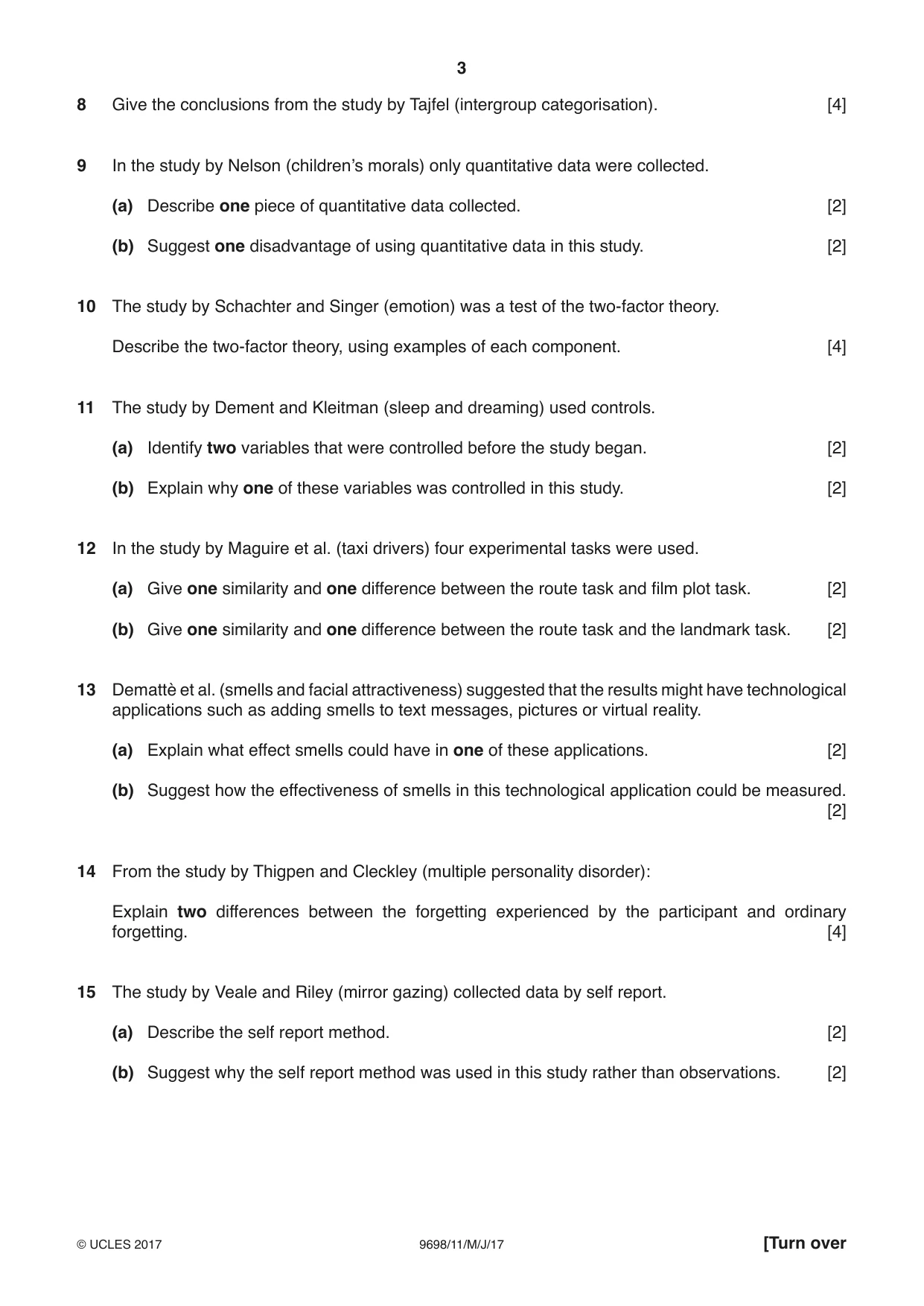
Question paper, page 3
3 9698/11/M/J/17 © UCLES 2017 [Turn over 8 Give the conclusions from the study by Tajfel (intergroup categorisation). [4] 9 In the study by Nelson (children’s morals) only quantitative data were collected. (a) Describe one piece of quantitative data collected. [2] (b) Suggest one disadvantage of using quantitative data in this study. [2] 10 The study by Schachter and Singer (emotion) was a test of the two-factor theory. Describe the two-factor theory, using examples of each component. [4] 11 The study by Dement and Kleitman (sleep and dreaming) used controls. (a) Identify two variables that were controlled before the study began. [2] (b) Explain why one of these variables was controlled in this study. [2] 12 In the study by Maguire et al. (taxi drivers) four experimental tasks were used. (a) Give one similarity and one difference between the route task and film plot task. [2] (b) Give one similarity and one difference between the route task and the landmark task. [2] 13 Demattè et al. (smells and facial attractiveness) suggested that the results might have technological applications such as adding smells to text messages, pictures or virtual reality. (a) Explain what effect smells could have in one of these applications. [2] (b) Suggest how the effectiveness of smells in this technological application could be measured. [2] 14 From the study by Thigpen and Cleckley (multiple personality disorder): Explain two differences between the forgetting experienced by the participant and ordinary forgetting. [4] 15 The study by Veale and Riley (mirror gazing) collected data by self report. (a) Describe the self report method. [2] (b) Suggest why the self report method was used in this study rather than observations. [2]
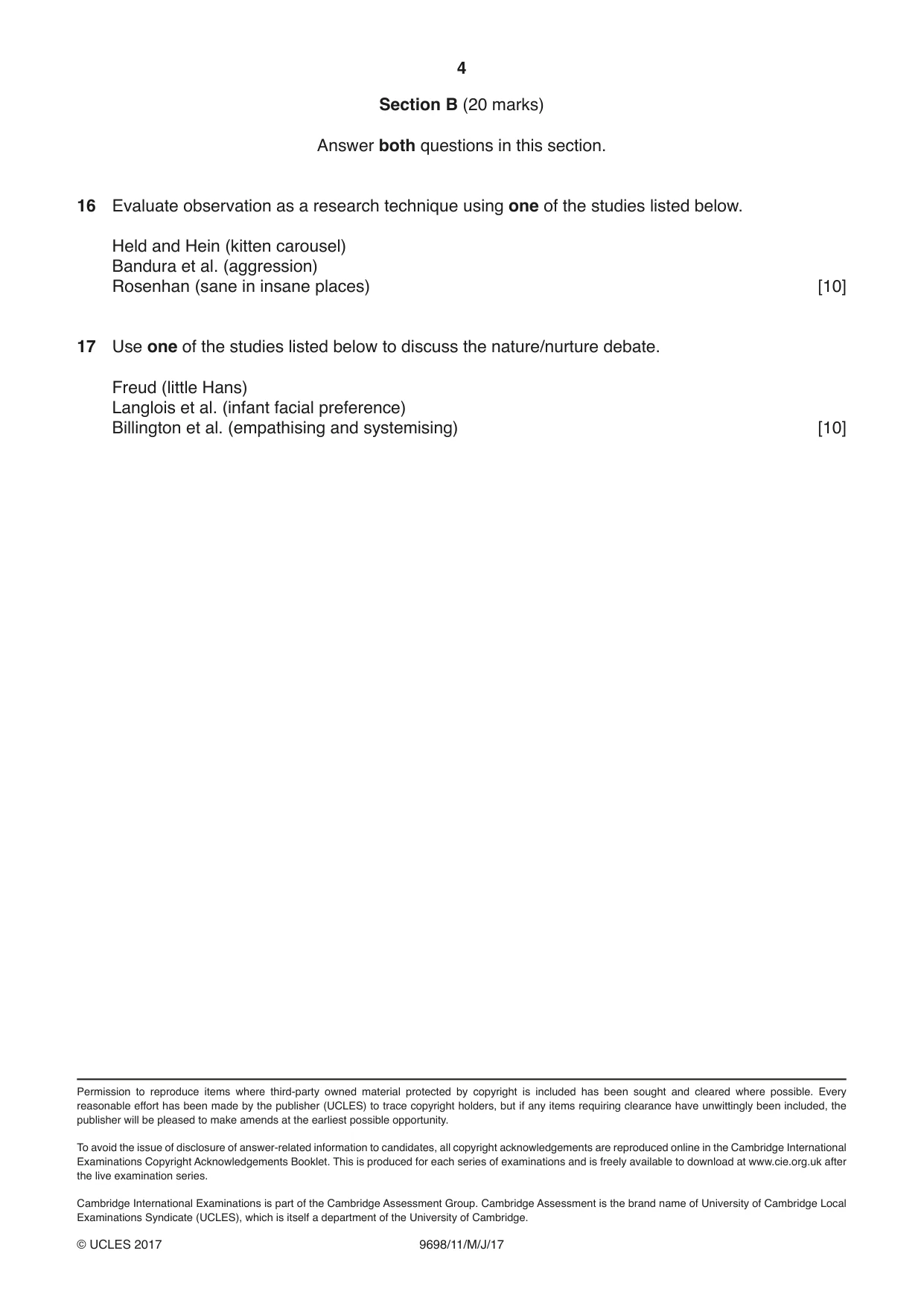
Question paper, page 4
4 9698/11/M/J/17 © UCLES 2017 Section B (20 marks) Answer both questions in this section. 16 Evaluate observation as a research technique using one of the studies listed below. Held and Hein (kitten carousel) Bandura et al. (aggression) Rosenhan (sane in insane places) [10] 17 Use one of the studies listed below to discuss the nature/nurture debate. Freud (little Hans) Langlois et al. (infant facial preference) Billington et al. (empathising and systemising) [10] Permission to reproduce items where third-party owned material protected by copyright is included has been sought and cleared where possible. Every reasonable effort has been made by the publisher (UCLES) to trace copyright holders, but if any items requiring clearance have unwittingly been included, the publisher will be pleased to make amends at the earliest possible opportunity. To avoid the issue of disclosure of answer-related information to candidates, all copyright acknowledgements are reproduced online in the Cambridge International Examinations Copyright Acknowledgements Booklet. This is produced for each series of examinations and is freely available to download at www.cie.org.uk after the live examination series. Cambridge International Examinations is part of the Cambridge Assessment Group. Cambridge Assessment is the brand name of University of Cambridge Local Examinations Syndicate (UCLES), which is itself a department of the University of Cambridge.
What you needed in this session
Cambridge’s own grade thresholds for 2017 May/June, Paper 1 · Variant 1. A higher threshold means an easier paper — the bar moves with how the cohort did.