Cambridge A Level Psychology 9698 — 2015 Oct/Nov Paper 1 · Variant 3
9698/13/O/N/15 · 80 marks · ≈90 min
The question paper and its mark scheme, free to read here and free to download. This is Cambridge’s own paper, exactly as it was sat.
Question paper4 pages
Mark scheme14 pages
Answers below. Sit the paper first if you are practising.

Paper as text
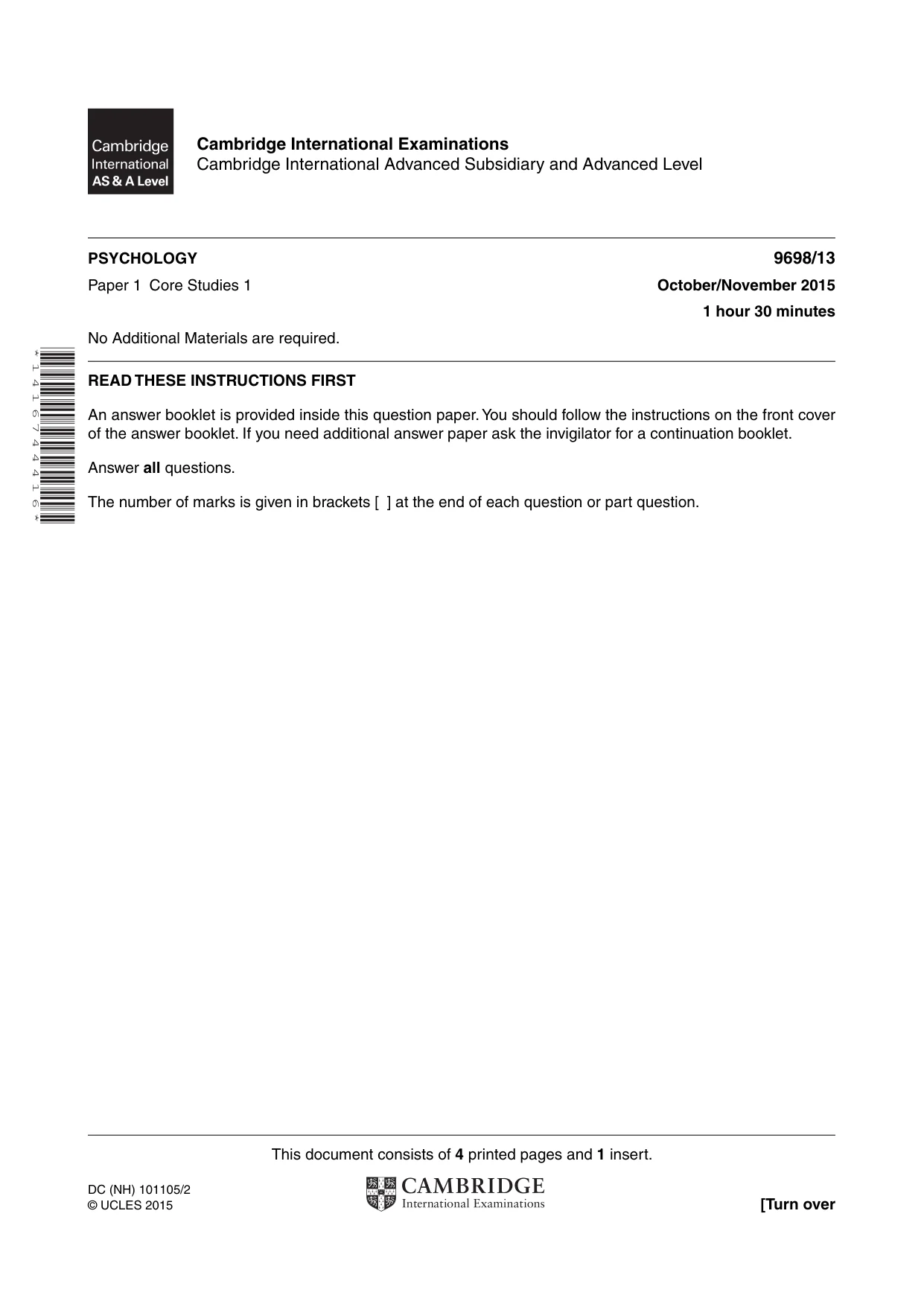
Question paper, page 1
This document consists of 4 printed pages and 1 insert. DC (NH) 101105/2 © UCLES 2015 [Turn over * 1 4 1 6 7 4 4 4 1 6 * PSYCHOLOGY 9698/13 Paper 1 Core Studies 1 October/November 2015 1 hour 30 minutes No Additional Materials are required. READ THESE INSTRUCTIONS FIRST An answer booklet is provided inside this question paper. You should follow the instructions on the front cover of the answer booklet. If you need additional answer paper ask the invigilator for a continuation booklet. Answer all questions. The number of marks is given in brackets [ ] at the end of each question or part question. Cambridge International Examinations Cambridge International Advanced Subsidiary and Advanced Level
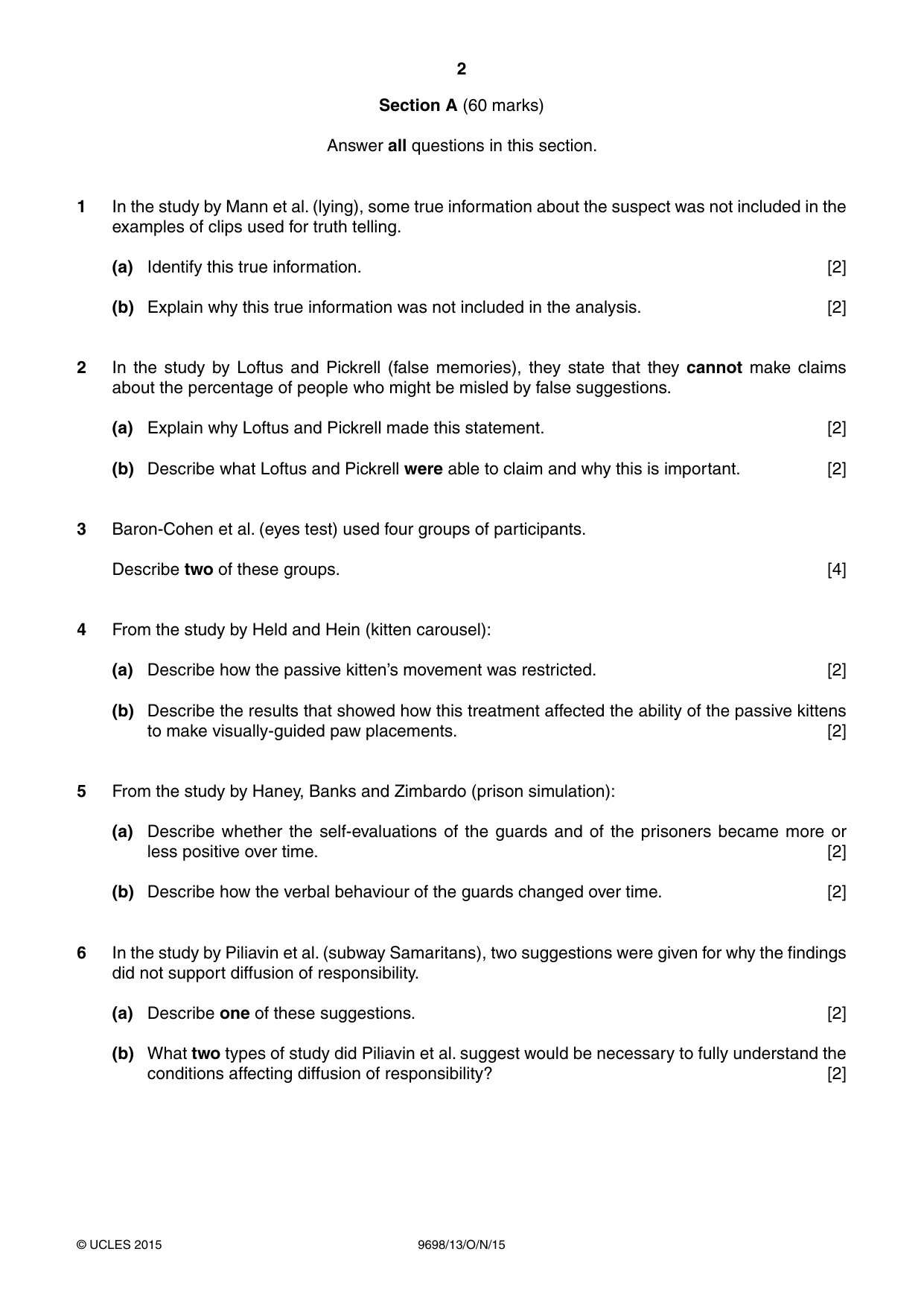
Question paper, page 2
2 9698/13/O/N/15 © UCLES 2015 Section A (60 marks) Answer all questions in this section. 1 In the study by Mann et al. (lying), some true information about the suspect was not included in the examples of clips used for truth telling. (a) Identify this true information. [2] (b) Explain why this true information was not included in the analysis. [2] 2 In the study by Loftus and Pickrell (false memories), they state that they cannot make claims about the percentage of people who might be misled by false suggestions. (a) Explain why Loftus and Pickrell made this statement. [2] (b) Describe what Loftus and Pickrell were able to claim and why this is important. [2] 3 Baron-Cohen et al. (eyes test) used four groups of participants. Describe two of these groups. [4] 4 From the study by Held and Hein (kitten carousel): (a) Describe how the passive kitten’s movement was restricted. [2] (b) Describe the results that showed how this treatment affected the ability of the passive kittens to make visually-guided paw placements. [2] 5 From the study by Haney, Banks and Zimbardo (prison simulation): (a) Describe whether the self-evaluations of the guards and of the prisoners became more or less positive over time. [2] (b) Describe how the verbal behaviour of the guards changed over time. [2] 6 In the study by Piliavin et al. (subway Samaritans), two suggestions were given for why the findings did not support diffusion of responsibility. (a) Describe one of these suggestions. [2] (b) What two types of study did Piliavin et al. suggest would be necessary to fully understand the conditions affecting diffusion of responsibility? [2]
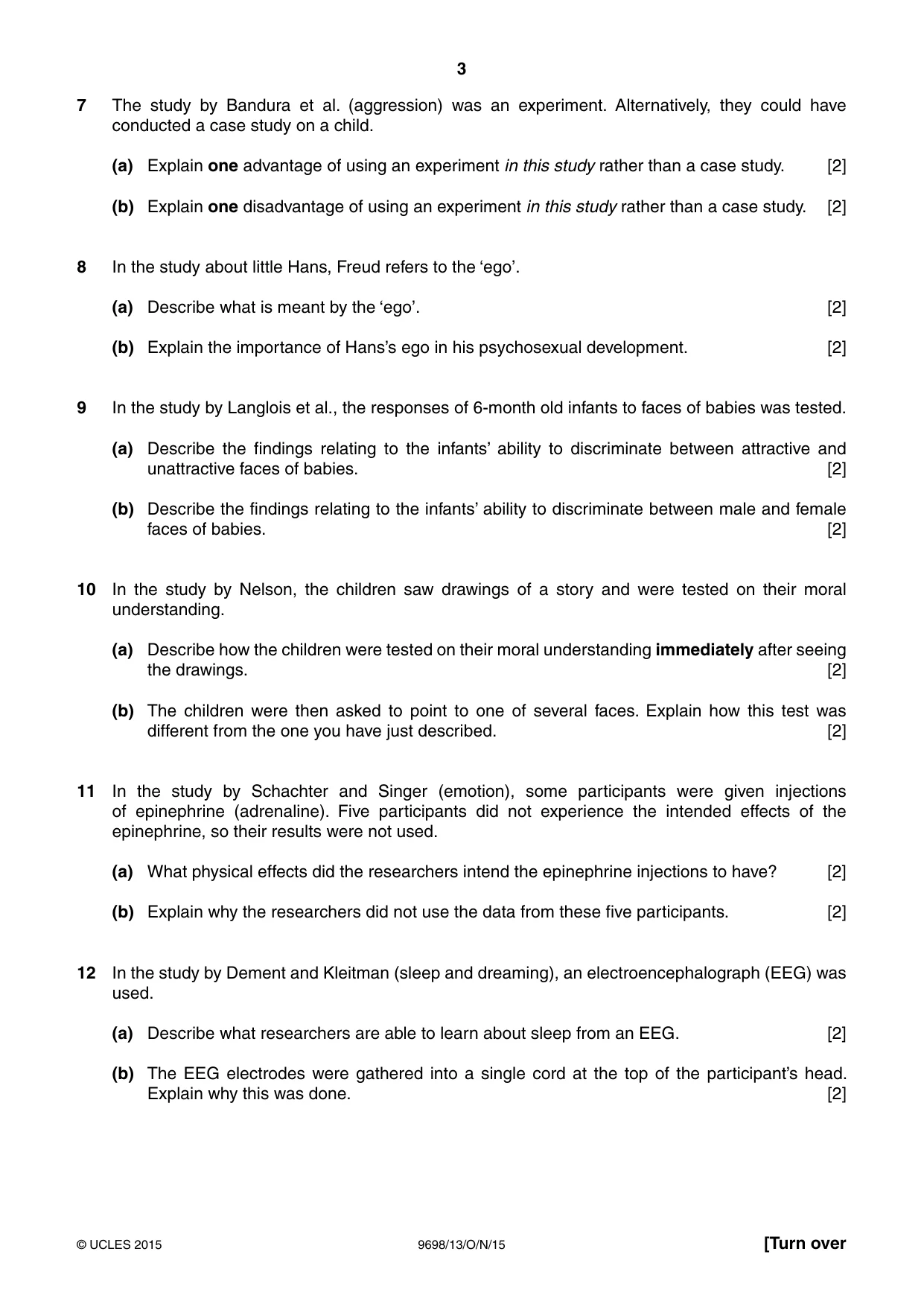
Question paper, page 3
3 9698/13/O/N/15 © UCLES 2015 [Turn over 7 The study by Bandura et al. (aggression) was an experiment. Alternatively, they could have conducted a case study on a child. (a) Explain one advantage of using an experiment in this study rather than a case study. [2] (b) Explain one disadvantage of using an experiment in this study rather than a case study. [2] 8 In the study about little Hans, Freud refers to the ‘ego’. (a) Describe what is meant by the ‘ego’. [2] (b) Explain the importance of Hans’s ego in his psychosexual development. [2] 9 In the study by Langlois et al., the responses of 6-month old infants to faces of babies was tested. (a) Describe the findings relating to the infants’ ability to discriminate between attractive and unattractive faces of babies. [2] (b) Describe the findings relating to the infants’ ability to discriminate between male and female faces of babies. [2] 10 In the study by Nelson, the children saw drawings of a story and were tested on their moral understanding. (a) Describe how the children were tested on their moral understanding immediately after seeing the drawings. [2] (b) The children were then asked to point to one of several faces. Explain how this test was different from the one you have just described. [2] 11 In the study by Schachter and Singer (emotion), some participants were given injections of epinephrine (adrenaline). Five participants did not experience the intended effects of the epinephrine, so their results were not used. (a) What physical effects did the researchers intend the epinephrine injections to have? [2] (b) Explain why the researchers did not use the data from these five participants. [2] 12 In the study by Dement and Kleitman (sleep and dreaming), an electroencephalograph (EEG) was used. (a) Describe what researchers are able to learn about sleep from an EEG. [2] (b) The EEG electrodes were gathered into a single cord at the top of the participant’s head. Explain why this was done. [2]
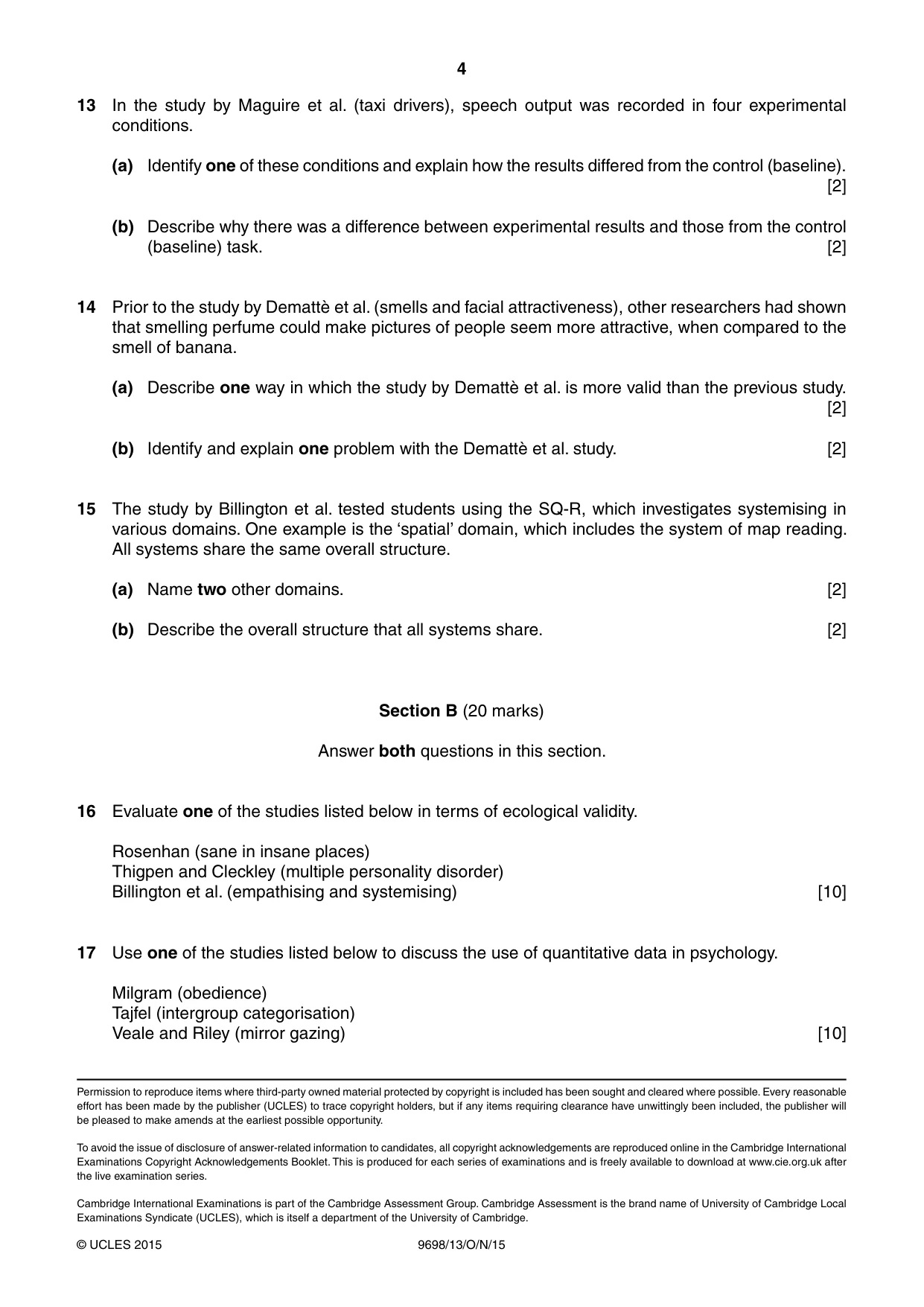
Question paper, page 4
4 9698/13/O/N/15 © UCLES 2015 13 In the study by Maguire et al. (taxi drivers), speech output was recorded in four experimental conditions. (a) Identify one of these conditions and explain how the results differed from the control (baseline). [2] (b) Describe why there was a difference between experimental results and those from the control (baseline) task. [2] 14 Prior to the study by Demattè et al. (smells and facial attractiveness), other researchers had shown that smelling perfume could make pictures of people seem more attractive, when compared to the smell of banana. (a) Describe one way in which the study by Demattè et al. is more valid than the previous study. [2] (b) Identify and explain one problem with the Demattè et al. study. [2] 15 The study by Billington et al. tested students using the SQ-R, which investigates systemising in various domains. One example is the ‘spatial’ domain, which includes the system of map reading. All systems share the same overall structure. (a) Name two other domains. [2] (b) Describe the overall structure that all systems share. [2] Section B (20 marks) Answer both questions in this section. 16 Evaluate one of the studies listed below in terms of ecological validity. Rosenhan (sane in insane places) Thigpen and Cleckley (multiple personality disorder) Billington et al. (empathising and systemising) [10] 17 Use one of the studies listed below to discuss the use of quantitative data in psychology. Milgram (obedience) Tajfel (intergroup categorisation) Veale and Riley (mirror gazing) [10] Permission to reproduce items where third-party owned material protected by copyright is included has been sought and cleared where possible. Every reasonable effort has been made by the publisher (UCLES) to trace copyright holders, but if any items requiring clearance have unwittingly been included, the publisher will be pleased to make amends at the earliest possible opportunity. To avoid the issue of disclosure of answer-related information to candidates, all copyright acknowledgements are reproduced online in the Cambridge International Examinations Copyright Acknowledgements Booklet. This is produced for each series of examinations and is freely available to download at www.cie.org.uk after the live examination series. Cambridge International Examinations is part of the Cambridge Assessment Group. Cambridge Assessment is the brand name of University of Cambridge Local Examinations Syndicate (UCLES), which is itself a department of the University of Cambridge.
Mark scheme, page 1
® IGCSE is the registered trademark of Cambridge International Examinations. CAMBRIDGE INTERNATIONAL EXAMINATIONS Cambridge International Advanced Subsidiary and Advanced Level MARK SCHEME for the October/November 2015 series 9698 PSYCHOLOGY 9698/13 Paper 1 (Core Studies), maximum raw mark 80 This mark scheme is published as an aid to teachers and candidates, to indicate the requirements of the examination. It shows the basis on which Examiners were instructed to award marks. It does not indicate the details of the discussions that took place at an Examiners’ meeting before marking began, which would have considered the acceptability of alternative answers. Mark schemes should be read in conjunction with the question paper and the Principal Examiner Report for Teachers. Cambridge will not enter into discussions about these mark schemes. Cambridge is publishing the mark schemes for the October/November 2015 series for most Cambridge IGCSE®, Cambridge International A and AS Level components and some Cambridge O Level components.
Mark scheme, page 2
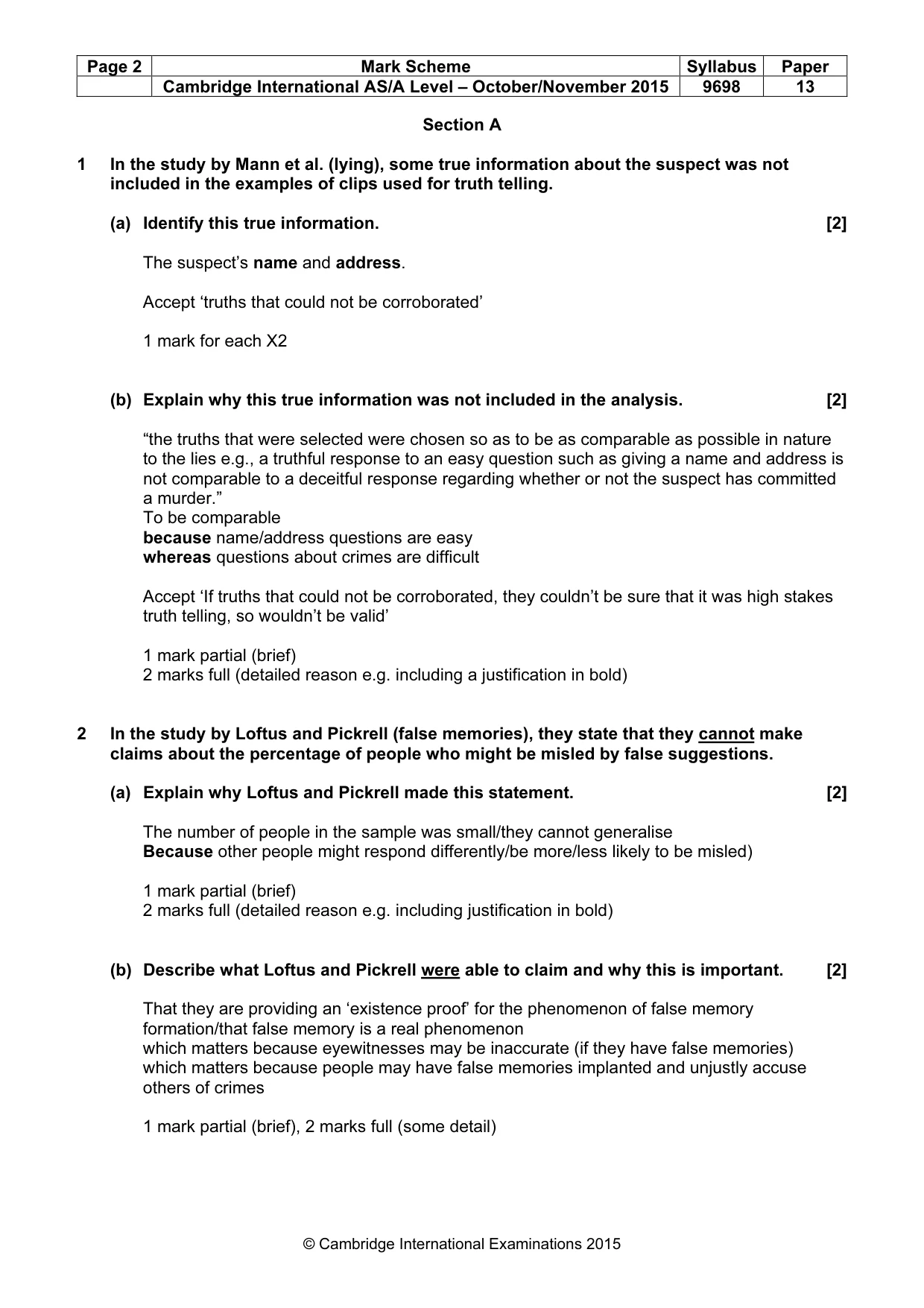
Page 2 Mark Scheme Syllabus Paper Cambridge International AS/A Level – October/November 2015 9698 13 © Cambridge International Examinations 2015 Section A 1 In the study by Mann et al. (lying), some true information about the suspect was not included in the examples of clips used for truth telling. (a) Identify this true information. [2] The suspect’s name and address. Accept ‘truths that could not be corroborated’ 1 mark for each X2 (b) Explain why this true information was not included in the analysis. [2] “the truths that were selected were chosen so as to be as comparable as possible in nature to the lies e.g., a truthful response to an easy question such as giving a name and address is not comparable to a deceitful response regarding whether or not the suspect has committed a murder.” To be comparable because name/address questions are easy whereas questions about crimes are difficult Accept ‘If truths that could not be corroborated, they couldn’t be sure that it was high stakes truth telling, so wouldn’t be valid’ 1 mark partial (brief) 2 marks full (detailed reason e.g. including a justification in bold) 2 In the study by Loftus and Pickrell (false memories), they state that they cannot make claims about the percentage of people who might be misled by false suggestions. (a) Explain why Loftus and Pickrell made this statement. [2] The number of people in the sample was small/they cannot generalise Because other people might respond differently/be more/less likely to be misled) 1 mark partial (brief) 2 marks full (detailed reason e.g. including justification in bold) (b) Describe what Loftus and Pickrell were able to claim and why this is important. [2] That they are providing an ‘existence proof’ for the phenomenon of false memory formation/that false memory is a real phenomenon which matters because eyewitnesses may be inaccurate (if they have false memories) which matters because people may have false memories implanted and unjustly accuse others of crimes 1 mark partial (brief), 2 marks full (some detail)
Mark scheme, page 3
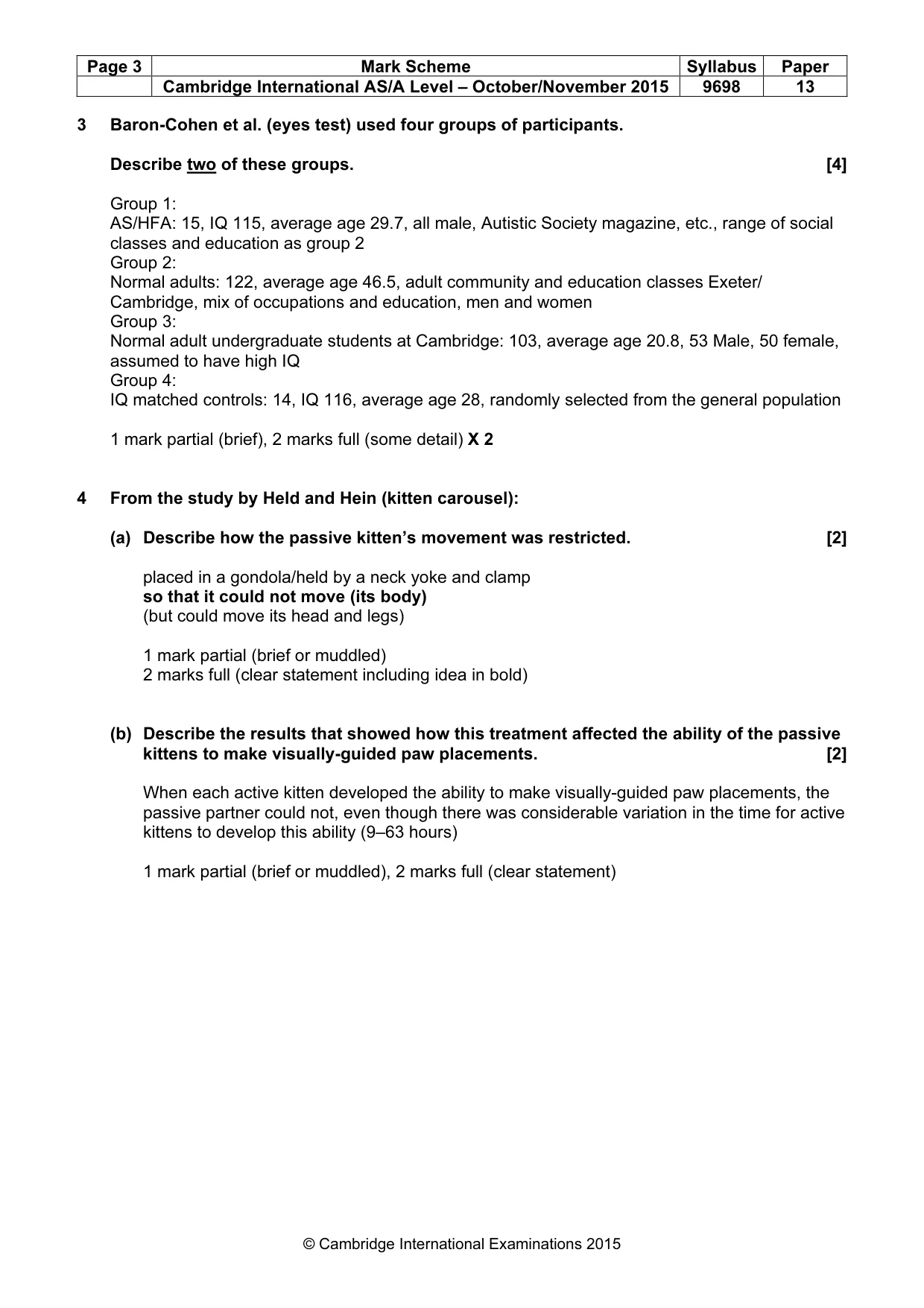
Page 3 Mark Scheme Syllabus Paper Cambridge International AS/A Level – October/November 2015 9698 13 © Cambridge International Examinations 2015 3 Baron-Cohen et al. (eyes test) used four groups of participants. Describe two of these groups. [4] Group 1: AS/HFA: 15, IQ 115, average age 29.7, all male, Autistic Society magazine, etc., range of social classes and education as group 2 Group 2: Normal adults: 122, average age 46.5, adult community and education classes Exeter/ Cambridge, mix of occupations and education, men and women Group 3: Normal adult undergraduate students at Cambridge: 103, average age 20.8, 53 Male, 50 female, assumed to have high IQ Group 4: IQ matched controls: 14, IQ 116, average age 28, randomly selected from the general population 1 mark partial (brief), 2 marks full (some detail) X 2 4 From the study by Held and Hein (kitten carousel): (a) Describe how the passive kitten’s movement was restricted. [2] placed in a gondola/held by a neck yoke and clamp so that it could not move (its body) (but could move its head and legs) 1 mark partial (brief or muddled) 2 marks full (clear statement including idea in bold) (b) Describe the results that showed how this treatment affected the ability of the passive kittens to make visually-guided paw placements. [2] When each active kitten developed the ability to make visually-guided paw placements, the passive partner could not, even though there was considerable variation in the time for active kittens to develop this ability (9–63 hours) 1 mark partial (brief or muddled), 2 marks full (clear statement)
Mark scheme, page 4
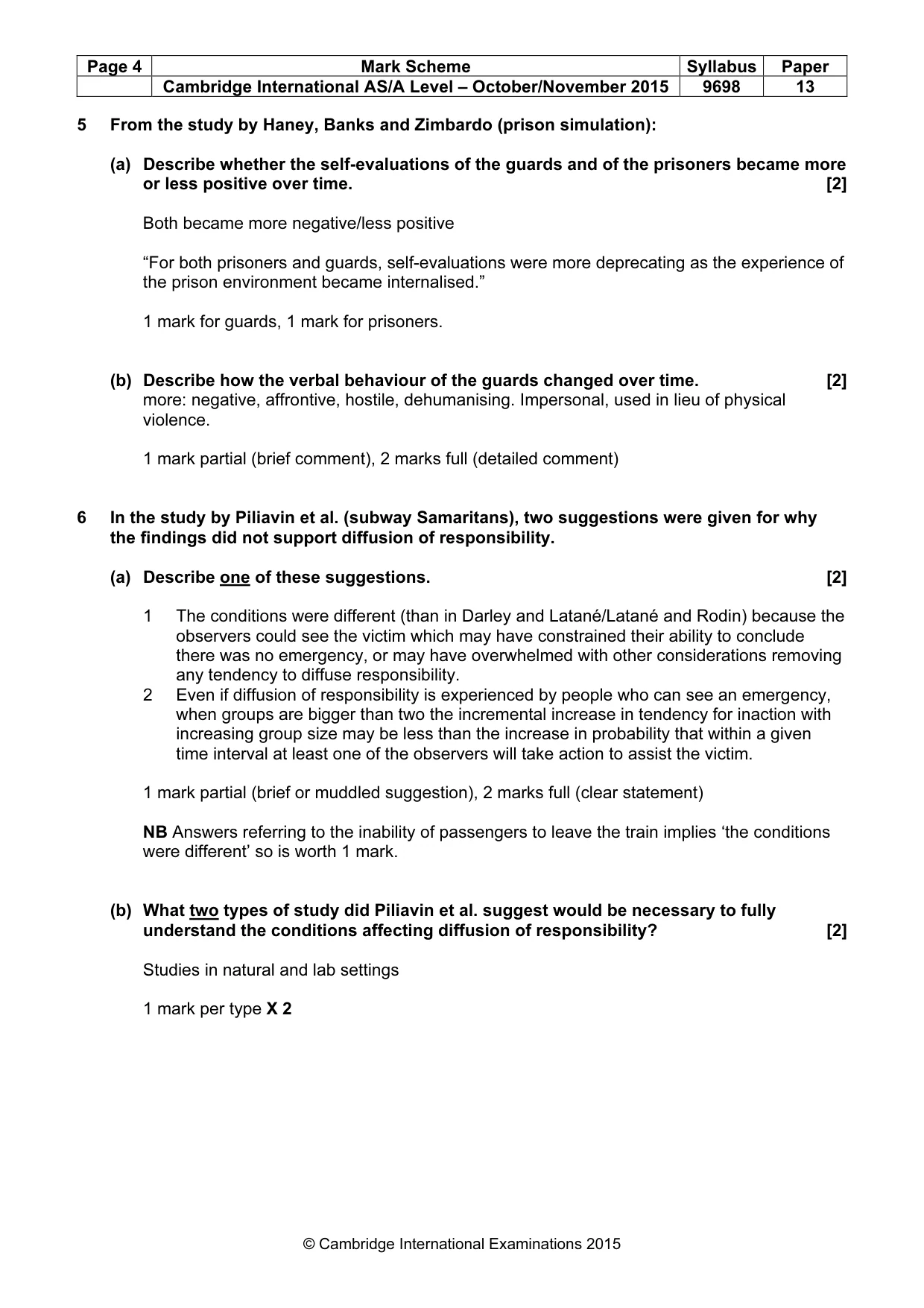
Page 4 Mark Scheme Syllabus Paper Cambridge International AS/A Level – October/November 2015 9698 13 © Cambridge International Examinations 2015 5 From the study by Haney, Banks and Zimbardo (prison simulation): (a) Describe whether the self-evaluations of the guards and of the prisoners became more or less positive over time. [2] Both became more negative/less positive “For both prisoners and guards, self-evaluations were more deprecating as the experience of the prison environment became internalised.” 1 mark for guards, 1 mark for prisoners. (b) Describe how the verbal behaviour of the guards changed over time. [2] more: negative, affrontive, hostile, dehumanising. Impersonal, used in lieu of physical violence. 1 mark partial (brief comment), 2 marks full (detailed comment) 6 In the study by Piliavin et al. (subway Samaritans), two suggestions were given for why the findings did not support diffusion of responsibility. (a) Describe one of these suggestions. [2] 1 The conditions were different (than in Darley and Latané/Latané and Rodin) because the observers could see the victim which may have constrained their ability to conclude there was no emergency, or may have overwhelmed with other considerations removing any tendency to diffuse responsibility. 2 Even if diffusion of responsibility is experienced by people who can see an emergency, when groups are bigger than two the incremental increase in tendency for inaction with increasing group size may be less than the increase in probability that within a given time interval at least one of the observers will take action to assist the victim. 1 mark partial (brief or muddled suggestion), 2 marks full (clear statement) NB Answers referring to the inability of passengers to leave the train implies ‘the conditions were different’ so is worth 1 mark. (b) What two types of study did Piliavin et al. suggest would be necessary to fully understand the conditions affecting diffusion of responsibility? [2] Studies in natural and lab settings 1 mark per type X 2
Mark scheme, page 5
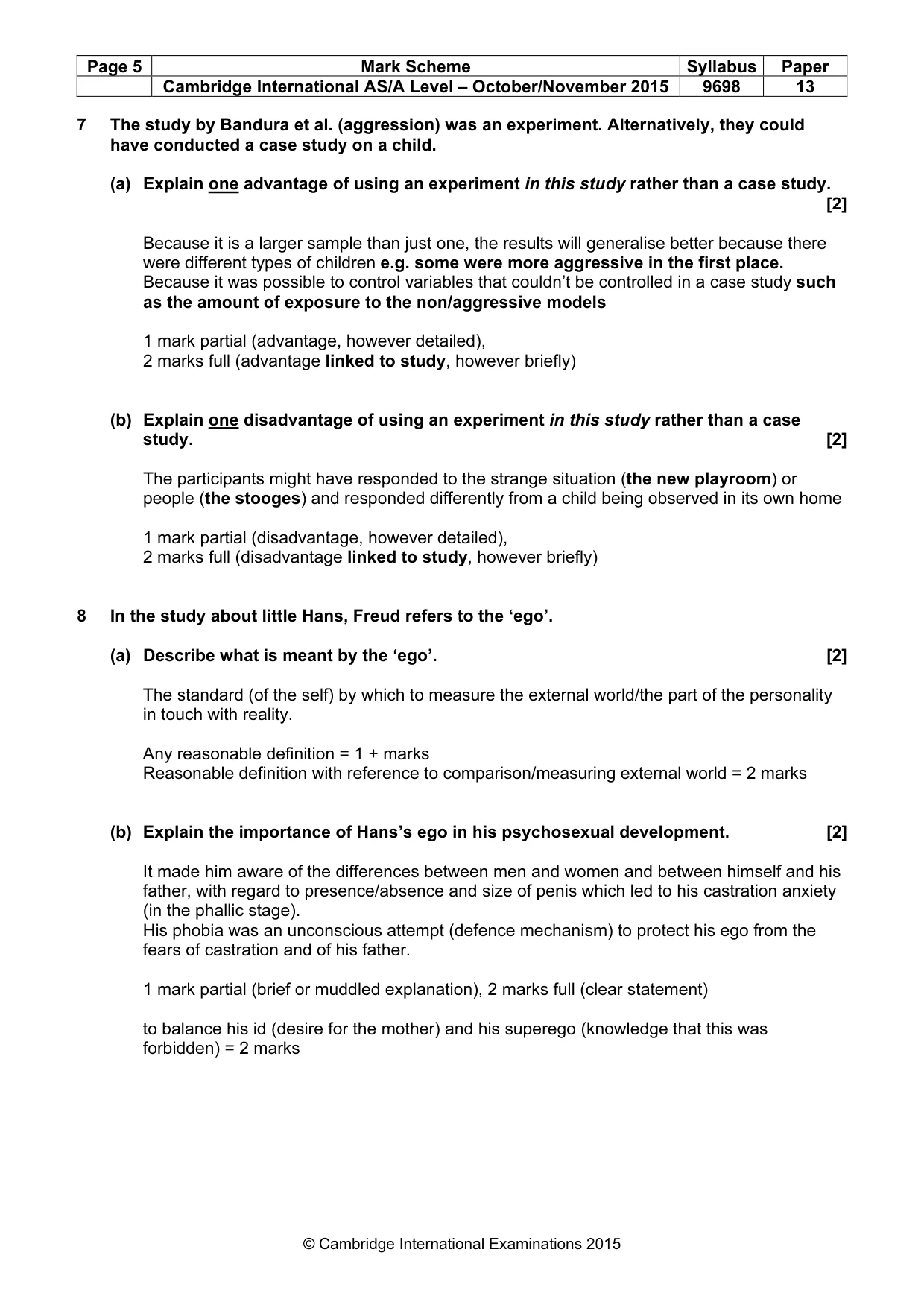
Page 5 Mark Scheme Syllabus Paper Cambridge International AS/A Level – October/November 2015 9698 13 © Cambridge International Examinations 2015 7 The study by Bandura et al. (aggression) was an experiment. Alternatively, they could have conducted a case study on a child. (a) Explain one advantage of using an experiment in this study rather than a case study. [2] Because it is a larger sample than just one, the results will generalise better because there were different types of children e.g. some were more aggressive in the first place. Because it was possible to control variables that couldn’t be controlled in a case study such as the amount of exposure to the non/aggressive models 1 mark partial (advantage, however detailed), 2 marks full (advantage linked to study, however briefly) (b) Explain one disadvantage of using an experiment in this study rather than a case study. [2] The participants might have responded to the strange situation (the new playroom) or people (the stooges) and responded differently from a child being observed in its own home 1 mark partial (disadvantage, however detailed), 2 marks full (disadvantage linked to study, however briefly) 8 In the study about little Hans, Freud refers to the ‘ego’. (a) Describe what is meant by the ‘ego’. [2] The standard (of the self) by which to measure the external world/the part of the personality in touch with reality. Any reasonable definition = 1 + marks Reasonable definition with reference to comparison/measuring external world = 2 marks (b) Explain the importance of Hans’s ego in his psychosexual development. [2] It made him aware of the differences between men and women and between himself and his father, with regard to presence/absence and size of penis which led to his castration anxiety (in the phallic stage). His phobia was an unconscious attempt (defence mechanism) to protect his ego from the fears of castration and of his father. 1 mark partial (brief or muddled explanation), 2 marks full (clear statement) to balance his id (desire for the mother) and his superego (knowledge that this was forbidden) = 2 marks
Mark scheme, page 6
Page 6 Mark Scheme Syllabus Paper Cambridge International AS/A Level – October/November 2015 9698 13 © Cambridge International Examinations 2015 9 In the study by Langlois et al., the responses of 6-month old infants to faces of babies was tested. (a) Describe the findings relating to the infants’ ability to discriminate between attractive and unattractive faces of babies. [2] Findings: They looked for longer at the attractive babies (and for longer in the first two trials) Conclusions: Infants respond to attractiveness regardless of age of the target Infants respond to attractiveness regardless of the familiarity of the target Infants respond to attractiveness regardless of the gender of the target Infants respond to attractiveness regardless of the ‘structure’ of the face Attractiveness must be based on invariant (perhaps universal) cues 1 mark partial (brief findings or conclusions) 2 marks full (detailed findings or conclusions) (b) Describe the findings relating to the infants’ ability to discriminate between male and female faces of babies. [2] Findings: They couldn’t tell the difference Conclusions: which was as expected since adults couldn’t either. so infants’ ability to discriminate gender (in babies) doesn’t differ from adults’ 1 mark partial (brief findings or conclusions) 2 marks full (detailed findings or conclusions)
Mark scheme, page 7
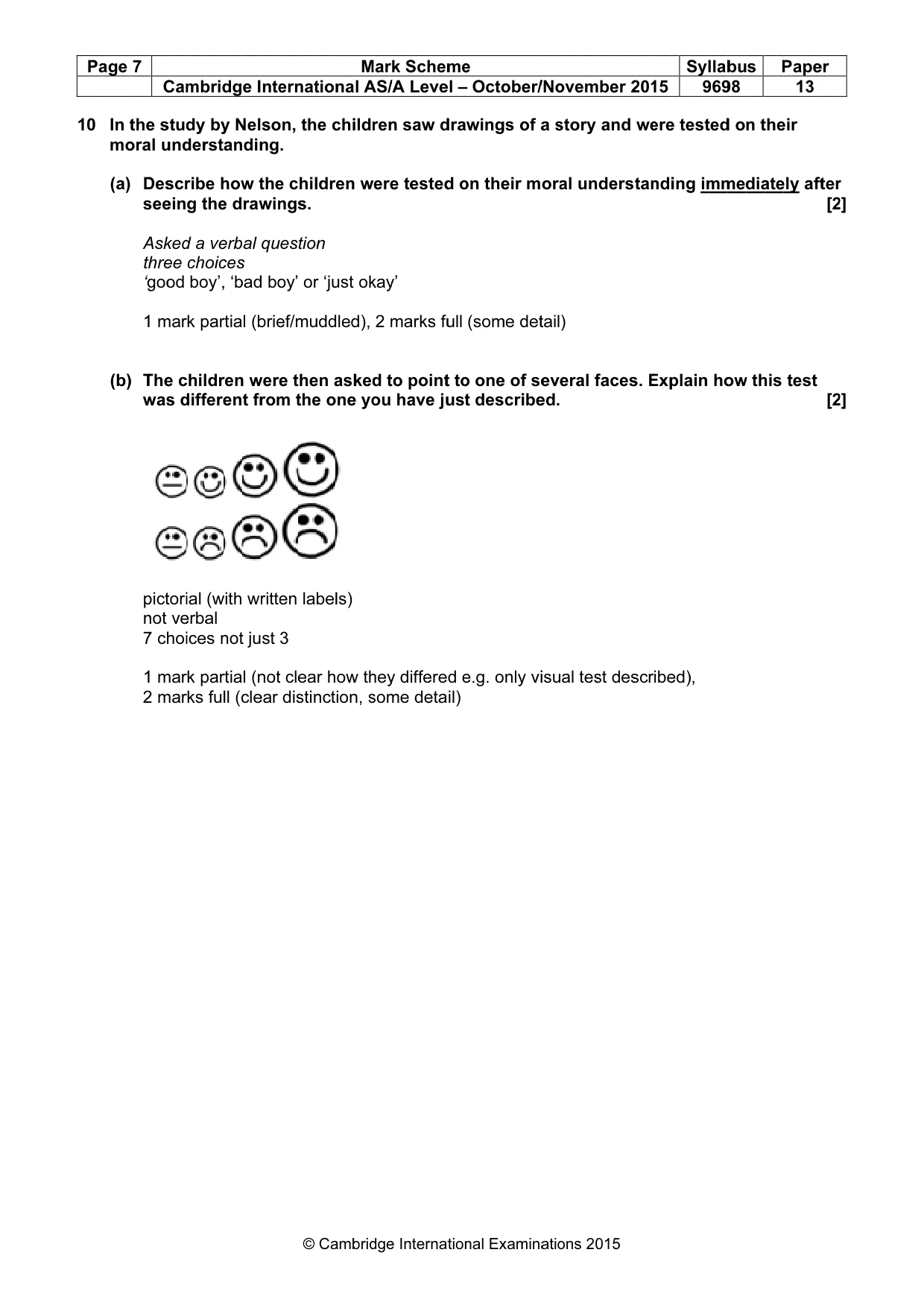
P 10 Pag 0 I m ( ( ge In t mo (a) (b) 7 the ora D s A th ‘g 1 ) T w p n 7 1 2 C e s al u Des see Ask hre goo 1 m The was pict not 7 ch 1 m 2 m Cam stud und scr ein ked ee od mar e c s d tori ve hoi mar mar mb dy der rib g t d a ch bo rk p chil diff ial erba ice rk p rks brid by rst e h the ve oic oy’, par ldr fere (w al es n par ful dg y N an how e d erb ces , ‘b rtia ren en with not rtia ll (c e I Nel din w t raw al s bad l (b n w t fr wr t ju l (n cle nte so ng the win qu d bo brie were rom ritte st not ear ern on, . e c ngs es oy’ ef/m e t m t en 3 t cle dis nat © th hil s. tion or mu he the lab ea stin tion Ca e c ldr n r ‘ju udd en a e o bel r h nct na amb chi en ust dled ask ne ls) ow ion M l A brid ildr w ok d), ked e yo w th n, s Mar AS/ dge ren were kay 2 m d t ou hey som k S /A e In n s e te y’ ma to p ha y d me Sch Le nter saw est arks po ave iffe de hem ve rnat w d ted s fu int e ju ere eta me el – tion dra d o ull t to ust d e il) e – O nal wi on t (so o o t d e.g cto Ex ng the om ne es . o obe xam gs o eir me d e of cri nly er/ mina of a m det f se ibe y vi /No atio a s ora tail ev ed. isu ove ons sto al ) era ual em s 20 ory un al f tes mbe 015 an de fac st d er 2 5 nd ers ces des 201 we tan s. E scr 15 ere ndi Exp ribe S e te ing pla ed) Syl 9 est g im ain ), llab 969 ted mm ho bu 98 d o med ow s n t dia w th P the ate his Pa 1 eir ely te pe 3 aft st er ter [2 [2 r 2] 2]
Mark scheme, page 8
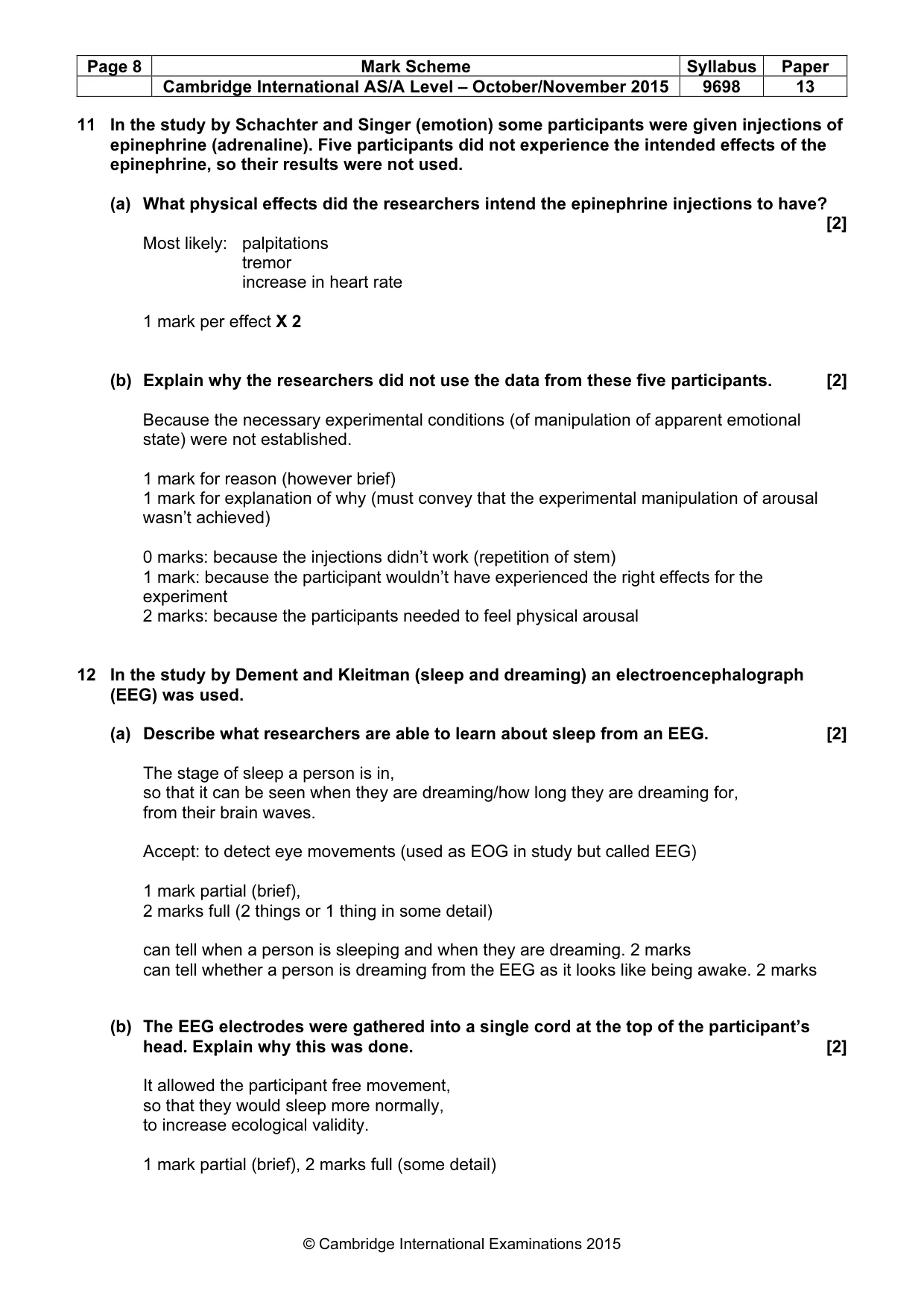
Page 8 Mark Scheme Syllabus Paper Cambridge International AS/A Level – October/November 2015 9698 13 © Cambridge International Examinations 2015 11 In the study by Schachter and Singer (emotion) some participants were given injections of epinephrine (adrenaline). Five participants did not experience the intended effects of the epinephrine, so their results were not used. (a) What physical effects did the researchers intend the epinephrine injections to have? [2] Most likely: palpitations tremor increase in heart rate 1 mark per effect X 2 (b) Explain why the researchers did not use the data from these five participants. [2] Because the necessary experimental conditions (of manipulation of apparent emotional state) were not established. 1 mark for reason (however brief) 1 mark for explanation of why (must convey that the experimental manipulation of arousal wasn’t achieved) 0 marks: because the injections didn’t work (repetition of stem) 1 mark: because the participant wouldn’t have experienced the right effects for the experiment 2 marks: because the participants needed to feel physical arousal 12 In the study by Dement and Kleitman (sleep and dreaming) an electroencephalograph (EEG) was used. (a) Describe what researchers are able to learn about sleep from an EEG. [2] The stage of sleep a person is in, so that it can be seen when they are dreaming/how long they are dreaming for, from their brain waves. Accept: to detect eye movements (used as EOG in study but called EEG) 1 mark partial (brief), 2 marks full (2 things or 1 thing in some detail) can tell when a person is sleeping and when they are dreaming. 2 marks can tell whether a person is dreaming from the EEG as it looks like being awake. 2 marks (b) The EEG electrodes were gathered into a single cord at the top of the participant’s head. Explain why this was done. [2] It allowed the participant free movement, so that they would sleep more normally, to increase ecological validity. 1 mark partial (brief), 2 marks full (some detail)
Mark scheme, page 9
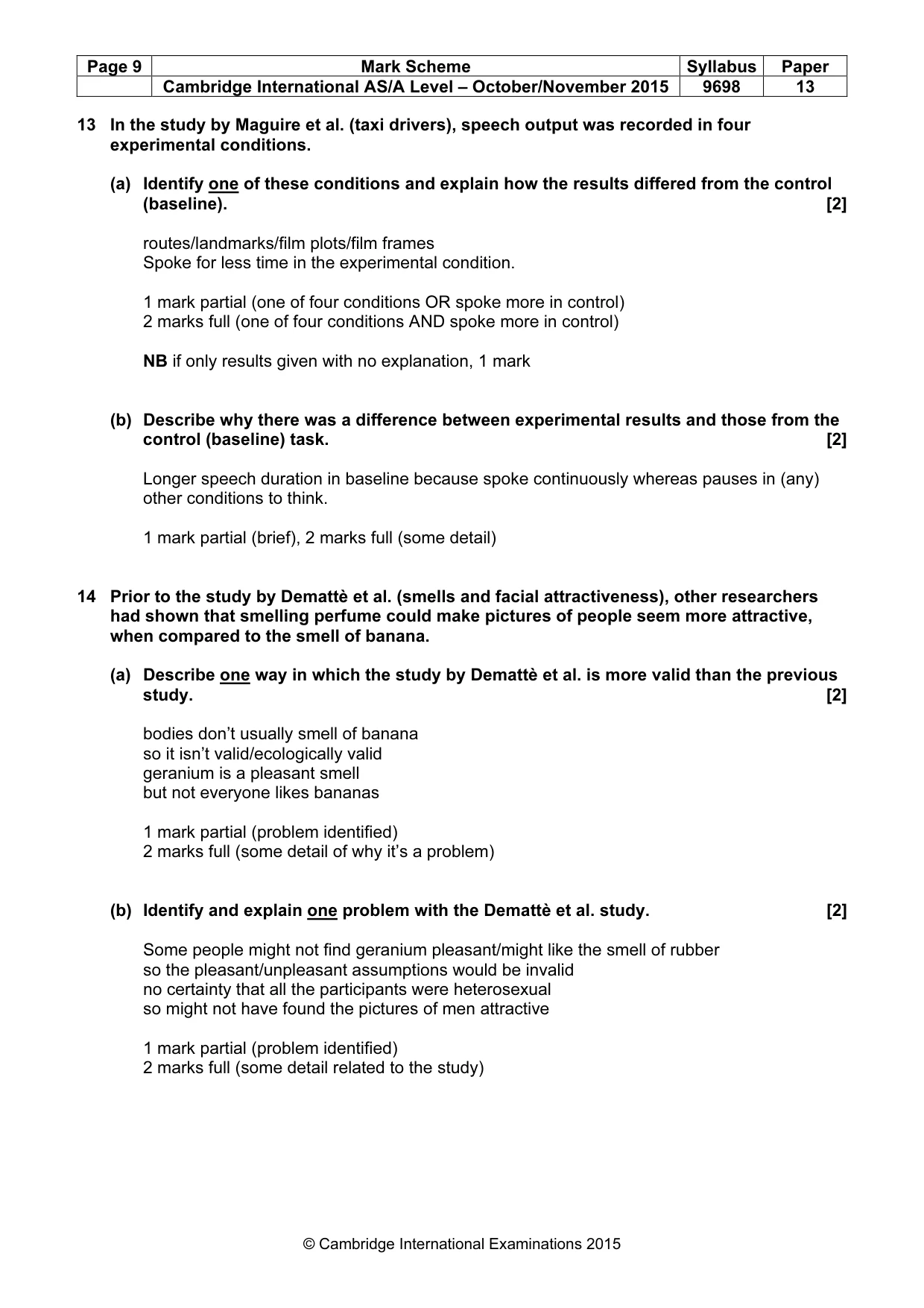
Page 9 Mark Scheme Syllabus Paper Cambridge International AS/A Level – October/November 2015 9698 13 © Cambridge International Examinations 2015 13 In the study by Maguire et al. (taxi drivers), speech output was recorded in four experimental conditions. (a) Identify one of these conditions and explain how the results differed from the control (baseline). [2] routes/landmarks/film plots/film frames Spoke for less time in the experimental condition. 1 mark partial (one of four conditions OR spoke more in control) 2 marks full (one of four conditions AND spoke more in control) NB if only results given with no explanation, 1 mark (b) Describe why there was a difference between experimental results and those from the control (baseline) task. [2] Longer speech duration in baseline because spoke continuously whereas pauses in (any) other conditions to think. 1 mark partial (brief), 2 marks full (some detail) 14 Prior to the study by Demattè et al. (smells and facial attractiveness), other researchers had shown that smelling perfume could make pictures of people seem more attractive, when compared to the smell of banana. (a) Describe one way in which the study by Demattè et al. is more valid than the previous study. [2] bodies don’t usually smell of banana so it isn’t valid/ecologically valid geranium is a pleasant smell but not everyone likes bananas 1 mark partial (problem identified) 2 marks full (some detail of why it’s a problem) (b) Identify and explain one problem with the Demattè et al. study. [2] Some people might not find geranium pleasant/might like the smell of rubber so the pleasant/unpleasant assumptions would be invalid no certainty that all the participants were heterosexual so might not have found the pictures of men attractive 1 mark partial (problem identified) 2 marks full (some detail related to the study)
Mark scheme, page 10
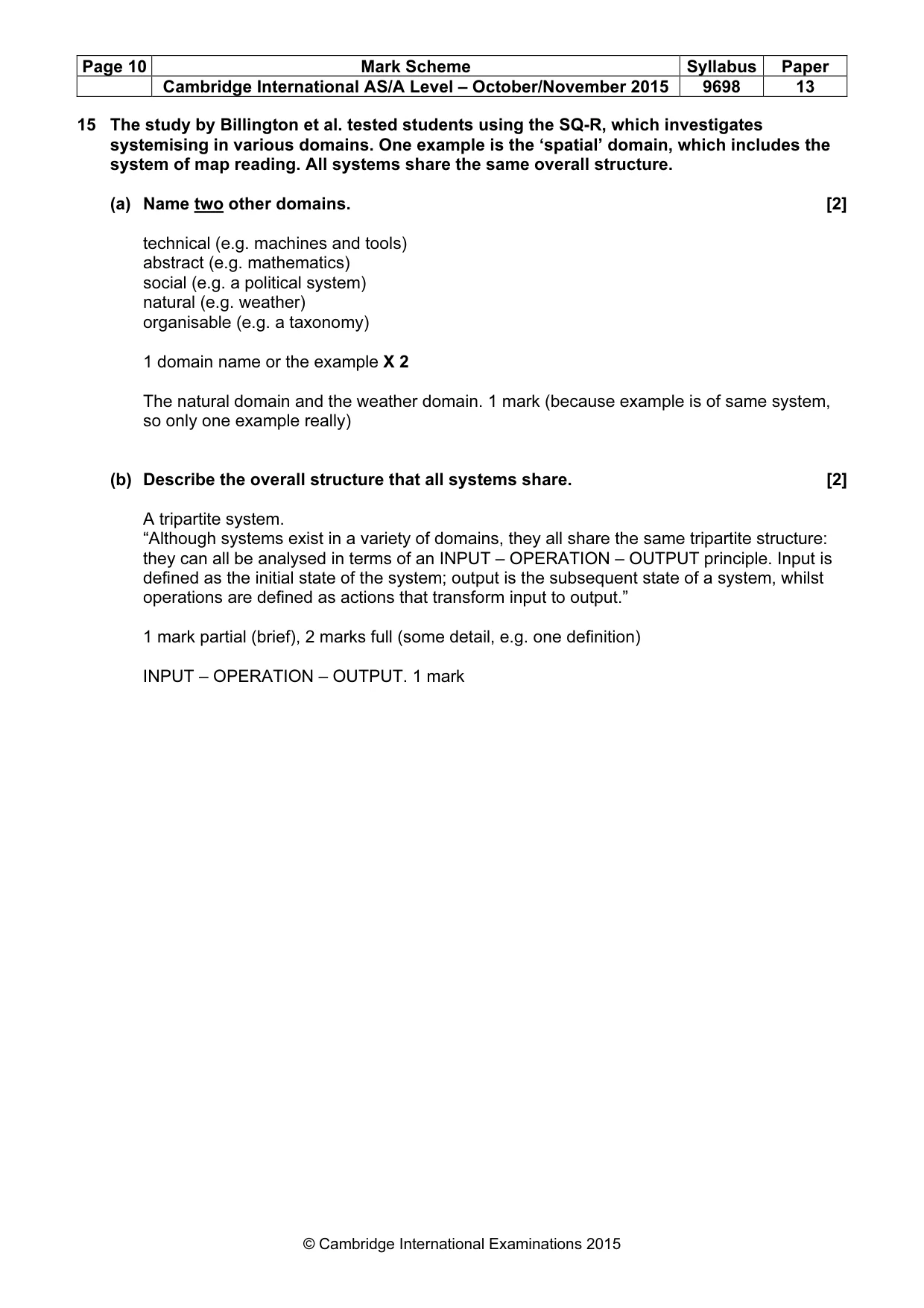
Page 10 Mark Scheme Syllabus Paper Cambridge International AS/A Level – October/November 2015 9698 13 © Cambridge International Examinations 2015 15 The study by Billington et al. tested students using the SQ-R, which investigates systemising in various domains. One example is the ‘spatial’ domain, which includes the system of map reading. All systems share the same overall structure. (a) Name two other domains. [2] technical (e.g. machines and tools) abstract (e.g. mathematics) social (e.g. a political system) natural (e.g. weather) organisable (e.g. a taxonomy) 1 domain name or the example X 2 The natural domain and the weather domain. 1 mark (because example is of same system, so only one example really) (b) Describe the overall structure that all systems share. [2] A tripartite system. “Although systems exist in a variety of domains, they all share the same tripartite structure: they can all be analysed in terms of an INPUT – OPERATION – OUTPUT principle. Input is defined as the initial state of the system; output is the subsequent state of a system, whilst operations are defined as actions that transform input to output.” 1 mark partial (brief), 2 marks full (some detail, e.g. one definition) INPUT – OPERATION – OUTPUT. 1 mark
Mark scheme, page 11
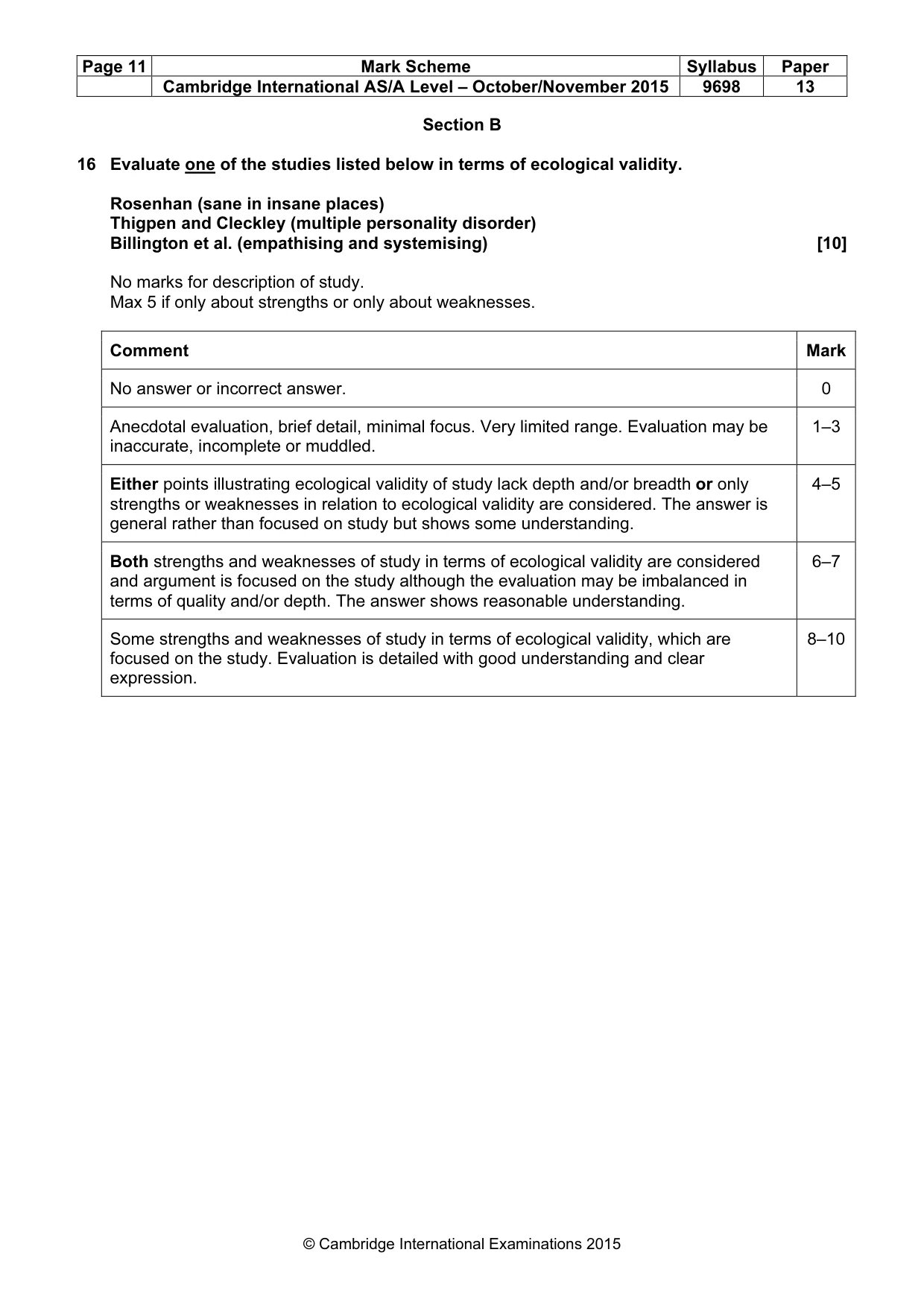
Page 11 Mark Scheme Syllabus Paper Cambridge International AS/A Level – October/November 2015 9698 13 © Cambridge International Examinations 2015 Section B 16 Evaluate one of the studies listed below in terms of ecological validity. Rosenhan (sane in insane places) Thigpen and Cleckley (multiple personality disorder) Billington et al. (empathising and systemising) [10] No marks for description of study. Max 5 if only about strengths or only about weaknesses. Comment Mark No answer or incorrect answer. 0 Anecdotal evaluation, brief detail, minimal focus. Very limited range. Evaluation may be inaccurate, incomplete or muddled. 1–3 Either points illustrating ecological validity of study lack depth and/or breadth or only strengths or weaknesses in relation to ecological validity are considered. The answer is general rather than focused on study but shows some understanding. 4–5 Both strengths and weaknesses of study in terms of ecological validity are considered and argument is focused on the study although the evaluation may be imbalanced in terms of quality and/or depth. The answer shows reasonable understanding. 6–7 Some strengths and weaknesses of study in terms of ecological validity, which are focused on the study. Evaluation is detailed with good understanding and clear expression. 8–10
Mark scheme, page 12
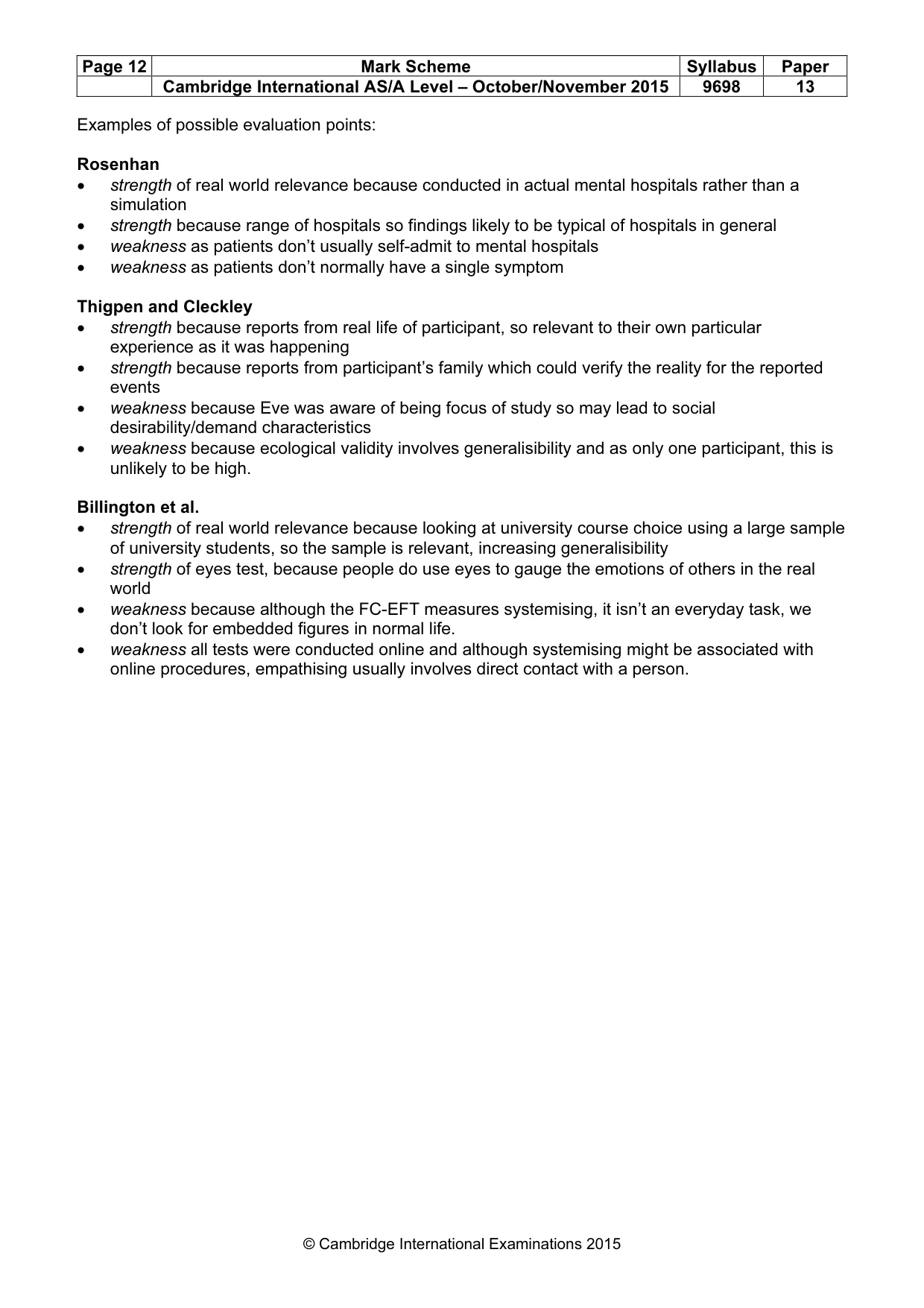
Page 12 Mark Scheme Syllabus Paper Cambridge International AS/A Level – October/November 2015 9698 13 © Cambridge International Examinations 2015 Examples of possible evaluation points: Rosenhan • strength of real world relevance because conducted in actual mental hospitals rather than a simulation • strength because range of hospitals so findings likely to be typical of hospitals in general • weakness as patients don’t usually self-admit to mental hospitals • weakness as patients don’t normally have a single symptom Thigpen and Cleckley • strength because reports from real life of participant, so relevant to their own particular experience as it was happening • strength because reports from participant’s family which could verify the reality for the reported events • weakness because Eve was aware of being focus of study so may lead to social desirability/demand characteristics • weakness because ecological validity involves generalisibility and as only one participant, this is unlikely to be high. Billington et al. • strength of real world relevance because looking at university course choice using a large sample of university students, so the sample is relevant, increasing generalisibility • strength of eyes test, because people do use eyes to gauge the emotions of others in the real world • weakness because although the FC-EFT measures systemising, it isn’t an everyday task, we don’t look for embedded figures in normal life. • weakness all tests were conducted online and although systemising might be associated with online procedures, empathising usually involves direct contact with a person.
Mark scheme, page 13
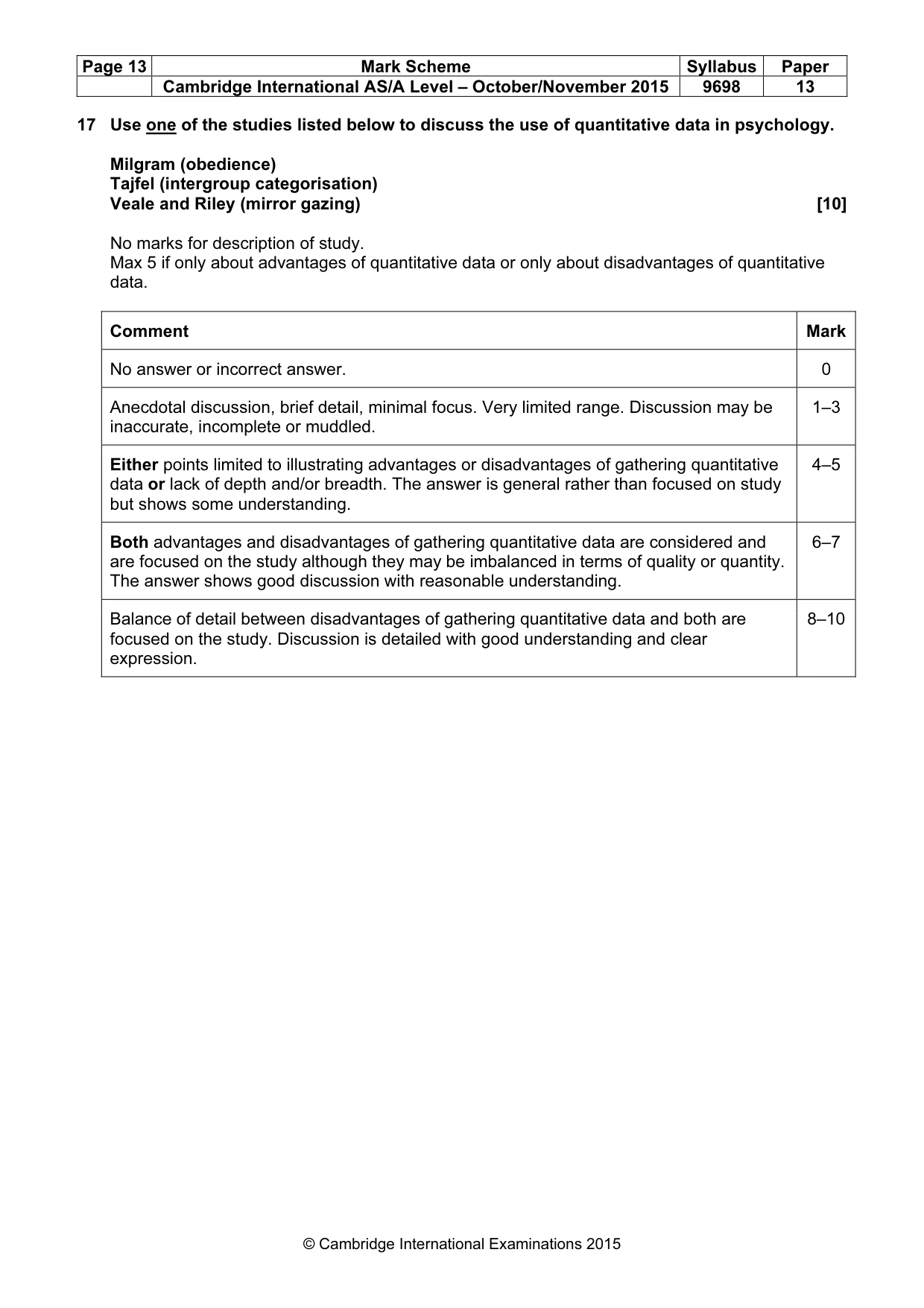
Page 13 Mark Scheme Syllabus Paper Cambridge International AS/A Level – October/November 2015 9698 13 © Cambridge International Examinations 2015 17 Use one of the studies listed below to discuss the use of quantitative data in psychology. Milgram (obedience) Tajfel (intergroup categorisation) Veale and Riley (mirror gazing) [10] No marks for description of study. Max 5 if only about advantages of quantitative data or only about disadvantages of quantitative data. Comment Mark No answer or incorrect answer. 0 Anecdotal discussion, brief detail, minimal focus. Very limited range. Discussion may be inaccurate, incomplete or muddled. 1–3 Either points limited to illustrating advantages or disadvantages of gathering quantitative data or lack of depth and/or breadth. The answer is general rather than focused on study but shows some understanding. 4–5 Both advantages and disadvantages of gathering quantitative data are considered and are focused on the study although they may be imbalanced in terms of quality or quantity. The answer shows good discussion with reasonable understanding. 6–7 Balance of detail between disadvantages of gathering quantitative data and both are focused on the study. Discussion is detailed with good understanding and clear expression. 8–10
Mark scheme, page 14
Page 14 Mark Scheme Syllabus Paper Cambridge International AS/A Level – October/November 2015 9698 13 © Cambridge International Examinations 2015 Examples of possible discussion points: Milgram • advantage able to collect objective data i.e. using quantitative measure of voltage level reached before disobeying • advantage able to calculate the percentage of participants who were anticipated to, and who actually, reached certain levels to give an indication of the extent of obedience • disadvantage although the main data were quantitative, other qualitative responses were not recorded systematically and decision making about emotionally charged behaviours such as (believing one is potentially) killing another person cannot be represented simply by a number. • disadvantage quantitative measures are often unrealistic, and stepped voltages are unlike the absoluteness of killing people in concentration camps (so was not a realistic test of the GAD hypothesis) Tajfel • advantage able to collect objective data i.e. using the quantitative measure of the responses on the matrices • advantage able to use statistical procedures, which is not possible on qualitative data, leading to generalisations e.g. about typical patterns such as the relative importance of maximum difference and maximum joint profit. • disadvantage quantitative data is likely to obscure individual differences (i.e. some of the boys may have been more generous than others to the out-group) hence the findings may not reflect the variation on prejudice. • disadvantage quantitative data cannot provide such a good insight into reasons behind a behaviour as qualitative data, so it cannot tell us why the boys favoured their (artificial) in-group. Veale and Riley • advantage able to systematically and consistently collect the same quantitative data from both groups of participants (BDD and controls) and in different situations (e.g. long and short sessions), i.e. likely to have high reliability whereas qualitative data would be less consistent • advantage able to use statistical procedures, which is not possible on qualitative data, and led to generalisations which could help most patients most of the time rather than being specific to one. • disadvantage although most of the data were quantitative, some was qualitative data and these revealed individual differences (e.g. in choice of reflective surfaces) which quantitative data tends to obscure. • disadvantage more quantitative data cannot provide such a good insight into individual false beliefs (which could then be tackled in therapy) as qualitative data.
What you needed in this session
Cambridge’s own grade thresholds for 2015 Oct/Nov, Paper 1 · Variant 3. A higher threshold means an easier paper — the bar moves with how the cohort did.