Cambridge A Level Psychology 9698 — 2017 Oct/Nov Paper 1 · Variant 1
9698/11/O/N/17 · 80 marks · ≈90 min
The question paper and its mark scheme, free to read here and free to download. This is Cambridge’s own paper, exactly as it was sat.
Question paper4 pages
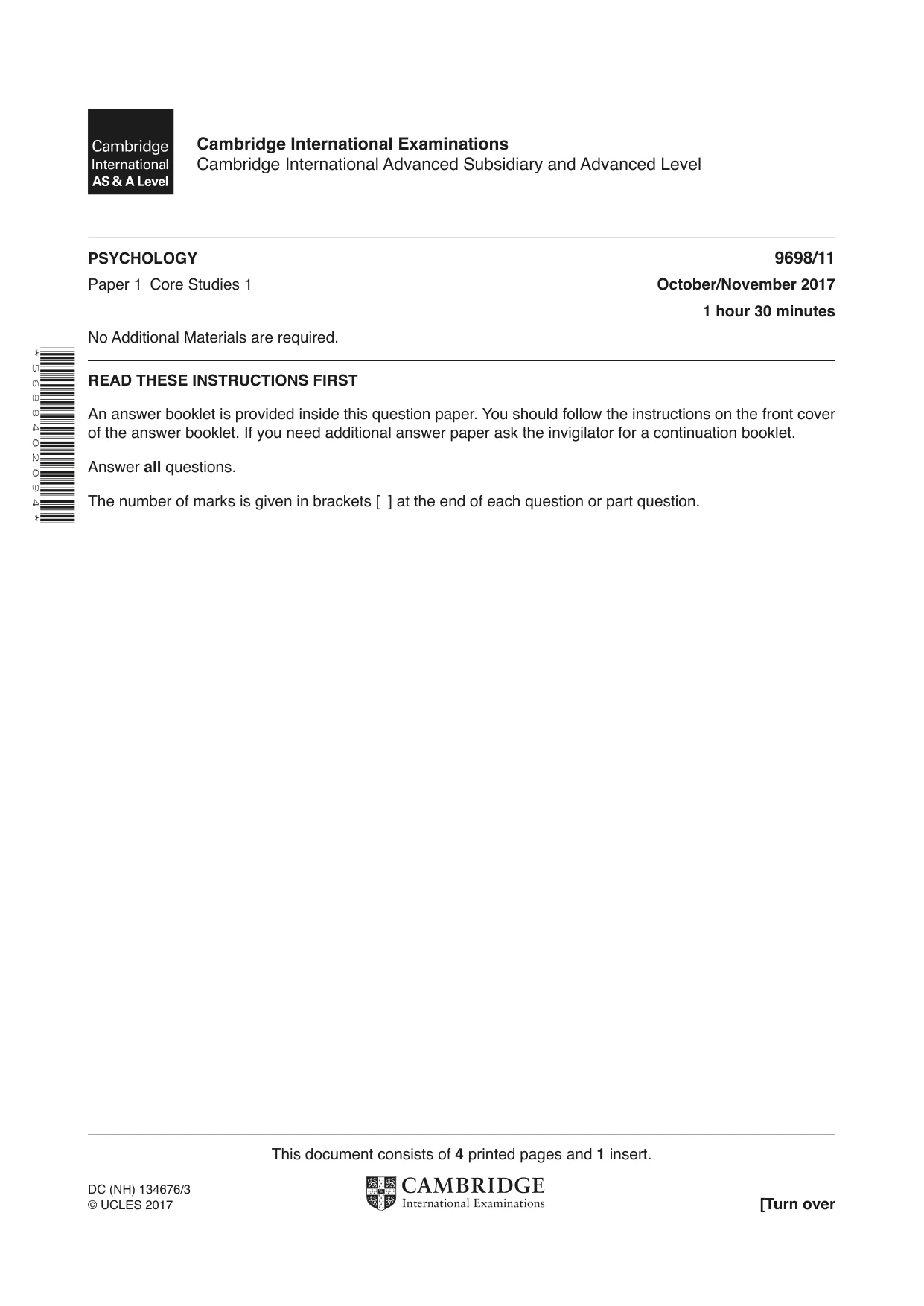
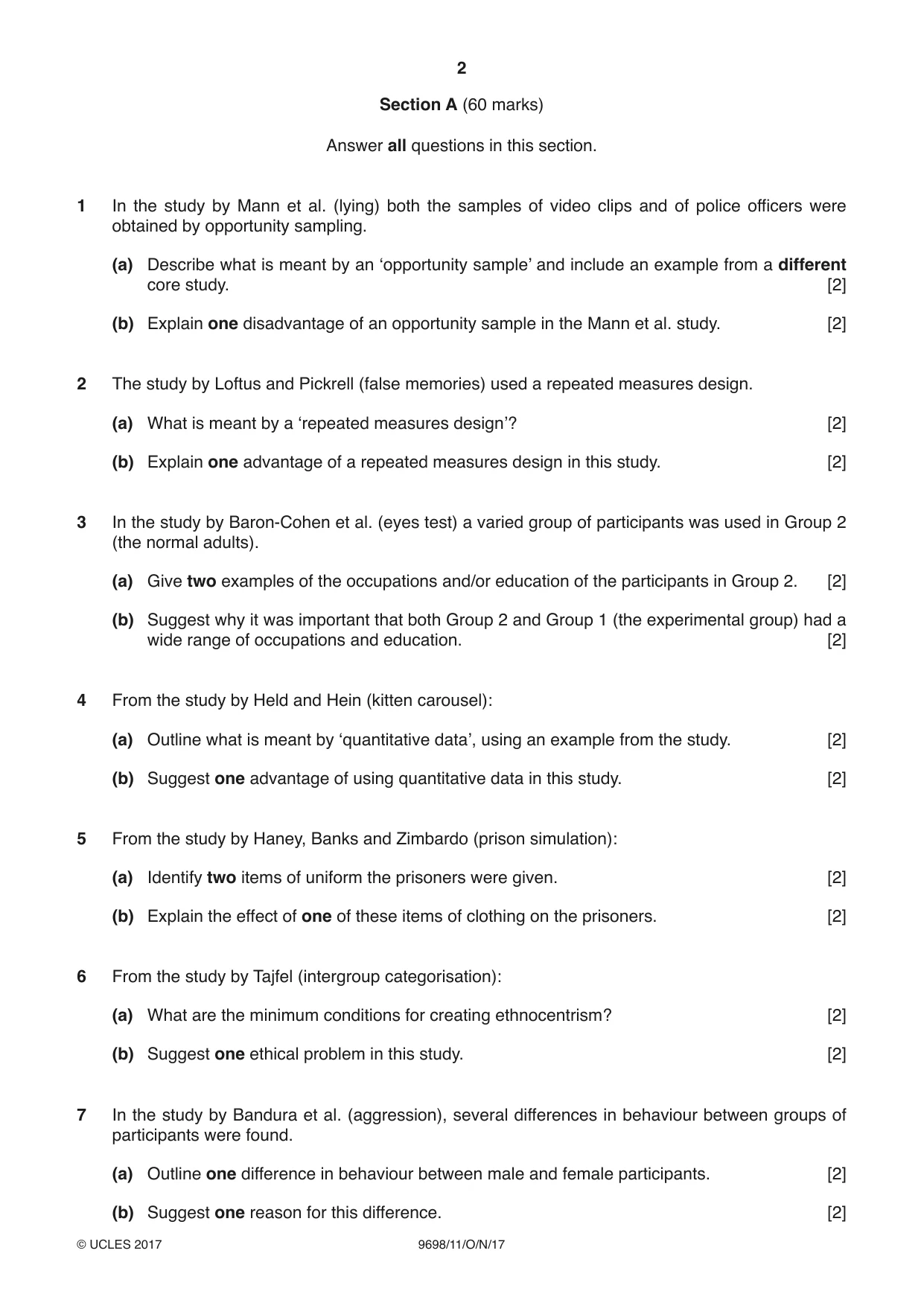
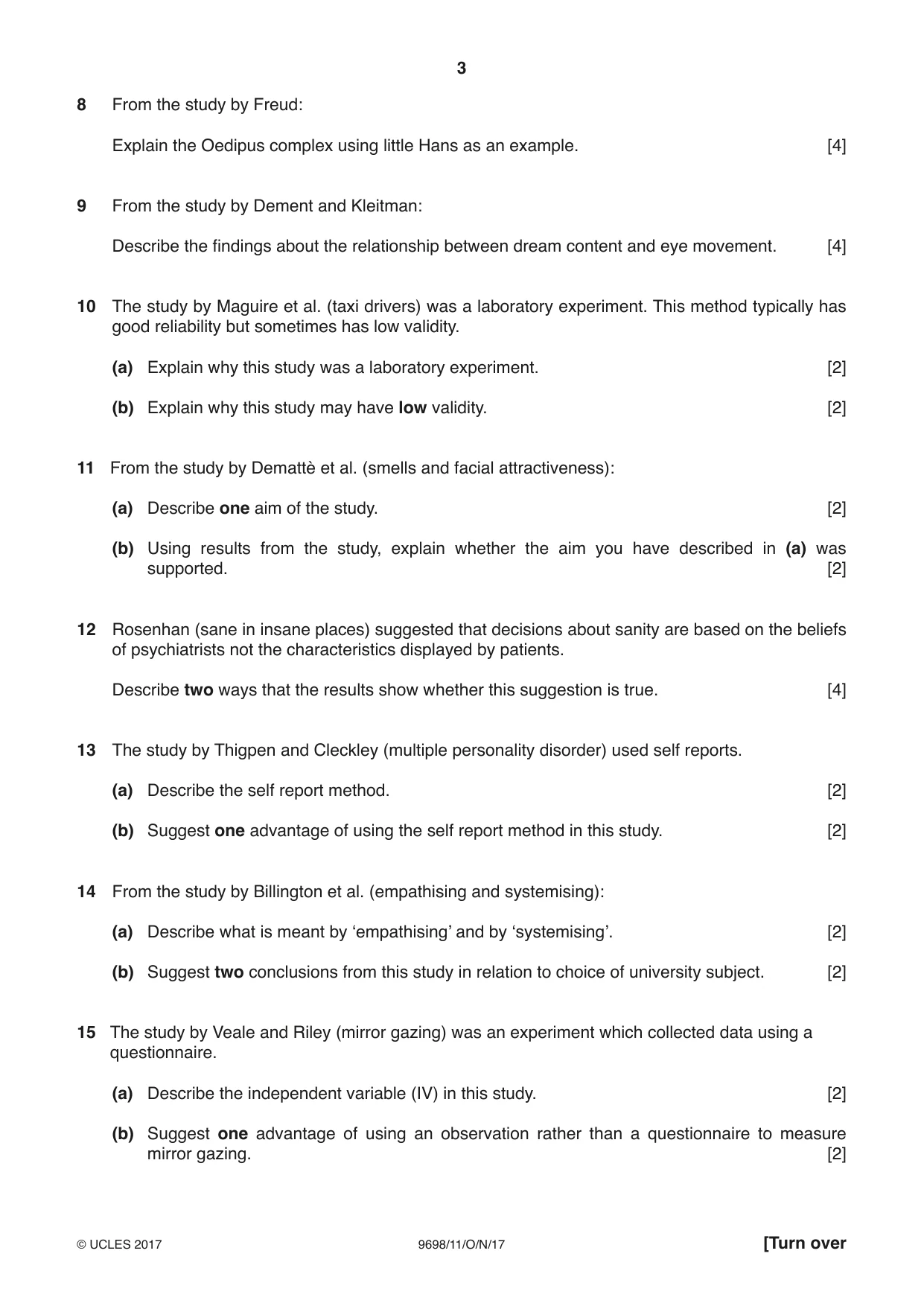
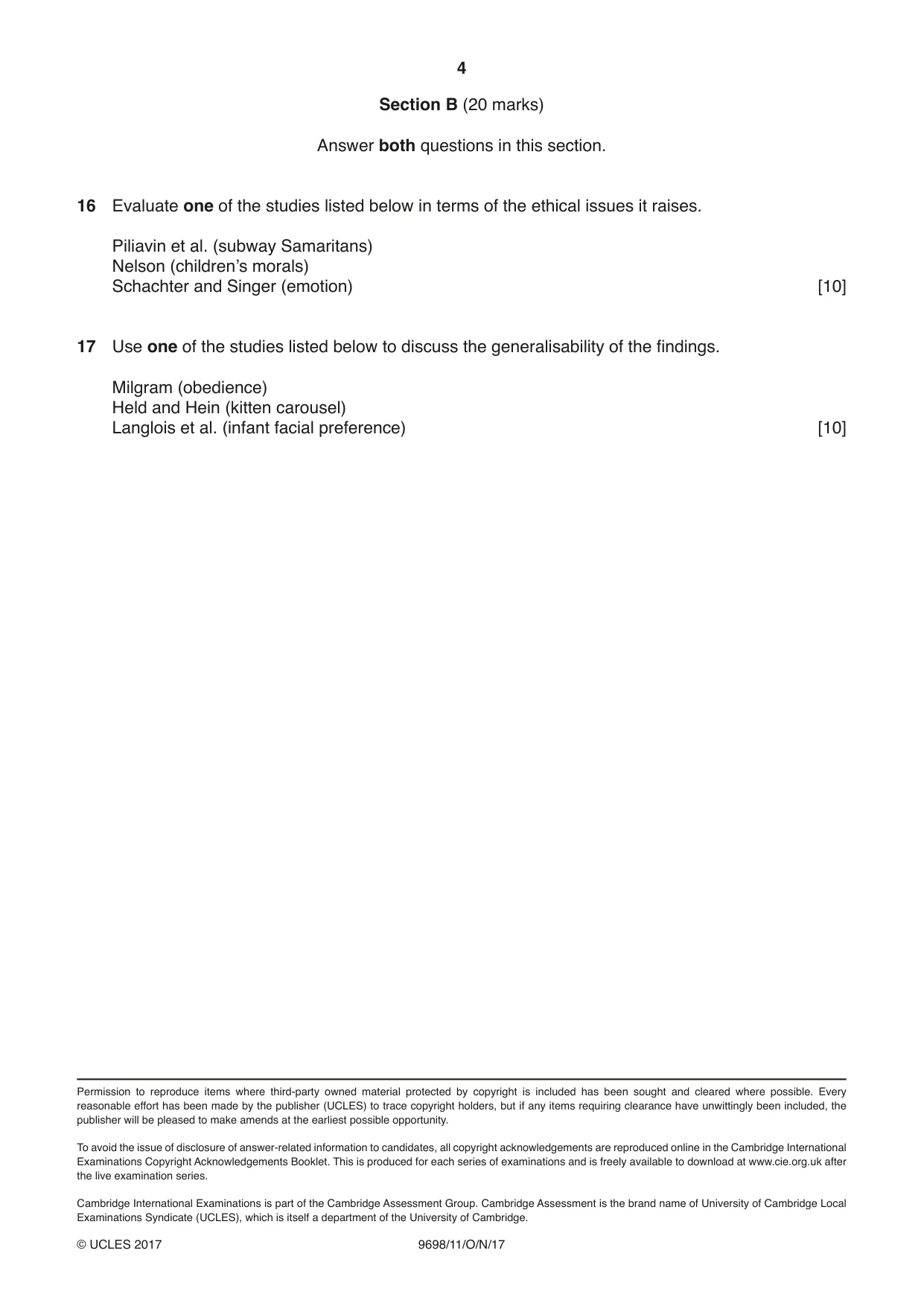
Mark scheme20 pages
Answers below. Sit the paper first if you are practising.
Paper as text
Question paper, page 1
This document consists of 4 printed pages and 1 insert. DC (NH) 134676/3 © UCLES 2017 [Turn over * 5 6 8 8 4 0 2 0 9 4 * PSYCHOLOGY 9698/11 Paper 1 Core Studies 1 October/November 2017 1 hour 30 minutes No Additional Materials are required. READ THESE INSTRUCTIONS FIRST An answer booklet is provided inside this question paper. You should follow the instructions on the front cover of the answer booklet. If you need additional answer paper ask the invigilator for a continuation booklet. Answer all questions. The number of marks is given in brackets [ ] at the end of each question or part question. Cambridge International Examinations Cambridge International Advanced Subsidiary and Advanced Level
Question paper, page 2
2 9698/11/O/N/17 © UCLES 2017 Section A (60 marks) Answer all questions in this section. 1 In the study by Mann et al. (lying) both the samples of video clips and of police officers were obtained by opportunity sampling. (a) Describe what is meant by an ‘opportunity sample’ and include an example from a different core study. [2] (b) Explain one disadvantage of an opportunity sample in the Mann et al. study. [2] 2 The study by Loftus and Pickrell (false memories) used a repeated measures design. (a) What is meant by a ‘repeated measures design’? [2] (b) Explain one advantage of a repeated measures design in this study. [2] 3 In the study by Baron-Cohen et al. (eyes test) a varied group of participants was used in Group 2 (the normal adults). (a) Give two examples of the occupations and/or education of the participants in Group 2. [2] (b) Suggest why it was important that both Group 2 and Group 1 (the experimental group) had a wide range of occupations and education. [2] 4 From the study by Held and Hein (kitten carousel): (a) Outline what is meant by ‘quantitative data’, using an example from the study. [2] (b) Suggest one advantage of using quantitative data in this study. [2] 5 From the study by Haney, Banks and Zimbardo (prison simulation): (a) Identify two items of uniform the prisoners were given. [2] (b) Explain the effect of one of these items of clothing on the prisoners. [2] 6 From the study by Tajfel (intergroup categorisation): (a) What are the minimum conditions for creating ethnocentrism? [2] (b) Suggest one ethical problem in this study. [2] 7 In the study by Bandura et al. (aggression), several differences in behaviour between groups of participants were found. (a) Outline one difference in behaviour between male and female participants. [2] (b) Suggest one reason for this difference. [2]
Question paper, page 3
3 9698/11/O/N/17 © UCLES 2017 [Turn over 8 From the study by Freud: Explain the Oedipus complex using little Hans as an example. [4] 9 From the study by Dement and Kleitman: Describe the findings about the relationship between dream content and eye movement. [4] 10 The study by Maguire et al. (taxi drivers) was a laboratory experiment. This method typically has good reliability but sometimes has low validity. (a) Explain why this study was a laboratory experiment. [2] (b) Explain why this study may have low validity. [2] 11 From the study by Demattè et al. (smells and facial attractiveness): (a) Describe one aim of the study. [2] (b) Using results from the study, explain whether the aim you have described in (a) was supported. [2] 12 Rosenhan (sane in insane places) suggested that decisions about sanity are based on the beliefs of psychiatrists not the characteristics displayed by patients. Describe two ways that the results show whether this suggestion is true. [4] 13 The study by Thigpen and Cleckley (multiple personality disorder) used self reports. (a) Describe the self report method. [2] (b) Suggest one advantage of using the self report method in this study. [2] 14 From the study by Billington et al. (empathising and systemising): (a) Describe what is meant by ‘empathising’ and by ‘systemising’. [2] (b) Suggest two conclusions from this study in relation to choice of university subject. [2] 15 The study by Veale and Riley (mirror gazing) was an experiment which collected data using a questionnaire. (a) Describe the independent variable (IV) in this study. [2] (b) Suggest one advantage of using an observation rather than a questionnaire to measure mirror gazing. [2]
Question paper, page 4
4 9698/11/O/N/17 © UCLES 2017 Permission to reproduce items where third-party owned material protected by copyright is included has been sought and cleared where possible. Every reasonable effort has been made by the publisher (UCLES) to trace copyright holders, but if any items requiring clearance have unwittingly been included, the publisher will be pleased to make amends at the earliest possible opportunity. To avoid the issue of disclosure of answer-related information to candidates, all copyright acknowledgements are reproduced online in the Cambridge International Examinations Copyright Acknowledgements Booklet. This is produced for each series of examinations and is freely available to download at www.cie.org.uk after the live examination series. Cambridge International Examinations is part of the Cambridge Assessment Group. Cambridge Assessment is the brand name of University of Cambridge Local Examinations Syndicate (UCLES), which is itself a department of the University of Cambridge. Section B (20 marks) Answer both questions in this section. 16 Evaluate one of the studies listed below in terms of the ethical issues it raises. Piliavin et al. (subway Samaritans) Nelson (children’s morals) Schachter and Singer (emotion) [10] 17 Use one of the studies listed below to discuss the generalisability of the findings. Milgram (obedience) Held and Hein (kitten carousel) Langlois et al. (infant facial preference) [10]
Mark scheme, page 1
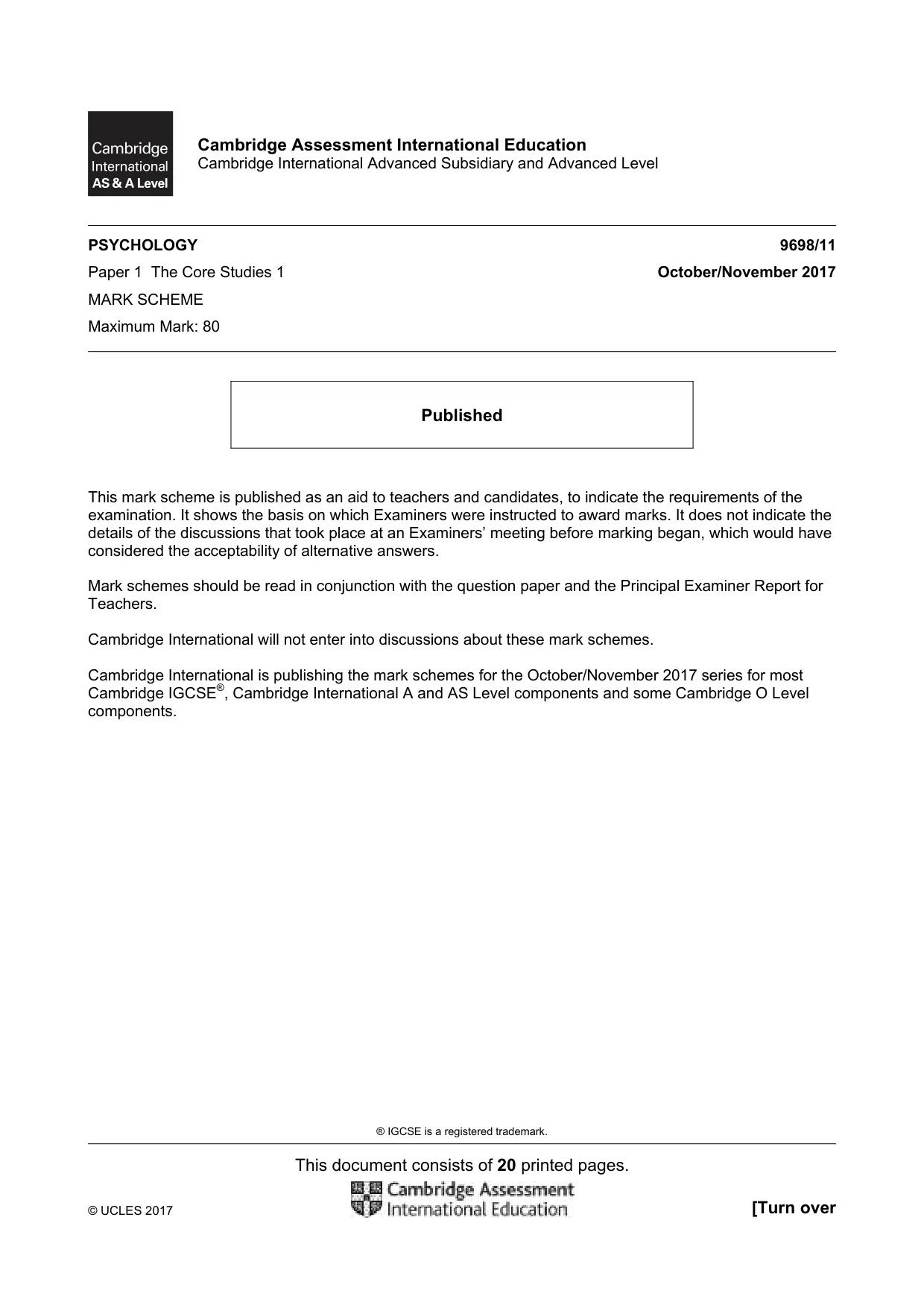
® IGCSE is a registered trademark. This document consists of 20 printed pages. © UCLES 2017 [Turn over Cambridge Assessment International Education Cambridge International Advanced Subsidiary and Advanced Level PSYCHOLOGY 9698/11 Paper 1 The Core Studies 1 October/November 2017 MARK SCHEME Maximum Mark: 80 Published This mark scheme is published as an aid to teachers and candidates, to indicate the requirements of the examination. It shows the basis on which Examiners were instructed to award marks. It does not indicate the details of the discussions that took place at an Examiners’ meeting before marking began, which would have considered the acceptability of alternative answers. Mark schemes should be read in conjunction with the question paper and the Principal Examiner Report for Teachers. Cambridge International will not enter into discussions about these mark schemes. Cambridge International is publishing the mark schemes for the October/November 2017 series for most Cambridge IGCSE®, Cambridge International A and AS Level components and some Cambridge O Level components.
Mark scheme, page 2
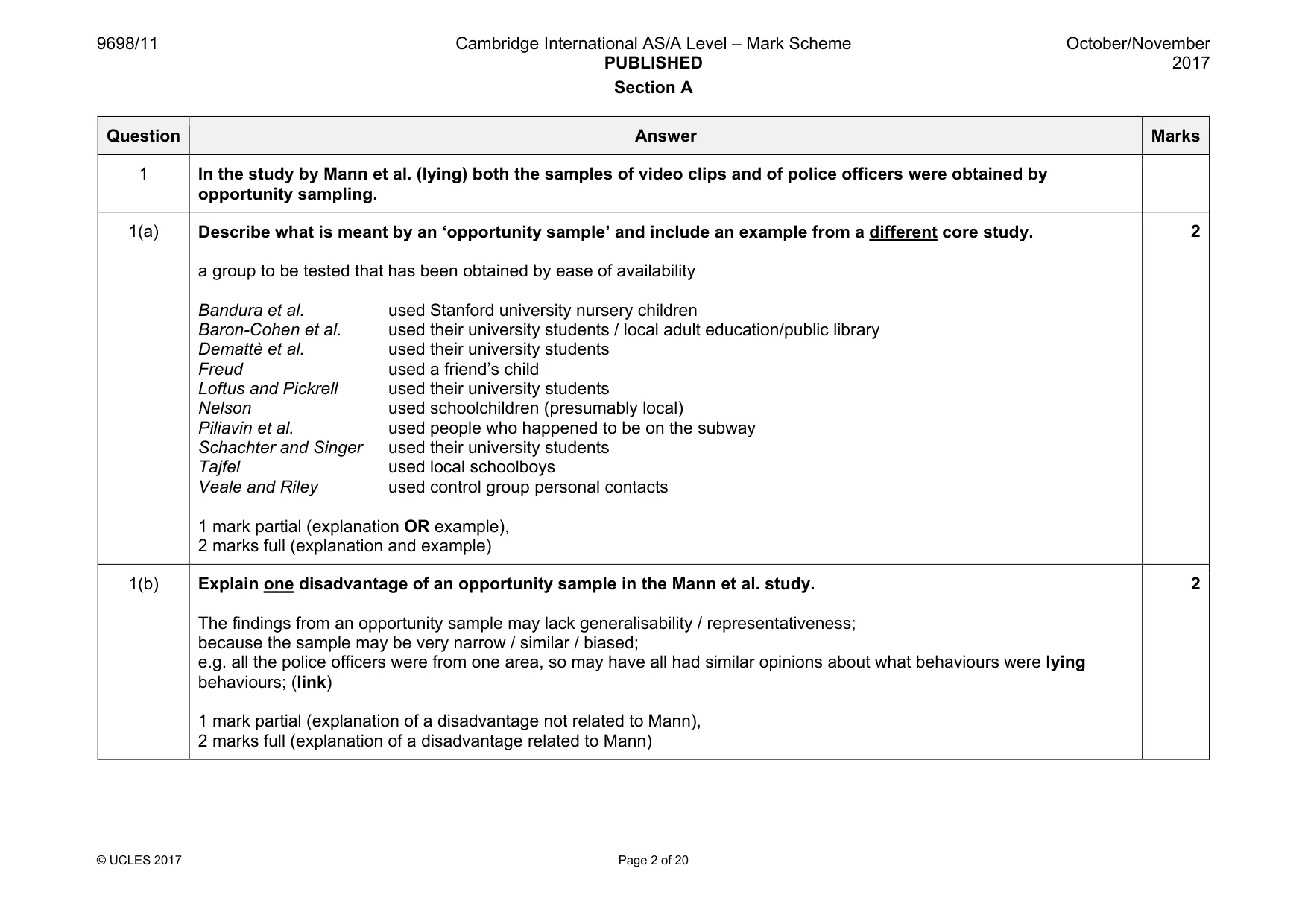
9698/11 Cambridge International AS/A Level – Mark Scheme PUBLISHED October/November 2017 © UCLES 2017 Page 2 of 20 Section A Question Answer Marks 1 In the study by Mann et al. (lying) both the samples of video clips and of police officers were obtained by opportunity sampling. 1(a) Describe what is meant by an ‘opportunity sample’ and include an example from a different core study. a group to be tested that has been obtained by ease of availability Bandura et al. used Stanford university nursery children Baron-Cohen et al. used their university students / local adult education/public library Demattè et al. used their university students Freud used a friend’s child Loftus and Pickrell used their university students Nelson used schoolchildren (presumably local) Piliavin et al. used people who happened to be on the subway Schachter and Singer used their university students Tajfel used local schoolboys Veale and Riley used control group personal contacts 1 mark partial (explanation OR example), 2 marks full (explanation and example) 2 1(b) Explain one disadvantage of an opportunity sample in the Mann et al. study. The findings from an opportunity sample may lack generalisability / representativeness; because the sample may be very narrow / similar / biased; e.g. all the police officers were from one area, so may have all had similar opinions about what behaviours were lying behaviours; (link) 1 mark partial (explanation of a disadvantage not related to Mann), 2 marks full (explanation of a disadvantage related to Mann) 2
Mark scheme, page 3
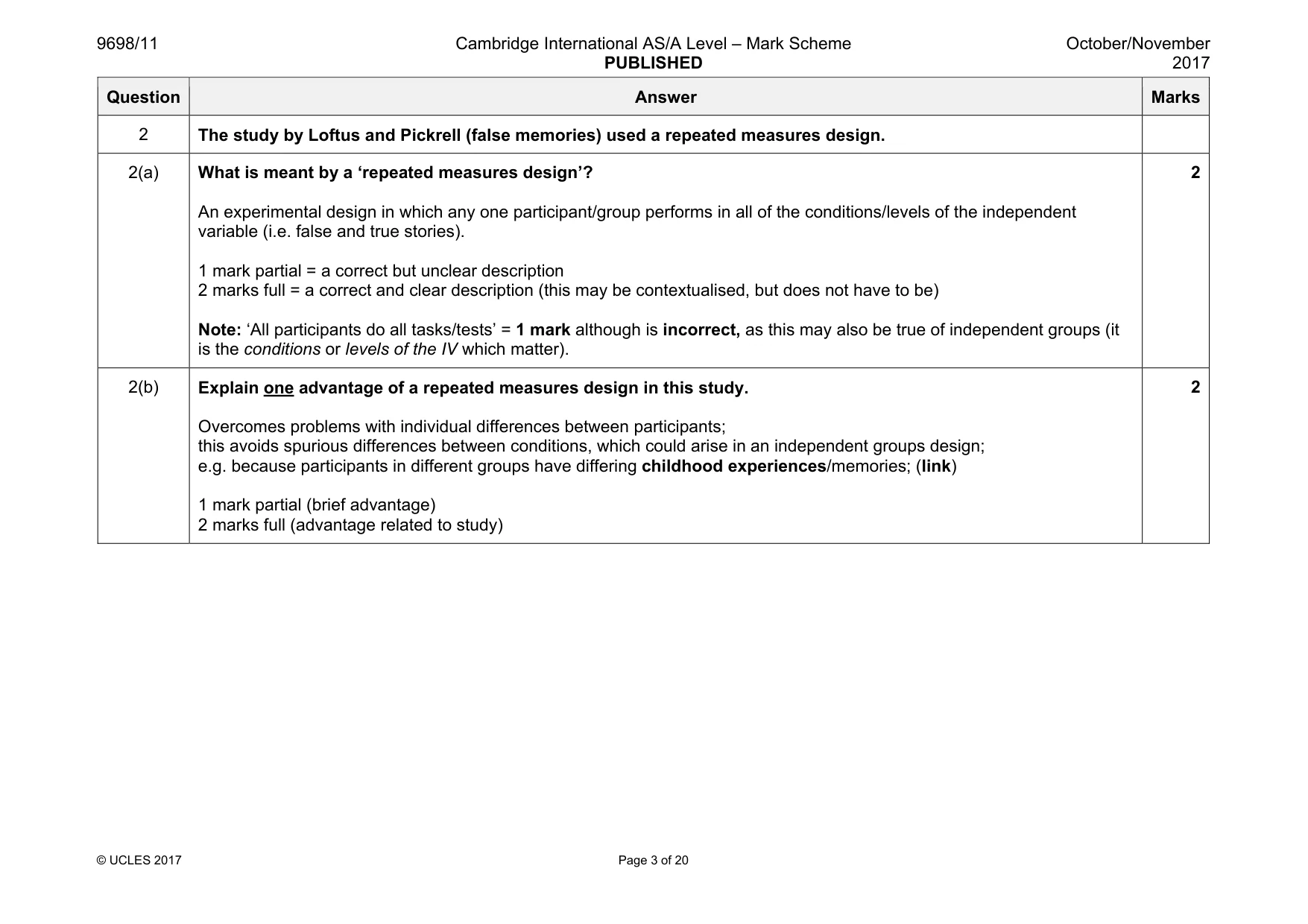
9698/11 Cambridge International AS/A Level – Mark Scheme PUBLISHED October/November 2017 © UCLES 2017 Page 3 of 20 Question Answer Marks 2 The study by Loftus and Pickrell (false memories) used a repeated measures design. 2(a) What is meant by a ‘repeated measures design’? An experimental design in which any one participant/group performs in all of the conditions/levels of the independent variable (i.e. false and true stories). 1 mark partial = a correct but unclear description 2 marks full = a correct and clear description (this may be contextualised, but does not have to be) Note: ‘All participants do all tasks/tests’ = 1 mark although is incorrect, as this may also be true of independent groups (it is the conditions or levels of the IV which matter). 2 2(b) Explain one advantage of a repeated measures design in this study. Overcomes problems with individual differences between participants; this avoids spurious differences between conditions, which could arise in an independent groups design; e.g. because participants in different groups have differing childhood experiences/memories; (link) 1 mark partial (brief advantage) 2 marks full (advantage related to study) 2
Mark scheme, page 4
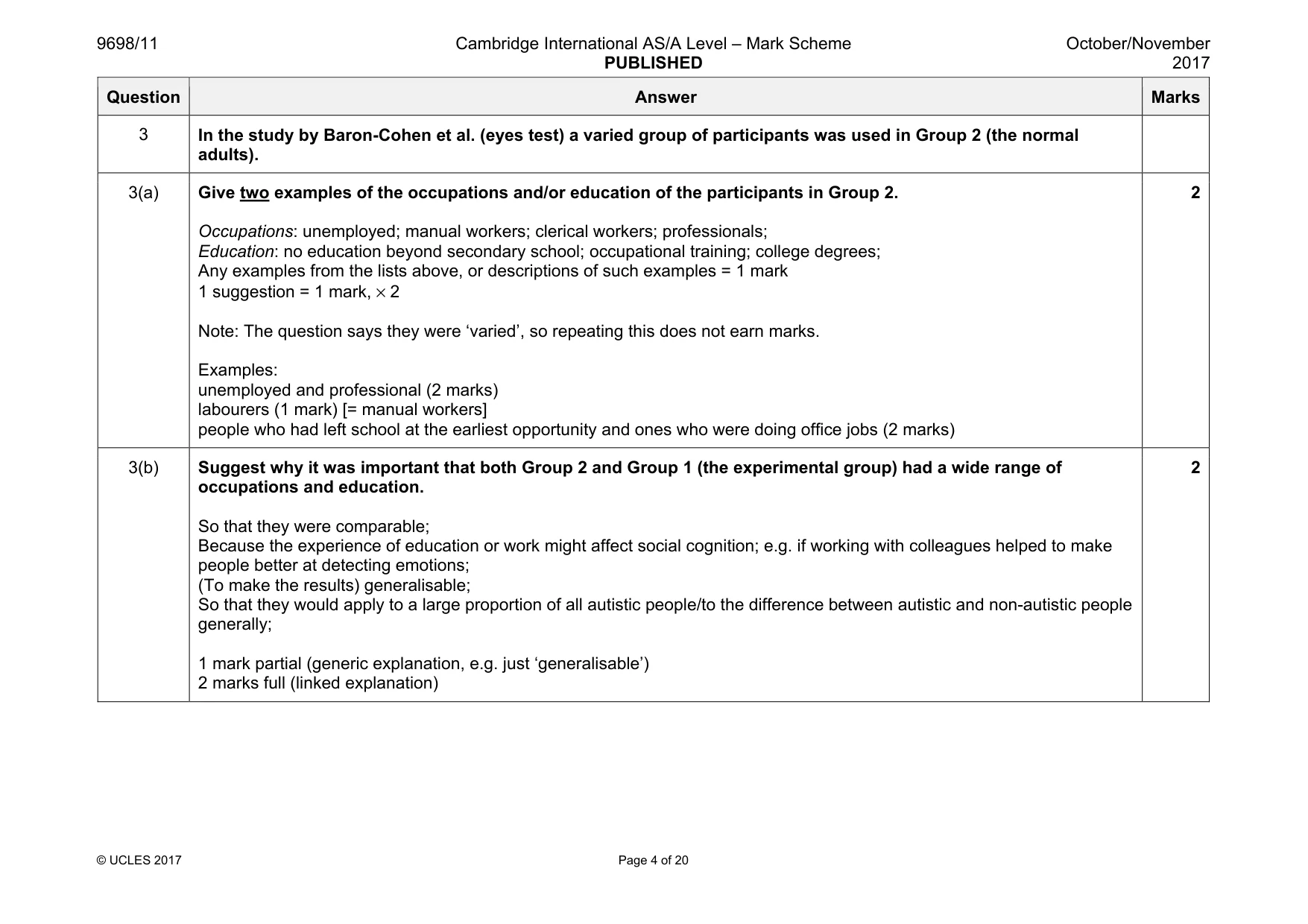
9698/11 Cambridge International AS/A Level – Mark Scheme PUBLISHED October/November 2017 © UCLES 2017 Page 4 of 20 Question Answer Marks 3 In the study by Baron-Cohen et al. (eyes test) a varied group of participants was used in Group 2 (the normal adults). 3(a) Give two examples of the occupations and/or education of the participants in Group 2. Occupations: unemployed; manual workers; clerical workers; professionals; Education: no education beyond secondary school; occupational training; college degrees; Any examples from the lists above, or descriptions of such examples = 1 mark 1 suggestion = 1 mark, × 2 Note: The question says they were ‘varied’, so repeating this does not earn marks. Examples: unemployed and professional (2 marks) labourers (1 mark) [= manual workers] people who had left school at the earliest opportunity and ones who were doing office jobs (2 marks) 2 3(b) Suggest why it was important that both Group 2 and Group 1 (the experimental group) had a wide range of occupations and education. So that they were comparable; Because the experience of education or work might affect social cognition; e.g. if working with colleagues helped to make people better at detecting emotions; (To make the results) generalisable; So that they would apply to a large proportion of all autistic people/to the difference between autistic and non-autistic people generally; 1 mark partial (generic explanation, e.g. just ‘generalisable’) 2 marks full (linked explanation) 2
Mark scheme, page 5
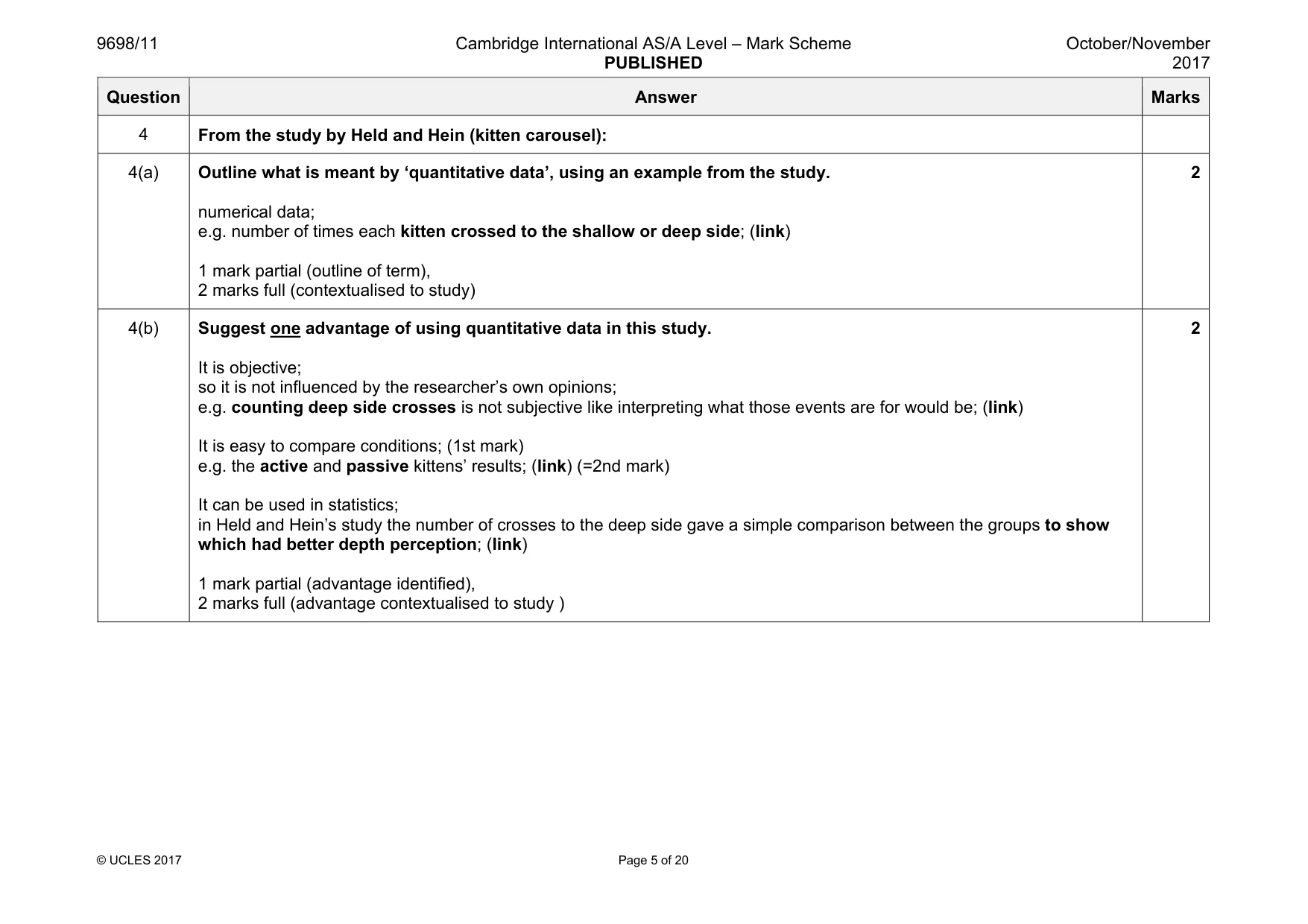
9698/11 Cambridge International AS/A Level – Mark Scheme PUBLISHED October/November 2017 © UCLES 2017 Page 5 of 20 Question Answer Marks 4 From the study by Held and Hein (kitten carousel): 4(a) Outline what is meant by ‘quantitative data’, using an example from the study. numerical data; e.g. number of times each kitten crossed to the shallow or deep side; (link) 1 mark partial (outline of term), 2 marks full (contextualised to study) 2 4(b) Suggest one advantage of using quantitative data in this study. It is objective; so it is not influenced by the researcher’s own opinions; e.g. counting deep side crosses is not subjective like interpreting what those events are for would be; (link) It is easy to compare conditions; (1st mark) e.g. the active and passive kittens’ results; (link) (=2nd mark) It can be used in statistics; in Held and Hein’s study the number of crosses to the deep side gave a simple comparison between the groups to show which had better depth perception; (link) 1 mark partial (advantage identified), 2 marks full (advantage contextualised to study ) 2
Mark scheme, page 6
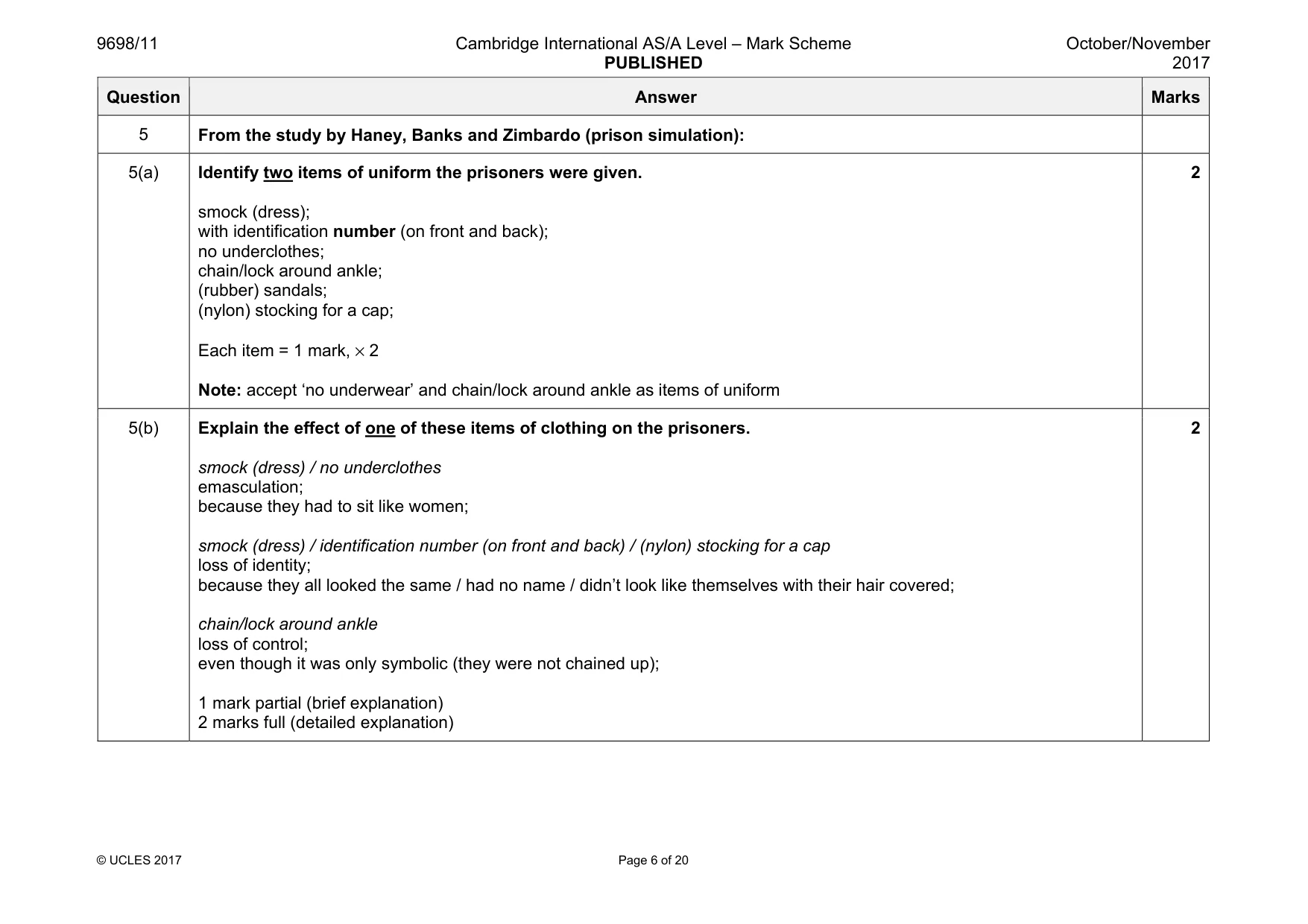
9698/11 Cambridge International AS/A Level – Mark Scheme PUBLISHED October/November 2017 © UCLES 2017 Page 6 of 20 Question Answer Marks 5 From the study by Haney, Banks and Zimbardo (prison simulation): 5(a) Identify two items of uniform the prisoners were given. smock (dress); with identification number (on front and back); no underclothes; chain/lock around ankle; (rubber) sandals; (nylon) stocking for a cap; Each item = 1 mark, × 2 Note: accept ‘no underwear’ and chain/lock around ankle as items of uniform 2 5(b) Explain the effect of one of these items of clothing on the prisoners. smock (dress) / no underclothes emasculation; because they had to sit like women; smock (dress) / identification number (on front and back) / (nylon) stocking for a cap loss of identity; because they all looked the same / had no name / didn’t look like themselves with their hair covered; chain/lock around ankle loss of control; even though it was only symbolic (they were not chained up); 1 mark partial (brief explanation) 2 marks full (detailed explanation) 2
Mark scheme, page 7
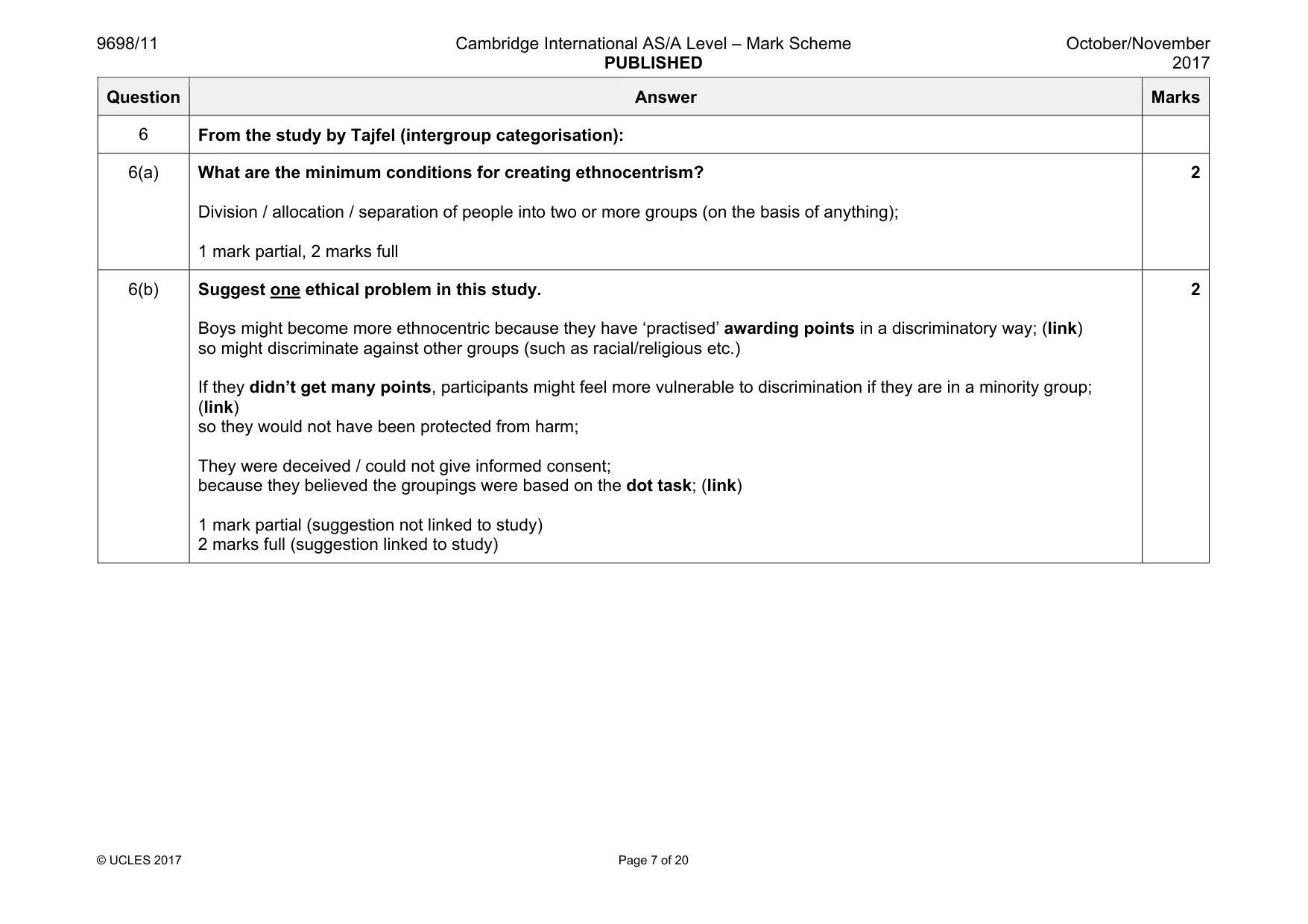
9698/11 Cambridge International AS/A Level – Mark Scheme PUBLISHED October/November 2017 © UCLES 2017 Page 7 of 20 Question Answer Marks 6 From the study by Tajfel (intergroup categorisation): 6(a) What are the minimum conditions for creating ethnocentrism? Division / allocation / separation of people into two or more groups (on the basis of anything); 1 mark partial, 2 marks full 2 6(b) Suggest one ethical problem in this study. Boys might become more ethnocentric because they have ‘practised’ awarding points in a discriminatory way; (link) so might discriminate against other groups (such as racial/religious etc.) If they didn’t get many points, participants might feel more vulnerable to discrimination if they are in a minority group; (link) so they would not have been protected from harm; They were deceived / could not give informed consent; because they believed the groupings were based on the dot task; (link) 1 mark partial (suggestion not linked to study) 2 marks full (suggestion linked to study) 2
Mark scheme, page 8
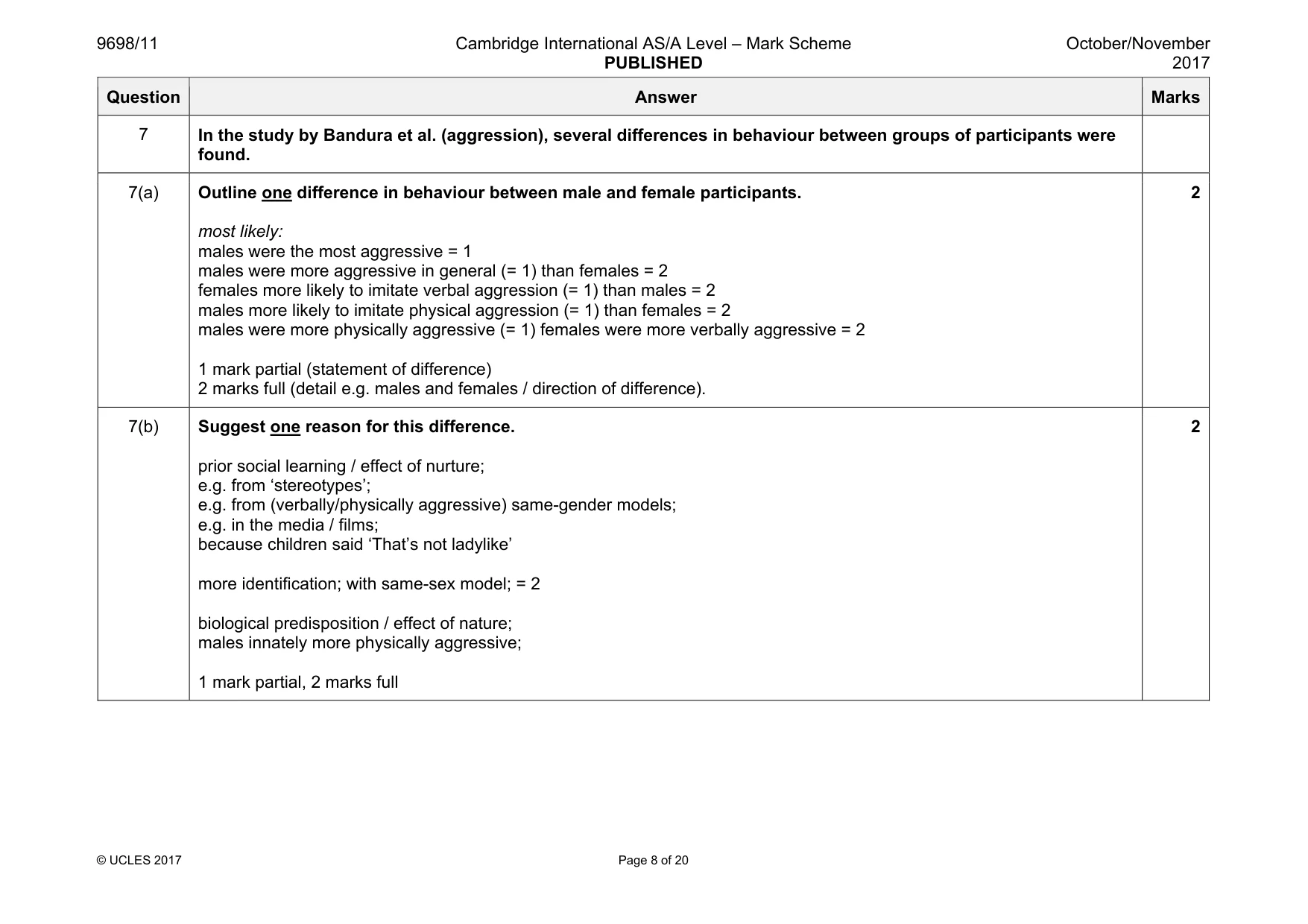
9698/11 Cambridge International AS/A Level – Mark Scheme PUBLISHED October/November 2017 © UCLES 2017 Page 8 of 20 Question Answer Marks 7 In the study by Bandura et al. (aggression), several differences in behaviour between groups of participants were found. 7(a) Outline one difference in behaviour between male and female participants. most likely: males were the most aggressive = 1 males were more aggressive in general (= 1) than females = 2 females more likely to imitate verbal aggression (= 1) than males = 2 males more likely to imitate physical aggression (= 1) than females = 2 males were more physically aggressive (= 1) females were more verbally aggressive = 2 1 mark partial (statement of difference) 2 marks full (detail e.g. males and females / direction of difference). 2 7(b) Suggest one reason for this difference. prior social learning / effect of nurture; e.g. from ‘stereotypes’; e.g. from (verbally/physically aggressive) same-gender models; e.g. in the media / films; because children said ‘That’s not ladylike’ more identification; with same-sex model; = 2 biological predisposition / effect of nature; males innately more physically aggressive; 1 mark partial, 2 marks full 2
Mark scheme, page 9
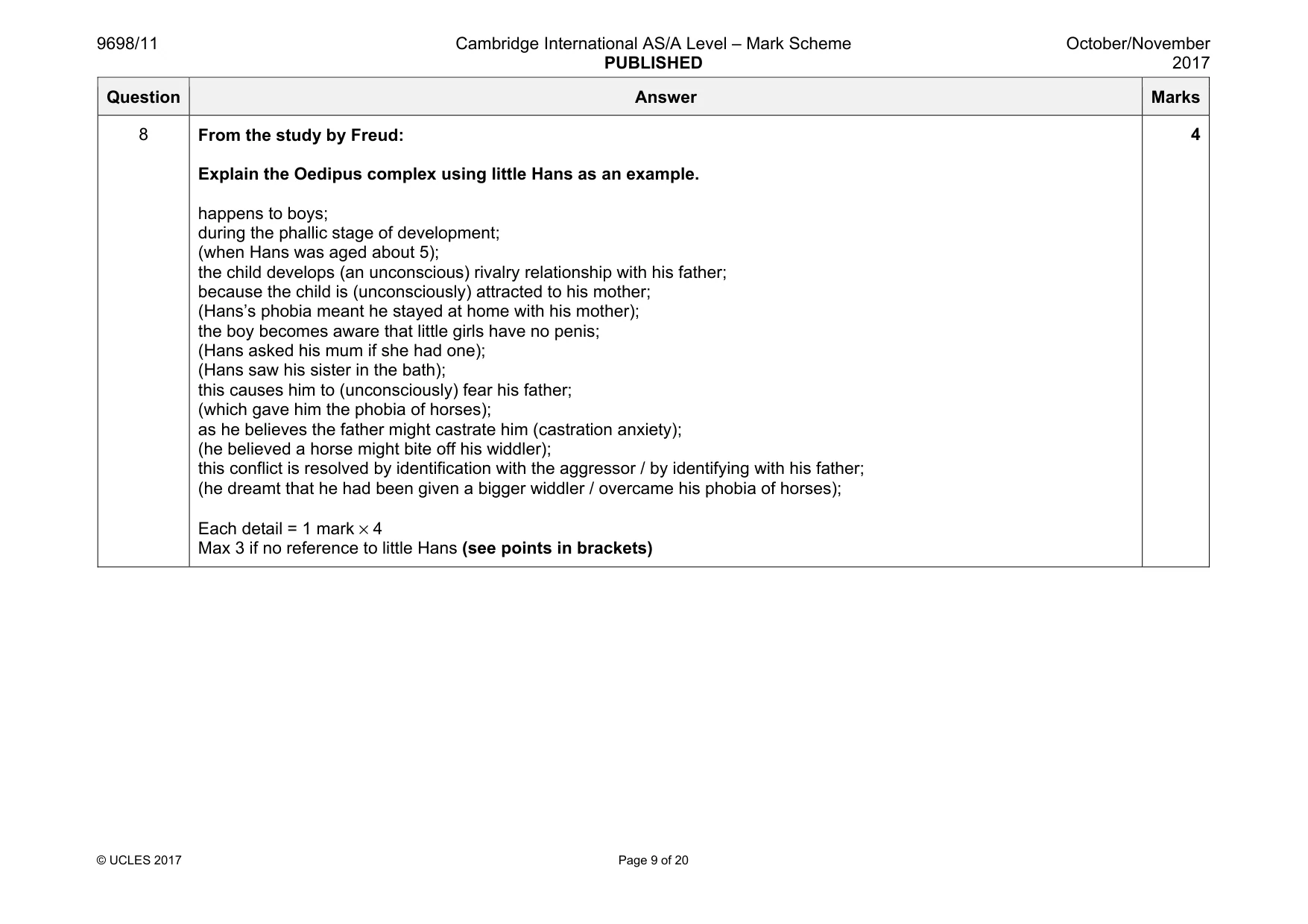
9698/11 Cambridge International AS/A Level – Mark Scheme PUBLISHED October/November 2017 © UCLES 2017 Page 9 of 20 Question Answer Marks 8 From the study by Freud: Explain the Oedipus complex using little Hans as an example. happens to boys; during the phallic stage of development; (when Hans was aged about 5); the child develops (an unconscious) rivalry relationship with his father; because the child is (unconsciously) attracted to his mother; (Hans’s phobia meant he stayed at home with his mother); the boy becomes aware that little girls have no penis; (Hans asked his mum if she had one); (Hans saw his sister in the bath); this causes him to (unconsciously) fear his father; (which gave him the phobia of horses); as he believes the father might castrate him (castration anxiety); (he believed a horse might bite off his widdler); this conflict is resolved by identification with the aggressor / by identifying with his father; (he dreamt that he had been given a bigger widdler / overcame his phobia of horses); Each detail = 1 mark × 4 Max 3 if no reference to little Hans (see points in brackets) 4
Mark scheme, page 10
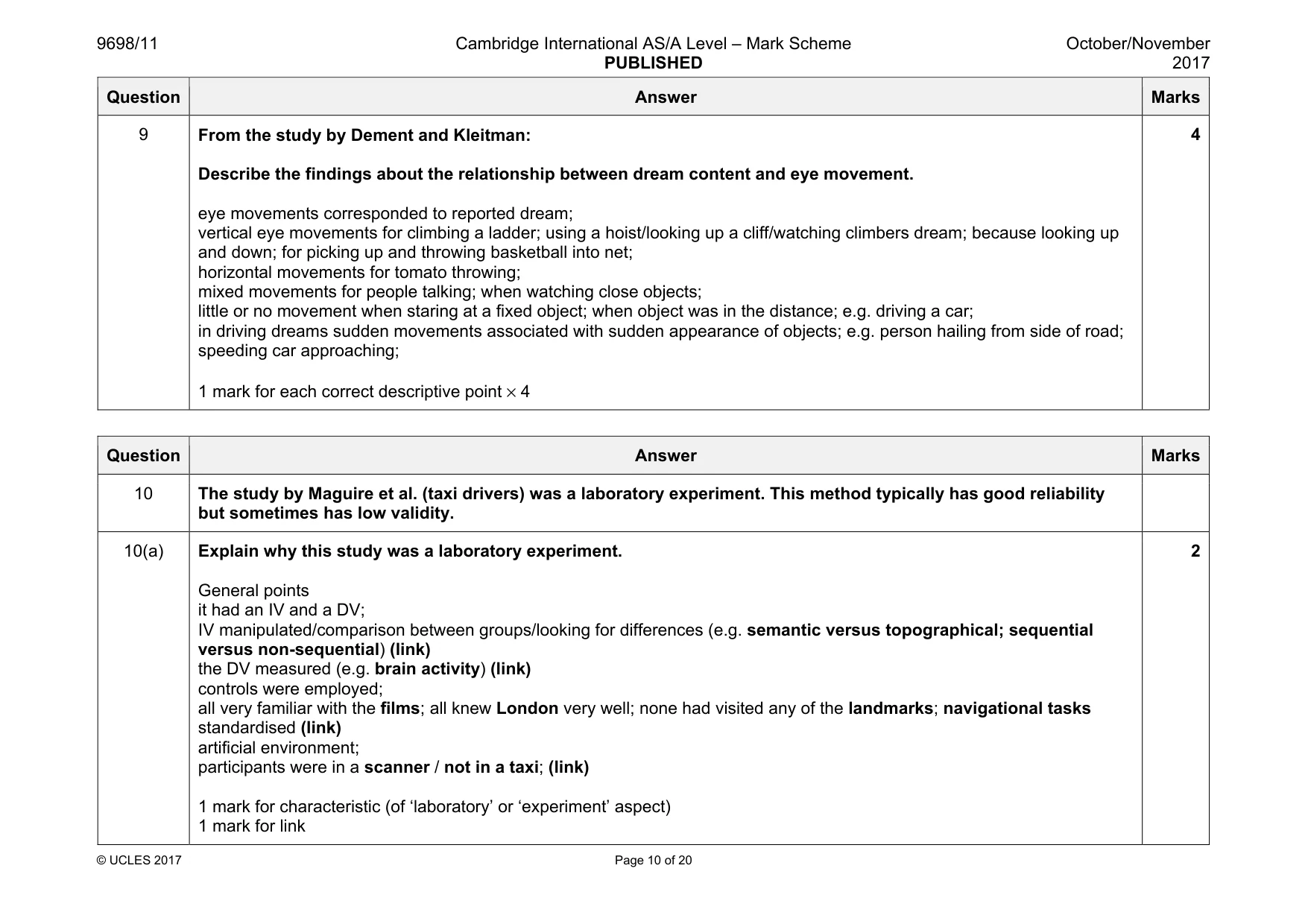
9698/11 Cambridge International AS/A Level – Mark Scheme PUBLISHED October/November 2017 © UCLES 2017 Page 10 of 20 Question Answer Marks 9 From the study by Dement and Kleitman: Describe the findings about the relationship between dream content and eye movement. eye movements corresponded to reported dream; vertical eye movements for climbing a ladder; using a hoist/looking up a cliff/watching climbers dream; because looking up and down; for picking up and throwing basketball into net; horizontal movements for tomato throwing; mixed movements for people talking; when watching close objects; little or no movement when staring at a fixed object; when object was in the distance; e.g. driving a car; in driving dreams sudden movements associated with sudden appearance of objects; e.g. person hailing from side of road; speeding car approaching; 1 mark for each correct descriptive point × 4 4 Question Answer Marks 10 The study by Maguire et al. (taxi drivers) was a laboratory experiment. This method typically has good reliability but sometimes has low validity. 10(a) Explain why this study was a laboratory experiment. General points it had an IV and a DV; IV manipulated/comparison between groups/looking for differences (e.g. semantic versus topographical; sequential versus non-sequential) (link) the DV measured (e.g. brain activity) (link) controls were employed; all very familiar with the films; all knew London very well; none had visited any of the landmarks; navigational tasks standardised (link) artificial environment; participants were in a scanner / not in a taxi; (link) 1 mark for characteristic (of ‘laboratory’ or ‘experiment’ aspect) 1 mark for link 2
Mark scheme, page 11
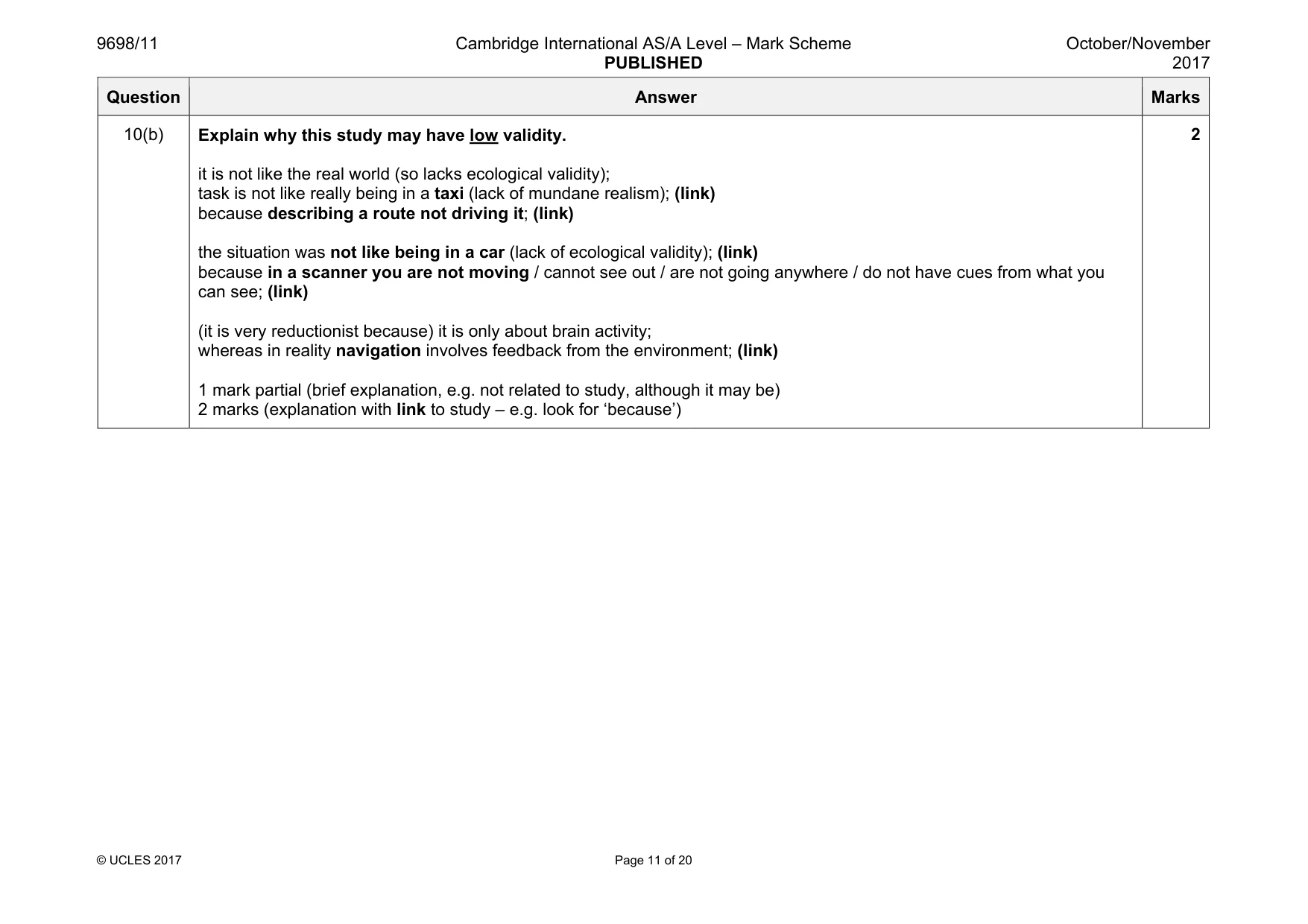
9698/11 Cambridge International AS/A Level – Mark Scheme PUBLISHED October/November 2017 © UCLES 2017 Page 11 of 20 Question Answer Marks 10(b) Explain why this study may have low validity. it is not like the real world (so lacks ecological validity); task is not like really being in a taxi (lack of mundane realism); (link) because describing a route not driving it; (link) the situation was not like being in a car (lack of ecological validity); (link) because in a scanner you are not moving / cannot see out / are not going anywhere / do not have cues from what you can see; (link) (it is very reductionist because) it is only about brain activity; whereas in reality navigation involves feedback from the environment; (link) 1 mark partial (brief explanation, e.g. not related to study, although it may be) 2 marks (explanation with link to study – e.g. look for ‘because’) 2
Mark scheme, page 12
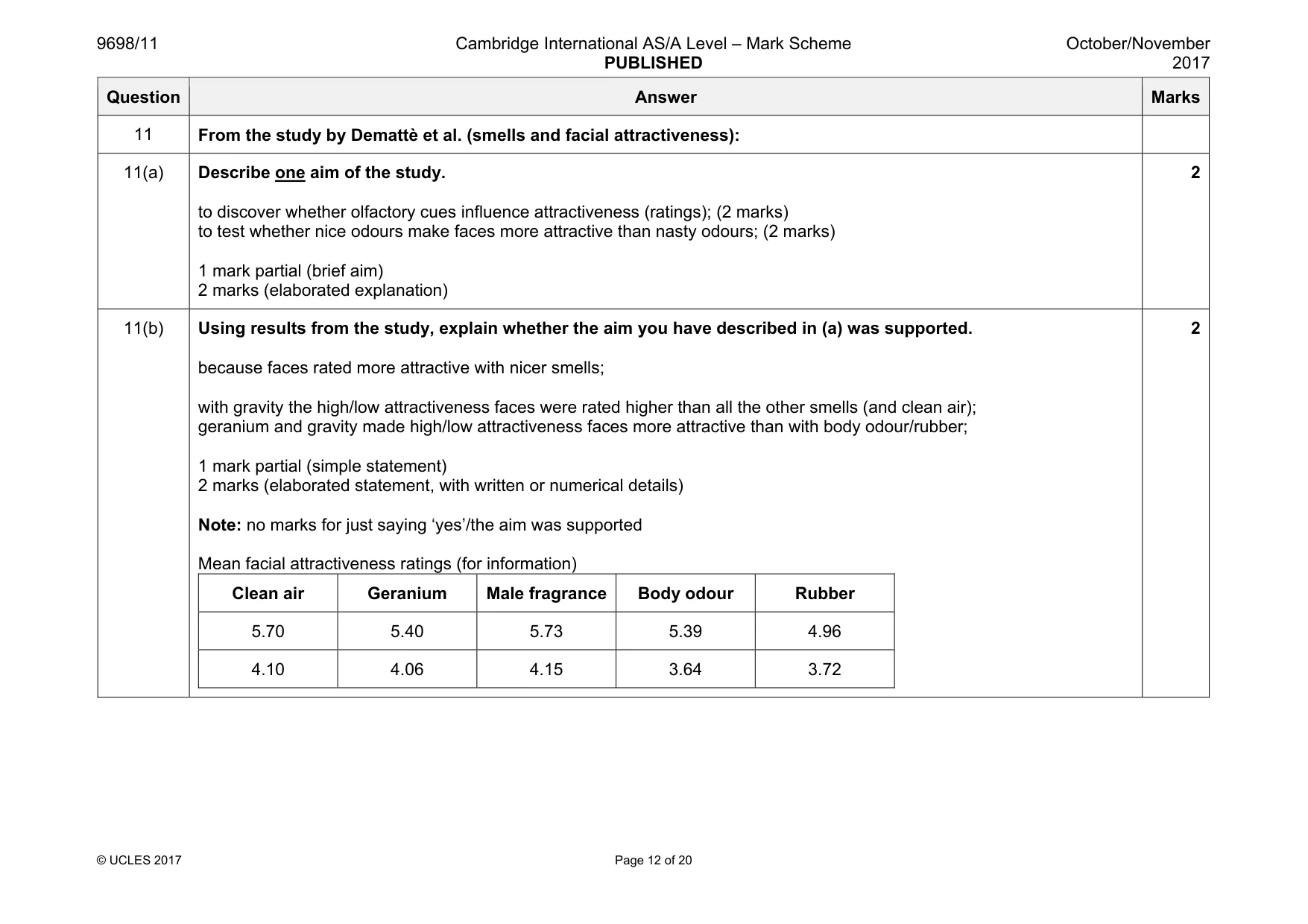
9698/11 Cambridge International AS/A Level – Mark Scheme PUBLISHED October/November 2017 © UCLES 2017 Page 12 of 20 Question Answer Marks 11 From the study by Demattè et al. (smells and facial attractiveness): 11(a) Describe one aim of the study. to discover whether olfactory cues influence attractiveness (ratings); (2 marks) to test whether nice odours make faces more attractive than nasty odours; (2 marks) 1 mark partial (brief aim) 2 marks (elaborated explanation) 2 11(b) Using results from the study, explain whether the aim you have described in (a) was supported. because faces rated more attractive with nicer smells; with gravity the high/low attractiveness faces were rated higher than all the other smells (and clean air); geranium and gravity made high/low attractiveness faces more attractive than with body odour/rubber; 1 mark partial (simple statement) 2 marks (elaborated statement, with written or numerical details) Note: no marks for just saying ‘yes’/the aim was supported Mean facial attractiveness ratings (for information) Clean air Geranium Male fragrance Body odour Rubber 5.70 5.40 5.73 5.39 4.96 4.10 4.06 4.15 3.64 3.72 2
Mark scheme, page 13
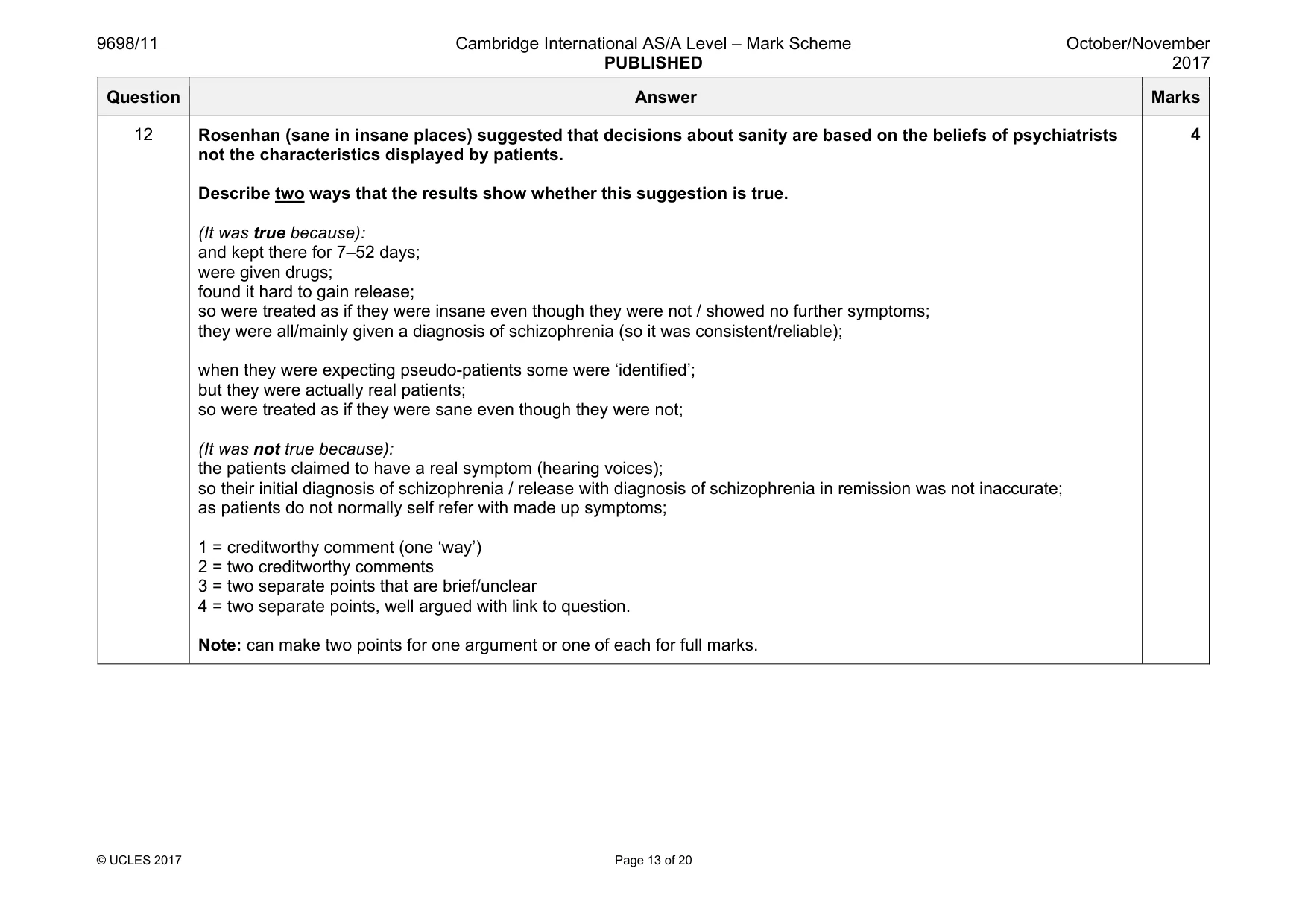
9698/11 Cambridge International AS/A Level – Mark Scheme PUBLISHED October/November 2017 © UCLES 2017 Page 13 of 20 Question Answer Marks 12 Rosenhan (sane in insane places) suggested that decisions about sanity are based on the beliefs of psychiatrists not the characteristics displayed by patients. Describe two ways that the results show whether this suggestion is true. (It was true because): and kept there for 7–52 days; were given drugs; found it hard to gain release; so were treated as if they were insane even though they were not / showed no further symptoms; they were all/mainly given a diagnosis of schizophrenia (so it was consistent/reliable); when they were expecting pseudo-patients some were ‘identified’; but they were actually real patients; so were treated as if they were sane even though they were not; (It was not true because): the patients claimed to have a real symptom (hearing voices); so their initial diagnosis of schizophrenia / release with diagnosis of schizophrenia in remission was not inaccurate; as patients do not normally self refer with made up symptoms; 1 = creditworthy comment (one ‘way’) 2 = two creditworthy comments 3 = two separate points that are brief/unclear 4 = two separate points, well argued with link to question. Note: can make two points for one argument or one of each for full marks. 4
Mark scheme, page 14
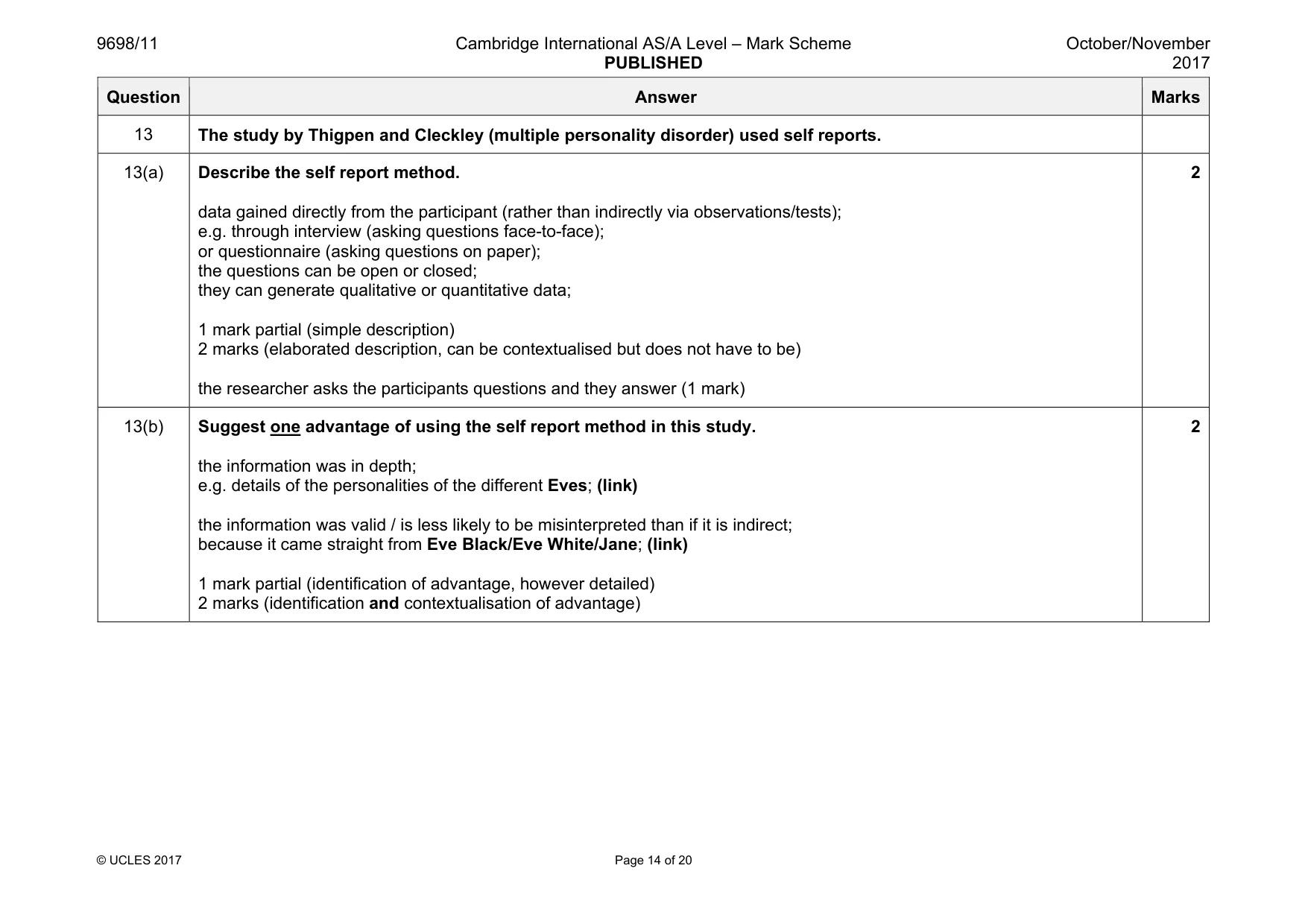
9698/11 Cambridge International AS/A Level – Mark Scheme PUBLISHED October/November 2017 © UCLES 2017 Page 14 of 20 Question Answer Marks 13 The study by Thigpen and Cleckley (multiple personality disorder) used self reports. 13(a) Describe the self report method. data gained directly from the participant (rather than indirectly via observations/tests); e.g. through interview (asking questions face-to-face); or questionnaire (asking questions on paper); the questions can be open or closed; they can generate qualitative or quantitative data; 1 mark partial (simple description) 2 marks (elaborated description, can be contextualised but does not have to be) the researcher asks the participants questions and they answer (1 mark) 2 13(b) Suggest one advantage of using the self report method in this study. the information was in depth; e.g. details of the personalities of the different Eves; (link) the information was valid / is less likely to be misinterpreted than if it is indirect; because it came straight from Eve Black/Eve White/Jane; (link) 1 mark partial (identification of advantage, however detailed) 2 marks (identification and contextualisation of advantage) 2
Mark scheme, page 15
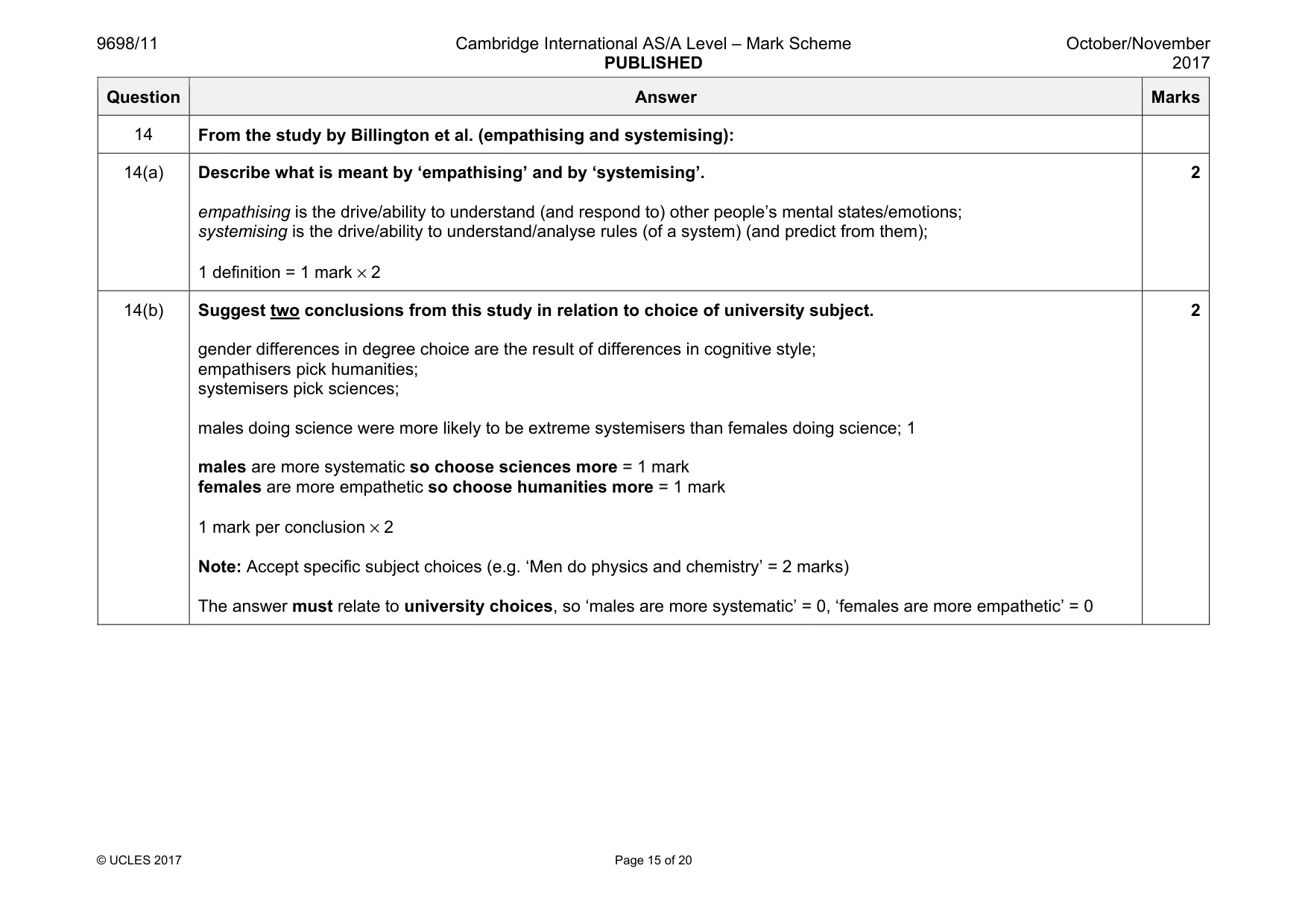
9698/11 Cambridge International AS/A Level – Mark Scheme PUBLISHED October/November 2017 © UCLES 2017 Page 15 of 20 Question Answer Marks 14 From the study by Billington et al. (empathising and systemising): 14(a) Describe what is meant by ‘empathising’ and by ‘systemising’. empathising is the drive/ability to understand (and respond to) other people’s mental states/emotions; systemising is the drive/ability to understand/analyse rules (of a system) (and predict from them); 1 definition = 1 mark × 2 2 14(b) Suggest two conclusions from this study in relation to choice of university subject. gender differences in degree choice are the result of differences in cognitive style; empathisers pick humanities; systemisers pick sciences; males doing science were more likely to be extreme systemisers than females doing science; 1 males are more systematic so choose sciences more = 1 mark females are more empathetic so choose humanities more = 1 mark 1 mark per conclusion × 2 Note: Accept specific subject choices (e.g. ‘Men do physics and chemistry’ = 2 marks) The answer must relate to university choices, so ‘males are more systematic’ = 0, ‘females are more empathetic’ = 0 2
Mark scheme, page 16
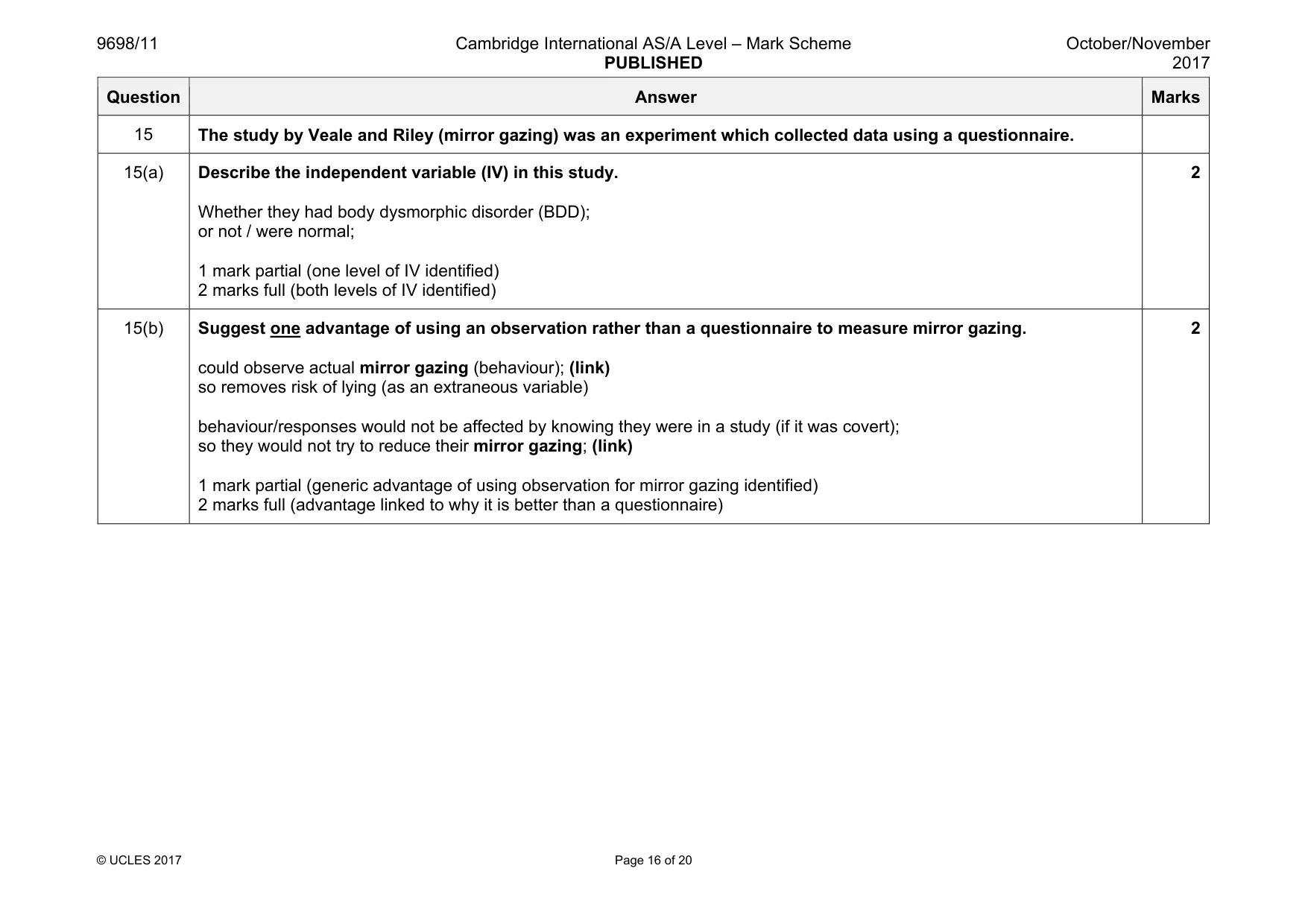
9698/11 Cambridge International AS/A Level – Mark Scheme PUBLISHED October/November 2017 © UCLES 2017 Page 16 of 20 Question Answer Marks 15 The study by Veale and Riley (mirror gazing) was an experiment which collected data using a questionnaire. 15(a) Describe the independent variable (IV) in this study. Whether they had body dysmorphic disorder (BDD); or not / were normal; 1 mark partial (one level of IV identified) 2 marks full (both levels of IV identified) 2 15(b) Suggest one advantage of using an observation rather than a questionnaire to measure mirror gazing. could observe actual mirror gazing (behaviour); (link) so removes risk of lying (as an extraneous variable) behaviour/responses would not be affected by knowing they were in a study (if it was covert); so they would not try to reduce their mirror gazing; (link) 1 mark partial (generic advantage of using observation for mirror gazing identified) 2 marks full (advantage linked to why it is better than a questionnaire) 2
Mark scheme, page 17
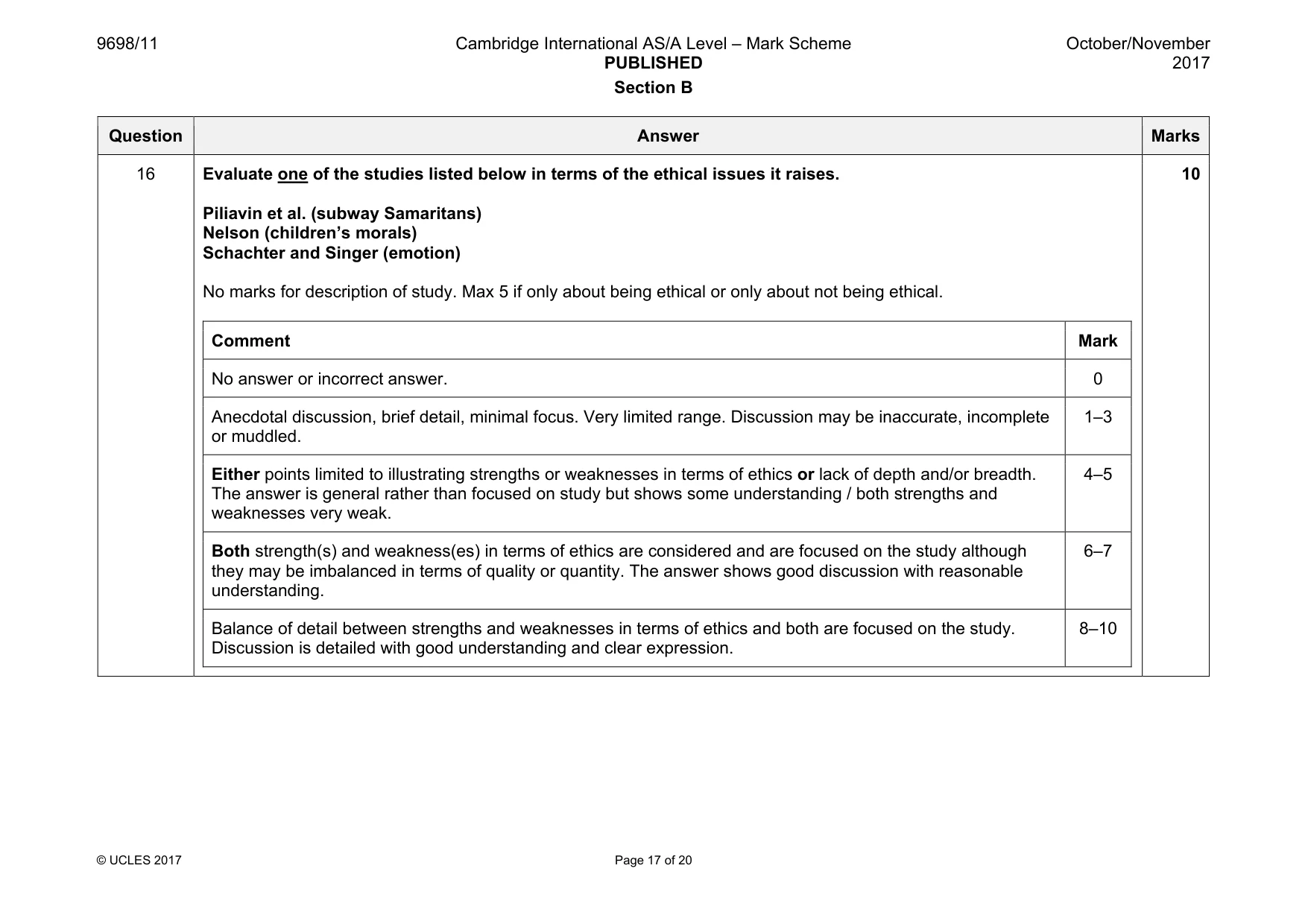
9698/11 Cambridge International AS/A Level – Mark Scheme PUBLISHED October/November 2017 © UCLES 2017 Page 17 of 20 Section B Question Answer Marks 16 Evaluate one of the studies listed below in terms of the ethical issues it raises. Piliavin et al. (subway Samaritans) Nelson (children’s morals) Schachter and Singer (emotion) No marks for description of study. Max 5 if only about being ethical or only about not being ethical. Comment Mark No answer or incorrect answer. 0 Anecdotal discussion, brief detail, minimal focus. Very limited range. Discussion may be inaccurate, incomplete or muddled. 1–3 Either points limited to illustrating strengths or weaknesses in terms of ethics or lack of depth and/or breadth. The answer is general rather than focused on study but shows some understanding / both strengths and weaknesses very weak. 4–5 Both strength(s) and weakness(es) in terms of ethics are considered and are focused on the study although they may be imbalanced in terms of quality or quantity. The answer shows good discussion with reasonable understanding. 6–7 Balance of detail between strengths and weaknesses in terms of ethics and both are focused on the study. Discussion is detailed with good understanding and clear expression. 8–10 10
Mark scheme, page 18
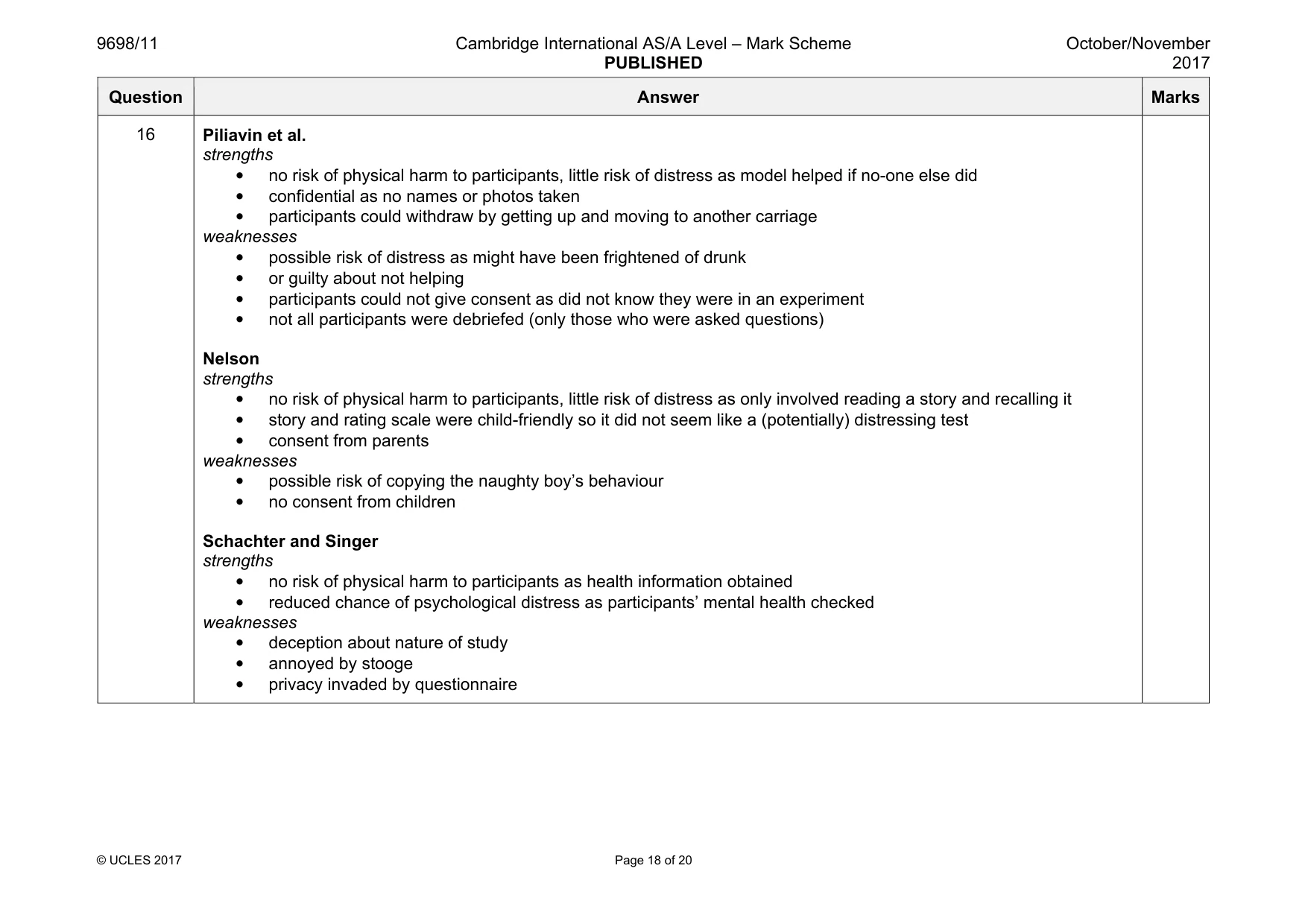
9698/11 Cambridge International AS/A Level – Mark Scheme PUBLISHED October/November 2017 © UCLES 2017 Page 18 of 20 Question Answer Marks 16 Piliavin et al. strengths • no risk of physical harm to participants, little risk of distress as model helped if no-one else did • confidential as no names or photos taken • participants could withdraw by getting up and moving to another carriage weaknesses • possible risk of distress as might have been frightened of drunk • or guilty about not helping • participants could not give consent as did not know they were in an experiment • not all participants were debriefed (only those who were asked questions) Nelson strengths • no risk of physical harm to participants, little risk of distress as only involved reading a story and recalling it • story and rating scale were child-friendly so it did not seem like a (potentially) distressing test • consent from parents weaknesses • possible risk of copying the naughty boy’s behaviour • no consent from children Schachter and Singer strengths • no risk of physical harm to participants as health information obtained • reduced chance of psychological distress as participants’ mental health checked weaknesses • deception about nature of study • annoyed by stooge • privacy invaded by questionnaire
Mark scheme, page 19
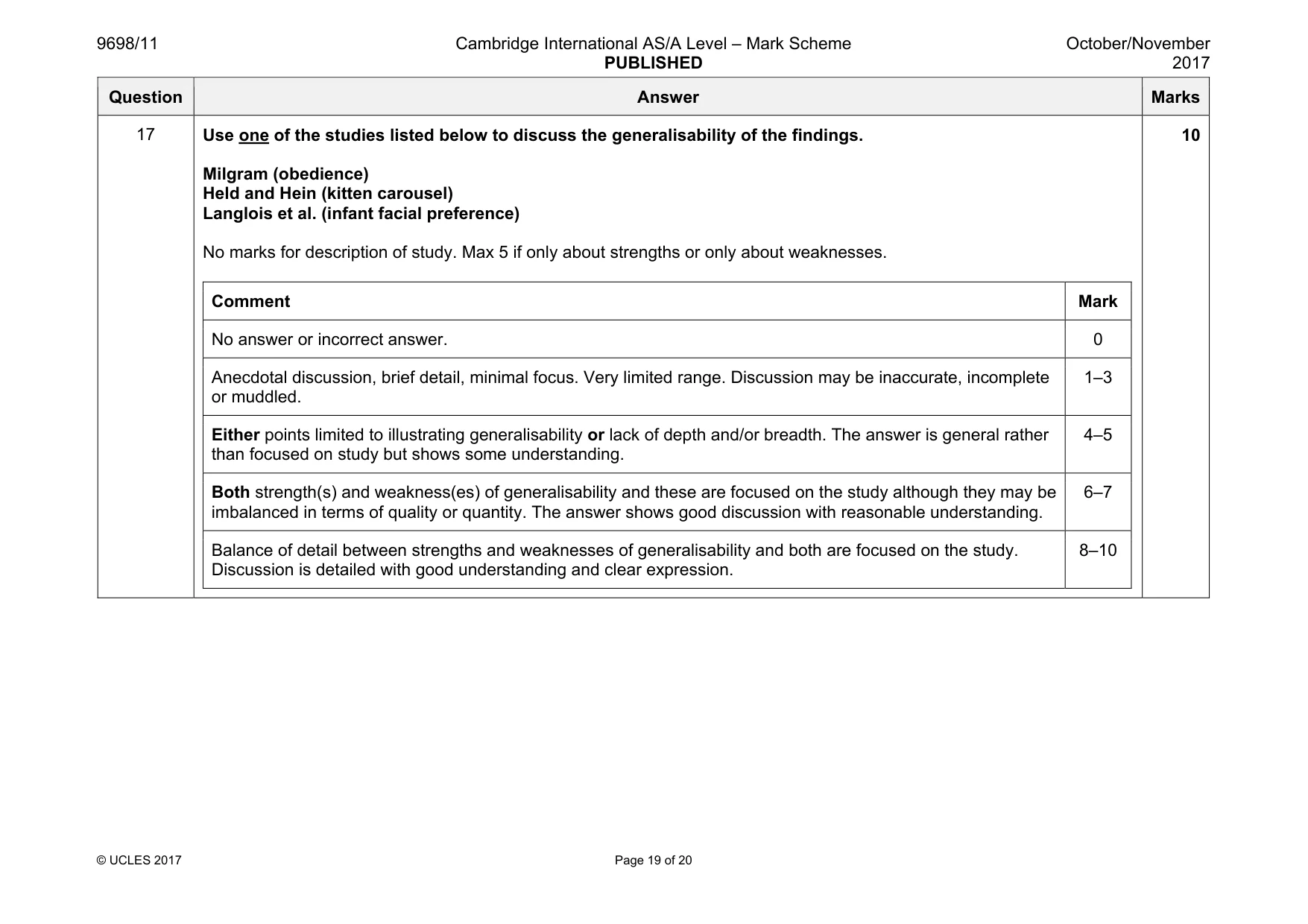
9698/11 Cambridge International AS/A Level – Mark Scheme PUBLISHED October/November 2017 © UCLES 2017 Page 19 of 20 Question Answer Marks 17 Use one of the studies listed below to discuss the generalisability of the findings. Milgram (obedience) Held and Hein (kitten carousel) Langlois et al. (infant facial preference) No marks for description of study. Max 5 if only about strengths or only about weaknesses. Comment Mark No answer or incorrect answer. 0 Anecdotal discussion, brief detail, minimal focus. Very limited range. Discussion may be inaccurate, incomplete or muddled. 1–3 Either points limited to illustrating generalisability or lack of depth and/or breadth. The answer is general rather than focused on study but shows some understanding. 4–5 Both strength(s) and weakness(es) of generalisability and these are focused on the study although they may be imbalanced in terms of quality or quantity. The answer shows good discussion with reasonable understanding. 6–7 Balance of detail between strengths and weaknesses of generalisability and both are focused on the study. Discussion is detailed with good understanding and clear expression. 8–10 10
Mark scheme, page 20
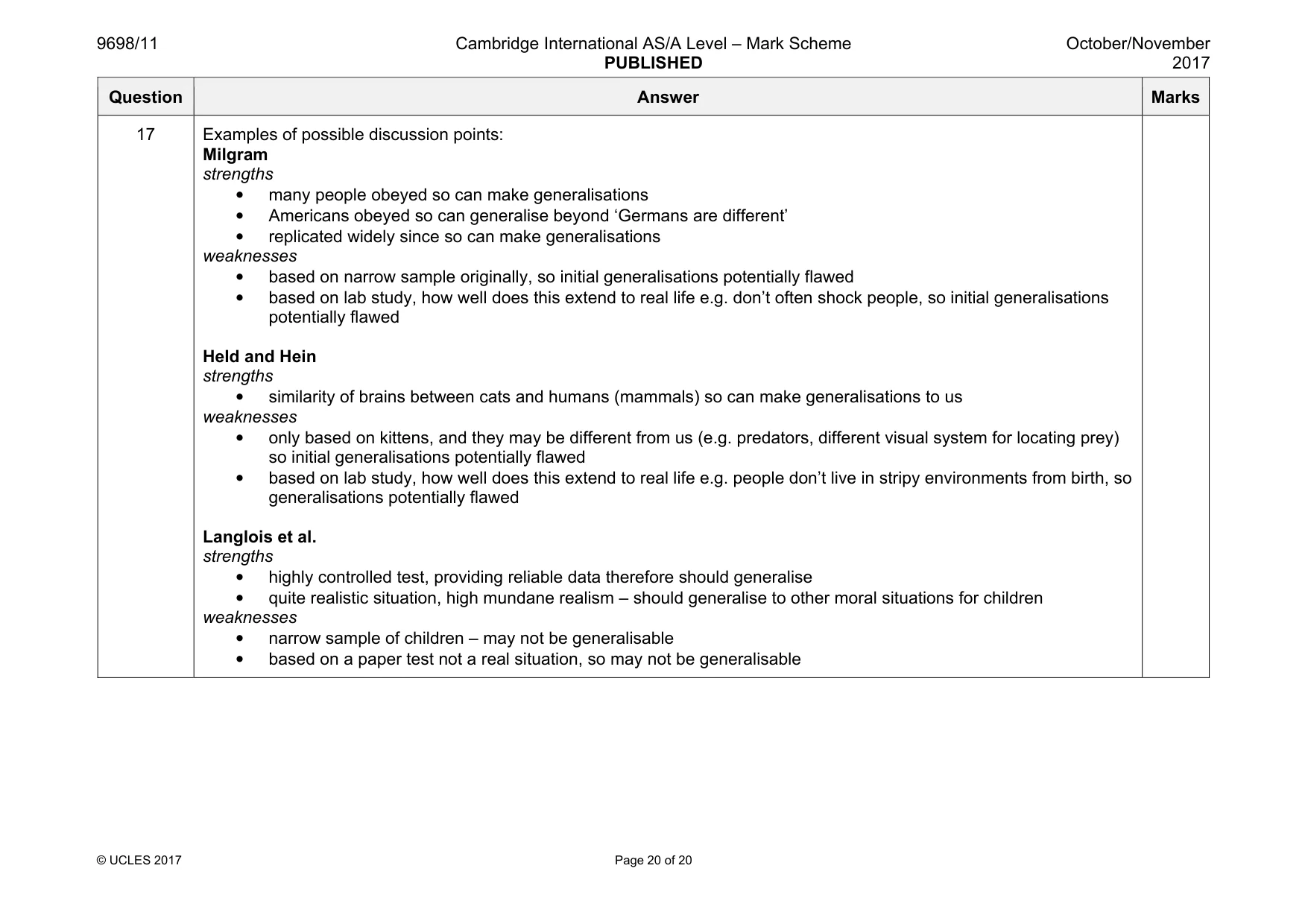
9698/11 Cambridge International AS/A Level – Mark Scheme PUBLISHED October/November 2017 © UCLES 2017 Page 20 of 20 Question Answer Marks 17 Examples of possible discussion points: Milgram strengths • many people obeyed so can make generalisations • Americans obeyed so can generalise beyond ‘Germans are different’ • replicated widely since so can make generalisations weaknesses • based on narrow sample originally, so initial generalisations potentially flawed • based on lab study, how well does this extend to real life e.g. don’t often shock people, so initial generalisations potentially flawed Held and Hein strengths • similarity of brains between cats and humans (mammals) so can make generalisations to us weaknesses • only based on kittens, and they may be different from us (e.g. predators, different visual system for locating prey) so initial generalisations potentially flawed • based on lab study, how well does this extend to real life e.g. people don’t live in stripy environments from birth, so generalisations potentially flawed Langlois et al. strengths • highly controlled test, providing reliable data therefore should generalise • quite realistic situation, high mundane realism – should generalise to other moral situations for children weaknesses • narrow sample of children – may not be generalisable • based on a paper test not a real situation, so may not be generalisable
What you needed in this session
Cambridge’s own grade thresholds for 2017 Oct/Nov, Paper 1 · Variant 1. A higher threshold means an easier paper — the bar moves with how the cohort did.