Cambridge A Level Psychology 9698 — 2018 Oct/Nov Paper 1 · Variant 1
9698/11/O/N/18 · 80 marks · ≈90 min
The question paper and its mark scheme, free to read here and free to download. This is Cambridge’s own paper, exactly as it was sat.
Question paper4 pages

Mark scheme16 pages
Answers below. Sit the paper first if you are practising.
Paper as text
Question paper, page 1
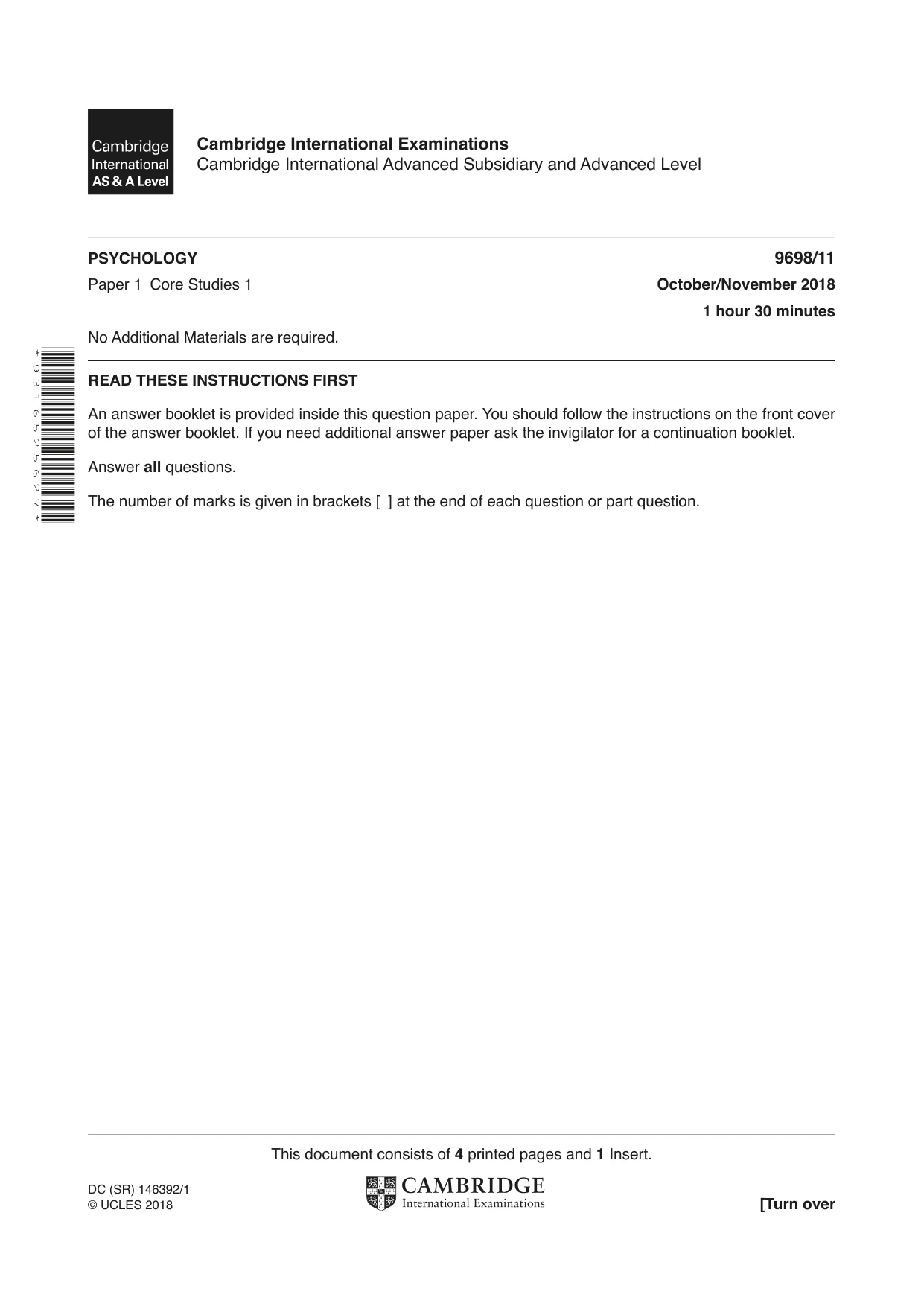
* 9 3 1 6 5 2 5 6 2 7 * This document consists of 4 printed pages and 1 Insert. DC (SR) 146392/1 © UCLES 2018 [Turn over PSYCHOLOGY 9698/11 Paper 1 Core Studies 1 October/November 2018 1 hour 30 minutes No Additional Materials are required. READ THESE INSTRUCTIONS FIRST An answer booklet is provided inside this question paper. You should follow the instructions on the front cover of the answer booklet. If you need additional answer paper ask the invigilator for a continuation booklet. Answer all questions. The number of marks is given in brackets [ ] at the end of each question or part question. Cambridge International Examinations Cambridge International Advanced Subsidiary and Advanced Level
Question paper, page 2
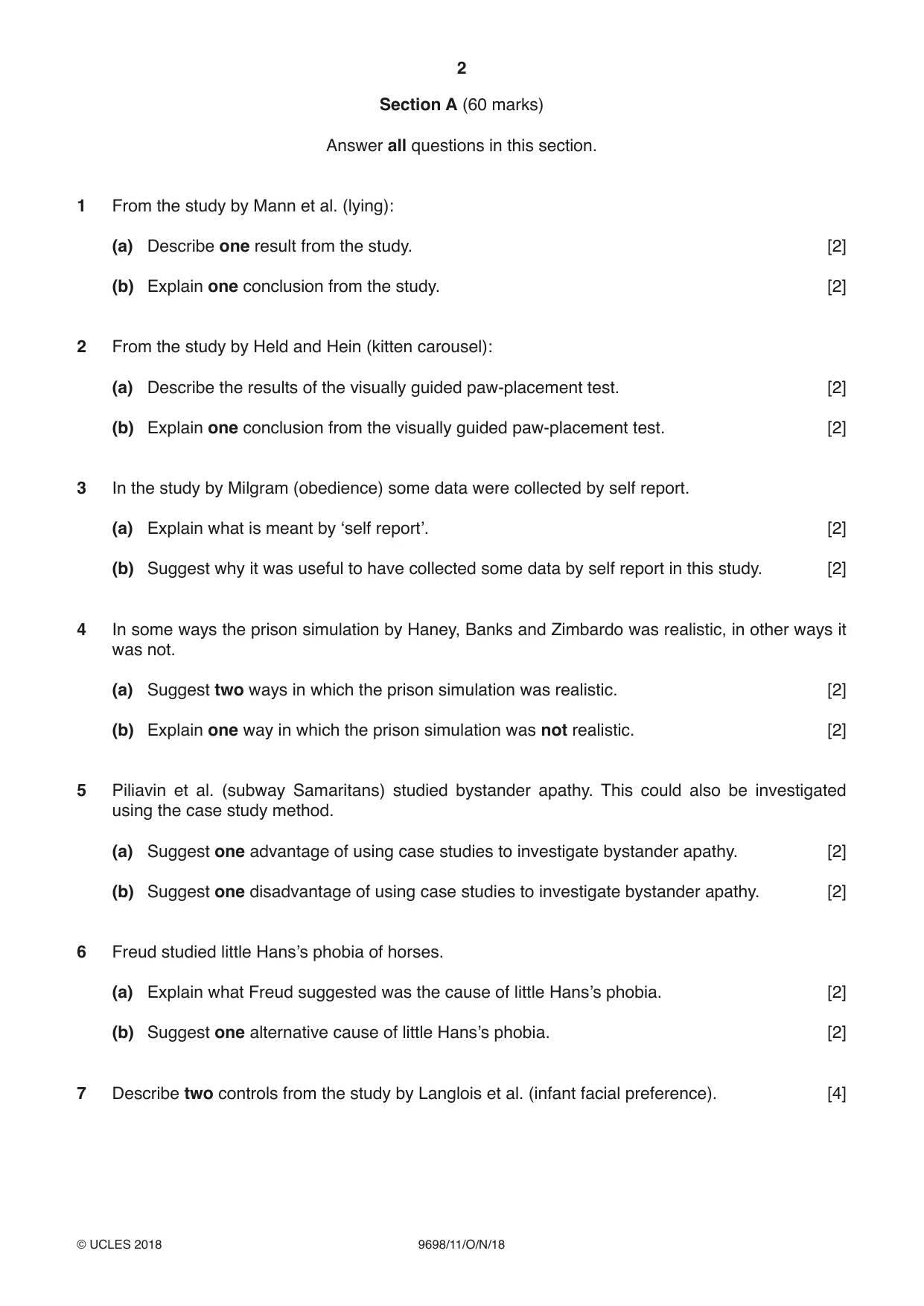
2 9698/11/O/N/18 © UCLES 2018 Section A (60 marks) Answer all questions in this section. 1 From the study by Mann et al. (lying): (a) Describe one result from the study. [2] (b) Explain one conclusion from the study. [2] 2 From the study by Held and Hein (kitten carousel): (a) Describe the results of the visually guided paw-placement test. [2] (b) Explain one conclusion from the visually guided paw-placement test. [2] 3 In the study by Milgram (obedience) some data were collected by self report. (a) Explain what is meant by ‘self report’. [2] (b) Suggest why it was useful to have collected some data by self report in this study. [2] 4 In some ways the prison simulation by Haney, Banks and Zimbardo was realistic, in other ways it was not. (a) Suggest two ways in which the prison simulation was realistic. [2] (b) Explain one way in which the prison simulation was not realistic. [2] 5 Piliavin et al. (subway Samaritans) studied bystander apathy. This could also be investigated using the case study method. (a) Suggest one advantage of using case studies to investigate bystander apathy. [2] (b) Suggest one disadvantage of using case studies to investigate bystander apathy. [2] 6 Freud studied little Hans’s phobia of horses. (a) Explain what Freud suggested was the cause of little Hans’s phobia. [2] (b) Suggest one alternative cause of little Hans’s phobia. [2] 7 Describe two controls from the study by Langlois et al. (infant facial preference). [4]
Question paper, page 3
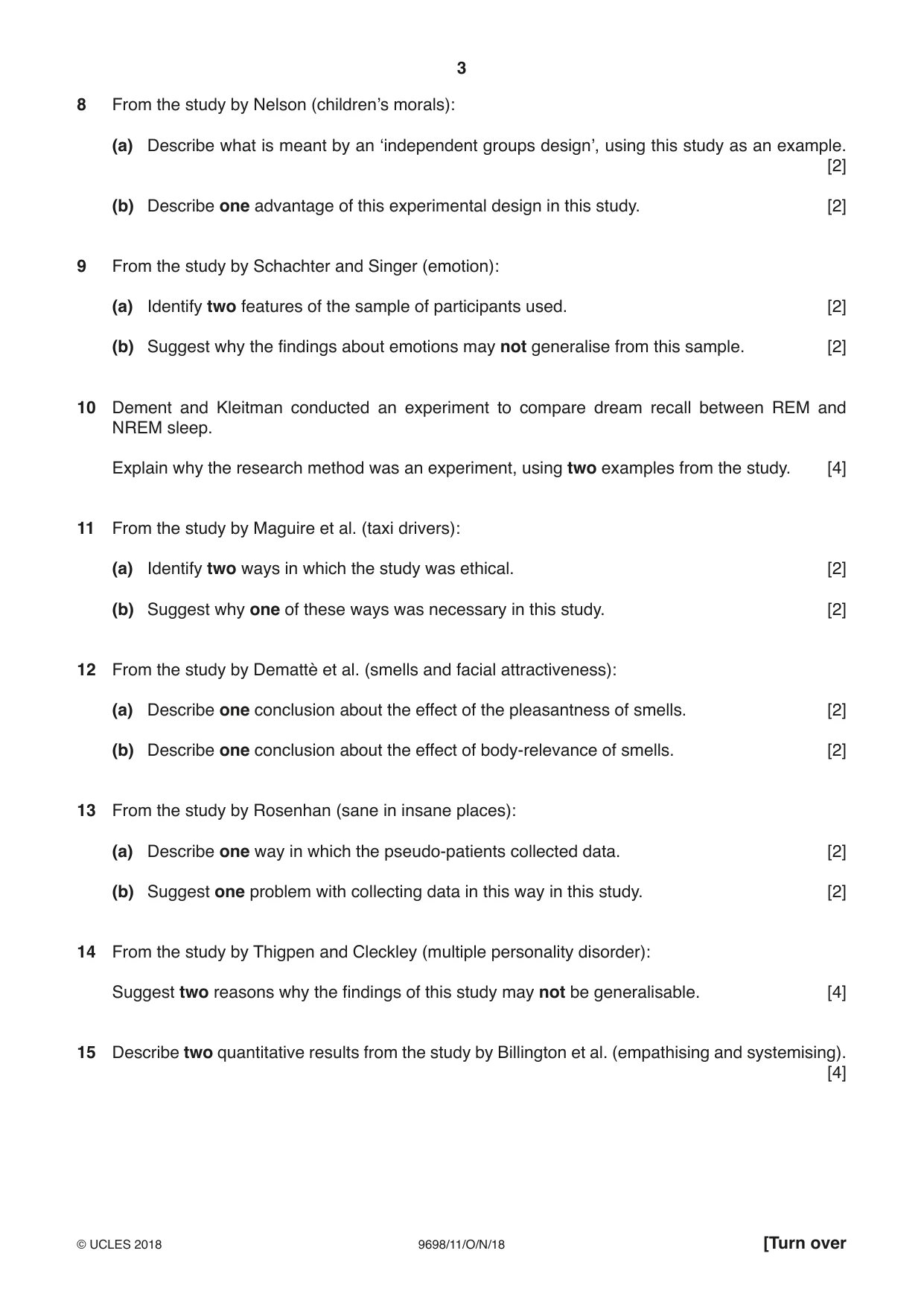
3 9698/11/O/N/18 © UCLES 2018 [Turn over 8 From the study by Nelson (children’s morals): (a) Describe what is meant by an ‘independent groups design’, using this study as an example. [2] (b) Describe one advantage of this experimental design in this study. [2] 9 From the study by Schachter and Singer (emotion): (a) Identify two features of the sample of participants used. [2] (b) Suggest why the findings about emotions may not generalise from this sample. [2] 10 Dement and Kleitman conducted an experiment to compare dream recall between REM and NREM sleep. Explain why the research method was an experiment, using two examples from the study. [4] 11 From the study by Maguire et al. (taxi drivers): (a) Identify two ways in which the study was ethical. [2] (b) Suggest why one of these ways was necessary in this study. [2] 12 From the study by Demattè et al. (smells and facial attractiveness): (a) Describe one conclusion about the effect of the pleasantness of smells. [2] (b) Describe one conclusion about the effect of body-relevance of smells. [2] 13 From the study by Rosenhan (sane in insane places): (a) Describe one way in which the pseudo-patients collected data. [2] (b) Suggest one problem with collecting data in this way in this study. [2] 14 From the study by Thigpen and Cleckley (multiple personality disorder): Suggest two reasons why the findings of this study may not be generalisable. [4] 15 Describe two quantitative results from the study by Billington et al. (empathising and systemising). [4]
Question paper, page 4
4 9698/11/O/N/18 © UCLES 2018 Permission to reproduce items where third-party owned material protected by copyright is included has been sought and cleared where possible. Every reasonable effort has been made by the publisher (UCLES) to trace copyright holders, but if any items requiring clearance have unwittingly been included, the publisher will be pleased to make amends at the earliest possible opportunity. To avoid the issue of disclosure of answer-related information to candidates, all copyright acknowledgements are reproduced online in the Cambridge International Examinations Copyright Acknowledgements Booklet. This is produced for each series of examinations and is freely available to download at www.cie.org.uk after the live examination series. Cambridge International Examinations is part of the Cambridge Assessment Group. Cambridge Assessment is the brand name of University of Cambridge Local Examinations Syndicate (UCLES), which is itself a department of the University of Cambridge. Section B (20 marks) Answer both questions in this section. 16 Evaluate one of the studies below in terms of its usefulness/applications. Loftus and Pickrell (false memories) Bandura et al. (aggression) Veale and Riley (mirror gazing) [10] 17 Discuss the use of quantitative data using one of the studies listed below. Mann et al. (lying) Baron-Cohen et al. (eyes test) Tajfel (intergroup categorisation) [10]
Mark scheme, page 1
This document consists of 16 printed pages. © UCLES 2018 [Turn over Cambridge Assessment International Education Cambridge International Advanced Subsidiary and Advanced Level PSYCHOLOGY 9698/11 Paper 1 Core Studies 1 October/November 2018 MARK SCHEME Maximum Mark: 80 Published This mark scheme is published as an aid to teachers and candidates, to indicate the requirements of the examination. It shows the basis on which Examiners were instructed to award marks. It does not indicate the details of the discussions that took place at an Examiners’ meeting before marking began, which would have considered the acceptability of alternative answers. Mark schemes should be read in conjunction with the question paper and the Principal Examiner Report for Teachers. Cambridge International will not enter into discussions about these mark schemes. Cambridge International is publishing the mark schemes for the October/November 2018 series for most Cambridge IGCSE™, Cambridge International A and AS Level components and some Cambridge O Level components.
Mark scheme, page 2
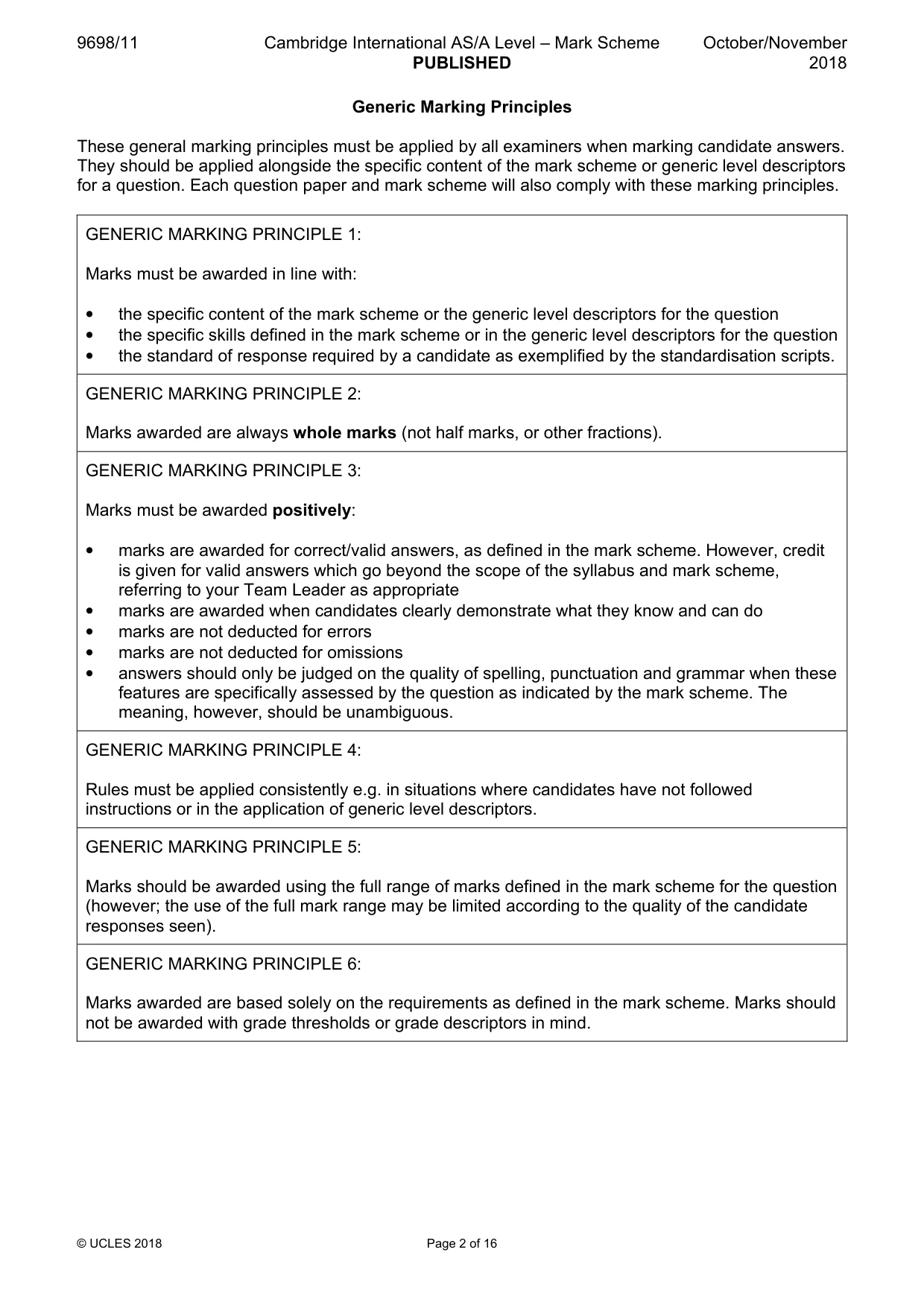
9698/11 Cambridge International AS/A Level – Mark Scheme PUBLISHED October/November 2018 © UCLES 2018 Page 2 of 16 Generic Marking Principles These general marking principles must be applied by all examiners when marking candidate answers. They should be applied alongside the specific content of the mark scheme or generic level descriptors for a question. Each question paper and mark scheme will also comply with these marking principles. GENERIC MARKING PRINCIPLE 1: Marks must be awarded in line with: • the specific content of the mark scheme or the generic level descriptors for the question • the specific skills defined in the mark scheme or in the generic level descriptors for the question • the standard of response required by a candidate as exemplified by the standardisation scripts. GENERIC MARKING PRINCIPLE 2: Marks awarded are always whole marks (not half marks, or other fractions). GENERIC MARKING PRINCIPLE 3: Marks must be awarded positively: • marks are awarded for correct/valid answers, as defined in the mark scheme. However, credit is given for valid answers which go beyond the scope of the syllabus and mark scheme, referring to your Team Leader as appropriate • marks are awarded when candidates clearly demonstrate what they know and can do • marks are not deducted for errors • marks are not deducted for omissions • answers should only be judged on the quality of spelling, punctuation and grammar when these features are specifically assessed by the question as indicated by the mark scheme. The meaning, however, should be unambiguous. GENERIC MARKING PRINCIPLE 4: Rules must be applied consistently e.g. in situations where candidates have not followed instructions or in the application of generic level descriptors. GENERIC MARKING PRINCIPLE 5: Marks should be awarded using the full range of marks defined in the mark scheme for the question (however; the use of the full mark range may be limited according to the quality of the candidate responses seen). GENERIC MARKING PRINCIPLE 6: Marks awarded are based solely on the requirements as defined in the mark scheme. Marks should not be awarded with grade thresholds or grade descriptors in mind.
Mark scheme, page 3
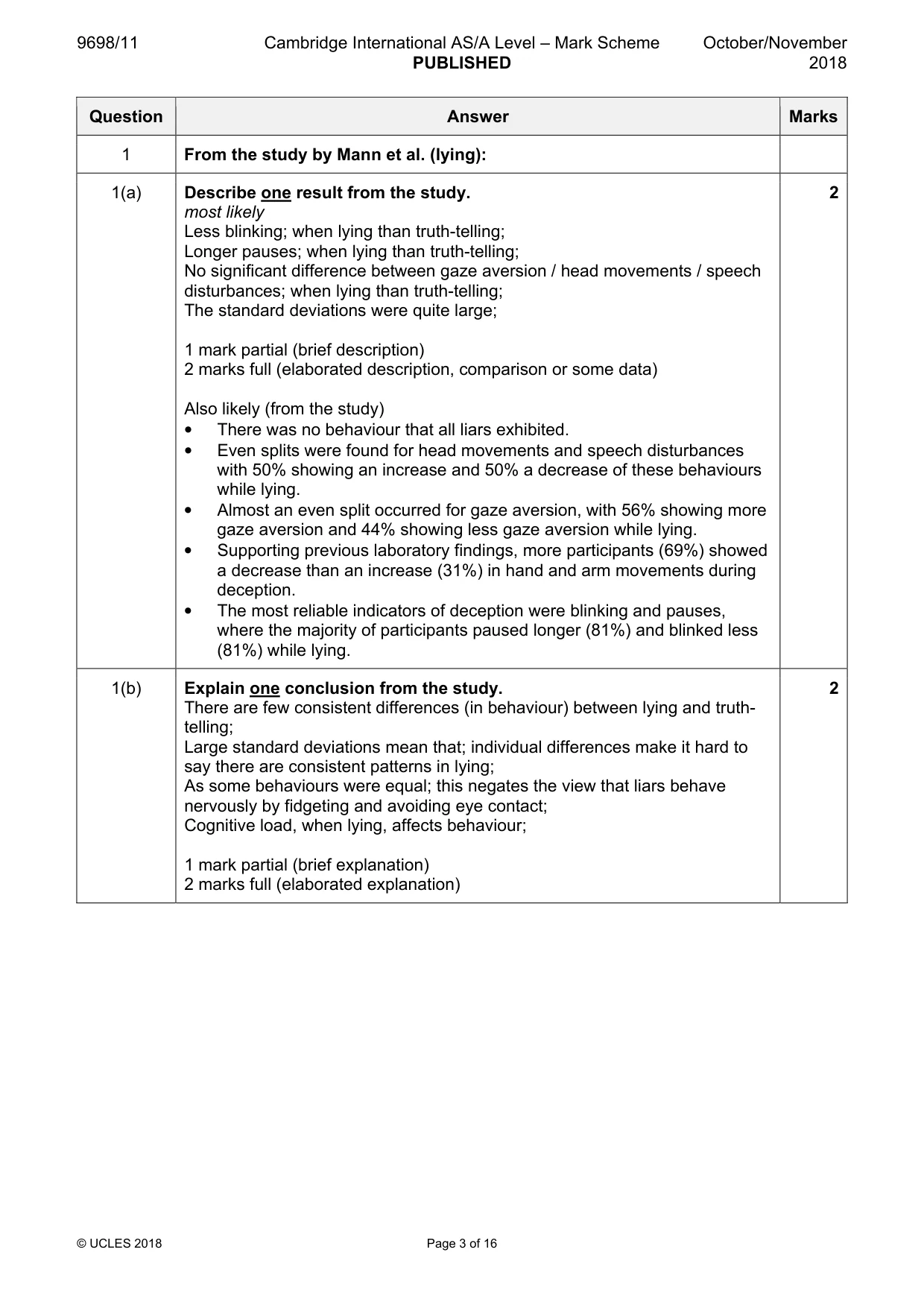
9698/11 Cambridge International AS/A Level – Mark Scheme PUBLISHED October/November 2018 © UCLES 2018 Page 3 of 16 Question Answer Marks 1 From the study by Mann et al. (lying): 1(a) Describe one result from the study. most likely Less blinking; when lying than truth-telling; Longer pauses; when lying than truth-telling; No significant difference between gaze aversion / head movements / speech disturbances; when lying than truth-telling; The standard deviations were quite large; 1 mark partial (brief description) 2 marks full (elaborated description, comparison or some data) Also likely (from the study) • There was no behaviour that all liars exhibited. • Even splits were found for head movements and speech disturbances with 50% showing an increase and 50% a decrease of these behaviours while lying. • Almost an even split occurred for gaze aversion, with 56% showing more gaze aversion and 44% showing less gaze aversion while lying. • Supporting previous laboratory findings, more participants (69%) showed a decrease than an increase (31%) in hand and arm movements during deception. • The most reliable indicators of deception were blinking and pauses, where the majority of participants paused longer (81%) and blinked less (81%) while lying. 2 1(b) Explain one conclusion from the study. There are few consistent differences (in behaviour) between lying and truth- telling; Large standard deviations mean that; individual differences make it hard to say there are consistent patterns in lying; As some behaviours were equal; this negates the view that liars behave nervously by fidgeting and avoiding eye contact; Cognitive load, when lying, affects behaviour; 1 mark partial (brief explanation) 2 marks full (elaborated explanation) 2
Mark scheme, page 4
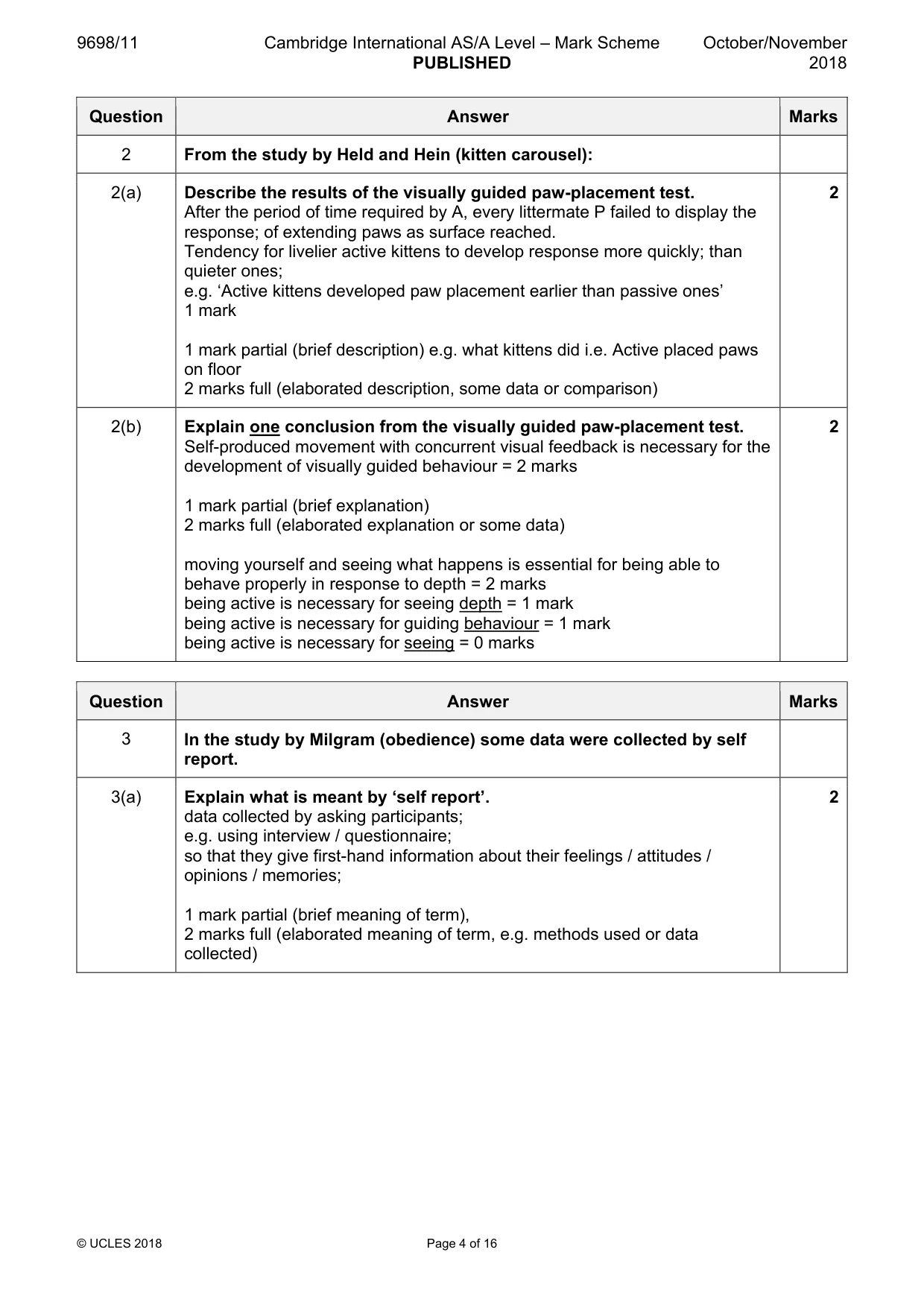
9698/11 Cambridge International AS/A Level – Mark Scheme PUBLISHED October/November 2018 © UCLES 2018 Page 4 of 16 Question Answer Marks 2 From the study by Held and Hein (kitten carousel): 2(a) Describe the results of the visually guided paw-placement test. After the period of time required by A, every littermate P failed to display the response; of extending paws as surface reached. Tendency for livelier active kittens to develop response more quickly; than quieter ones; e.g. ‘Active kittens developed paw placement earlier than passive ones’ 1 mark 1 mark partial (brief description) e.g. what kittens did i.e. Active placed paws on floor 2 marks full (elaborated description, some data or comparison) 2 2(b) Explain one conclusion from the visually guided paw-placement test. Self-produced movement with concurrent visual feedback is necessary for the development of visually guided behaviour = 2 marks 1 mark partial (brief explanation) 2 marks full (elaborated explanation or some data) moving yourself and seeing what happens is essential for being able to behave properly in response to depth = 2 marks being active is necessary for seeing depth = 1 mark being active is necessary for guiding behaviour = 1 mark being active is necessary for seeing = 0 marks 2 Question Answer Marks 3 In the study by Milgram (obedience) some data were collected by self report. 3(a) Explain what is meant by ‘self report’. data collected by asking participants; e.g. using interview / questionnaire; so that they give first-hand information about their feelings / attitudes / opinions / memories; 1 mark partial (brief meaning of term), 2 marks full (elaborated meaning of term, e.g. methods used or data collected) 2
Mark scheme, page 5
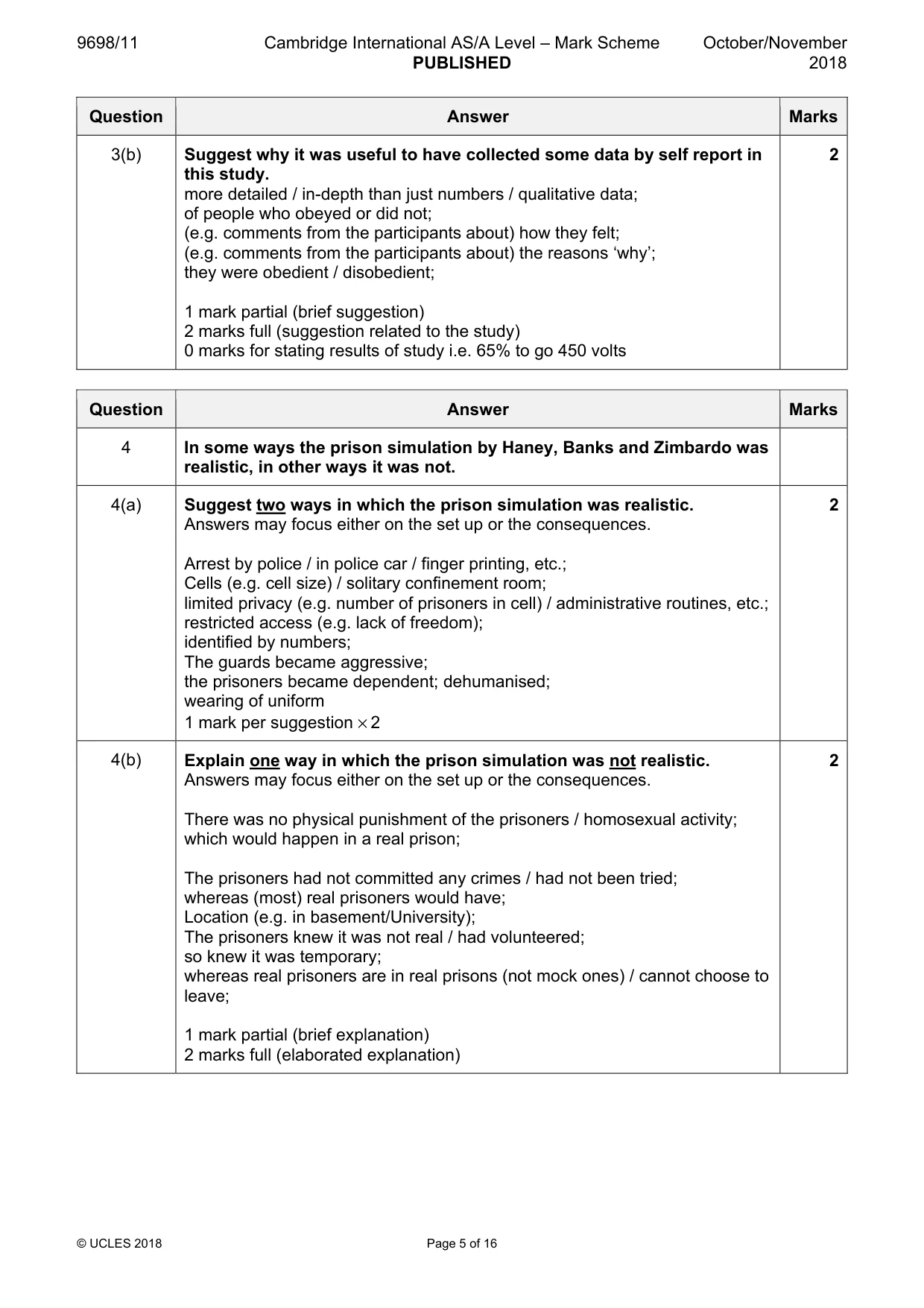
9698/11 Cambridge International AS/A Level – Mark Scheme PUBLISHED October/November 2018 © UCLES 2018 Page 5 of 16 Question Answer Marks 3(b) Suggest why it was useful to have collected some data by self report in this study. more detailed / in-depth than just numbers / qualitative data; of people who obeyed or did not; (e.g. comments from the participants about) how they felt; (e.g. comments from the participants about) the reasons ‘why’; they were obedient / disobedient; 1 mark partial (brief suggestion) 2 marks full (suggestion related to the study) 0 marks for stating results of study i.e. 65% to go 450 volts 2 Question Answer Marks 4 In some ways the prison simulation by Haney, Banks and Zimbardo was realistic, in other ways it was not. 4(a) Suggest two ways in which the prison simulation was realistic. Answers may focus either on the set up or the consequences. Arrest by police / in police car / finger printing, etc.; Cells (e.g. cell size) / solitary confinement room; limited privacy (e.g. number of prisoners in cell) / administrative routines, etc.; restricted access (e.g. lack of freedom); identified by numbers; The guards became aggressive; the prisoners became dependent; dehumanised; wearing of uniform 1 mark per suggestion × 2 2 4(b) Explain one way in which the prison simulation was not realistic. Answers may focus either on the set up or the consequences. There was no physical punishment of the prisoners / homosexual activity; which would happen in a real prison; The prisoners had not committed any crimes / had not been tried; whereas (most) real prisoners would have; Location (e.g. in basement/University); The prisoners knew it was not real / had volunteered; so knew it was temporary; whereas real prisoners are in real prisons (not mock ones) / cannot choose to leave; 1 mark partial (brief explanation) 2 marks full (elaborated explanation) 2
Mark scheme, page 6
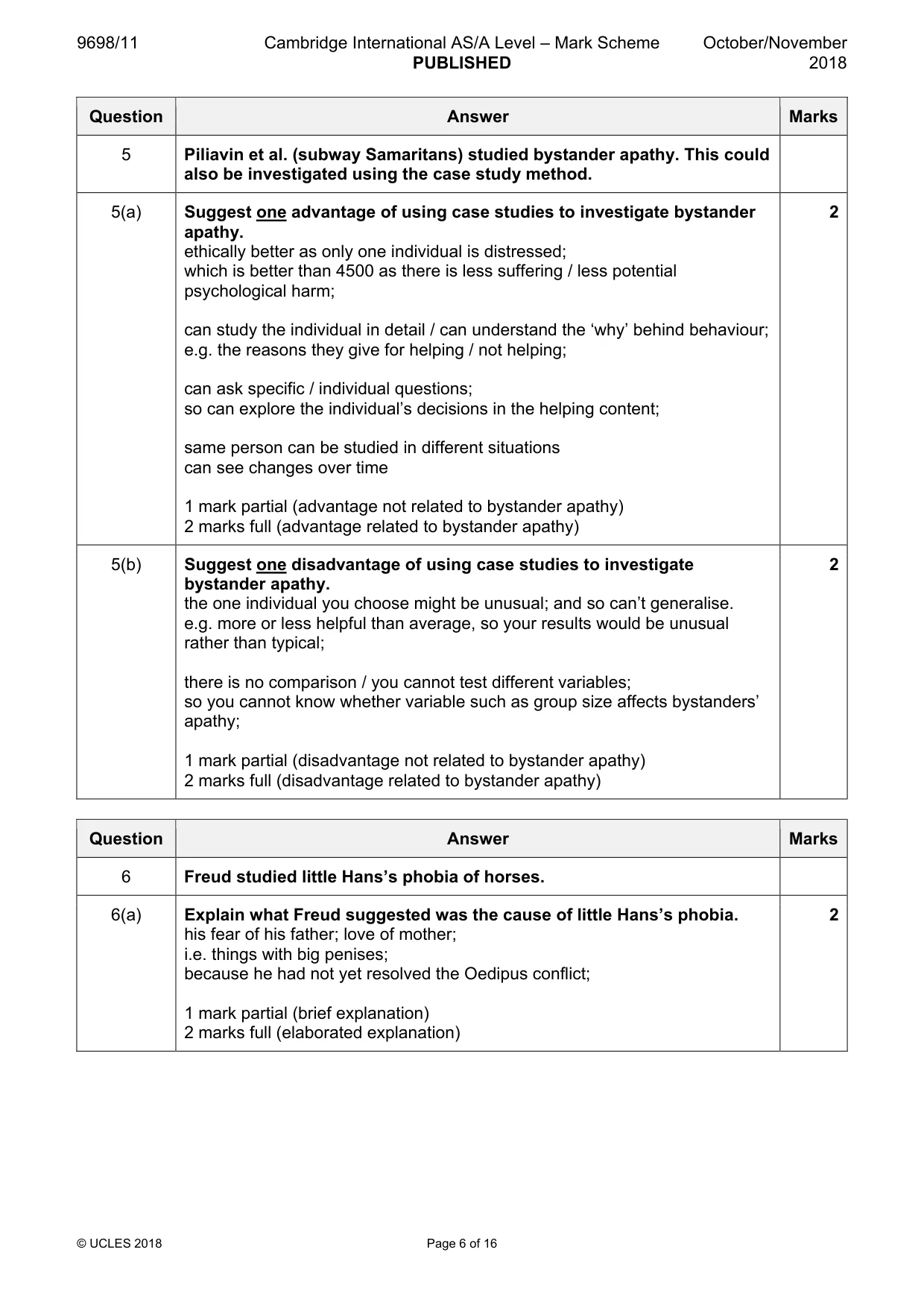
9698/11 Cambridge International AS/A Level – Mark Scheme PUBLISHED October/November 2018 © UCLES 2018 Page 6 of 16 Question Answer Marks 5 Piliavin et al. (subway Samaritans) studied bystander apathy. This could also be investigated using the case study method. 5(a) Suggest one advantage of using case studies to investigate bystander apathy. ethically better as only one individual is distressed; which is better than 4500 as there is less suffering / less potential psychological harm; can study the individual in detail / can understand the ‘why’ behind behaviour; e.g. the reasons they give for helping / not helping; can ask specific / individual questions; so can explore the individual’s decisions in the helping content; same person can be studied in different situations can see changes over time 1 mark partial (advantage not related to bystander apathy) 2 marks full (advantage related to bystander apathy) 2 5(b) Suggest one disadvantage of using case studies to investigate bystander apathy. the one individual you choose might be unusual; and so can’t generalise. e.g. more or less helpful than average, so your results would be unusual rather than typical; there is no comparison / you cannot test different variables; so you cannot know whether variable such as group size affects bystanders’ apathy; 1 mark partial (disadvantage not related to bystander apathy) 2 marks full (disadvantage related to bystander apathy) 2 Question Answer Marks 6 Freud studied little Hans’s phobia of horses. 6(a) Explain what Freud suggested was the cause of little Hans’s phobia. his fear of his father; love of mother; i.e. things with big penises; because he had not yet resolved the Oedipus conflict; 1 mark partial (brief explanation) 2 marks full (elaborated explanation) 2
Mark scheme, page 7
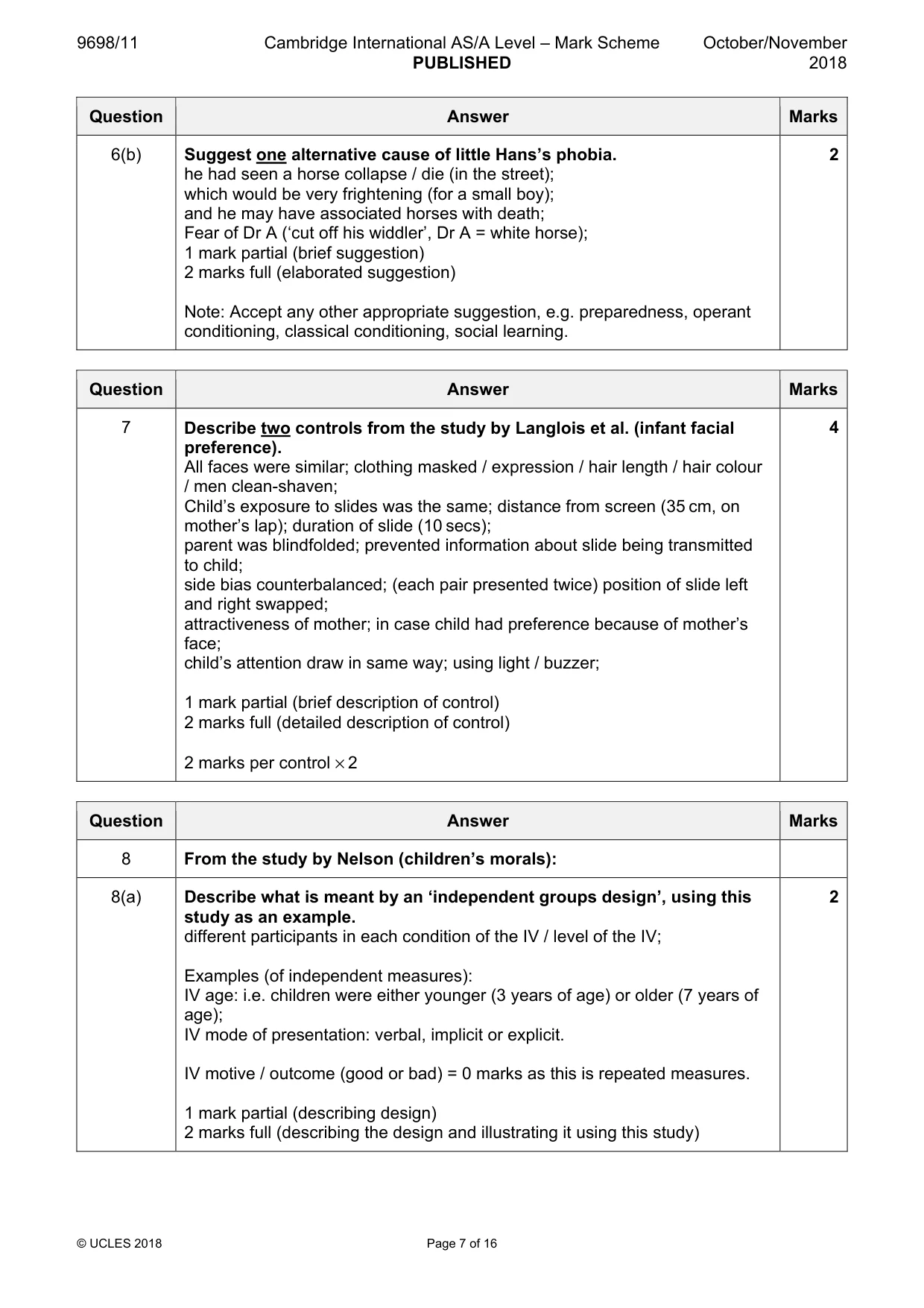
9698/11 Cambridge International AS/A Level – Mark Scheme PUBLISHED October/November 2018 © UCLES 2018 Page 7 of 16 Question Answer Marks 6(b) Suggest one alternative cause of little Hans’s phobia. he had seen a horse collapse / die (in the street); which would be very frightening (for a small boy); and he may have associated horses with death; Fear of Dr A (‘cut off his widdler’, Dr A = white horse); 1 mark partial (brief suggestion) 2 marks full (elaborated suggestion) Note: Accept any other appropriate suggestion, e.g. preparedness, operant conditioning, classical conditioning, social learning. 2 Question Answer Marks 7 Describe two controls from the study by Langlois et al. (infant facial preference). All faces were similar; clothing masked / expression / hair length / hair colour / men clean-shaven; Child’s exposure to slides was the same; distance from screen (35 cm, on mother’s lap); duration of slide (10 secs); parent was blindfolded; prevented information about slide being transmitted to child; side bias counterbalanced; (each pair presented twice) position of slide left and right swapped; attractiveness of mother; in case child had preference because of mother’s face; child’s attention draw in same way; using light / buzzer; 1 mark partial (brief description of control) 2 marks full (detailed description of control) 2 marks per control × 2 4 Question Answer Marks 8 From the study by Nelson (children’s morals): 8(a) Describe what is meant by an ‘independent groups design’, using this study as an example. different participants in each condition of the IV / level of the IV; Examples (of independent measures): IV age: i.e. children were either younger (3 years of age) or older (7 years of age); IV mode of presentation: verbal, implicit or explicit. IV motive / outcome (good or bad) = 0 marks as this is repeated measures. 1 mark partial (describing design) 2 marks full (describing the design and illustrating it using this study) 2
Mark scheme, page 8
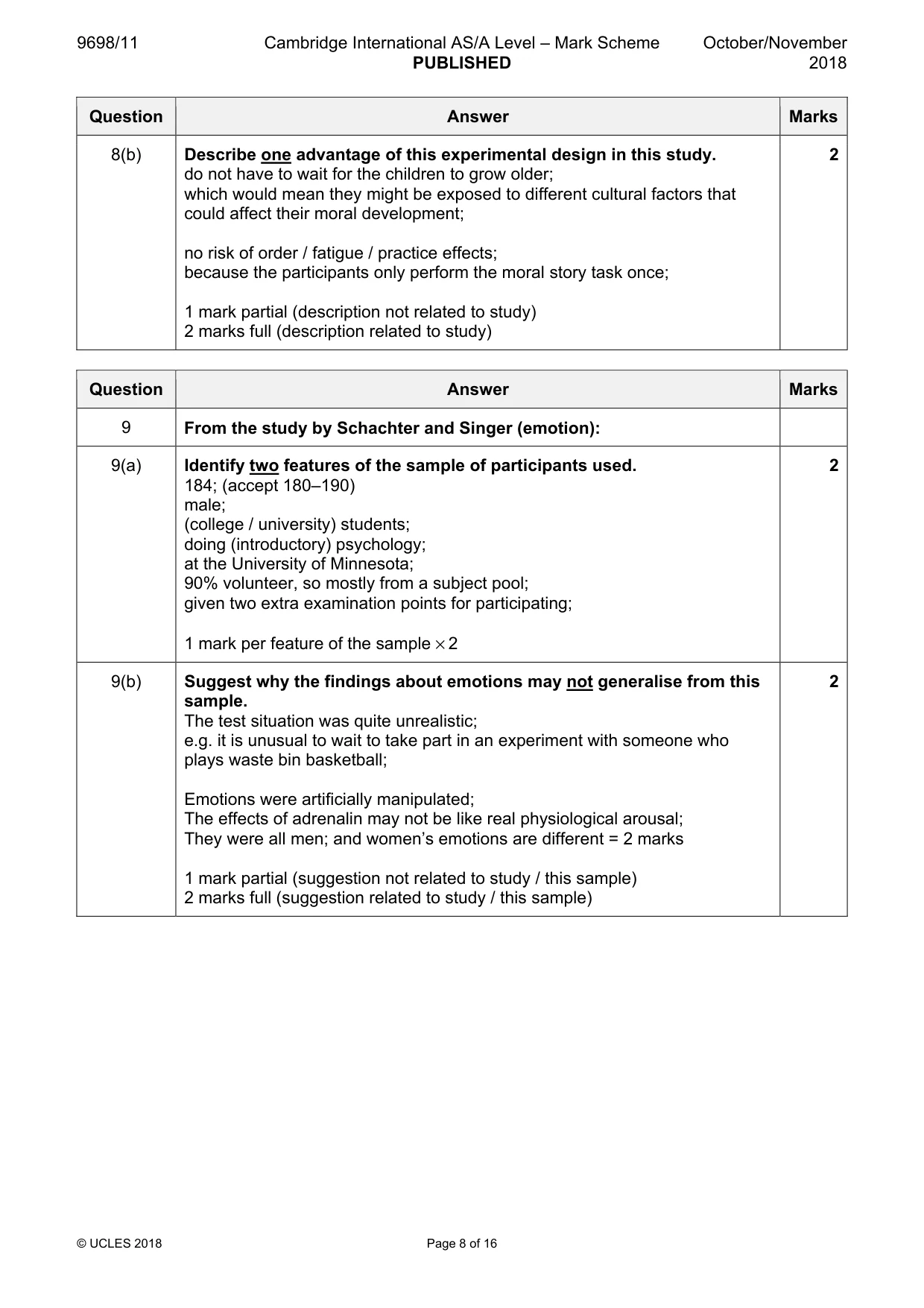
9698/11 Cambridge International AS/A Level – Mark Scheme PUBLISHED October/November 2018 © UCLES 2018 Page 8 of 16 Question Answer Marks 8(b) Describe one advantage of this experimental design in this study. do not have to wait for the children to grow older; which would mean they might be exposed to different cultural factors that could affect their moral development; no risk of order / fatigue / practice effects; because the participants only perform the moral story task once; 1 mark partial (description not related to study) 2 marks full (description related to study) 2 Question Answer Marks 9 From the study by Schachter and Singer (emotion): 9(a) Identify two features of the sample of participants used. 184; (accept 180–190) male; (college / university) students; doing (introductory) psychology; at the University of Minnesota; 90% volunteer, so mostly from a subject pool; given two extra examination points for participating; 1 mark per feature of the sample × 2 2 9(b) Suggest why the findings about emotions may not generalise from this sample. The test situation was quite unrealistic; e.g. it is unusual to wait to take part in an experiment with someone who plays waste bin basketball; Emotions were artificially manipulated; The effects of adrenalin may not be like real physiological arousal; They were all men; and women’s emotions are different = 2 marks 1 mark partial (suggestion not related to study / this sample) 2 marks full (suggestion related to study / this sample) 2
Mark scheme, page 9
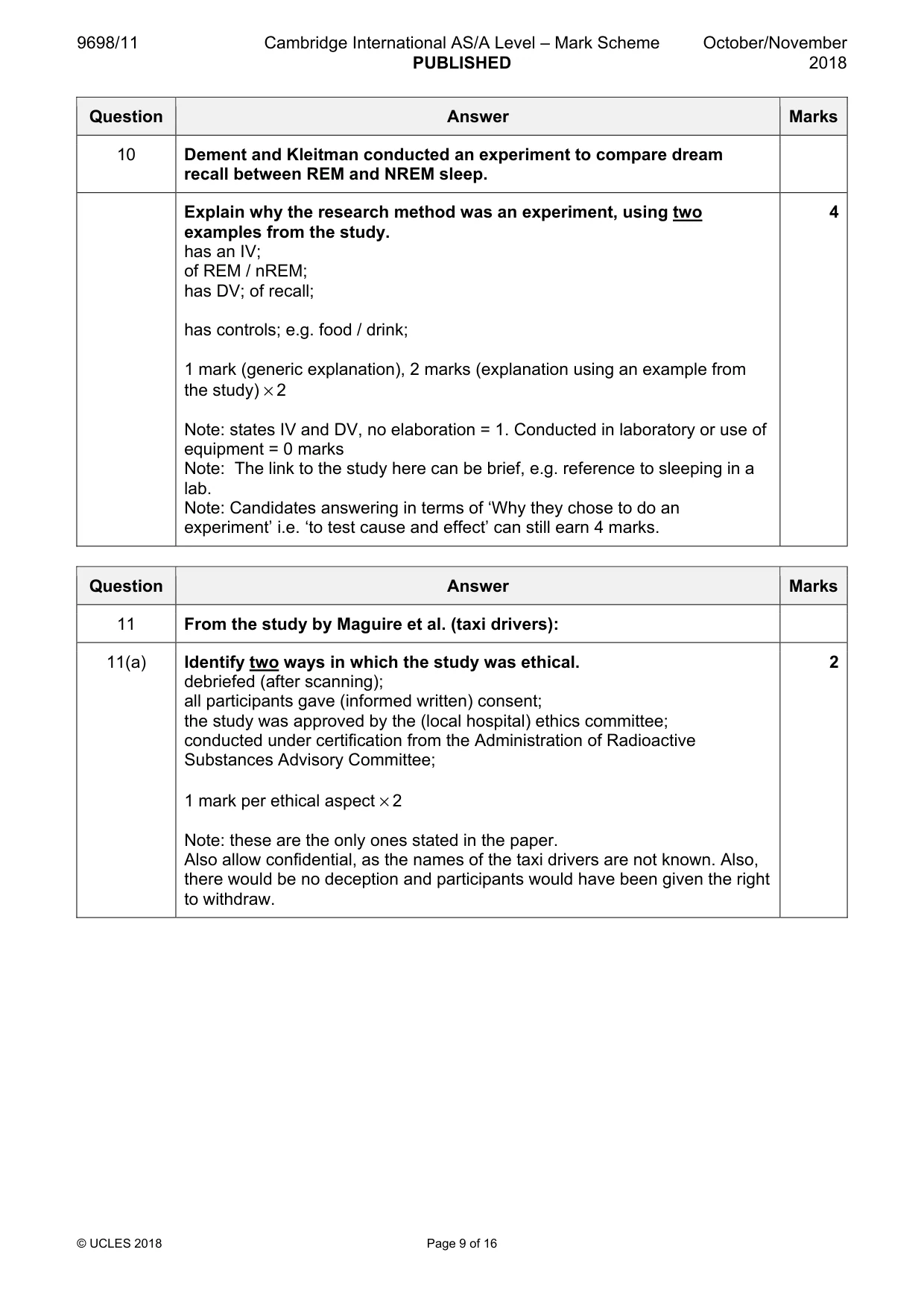
9698/11 Cambridge International AS/A Level – Mark Scheme PUBLISHED October/November 2018 © UCLES 2018 Page 9 of 16 Question Answer Marks 10 Dement and Kleitman conducted an experiment to compare dream recall between REM and NREM sleep. Explain why the research method was an experiment, using two examples from the study. has an IV; of REM / nREM; has DV; of recall; has controls; e.g. food / drink; 1 mark (generic explanation), 2 marks (explanation using an example from the study) × 2 Note: states IV and DV, no elaboration = 1. Conducted in laboratory or use of equipment = 0 marks Note: The link to the study here can be brief, e.g. reference to sleeping in a lab. Note: Candidates answering in terms of ‘Why they chose to do an experiment’ i.e. ‘to test cause and effect’ can still earn 4 marks. 4 Question Answer Marks 11 From the study by Maguire et al. (taxi drivers): 11(a) Identify two ways in which the study was ethical. debriefed (after scanning); all participants gave (informed written) consent; the study was approved by the (local hospital) ethics committee; conducted under certification from the Administration of Radioactive Substances Advisory Committee; 1 mark per ethical aspect × 2 Note: these are the only ones stated in the paper. Also allow confidential, as the names of the taxi drivers are not known. Also, there would be no deception and participants would have been given the right to withdraw. 2
Mark scheme, page 10
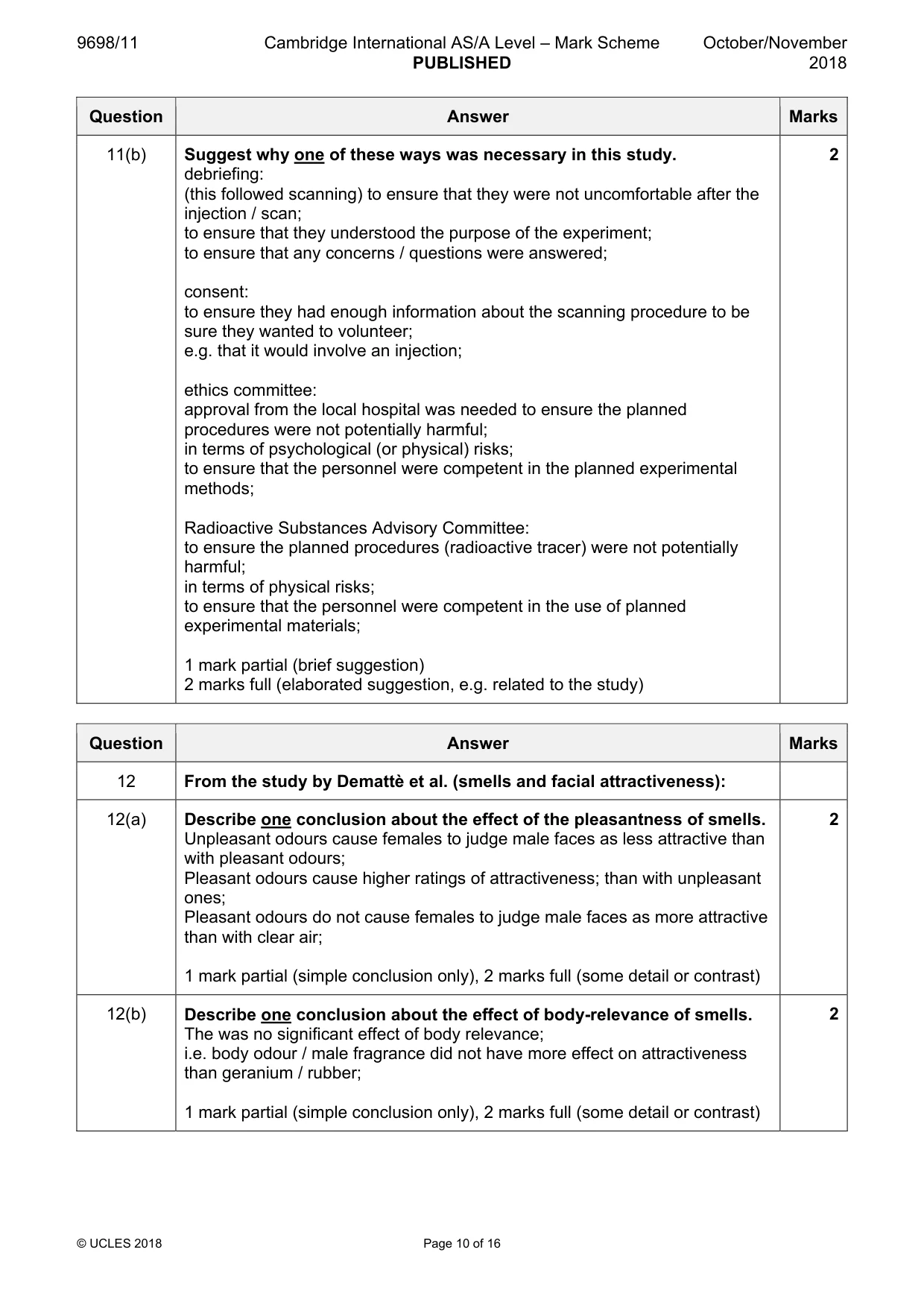
9698/11 Cambridge International AS/A Level – Mark Scheme PUBLISHED October/November 2018 © UCLES 2018 Page 10 of 16 Question Answer Marks 11(b) Suggest why one of these ways was necessary in this study. debriefing: (this followed scanning) to ensure that they were not uncomfortable after the injection / scan; to ensure that they understood the purpose of the experiment; to ensure that any concerns / questions were answered; consent: to ensure they had enough information about the scanning procedure to be sure they wanted to volunteer; e.g. that it would involve an injection; ethics committee: approval from the local hospital was needed to ensure the planned procedures were not potentially harmful; in terms of psychological (or physical) risks; to ensure that the personnel were competent in the planned experimental methods; Radioactive Substances Advisory Committee: to ensure the planned procedures (radioactive tracer) were not potentially harmful; in terms of physical risks; to ensure that the personnel were competent in the use of planned experimental materials; 1 mark partial (brief suggestion) 2 marks full (elaborated suggestion, e.g. related to the study) 2 Question Answer Marks 12 From the study by Demattè et al. (smells and facial attractiveness): 12(a) Describe one conclusion about the effect of the pleasantness of smells. Unpleasant odours cause females to judge male faces as less attractive than with pleasant odours; Pleasant odours cause higher ratings of attractiveness; than with unpleasant ones; Pleasant odours do not cause females to judge male faces as more attractive than with clear air; 1 mark partial (simple conclusion only), 2 marks full (some detail or contrast) 2 12(b) Describe one conclusion about the effect of body-relevance of smells. The was no significant effect of body relevance; i.e. body odour / male fragrance did not have more effect on attractiveness than geranium / rubber; 1 mark partial (simple conclusion only), 2 marks full (some detail or contrast) 2
Mark scheme, page 11
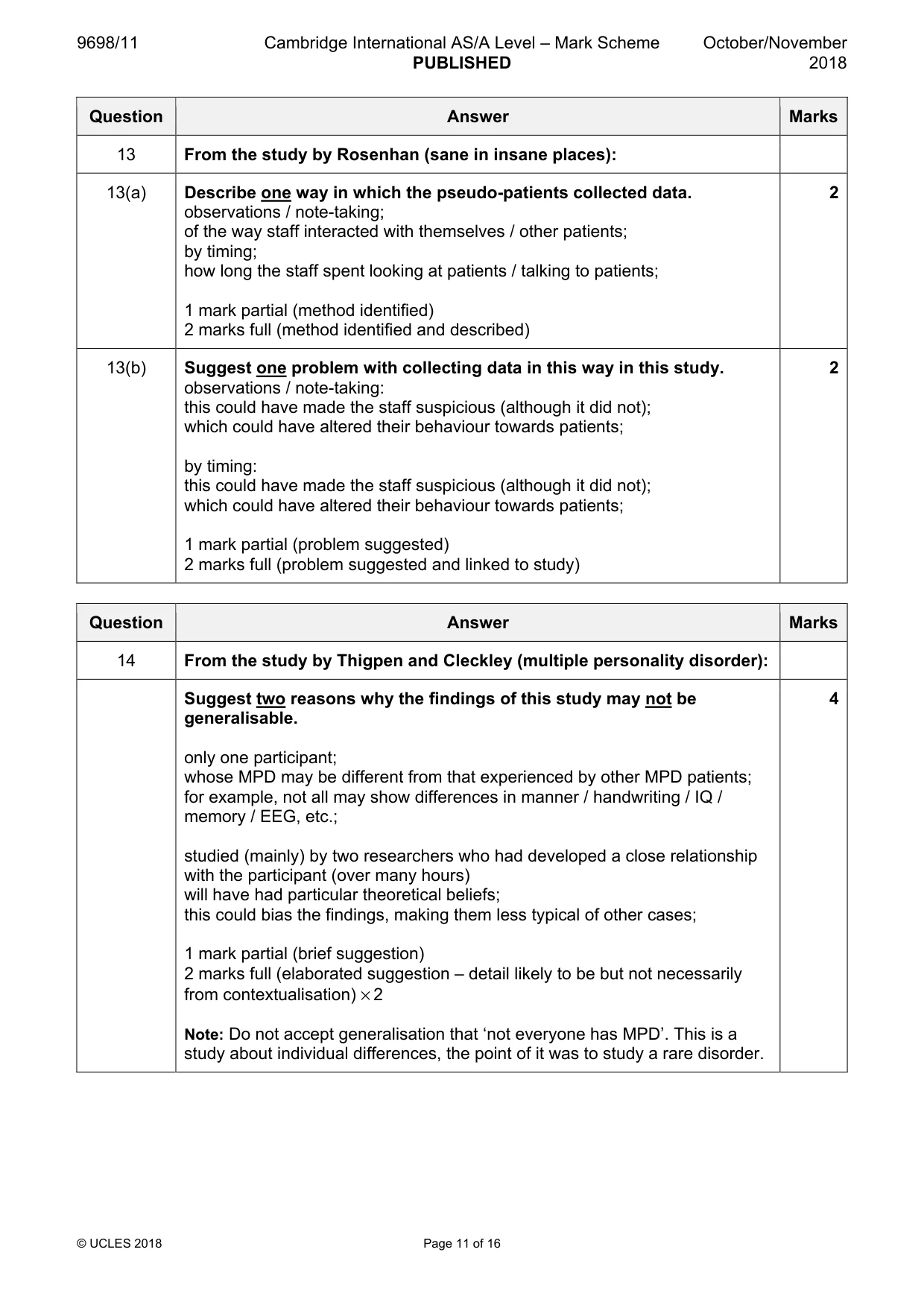
9698/11 Cambridge International AS/A Level – Mark Scheme PUBLISHED October/November 2018 © UCLES 2018 Page 11 of 16 Question Answer Marks 13 From the study by Rosenhan (sane in insane places): 13(a) Describe one way in which the pseudo-patients collected data. observations / note-taking; of the way staff interacted with themselves / other patients; by timing; how long the staff spent looking at patients / talking to patients; 1 mark partial (method identified) 2 marks full (method identified and described) 2 13(b) Suggest one problem with collecting data in this way in this study. observations / note-taking: this could have made the staff suspicious (although it did not); which could have altered their behaviour towards patients; by timing: this could have made the staff suspicious (although it did not); which could have altered their behaviour towards patients; 1 mark partial (problem suggested) 2 marks full (problem suggested and linked to study) 2 Question Answer Marks 14 From the study by Thigpen and Cleckley (multiple personality disorder): Suggest two reasons why the findings of this study may not be generalisable. only one participant; whose MPD may be different from that experienced by other MPD patients; for example, not all may show differences in manner / handwriting / IQ / memory / EEG, etc.; studied (mainly) by two researchers who had developed a close relationship with the participant (over many hours) will have had particular theoretical beliefs; this could bias the findings, making them less typical of other cases; 1 mark partial (brief suggestion) 2 marks full (elaborated suggestion – detail likely to be but not necessarily from contextualisation) × 2 Note: Do not accept generalisation that ‘not everyone has MPD’. This is a study about individual differences, the point of it was to study a rare disorder. 4
Mark scheme, page 12
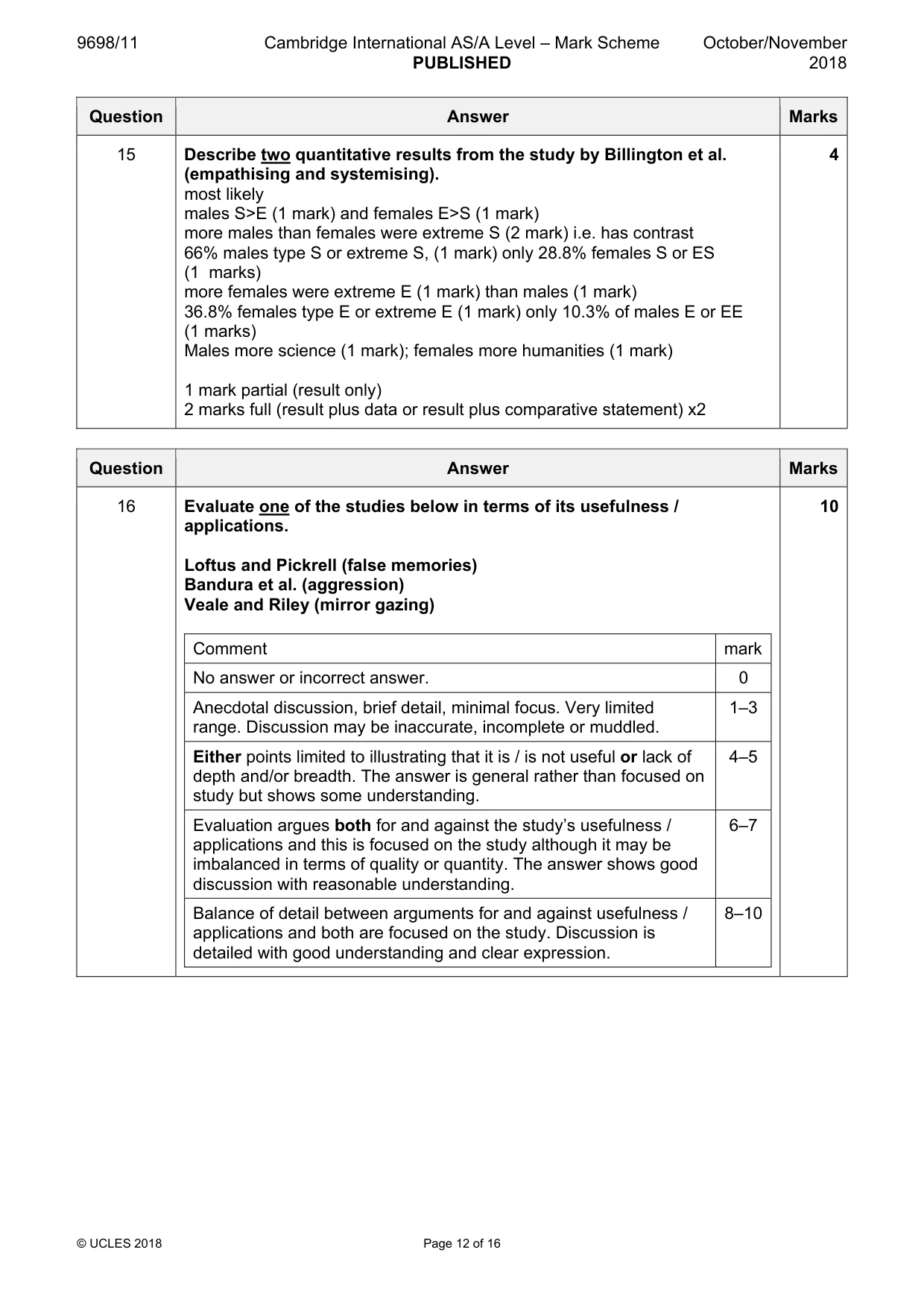
9698/11 Cambridge International AS/A Level – Mark Scheme PUBLISHED October/November 2018 © UCLES 2018 Page 12 of 16 Question Answer Marks 15 Describe two quantitative results from the study by Billington et al. (empathising and systemising). most likely males S>E (1 mark) and females E>S (1 mark) more males than females were extreme S (2 mark) i.e. has contrast 66% males type S or extreme S, (1 mark) only 28.8% females S or ES (1 marks) more females were extreme E (1 mark) than males (1 mark) 36.8% females type E or extreme E (1 mark) only 10.3% of males E or EE (1 marks) Males more science (1 mark); females more humanities (1 mark) 1 mark partial (result only) 2 marks full (result plus data or result plus comparative statement) x2 4 Question Answer Marks 16 Evaluate one of the studies below in terms of its usefulness / applications. Loftus and Pickrell (false memories) Bandura et al. (aggression) Veale and Riley (mirror gazing) Comment mark No answer or incorrect answer. 0 Anecdotal discussion, brief detail, minimal focus. Very limited range. Discussion may be inaccurate, incomplete or muddled. 1–3 Either points limited to illustrating that it is / is not useful or lack of depth and/or breadth. The answer is general rather than focused on study but shows some understanding. 4–5 Evaluation argues both for and against the study’s usefulness / applications and this is focused on the study although it may be imbalanced in terms of quality or quantity. The answer shows good discussion with reasonable understanding. 6–7 Balance of detail between arguments for and against usefulness / applications and both are focused on the study. Discussion is detailed with good understanding and clear expression. 8–10 10
Mark scheme, page 13
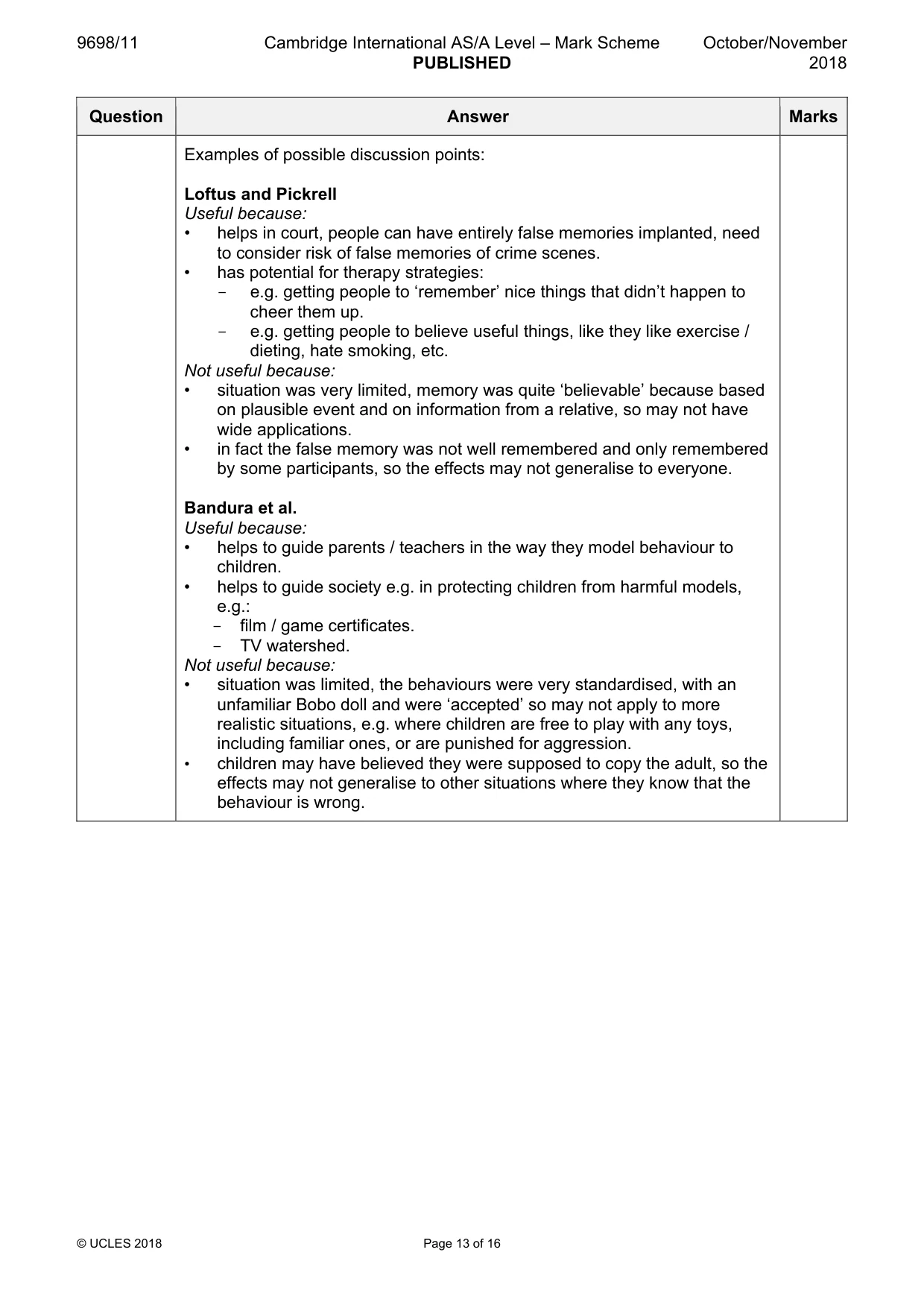
9698/11 Cambridge International AS/A Level – Mark Scheme PUBLISHED October/November 2018 © UCLES 2018 Page 13 of 16 Question Answer Marks Examples of possible discussion points: Loftus and Pickrell Useful because: • helps in court, people can have entirely false memories implanted, need to consider risk of false memories of crime scenes. • has potential for therapy strategies: - e.g. getting people to ‘remember’ nice things that didn’t happen to cheer them up. - e.g. getting people to believe useful things, like they like exercise / dieting, hate smoking, etc. Not useful because: • situation was very limited, memory was quite ‘believable’ because based on plausible event and on information from a relative, so may not have wide applications. • in fact the false memory was not well remembered and only remembered by some participants, so the effects may not generalise to everyone. Bandura et al. Useful because: • helps to guide parents / teachers in the way they model behaviour to children. • helps to guide society e.g. in protecting children from harmful models, e.g.: - film / game certificates. - TV watershed. Not useful because: • situation was limited, the behaviours were very standardised, with an unfamiliar Bobo doll and were ‘accepted’ so may not apply to more realistic situations, e.g. where children are free to play with any toys, including familiar ones, or are punished for aggression. • children may have believed they were supposed to copy the adult, so the effects may not generalise to other situations where they know that the behaviour is wrong.
Mark scheme, page 14
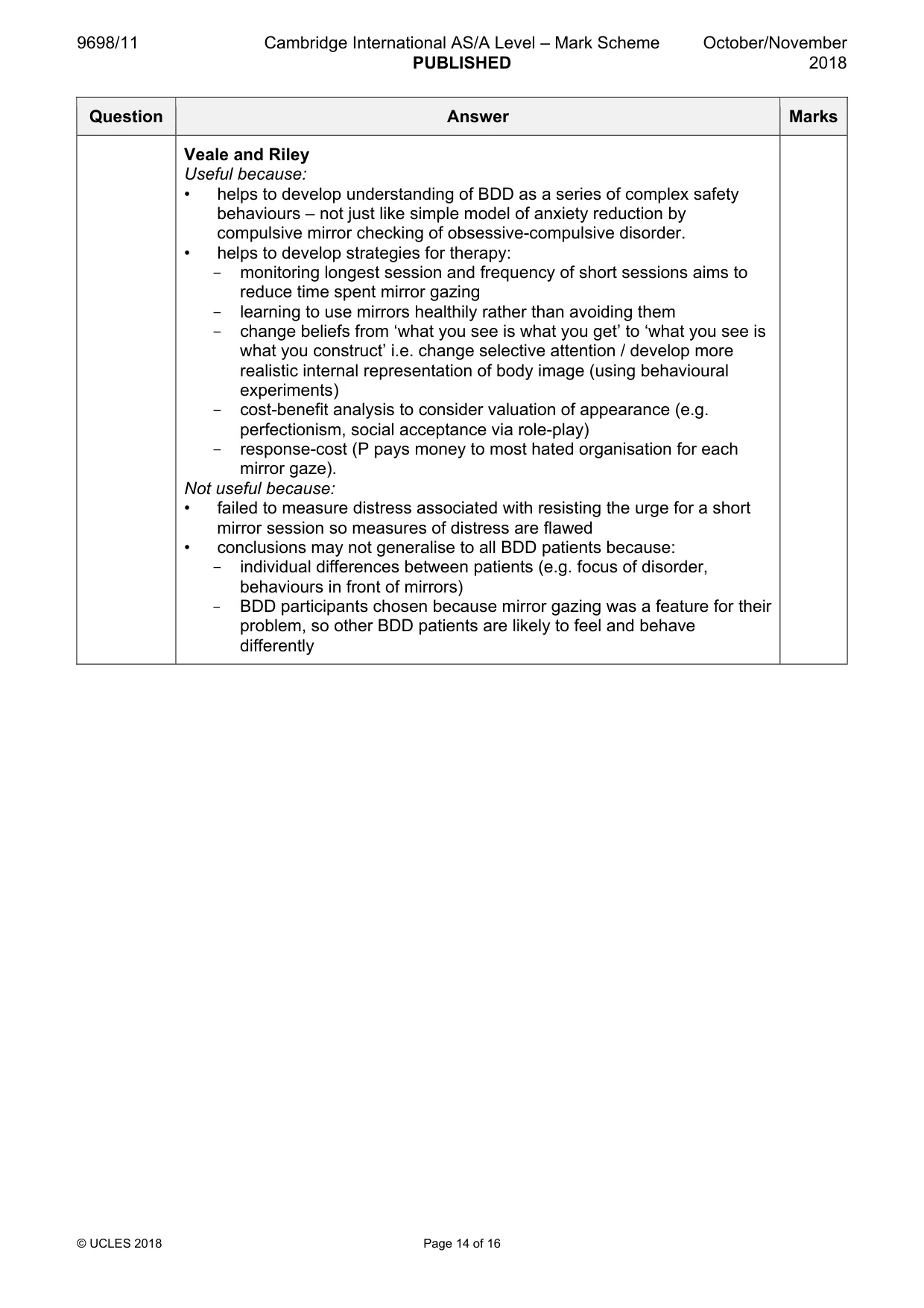
9698/11 Cambridge International AS/A Level – Mark Scheme PUBLISHED October/November 2018 © UCLES 2018 Page 14 of 16 Question Answer Marks Veale and Riley Useful because: • helps to develop understanding of BDD as a series of complex safety behaviours – not just like simple model of anxiety reduction by compulsive mirror checking of obsessive-compulsive disorder. • helps to develop strategies for therapy: - monitoring longest session and frequency of short sessions aims to reduce time spent mirror gazing - learning to use mirrors healthily rather than avoiding them - change beliefs from ‘what you see is what you get’ to ‘what you see is what you construct’ i.e. change selective attention / develop more realistic internal representation of body image (using behavioural experiments) - cost-benefit analysis to consider valuation of appearance (e.g. perfectionism, social acceptance via role-play) - response-cost (P pays money to most hated organisation for each mirror gaze). Not useful because: • failed to measure distress associated with resisting the urge for a short mirror session so measures of distress are flawed • conclusions may not generalise to all BDD patients because: - individual differences between patients (e.g. focus of disorder, behaviours in front of mirrors) - BDD participants chosen because mirror gazing was a feature for their problem, so other BDD patients are likely to feel and behave differently
Mark scheme, page 15
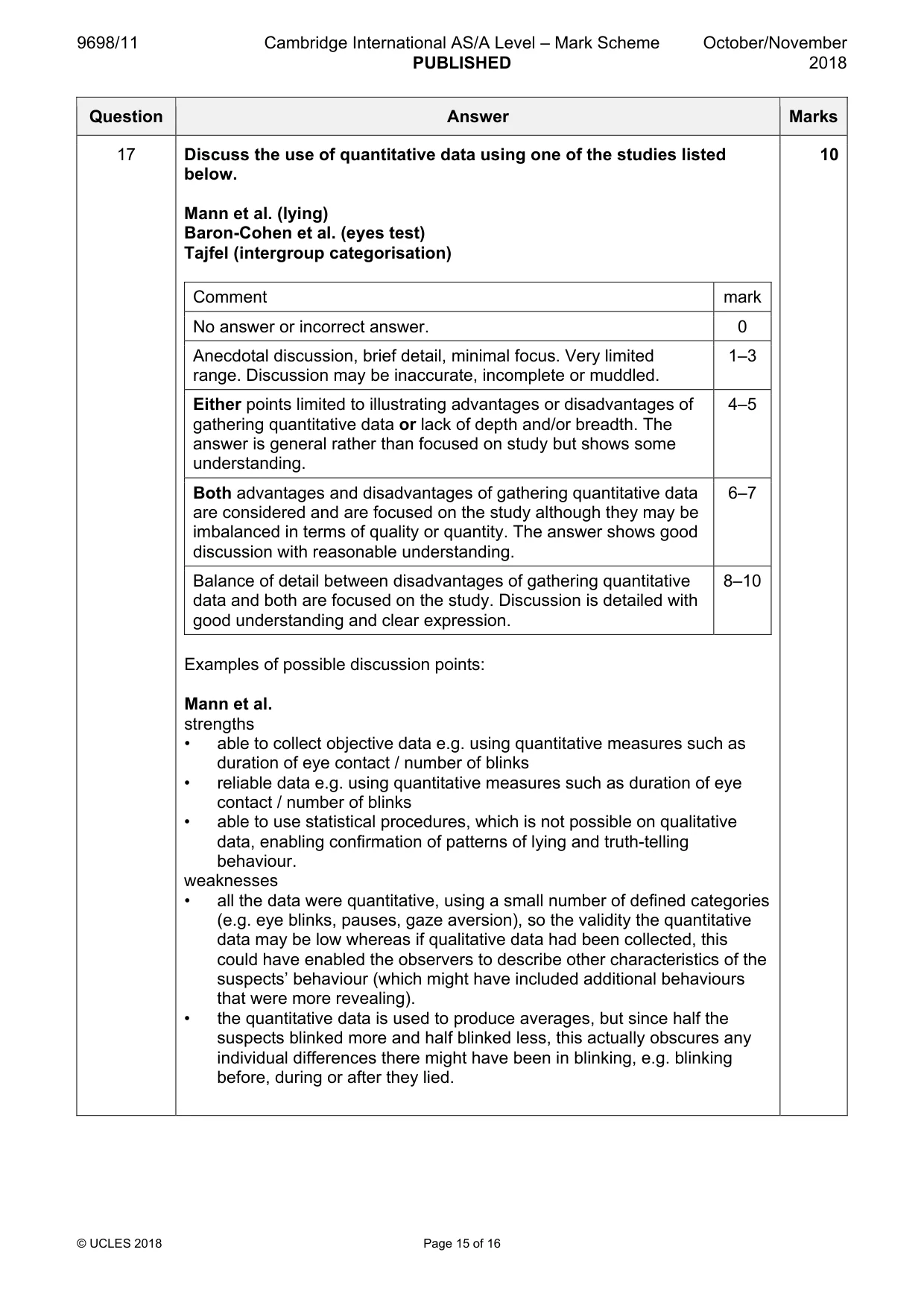
9698/11 Cambridge International AS/A Level – Mark Scheme PUBLISHED October/November 2018 © UCLES 2018 Page 15 of 16 Question Answer Marks 17 Discuss the use of quantitative data using one of the studies listed below. Mann et al. (lying) Baron-Cohen et al. (eyes test) Tajfel (intergroup categorisation) Comment mark No answer or incorrect answer. 0 Anecdotal discussion, brief detail, minimal focus. Very limited range. Discussion may be inaccurate, incomplete or muddled. 1–3 Either points limited to illustrating advantages or disadvantages of gathering quantitative data or lack of depth and/or breadth. The answer is general rather than focused on study but shows some understanding. 4–5 Both advantages and disadvantages of gathering quantitative data are considered and are focused on the study although they may be imbalanced in terms of quality or quantity. The answer shows good discussion with reasonable understanding. 6–7 Balance of detail between disadvantages of gathering quantitative data and both are focused on the study. Discussion is detailed with good understanding and clear expression. 8–10 Examples of possible discussion points: Mann et al. strengths • able to collect objective data e.g. using quantitative measures such as duration of eye contact / number of blinks • reliable data e.g. using quantitative measures such as duration of eye contact / number of blinks • able to use statistical procedures, which is not possible on qualitative data, enabling confirmation of patterns of lying and truth-telling behaviour. weaknesses • all the data were quantitative, using a small number of defined categories (e.g. eye blinks, pauses, gaze aversion), so the validity the quantitative data may be low whereas if qualitative data had been collected, this could have enabled the observers to describe other characteristics of the suspects’ behaviour (which might have included additional behaviours that were more revealing). • the quantitative data is used to produce averages, but since half the suspects blinked more and half blinked less, this actually obscures any individual differences there might have been in blinking, e.g. blinking before, during or after they lied. 10
Mark scheme, page 16
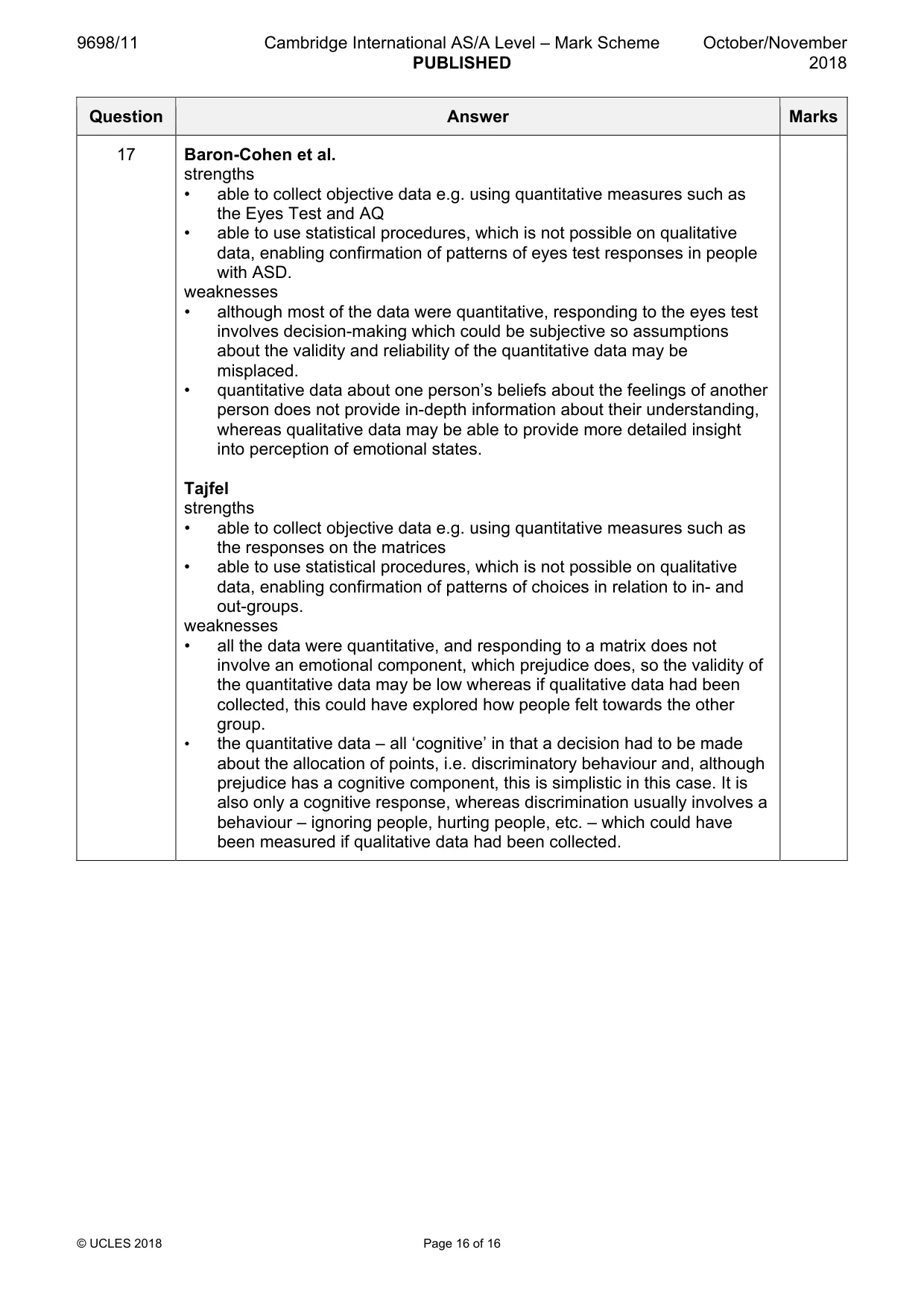
9698/11 Cambridge International AS/A Level – Mark Scheme PUBLISHED October/November 2018 © UCLES 2018 Page 16 of 16 Question Answer Marks 17 Baron-Cohen et al. strengths • able to collect objective data e.g. using quantitative measures such as the Eyes Test and AQ • able to use statistical procedures, which is not possible on qualitative data, enabling confirmation of patterns of eyes test responses in people with ASD. weaknesses • although most of the data were quantitative, responding to the eyes test involves decision-making which could be subjective so assumptions about the validity and reliability of the quantitative data may be misplaced. • quantitative data about one person’s beliefs about the feelings of another person does not provide in-depth information about their understanding, whereas qualitative data may be able to provide more detailed insight into perception of emotional states. Tajfel strengths • able to collect objective data e.g. using quantitative measures such as the responses on the matrices • able to use statistical procedures, which is not possible on qualitative data, enabling confirmation of patterns of choices in relation to in- and out-groups. weaknesses • all the data were quantitative, and responding to a matrix does not involve an emotional component, which prejudice does, so the validity of the quantitative data may be low whereas if qualitative data had been collected, this could have explored how people felt towards the other group. • the quantitative data – all ‘cognitive’ in that a decision had to be made about the allocation of points, i.e. discriminatory behaviour and, although prejudice has a cognitive component, this is simplistic in this case. It is also only a cognitive response, whereas discrimination usually involves a behaviour – ignoring people, hurting people, etc. – which could have been measured if qualitative data had been collected.
What you needed in this session
Cambridge’s own grade thresholds for 2018 Oct/Nov, Paper 1 · Variant 1. A higher threshold means an easier paper — the bar moves with how the cohort did.