Cambridge A Level Psychology 9698 — 2016 Oct/Nov Paper 1 · Variant 1
9698/11/O/N/16 · 80 marks · ≈90 min
The question paper and its mark scheme, free to read here and free to download. This is Cambridge’s own paper, exactly as it was sat.
Question paper4 pages
Mark scheme15 pages
Answers below. Sit the paper first if you are practising.


Paper as text
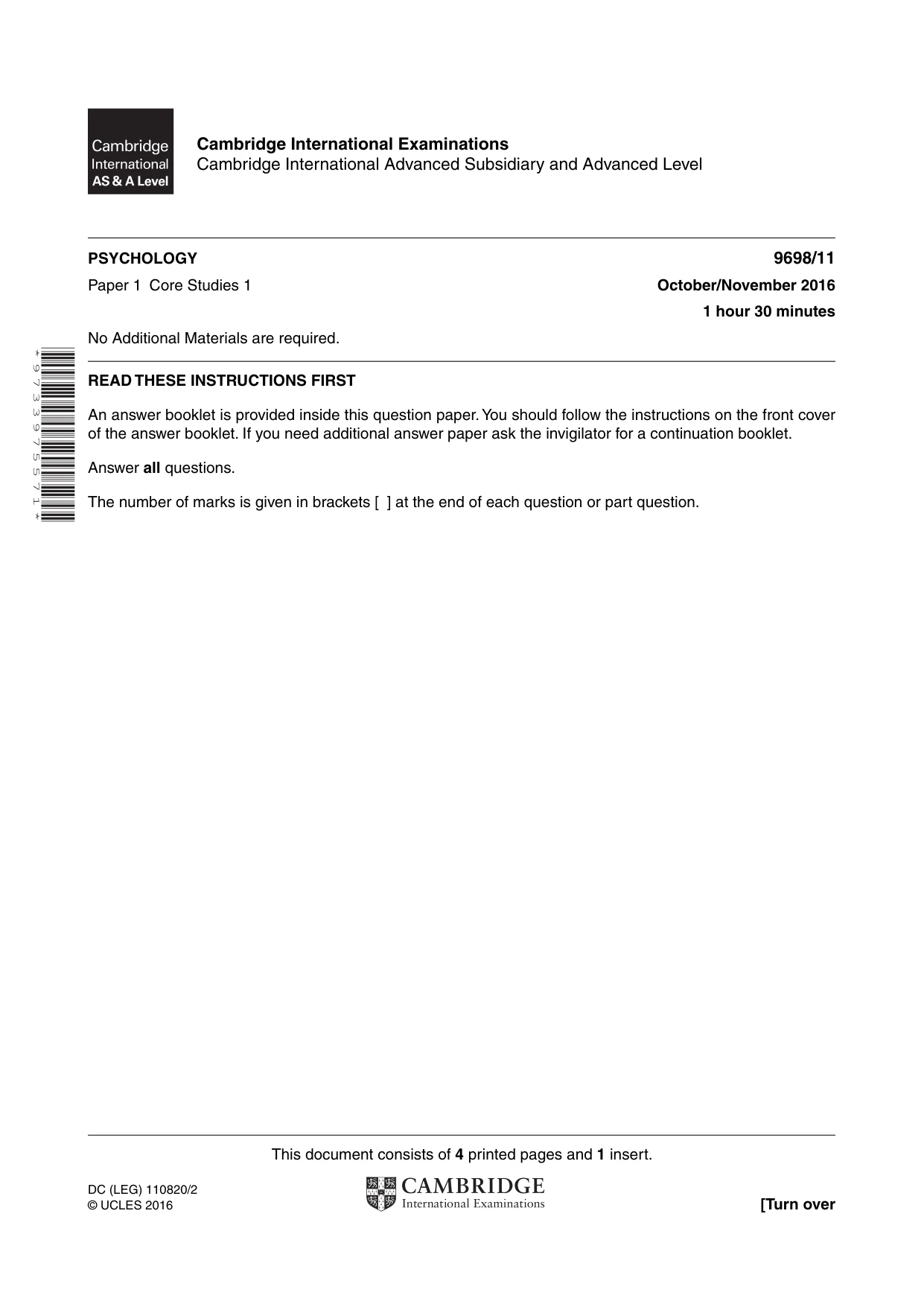
Question paper, page 1
This document consists of 4 printed pages and 1 insert. DC (LEG) 110820/2 © UCLES 2016 [Turn over * 9 7 3 3 9 7 5 5 7 1 * PSYCHOLOGY 9698/11 Paper 1 Core Studies 1 October/November 2016 1 hour 30 minutes No Additional Materials are required. READ THESE INSTRUCTIONS FIRST An answer booklet is provided inside this question paper. You should follow the instructions on the front cover of the answer booklet. If you need additional answer paper ask the invigilator for a continuation booklet. Answer all questions. The number of marks is given in brackets [ ] at the end of each question or part question. Cambridge International Examinations Cambridge International Advanced Subsidiary and Advanced Level
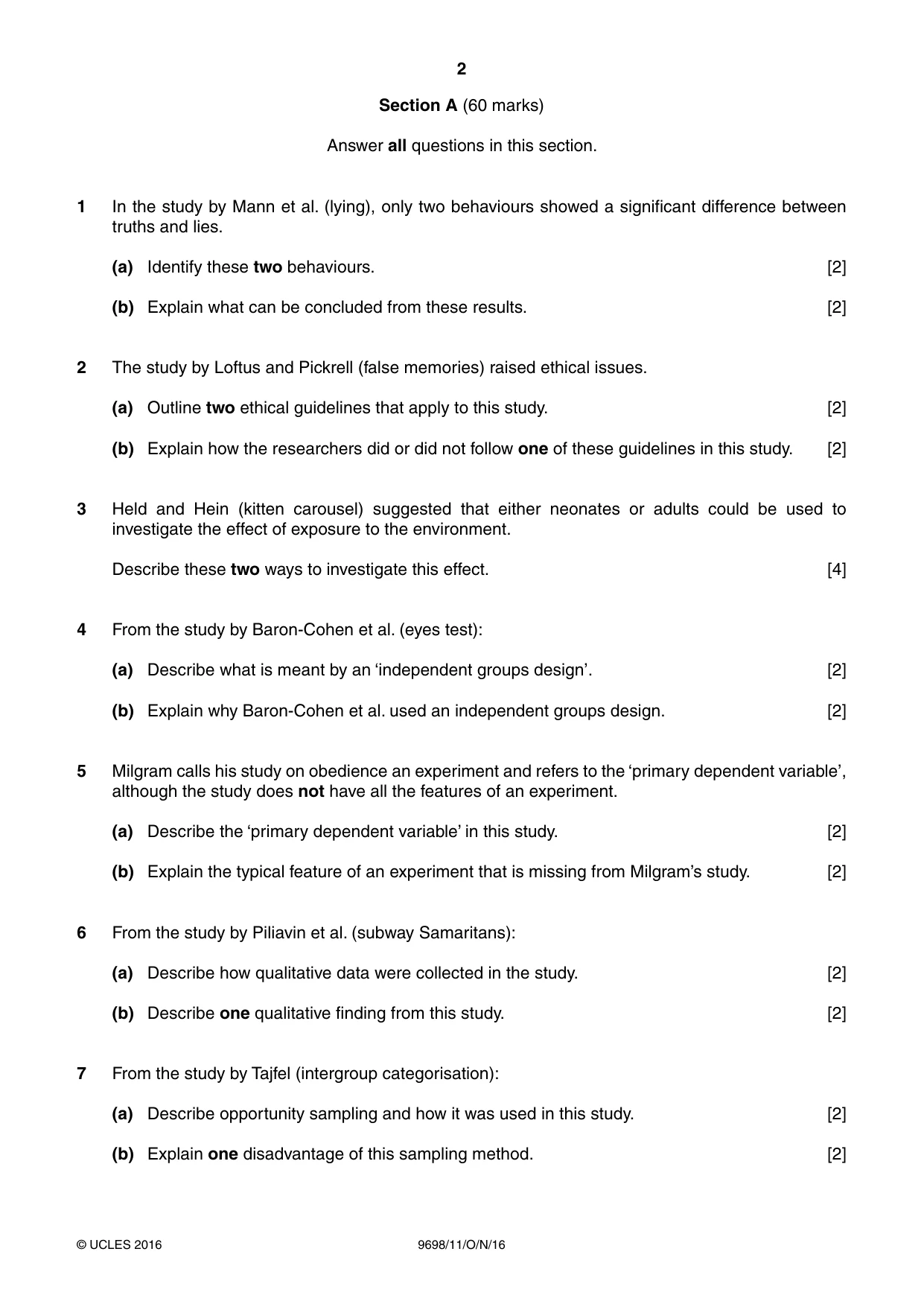
Question paper, page 2
2 9698/11/O/N/16 © UCLES 2016 Section A (60 marks) Answer all questions in this section. 1 In the study by Mann et al. (lying), only two behaviours showed a significant difference between truths and lies. (a) Identify these two behaviours. [2] (b) Explain what can be concluded from these results. [2] 2 The study by Loftus and Pickrell (false memories) raised ethical issues. (a) Outline two ethical guidelines that apply to this study. [2] (b) Explain how the researchers did or did not follow one of these guidelines in this study. [2] 3 Held and Hein (kitten carousel) suggested that either neonates or adults could be used to investigate the effect of exposure to the environment. Describe these two ways to investigate this effect. [4] 4 From the study by Baron-Cohen et al. (eyes test): (a) Describe what is meant by an ‘independent groups design’. [2] (b) Explain why Baron-Cohen et al. used an independent groups design. [2] 5 Milgram calls his study on obedience an experiment and refers to the ‘primary dependent variable’, although the study does not have all the features of an experiment. (a) Describe the ‘primary dependent variable’ in this study. [2] (b) Explain the typical feature of an experiment that is missing from Milgram’s study. [2] 6 From the study by Piliavin et al. (subway Samaritans): (a) Describe how qualitative data were collected in the study. [2] (b) Describe one qualitative finding from this study. [2] 7 From the study by Tajfel (intergroup categorisation): (a) Describe opportunity sampling and how it was used in this study. [2] (b) Explain one disadvantage of this sampling method. [2]
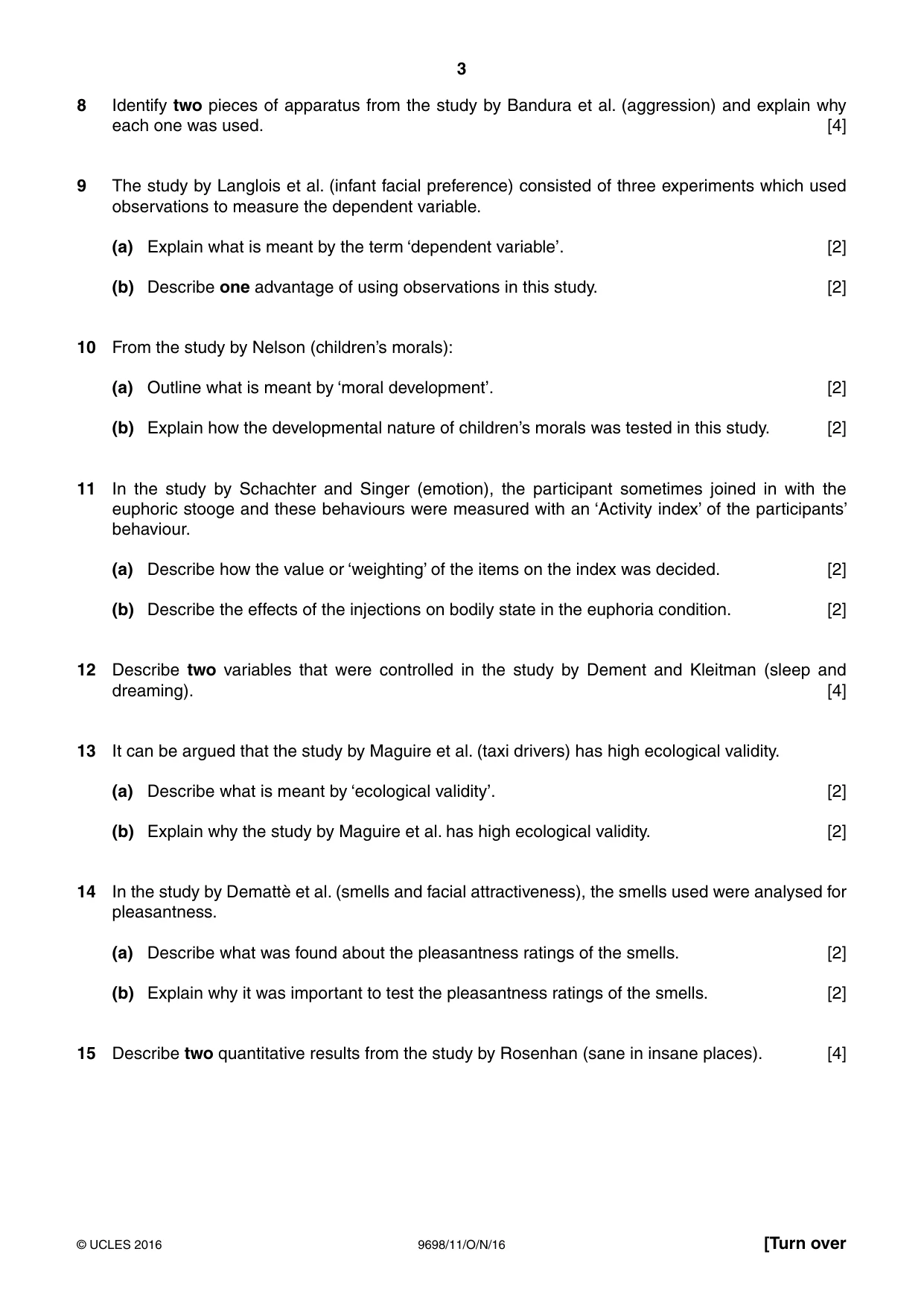
Question paper, page 3
3 9698/11/O/N/16 © UCLES 2016 [Turn over 8 Identify two pieces of apparatus from the study by Bandura et al. (aggression) and explain why each one was used. [4] 9 The study by Langlois et al. (infant facial preference) consisted of three experiments which used observations to measure the dependent variable. (a) Explain what is meant by the term ‘dependent variable’. [2] (b) Describe one advantage of using observations in this study. [2] 10 From the study by Nelson (children’s morals): (a) Outline what is meant by ‘moral development’. [2] (b) Explain how the developmental nature of children’s morals was tested in this study. [2] 11 In the study by Schachter and Singer (emotion), the participant sometimes joined in with the euphoric stooge and these behaviours were measured with an ‘Activity index’ of the participants’ behaviour. (a) Describe how the value or ‘weighting’ of the items on the index was decided. [2] (b) Describe the effects of the injections on bodily state in the euphoria condition. [2] 12 Describe two variables that were controlled in the study by Dement and Kleitman (sleep and dreaming). [4] 13 It can be argued that the study by Maguire et al. (taxi drivers) has high ecological validity. (a) Describe what is meant by ‘ecological validity’. [2] (b) Explain why the study by Maguire et al. has high ecological validity. [2] 14 In the study by Demattè et al. (smells and facial attractiveness), the smells used were analysed for pleasantness. (a) Describe what was found about the pleasantness ratings of the smells. [2] (b) Explain why it was important to test the pleasantness ratings of the smells. [2] 15 Describe two quantitative results from the study by Rosenhan (sane in insane places). [4]
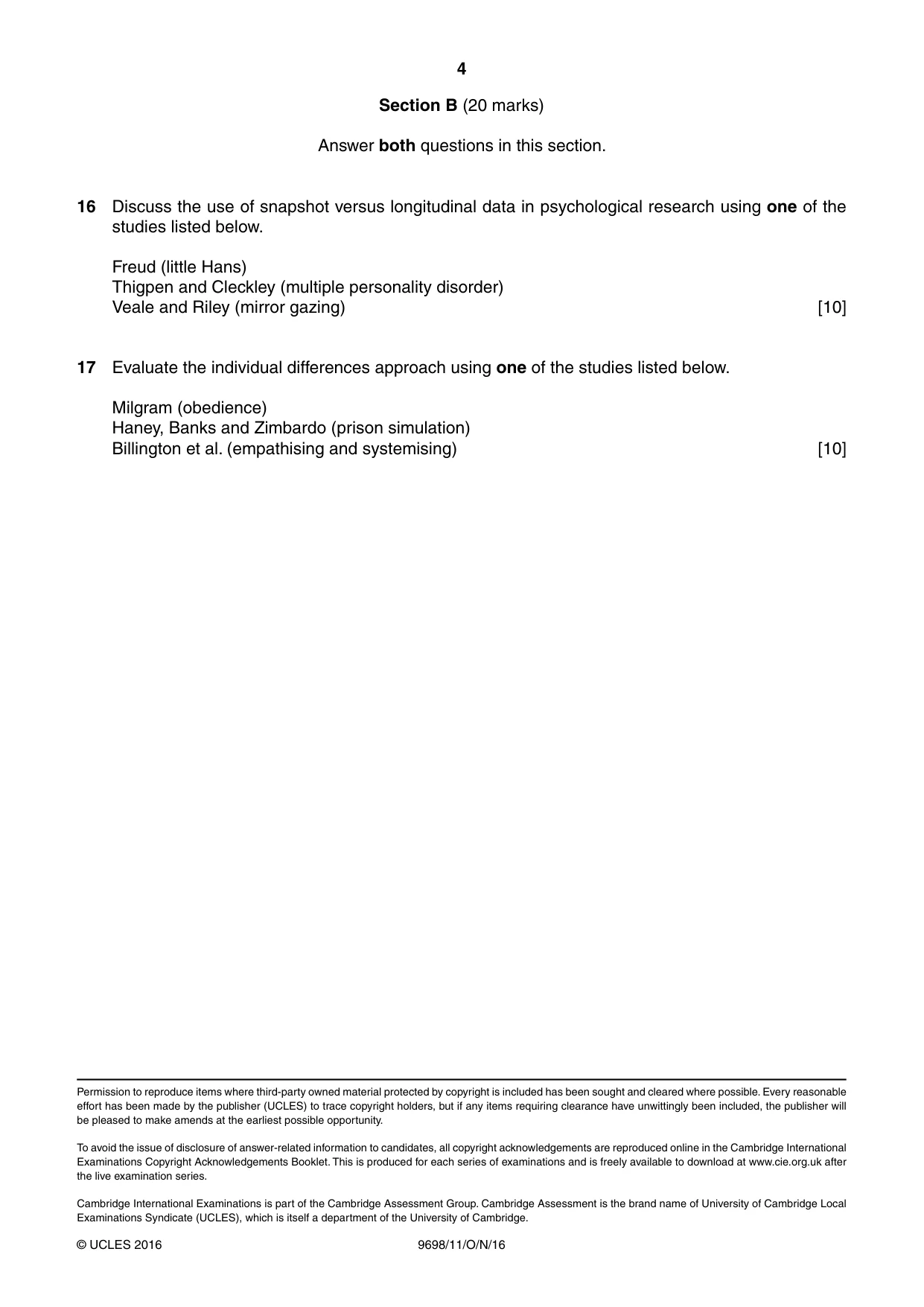
Question paper, page 4
4 9698/11/O/N/16 © UCLES 2016 Permission to reproduce items where third-party owned material protected by copyright is included has been sought and cleared where possible. Every reasonable effort has been made by the publisher (UCLES) to trace copyright holders, but if any items requiring clearance have unwittingly been included, the publisher will be pleased to make amends at the earliest possible opportunity. To avoid the issue of disclosure of answer-related information to candidates, all copyright acknowledgements are reproduced online in the Cambridge International Examinations Copyright Acknowledgements Booklet. This is produced for each series of examinations and is freely available to download at www.cie.org.uk after the live examination series. Cambridge International Examinations is part of the Cambridge Assessment Group. Cambridge Assessment is the brand name of University of Cambridge Local Examinations Syndicate (UCLES), which is itself a department of the University of Cambridge. Section B (20 marks) Answer both questions in this section. 16 Discuss the use of snapshot versus longitudinal data in psychological research using one of the studies listed below. Freud (little Hans) Thigpen and Cleckley (multiple personality disorder) Veale and Riley (mirror gazing) [10] 17 Evaluate the individual differences approach using one of the studies listed below. Milgram (obedience) Haney, Banks and Zimbardo (prison simulation) Billington et al. (empathising and systemising) [10]
Mark scheme, page 1
® IGCSE is the registered trademark of Cambridge International Examinations. This document consists of 15 printed pages. © UCLES 2016 [Turn over Cambridge International Examinations Cambridge International Advanced Subsidiary and Advanced Level PSYCHOLOGY 9698/11 Paper 1 Core Studies 1 October/November 2016 MARK SCHEME Maximum Mark: 80 Published This mark scheme is published as an aid to teachers and candidates, to indicate the requirements of the examination. It shows the basis on which Examiners were instructed to award marks. It does not indicate the details of the discussions that took place at an Examiners’ meeting before marking began, which would have considered the acceptability of alternative answers. Mark schemes should be read in conjunction with the question paper and the Principal Examiner Report for Teachers. Cambridge will not enter into discussions about these mark schemes. Cambridge is publishing the mark schemes for the October/November 2016 series for most Cambridge IGCSE®, Cambridge International A and AS Level components and some Cambridge O Level components.
Mark scheme, page 2
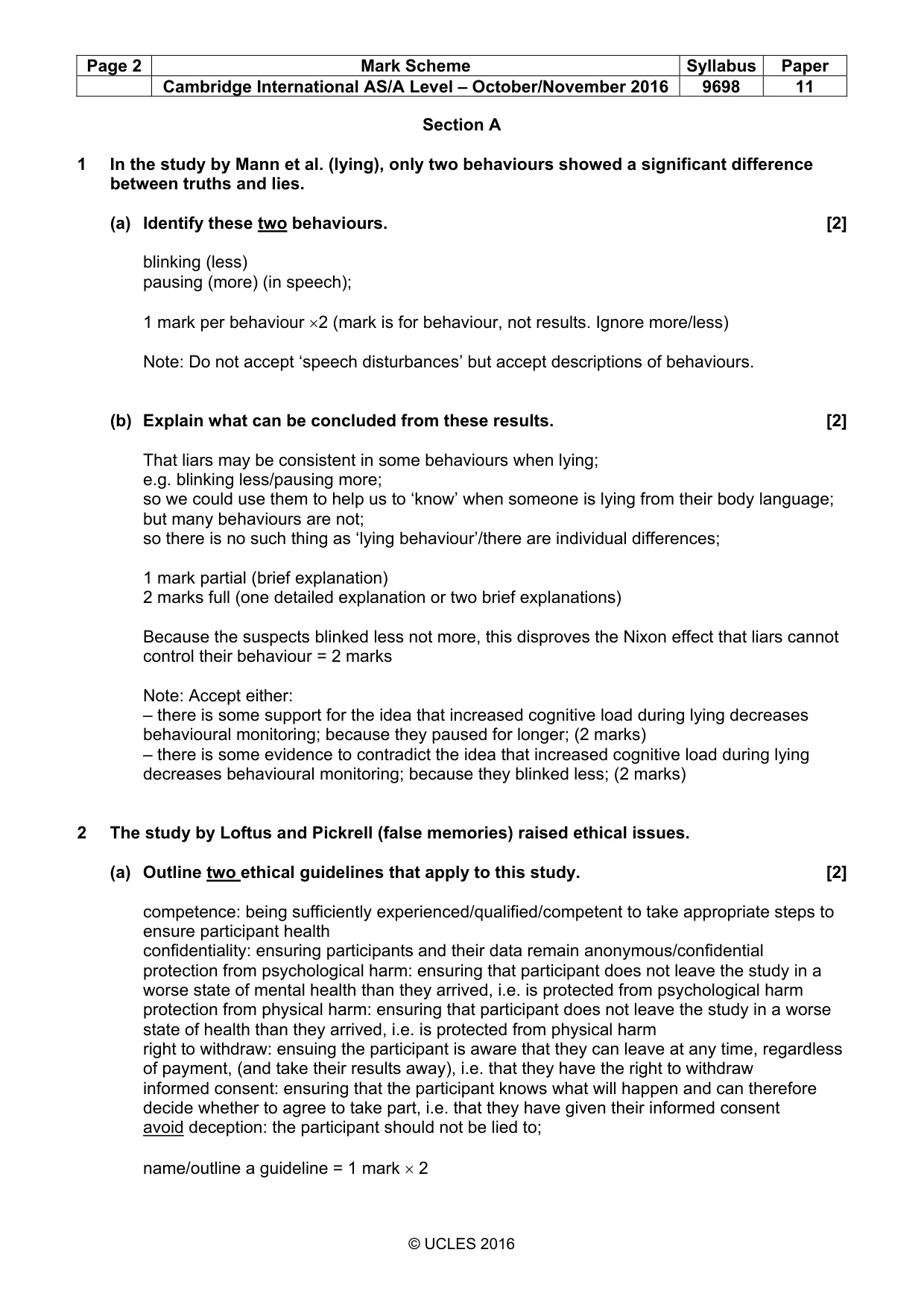
Page 2 Mark Scheme Syllabus Paper Cambridge International AS/A Level – October/November 2016 9698 11 © UCLES 2016 Section A 1 In the study by Mann et al. (lying), only two behaviours showed a significant difference between truths and lies. (a) Identify these two behaviours. [2] blinking (less) pausing (more) (in speech); 1 mark per behaviour ×2 (mark is for behaviour, not results. Ignore more/less) Note: Do not accept ‘speech disturbances’ but accept descriptions of behaviours. (b) Explain what can be concluded from these results. [2] That liars may be consistent in some behaviours when lying; e.g. blinking less/pausing more; so we could use them to help us to ‘know’ when someone is lying from their body language; but many behaviours are not; so there is no such thing as ‘lying behaviour’/there are individual differences; 1 mark partial (brief explanation) 2 marks full (one detailed explanation or two brief explanations) Because the suspects blinked less not more, this disproves the Nixon effect that liars cannot control their behaviour = 2 marks Note: Accept either: – there is some support for the idea that increased cognitive load during lying decreases behavioural monitoring; because they paused for longer; (2 marks) – there is some evidence to contradict the idea that increased cognitive load during lying decreases behavioural monitoring; because they blinked less; (2 marks) 2 The study by Loftus and Pickrell (false memories) raised ethical issues. (a) Outline two ethical guidelines that apply to this study. [2] competence: being sufficiently experienced/qualified/competent to take appropriate steps to ensure participant health confidentiality: ensuring participants and their data remain anonymous/confidential protection from psychological harm: ensuring that participant does not leave the study in a worse state of mental health than they arrived, i.e. is protected from psychological harm protection from physical harm: ensuring that participant does not leave the study in a worse state of health than they arrived, i.e. is protected from physical harm right to withdraw: ensuing the participant is aware that they can leave at any time, regardless of payment, (and take their results away), i.e. that they have the right to withdraw informed consent: ensuring that the participant knows what will happen and can therefore decide whether to agree to take part, i.e. that they have given their informed consent avoid deception: the participant should not be lied to; name/outline a guideline = 1 mark × 2
Mark scheme, page 3
Page 3 Mark Scheme Syllabus Paper Cambridge International AS/A Level – October/November 2016 9698 11 © UCLES 2016 (b) Explain how the researchers did or did not follow one of these guidelines in this study. [2] Protection from harm: the real events supplied by relatives may have been painful for the participants; even though the relatives thought they would not be; so they were under more stress than they would be in normal life. Deception: the participants were not told the real aim of the study and were led to believe that all the stories were true / told it was about why some people remember childhood memories. Debrief: even though they explained about the false event / apologised for the deception / explained why it had been necessary for the research, this may not have been enough to reassure the participants so they may have been negatively affected by the study. Right to withdraw: Although the participants could have not returned their questionnaire/ responded to telephone call they did not know the real aim of the study so in a sense they could not choose to leave. 1 mark partial – for describing a relevant problem that would be tackled by a guideline. 2 marks full – name/identification of guideline, and explanation of how it is challenged (i.e. contextualisation). Note: do not accept references to Chris as an illustration of confidentiality being broken (‘Chris’ was not one of the participants in the study but an example of a false memory) 3 Held and Hein (kitten carousel) suggested that either neonates or adults could be used to investigate the effect of exposure to the environment. Describe these two ways to investigate this effect. [4] restricted rearing of neonates: raising young animals in deprived environments (to see what skills they lack) adaptation by adults: experimental analysis of conditions needed to modify the responses of adults. 1 mark partial (brief comment on a possible method) 2 marks full (clear comment on a possible method) 2 marks per way × 2
Mark scheme, page 4
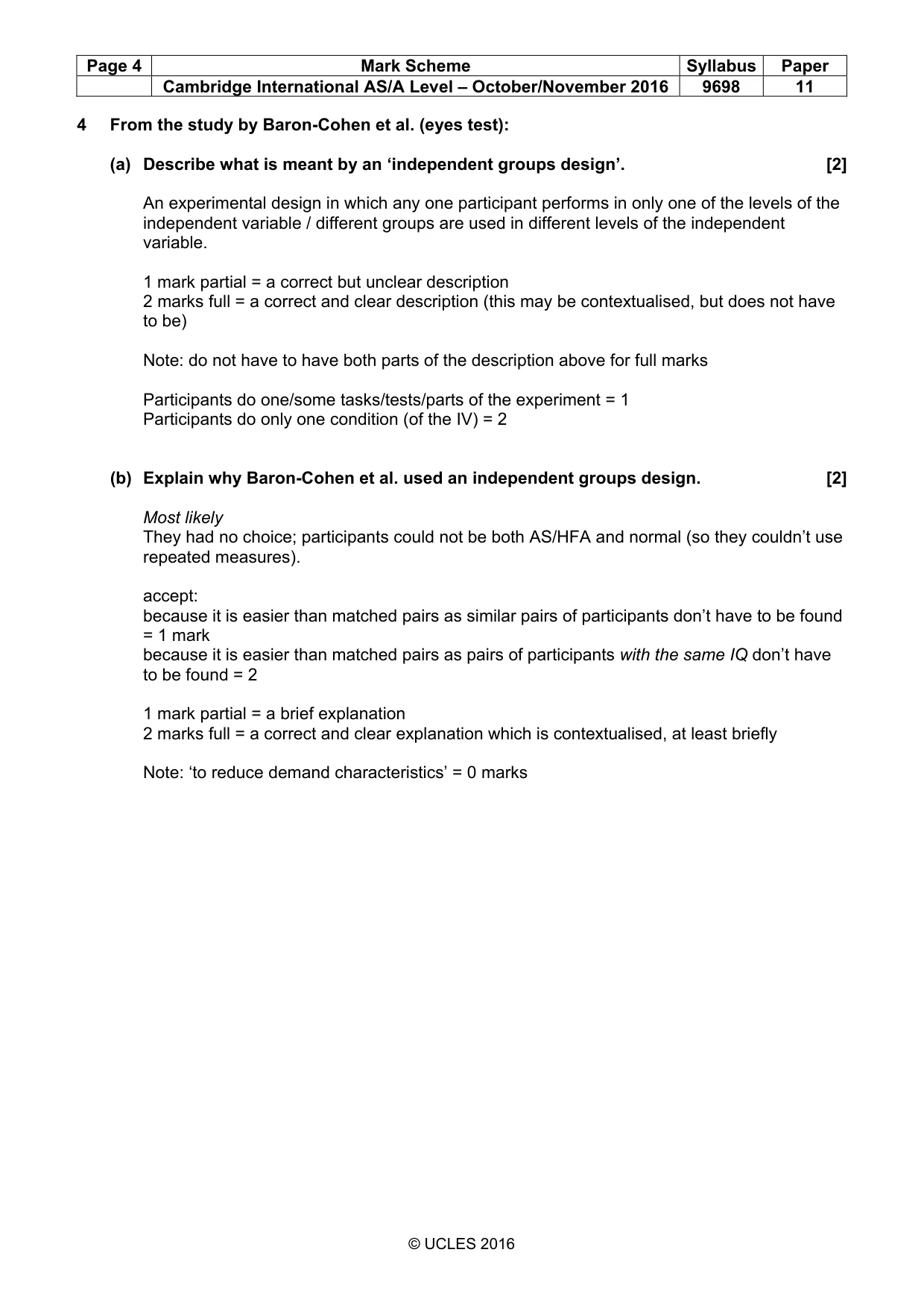
Page 4 Mark Scheme Syllabus Paper Cambridge International AS/A Level – October/November 2016 9698 11 © UCLES 2016 4 From the study by Baron-Cohen et al. (eyes test): (a) Describe what is meant by an ‘independent groups design’. [2] An experimental design in which any one participant performs in only one of the levels of the independent variable / different groups are used in different levels of the independent variable. 1 mark partial = a correct but unclear description 2 marks full = a correct and clear description (this may be contextualised, but does not have to be) Note: do not have to have both parts of the description above for full marks Participants do one/some tasks/tests/parts of the experiment = 1 Participants do only one condition (of the IV) = 2 (b) Explain why Baron-Cohen et al. used an independent groups design. [2] Most likely They had no choice; participants could not be both AS/HFA and normal (so they couldn’t use repeated measures). accept: because it is easier than matched pairs as similar pairs of participants don’t have to be found = 1 mark because it is easier than matched pairs as pairs of participants with the same IQ don’t have to be found = 2 1 mark partial = a brief explanation 2 marks full = a correct and clear explanation which is contextualised, at least briefly Note: ‘to reduce demand characteristics’ = 0 marks
Mark scheme, page 5
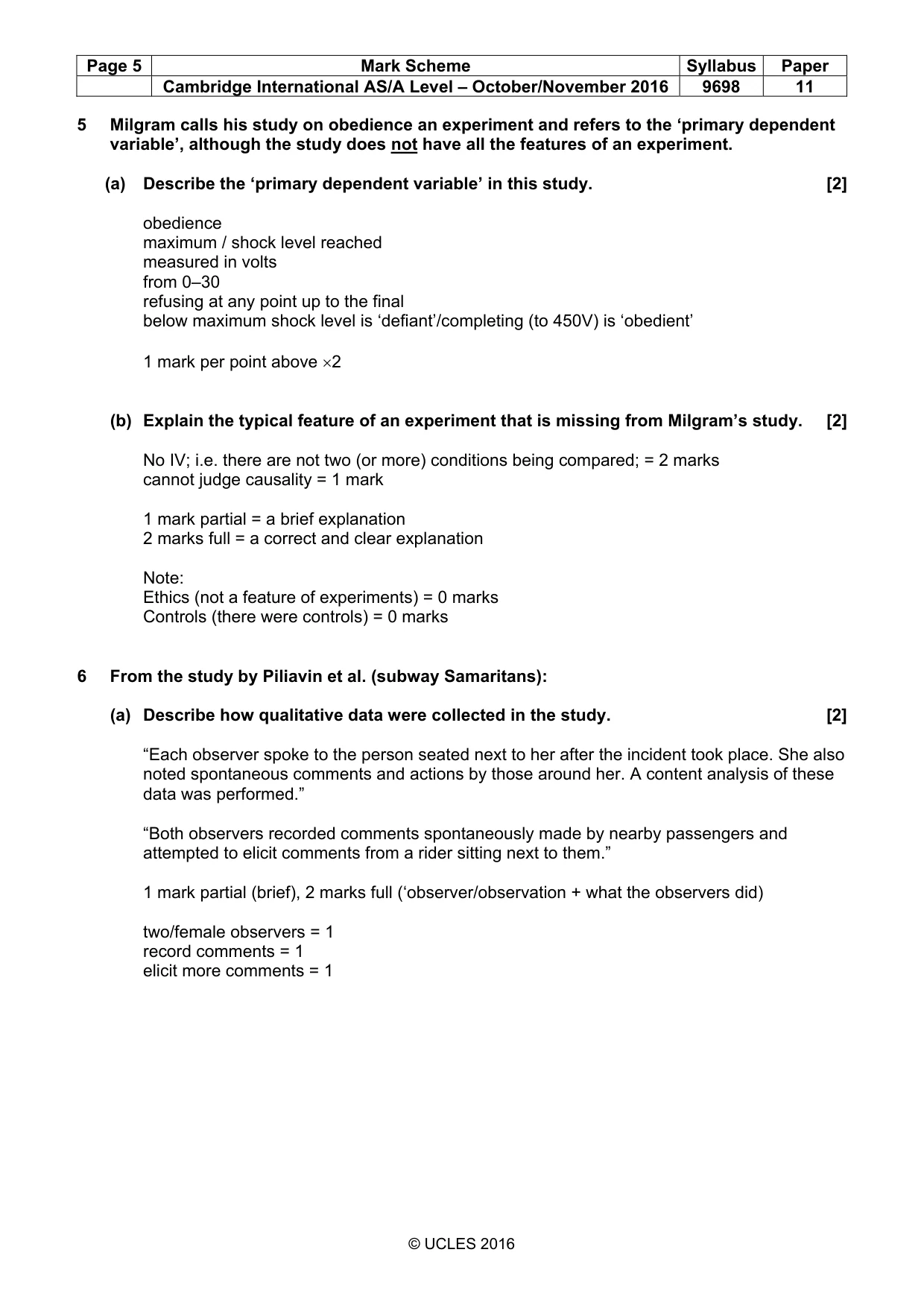
Page 5 Mark Scheme Syllabus Paper Cambridge International AS/A Level – October/November 2016 9698 11 © UCLES 2016 5 Milgram calls his study on obedience an experiment and refers to the ‘primary dependent variable’, although the study does not have all the features of an experiment. (a) Describe the ‘primary dependent variable’ in this study. [2] obedience maximum / shock level reached measured in volts from 0–30 refusing at any point up to the final below maximum shock level is ‘defiant’/completing (to 450V) is ‘obedient’ 1 mark per point above ×2 (b) Explain the typical feature of an experiment that is missing from Milgram’s study. [2] No IV; i.e. there are not two (or more) conditions being compared; = 2 marks cannot judge causality = 1 mark 1 mark partial = a brief explanation 2 marks full = a correct and clear explanation Note: Ethics (not a feature of experiments) = 0 marks Controls (there were controls) = 0 marks 6 From the study by Piliavin et al. (subway Samaritans): (a) Describe how qualitative data were collected in the study. [2] “Each observer spoke to the person seated next to her after the incident took place. She also noted spontaneous comments and actions by those around her. A content analysis of these data was performed.” “Both observers recorded comments spontaneously made by nearby passengers and attempted to elicit comments from a rider sitting next to them.” 1 mark partial (brief), 2 marks full (‘observer/observation + what the observers did) two/female observers = 1 record comments = 1 elicit more comments = 1
Mark scheme, page 6
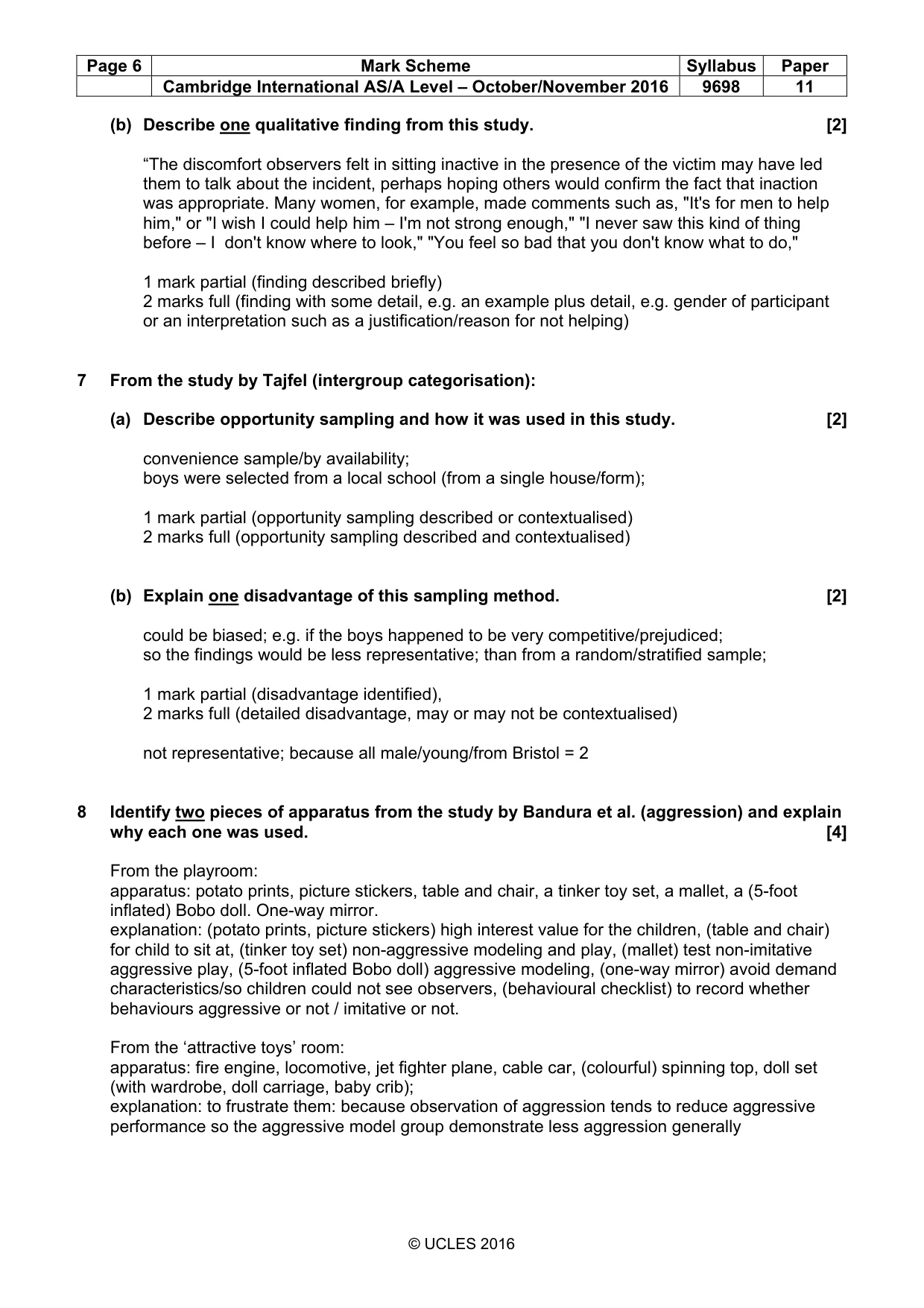
Page 6 Mark Scheme Syllabus Paper Cambridge International AS/A Level – October/November 2016 9698 11 © UCLES 2016 (b) Describe one qualitative finding from this study. [2] “The discomfort observers felt in sitting inactive in the presence of the victim may have led them to talk about the incident, perhaps hoping others would confirm the fact that inaction was appropriate. Many women, for example, made comments such as, "It's for men to help him," or "I wish I could help him – I'm not strong enough," "I never saw this kind of thing before – I don't know where to look," "You feel so bad that you don't know what to do," 1 mark partial (finding described briefly) 2 marks full (finding with some detail, e.g. an example plus detail, e.g. gender of participant or an interpretation such as a justification/reason for not helping) 7 From the study by Tajfel (intergroup categorisation): (a) Describe opportunity sampling and how it was used in this study. [2] convenience sample/by availability; boys were selected from a local school (from a single house/form); 1 mark partial (opportunity sampling described or contextualised) 2 marks full (opportunity sampling described and contextualised) (b) Explain one disadvantage of this sampling method. [2] could be biased; e.g. if the boys happened to be very competitive/prejudiced; so the findings would be less representative; than from a random/stratified sample; 1 mark partial (disadvantage identified), 2 marks full (detailed disadvantage, may or may not be contextualised) not representative; because all male/young/from Bristol = 2 8 Identify two pieces of apparatus from the study by Bandura et al. (aggression) and explain why each one was used. [4] From the playroom: apparatus: potato prints, picture stickers, table and chair, a tinker toy set, a mallet, a (5-foot inflated) Bobo doll. One-way mirror. explanation: (potato prints, picture stickers) high interest value for the children, (table and chair) for child to sit at, (tinker toy set) non-aggressive modeling and play, (mallet) test non-imitative aggressive play, (5-foot inflated Bobo doll) aggressive modeling, (one-way mirror) avoid demand characteristics/so children could not see observers, (behavioural checklist) to record whether behaviours aggressive or not / imitative or not. From the ‘attractive toys’ room: apparatus: fire engine, locomotive, jet fighter plane, cable car, (colourful) spinning top, doll set (with wardrobe, doll carriage, baby crib); explanation: to frustrate them: because observation of aggression tends to reduce aggressive performance so the aggressive model group demonstrate less aggression generally
Mark scheme, page 7
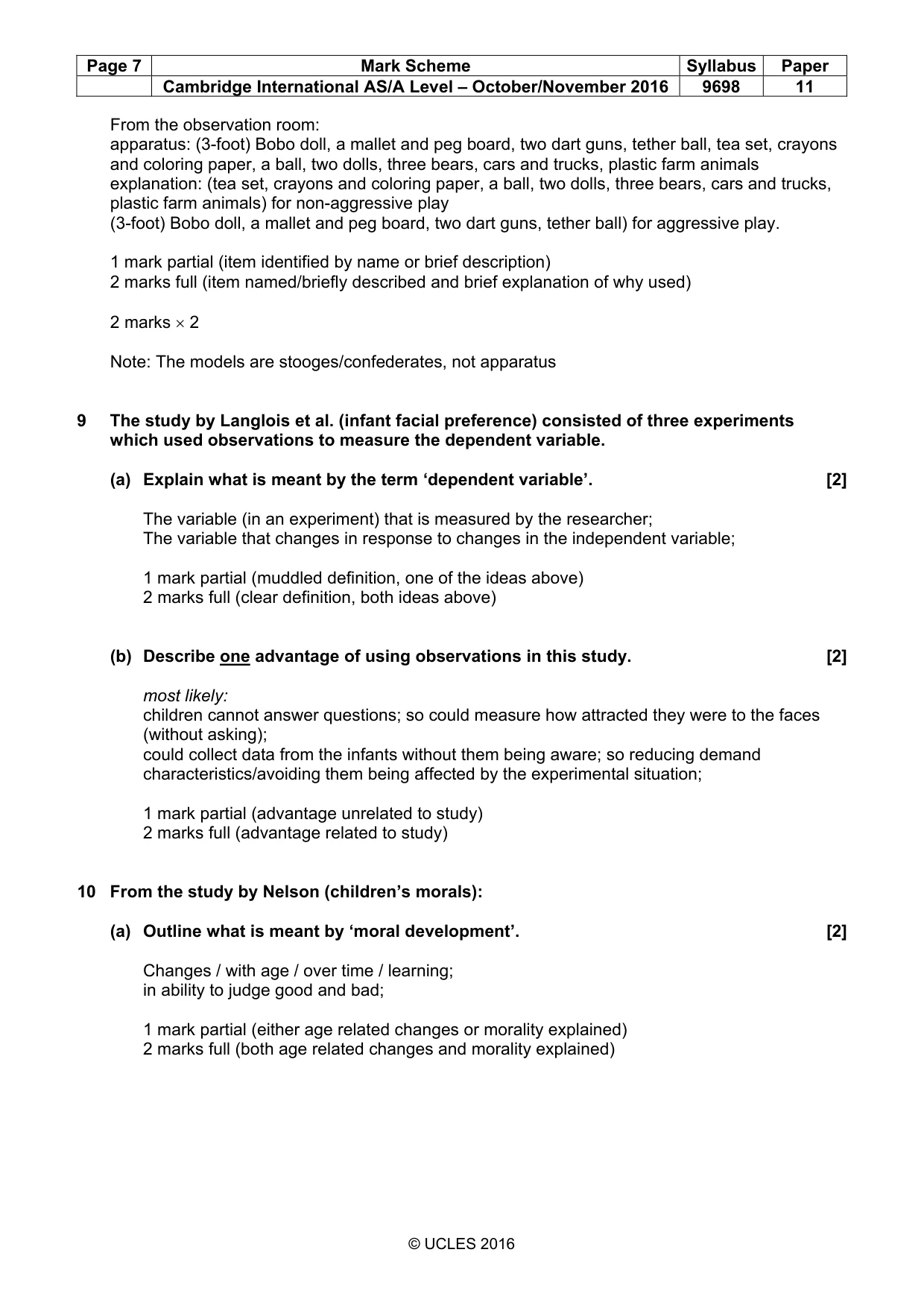
Page 7 Mark Scheme Syllabus Paper Cambridge International AS/A Level – October/November 2016 9698 11 © UCLES 2016 From the observation room: apparatus: (3-foot) Bobo doll, a mallet and peg board, two dart guns, tether ball, tea set, crayons and coloring paper, a ball, two dolls, three bears, cars and trucks, plastic farm animals explanation: (tea set, crayons and coloring paper, a ball, two dolls, three bears, cars and trucks, plastic farm animals) for non-aggressive play (3-foot) Bobo doll, a mallet and peg board, two dart guns, tether ball) for aggressive play. 1 mark partial (item identified by name or brief description) 2 marks full (item named/briefly described and brief explanation of why used) 2 marks × 2 Note: The models are stooges/confederates, not apparatus 9 The study by Langlois et al. (infant facial preference) consisted of three experiments which used observations to measure the dependent variable. (a) Explain what is meant by the term ‘dependent variable’. [2] The variable (in an experiment) that is measured by the researcher; The variable that changes in response to changes in the independent variable; 1 mark partial (muddled definition, one of the ideas above) 2 marks full (clear definition, both ideas above) (b) Describe one advantage of using observations in this study. [2] most likely: children cannot answer questions; so could measure how attracted they were to the faces (without asking); could collect data from the infants without them being aware; so reducing demand characteristics/avoiding them being affected by the experimental situation; 1 mark partial (advantage unrelated to study) 2 marks full (advantage related to study) 10 From the study by Nelson (children’s morals): (a) Outline what is meant by ‘moral development’. [2] Changes / with age / over time / learning; in ability to judge good and bad; 1 mark partial (either age related changes or morality explained) 2 marks full (both age related changes and morality explained)
Mark scheme, page 8
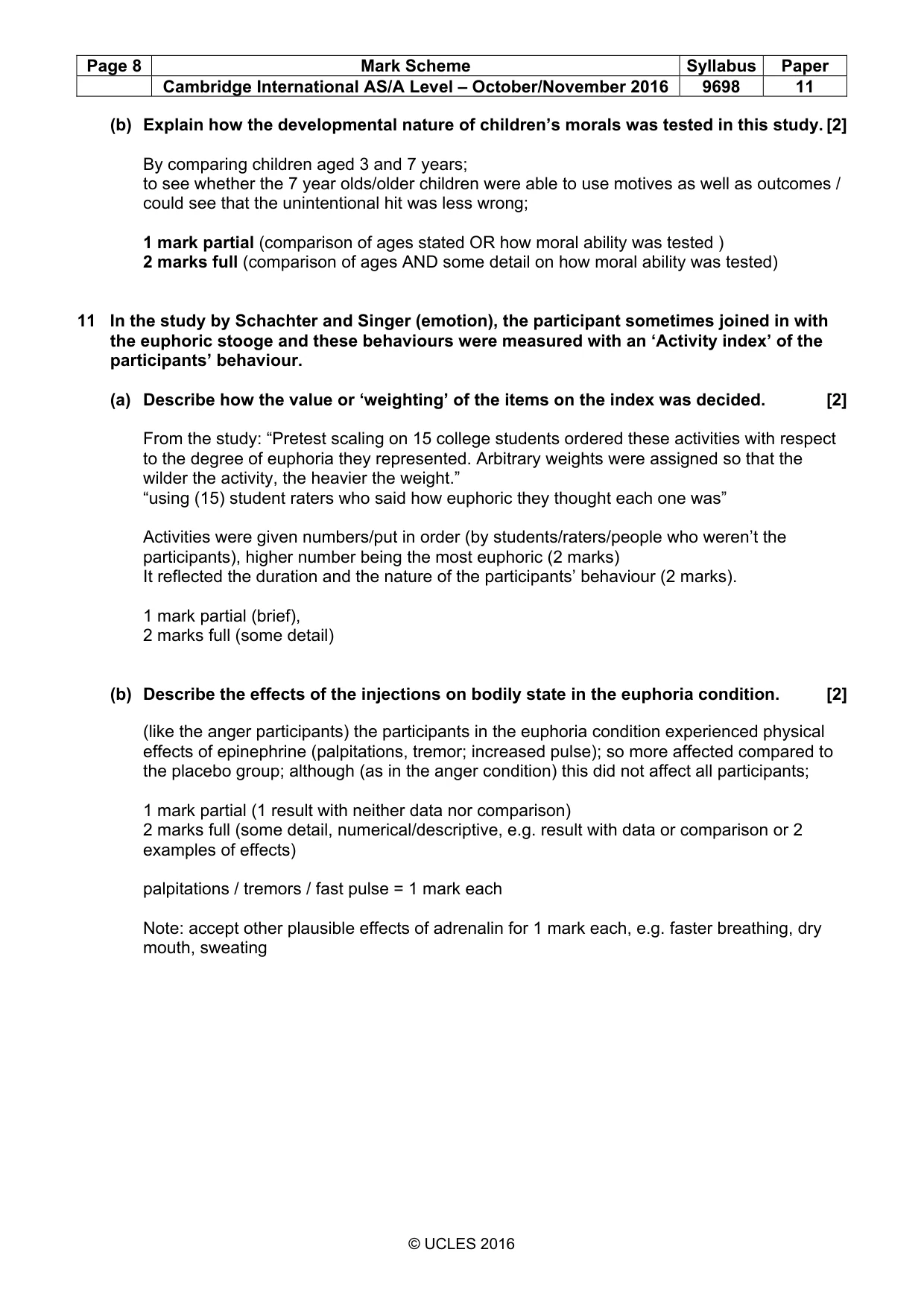
Page 8 Mark Scheme Syllabus Paper Cambridge International AS/A Level – October/November 2016 9698 11 © UCLES 2016 (b) Explain how the developmental nature of children’s morals was tested in this study. [2] By comparing children aged 3 and 7 years; to see whether the 7 year olds/older children were able to use motives as well as outcomes / could see that the unintentional hit was less wrong; 1 mark partial (comparison of ages stated OR how moral ability was tested ) 2 marks full (comparison of ages AND some detail on how moral ability was tested) 11 In the study by Schachter and Singer (emotion), the participant sometimes joined in with the euphoric stooge and these behaviours were measured with an ‘Activity index’ of the participants’ behaviour. (a) Describe how the value or ‘weighting’ of the items on the index was decided. [2] From the study: “Pretest scaling on 15 college students ordered these activities with respect to the degree of euphoria they represented. Arbitrary weights were assigned so that the wilder the activity, the heavier the weight.” “using (15) student raters who said how euphoric they thought each one was” Activities were given numbers/put in order (by students/raters/people who weren’t the participants), higher number being the most euphoric (2 marks) It reflected the duration and the nature of the participants’ behaviour (2 marks). 1 mark partial (brief), 2 marks full (some detail) (b) Describe the effects of the injections on bodily state in the euphoria condition. [2] (like the anger participants) the participants in the euphoria condition experienced physical effects of epinephrine (palpitations, tremor; increased pulse); so more affected compared to the placebo group; although (as in the anger condition) this did not affect all participants; 1 mark partial (1 result with neither data nor comparison) 2 marks full (some detail, numerical/descriptive, e.g. result with data or comparison or 2 examples of effects) palpitations / tremors / fast pulse = 1 mark each Note: accept other plausible effects of adrenalin for 1 mark each, e.g. faster breathing, dry mouth, sweating
Mark scheme, page 9
Page 9 Mark Scheme Syllabus Paper Cambridge International AS/A Level – October/November 2016 9698 11 © UCLES 2016 12 Describe two variables that were controlled in the study by Dement and Kleitman (sleep and dreaming). [4] arrive just before normal bedtime; likely to have an equally good / normal night’s sleep; as sleep better if not too tired / trying to go to sleep ‘early’; eat normally; likely to have an equally good / normal night’s sleep; if not hungry; no alcohol; it affects sleep/dreams; so better if all participants are alcohol free; no caffeine (containing drinks); caffeine reduces need for sleep; so better if all participants are caffeine free; 1 mark partial (identify control) + 1 mark (describe control) × 2 13 It can be argued that the study by Maguire et al. (taxi drivers) has high ecological validity. (a) Describe what is meant by ‘ecological validity’. [2] it is the extent to which the findings of a study will generalise outside the situation tested; 1 mark partial (simple definition) 2 marks, full (either good explanation or a definition with an appropriate example) Note: ecological validity is about being like real life and being able to generalise beyond the specifics tested The extent to which the results generalise to real life = 1 mark. (b) Explain why the study by Maguire et al. has high ecological validity. [2] neural processes are unlikely to be affected by setting; so scanner would make little difference to activation/recall; the tasks were designed and tested to be complex like real-world tasks / used real routes the taxi drivers drove / well known films; so were usual for the taxi drivers; so the findings should generalise to other situations like navigation that is complicated; they were taxi drivers being tested on navigation; which is what taxi drivers do all day; 1 mark partial (simple explanation or example from study) 2 marks, full (explanation and reference to study – example may be of mundane realism if generalisation is referred to) Because it is unlikely that the taxi drivers’ brains responded differently inside the scanner than they would in a taxi; (2 marks ‘in a taxi’ is sufficient reference to study)
Mark scheme, page 10
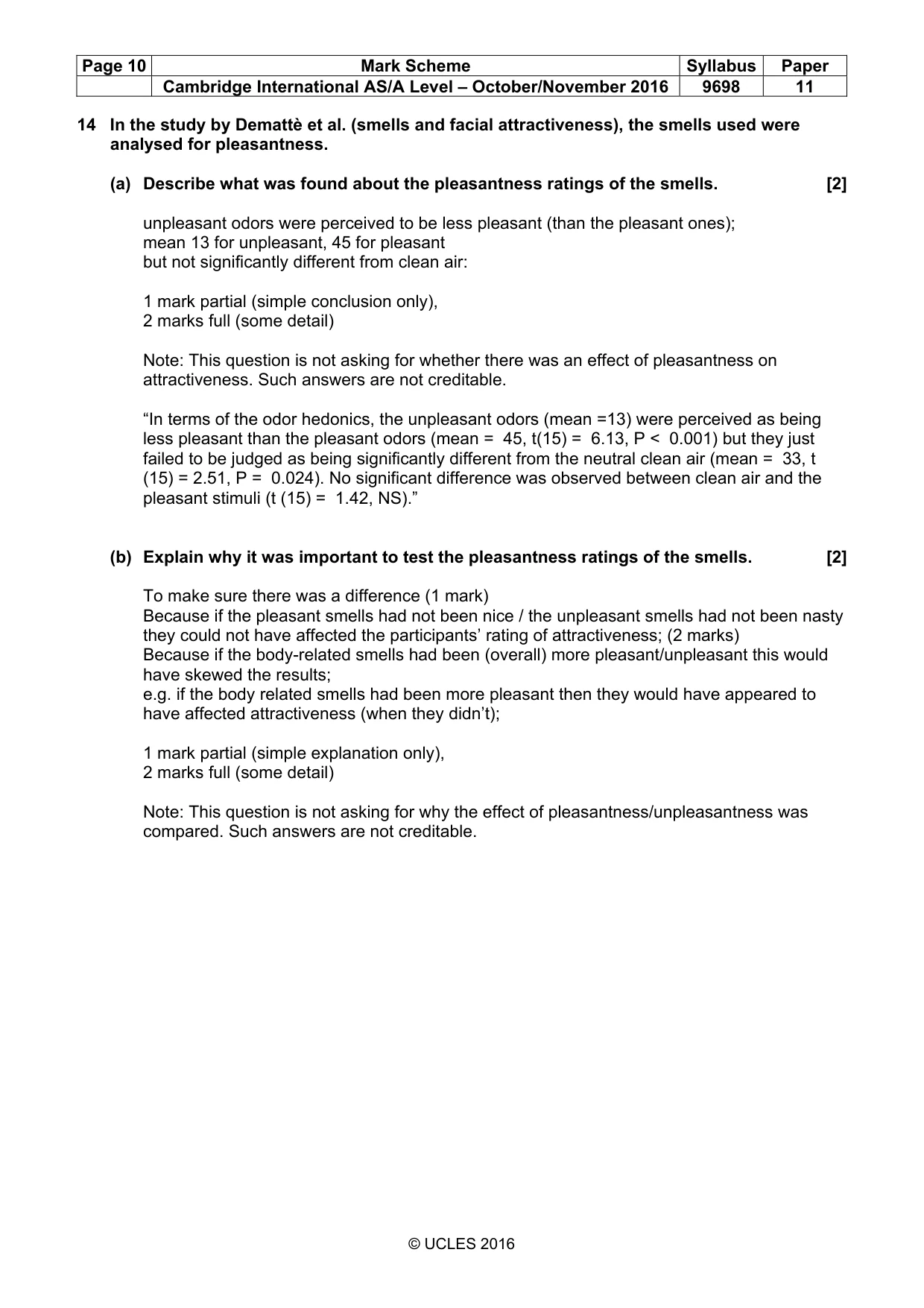
Page 10 Mark Scheme Syllabus Paper Cambridge International AS/A Level – October/November 2016 9698 11 © UCLES 2016 14 In the study by Demattè et al. (smells and facial attractiveness), the smells used were analysed for pleasantness. (a) Describe what was found about the pleasantness ratings of the smells. [2] unpleasant odors were perceived to be less pleasant (than the pleasant ones); mean 13 for unpleasant, 45 for pleasant but not significantly different from clean air: 1 mark partial (simple conclusion only), 2 marks full (some detail) Note: This question is not asking for whether there was an effect of pleasantness on attractiveness. Such answers are not creditable. “In terms of the odor hedonics, the unpleasant odors (mean =13) were perceived as being less pleasant than the pleasant odors (mean = 45, t(15) = 6.13, P < 0.001) but they just failed to be judged as being significantly different from the neutral clean air (mean = 33, t (15) = 2.51, P = 0.024). No significant difference was observed between clean air and the pleasant stimuli (t (15) = 1.42, NS).” (b) Explain why it was important to test the pleasantness ratings of the smells. [2] To make sure there was a difference (1 mark) Because if the pleasant smells had not been nice / the unpleasant smells had not been nasty they could not have affected the participants’ rating of attractiveness; (2 marks) Because if the body-related smells had been (overall) more pleasant/unpleasant this would have skewed the results; e.g. if the body related smells had been more pleasant then they would have appeared to have affected attractiveness (when they didn’t); 1 mark partial (simple explanation only), 2 marks full (some detail) Note: This question is not asking for why the effect of pleasantness/unpleasantness was compared. Such answers are not creditable.
Mark scheme, page 11
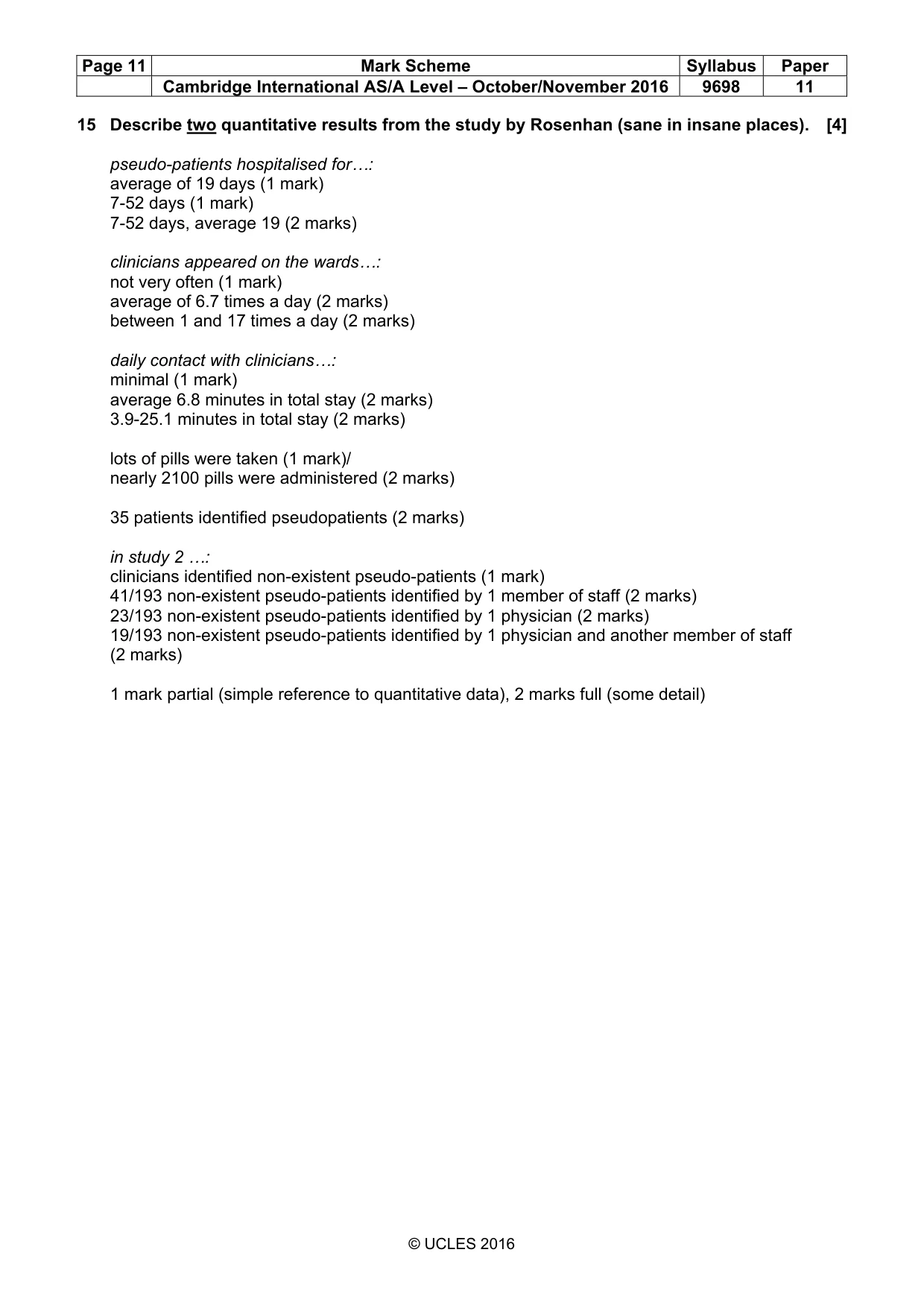
Page 11 Mark Scheme Syllabus Paper Cambridge International AS/A Level – October/November 2016 9698 11 © UCLES 2016 15 Describe two quantitative results from the study by Rosenhan (sane in insane places). [4] pseudo-patients hospitalised for…: average of 19 days (1 mark) 7-52 days (1 mark) 7-52 days, average 19 (2 marks) clinicians appeared on the wards…: not very often (1 mark) average of 6.7 times a day (2 marks) between 1 and 17 times a day (2 marks) daily contact with clinicians…: minimal (1 mark) average 6.8 minutes in total stay (2 marks) 3.9-25.1 minutes in total stay (2 marks) lots of pills were taken (1 mark)/ nearly 2100 pills were administered (2 marks) 35 patients identified pseudopatients (2 marks) in study 2 …: clinicians identified non-existent pseudo-patients (1 mark) 41/193 non-existent pseudo-patients identified by 1 member of staff (2 marks) 23/193 non-existent pseudo-patients identified by 1 physician (2 marks) 19/193 non-existent pseudo-patients identified by 1 physician and another member of staff (2 marks) 1 mark partial (simple reference to quantitative data), 2 marks full (some detail)
Mark scheme, page 12
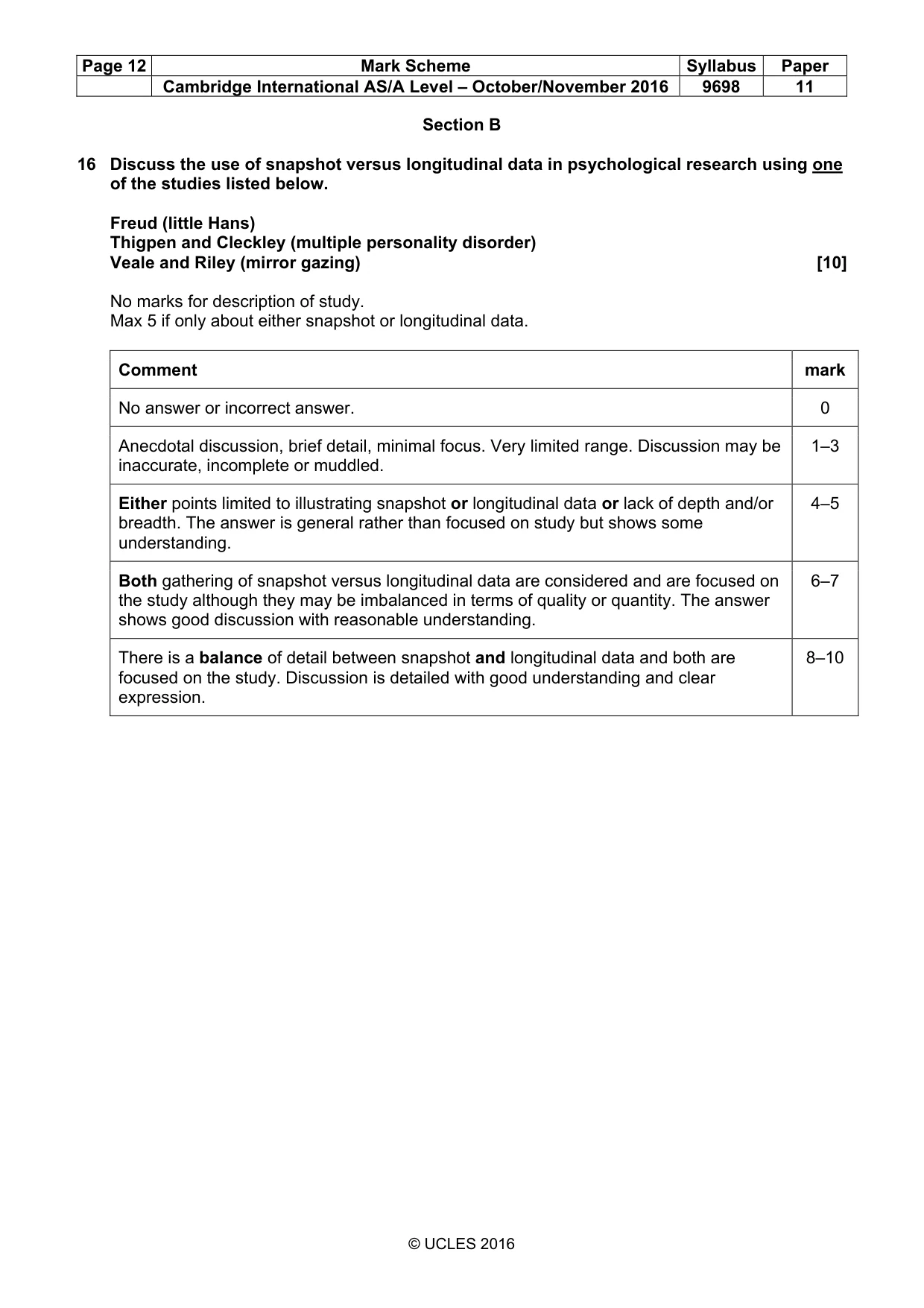
Page 12 Mark Scheme Syllabus Paper Cambridge International AS/A Level – October/November 2016 9698 11 © UCLES 2016 Section B 16 Discuss the use of snapshot versus longitudinal data in psychological research using one of the studies listed below. Freud (little Hans) Thigpen and Cleckley (multiple personality disorder) Veale and Riley (mirror gazing) [10] No marks for description of study. Max 5 if only about either snapshot or longitudinal data. Comment mark No answer or incorrect answer. 0 Anecdotal discussion, brief detail, minimal focus. Very limited range. Discussion may be inaccurate, incomplete or muddled. 1–3 Either points limited to illustrating snapshot or longitudinal data or lack of depth and/or breadth. The answer is general rather than focused on study but shows some understanding. 4–5 Both gathering of snapshot versus longitudinal data are considered and are focused on the study although they may be imbalanced in terms of quality or quantity. The answer shows good discussion with reasonable understanding. 6–7 There is a balance of detail between snapshot and longitudinal data and both are focused on the study. Discussion is detailed with good understanding and clear expression. 8–10
Mark scheme, page 13
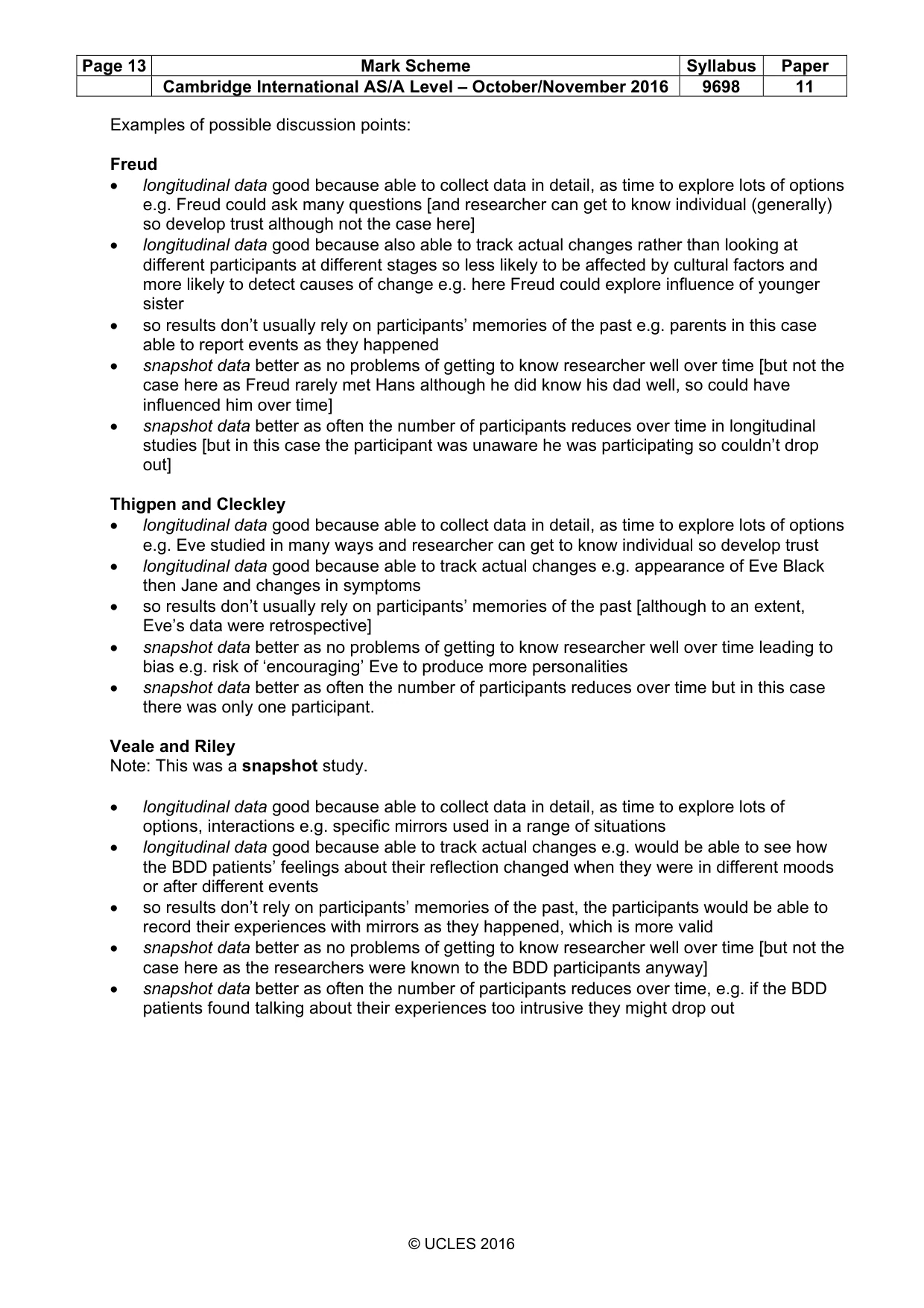
Page 13 Mark Scheme Syllabus Paper Cambridge International AS/A Level – October/November 2016 9698 11 © UCLES 2016 Examples of possible discussion points: Freud • longitudinal data good because able to collect data in detail, as time to explore lots of options e.g. Freud could ask many questions [and researcher can get to know individual (generally) so develop trust although not the case here] • longitudinal data good because also able to track actual changes rather than looking at different participants at different stages so less likely to be affected by cultural factors and more likely to detect causes of change e.g. here Freud could explore influence of younger sister • so results don’t usually rely on participants’ memories of the past e.g. parents in this case able to report events as they happened • snapshot data better as no problems of getting to know researcher well over time [but not the case here as Freud rarely met Hans although he did know his dad well, so could have influenced him over time] • snapshot data better as often the number of participants reduces over time in longitudinal studies [but in this case the participant was unaware he was participating so couldn’t drop out] Thigpen and Cleckley • longitudinal data good because able to collect data in detail, as time to explore lots of options e.g. Eve studied in many ways and researcher can get to know individual so develop trust • longitudinal data good because able to track actual changes e.g. appearance of Eve Black then Jane and changes in symptoms • so results don’t usually rely on participants’ memories of the past [although to an extent, Eve’s data were retrospective] • snapshot data better as no problems of getting to know researcher well over time leading to bias e.g. risk of ‘encouraging’ Eve to produce more personalities • snapshot data better as often the number of participants reduces over time but in this case there was only one participant. Veale and Riley Note: This was a snapshot study. • longitudinal data good because able to collect data in detail, as time to explore lots of options, interactions e.g. specific mirrors used in a range of situations • longitudinal data good because able to track actual changes e.g. would be able to see how the BDD patients’ feelings about their reflection changed when they were in different moods or after different events • so results don’t rely on participants’ memories of the past, the participants would be able to record their experiences with mirrors as they happened, which is more valid • snapshot data better as no problems of getting to know researcher well over time [but not the case here as the researchers were known to the BDD participants anyway] • snapshot data better as often the number of participants reduces over time, e.g. if the BDD patients found talking about their experiences too intrusive they might drop out
Mark scheme, page 14
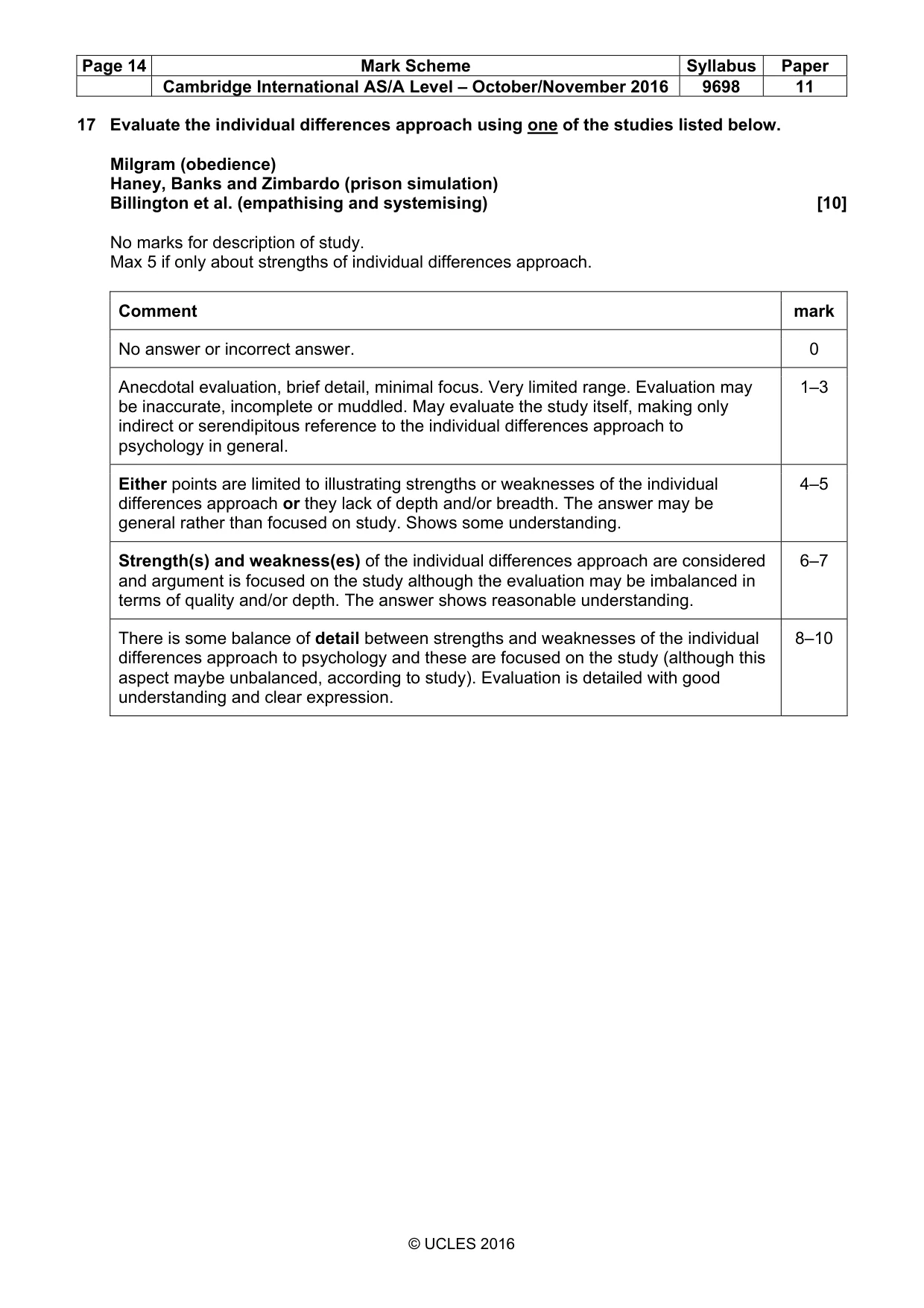
Page 14 Mark Scheme Syllabus Paper Cambridge International AS/A Level – October/November 2016 9698 11 © UCLES 2016 17 Evaluate the individual differences approach using one of the studies listed below. Milgram (obedience) Haney, Banks and Zimbardo (prison simulation) Billington et al. (empathising and systemising) [10] No marks for description of study. Max 5 if only about strengths of individual differences approach. Comment mark No answer or incorrect answer. 0 Anecdotal evaluation, brief detail, minimal focus. Very limited range. Evaluation may be inaccurate, incomplete or muddled. May evaluate the study itself, making only indirect or serendipitous reference to the individual differences approach to psychology in general. 1–3 Either points are limited to illustrating strengths or weaknesses of the individual differences approach or they lack of depth and/or breadth. The answer may be general rather than focused on study. Shows some understanding. 4–5 Strength(s) and weakness(es) of the individual differences approach are considered and argument is focused on the study although the evaluation may be imbalanced in terms of quality and/or depth. The answer shows reasonable understanding. 6–7 There is some balance of detail between strengths and weaknesses of the individual differences approach to psychology and these are focused on the study (although this aspect maybe unbalanced, according to study). Evaluation is detailed with good understanding and clear expression. 8–10
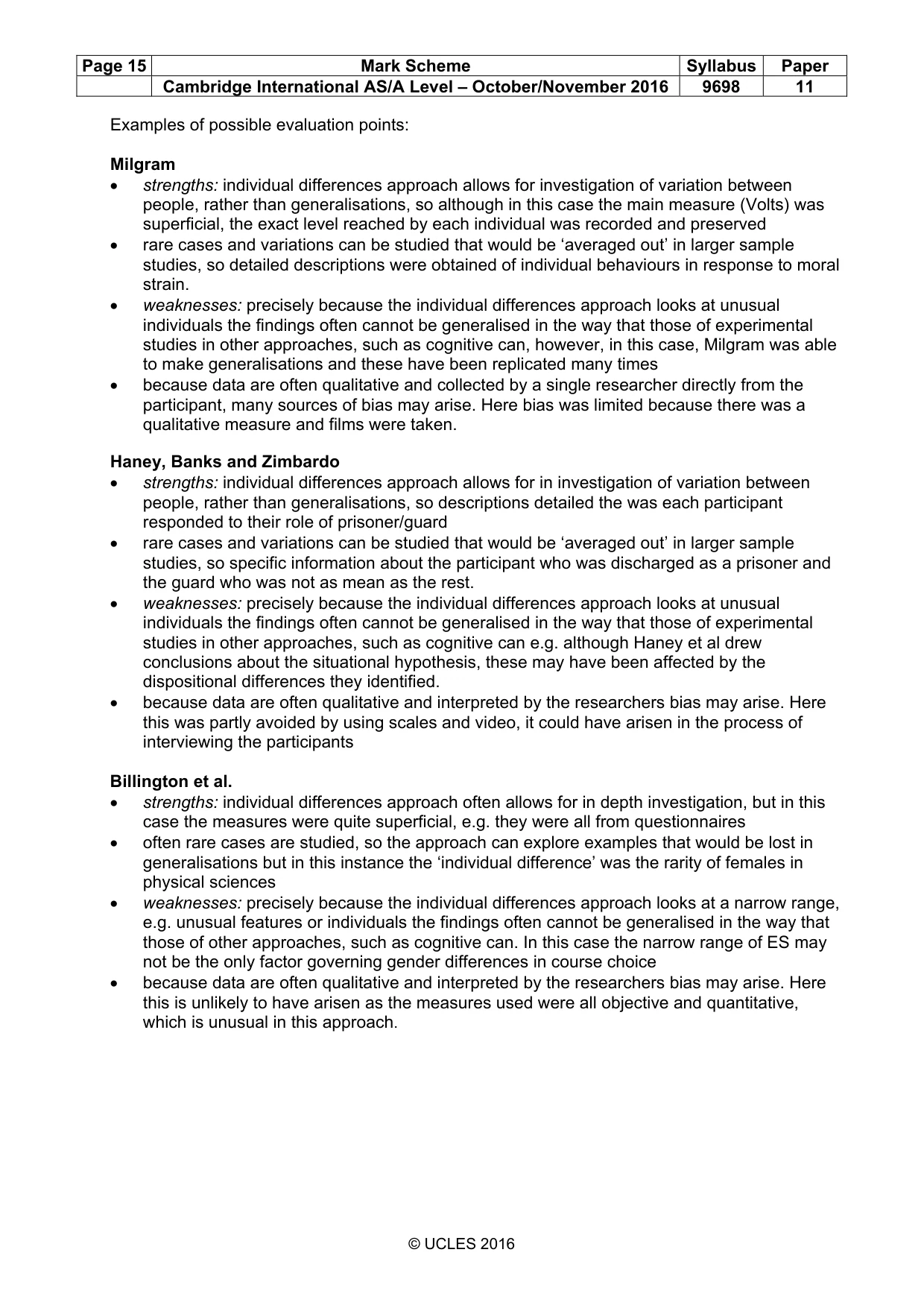
Mark scheme, page 15
Page 15 Mark Scheme Syllabus Paper Cambridge International AS/A Level – October/November 2016 9698 11 © UCLES 2016 Examples of possible evaluation points: Milgram • strengths: individual differences approach allows for investigation of variation between people, rather than generalisations, so although in this case the main measure (Volts) was superficial, the exact level reached by each individual was recorded and preserved • rare cases and variations can be studied that would be ‘averaged out’ in larger sample studies, so detailed descriptions were obtained of individual behaviours in response to moral strain. • weaknesses: precisely because the individual differences approach looks at unusual individuals the findings often cannot be generalised in the way that those of experimental studies in other approaches, such as cognitive can, however, in this case, Milgram was able to make generalisations and these have been replicated many times • because data are often qualitative and collected by a single researcher directly from the participant, many sources of bias may arise. Here bias was limited because there was a qualitative measure and films were taken. Haney, Banks and Zimbardo • strengths: individual differences approach allows for in investigation of variation between people, rather than generalisations, so descriptions detailed the was each participant responded to their role of prisoner/guard • rare cases and variations can be studied that would be ‘averaged out’ in larger sample studies, so specific information about the participant who was discharged as a prisoner and the guard who was not as mean as the rest. • weaknesses: precisely because the individual differences approach looks at unusual individuals the findings often cannot be generalised in the way that those of experimental studies in other approaches, such as cognitive can e.g. although Haney et al drew conclusions about the situational hypothesis, these may have been affected by the dispositional differences they identified. • because data are often qualitative and interpreted by the researchers bias may arise. Here this was partly avoided by using scales and video, it could have arisen in the process of interviewing the participants Billington et al. • strengths: individual differences approach often allows for in depth investigation, but in this case the measures were quite superficial, e.g. they were all from questionnaires • often rare cases are studied, so the approach can explore examples that would be lost in generalisations but in this instance the ‘individual difference’ was the rarity of females in physical sciences • weaknesses: precisely because the individual differences approach looks at a narrow range, e.g. unusual features or individuals the findings often cannot be generalised in the way that those of other approaches, such as cognitive can. In this case the narrow range of ES may not be the only factor governing gender differences in course choice • because data are often qualitative and interpreted by the researchers bias may arise. Here this is unlikely to have arisen as the measures used were all objective and quantitative, which is unusual in this approach.
What you needed in this session
Cambridge’s own grade thresholds for 2016 Oct/Nov, Paper 1 · Variant 1. A higher threshold means an easier paper — the bar moves with how the cohort did.