Questions as text
Q1 · State what is meant by a photon 9702/42 Feb/March 2017
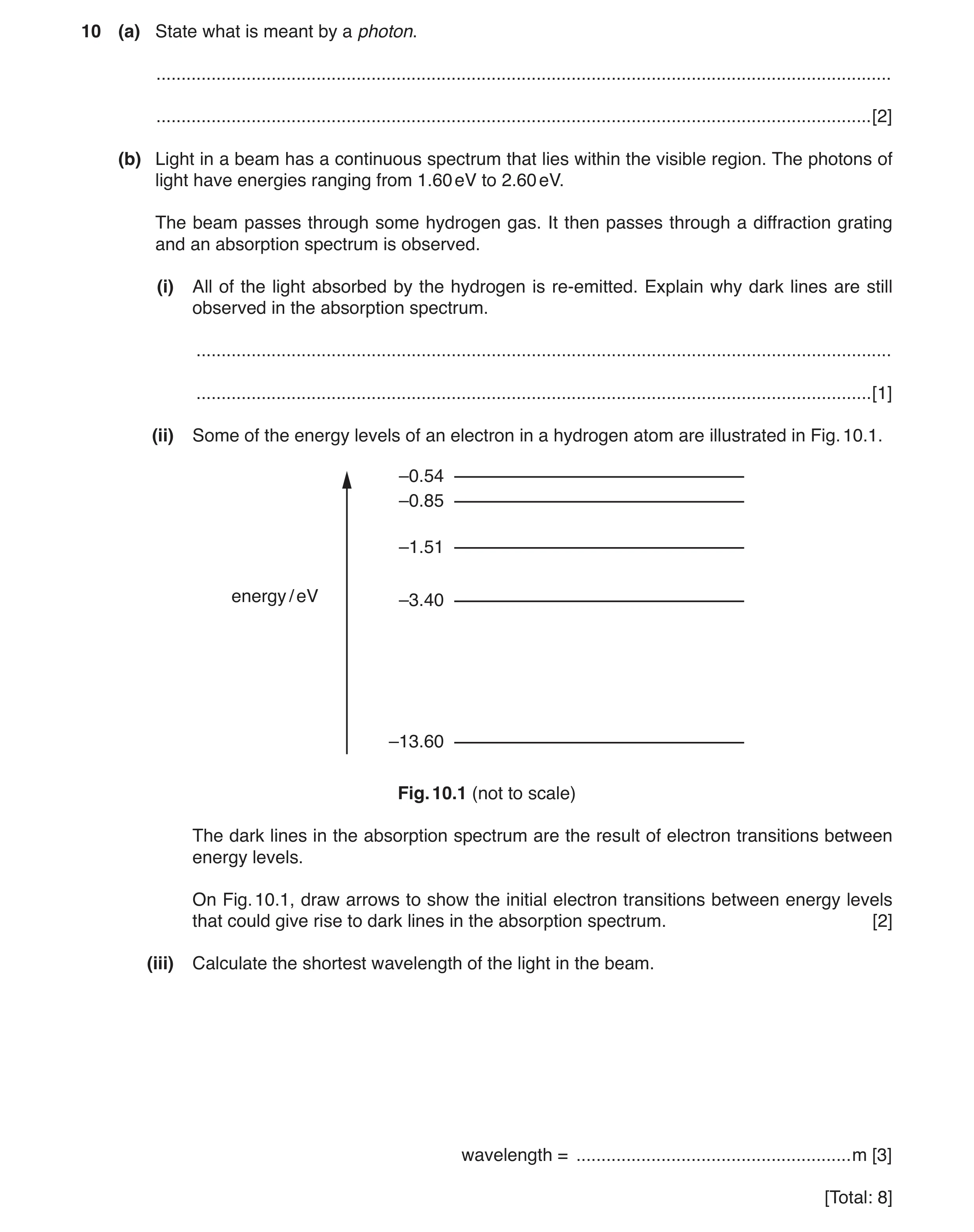
10 (a) State what is meant by a photon. … … [2] (b) Light in a beam has a continuous spectrum that lies within the visible region. The photons of light have energies ranging from 1.60 eV to 2.60 eV. The beam passes through some hydrogen gas. It then passes through a diffraction grating and an absorption spectrum is observed. (i) All of the light absorbed by the hydrogen is re-emitted. Explain why dark lines are still observed in the absorption spectrum. … … [1] (ii) Some of the energy levels of an electron in a hydrogen atom are illustrated in Fig. 10.1. –0.54 –0.85 –1.51 energy / eV –3.40 –13.60 Fig. 10.1 (not to scale) The dark lines in the absorption spectrum are the result of electron transitions between energy levels. On Fig. 10.1, draw arrows to show the initial electron transitions between energy levels that could give rise to dark lines in the absorption spectrum. [2] (iii) Calculate the shortest wavelength of the light in the beam. wavelength = … m [3] [Total: 8]
8 marks
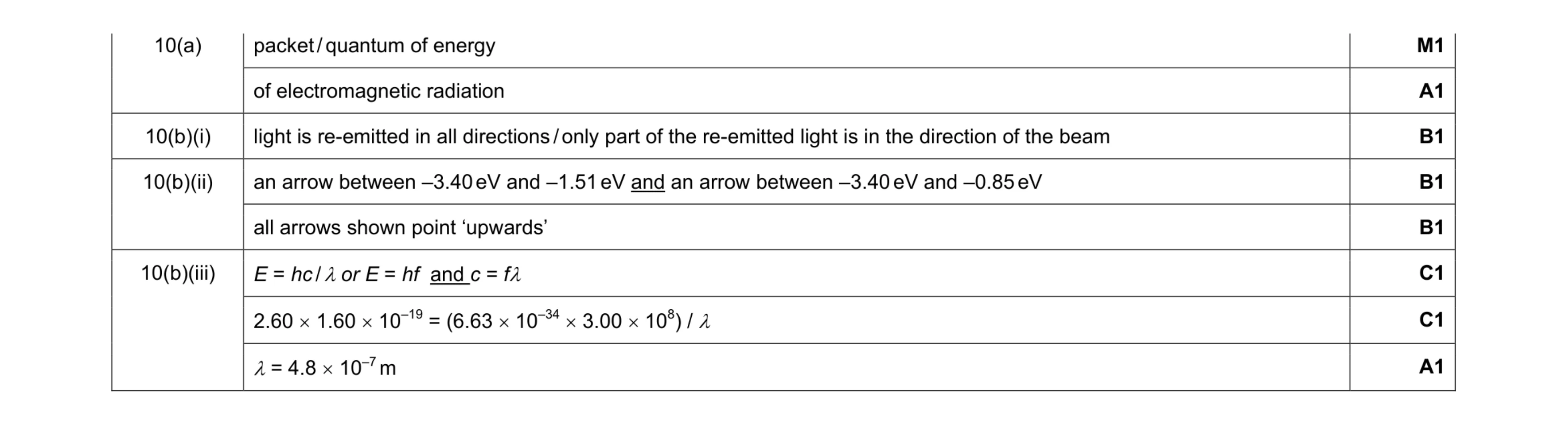
Mark scheme: 10(a) packet / quantum of energy M1 of electromagnetic radiation A1 10(b)(i) light is re-emitted in all directions / only part of the re-emitted light is in the direction of the beam B1 10(b)(ii) an arrow between –3.40 eV and –1.51 eV and an arrow between –3.40 eV and –0.85 eV B1 all arrows shown point ‘upwards’ B1 10(b)(iii) E = hc / λ or E = hf and c = fλ C1 2.60 × 1.60 × 10–19 = (6.63 × 10–34 × 3.00 × 108) / λ C1 λ = 4.8 × 10⁻⁷ m A1
This question in 9702/42 Feb/March 2017
Q2 · A beam of light consists of a continuous range of wavelengths from 420 nm to 740 nm 9702/41 May/June 2017
11 A beam of light consists of a continuous range of wavelengths from 420 nm to 740 nm. The light passes through a cloud of cool gas, as shown in Fig. 11.1. incident light emergent light cool gas wavelengths 420 nm – 740 nm Fig. 11.1 (a) The spectrum of the light emerging from the cloud of cool gas is viewed using a diffraction grating. Explain why this spectrum contains a number of dark lines. … … … … … … [4] (b) Some of the electron energy levels of the atoms in the cloud of gas are represented in Fig. 11.2. – 0.38 eV – 0.54 eV – 0.85 eV – 1.5 eV energy – 3.4 eV – 13.6 eV Fig. 11.2 (not to scale) (i) Light of wavelength 420 nm has a photon energy of 2.96 eV. Calculate the photon energy, in eV, of light of wavelength 740 nm. photon energy = … eV [2] (ii) Use data from (i) and your answer in (i) to show, on Fig. 11.2, the changes in energy levels giving rise to the dark lines in (a). [2] [Total: 8]
8 marks
Mark scheme: 11(a) electrons (in gas atoms/molecules) interact with photons B1 photon energy causes electron to move to higher energy level/to be excited B1 photon energy = difference in energy of (electron) energy levels B1 when electrons de-excite, photons emitted in all directions (so dark line) B1 11(b)(i) photon energy ∝ 1 / λ C1 energy = 1.68 eV A1 or E = hc / λ E = 6.63 × 10–34 × 3.0 × 108 / (740 × 10–9) = 2.688 × 10⁻¹⁹ J (C1) energy = 1.68 eV (A1) 11(b)(ii) 3.4 eV → 1.5 eV 3.4 eV → 0.85 eV 3.4 eV → 0.54 eV all correct and none incorrect 2/2 2 correct and 1 incorrect or only 2 correctly drawn 1/2 B2
This question in 9702/41 May/June 2017
Q3 · A beam of light consists of a continuous range of wavelengths from 420 nm to 740 nm 9702/43 May/June 2017
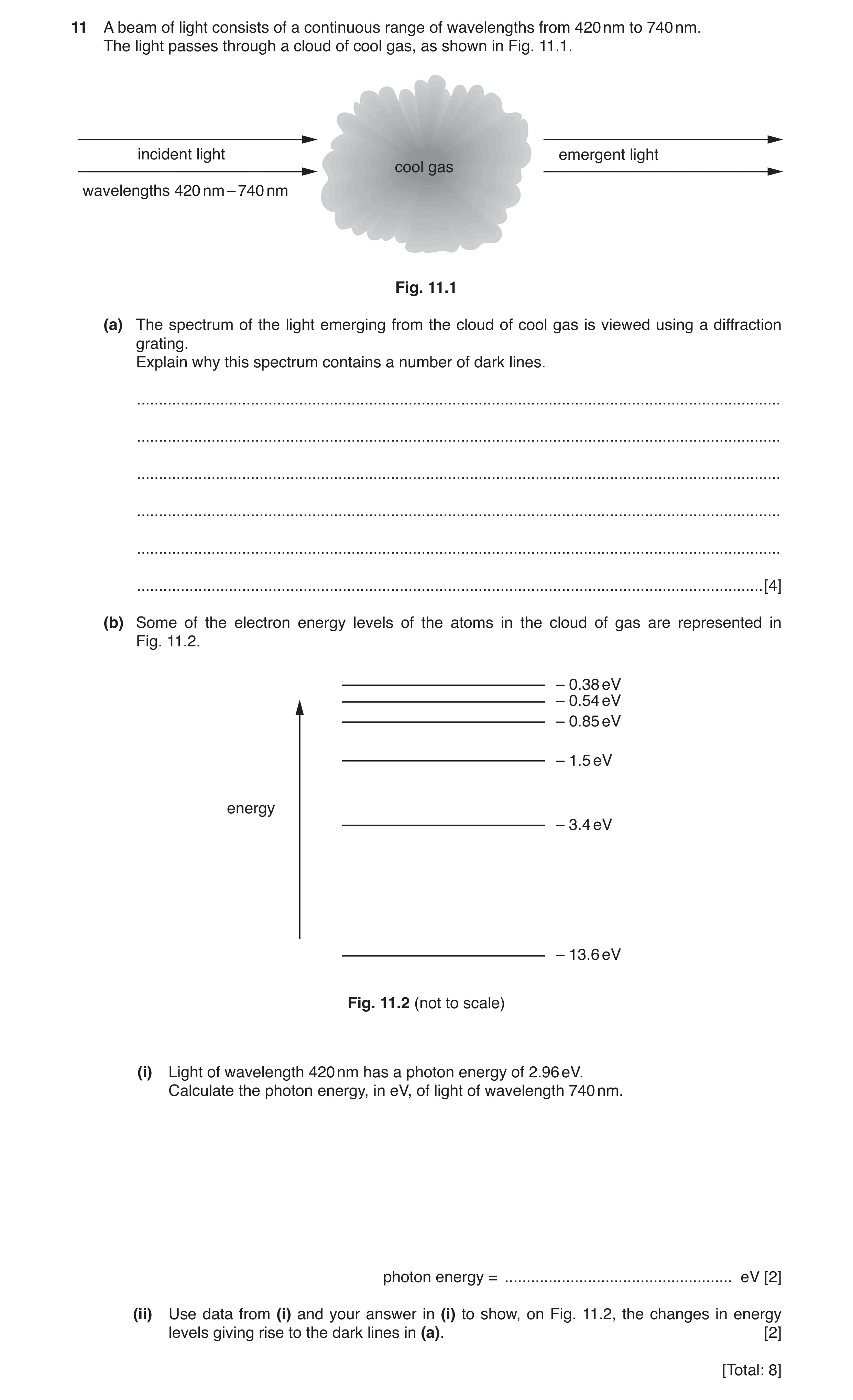
11 A beam of light consists of a continuous range of wavelengths from 420 nm to 740 nm. The light passes through a cloud of cool gas, as shown in Fig. 11.1. incident light emergent light cool gas wavelengths 420 nm – 740 nm Fig. 11.1 (a) The spectrum of the light emerging from the cloud of cool gas is viewed using a diffraction grating. Explain why this spectrum contains a number of dark lines. … … … … … … [4] (b) Some of the electron energy levels of the atoms in the cloud of gas are represented in Fig. 11.2. – 0.38 eV – 0.54 eV – 0.85 eV – 1.5 eV energy – 3.4 eV – 13.6 eV Fig. 11.2 (not to scale) (i) Light of wavelength 420 nm has a photon energy of 2.96 eV. Calculate the photon energy, in eV, of light of wavelength 740 nm. photon energy = … eV [2] (ii) Use data from (i) and your answer in (i) to show, on Fig. 11.2, the changes in energy levels giving rise to the dark lines in (a). [2] [Total: 8]
8 marks
Mark scheme: 11(a) electrons (in gas atoms/molecules) interact with photons B1 photon energy causes electron to move to higher energy level/to be excited B1 photon energy = difference in energy of (electron) energy levels B1 when electrons de-excite, photons emitted in all directions (so dark line) B1 11(b)(i) photon energy ∝ 1 / λ C1 energy = 1.68 eV A1 or E = hc / λ E = 6.63 × 10–34 × 3.0 × 108 / (740 × 10–9) = 2.688 × 10⁻¹⁹ J (C1) energy = 1.68 eV (A1) 11(b)(ii) 3.4 eV → 1.5 eV 3.4 eV → 0.85 eV 3.4 eV → 0.54 eV all correct and none incorrect 2/2 2 correct and 1 incorrect or only 2 correctly drawn 1/2 B2
This question in 9702/43 May/June 2017
Q4 · Some of the electron energy bands in a semiconductor material at the absolute zero of… 9702/41 Oct/Nov 2018
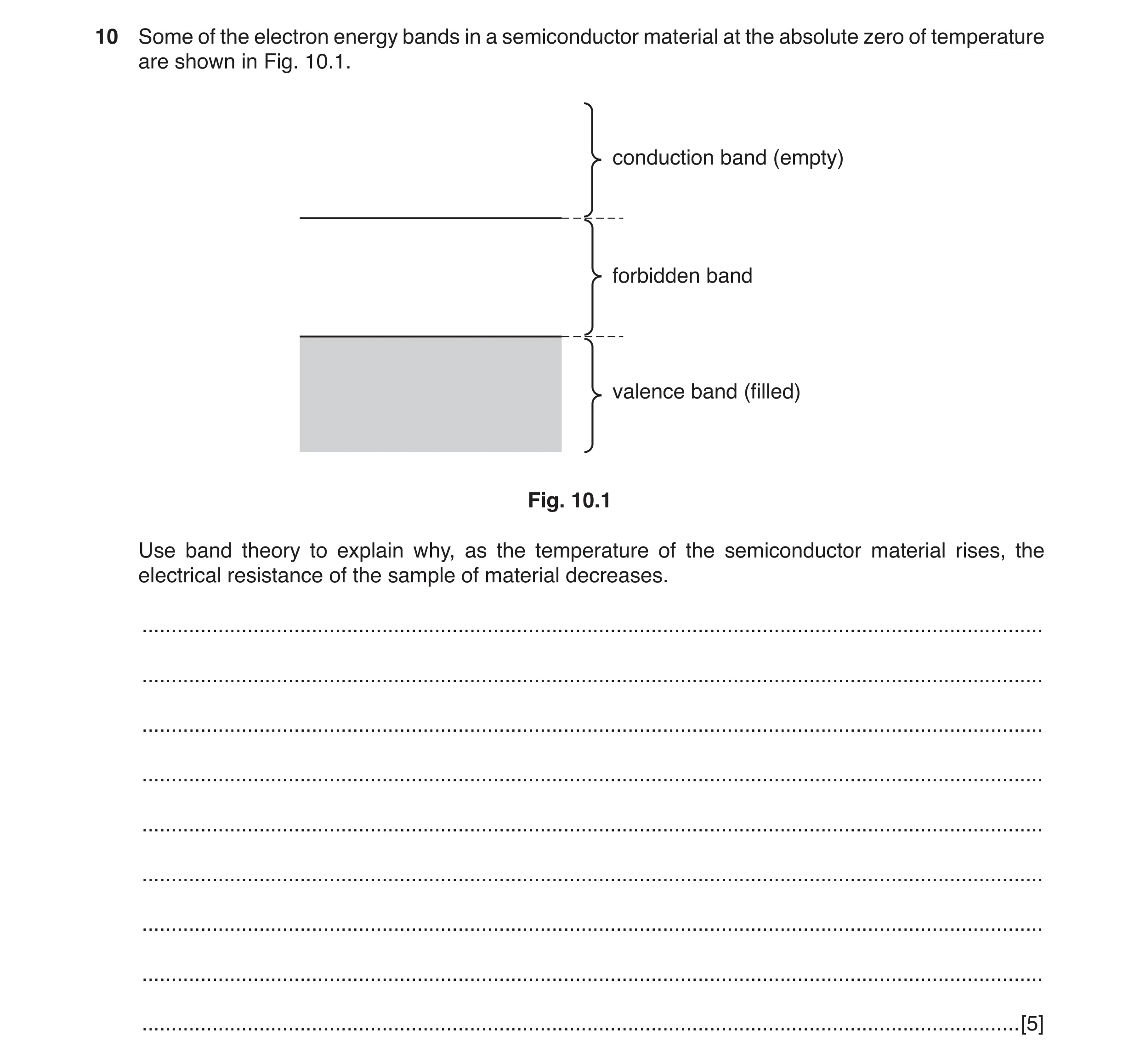
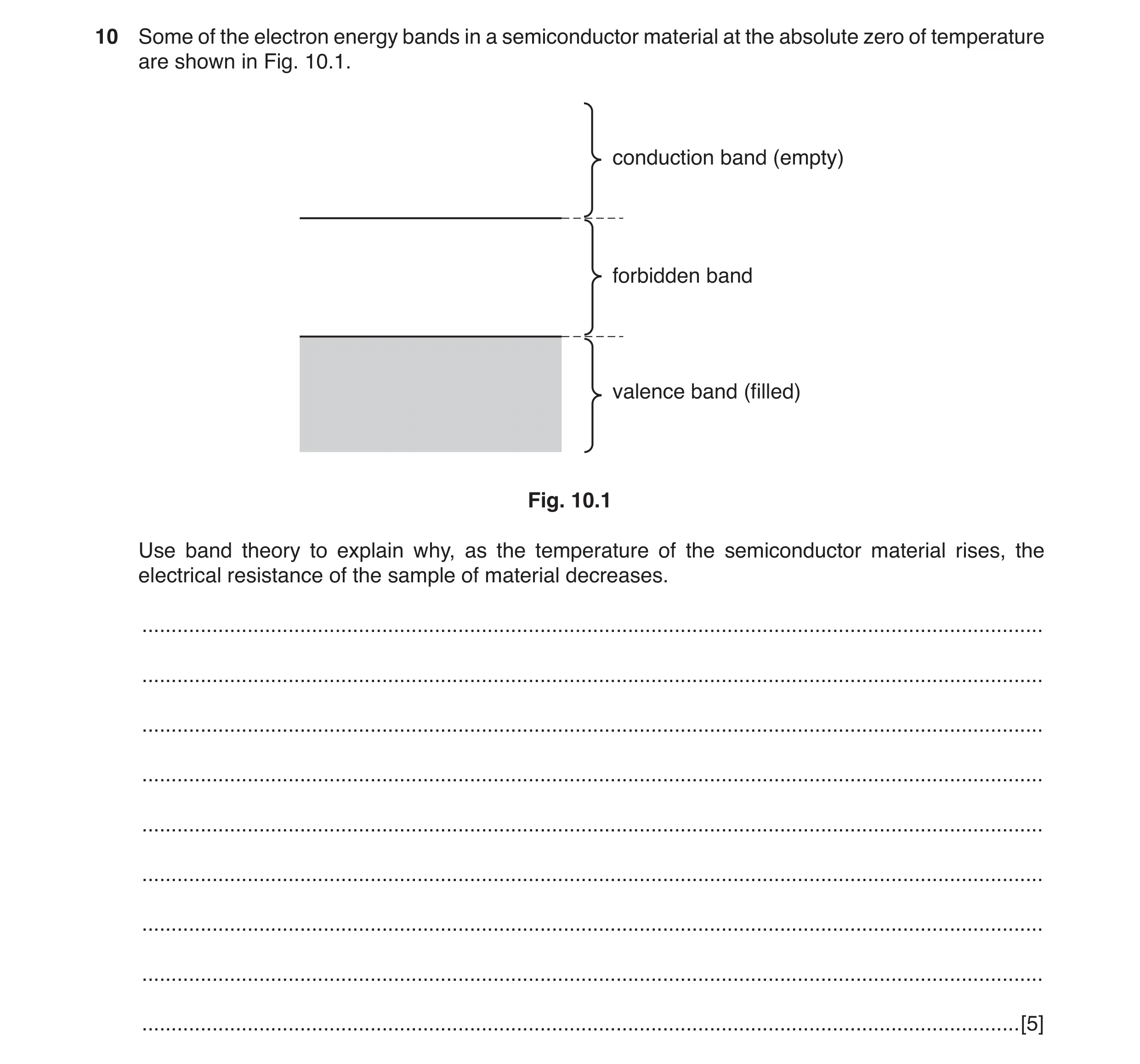
10 Some of the electron energy bands in a semiconductor material at the absolute zero of temperature are shown in Fig. 10.1. conduction band (empty) forbidden band valence band (filled) Fig. 10.1 Use band theory to explain why, as the temperature of the semiconductor material rises, the electrical resistance of the sample of material decreases. … … … … … … … … … [5]
5 marks
Mark scheme: 10 Any five points from: • as temperature rises electrons gain energy • electrons enter conduction band • (positively charged) holes left in valence band • more charge carriers (so resistance decreases) • (as temperature rises,) lattice vibrations increase • effect of increase in number of electrons or holes or charge carriers outweighs effect of increased lattice vibrations (so resistance decreases) B5
This question in 9702/41 Oct/Nov 2018
Q5 · State what is meant by a photon 9702/42 Oct/Nov 2018
11 (a) State what is meant by a photon. … … … [2] (b) Describe the appearance of a visible line emission spectrum, as seen using a diffraction grating. … … … … [2] (c) The lowest electron energy levels in an isolated hydrogen atom are shown in Fig. 11.1. – 0.54 – 0.38 – 0.85 –1.50 – 3.40 energy / eV –13.6 Fig. 11.1 (not to scale) (i) An electron is initially at the energy level –0.85 eV. State the total number of different wavelengths that may be emitted as the electron de-excites (loses energy). number = … [1] (ii) Photons resulting from electron de-excitation from the –0.85 eV energy level are incident on the surface of a sample of platinum. Platinum has a work function energy of 5.6 eV. Determine 1. the maximum kinetic energy, in eV, of a photoelectron emitted from the surface of the platinum, maximum energy = … eV [2] 2. the wavelength of the photon producing the photoelectron in (ii) part 1. wavelength = … m [3] [Total: 10]
10 marks
Mark scheme: 11(a) discrete amount/quantum/packet of energy M1 of electromagnetic radiation A1 11(b) mostly dark/dark background B1 coloured lines B1 11(c)(i) 6 A1 11(c)(ii) 1. maximum photon energy = 13.6 – 0.85 (= 12.75 eV) C1 maximum kinetic energy = (13.6 – 0.85) – 5.6 = 7.2 eV A1 2. energy = hc / λ C1 λ = (6.63 × 10–34 × 3.00 × 108) / [(13.6 – 0.85) × 1.60 × 10–19] C1 = 9.8 × 10⁻⁸ m A1
This question in 9702/42 Oct/Nov 2018
Q6 · Some of the electron energy bands in a semiconductor material at the absolute zero of… 9702/43 Oct/Nov 2018
10 Some of the electron energy bands in a semiconductor material at the absolute zero of temperature are shown in Fig. 10.1. conduction band (empty) forbidden band valence band (filled) Fig. 10.1 Use band theory to explain why, as the temperature of the semiconductor material rises, the electrical resistance of the sample of material decreases. … … … … … … … … … [5]
5 marks
Mark scheme: 10 Any five points from: • as temperature rises electrons gain energy • electrons enter conduction band • (positively charged) holes left in valence band • more charge carriers (so resistance decreases) • (as temperature rises,) lattice vibrations increase • effect of increase in number of electrons or holes or charge carriers outweighs effect of increased lattice vibrations (so resistance decreases) B5
This question in 9702/43 Oct/Nov 2018
Q7 · State what is meant by a photon 9702/42 Feb/March 2019
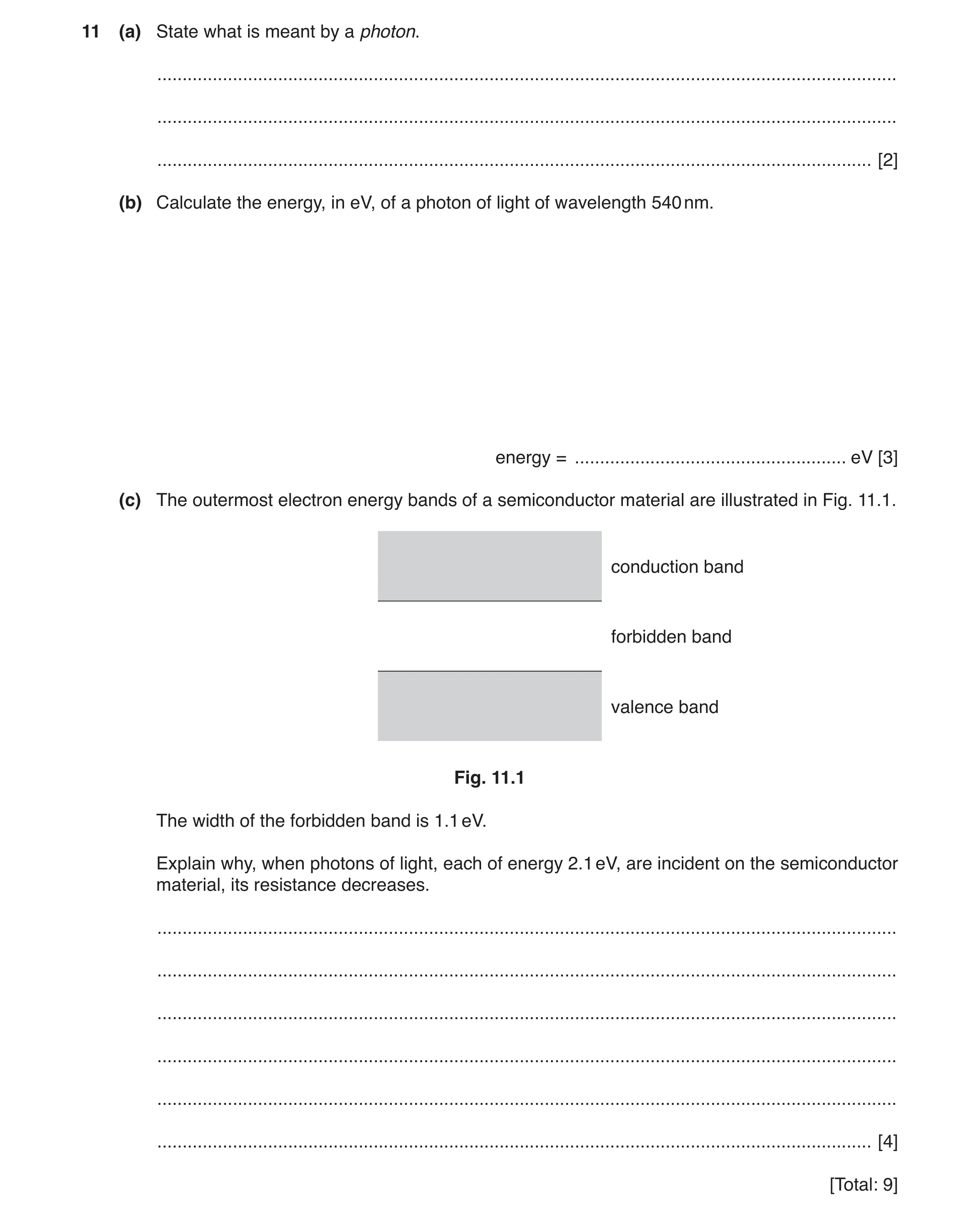
11 (a) State what is meant by a photon. … … … [2] (b) Calculate the energy, in eV, of a photon of light of wavelength 540 nm. energy = … eV [3] (c) The outermost electron energy bands of a semiconductor material are illustrated in Fig. 11.1. conduction band forbidden band valence band Fig. 11.1 The width of the forbidden band is 1.1 eV. Explain why, when photons of light, each of energy 2.1 eV, are incident on the semiconductor material, its resistance decreases. … … … … … … [4] [Total: 9]
9 marks
Mark scheme: 11(a) quantum / packet / discrete amount of energy M1 of electromagnetic radiation A1 11(b) E = hc / λ C1 = (6.63 × 10–34 × 3.0 × 108) / (540 × 10–9) C1 = (3.68 × 10⁻¹⁹) / (1.6 × 10⁻¹⁹) = 2.3 eV A1 11(c) Any 4 from: photon absorbed by electron in valence band (1) photon energy > energy of forbidden band (1) electron promoted to conduction band (1) hole left in valence band (1) more charge carriers so lower resistance (1) B4
This question in 9702/42 Feb/March 2019
Q8 · White light passes through a cloud of cool low-pressure gas, as illustrated in Fig 9702/41 May/June 2020
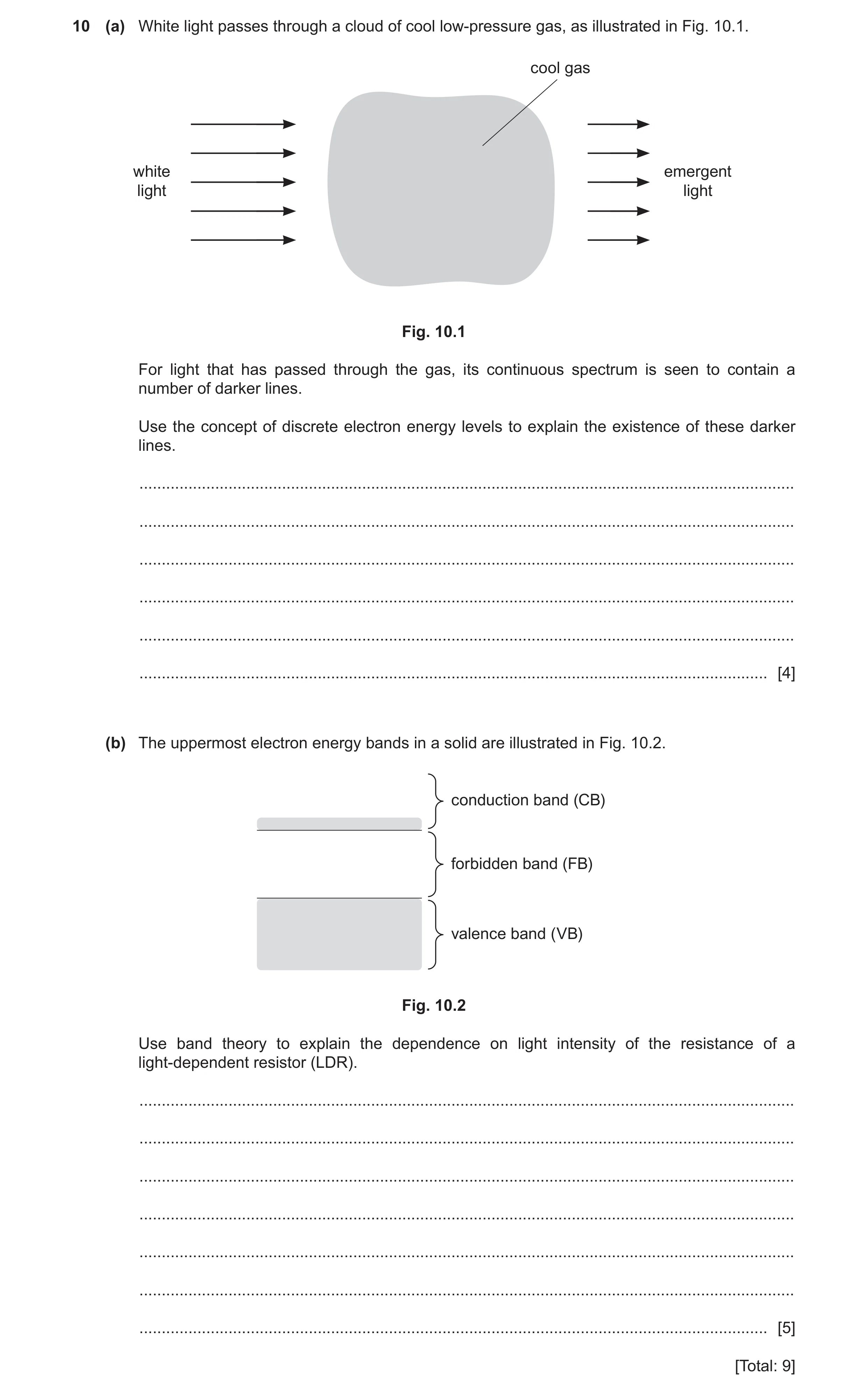
10 (a) White light passes through a cloud of cool low-pressure gas, as illustrated in Fig. 10.1. cool gas white emergent light light Fig. 10.1 For light that has passed through the gas, its continuous spectrum is seen to contain a number of darker lines. Use the concept of discrete electron energy levels to explain the existence of these darker lines. … … … … … … [4] (b) The uppermost electron energy bands in a solid are illustrated in Fig. 10.2. conduction band (CB) forbidden band (FB) valence band (VB) Fig. 10.2 Use band theory to explain the dependence on light intensity of the resistance of a light-dependent resistor (LDR). … … … … … … … [5] [Total: 9]
9 marks
Mark scheme: 10(a) • photon gives energy to electron (in an inner shell) or electron (in an inner shell) absorbs a photon • electron moves (from lower) to higher energy level • energy (of photon) is equal to difference in energy levels • electron de-excites giving off photon (of same energy) • photons emitted in all directions Any four points, 1 mark each B4 10(b) (in light) photons gives energy to electrons in VB or (in light) electrons in VB absorb photons B1 electron crosses FB/jumps to CB B1 (positive) holes left/created in VB B1 low intensity: few electrons in CB/most electrons in VB or high intensity: more photons so more electrons in CB or electron-hole pairs are charge carriers B1 more charge carriers results in lower resistance B1
This question in 9702/41 May/June 2020
Q9 · White light passes through a cloud of cool low-pressure gas, as illustrated in Fig 9702/43 May/June 2020
10 (a) White light passes through a cloud of cool low-pressure gas, as illustrated in Fig. 10.1. cool gas white emergent light light Fig. 10.1 For light that has passed through the gas, its continuous spectrum is seen to contain a number of darker lines. Use the concept of discrete electron energy levels to explain the existence of these darker lines. … … … … … … [4] (b) The uppermost electron energy bands in a solid are illustrated in Fig. 10.2. conduction band (CB) forbidden band (FB) valence band (VB) Fig. 10.2 Use band theory to explain the dependence on light intensity of the resistance of a light-dependent resistor (LDR). … … … … … … … [5] [Total: 9]
9 marks
Mark scheme: 10(a) • photon gives energy to electron (in an inner shell) or electron (in an inner shell) absorbs a photon • electron moves (from lower) to higher energy level • energy (of photon) is equal to difference in energy levels • electron de-excites giving off photon (of same energy) • photons emitted in all directions Any four points, 1 mark each B4 10(b) (in light) photons gives energy to electrons in VB or (in light) electrons in VB absorb photons B1 electron crosses FB/jumps to CB B1 (positive) holes left/created in VB B1 low intensity: few electrons in CB/most electrons in VB or high intensity: more photons so more electrons in CB or electron-hole pairs are charge carriers B1 more charge carriers results in lower resistance B1
This question in 9702/43 May/June 2020
Q10 · The visible part of the emission spectrum from hydrogen gas in a laboratory on the Earth 9702/42 Oct/Nov 2022
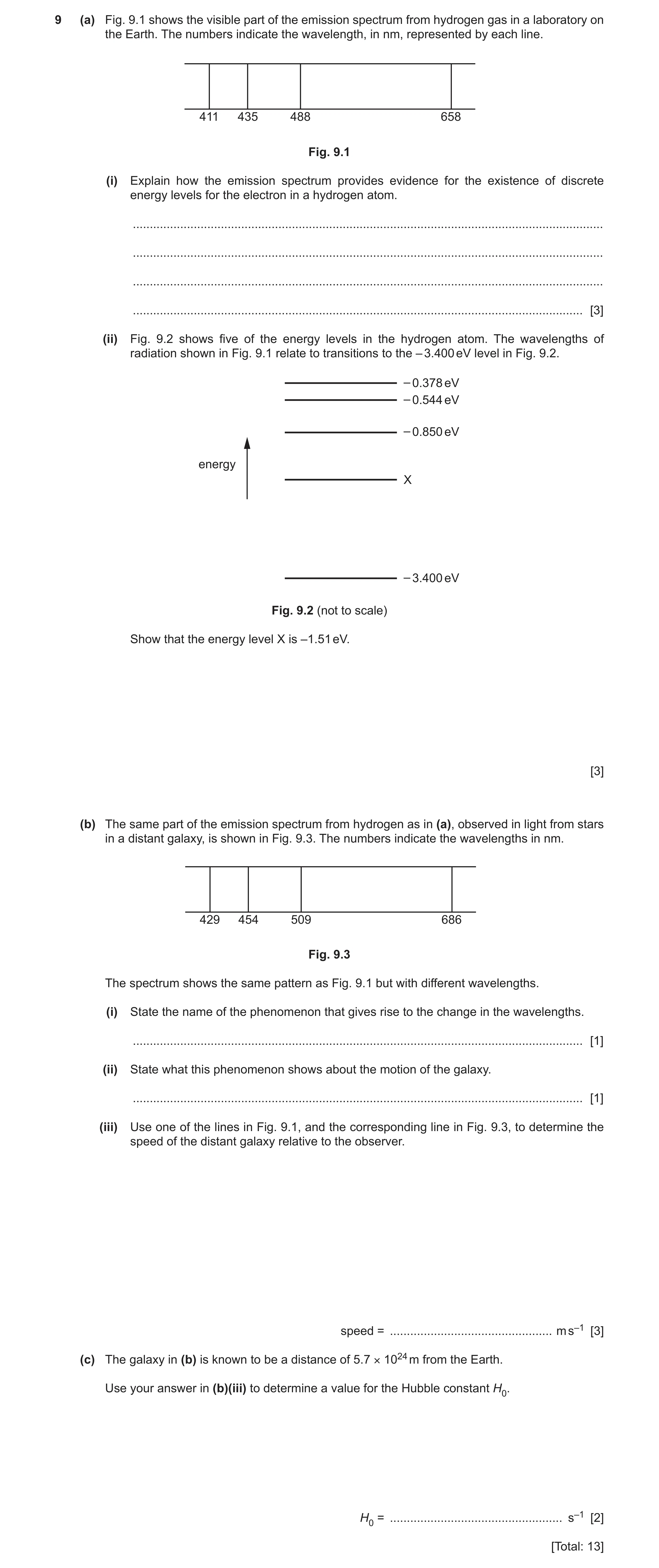
9 (a) Fig. 9.1 shows the visible part of the emission spectrum from hydrogen gas in a laboratory on the Earth. The numbers indicate the wavelength, in nm, represented by each line. 411 435 488 658 Fig. 9.1 (i) Explain how the emission spectrum provides evidence for the existence of discrete energy levels for the electron in a hydrogen atom. … … … … [3] (ii) Fig. 9.2 shows five of the energy levels in the hydrogen atom. The wavelengths of radiation shown in Fig. 9.1 relate to transitions to the – 3.400 eV level in Fig. 9.2. – 0.378 eV – 0.544 eV – 0.850 eV energy X – 3.400 eV Fig. 9.2 (not to scale) Show that the energy level X is –1.51 eV. [3] (b) The same part of the emission spectrum from hydrogen as in (a), observed in light from stars in a distant galaxy, is shown in Fig. 9.3. The numbers indicate the wavelengths in nm. 429 454 509 686 Fig. 9.3 The spectrum shows the same pattern as Fig. 9.1 but with different wavelengths. (i) State the name of the phenomenon that gives rise to the change in the wavelengths. … [1] (ii) State what this phenomenon shows about the motion of the galaxy. … [1] (iii) Use one of the lines in Fig. 9.1, and the corresponding line in Fig. 9.3, to determine the speed of the distant galaxy relative to the observer. speed = … m s–1 [3] (c) The galaxy in (b) is known to be a distance of 5.7 × 1024 m from the Earth. Use your answer in (b)(iii) to determine a value for the Hubble constant H0. H0 = … s–1 [2] [Total: 13]
13 marks
Mark scheme: 9(a)(i) • energy of photon has a corresponding frequency B3 • change in electron energy level emits a single photon • photon energy = difference in energy levels • discrete frequencies must have come from discrete energy gaps • discrete energy changes imply discrete energy levels Any three points, 1 mark each 9(a)(ii) transition (to – 3.400 eV) from X corresponds to 658 nm line C1 E1 – E2 = hc / C1 E1 – (– 3.400) = (6.63 10–34 3.00 108) / (658 10–9 1.60 10–19) A1 and so E1 = –1.51 eV (full substitution and answer needed) 9(b)(i) redshift B1 9(b)(ii) moving away (from observer) B1 9(b)(iii) / = v / c C1 e.g. for 658 nm line: = 686 – 658 ( = 28 nm) (other lines may be used) 28 / 658 = v / (3.00 108) (other lines may be used) C1 v = 1.3 107 m s–1 A1 9(c) v = H0d C1 H0 = (1.3 107) / (5.7 1024) A1 = 2.3 10–18 s–1
This question in 9702/42 Oct/Nov 2022
Q11 · A beam of white light passes through a cloud of cool gas 9702/42 Feb/March 2023
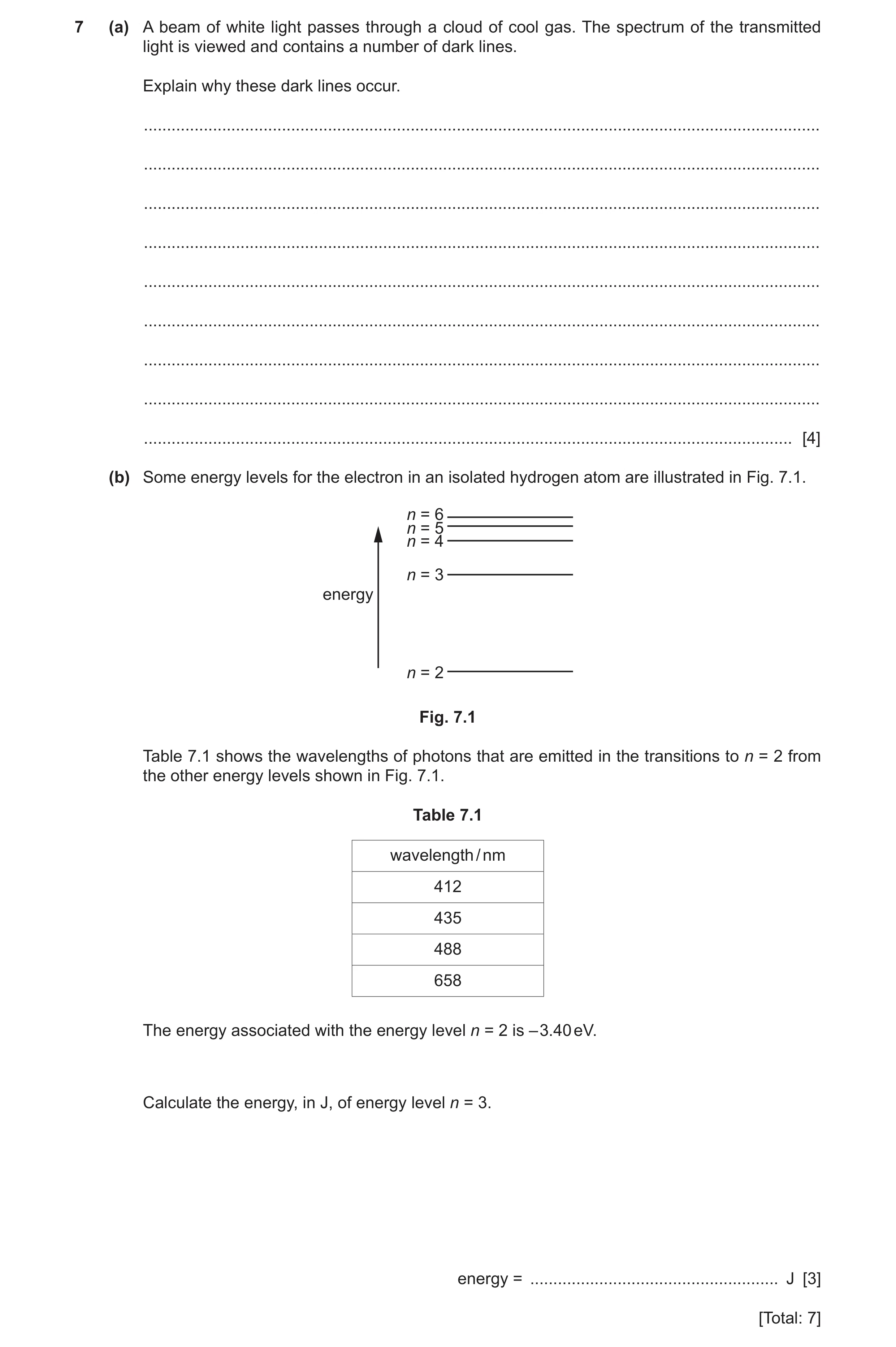
7 (a) A beam of white light passes through a cloud of cool gas. The spectrum of the transmitted light is viewed and contains a number of dark lines. Explain why these dark lines occur. … … … … … … … … … [4] (b) Some energy levels for the electron in an isolated hydrogen atom are illustrated in Fig. 7.1. n = 6 n = 5 n = 4 n = 3 energy n = 2 Fig. 7.1 Table 7.1 shows the wavelengths of photons that are emitted in the transitions to n = 2 from the other energy levels shown in Fig. 7.1. Table 7.1 wavelength / nm 412 435 488 658 The energy associated with the energy level n = 2 is – 3.40 eV. Calculate the energy, in J, of energy level n = 3. energy = … J [3] [Total: 7]
7 marks
Mark scheme: 7(a) photon absorbed (by electron) and electron excited B1 photon energy equal to difference in (energy of two) energy levels B1 photon energy relates to a single wavelength / single frequency B1 electron de-excites and emits photon in any direction B1 7(b) hc C1 = E uses 658 nm C1 6.63 1 0 –34 3.00 1 0 8 A1 –9 = – E1 – (–3.40 × 1.60 × 10–19) 658 1 0 E1 = –2.42 10–19 J
This question in 9702/42 Feb/March 2023
Q12 · The lowest four energy levels of an electron in an isolated atom 9702/42 May/June 2023
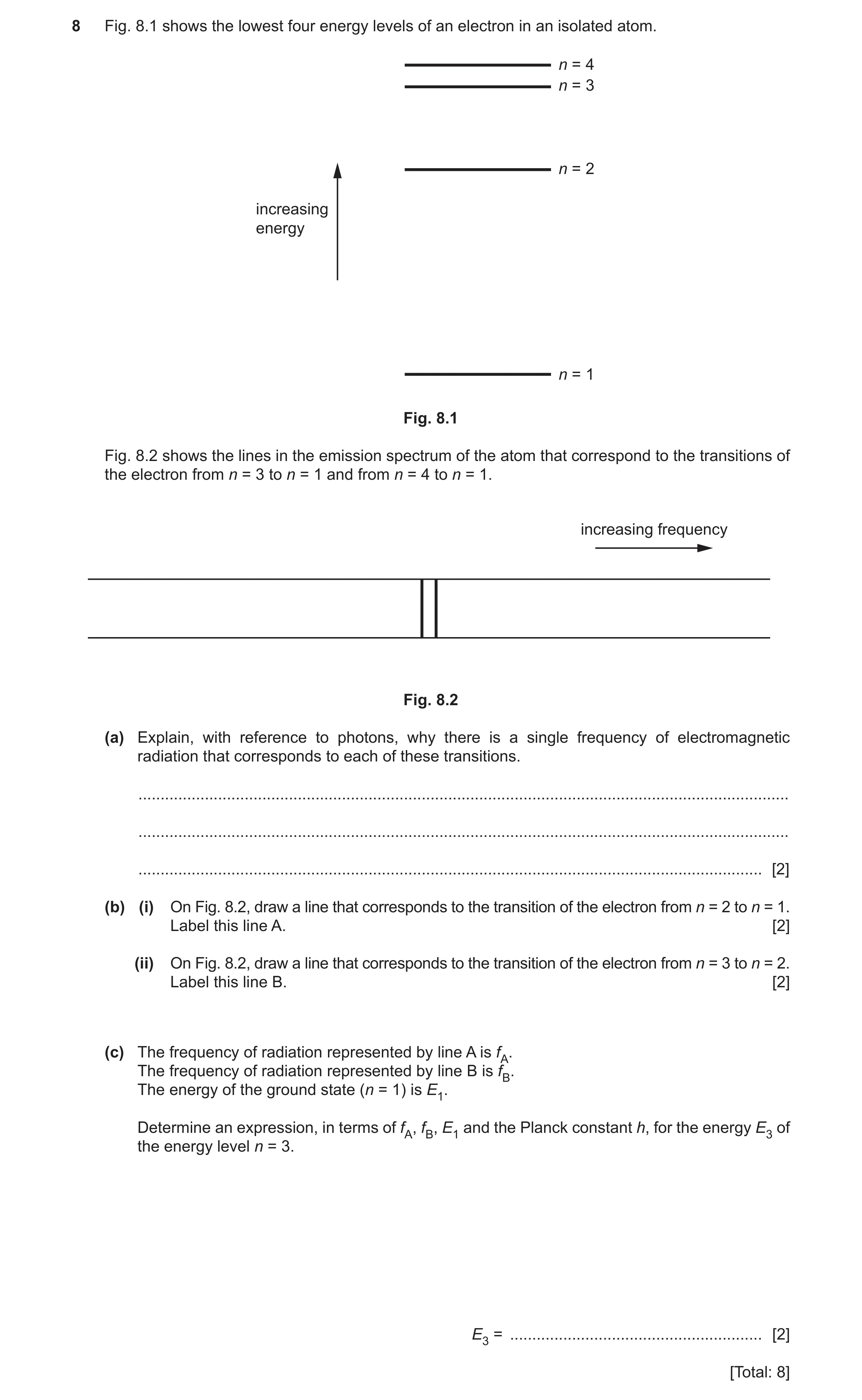
8 Fig. 8.1 shows the lowest four energy levels of an electron in an isolated atom. n = 4 n = 3 n = 2 increasing energy n = 1 Fig. 8.1 Fig. 8.2 shows the lines in the emission spectrum of the atom that correspond to the transitions of the electron from n = 3 to n = 1 and from n = 4 to n = 1. increasing frequency Fig. 8.2 (a) Explain, with reference to photons, why there is a single frequency of electromagnetic radiation that corresponds to each of these transitions. … … … [2] (b) (i) On Fig. 8.2, draw a line that corresponds to the transition of the electron from n = 2 to n = 1. Label this line A. [2] (ii) On Fig. 8.2, draw a line that corresponds to the transition of the electron from n = 3 to n = 2. Label this line B. [2] (c) The frequency of radiation represented by line A is fA. The frequency of radiation represented by line B is fB. The energy of the ground state (n = 1) is E1. Determine an expression, in terms of fA, fB, E1 and the Planck constant h, for the energy E3 of the energy level n = 3. E3 = … [2] [Total: 8]
8 marks
Mark scheme: 8(a) transition (emits) (one) photon with energy equal to the difference in energy between the two levels B1 frequency of radiation corresponds to energy of photon B1 8(b)(i) line to the left of the pair in Fig. 8.2, labelled A B1 larger gap between line A and the nearest of the pair in Fig. 8.2 than between the lines in the pair B1 8(b)(ii) line to the left of both the pair in Fig. 8.2 and line A, labelled B B1 larger gap between line B and line A than between line A and the nearest one of the pair in Fig. 8.2 B1 8(c) E = hf C1 E3 = E1 + h(fA + fB) A1
This question in 9702/42 May/June 2023
Q13 · State what is meant by a photon 9702/41 Oct/Nov 2025
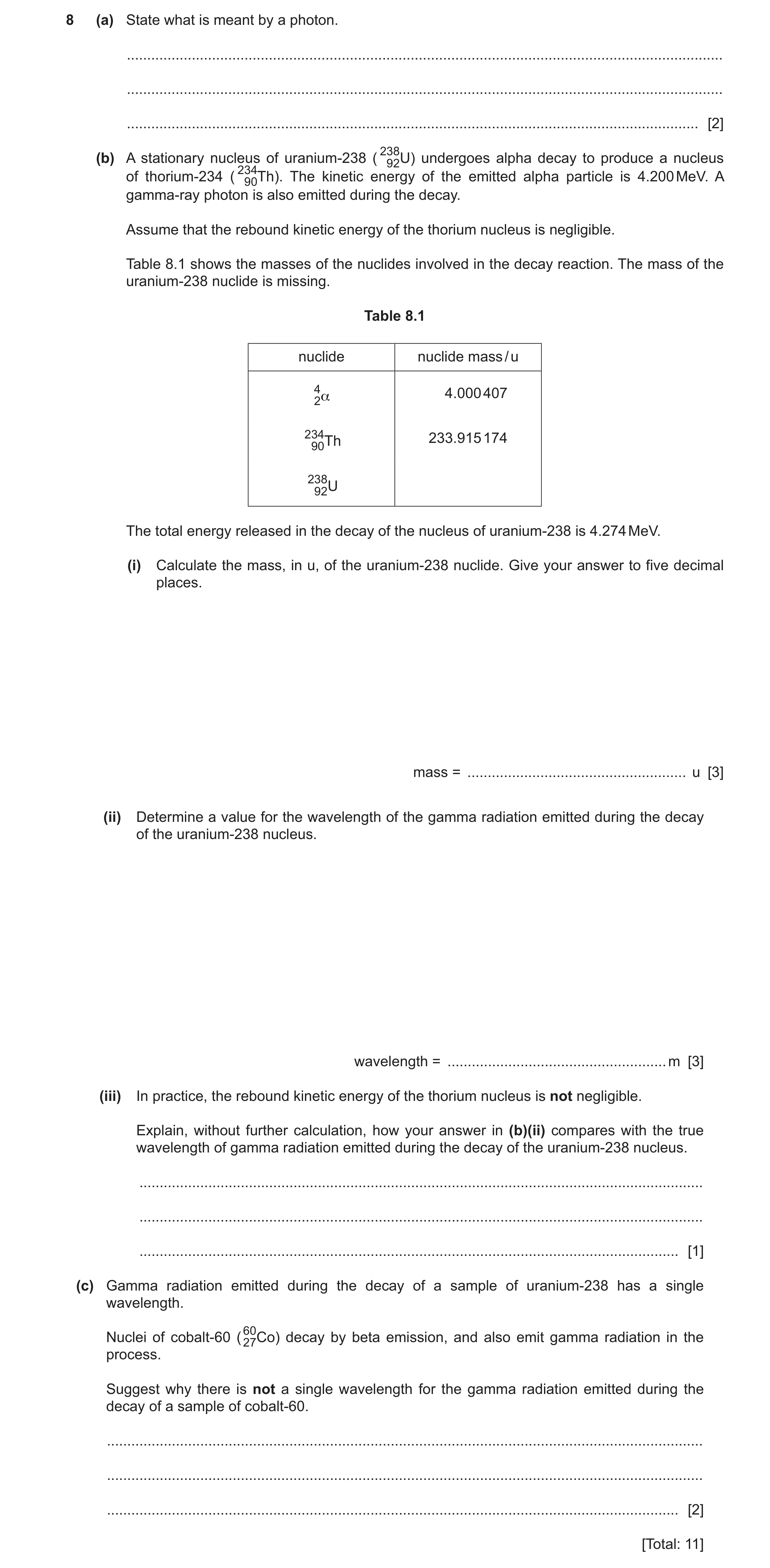
8 (a) State what is meant by a photon. … … … [2] 238 (b) A stationary nucleus of uranium-238 ( 92U) undergoes alpha decay to produce a nucleus 234 of thorium-234 ( 90Th). The kinetic energy of the emitted alpha particle is 4.200 MeV. A gamma-ray photon is also emitted during the decay. Assume that the rebound kinetic energy of the thorium nucleus is negligible. Table 8.1 shows the masses of the nuclides involved in the decay reaction. The mass of the uranium-238 nuclide is missing. Table 8.1 nuclide nuclide mass / u 4 4.000 407 2α 234 233.915 174 90Th 238 92U The total energy released in the decay of the nucleus of uranium-238 is 4.274 MeV. (i) Calculate the mass, in u, of the uranium-238 nuclide. Give your answer to five decimal places. mass = … u [3] (ii) Determine a value for the wavelength of the gamma radiation emitted during the decay of the uranium-238 nucleus. wavelength = … m [3] (iii) In practice, the rebound kinetic energy of the thorium nucleus is not negligible. Explain, without further calculation, how your answer in (b)(ii) compares with the true wavelength of gamma radiation emitted during the decay of the uranium-238 nucleus. … … … [1] (c) Gamma radiation emitted during the decay of a sample of uranium-238 has a single wavelength. decay by beta emission, and also emit gamma radiation in the Nuclei of cobalt-60 (6027Co) process. Suggest why there is not a single wavelength for the gamma radiation emitted during the decay of a sample of cobalt-60. … … … [2] [Total: 11]
11 marks
Mark scheme: 8(a) packet / quantum of energy M1 of electromagnetic radiation A1 8(b)(i) E = c2m C1 m = (4.274 106 1.60 10–19) / (1.66 10–27 (3.00 108)2) C1 ( = 0.00458 u) m = 233.915174 + 4.000407 + 0.00458 A1 = 237.92016 u 8(b)(ii) E = hc / C1 or E = hf and c = f (4.274 – 4.200) 1.60 10–13 = (6.63 10–34 3.00 108) / C1 = 1.7 10–11 m A1 8(b)(iii) (true) energy of gamma photon is smaller so (true) wavelength is larger B1 8(c) (anti)neutrinos are emitted during beta decay B1 particles emitted during beta decay carry varying amounts of energy, so energy of gamma photon is also variable (between B1 decays)
This question in 9702/41 Oct/Nov 2025
Q14 · The three lowest-frequency lines in the part of the emission spectrum for hydrogen that… 9702/42 Oct/Nov 2025
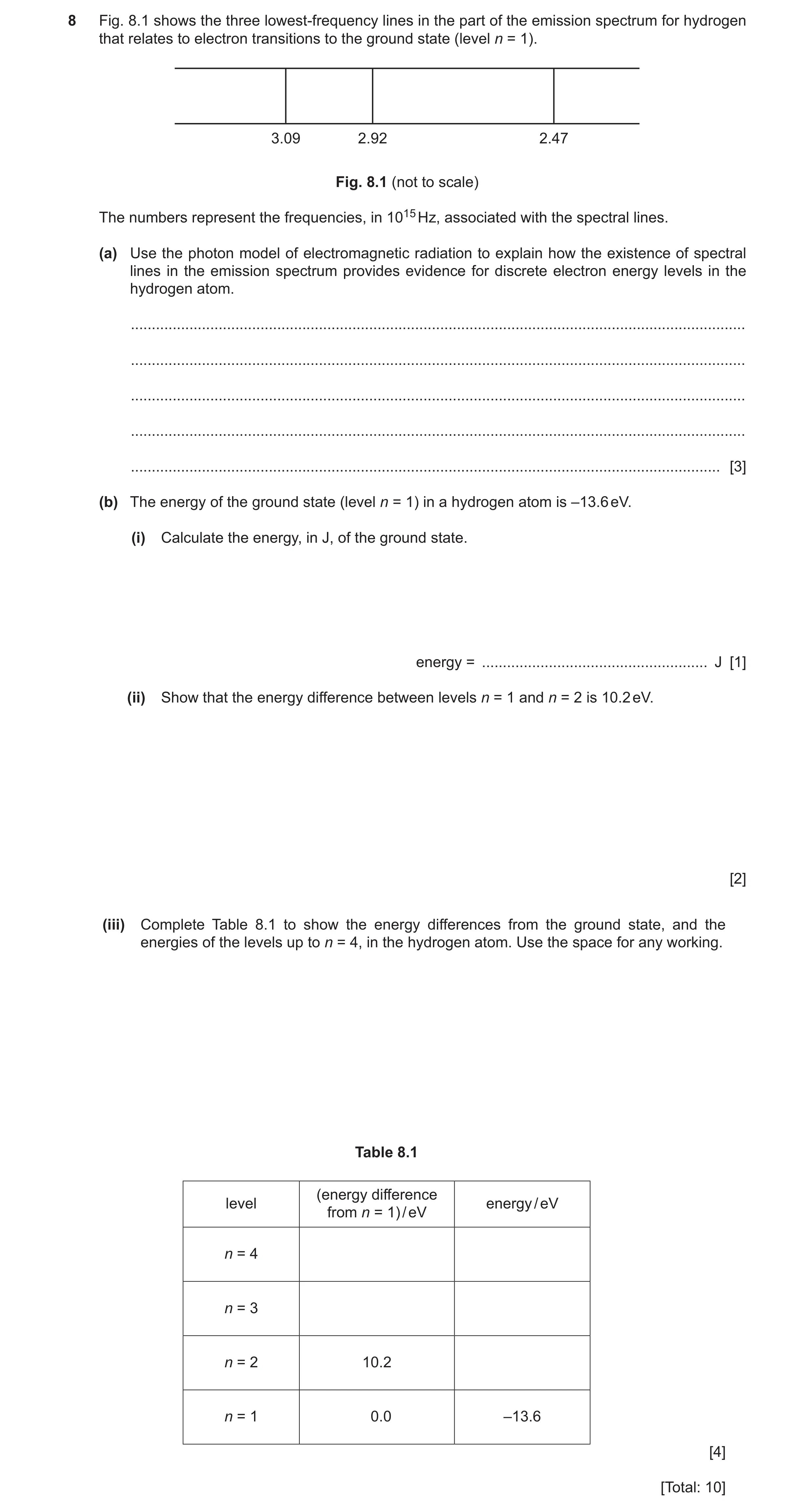
8 Fig. 8.1 shows the three lowest-frequency lines in the part of the emission spectrum for hydrogen that relates to electron transitions to the ground state (level n = 1). 3.09 2.92 2.47 Fig. 8.1 (not to scale) The numbers represent the frequencies, in 1015 Hz, associated with the spectral lines. (a) Use the photon model of electromagnetic radiation to explain how the existence of spectral lines in the emission spectrum provides evidence for discrete electron energy levels in the hydrogen atom. … … … … … [3] (b) The energy of the ground state (level n = 1) in a hydrogen atom is –13.6 eV. (i) Calculate the energy, in J, of the ground state. energy = … J [1] (ii) Show that the energy difference between levels n = 1 and n = 2 is 10.2 eV. [2] (iii) Complete Table 8.1 to show the energy differences from the ground state, and the energies of the levels up to n = 4, in the hydrogen atom. Use the space for any working. Table 8.1 (energy difference level energy / eV from n = 1) / eV n = 4 n = 3 n = 2 10.2 n = 1 0.0 –13.6 [4] [Total: 10]
10 marks
Mark scheme: 8(a) Any three points from: B3 • electrons moving between levels emit a single photon • energy of photon = difference between energy levels • energy of photon depends on frequency • discrete frequencies (in spectrum) so differences between electron energies must be discrete • discrete differences between electron energies means energy levels must be discrete 8(b)(i) energy = – (13.6 1.60 10–19) A1 = – 2.18 10–18 J 8(b)(ii) E = hf C1 = (6.63 10–34 2.47 1015) / (1.60 10–19) = 10.2 eV A1 8(b)(iii) n = 2 energy level = – 3.4 eV A1 n = 3 energy difference = 12.1 eV A1 n = 4 energy difference = 12.8 eV A1 n = 3 energy level = – 1.5 eV and n = 4 energy level = – 0.8 eV A1
This question in 9702/42 Oct/Nov 2025
Q15 · State what is meant by a photon 9702/43 Oct/Nov 2025
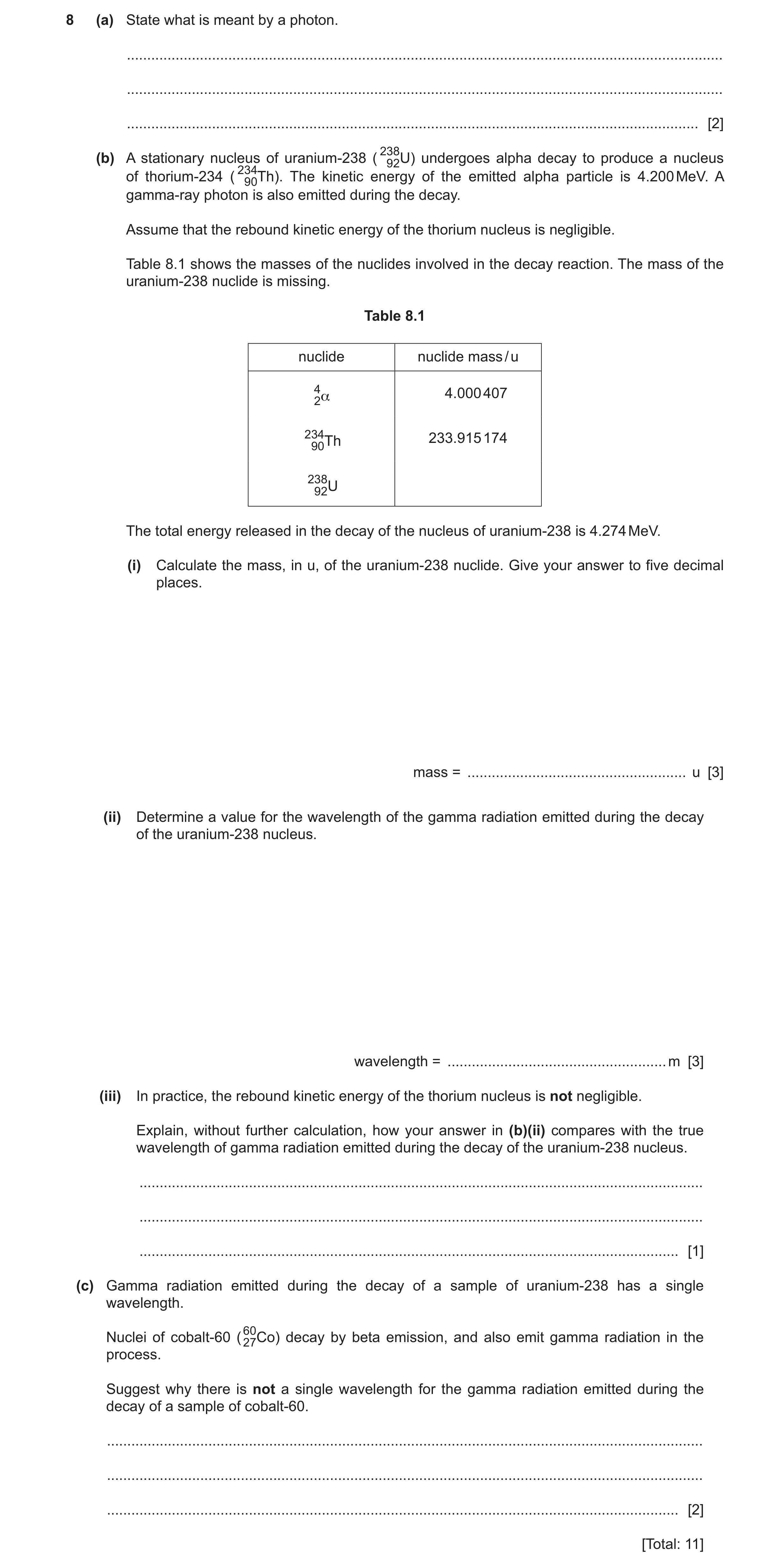
8 (a) State what is meant by a photon. … … … [2] 238 (b) A stationary nucleus of uranium-238 ( 92U) undergoes alpha decay to produce a nucleus 234 of thorium-234 ( 90Th). The kinetic energy of the emitted alpha particle is 4.200 MeV. A gamma-ray photon is also emitted during the decay. Assume that the rebound kinetic energy of the thorium nucleus is negligible. Table 8.1 shows the masses of the nuclides involved in the decay reaction. The mass of the uranium-238 nuclide is missing. Table 8.1 nuclide nuclide mass / u 4 4.000 407 2α 234 233.915 174 90Th 238 92U The total energy released in the decay of the nucleus of uranium-238 is 4.274 MeV. (i) Calculate the mass, in u, of the uranium-238 nuclide. Give your answer to five decimal places. mass = … u [3] (ii) Determine a value for the wavelength of the gamma radiation emitted during the decay of the uranium-238 nucleus. wavelength = … m [3] (iii) In practice, the rebound kinetic energy of the thorium nucleus is not negligible. Explain, without further calculation, how your answer in (b)(ii) compares with the true wavelength of gamma radiation emitted during the decay of the uranium-238 nucleus. … … … [1] (c) Gamma radiation emitted during the decay of a sample of uranium-238 has a single wavelength. decay by beta emission, and also emit gamma radiation in the Nuclei of cobalt-60 (6027Co) process. Suggest why there is not a single wavelength for the gamma radiation emitted during the decay of a sample of cobalt-60. … … … [2] [Total: 11]
11 marks
Mark scheme: 8(a) packet / quantum of energy M1 of electromagnetic radiation A1 8(b)(i) E = c2m C1 m = (4.274 106 1.60 10–19) / (1.66 10–27 (3.00 108)2) C1 ( = 0.00458 u) m = 233.915174 + 4.000407 + 0.00458 A1 = 237.92016 u 8(b)(ii) E = hc / C1 or E = hf and c = f (4.274 – 4.200) 1.60 10–13 = (6.63 10–34 3.00 108) / C1 = 1.7 10–11 m A1 8(b)(iii) (true) energy of gamma photon is smaller so (true) wavelength is larger B1 8(c) (anti)neutrinos are emitted during beta decay B1 particles emitted during beta decay carry varying amounts of energy, so energy of gamma photon is also variable (between B1 decays)
This question in 9702/43 Oct/Nov 2025
 1 / 19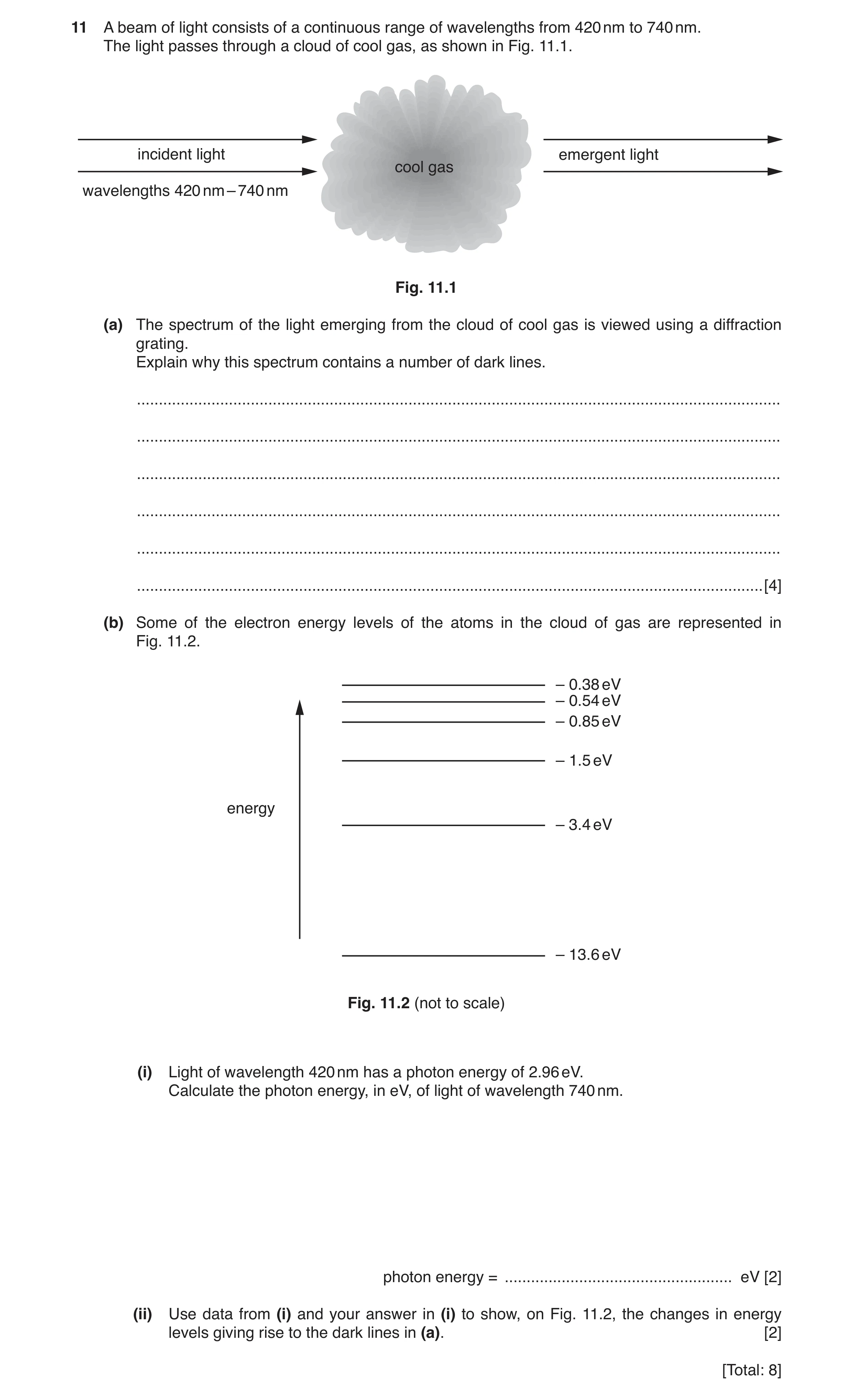
 5 / 19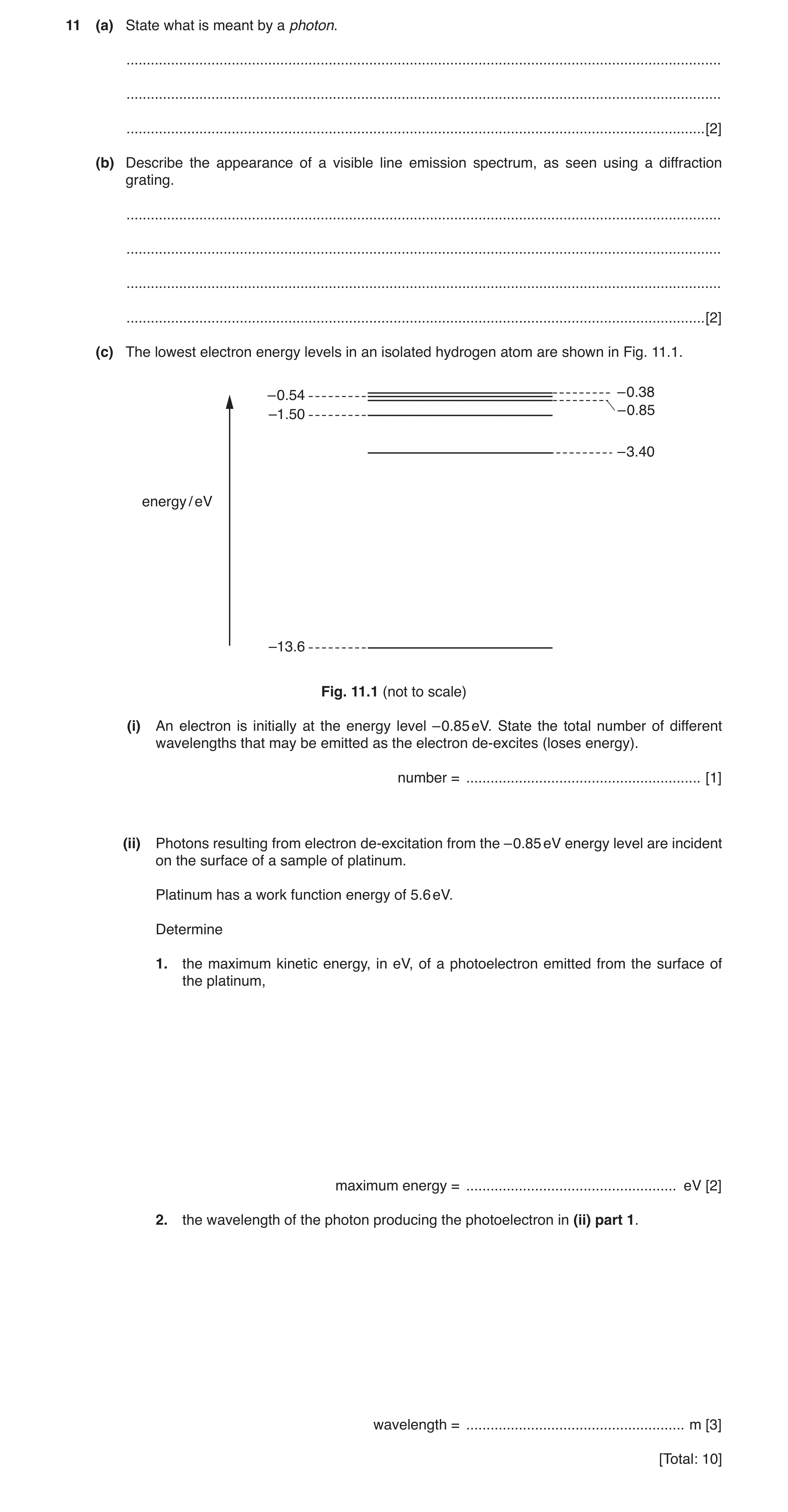
 7 / 19
 8 / 19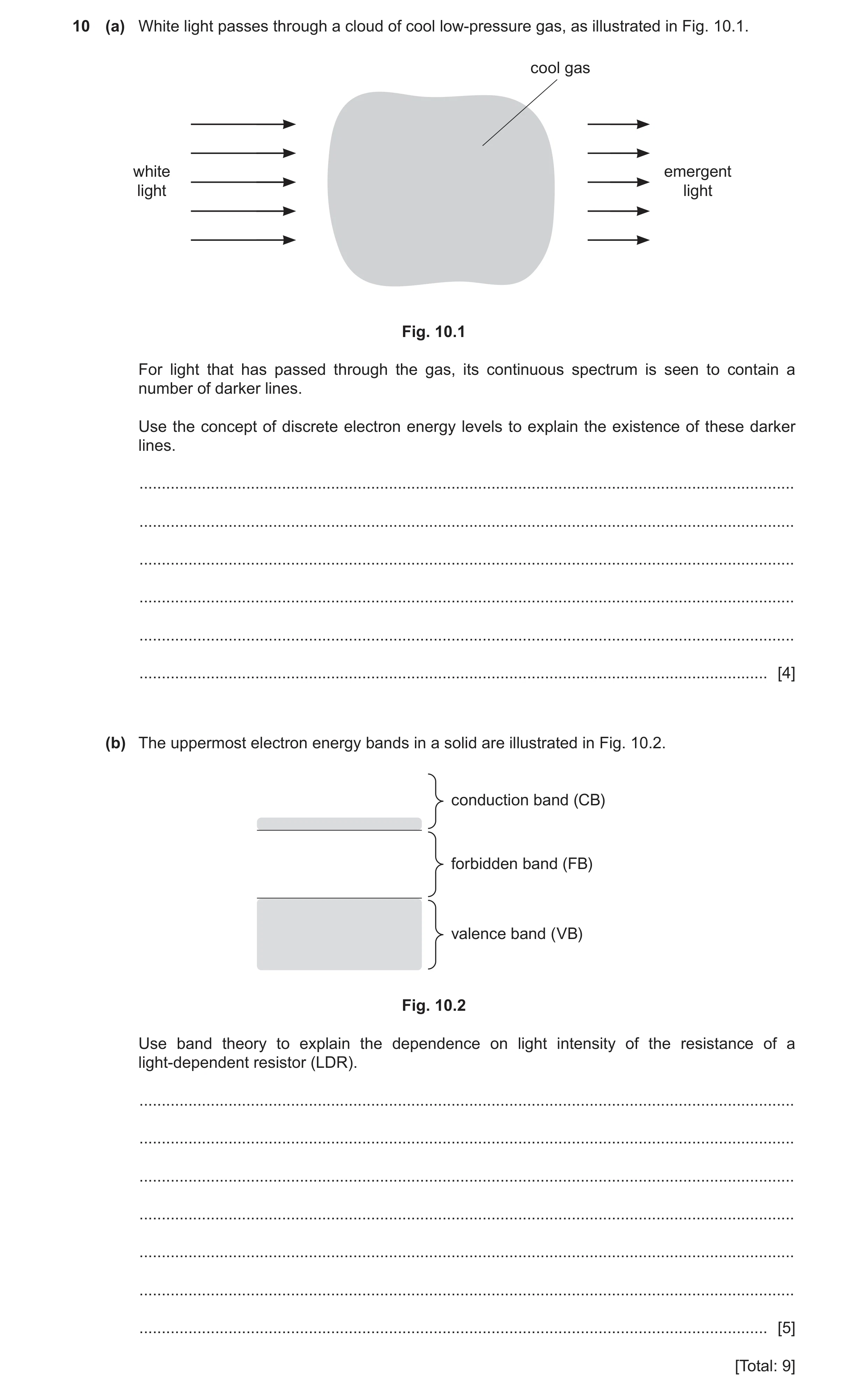
 8
8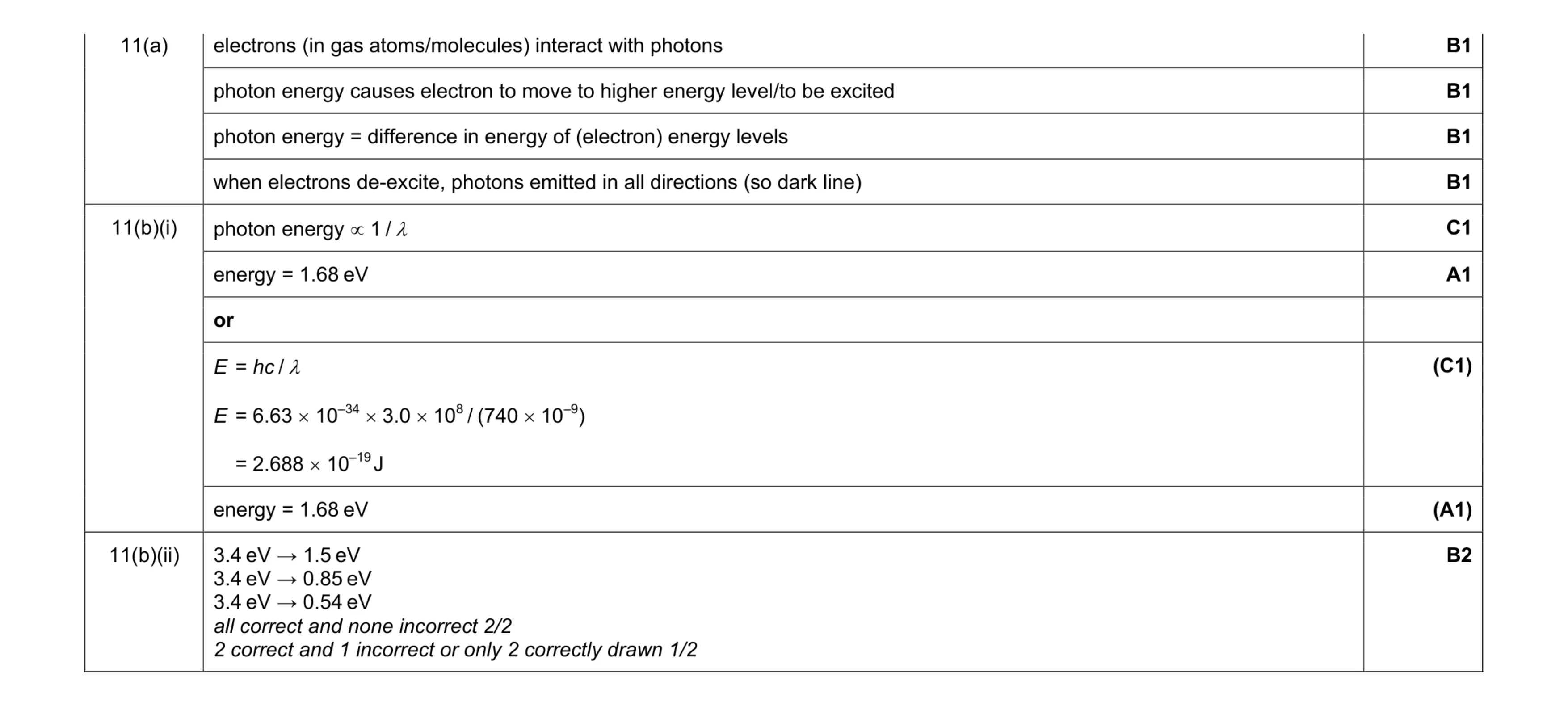 8
8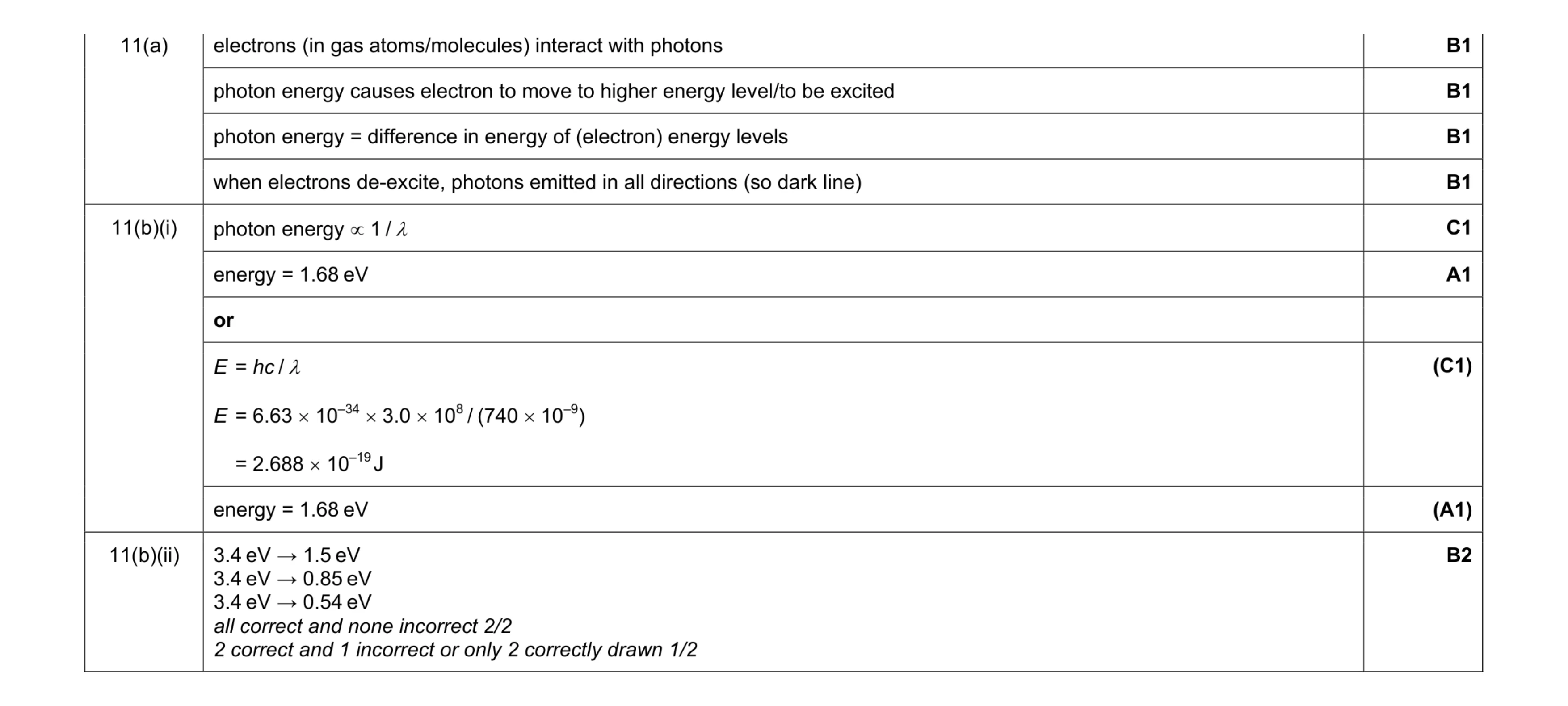 8
8 5
5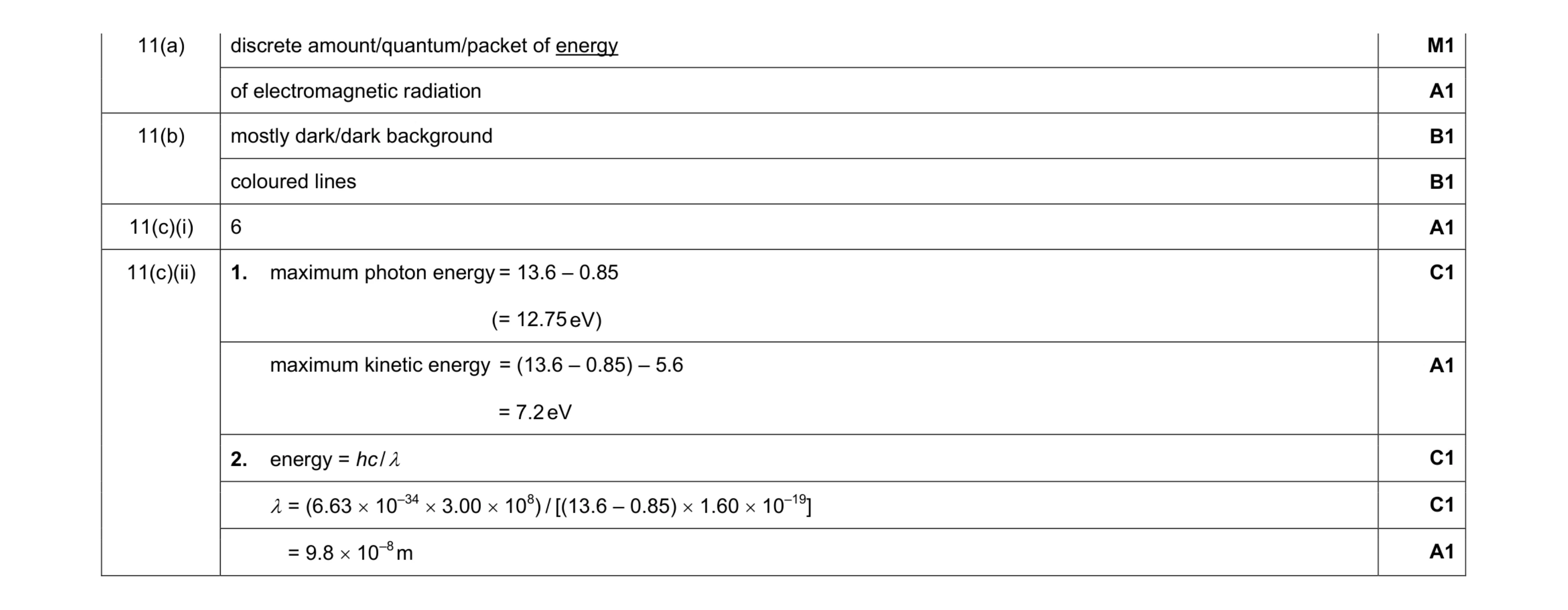 10
10 5
5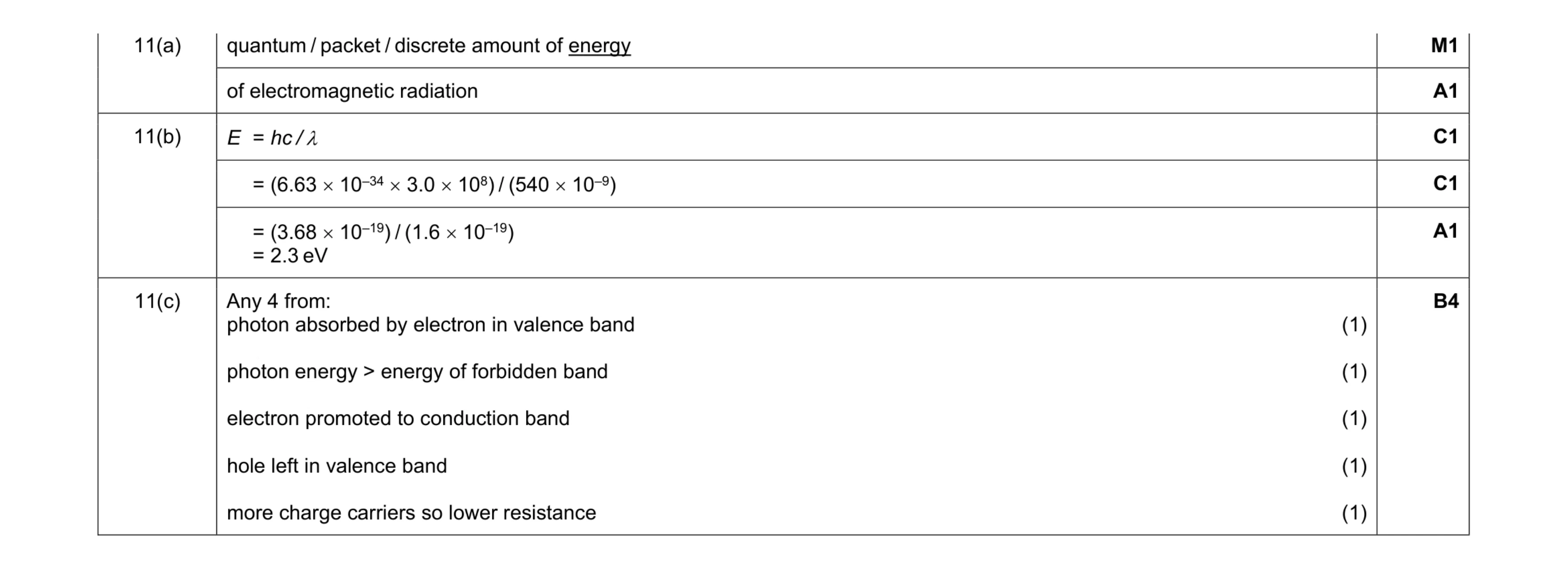 9
9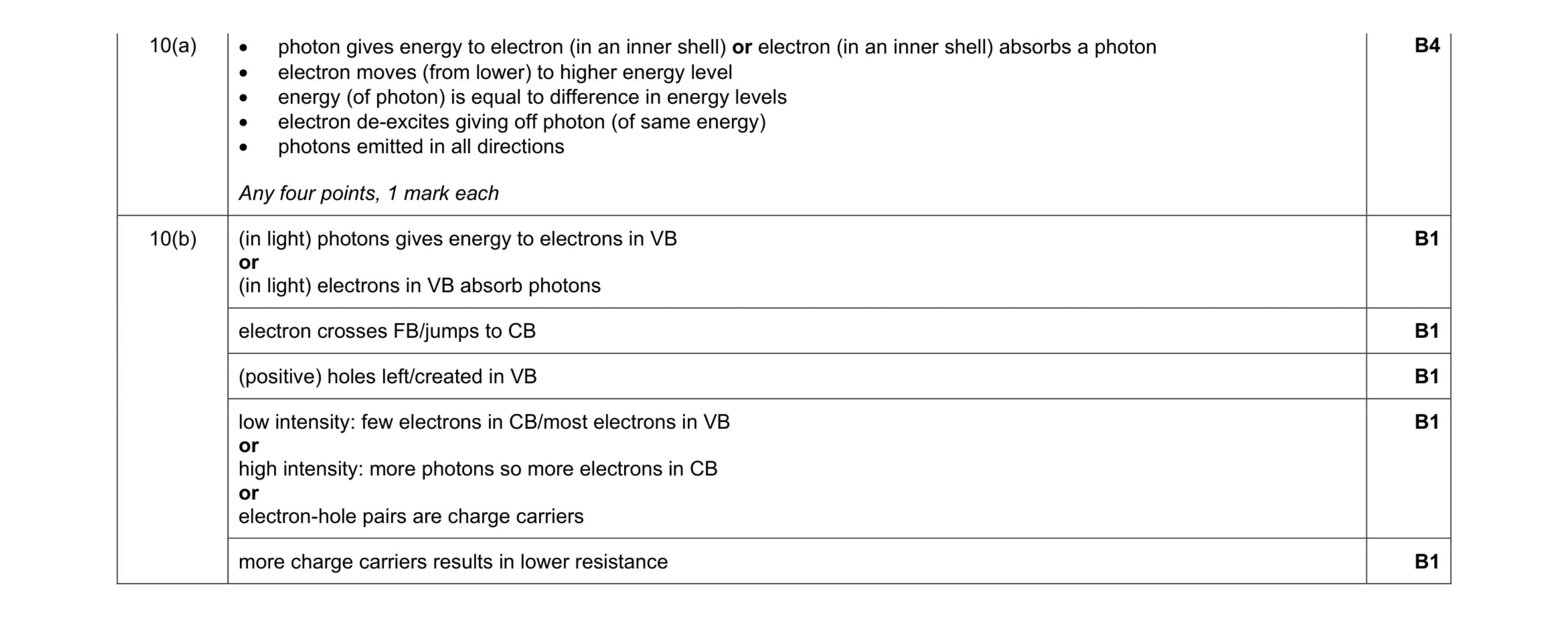 9
9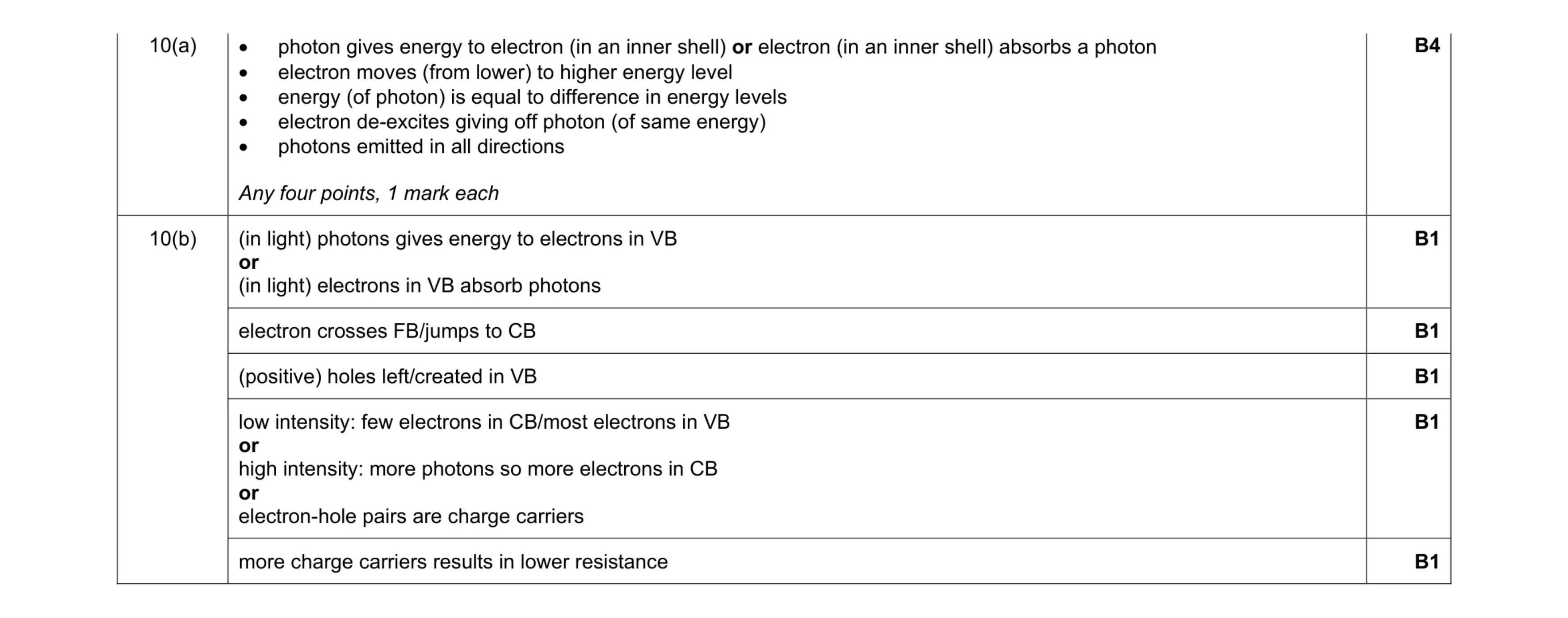 9
9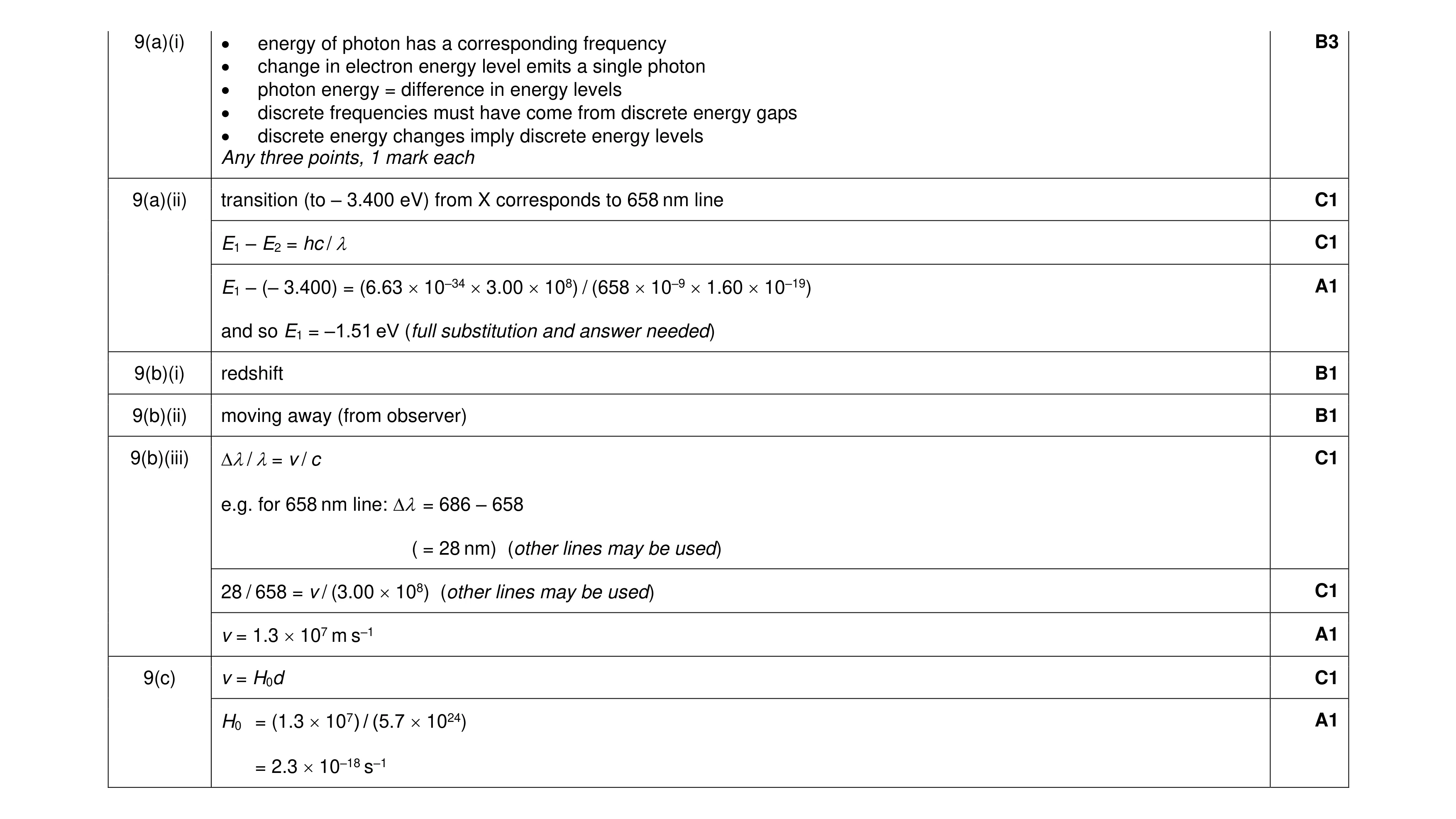 13
13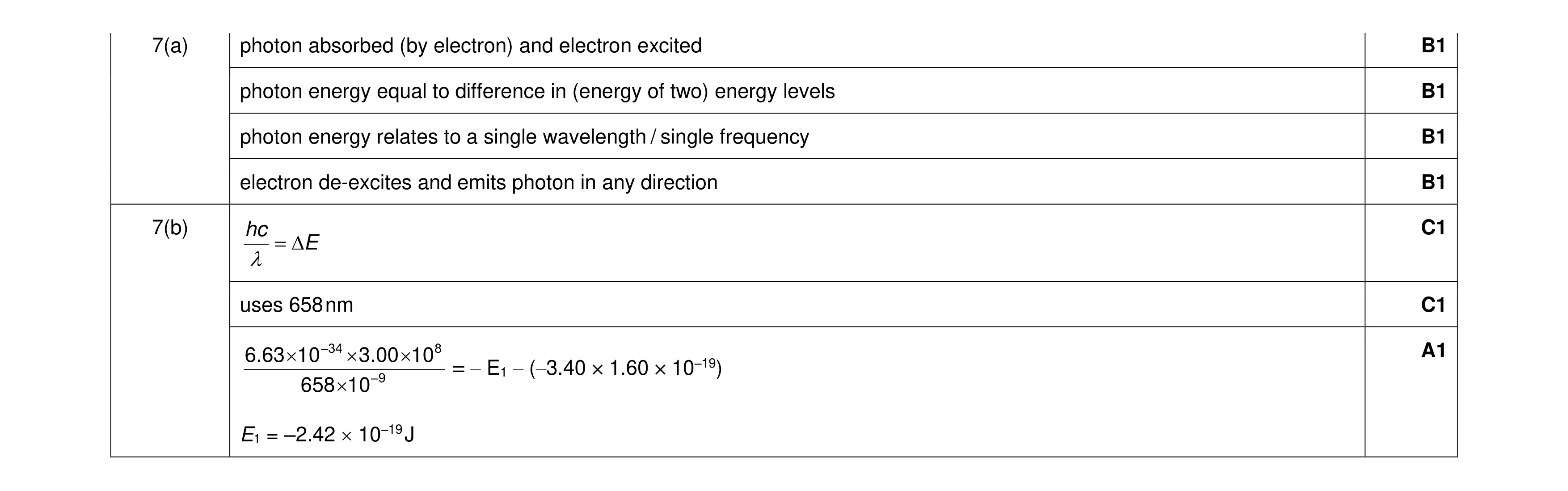 7
7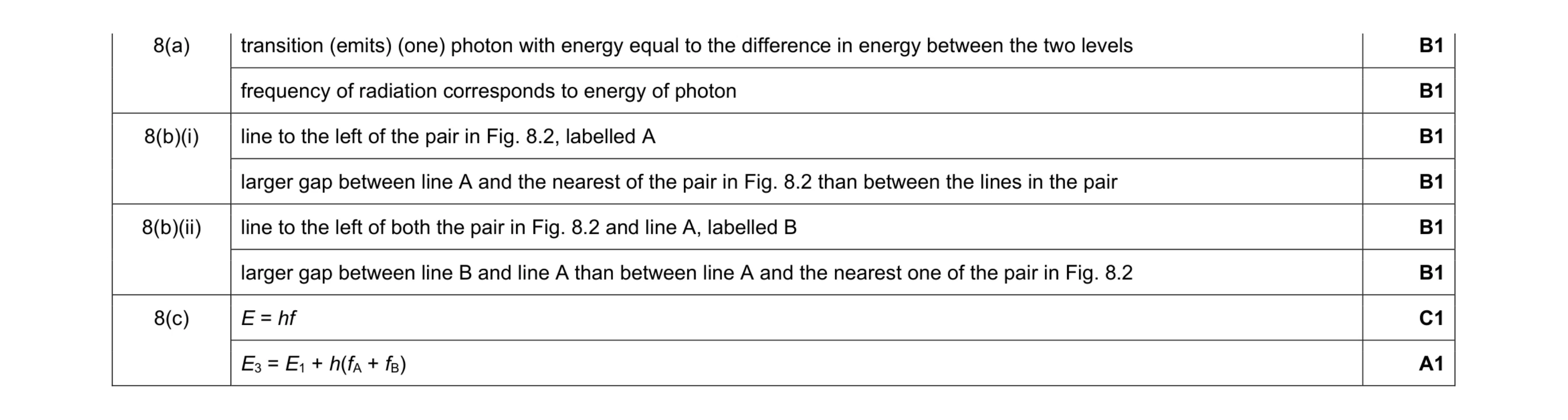 8
8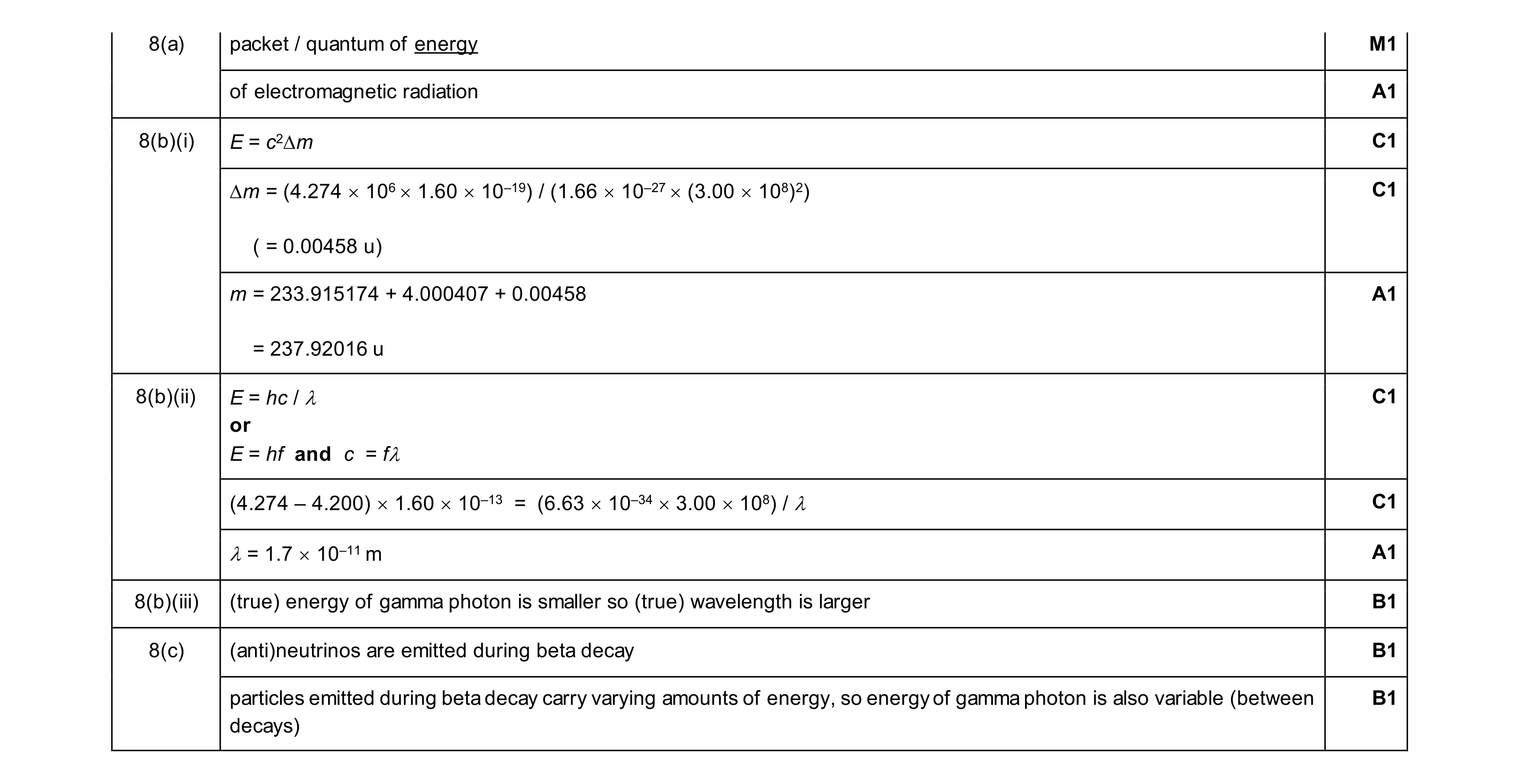 11
11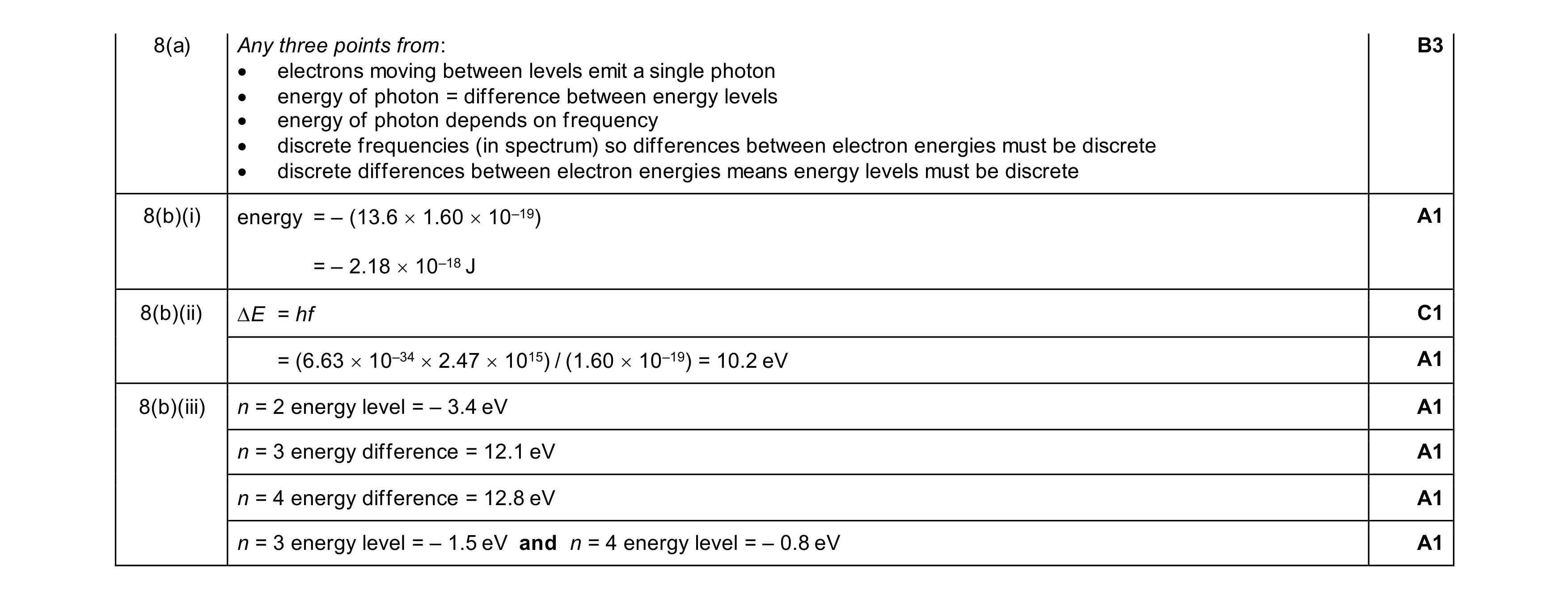 10
10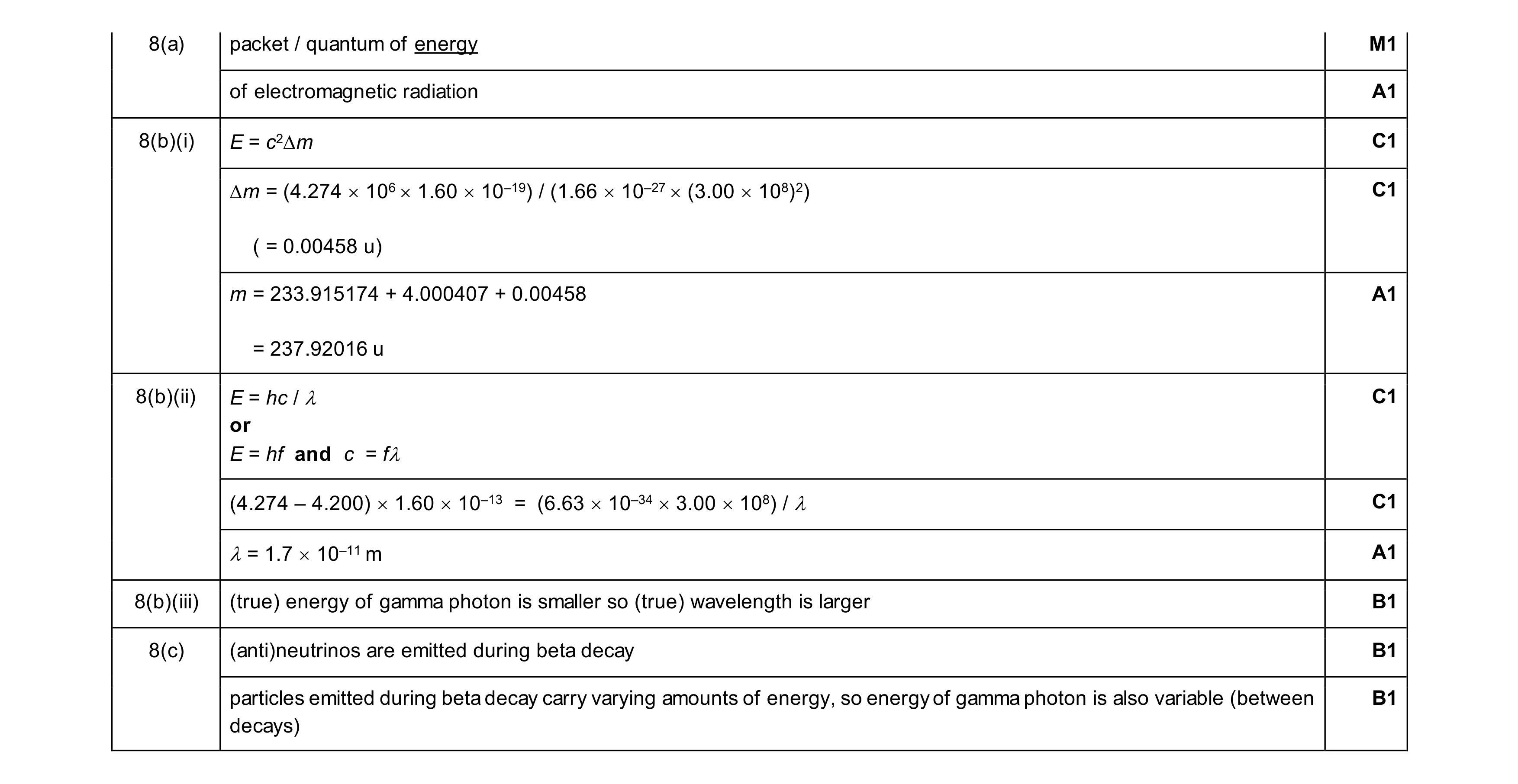 11
11