Questions as text
Q1 · An electron has charge –q and mass m 9702/42 May/June 2017
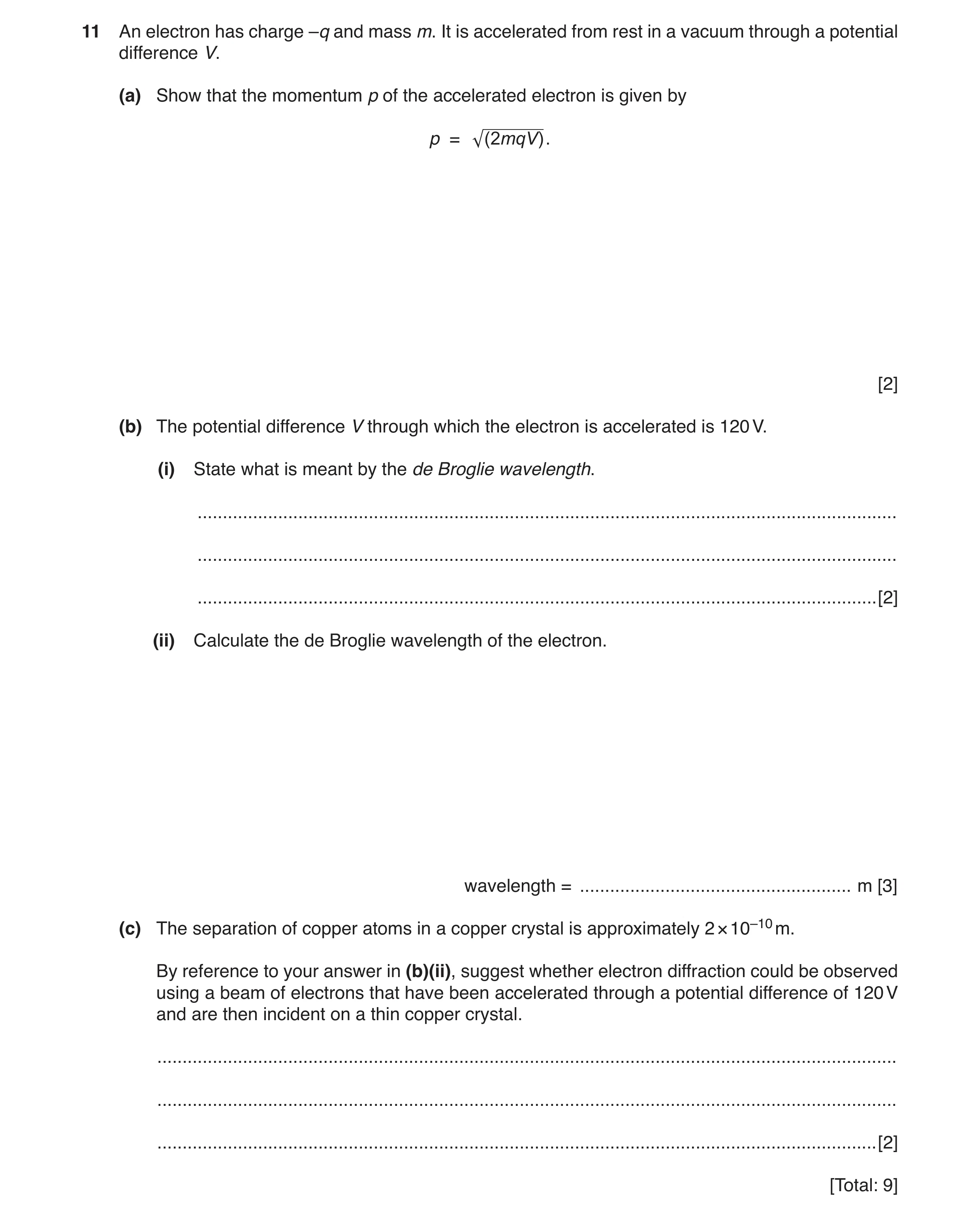
11 An electron has charge –q and mass m. It is accelerated from rest in a vacuum through a potential difference V. (a) Show that the momentum p of the accelerated electron is given by p = (2 mqV ) . [2] (b) The potential difference V through which the electron is accelerated is 120 V. (i) State what is meant by the de Broglie wavelength. … … … [2] (ii) Calculate the de Broglie wavelength of the electron. wavelength = … m [3] (c) The separation of copper atoms in a copper crystal is approximately 2 × 10⁻¹⁰ m. By reference to your answer in (b)(ii), suggest whether electron diffraction could be observed using a beam of electrons that have been accelerated through a potential difference of 120 V and are then incident on a thin copper crystal. … … … [2] [Total: 9]
9 marks
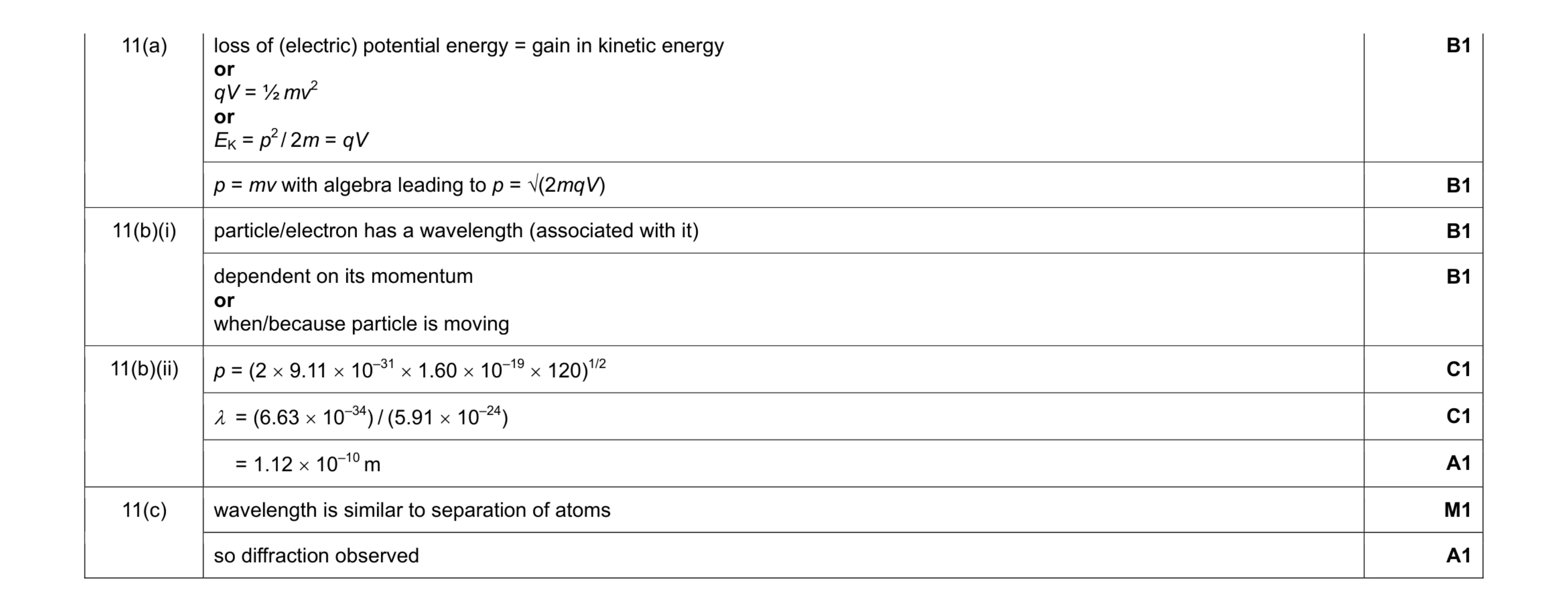
Mark scheme: 11(a) loss of (electric) potential energy = gain in kinetic energy or qV = ½ mv2 or EK = p2 / 2m = qV B1 p = mv with algebra leading to p = √(2mqV) B1 11(b)(i) particle/electron has a wavelength (associated with it) B1 dependent on its momentum or when/because particle is moving B1 11(b)(ii) p = (2 × 9.11 × 10–31 × 1.60 × 10–19 × 120)1/2 C1 λ = (6.63 × 10⁻³⁴) / (5.91 × 10⁻²⁴) C1 = 1.12 × 10⁻¹⁰ m A1 11(c) wavelength is similar to separation of atoms M1 so diffraction observed A1
This question in 9702/42 May/June 2017
Q2 · A metal surface is illuminated with light of a single wavelength λ 9702/42 Oct/Nov 2017
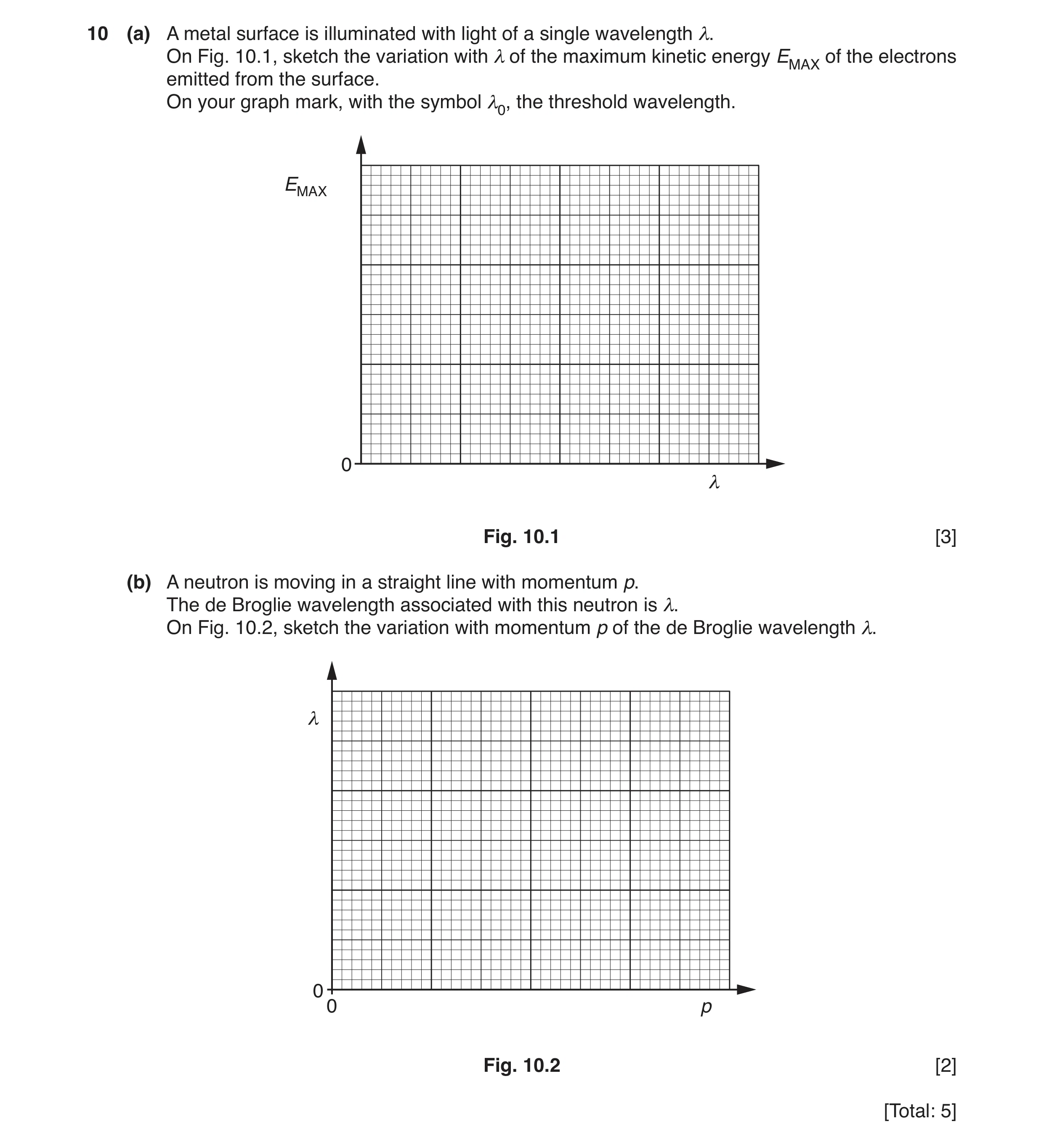
10 (a) A metal surface is illuminated with light of a single wavelength λ. On Fig. 10.1, sketch the variation with λ of the maximum kinetic energy EMAX of the electrons emitted from the surface. On your graph mark, with the symbol λ0, the threshold wavelength. EMAX 0 λ Fig. 10.1 [3] (b) A neutron is moving in a straight line with momentum p. The de Broglie wavelength associated with this neutron is λ. On Fig. 10.2, sketch the variation with momentum p of the de Broglie wavelength λ. λ 0 0 p Fig. 10.2 [2] [Total: 5]
5 marks
Mark scheme: 10(a) B1 graph line with λ always < λ0 B1 negative gradient with correct concave curvature B1 10(b) curve with negative gradient and correct concave curvature M1 not touching either axis A1
This question in 9702/42 Oct/Nov 2017
Q3 · The uppermost energy bands in a solid are known as the valence band (VB), the forbidden… 9702/42 May/June 2020
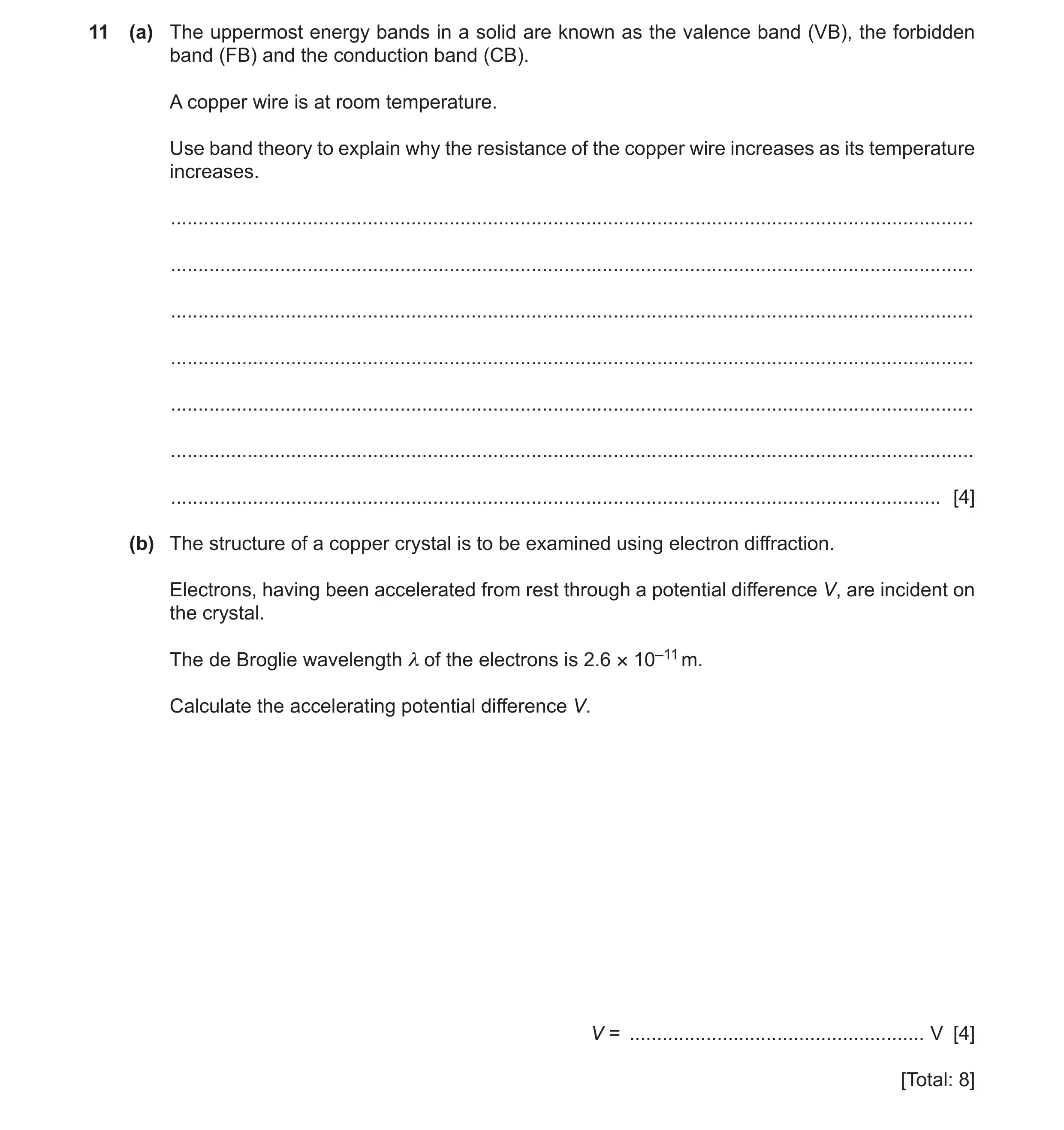
11 (a) The uppermost energy bands in a solid are known as the valence band (VB), the forbidden band (FB) and the conduction band (CB). A copper wire is at room temperature. Use band theory to explain why the resistance of the copper wire increases as its temperature increases. … … … … … … … [4] (b) The structure of a copper crystal is to be examined using electron diffraction. Electrons, having been accelerated from rest through a potential difference V, are incident on the crystal. The de Broglie wavelength λ of the electrons is 2.6 × 10⁻¹¹ m. Calculate the accelerating potential difference V. V = … V [4] [Total: 8]
8 marks
Mark scheme: 11(a) conduction band and valence band overlap B1 number (density) of charge carriers does not vary B1 increase in temperature gives rise to increased lattice vibrations B1 (lattice) vibrations hinder movement of charge carriers so resistance increases B1 11(b) mv = h / λ C1 v = (6.63 × 10⁻³⁴) / [(2.6 × 10–11) × (9.11 × 10–31)] ( = 2.80 × 10⁷ m s–1) C1 qV = ½mv2 C1 V = [9.11 × 10–31 × (2.80 × 107)2] / [2 × 1.60 × 10–19] = 2.2 × 10³ V A1
This question in 9702/42 May/June 2020
Q4 · An isolated metal sphere of radius r is charged so that the electric field strength at… 9702/41 May/June 2021
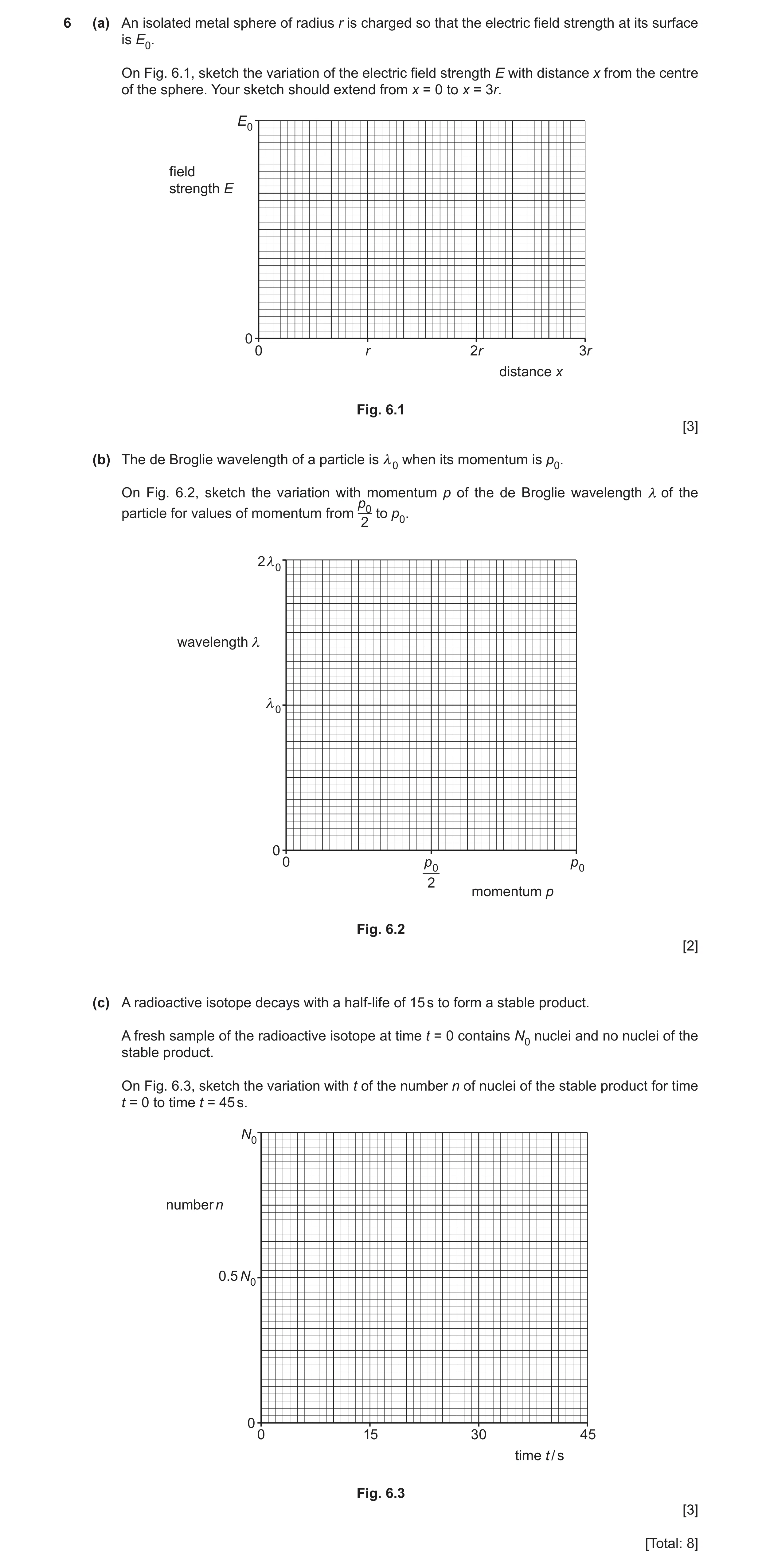
6 (a) An isolated metal sphere of radius r is charged so that the electric field strength at its surface is E0. On Fig. 6.1, sketch the variation of the electric field strength E with distance x from the centre of the sphere. Your sketch should extend from x = 0 to x = 3r. E0 field strength E 0 0 r 2r 3r distance x Fig. 6.1 [3] (b) The de Broglie wavelength of a particle is λ 0 when its momentum is p0. On Fig. 6.2, sketch the variation with momentum p of the de Broglie wavelength λ of the p0 particle for values of momentum from to p0. 2 2λ0 wavelength λ λ 0 0 0 p0 p0 2 momentum p Fig. 6.2 [2] (c) A radioactive isotope decays with a half-life of 15 s to form a stable product. A fresh sample of the radioactive isotope at time t = 0 contains N0 nuclei and no nuclei of the stable product. On Fig. 6.3, sketch the variation with t of the number n of nuclei of the stable product for time t = 0 to time t = 45 s. N0 number n 0.5 N0 0 0 15 30 45 time t / s Fig. 6.3 [3] [Total: 8]
8 marks
Mark scheme: 6(a) from x = 0 to x = r: E = 0 B1 from x = r to x = 3r: curve with negative gradient of decreasing magnitude passing through (r, E0) B1 line passing through (2r, E0 / 4) and (3r, E0 / 9) B1 6(b) from p = p0 / 2 to p = p0: curve with negative gradient of decreasing magnitude passing through (p0, λ0) B1 line passing through (½p0, 2λ0) B1 6(c) from t = 0 to t = 45 s: curve with positive gradient of decreasing magnitude starting at (0, 0) B1 line passing through (15, ½N0) B1 line passing through (30, 0.75N0) and (45, 0.88N0) B1
This question in 9702/41 May/June 2021
Q5 · An isolated metal sphere of radius r is charged so that the electric field strength at… 9702/43 May/June 2021
6 (a) An isolated metal sphere of radius r is charged so that the electric field strength at its surface is E0. On Fig. 6.1, sketch the variation of the electric field strength E with distance x from the centre of the sphere. Your sketch should extend from x = 0 to x = 3r. E0 field strength E 0 0 r 2r 3r distance x Fig. 6.1 [3] (b) The de Broglie wavelength of a particle is λ 0 when its momentum is p0. On Fig. 6.2, sketch the variation with momentum p of the de Broglie wavelength λ of the p0 particle for values of momentum from to p0. 2 2λ0 wavelength λ λ 0 0 0 p0 p0 2 momentum p Fig. 6.2 [2] (c) A radioactive isotope decays with a half-life of 15 s to form a stable product. A fresh sample of the radioactive isotope at time t = 0 contains N0 nuclei and no nuclei of the stable product. On Fig. 6.3, sketch the variation with t of the number n of nuclei of the stable product for time t = 0 to time t = 45 s. N0 number n 0.5 N0 0 0 15 30 45 time t / s Fig. 6.3 [3] [Total: 8]
8 marks
Mark scheme: 6(a) from x = 0 to x = r: E = 0 B1 from x = r to x = 3r: curve with negative gradient of decreasing magnitude passing through (r, E0) B1 line passing through (2r, E0 / 4) and (3r, E0 / 9) B1 6(b) from p = p0 / 2 to p = p0: curve with negative gradient of decreasing magnitude passing through (p0, λ0) B1 line passing through (½p0, 2λ0) B1 6(c) from t = 0 to t = 45 s: curve with positive gradient of decreasing magnitude starting at (0, 0) B1 line passing through (15, ½N0) B1 line passing through (30, 0.75N0) and (45, 0.88N0) B1
This question in 9702/43 May/June 2021
Q6 · State an experimental phenomenon that provides evidence for: (i) the particulate nature… 9702/41 Oct/Nov 2021
10 (a) State an experimental phenomenon that provides evidence for: (i) the particulate nature of electromagnetic radiation … [1] (ii) the wave nature of matter. … [1] (b) A particle of matter moves with momentum p. (i) State the equation that gives the effective wavelength λ of the particle. State the name of any other symbols used. [2] (ii) State the name given to the wavelength of the moving particle. … [1] (c) Electrons are accelerated from rest through a potential difference (p.d.) of 4.8 kV. (i) Show that the final speed of the electrons is 4.1 × 10⁷ m s–1. [2] (ii) Calculate the effective wavelength of a beam of electrons moving at the speed in (c)(i). wavelength = … m [2] [Total: 9]
9 marks
Mark scheme: 10(a)(i) photoelectric effect B1 10(a)(ii) electron diffraction B1 10(b)(i) λ = h / p M1 h is the Planck constant A1 10(b)(ii) de Broglie (wavelength) B1 10(c)(i) ½mv2 = eV C1 ½ × 9.11 × 10–31 × v2 = 1.60 × 10–19 × 4800 so v = 4.1 × 10⁷ m s–1 A1 10(c)(ii) λ = h / mv = 6.63 × 10⁻³⁴ / (9.11 × 10–31 × 4.1 × 107) C1 = 1.8 × 10⁻¹¹ m A1
This question in 9702/41 Oct/Nov 2021
Q7 · State an experimental phenomenon that provides evidence for: (i) the particulate nature… 9702/43 Oct/Nov 2021
10 (a) State an experimental phenomenon that provides evidence for: (i) the particulate nature of electromagnetic radiation … [1] (ii) the wave nature of matter. … [1] (b) A particle of matter moves with momentum p. (i) State the equation that gives the effective wavelength λ of the particle. State the name of any other symbols used. [2] (ii) State the name given to the wavelength of the moving particle. … [1] (c) Electrons are accelerated from rest through a potential difference (p.d.) of 4.8 kV. (i) Show that the final speed of the electrons is 4.1 × 10⁷ m s–1. [2] (ii) Calculate the effective wavelength of a beam of electrons moving at the speed in (c)(i). wavelength = … m [2] [Total: 9]
9 marks
Mark scheme: 10(a)(i) photoelectric effect B1 10(a)(ii) electron diffraction B1 10(b)(i) λ = h / p M1 h is the Planck constant A1 10(b)(ii) de Broglie (wavelength) B1 10(c)(i) ½mv2 = eV C1 ½ × 9.11 × 10–31 × v2 = 1.60 × 10–19 × 4800 so v = 4.1 × 10⁷ m s–1 A1 10(c)(ii) λ = h / mv = 6.63 × 10⁻³⁴ / (9.11 × 10–31 × 4.1 × 107) C1 = 1.8 × 10⁻¹¹ m A1
This question in 9702/43 Oct/Nov 2021
Q8 · State the formula for the de Broglie wavelength λ of a moving particle 9702/42 Feb/March 2022
8 (a) State the formula for the de Broglie wavelength λ of a moving particle. State the meaning of any other symbol used. … … … [2] (b) Electrons accelerate through a potential difference, pass through a thin crystal and are then incident on a fluorescent screen. The pattern in Fig. 8.1 is observed on the fluorescent screen. edge of screen Fig. 8.1 not to scale (i) State the name of the phenomenon shown by the electrons at the crystal. … [1] (ii) State what this phenomenon shows about the nature of electrons. … … [1] (iii) Suggest why the thin crystal causes the phenomenon in (b)(i). … … [1] (iv) The electron is accelerated through a different potential difference. The new pattern observed on the screen is shown in Fig. 8.2. edge of screen Fig. 8.2 not to scale State and explain the change that has been made to the potential difference to create the pattern shown in Fig. 8.2. … … … … [2] [Total: 7]
7 marks
Mark scheme: 8(a) h h = or = p mv λ λ M1 where h is the Planck constant and p is the momentum (of particle) / mv is the momentum (of particle) / m is the mass (of particle) and v is the velocity (of particle) A1 8(b)(i) (electron) diffraction B1 8(b)(ii) moving electrons behave like waves B1 8(b)(iii) spacing between atoms ≈ wavelength of electron or diameter of atom ≈ wavelength of electron B1 8(b)(iv) Any one of: • wavelength has decreased • electron had greater momentum M1 so (accelerating) p.d. was increased A1
This question in 9702/42 Feb/March 2022
Q9 · State one piece of experimental evidence for: (i) the particulate nature of… 9702/42 May/June 2022
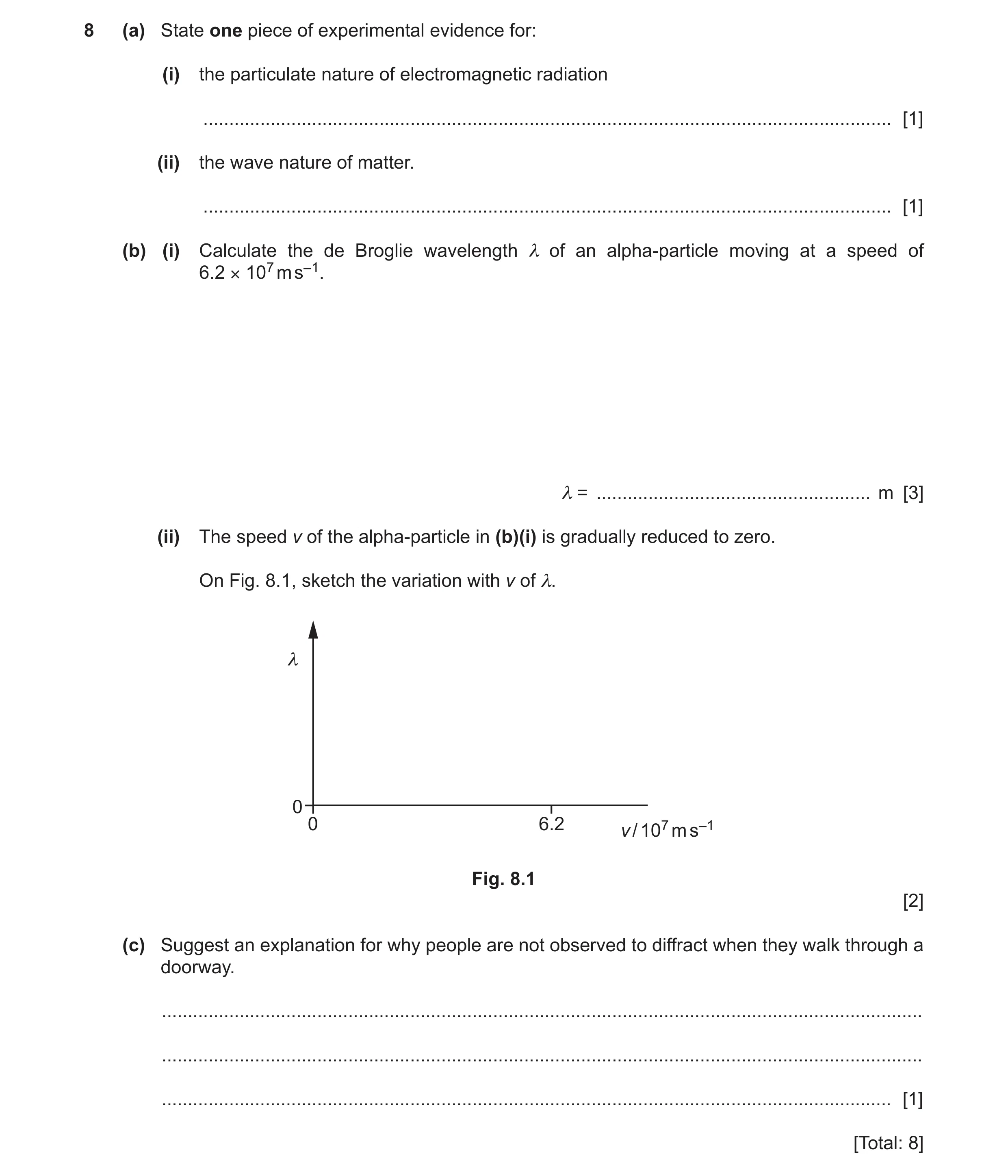
8 (a) State one piece of experimental evidence for: (i) the particulate nature of electromagnetic radiation … [1] (ii) the wave nature of matter. … [1] (b) (i) Calculate the de Broglie wavelength λ of an alpha-particle moving at a speed of 6.2 × 10⁷ m s–1. λ = … m [3] (ii) The speed v of the alpha-particle in (b)(i) is gradually reduced to zero. On Fig. 8.1, sketch the variation with v of λ. λ 0 0 6.2 v / 107 m s–1 Fig. 8.1 [2] (c) Suggest an explanation for why people are not observed to diffract when they walk through a doorway. … … … [1] [Total: 8]
8 marks
Mark scheme: 8(a)(i) photoelectric effect B1 8(a)(ii) electron diffraction B1 8(b)(i) = h / p C1 p = 4 1.66 10–27 6.2 107 ( = 4.1 10–19 N s) C1 = 6.63 10–34 / 4.1 10–19 = 1.6 10–15 m A1 8(b)(ii) line with negative gradient throughout B1 curve asymptotic to both axes with non-zero at v = 6.2 107 m s–1 B1 8(c) (de Broglie) wavelength negligible compared with width of doorway B1
This question in 9702/42 May/June 2022
Q10 · State what is meant by the de Broglie wavelength 9702/41 May/June 2023
7 (a) State what is meant by the de Broglie wavelength. … … [1] (b) Fig. 7.1 shows a glass tube in which electrons are accelerated through a high p.d. to form a beam that is incident on a thin graphite crystal. vacuum graphite crystal filament fluorescent cathode anode screen electron beam collimator – + glass tube high p.d. Fig. 7.1 (not to scale) After passing through the graphite crystal, the electrons reach the fluorescent screen. The screen glows where the electrons strike it. Fig. 7.2 shows the fluorescent screen viewed end-on, from the right-hand side of Fig. 7.1. Fig. 7.2 (i) State the name of the phenomenon demonstrated by the pattern shown in Fig. 7.2. … [1] (ii) Explain what can be concluded from the pattern in Fig. 7.2 about the nature of electrons. … … … [2] (c) The electrons in (b) are now accelerated through a greater potential difference between the cathode and the anode. (i) On Fig. 7.3, sketch the pattern that is now seen on the fluorescent screen in Fig. 7.1. Fig. 7.3 [2] (ii) Explain, with reference to de Broglie wavelength, the change in the pattern on the fluorescent screen. … … … … … [3] [Total: 9]
9 marks
Mark scheme: 7(a) wavelength associated with a moving particle B1 7(b)(i) (electron) diffraction B1 7(b)(ii) beam spreads out indicating diffraction or light and dark regions indicate an interference pattern B1 electron beam is behaving as a wave B1 7(c)(i) central blob and concentric rings B1 rings closer together (than previously) B1 7(c)(ii) (greater p.d. so) electrons to have greater momentum B1 greater momentum so decrease in (de Broglie) wavelength B1 lower (de Broglie) wavelength (for same grating spacing in crystal) causes: smaller diffraction angle or smaller angle of intensity maxima (for each order) or decrease in fringe spacing in diffraction pattern B1
This question in 9702/41 May/June 2023
Q11 · State what is meant by the de Broglie wavelength 9702/43 May/June 2023
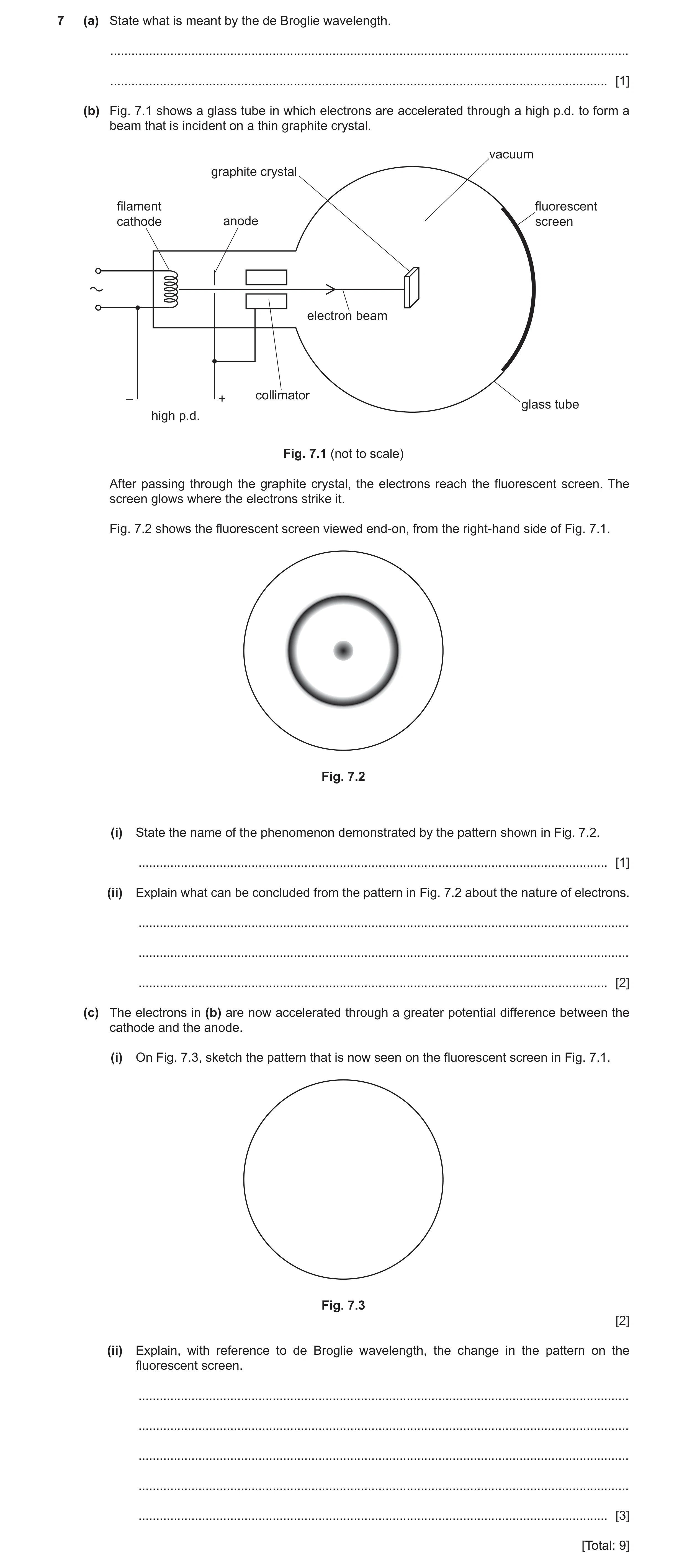
7 (a) State what is meant by the de Broglie wavelength. … … [1] (b) Fig. 7.1 shows a glass tube in which electrons are accelerated through a high p.d. to form a beam that is incident on a thin graphite crystal. vacuum graphite crystal filament fluorescent cathode anode screen electron beam collimator – + glass tube high p.d. Fig. 7.1 (not to scale) After passing through the graphite crystal, the electrons reach the fluorescent screen. The screen glows where the electrons strike it. Fig. 7.2 shows the fluorescent screen viewed end-on, from the right-hand side of Fig. 7.1. Fig. 7.2 (i) State the name of the phenomenon demonstrated by the pattern shown in Fig. 7.2. … [1] (ii) Explain what can be concluded from the pattern in Fig. 7.2 about the nature of electrons. … … … [2] (c) The electrons in (b) are now accelerated through a greater potential difference between the cathode and the anode. (i) On Fig. 7.3, sketch the pattern that is now seen on the fluorescent screen in Fig. 7.1. Fig. 7.3 [2] (ii) Explain, with reference to de Broglie wavelength, the change in the pattern on the fluorescent screen. … … … … … [3] [Total: 9]
9 marks
Mark scheme: 7(a) wavelength associated with a moving particle B1 7(b)(i) (electron) diffraction B1 7(b)(ii) beam spreads out indicating diffraction or light and dark regions indicate an interference pattern B1 electron beam is behaving as a wave B1 7(c)(i) central blob and concentric rings B1 rings closer together (than previously) B1 7(c)(ii) (greater p.d. so) electrons to have greater momentum B1 greater momentum so decrease in (de Broglie) wavelength B1 lower (de Broglie) wavelength (for same grating spacing in crystal) causes: smaller diffraction angle or smaller angle of intensity maxima (for each order) or decrease in fringe spacing in diffraction pattern B1
This question in 9702/43 May/June 2023
Q12 · Electrons in a vacuum are accelerated from rest through a potential difference (p.d.) V… 9702/42 Oct/Nov 2024
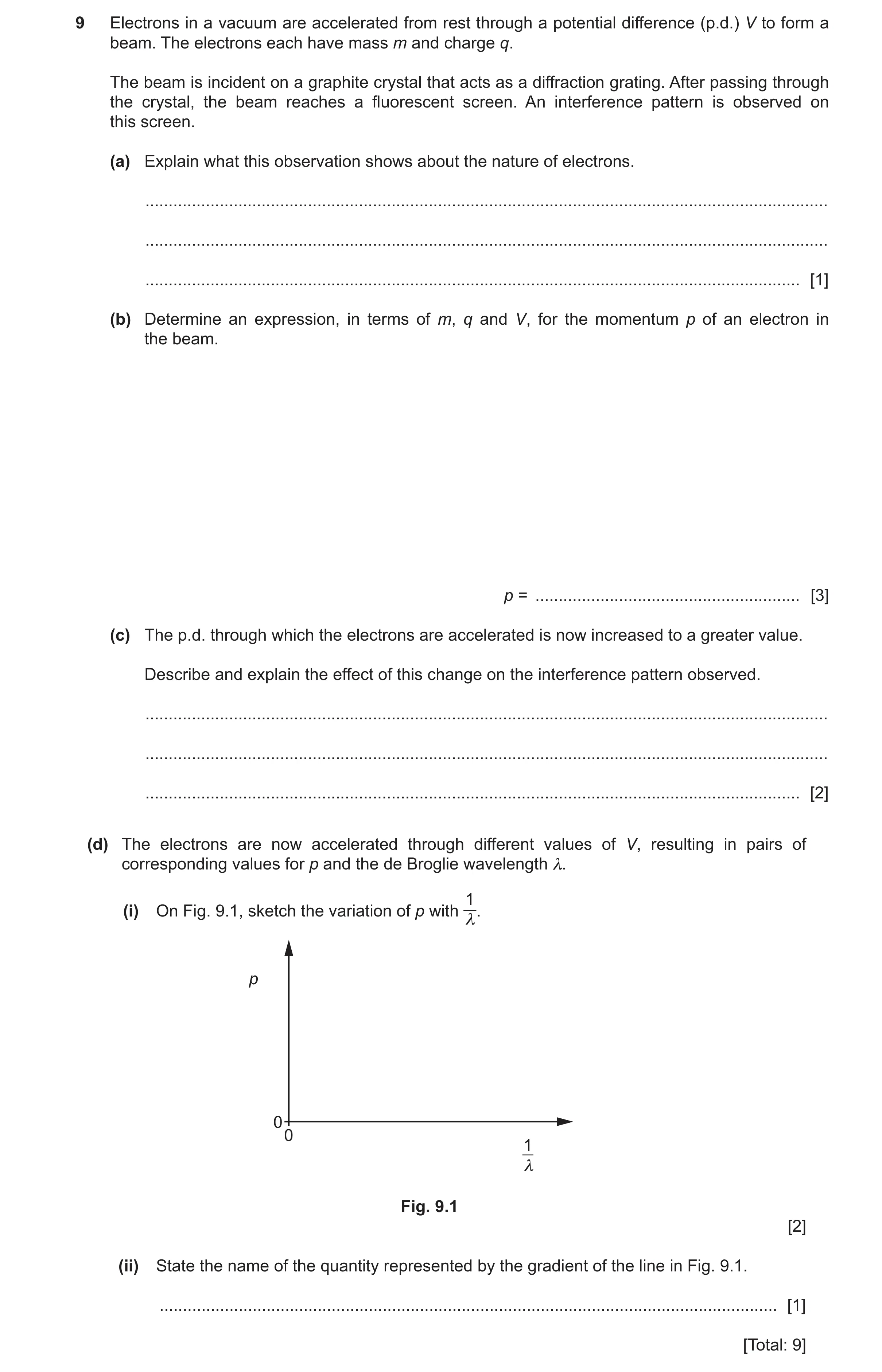
9 Electrons in a vacuum are accelerated from rest through a potential difference (p.d.) V to form a beam. The electrons each have mass m and charge q. The beam is incident on a graphite crystal that acts as a diffraction grating. After passing through the crystal, the beam reaches a fluorescent screen. An interference pattern is observed on this screen. (a) Explain what this observation shows about the nature of electrons. … … … [1] (b) Determine an expression, in terms of m, q and V, for the momentum p of an electron in the beam. p = … [3] (c) The p.d. through which the electrons are accelerated is now increased to a greater value. Describe and explain the effect of this change on the interference pattern observed. … … … [2] (d) The electrons are now accelerated through different values of V, resulting in pairs of corresponding values for p and the de Broglie wavelength λ. 1 (i) On Fig. 9.1, sketch the variation of p with λ. p 0 0 1 λ Fig. 9.1 [2] (ii) State the name of the quantity represented by the gradient of the line in Fig. 9.1. … [1] [Total: 9]
9 marks
Mark scheme: 9(a) diffraction is characteristic of wave behaviour so shows that electrons can behave like waves B1 9(b) qV = ½mv2 C1 p = mv C1 p = m √(2qV / m) A1 = √(2qVm) 9(c) (electrons have) greater momentum so smaller (de Broglie) wavelength B1 fringes become closer together B1 9(d)(i) straight line with positive gradient B1 line with positive gradient passing through the origin B1 9(d)(ii) Planck constant B1
This question in 9702/42 Oct/Nov 2024
Q13 · State what is meant by the de Broglie wavelength 9702/41 May/June 2025
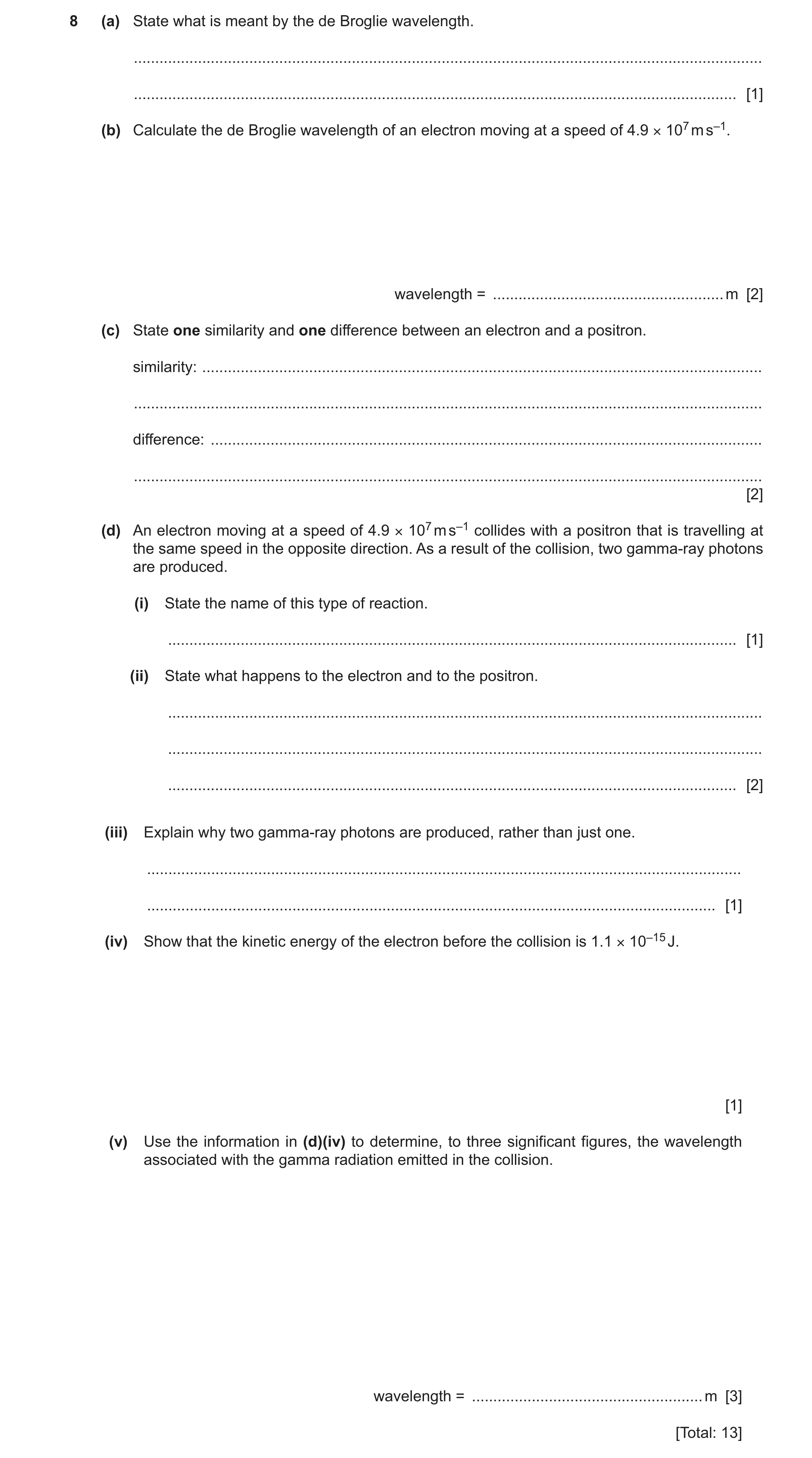
8 (a) State what is meant by the de Broglie wavelength. … … [1] (b) Calculate the de Broglie wavelength of an electron moving at a speed of 4.9 × 10⁷ m s–1. wavelength = … m [2] (c) State one similarity and one difference between an electron and a positron. similarity: … … difference: … … [2] (d) An electron moving at a speed of 4.9 × 10⁷ m s–1 collides with a positron that is travelling at the same speed in the opposite direction. As a result of the collision, two gamma-ray photons are produced. (i) State the name of this type of reaction. … [1] (ii) State what happens to the electron and to the positron. … … … [2] (iii) Explain why two gamma-ray photons are produced, rather than just one. … … [1] (iv) Show that the kinetic energy of the electron before the collision is 1.1 × 10⁻¹⁵ J. [1] (v) Use the information in (d)(iv) to determine, to three significant figures, the wavelength associated with the gamma radiation emitted in the collision. wavelength = … m [3] [Total: 13]
13 marks
Mark scheme: 8(a) wavelength associated with a moving particle B1 8(b) = h / p C1 = (6.63 × 10⁻³⁴) / (9.11 × 10–31 × 4.9 × 107) A1 = 1.5 × 10⁻¹¹ m 8(c) similarity: any one point from: B1 • same mass • same magnitude of charge • both leptons difference: any one point from: B1 • electron has negative charge, positron has positive charge • positron is anti-particle of electron • electron is a particle, positron is an anti-particle 8(d)(i) (pair) annihilation B1 8(d)(ii) their mass gets converted into energy B1 (their mass–energy) becomes the energy of the gamma photons B1 8(d)(iii) they travel in opposite directions to conserve momentum B1 8(d)(iv) kinetic energy = ½ × 9.11 × 10–31 × (4.9 × 107)2 = 1.1 × 10⁻¹⁵ J A1 8(d)(v) E = mc2 C1 E = hc / C1 or E = hf and c = f (1.1 × 10⁻¹⁵) + (9.11 × 10–31 × (3.00 × 108)2) = (6.63 × 10–34 × 3.00 × 108) / A1 = 2.39 × 10⁻¹² m
This question in 9702/41 May/June 2025
Q14 · State what is meant by the de Broglie wavelength 9702/43 May/June 2025
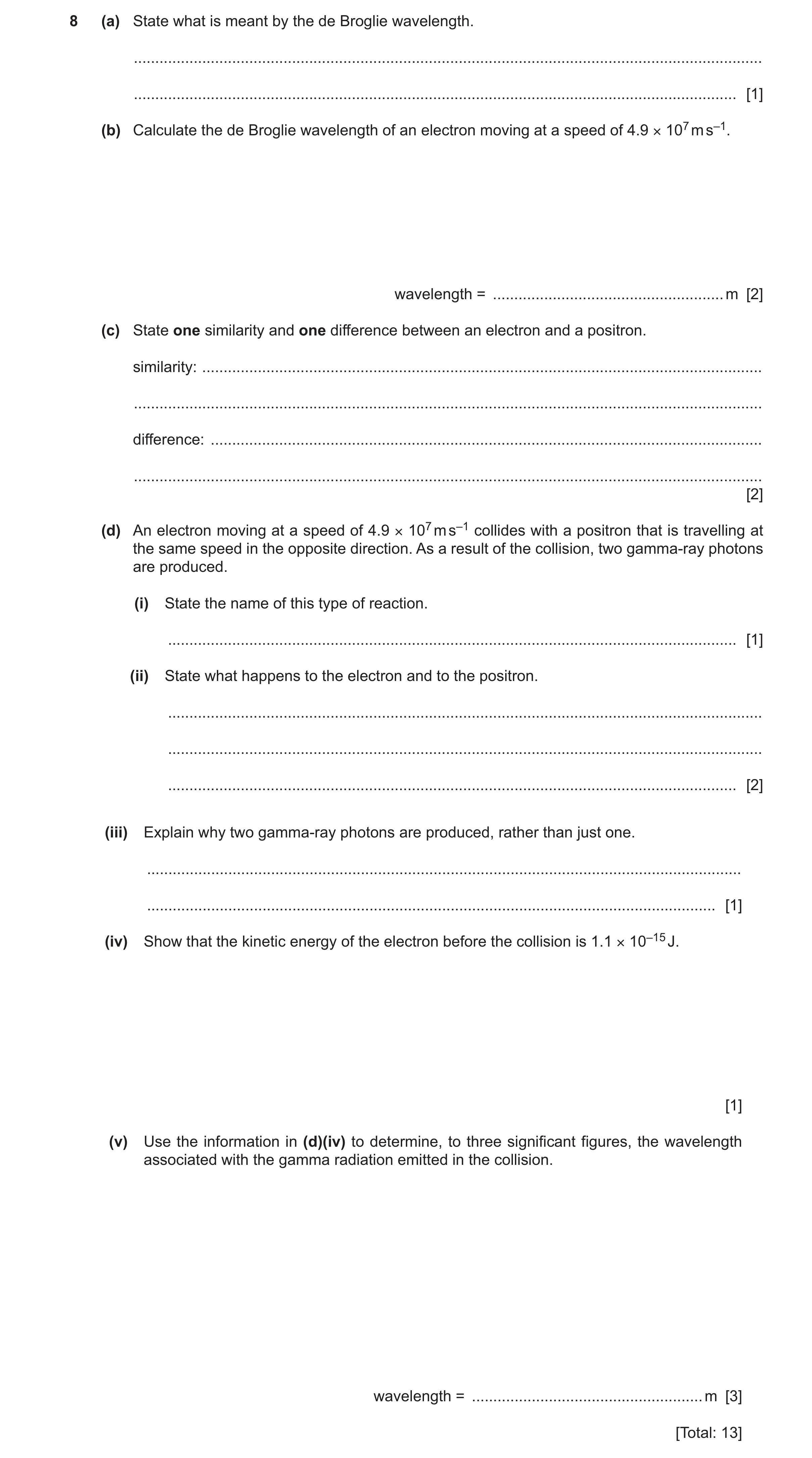
8 (a) State what is meant by the de Broglie wavelength. … … [1] (b) Calculate the de Broglie wavelength of an electron moving at a speed of 4.9 × 10⁷ m s–1. wavelength = … m [2] (c) State one similarity and one difference between an electron and a positron. similarity: … … difference: … … [2] (d) An electron moving at a speed of 4.9 × 10⁷ m s–1 collides with a positron that is travelling at the same speed in the opposite direction. As a result of the collision, two gamma-ray photons are produced. (i) State the name of this type of reaction. … [1] (ii) State what happens to the electron and to the positron. … … … [2] (iii) Explain why two gamma-ray photons are produced, rather than just one. … … [1] (iv) Show that the kinetic energy of the electron before the collision is 1.1 × 10⁻¹⁵ J. [1] (v) Use the information in (d)(iv) to determine, to three significant figures, the wavelength associated with the gamma radiation emitted in the collision. wavelength = … m [3] [Total: 13]
13 marks
Mark scheme: 8(a) wavelength associated with a moving particle B1 8(b) = h / p C1 = (6.63 × 10⁻³⁴) / (9.11 × 10–31 × 4.9 × 107) A1 = 1.5 × 10⁻¹¹ m 8(c) similarity: any one point from: B1 • same mass • same magnitude of charge • both leptons difference: any one point from: B1 • electron has negative charge, positron has positive charge • positron is anti-particle of electron • electron is a particle, positron is an anti-particle 8(d)(i) (pair) annihilation B1 8(d)(ii) their mass gets converted into energy B1 (their mass–energy) becomes the energy of the gamma photons B1 8(d)(iii) they travel in opposite directions to conserve momentum B1 8(d)(iv) kinetic energy = ½ × 9.11 × 10–31 × (4.9 × 107)2 = 1.1 × 10⁻¹⁵ J A1 8(d)(v) E = mc2 C1 E = hc / C1 or E = hf and c = f (1.1 × 10⁻¹⁵) + (9.11 × 10–31 × (3.00 × 108)2) = (6.63 × 10–34 × 3.00 × 108) / A1 = 2.39 × 10⁻¹² m
This question in 9702/43 May/June 2025
Q15 · Describe what is meant by wave–particle duality 9702/44 May/June 2025
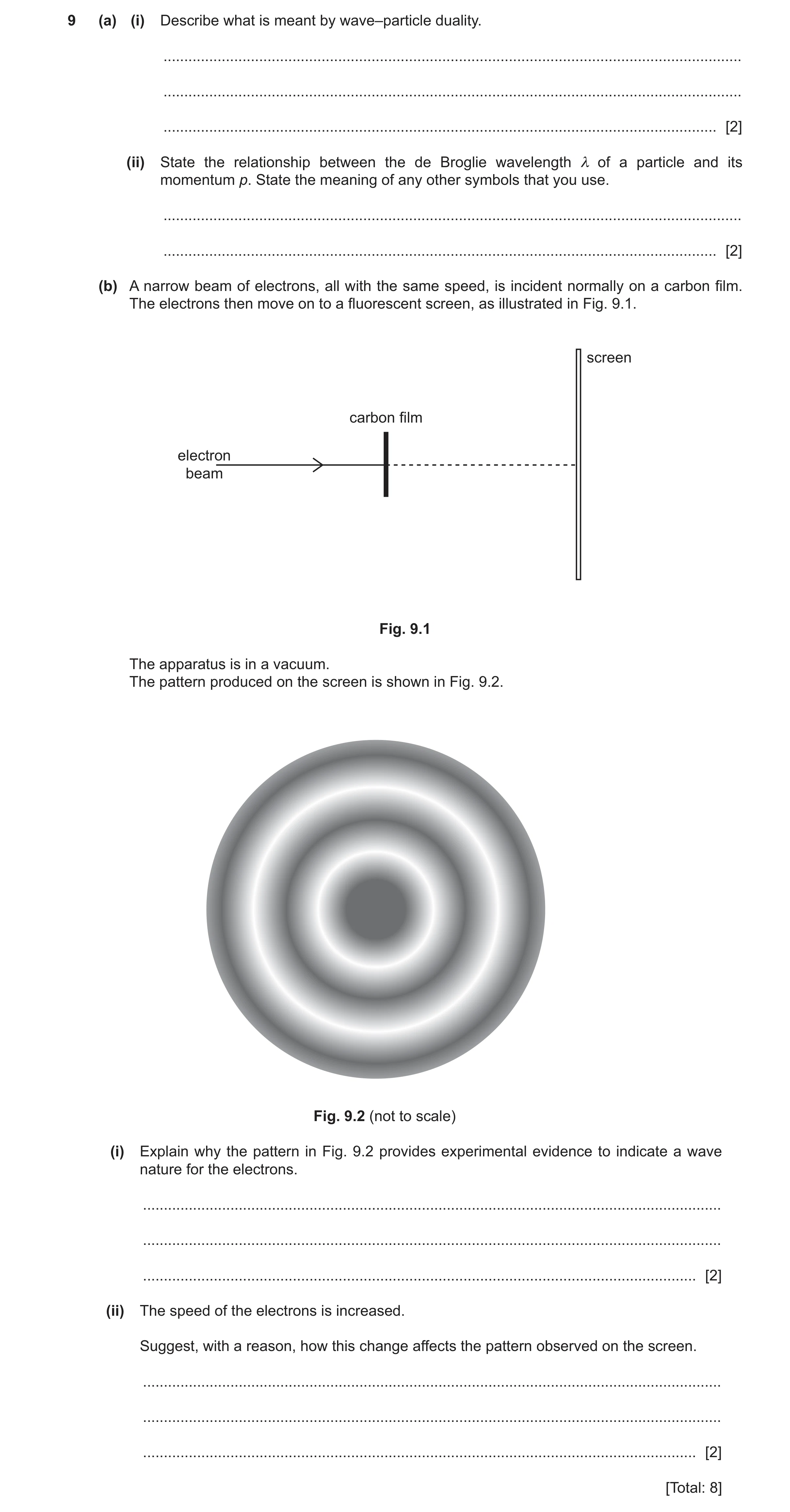
9 (a) (i) Describe what is meant by wave–particle duality. … … … [2] (ii) State the relationship between the de Broglie wavelength λ of a particle and its momentum p. State the meaning of any other symbols that you use. … … [2] (b) A narrow beam of electrons, all with the same speed, is incident normally on a carbon film. The electrons then move on to a fluorescent screen, as illustrated in Fig. 9.1. screen carbon film electron beam Fig. 9.1 The apparatus is in a vacuum. The pattern produced on the screen is shown in Fig. 9.2. Fig. 9.2 (not to scale) (i) Explain why the pattern in Fig. 9.2 provides experimental evidence to indicate a wave nature for the electrons. … … … [2] (ii) The speed of the electrons is increased. Suggest, with a reason, how this change affects the pattern observed on the screen. … … … [2] [Total: 8]
8 marks
Mark scheme: 9(a)(i) electromagnetic wave can behave like a particle B1 moving particle can behave like a wave B1 9(a)(ii) = h / p M1 h is the Planck constant A1 9(b)(i) Any two points from: B2 • pattern similar to diffraction of light • diffraction (pattern) is characteristic of wave behaviour • rings show constructive and destructive interference 9(b)(ii) (de Broglie) wavelength decreases B1 rings become closer together B1
This question in 9702/44 May/June 2025
 1 / 19
 2 / 19
 3 / 19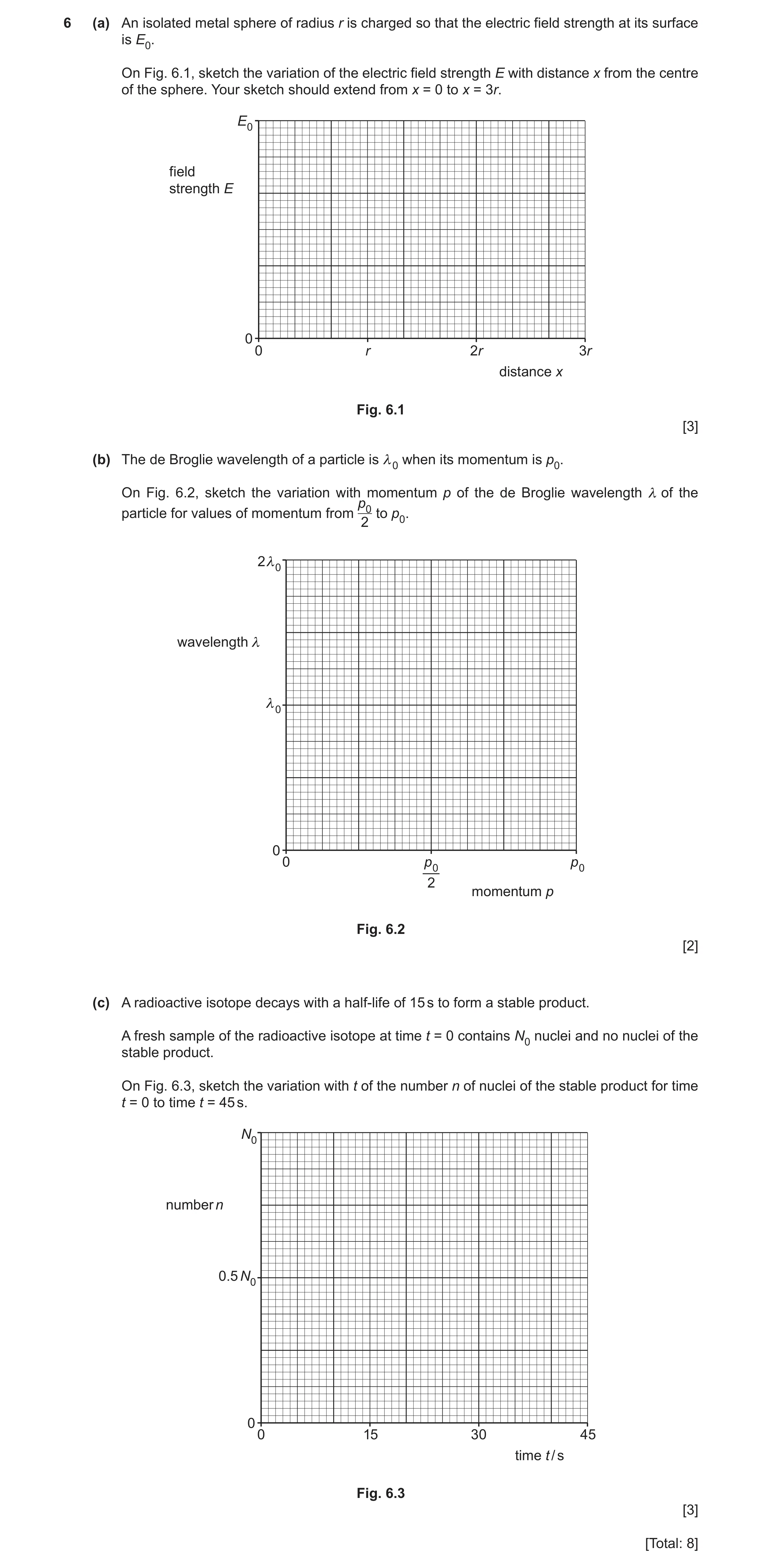
 7 / 19
 8 / 19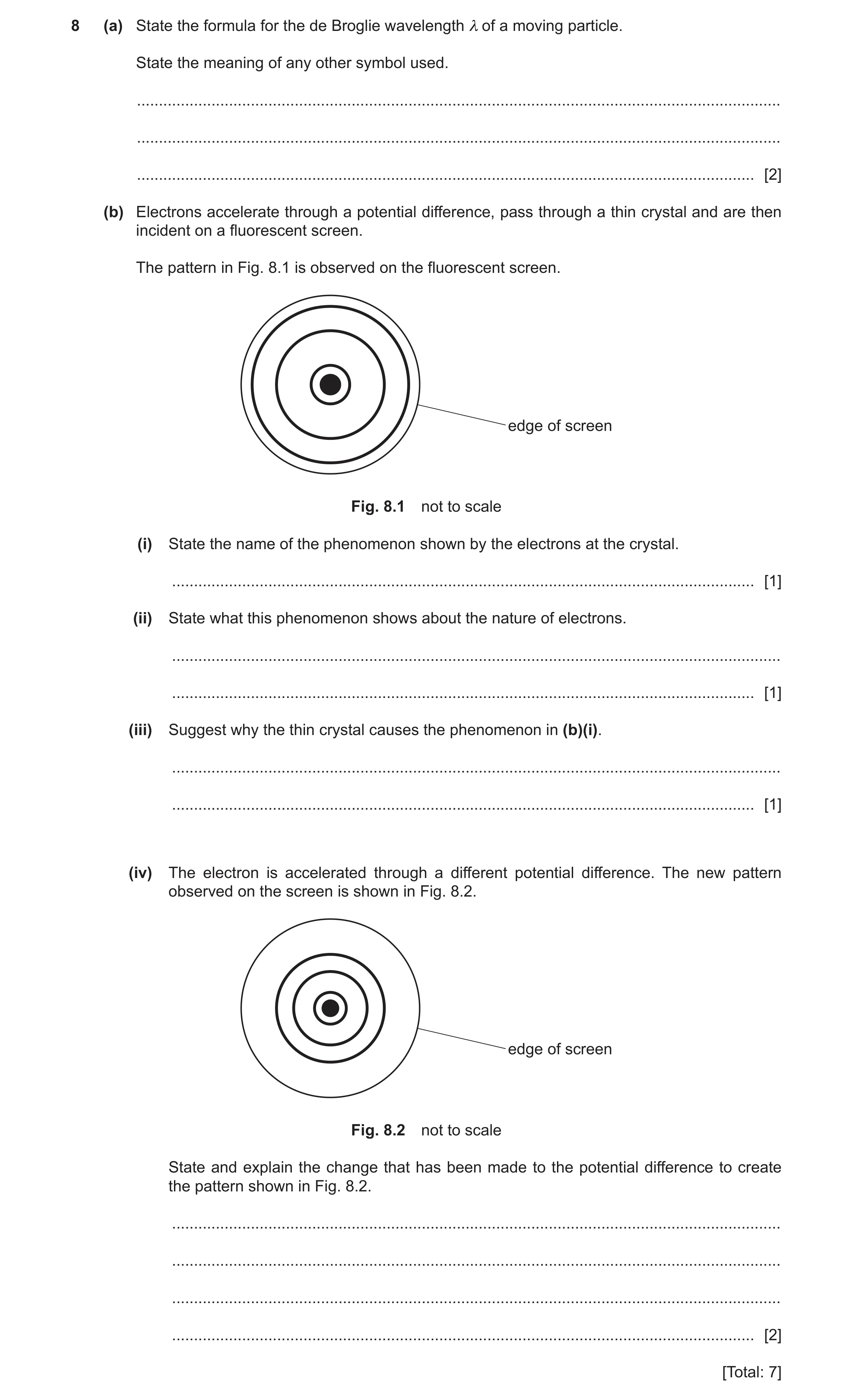
 10 / 19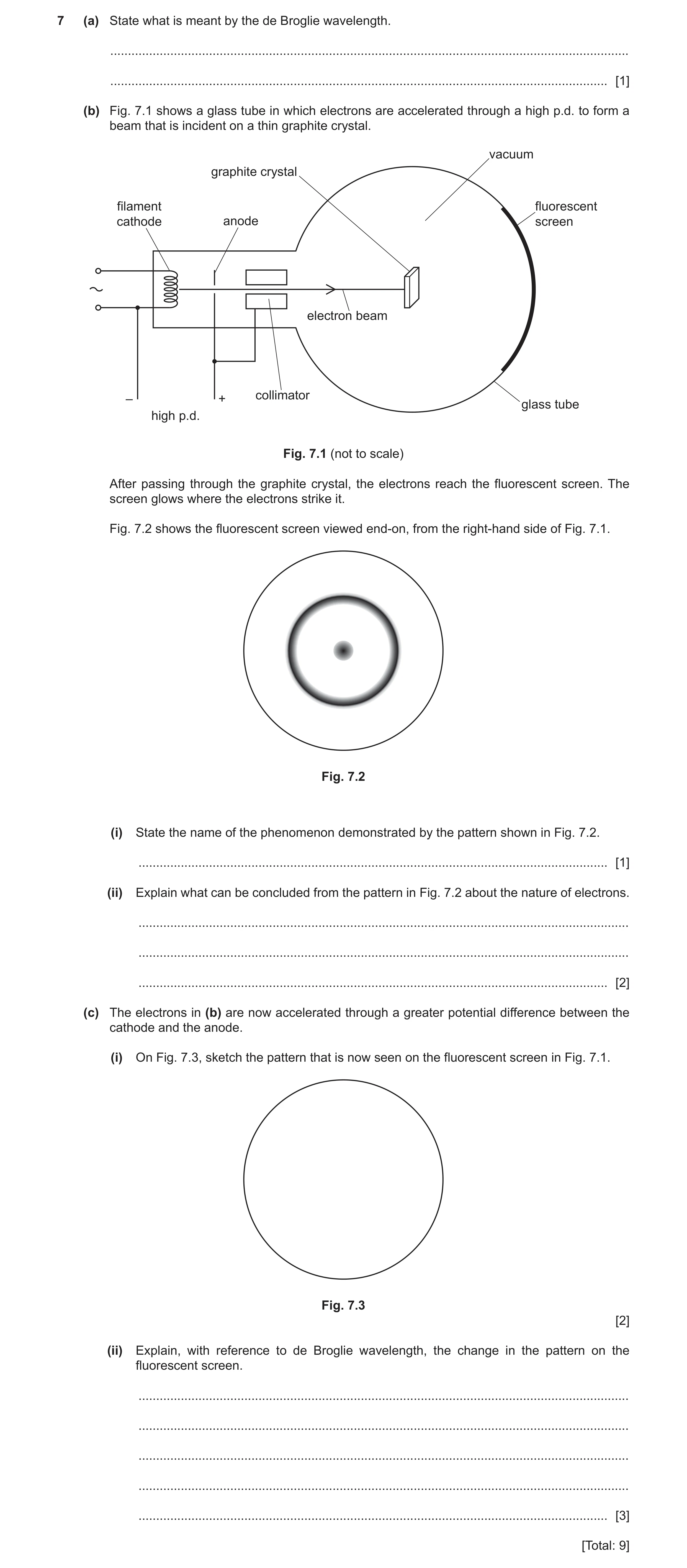
 9
9 5
5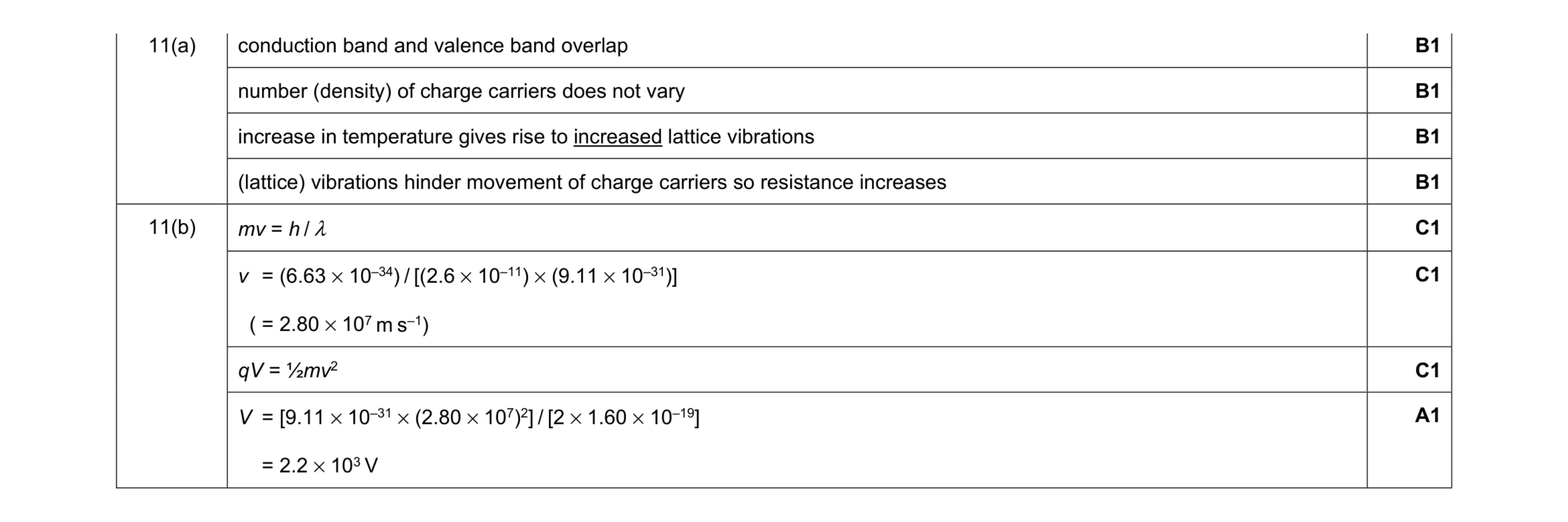 8
8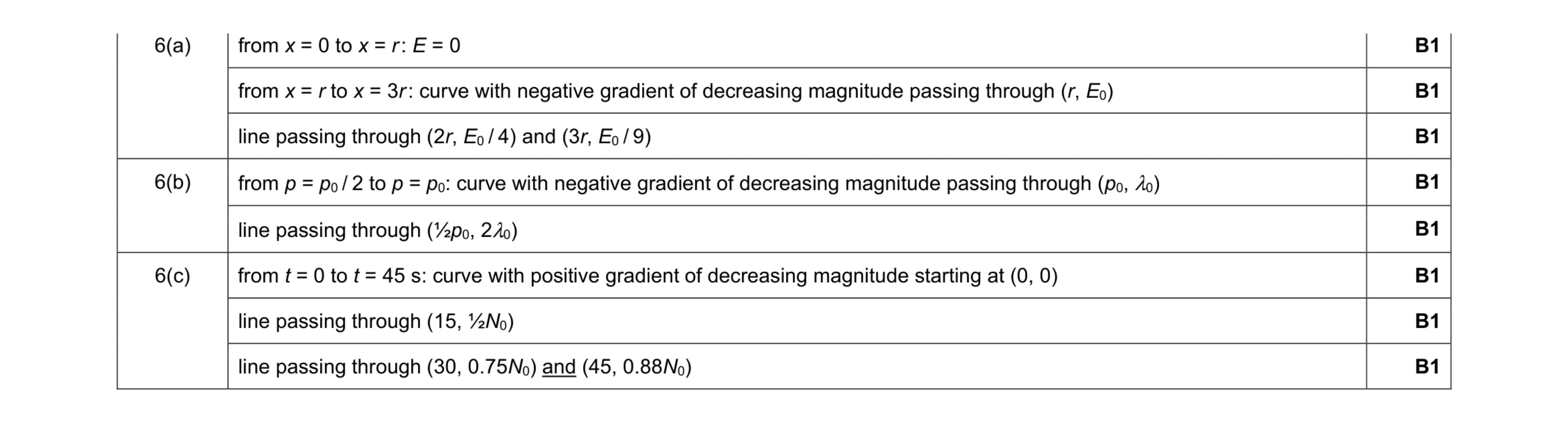 8
8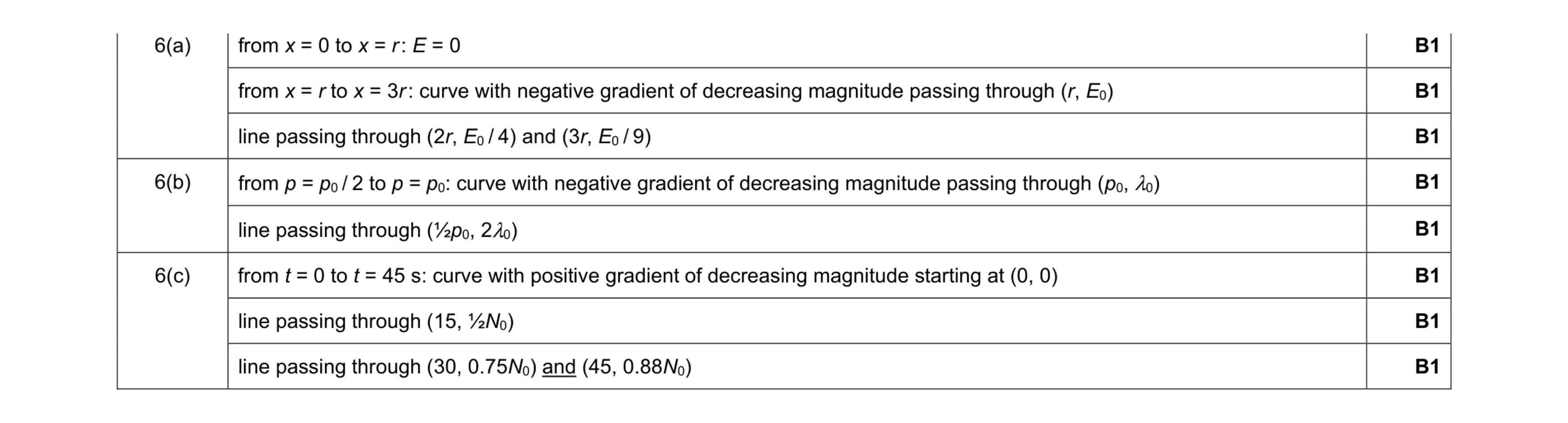 8
8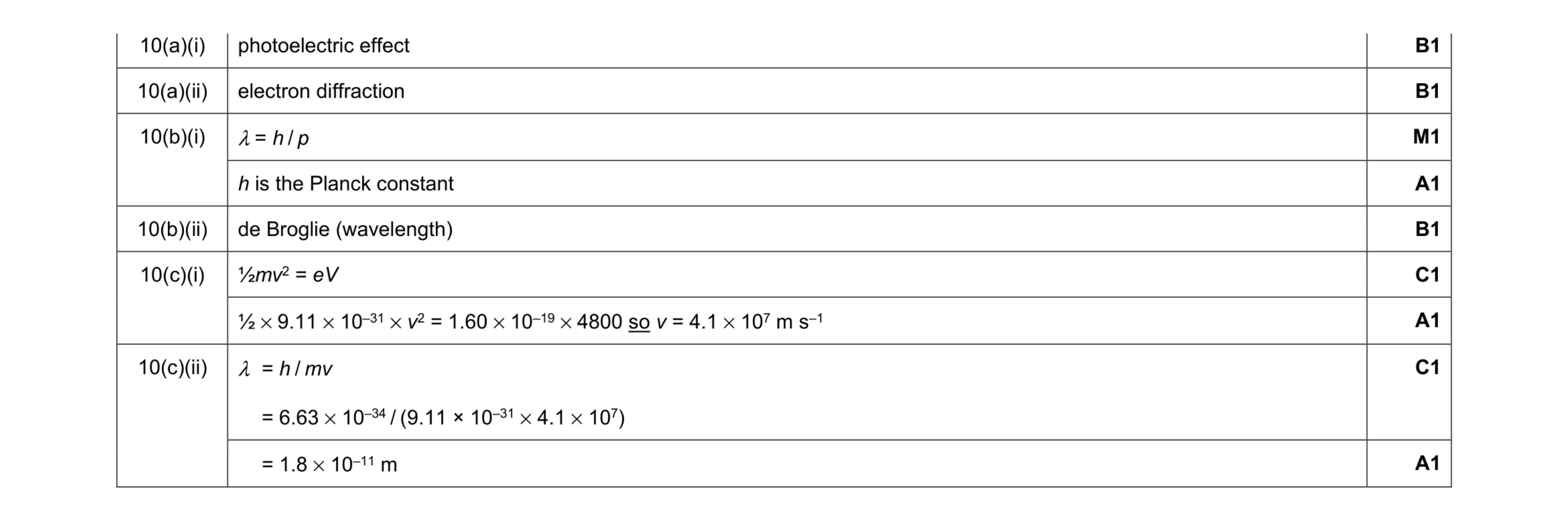 9
9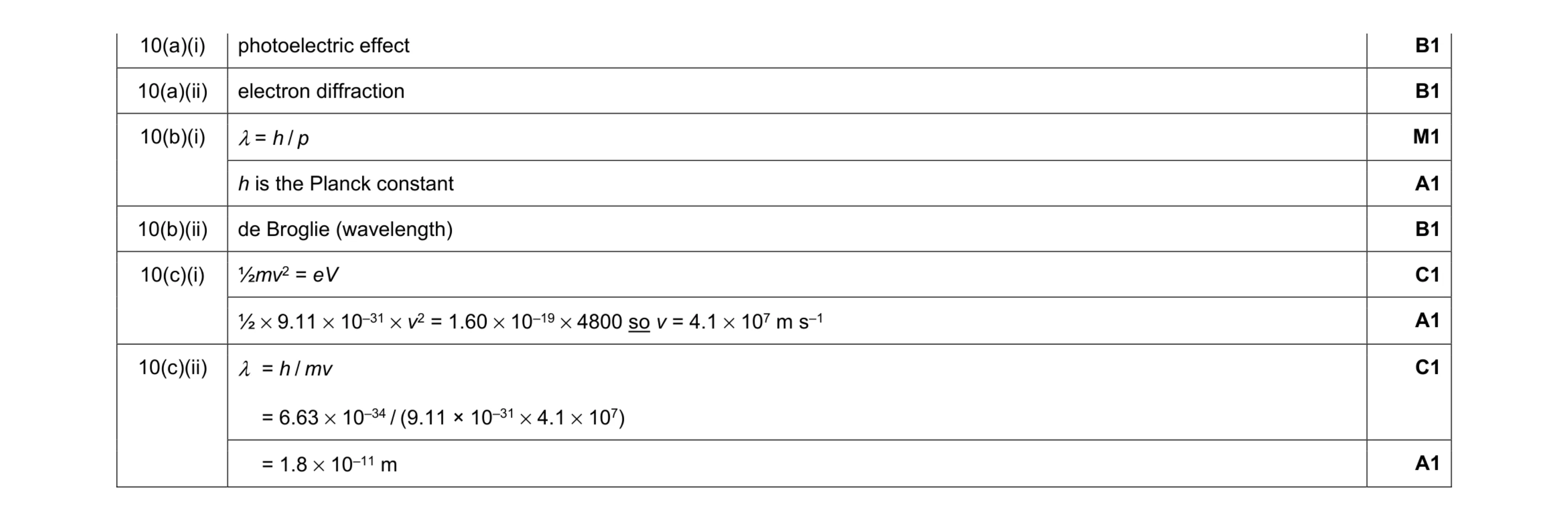 9
9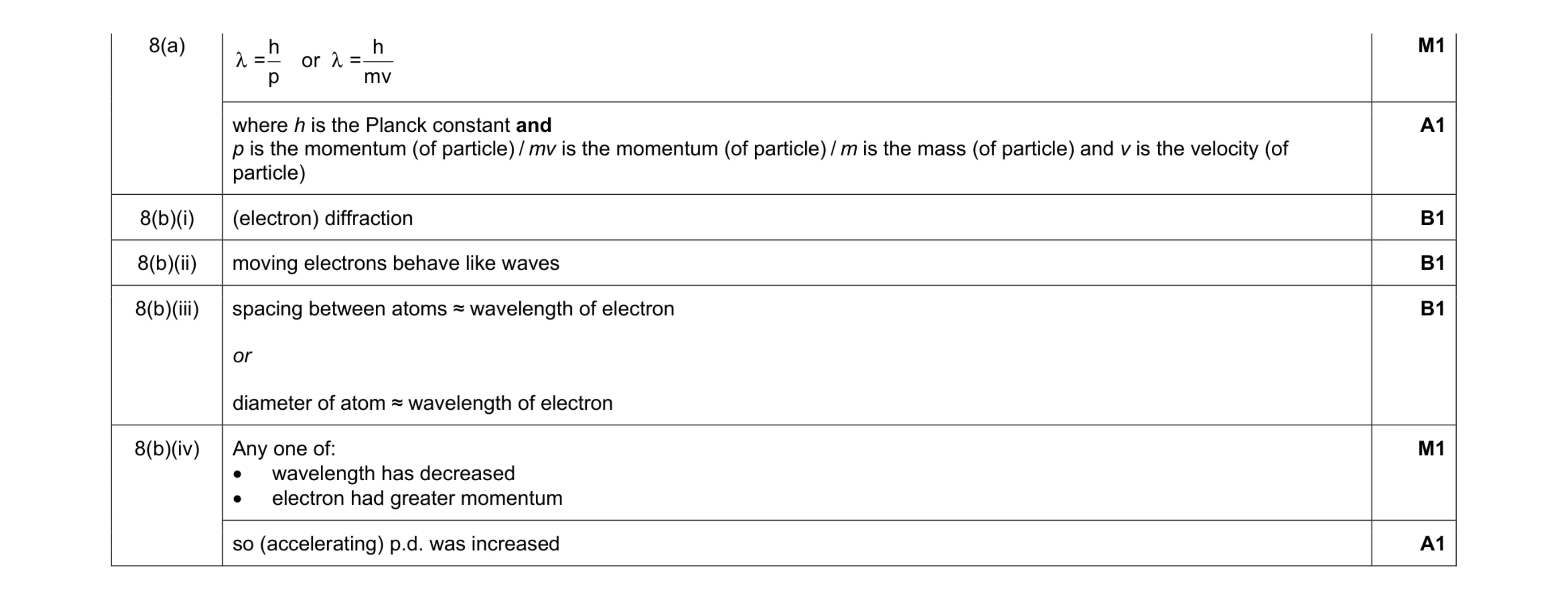 7
7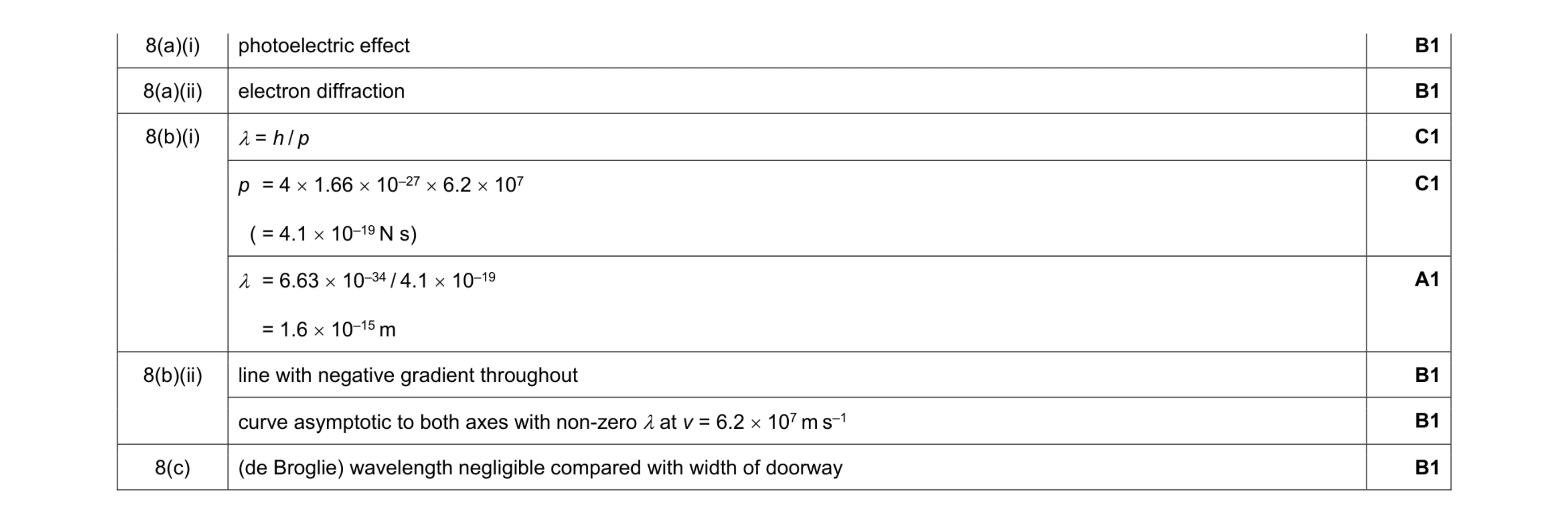 8
8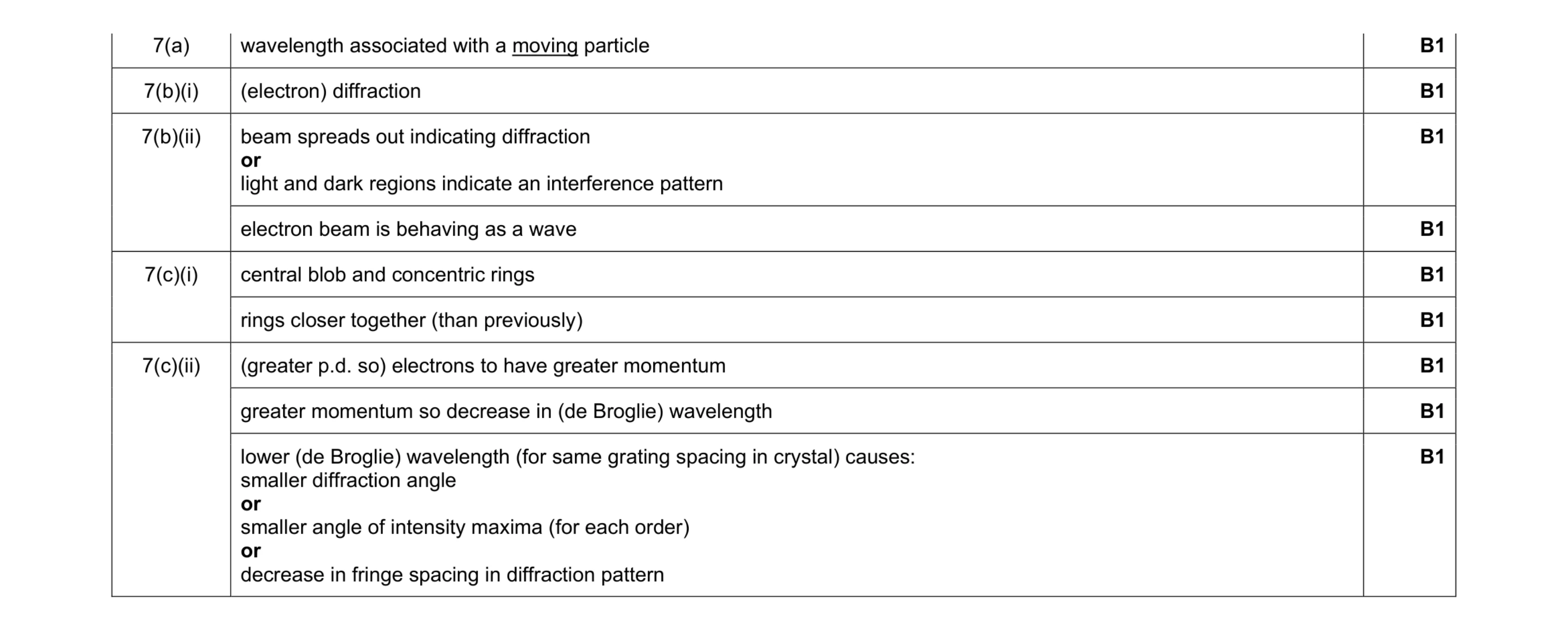 9
9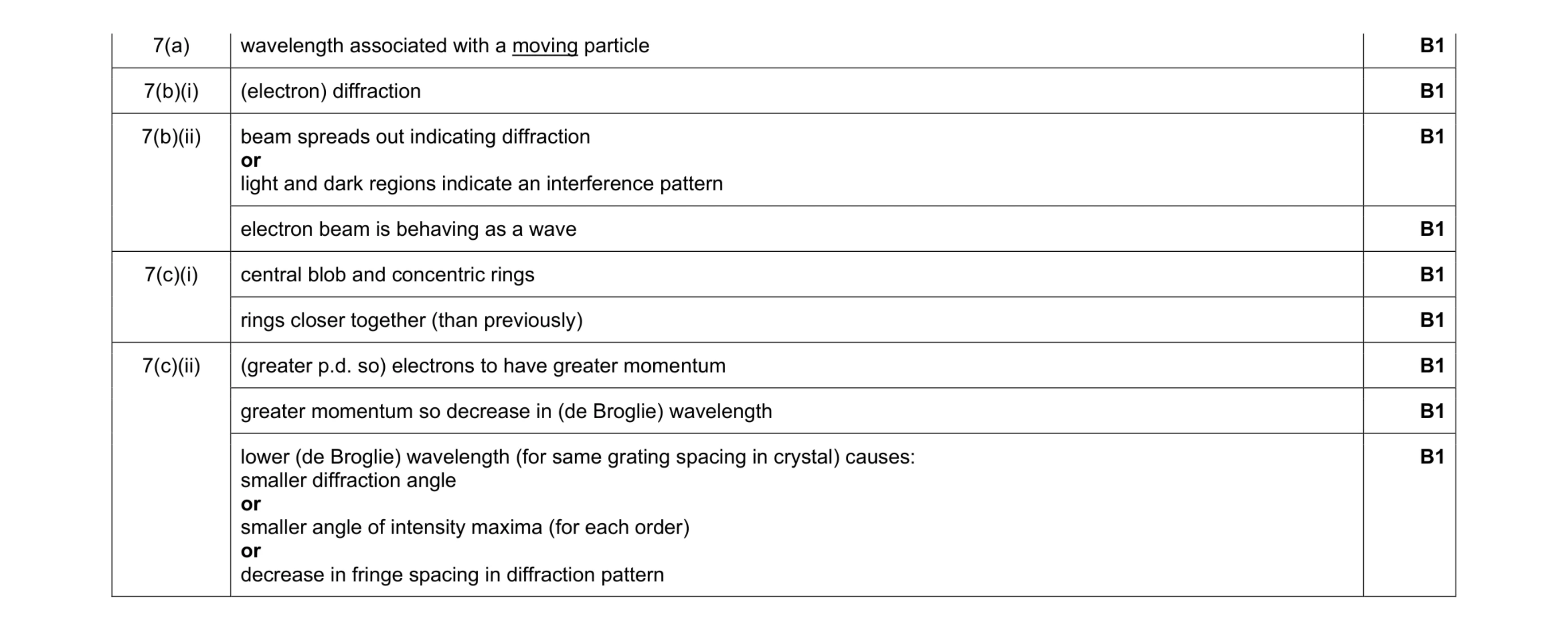 9
9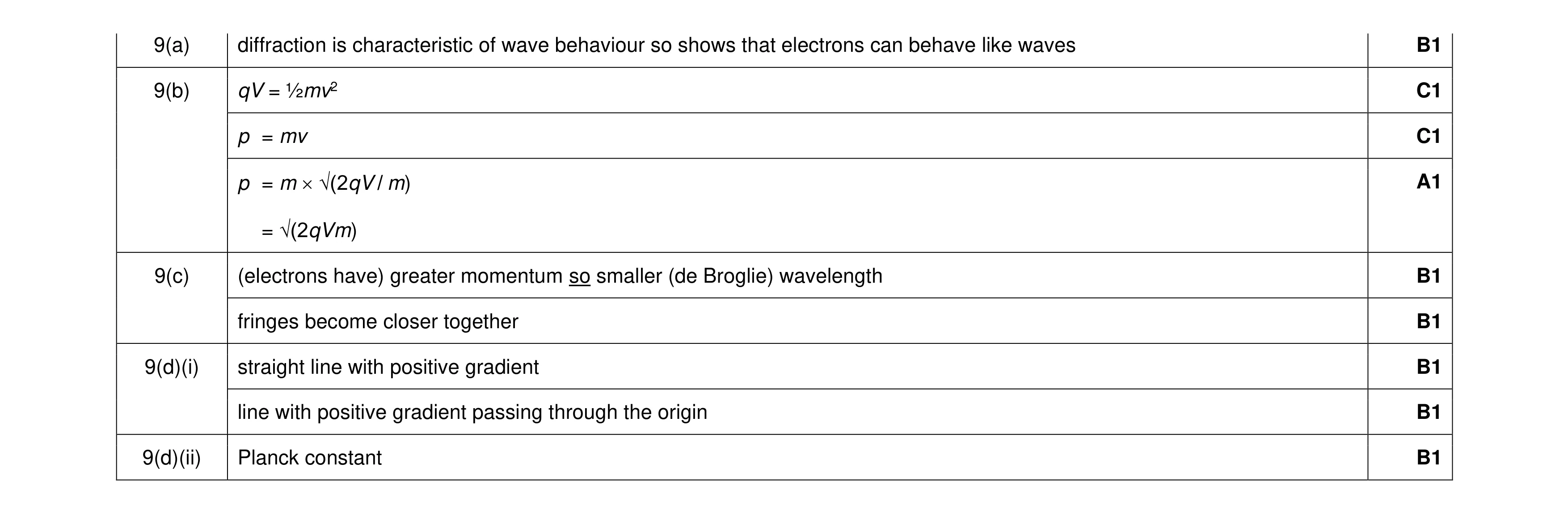 9
9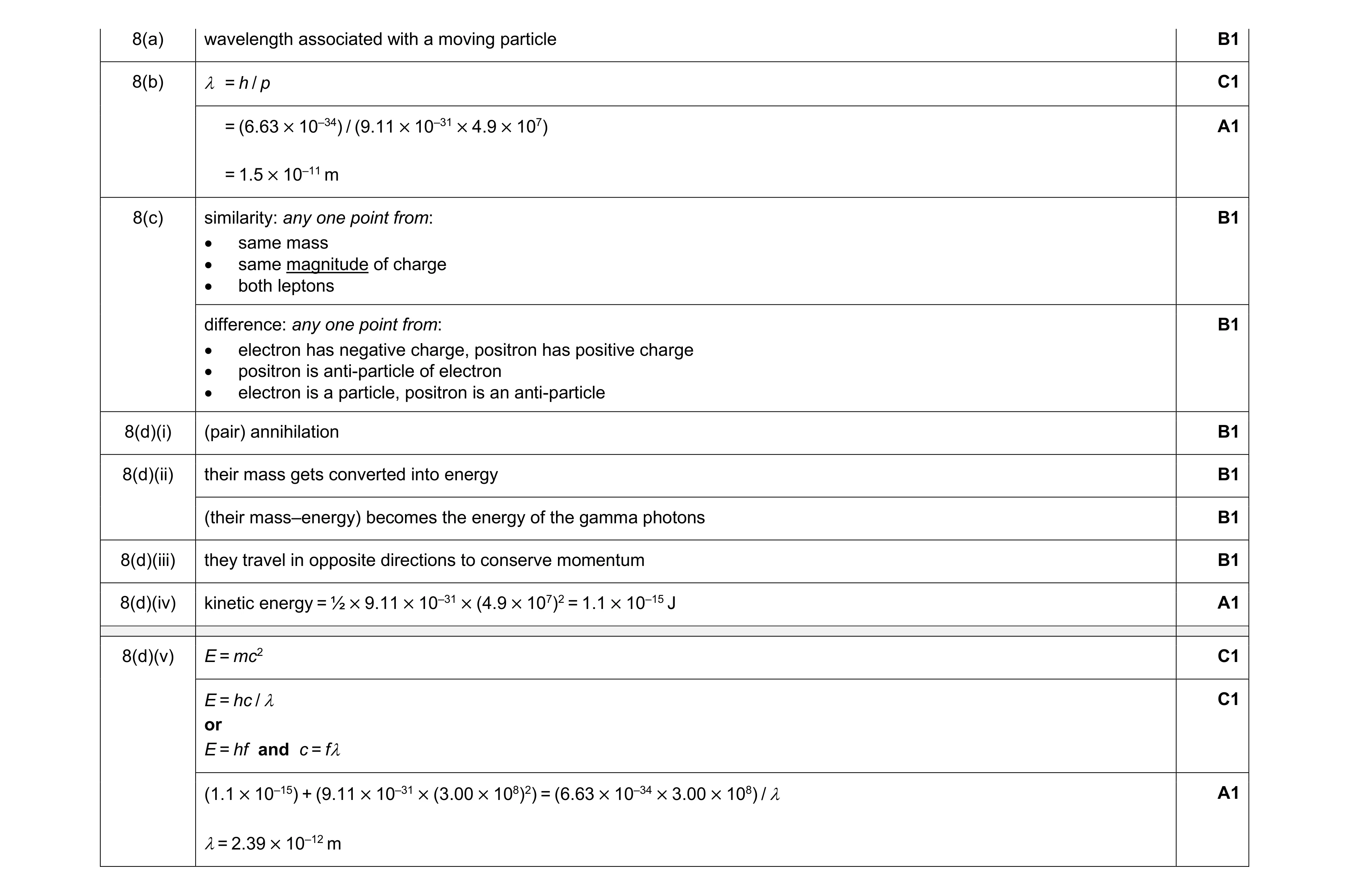 13
13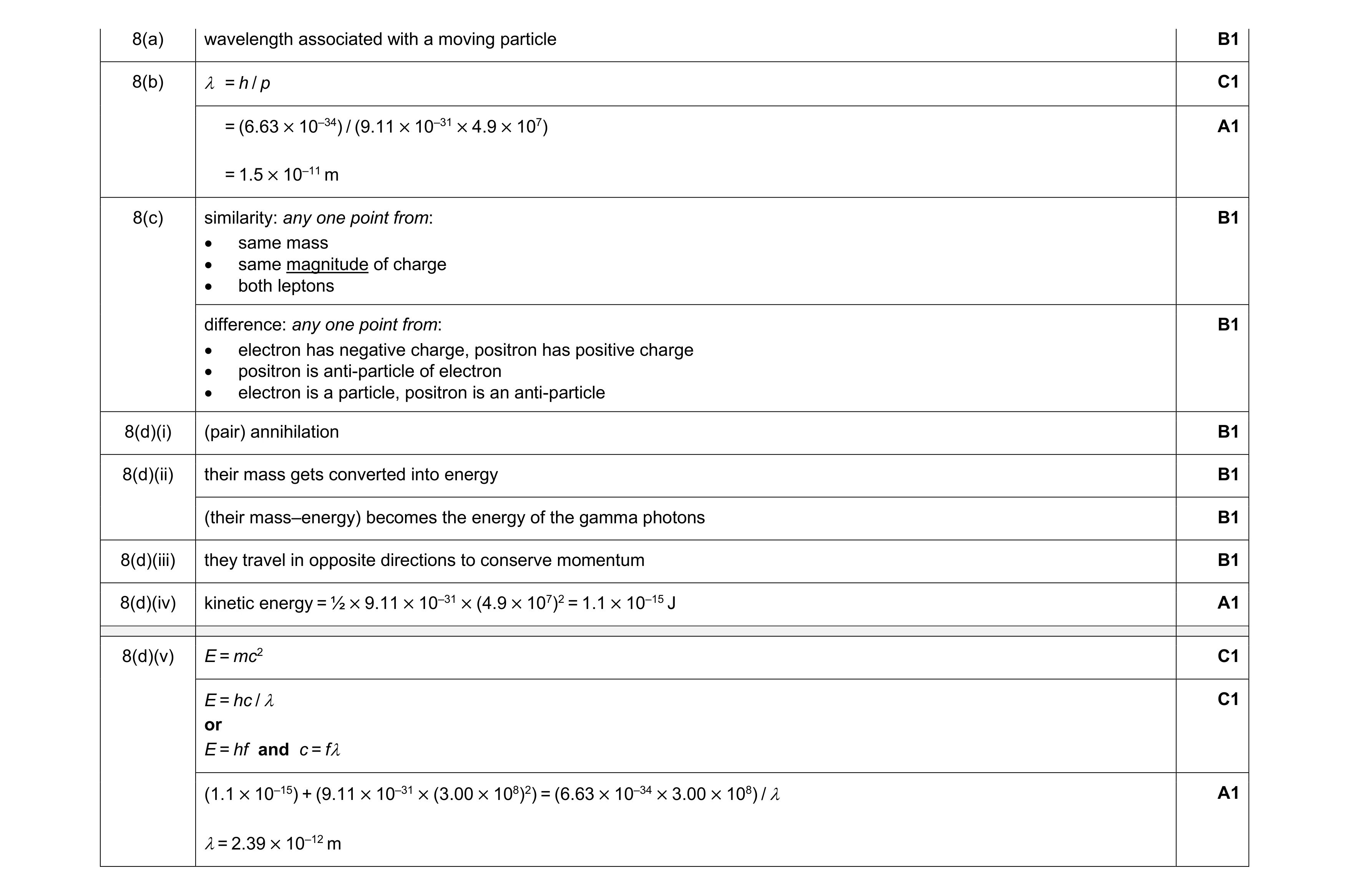 13
13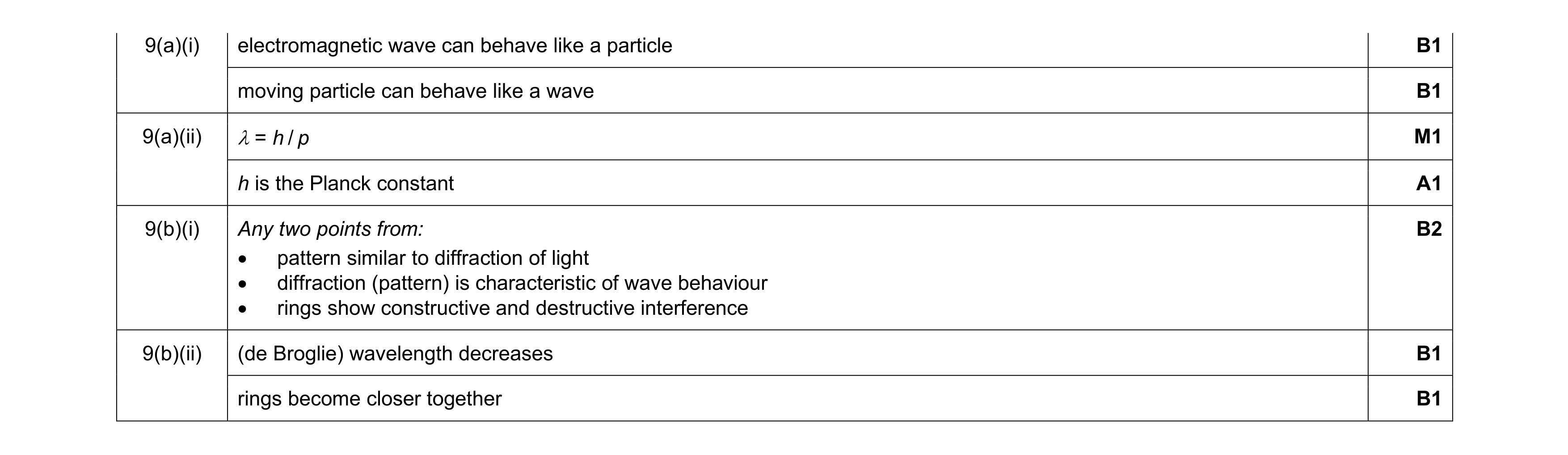 8
8