Questions as text
Q1 · Explain how a satellite may be in a circular orbit around a planet 9702/41 May/June 2017
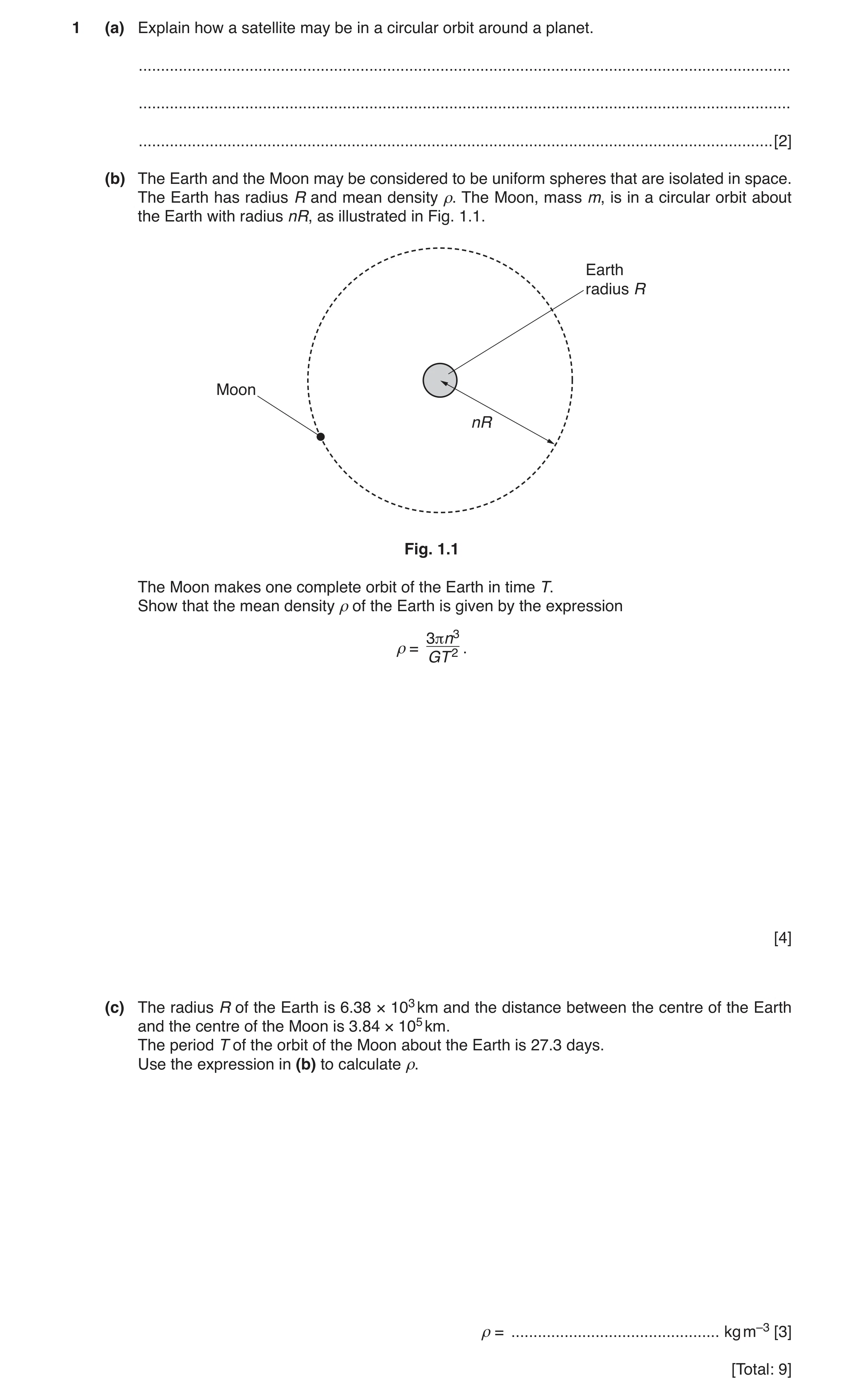
1 (a) Explain how a satellite may be in a circular orbit around a planet. … … … [2] (b) The Earth and the Moon may be considered to be uniform spheres that are isolated in space. The Earth has radius R and mean density ρ. The Moon, mass m, is in a circular orbit about the Earth with radius nR, as illustrated in Fig. 1.1. Earth radius R Moon nR Fig. 1.1 The Moon makes one complete orbit of the Earth in time T. Show that the mean density ρ of the Earth is given by the expression 3πn3 ρ = 2 . GT [4] (c) The radius R of the Earth is 6.38 × 10³ km and the distance between the centre of the Earth and the centre of the Moon is 3.84 × 10⁵ km. The period T of the orbit of the Moon about the Earth is 27.3 days. Use the expression in (b) to calculate ρ. ρ = … kg m–3 [3] [Total: 9]
9 marks
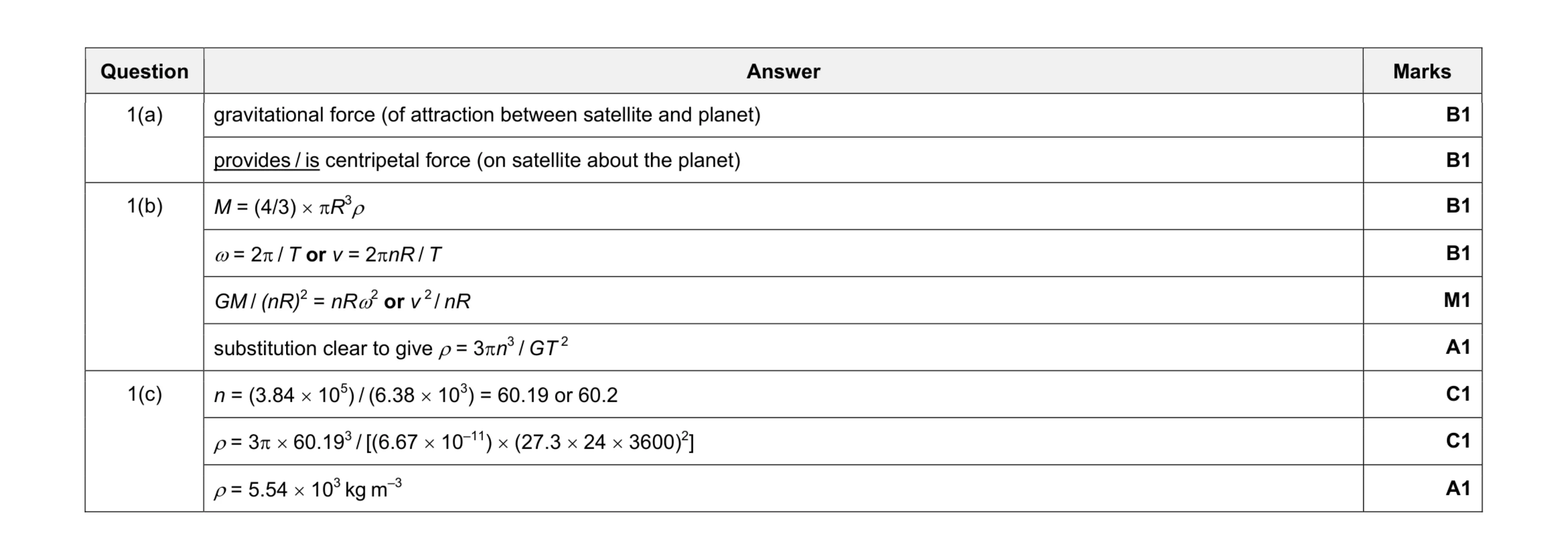
Mark scheme: 1(a) gravitational force (of attraction between satellite and planet) B1 provides / is centripetal force (on satellite about the planet) B1 1(b) M = (4/3) × πR3ρ B1 ω = 2π / T or v = 2πnR / T B1 GM / (nR)2 = nRω2 or v 2 / nR M1 substitution clear to give ρ = 3πn3 / GT 2 A1 1(c) n = (3.84 × 10⁵) / (6.38 × 10³) = 60.19 or 60.2 C1 ρ = 3π × 60.193 / [(6.67 × 10–11) × (27.3 × 24 × 3600)2] C1 ρ = 5.54 × 10³ kg m–3 A1
This question in 9702/41 May/June 2017
Q2 · Explain how a satellite may be in a circular orbit around a planet 9702/43 May/June 2017
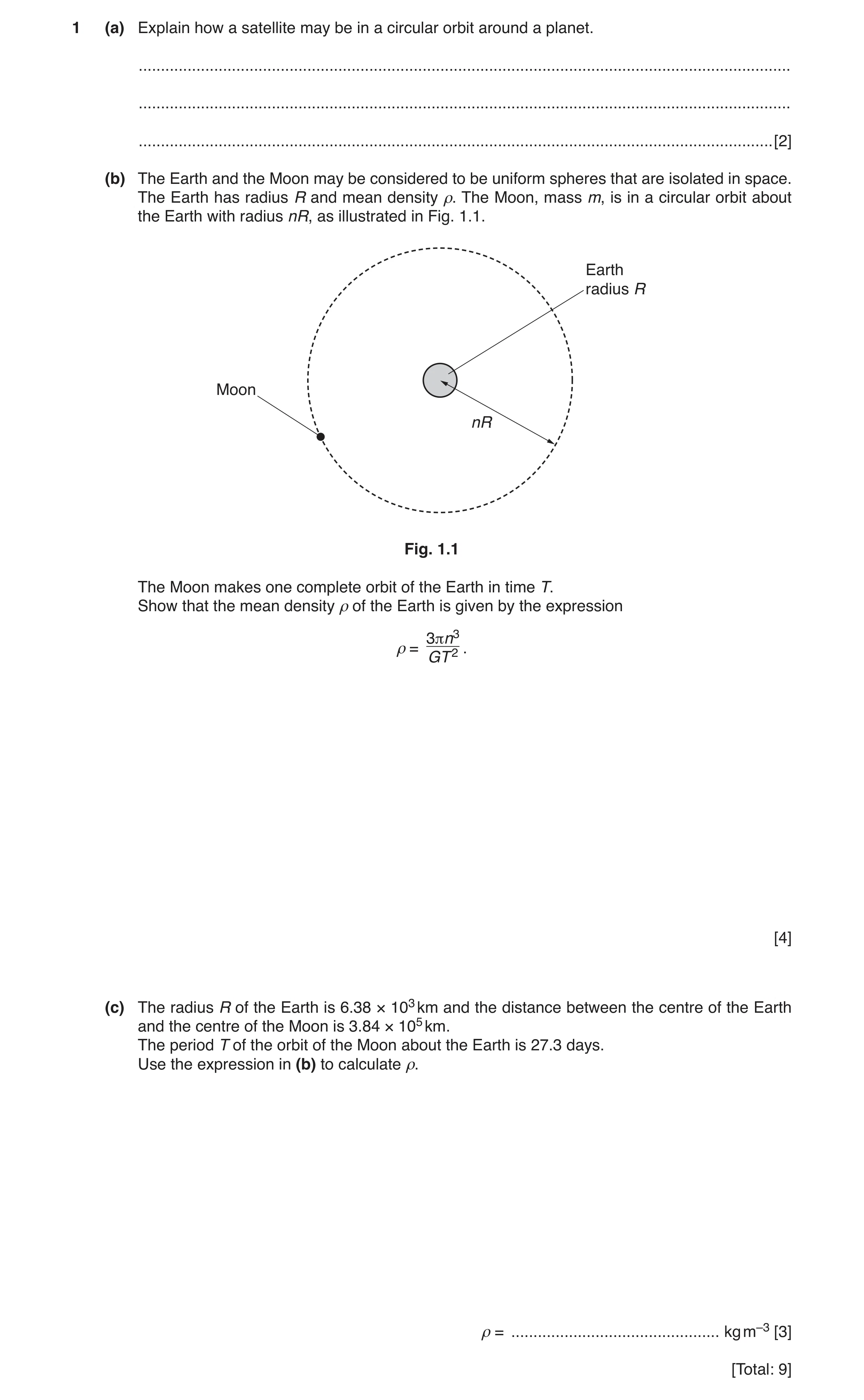
1 (a) Explain how a satellite may be in a circular orbit around a planet. … … … [2] (b) The Earth and the Moon may be considered to be uniform spheres that are isolated in space. The Earth has radius R and mean density ρ. The Moon, mass m, is in a circular orbit about the Earth with radius nR, as illustrated in Fig. 1.1. Earth radius R Moon nR Fig. 1.1 The Moon makes one complete orbit of the Earth in time T. Show that the mean density ρ of the Earth is given by the expression 3πn3 ρ = 2 . GT [4] (c) The radius R of the Earth is 6.38 × 10³ km and the distance between the centre of the Earth and the centre of the Moon is 3.84 × 10⁵ km. The period T of the orbit of the Moon about the Earth is 27.3 days. Use the expression in (b) to calculate ρ. ρ = … kg m–3 [3] [Total: 9]
9 marks
Mark scheme: 1(a) gravitational force (of attraction between satellite and planet) B1 provides / is centripetal force (on satellite about the planet) B1 1(b) M = (4/3) × πR3ρ B1 ω = 2π / T or v = 2πnR / T B1 GM / (nR)2 = nRω2 or v 2 / nR M1 substitution clear to give ρ = 3πn3 / GT 2 A1 1(c) n = (3.84 × 10⁵) / (6.38 × 10³) = 60.19 or 60.2 C1 ρ = 3π × 60.193 / [(6.67 × 10–11) × (27.3 × 24 × 3600)2] C1 ρ = 5.54 × 10³ kg m–3 A1
This question in 9702/43 May/June 2017
Q3 · State Newton’s law of gravitation 9702/42 Oct/Nov 2017
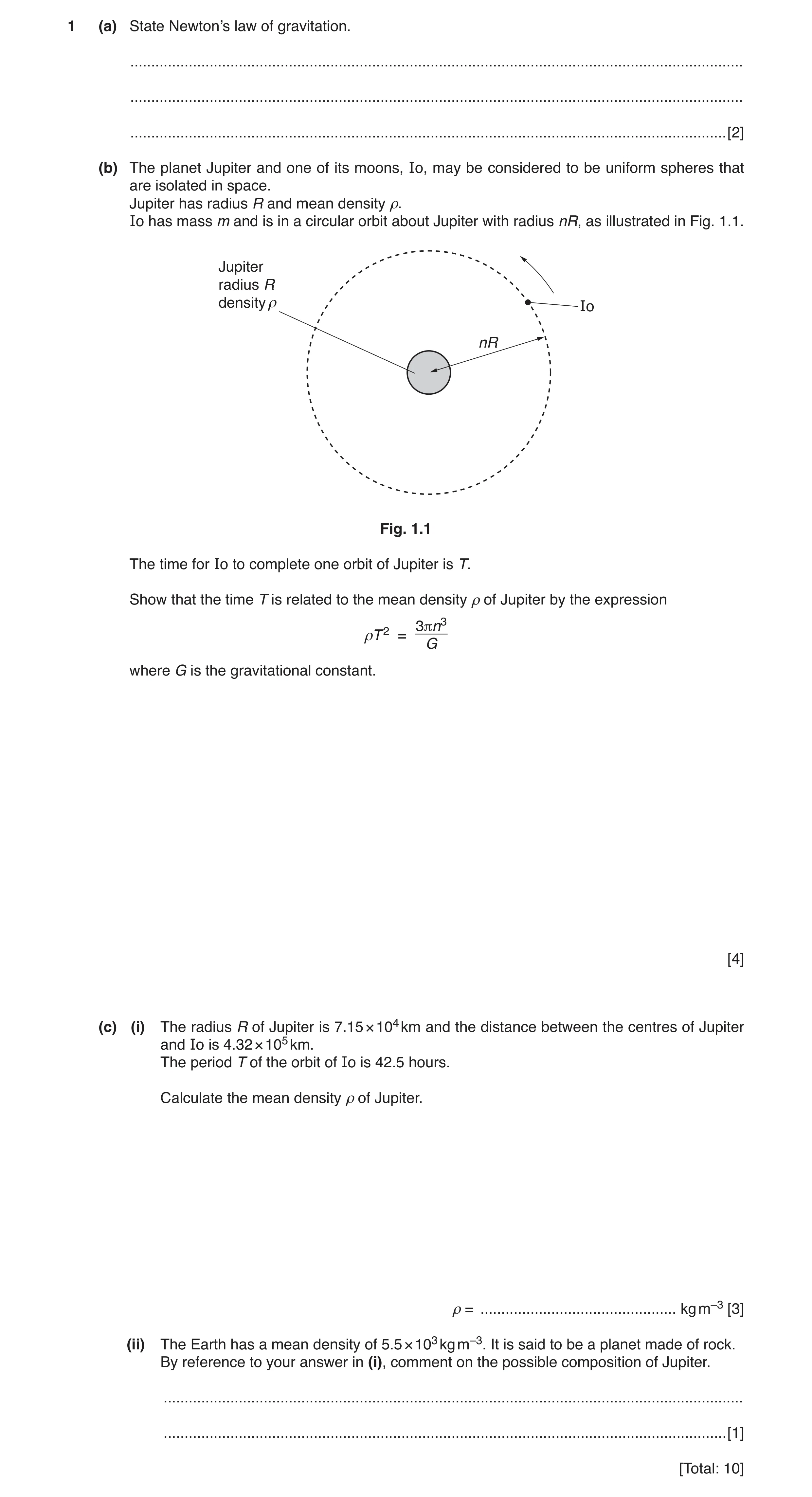
1 (a) State Newton’s law of gravitation. … … … [2] (b) The planet Jupiter and one of its moons, Io, may be considered to be uniform spheres that are isolated in space. Jupiter has radius R and mean density ρ. Io has mass m and is in a circular orbit about Jupiter with radius nR, as illustrated in Fig. 1.1. Jupiter radius R density ρ Io nR Fig. 1.1 The time for Io to complete one orbit of Jupiter is T. Show that the time T is related to the mean density ρ of Jupiter by the expression 2 3πn3 ρT = G where G is the gravitational constant. [4] (c) (i) The radius R of Jupiter is 7.15 × 10⁴ km and the distance between the centres of Jupiter and Io is 4.32 × 10⁵ km. The period T of the orbit of Io is 42.5 hours. Calculate the mean density ρ of Jupiter. ρ = … kg m–3 [3] (ii) The Earth has a mean density of 5.5 × 10³ kg m–3. It is said to be a planet made of rock. By reference to your answer in (i), comment on the possible composition of Jupiter. … … [1] [Total: 10]
10 marks
Mark scheme: 1(a) force proportional to product of masses and inversely proportional to square of separation B1 idea of force between point masses B1 1(b) mass of Jupiter (M) = (4 / 3) πR3ρ B1 ω = 2π / T or v = 2πnR / T B1 (m)ω2x = GM(m) / x2 or (m)v2 / x = GM(m) / x2 M1 substitution and correct algebra leading to ρT2 = 3πn3 / G A1 1(c)(i) n = (4.32 × 10⁵) / (7.15 × 10⁴) or n = 6.04 C1 ρ × (42.5 × 3600)2 = (3π × 6.043) / (6.67 × 10⁻¹¹) C1 ρ = 1.33 × 10³ kg m–3 A1 1(c)(ii) Jupiter likely to be a gas/liquid (at high pressure) [allow other sensible suggestions] B1
This question in 9702/42 Oct/Nov 2017
Q4 · Define gravitational field strength 9702/43 Oct/Nov 2017
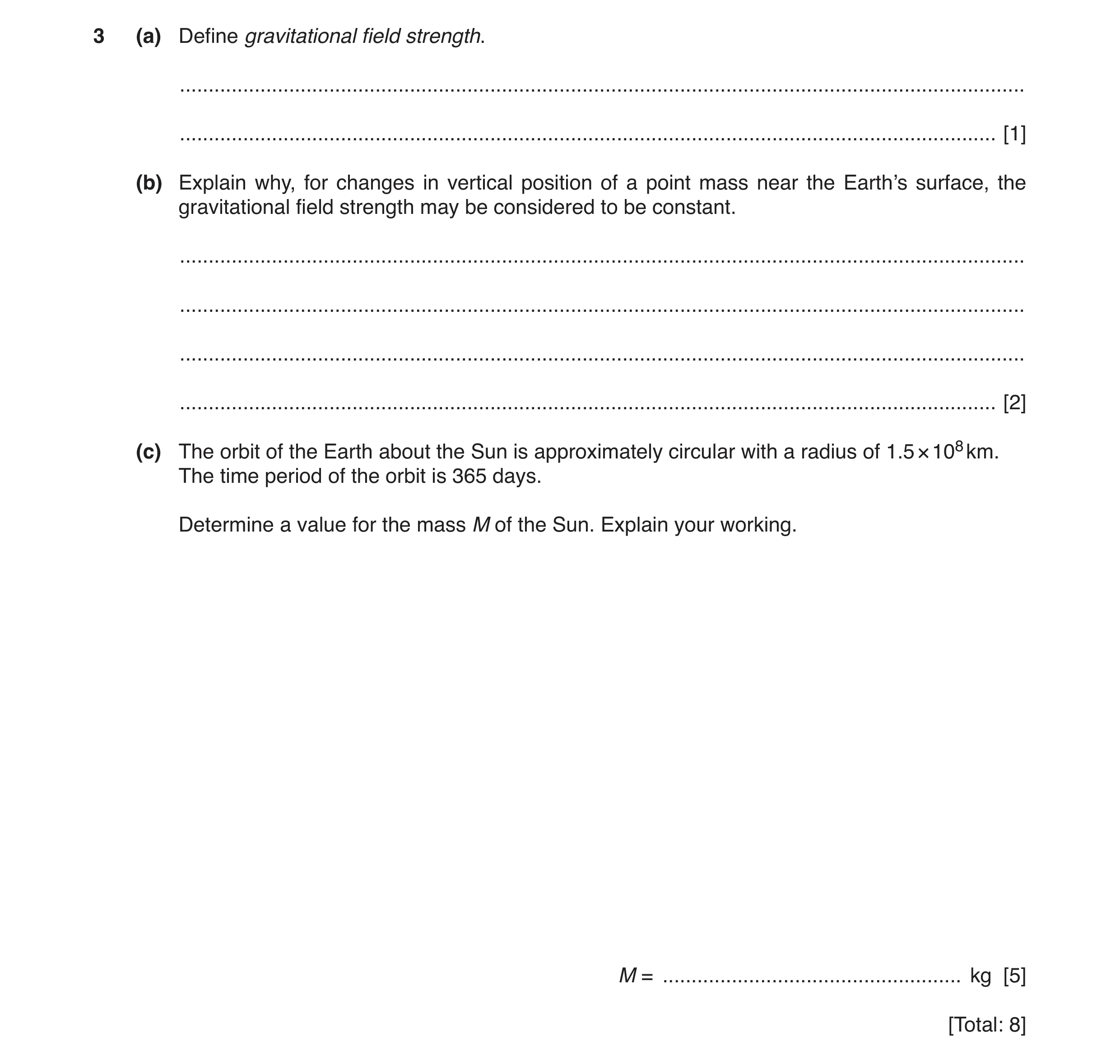
3 (a) Define gravitational field strength. … … [1] (b) Explain why, for changes in vertical position of a point mass near the Earth’s surface, the gravitational field strength may be considered to be constant. … … … … [2] (c) The orbit of the Earth about the Sun is approximately circular with a radius of 1.5 × 10⁸ km. The time period of the orbit is 365 days. Determine a value for the mass M of the Sun. Explain your working. M = … kg [5] [Total: 8]
8 marks
Mark scheme: 3(a) force per unit mass B1 3(b) changes in height much less than radius of Earth M1 so (radial) field lines are almost parallel or g = GM / R2 ≈ GM / (R + h)2 A1 Question Answer Marks 3(c) gravitational force provides/is centripetal force B1 GMm / r2 = mv2 / r C1 v = (2π × 1.5 × 1011) / (3600 × 24 × 365) = 2.99 × 10⁴ (m s–1) C1 6.67 × 10⁻¹¹M = 1.5 × 1011 × (2.99 × 104)2 C1 M = 2.0 × 1030 kg A1 or GMm / r2 = mrω2 (C1) ω = 2π / (3600 × 24 × 365) = 1.99 × 10⁻⁷ (rad s–1) (C1) 6.67 × 10⁻¹¹M = (1.5 × 10¹¹)3 × (1.99 × 10–7)2 (C1) M = 2.0 × 1030 kg (A1) or T2 = 4π2r3 / GM (C2) M = 4π2 × (1.5 × 1011)3 / ({3600 × 24 × 365}2 × 6.67 × 10–11) (C1) = 2.0 × 1030 kg (A1)
This question in 9702/43 Oct/Nov 2017
Q5 · State Newton’s law of gravitation 9702/41 May/June 2018
1 (a) State Newton’s law of gravitation. … … … … [2] (b) A distant star is orbited by several planets. Each planet has a circular orbit with a different radius. (i) Each planet orbits at constant speed. Explain whether the planets are in equilibrium. … … … [1] (ii) The radius of the orbit of a planet is R and the orbital period is T. Data for some of the planets are given in Fig. 1.1. planet R / m T 2 / s2 c 9.6 × 10¹⁰ 2.5 × 10¹¹ e 4.0 × 10¹¹ 1.8 × 10¹³ g 2.1 × 10¹² 2.6 × 10¹⁵ Fig. 1.1 The relationship between R and T is given by the expression R 3 = kT 2. 1. Show that the constant k is given by the expression GM k = 4π2 where G is the gravitational constant and M is the mass of the star. [3] 2. Use data from Fig. 1.1 for the three planets and the expression for k to calculate the mass M of the star. M = … kg [3] [Total: 9]
9 marks
Mark scheme: 1(a) force proportional to product of masses and inversely proportional to square of separation B1 idea of force between point masses B1 1(b)(i) velocity changes/direction of motion changes/there is an acceleration/there is a resultant force so not in equilibrium B1 1(b)(ii)1. gravitational force equals/is centripetal force C1 GMm / R2 = mRω2 and ω = 2π / T or Gm / R2 = mv2 / R and v = 2πr / T or GMm / R2 = mR (2π / T)2 M1 convincing algebra leading to k = GM / 4π2 A1 1(b)(ii)2. correct use of R3 / T2 for one planet (c gives 3.54 × 10²¹; e and g both give 3.56 × 10²¹) C1 3.5(5) × 1021 = (6.67 × 10⁻¹¹ × M) / 4π2 M = 2.1 × 1033 kg A1 two or three values of R3 / T2 correctly calculated and used in a valid way to find a value for M based on more than one k B1
This question in 9702/41 May/June 2018
Q6 · State Newton’s law of gravitation 9702/43 May/June 2018
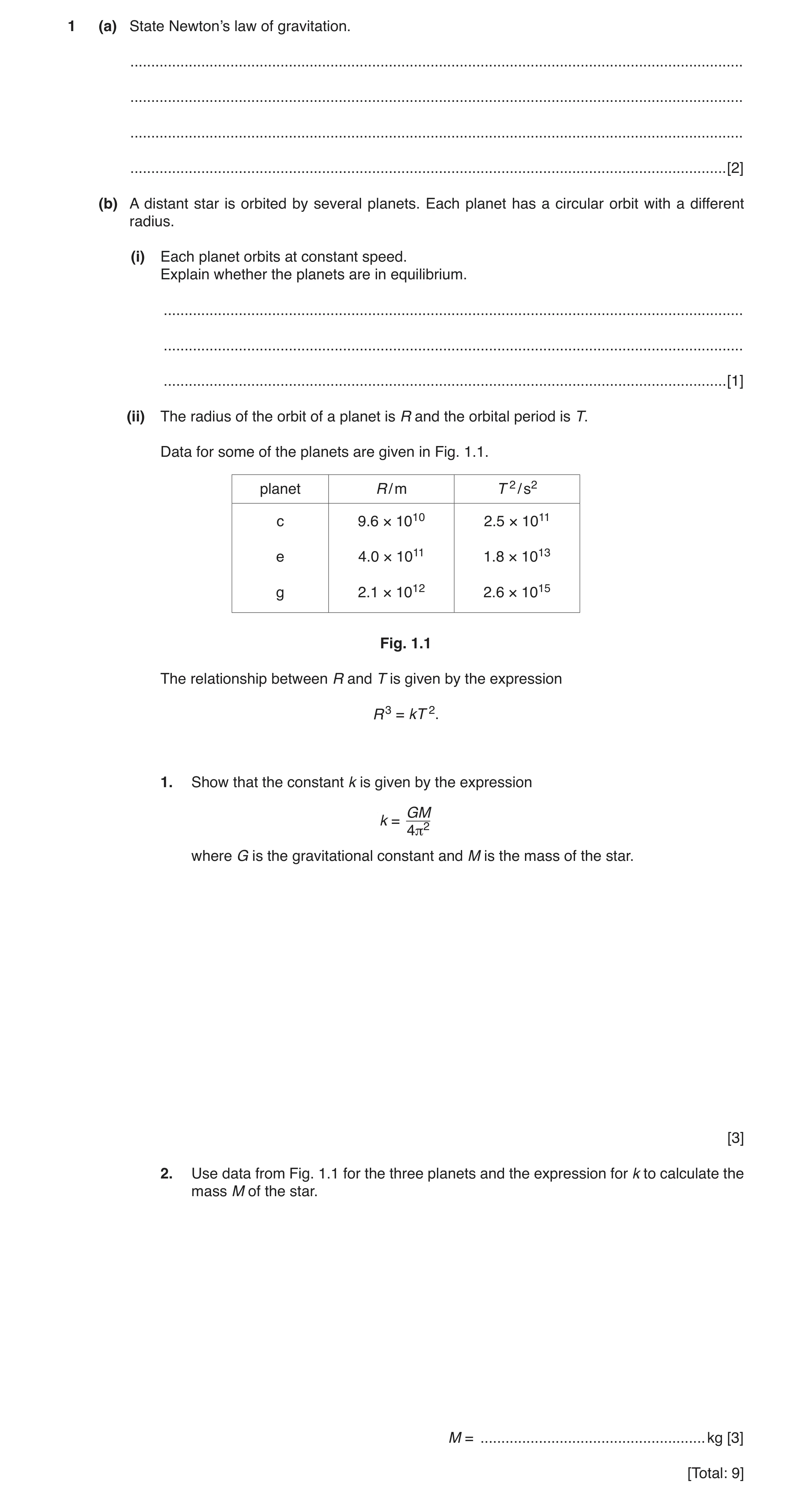
1 (a) State Newton’s law of gravitation. … … … … [2] (b) A distant star is orbited by several planets. Each planet has a circular orbit with a different radius. (i) Each planet orbits at constant speed. Explain whether the planets are in equilibrium. … … … [1] (ii) The radius of the orbit of a planet is R and the orbital period is T. Data for some of the planets are given in Fig. 1.1. planet R / m T 2 / s2 c 9.6 × 10¹⁰ 2.5 × 10¹¹ e 4.0 × 10¹¹ 1.8 × 10¹³ g 2.1 × 10¹² 2.6 × 10¹⁵ Fig. 1.1 The relationship between R and T is given by the expression R 3 = kT 2. 1. Show that the constant k is given by the expression GM k = 4π2 where G is the gravitational constant and M is the mass of the star. [3] 2. Use data from Fig. 1.1 for the three planets and the expression for k to calculate the mass M of the star. M = … kg [3] [Total: 9]
9 marks
Mark scheme: 1(a) force proportional to product of masses and inversely proportional to square of separation B1 idea of force between point masses B1 1(b)(i) velocity changes/direction of motion changes/there is an acceleration/there is a resultant force so not in equilibrium B1 1(b)(ii)1. gravitational force equals/is centripetal force C1 GMm / R2 = mRω2 and ω = 2π / T or Gm / R2 = mv2 / R and v = 2πr / T or GMm / R2 = mR (2π / T)2 M1 convincing algebra leading to k = GM / 4π2 A1 1(b)(ii)2. correct use of R3 / T2 for one planet (c gives 3.54 × 10²¹; e and g both give 3.56 × 10²¹) C1 3.5(5) × 1021 = (6.67 × 10⁻¹¹ × M) / 4π2 M = 2.1 × 1033 kg A1 two or three values of R3 / T2 correctly calculated and used in a valid way to find a value for M based on more than one k B1
This question in 9702/43 May/June 2018
Q7 · Two point masses are isolated in space and are separated by a distance x 9702/41 May/June 2019
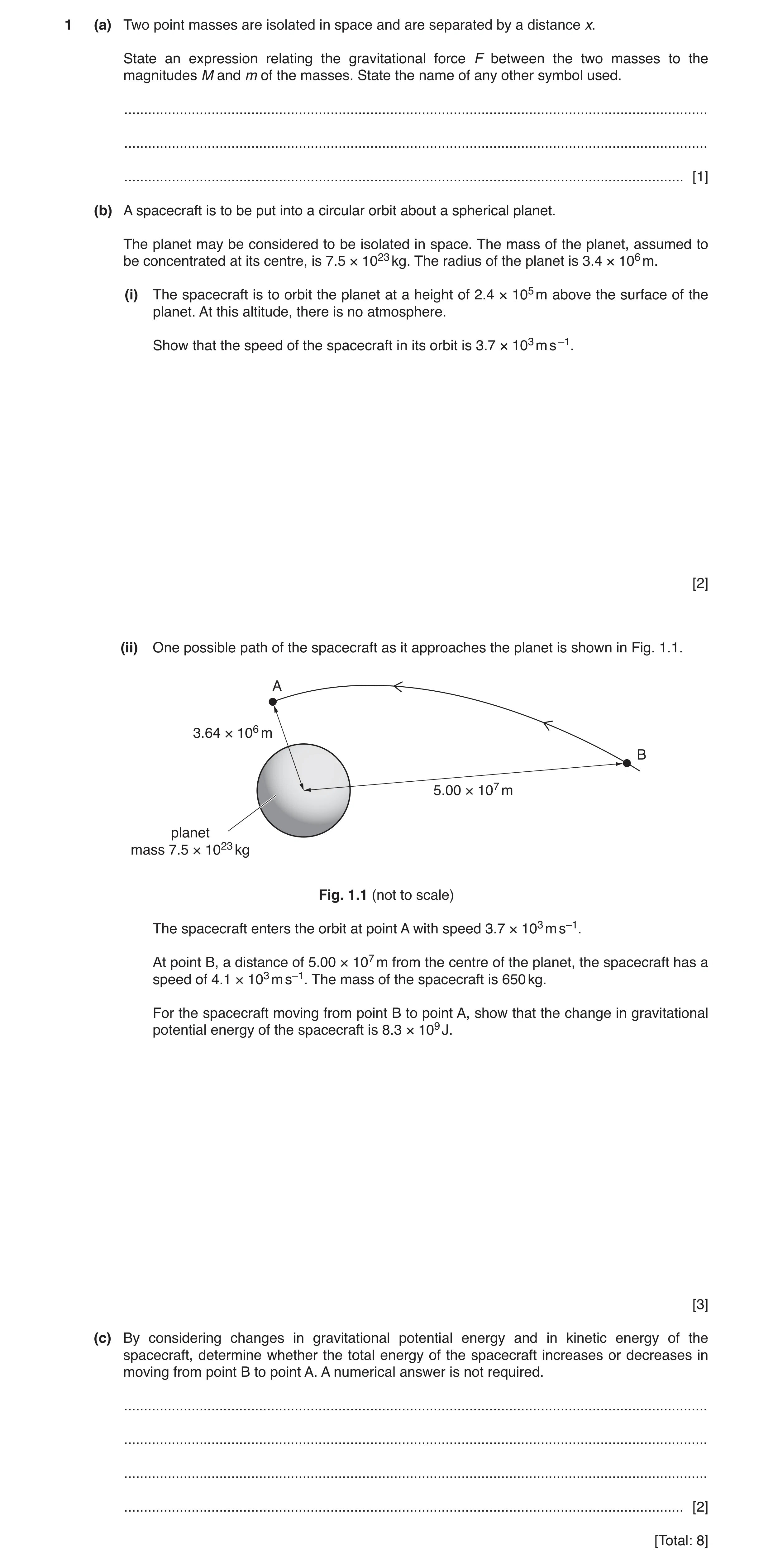
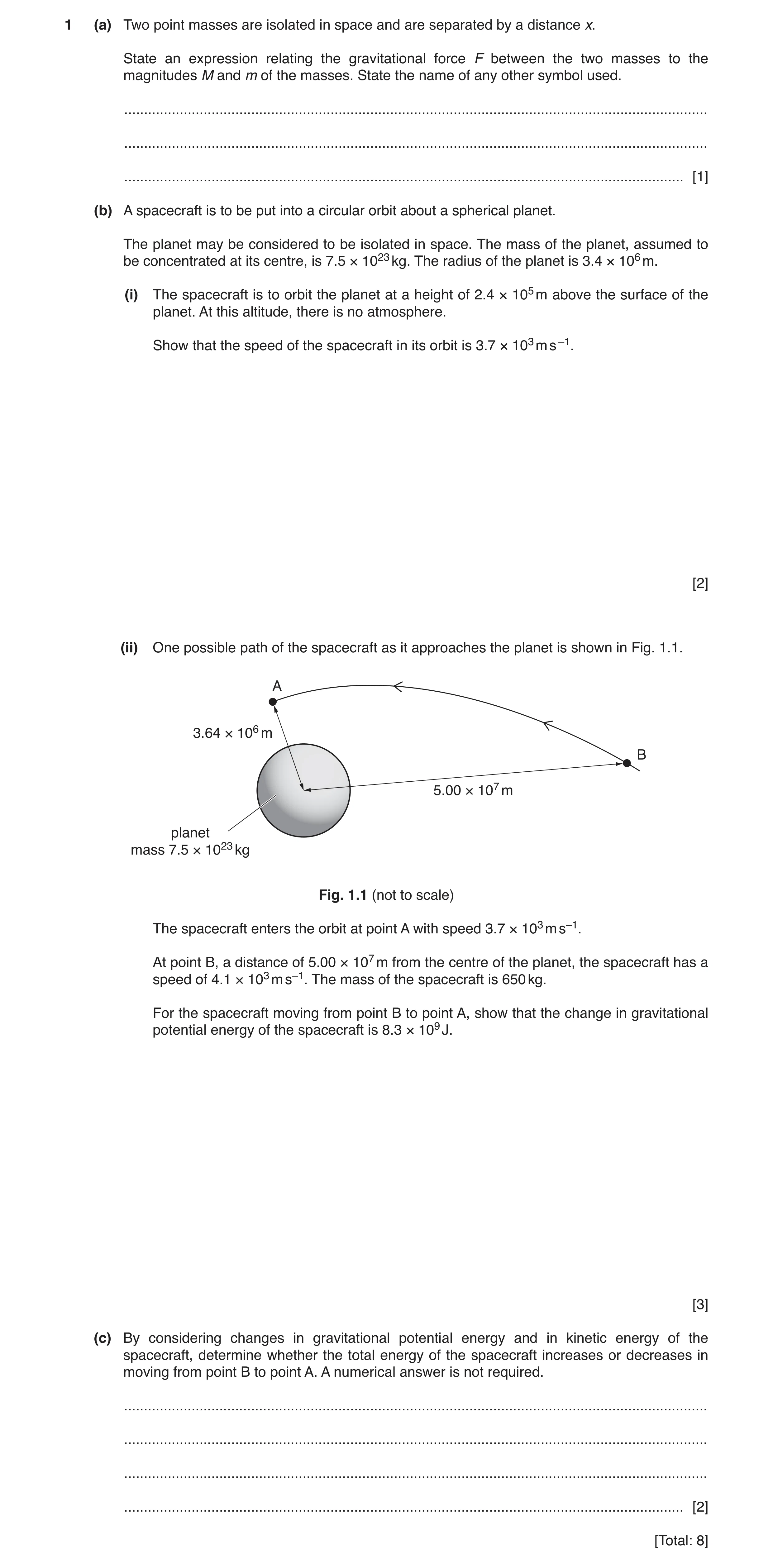
1 (a) Two point masses are isolated in space and are separated by a distance x. State an expression relating the gravitational force F between the two masses to the magnitudes M and m of the masses. State the name of any other symbol used. … … … [1] (b) A spacecraft is to be put into a circular orbit about a spherical planet. The planet may be considered to be isolated in space. The mass of the planet, assumed to be concentrated at its centre, is 7.5 × 10²³ kg. The radius of the planet is 3.4 × 10⁶ m. (i) The spacecraft is to orbit the planet at a height of 2.4 × 10⁵ m above the surface of the planet. At this altitude, there is no atmosphere. Show that the speed of the spacecraft in its orbit is 3.7 × 10³ m s –1. [2] (ii) One possible path of the spacecraft as it approaches the planet is shown in Fig. 1.1. A 3.64 × 10⁶ m B 5.00 × 10⁷ m planet mass 7.5 × 10²³ kg Fig. 1.1 (not to scale) The spacecraft enters the orbit at point A with speed 3.7 × 10³ m s–1. At point B, a distance of 5.00 × 10⁷ m from the centre of the planet, the spacecraft has a speed of 4.1 × 10³ m s–1. The mass of the spacecraft is 650 kg. For the spacecraft moving from point B to point A, show that the change in gravitational potential energy of the spacecraft is 8.3 × 10⁹ J. [3] (c) By considering changes in gravitational potential energy and in kinetic energy of the spacecraft, determine whether the total energy of the spacecraft increases or decreases in moving from point B to point A. A numerical answer is not required. … … … … [2] [Total: 8]
8 marks
Mark scheme: 1(a) (F =) GMm / x2, where G is the (universal) gravitational constant B1 1(b)(i) GMm / x2 = mv2 / x or v2 = GM / x C1 v 2 = (6.67 × 10–11 × 7.5 × 1023) / (3.4 × 10⁶ + 240 × 103) so v = 3.7 × 10³ m s–1 A1 1(b)(ii) potential energy = (–)GMm / x C1 EA = (–)(6.67 × 10–11 × 7.5 × 1023 × 650) / (3.64 × 10⁶) or EB = (–)(6.67 × 10–11 × 7.5 × 1023 × 650) / (5.00 × 10⁷) M1 correct substitution and subtraction EB – EA shown, leading to ∆Ep = 8.3 × 10⁹ J A1 or φ = (–)GM / x and potential energy = mφ (C1) ∆φ = (6.67 × 10–11 × 7.5 × 1023) × [(1 / (3.64 × 10⁶)) – (1 / (5.00 × 10⁷))] ( = 1.27 × 10⁷ J kg–1) (M1) ∆Ep = 1.27 × 107 × 650 = 8.3 × 10⁹ J (A1) 1(c) kinetic energy or potential energy decreases B1 kinetic energy and potential energy decrease so total energy decreases B1
This question in 9702/41 May/June 2019
Q8 · Two point masses are separated by a distance x in a vacuum 9702/42 May/June 2019
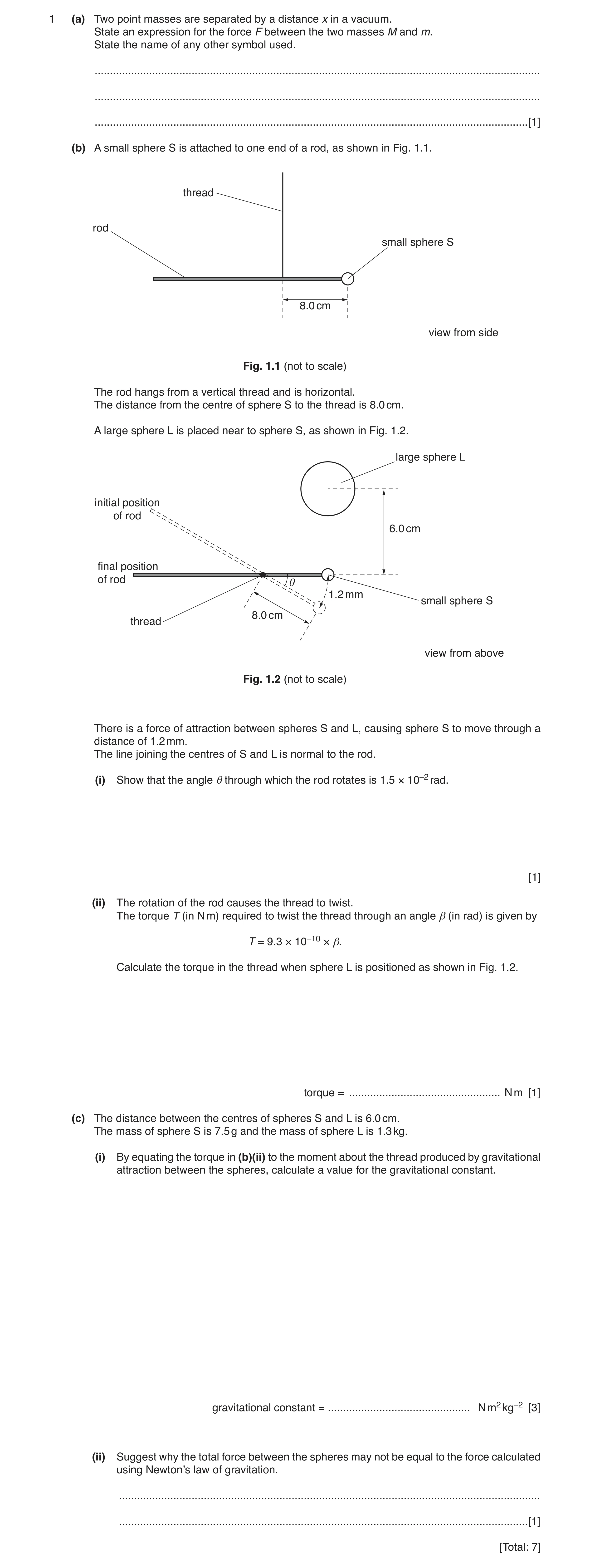
1 (a) Two point masses are separated by a distance x in a vacuum. State an expression for the force F between the two masses M and m. State the name of any other symbol used. … … … [1] (b) A small sphere S is attached to one end of a rod, as shown in Fig. 1.1. thread rod small sphere S 8.0 cm view from side Fig. 1.1 (not to scale) The rod hangs from a vertical thread and is horizontal. The distance from the centre of sphere S to the thread is 8.0 cm. A large sphere L is placed near to sphere S, as shown in Fig. 1.2. large sphere L initial position of rod 6.0 cm final position of rod θ 1.2 mm small sphere S 8.0 cm thread view from above Fig. 1.2 (not to scale) There is a force of attraction between spheres S and L, causing sphere S to move through a distance of 1.2 mm. The line joining the centres of S and L is normal to the rod. (i) Show that the angle θ through which the rod rotates is 1.5 × 10⁻² rad. [1] (ii) The rotation of the rod causes the thread to twist. The torque T (in N m) required to twist the thread through an angle β (in rad) is given by T = 9.3 × 10⁻¹⁰ × β. Calculate the torque in the thread when sphere L is positioned as shown in Fig. 1.2. torque = … N m [1] (c) The distance between the centres of spheres S and L is 6.0 cm. The mass of sphere S is 7.5 g and the mass of sphere L is 1.3 kg. (i) By equating the torque in (b)(ii) to the moment about the thread produced by gravitational attraction between the spheres, calculate a value for the gravitational constant. gravitational constant = … N m2 kg–2 [3] (ii) Suggest why the total force between the spheres may not be equal to the force calculated using Newton’s law of gravitation. … … [1] [Total: 7]
7 marks
Mark scheme: 1(a) (F =) GMm / x2, where G is the (universal) gravitational constant B1 1(b)(i) angle = (1.2 × 10⁻³) / (8.0 × 10⁻²) = 1.5 × 10⁻² (rad) B1 1(b)(ii) torque = 1.5 × 10–2 × 9.3 × 10–10 = 1.4 × 10⁻¹¹ N m A1 1(c)(i) force × 8.0 × 10–2 = 1.4 × 10⁻¹¹ C1 (G × 1.3 × 7.5 × 10–3 × 8.0 × 10–2) / (6.0 × 10⁻²)2 = 1.4 × 10⁻¹¹ C1 G = 6.4 × 10⁻¹¹ N m2 kg–2 A1 1(c)(ii) Any one from: • law applies only to point masses/spheres are not point masses • radii of spheres not small compared with separation • spheres may not be uniform • the masses are not isolated • force between L and rod • spheres may be charged/may be electrostatic force (between spheres) B1
This question in 9702/42 May/June 2019
Q9 · Two point masses are isolated in space and are separated by a distance x 9702/43 May/June 2019
1 (a) Two point masses are isolated in space and are separated by a distance x. State an expression relating the gravitational force F between the two masses to the magnitudes M and m of the masses. State the name of any other symbol used. … … … [1] (b) A spacecraft is to be put into a circular orbit about a spherical planet. The planet may be considered to be isolated in space. The mass of the planet, assumed to be concentrated at its centre, is 7.5 × 10²³ kg. The radius of the planet is 3.4 × 10⁶ m. (i) The spacecraft is to orbit the planet at a height of 2.4 × 10⁵ m above the surface of the planet. At this altitude, there is no atmosphere. Show that the speed of the spacecraft in its orbit is 3.7 × 10³ m s –1. [2] (ii) One possible path of the spacecraft as it approaches the planet is shown in Fig. 1.1. A 3.64 × 10⁶ m B 5.00 × 10⁷ m planet mass 7.5 × 10²³ kg Fig. 1.1 (not to scale) The spacecraft enters the orbit at point A with speed 3.7 × 10³ m s–1. At point B, a distance of 5.00 × 10⁷ m from the centre of the planet, the spacecraft has a speed of 4.1 × 10³ m s–1. The mass of the spacecraft is 650 kg. For the spacecraft moving from point B to point A, show that the change in gravitational potential energy of the spacecraft is 8.3 × 10⁹ J. [3] (c) By considering changes in gravitational potential energy and in kinetic energy of the spacecraft, determine whether the total energy of the spacecraft increases or decreases in moving from point B to point A. A numerical answer is not required. … … … … [2] [Total: 8]
8 marks
Mark scheme: 1(a) (F =) GMm / x2, where G is the (universal) gravitational constant B1 1(b)(i) GMm / x2 = mv2 / x or v2 = GM / x C1 v 2 = (6.67 × 10–11 × 7.5 × 1023) / (3.4 × 10⁶ + 240 × 103) so v = 3.7 × 10³ m s–1 A1 1(b)(ii) potential energy = (–)GMm / x C1 EA = (–)(6.67 × 10–11 × 7.5 × 1023 × 650) / (3.64 × 10⁶) or EB = (–)(6.67 × 10–11 × 7.5 × 1023 × 650) / (5.00 × 10⁷) M1 correct substitution and subtraction EB – EA shown, leading to ∆Ep = 8.3 × 10⁹ J A1 or φ = (–)GM / x and potential energy = mφ (C1) ∆φ = (6.67 × 10–11 × 7.5 × 1023) × [(1 / (3.64 × 10⁶)) – (1 / (5.00 × 10⁷))] ( = 1.27 × 10⁷ J kg–1) (M1) ∆Ep = 1.27 × 107 × 650 = 8.3 × 10⁹ J (A1) 1(c) kinetic energy or potential energy decreases B1 kinetic energy and potential energy decrease so total energy decreases B1
This question in 9702/43 May/June 2019
Q10 · State Newton’s law of gravitation 9702/41 Oct/Nov 2019
1 (a) State Newton’s law of gravitation. … … … [2] (b) A geostationary satellite orbits the Earth. The orbit of the satellite is circular and the period of the orbit is 24 hours. (i) State two other features of this orbit. 1. … … 2. … … [2] (ii) The radius of the orbit of the satellite is 4.23 × 10⁴ km. Determine a value for the mass of the Earth. Explain your working. mass = … kg [4] [Total: 8]
8 marks
Mark scheme: 1(a) force proportional to product of masses and inversely proportional to square of separation B1 idea of (gravitational) force between point masses B1 1(b)(i) above the equator B1 from west to east B1 1(b)(ii) gravitational force provides/is the centripetal force B1 GM / r2 = r (2π / T)2 C1 (6.67 × 10⁻¹¹ × M) = {(4.23 × 10⁷)3 × 4π2} / (24 × 3600)2 C1 M = 6.0 × 1024 kg A1
This question in 9702/41 Oct/Nov 2019
Q11 · State Newton’s law of gravitation 9702/42 Oct/Nov 2019
1 (a) State Newton’s law of gravitation. … … … [2] (b) The astronomer Johannes Kepler showed that the period T of rotation of a planet about the Sun is related to its mean distance R from the centre of the Sun by the expression R 3 2 = k T where k is a constant. Use Newton’s law to show that, for planets in circular orbits about the Sun of mass M, the constant k is given by GM k = 2 4π where G is the gravitational constant. Explain your working. [4] (c) A satellite is in a circular orbit about Mars. The radius of the orbit of the satellite is 4.38 × 10⁶ m. The orbital period is 2.44 hours. Use the expressions in (b) to calculate a value for the mass of Mars. mass = … kg [2] [Total: 8]
8 marks
Mark scheme: 1(a) force proportional to product of masses and inversely proportional to square of separation B1 idea of (gravitational) force between point masses B1 1(b) gravitational force provides/is the centripetal force B1 GM / R2 = Rω2 or GM / R2 = v2 / R M1 ω = 2π / T or v = 2πR / T M1 algebra leading to R3/T2 = GM / 4π2 A1 1(c) (6.67 × 10⁻¹¹ × M) / 4π2 = (4.38 × 10⁶)3 / (2.44 × 3600)2 C1 M = 6.45 × 10²³ kg A1
This question in 9702/42 Oct/Nov 2019
Q12 · State Newton’s law of gravitation 9702/43 Oct/Nov 2019
1 (a) State Newton’s law of gravitation. … … … [2] (b) A geostationary satellite orbits the Earth. The orbit of the satellite is circular and the period of the orbit is 24 hours. (i) State two other features of this orbit. 1. … … 2. … … [2] (ii) The radius of the orbit of the satellite is 4.23 × 10⁴ km. Determine a value for the mass of the Earth. Explain your working. mass = … kg [4] [Total: 8]
8 marks
Mark scheme: 1(a) force proportional to product of masses and inversely proportional to square of separation B1 idea of (gravitational) force between point masses B1 1(b)(i) above the equator B1 from west to east B1 1(b)(ii) gravitational force provides/is the centripetal force B1 GM / r2 = r (2π / T)2 C1 (6.67 × 10⁻¹¹ × M) = {(4.23 × 10⁷)3 × 4π2} / (24 × 3600)2 C1 M = 6.0 × 1024 kg A1
This question in 9702/43 Oct/Nov 2019
Q13 · State what is meant by a gravitational force 9702/41 May/June 2020
1 (a) State what is meant by a gravitational force. … … [1] (b) A binary star system consists of two stars S1 and S2, each in a circular orbit. The orbit of each star in the system has a period of rotation T. Observations of the binary star from Earth are represented in Fig. 1.1. S1 S1 S2 S2 T t = 0 t = — 4 S2 S1 S2 S1 T 3T t = — t = — 2 4 S1 S2 t = T Fig. 1.1 (not to scale) Observed from Earth, the angular separation of the centres of S1 and S2 is 1.2 × 10⁻⁵ rad. The distance of the binary star system from Earth is 1.5 × 10¹⁷ m. Show that the separation d of the centres of S1 and S2 is 1.8 × 10¹² m. [1] (c) The stars S1 and S2 rotate with the same angular velocity ω about a point P, as illustrated in Fig. 1.2. d P S1 S2 x Fig. 1.2 (not to scale) Point P is at a distance x from the centre of star S1. The period of rotation of the stars is 44.2 years. (i) Calculate the angular velocity ω. ω = … rad s–1 [2] (ii) By considering the forces acting on the two stars, show that the ratio of the masses of the stars is given by mass of S1 d – x = . mass of S2 x [2] (iii) The mass M1 of star S1 is given by the expression GM1 = d 2 (d – x) ω 2 where G is the gravitational constant. The ratio in (ii) is found to be 1.5. Use data from (b) and your answer in (c)(i) to determine the mass M1. M1 = … kg [3] [Total: 9]
9 marks
Mark scheme: 1(a) force acting between two masses or force on mass due to another mass or force on mass in a gravitational field B1 1(b) arc length = rθ d = 1.5 × 1017 × 1.2 × 10–5 = 1.8 × 10¹² m A1 1(c)(i) ω = 2π / T C1 = 2π / (44.2 × 365 × 24 × 3600) = 4.5 × 10⁻⁹ rad s–1 A1 1(c)(ii) gravitational forces are equal or centripetal force about P is the same C1 M1xω2 = M2(d – x)ω2 so M1 / M2 = (d – x) / x A1 1(c)(iii) x = 0.4d C1 6.67 × 10⁻¹¹ × M1 = (1.0 – 0.4) × (1.8 × 1012)3 × (4.5 × 10–9)2 C1 M1 = 1.1 × 1030 kg A1
This question in 9702/41 May/June 2020
Q14 · State what is meant by a gravitational force 9702/43 May/June 2020
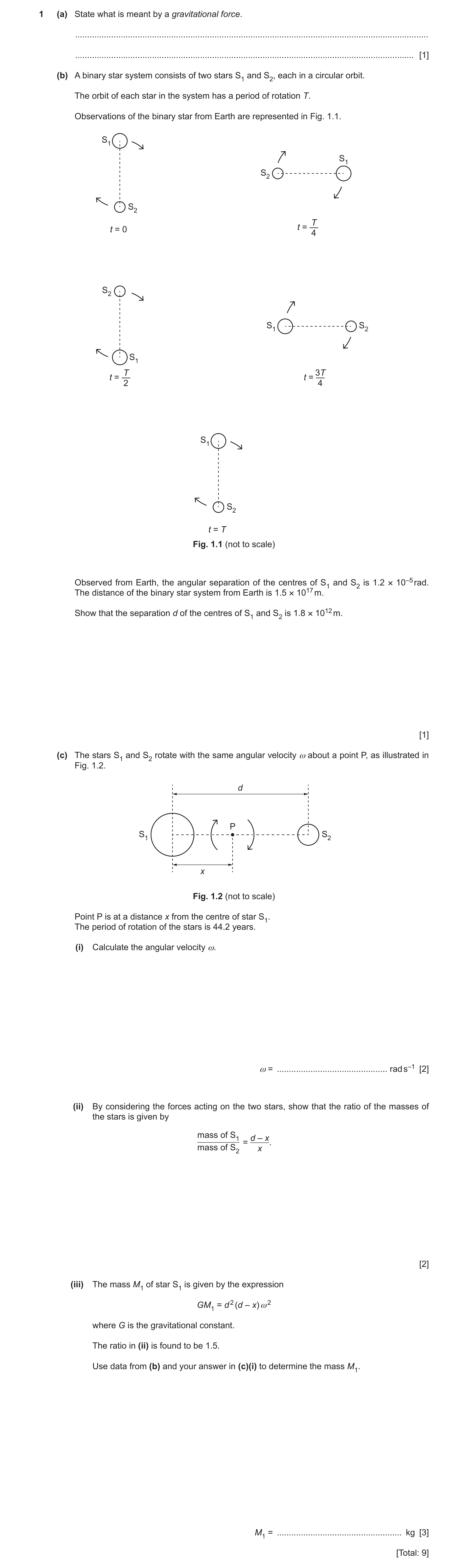
1 (a) State what is meant by a gravitational force. … … [1] (b) A binary star system consists of two stars S1 and S2, each in a circular orbit. The orbit of each star in the system has a period of rotation T. Observations of the binary star from Earth are represented in Fig. 1.1. S1 S1 S2 S2 T t = 0 t = — 4 S2 S1 S2 S1 T 3T t = — t = — 2 4 S1 S2 t = T Fig. 1.1 (not to scale) Observed from Earth, the angular separation of the centres of S1 and S2 is 1.2 × 10⁻⁵ rad. The distance of the binary star system from Earth is 1.5 × 10¹⁷ m. Show that the separation d of the centres of S1 and S2 is 1.8 × 10¹² m. [1] (c) The stars S1 and S2 rotate with the same angular velocity ω about a point P, as illustrated in Fig. 1.2. d P S1 S2 x Fig. 1.2 (not to scale) Point P is at a distance x from the centre of star S1. The period of rotation of the stars is 44.2 years. (i) Calculate the angular velocity ω. ω = … rad s–1 [2] (ii) By considering the forces acting on the two stars, show that the ratio of the masses of the stars is given by mass of S1 d – x = . mass of S2 x [2] (iii) The mass M1 of star S1 is given by the expression GM1 = d 2 (d – x) ω 2 where G is the gravitational constant. The ratio in (ii) is found to be 1.5. Use data from (b) and your answer in (c)(i) to determine the mass M1. M1 = … kg [3] [Total: 9]
9 marks
Mark scheme: 1(a) force acting between two masses or force on mass due to another mass or force on mass in a gravitational field B1 1(b) arc length = rθ d = 1.5 × 1017 × 1.2 × 10–5 = 1.8 × 10¹² m A1 1(c)(i) ω = 2π / T C1 = 2π / (44.2 × 365 × 24 × 3600) = 4.5 × 10⁻⁹ rad s–1 A1 1(c)(ii) gravitational forces are equal or centripetal force about P is the same C1 M1xω2 = M2(d – x)ω2 so M1 / M2 = (d – x) / x A1 1(c)(iii) x = 0.4d C1 6.67 × 10⁻¹¹ × M1 = (1.0 – 0.4) × (1.8 × 1012)3 × (4.5 × 10–9)2 C1 M1 = 1.1 × 1030 kg A1
This question in 9702/43 May/June 2020
Q15 · State Newton’s law of gravitation 9702/42 Feb/March 2021
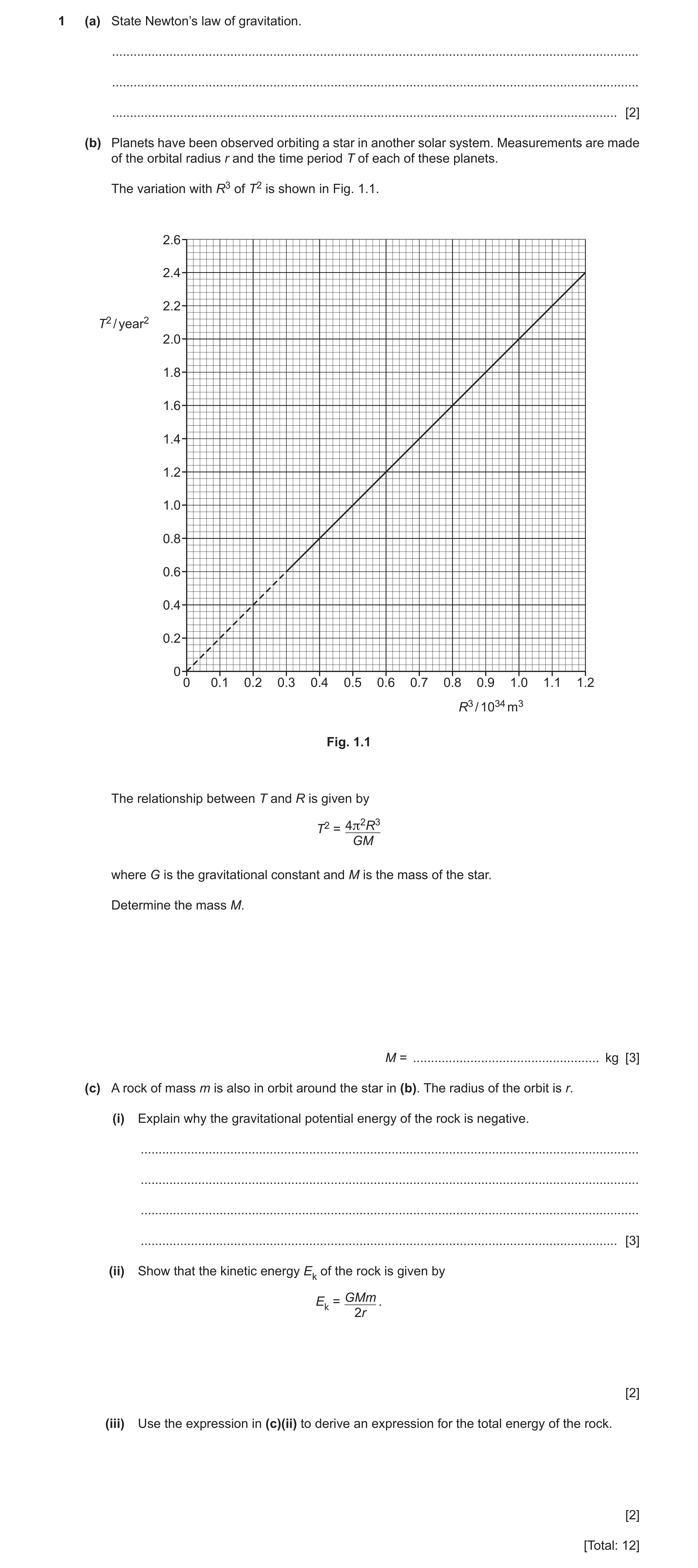
1 (a) State Newton’s law of gravitation. … … … [2] (b) Planets have been observed orbiting a star in another solar system. Measurements are made of the orbital radius r and the time period T of each of these planets. The variation with R3 of T2 is shown in Fig. 1.1. 2.6 2.4 2.2 T2 / year2 2.0 1.8 1.6 1.4 1.2 1.0 0.8 0.6 0.4 0.2 0 0 0.1 0.2 0.3 0.4 0.5 0.6 0.7 0.8 0.9 1.0 1.1 1.2 R3 / 1034 m3 Fig. 1.1 The relationship between T and R is given by T2 = 4π2R3 GM where G is the gravitational constant and M is the mass of the star. Determine the mass M. M = … kg [3] (c) A rock of mass m is also in orbit around the star in (b). The radius of the orbit is r. (i) Explain why the gravitational potential energy of the rock is negative. … … … … [3] (ii) Show that the kinetic energy Ek of the rock is given by Ek = GMm . 2r [2] (iii) Use the expression in (c)(ii) to derive an expression for the total energy of the rock. [2] [Total: 12]
12 marks
Mark scheme: 1(a) (gravitational) force is (directly) proportional to product of masses B1 force (between point masses) is inversely proportional to the square of their separation B1 1(b) correct read offs from the graph with correct power of ten for R3 C1 ( ) 2 34 2 11 4 1.2 10 6.67 10 2.4 365 24 3600 M π − × × × = × × × × × C1 30 3.0 10 kg = × A1 1(c)(i) potential energy is zero at infinity B1 (gravitational) forces are attractive B1 work must be done on the rock to move it to infinity B1 1(c)(ii) 2 2 2 GMm mv GM GM OR v OR v r r r r = = = M1 use of ½ mv2 (e.g. multiplication by ½ m) leading to 2 GMm r A1 1(c)(iii) Ep = φ m and φ = GM r − or p GMm E r − = Total energy = Ek + Ep C1 Total energy 2 GMm GMm r r − = + 2 GMm r − = A1
This question in 9702/42 Feb/March 2021
Q16 · State Newton’s law of gravitation 9702/41 May/June 2022
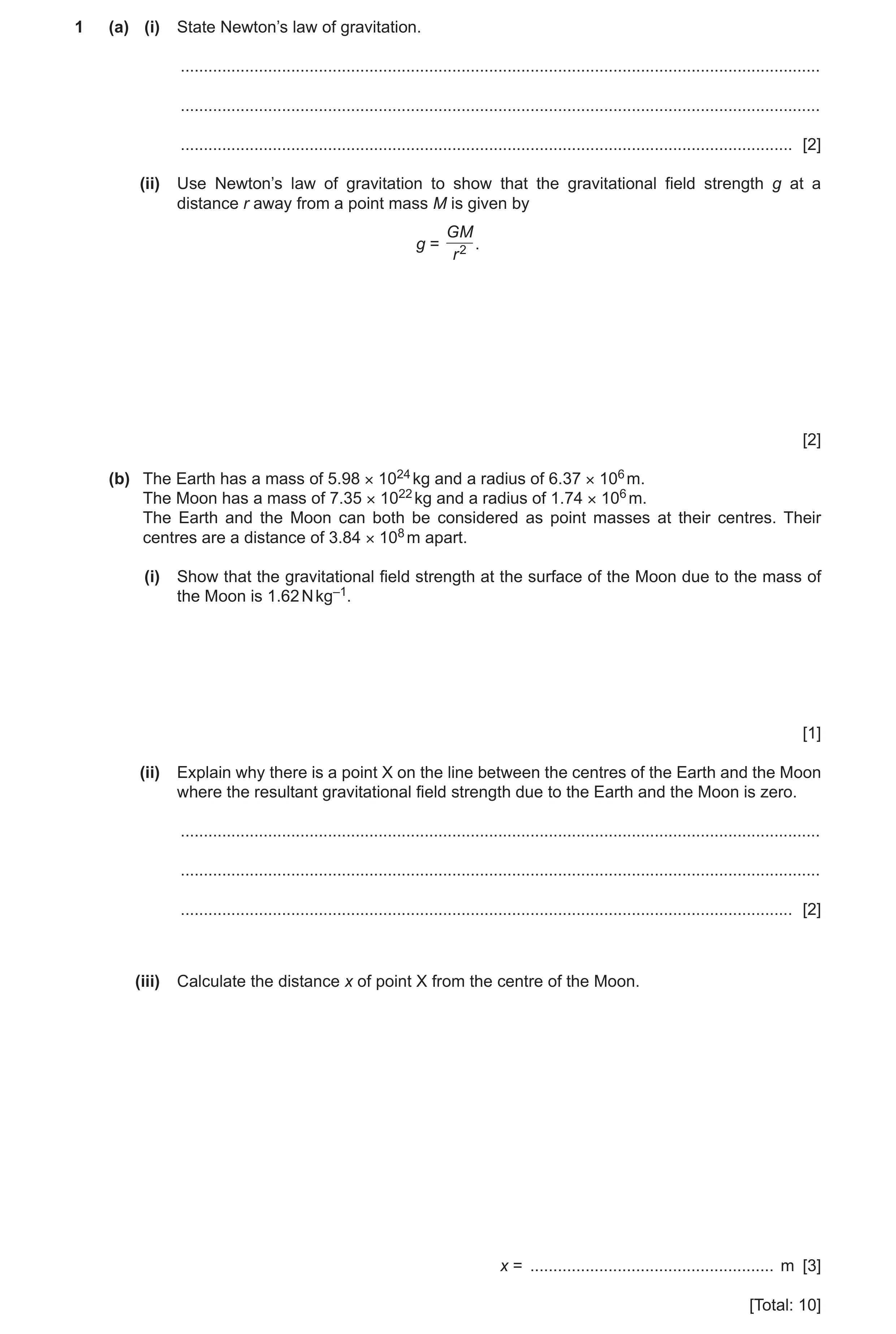
1 (a) (i) State Newton’s law of gravitation. … … … [2] (ii) Use Newton’s law of gravitation to show that the gravitational field strength g at a distance r away from a point mass M is given by GM g = . r 2 [2] (b) The Earth has a mass of 5.98 × 1024 kg and a radius of 6.37 × 10⁶ m. The Moon has a mass of 7.35 × 10²² kg and a radius of 1.74 × 10⁶ m. The Earth and the Moon can both be considered as point masses at their centres. Their centres are a distance of 3.84 × 10⁸ m apart. (i) Show that the gravitational field strength at the surface of the Moon due to the mass of the Moon is 1.62 N kg–1. [1] (ii) Explain why there is a point X on the line between the centres of the Earth and the Moon where the resultant gravitational field strength due to the Earth and the Moon is zero. … … … [2] (iii) Calculate the distance x of point X from the centre of the Moon. x = … m [3] [Total: 10]
10 marks
Mark scheme: 1(a)(i) (gravitational) force is (directly) proportional to product of masses B1 force (between point masses) is inversely proportional to the square of their separation B1 1(a)(ii) g = F / m C1 F = GMm / r2 and so g = [GMm / r2] / m = GM / r2 A1 1(b)(i) g = (6.67 10–11 7.35 1022) / (1.74 106)2 = 1.62 N kg–1 A1 1(b)(ii) fields (due to Earth and the Moon) have equal magnitudes B1 fields (due to Earth and the Moon) are in opposite directions B1 1(b)(iii) distance of X from Earth = (3.84 108 – x) C1 (G ) 7.35 1022 / x2 = (G ) 5.98 1024 / (3.84 108 – x)2 C1 x = 3.8 107 m A1
This question in 9702/41 May/June 2022
Q17 · State Newton’s law of gravitation 9702/43 May/June 2022
1 (a) (i) State Newton’s law of gravitation. … … … [2] (ii) Use Newton’s law of gravitation to show that the gravitational field strength g at a distance r away from a point mass M is given by GM g = . r 2 [2] (b) The Earth has a mass of 5.98 × 1024 kg and a radius of 6.37 × 10⁶ m. The Moon has a mass of 7.35 × 10²² kg and a radius of 1.74 × 10⁶ m. The Earth and the Moon can both be considered as point masses at their centres. Their centres are a distance of 3.84 × 10⁸ m apart. (i) Show that the gravitational field strength at the surface of the Moon due to the mass of the Moon is 1.62 N kg–1. [1] (ii) Explain why there is a point X on the line between the centres of the Earth and the Moon where the resultant gravitational field strength due to the Earth and the Moon is zero. … … … [2] (iii) Calculate the distance x of point X from the centre of the Moon. x = … m [3] [Total: 10]
10 marks
Mark scheme: 1(a)(i) (gravitational) force is (directly) proportional to product of masses B1 force (between point masses) is inversely proportional to the square of their separation B1 1(a)(ii) g = F / m C1 F = GMm / r2 and so g = [GMm / r2] / m = GM / r2 A1 1(b)(i) g = (6.67 10–11 7.35 1022) / (1.74 106)2 = 1.62 N kg–1 A1 1(b)(ii) fields (due to Earth and the Moon) have equal magnitudes B1 fields (due to Earth and the Moon) are in opposite directions B1 1(b)(iii) distance of X from Earth = (3.84 108 – x) C1 (G ) 7.35 1022 / x2 = (G ) 5.98 1024 / (3.84 108 – x)2 C1 x = 3.8 107 m A1
This question in 9702/43 May/June 2022
Q18 · State the equation for the gravitational force F between two point masses m1 and m2 that… 9702/41 Oct/Nov 2022
1 (a) State the equation for the gravitational force F between two point masses m1 and m2 that are separated by a distance r. State the meaning of any other symbols you use. [2] (b) A satellite is in a circular orbit of radius R around a planet of mass M. Show that the period T of the orbit is given by T 2 = kR3 where k is a constant that depends on the value of M. Explain your reasoning. [3] (c) A satellite is in a circular orbit around the Earth with a period of 24 hours. The mass of the Earth is 6.0 × 1024 kg. (i) Calculate the radius of the orbit. radius = … m [2] (ii) State the two other conditions that must be met for the orbit to be geostationary. 1 … … 2 … … [2] [Total: 9]
9 marks
Mark scheme: Question Answer Marks 1(a) F = (Gm1m2) / r 2 M1 where G is the gravitational constant A1 1(b) gravitational force provides the centripetal force B1 mR 2 = GMm / R 2 and = 2 / T M1 or mv 2 / R = GMm / R 2 and v = 2R / T or 42mR / T 2 = GMm / R 2 correct completion of algebra to get T2 = (42 / GM) R3, with identification of (42 / GM) as k A1 1(c)(i) (24 3600)2 = (42 R3) / (6.67 10–11 6.0 1024) C1 R = 4.2 107 m A1 1(c)(ii) (orbit) must be above the Equator B1 (direction) must be from west to east B1
This question in 9702/41 Oct/Nov 2022
Q19 · State the equation for the gravitational force F between two point masses m1 and m2 that… 9702/43 Oct/Nov 2022
1 (a) State the equation for the gravitational force F between two point masses m1 and m2 that are separated by a distance r. State the meaning of any other symbols you use. [2] (b) A satellite is in a circular orbit of radius R around a planet of mass M. Show that the period T of the orbit is given by T 2 = kR3 where k is a constant that depends on the value of M. Explain your reasoning. [3] (c) A satellite is in a circular orbit around the Earth with a period of 24 hours. The mass of the Earth is 6.0 × 1024 kg. (i) Calculate the radius of the orbit. radius = … m [2] (ii) State the two other conditions that must be met for the orbit to be geostationary. 1 … … 2 … … [2] [Total: 9]
9 marks
Mark scheme: Question Answer Marks 1(a) F = (Gm1m2) / r 2 M1 where G is the gravitational constant A1 1(b) gravitational force provides the centripetal force B1 mR 2 = GMm / R 2 and = 2 / T M1 or mv 2 / R = GMm / R 2 and v = 2R / T or 42mR / T 2 = GMm / R 2 correct completion of algebra to get T2 = (42 / GM) R3, with identification of (42 / GM) as k A1 1(c)(i) (24 3600)2 = (42 R3) / (6.67 10–11 6.0 1024) C1 R = 4.2 107 m A1 1(c)(ii) (orbit) must be above the Equator B1 (direction) must be from west to east B1
This question in 9702/43 Oct/Nov 2022
Q20 · State Newton’s law of gravitation 9702/42 May/June 2023
1 (a) State Newton’s law of gravitation. … … … [2] (b) A satellite is in a circular orbit around a planet. The radius of the orbit is R and the period of the orbit is T. The planet is a uniform sphere. Use Newton’s law of gravitation to show that R and T are related by 4π2R 3 = GMT 2 where M is the mass of the planet and G is the gravitational constant. [2] (c) The Earth may be considered to be a uniform sphere of mass 5.98 × 1024 kg and radius 6.37 × 10⁶ m. A geostationary satellite is in orbit around the Earth. Use the expression in (b) to determine the height of the satellite above the Earth’s surface. height = … m [3] (d) Another satellite is in a circular orbit around the Earth with the same orbital radius and period as the satellite in (c). (i) Calculate the angular speed of the satellite in this orbit. Give a unit with your answer. angular speed = … unit … [2] (ii) Despite having the same orbital period, the orbit of this satellite is not geostationary. Suggest two ways in which the orbit of this satellite could be different from the orbit of the satellite in (c). 1 … … 2 … … [2] [Total: 11]
11 marks
Mark scheme: 1(a) (gravitational) force is (directly) proportional to product of masses B1 force (between point masses) is inversely proportional to the square of their separation B1 1(b) GMm / R2 = mR2 M1 = 2 / T and algebra leading to 42R3 = GMT2 A1 or GMm / R2 = mv2 / R (M1) v = 2R / T and algebra leading to 42R3 = GMT2 (A1) 1(c) 42 R3 = 6.67 10–11 5.98 1024 (24 60 60)2 (R = 4.22 107 m) C1 h = R – (6.37 106) C1 h = (4.22 107) – (6.37 106) = 3.6 107 m A1 1(d)(i) = 2 / T C1 = 2 / (24 60 60) = 7.3 10–5 rad s–1 A1 1(d)(ii) orbit is from east to west B1 orbit is not equatorial / orbit is polar B1
This question in 9702/42 May/June 2023
Q21 · State Newton’s law of gravitation 9702/41 Oct/Nov 2024
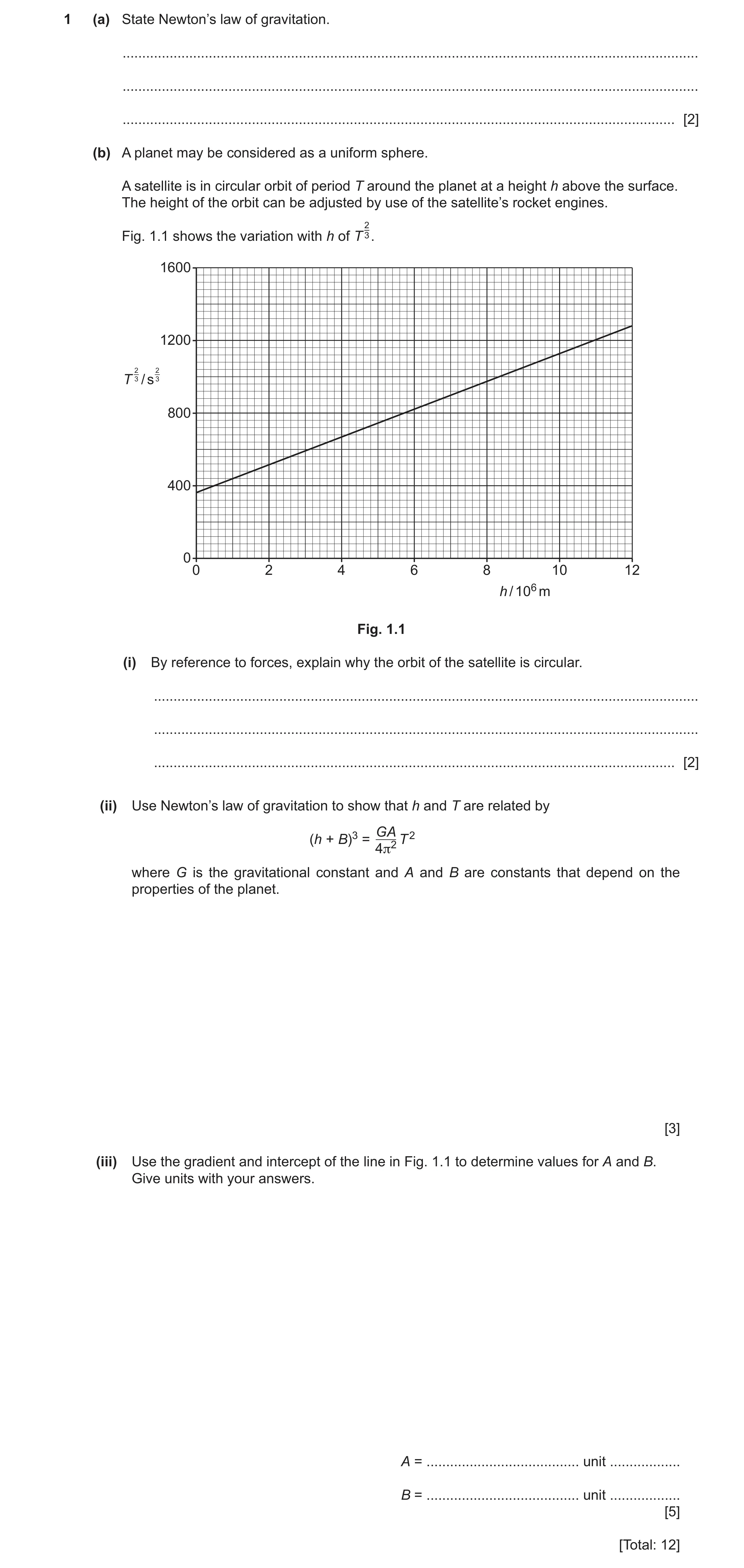
1 (a) State Newton’s law of gravitation. … … … [2] (b) A planet may be considered as a uniform sphere. A satellite is in circular orbit of period T around the planet at a height h above the surface. The height of the orbit can be adjusted by use of the satellite’s rocket engines. 2 Fig. 1.1 shows the variation with h of T 3 . 1600 1200 2 2 T 3 /s 3 800 400 0 0 2 4 6 8 10 12 h / 106 m Fig. 1.1 (i) By reference to forces, explain why the orbit of the satellite is circular. … … … [2] (ii) Use Newton’s law of gravitation to show that h and T are related by GA 2 (h + B)3 = T 4π2 where G is the gravitational constant and A and B are constants that depend on the properties of the planet. [3] (iii) Use the gradient and intercept of the line in Fig. 1.1 to determine values for A and B. Give units with your answers. A = … unit … B = … unit … [5] [Total: 12]
12 marks
Mark scheme: Question Answer Marks 1(a) (gravitational) force is (directly) proportional to product of masses B1 force (between point masses) is inversely proportional to the square of their separation B1 1(b)(i) (gravitational) force acts perpendicular to direction of motion B1 gravitational force provides centripetal acceleration B1 1(b)(ii) (F =) GMm / x2 = mx2 and = 2 / T M1 or GMm / x2 = 42mx / T2 completion of algebra leading to x3 = GMT2 / 42 A1 clear indication that B = radius of planet and that A = mass (of planet) B1 1(b)(iii) gradient = 3√(42 / GA) C1 e.g. (1280 – 360) / (12 106) = 3√(42 / [6.67 10–11 A]) C1 A = 1.3 1024 kg A1 intercept = gradient B C1 e.g. 360 = ((1280 – 360) B) / (12 106) A1 B = 4.7 106 m
This question in 9702/41 Oct/Nov 2024
Q22 · State Newton’s law of gravitation 9702/43 Oct/Nov 2024
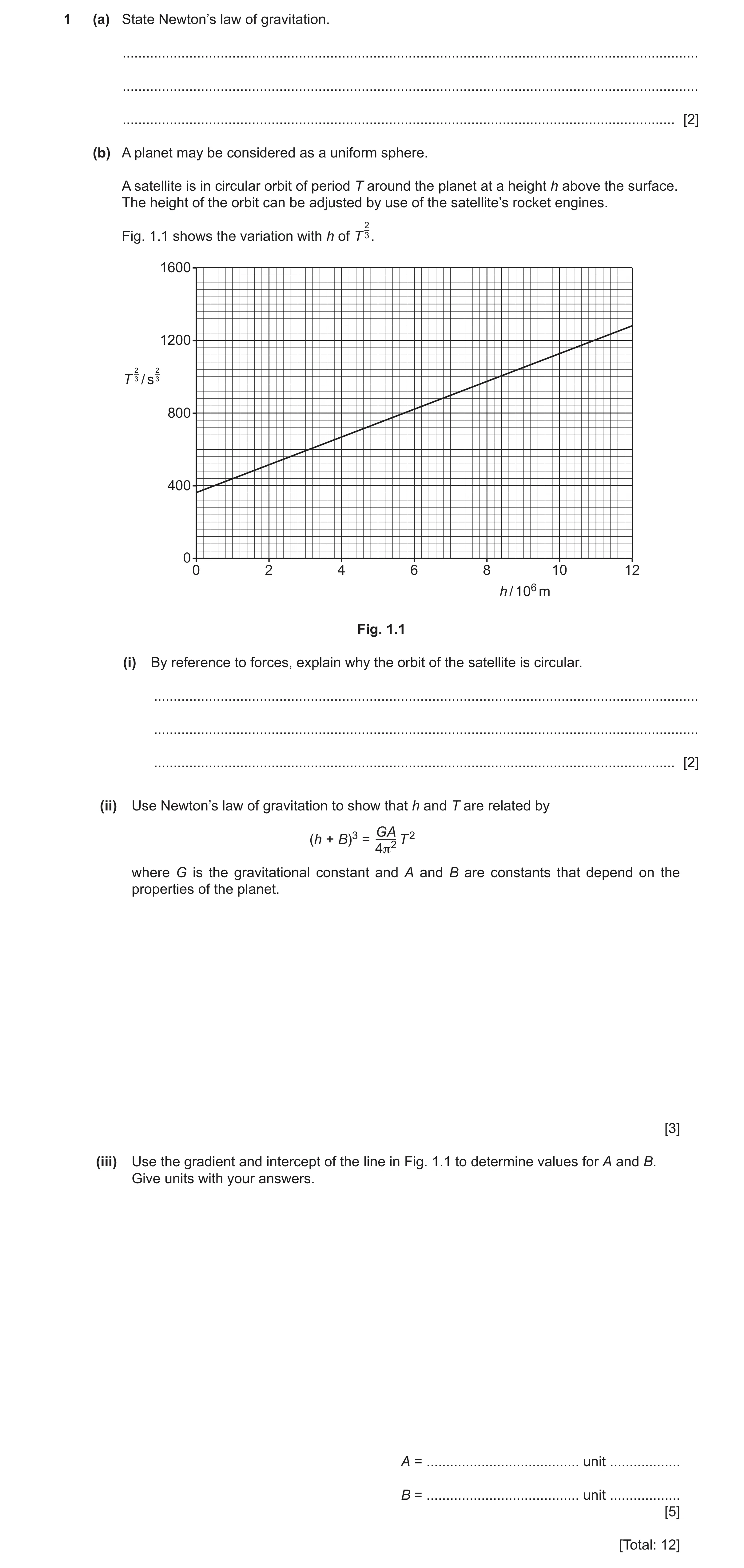
1 (a) State Newton’s law of gravitation. … … … [2] (b) A planet may be considered as a uniform sphere. A satellite is in circular orbit of period T around the planet at a height h above the surface. The height of the orbit can be adjusted by use of the satellite’s rocket engines. 2 Fig. 1.1 shows the variation with h of T 3 . 1600 1200 2 2 T 3 /s 3 800 400 0 0 2 4 6 8 10 12 h / 106 m Fig. 1.1 (i) By reference to forces, explain why the orbit of the satellite is circular. … … … [2] (ii) Use Newton’s law of gravitation to show that h and T are related by GA 2 (h + B)3 = T 4π2 where G is the gravitational constant and A and B are constants that depend on the properties of the planet. [3] (iii) Use the gradient and intercept of the line in Fig. 1.1 to determine values for A and B. Give units with your answers. A = … unit … B = … unit … [5] [Total: 12]
12 marks
Mark scheme: Question Answer Marks 1(a) (gravitational) force is (directly) proportional to product of masses B1 force (between point masses) is inversely proportional to the square of their separation B1 1(b)(i) (gravitational) force acts perpendicular to direction of motion B1 gravitational force provides centripetal acceleration B1 1(b)(ii) (F =) GMm / x2 = mx2 and = 2 / T M1 or GMm / x2 = 42mx / T2 completion of algebra leading to x3 = GMT2 / 42 A1 clear indication that B = radius of planet and that A = mass (of planet) B1 1(b)(iii) gradient = 3√(42 / GA) C1 e.g. (1280 – 360) / (12 106) = 3√(42 / [6.67 10–11 A]) C1 A = 1.3 1024 kg A1 intercept = gradient B C1 e.g. 360 = ((1280 – 360) B) / (12 106) A1 B = 4.7 106 m
This question in 9702/43 Oct/Nov 2024
Q23 · State Newton’s law of gravitation 9702/42 Oct/Nov 2025
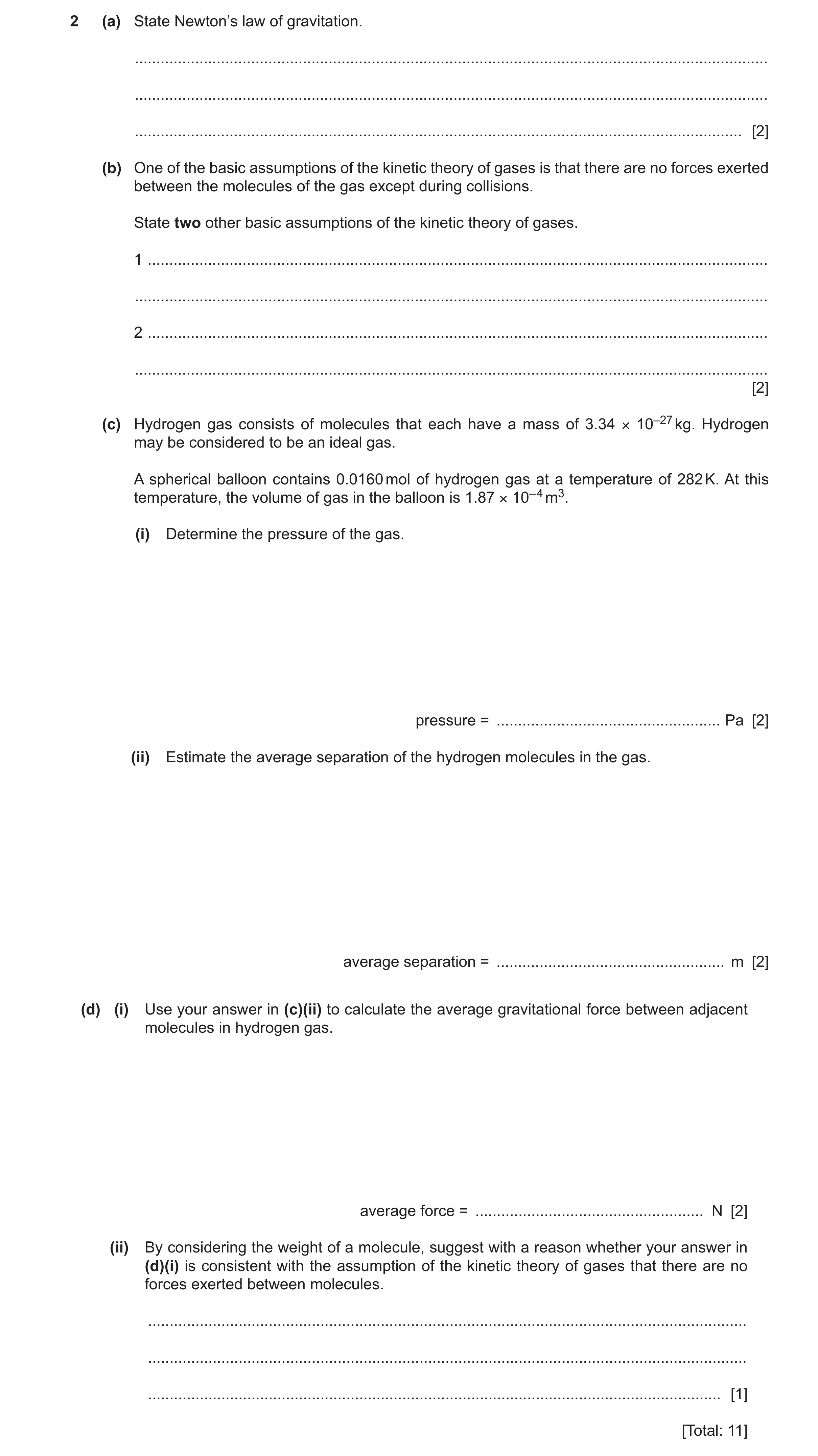
2 (a) State Newton’s law of gravitation. … … … [2] (b) One of the basic assumptions of the kinetic theory of gases is that there are no forces exerted between the molecules of the gas except during collisions. State two other basic assumptions of the kinetic theory of gases. 1 … … 2 … … [2] (c) Hydrogen gas consists of molecules that each have a mass of 3.34 × 10⁻²⁷ kg. Hydrogen may be considered to be an ideal gas. A spherical balloon contains 0.0160 mol of hydrogen gas at a temperature of 282 K. At this temperature, the volume of gas in the balloon is 1.87 × 10– 4 m3. (i) Determine the pressure of the gas. pressure = … Pa [2] (ii) Estimate the average separation of the hydrogen molecules in the gas. average separation = … m [2] (d) (i) Use your answer in (c)(ii) to calculate the average gravitational force between adjacent molecules in hydrogen gas. average force = … N [2] (ii) By considering the weight of a molecule, suggest with a reason whether your answer in (d)(i) is consistent with the assumption of the kinetic theory of gases that there are no forces exerted between molecules. … … … [1] [Total: 11]
11 marks
Mark scheme: 2(a) (gravitational) force is (directly) proportional to product of masses B1 force (between point masses) is inversely proportional to the square of their separation B1 2(b) Any two points from: B2 • molecules are in continuous random motion • molecules have negligible volume compared with volume of gas • collisions (involving molecules) are (perfectly) elastic • collisions (of molecules) are instantaneous 2(c)(i) pV = nRT C1 p = (0.0160 8.31 282) / (1.87 10–4) A1 = 2.01 105 Pa 2(c)(ii) number of molecules = 0.0160 6.02 1023 C1 separation = 3√[(1.87 10–4) / (0.0160 6.02 1023)] A1 = 2.7 10–9 m (allow any answer that is 3 10–9 m to one significant figure) 2(d)(i) F = 6.67 10–11 (3.34 10–27)2 / (2.7 10–9)2 C1 = 1.0 10–46 N A1 2(d)(ii) numerical comparison between 10–46 N (F) and 10–26 N (the weight of molecule) leading to a conclusion that the assumption B1 is supported
This question in 9702/42 Oct/Nov 2025
Q24 · State Newton’s law of gravitation 9702/44 Oct/Nov 2025
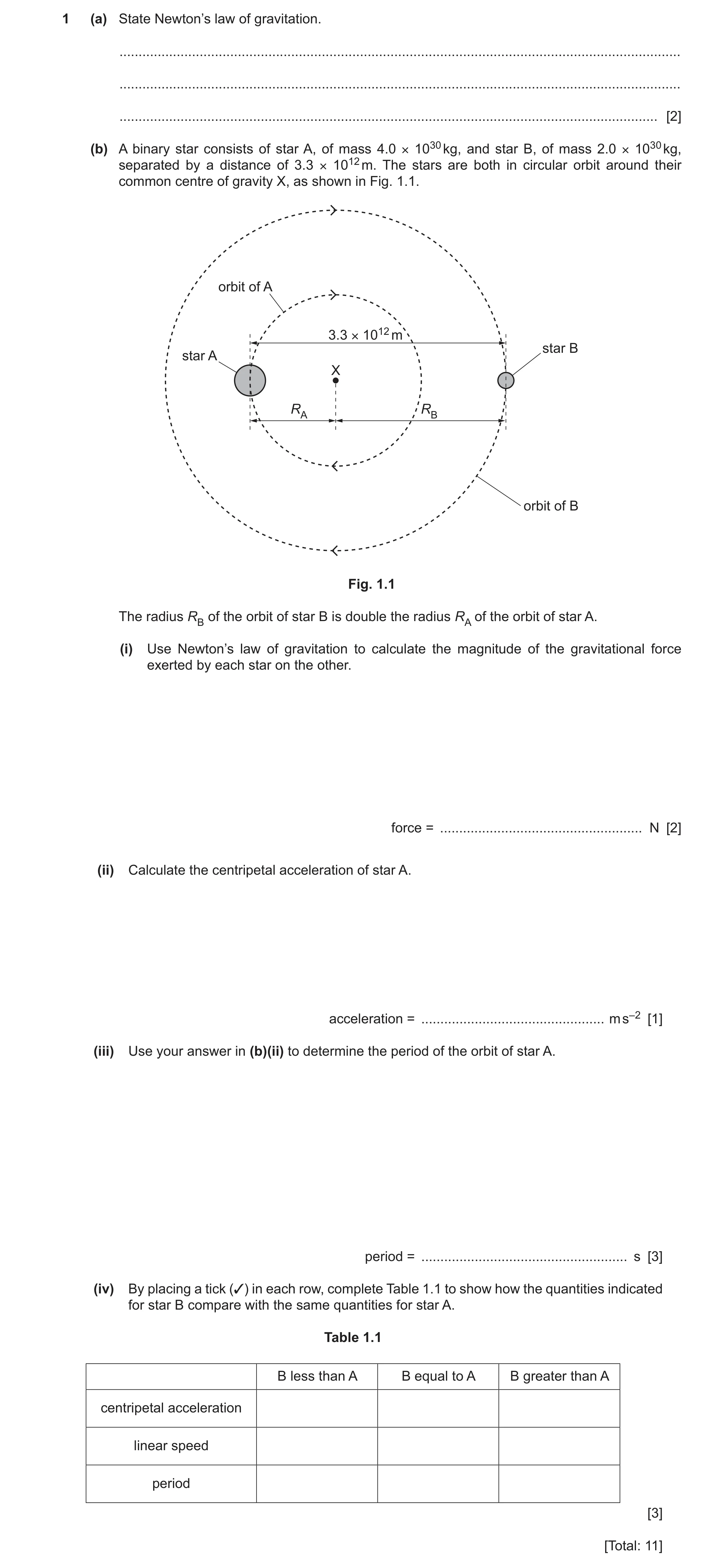
1 (a) State Newton’s law of gravitation. … … … [2] (b) A binary star consists of star A, of mass 4.0 × 1030 kg, and star B, of mass 2.0 × 1030 kg, separated by a distance of 3.3 × 10¹² m. The stars are both in circular orbit around their common centre of gravity X, as shown in Fig. 1.1. orbit of A 3.3 × 10¹² m star B star A X RA RB orbit of B Fig. 1.1 The radius RB of the orbit of star B is double the radius RA of the orbit of star A. (i) Use Newton’s law of gravitation to calculate the magnitude of the gravitational force exerted by each star on the other. force = … N [2] (ii) Calculate the centripetal acceleration of star A. acceleration = … m s–2 [1] (iii) Use your answer in (b)(ii) to determine the period of the orbit of star A. period = … s [3] (iv) By placing a tick (✓) in each row, complete Table 1.1 to show how the quantities indicated for star B compare with the same quantities for star A. Table 1.1 B less than A B equal to A B greater than A centripetal acceleration linear speed period [3] [Total: 11]
11 marks
Mark scheme: Question Answer Marks 1(a) (gravitational) force is (directly) proportional to product of masses B1 force (between point masses) is inversely proportional to the square of their separation B1 1(b)(i) force = (6.67 10–11 4.0 1030 2.0 1030) / (3.3 1012)2 C1 = 4.9 1025 N A1 1(b)(ii) a = F / m = (4.9 1025) / (4.0 1030) A1 = 1.2 10–5 m s–2 1(b)(iii) a = r2 and = 2 / T C1 or a = v2 / r and v = (2r / T) r = (3.3 1012) / 3 C1 T = 2 [(3.3 1012) / (3 1.2 10–5)]½ A1 = 1.9 109 s 1(b)(iv) acceleration: B greater than A B1 linear speed: B greater than A B1 period: B equal to A B1
This question in 9702/44 Oct/Nov 2025
 5 / 35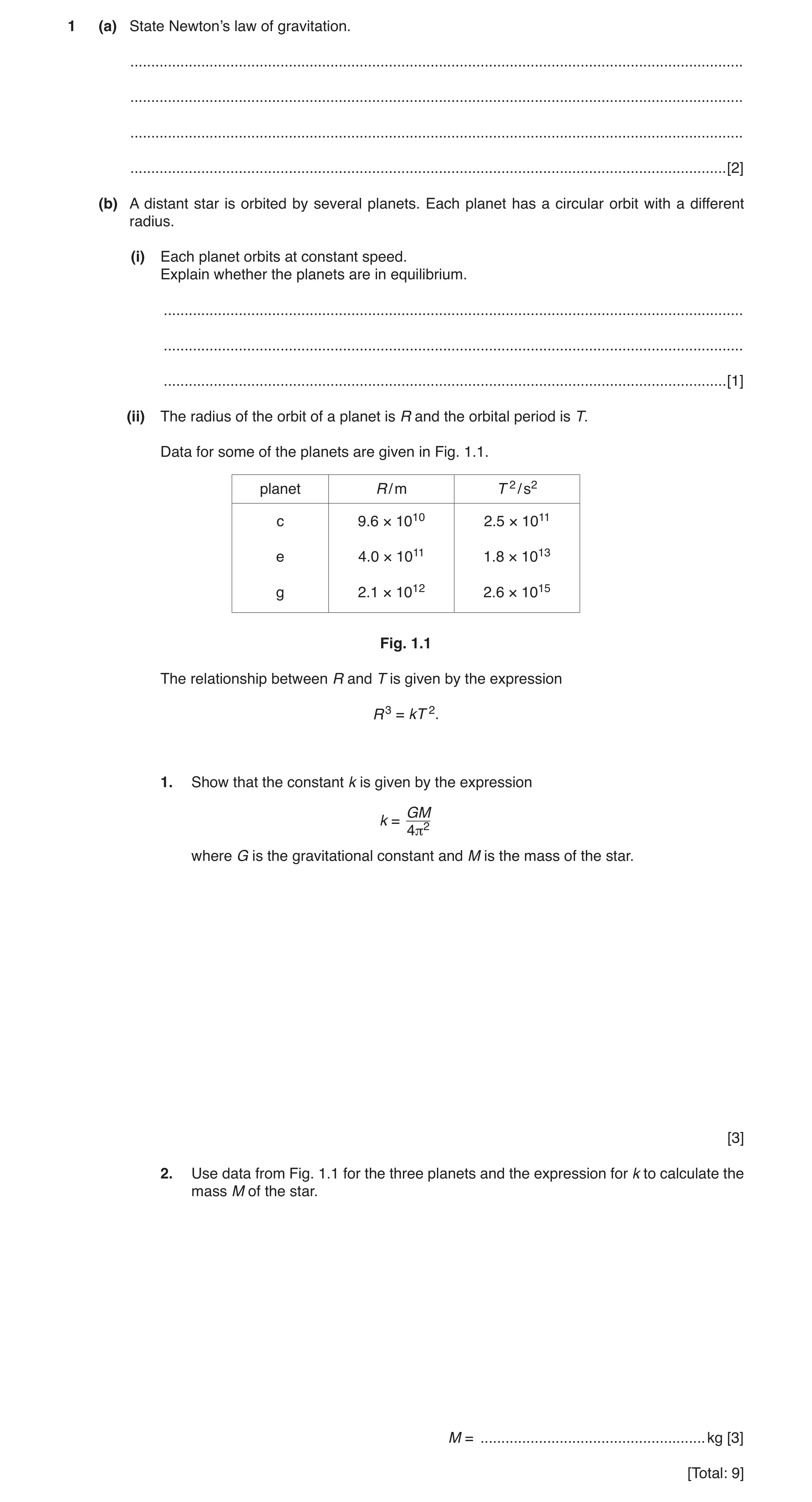
 14 / 35
 15 / 35
 16 / 35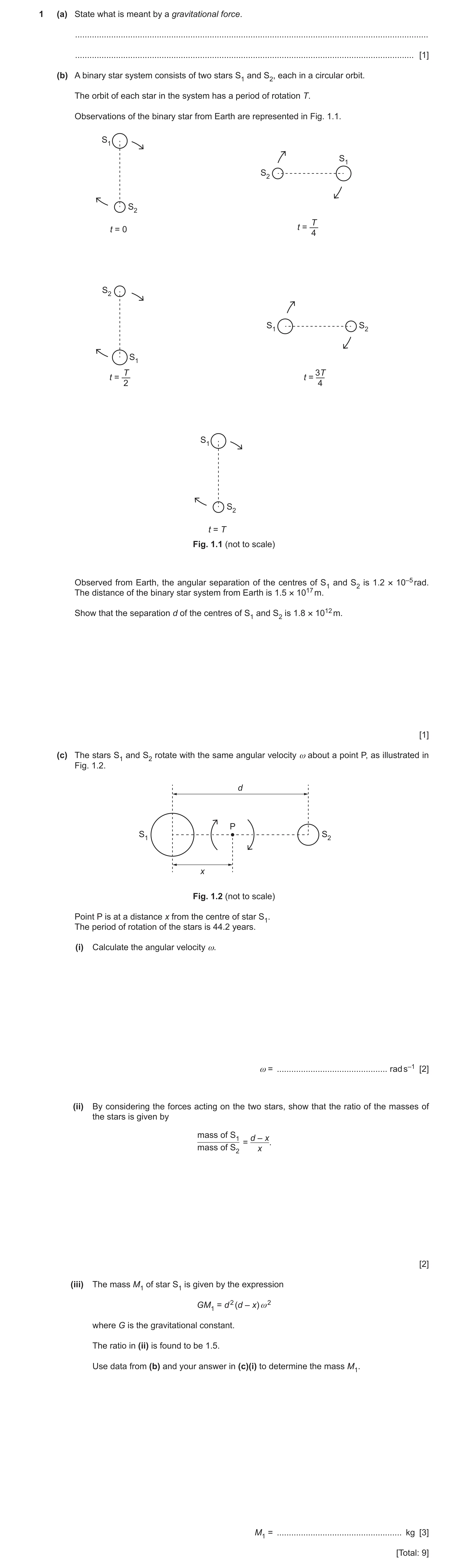
 9
9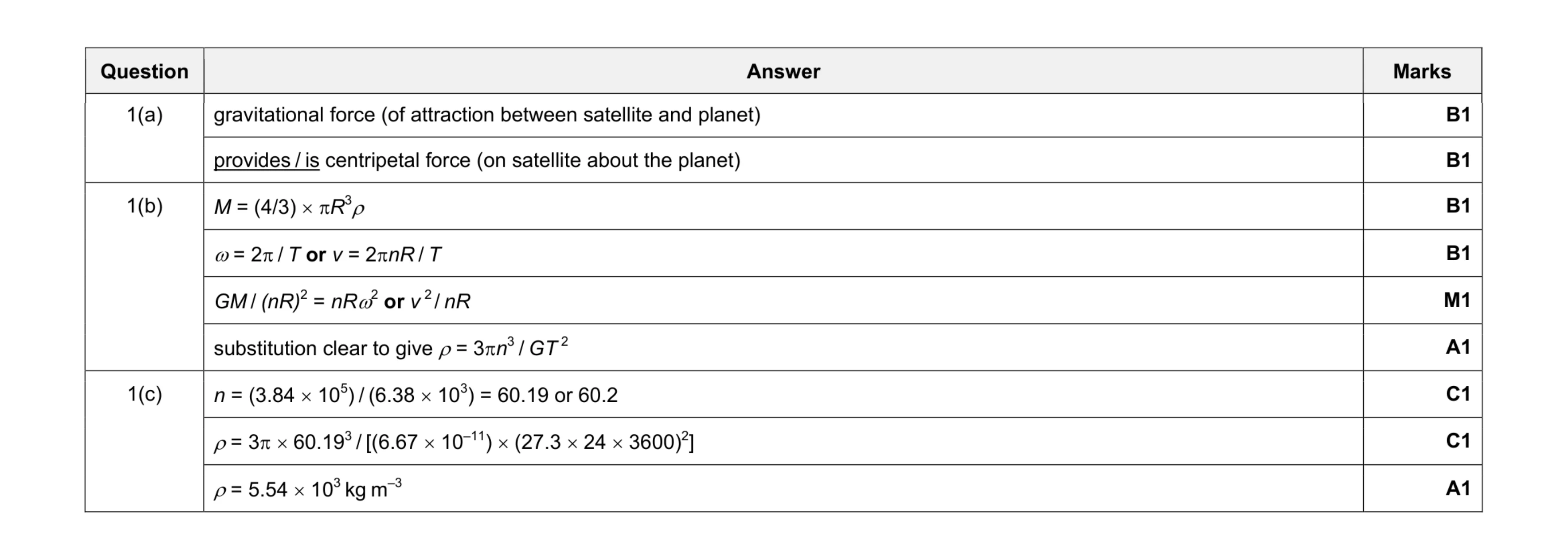 9
9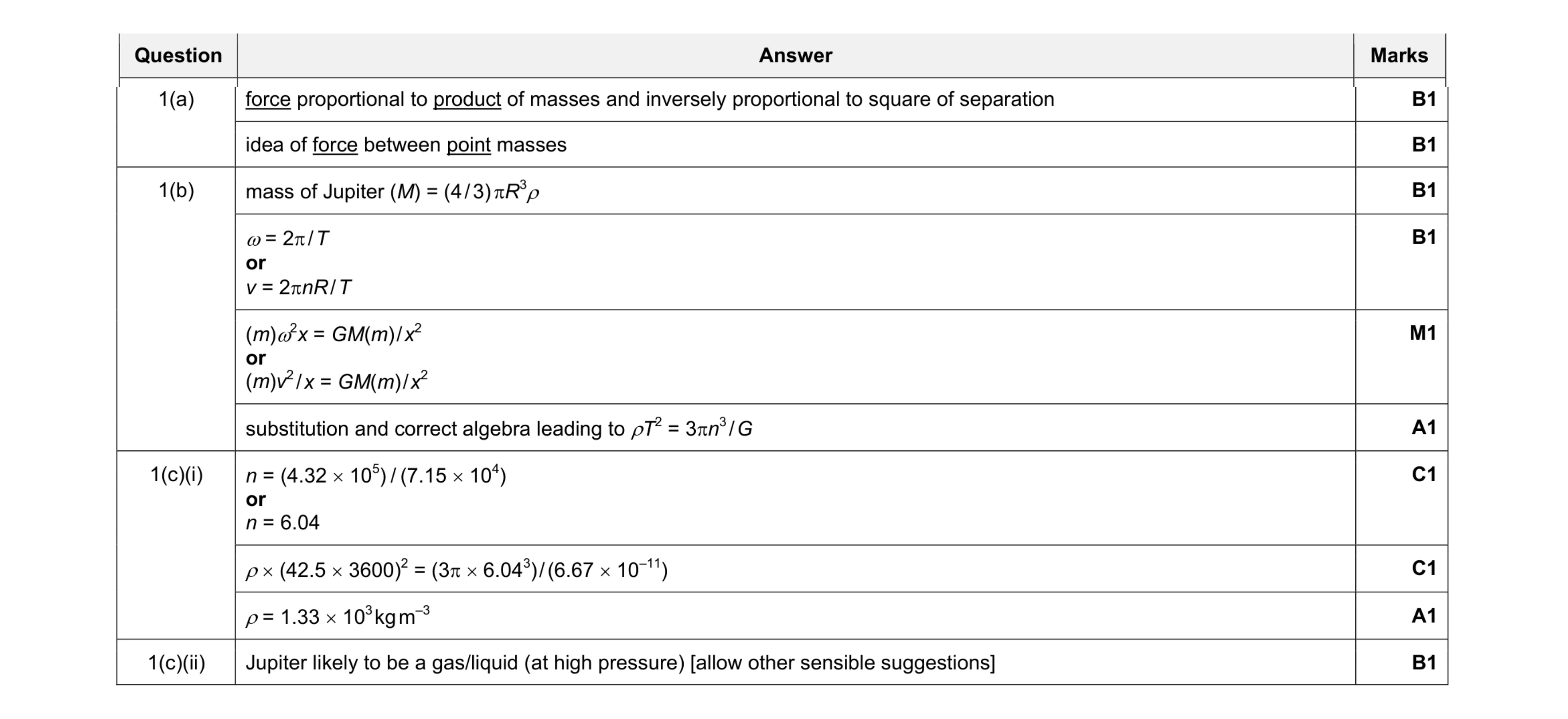 10
10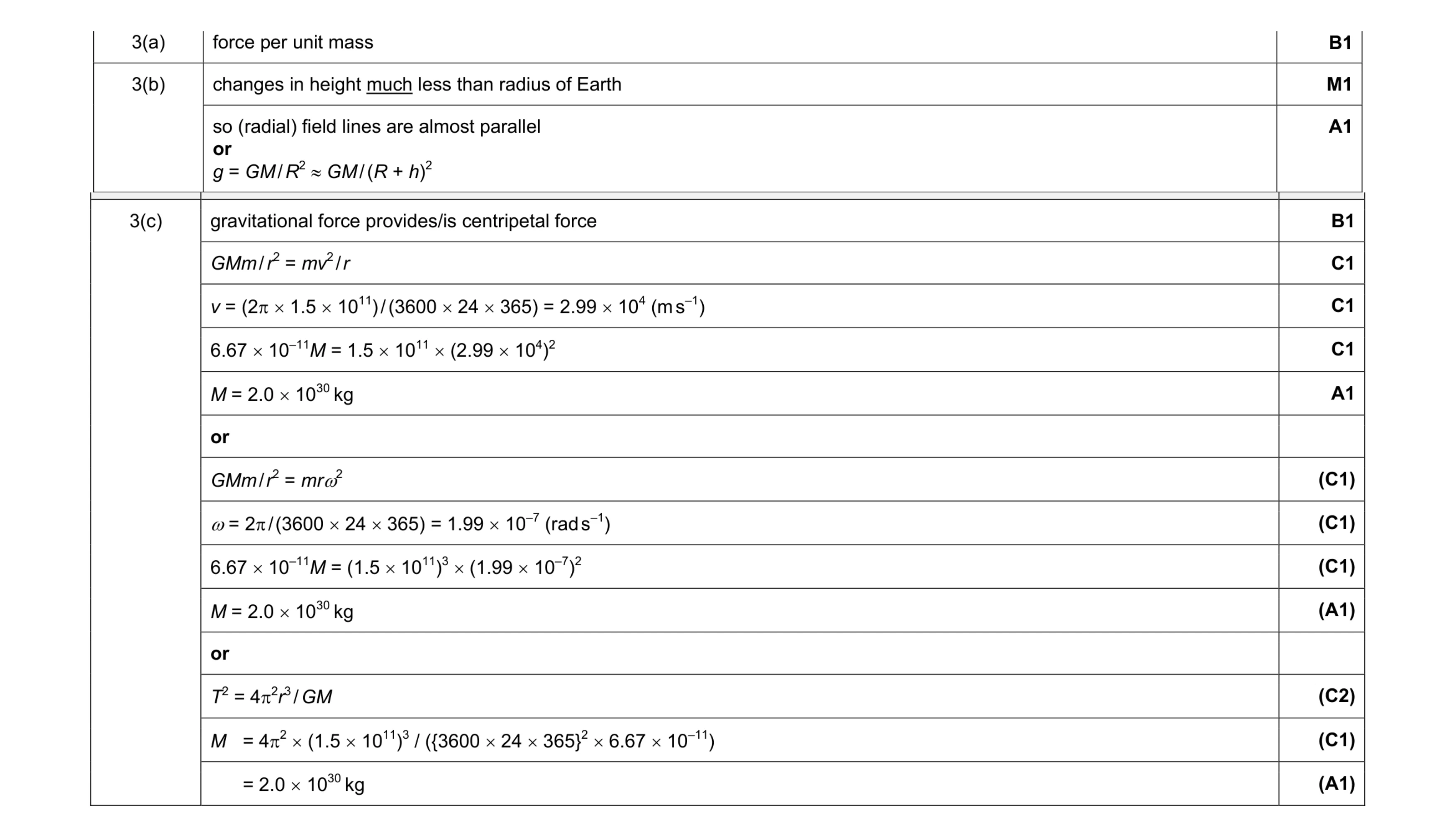 8
8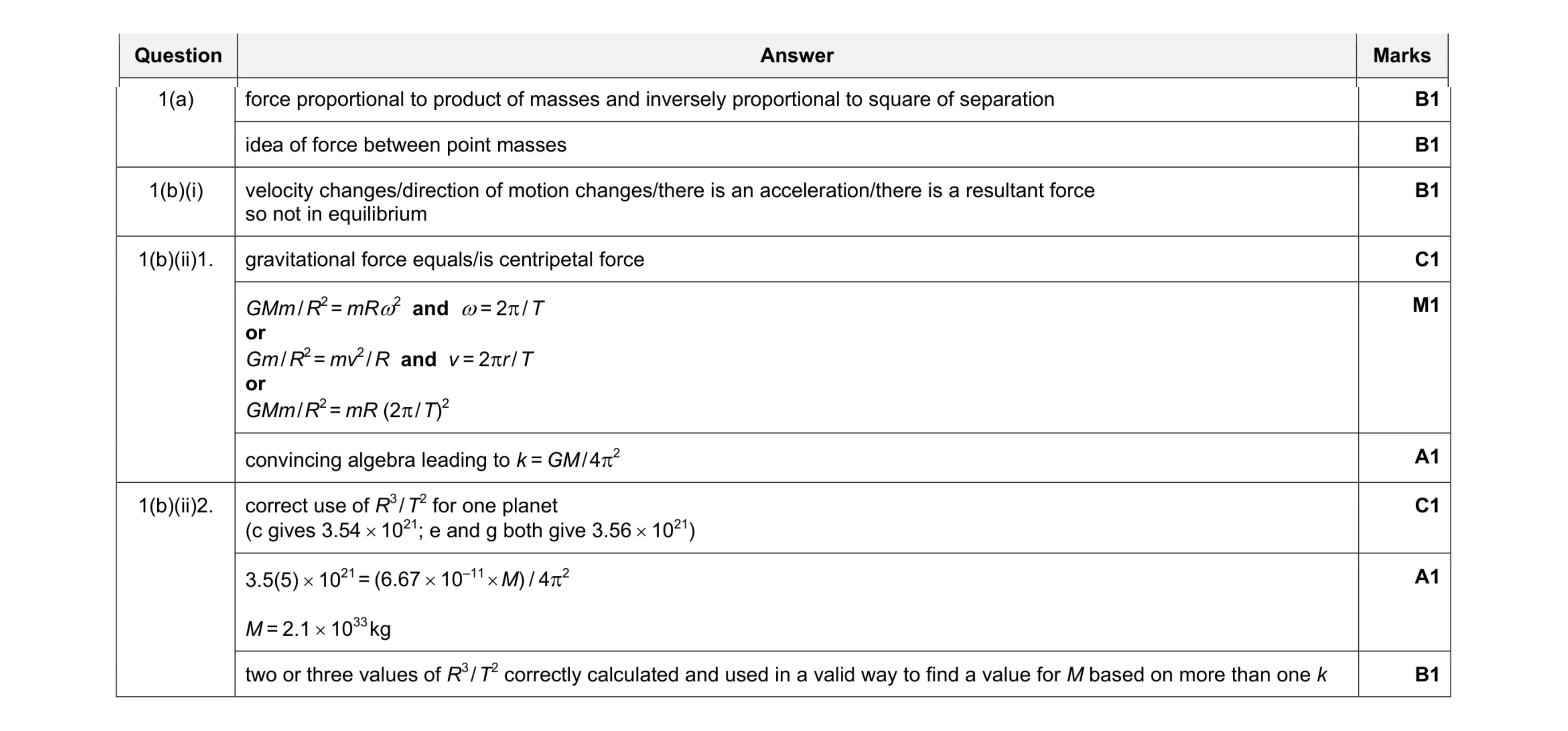 9
9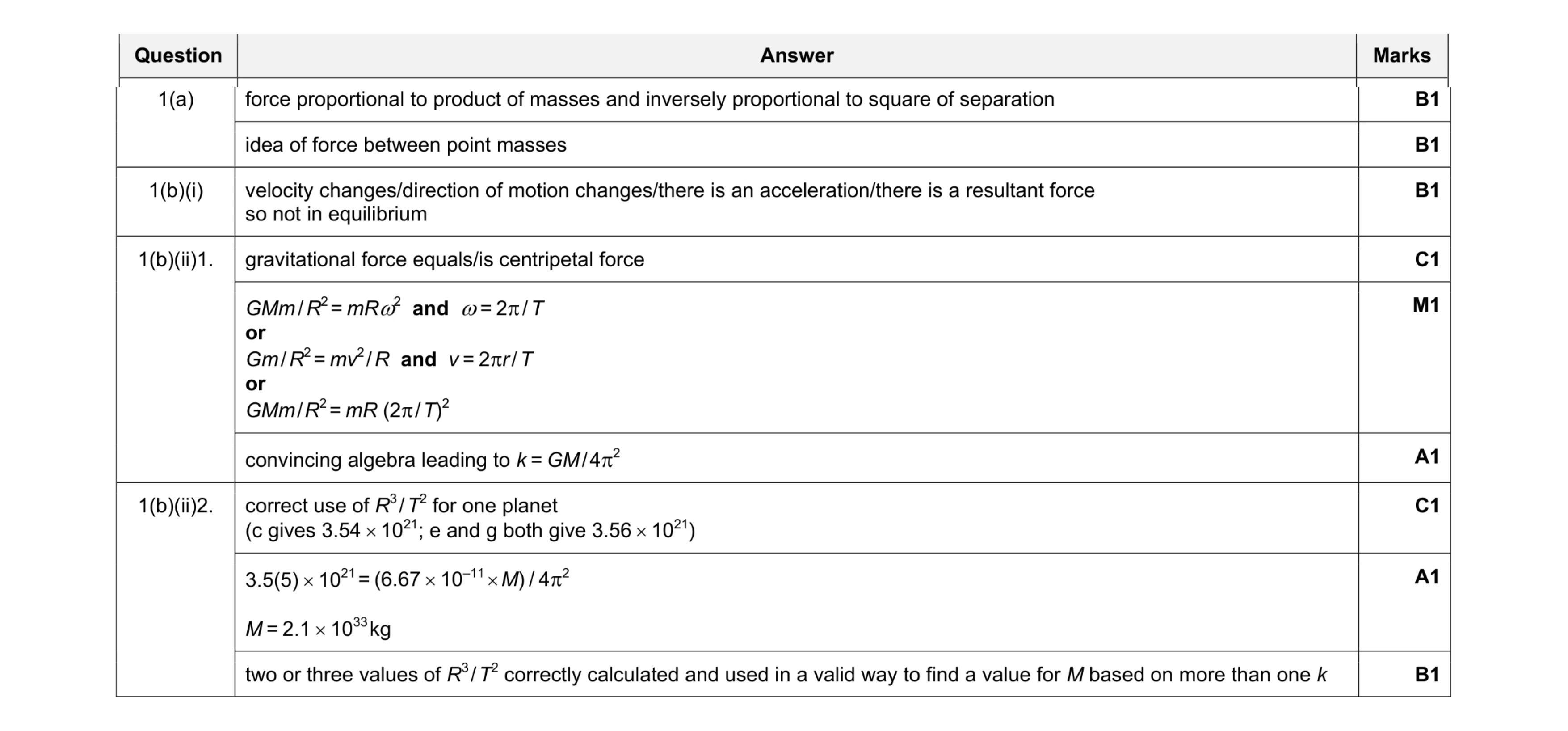 9
9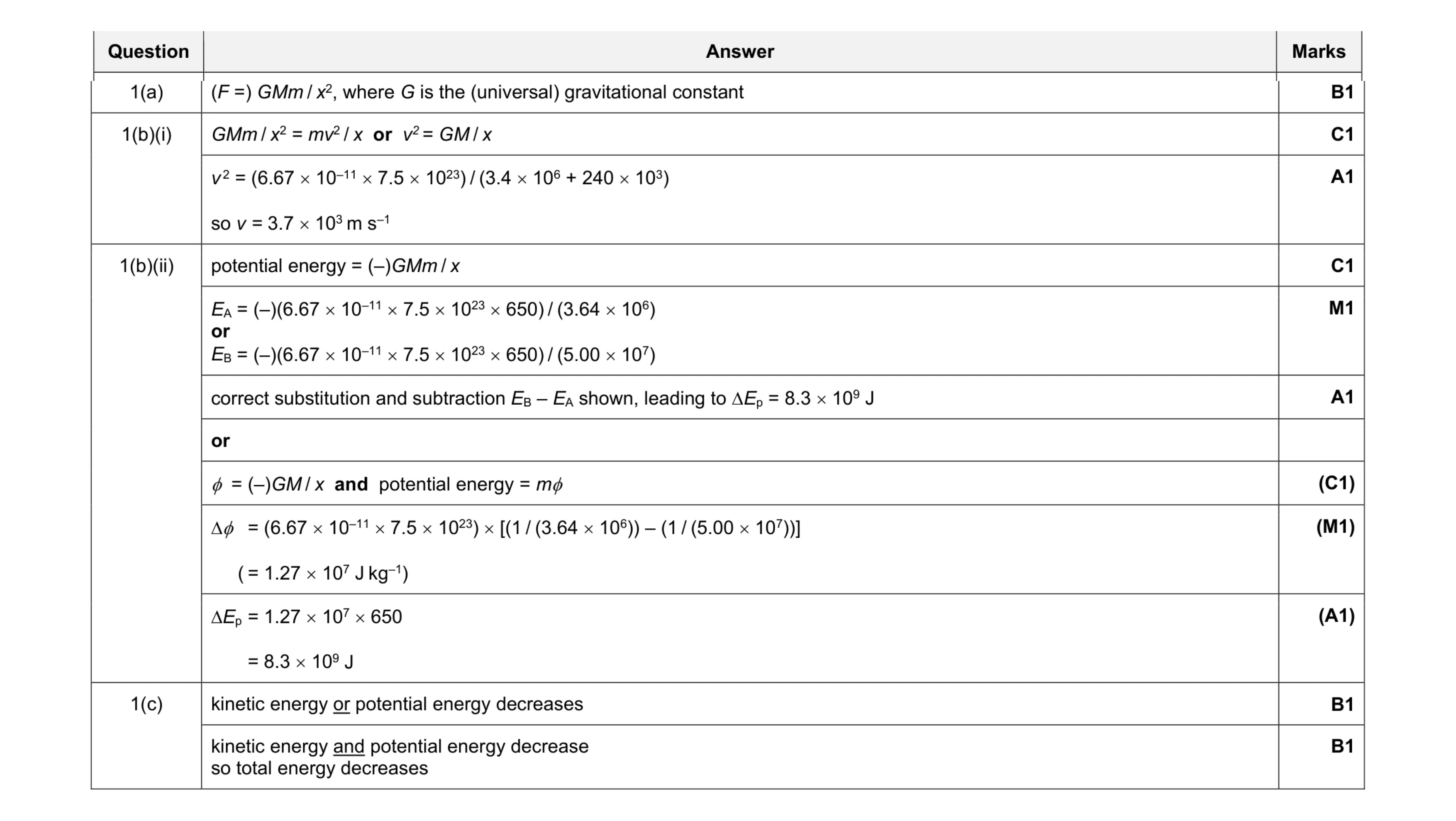 8
8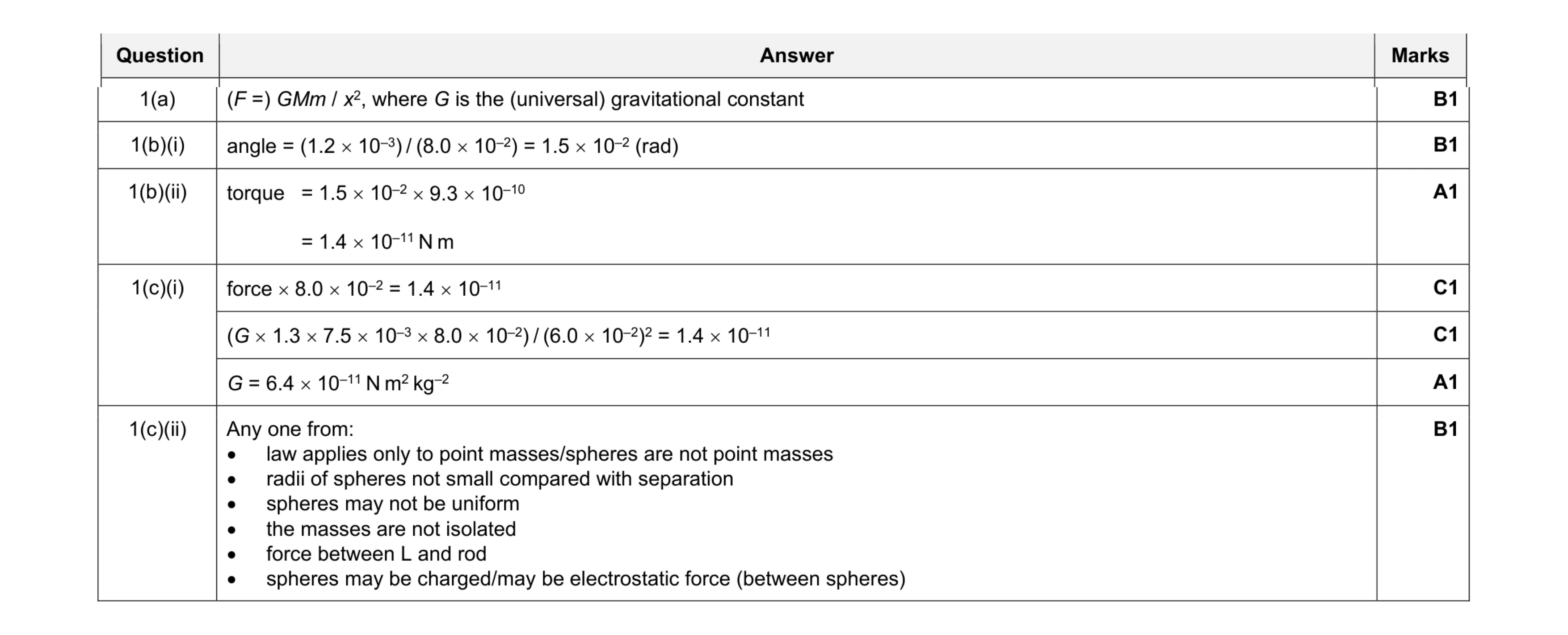 7
7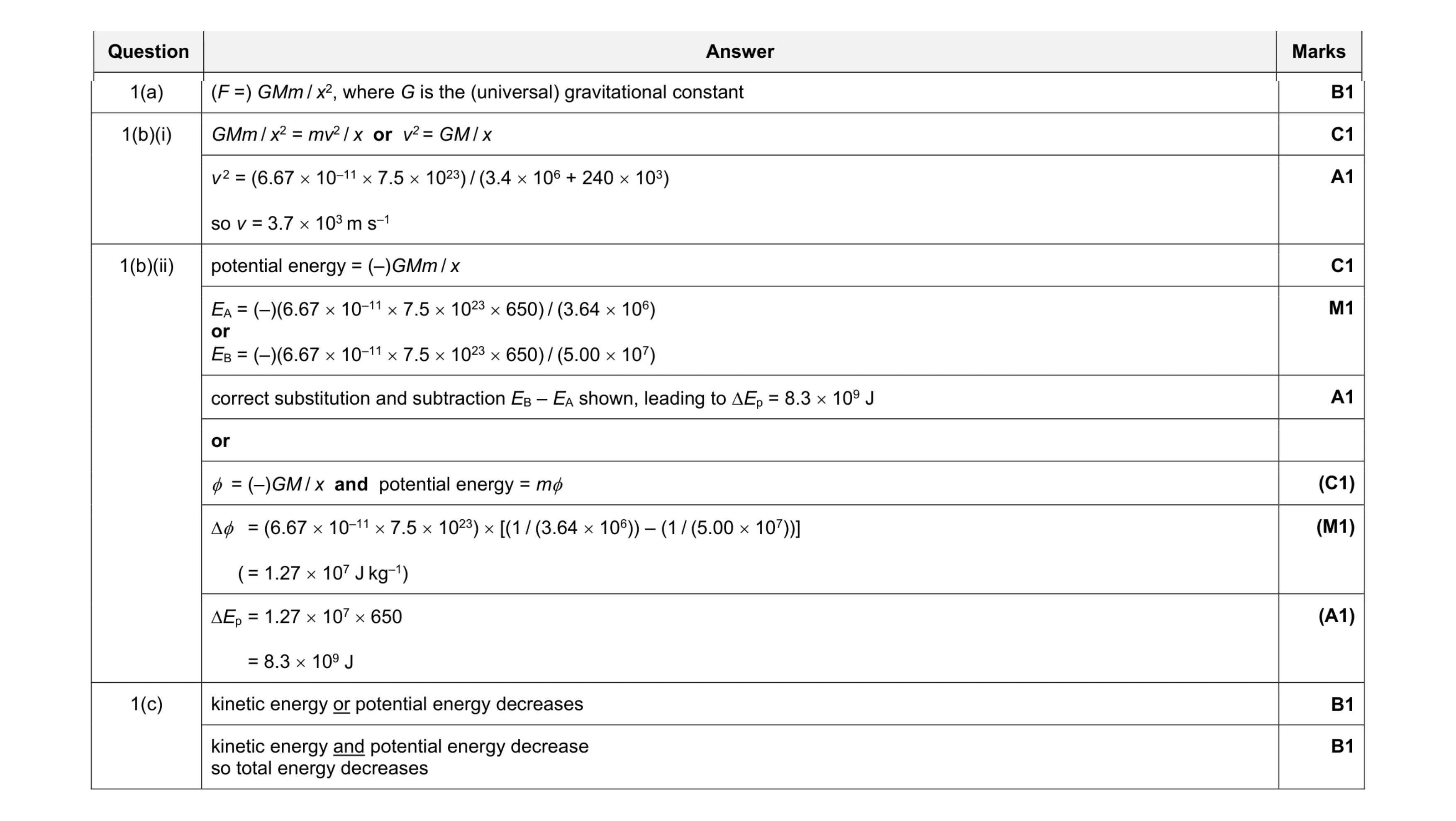 8
8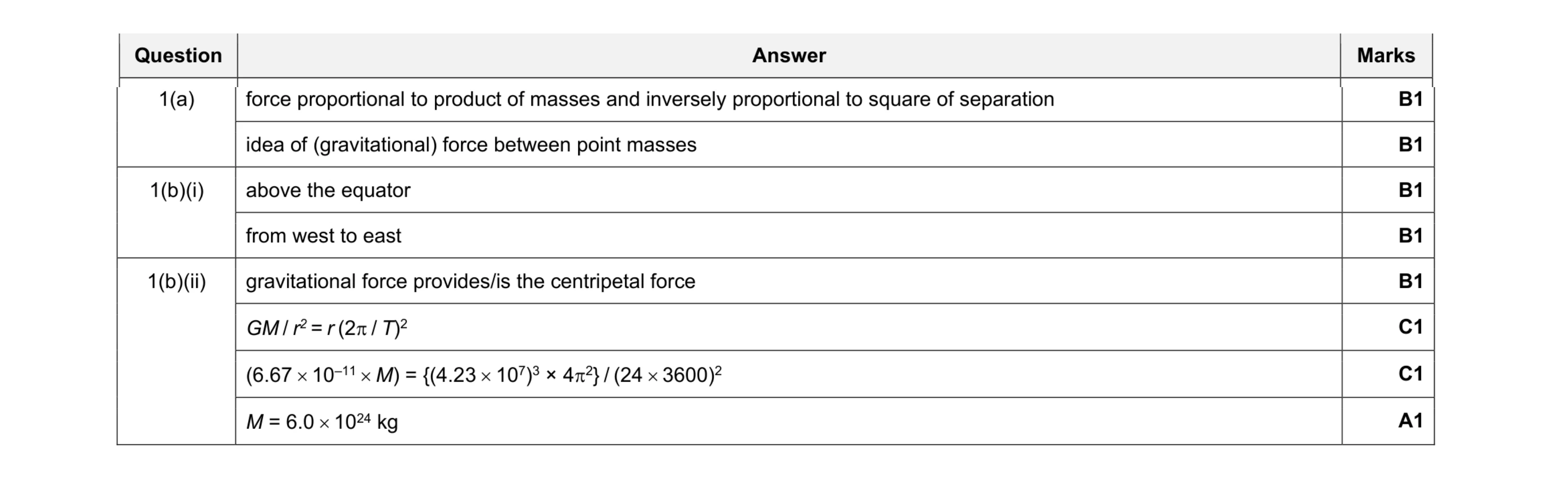 8
8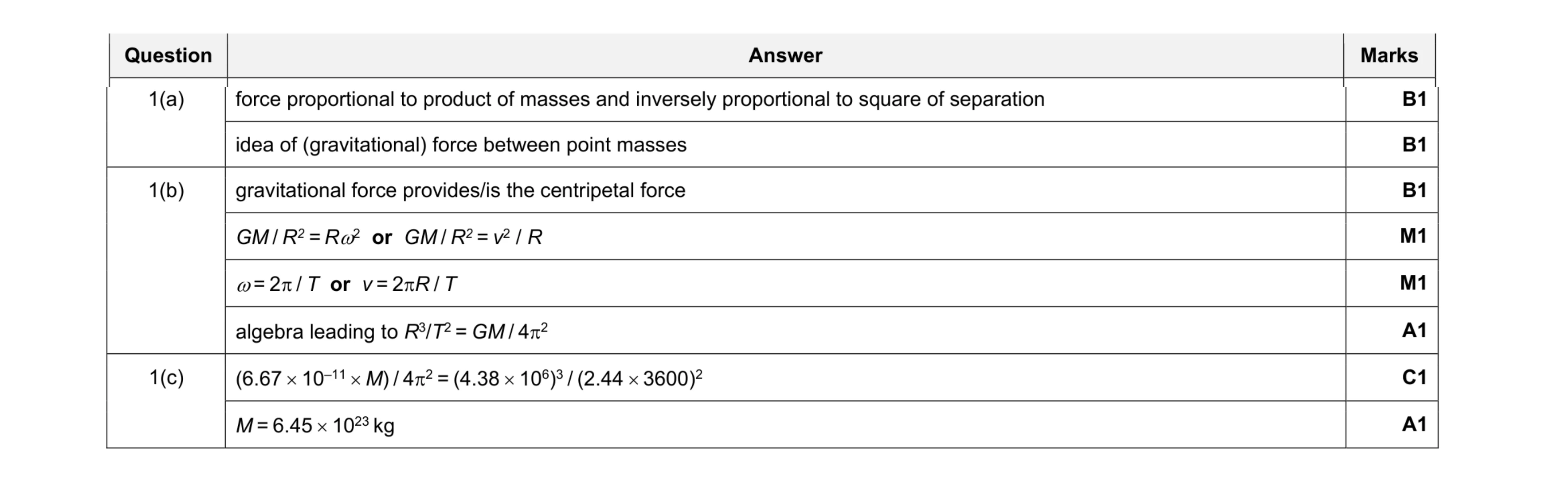 8
8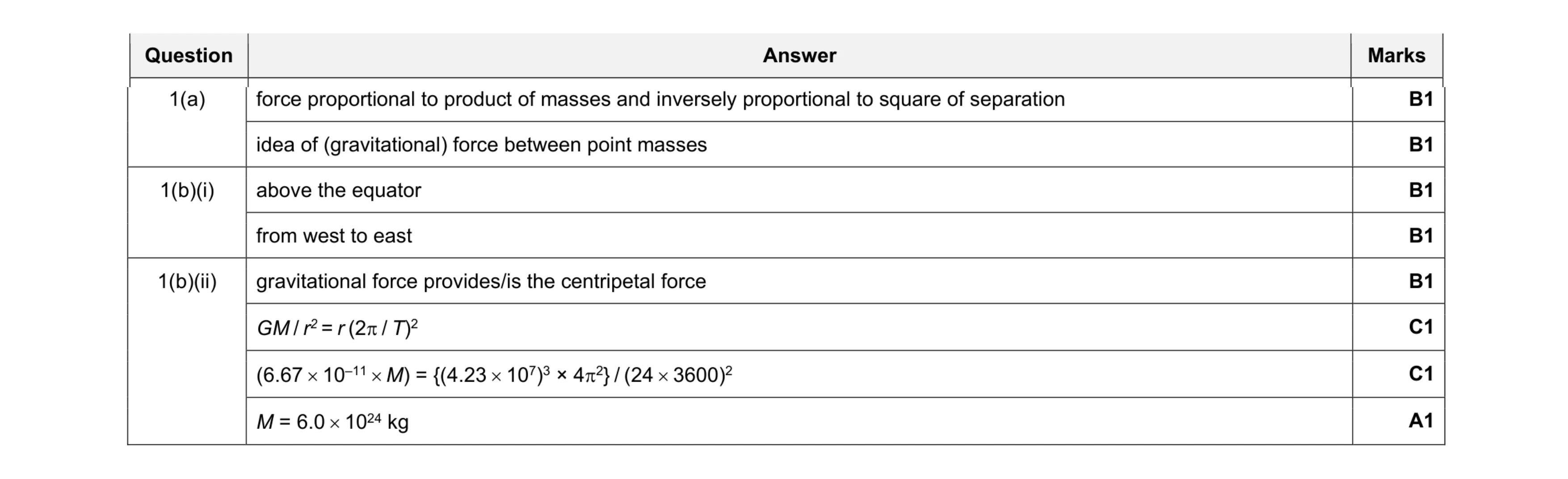 8
8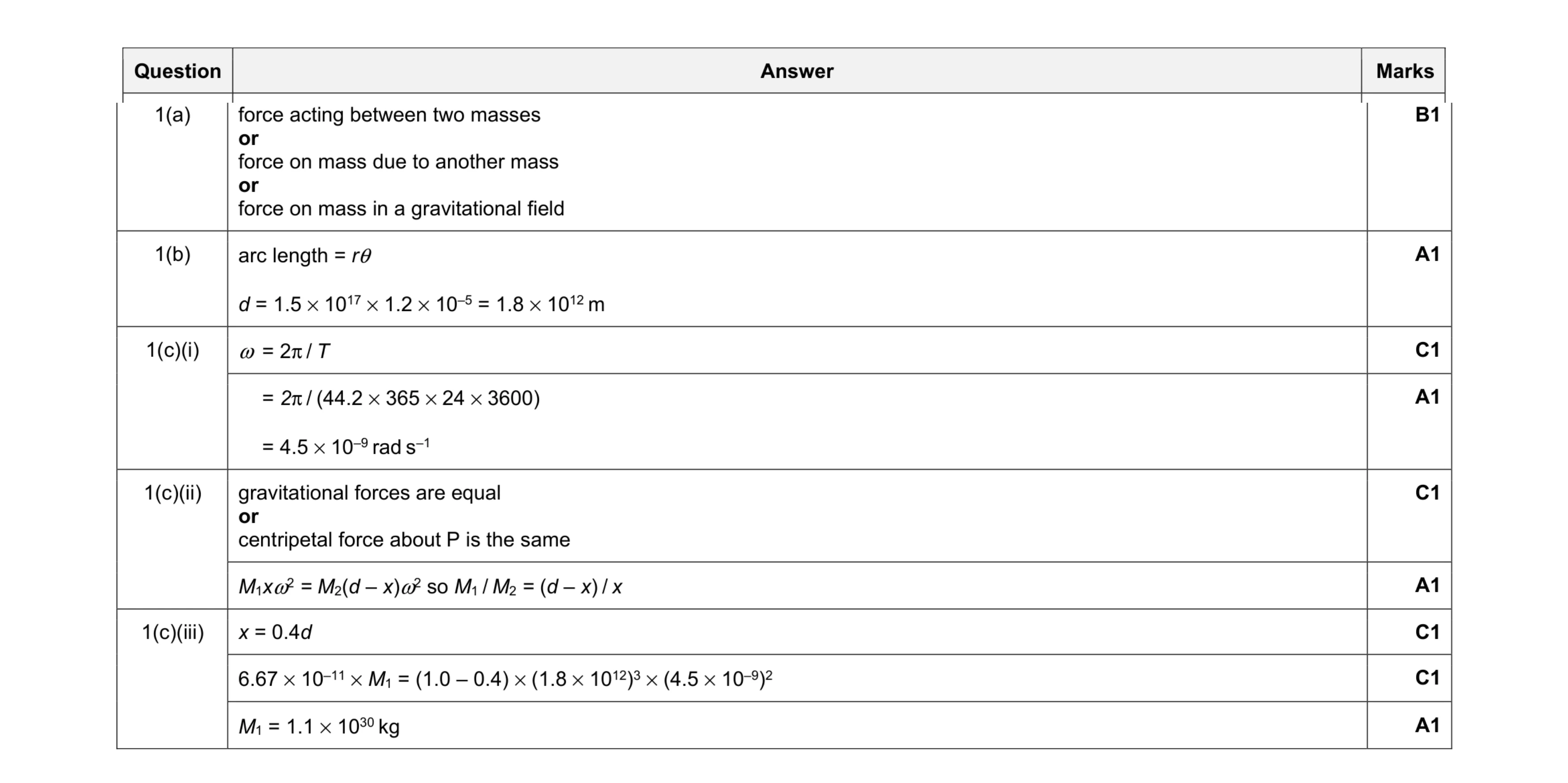 9
9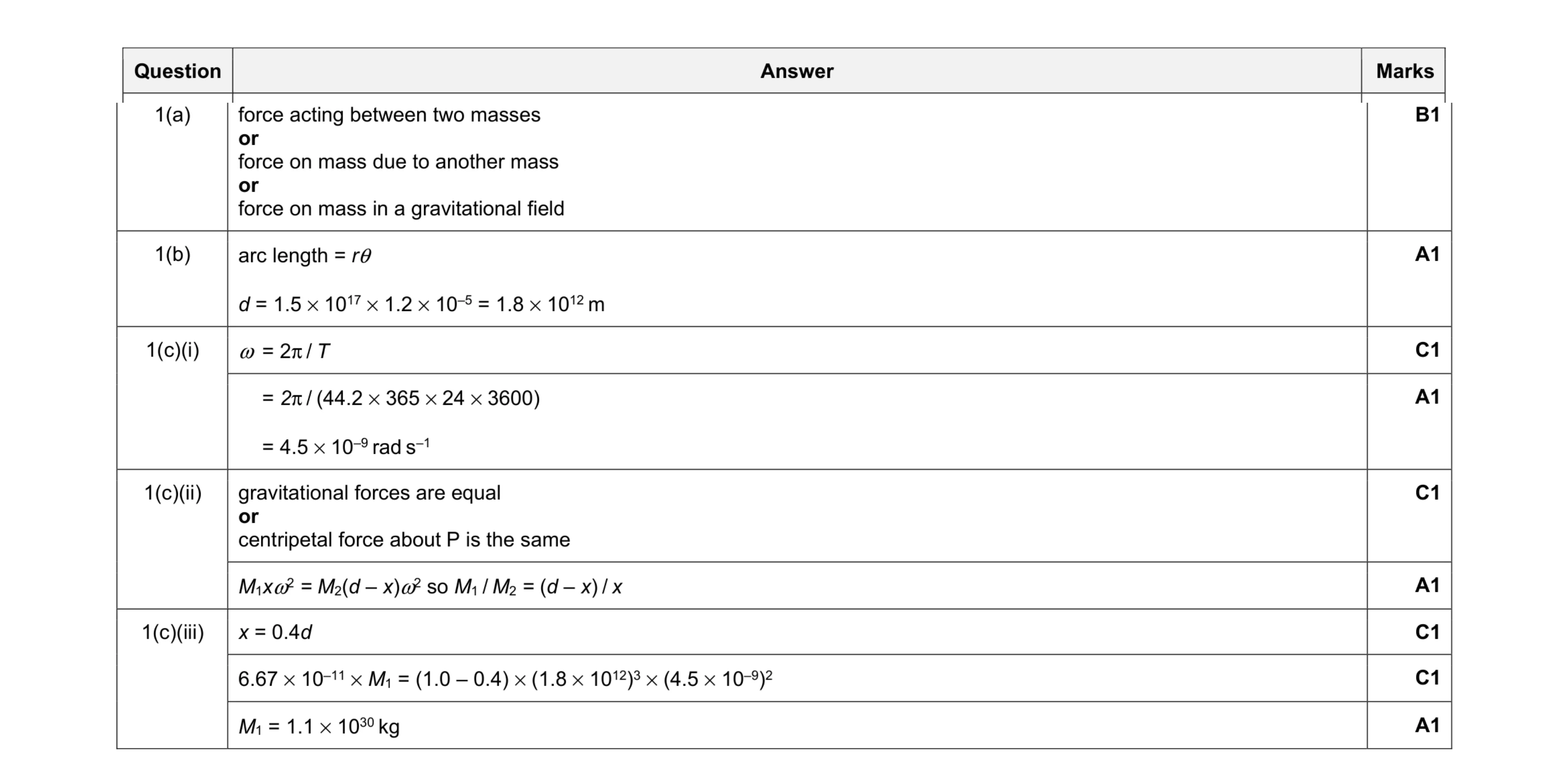 9
9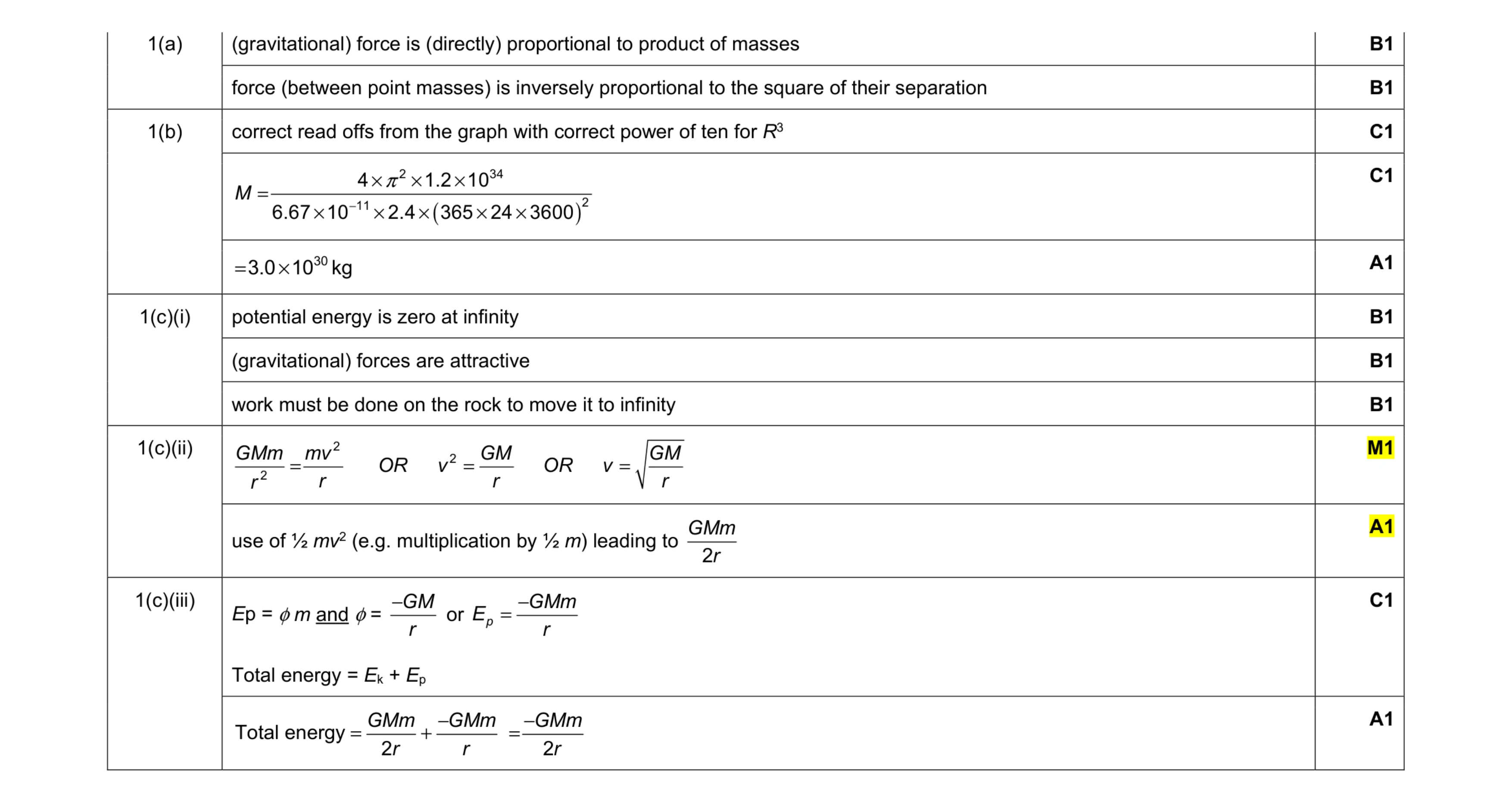 12
12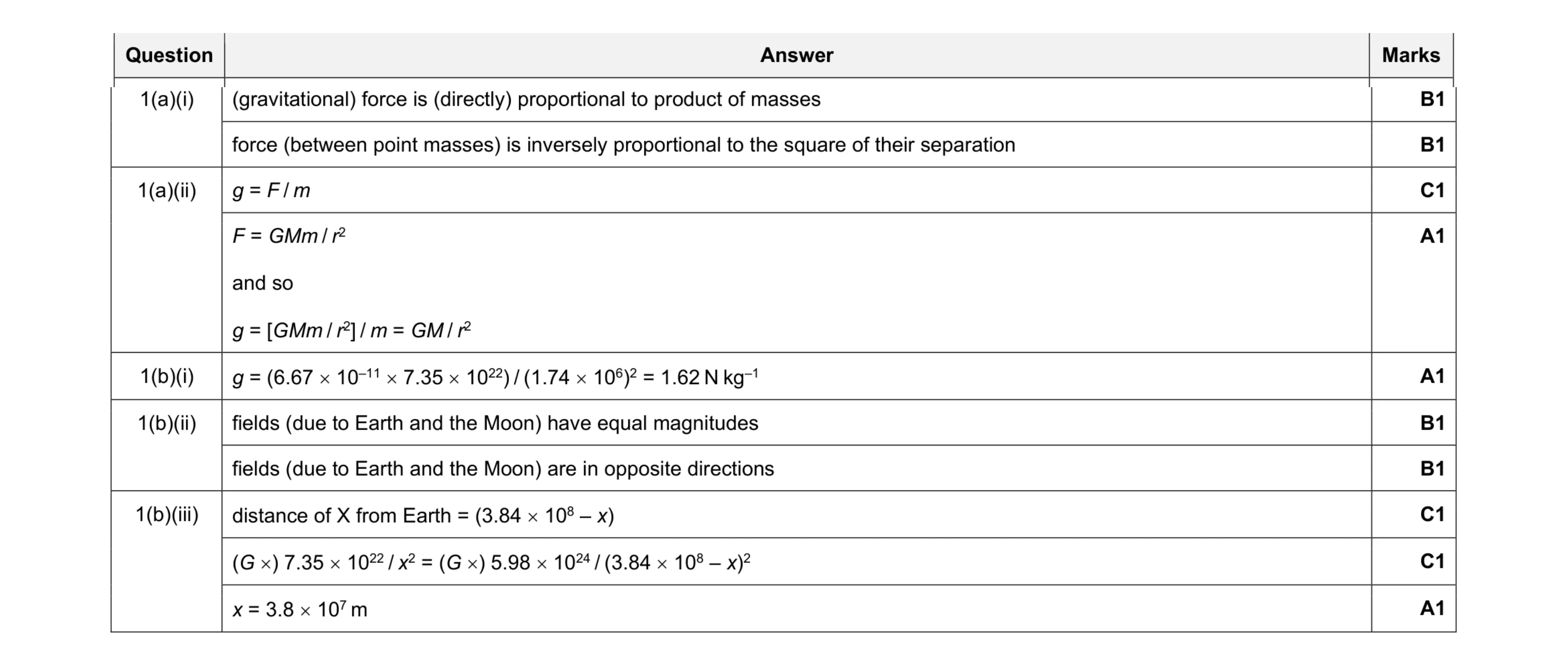 10
10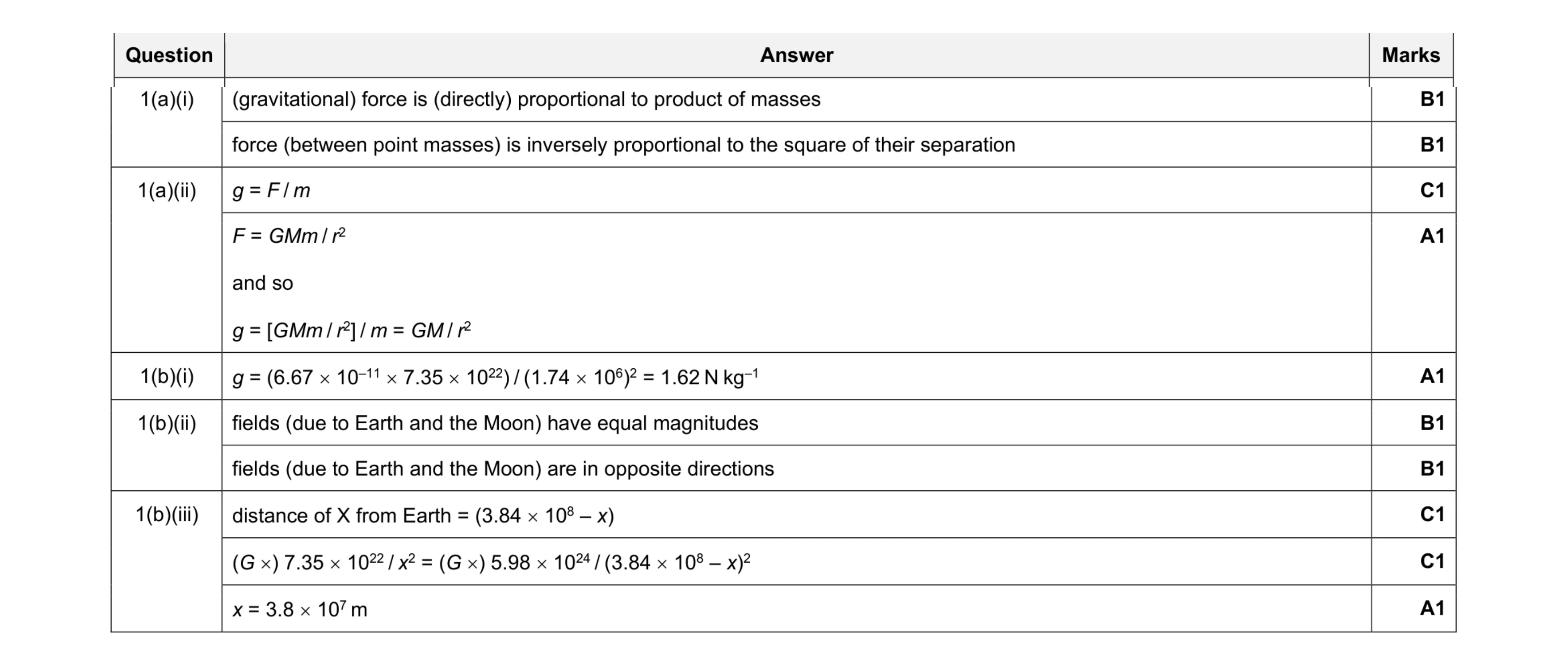 10
10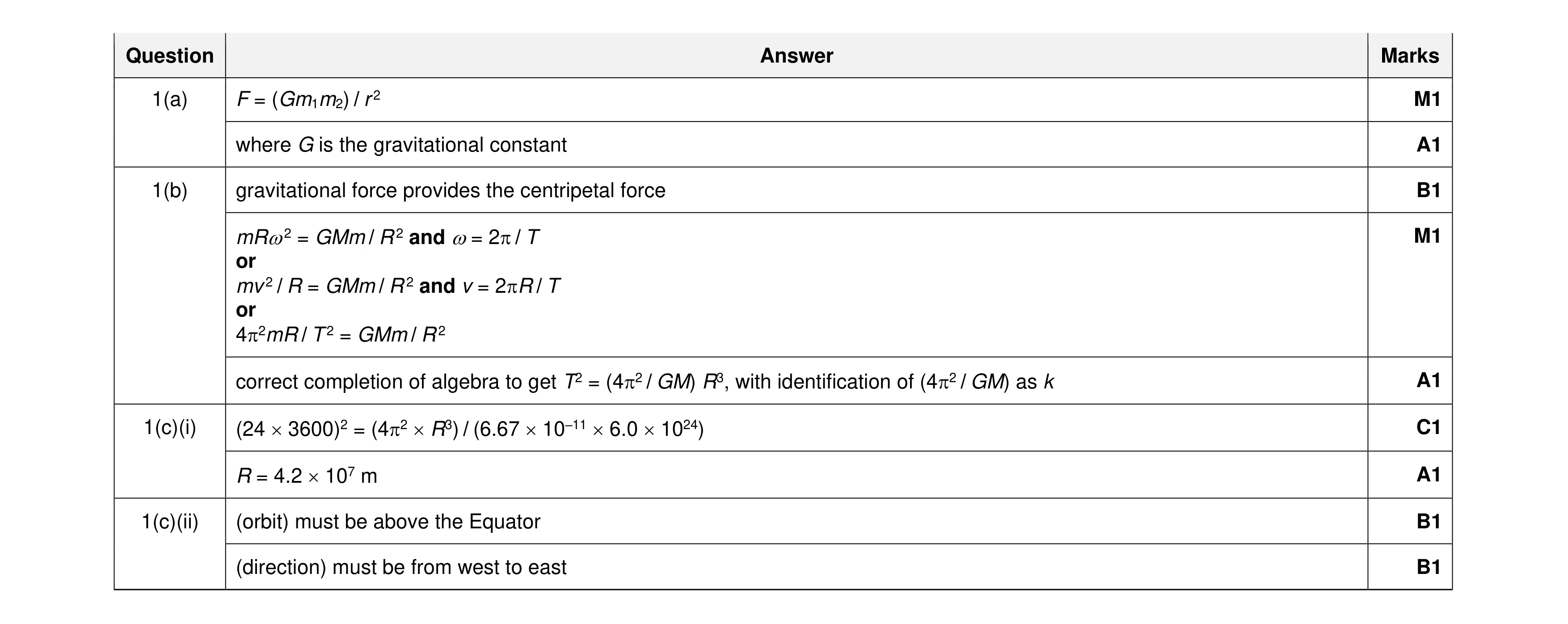 9
9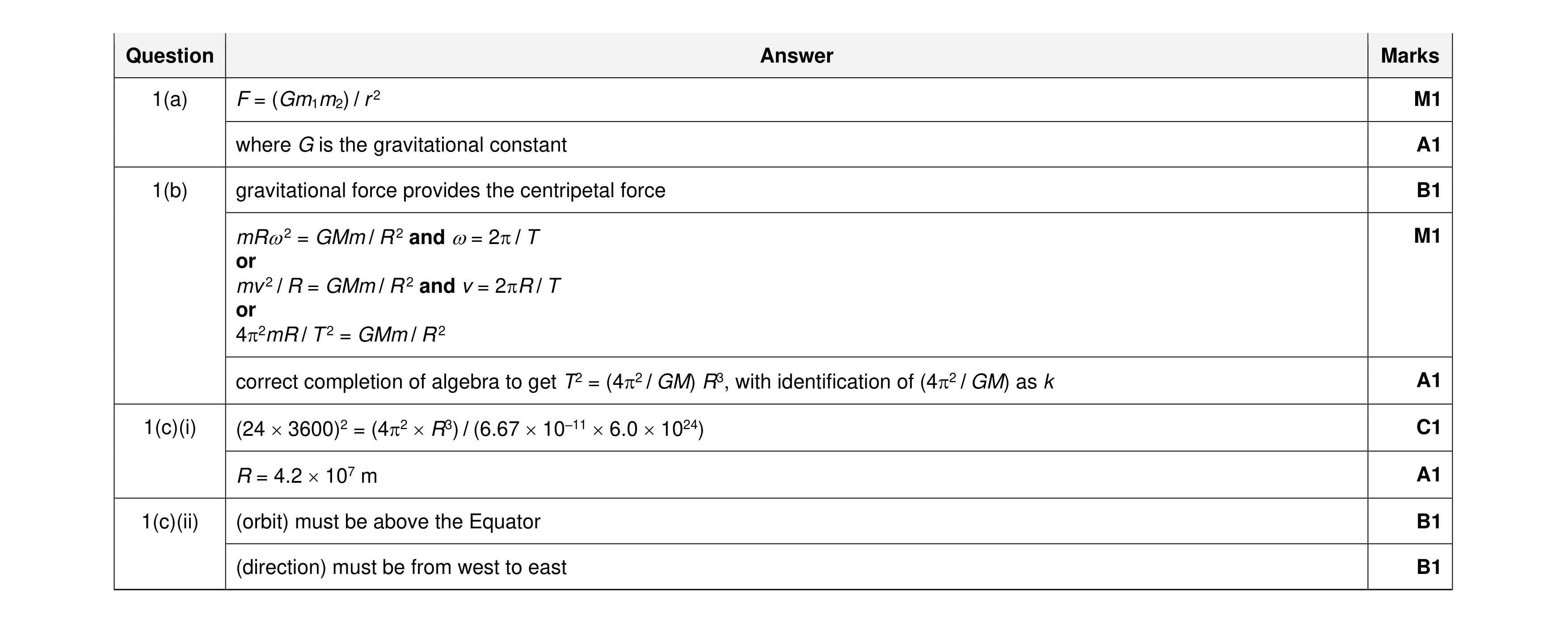 9
9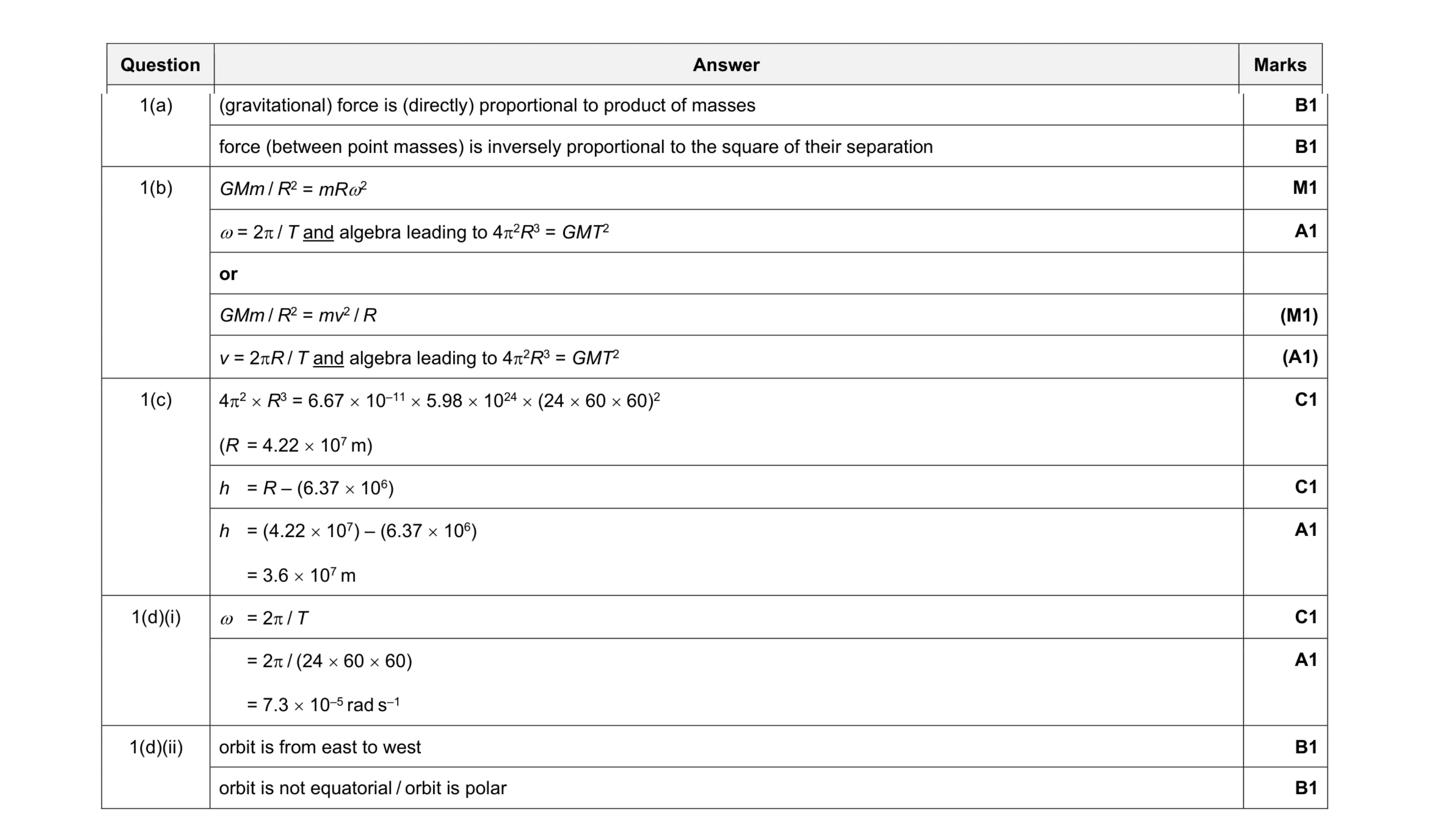 11
11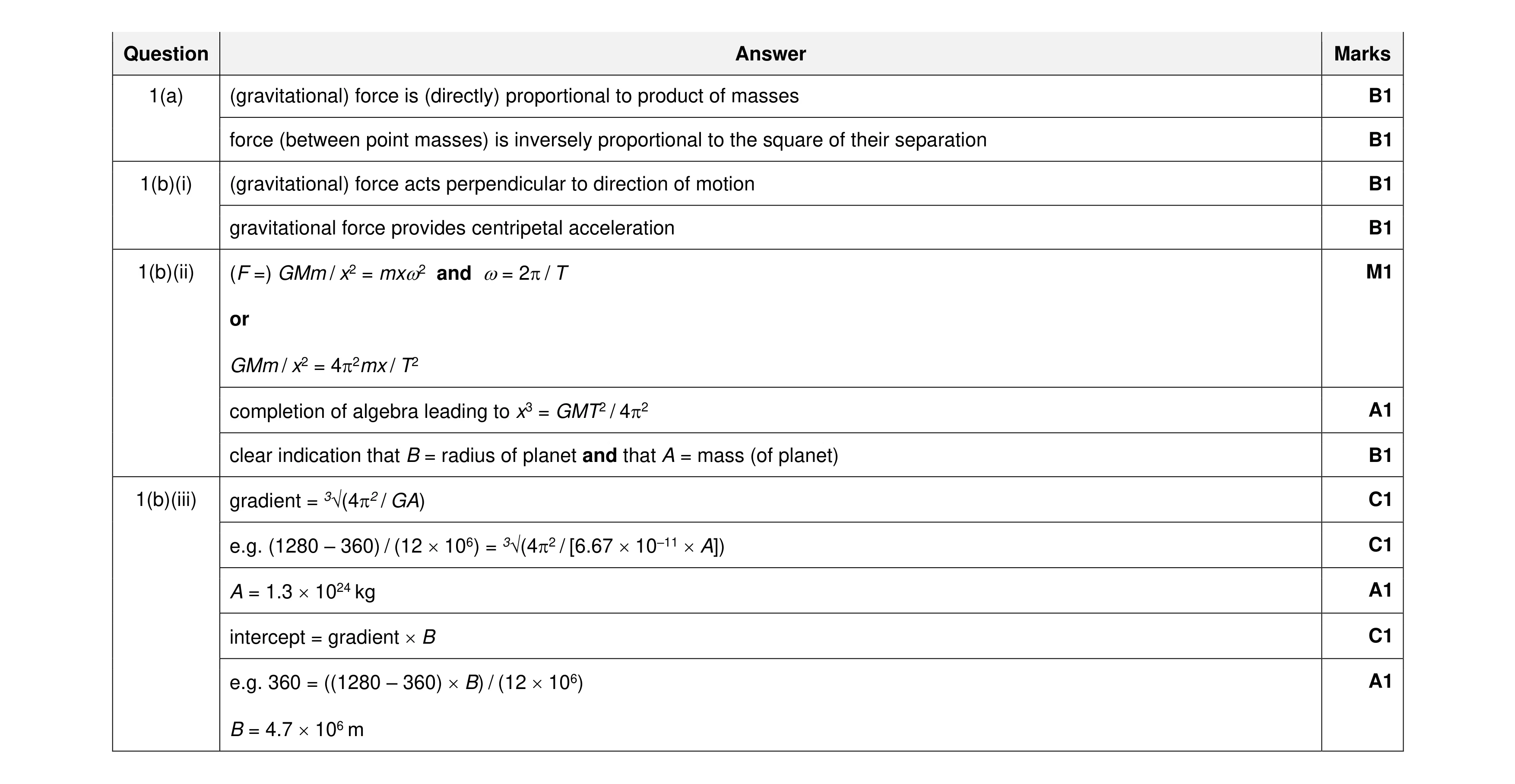 12
12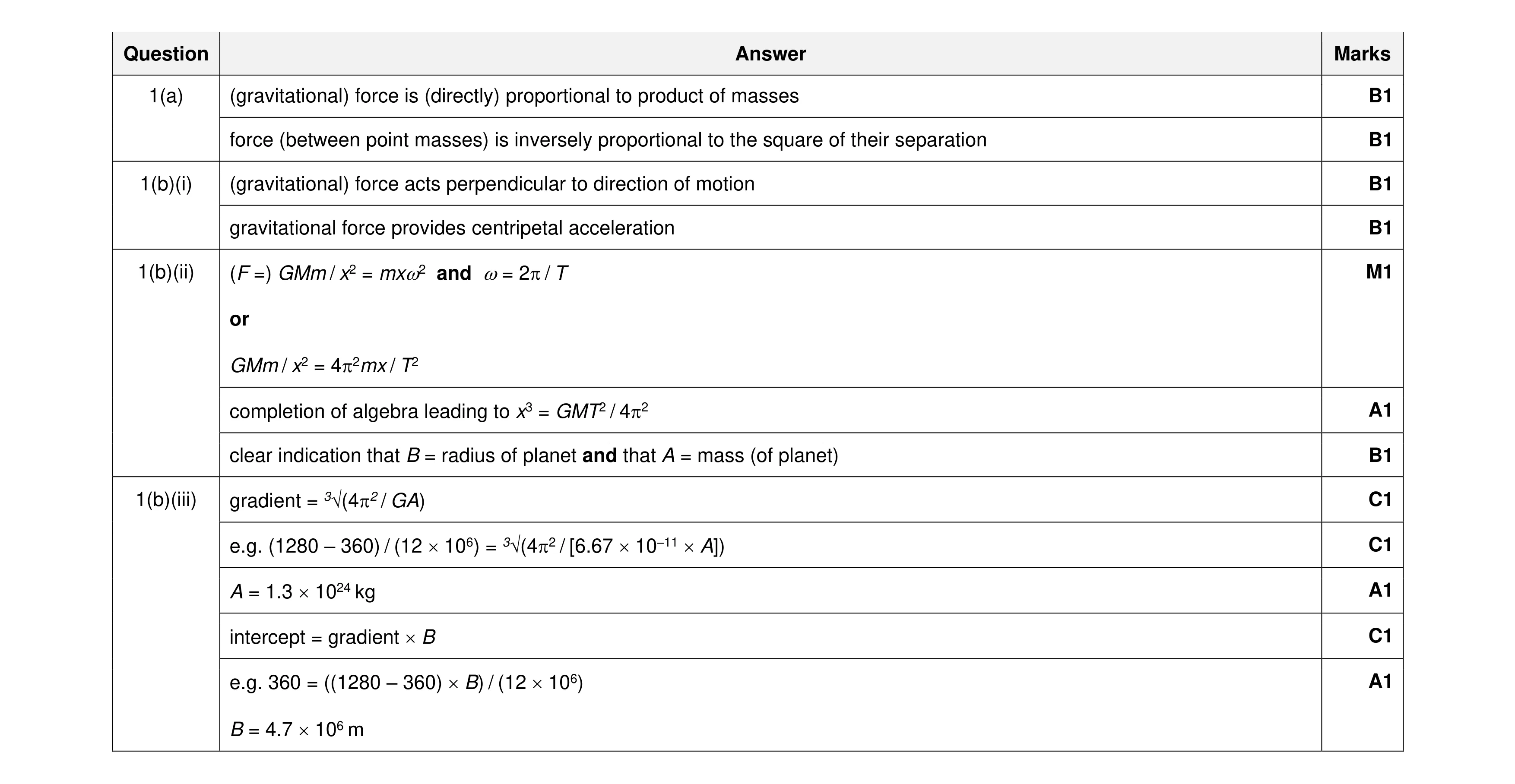 12
12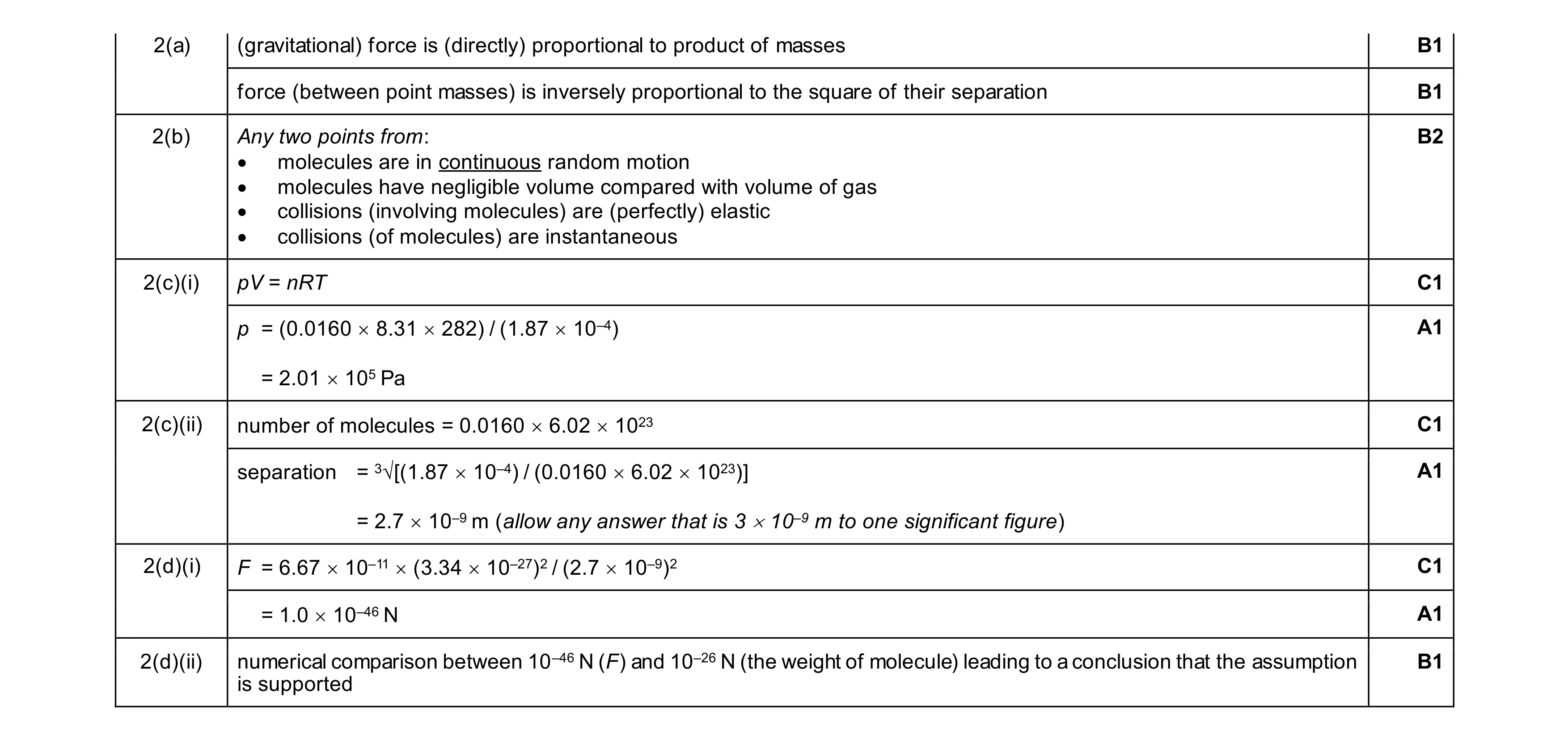 11
11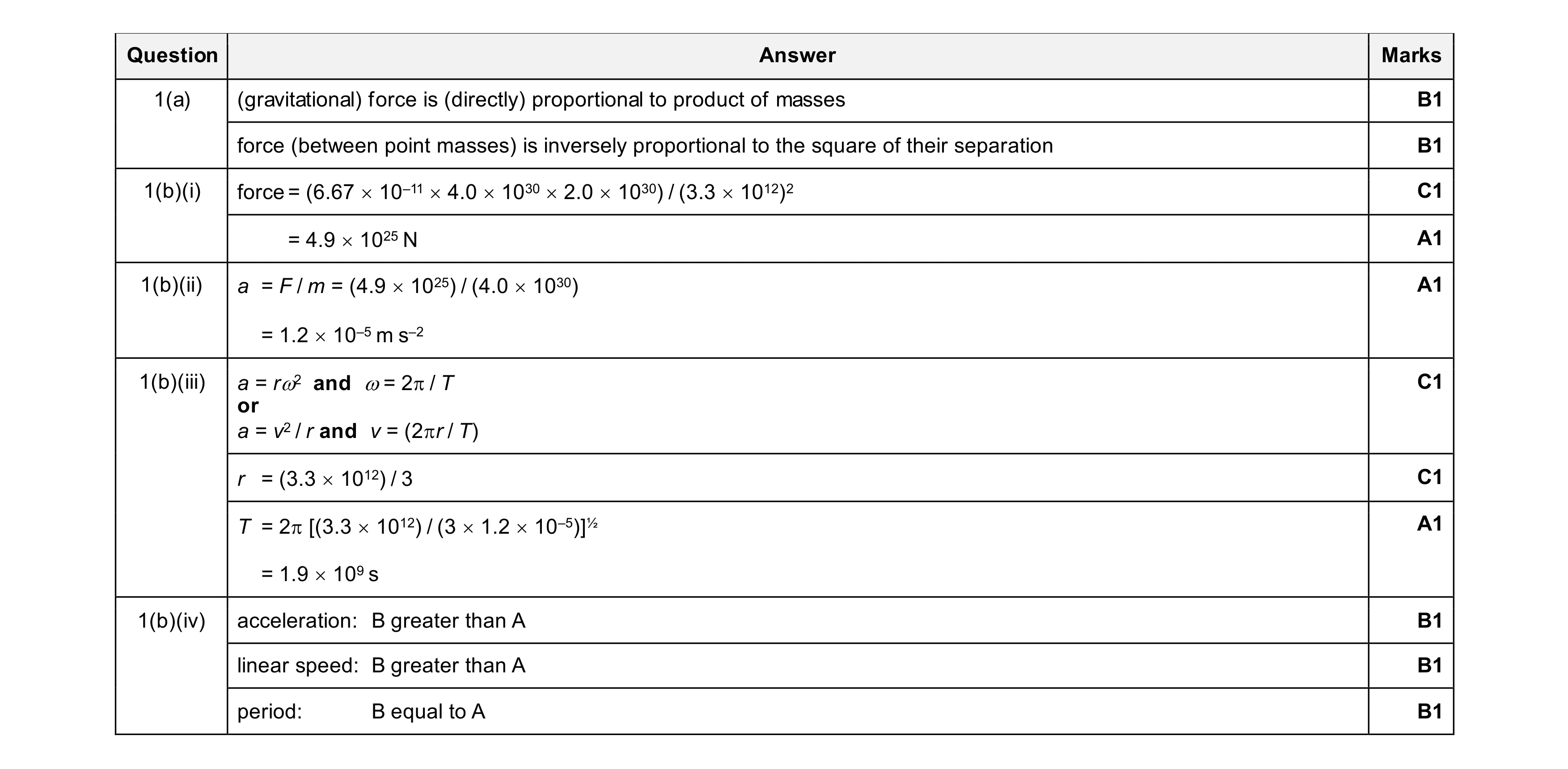 11
11