Cambridge A Level Physics 9702 — 2013 May/June Paper 2 · Variant 2
9702/22/M/J/13 · 7 questions · 60 marks · ≈68 min
The question paper and its mark scheme, free to read here and free to download. This is Cambridge’s own paper, exactly as it was sat.
Question paper16 pages
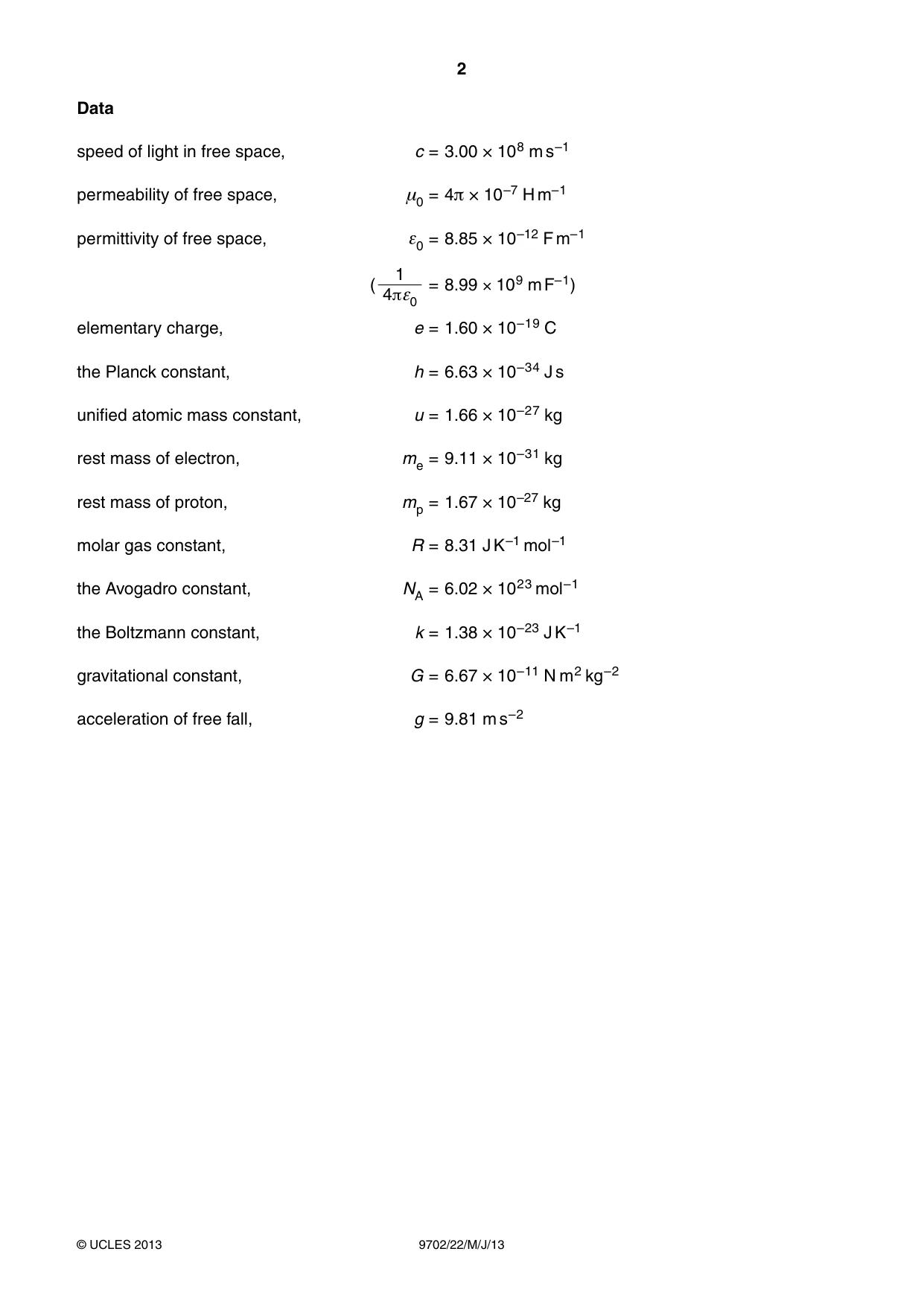
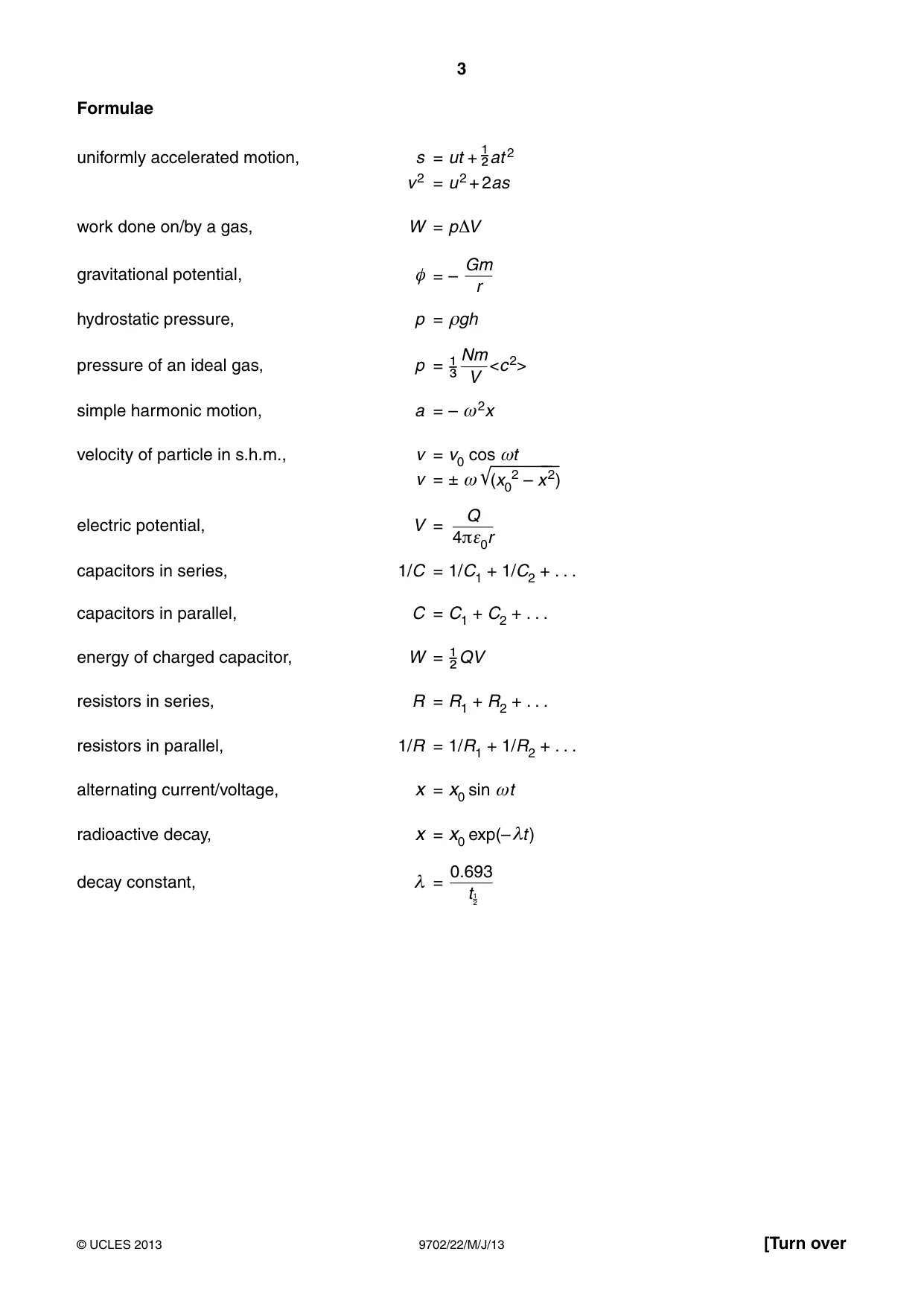
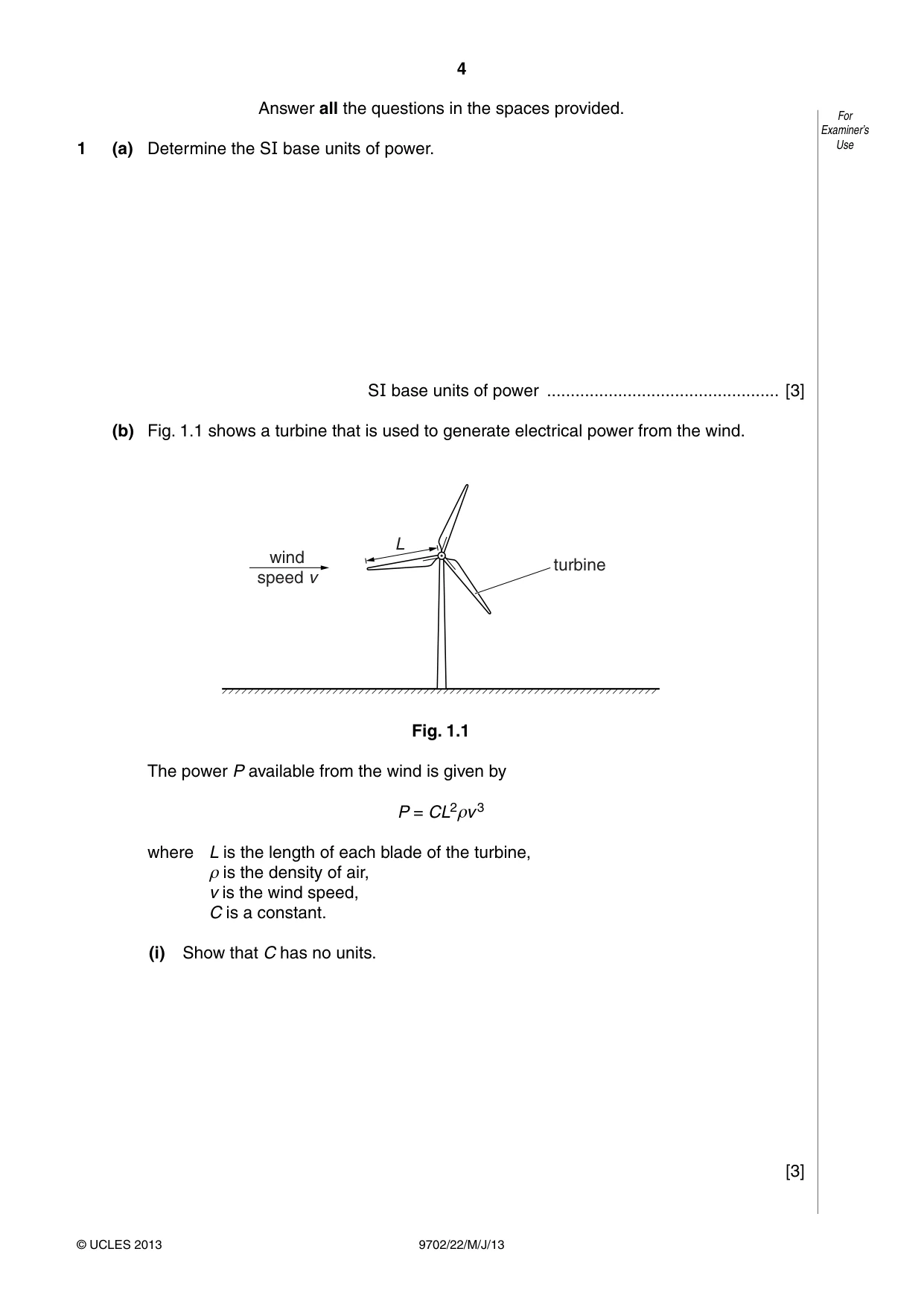

Mark scheme4 pages
Answers below. Sit the paper first if you are practising.
Questions as text
Q1 · Determine the SI base units of power
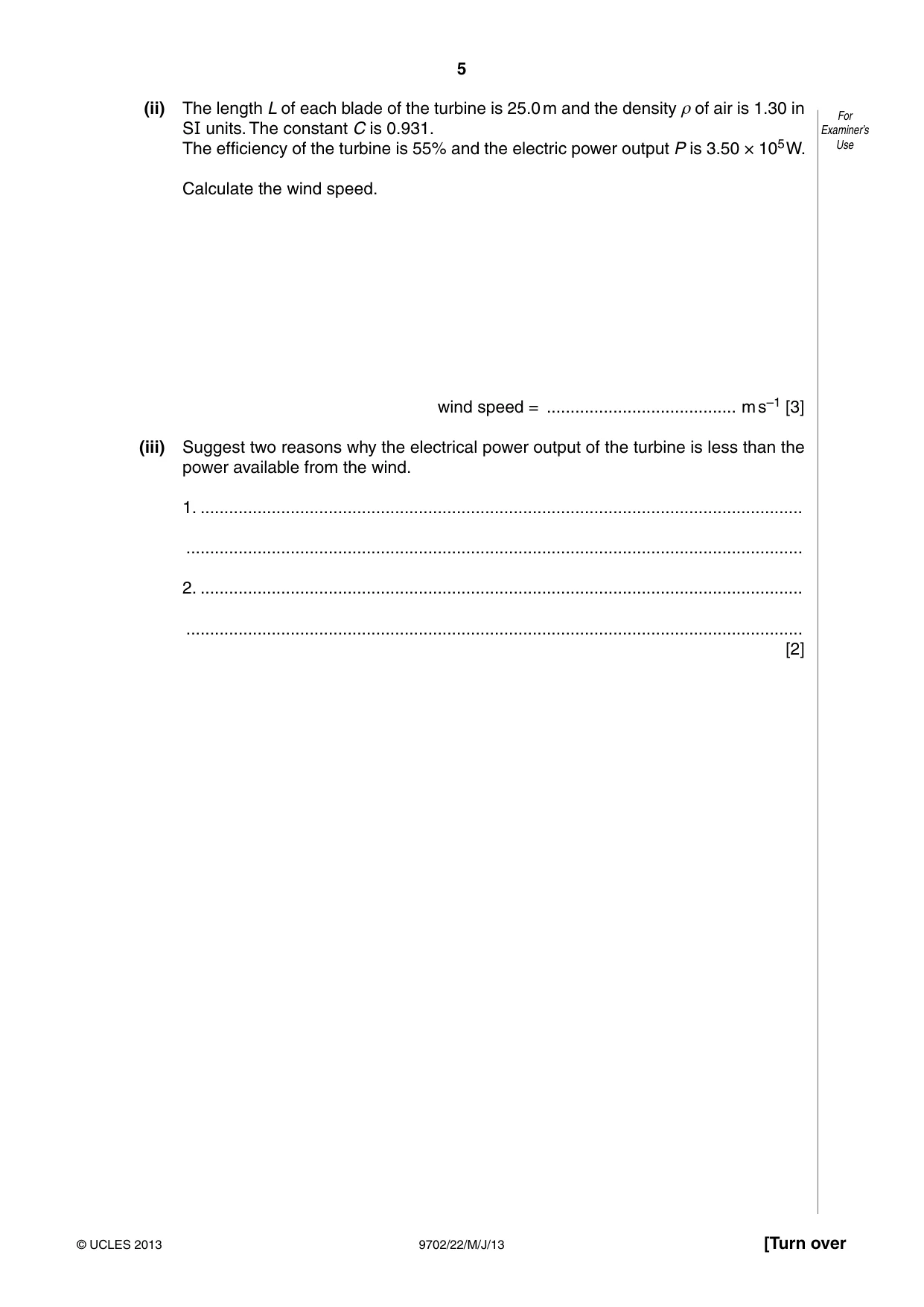
1 (a) Determine the SI base units of power. Use SI base units of power ................................................. [3] (b) Fig. 1.1 shows a turbine that is used to generate electrical power from the wind. L wind turbine speed v Fig. 1.1 The power P available from the wind is given by P = CL2ρv 3 where L is the length of each blade of the turbine, ρ is the density of air, v is the wind speed, C is a constant. (i) Show that C has no units. [3] (ii) The length L of each blade of the turbine is 25.0 m and the density ρ of air is 1.30 in For SI units. The constant C is 0.931. Examiner’s The efficiency of the turbine is 55% and the electric power output P is 3.50 × 10⁵ W. Use Calculate the wind speed. wind speed = ........................................ m s–1 [3] (iii) Suggest two reasons why the electrical power output of the turbine is less than the power available from the wind. 1. ............................................................................................................................... .................................................................................................................................. 2. ............................................................................................................................... .................................................................................................................................. [2]
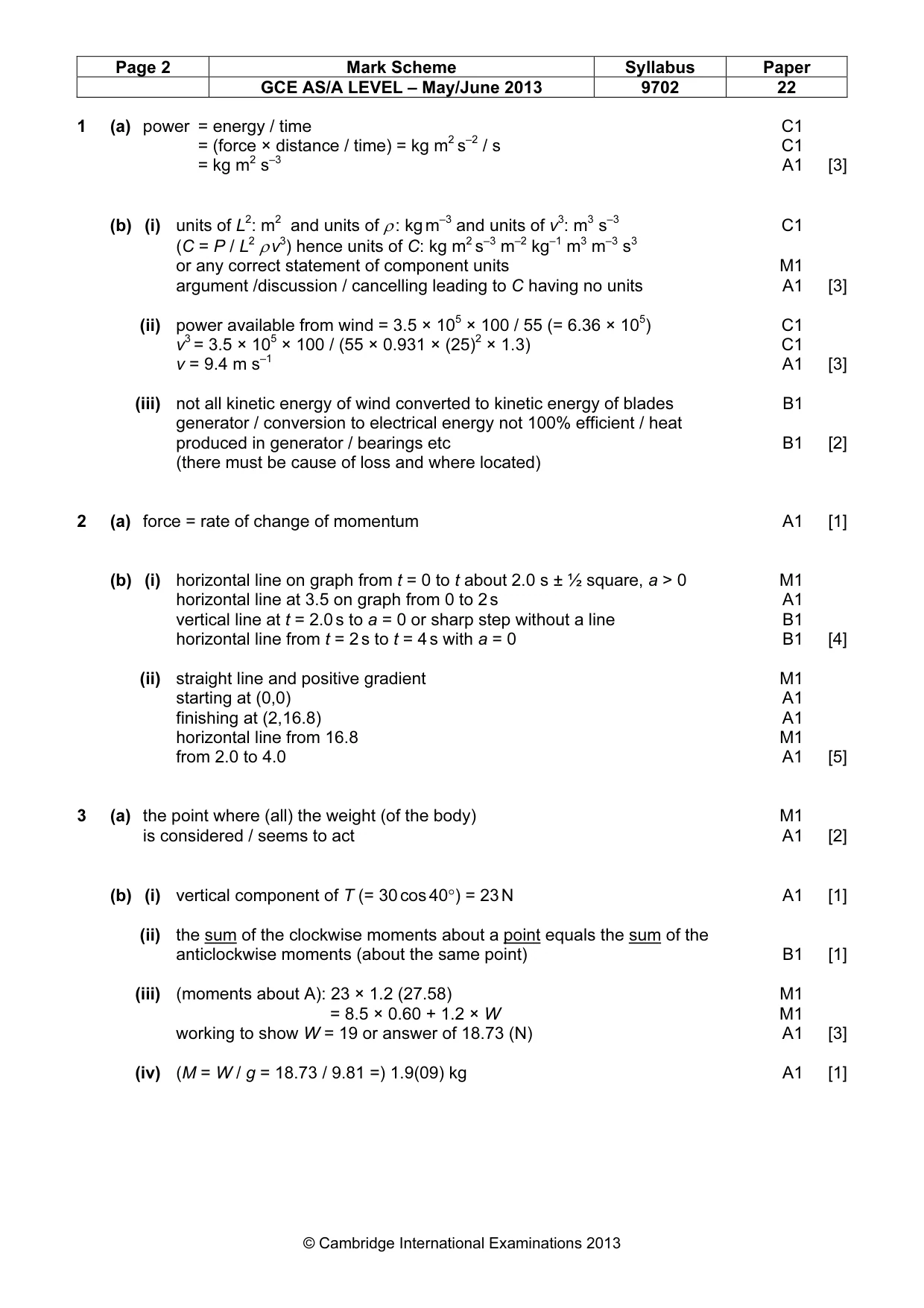
Mark scheme: 1 (a) power = energy / time C1 = (force × distance / time) = kg m2 s–2 / s C1 = kg m2 s–3 A1 [3] (b) (i) units of L2: m2 and units of ρ : kg m–3 and units of v3: m3 s–3 C1 (C = P / L2 ρ v3) hence units of C: kg m2 s–3 m–2 kg–1 m3 m–3 s3 or any correct statement of component units M1 argument /discussion / cancelling leading to C having no units A1 [3] (ii) power available from wind = 3.5 × 105 × 100 / 55 (= 6.36 × 10⁵) C1 v3 = 3.5 × 105 × 100 / (55 × 0.931 × (25)2 × 1.3) C1 v = 9.4 m s–1 A1 [3] (iii) not all kinetic energy of wind converted to kinetic energy of blades B1 generator / conversion to electrical energy not 100% efficient / heat produced in generator / bearings etc B1 [2] (there must be cause of loss and where located)
Question 2
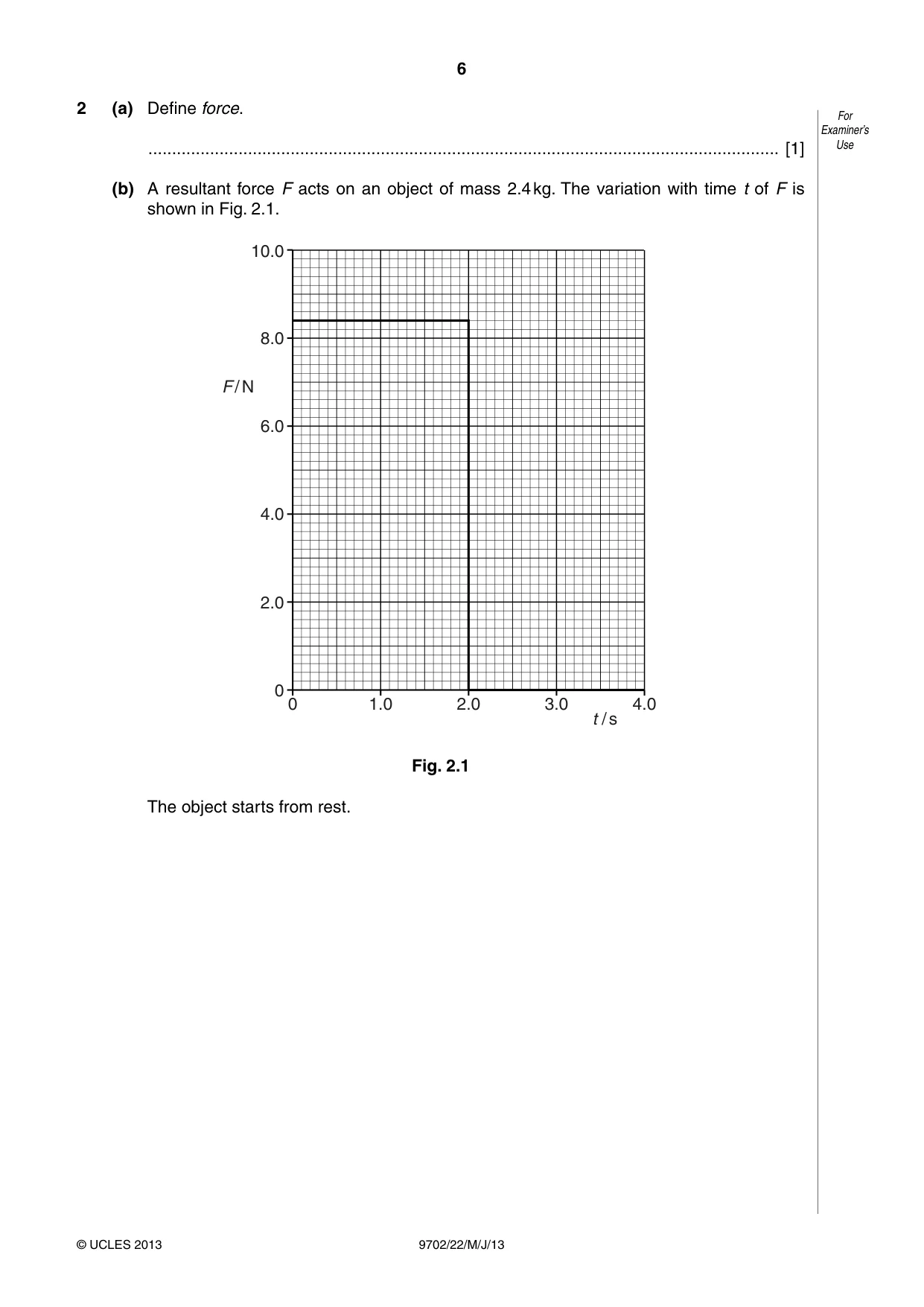
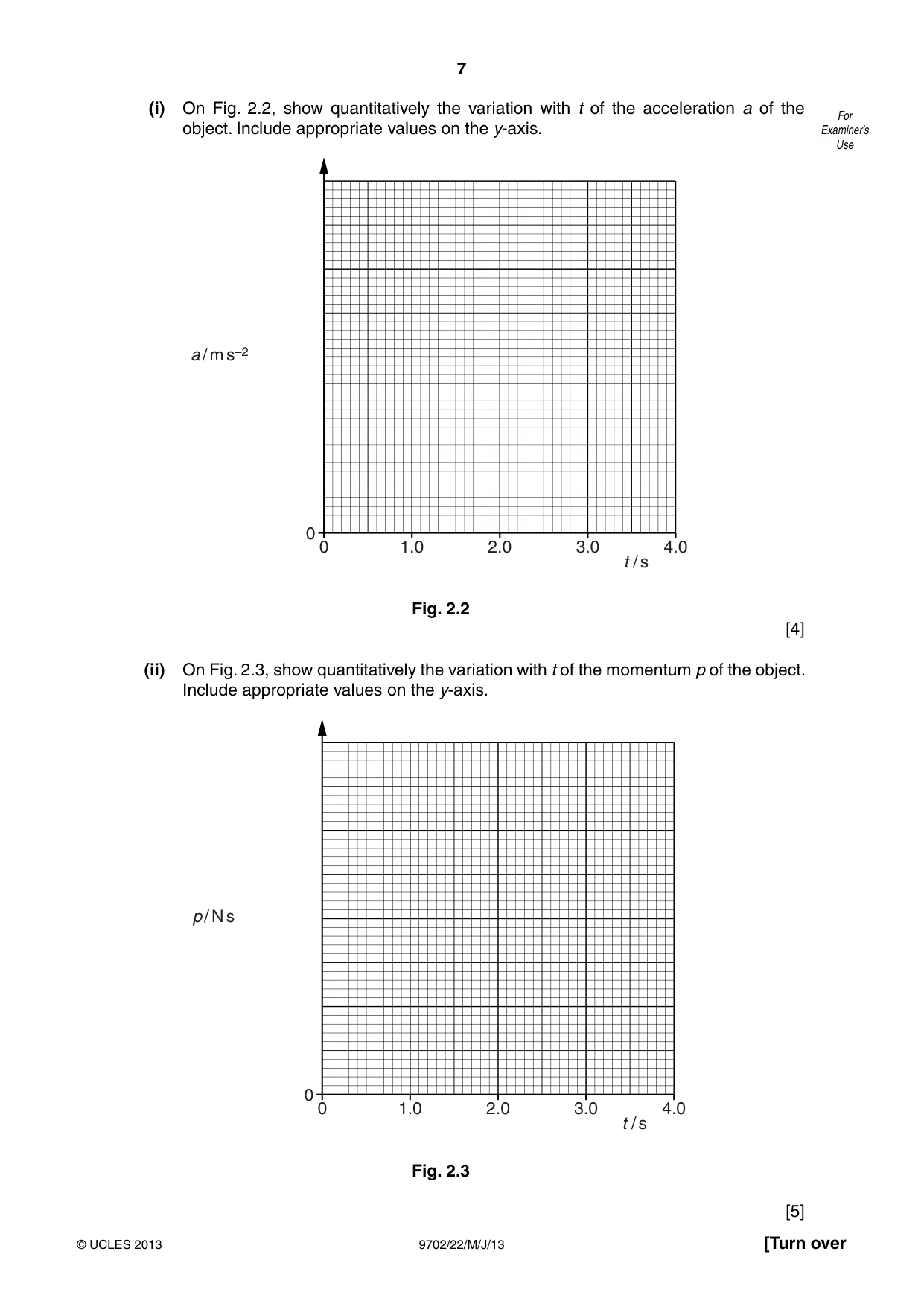
2 (a) Define force. For Examiner’s ..................................................................................................................................... [1] Use (b) A resultant force F acts on an object of mass 2.4 kg. The variation with time t of F is shown in Fig. 2.1. 10.0 8.0 F / N 6.0 4.0 2.0 0 0 1.0 2.0 3.0 4.0 t / s Fig. 2.1 The object starts from rest. (i) On Fig. 2.2, show quantitatively the variation with t of the acceleration a of the For object. Include appropriate values on the y-axis. Examiner’s Use a / m s–2 0 0 1.0 2.0 3.0 4.0 t / s Fig. 2.2 [4] (ii) On Fig. 2.3, show quantitatively the variation with t of the momentum p of the object. Include appropriate values on the y-axis. p / N s 0 0 1.0 2.0 3.0 4.0 t / s Fig. 2.3 [5]
Mark scheme: 2 (a) force = rate of change of momentum A1 [1] (b) (i) horizontal line on graph from t = 0 to t about 2.0 s ± ½ square, a > 0 M1 horizontal line at 3.5 on graph from 0 to 2 s A1 vertical line at t = 2.0 s to a = 0 or sharp step without a line B1 horizontal line from t = 2 s to t = 4 s with a = 0 B1 [4] (ii) straight line and positive gradient M1 starting at (0,0) A1 finishing at (2,16.8) A1 horizontal line from 16.8 M1 from 2.0 to 4.0 A1 [5]
Q3 · Define centre of gravity
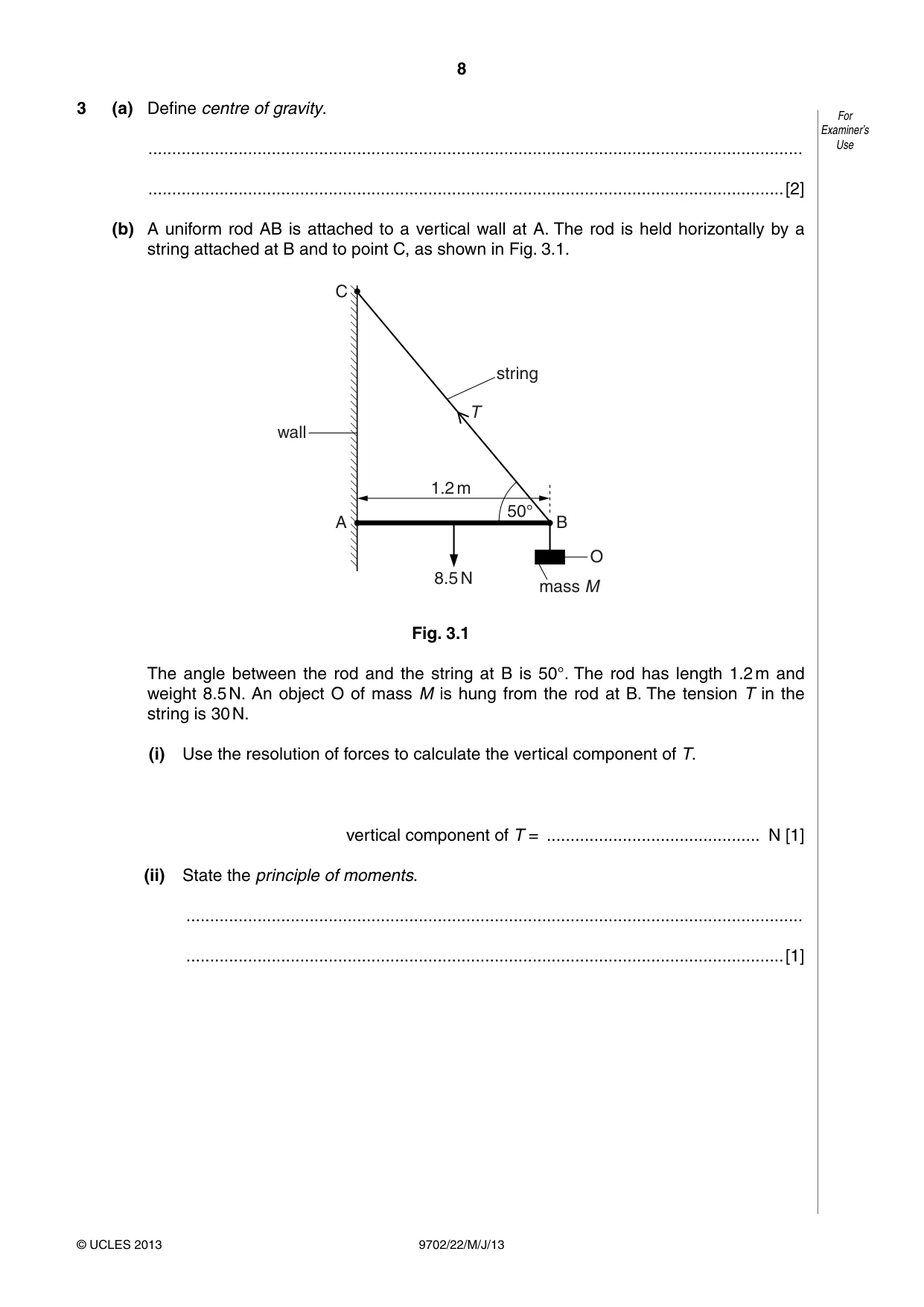
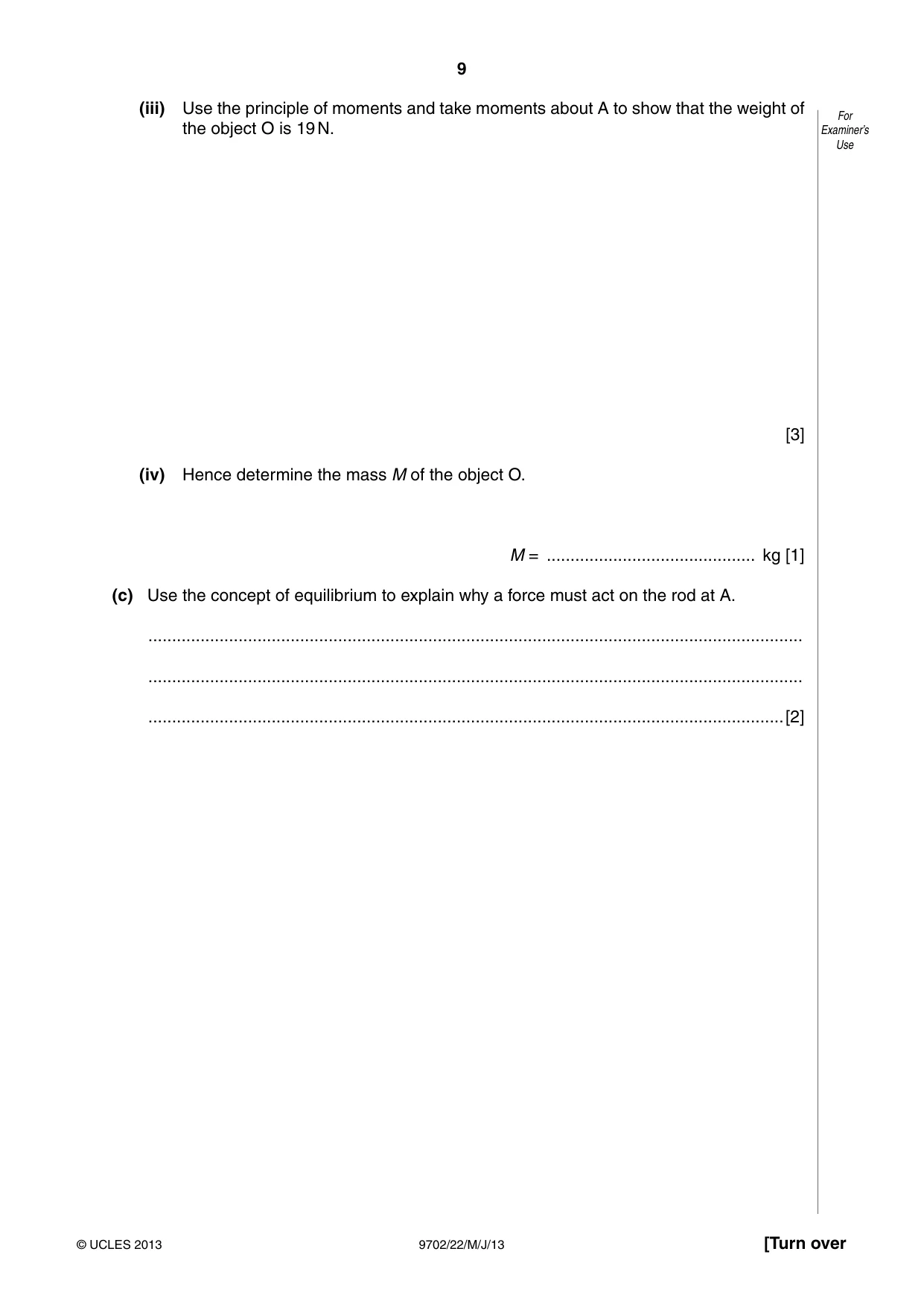
3 (a) Define centre of gravity. For Examiner’s .......................................................................................................................................... Use ......................................................................................................................................[2] (b) A uniform rod AB is attached to a vertical wall at A. The rod is held horizontally by a string attached at B and to point C, as shown in Fig. 3.1. C string T wall 1.2 m 50° A B O 8.5 N mass M Fig. 3.1 The angle between the rod and the string at B is 50°. The rod has length 1.2 m and weight 8.5 N. An object O of mass M is hung from the rod at B. The tension T in the string is 30 N. (i) Use the resolution of forces to calculate the vertical component of T. vertical component of T = ............................................. N [1] (ii) State the principle of moments. .................................................................................................................................. ..............................................................................................................................[1] (iii) Use the principle of moments and take moments about A to show that the weight of For the object O is 19 N. Examiner’s Use [3] (iv) Hence determine the mass M of the object O. M = ............................................ kg [1] (c) Use the concept of equilibrium to explain why a force must act on the rod at A. .......................................................................................................................................... .......................................................................................................................................... ......................................................................................................................................[2]
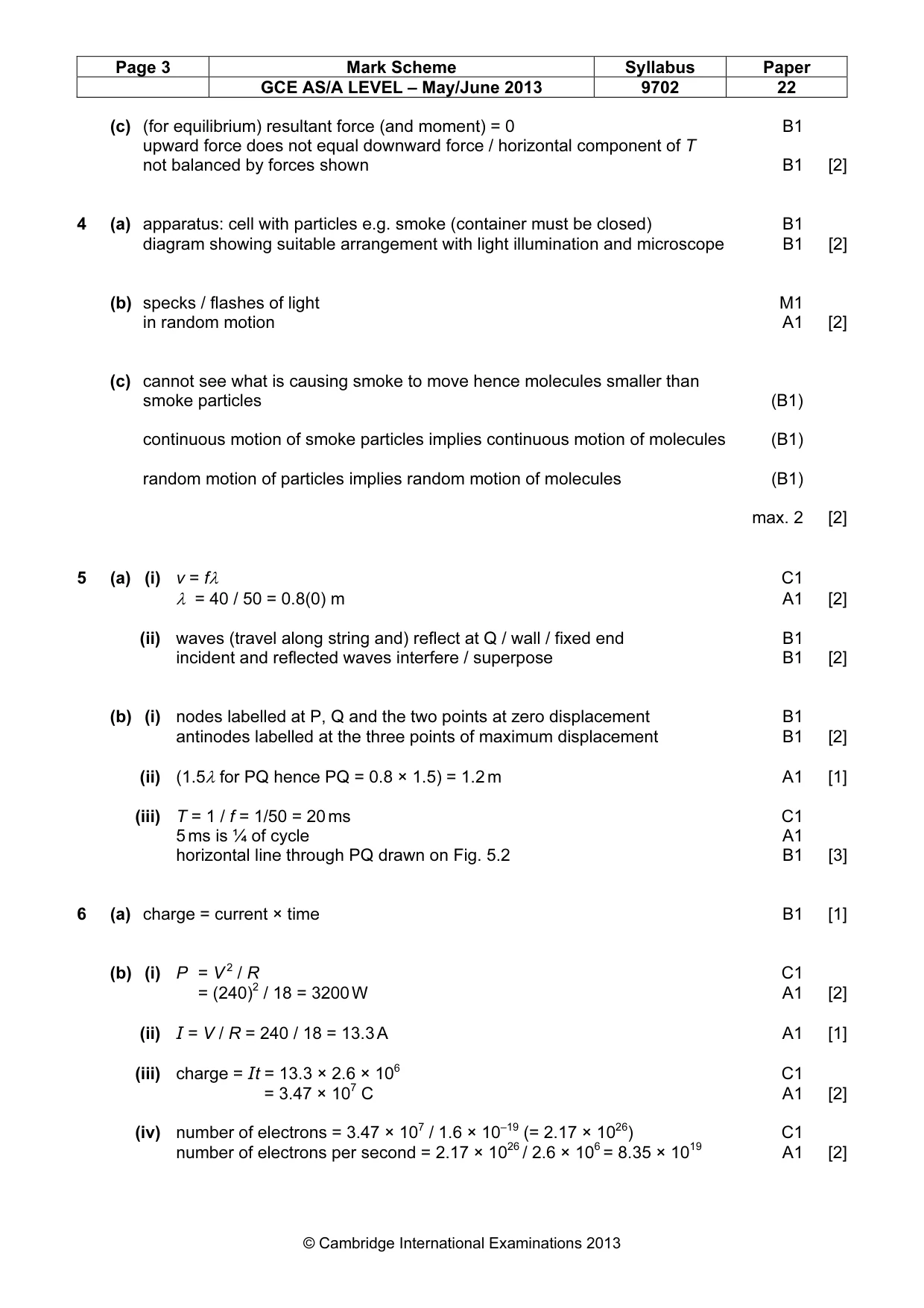
Mark scheme: 3 (a) the point where (all) the weight (of the body) M1 is considered / seems to act A1 [2] (b) (i) vertical component of T (= 30 cos 40°) = 23 N A1 [1] (ii) the sum of the clockwise moments about a point equals the sum of the anticlockwise moments (about the same point) B1 [1] (iii) (moments about A): 23 × 1.2 (27.58) M1 = 8.5 × 0.60 + 1.2 × W M1 working to show W = 19 or answer of 18.73 (N) A1 [3] (iv) (M = W / g = 18.73 / 9.81 =) 1.9(09) kg A1 [1] GCE AS/A LEVEL – May/June 2013 9702 22 (c) (for equilibrium) resultant force (and moment) = 0 B1 upward force does not equal downward force / horizontal component of T not balanced by forces shown B1 [2]
Q4 · Describe apparatus that demonstrates Brownian motion
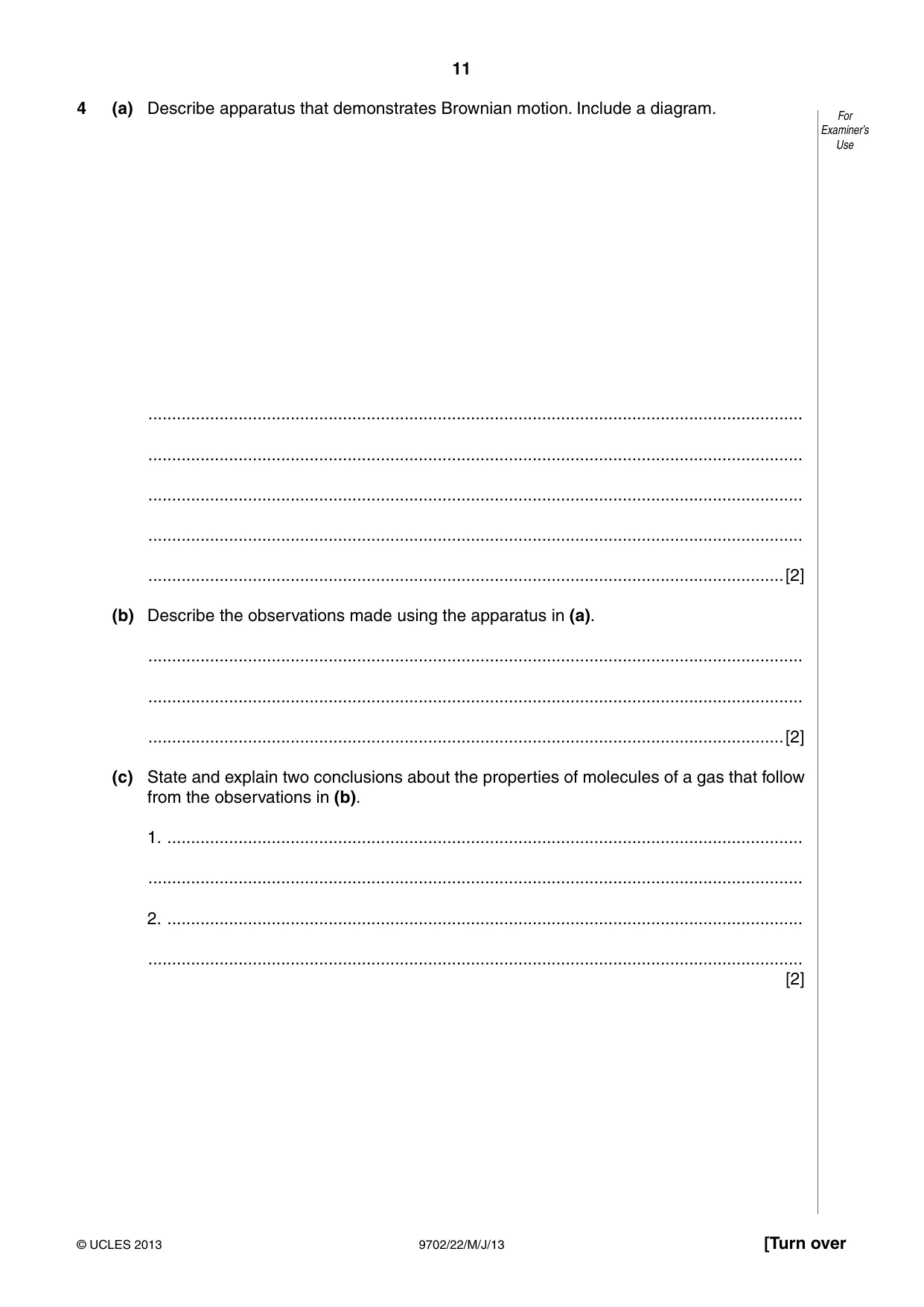
4 (a) Describe apparatus that demonstrates Brownian motion. Include a diagram. For Examiner’s Use .......................................................................................................................................... .......................................................................................................................................... .......................................................................................................................................... .......................................................................................................................................... ......................................................................................................................................[2] (b) Describe the observations made using the apparatus in (a). .......................................................................................................................................... .......................................................................................................................................... ......................................................................................................................................[2] (c) State and explain two conclusions about the properties of molecules of a gas that follow from the observations in (b). 1. ...................................................................................................................................... .......................................................................................................................................... 2. ...................................................................................................................................... .......................................................................................................................................... [2]
Mark scheme: 4 (a) apparatus: cell with particles e.g. smoke (container must be closed) B1 diagram showing suitable arrangement with light illumination and microscope B1 [2] (b) specks / flashes of light M1 in random motion A1 [2] (c) cannot see what is causing smoke to move hence molecules smaller than smoke particles (B1) continuous motion of smoke particles implies continuous motion of molecules (B1) random motion of particles implies random motion of molecules (B1) max. 2 [2]
Q5 · A string stretched between two fixed points P and Q
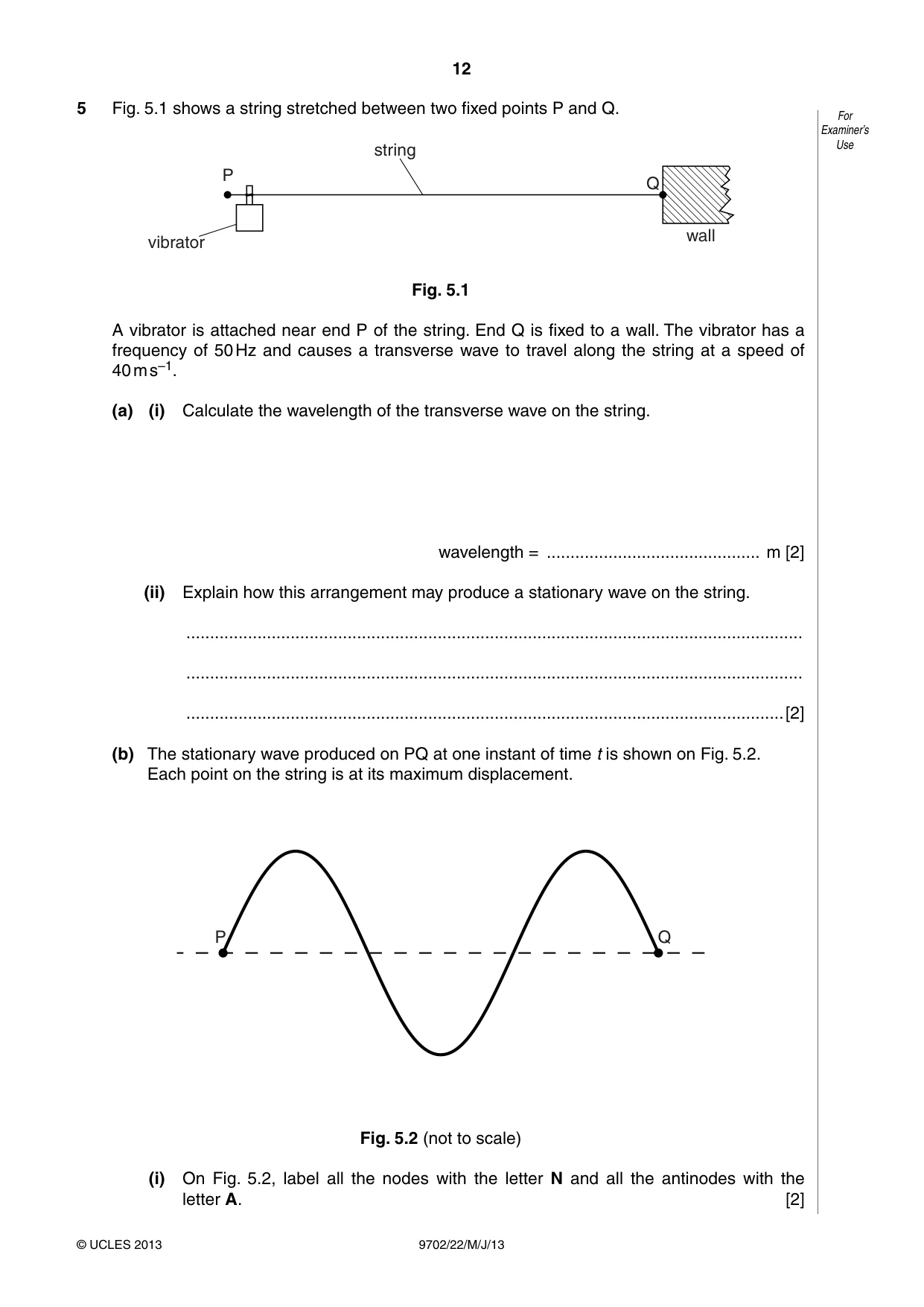
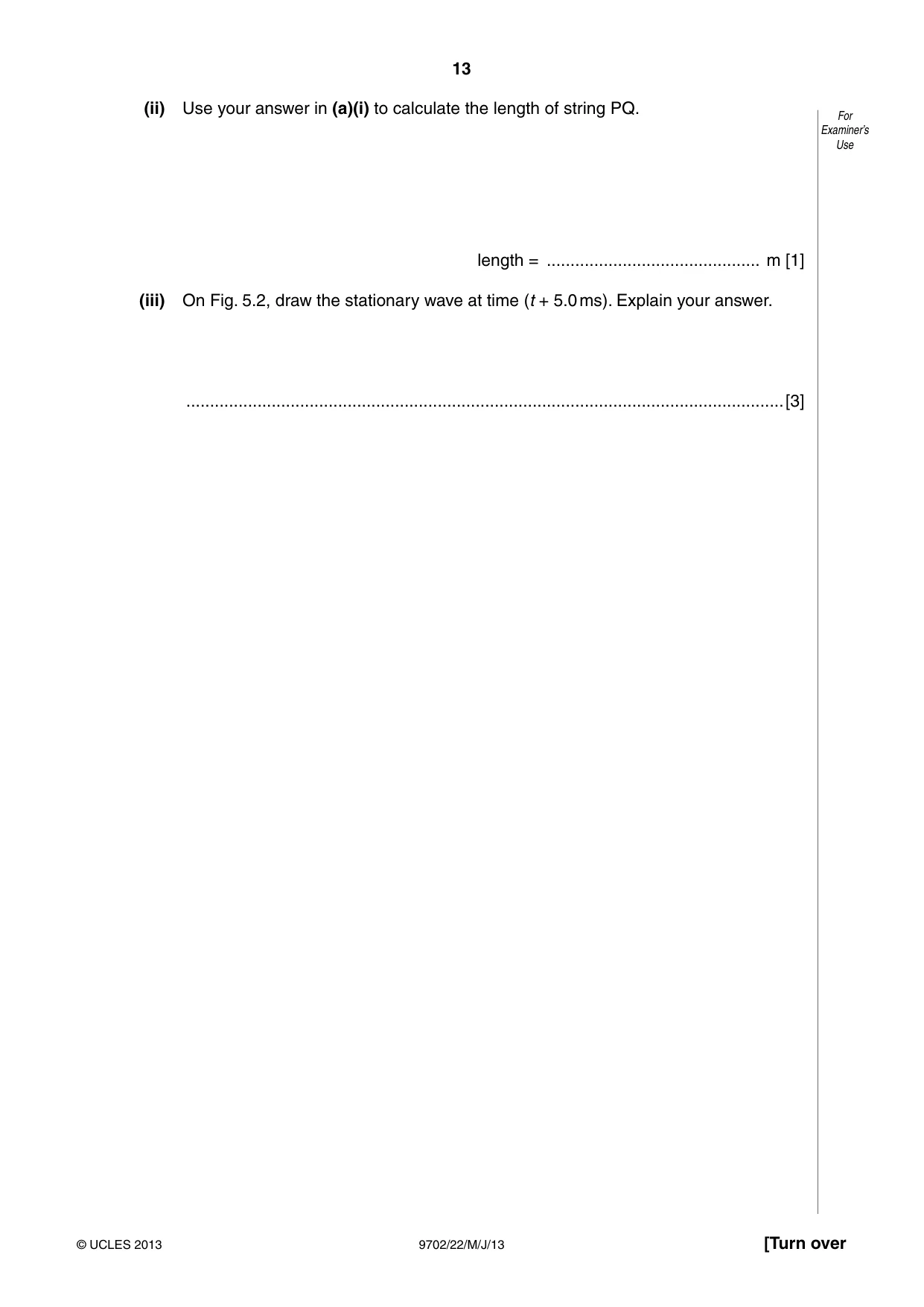
5 Fig. 5.1 shows a string stretched between two fixed points P and Q. For Examiner’s string Use P Q wall vibrator Fig. 5.1 A vibrator is attached near end P of the string. End Q is fixed to a wall. The vibrator has a frequency of 50 Hz and causes a transverse wave to travel along the string at a speed of 40 m s–1. (a) (i) Calculate the wavelength of the transverse wave on the string. wavelength = ............................................. m [2] (ii) Explain how this arrangement may produce a stationary wave on the string. .................................................................................................................................. .................................................................................................................................. ..............................................................................................................................[2] (b) The stationary wave produced on PQ at one instant of time t is shown on Fig. 5.2. Each point on the string is at its maximum displacement. P Q Fig. 5.2 (not to scale) (i) On Fig. 5.2, label all the nodes with the letter N and all the antinodes with the letter A. [2] (ii) Use your answer in (a)(i) to calculate the length of string PQ. For Examiner’s Use length = ............................................. m [1] (iii) On Fig. 5.2, draw the stationary wave at time (t + 5.0 ms). Explain your answer. ..............................................................................................................................[3]
Mark scheme: 5 (a) (i) v = fλ C1 λ = 40 / 50 = 0.8(0) m A1 [2] (ii) waves (travel along string and) reflect at Q / wall / fixed end B1 incident and reflected waves interfere / superpose B1 [2] (b) (i) nodes labelled at P, Q and the two points at zero displacement B1 antinodes labelled at the three points of maximum displacement B1 [2] (ii) (1.5λ for PQ hence PQ = 0.8 × 1.5) = 1.2 m A1 [1] (iii) T = 1 / f = 1/50 = 20 ms C1 5 ms is ¼ of cycle A1 horizontal line through PQ drawn on Fig. 5.2 B1 [3]
Question 6
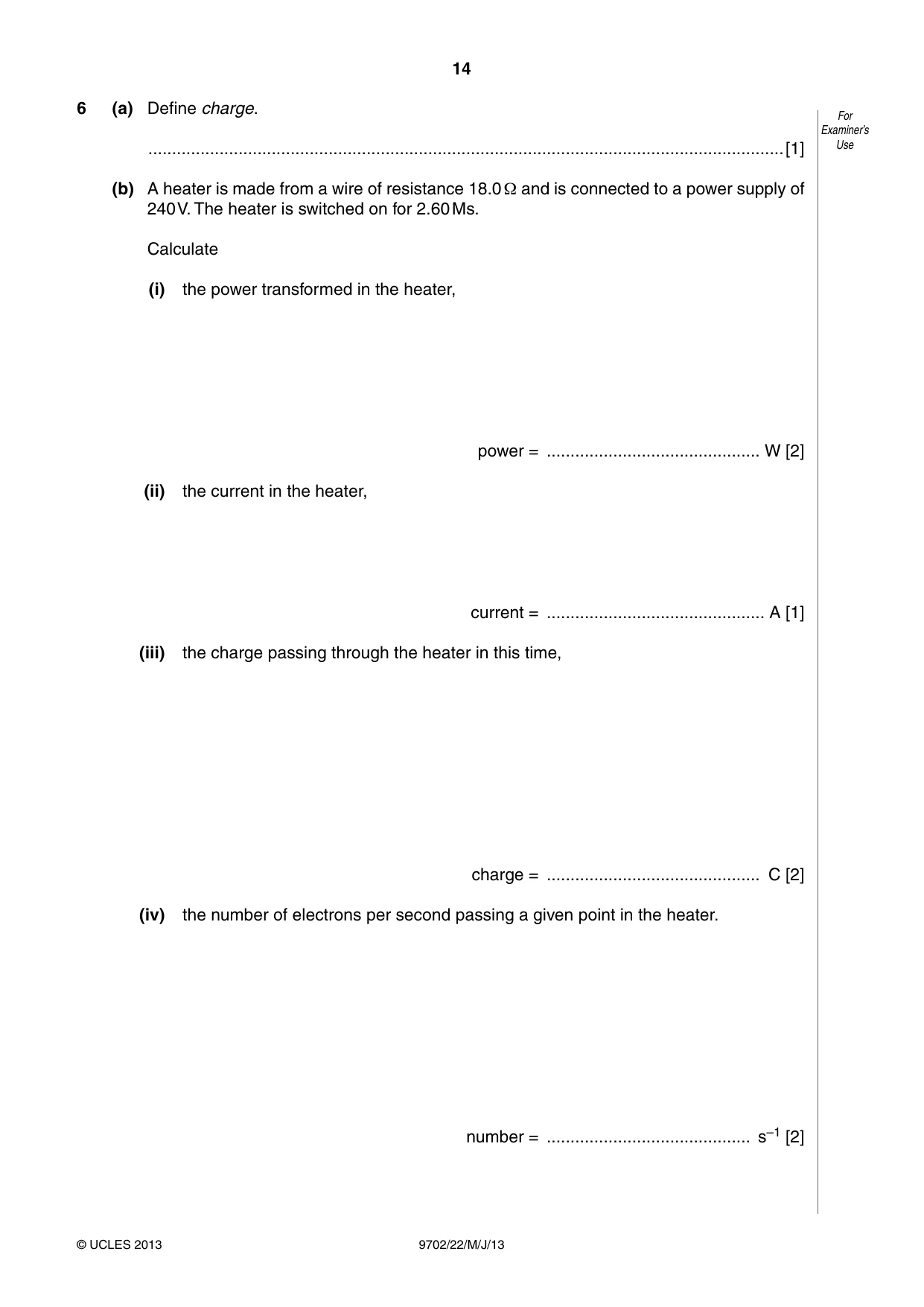
6 (a) Define charge. For Examiner’s ......................................................................................................................................[1] Use (b) A heater is made from a wire of resistance 18.0 Ω and is connected to a power supply of 240 V. The heater is switched on for 2.60 Ms. Calculate (i) the power transformed in the heater, power = ............................................. W [2] (ii) the current in the heater, current = .............................................. A [1] (iii) the charge passing through the heater in this time, charge = ............................................. C [2] (iv) the number of electrons per second passing a given point in the heater. number = ........................................... s–1 [2]
Mark scheme: 6 (a) charge = current × time B1 [1] (b) (i) P = V 2 / R C1 = (240)2 / 18 = 3200 W A1 [2] (ii) I = V / R = 240 / 18 = 13.3 A A1 [1] (iii) charge = It = 13.3 × 2.6 × 106 C1 = 3.47 × 10⁷ C A1 [2] (iv) number of electrons = 3.47 × 10⁷ / 1.6 × 10⁻¹⁹ (= 2.17 × 1026) C1 number of electrons per second = 2.17 × 1026 / 2.6 × 106 = 8.35 × 10¹⁹ A1 [2] GCE AS/A LEVEL – May/June 2013 9702 22
Q7 · 0 7 A polonium nucleus 84Po is radioactive and decays with the emission of an α-particle
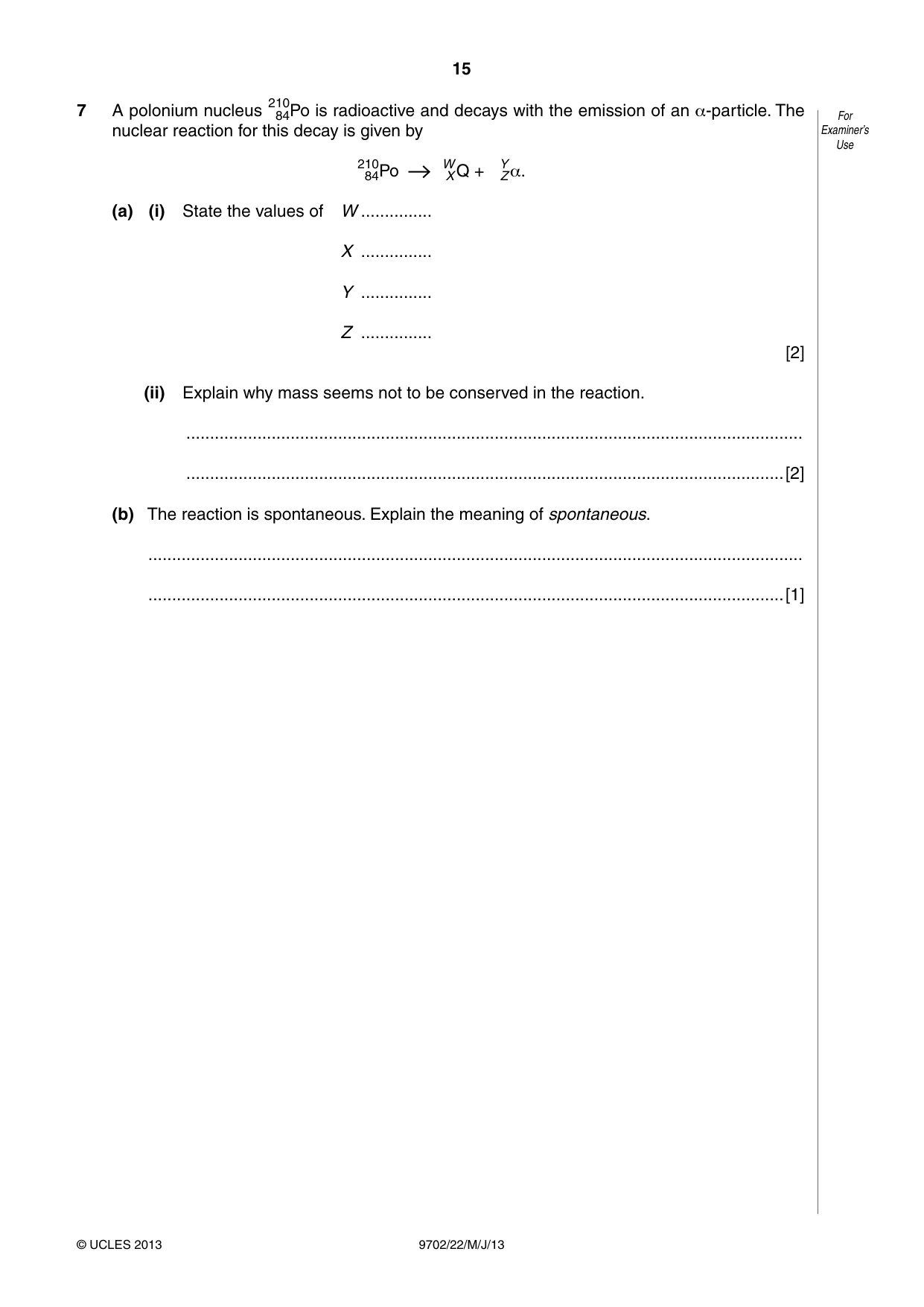
210 7 A polonium nucleus 84Po is radioactive and decays with the emission of an α-particle. The For nuclear reaction for this decay is given by Examiner’s Use 210 W Y 84Po X Q + Z α. (a) (i) State the values of W ............... X ............... Y ............... Z ............... [2] (ii) Explain why mass seems not to be conserved in the reaction. .................................................................................................................................. ..............................................................................................................................[2] (b) The reaction is spontaneous. Explain the meaning of spontaneous. .......................................................................................................................................... ......................................................................................................................................[1]
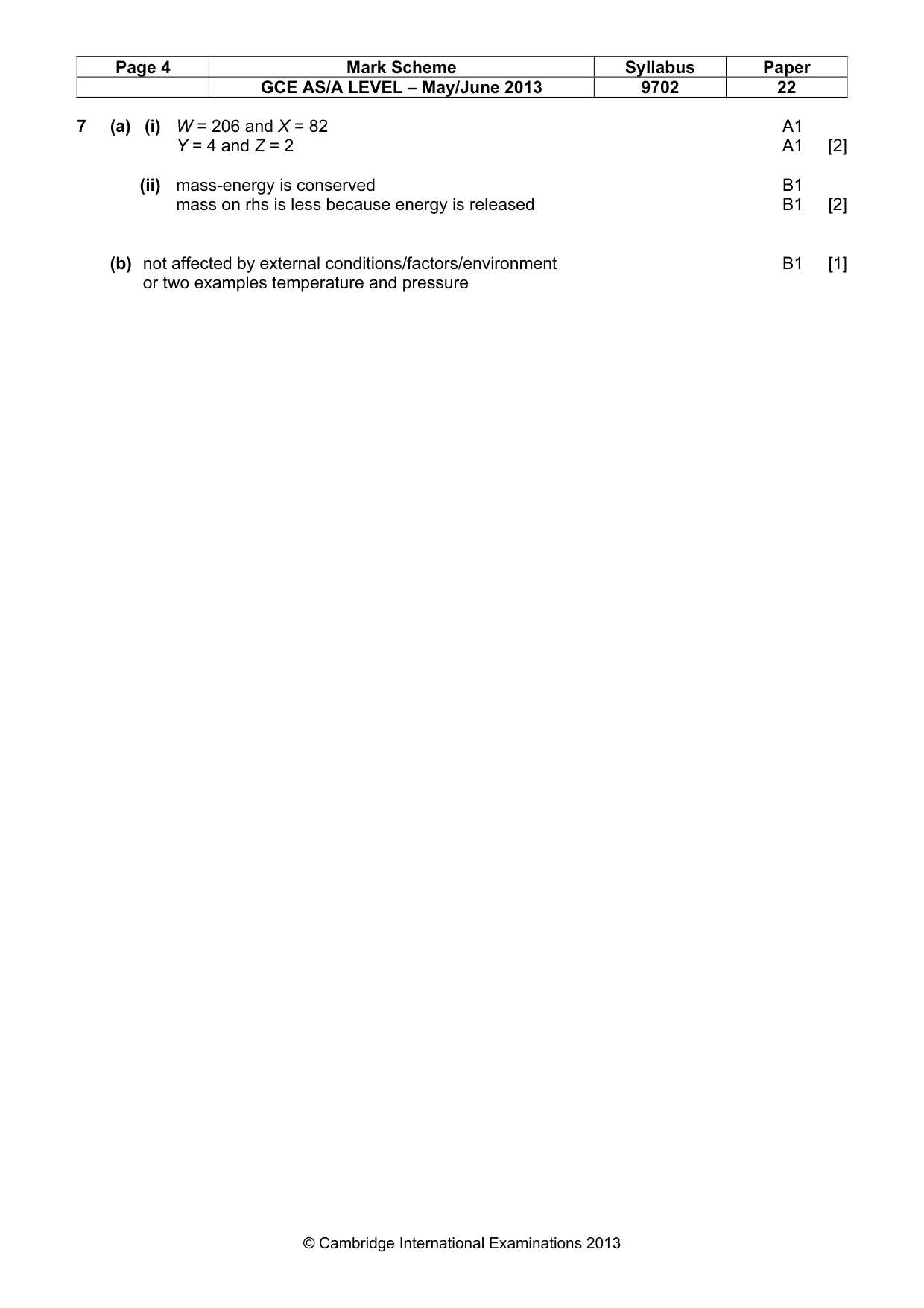
Mark scheme: 7 (a) (i) W = 206 and X = 82 A1 Y = 4 and Z = 2 A1 [2] (ii) mass-energy is conserved B1 mass on rhs is less because energy is released B1 [2] (b) not affected by external conditions/factors/environment B1 [1] or two examples temperature and pressure
What was in this paper
The subtopics covered by these 7 questions, and how many questions each got. Open one in a new tab to see every Cambridge question on it.
What you needed in this session
Cambridge’s own grade thresholds for 2013 May/June, Paper 2 · Variant 2. A higher threshold means an easier paper — the bar moves with how the cohort did.