Cambridge A Level Mathematics 9709 — 2014 Oct/Nov Paper 3 · Variant 2
9709/32/O/N/14 · 6 questions · 75 marks · ≈84 min
The question paper and its mark scheme, free to read here and free to download. This is Cambridge’s own paper, exactly as it was sat.
Question paper4 pages
Mark scheme7 pages
Answers below. Sit the paper first if you are practising.
Questions as text
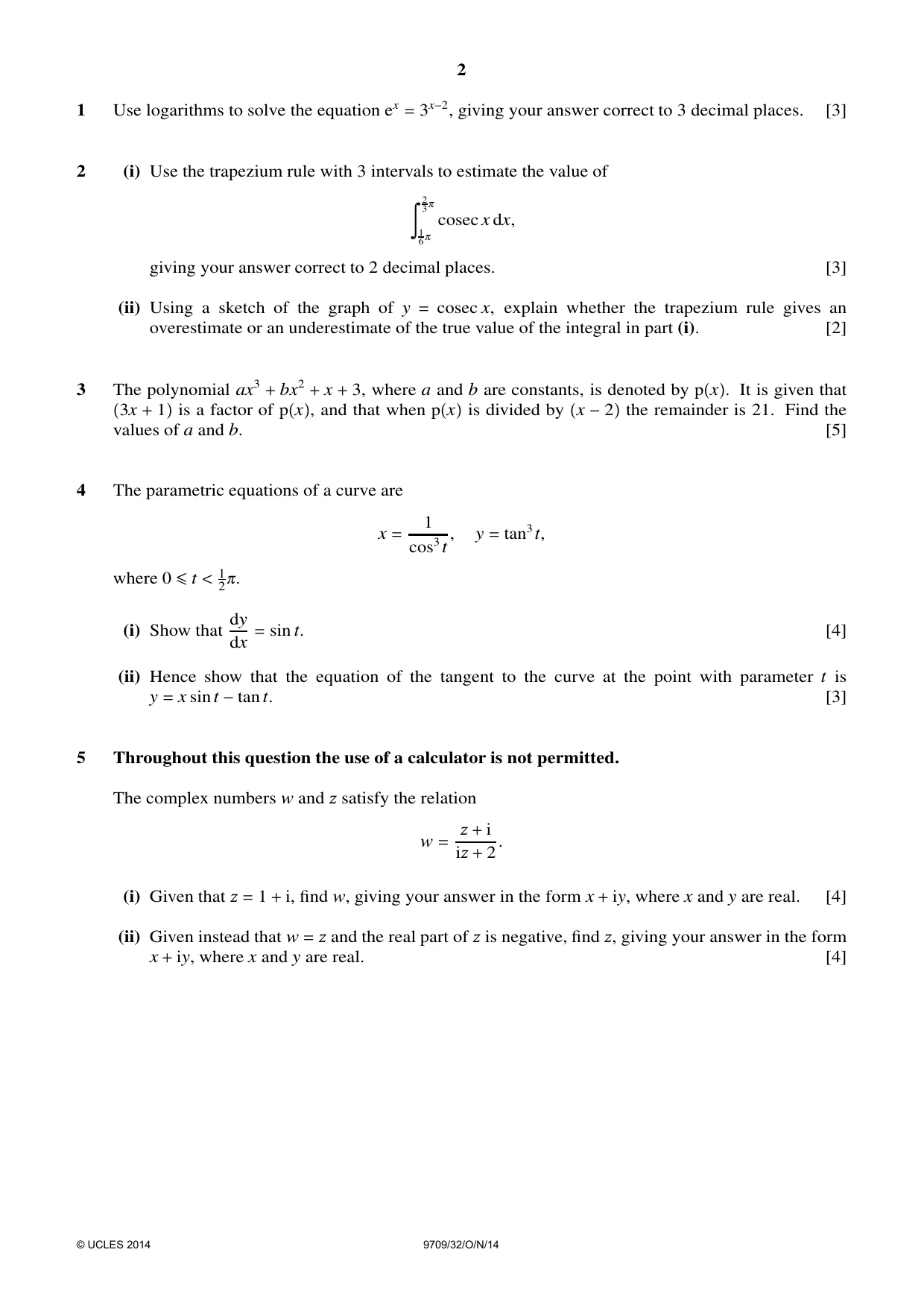
Q1 · Use logarithms to solve the equation ex giving your answer correct to 3 decimal places
1 Use logarithms to solve the equation ex giving your answer correct to 3 decimal places. [3] = 3x−2,
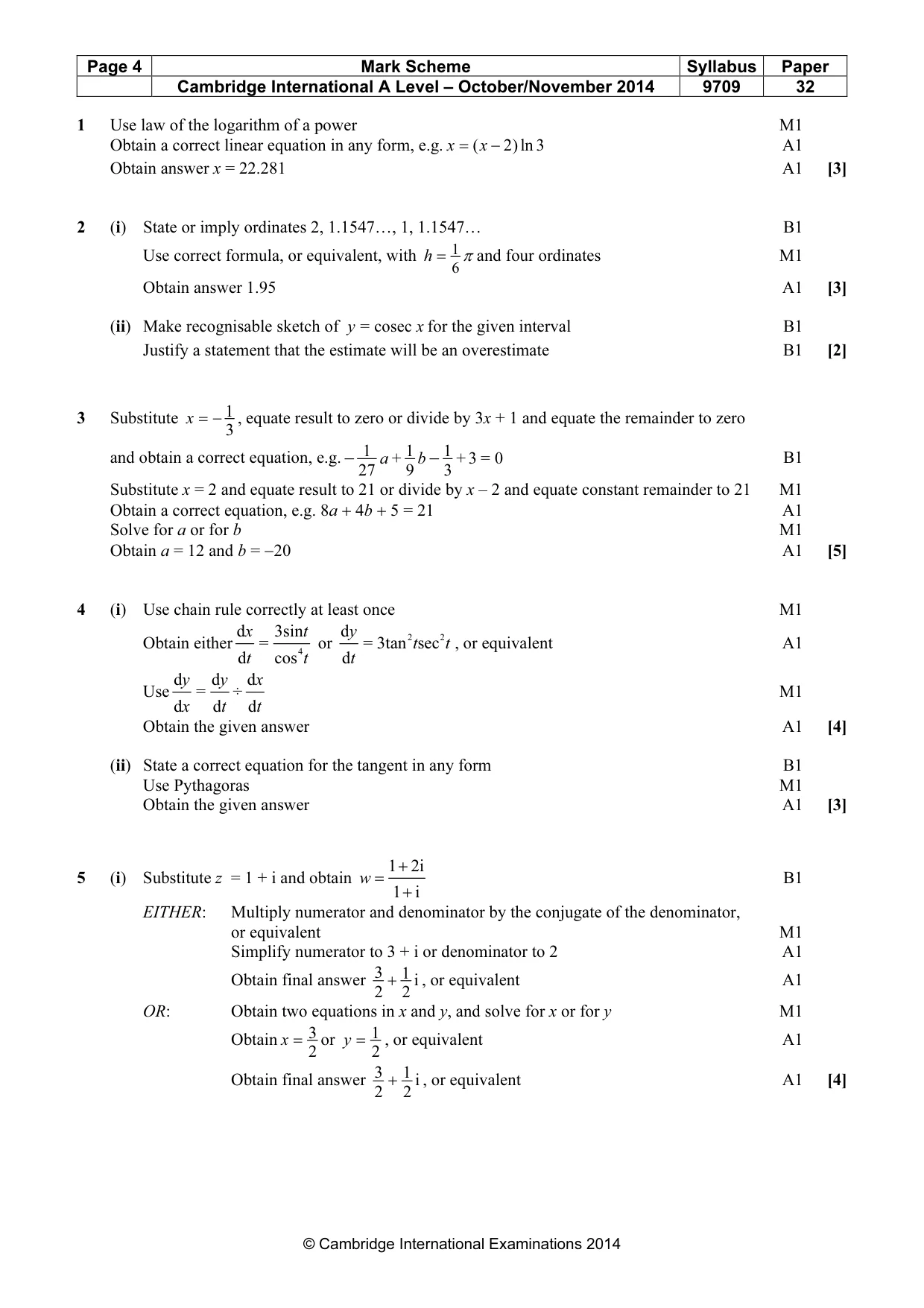
Mark scheme: 1 Use law of the logarithm of a power M1 Obtain a correct linear equation in any form, e.g. x = ( x − 2)ln 3 A1 Obtain answer x = 22.281 A1 [3]
Q2 · Use the trapezium rule with 3 intervals to estimate the value of 230 cosecx dx, Ó 1 60…
2 (i) Use the trapezium rule with 3 intervals to estimate the value of 230 cosecx dx, Ó 1 60 giving your answer correct to 2 decimal places. [3] (ii) Using a sketch of the graph of y cosec x, explain whether the trapezium rule gives an = overestimate or an underestimate of the true value of the integral in part (i). [2]
Mark scheme: 2 (i) State or imply ordinates 2, 1.1547…, 1, 1.1547… B1 1 Use correct formula, or equivalent, with h = π and four ordinates M1 6 Obtain answer 1.95 A1 [3] (ii) Make recognisable sketch of y = cosec x for the given interval B1 Justify a statement that the estimate will be an overestimate B1 [2] 1
Q4 · The parametric equations of a curve are 1 x , y tan3t, = cos3t = where 0 1 ≤t < 20
4 The parametric equations of a curve are 1 x , y tan3t, = cos3t = where 0 1 ≤t < 20. dy (i) Show that sin t. [4] dx = (ii) Hence show that the equation of the tangent to the curve at the point with parameter t is y x sint t. [3] = −tan
Mark scheme: 4 (i) Use chain rule correctly at least once M1 dx 3sint dy 2 2 Obtain either = 4 or = 3tan t sec t , or equivalent A1 d t cos t dt dy dy dx Use = ÷ M1 dx dt dt Obtain the given answer A1 [4] (ii) State a correct equation for the tangent in any form B1 Use Pythagoras M1 Obtain the given answer A1 [3] 1 + 2i
Q5 · Throughout this question the use of a calculator is not permitted
5 Throughout this question the use of a calculator is not permitted. The complex numbers w and satisfy the relation Ï i w Ï + = 2. iÏ + (i) Given that 1 i, find w, giving your answer in the form x iy, where x and y are real. [4] Ï = + + (ii) Given instead that w and the real part of is negative, find giving your answer in the form = Ï Ï Ï, x iy, where x and y are real. [4] +
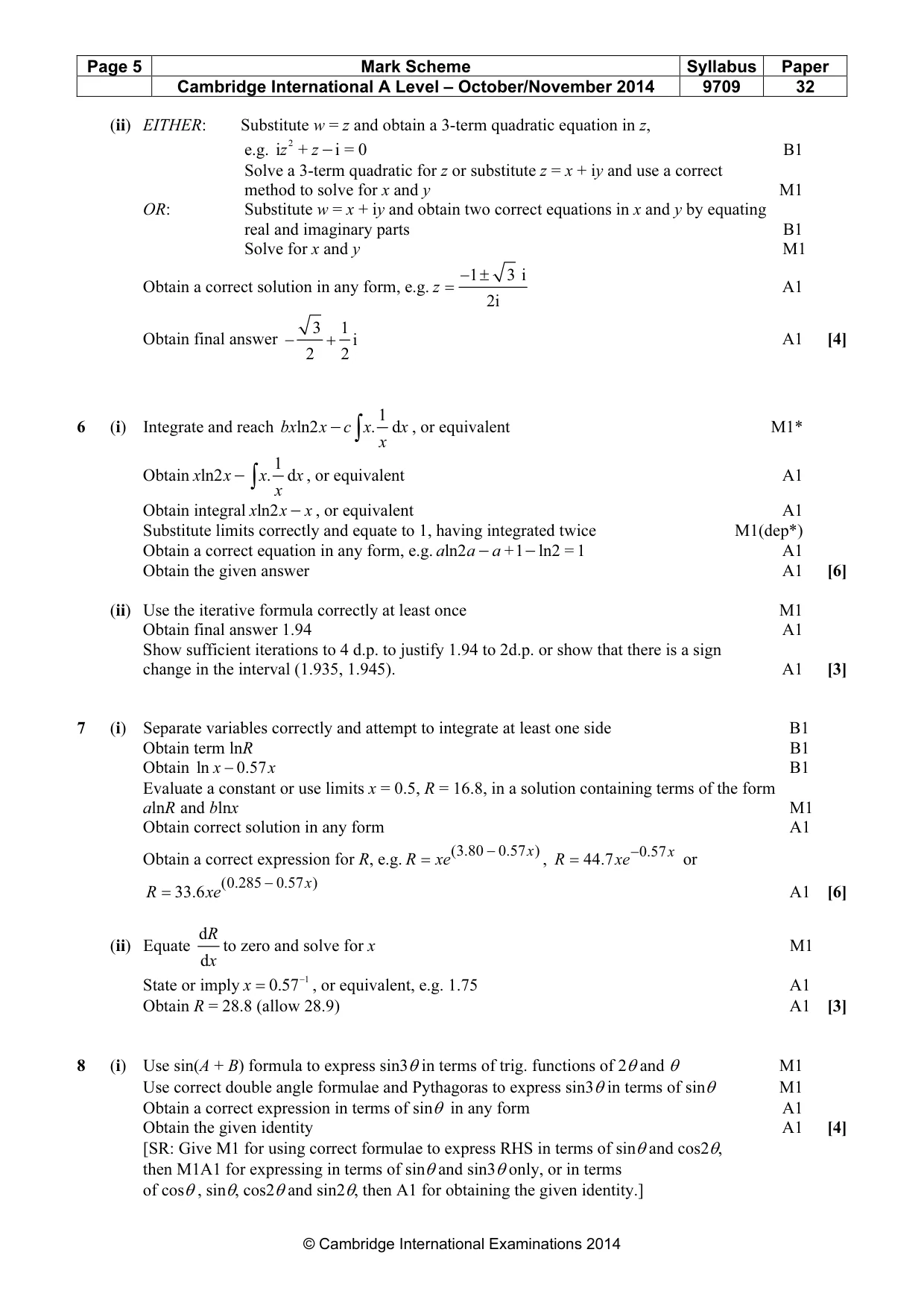
Mark scheme: 1 + 2i 5 (i) Substitute z = 1 + i and obtain w = B1 1 + i EITHER: Multiply numerator and denominator by the conjugate of the denominator, or equivalent M1 Simplify numerator to 3 + i or denominator to 2 A1 3 1 Obtain final answer + i , or equivalent A1 2 2 OR: Obtain two equations in x and y, and solve for x or for y M1 3 1 Obtain x = or y = , or equivalent A1 2 2 3 1 Obtain final answer + i , or equivalent A1 [4] 2 2 (ii) EITHER: Substitute w = z and obtain a 3-term quadratic equation in z, e.g. iz 2 + z − i = 0 B1 Solve a 3-term quadratic for z or substitute z = x + iy and use a correct method to solve for x and y M1 OR: Substitute w = x + iy and obtain two correct equations in x and y by equating real and imaginary parts B1 Solve for x and y M1 −±1 3 i Obtain a correct solution in any form, e.g. z = A1 2i 3 1 Obtain final answer − + i A1 [4] 2 2 1 ∫
Q7 · In a certain country the government charges tax on each litre of petrol sold to motorists
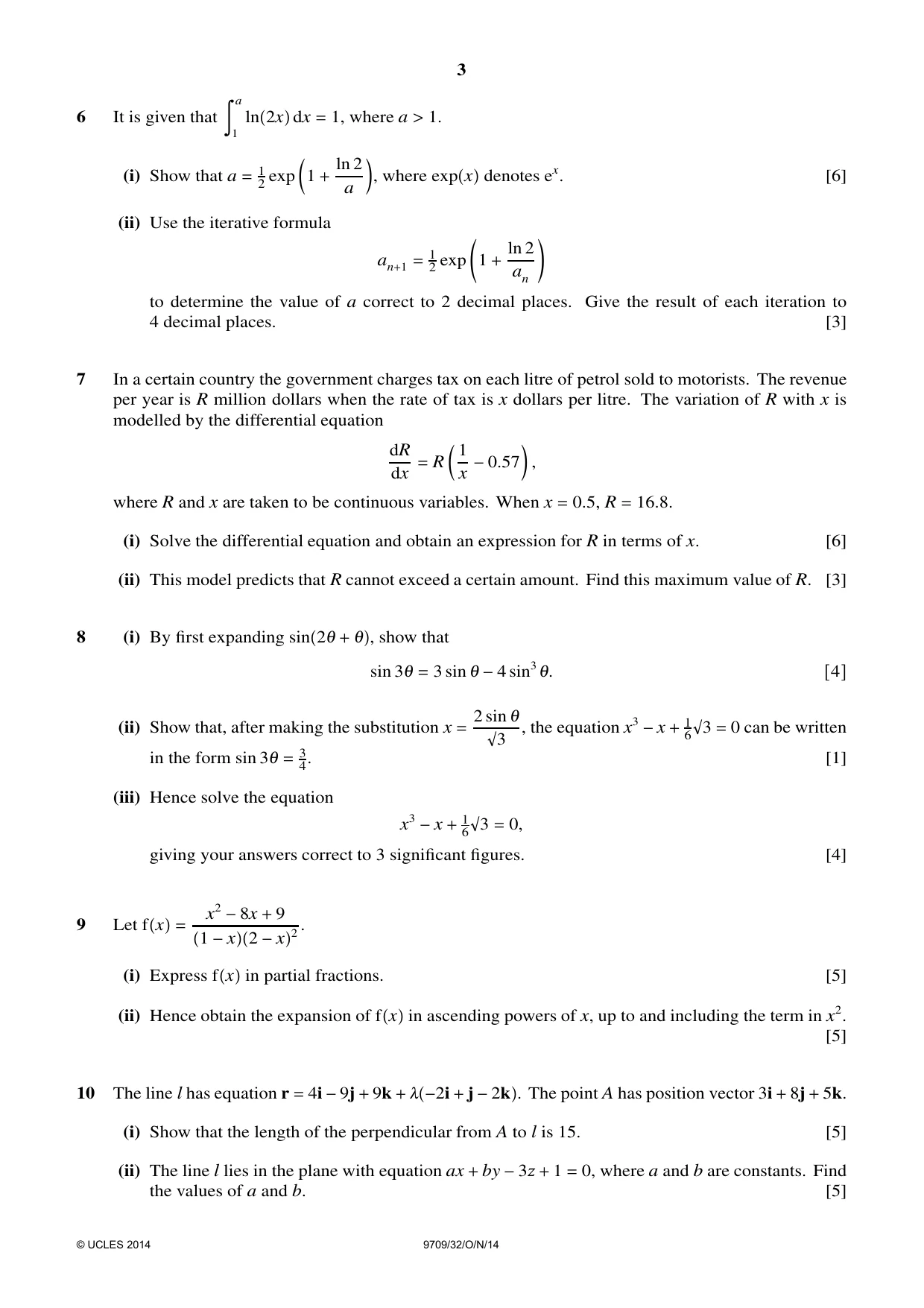
7 In a certain country the government charges tax on each litre of petrol sold to motorists. The revenue per year is R million dollars when the rate of tax is x dollars per litre. The variation of R with x is modelled by the differential equation dR @1 A R , dx = x −0.57 where R and x are taken to be continuous variables. When x 0.5, R 16.8. = = (i) Solve the differential equation and obtain an expression for R in terms of x. [6] (ii) This model predicts that R cannot exceed a certain amount. Find this maximum value of R. [3]
Mark scheme: 7 (i) Separate variables correctly and attempt to integrate at least one side B1 Obtain term lnR B1 Obtain ln x − 0.57 x B1 Evaluate a constant or use limits x = 0.5, R = 16.8, in a solution containing terms of the form alnR and blnx M1 Obtain correct solution in any form A1 (3.80 − 0.57 x ) 0.57 x Obtain a correct expression for R, e.g. R = xe , R = 44.7 xe− or (0.285 − 0.57 x ) R = 33.6 xe A1 [6] d R (ii) Equate to zero and solve for x M1 d x State or imply x = 0.57 −1 , or equivalent, e.g. 1.75 A1 Obtain R = 28.8 (allow 28.9) A1 [3]
Q10 · The line l has equation r 4i 9k j
10 The line l has equation r 4i 9k j . The point A has position vector 3i 8j 5k. = −9j + + , −2i + −2k + + (i) Show that the length of the perpendicular from A to l is 15. [5] (ii) The line l lies in the plane with equation ax by 1 0, where a and b are constants. Find + −3Ï + = the values of a and b. [5]
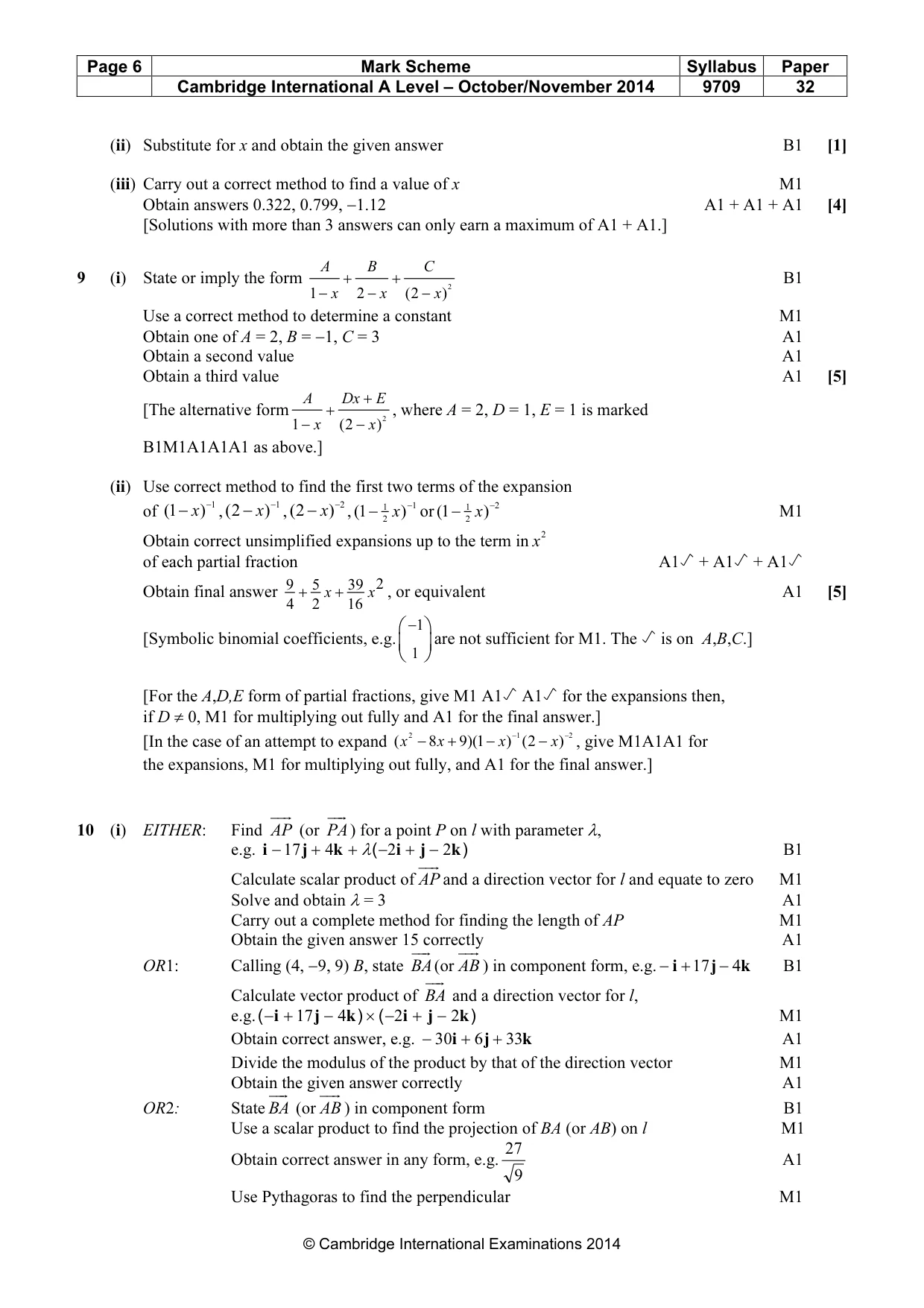
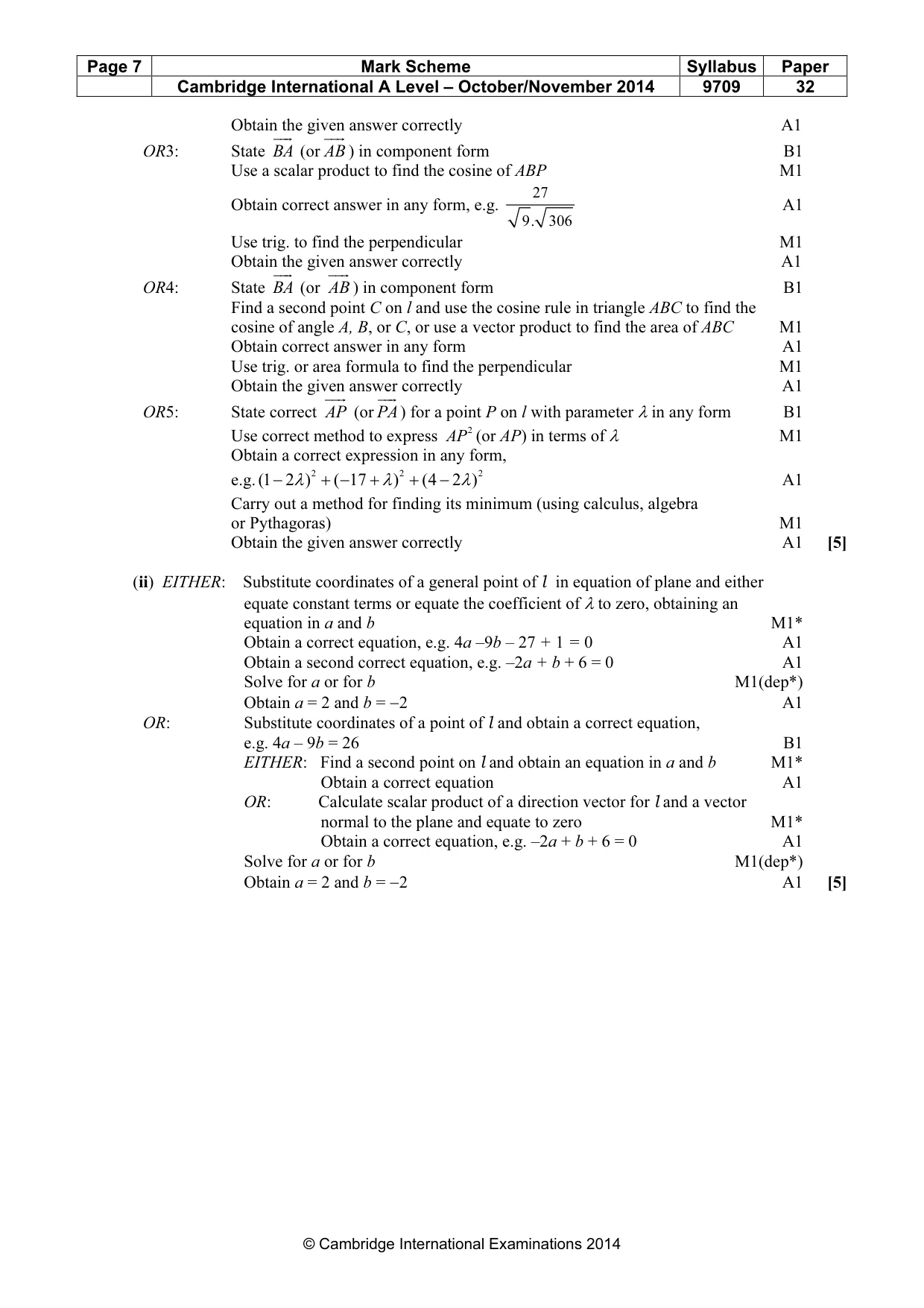
Mark scheme: 10 (i) EITHER: Find AP (or PA) for a point P on l with parameter λ, e.g. i − 17 j + 4k + λ ( −2 i + j − 2k ) B1 uur Calculate scalar product of AP and a direction vector for l and equate to zero M1 Solve and obtain λ = 3 A1 Carry out a complete method for finding the length of AP M1 Obtain the given answer 15 correctly A1 uur uur OR1: Calling (4, −9, 9) B, state BA (or AB ) in component form, e.g. − i + 17 j − 4k B1 uur Calculate vector product of BA and a direction vector for l, e.g. ( − i + 17 j − 4k ) × ( −2 i + j − 2k ) M1 Obtain correct answer, e.g. − 30i + 6 j + 33k A1 Divide the modulus of the product by that of the direction vector M1 Obtain the given answer correctly A1 uur uur OR2: State BA (or AB ) in component form B1 Use a scalar product to find the projection of BA (or AB) on l M1 27 Obtain correct answer in any form, e.g. A1 9 Use Pythagoras to find the perpendicular M1 Obtain the given answer correctly A1 uur uur OR3: State BA (or AB ) in component form B1 Use a scalar product to find the cosine of ABP M1 27 Obtain correct answer in any form, e.g. A1 9. 306 Use trig. to find the perpendicular M1 Obtain the given answer correctly A1 uur uur OR4: State BA (or AB ) in component form B1 Find a second point C on l and use the cosine rule in triangle ABC to find the cosine of angle A, B, or C, or use a vector product to find the area of ABC M1 Obtain correct answer in any form A1 Use trig. or area formula to find the perpendicular M1 Obtain the given answer correctly A1 uur uur OR5: State correct AP (or PA ) for a point P on l with parameter λ in any form B1 Use correct method to express AP 2 (or AP) in terms of λ M1 Obtain a correct expression in any form, e.g. (1 − 2λ ) 2 + ( −17 + λ ) 2 + (4 − 2λ ) 2 A1 Carry out a method for finding its minimum (using calculus, algebra or Pythagoras) M1 Obtain the given answer correctly A1 [5] (ii) EITHER: Substitute coordinates of a general point of l in equation of plane and either equate constant terms or equate the coefficient of λ to zero, obtaining an equation in a and b M1* Obtain a correct equation, e.g. 4a –9b – 27 + 1 = 0 A1 Obtain a second correct equation, e.g. –2a + b + 6 = 0 A1 Solve for a or for b M1(dep*) Obtain a = 2 and b = −2 A1 OR: Substitute coordinates of a point of l and obtain a correct equation, e.g. 4a – 9b = 26 B1 EITHER: Find a second point on l and obtain an equation in a and b M1* Obtain a correct equation A1 OR: Calculate scalar product of a direction vector for l and a vector normal to the plane and equate to zero M1* Obtain a correct equation, e.g. –2a + b + 6 = 0 A1 Solve for a or for b M1(dep*) Obtain a = 2 and b = −2 A1 [5]
What was in this paper
The subtopics covered by these 6 questions, and how many questions each got. Open one in a new tab to see every Cambridge question on it.
What you needed in this session
Cambridge’s own grade thresholds for 2014 Oct/Nov, Paper 3 · Variant 2. A higher threshold means an easier paper — the bar moves with how the cohort did.