Cambridge A Level Law 9084 — 2025 Oct/Nov Paper 2 · Variant 3
9084/23/O/N/25 · 3 questions · 60 marks · ≈68 min
The question paper and its mark scheme, free to read here and free to download. This is Cambridge’s own paper, exactly as it was sat.
Question paper4 pages
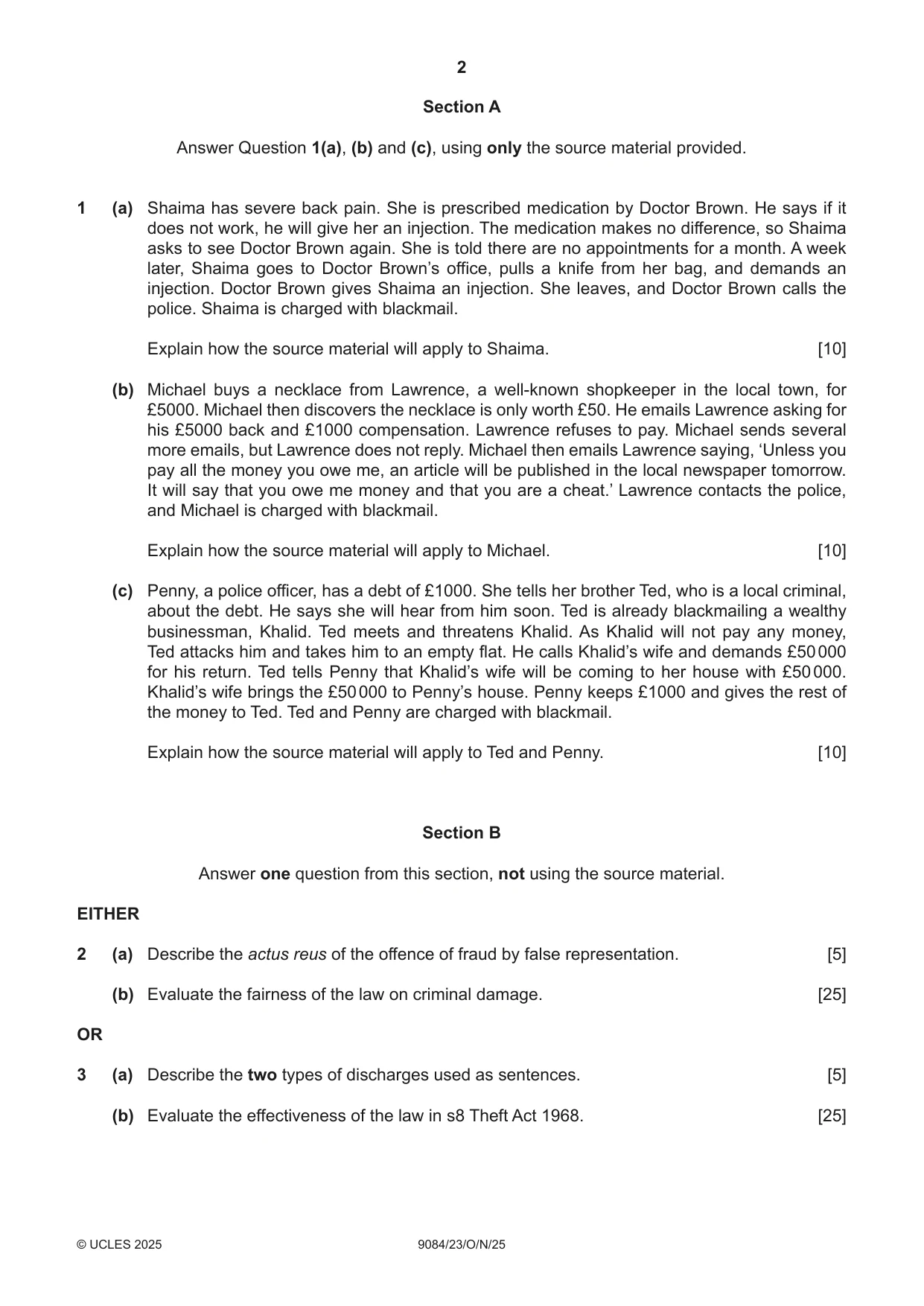
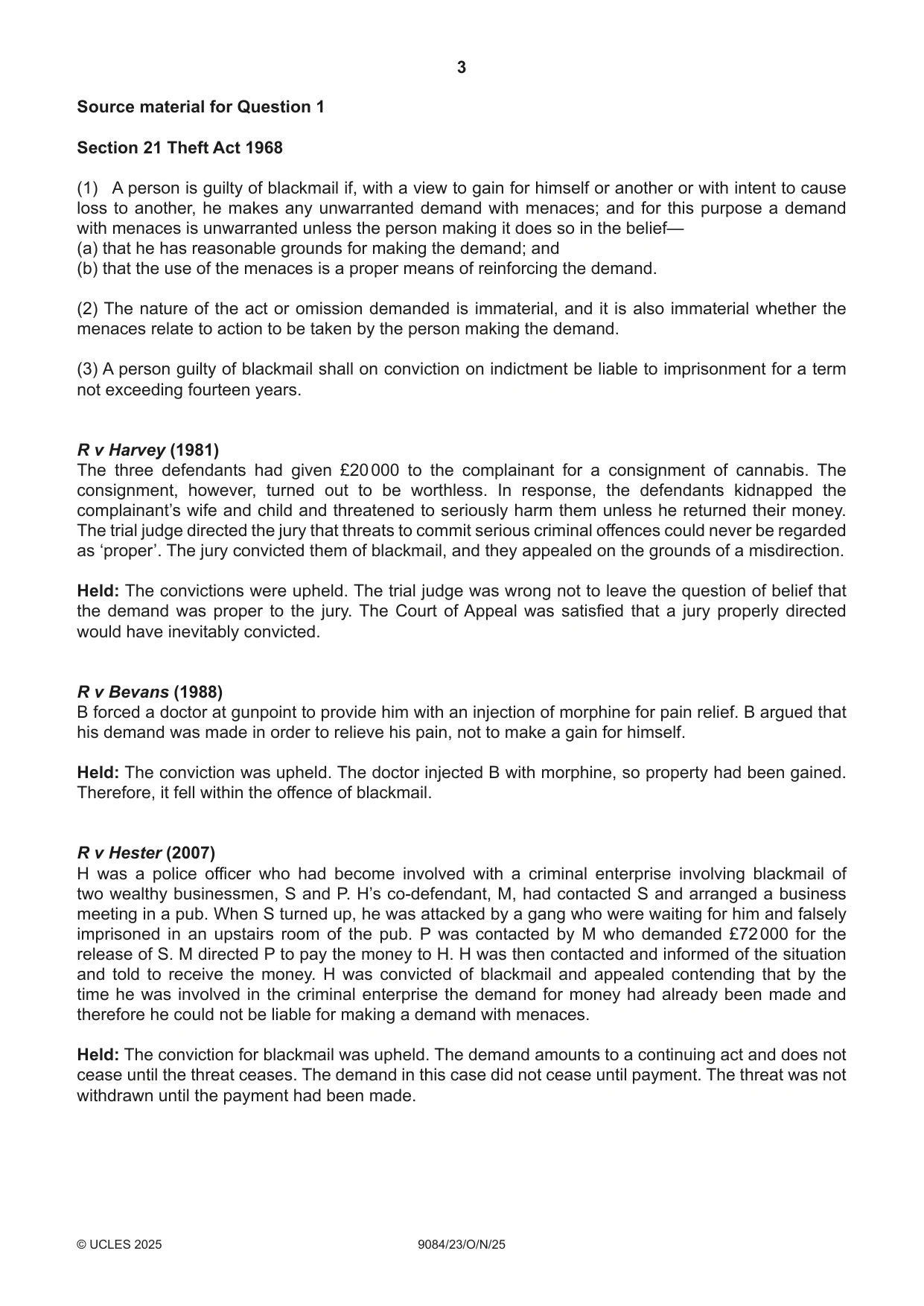

Mark scheme18 pages
Answers below. Sit the paper first if you are practising.

Questions as text
Q1 · Shaima has severe back pain
1 (a) Shaima has severe back pain. She is prescribed medication by Doctor Brown. He says if it does not work, he will give her an injection. The medication makes no difference, so Shaima asks to see Doctor Brown again. She is told there are no appointments for a month. A week later, Shaima goes to Doctor Brown’s office, pulls a knife from her bag, and demands an injection. Doctor Brown gives Shaima an injection. She leaves, and Doctor Brown calls the police. Shaima is charged with blackmail. Explain how the source material will apply to Shaima. [10] (b) Michael buys a necklace from Lawrence, a well-known shopkeeper in the local town, for £5000. Michael then discovers the necklace is only worth £50. He emails Lawrence asking for his £5000 back and £1000 compensation. Lawrence refuses to pay. Michael sends several more emails, but Lawrence does not reply. Michael then emails Lawrence saying, ‘Unless you pay all the money you owe me, an article will be published in the local newspaper tomorrow. It will say that you owe me money and that you are a cheat.’ Lawrence contacts the police, and Michael is charged with blackmail. Explain how the source material will apply to Michael. [10] (c) Penny, a police officer, has a debt of £1000. She tells her brother Ted, who is a local criminal, about the debt. He says she will hear from him soon. Ted is already blackmailing a wealthy businessman, Khalid. Ted meets and threatens Khalid. As Khalid will not pay any money, Ted attacks him and takes him to an empty flat. He calls Khalid’s wife and demands £50 000 for his return. Ted tells Penny that Khalid’s wife will be coming to her house with £50 000. Khalid’s wife brings the £50 000 to Penny’s house. Penny keeps £1000 and gives the rest of the money to Ted. Ted and Penny are charged with blackmail. Explain how the source material will apply to Ted and Penny. [10]
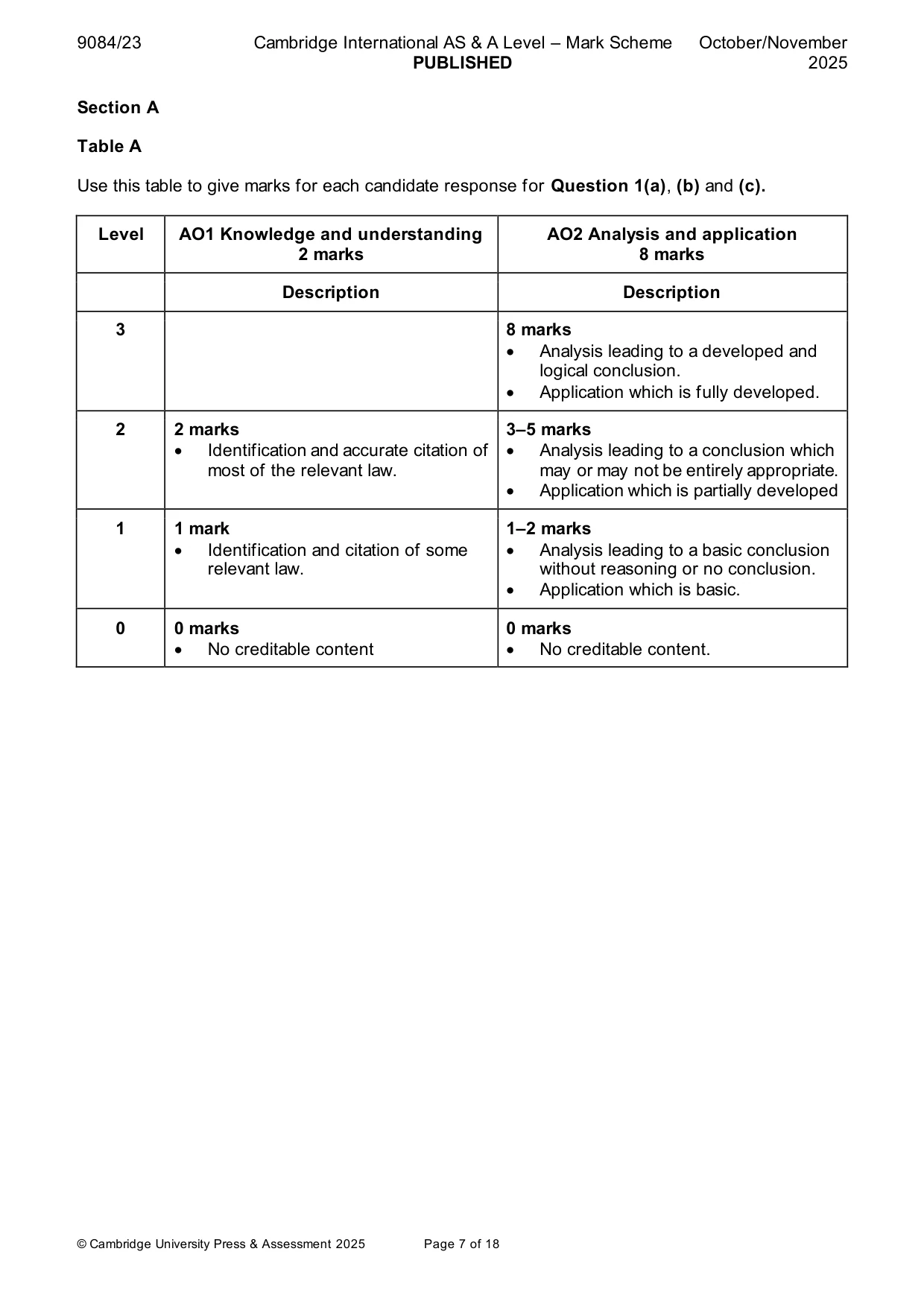
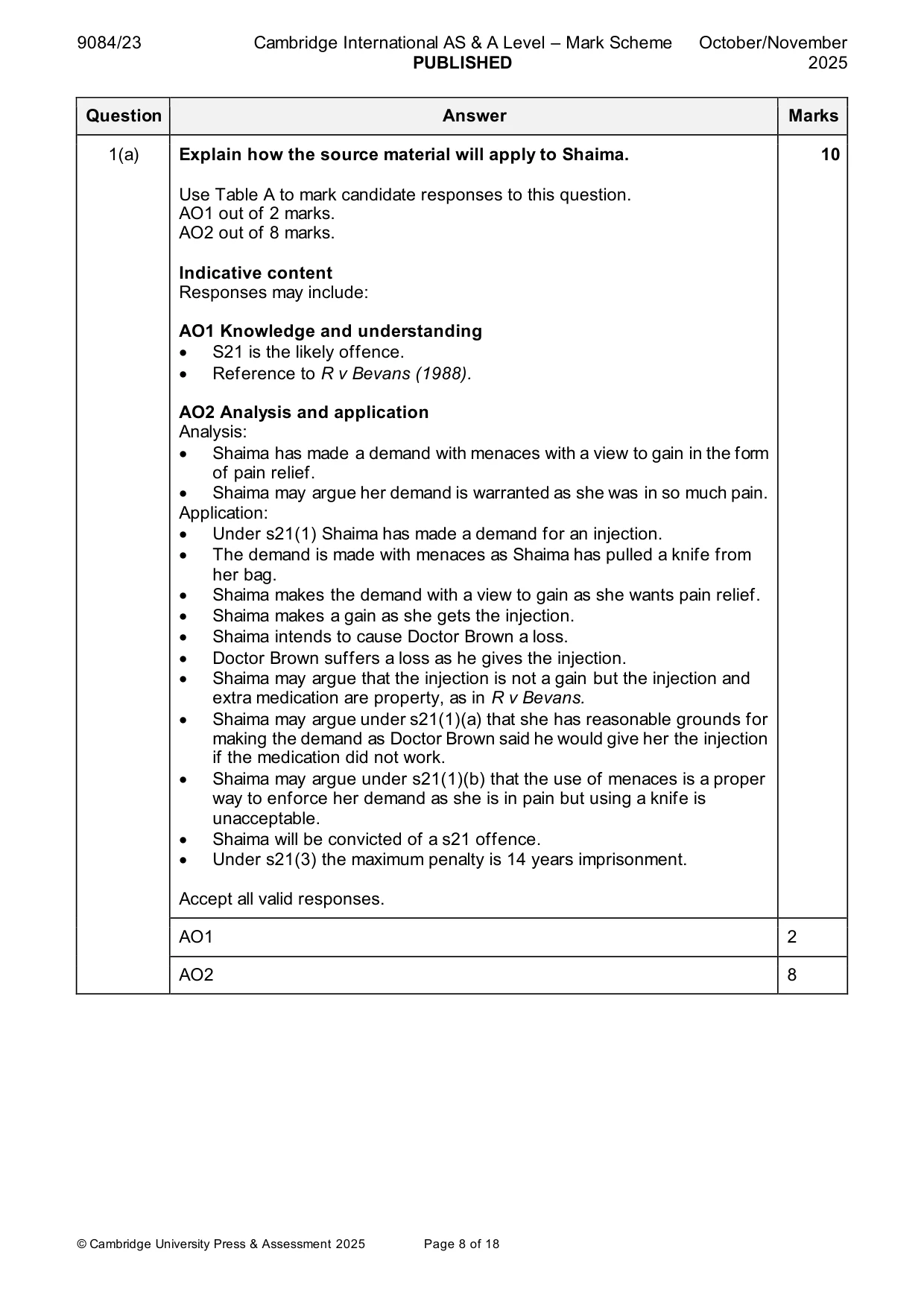
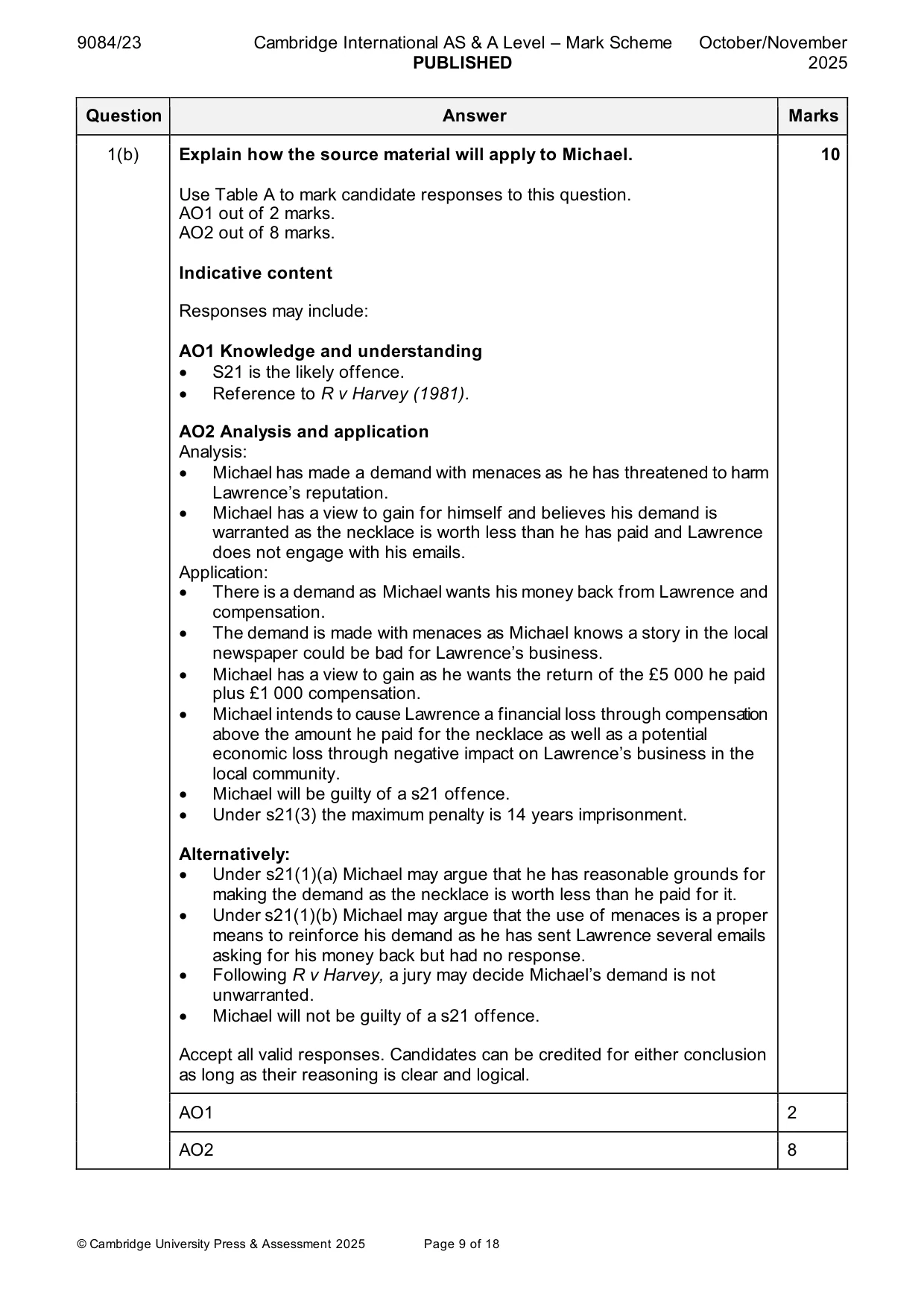
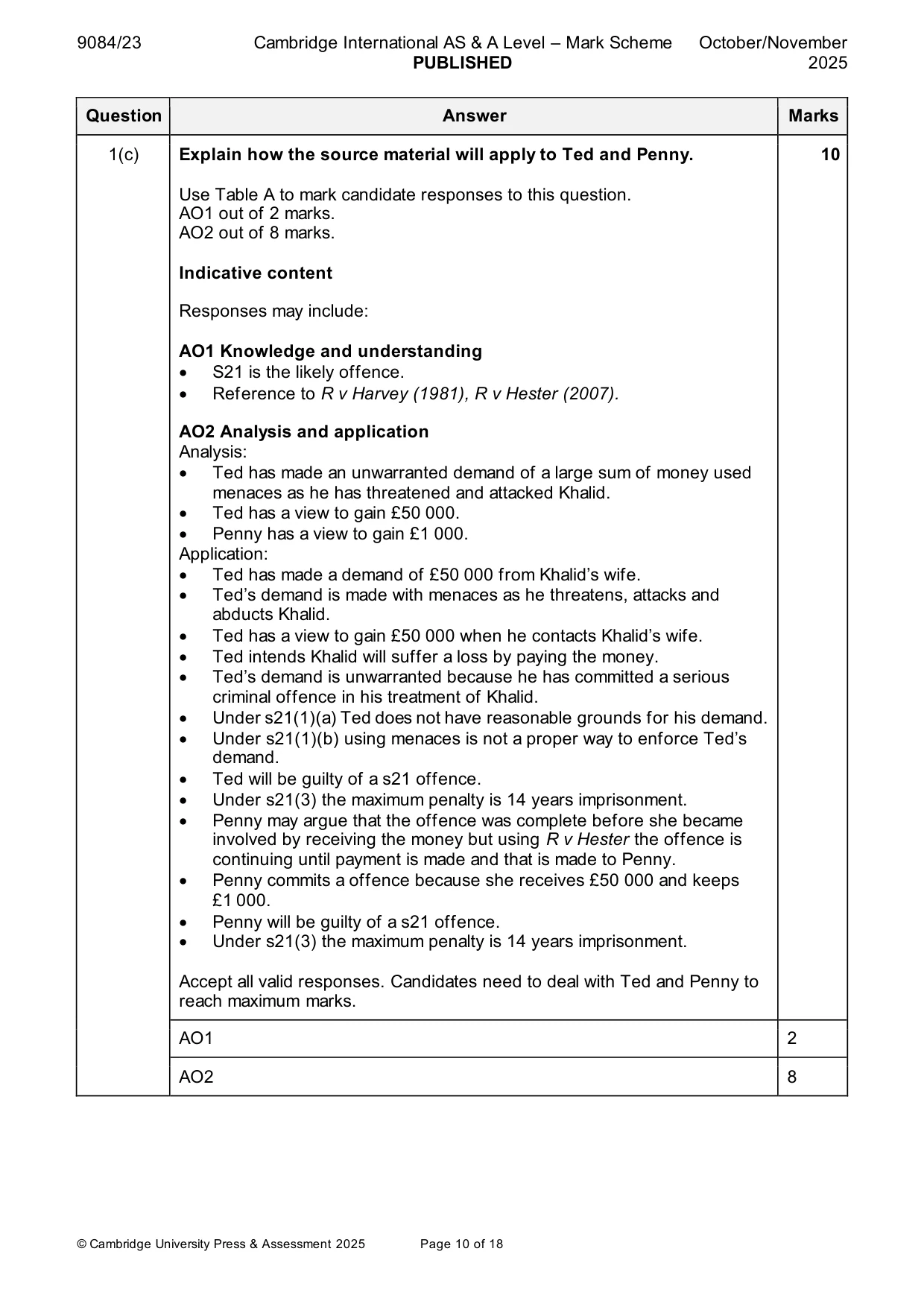
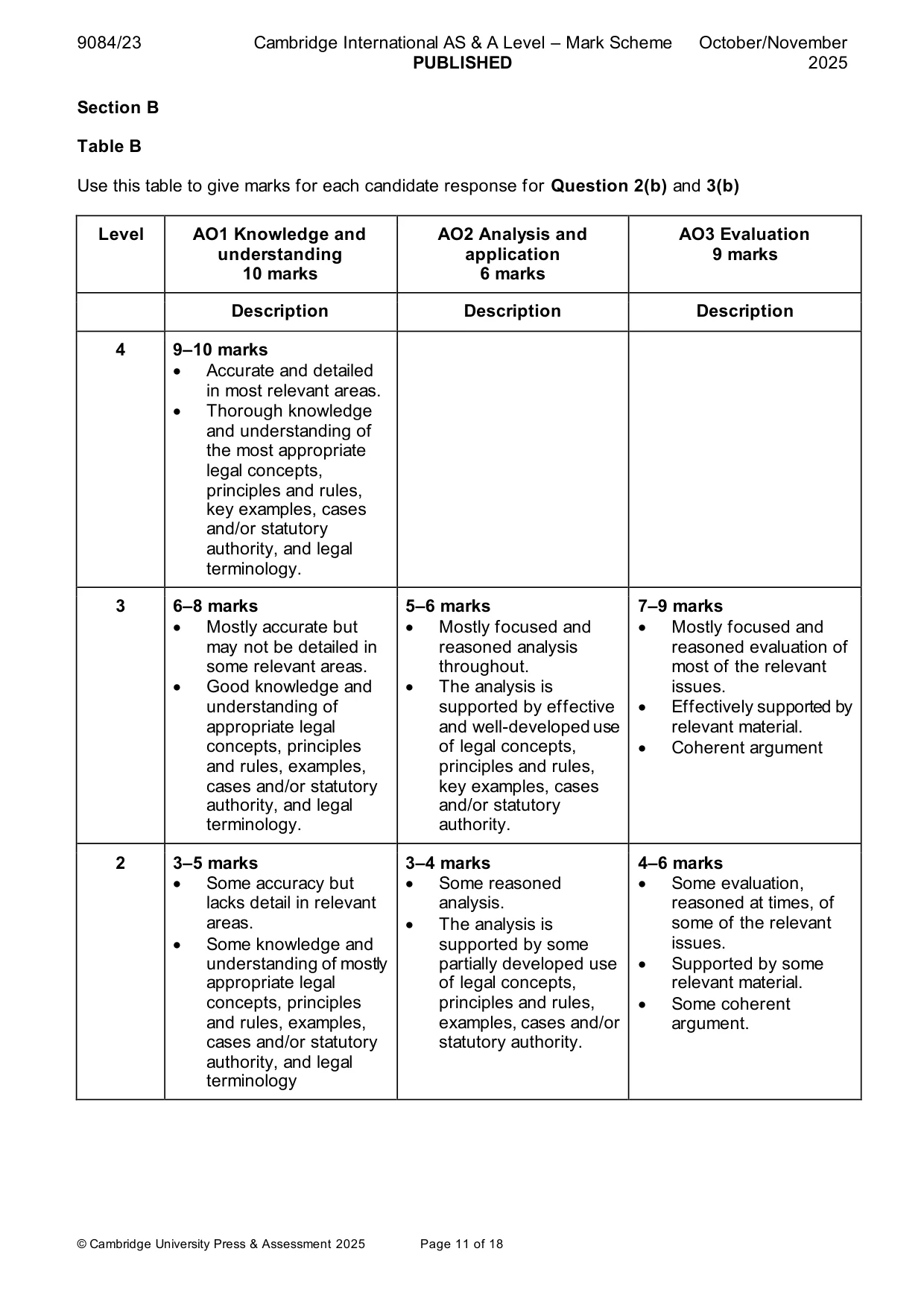
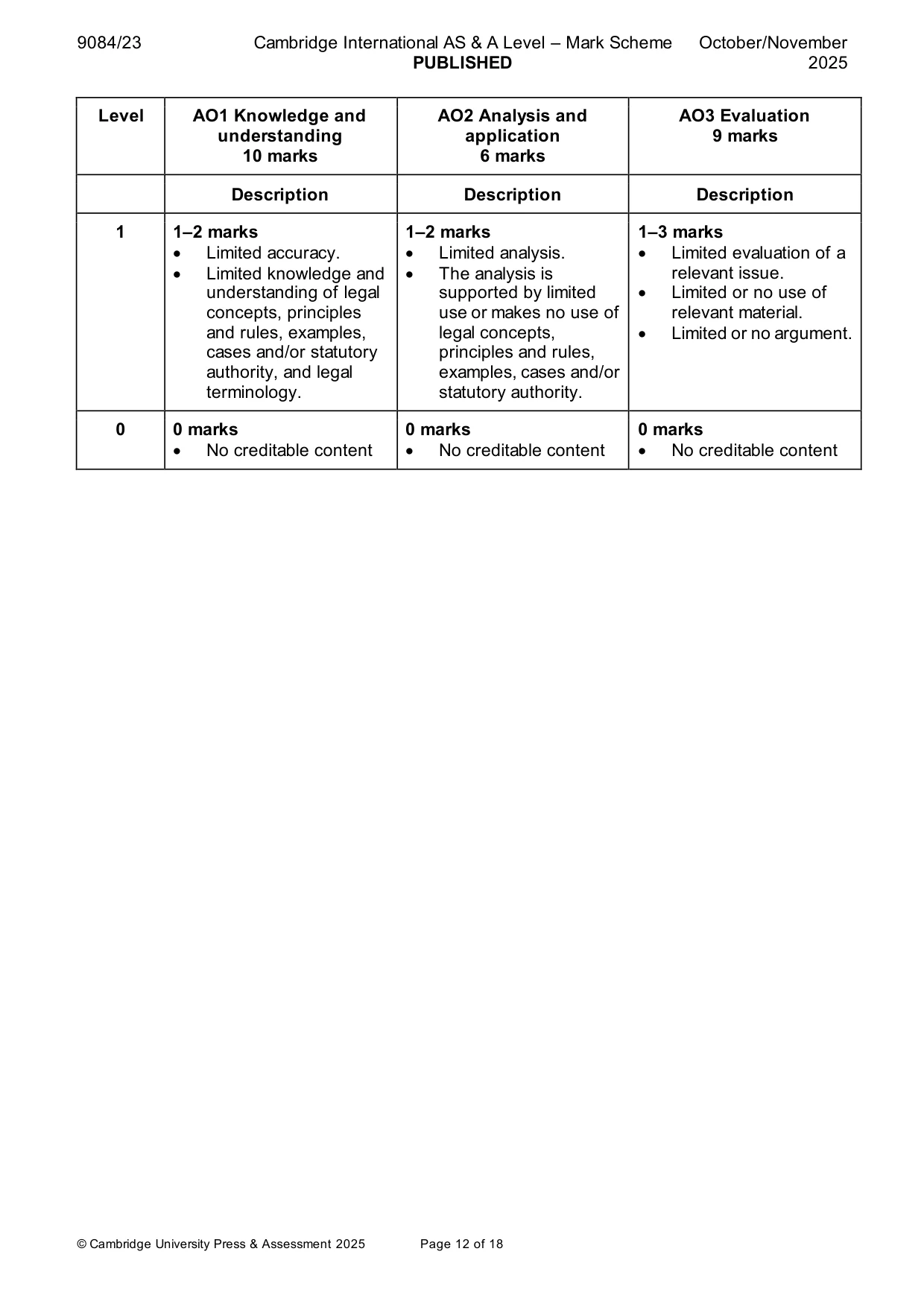
Mark scheme: Question Answer Marks 1(a) Explain how the source material will apply to Shaima. 10 Use Table A to mark candidate responses to this question. AO1 out of 2 marks. AO2 out of 8 marks. Indicative content Responses may include: AO1 Knowledge and understanding • S21 is the likely offence. • Reference to R v Bevans (1988). AO2 Analysis and application Analysis: • Shaima has made a demand with menaces with a view to gain in the form of pain relief. • Shaima may argue her demand is warranted as she was in so much pain. Application: • Under s21(1) Shaima has made a demand for an injection. • The demand is made with menaces as Shaima has pulled a knife from her bag. • Shaima makes the demand with a view to gain as she wants pain relief. • Shaima makes a gain as she gets the injection. • Shaima intends to cause Doctor Brown a loss. • Doctor Brown suffers a loss as he gives the injection. • Shaima may argue that the injection is not a gain but the injection and extra medication are property, as in R v Bevans. • Shaima may argue under s21(1)(a) that she has reasonable grounds for making the demand as Doctor Brown said he would give her the injection if the medication did not work. • Shaima may argue under s21(1)(b) that the use of menaces is a proper way to enforce her demand as she is in pain but using a knife is unacceptable. • Shaima will be convicted of a s21 offence. • Under s21(3) the maximum penalty is 14 years imprisonment. Accept all valid responses. AO1 2 AO2 8 1(b) Explain how the source material will apply to Michael. 10 Use Table A to mark candidate responses to this question. AO1 out of 2 marks. AO2 out of 8 marks. Indicative content Responses may include: AO1 Knowledge and understanding • S21 is the likely offence. • Reference to R v Harvey (1981). AO2 Analysis and application Analysis: • Michael has made a demand with menaces as he has threatened to harm Lawrence’s reputation. • Michael has a view to gain for himself and believes his demand is warranted as the necklace is worth less than he has paid and Lawrence does not engage with his emails. Application: • There is a demand as Michael wants his money back from Lawrence and compensation. • The demand is made with menaces as Michael knows a story in the local newspaper could be bad for Lawrence’s business. • Michael has a view to gain as he wants the return of the £5 000 he paid plus £1 000 compensation. • Michael intends to cause Lawrence a financial loss through compensation above the amount he paid for the necklace as well as a potential economic loss through negative impact on Lawrence’s business in the local community. • Michael will be guilty of a s21 offence. • Under s21(3) the maximum penalty is 14 years imprisonment. Alternatively: • Under s21(1)(a) Michael may argue that he has reasonable grounds for making the demand as the necklace is worth less than he paid for it. • Under s21(1)(b) Michael may argue that the use of menaces is a proper means to reinforce his demand as he has sent Lawrence several emails asking for his money back but had no response. • Following R v Harvey, a jury may decide Michael’s demand is not unwarranted. • Michael will not be guilty of a s21 offence. Accept all valid responses. Candidates can be credited for either conclusion as long as their reasoning is clear and logical. AO1 2 AO2 8 1(c) Explain how the source material will apply to Ted and Penny. 10 Use Table A to mark candidate responses to this question. AO1 out of 2 marks. AO2 out of 8 marks. Indicative content Responses may include: AO1 Knowledge and understanding • S21 is the likely offence. • Reference to R v Harvey (1981), R v Hester (2007). AO2 Analysis and application Analysis: • Ted has made an unwarranted demand of a large sum of money used menaces as he has threatened and attacked Khalid. • Ted has a view to gain £50 000. • Penny has a view to gain £1 000. Application: • Ted has made a demand of £50 000 from Khalid’s wife. • Ted’s demand is made with menaces as he threatens, attacks and abducts Khalid. • Ted has a view to gain £50 000 when he contacts Khalid’s wife. • Ted intends Khalid will suffer a loss by paying the money. • Ted’s demand is unwarranted because he has committed a serious criminal offence in his treatment of Khalid. • Under s21(1)(a) Ted does not have reasonable grounds for his demand. • Under s21(1)(b) using menaces is not a proper way to enforce Ted’s demand. • Ted will be guilty of a s21 offence. • Under s21(3) the maximum penalty is 14 years imprisonment. • Penny may argue that the offence was complete before she became involved by receiving the money but using R v Hester the offence is continuing until payment is made and that is made to Penny. • Penny commits a offence because she receives £50 000 and keeps £1 000. • Penny will be guilty of a s21 offence. • Under s21(3) the maximum penalty is 14 years imprisonment. Accept all valid responses. Candidates need to deal with Ted and Penny to reach maximum marks. AO1 2 AO2 8 Section B Table B Use this table to give marks for each candidate response for Question 2(b) and 3(b) Level AO1 Knowledge and AO2 Analysis and AO3 Evaluation understanding application 9 marks 10 marks 6 marks Description Description Description 4 9–10 marks • Accurate and detailed in most relevant areas. • Thorough knowledge and understanding of the most appropriate legal concepts, principles and rules, key examples, cases and/or statutory authority, and legal terminology. 3 6–8 marks 5–6 marks 7–9 marks • Mostly accurate but • Mostly focused and • Mostly focused and may not be detailed in reasoned analysis reasoned evaluation of some relevant areas. throughout. most of the relevant • Good knowledge and • The analysis is issues. understanding of supported by effective • Effectively supported by appropriate legal and well-developed use relevant material. concepts, principles of legal concepts, • Coherent argument and rules, examples, principles and rules, cases and/or statutory key examples, cases authority, and legal and/or statutory terminology. authority. 2 3–5 marks 3–4 marks 4–6 marks • Some accuracy but • Some reasoned • Some evaluation, lacks detail in relevant analysis. reasoned at times, of areas. • The analysis is some of the relevant • Some knowledge and supported by some issues. understanding of mostly partially developed use • Supported by some appropriate legal of legal concepts, relevant material. concepts, principles principles and rules, • Some coherent and rules, examples, examples, cases and/or argument. cases and/or statutory statutory authority. authority, and legal terminology Level AO1 Knowledge and AO2 Analysis and AO3 Evaluation understanding application 9 marks 10 marks 6 marks Description Description Description 1 1–2 marks 1–2 marks 1–3 marks • Limited accuracy. • Limited analysis. • Limited evaluation of a • Limited knowledge and • The analysis is relevant issue. understanding of legal supported by limited • Limited or no use of concepts, principles use or makes no use of relevant material. and rules, examples, legal concepts, • Limited or no argument. cases and/or statutory principles and rules, authority, and legal examples, cases and/or terminology. statutory authority. 0 0 marks 0 marks 0 marks • No creditable content • No creditable content • No creditable content
Q2 · Describe the actus reus of the offence of fraud by false representation
2 (a) Describe the actus reus of the offence of fraud by false representation. [5] (b) Evaluate the fairness of the law on criminal damage. [25] OR
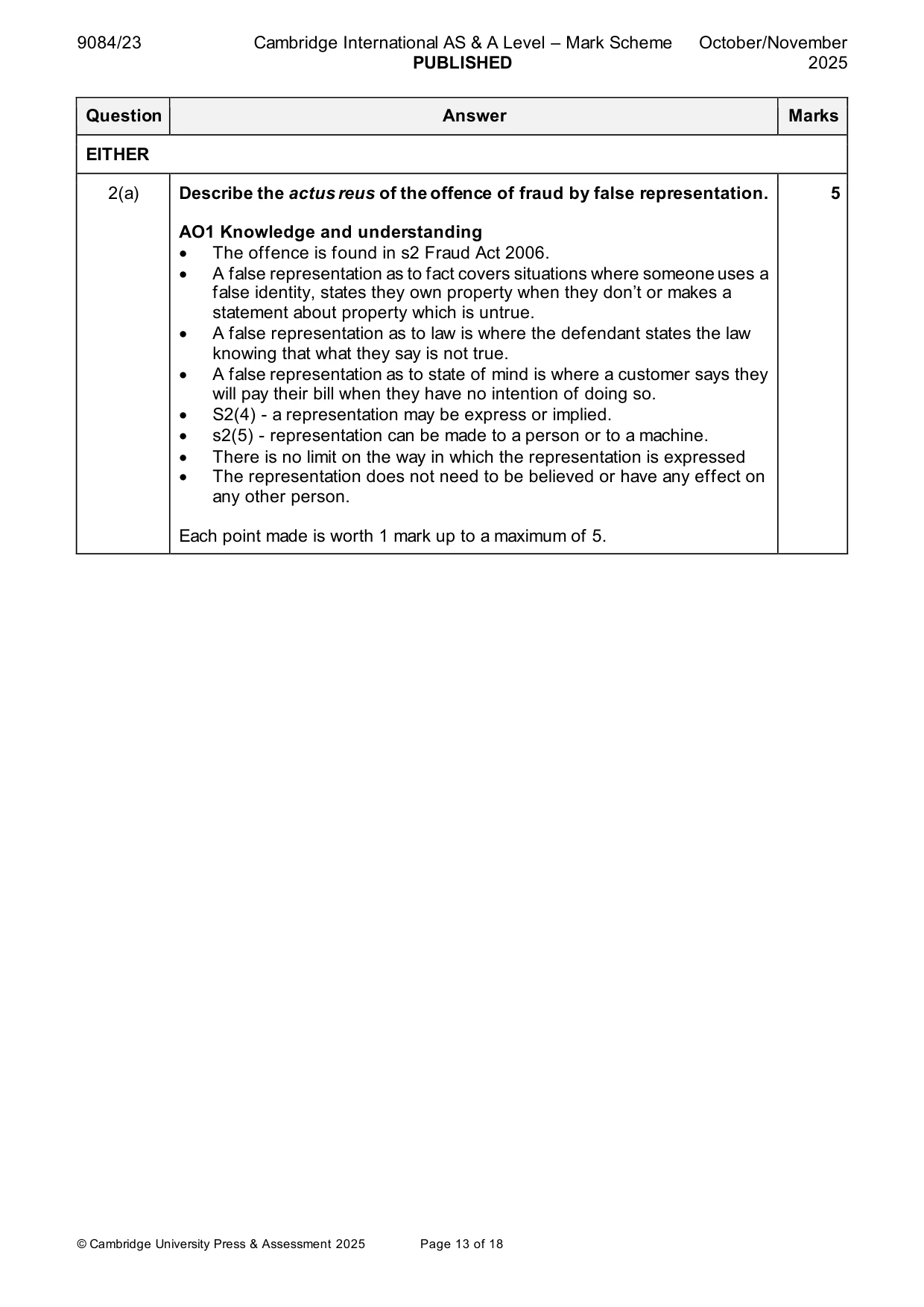
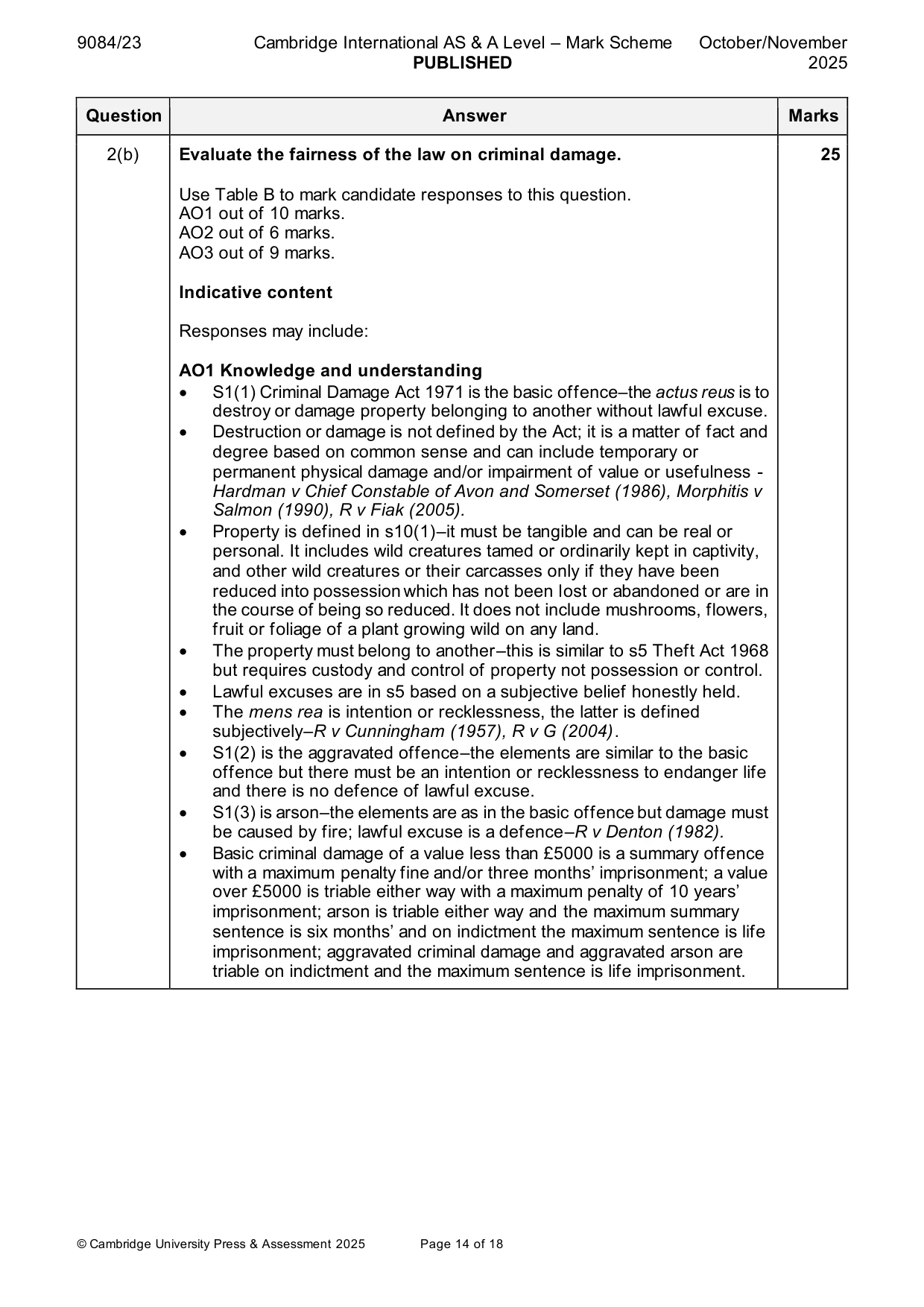
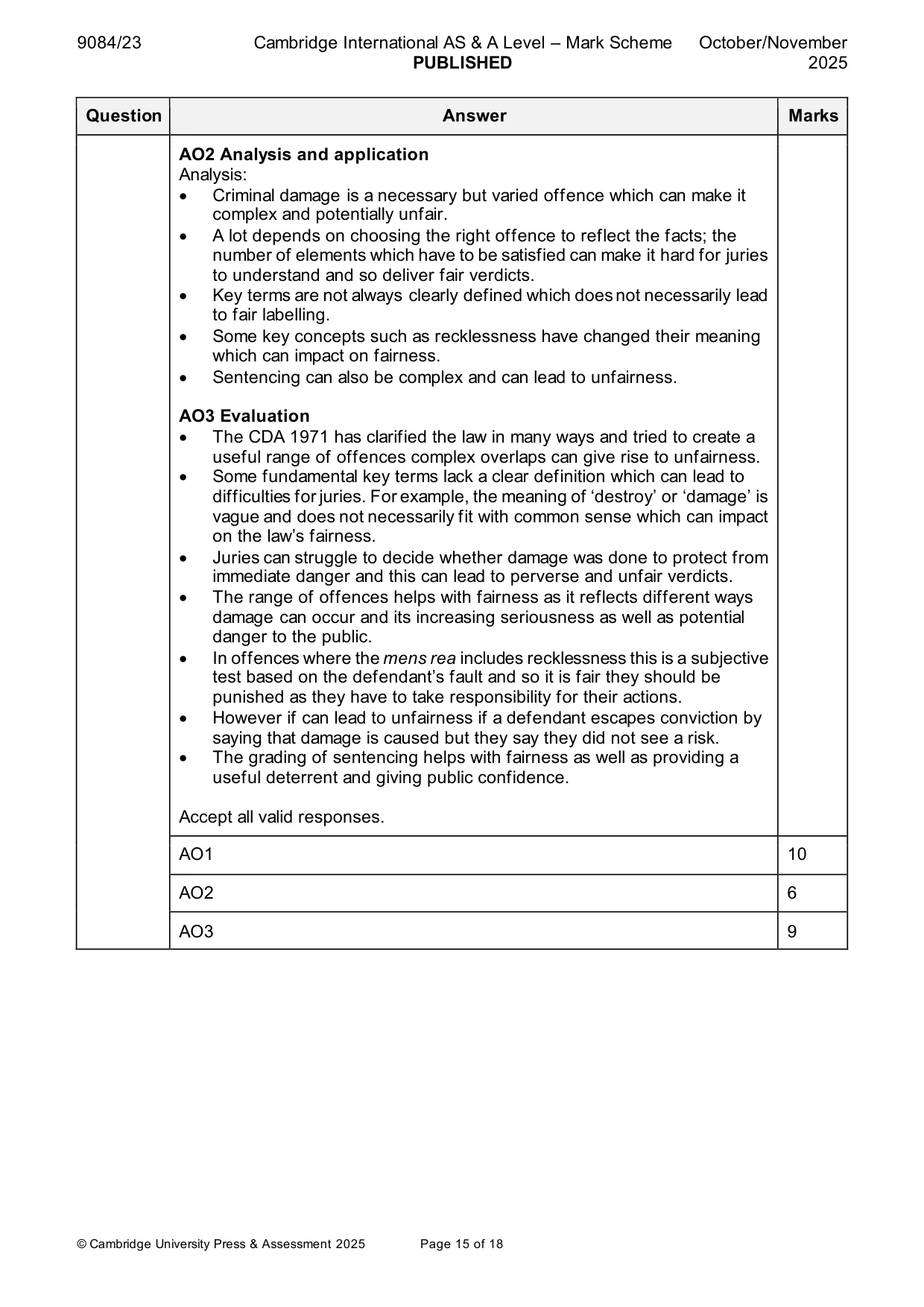
Mark scheme: 2(a) Describe the actus reus of the offence of fraud by false representation. 5 AO1 Knowledge and understanding • The offence is found in s2 Fraud Act 2006. • A false representation as to fact covers situations where someone uses a false identity, states they own property when they don’t or makes a statement about property which is untrue. • A false representation as to law is where the defendant states the law knowing that what they say is not true. • A false representation as to state of mind is where a customer says they will pay their bill when they have no intention of doing so. • S2(4) - a representation may be express or implied. • s2(5) - representation can be made to a person or to a machine. • There is no limit on the way in which the representation is expressed • The representation does not need to be believed or have any effect on any other person. Each point made is worth 1 mark up to a maximum of 5. 2(b) Evaluate the fairness of the law on criminal damage. 25 Use Table B to mark candidate responses to this question. AO1 out of 10 marks. AO2 out of 6 marks. AO3 out of 9 marks. Indicative content Responses may include: AO1 Knowledge and understanding • S1(1) Criminal Damage Act 1971 is the basic offence–the actus reus is to destroy or damage property belonging to another without lawful excuse. • Destruction or damage is not defined by the Act; it is a matter of fact and degree based on common sense and can include temporary or permanent physical damage and/or impairment of value or usefulness - Hardman v Chief Constable of Avon and Somerset (1986), Morphitis v Salmon (1990), R v Fiak (2005). • Property is defined in s10(1)–it must be tangible and can be real or personal. It includes wild creatures tamed or ordinarily kept in captivity, and other wild creatures or their carcasses only if they have been reduced into possession which has not been lost or abandoned or are in the course of being so reduced. It does not include mushrooms, flowers, fruit or foliage of a plant growing wild on any land. • The property must belong to another–this is similar to s5 Theft Act 1968 but requires custody and control of property not possession or control. • Lawful excuses are in s5 based on a subjective belief honestly held. • The mens rea is intention or recklessness, the latter is defined subjectively–R v Cunningham (1957), R v G (2004). • S1(2) is the aggravated offence–the elements are similar to the basic offence but there must be an intention or recklessness to endanger life and there is no defence of lawful excuse. • S1(3) is arson–the elements are as in the basic offence but damage must be caused by fire; lawful excuse is a defence–R v Denton (1982). • Basic criminal damage of a value less than £5000 is a summary offence with a maximum penalty fine and/or three months’ imprisonment; a value over £5000 is triable either way with a maximum penalty of 10 years’ imprisonment; arson is triable either way and the maximum summary sentence is six months’ and on indictment the maximum sentence is life imprisonment; aggravated criminal damage and aggravated arson are triable on indictment and the maximum sentence is life imprisonment. AO2 Analysis and application Analysis: • Criminal damage is a necessary but varied offence which can make it complex and potentially unfair. • A lot depends on choosing the right offence to reflect the facts; the number of elements which have to be satisfied can make it hard for juries to understand and so deliver fair verdicts. • Key terms are not always clearly defined which does not necessarily lead to fair labelling. • Some key concepts such as recklessness have changed their meaning which can impact on fairness. • Sentencing can also be complex and can lead to unfairness. AO3 Evaluation • The CDA 1971 has clarified the law in many ways and tried to create a useful range of offences complex overlaps can give rise to unfairness. • Some fundamental key terms lack a clear definition which can lead to difficulties for juries. For example, the meaning of ‘destroy’ or ‘damage’ is vague and does not necessarily fit with common sense which can impact on the law’s fairness. • Juries can struggle to decide whether damage was done to protect from immediate danger and this can lead to perverse and unfair verdicts. • The range of offences helps with fairness as it reflects different ways damage can occur and its increasing seriousness as well as potential danger to the public. • In offences where the mens rea includes recklessness this is a subjective test based on the defendant’s fault and so it is fair they should be punished as they have to take responsibility for their actions. • However if can lead to unfairness if a defendant escapes conviction by saying that damage is caused but they say they did not see a risk. • The grading of sentencing helps with fairness as well as providing a useful deterrent and giving public confidence. Accept all valid responses. AO1 10 AO2 6 AO3 9
Q3 · Describe the two types of discharges used as sentences
3 (a) Describe the two types of discharges used as sentences. [5] (b) Evaluate the effectiveness of the law in s8 Theft Act 1968. [25] Source material for Question 1 Section 21 Theft Act 1968 (1) A person is guilty of blackmail if, with a view to gain for himself or another or with intent to cause loss to another, he makes any unwarranted demand with menaces; and for this purpose a demand with menaces is unwarranted unless the person making it does so in the belief— (a) that he has reasonable grounds for making the demand; and (b) that the use of the menaces is a proper means of reinforcing the demand. (2) The nature of the act or omission demanded is immaterial, and it is also immaterial whether the menaces relate to action to be taken by the person making the demand. (3) A person guilty of blackmail shall on conviction on indictment be liable to imprisonment for a term not exceeding fourteen years. R v Harvey (1981) The three defendants had given £20 000 to the complainant for a consignment of cannabis. The consignment, however, turned out to be worthless. In response, the defendants kidnapped the complainant’s wife and child and threatened to seriously harm them unless he returned their money. The trial judge directed the jury that threats to commit serious criminal offences could never be regarded as ‘proper’. The jury convicted them of blackmail, and they appealed on the grounds of a misdirection. Held: The convictions were upheld. The trial judge was wrong not to leave the question of belief that the demand was proper to the jury. The Court of Appeal was satisfied that a jury properly directed would have inevitably convicted. R v Bevans (1988) B forced a doctor at gunpoint to provide him with an injection of morphine for pain relief. B argued that his demand was made in order to relieve his pain, not to make a gain for himself. Held: The conviction was upheld. The doctor injected B with morphine, so property had been gained. Therefore, it fell within the offence of blackmail. R v Hester (2007) H was a police officer who had become involved with a criminal enterprise involving blackmail of two wealthy businessmen, S and P. H’s co-defendant, M, had contacted S and arranged a business meeting in a pub. When S turned up, he was attacked by a gang who were waiting for him and falsely imprisoned in an upstairs room of the pub. P was contacted by M who demanded £72 000 for the release of S. M directed P to pay the money to H. H was then contacted and informed of the situation and told to receive the money. H was convicted of blackmail and appealed contending that by the time he was involved in the criminal enterprise the demand for money had already been made and therefore he could not be liable for making a demand with menaces. Held: The conviction for blackmail was upheld. The demand amounts to a continuing act and does not cease until the threat ceases. The demand in this case did not cease until payment. The threat was not withdrawn until the payment had been made.
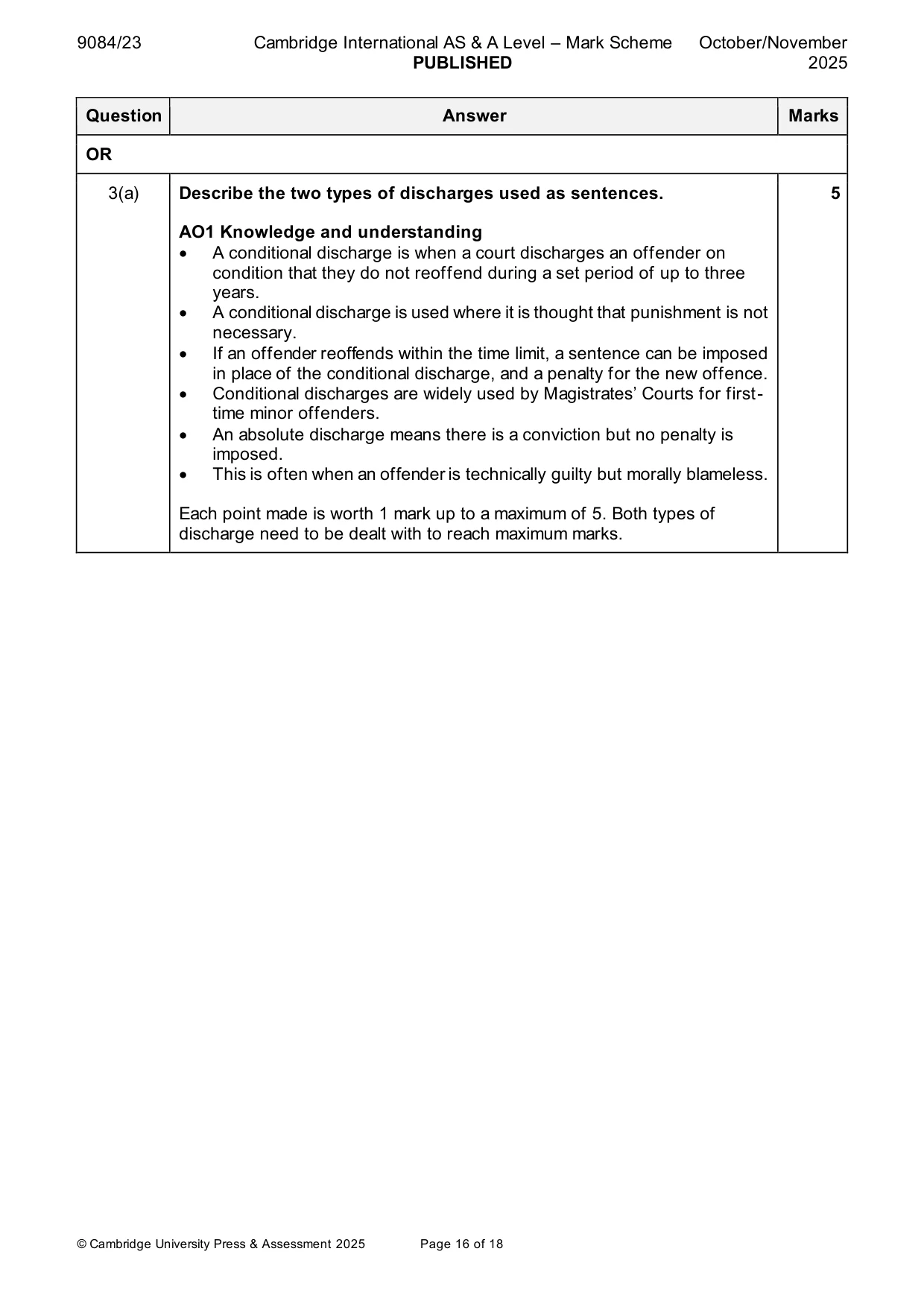
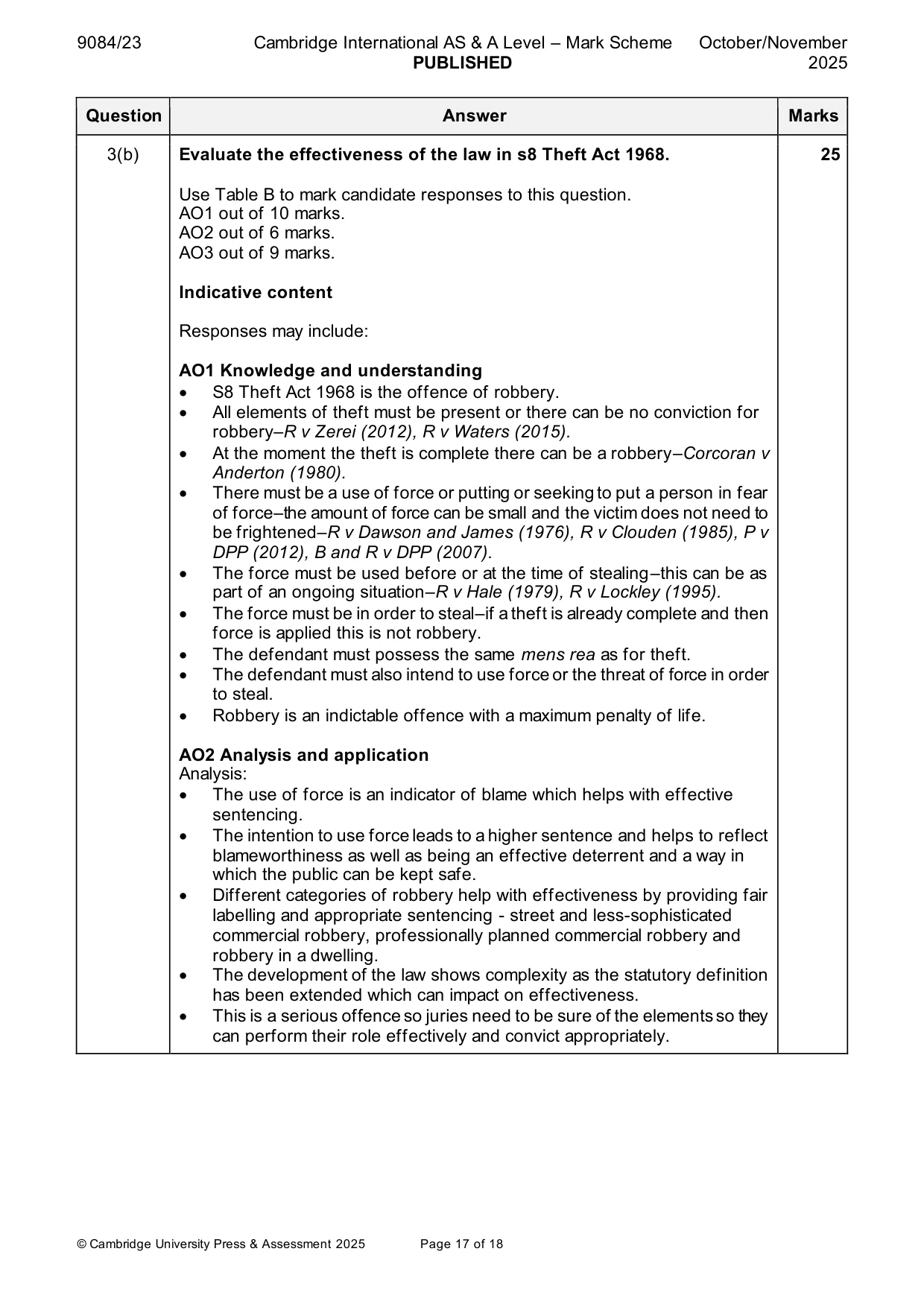
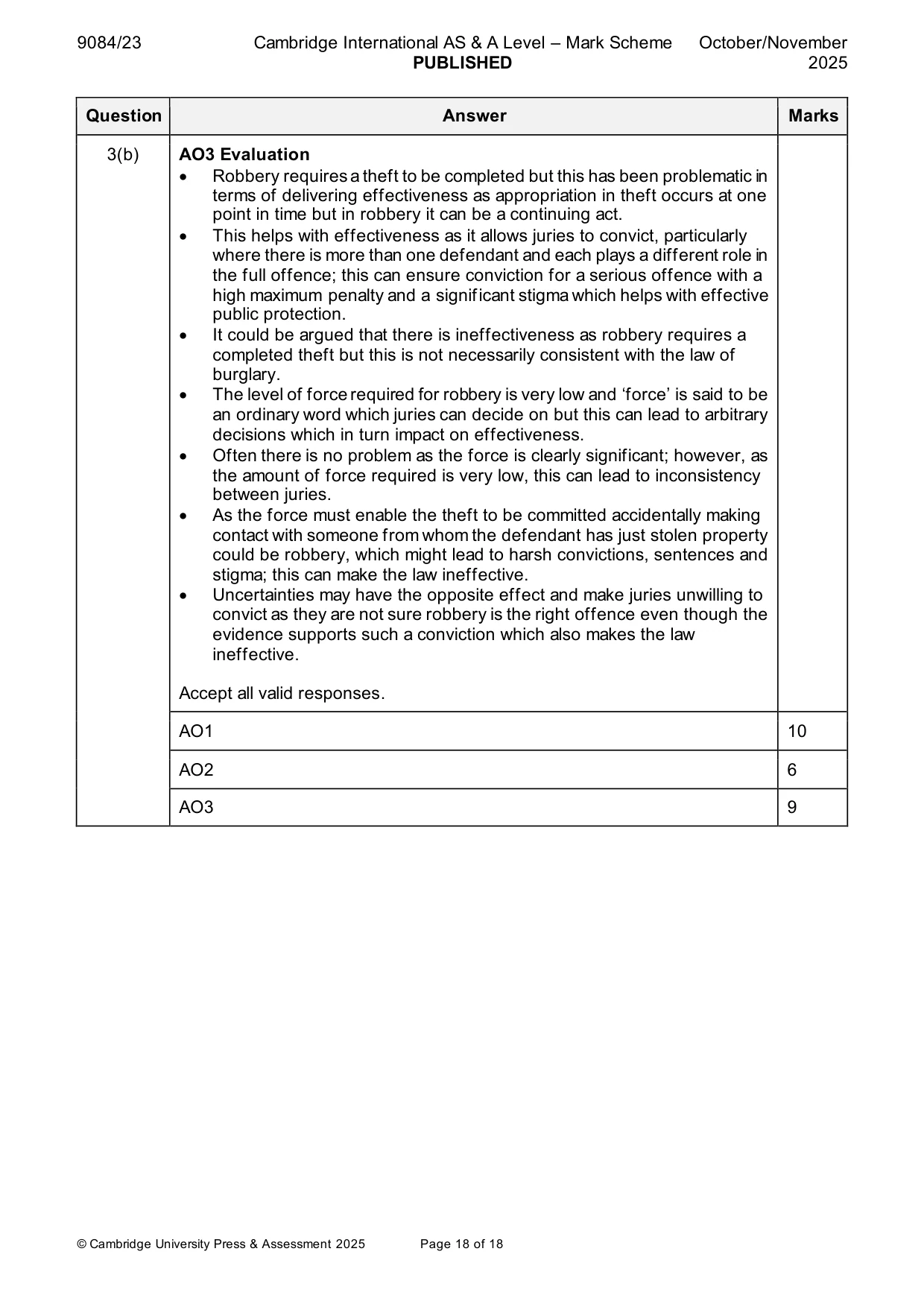
Mark scheme: 3(a) Describe the two types of discharges used as sentences. 5 AO1 Knowledge and understanding • A conditional discharge is when a court discharges an offender on condition that they do not reoffend during a set period of up to three years. • A conditional discharge is used where it is thought that punishment is not necessary. • If an offender reoffends within the time limit, a sentence can be imposed in place of the conditional discharge, and a penalty for the new offence. • Conditional discharges are widely used by Magistrates’ Courts for first- time minor offenders. • An absolute discharge means there is a conviction but no penalty is imposed. • This is often when an offender is technically guilty but morally blameless. Each point made is worth 1 mark up to a maximum of 5. Both types of discharge need to be dealt with to reach maximum marks. 3(b) Evaluate the effectiveness of the law in s8 Theft Act 1968. 25 Use Table B to mark candidate responses to this question. AO1 out of 10 marks. AO2 out of 6 marks. AO3 out of 9 marks. Indicative content Responses may include: AO1 Knowledge and understanding • S8 Theft Act 1968 is the offence of robbery. • All elements of theft must be present or there can be no conviction for robbery–R v Zerei (2012), R v Waters (2015). • At the moment the theft is complete there can be a robbery–Corcoran v Anderton (1980). • There must be a use of force or putting or seeking to put a person in fear of force–the amount of force can be small and the victim does not need to be frightened–R v Dawson and James (1976), R v Clouden (1985), P v DPP (2012), B and R v DPP (2007). • The force must be used before or at the time of stealing–this can be as part of an ongoing situation–R v Hale (1979), R v Lockley (1995). • The force must be in order to steal–if a theft is already complete and then force is applied this is not robbery. • The defendant must possess the same mens rea as for theft. • The defendant must also intend to use force or the threat of force in order to steal. • Robbery is an indictable offence with a maximum penalty of life. AO2 Analysis and application Analysis: • The use of force is an indicator of blame which helps with effective sentencing. • The intention to use force leads to a higher sentence and helps to reflect blameworthiness as well as being an effective deterrent and a way in which the public can be kept safe. • Different categories of robbery help with effectiveness by providing fair labelling and appropriate sentencing - street and less-sophisticated commercial robbery, professionally planned commercial robbery and robbery in a dwelling. • The development of the law shows complexity as the statutory definition has been extended which can impact on effectiveness. • This is a serious offence so juries need to be sure of the elements so they can perform their role effectively and convict appropriately. 3(b) AO3 Evaluation • Robbery requires a theft to be completed but this has been problematic in terms of delivering effectiveness as appropriation in theft occurs at one point in time but in robbery it can be a continuing act. • This helps with effectiveness as it allows juries to convict, particularly where there is more than one defendant and each plays a different role in the full offence; this can ensure conviction for a serious offence with a high maximum penalty and a significant stigma which helps with effective public protection. • It could be argued that there is ineffectiveness as robbery requires a completed theft but this is not necessarily consistent with the law of burglary. • The level of force required for robbery is very low and ‘force’ is said to be an ordinary word which juries can decide on but this can lead to arbitrary decisions which in turn impact on effectiveness. • Often there is no problem as the force is clearly significant; however, as the amount of force required is very low, this can lead to inconsistency between juries. • As the force must enable the theft to be committed accidentally making contact with someone from whom the defendant has just stolen property could be robbery, which might lead to harsh convictions, sentences and stigma; this can make the law ineffective. • Uncertainties may have the opposite effect and make juries unwilling to convict as they are not sure robbery is the right offence even though the evidence supports such a conviction which also makes the law ineffective. Accept all valid responses. AO1 10 AO2 6 AO3 9
What was in this paper
The subtopics covered by these 3 questions, and how many questions each got. Open one in a new tab to see every Cambridge question on it.
What you needed in this session
Cambridge’s own grade thresholds for 2025 Oct/Nov, Paper 2 · Variant 3. A higher threshold means an easier paper — the bar moves with how the cohort did.