Cambridge A Level Law 9084 — 2023 May/June Paper 3 · Variant 3
9084/33/M/J/23 · 75 marks · ≈84 min
The question paper and its mark scheme, free to read here and free to download. This is Cambridge’s own paper, exactly as it was sat.
Question paper4 pages

Mark scheme11 pages
Answers below. Sit the paper first if you are practising.
Paper as text
Question paper, page 1
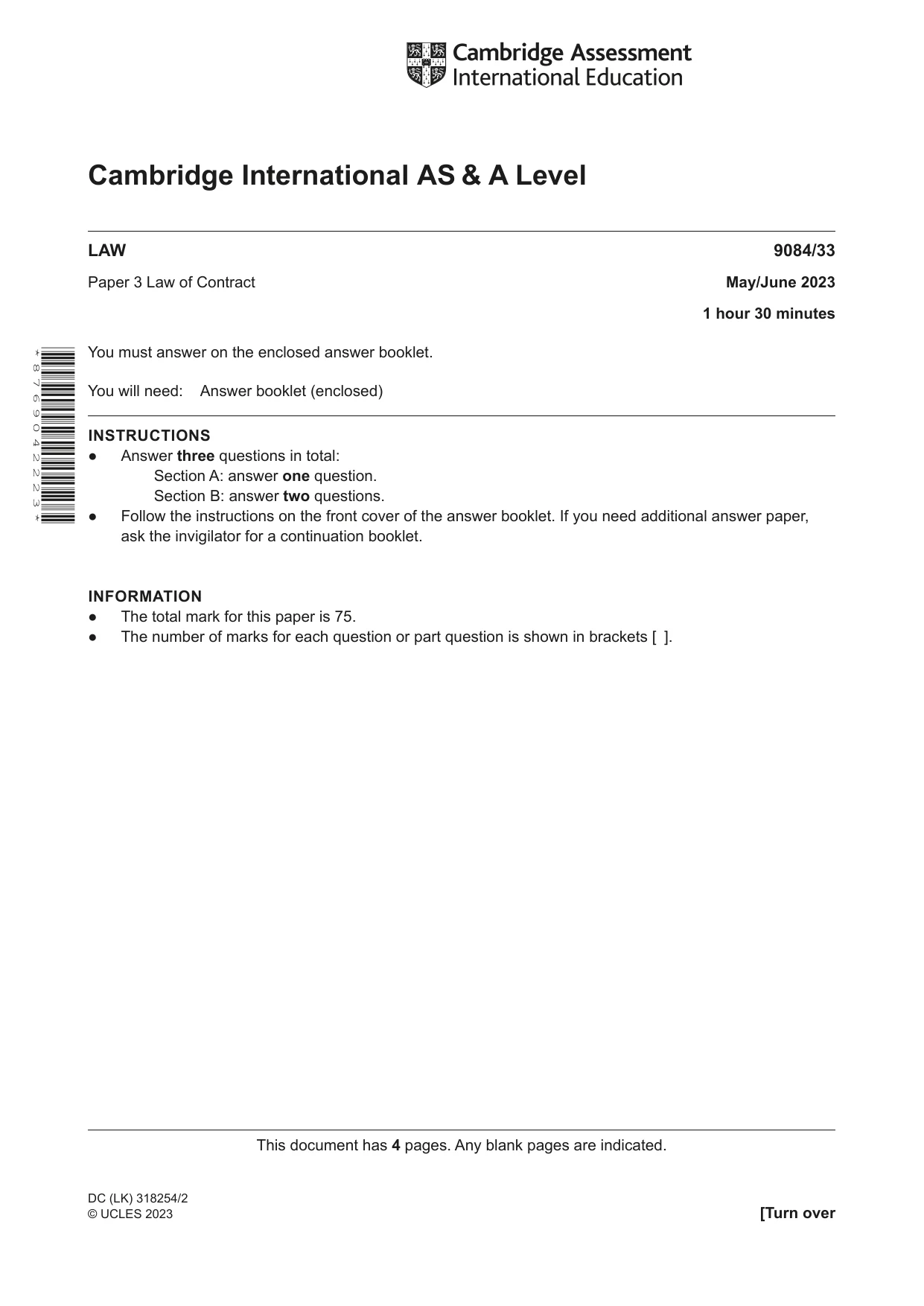
This document has 4 pages. Any blank pages are indicated. [Turn over Cambridge International AS & A Level LAW 9084/33 Paper 3 Law of Contract May/June 2023 1 hour 30 minutes You must answer on the enclosed answer booklet. You will need: Answer booklet (enclosed) INSTRUCTIONS ● Answer three questions in total: Section A: answer one question. Section B: answer two questions. ● Follow the instructions on the front cover of the answer booklet. If you need additional answer paper, ask the invigilator for a continuation booklet. INFORMATION ● The total mark for this paper is 75. ● The number of marks for each question or part question is shown in brackets [ ]. * 8 7 6 9 0 4 2 2 2 3 * DC (LK) 318254/2 © UCLES 2023
Question paper, page 2
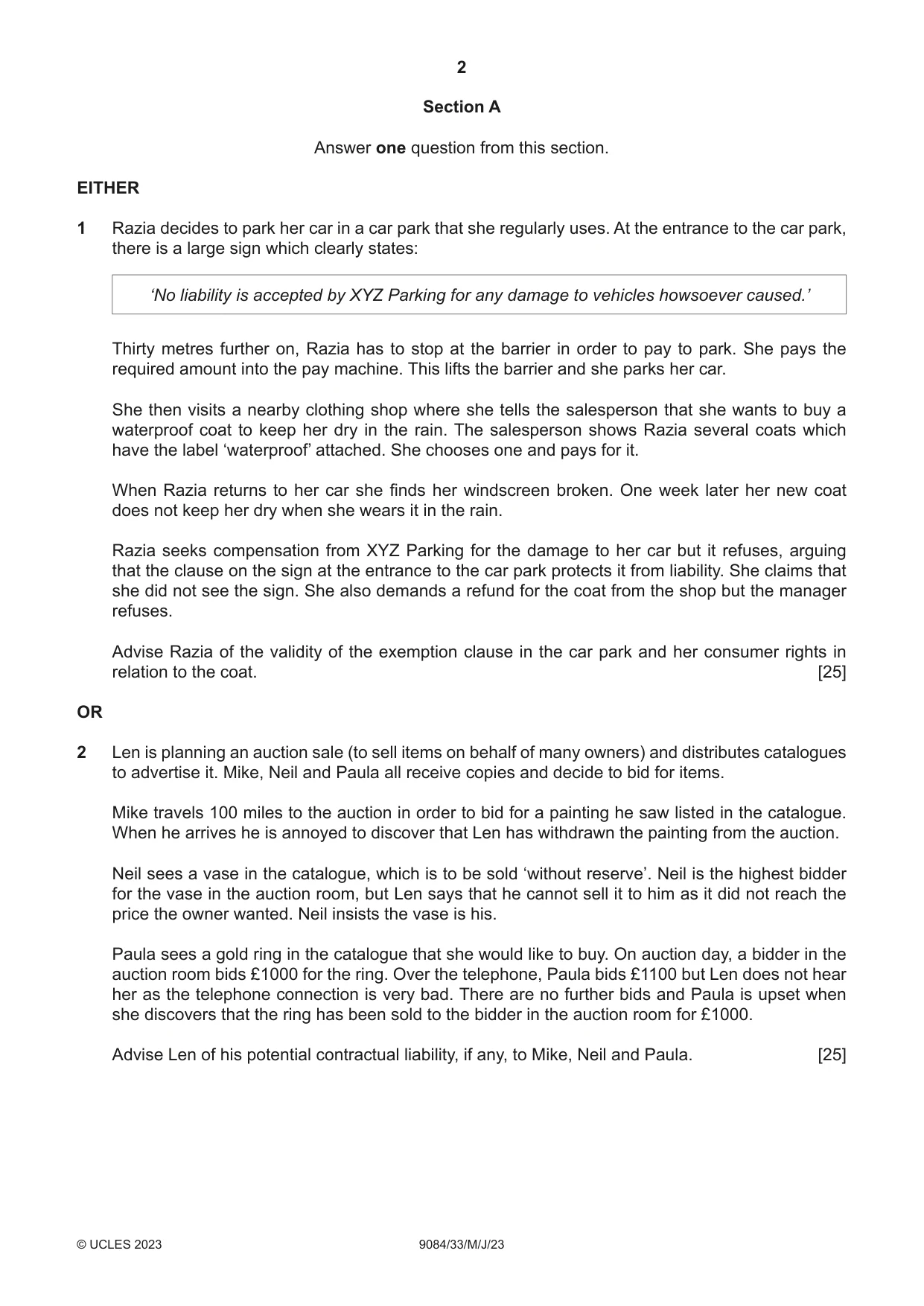
2 9084/33/M/J/23 © UCLES 2023 Section A Answer one question from this section. EITHER 1 Razia decides to park her car in a car park that she regularly uses. At the entrance to the car park, there is a large sign which clearly states: ‘No liability is accepted by XYZ Parking for any damage to vehicles howsoever caused.’ Thirty metres further on, Razia has to stop at the barrier in order to pay to park. She pays the required amount into the pay machine. This lifts the barrier and she parks her car. She then visits a nearby clothing shop where she tells the salesperson that she wants to buy a waterproof coat to keep her dry in the rain. The salesperson shows Razia several coats which have the label ‘waterproof’ attached. She chooses one and pays for it. When Razia returns to her car she finds her windscreen broken. One week later her new coat does not keep her dry when she wears it in the rain. Razia seeks compensation from XYZ Parking for the damage to her car but it refuses, arguing that the clause on the sign at the entrance to the car park protects it from liability. She claims that she did not see the sign. She also demands a refund for the coat from the shop but the manager refuses. Advise Razia of the validity of the exemption clause in the car park and her consumer rights in relation to the coat. [25] OR 2 Len is planning an auction sale (to sell items on behalf of many owners) and distributes catalogues to advertise it. Mike, Neil and Paula all receive copies and decide to bid for items. Mike travels 100 miles to the auction in order to bid for a painting he saw listed in the catalogue. When he arrives he is annoyed to discover that Len has withdrawn the painting from the auction. Neil sees a vase in the catalogue, which is to be sold ‘without reserve’. Neil is the highest bidder for the vase in the auction room, but Len says that he cannot sell it to him as it did not reach the price the owner wanted. Neil insists the vase is his. Paula sees a gold ring in the catalogue that she would like to buy. On auction day, a bidder in the auction room bids £1000 for the ring. Over the telephone, Paula bids £1100 but Len does not hear her as the telephone connection is very bad. There are no further bids and Paula is upset when she discovers that the ring has been sold to the bidder in the auction room for £1000. Advise Len of his potential contractual liability, if any, to Mike, Neil and Paula. [25]
Question paper, page 3
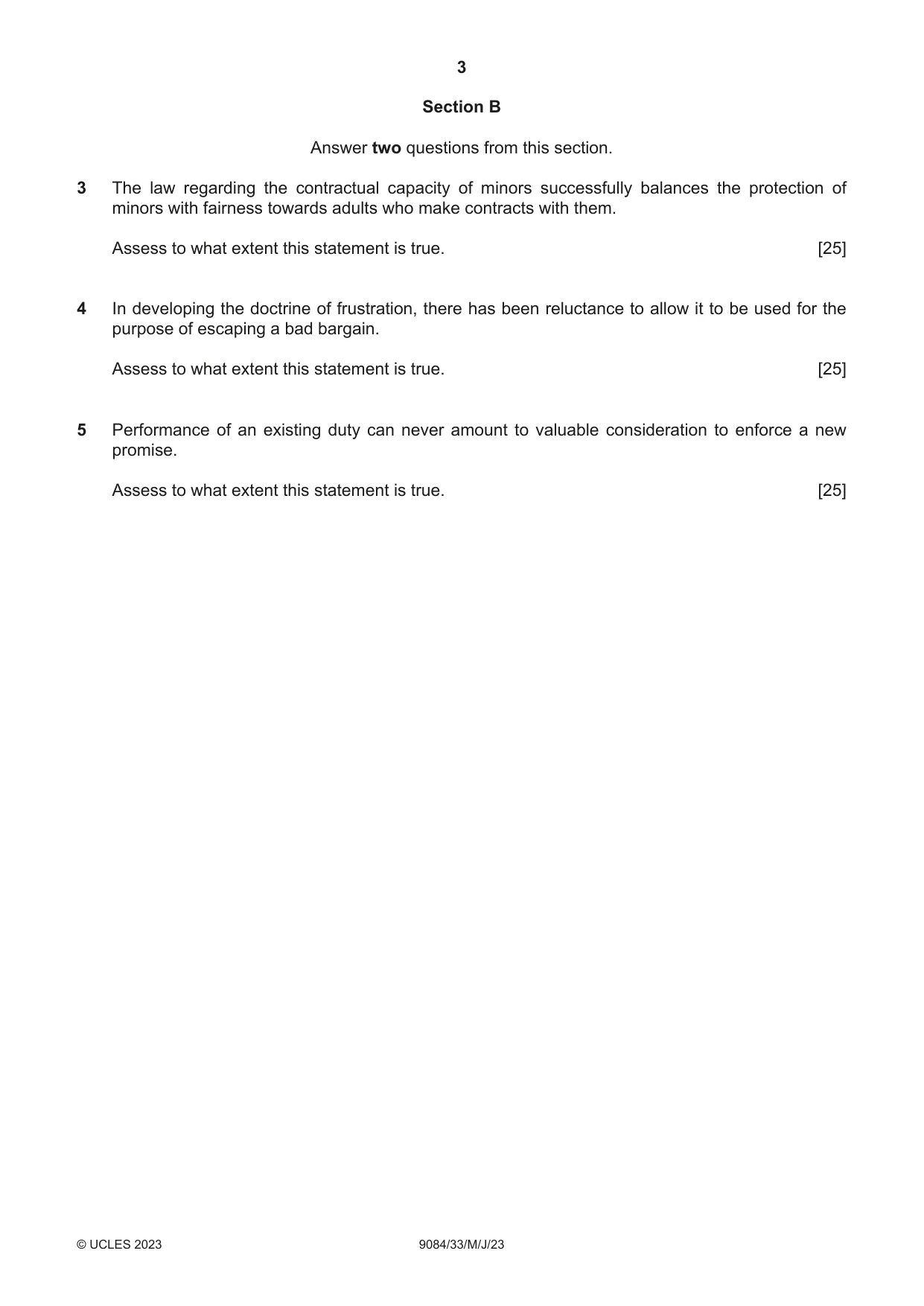
3 9084/33/M/J/23 © UCLES 2023 Section B Answer two questions from this section. 3 The law regarding the contractual capacity of minors successfully balances the protection of minors with fairness towards adults who make contracts with them. Assess to what extent this statement is true. [25] 4 In developing the doctrine of frustration, there has been reluctance to allow it to be used for the purpose of escaping a bad bargain. Assess to what extent this statement is true. [25] 5 Performance of an existing duty can never amount to valuable consideration to enforce a new promise. Assess to what extent this statement is true. [25]
Question paper, page 4
4 9084/33/M/J/23 © UCLES 2023 Permission to reproduce items where third-party owned material protected by copyright is included has been sought and cleared where possible. Every reasonable effort has been made by the publisher (UCLES) to trace copyright holders, but if any items requiring clearance have unwittingly been included, the publisher will be pleased to make amends at the earliest possible opportunity. To avoid the issue of disclosure of answer-related information to candidates, all copyright acknowledgements are reproduced online in the Cambridge Assessment International Education Copyright Acknowledgements Booklet. This is produced for each series of examinations and is freely available to download at www.cambridgeinternational.org after the live examination series. Cambridge Assessment International Education is part of Cambridge Assessment. Cambridge Assessment is the brand name of the University of Cambridge Local Examinations Syndicate (UCLES), which is a department of the University of Cambridge. BLANK PAGE
Mark scheme, page 1
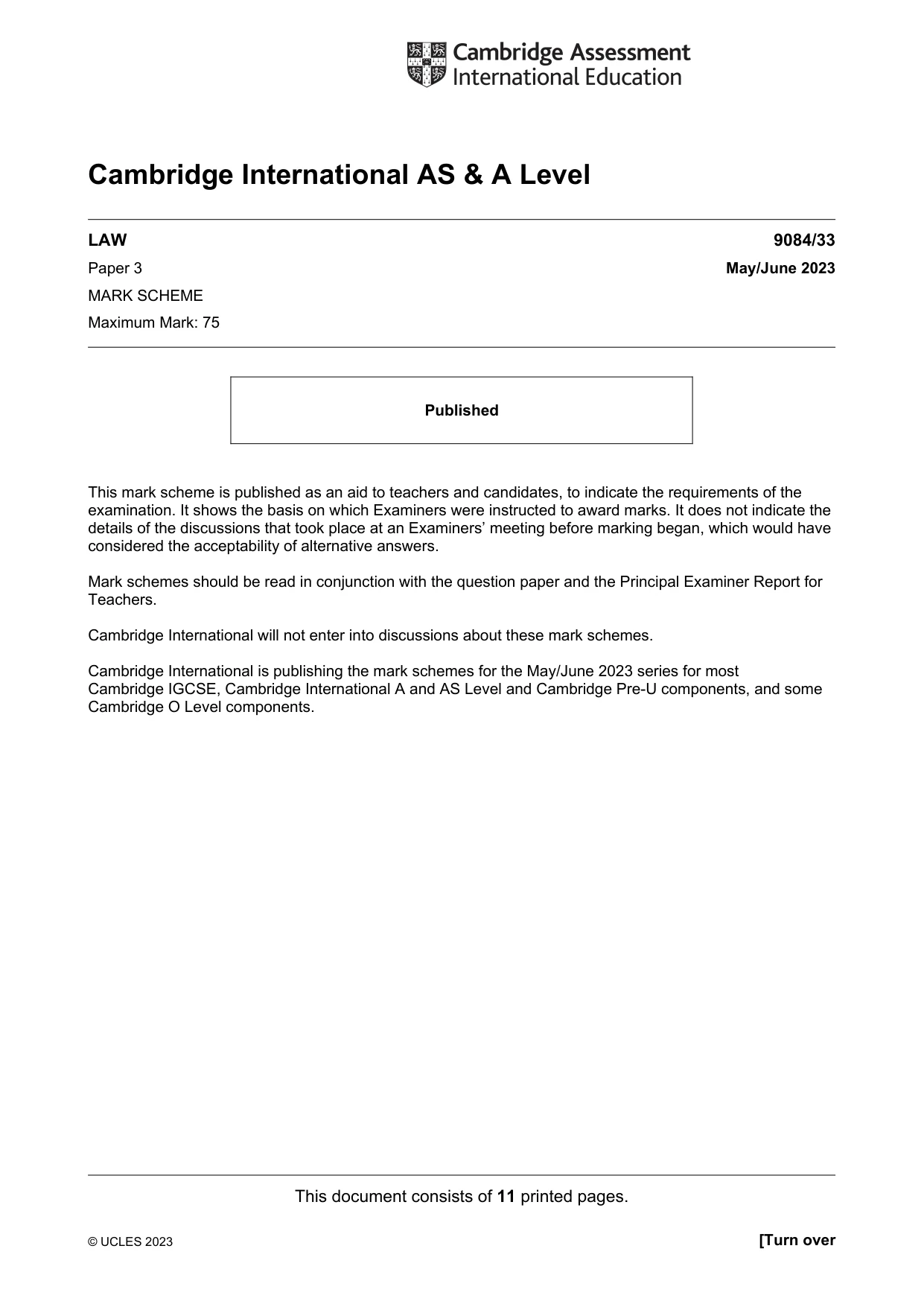
This document consists of 11 printed pages. © UCLES 2023 [Turn over Cambridge International AS & A Level LAW 9084/33 Paper 3 May/June 2023 MARK SCHEME Maximum Mark: 75 Published This mark scheme is published as an aid to teachers and candidates, to indicate the requirements of the examination. It shows the basis on which Examiners were instructed to award marks. It does not indicate the details of the discussions that took place at an Examiners’ meeting before marking began, which would have considered the acceptability of alternative answers. Mark schemes should be read in conjunction with the question paper and the Principal Examiner Report for Teachers. Cambridge International will not enter into discussions about these mark schemes. Cambridge International is publishing the mark schemes for the May/June 2023 series for most Cambridge IGCSE, Cambridge International A and AS Level and Cambridge Pre-U components, and some Cambridge O Level components.
Mark scheme, page 2
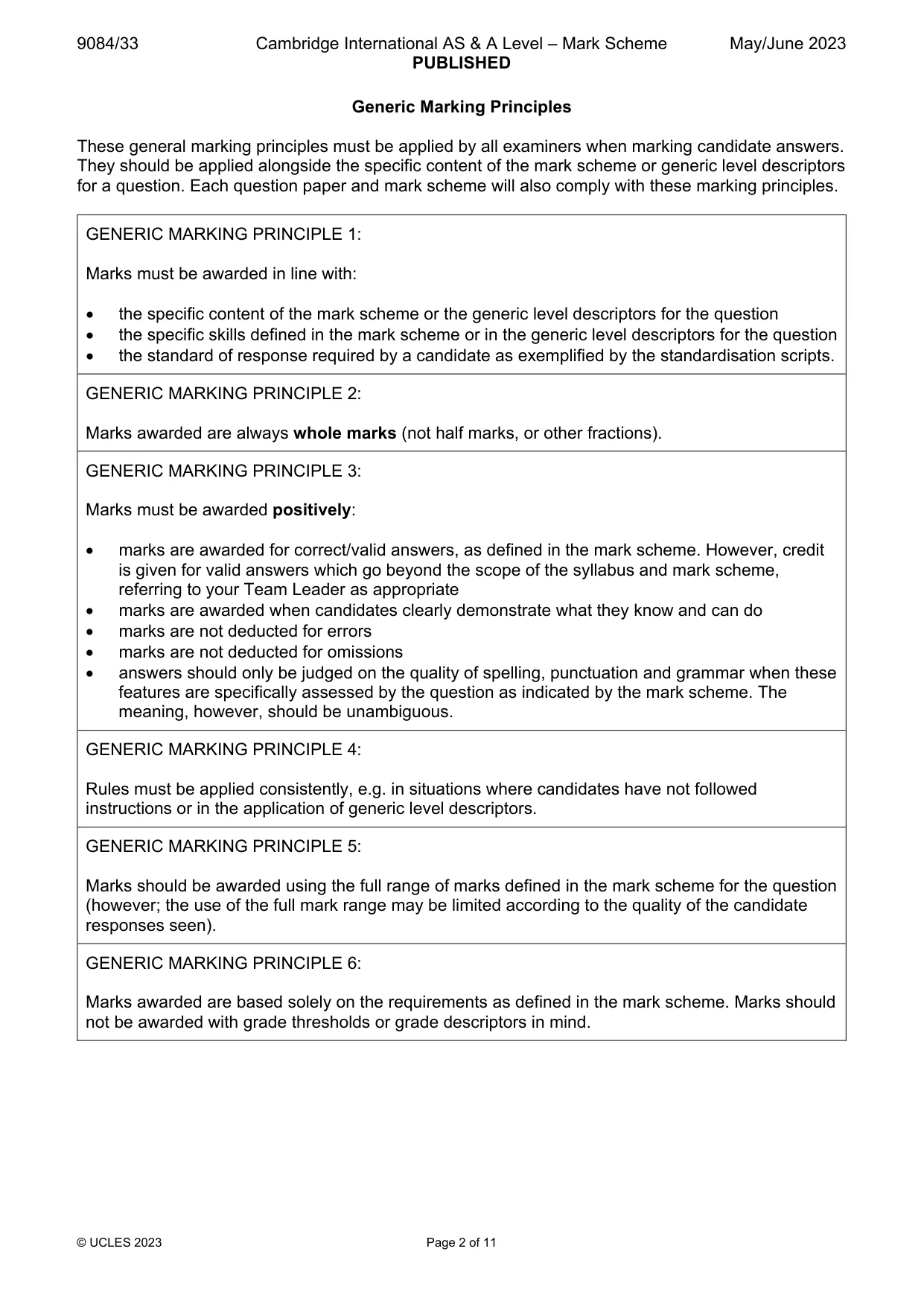
9084/33 Cambridge International AS & A Level – Mark Scheme PUBLISHED May/June 2023 © UCLES 2023 Page 2 of 11 Generic Marking Principles These general marking principles must be applied by all examiners when marking candidate answers. They should be applied alongside the specific content of the mark scheme or generic level descriptors for a question. Each question paper and mark scheme will also comply with these marking principles. GENERIC MARKING PRINCIPLE 1: Marks must be awarded in line with: the specific content of the mark scheme or the generic level descriptors for the question the specific skills defined in the mark scheme or in the generic level descriptors for the question the standard of response required by a candidate as exemplified by the standardisation scripts. GENERIC MARKING PRINCIPLE 2: Marks awarded are always whole marks (not half marks, or other fractions). GENERIC MARKING PRINCIPLE 3: Marks must be awarded positively: marks are awarded for correct/valid answers, as defined in the mark scheme. However, credit is given for valid answers which go beyond the scope of the syllabus and mark scheme, referring to your Team Leader as appropriate marks are awarded when candidates clearly demonstrate what they know and can do marks are not deducted for errors marks are not deducted for omissions answers should only be judged on the quality of spelling, punctuation and grammar when these features are specifically assessed by the question as indicated by the mark scheme. The meaning, however, should be unambiguous. GENERIC MARKING PRINCIPLE 4: Rules must be applied consistently, e.g. in situations where candidates have not followed instructions or in the application of generic level descriptors. GENERIC MARKING PRINCIPLE 5: Marks should be awarded using the full range of marks defined in the mark scheme for the question (however; the use of the full mark range may be limited according to the quality of the candidate responses seen). GENERIC MARKING PRINCIPLE 6: Marks awarded are based solely on the requirements as defined in the mark scheme. Marks should not be awarded with grade thresholds or grade descriptors in mind.
Mark scheme, page 3
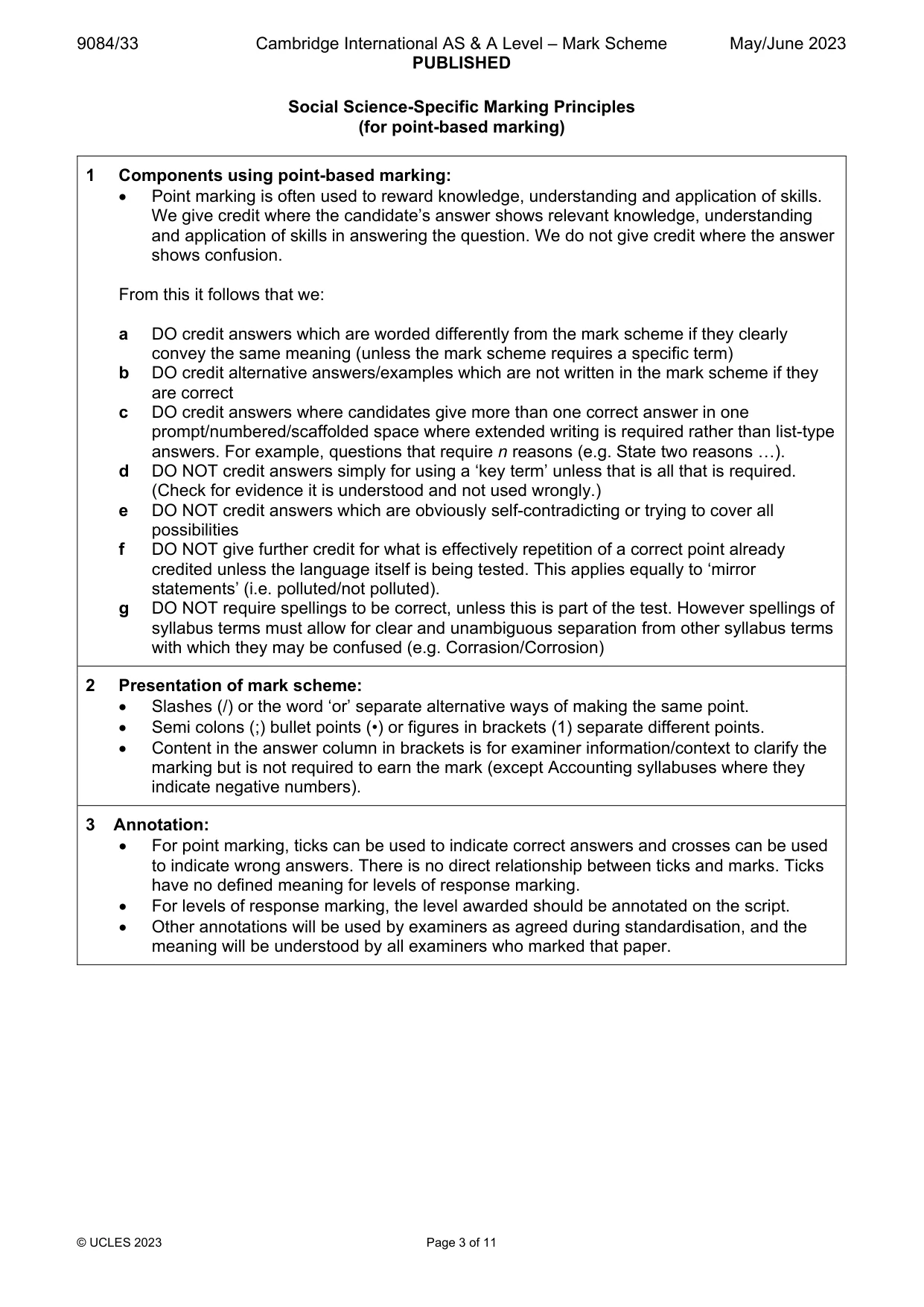
9084/33 Cambridge International AS & A Level – Mark Scheme PUBLISHED May/June 2023 © UCLES 2023 Page 3 of 11 Social Science-Specific Marking Principles (for point-based marking) 1 Components using point-based marking: Point marking is often used to reward knowledge, understanding and application of skills. We give credit where the candidate’s answer shows relevant knowledge, understanding and application of skills in answering the question. We do not give credit where the answer shows confusion. From this it follows that we: a DO credit answers which are worded differently from the mark scheme if they clearly convey the same meaning (unless the mark scheme requires a specific term) b DO credit alternative answers/examples which are not written in the mark scheme if they are correct c DO credit answers where candidates give more than one correct answer in one prompt/numbered/scaffolded space where extended writing is required rather than list-type answers. For example, questions that require n reasons (e.g. State two reasons …). d DO NOT credit answers simply for using a ‘key term’ unless that is all that is required. (Check for evidence it is understood and not used wrongly.) e DO NOT credit answers which are obviously self-contradicting or trying to cover all possibilities f DO NOT give further credit for what is effectively repetition of a correct point already credited unless the language itself is being tested. This applies equally to ‘mirror statements’ (i.e. polluted/not polluted). g DO NOT require spellings to be correct, unless this is part of the test. However spellings of syllabus terms must allow for clear and unambiguous separation from other syllabus terms with which they may be confused (e.g. Corrasion/Corrosion) 2 Presentation of mark scheme: Slashes (/) or the word ‘or’ separate alternative ways of making the same point. Semi colons (;) bullet points (•) or figures in brackets (1) separate different points. Content in the answer column in brackets is for examiner information/context to clarify the marking but is not required to earn the mark (except Accounting syllabuses where they indicate negative numbers). 3 Annotation: For point marking, ticks can be used to indicate correct answers and crosses can be used to indicate wrong answers. There is no direct relationship between ticks and marks. Ticks have no defined meaning for levels of response marking. For levels of response marking, the level awarded should be annotated on the script. Other annotations will be used by examiners as agreed during standardisation, and the meaning will be understood by all examiners who marked that paper.
Mark scheme, page 4
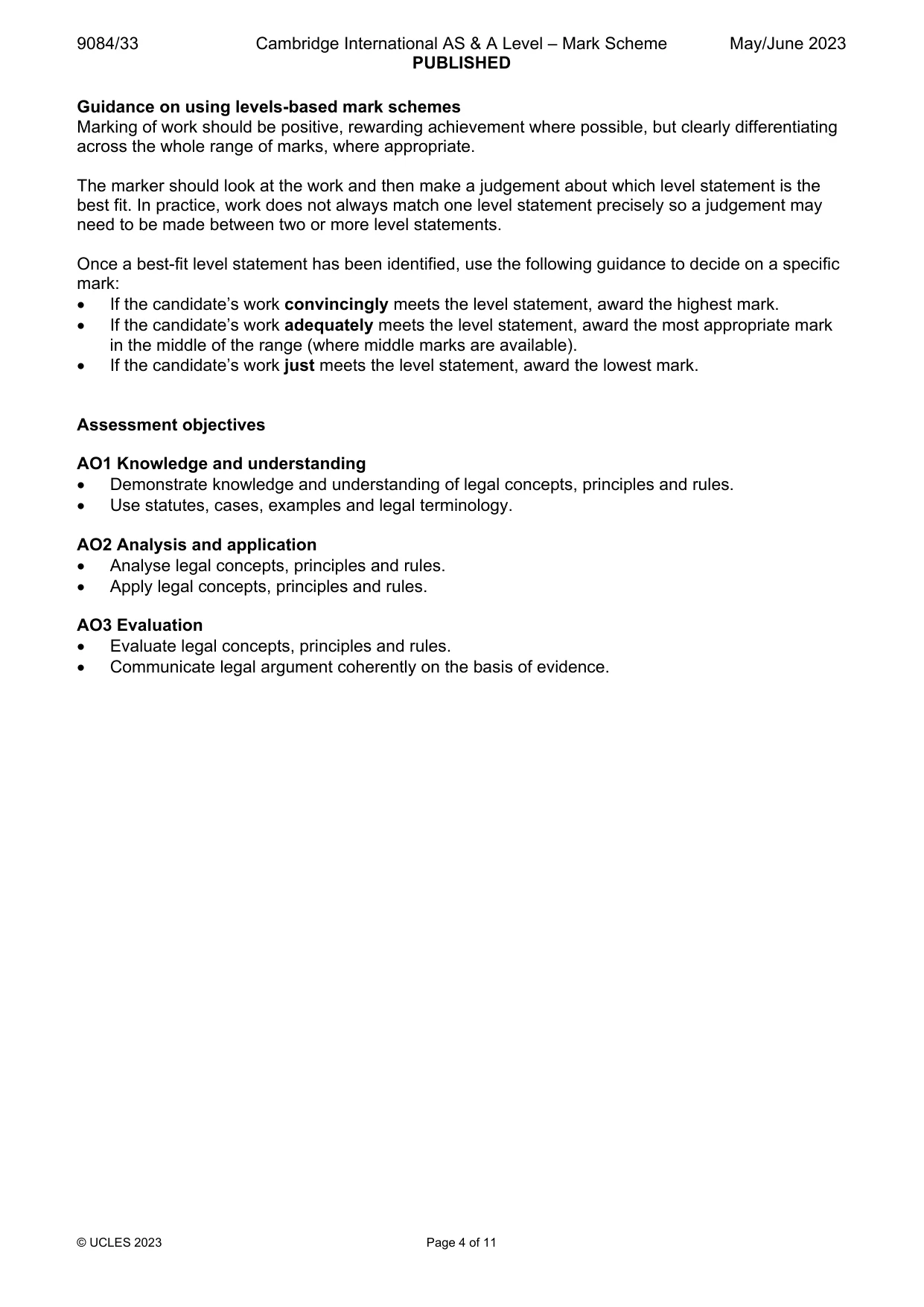
9084/33 Cambridge International AS & A Level – Mark Scheme PUBLISHED May/June 2023 © UCLES 2023 Page 4 of 11 Guidance on using levels-based mark schemes Marking of work should be positive, rewarding achievement where possible, but clearly differentiating across the whole range of marks, where appropriate. The marker should look at the work and then make a judgement about which level statement is the best fit. In practice, work does not always match one level statement precisely so a judgement may need to be made between two or more level statements. Once a best-fit level statement has been identified, use the following guidance to decide on a specific mark: If the candidate’s work convincingly meets the level statement, award the highest mark. If the candidate’s work adequately meets the level statement, award the most appropriate mark in the middle of the range (where middle marks are available). If the candidate’s work just meets the level statement, award the lowest mark. Assessment objectives AO1 Knowledge and understanding Demonstrate knowledge and understanding of legal concepts, principles and rules. Use statutes, cases, examples and legal terminology. AO2 Analysis and application Analyse legal concepts, principles and rules. Apply legal concepts, principles and rules. AO3 Evaluation Evaluate legal concepts, principles and rules. Communicate legal argument coherently on the basis of evidence.
Mark scheme, page 5
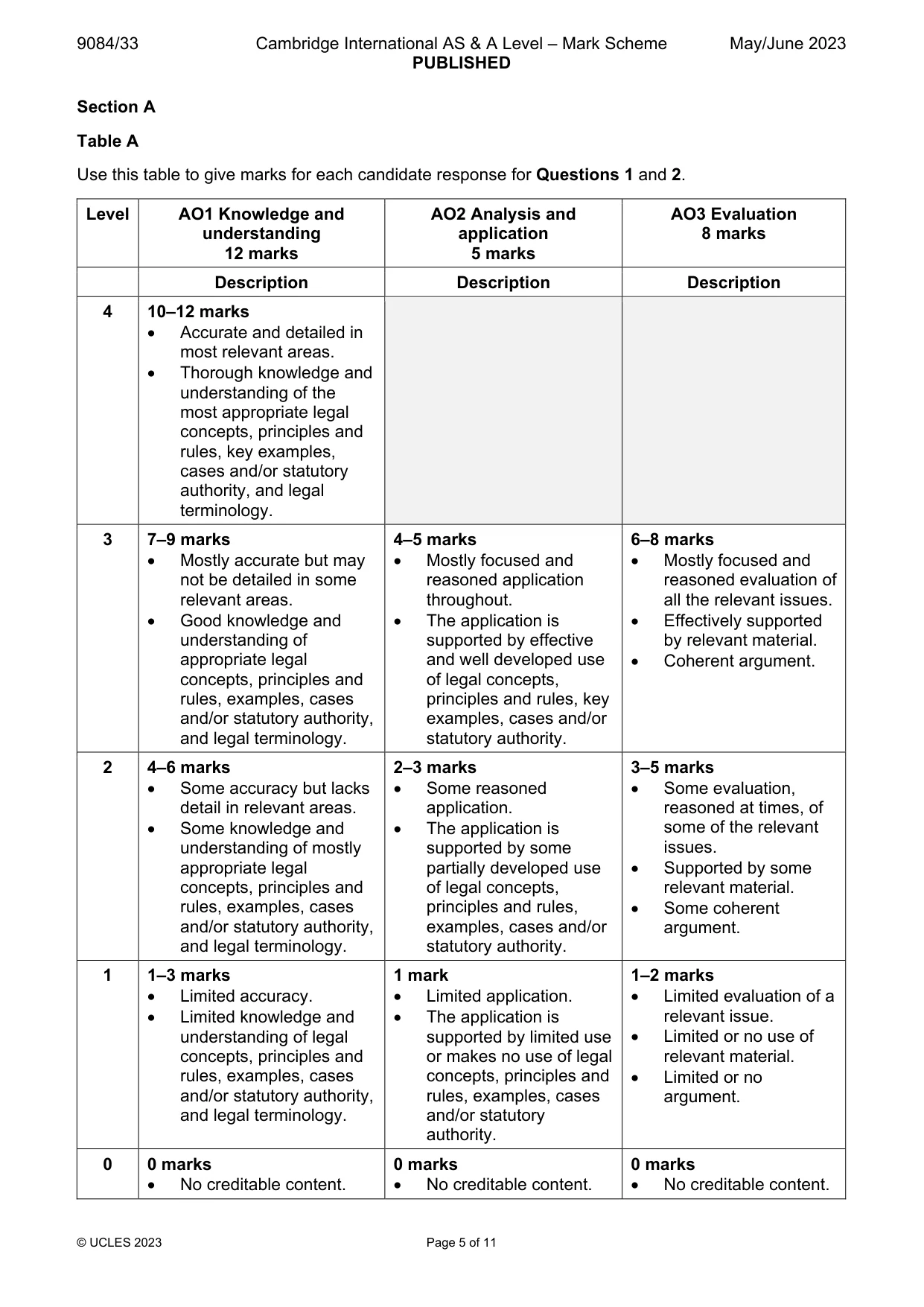
9084/33 Cambridge International AS & A Level – Mark Scheme PUBLISHED May/June 2023 © UCLES 2023 Page 5 of 11 Section A Table A Use this table to give marks for each candidate response for Questions 1 and 2. Level AO1 Knowledge and understanding 12 marks AO2 Analysis and application 5 marks AO3 Evaluation 8 marks Description Description Description 4 10–12 marks Accurate and detailed in most relevant areas. Thorough knowledge and understanding of the most appropriate legal concepts, principles and rules, key examples, cases and/or statutory authority, and legal terminology. 3 7–9 marks Mostly accurate but may not be detailed in some relevant areas. Good knowledge and understanding of appropriate legal concepts, principles and rules, examples, cases and/or statutory authority, and legal terminology. 4–5 marks Mostly focused and reasoned application throughout. The application is supported by effective and well developed use of legal concepts, principles and rules, key examples, cases and/or statutory authority. 6–8 marks Mostly focused and reasoned evaluation of all the relevant issues. Effectively supported by relevant material. Coherent argument. 2 4–6 marks Some accuracy but lacks detail in relevant areas. Some knowledge and understanding of mostly appropriate legal concepts, principles and rules, examples, cases and/or statutory authority, and legal terminology. 2–3 marks Some reasoned application. The application is supported by some partially developed use of legal concepts, principles and rules, examples, cases and/or statutory authority. 3–5 marks Some evaluation, reasoned at times, of some of the relevant issues. Supported by some relevant material. Some coherent argument. 1 1–3 marks Limited accuracy. Limited knowledge and understanding of legal concepts, principles and rules, examples, cases and/or statutory authority, and legal terminology. 1 mark Limited application. The application is supported by limited use or makes no use of legal concepts, principles and rules, examples, cases and/or statutory authority. 1–2 marks Limited evaluation of a relevant issue. Limited or no use of relevant material. Limited or no argument. 0 0 marks No creditable content. 0 marks No creditable content. 0 marks No creditable content.
Mark scheme, page 6
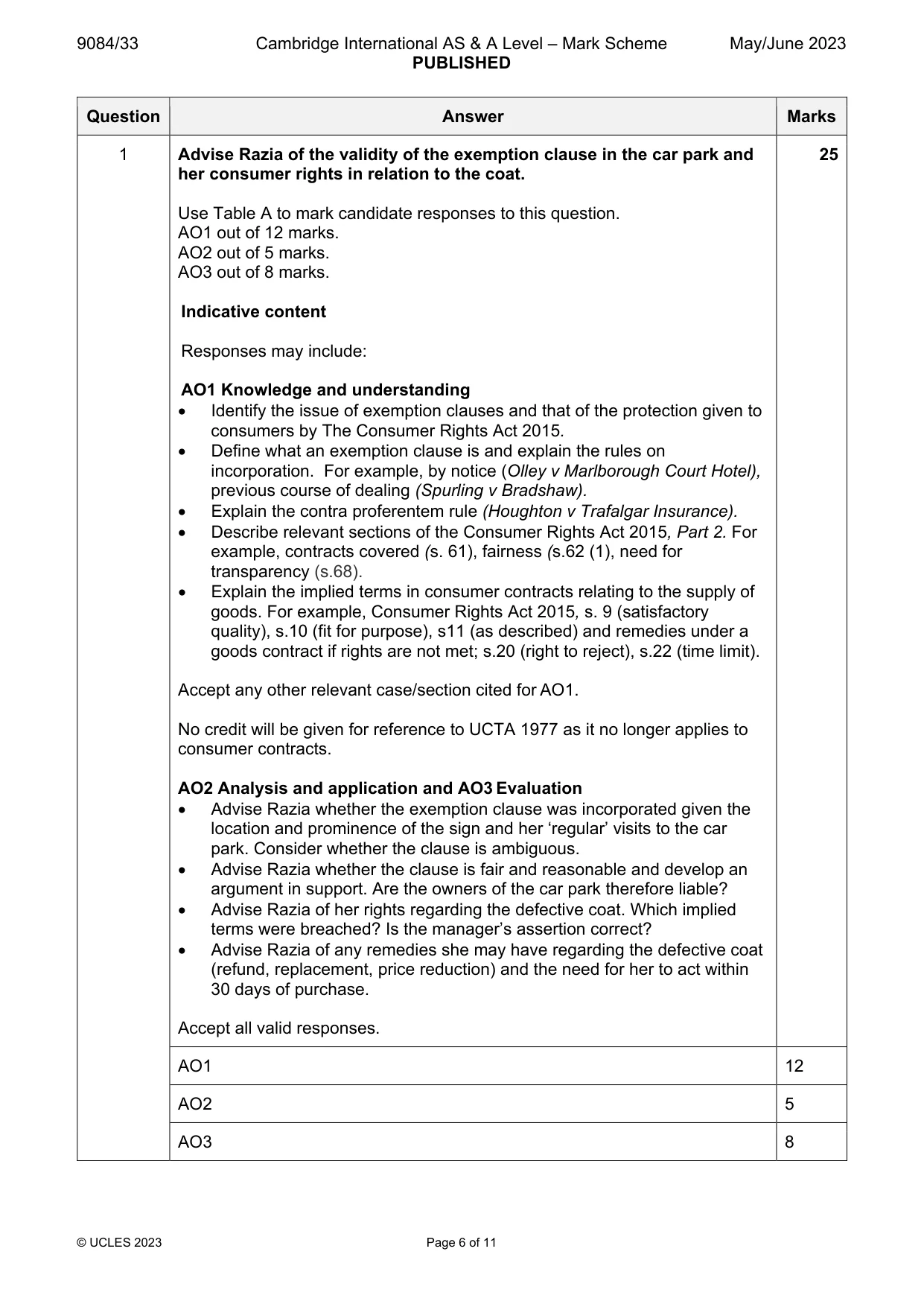
9084/33 Cambridge International AS & A Level – Mark Scheme PUBLISHED May/June 2023 © UCLES 2023 Page 6 of 11 Question Answer Marks 1 Advise Razia of the validity of the exemption clause in the car park and her consumer rights in relation to the coat. Use Table A to mark candidate responses to this question. AO1 out of 12 marks. AO2 out of 5 marks. AO3 out of 8 marks. Indicative content Responses may include: AO1 Knowledge and understanding Identify the issue of exemption clauses and that of the protection given to consumers by The Consumer Rights Act 2015. Define what an exemption clause is and explain the rules on incorporation. For example, by notice (Olley v Marlborough Court Hotel), previous course of dealing (Spurling v Bradshaw). Explain the contra proferentem rule (Houghton v Trafalgar Insurance). Describe relevant sections of the Consumer Rights Act 2015, Part 2. For example, contracts covered (s. 61), fairness (s.62 (1), need for transparency (s.68). Explain the implied terms in consumer contracts relating to the supply of goods. For example, Consumer Rights Act 2015, s. 9 (satisfactory quality), s.10 (fit for purpose), s11 (as described) and remedies under a goods contract if rights are not met; s.20 (right to reject), s.22 (time limit). Accept any other relevant case/section cited for AO1. No credit will be given for reference to UCTA 1977 as it no longer applies to consumer contracts. AO2 Analysis and application and AO3 Evaluation Advise Razia whether the exemption clause was incorporated given the location and prominence of the sign and her ‘regular’ visits to the car park. Consider whether the clause is ambiguous. Advise Razia whether the clause is fair and reasonable and develop an argument in support. Are the owners of the car park therefore liable? Advise Razia of her rights regarding the defective coat. Which implied terms were breached? Is the manager’s assertion correct? Advise Razia of any remedies she may have regarding the defective coat (refund, replacement, price reduction) and the need for her to act within 30 days of purchase. Accept all valid responses. 25 AO1 12 AO2 5 AO3 8
Mark scheme, page 7
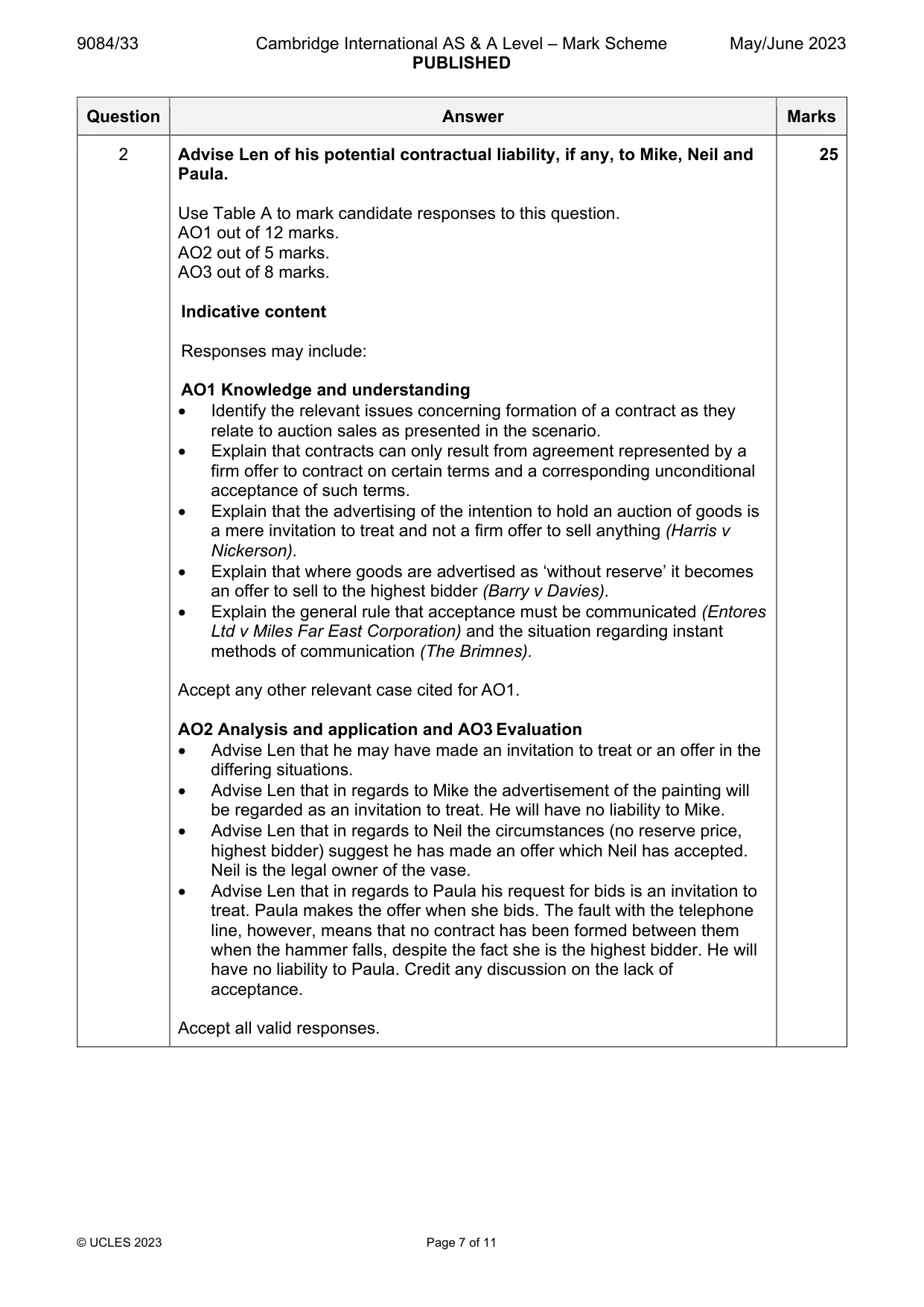
9084/33 Cambridge International AS & A Level – Mark Scheme PUBLISHED May/June 2023 © UCLES 2023 Page 7 of 11 Question Answer Marks 2 Advise Len of his potential contractual liability, if any, to Mike, Neil and Paula. Use Table A to mark candidate responses to this question. AO1 out of 12 marks. AO2 out of 5 marks. AO3 out of 8 marks. Indicative content Responses may include: AO1 Knowledge and understanding Identify the relevant issues concerning formation of a contract as they relate to auction sales as presented in the scenario. Explain that contracts can only result from agreement represented by a firm offer to contract on certain terms and a corresponding unconditional acceptance of such terms. Explain that the advertising of the intention to hold an auction of goods is a mere invitation to treat and not a firm offer to sell anything (Harris v Nickerson). Explain that where goods are advertised as ‘without reserve’ it becomes an offer to sell to the highest bidder (Barry v Davies). Explain the general rule that acceptance must be communicated (Entores Ltd v Miles Far East Corporation) and the situation regarding instant methods of communication (The Brimnes). Accept any other relevant case cited for AO1. AO2 Analysis and application and AO3 Evaluation Advise Len that he may have made an invitation to treat or an offer in the differing situations. Advise Len that in regards to Mike the advertisement of the painting will be regarded as an invitation to treat. He will have no liability to Mike. Advise Len that in regards to Neil the circumstances (no reserve price, highest bidder) suggest he has made an offer which Neil has accepted. Neil is the legal owner of the vase. Advise Len that in regards to Paula his request for bids is an invitation to treat. Paula makes the offer when she bids. The fault with the telephone line, however, means that no contract has been formed between them when the hammer falls, despite the fact she is the highest bidder. He will have no liability to Paula. Credit any discussion on the lack of acceptance. Accept all valid responses. 25
Mark scheme, page 8
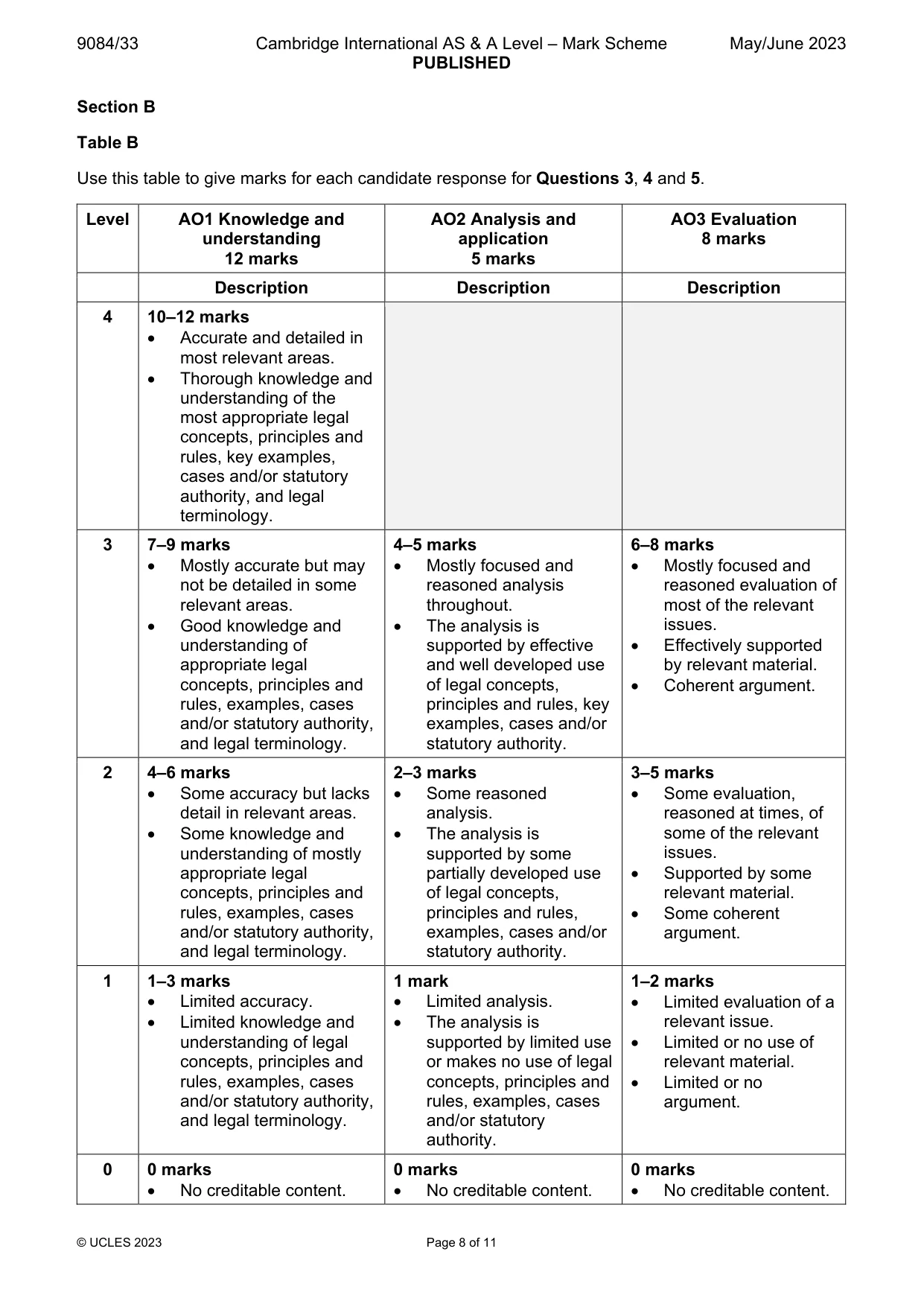
9084/33 Cambridge International AS & A Level – Mark Scheme PUBLISHED May/June 2023 © UCLES 2023 Page 8 of 11 Section B Table B Use this table to give marks for each candidate response for Questions 3, 4 and 5. Level AO1 Knowledge and understanding 12 marks AO2 Analysis and application 5 marks AO3 Evaluation 8 marks Description Description Description 4 10–12 marks Accurate and detailed in most relevant areas. Thorough knowledge and understanding of the most appropriate legal concepts, principles and rules, key examples, cases and/or statutory authority, and legal terminology. 3 7–9 marks Mostly accurate but may not be detailed in some relevant areas. Good knowledge and understanding of appropriate legal concepts, principles and rules, examples, cases and/or statutory authority, and legal terminology. 4–5 marks Mostly focused and reasoned analysis throughout. The analysis is supported by effective and well developed use of legal concepts, principles and rules, key examples, cases and/or statutory authority. 6–8 marks Mostly focused and reasoned evaluation of most of the relevant issues. Effectively supported by relevant material. Coherent argument. 2 4–6 marks Some accuracy but lacks detail in relevant areas. Some knowledge and understanding of mostly appropriate legal concepts, principles and rules, examples, cases and/or statutory authority, and legal terminology. 2–3 marks Some reasoned analysis. The analysis is supported by some partially developed use of legal concepts, principles and rules, examples, cases and/or statutory authority. 3–5 marks Some evaluation, reasoned at times, of some of the relevant issues. Supported by some relevant material. Some coherent argument. 1 1–3 marks Limited accuracy. Limited knowledge and understanding of legal concepts, principles and rules, examples, cases and/or statutory authority, and legal terminology. 1 mark Limited analysis. The analysis is supported by limited use or makes no use of legal concepts, principles and rules, examples, cases and/or statutory authority. 1–2 marks Limited evaluation of a relevant issue. Limited or no use of relevant material. Limited or no argument. 0 0 marks No creditable content. 0 marks No creditable content. 0 marks No creditable content.
Mark scheme, page 9
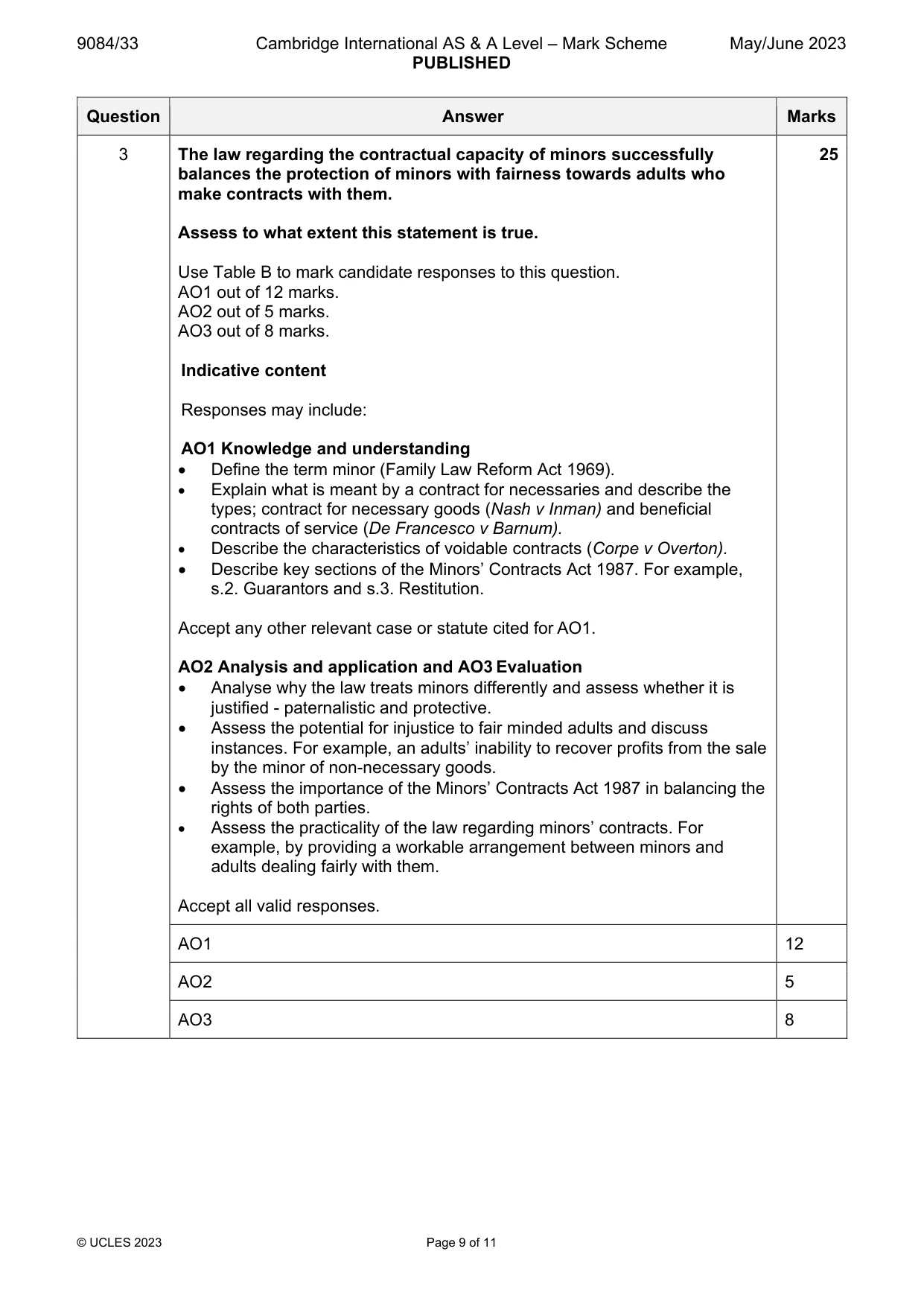
9084/33 Cambridge International AS & A Level – Mark Scheme PUBLISHED May/June 2023 © UCLES 2023 Page 9 of 11 Question Answer Marks 3 The law regarding the contractual capacity of minors successfully balances the protection of minors with fairness towards adults who make contracts with them. Assess to what extent this statement is true. Use Table B to mark candidate responses to this question. AO1 out of 12 marks. AO2 out of 5 marks. AO3 out of 8 marks. Indicative content Responses may include: AO1 Knowledge and understanding Define the term minor (Family Law Reform Act 1969). Explain what is meant by a contract for necessaries and describe the types; contract for necessary goods (Nash v Inman) and beneficial contracts of service (De Francesco v Barnum). Describe the characteristics of voidable contracts (Corpe v Overton). Describe key sections of the Minors’ Contracts Act 1987. For example, s.2. Guarantors and s.3. Restitution. Accept any other relevant case or statute cited for AO1. AO2 Analysis and application and AO3 Evaluation Analyse why the law treats minors differently and assess whether it is justified - paternalistic and protective. Assess the potential for injustice to fair minded adults and discuss instances. For example, an adults’ inability to recover profits from the sale by the minor of non-necessary goods. Assess the importance of the Minors’ Contracts Act 1987 in balancing the rights of both parties. Assess the practicality of the law regarding minors’ contracts. For example, by providing a workable arrangement between minors and adults dealing fairly with them. Accept all valid responses. 25 AO1 12 AO2 5 AO3 8
Mark scheme, page 10
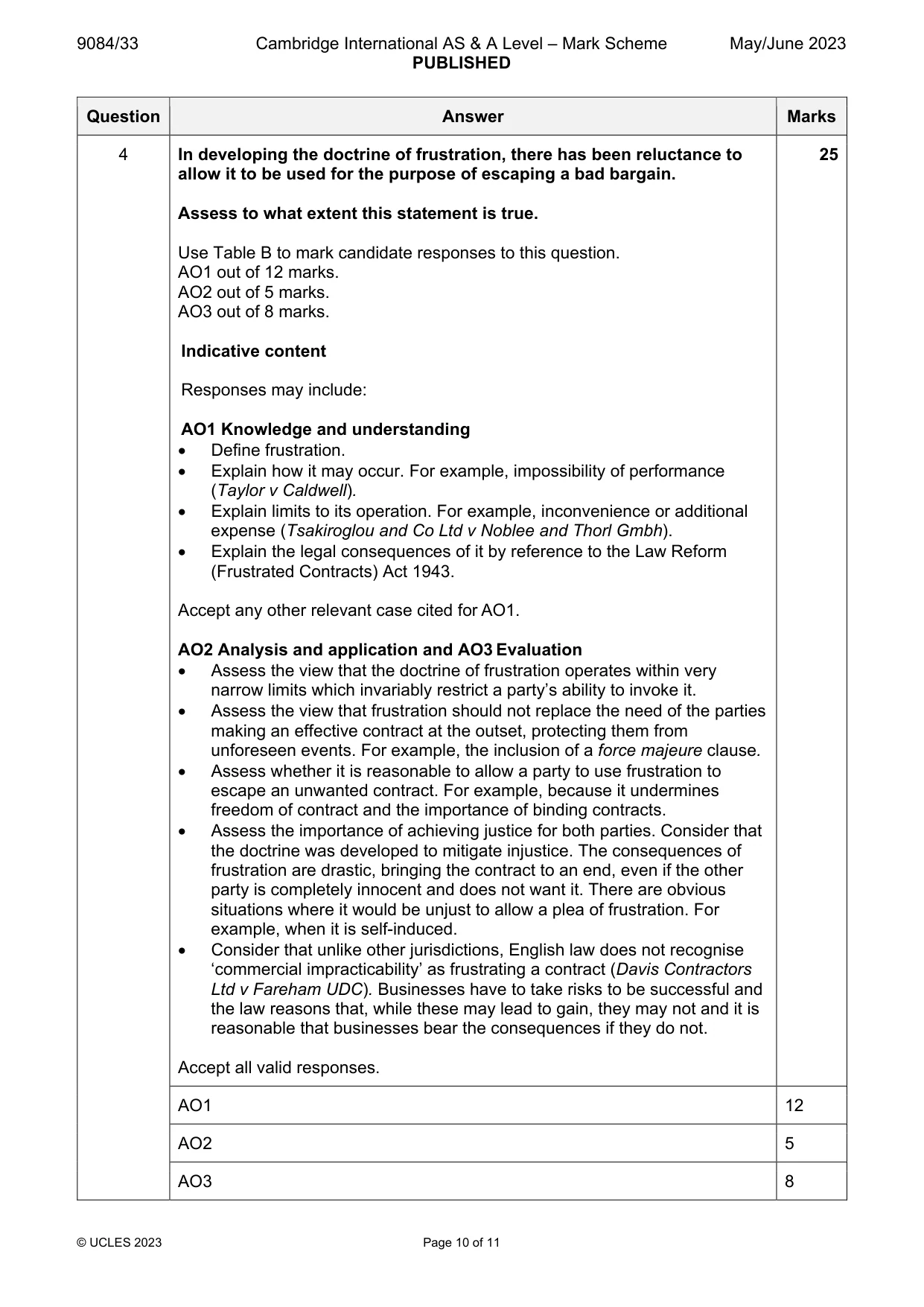
9084/33 Cambridge International AS & A Level – Mark Scheme PUBLISHED May/June 2023 © UCLES 2023 Page 10 of 11 Question Answer Marks 4 In developing the doctrine of frustration, there has been reluctance to allow it to be used for the purpose of escaping a bad bargain. Assess to what extent this statement is true. Use Table B to mark candidate responses to this question. AO1 out of 12 marks. AO2 out of 5 marks. AO3 out of 8 marks. Indicative content Responses may include: AO1 Knowledge and understanding Define frustration. Explain how it may occur. For example, impossibility of performance (Taylor v Caldwell). Explain limits to its operation. For example, inconvenience or additional expense (Tsakiroglou and Co Ltd v Noblee and Thorl Gmbh). Explain the legal consequences of it by reference to the Law Reform (Frustrated Contracts) Act 1943. Accept any other relevant case cited for AO1. AO2 Analysis and application and AO3 Evaluation Assess the view that the doctrine of frustration operates within very narrow limits which invariably restrict a party’s ability to invoke it. Assess the view that frustration should not replace the need of the parties making an effective contract at the outset, protecting them from unforeseen events. For example, the inclusion of a force majeure clause. Assess whether it is reasonable to allow a party to use frustration to escape an unwanted contract. For example, because it undermines freedom of contract and the importance of binding contracts. Assess the importance of achieving justice for both parties. Consider that the doctrine was developed to mitigate injustice. The consequences of frustration are drastic, bringing the contract to an end, even if the other party is completely innocent and does not want it. There are obvious situations where it would be unjust to allow a plea of frustration. For example, when it is self-induced. Consider that unlike other jurisdictions, English law does not recognise ‘commercial impracticability’ as frustrating a contract (Davis Contractors Ltd v Fareham UDC). Businesses have to take risks to be successful and the law reasons that, while these may lead to gain, they may not and it is reasonable that businesses bear the consequences if they do not. Accept all valid responses. 25 AO1 12 AO2 5 AO3 8
Mark scheme, page 11
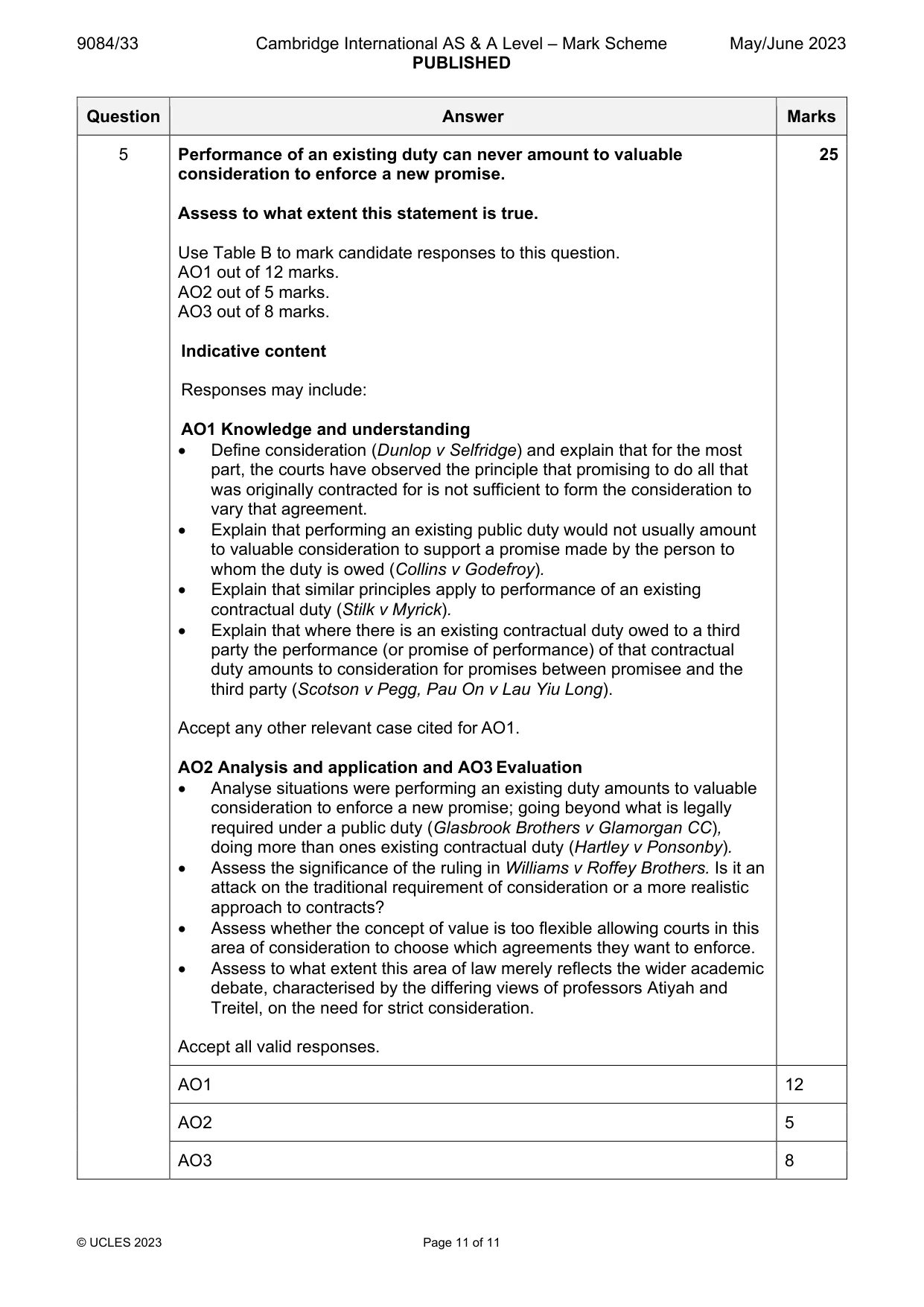
9084/33 Cambridge International AS & A Level – Mark Scheme PUBLISHED May/June 2023 © UCLES 2023 Page 11 of 11 Question Answer Marks 5 Performance of an existing duty can never amount to valuable consideration to enforce a new promise. Assess to what extent this statement is true. Use Table B to mark candidate responses to this question. AO1 out of 12 marks. AO2 out of 5 marks. AO3 out of 8 marks. Indicative content Responses may include: AO1 Knowledge and understanding Define consideration (Dunlop v Selfridge) and explain that for the most part, the courts have observed the principle that promising to do all that was originally contracted for is not sufficient to form the consideration to vary that agreement. Explain that performing an existing public duty would not usually amount to valuable consideration to support a promise made by the person to whom the duty is owed (Collins v Godefroy). Explain that similar principles apply to performance of an existing contractual duty (Stilk v Myrick). Explain that where there is an existing contractual duty owed to a third party the performance (or promise of performance) of that contractual duty amounts to consideration for promises between promisee and the third party (Scotson v Pegg, Pau On v Lau Yiu Long). Accept any other relevant case cited for AO1. AO2 Analysis and application and AO3 Evaluation Analyse situations were performing an existing duty amounts to valuable consideration to enforce a new promise; going beyond what is legally required under a public duty (Glasbrook Brothers v Glamorgan CC), doing more than ones existing contractual duty (Hartley v Ponsonby). Assess the significance of the ruling in Williams v Roffey Brothers. Is it an attack on the traditional requirement of consideration or a more realistic approach to contracts? Assess whether the concept of value is too flexible allowing courts in this area of consideration to choose which agreements they want to enforce. Assess to what extent this area of law merely reflects the wider academic debate, characterised by the differing views of professors Atiyah and Treitel, on the need for strict consideration. Accept all valid responses. 25 AO1 12 AO2 5 AO3 8
What you needed in this session
Cambridge’s own grade thresholds for 2023 May/June, Paper 3 · Variant 3. A higher threshold means an easier paper — the bar moves with how the cohort did.