Cambridge A Level Law 9084 — 2025 May/June Paper 3 · Variant 3
9084/33/M/J/25 · 75 marks · ≈84 min
The question paper and its mark scheme, free to read here and free to download. This is Cambridge’s own paper, exactly as it was sat.
Question paper4 pages

Mark scheme20 pages
Answers below. Sit the paper first if you are practising.

Paper as text
Question paper, page 1
This document has 4 pages. Any blank pages are indicated. [Turn over Cambridge International AS & A Level LAW 9084/33 Paper 3 Law of Contract May/June 2025 1 hour 30 minutes You must answer on the enclosed answer booklet. You will need: Answer booklet (enclosed) INSTRUCTIONS ● Answer three questions in total: Section A: answer one question. Section B: answer two questions. ● Follow the instructions on the front cover of the answer booklet. If you need additional answer paper, ask the invigilator for a continuation booklet. INFORMATION ● The total mark for this paper is 75. ● The number of marks for each question or part question is shown in brackets [ ]. * 0 0 7 9 2 6 3 8 9 1 * DC (CE) 356172 © UCLES 2025
Question paper, page 2
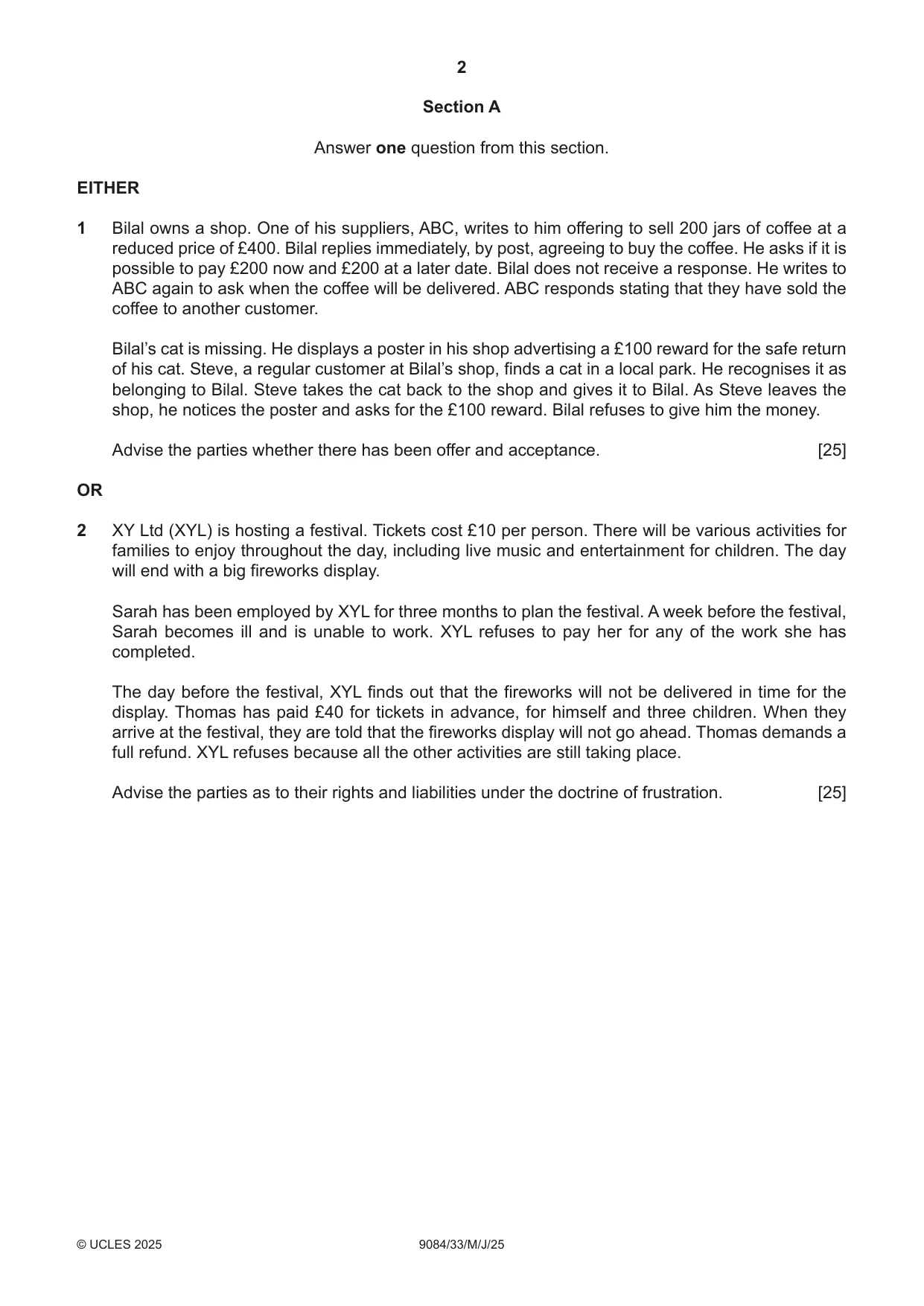
2 9084/33/M/J/25 © UCLES 2025 Section A Answer one question from this section. EITHER 1 Bilal owns a shop. One of his suppliers, ABC, writes to him offering to sell 200 jars of coffee at a reduced price of £400. Bilal replies immediately, by post, agreeing to buy the coffee. He asks if it is possible to pay £200 now and £200 at a later date. Bilal does not receive a response. He writes to ABC again to ask when the coffee will be delivered. ABC responds stating that they have sold the coffee to another customer. Bilal’s cat is missing. He displays a poster in his shop advertising a £100 reward for the safe return of his cat. Steve, a regular customer at Bilal’s shop, finds a cat in a local park. He recognises it as belonging to Bilal. Steve takes the cat back to the shop and gives it to Bilal. As Steve leaves the shop, he notices the poster and asks for the £100 reward. Bilal refuses to give him the money. Advise the parties whether there has been offer and acceptance. [25] OR 2 XY Ltd (XYL) is hosting a festival. Tickets cost £10 per person. There will be various activities for families to enjoy throughout the day, including live music and entertainment for children. The day will end with a big fireworks display. Sarah has been employed by XYL for three months to plan the festival. A week before the festival, Sarah becomes ill and is unable to work. XYL refuses to pay her for any of the work she has completed. The day before the festival, XYL finds out that the fireworks will not be delivered in time for the display. Thomas has paid £40 for tickets in advance, for himself and three children. When they arrive at the festival, they are told that the fireworks display will not go ahead. Thomas demands a full refund. XYL refuses because all the other activities are still taking place. Advise the parties as to their rights and liabilities under the doctrine of frustration. [25]
Question paper, page 3
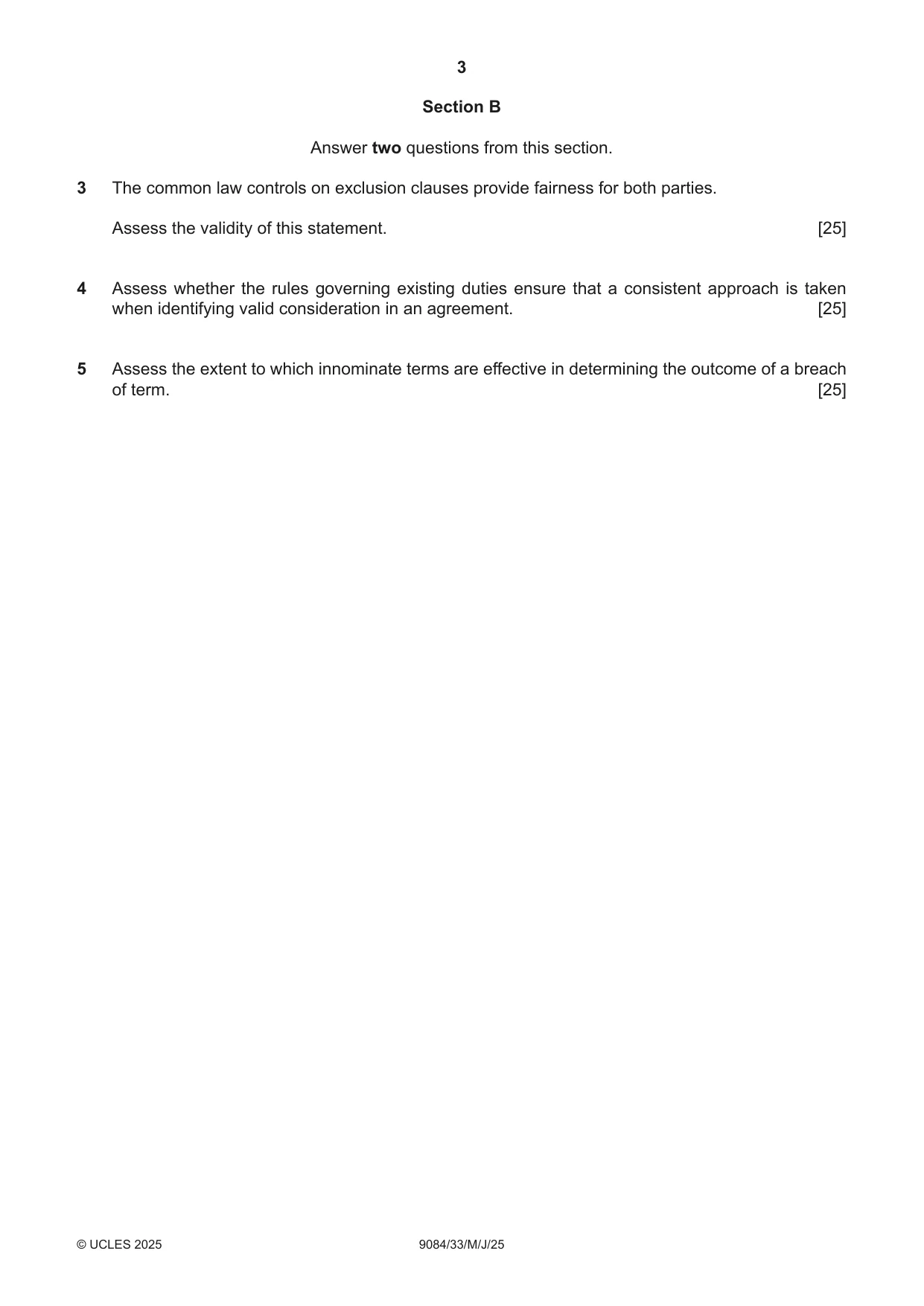
3 9084/33/M/J/25 © UCLES 2025 Section B Answer two questions from this section. 3 The common law controls on exclusion clauses provide fairness for both parties. Assess the validity of this statement. [25] 4 Assess whether the rules governing existing duties ensure that a consistent approach is taken when identifying valid consideration in an agreement. [25] 5 Assess the extent to which innominate terms are effective in determining the outcome of a breach of term. [25]
Question paper, page 4
4 9084/33/M/J/25 © UCLES 2025 Permission to reproduce items where third-party owned material protected by copyright is included has been sought and cleared where possible. Every reasonable effort has been made by the publisher (UCLES) to trace copyright holders, but if any items requiring clearance have unwittingly been included, the publisher will be pleased to make amends at the earliest possible opportunity. To avoid the issue of disclosure of answer-related information to candidates, all copyright acknowledgements are reproduced online in the Cambridge Assessment International Education Copyright Acknowledgements Booklet. This is produced for each series of examinations and is freely available to download at www.cambridgeinternational.org after the live examination series. Cambridge Assessment International Education is part of Cambridge Assessment. Cambridge Assessment is the brand name of the University of Cambridge Local Examinations Syndicate (UCLES), which is a department of the University of Cambridge. BLANK PAGE
Mark scheme, page 1
This document consists of 20 printed pages. © Cambridge University Press & Assessment 2025 [Turn over Cambridge International AS & A Level LAW 9084/33 Paper 3 Law of Contract May/June 2025 MARK SCHEME Maximum Mark: 75 Published This mark scheme is published as an aid to teachers and candidates, to indicate the requirements of the examination. It shows the basis on which Examiners were instructed to award marks. It does not indicate the details of the discussions that took place at an Examiners’ meeting before marking began, which would have considered the acceptability of alternative answers. Mark schemes should be read in conjunction with the question paper and the Principal Examiner Report for Teachers. Cambridge International will not enter into discussions about these mark schemes. Cambridge International is publishing the mark schemes for the May/June 2025 series for most Cambridge IGCSE, Cambridge International A and AS Level components, and some Cambridge O Level components.
Mark scheme, page 2
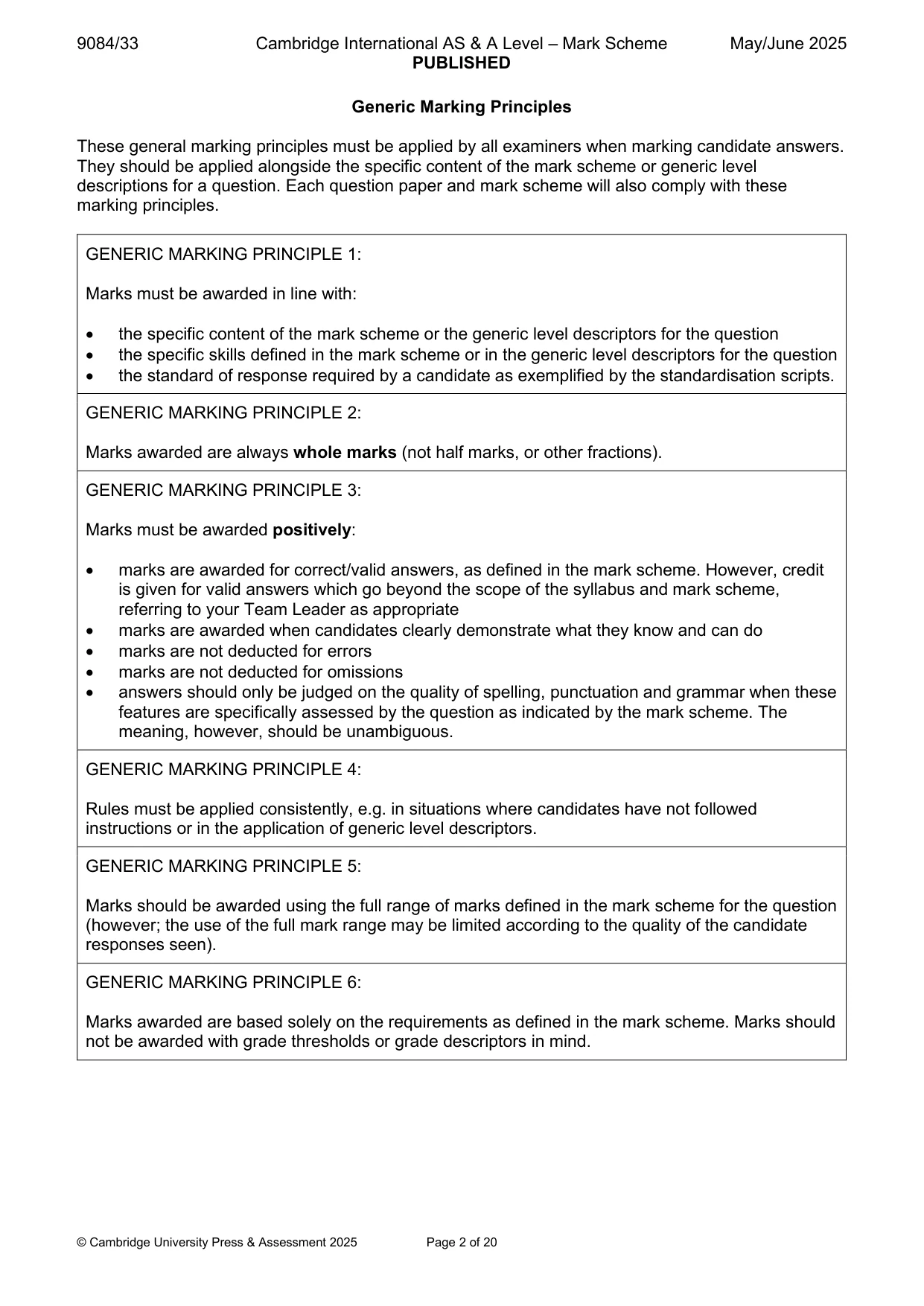
9084/33 Cambridge International AS & A Level – Mark Scheme PUBLISHED May/June 2025 © Cambridge University Press & Assessment 2025 Page 2 of 20 Generic Marking Principles These general marking principles must be applied by all examiners when marking candidate answers. They should be applied alongside the specific content of the mark scheme or generic level descriptions for a question. Each question paper and mark scheme will also comply with these marking principles. GENERIC MARKING PRINCIPLE 1: Marks must be awarded in line with: • the specific content of the mark scheme or the generic level descriptors for the question • the specific skills defined in the mark scheme or in the generic level descriptors for the question • the standard of response required by a candidate as exemplified by the standardisation scripts. GENERIC MARKING PRINCIPLE 2: Marks awarded are always whole marks (not half marks, or other fractions). GENERIC MARKING PRINCIPLE 3: Marks must be awarded positively: • marks are awarded for correct/valid answers, as defined in the mark scheme. However, credit is given for valid answers which go beyond the scope of the syllabus and mark scheme, referring to your Team Leader as appropriate • marks are awarded when candidates clearly demonstrate what they know and can do • marks are not deducted for errors • marks are not deducted for omissions • answers should only be judged on the quality of spelling, punctuation and grammar when these features are specifically assessed by the question as indicated by the mark scheme. The meaning, however, should be unambiguous. GENERIC MARKING PRINCIPLE 4: Rules must be applied consistently, e.g. in situations where candidates have not followed instructions or in the application of generic level descriptors. GENERIC MARKING PRINCIPLE 5: Marks should be awarded using the full range of marks defined in the mark scheme for the question (however; the use of the full mark range may be limited according to the quality of the candidate responses seen). GENERIC MARKING PRINCIPLE 6: Marks awarded are based solely on the requirements as defined in the mark scheme. Marks should not be awarded with grade thresholds or grade descriptors in mind.
Mark scheme, page 3
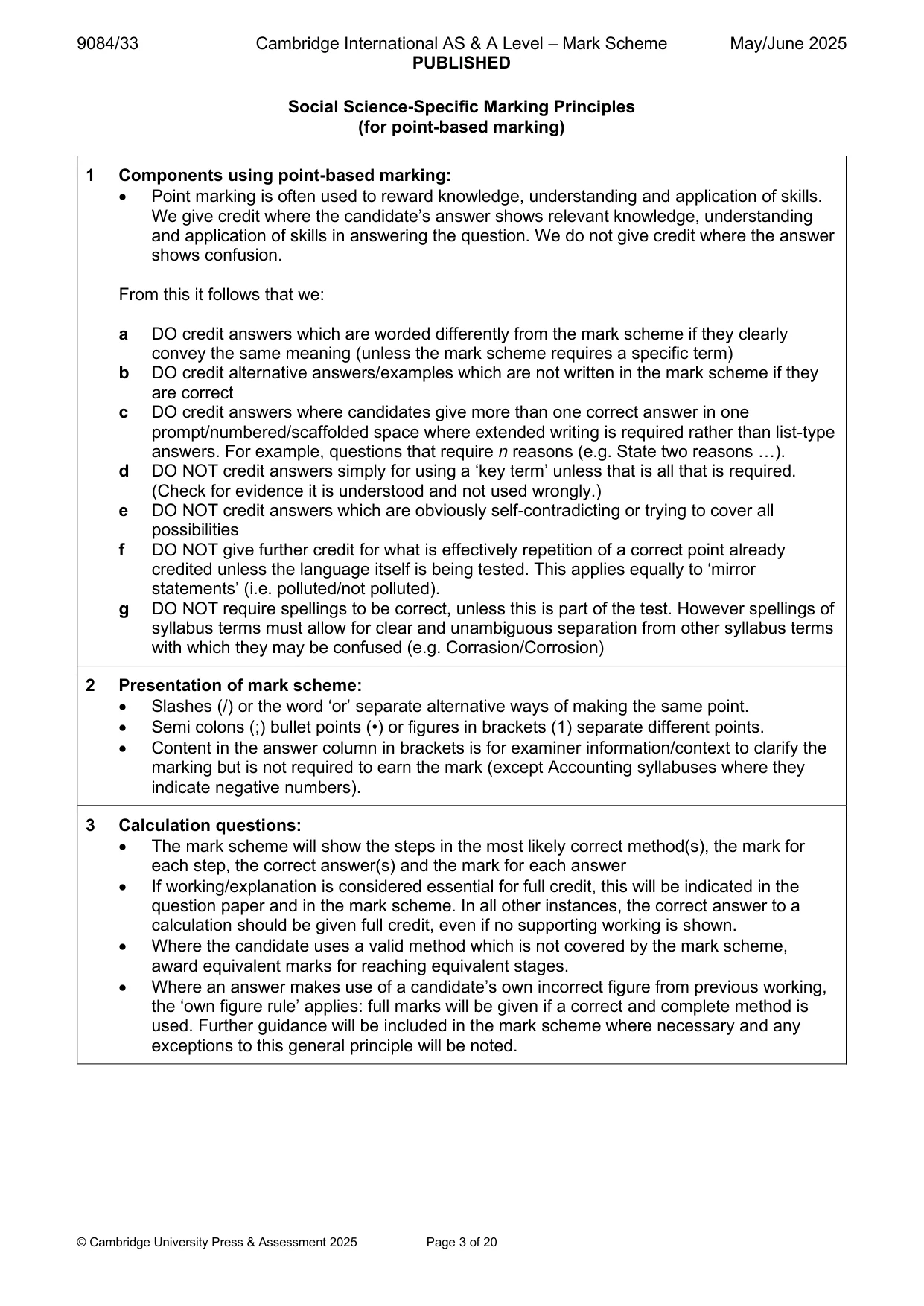
9084/33 Cambridge International AS & A Level – Mark Scheme PUBLISHED May/June 2025 © Cambridge University Press & Assessment 2025 Page 3 of 20 Social Science-Specific Marking Principles (for point-based marking) 1 Components using point-based marking: • Point marking is often used to reward knowledge, understanding and application of skills. We give credit where the candidate’s answer shows relevant knowledge, understanding and application of skills in answering the question. We do not give credit where the answer shows confusion. From this it follows that we: a DO credit answers which are worded differently from the mark scheme if they clearly convey the same meaning (unless the mark scheme requires a specific term) b DO credit alternative answers/examples which are not written in the mark scheme if they are correct c DO credit answers where candidates give more than one correct answer in one prompt/numbered/scaffolded space where extended writing is required rather than list-type answers. For example, questions that require n reasons (e.g. State two reasons …). d DO NOT credit answers simply for using a ‘key term’ unless that is all that is required. (Check for evidence it is understood and not used wrongly.) e DO NOT credit answers which are obviously self-contradicting or trying to cover all possibilities f DO NOT give further credit for what is effectively repetition of a correct point already credited unless the language itself is being tested. This applies equally to ‘mirror statements’ (i.e. polluted/not polluted). g DO NOT require spellings to be correct, unless this is part of the test. However spellings of syllabus terms must allow for clear and unambiguous separation from other syllabus terms with which they may be confused (e.g. Corrasion/Corrosion) 2 Presentation of mark scheme: • Slashes (/) or the word ‘or’ separate alternative ways of making the same point. • Semi colons (;) bullet points (•) or figures in brackets (1) separate different points. • Content in the answer column in brackets is for examiner information/context to clarify the marking but is not required to earn the mark (except Accounting syllabuses where they indicate negative numbers). 3 Calculation questions: • The mark scheme will show the steps in the most likely correct method(s), the mark for each step, the correct answer(s) and the mark for each answer • If working/explanation is considered essential for full credit, this will be indicated in the question paper and in the mark scheme. In all other instances, the correct answer to a calculation should be given full credit, even if no supporting working is shown. • Where the candidate uses a valid method which is not covered by the mark scheme, award equivalent marks for reaching equivalent stages. • Where an answer makes use of a candidate’s own incorrect figure from previous working, the ‘own figure rule’ applies: full marks will be given if a correct and complete method is used. Further guidance will be included in the mark scheme where necessary and any exceptions to this general principle will be noted.
Mark scheme, page 4
9084/33 Cambridge International AS & A Level – Mark Scheme PUBLISHED May/June 2025 © Cambridge University Press & Assessment 2025 Page 4 of 20 4 Annotation: • For point marking, ticks can be used to indicate correct answers and crosses can be used to indicate wrong answers. There is no direct relationship between ticks and marks. Ticks have no defined meaning for levels of response marking. • For levels of response marking, the level awarded should be annotated on the script. • Other annotations will be used by examiners as agreed during standardisation, and the meaning will be understood by all examiners who marked that paper.
Mark scheme, page 5
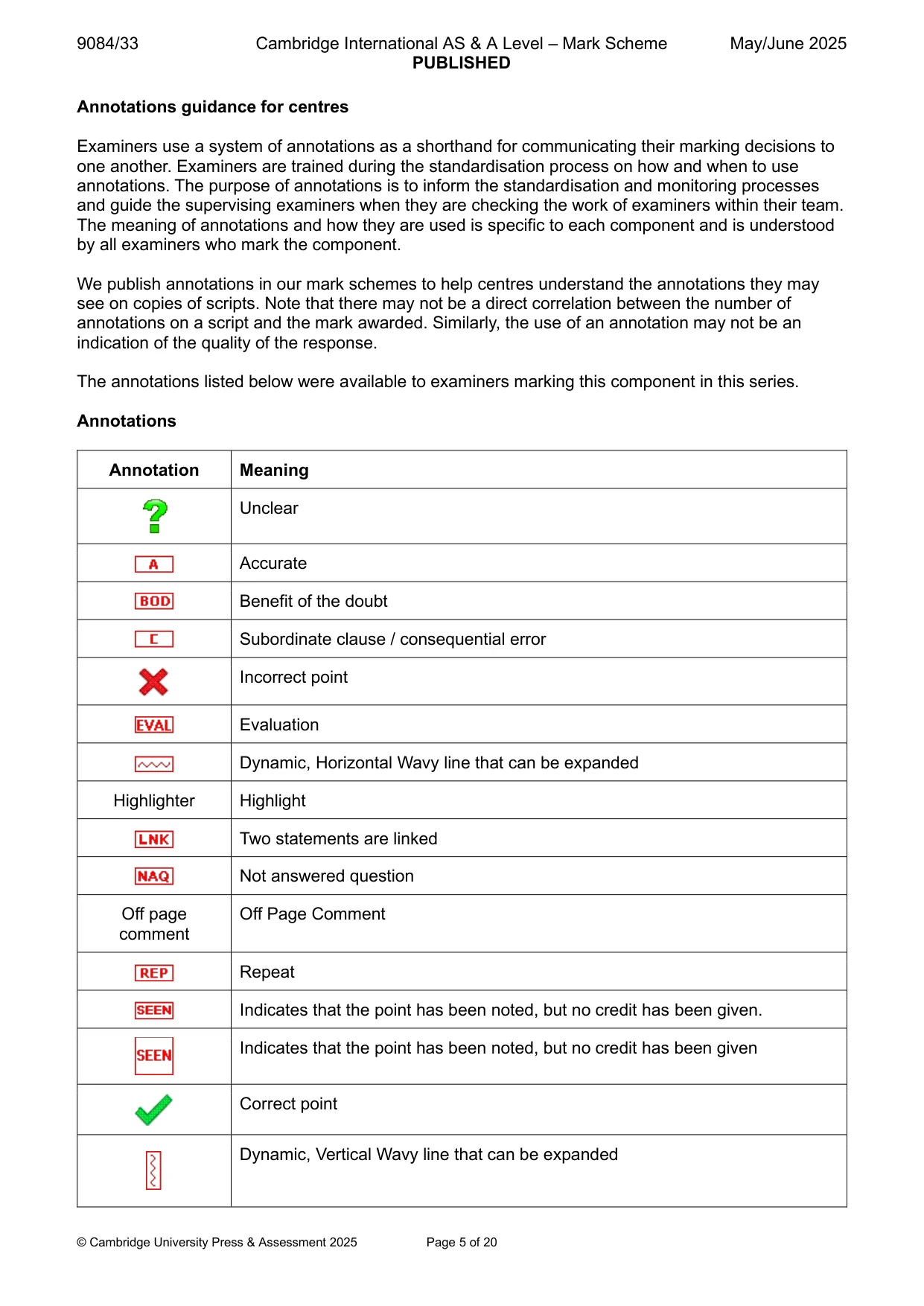
9084/33 Cambridge International AS & A Level – Mark Scheme PUBLISHED May/June 2025 © Cambridge University Press & Assessment 2025 Page 5 of 20 Annotations guidance for centres Examiners use a system of annotations as a shorthand for communicating their marking decisions to one another. Examiners are trained during the standardisation process on how and when to use annotations. The purpose of annotations is to inform the standardisation and monitoring processes and guide the supervising examiners when they are checking the work of examiners within their team. The meaning of annotations and how they are used is specific to each component and is understood by all examiners who mark the component. We publish annotations in our mark schemes to help centres understand the annotations they may see on copies of scripts. Note that there may not be a direct correlation between the number of annotations on a script and the mark awarded. Similarly, the use of an annotation may not be an indication of the quality of the response. The annotations listed below were available to examiners marking this component in this series. Annotations Annotation Meaning Unclear Accurate Benefit of the doubt Subordinate clause / consequential error Incorrect point Evaluation Dynamic, Horizontal Wavy line that can be expanded Highlighter Highlight Two statements are linked Not answered question Off page comment Off Page Comment Repeat Indicates that the point has been noted, but no credit has been given. Indicates that the point has been noted, but no credit has been given Correct point Dynamic, Vertical Wavy line that can be expanded
Mark scheme, page 6
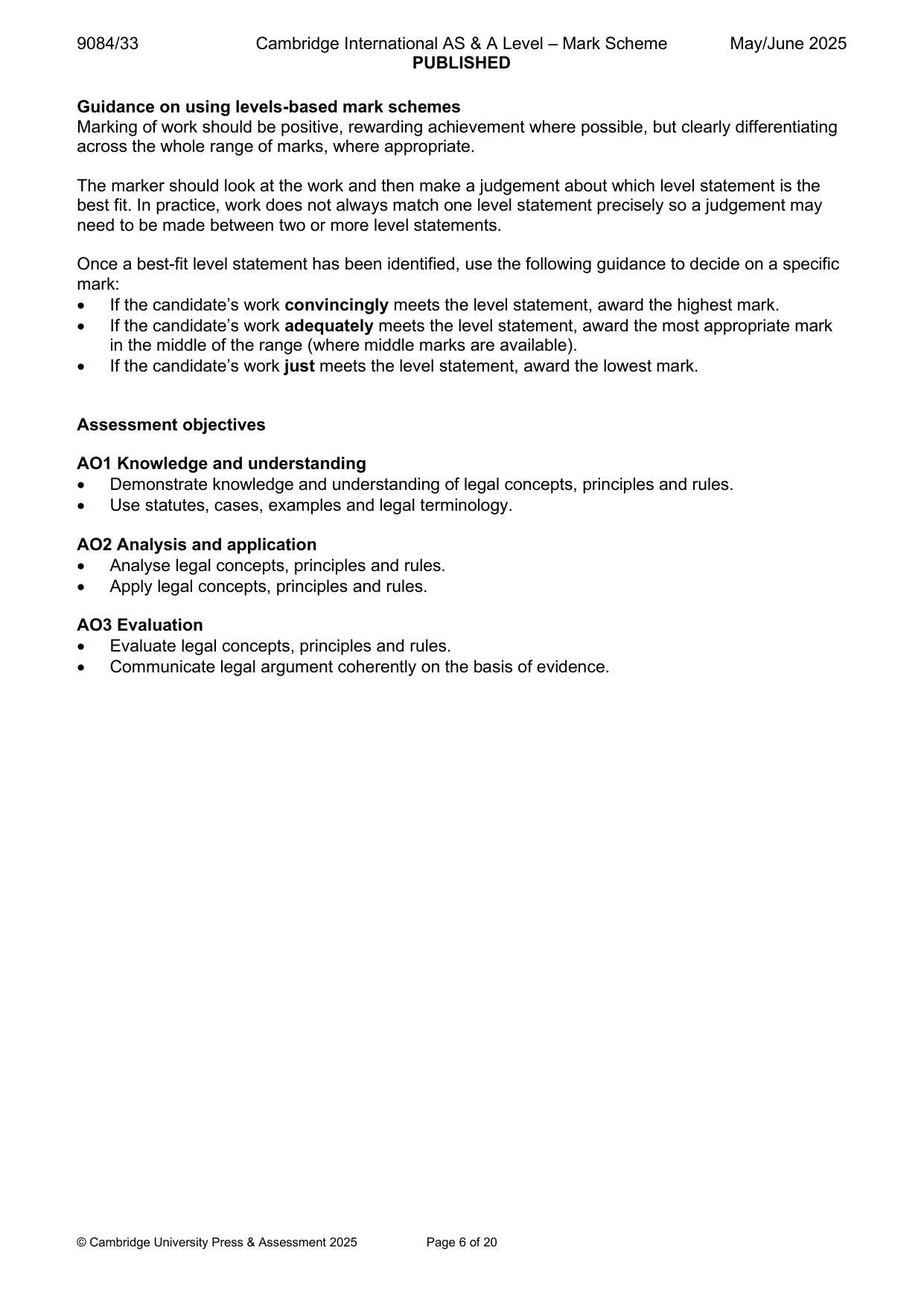
9084/33 Cambridge International AS & A Level – Mark Scheme PUBLISHED May/June 2025 © Cambridge University Press & Assessment 2025 Page 6 of 20 Guidance on using levels-based mark schemes Marking of work should be positive, rewarding achievement where possible, but clearly differentiating across the whole range of marks, where appropriate. The marker should look at the work and then make a judgement about which level statement is the best fit. In practice, work does not always match one level statement precisely so a judgement may need to be made between two or more level statements. Once a best-fit level statement has been identified, use the following guidance to decide on a specific mark: • If the candidate’s work convincingly meets the level statement, award the highest mark. • If the candidate’s work adequately meets the level statement, award the most appropriate mark in the middle of the range (where middle marks are available). • If the candidate’s work just meets the level statement, award the lowest mark. Assessment objectives AO1 Knowledge and understanding • Demonstrate knowledge and understanding of legal concepts, principles and rules. • Use statutes, cases, examples and legal terminology. AO2 Analysis and application • Analyse legal concepts, principles and rules. • Apply legal concepts, principles and rules. AO3 Evaluation • Evaluate legal concepts, principles and rules. • Communicate legal argument coherently on the basis of evidence.
Mark scheme, page 7
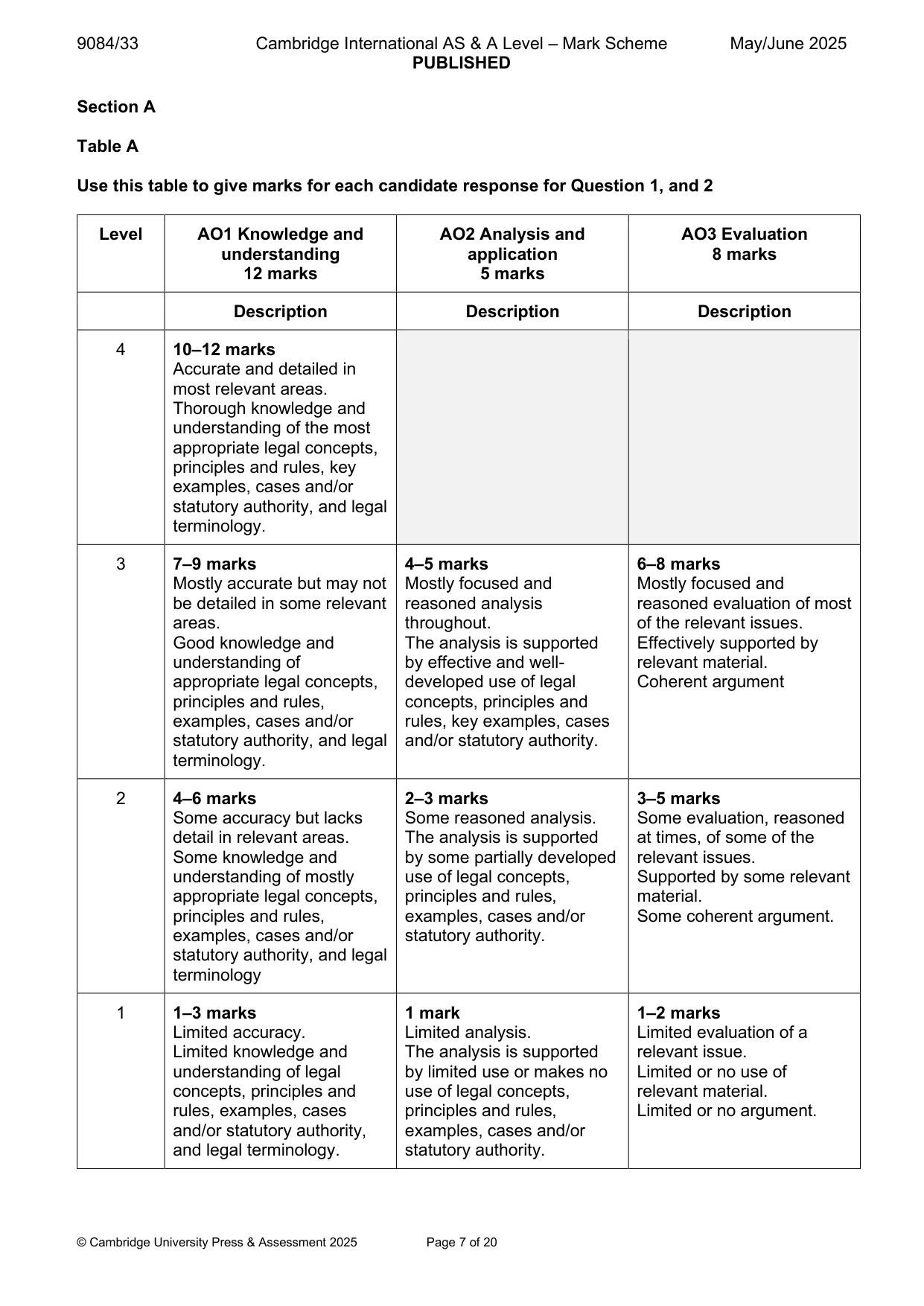
9084/33 Cambridge International AS & A Level – Mark Scheme PUBLISHED May/June 2025 © Cambridge University Press & Assessment 2025 Page 7 of 20 Section A Table A Use this table to give marks for each candidate response for Question 1, and 2 Level AO1 Knowledge and understanding 12 marks AO2 Analysis and application 5 marks AO3 Evaluation 8 marks Description Description Description 4 10–12 marks Accurate and detailed in most relevant areas. Thorough knowledge and understanding of the most appropriate legal concepts, principles and rules, key examples, cases and/or statutory authority, and legal terminology. 3 7–9 marks Mostly accurate but may not be detailed in some relevant areas. Good knowledge and understanding of appropriate legal concepts, principles and rules, examples, cases and/or statutory authority, and legal terminology. 4–5 marks Mostly focused and reasoned analysis throughout. The analysis is supported by effective and well- developed use of legal concepts, principles and rules, key examples, cases and/or statutory authority. 6–8 marks Mostly focused and reasoned evaluation of most of the relevant issues. Effectively supported by relevant material. Coherent argument 2 4–6 marks Some accuracy but lacks detail in relevant areas. Some knowledge and understanding of mostly appropriate legal concepts, principles and rules, examples, cases and/or statutory authority, and legal terminology 2–3 marks Some reasoned analysis. The analysis is supported by some partially developed use of legal concepts, principles and rules, examples, cases and/or statutory authority. 3–5 marks Some evaluation, reasoned at times, of some of the relevant issues. Supported by some relevant material. Some coherent argument. 1 1–3 marks Limited accuracy. Limited knowledge and understanding of legal concepts, principles and rules, examples, cases and/or statutory authority, and legal terminology. 1 mark Limited analysis. The analysis is supported by limited use or makes no use of legal concepts, principles and rules, examples, cases and/or statutory authority. 1–2 marks Limited evaluation of a relevant issue. Limited or no use of relevant material. Limited or no argument.
Mark scheme, page 8
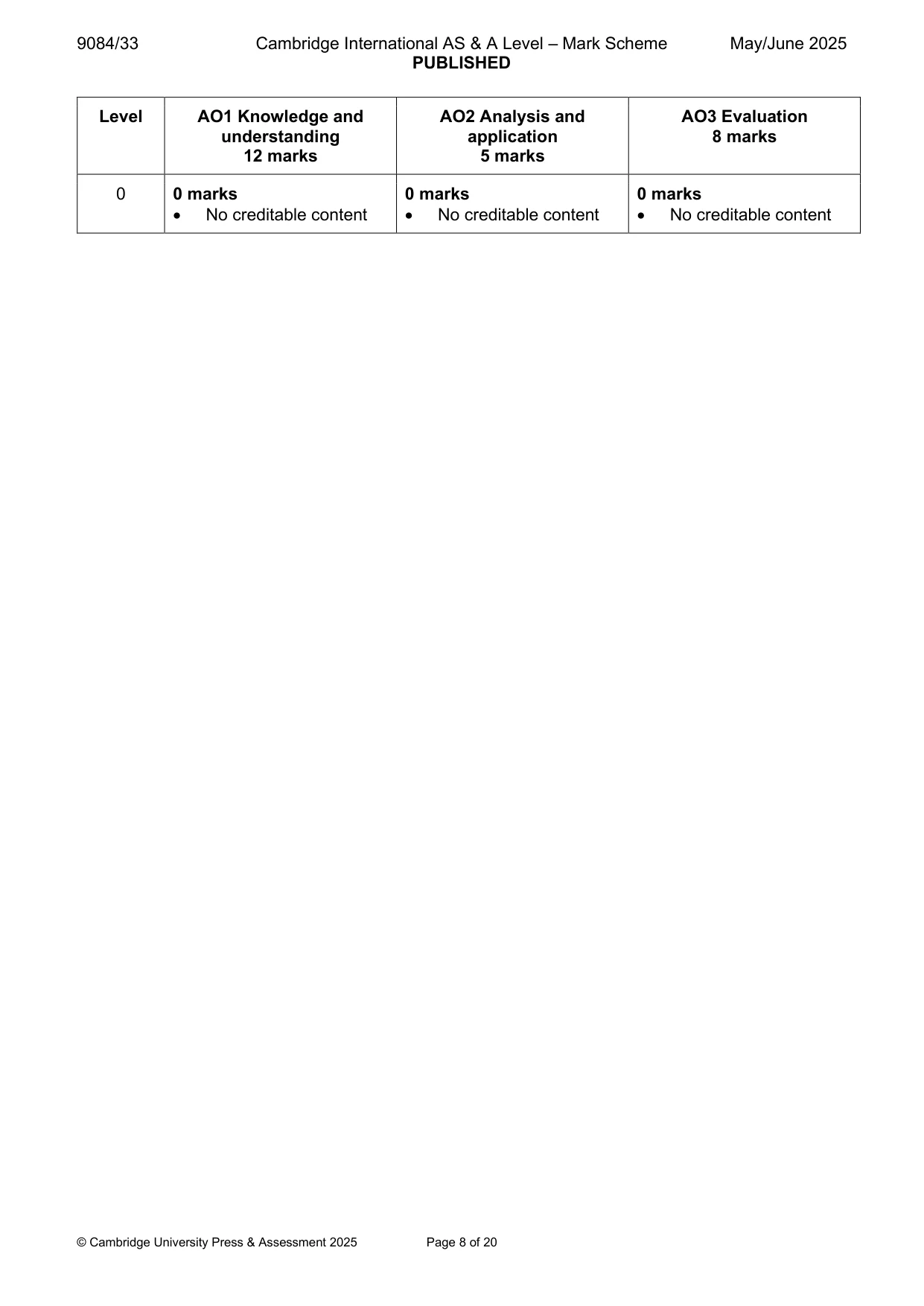
9084/33 Cambridge International AS & A Level – Mark Scheme PUBLISHED May/June 2025 © Cambridge University Press & Assessment 2025 Page 8 of 20 Level AO1 Knowledge and understanding 12 marks AO2 Analysis and application 5 marks AO3 Evaluation 8 marks 0 0 marks • No creditable content 0 marks • No creditable content 0 marks • No creditable content
Mark scheme, page 9
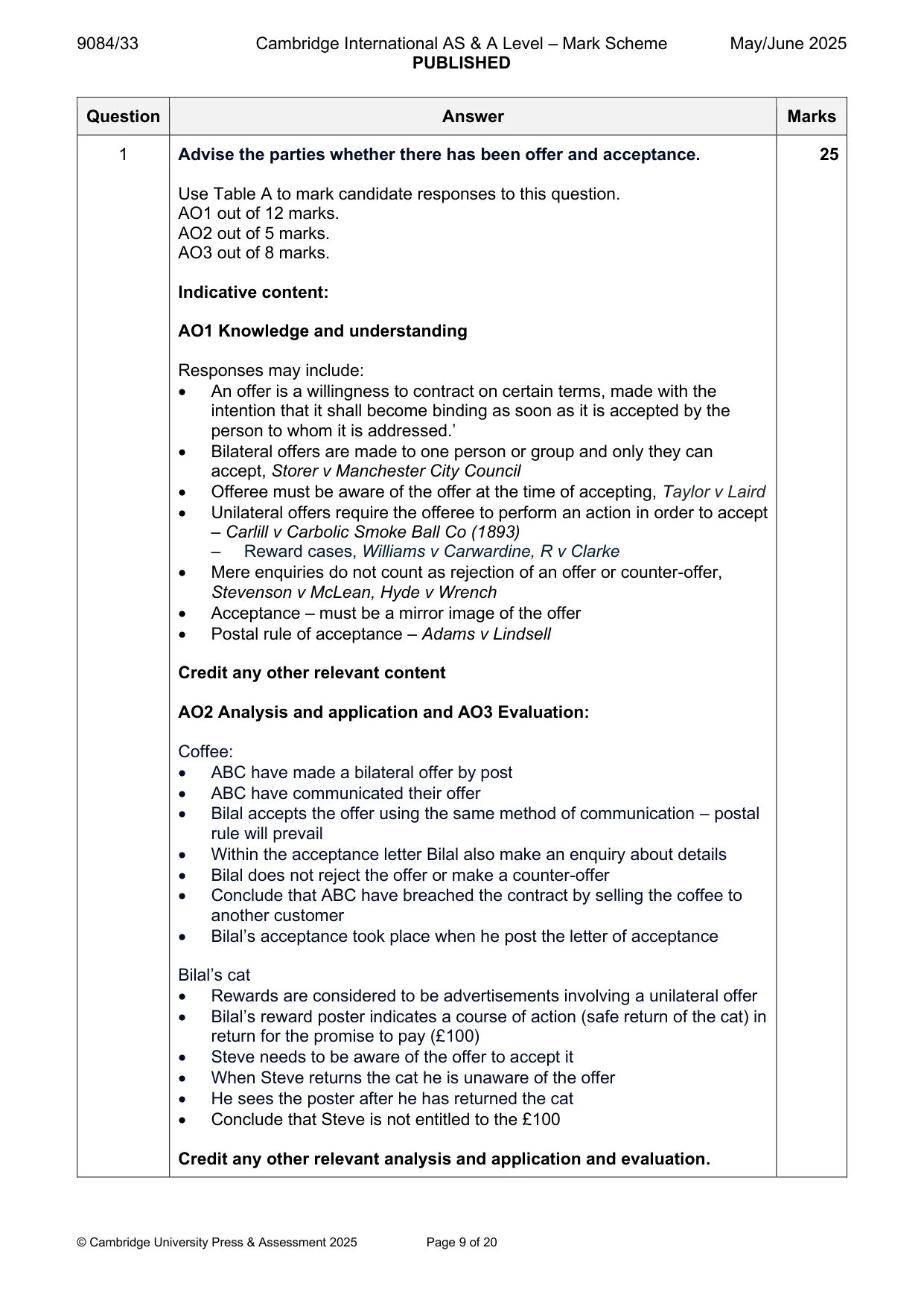
9084/33 Cambridge International AS & A Level – Mark Scheme PUBLISHED May/June 2025 © Cambridge University Press & Assessment 2025 Page 9 of 20 Question Answer Marks 1 Advise the parties whether there has been offer and acceptance. Use Table A to mark candidate responses to this question. AO1 out of 12 marks. AO2 out of 5 marks. AO3 out of 8 marks. Indicative content: AO1 Knowledge and understanding Responses may include: • An offer is a willingness to contract on certain terms, made with the intention that it shall become binding as soon as it is accepted by the person to whom it is addressed.’ • Bilateral offers are made to one person or group and only they can accept, Storer v Manchester City Council • Offeree must be aware of the offer at the time of accepting, Taylor v Laird • Unilateral offers require the offeree to perform an action in order to accept – Carlill v Carbolic Smoke Ball Co (1893) – Reward cases, Williams v Carwardine, R v Clarke • Mere enquiries do not count as rejection of an offer or counter-offer, Stevenson v McLean, Hyde v Wrench • Acceptance – must be a mirror image of the offer • Postal rule of acceptance – Adams v Lindsell Credit any other relevant content AO2 Analysis and application and AO3 Evaluation: Coffee: • ABC have made a bilateral offer by post • ABC have communicated their offer • Bilal accepts the offer using the same method of communication – postal rule will prevail • Within the acceptance letter Bilal also make an enquiry about details • Bilal does not reject the offer or make a counter-offer • Conclude that ABC have breached the contract by selling the coffee to another customer • Bilal’s acceptance took place when he post the letter of acceptance Bilal’s cat • Rewards are considered to be advertisements involving a unilateral offer • Bilal’s reward poster indicates a course of action (safe return of the cat) in return for the promise to pay (£100) • Steve needs to be aware of the offer to accept it • When Steve returns the cat he is unaware of the offer • He sees the poster after he has returned the cat • Conclude that Steve is not entitled to the £100 Credit any other relevant analysis and application and evaluation. 25
Mark scheme, page 10
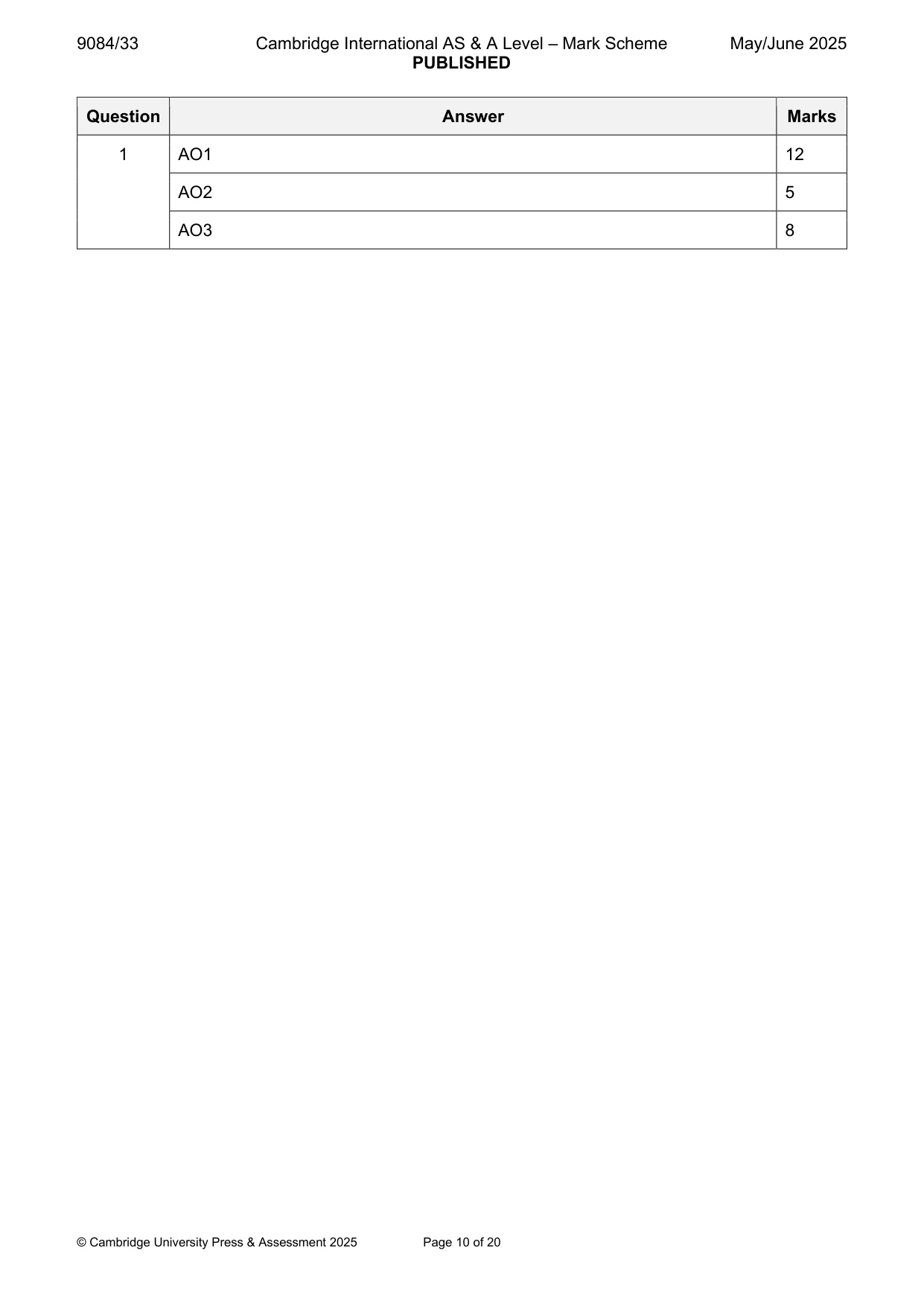
9084/33 Cambridge International AS & A Level – Mark Scheme PUBLISHED May/June 2025 © Cambridge University Press & Assessment 2025 Page 10 of 20 Question Answer Marks 1 AO1 12 AO2 5 AO3 8
Mark scheme, page 11
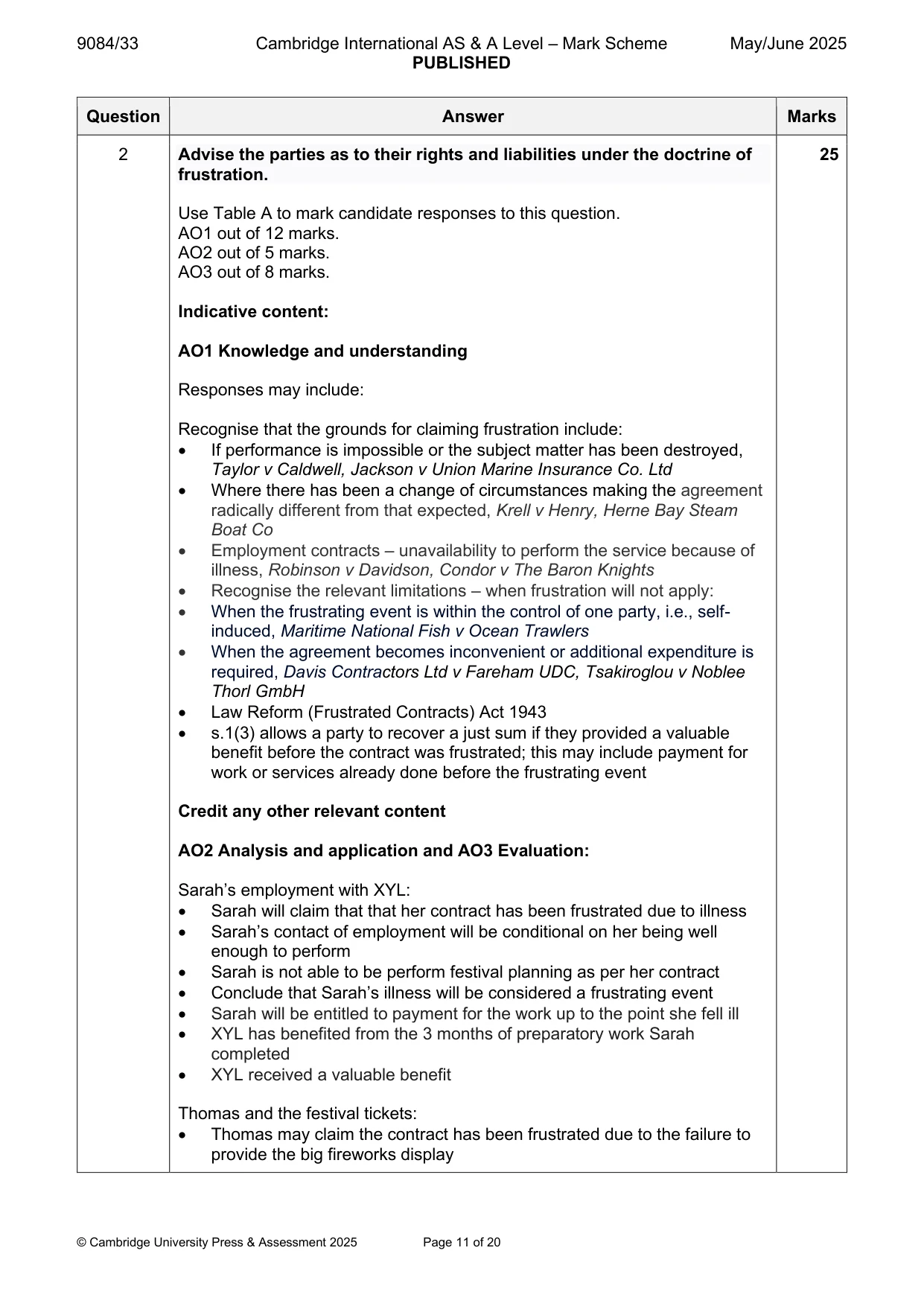
9084/33 Cambridge International AS & A Level – Mark Scheme PUBLISHED May/June 2025 © Cambridge University Press & Assessment 2025 Page 11 of 20 Question Answer Marks 2 Advise the parties as to their rights and liabilities under the doctrine of frustration. Use Table A to mark candidate responses to this question. AO1 out of 12 marks. AO2 out of 5 marks. AO3 out of 8 marks. Indicative content: AO1 Knowledge and understanding Responses may include: Recognise that the grounds for claiming frustration include: • If performance is impossible or the subject matter has been destroyed, Taylor v Caldwell, Jackson v Union Marine Insurance Co. Ltd • Where there has been a change of circumstances making the agreement radically different from that expected, Krell v Henry, Herne Bay Steam Boat Co • Employment contracts – unavailability to perform the service because of illness, Robinson v Davidson, Condor v The Baron Knights • Recognise the relevant limitations – when frustration will not apply: • When the frustrating event is within the control of one party, i.e., self- induced, Maritime National Fish v Ocean Trawlers • When the agreement becomes inconvenient or additional expenditure is required, Davis Contractors Ltd v Fareham UDC, Tsakiroglou v Noblee Thorl GmbH • Law Reform (Frustrated Contracts) Act 1943 • s.1(3) allows a party to recover a just sum if they provided a valuable benefit before the contract was frustrated; this may include payment for work or services already done before the frustrating event Credit any other relevant content AO2 Analysis and application and AO3 Evaluation: Sarah’s employment with XYL: • Sarah will claim that that her contract has been frustrated due to illness • Sarah’s contact of employment will be conditional on her being well enough to perform • Sarah is not able to be perform festival planning as per her contract • Conclude that Sarah’s illness will be considered a frustrating event • Sarah will be entitled to payment for the work up to the point she fell ill • XYL has benefited from the 3 months of preparatory work Sarah completed • XYL received a valuable benefit Thomas and the festival tickets: • Thomas may claim the contract has been frustrated due to the failure to provide the big fireworks display 25
Mark scheme, page 12
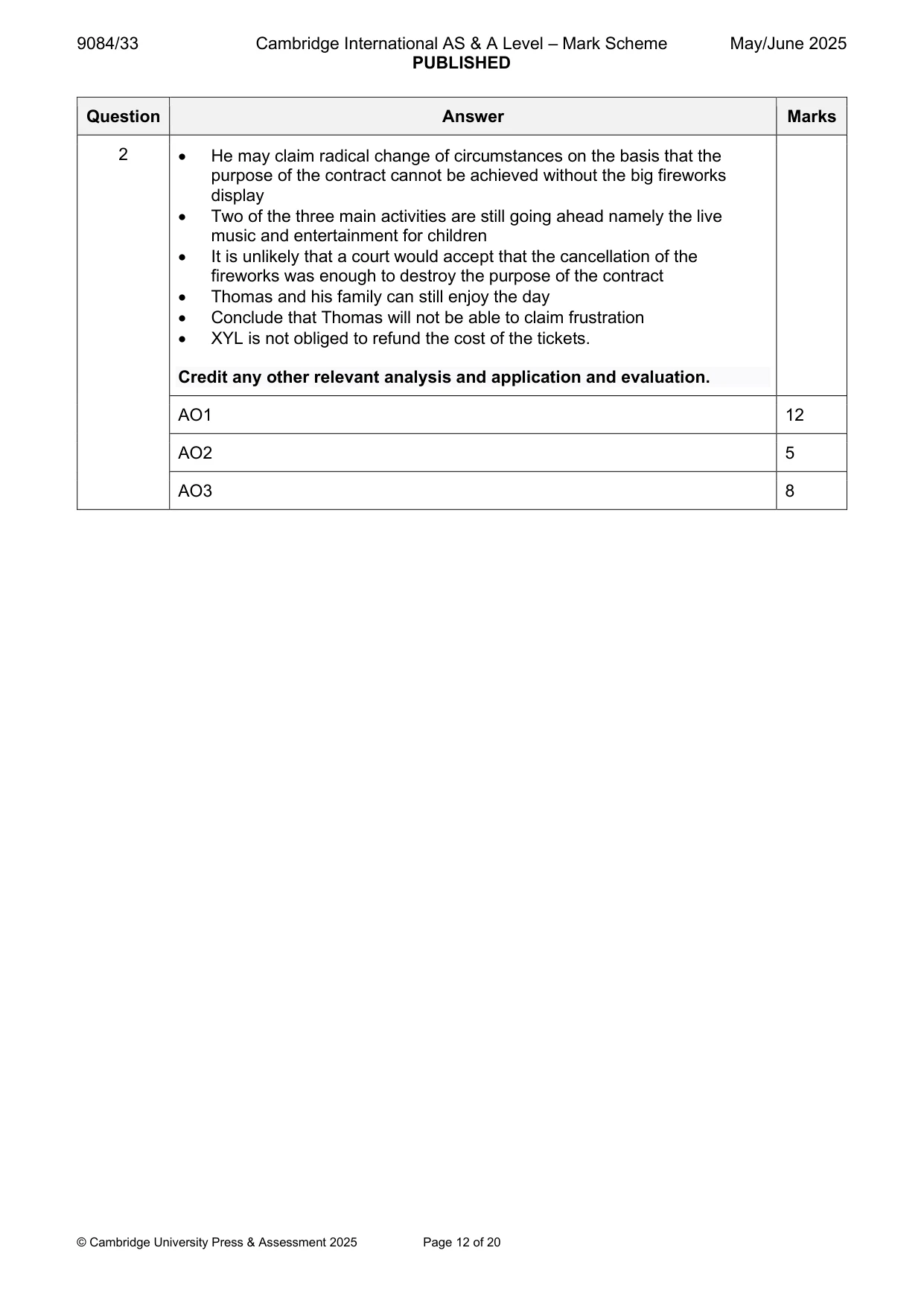
9084/33 Cambridge International AS & A Level – Mark Scheme PUBLISHED May/June 2025 © Cambridge University Press & Assessment 2025 Page 12 of 20 Question Answer Marks 2 • He may claim radical change of circumstances on the basis that the purpose of the contract cannot be achieved without the big fireworks display • Two of the three main activities are still going ahead namely the live music and entertainment for children • It is unlikely that a court would accept that the cancellation of the fireworks was enough to destroy the purpose of the contract • Thomas and his family can still enjoy the day • Conclude that Thomas will not be able to claim frustration • XYL is not obliged to refund the cost of the tickets. Credit any other relevant analysis and application and evaluation. AO1 12 AO2 5 AO3 8
Mark scheme, page 13
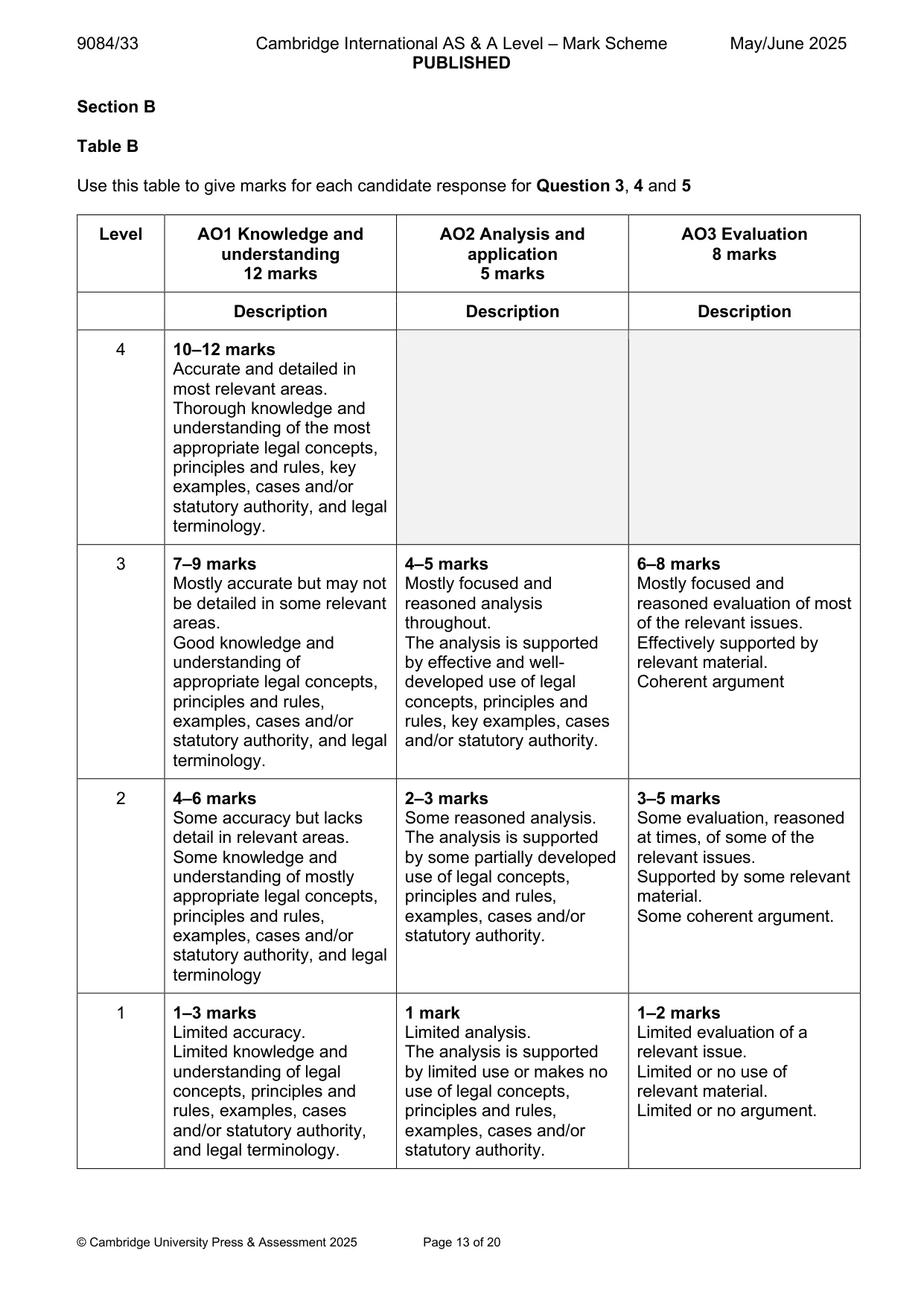
9084/33 Cambridge International AS & A Level – Mark Scheme PUBLISHED May/June 2025 © Cambridge University Press & Assessment 2025 Page 13 of 20 Section B Table B Use this table to give marks for each candidate response for Question 3, 4 and 5 Level AO1 Knowledge and understanding 12 marks AO2 Analysis and application 5 marks AO3 Evaluation 8 marks Description Description Description 4 10–12 marks Accurate and detailed in most relevant areas. Thorough knowledge and understanding of the most appropriate legal concepts, principles and rules, key examples, cases and/or statutory authority, and legal terminology. 3 7–9 marks Mostly accurate but may not be detailed in some relevant areas. Good knowledge and understanding of appropriate legal concepts, principles and rules, examples, cases and/or statutory authority, and legal terminology. 4–5 marks Mostly focused and reasoned analysis throughout. The analysis is supported by effective and well- developed use of legal concepts, principles and rules, key examples, cases and/or statutory authority. 6–8 marks Mostly focused and reasoned evaluation of most of the relevant issues. Effectively supported by relevant material. Coherent argument 2 4–6 marks Some accuracy but lacks detail in relevant areas. Some knowledge and understanding of mostly appropriate legal concepts, principles and rules, examples, cases and/or statutory authority, and legal terminology 2–3 marks Some reasoned analysis. The analysis is supported by some partially developed use of legal concepts, principles and rules, examples, cases and/or statutory authority. 3–5 marks Some evaluation, reasoned at times, of some of the relevant issues. Supported by some relevant material. Some coherent argument. 1 1–3 marks Limited accuracy. Limited knowledge and understanding of legal concepts, principles and rules, examples, cases and/or statutory authority, and legal terminology. 1 mark Limited analysis. The analysis is supported by limited use or makes no use of legal concepts, principles and rules, examples, cases and/or statutory authority. 1–2 marks Limited evaluation of a relevant issue. Limited or no use of relevant material. Limited or no argument.
Mark scheme, page 14
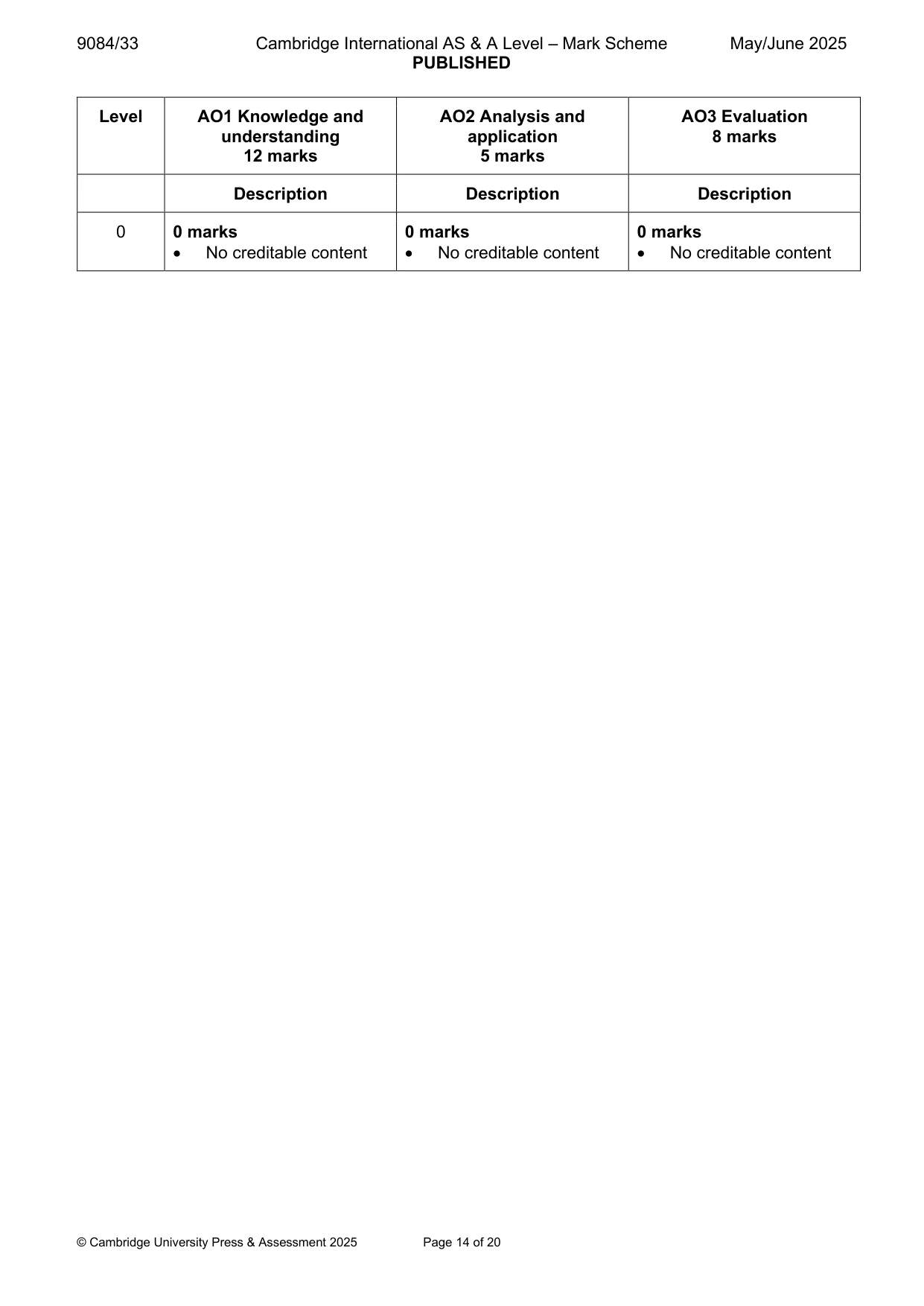
9084/33 Cambridge International AS & A Level – Mark Scheme PUBLISHED May/June 2025 © Cambridge University Press & Assessment 2025 Page 14 of 20 Level AO1 Knowledge and understanding 12 marks AO2 Analysis and application 5 marks AO3 Evaluation 8 marks Description Description Description 0 0 marks • No creditable content 0 marks • No creditable content 0 marks • No creditable content
Mark scheme, page 15
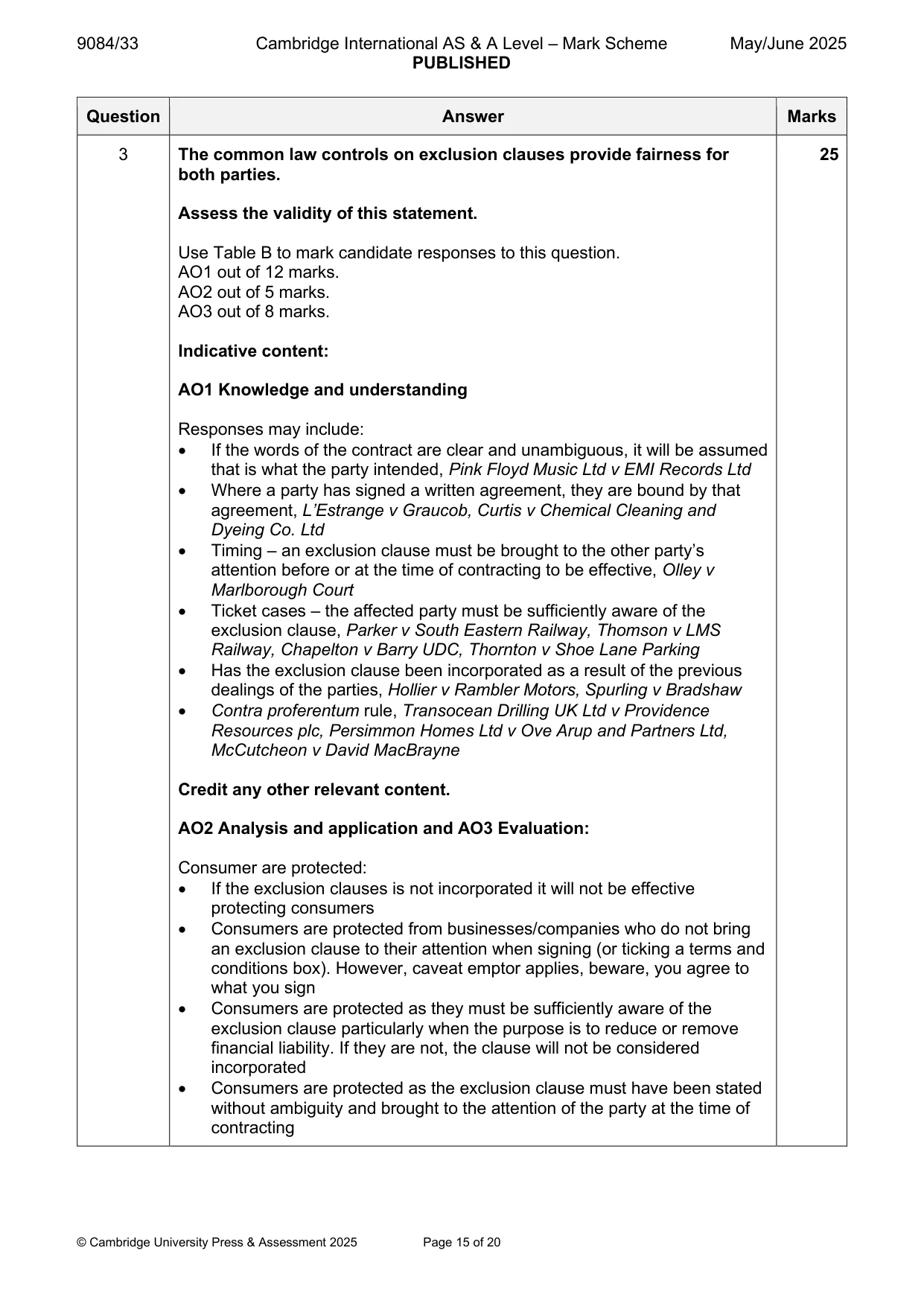
9084/33 Cambridge International AS & A Level – Mark Scheme PUBLISHED May/June 2025 © Cambridge University Press & Assessment 2025 Page 15 of 20 Question Answer Marks 3 The common law controls on exclusion clauses provide fairness for both parties. Assess the validity of this statement. Use Table B to mark candidate responses to this question. AO1 out of 12 marks. AO2 out of 5 marks. AO3 out of 8 marks. Indicative content: AO1 Knowledge and understanding Responses may include: • If the words of the contract are clear and unambiguous, it will be assumed that is what the party intended, Pink Floyd Music Ltd v EMI Records Ltd • Where a party has signed a written agreement, they are bound by that agreement, L’Estrange v Graucob, Curtis v Chemical Cleaning and Dyeing Co. Ltd • Timing – an exclusion clause must be brought to the other party’s attention before or at the time of contracting to be effective, Olley v Marlborough Court • Ticket cases – the affected party must be sufficiently aware of the exclusion clause, Parker v South Eastern Railway, Thomson v LMS Railway, Chapelton v Barry UDC, Thornton v Shoe Lane Parking • Has the exclusion clause been incorporated as a result of the previous dealings of the parties, Hollier v Rambler Motors, Spurling v Bradshaw • Contra proferentum rule, Transocean Drilling UK Ltd v Providence Resources plc, Persimmon Homes Ltd v Ove Arup and Partners Ltd, McCutcheon v David MacBrayne Credit any other relevant content. AO2 Analysis and application and AO3 Evaluation: Consumer are protected: • If the exclusion clauses is not incorporated it will not be effective protecting consumers • Consumers are protected from businesses/companies who do not bring an exclusion clause to their attention when signing (or ticking a terms and conditions box). However, caveat emptor applies, beware, you agree to what you sign • Consumers are protected as they must be sufficiently aware of the exclusion clause particularly when the purpose is to reduce or remove financial liability. If they are not, the clause will not be considered incorporated • Consumers are protected as the exclusion clause must have been stated without ambiguity and brought to the attention of the party at the time of contracting 25
Mark scheme, page 16
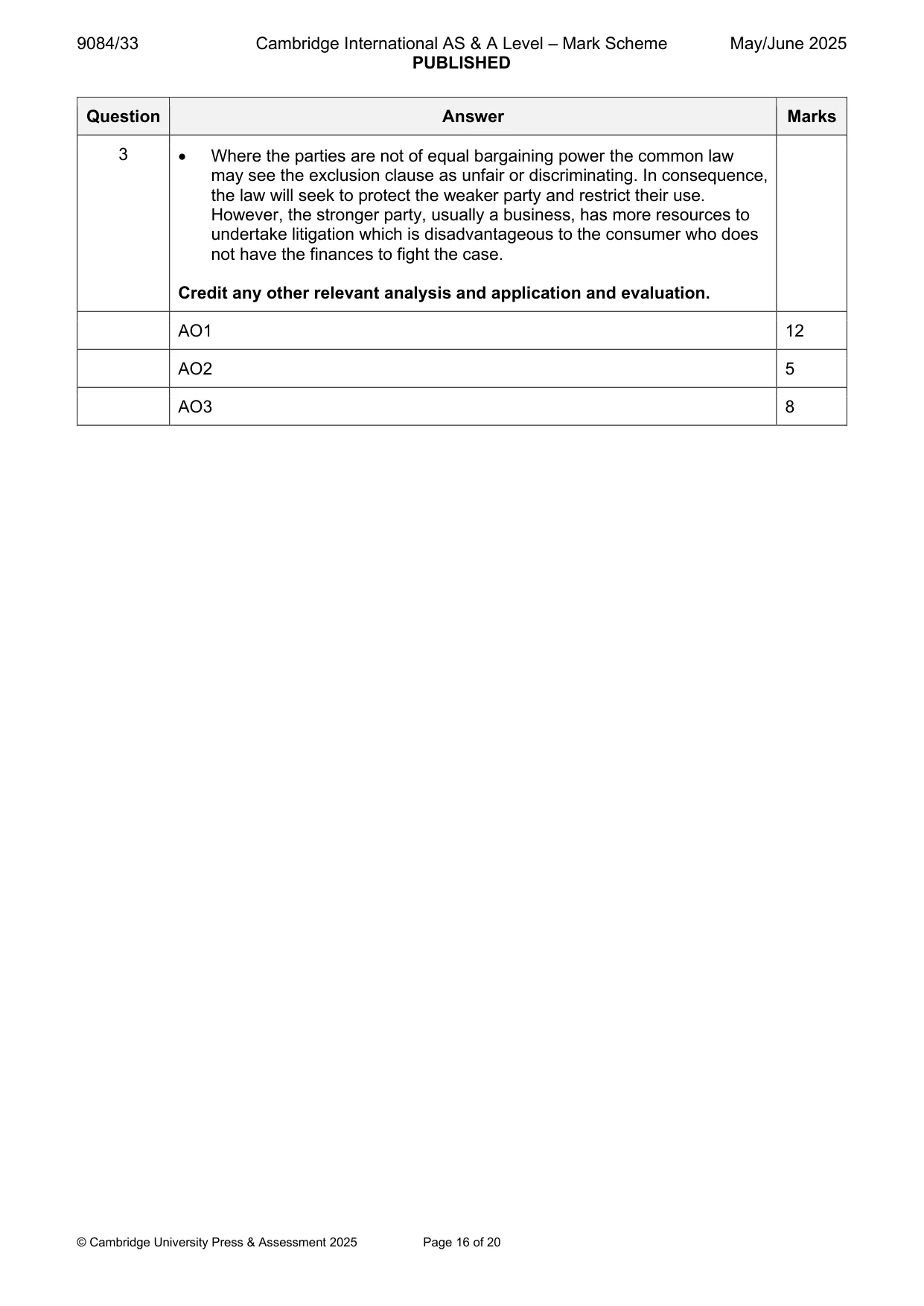
9084/33 Cambridge International AS & A Level – Mark Scheme PUBLISHED May/June 2025 © Cambridge University Press & Assessment 2025 Page 16 of 20 Question Answer Marks 3 • Where the parties are not of equal bargaining power the common law may see the exclusion clause as unfair or discriminating. In consequence, the law will seek to protect the weaker party and restrict their use. However, the stronger party, usually a business, has more resources to undertake litigation which is disadvantageous to the consumer who does not have the finances to fight the case. Credit any other relevant analysis and application and evaluation. AO1 12 AO2 5 AO3 8
Mark scheme, page 17
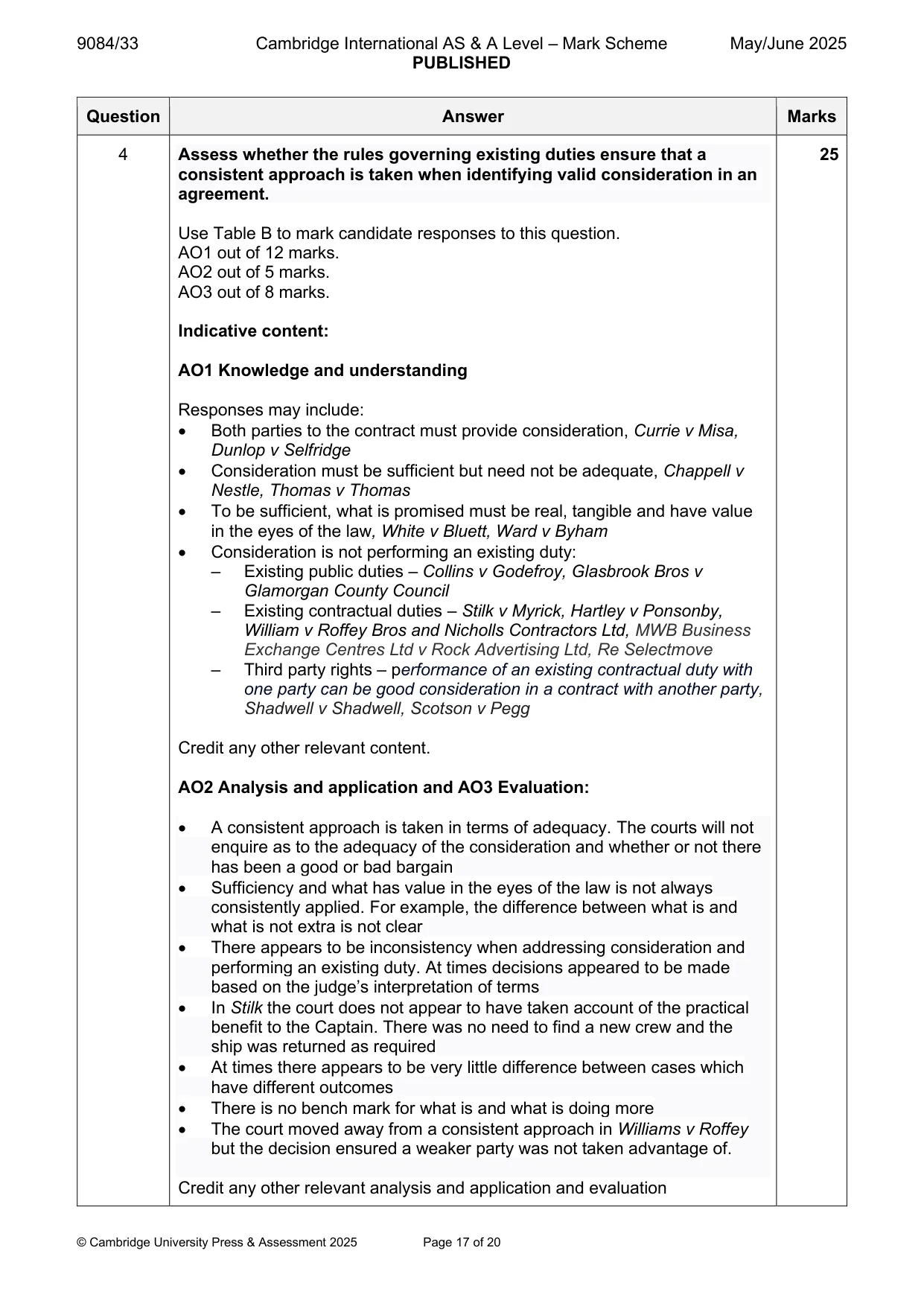
9084/33 Cambridge International AS & A Level – Mark Scheme PUBLISHED May/June 2025 © Cambridge University Press & Assessment 2025 Page 17 of 20 Question Answer Marks 4 Assess whether the rules governing existing duties ensure that a consistent approach is taken when identifying valid consideration in an agreement. Use Table B to mark candidate responses to this question. AO1 out of 12 marks. AO2 out of 5 marks. AO3 out of 8 marks. Indicative content: AO1 Knowledge and understanding Responses may include: • Both parties to the contract must provide consideration, Currie v Misa, Dunlop v Selfridge • Consideration must be sufficient but need not be adequate, Chappell v Nestle, Thomas v Thomas • To be sufficient, what is promised must be real, tangible and have value in the eyes of the law, White v Bluett, Ward v Byham • Consideration is not performing an existing duty: – Existing public duties – Collins v Godefroy, Glasbrook Bros v Glamorgan County Council – Existing contractual duties – Stilk v Myrick, Hartley v Ponsonby, William v Roffey Bros and Nicholls Contractors Ltd, MWB Business Exchange Centres Ltd v Rock Advertising Ltd, Re Selectmove – Third party rights – performance of an existing contractual duty with one party can be good consideration in a contract with another party, Shadwell v Shadwell, Scotson v Pegg Credit any other relevant content. AO2 Analysis and application and AO3 Evaluation: • A consistent approach is taken in terms of adequacy. The courts will not enquire as to the adequacy of the consideration and whether or not there has been a good or bad bargain • Sufficiency and what has value in the eyes of the law is not always consistently applied. For example, the difference between what is and what is not extra is not clear • There appears to be inconsistency when addressing consideration and performing an existing duty. At times decisions appeared to be made based on the judge’s interpretation of terms • In Stilk the court does not appear to have taken account of the practical benefit to the Captain. There was no need to find a new crew and the ship was returned as required • At times there appears to be very little difference between cases which have different outcomes • There is no bench mark for what is and what is doing more • The court moved away from a consistent approach in Williams v Roffey but the decision ensured a weaker party was not taken advantage of. Credit any other relevant analysis and application and evaluation 25
Mark scheme, page 18
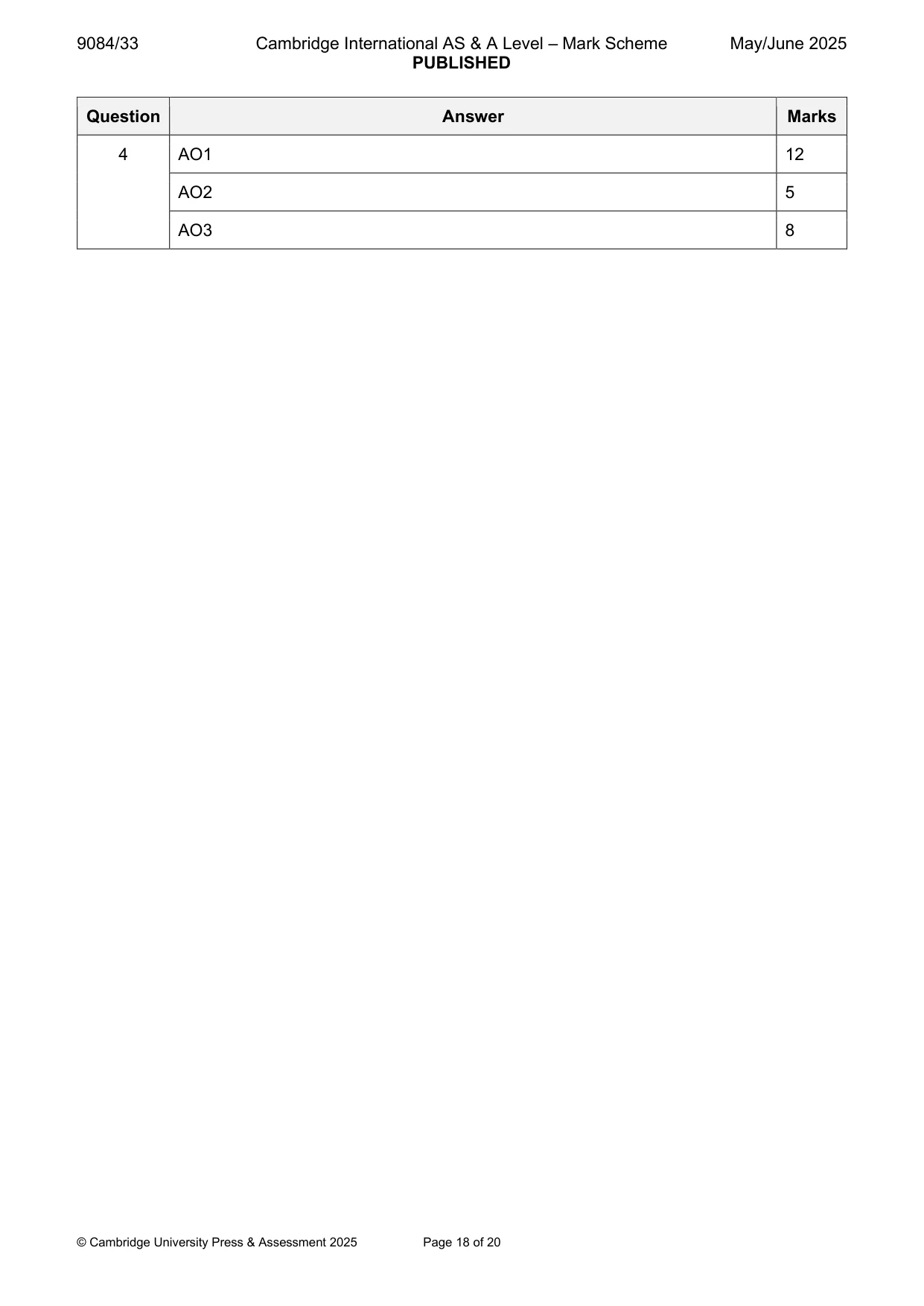
9084/33 Cambridge International AS & A Level – Mark Scheme PUBLISHED May/June 2025 © Cambridge University Press & Assessment 2025 Page 18 of 20 Question Answer Marks 4 AO1 12 AO2 5 AO3 8
Mark scheme, page 19
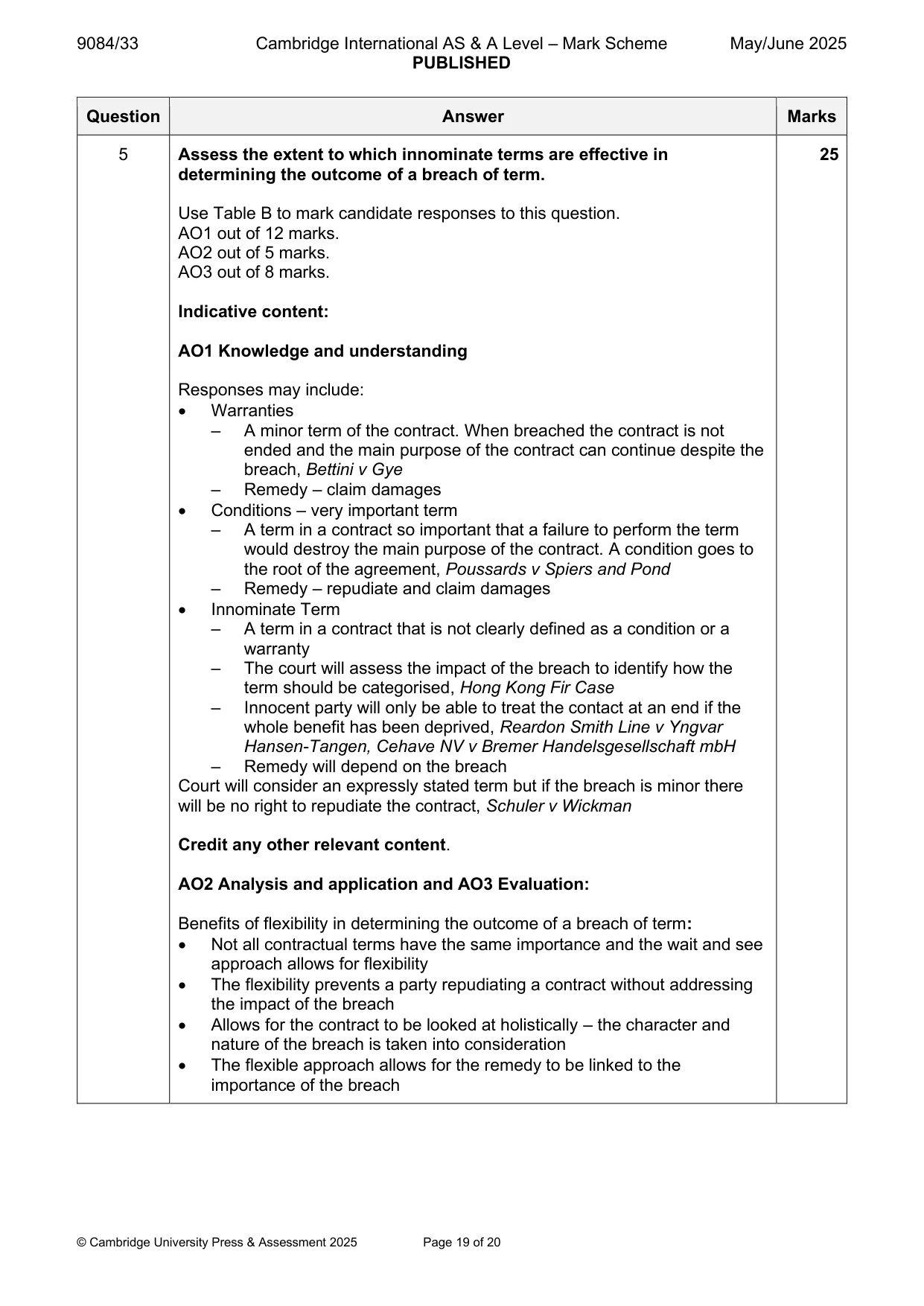
9084/33 Cambridge International AS & A Level – Mark Scheme PUBLISHED May/June 2025 © Cambridge University Press & Assessment 2025 Page 19 of 20 Question Answer Marks 5 Assess the extent to which innominate terms are effective in determining the outcome of a breach of term. Use Table B to mark candidate responses to this question. AO1 out of 12 marks. AO2 out of 5 marks. AO3 out of 8 marks. Indicative content: AO1 Knowledge and understanding Responses may include: • Warranties – A minor term of the contract. When breached the contract is not ended and the main purpose of the contract can continue despite the breach, Bettini v Gye – Remedy – claim damages • Conditions – very important term – A term in a contract so important that a failure to perform the term would destroy the main purpose of the contract. A condition goes to the root of the agreement, Poussards v Spiers and Pond – Remedy – repudiate and claim damages • Innominate Term – A term in a contract that is not clearly defined as a condition or a warranty – The court will assess the impact of the breach to identify how the term should be categorised, Hong Kong Fir Case – Innocent party will only be able to treat the contact at an end if the whole benefit has been deprived, Reardon Smith Line v Yngvar Hansen-Tangen, Cehave NV v Bremer Handelsgesellschaft mbH – Remedy will depend on the breach Court will consider an expressly stated term but if the breach is minor there will be no right to repudiate the contract, Schuler v Wickman Credit any other relevant content. AO2 Analysis and application and AO3 Evaluation: Benefits of flexibility in determining the outcome of a breach of term: • Not all contractual terms have the same importance and the wait and see approach allows for flexibility • The flexibility prevents a party repudiating a contract without addressing the impact of the breach • Allows for the contract to be looked at holistically – the character and nature of the breach is taken into consideration • The flexible approach allows for the remedy to be linked to the importance of the breach 25
Mark scheme, page 20
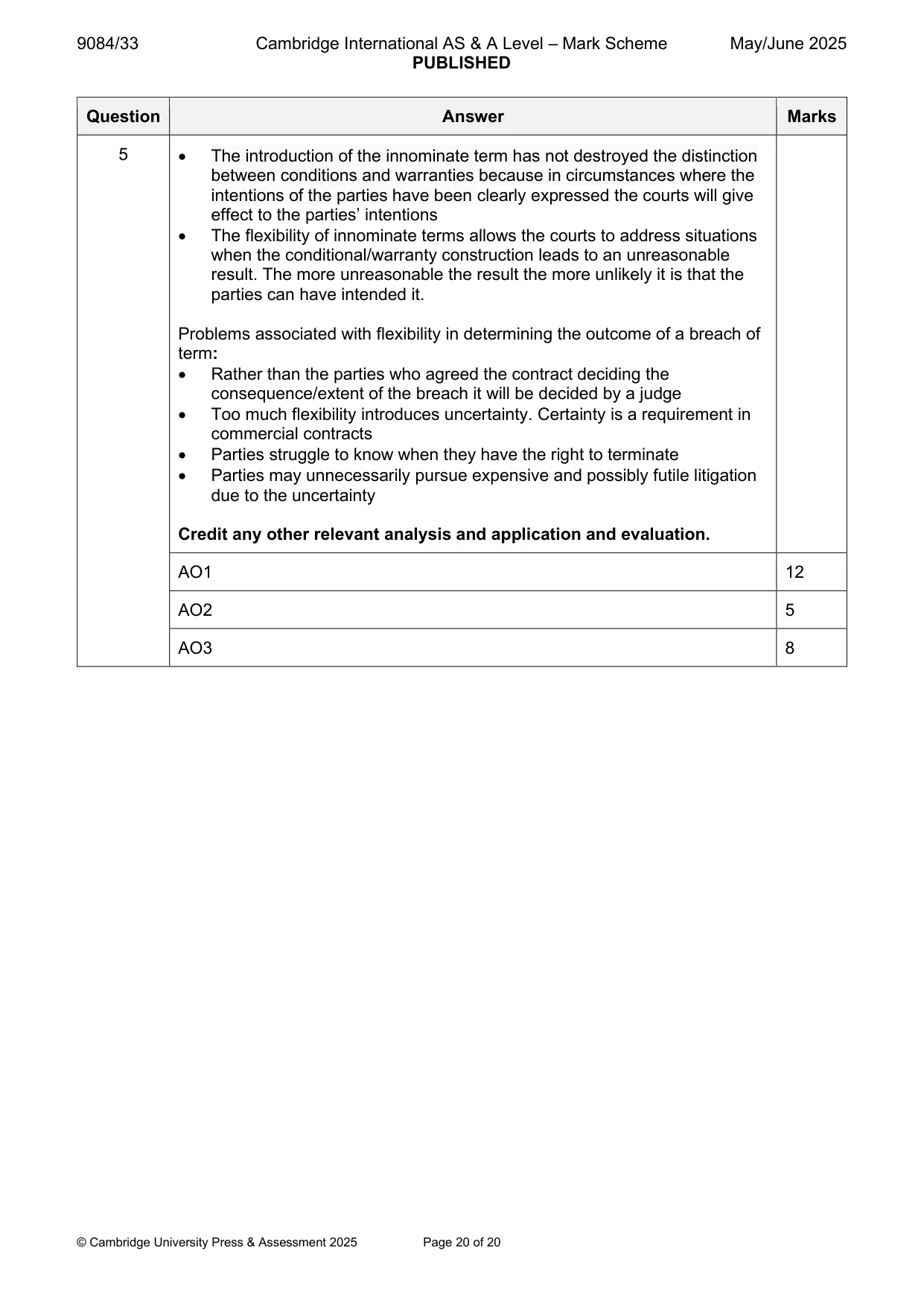
9084/33 Cambridge International AS & A Level – Mark Scheme PUBLISHED May/June 2025 © Cambridge University Press & Assessment 2025 Page 20 of 20 Question Answer Marks 5 • The introduction of the innominate term has not destroyed the distinction between conditions and warranties because in circumstances where the intentions of the parties have been clearly expressed the courts will give effect to the parties’ intentions • The flexibility of innominate terms allows the courts to address situations when the conditional/warranty construction leads to an unreasonable result. The more unreasonable the result the more unlikely it is that the parties can have intended it. Problems associated with flexibility in determining the outcome of a breach of term: • Rather than the parties who agreed the contract deciding the consequence/extent of the breach it will be decided by a judge • Too much flexibility introduces uncertainty. Certainty is a requirement in commercial contracts • Parties struggle to know when they have the right to terminate • Parties may unnecessarily pursue expensive and possibly futile litigation due to the uncertainty Credit any other relevant analysis and application and evaluation. AO1 12 AO2 5 AO3 8
What you needed in this session
Cambridge’s own grade thresholds for 2025 May/June, Paper 3 · Variant 3. A higher threshold means an easier paper — the bar moves with how the cohort did.