Cambridge A Level Law 9084 — 2022 May/June Paper 3 · Variant 3
9084/33/M/J/22 · 75 marks · ≈84 min
The question paper and its mark scheme, free to read here and free to download. This is Cambridge’s own paper, exactly as it was sat.
Question paper4 pages

Mark scheme10 pages
Answers below. Sit the paper first if you are practising.
Paper as text
Question paper, page 1
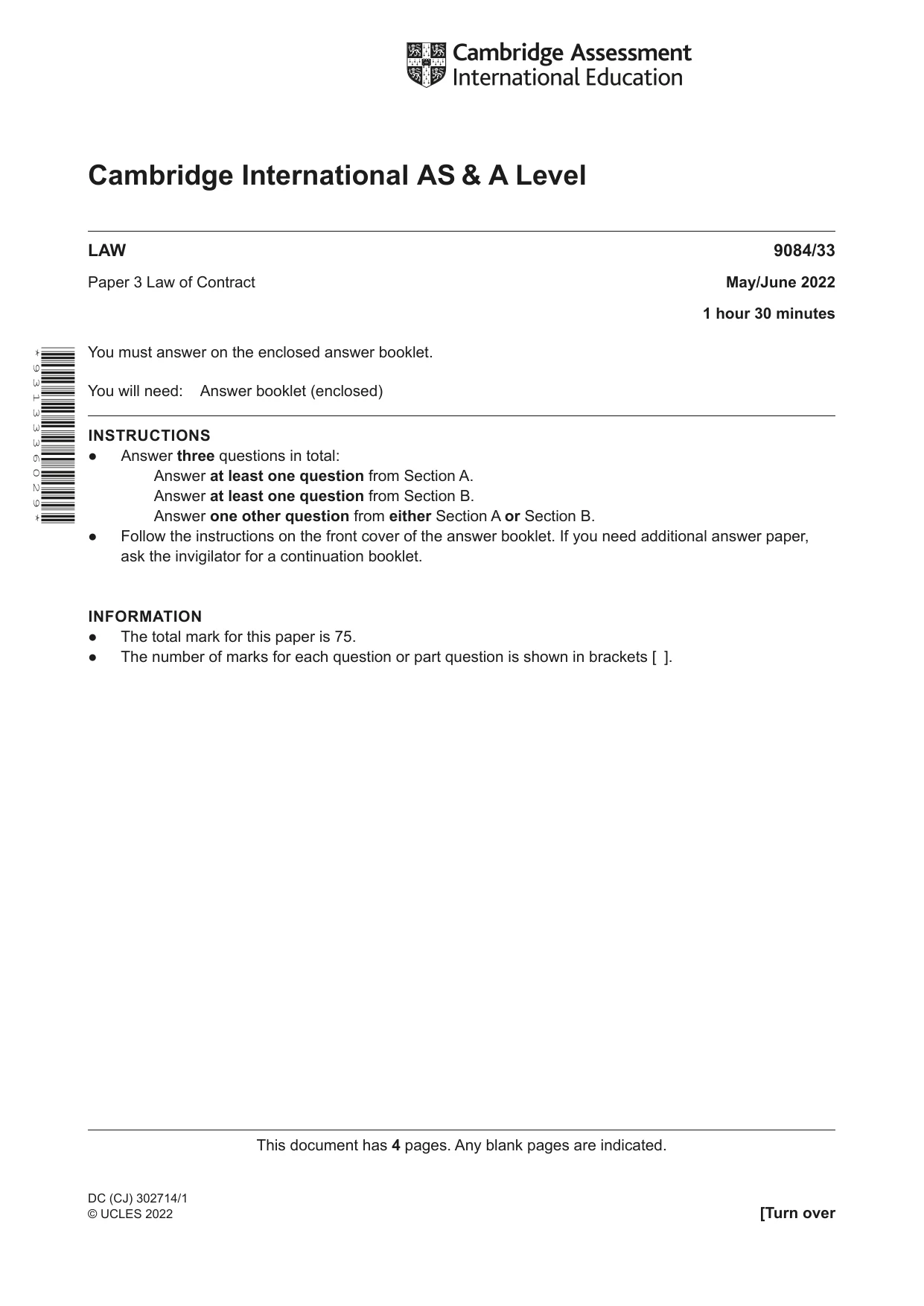
This document has 4 pages. Any blank pages are indicated. [Turn over Cambridge International AS & A Level LAW 9084/33 Paper 3 Law of Contract May/June 2022 1 hour 30 minutes You must answer on the enclosed answer booklet. You will need: Answer booklet (enclosed) INSTRUCTIONS ● Answer three questions in total: Answer at least one question from Section A. Answer at least one question from Section B. Answer one other question from either Section A or Section B. ● Follow the instructions on the front cover of the answer booklet. If you need additional answer paper, ask the invigilator for a continuation booklet. INFORMATION ● The total mark for this paper is 75. ● The number of marks for each question or part question is shown in brackets [ ]. * 9 3 1 3 3 3 6 0 2 9 * DC (CJ) 302714/1 © UCLES 2022
Question paper, page 2
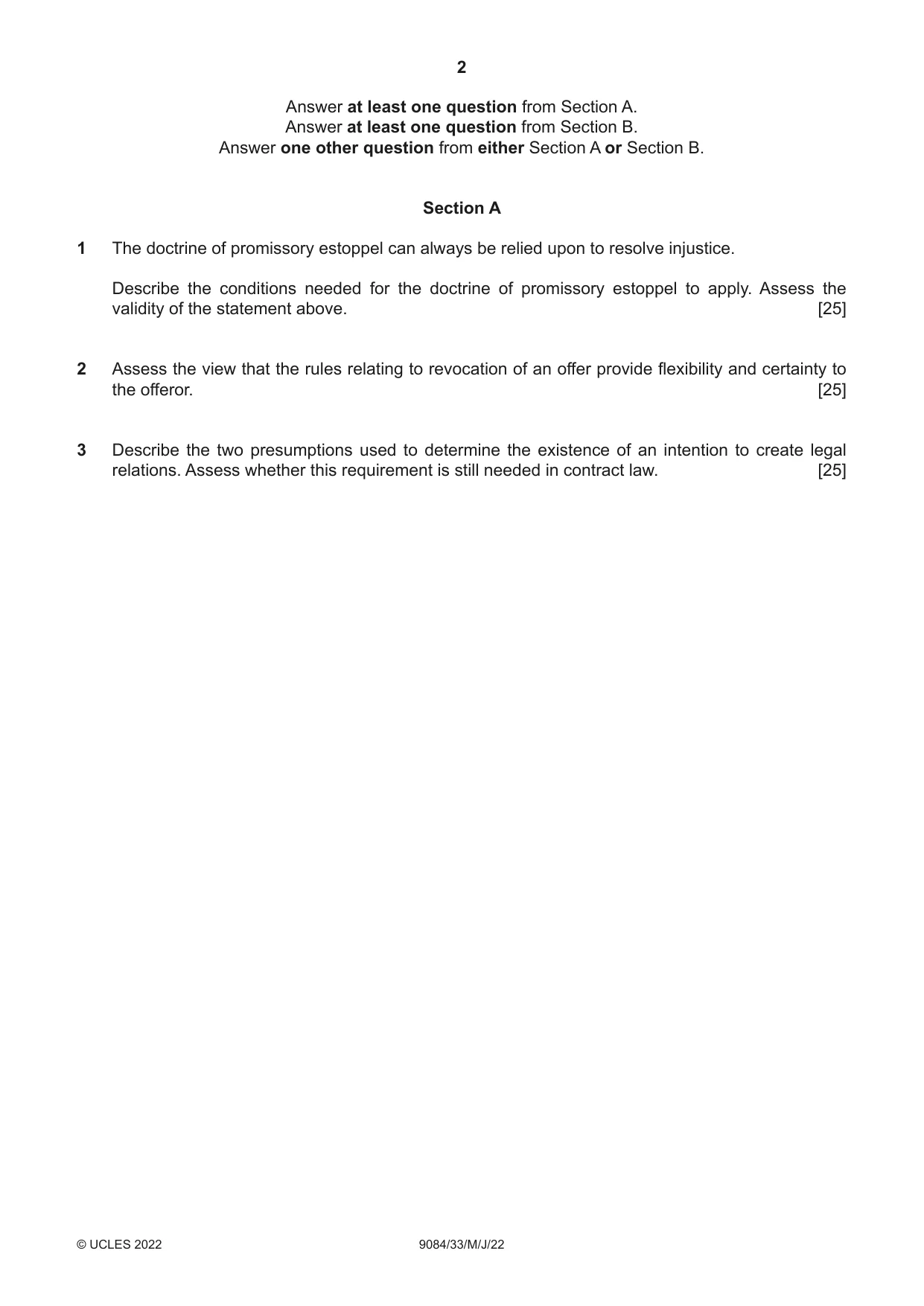
2 9084/33/M/J/22 © UCLES 2022 Answer at least one question from Section A. Answer at least one question from Section B. Answer one other question from either Section A or Section B. Section A 1 The doctrine of promissory estoppel can always be relied upon to resolve injustice. Describe the conditions needed for the doctrine of promissory estoppel to apply. Assess the validity of the statement above. [25] 2 Assess the view that the rules relating to revocation of an offer provide flexibility and certainty to the offeror. [25] 3 Describe the two presumptions used to determine the existence of an intention to create legal relations. Assess whether this requirement is still needed in contract law. [25]
Question paper, page 3
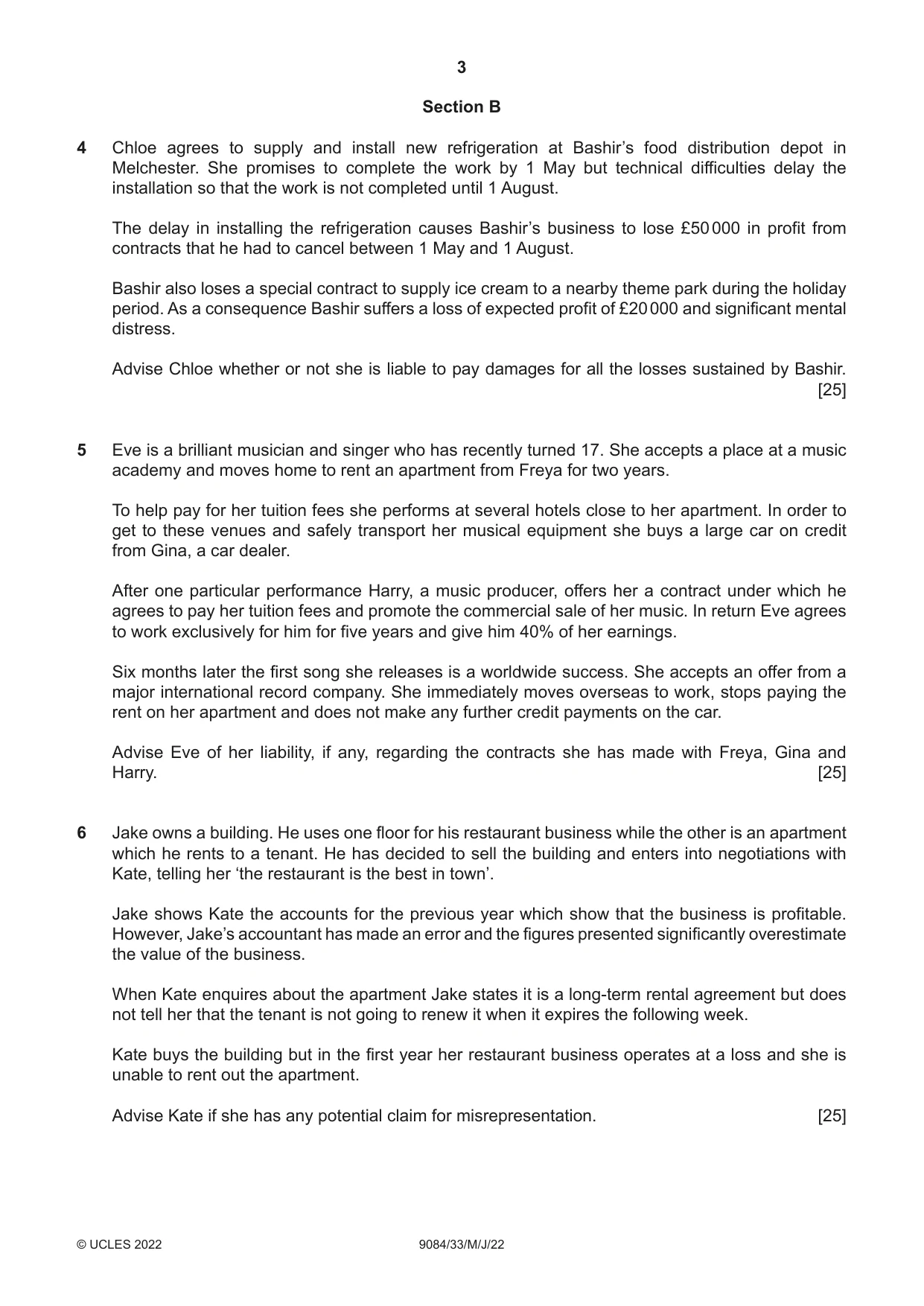
3 9084/33/M/J/22 © UCLES 2022 Section B 4 Chloe agrees to supply and install new refrigeration at Bashir’s food distribution depot in Melchester. She promises to complete the work by 1 May but technical difficulties delay the installation so that the work is not completed until 1 August. The delay in installing the refrigeration causes Bashir’s business to lose £50 000 in profit from contracts that he had to cancel between 1 May and 1 August. Bashir also loses a special contract to supply ice cream to a nearby theme park during the holiday period. As a consequence Bashir suffers a loss of expected profit of £20 000 and significant mental distress. Advise Chloe whether or not she is liable to pay damages for all the losses sustained by Bashir. [25] 5 Eve is a brilliant musician and singer who has recently turned 17. She accepts a place at a music academy and moves home to rent an apartment from Freya for two years. To help pay for her tuition fees she performs at several hotels close to her apartment. In order to get to these venues and safely transport her musical equipment she buys a large car on credit from Gina, a car dealer. After one particular performance Harry, a music producer, offers her a contract under which he agrees to pay her tuition fees and promote the commercial sale of her music. In return Eve agrees to work exclusively for him for five years and give him 40% of her earnings. Six months later the first song she releases is a worldwide success. She accepts an offer from a major international record company. She immediately moves overseas to work, stops paying the rent on her apartment and does not make any further credit payments on the car. Advise Eve of her liability, if any, regarding the contracts she has made with Freya, Gina and Harry. [25] 6 Jake owns a building. He uses one floor for his restaurant business while the other is an apartment which he rents to a tenant. He has decided to sell the building and enters into negotiations with Kate, telling her ‘the restaurant is the best in town’. Jake shows Kate the accounts for the previous year which show that the business is profitable. However, Jake’s accountant has made an error and the figures presented significantly overestimate the value of the business. When Kate enquires about the apartment Jake states it is a long-term rental agreement but does not tell her that the tenant is not going to renew it when it expires the following week. Kate buys the building but in the first year her restaurant business operates at a loss and she is unable to rent out the apartment. Advise Kate if she has any potential claim for misrepresentation. [25]
Question paper, page 4
4 9084/33/M/J/22 © UCLES 2022 Permission to reproduce items where third-party owned material protected by copyright is included has been sought and cleared where possible. Every reasonable effort has been made by the publisher (UCLES) to trace copyright holders, but if any items requiring clearance have unwittingly been included, the publisher will be pleased to make amends at the earliest possible opportunity. To avoid the issue of disclosure of answer-related information to candidates, all copyright acknowledgements are reproduced online in the Cambridge Assessment International Education Copyright Acknowledgements Booklet. This is produced for each series of examinations and is freely available to download at www.cambridgeinternational.org after the live examination series. Cambridge Assessment International Education is part of Cambridge Assessment. Cambridge Assessment is the brand name of the University of Cambridge Local Examinations Syndicate (UCLES), which is a department of the University of Cambridge. BLANK PAGE
Mark scheme, page 1
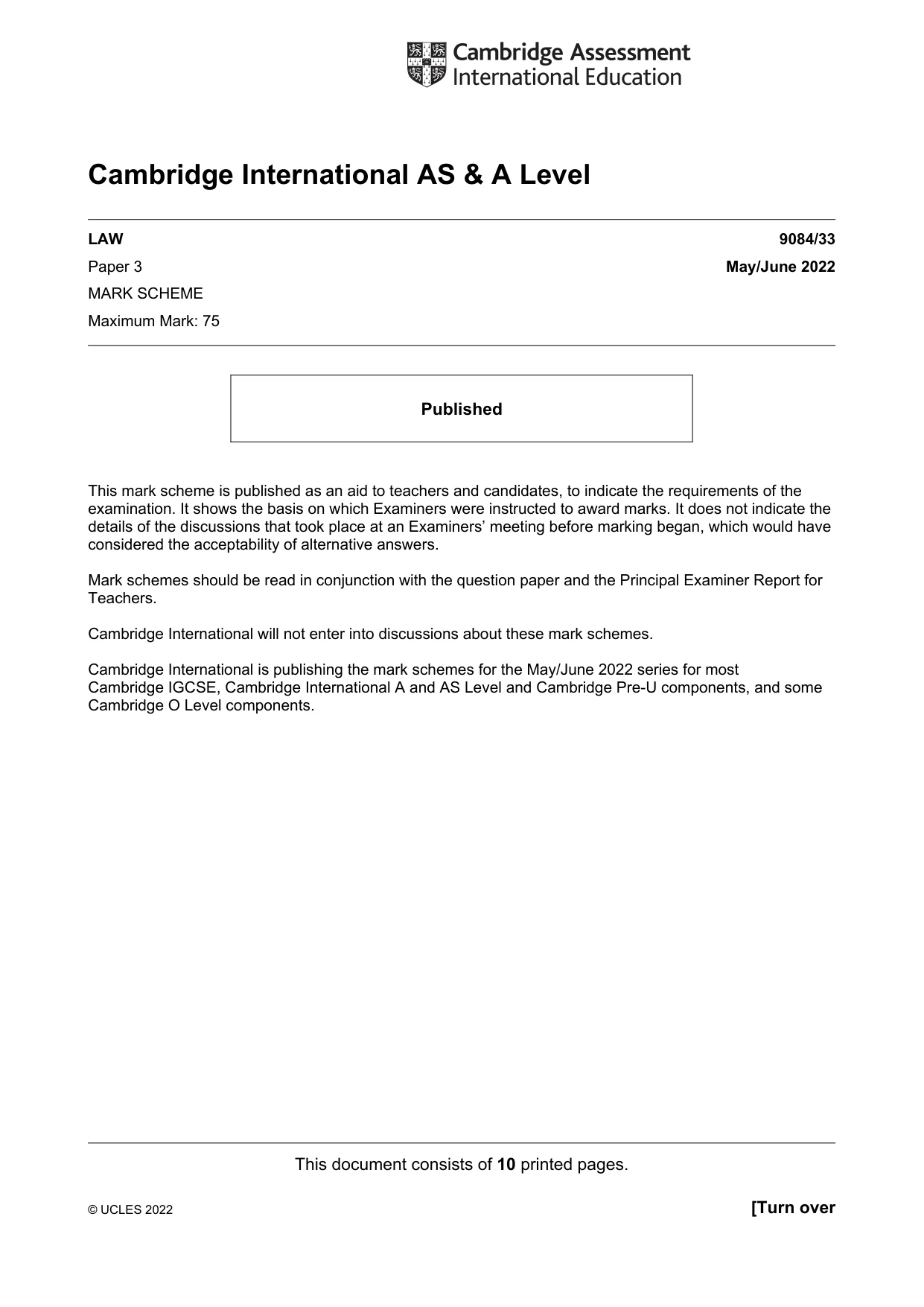
This document consists of 10 printed pages. © UCLES 2022 [Turn over Cambridge International AS & A Level LAW 9084/33 Paper 3 May/June 2022 MARK SCHEME Maximum Mark: 75 Published This mark scheme is published as an aid to teachers and candidates, to indicate the requirements of the examination. It shows the basis on which Examiners were instructed to award marks. It does not indicate the details of the discussions that took place at an Examiners’ meeting before marking began, which would have considered the acceptability of alternative answers. Mark schemes should be read in conjunction with the question paper and the Principal Examiner Report for Teachers. Cambridge International will not enter into discussions about these mark schemes. Cambridge International is publishing the mark schemes for the May/June 2022 series for most Cambridge IGCSE, Cambridge International A and AS Level and Cambridge Pre-U components, and some Cambridge O Level components.
Mark scheme, page 2
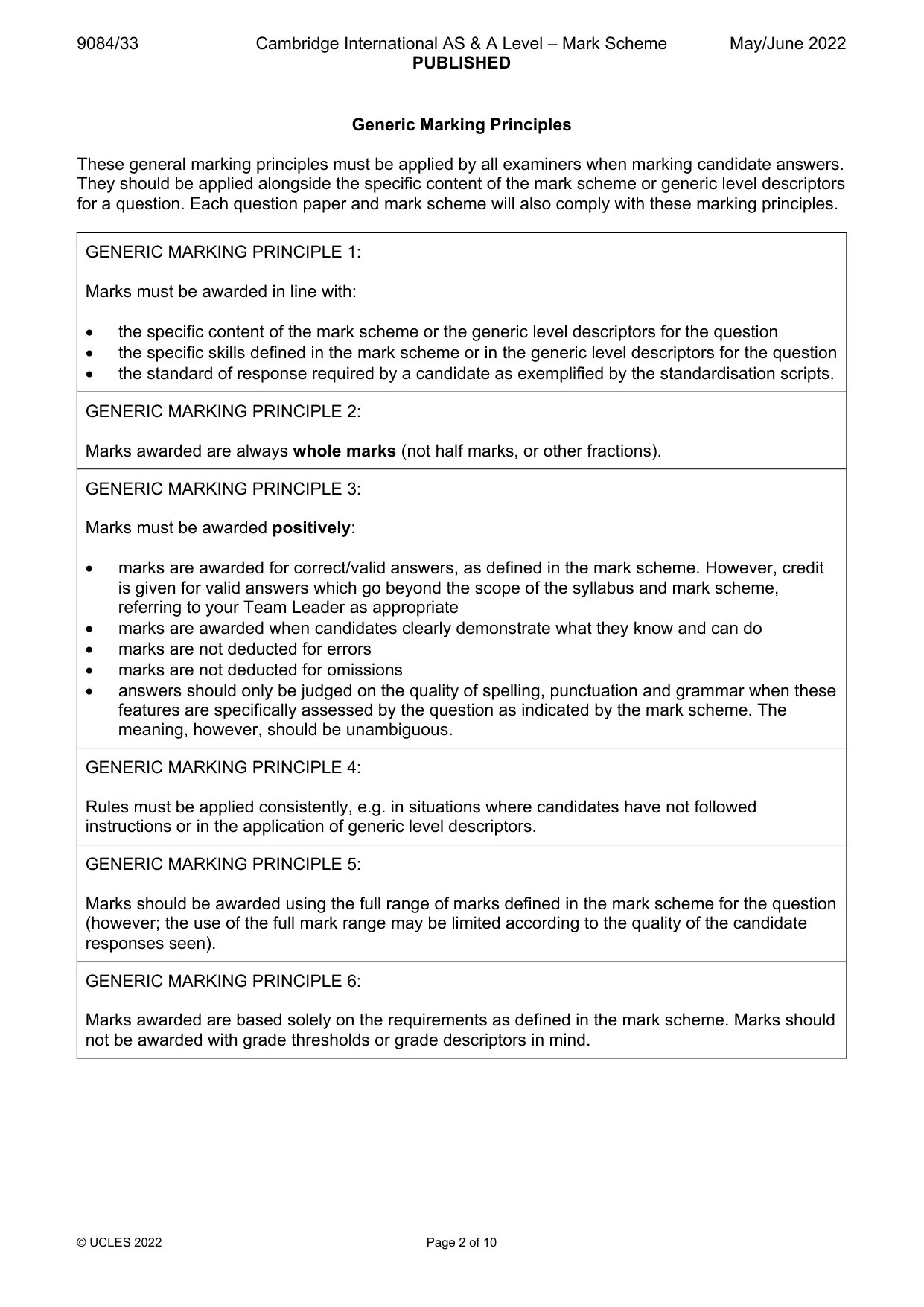
9084/33 Cambridge International AS & A Level – Mark Scheme PUBLISHED May/June 2022 © UCLES 2022 Page 2 of 10 Generic Marking Principles These general marking principles must be applied by all examiners when marking candidate answers. They should be applied alongside the specific content of the mark scheme or generic level descriptors for a question. Each question paper and mark scheme will also comply with these marking principles. GENERIC MARKING PRINCIPLE 1: Marks must be awarded in line with: the specific content of the mark scheme or the generic level descriptors for the question the specific skills defined in the mark scheme or in the generic level descriptors for the question the standard of response required by a candidate as exemplified by the standardisation scripts. GENERIC MARKING PRINCIPLE 2: Marks awarded are always whole marks (not half marks, or other fractions). GENERIC MARKING PRINCIPLE 3: Marks must be awarded positively: marks are awarded for correct/valid answers, as defined in the mark scheme. However, credit is given for valid answers which go beyond the scope of the syllabus and mark scheme, referring to your Team Leader as appropriate marks are awarded when candidates clearly demonstrate what they know and can do marks are not deducted for errors marks are not deducted for omissions answers should only be judged on the quality of spelling, punctuation and grammar when these features are specifically assessed by the question as indicated by the mark scheme. The meaning, however, should be unambiguous. GENERIC MARKING PRINCIPLE 4: Rules must be applied consistently, e.g. in situations where candidates have not followed instructions or in the application of generic level descriptors. GENERIC MARKING PRINCIPLE 5: Marks should be awarded using the full range of marks defined in the mark scheme for the question (however; the use of the full mark range may be limited according to the quality of the candidate responses seen). GENERIC MARKING PRINCIPLE 6: Marks awarded are based solely on the requirements as defined in the mark scheme. Marks should not be awarded with grade thresholds or grade descriptors in mind.
Mark scheme, page 3
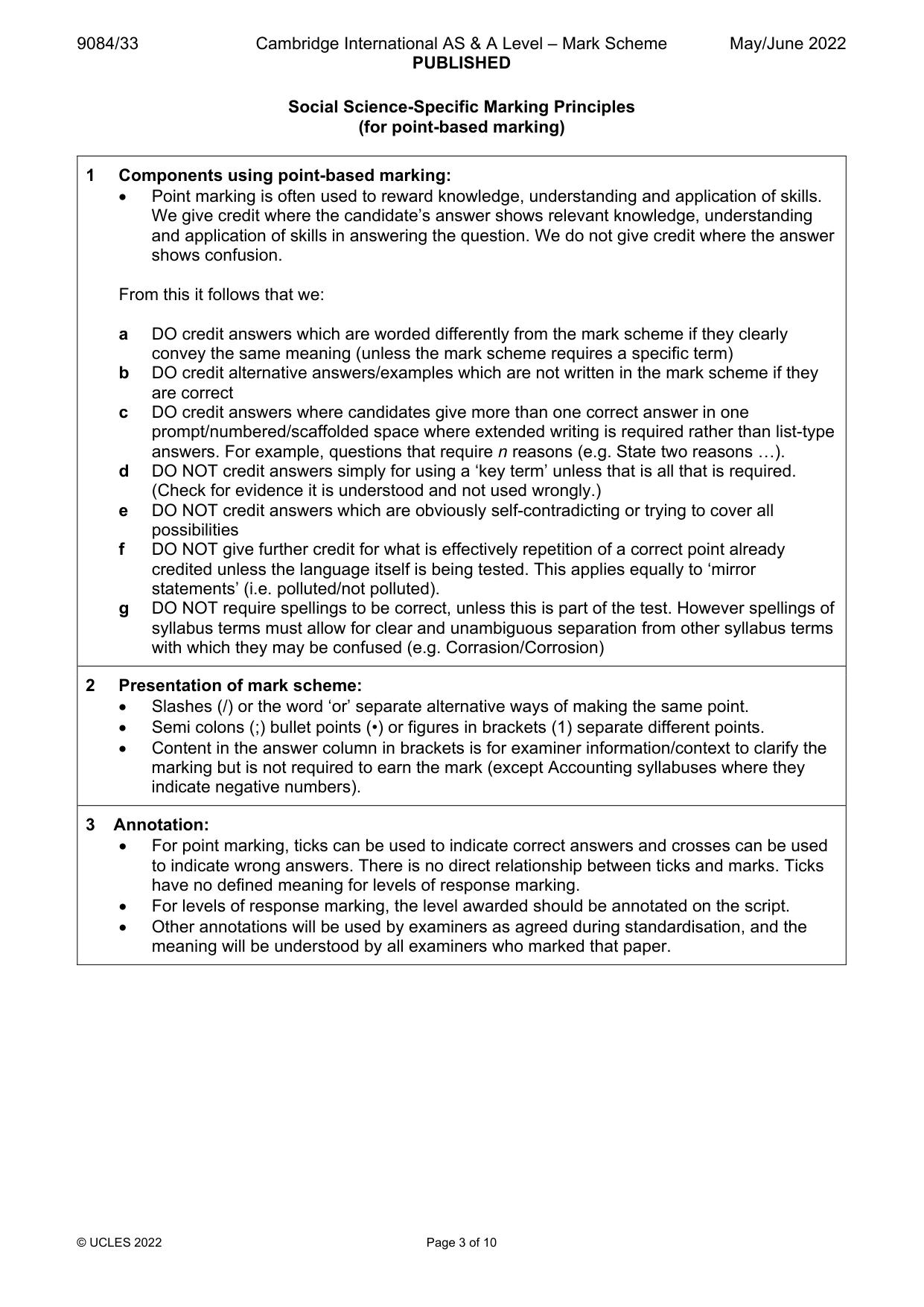
9084/33 Cambridge International AS & A Level – Mark Scheme PUBLISHED May/June 2022 © UCLES 2022 Page 3 of 10 Social Science-Specific Marking Principles (for point-based marking) 1 Components using point-based marking: Point marking is often used to reward knowledge, understanding and application of skills. We give credit where the candidate’s answer shows relevant knowledge, understanding and application of skills in answering the question. We do not give credit where the answer shows confusion. From this it follows that we: a DO credit answers which are worded differently from the mark scheme if they clearly convey the same meaning (unless the mark scheme requires a specific term) b DO credit alternative answers/examples which are not written in the mark scheme if they are correct c DO credit answers where candidates give more than one correct answer in one prompt/numbered/scaffolded space where extended writing is required rather than list-type answers. For example, questions that require n reasons (e.g. State two reasons …). d DO NOT credit answers simply for using a ‘key term’ unless that is all that is required. (Check for evidence it is understood and not used wrongly.) e DO NOT credit answers which are obviously self-contradicting or trying to cover all possibilities f DO NOT give further credit for what is effectively repetition of a correct point already credited unless the language itself is being tested. This applies equally to ‘mirror statements’ (i.e. polluted/not polluted). g DO NOT require spellings to be correct, unless this is part of the test. However spellings of syllabus terms must allow for clear and unambiguous separation from other syllabus terms with which they may be confused (e.g. Corrasion/Corrosion) 2 Presentation of mark scheme: Slashes (/) or the word ‘or’ separate alternative ways of making the same point. Semi colons (;) bullet points (•) or figures in brackets (1) separate different points. Content in the answer column in brackets is for examiner information/context to clarify the marking but is not required to earn the mark (except Accounting syllabuses where they indicate negative numbers). 3 Annotation: For point marking, ticks can be used to indicate correct answers and crosses can be used to indicate wrong answers. There is no direct relationship between ticks and marks. Ticks have no defined meaning for levels of response marking. For levels of response marking, the level awarded should be annotated on the script. Other annotations will be used by examiners as agreed during standardisation, and the meaning will be understood by all examiners who marked that paper.
Mark scheme, page 4
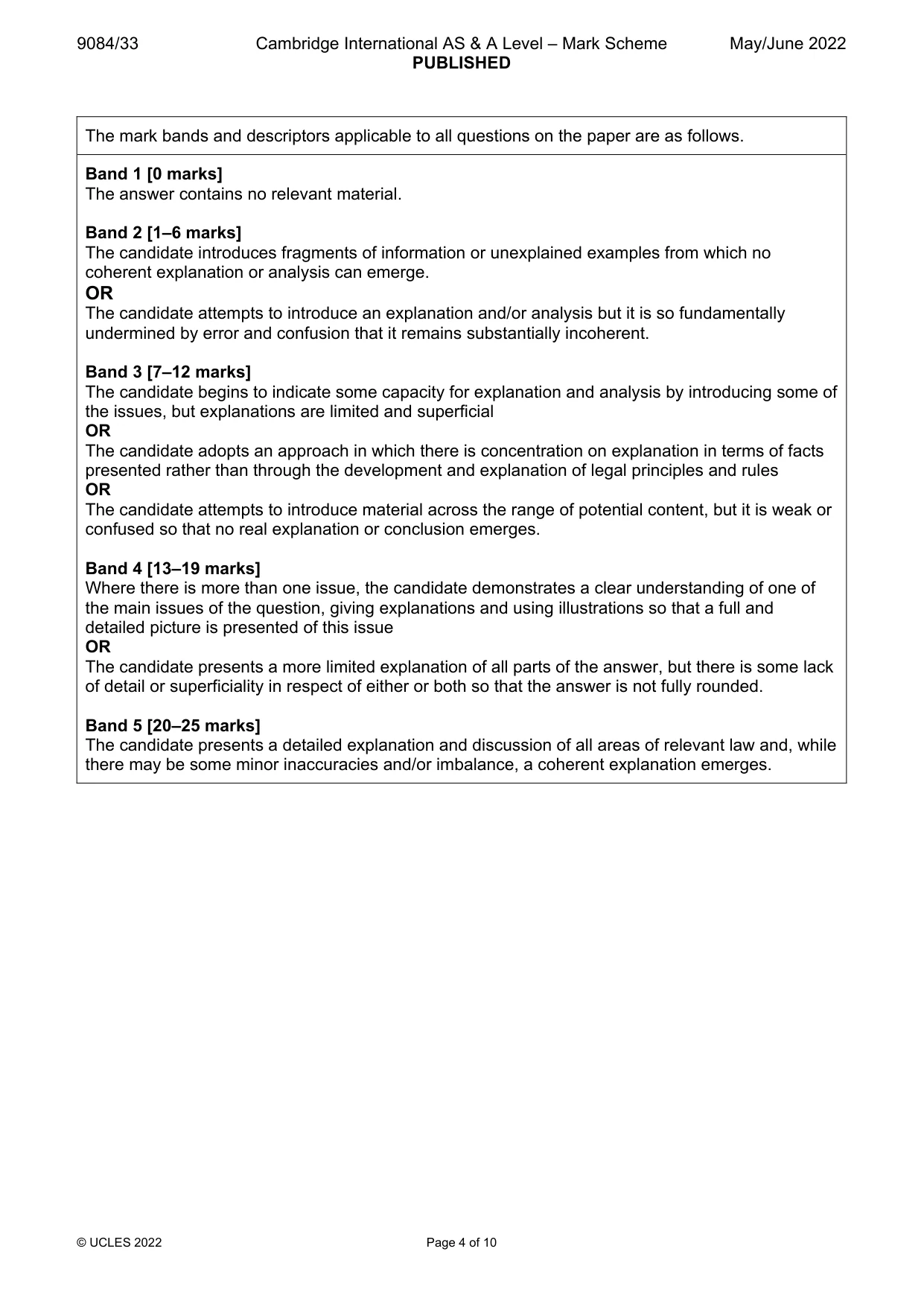
9084/33 Cambridge International AS & A Level – Mark Scheme PUBLISHED May/June 2022 © UCLES 2022 Page 4 of 10 The mark bands and descriptors applicable to all questions on the paper are as follows. Band 1 [0 marks] The answer contains no relevant material. Band 2 [1–6 marks] The candidate introduces fragments of information or unexplained examples from which no coherent explanation or analysis can emerge. OR The candidate attempts to introduce an explanation and/or analysis but it is so fundamentally undermined by error and confusion that it remains substantially incoherent. Band 3 [7–12 marks] The candidate begins to indicate some capacity for explanation and analysis by introducing some of the issues, but explanations are limited and superficial OR The candidate adopts an approach in which there is concentration on explanation in terms of facts presented rather than through the development and explanation of legal principles and rules OR The candidate attempts to introduce material across the range of potential content, but it is weak or confused so that no real explanation or conclusion emerges. Band 4 [13–19 marks] Where there is more than one issue, the candidate demonstrates a clear understanding of one of the main issues of the question, giving explanations and using illustrations so that a full and detailed picture is presented of this issue OR The candidate presents a more limited explanation of all parts of the answer, but there is some lack of detail or superficiality in respect of either or both so that the answer is not fully rounded. Band 5 [20–25 marks] The candidate presents a detailed explanation and discussion of all areas of relevant law and, while there may be some minor inaccuracies and/or imbalance, a coherent explanation emerges.
Mark scheme, page 5
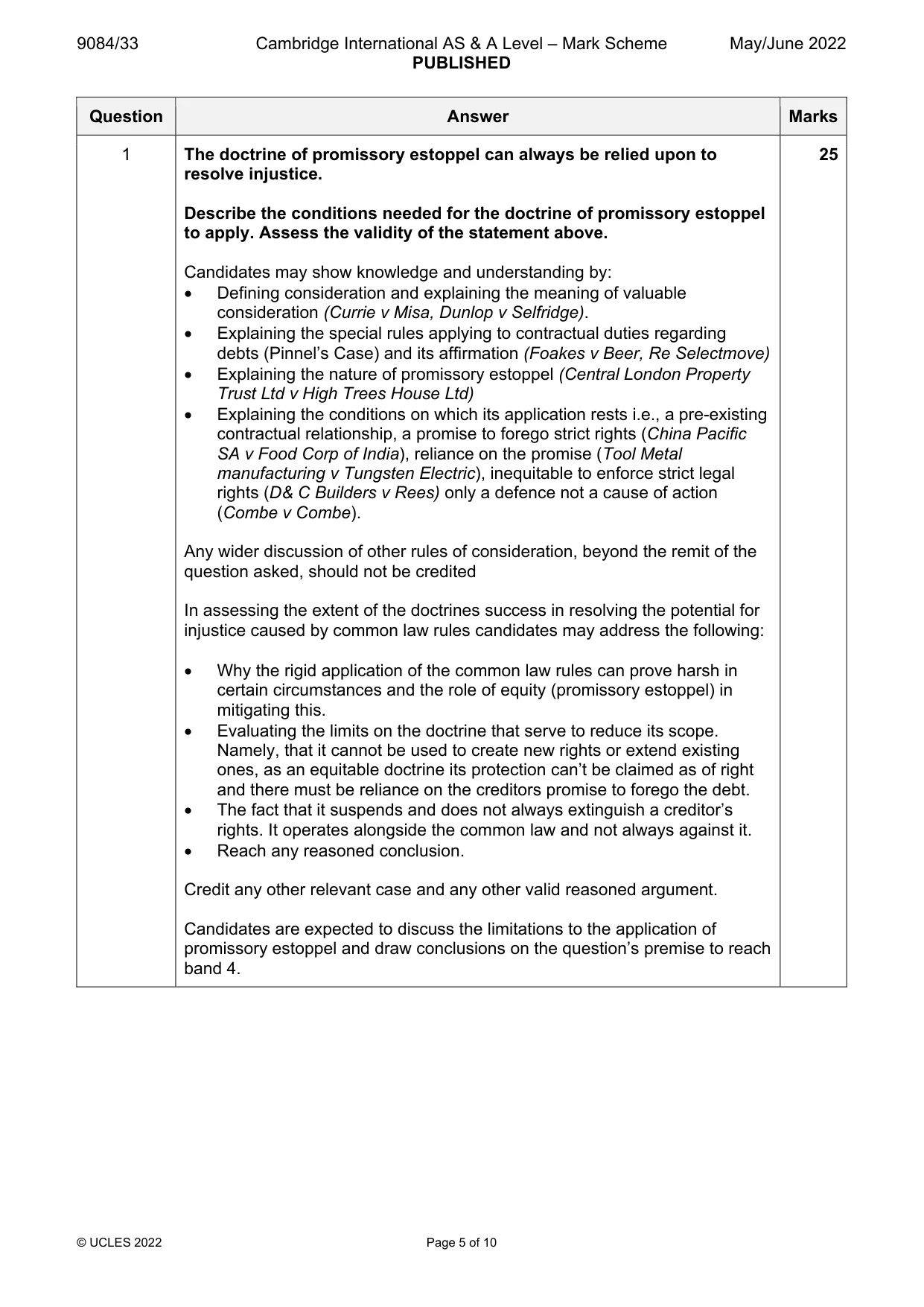
9084/33 Cambridge International AS & A Level – Mark Scheme PUBLISHED May/June 2022 © UCLES 2022 Page 5 of 10 Question Answer Marks 1 The doctrine of promissory estoppel can always be relied upon to resolve injustice. Describe the conditions needed for the doctrine of promissory estoppel to apply. Assess the validity of the statement above. Candidates may show knowledge and understanding by: Defining consideration and explaining the meaning of valuable consideration (Currie v Misa, Dunlop v Selfridge). Explaining the special rules applying to contractual duties regarding debts (Pinnel’s Case) and its affirmation (Foakes v Beer, Re Selectmove) Explaining the nature of promissory estoppel (Central London Property Trust Ltd v High Trees House Ltd) Explaining the conditions on which its application rests i.e., a pre-existing contractual relationship, a promise to forego strict rights (China Pacific SA v Food Corp of India), reliance on the promise (Tool Metal manufacturing v Tungsten Electric), inequitable to enforce strict legal rights (D& C Builders v Rees) only a defence not a cause of action (Combe v Combe). Any wider discussion of other rules of consideration, beyond the remit of the question asked, should not be credited In assessing the extent of the doctrines success in resolving the potential for injustice caused by common law rules candidates may address the following: Why the rigid application of the common law rules can prove harsh in certain circumstances and the role of equity (promissory estoppel) in mitigating this. Evaluating the limits on the doctrine that serve to reduce its scope. Namely, that it cannot be used to create new rights or extend existing ones, as an equitable doctrine its protection can’t be claimed as of right and there must be reliance on the creditors promise to forego the debt. The fact that it suspends and does not always extinguish a creditor’s rights. It operates alongside the common law and not always against it. Reach any reasoned conclusion. Credit any other relevant case and any other valid reasoned argument. Candidates are expected to discuss the limitations to the application of promissory estoppel and draw conclusions on the question’s premise to reach band 4. 25
Mark scheme, page 6
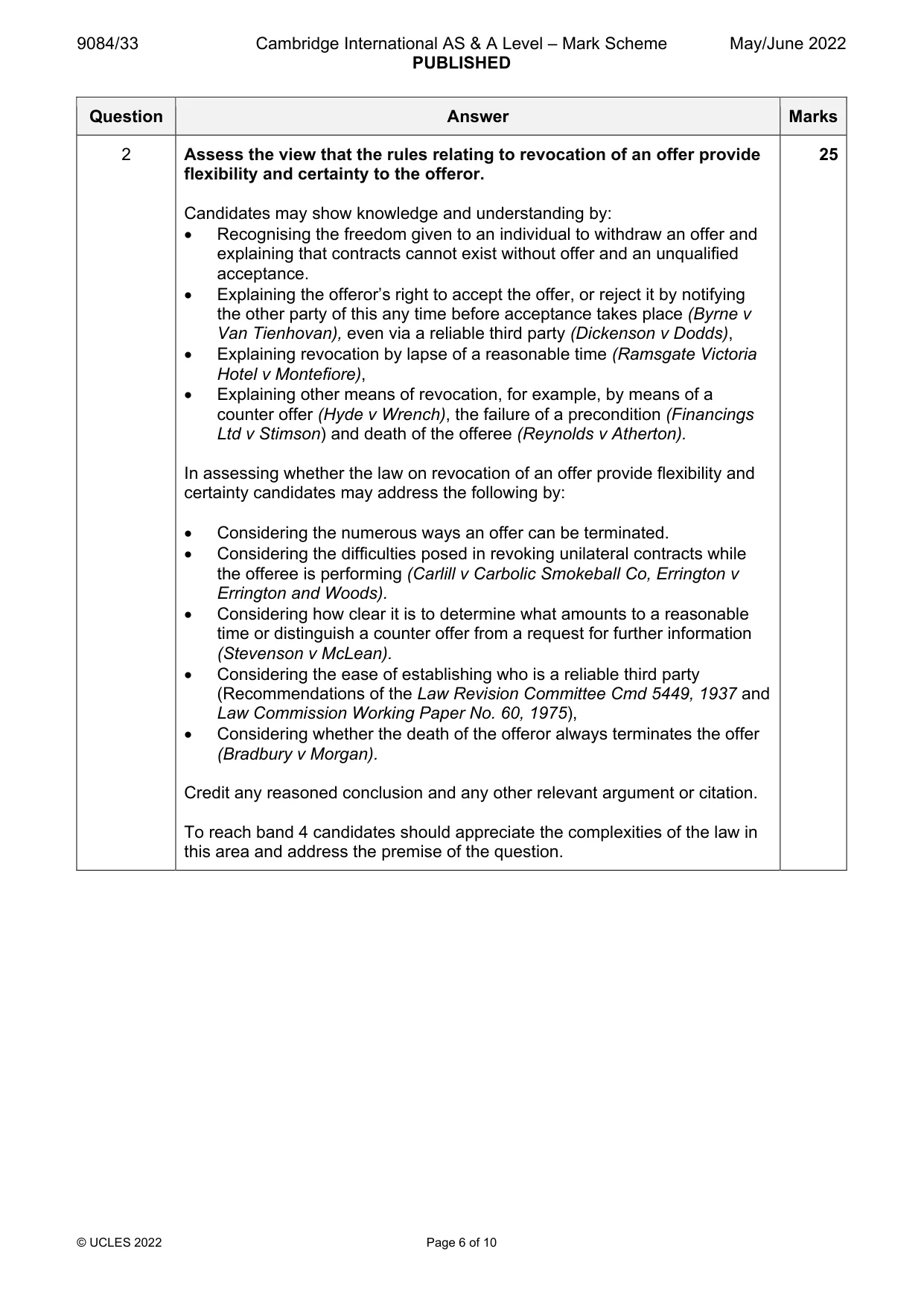
9084/33 Cambridge International AS & A Level – Mark Scheme PUBLISHED May/June 2022 © UCLES 2022 Page 6 of 10 Question Answer Marks 2 Assess the view that the rules relating to revocation of an offer provide flexibility and certainty to the offeror. Candidates may show knowledge and understanding by: Recognising the freedom given to an individual to withdraw an offer and explaining that contracts cannot exist without offer and an unqualified acceptance. Explaining the offeror’s right to accept the offer, or reject it by notifying the other party of this any time before acceptance takes place (Byrne v Van Tienhovan), even via a reliable third party (Dickenson v Dodds), Explaining revocation by lapse of a reasonable time (Ramsgate Victoria Hotel v Montefiore), Explaining other means of revocation, for example, by means of a counter offer (Hyde v Wrench), the failure of a precondition (Financings Ltd v Stimson) and death of the offeree (Reynolds v Atherton). In assessing whether the law on revocation of an offer provide flexibility and certainty candidates may address the following by: Considering the numerous ways an offer can be terminated. Considering the difficulties posed in revoking unilateral contracts while the offeree is performing (Carlill v Carbolic Smokeball Co, Errington v Errington and Woods). Considering how clear it is to determine what amounts to a reasonable time or distinguish a counter offer from a request for further information (Stevenson v McLean). Considering the ease of establishing who is a reliable third party (Recommendations of the Law Revision Committee Cmd 5449, 1937 and Law Commission Working Paper No. 60, 1975), Considering whether the death of the offeror always terminates the offer (Bradbury v Morgan). Credit any reasoned conclusion and any other relevant argument or citation. To reach band 4 candidates should appreciate the complexities of the law in this area and address the premise of the question. 25
Mark scheme, page 7
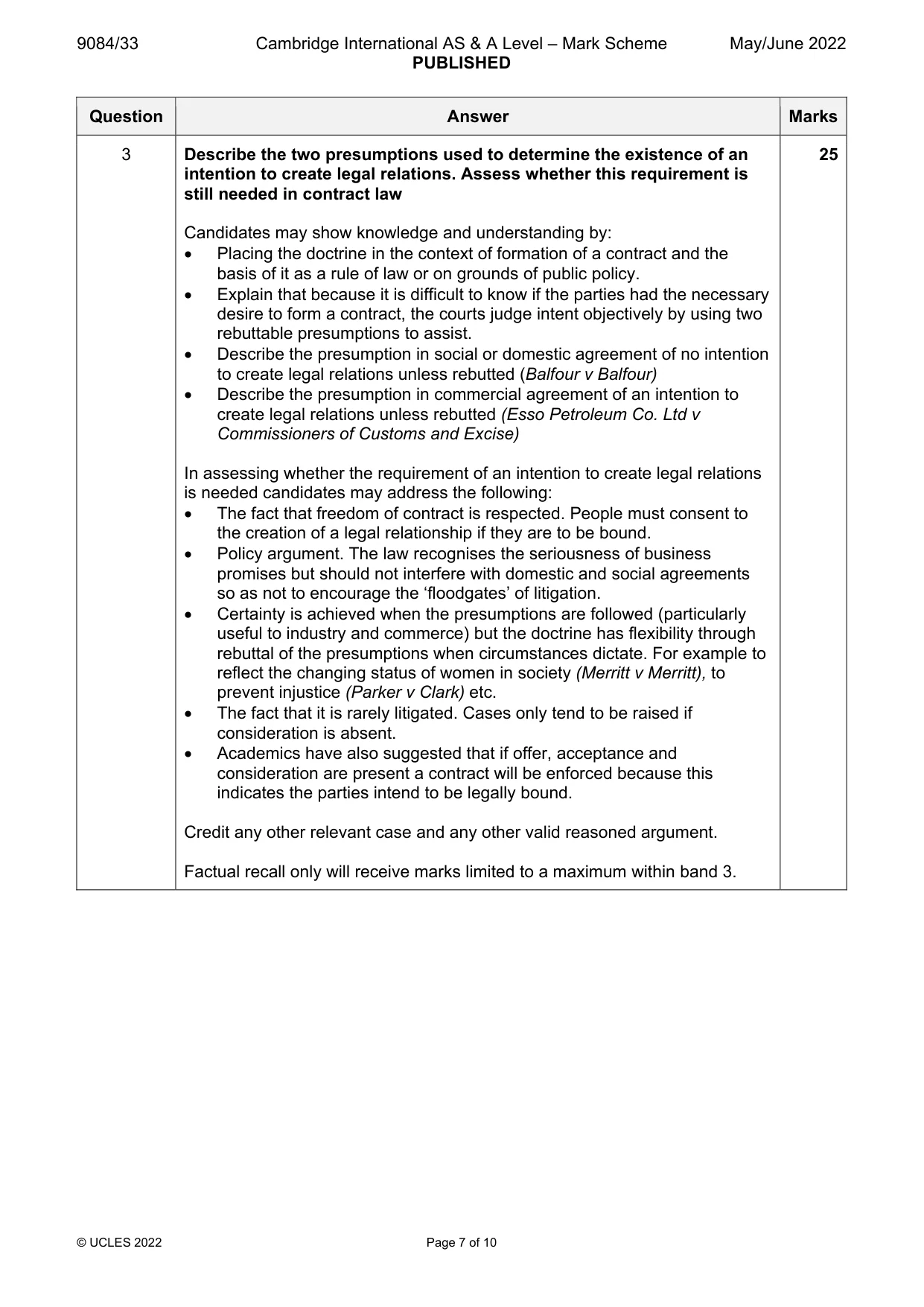
9084/33 Cambridge International AS & A Level – Mark Scheme PUBLISHED May/June 2022 © UCLES 2022 Page 7 of 10 Question Answer Marks 3 Describe the two presumptions used to determine the existence of an intention to create legal relations. Assess whether this requirement is still needed in contract law Candidates may show knowledge and understanding by: Placing the doctrine in the context of formation of a contract and the basis of it as a rule of law or on grounds of public policy. Explain that because it is difficult to know if the parties had the necessary desire to form a contract, the courts judge intent objectively by using two rebuttable presumptions to assist. Describe the presumption in social or domestic agreement of no intention to create legal relations unless rebutted (Balfour v Balfour) Describe the presumption in commercial agreement of an intention to create legal relations unless rebutted (Esso Petroleum Co. Ltd v Commissioners of Customs and Excise) In assessing whether the requirement of an intention to create legal relations is needed candidates may address the following: The fact that freedom of contract is respected. People must consent to the creation of a legal relationship if they are to be bound. Policy argument. The law recognises the seriousness of business promises but should not interfere with domestic and social agreements so as not to encourage the ‘floodgates’ of litigation. Certainty is achieved when the presumptions are followed (particularly useful to industry and commerce) but the doctrine has flexibility through rebuttal of the presumptions when circumstances dictate. For example to reflect the changing status of women in society (Merritt v Merritt), to prevent injustice (Parker v Clark) etc. The fact that it is rarely litigated. Cases only tend to be raised if consideration is absent. Academics have also suggested that if offer, acceptance and consideration are present a contract will be enforced because this indicates the parties intend to be legally bound. Credit any other relevant case and any other valid reasoned argument. Factual recall only will receive marks limited to a maximum within band 3. 25
Mark scheme, page 8
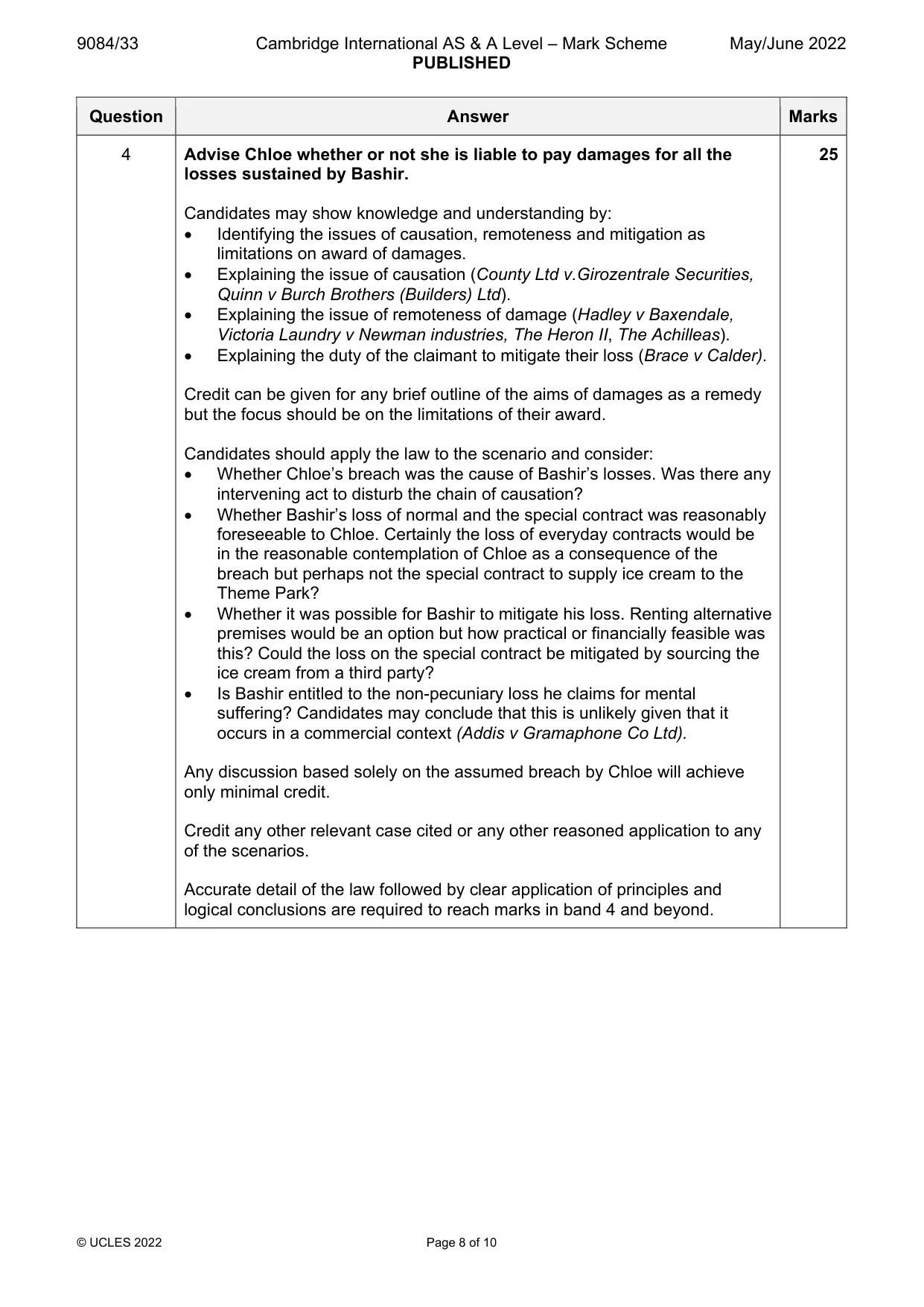
9084/33 Cambridge International AS & A Level – Mark Scheme PUBLISHED May/June 2022 © UCLES 2022 Page 8 of 10 Question Answer Marks 4 Advise Chloe whether or not she is liable to pay damages for all the losses sustained by Bashir. Candidates may show knowledge and understanding by: Identifying the issues of causation, remoteness and mitigation as limitations on award of damages. Explaining the issue of causation (County Ltd v.Girozentrale Securities, Quinn v Burch Brothers (Builders) Ltd). Explaining the issue of remoteness of damage (Hadley v Baxendale, Victoria Laundry v Newman industries, The Heron II, The Achilleas). Explaining the duty of the claimant to mitigate their loss (Brace v Calder). Credit can be given for any brief outline of the aims of damages as a remedy but the focus should be on the limitations of their award. Candidates should apply the law to the scenario and consider: Whether Chloe’s breach was the cause of Bashir’s losses. Was there any intervening act to disturb the chain of causation? Whether Bashir’s loss of normal and the special contract was reasonably foreseeable to Chloe. Certainly the loss of everyday contracts would be in the reasonable contemplation of Chloe as a consequence of the breach but perhaps not the special contract to supply ice cream to the Theme Park? Whether it was possible for Bashir to mitigate his loss. Renting alternative premises would be an option but how practical or financially feasible was this? Could the loss on the special contract be mitigated by sourcing the ice cream from a third party? Is Bashir entitled to the non-pecuniary loss he claims for mental suffering? Candidates may conclude that this is unlikely given that it occurs in a commercial context (Addis v Gramaphone Co Ltd). Any discussion based solely on the assumed breach by Chloe will achieve only minimal credit. Credit any other relevant case cited or any other reasoned application to any of the scenarios. Accurate detail of the law followed by clear application of principles and logical conclusions are required to reach marks in band 4 and beyond. 25
Mark scheme, page 9
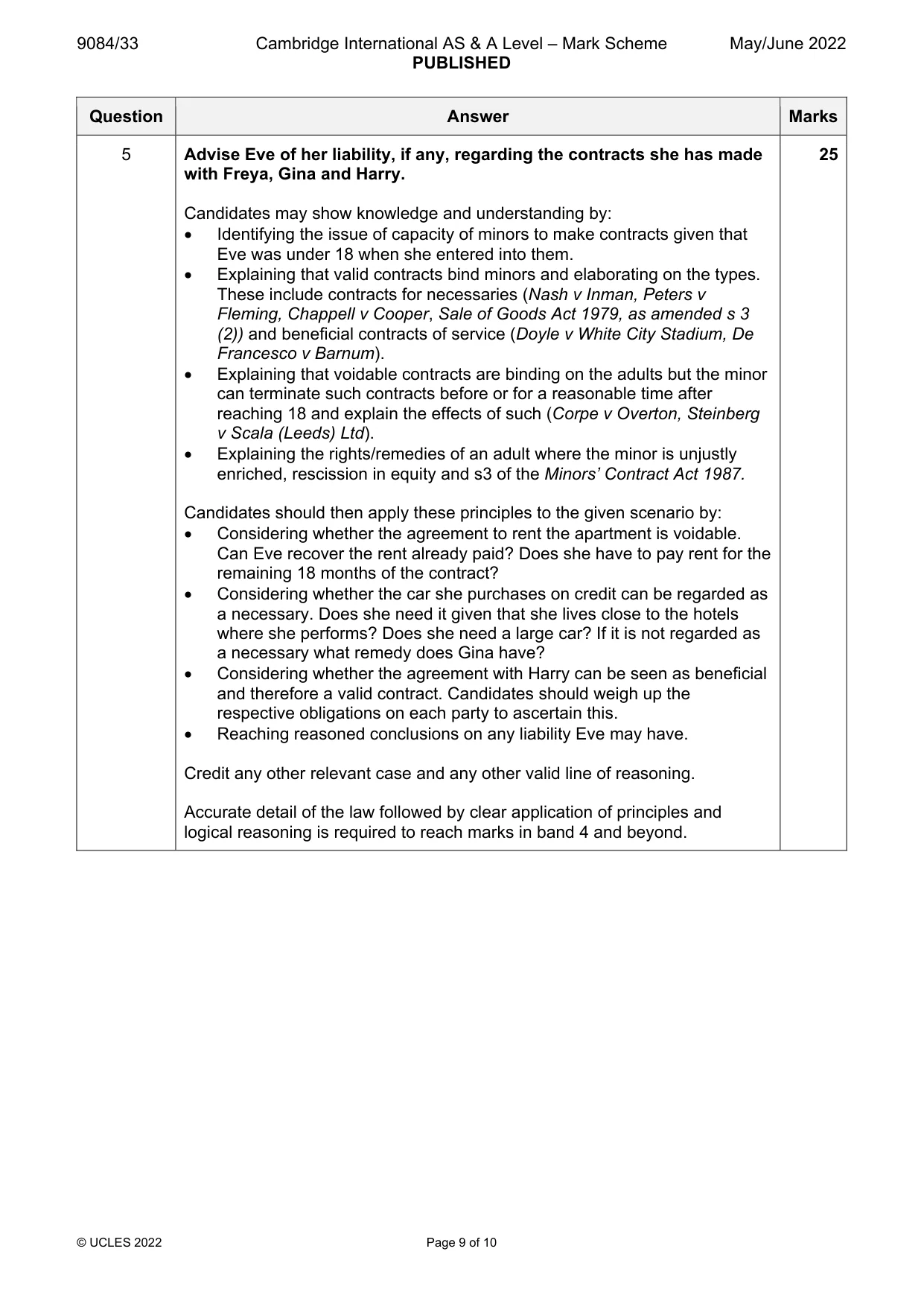
9084/33 Cambridge International AS & A Level – Mark Scheme PUBLISHED May/June 2022 © UCLES 2022 Page 9 of 10 Question Answer Marks 5 Advise Eve of her liability, if any, regarding the contracts she has made with Freya, Gina and Harry. Candidates may show knowledge and understanding by: Identifying the issue of capacity of minors to make contracts given that Eve was under 18 when she entered into them. Explaining that valid contracts bind minors and elaborating on the types. These include contracts for necessaries (Nash v Inman, Peters v Fleming, Chappell v Cooper, Sale of Goods Act 1979, as amended s 3 (2)) and beneficial contracts of service (Doyle v White City Stadium, De Francesco v Barnum). Explaining that voidable contracts are binding on the adults but the minor can terminate such contracts before or for a reasonable time after reaching 18 and explain the effects of such (Corpe v Overton, Steinberg v Scala (Leeds) Ltd). Explaining the rights/remedies of an adult where the minor is unjustly enriched, rescission in equity and s3 of the Minors’ Contract Act 1987. Candidates should then apply these principles to the given scenario by: Considering whether the agreement to rent the apartment is voidable. Can Eve recover the rent already paid? Does she have to pay rent for the remaining 18 months of the contract? Considering whether the car she purchases on credit can be regarded as a necessary. Does she need it given that she lives close to the hotels where she performs? Does she need a large car? If it is not regarded as a necessary what remedy does Gina have? Considering whether the agreement with Harry can be seen as beneficial and therefore a valid contract. Candidates should weigh up the respective obligations on each party to ascertain this. Reaching reasoned conclusions on any liability Eve may have. Credit any other relevant case and any other valid line of reasoning. Accurate detail of the law followed by clear application of principles and logical reasoning is required to reach marks in band 4 and beyond. 25
Mark scheme, page 10
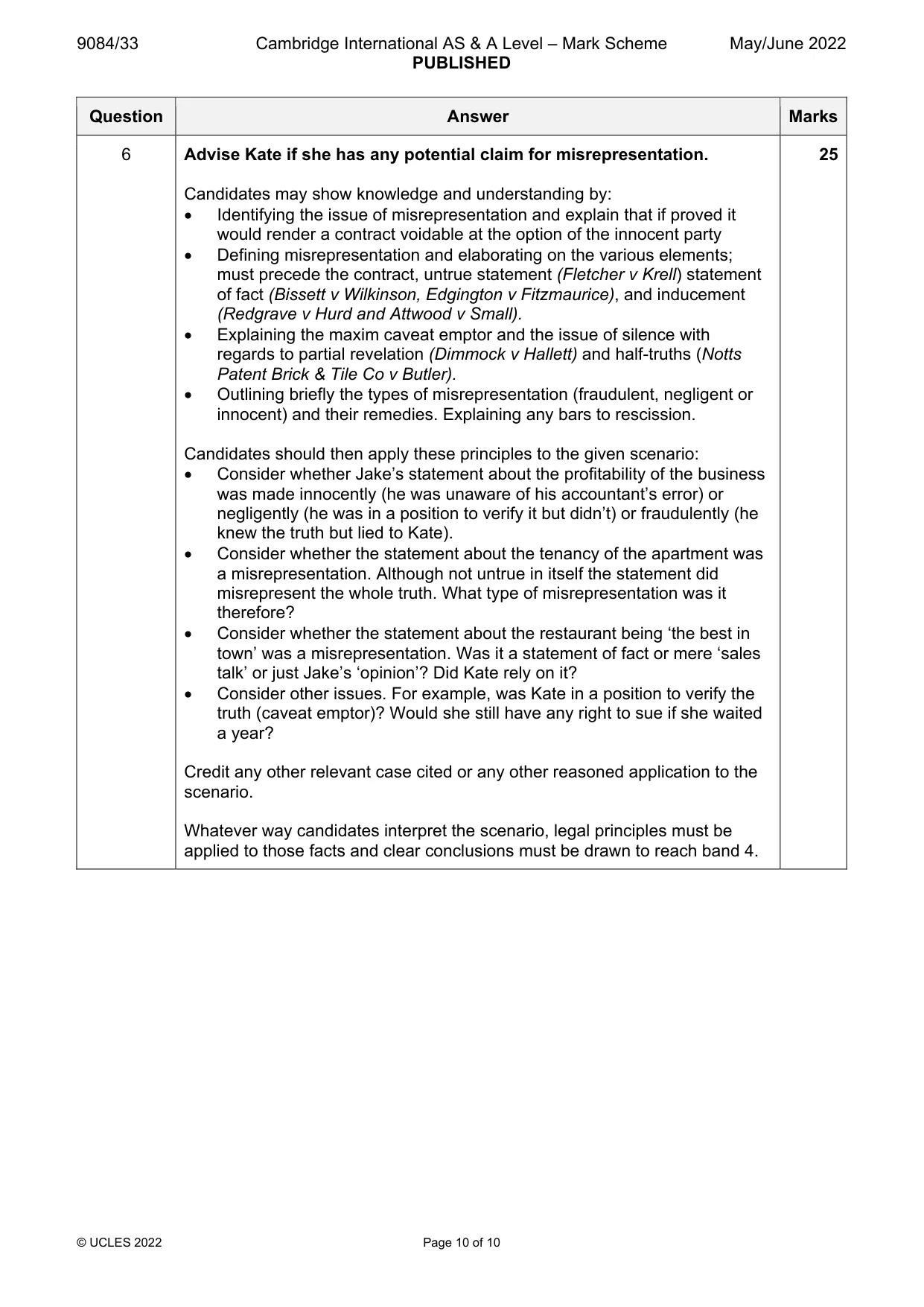
9084/33 Cambridge International AS & A Level – Mark Scheme PUBLISHED May/June 2022 © UCLES 2022 Page 10 of 10 Question Answer Marks 6 Advise Kate if she has any potential claim for misrepresentation. Candidates may show knowledge and understanding by: Identifying the issue of misrepresentation and explain that if proved it would render a contract voidable at the option of the innocent party Defining misrepresentation and elaborating on the various elements; must precede the contract, untrue statement (Fletcher v Krell) statement of fact (Bissett v Wilkinson, Edgington v Fitzmaurice), and inducement (Redgrave v Hurd and Attwood v Small). Explaining the maxim caveat emptor and the issue of silence with regards to partial revelation (Dimmock v Hallett) and half-truths (Notts Patent Brick & Tile Co v Butler). Outlining briefly the types of misrepresentation (fraudulent, negligent or innocent) and their remedies. Explaining any bars to rescission. Candidates should then apply these principles to the given scenario: Consider whether Jake’s statement about the profitability of the business was made innocently (he was unaware of his accountant’s error) or negligently (he was in a position to verify it but didn’t) or fraudulently (he knew the truth but lied to Kate). Consider whether the statement about the tenancy of the apartment was a misrepresentation. Although not untrue in itself the statement did misrepresent the whole truth. What type of misrepresentation was it therefore? Consider whether the statement about the restaurant being ‘the best in town’ was a misrepresentation. Was it a statement of fact or mere ‘sales talk’ or just Jake’s ‘opinion’? Did Kate rely on it? Consider other issues. For example, was Kate in a position to verify the truth (caveat emptor)? Would she still have any right to sue if she waited a year? Credit any other relevant case cited or any other reasoned application to the scenario. Whatever way candidates interpret the scenario, legal principles must be applied to those facts and clear conclusions must be drawn to reach band 4. 25
What you needed in this session
Cambridge’s own grade thresholds for 2022 May/June, Paper 3 · Variant 3. A higher threshold means an easier paper — the bar moves with how the cohort did.