Cambridge A Level Law 9084 — 2023 May/June Paper 3 · Variant 2
9084/32/M/J/23 · 75 marks · ≈84 min
The question paper and its mark scheme, free to read here and free to download. This is Cambridge’s own paper, exactly as it was sat.
Question paper4 pages

Mark scheme11 pages
Answers below. Sit the paper first if you are practising.
Paper as text
Question paper, page 1
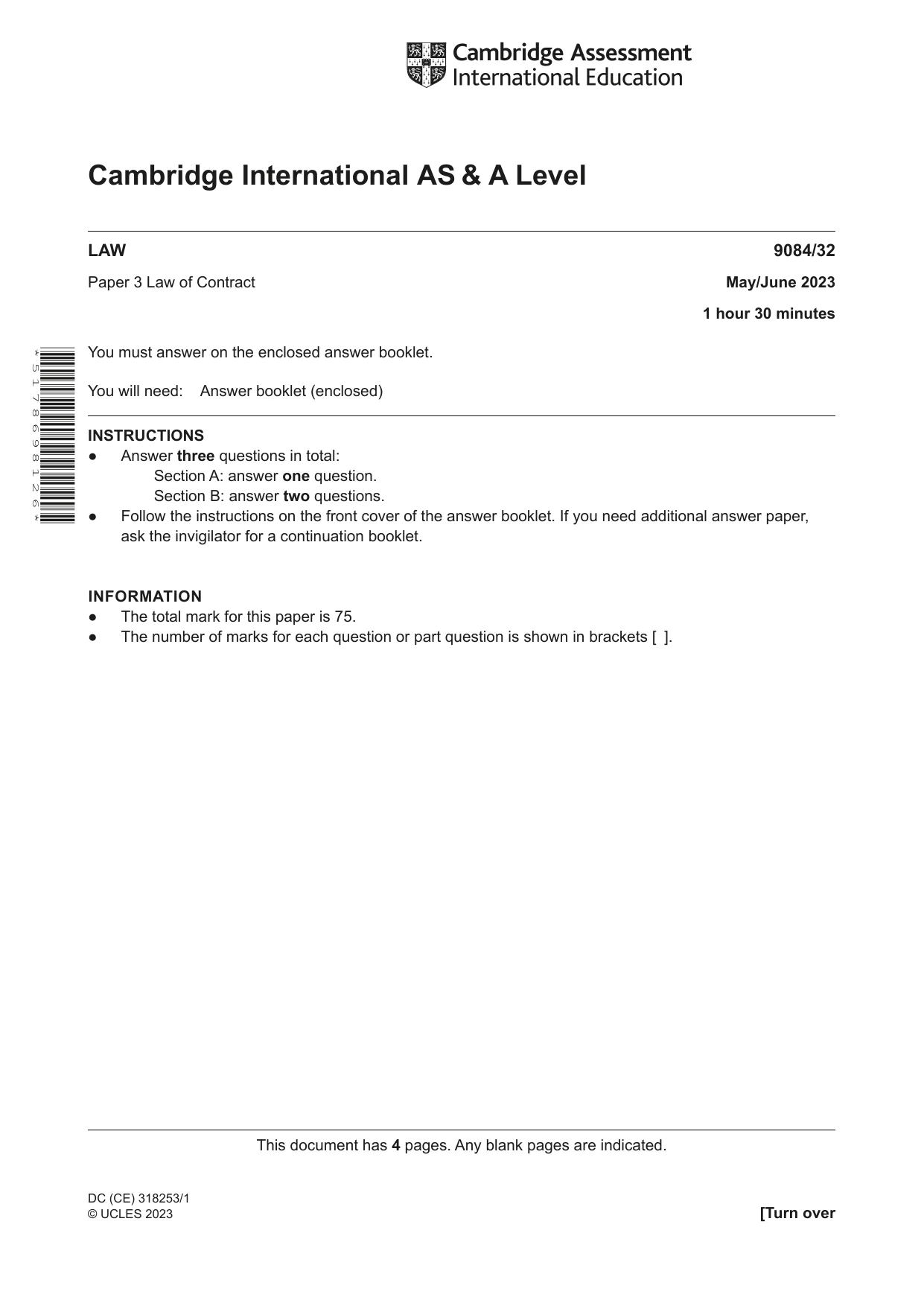
This document has 4 pages. Any blank pages are indicated. [Turn over Cambridge International AS & A Level DC (CE) 318253/1 © UCLES 2023 LAW 9084/32 Paper 3 Law of Contract May/June 2023 1 hour 30 minutes You must answer on the enclosed answer booklet. You will need: Answer booklet (enclosed) INSTRUCTIONS ● Answer three questions in total: Section A: answer one question. Section B: answer two questions. ● Follow the instructions on the front cover of the answer booklet. If you need additional answer paper, ask the invigilator for a continuation booklet. INFORMATION ● The total mark for this paper is 75. ● The number of marks for each question or part question is shown in brackets [ ]. * 5 1 7 8 6 9 8 1 2 6 *
Question paper, page 2
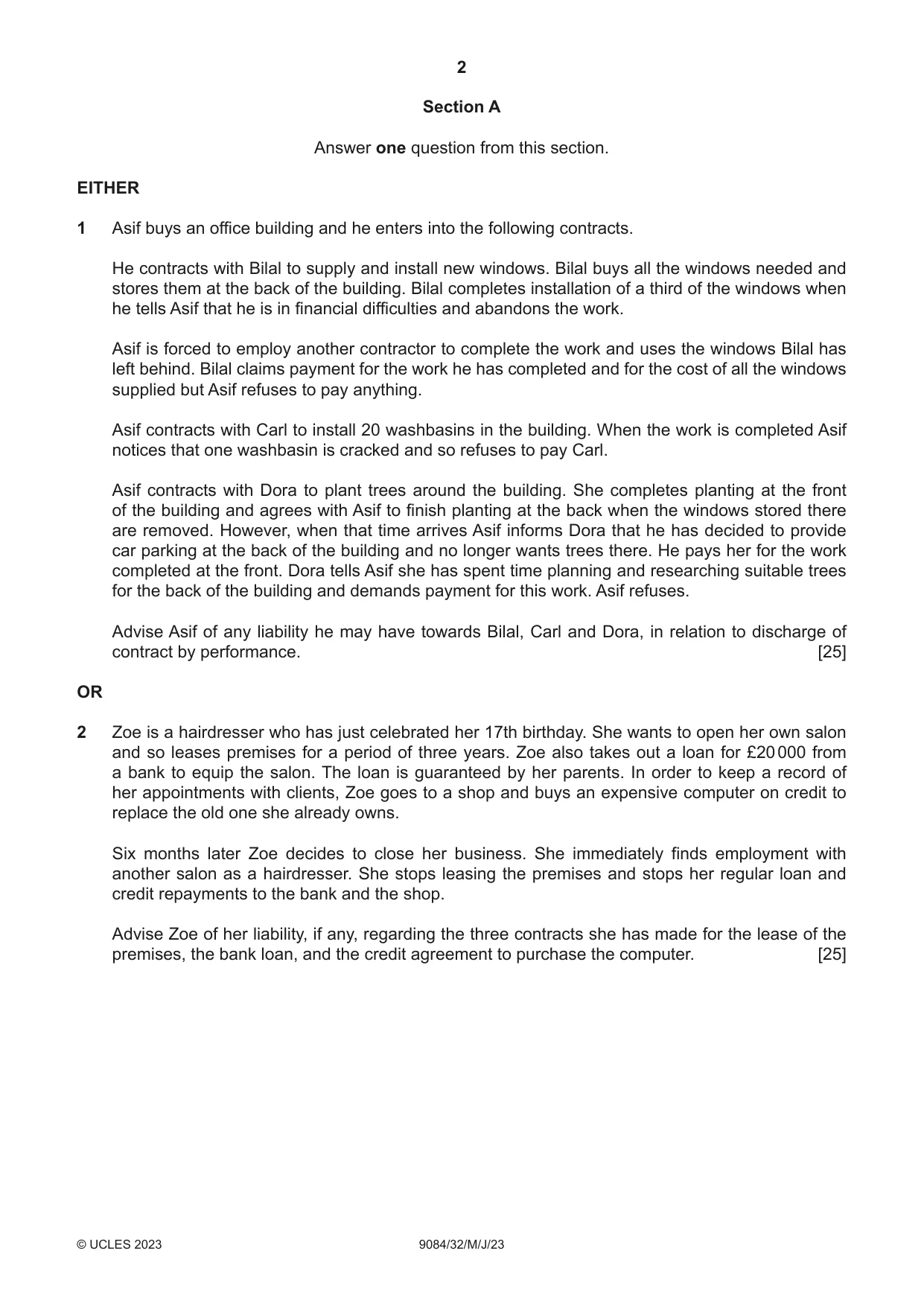
2 9084/32/M/J/23 © UCLES 2023 Section A Answer one question from this section. EITHER 1 Asif buys an office building and he enters into the following contracts. He contracts with Bilal to supply and install new windows. Bilal buys all the windows needed and stores them at the back of the building. Bilal completes installation of a third of the windows when he tells Asif that he is in financial difficulties and abandons the work. Asif is forced to employ another contractor to complete the work and uses the windows Bilal has left behind. Bilal claims payment for the work he has completed and for the cost of all the windows supplied but Asif refuses to pay anything. Asif contracts with Carl to install 20 washbasins in the building. When the work is completed Asif notices that one washbasin is cracked and so refuses to pay Carl. Asif contracts with Dora to plant trees around the building. She completes planting at the front of the building and agrees with Asif to finish planting at the back when the windows stored there are removed. However, when that time arrives Asif informs Dora that he has decided to provide car parking at the back of the building and no longer wants trees there. He pays her for the work completed at the front. Dora tells Asif she has spent time planning and researching suitable trees for the back of the building and demands payment for this work. Asif refuses. Advise Asif of any liability he may have towards Bilal, Carl and Dora, in relation to discharge of contract by performance. [25] OR 2 Zoe is a hairdresser who has just celebrated her 17th birthday. She wants to open her own salon and so leases premises for a period of three years. Zoe also takes out a loan for £20 000 from a bank to equip the salon. The loan is guaranteed by her parents. In order to keep a record of her appointments with clients, Zoe goes to a shop and buys an expensive computer on credit to replace the old one she already owns. Six months later Zoe decides to close her business. She immediately finds employment with another salon as a hairdresser. She stops leasing the premises and stops her regular loan and credit repayments to the bank and the shop. Advise Zoe of her liability, if any, regarding the three contracts she has made for the lease of the premises, the bank loan, and the credit agreement to purchase the computer. [25]
Question paper, page 3
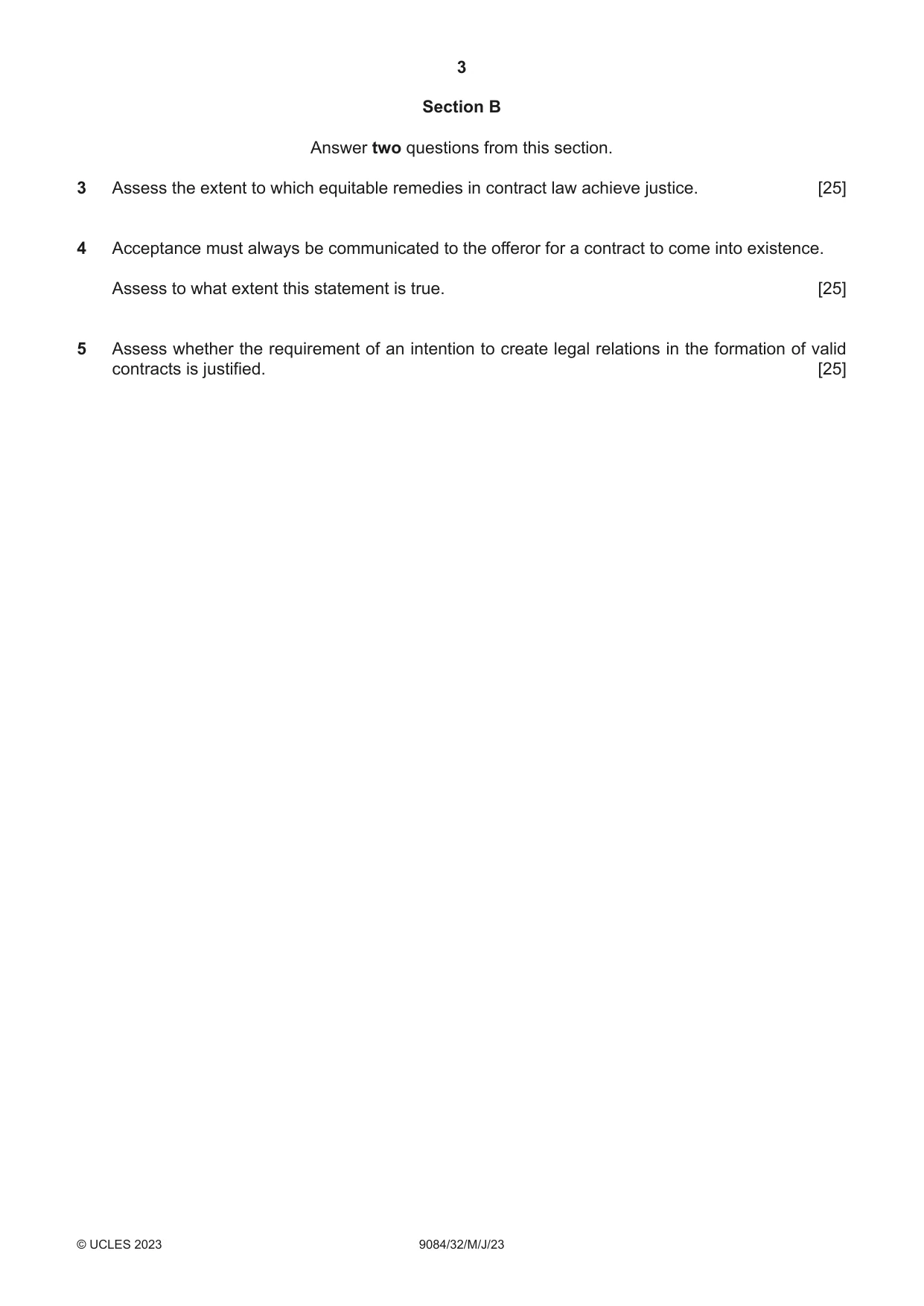
3 9084/32/M/J/23 © UCLES 2023 Section B Answer two questions from this section. 3 Assess the extent to which equitable remedies in contract law achieve justice. [25] 4 Acceptance must always be communicated to the offeror for a contract to come into existence. Assess to what extent this statement is true. [25] 5 Assess whether the requirement of an intention to create legal relations in the formation of valid contracts is justified. [25]
Question paper, page 4
4 9084/32/M/J/23 © UCLES 2023 Permission to reproduce items where third-party owned material protected by copyright is included has been sought and cleared where possible. Every reasonable effort has been made by the publisher (UCLES) to trace copyright holders, but if any items requiring clearance have unwittingly been included, the publisher will be pleased to make amends at the earliest possible opportunity. To avoid the issue of disclosure of answer-related information to candidates, all copyright acknowledgements are reproduced online in the Cambridge Assessment International Education Copyright Acknowledgements Booklet. This is produced for each series of examinations and is freely available to download at www.cambridgeinternational.org after the live examination series. Cambridge Assessment International Education is part of Cambridge Assessment. Cambridge Assessment is the brand name of the University of Cambridge Local Examinations Syndicate (UCLES), which is a department of the University of Cambridge. BLANK PAGE
Mark scheme, page 1
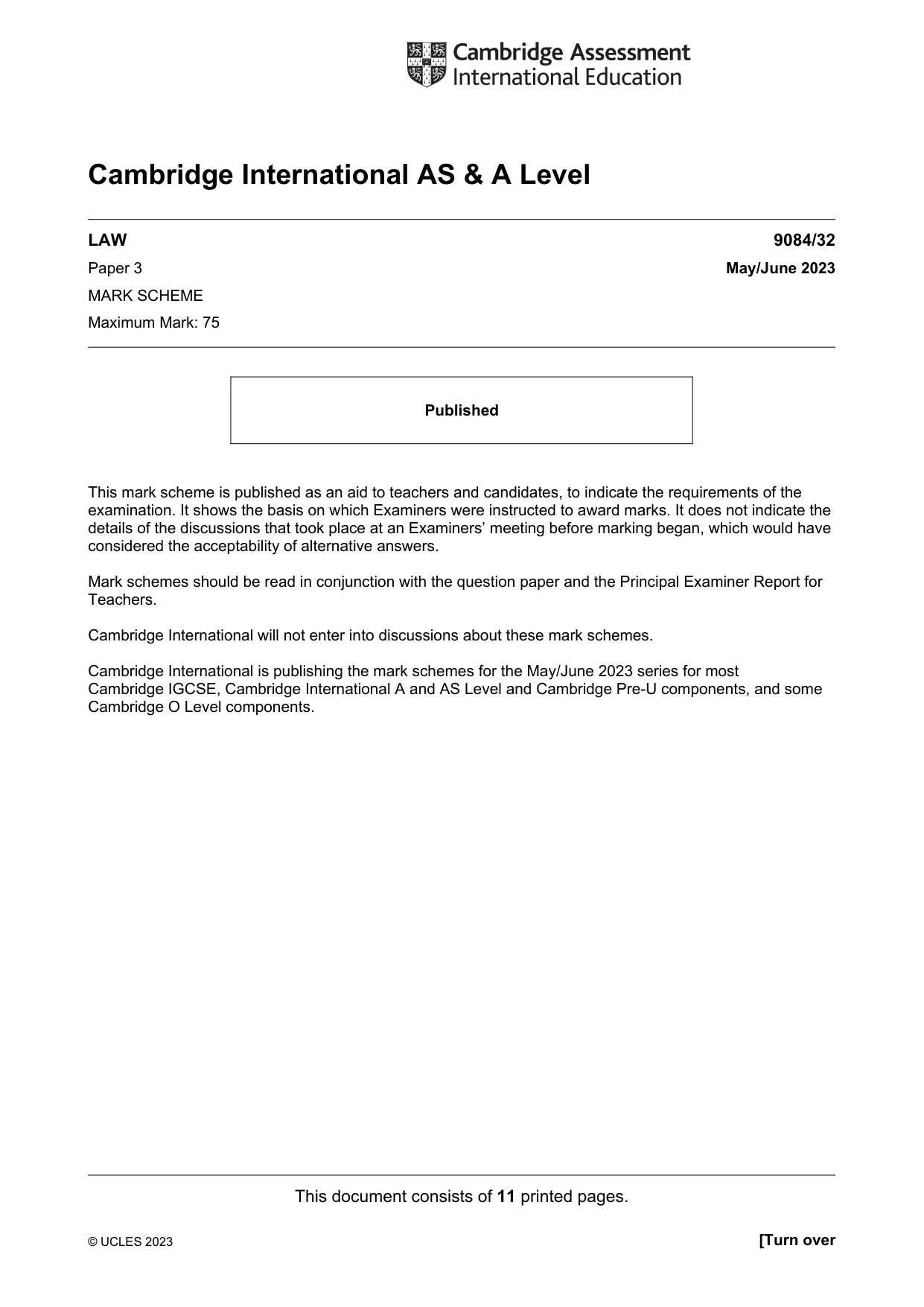
This document consists of 11 printed pages. © UCLES 2023 [Turn over Cambridge International AS & A Level LAW 9084/32 Paper 3 May/June 2023 MARK SCHEME Maximum Mark: 75 Published This mark scheme is published as an aid to teachers and candidates, to indicate the requirements of the examination. It shows the basis on which Examiners were instructed to award marks. It does not indicate the details of the discussions that took place at an Examiners’ meeting before marking began, which would have considered the acceptability of alternative answers. Mark schemes should be read in conjunction with the question paper and the Principal Examiner Report for Teachers. Cambridge International will not enter into discussions about these mark schemes. Cambridge International is publishing the mark schemes for the May/June 2023 series for most Cambridge IGCSE, Cambridge International A and AS Level and Cambridge Pre-U components, and some Cambridge O Level components.
Mark scheme, page 2
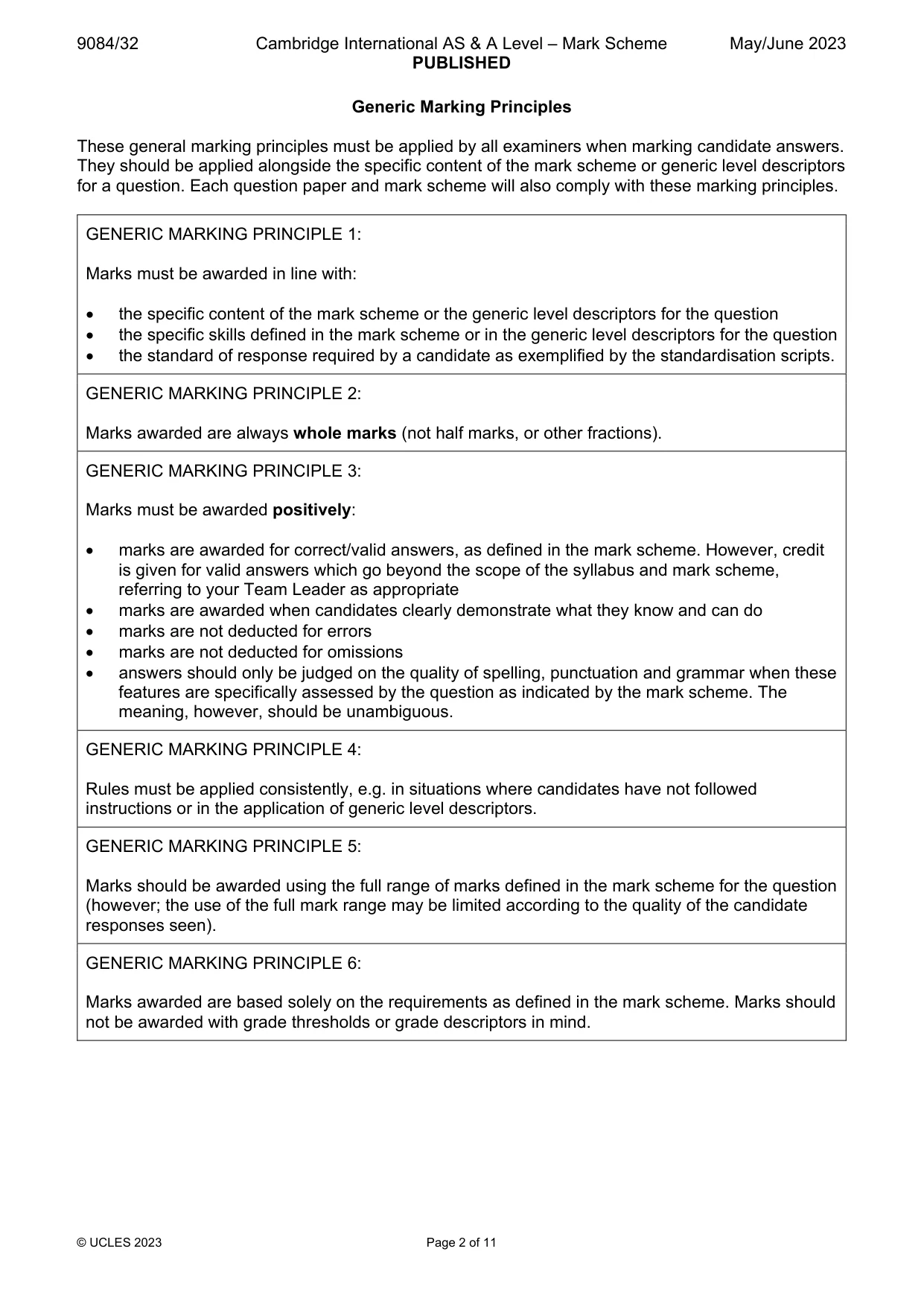
9084/32 Cambridge International AS & A Level – Mark Scheme PUBLISHED May/June 2023 © UCLES 2023 Page 2 of 11 Generic Marking Principles These general marking principles must be applied by all examiners when marking candidate answers. They should be applied alongside the specific content of the mark scheme or generic level descriptors for a question. Each question paper and mark scheme will also comply with these marking principles. GENERIC MARKING PRINCIPLE 1: Marks must be awarded in line with: the specific content of the mark scheme or the generic level descriptors for the question the specific skills defined in the mark scheme or in the generic level descriptors for the question the standard of response required by a candidate as exemplified by the standardisation scripts. GENERIC MARKING PRINCIPLE 2: Marks awarded are always whole marks (not half marks, or other fractions). GENERIC MARKING PRINCIPLE 3: Marks must be awarded positively: marks are awarded for correct/valid answers, as defined in the mark scheme. However, credit is given for valid answers which go beyond the scope of the syllabus and mark scheme, referring to your Team Leader as appropriate marks are awarded when candidates clearly demonstrate what they know and can do marks are not deducted for errors marks are not deducted for omissions answers should only be judged on the quality of spelling, punctuation and grammar when these features are specifically assessed by the question as indicated by the mark scheme. The meaning, however, should be unambiguous. GENERIC MARKING PRINCIPLE 4: Rules must be applied consistently, e.g. in situations where candidates have not followed instructions or in the application of generic level descriptors. GENERIC MARKING PRINCIPLE 5: Marks should be awarded using the full range of marks defined in the mark scheme for the question (however; the use of the full mark range may be limited according to the quality of the candidate responses seen). GENERIC MARKING PRINCIPLE 6: Marks awarded are based solely on the requirements as defined in the mark scheme. Marks should not be awarded with grade thresholds or grade descriptors in mind.
Mark scheme, page 3
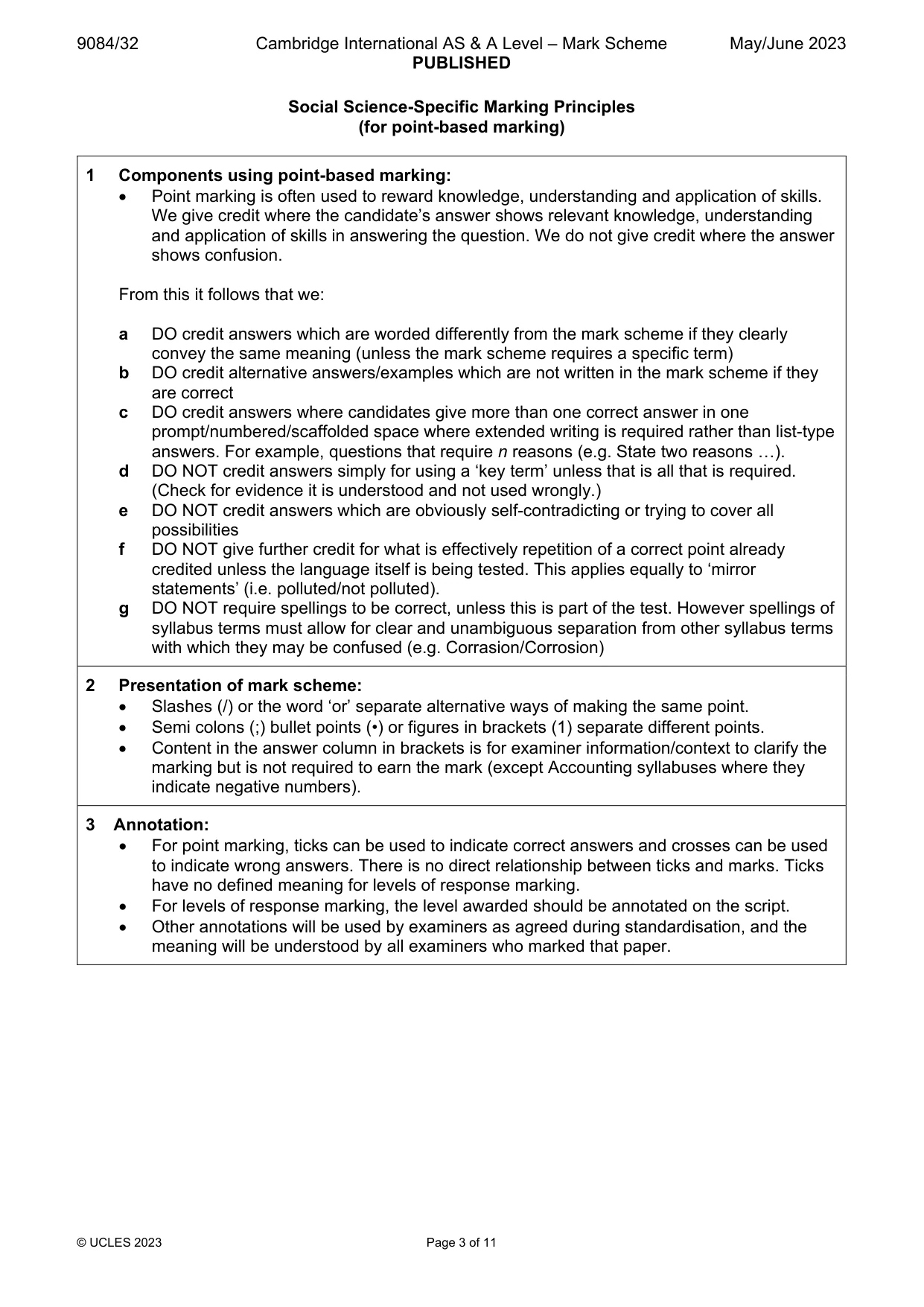
9084/32 Cambridge International AS & A Level – Mark Scheme PUBLISHED May/June 2023 © UCLES 2023 Page 3 of 11 Social Science-Specific Marking Principles (for point-based marking) 1 Components using point-based marking: Point marking is often used to reward knowledge, understanding and application of skills. We give credit where the candidate’s answer shows relevant knowledge, understanding and application of skills in answering the question. We do not give credit where the answer shows confusion. From this it follows that we: a DO credit answers which are worded differently from the mark scheme if they clearly convey the same meaning (unless the mark scheme requires a specific term) b DO credit alternative answers/examples which are not written in the mark scheme if they are correct c DO credit answers where candidates give more than one correct answer in one prompt/numbered/scaffolded space where extended writing is required rather than list-type answers. For example, questions that require n reasons (e.g. State two reasons …). d DO NOT credit answers simply for using a ‘key term’ unless that is all that is required. (Check for evidence it is understood and not used wrongly.) e DO NOT credit answers which are obviously self-contradicting or trying to cover all possibilities f DO NOT give further credit for what is effectively repetition of a correct point already credited unless the language itself is being tested. This applies equally to ‘mirror statements’ (i.e. polluted/not polluted). g DO NOT require spellings to be correct, unless this is part of the test. However spellings of syllabus terms must allow for clear and unambiguous separation from other syllabus terms with which they may be confused (e.g. Corrasion/Corrosion) 2 Presentation of mark scheme: Slashes (/) or the word ‘or’ separate alternative ways of making the same point. Semi colons (;) bullet points (•) or figures in brackets (1) separate different points. Content in the answer column in brackets is for examiner information/context to clarify the marking but is not required to earn the mark (except Accounting syllabuses where they indicate negative numbers). 3 Annotation: For point marking, ticks can be used to indicate correct answers and crosses can be used to indicate wrong answers. There is no direct relationship between ticks and marks. Ticks have no defined meaning for levels of response marking. For levels of response marking, the level awarded should be annotated on the script. Other annotations will be used by examiners as agreed during standardisation, and the meaning will be understood by all examiners who marked that paper.
Mark scheme, page 4
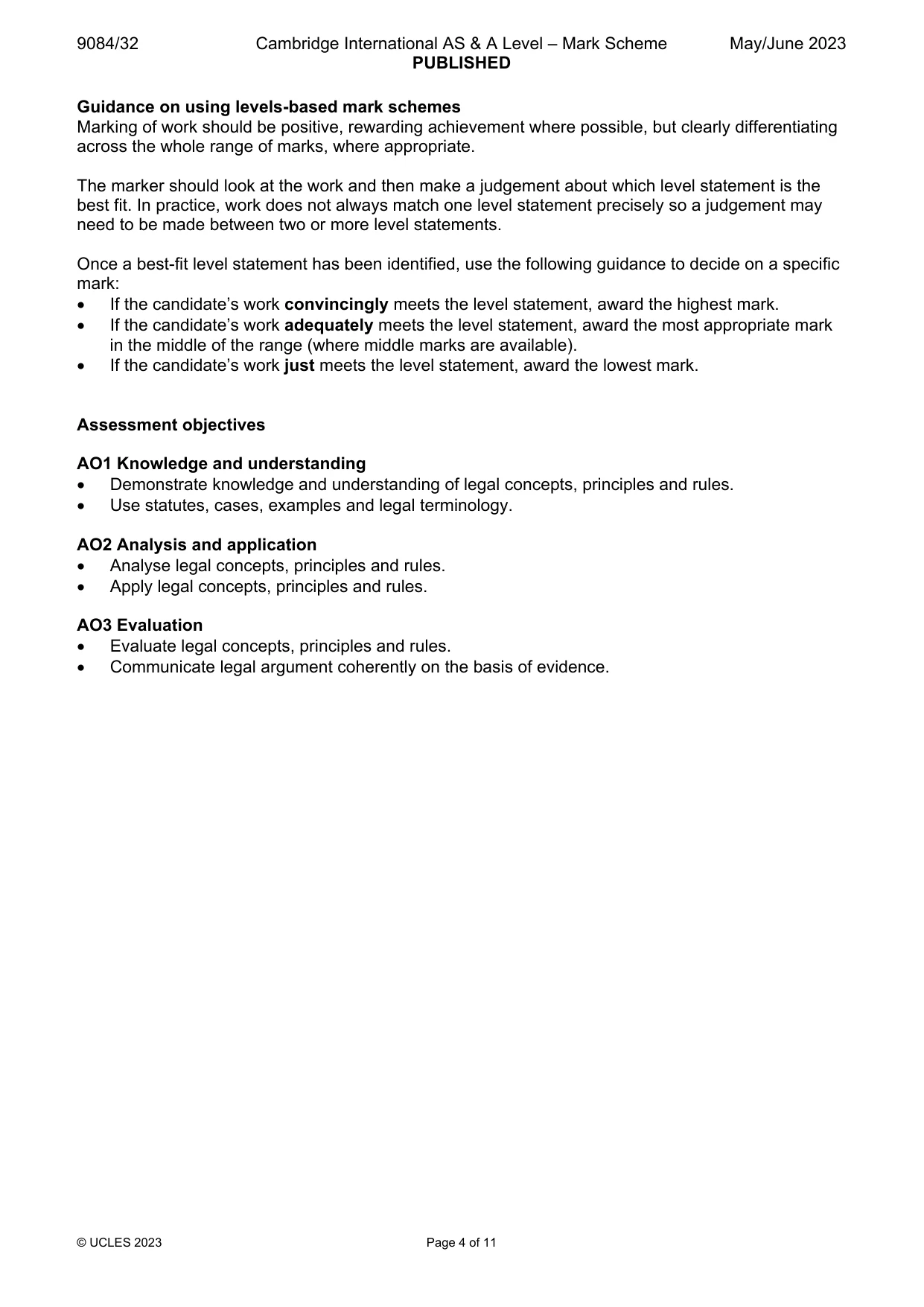
9084/32 Cambridge International AS & A Level – Mark Scheme PUBLISHED May/June 2023 © UCLES 2023 Page 4 of 11 Guidance on using levels-based mark schemes Marking of work should be positive, rewarding achievement where possible, but clearly differentiating across the whole range of marks, where appropriate. The marker should look at the work and then make a judgement about which level statement is the best fit. In practice, work does not always match one level statement precisely so a judgement may need to be made between two or more level statements. Once a best-fit level statement has been identified, use the following guidance to decide on a specific mark: If the candidate’s work convincingly meets the level statement, award the highest mark. If the candidate’s work adequately meets the level statement, award the most appropriate mark in the middle of the range (where middle marks are available). If the candidate’s work just meets the level statement, award the lowest mark. Assessment objectives AO1 Knowledge and understanding Demonstrate knowledge and understanding of legal concepts, principles and rules. Use statutes, cases, examples and legal terminology. AO2 Analysis and application Analyse legal concepts, principles and rules. Apply legal concepts, principles and rules. AO3 Evaluation Evaluate legal concepts, principles and rules. Communicate legal argument coherently on the basis of evidence.
Mark scheme, page 5
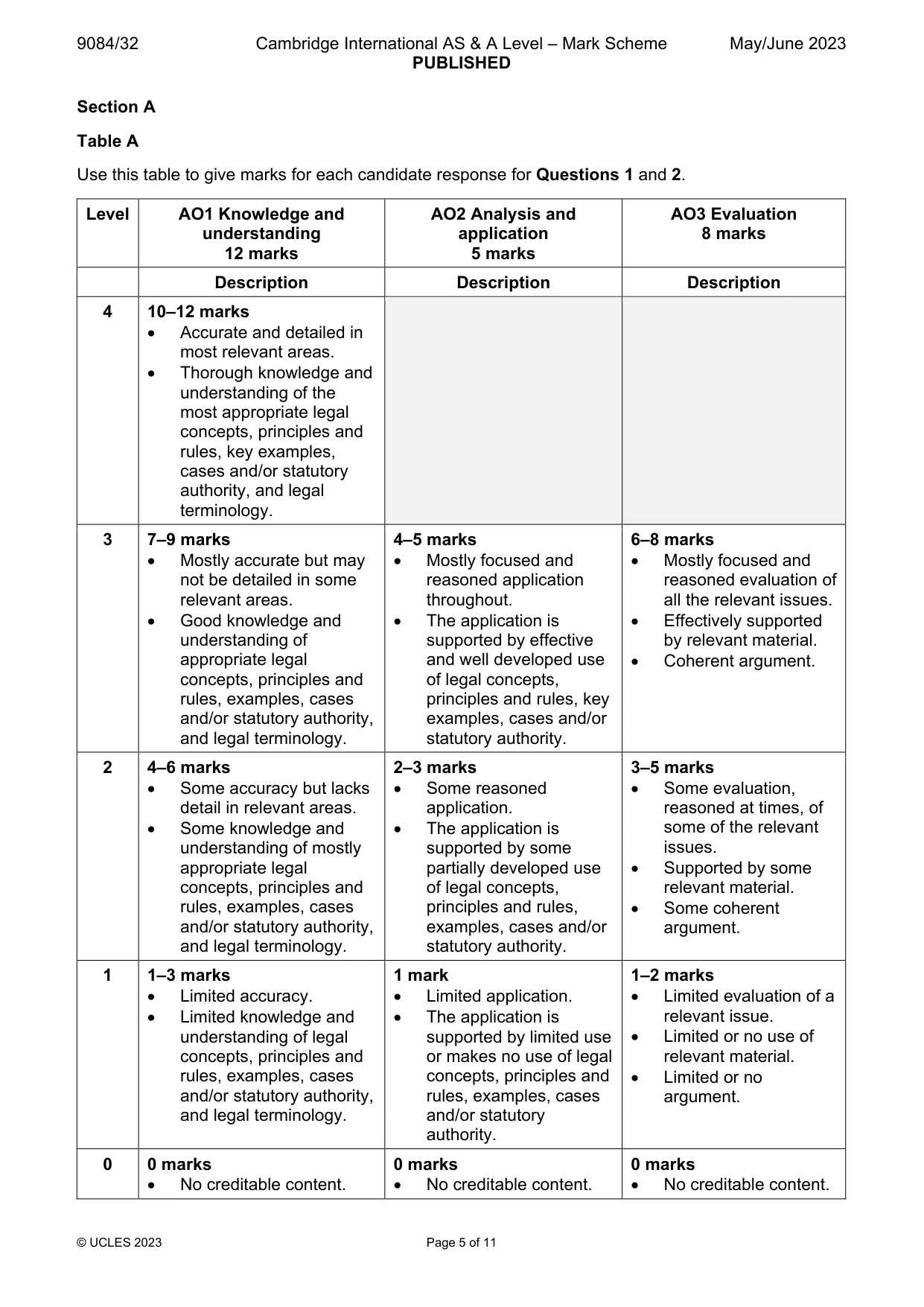
9084/32 Cambridge International AS & A Level – Mark Scheme PUBLISHED May/June 2023 © UCLES 2023 Page 5 of 11 Section A Table A Use this table to give marks for each candidate response for Questions 1 and 2. Level AO1 Knowledge and understanding 12 marks AO2 Analysis and application 5 marks AO3 Evaluation 8 marks Description Description Description 4 10–12 marks Accurate and detailed in most relevant areas. Thorough knowledge and understanding of the most appropriate legal concepts, principles and rules, key examples, cases and/or statutory authority, and legal terminology. 3 7–9 marks Mostly accurate but may not be detailed in some relevant areas. Good knowledge and understanding of appropriate legal concepts, principles and rules, examples, cases and/or statutory authority, and legal terminology. 4–5 marks Mostly focused and reasoned application throughout. The application is supported by effective and well developed use of legal concepts, principles and rules, key examples, cases and/or statutory authority. 6–8 marks Mostly focused and reasoned evaluation of all the relevant issues. Effectively supported by relevant material. Coherent argument. 2 4–6 marks Some accuracy but lacks detail in relevant areas. Some knowledge and understanding of mostly appropriate legal concepts, principles and rules, examples, cases and/or statutory authority, and legal terminology. 2–3 marks Some reasoned application. The application is supported by some partially developed use of legal concepts, principles and rules, examples, cases and/or statutory authority. 3–5 marks Some evaluation, reasoned at times, of some of the relevant issues. Supported by some relevant material. Some coherent argument. 1 1–3 marks Limited accuracy. Limited knowledge and understanding of legal concepts, principles and rules, examples, cases and/or statutory authority, and legal terminology. 1 mark Limited application. The application is supported by limited use or makes no use of legal concepts, principles and rules, examples, cases and/or statutory authority. 1–2 marks Limited evaluation of a relevant issue. Limited or no use of relevant material. Limited or no argument. 0 0 marks No creditable content. 0 marks No creditable content. 0 marks No creditable content.
Mark scheme, page 6
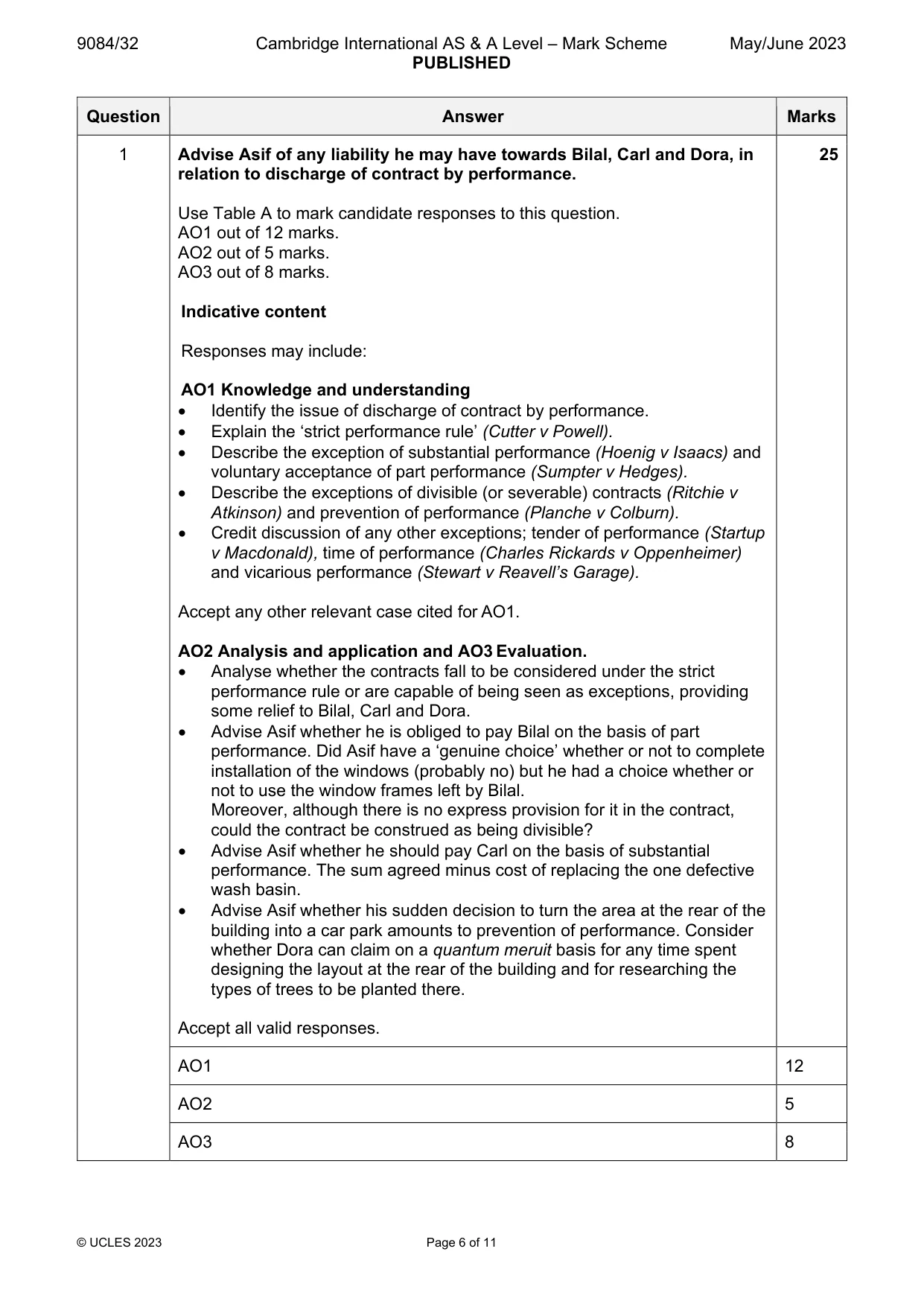
9084/32 Cambridge International AS & A Level – Mark Scheme PUBLISHED May/June 2023 © UCLES 2023 Page 6 of 11 Question Answer Marks 1 Advise Asif of any liability he may have towards Bilal, Carl and Dora, in relation to discharge of contract by performance. Use Table A to mark candidate responses to this question. AO1 out of 12 marks. AO2 out of 5 marks. AO3 out of 8 marks. Indicative content Responses may include: AO1 Knowledge and understanding Identify the issue of discharge of contract by performance. Explain the ‘strict performance rule’ (Cutter v Powell). Describe the exception of substantial performance (Hoenig v Isaacs) and voluntary acceptance of part performance (Sumpter v Hedges). Describe the exceptions of divisible (or severable) contracts (Ritchie v Atkinson) and prevention of performance (Planche v Colburn). Credit discussion of any other exceptions; tender of performance (Startup v Macdonald), time of performance (Charles Rickards v Oppenheimer) and vicarious performance (Stewart v Reavell’s Garage). Accept any other relevant case cited for AO1. AO2 Analysis and application and AO3 Evaluation. Analyse whether the contracts fall to be considered under the strict performance rule or are capable of being seen as exceptions, providing some relief to Bilal, Carl and Dora. Advise Asif whether he is obliged to pay Bilal on the basis of part performance. Did Asif have a ‘genuine choice’ whether or not to complete installation of the windows (probably no) but he had a choice whether or not to use the window frames left by Bilal. Moreover, although there is no express provision for it in the contract, could the contract be construed as being divisible? Advise Asif whether he should pay Carl on the basis of substantial performance. The sum agreed minus cost of replacing the one defective wash basin. Advise Asif whether his sudden decision to turn the area at the rear of the building into a car park amounts to prevention of performance. Consider whether Dora can claim on a quantum meruit basis for any time spent designing the layout at the rear of the building and for researching the types of trees to be planted there. Accept all valid responses. 25 AO1 12 AO2 5 AO3 8
Mark scheme, page 7
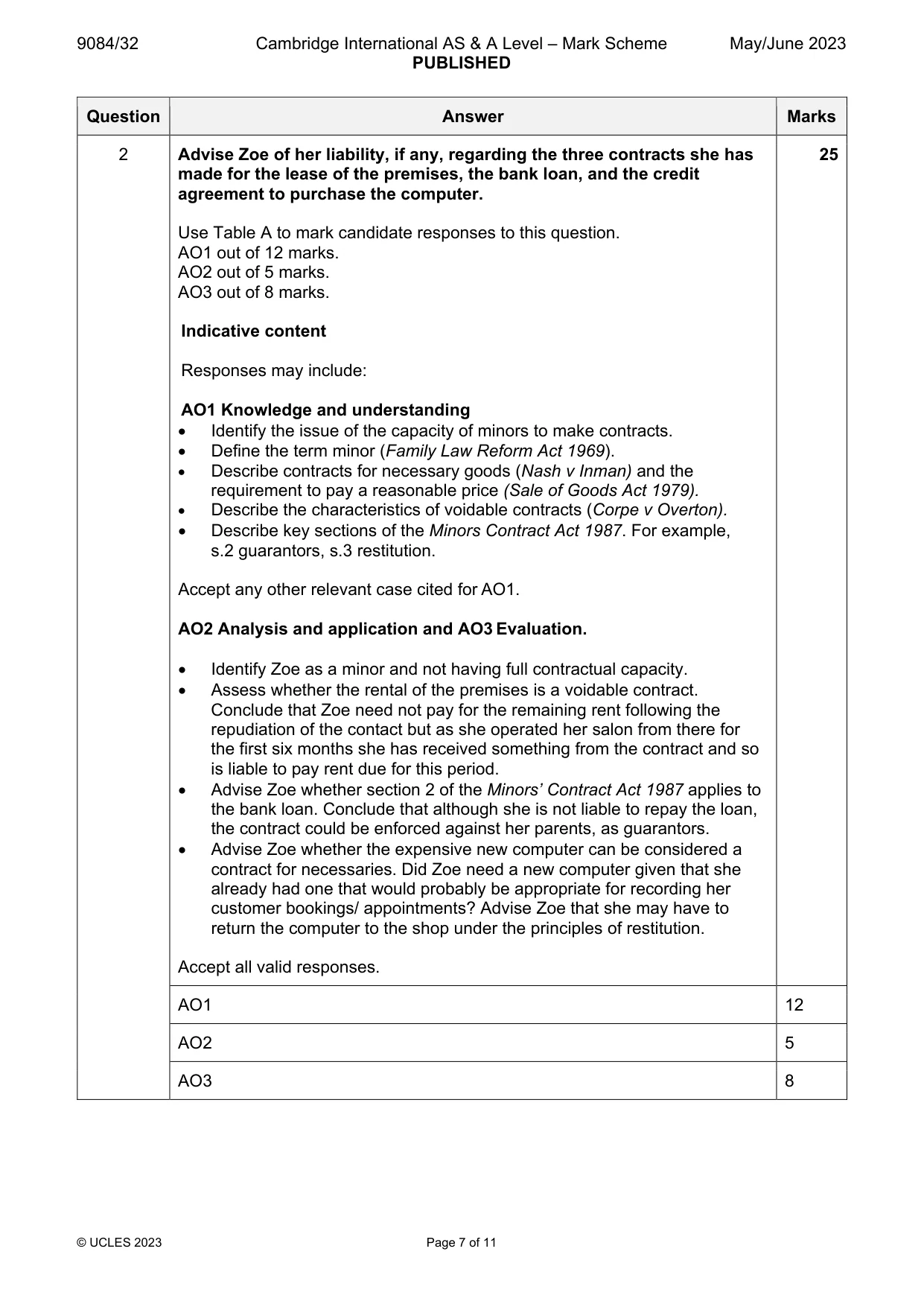
9084/32 Cambridge International AS & A Level – Mark Scheme PUBLISHED May/June 2023 © UCLES 2023 Page 7 of 11 Question Answer Marks 2 Advise Zoe of her liability, if any, regarding the three contracts she has made for the lease of the premises, the bank loan, and the credit agreement to purchase the computer. Use Table A to mark candidate responses to this question. AO1 out of 12 marks. AO2 out of 5 marks. AO3 out of 8 marks. Indicative content Responses may include: AO1 Knowledge and understanding Identify the issue of the capacity of minors to make contracts. Define the term minor (Family Law Reform Act 1969). Describe contracts for necessary goods (Nash v Inman) and the requirement to pay a reasonable price (Sale of Goods Act 1979). Describe the characteristics of voidable contracts (Corpe v Overton). Describe key sections of the Minors Contract Act 1987. For example, s.2 guarantors, s.3 restitution. Accept any other relevant case cited for AO1. AO2 Analysis and application and AO3 Evaluation. Identify Zoe as a minor and not having full contractual capacity. Assess whether the rental of the premises is a voidable contract. Conclude that Zoe need not pay for the remaining rent following the repudiation of the contact but as she operated her salon from there for the first six months she has received something from the contract and so is liable to pay rent due for this period. Advise Zoe whether section 2 of the Minors’ Contract Act 1987 applies to the bank loan. Conclude that although she is not liable to repay the loan, the contract could be enforced against her parents, as guarantors. Advise Zoe whether the expensive new computer can be considered a contract for necessaries. Did Zoe need a new computer given that she already had one that would probably be appropriate for recording her customer bookings/ appointments? Advise Zoe that she may have to return the computer to the shop under the principles of restitution. Accept all valid responses. 25 AO1 12 AO2 5 AO3 8
Mark scheme, page 8
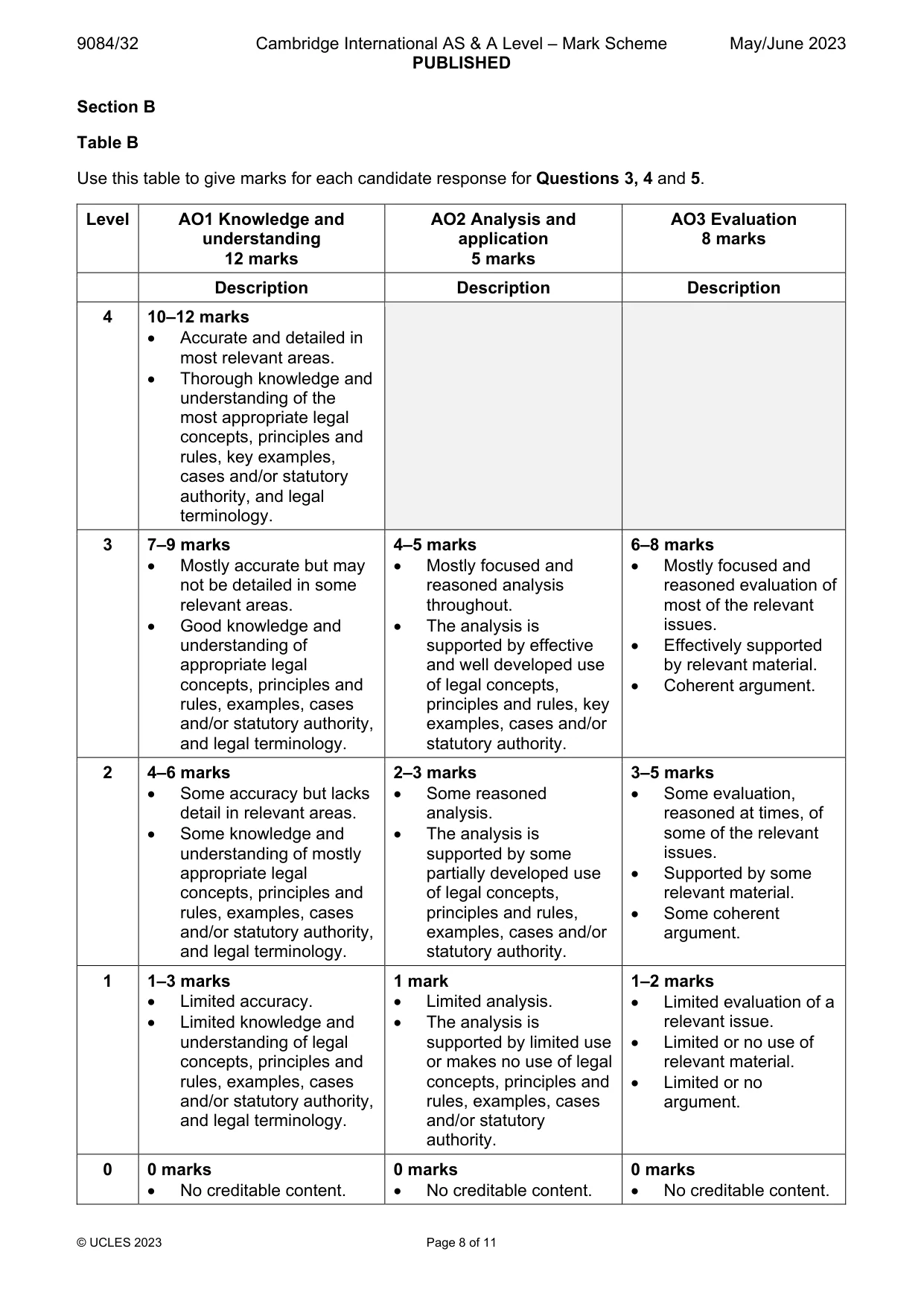
9084/32 Cambridge International AS & A Level – Mark Scheme PUBLISHED May/June 2023 © UCLES 2023 Page 8 of 11 Section B Table B Use this table to give marks for each candidate response for Questions 3, 4 and 5. Level AO1 Knowledge and understanding 12 marks AO2 Analysis and application 5 marks AO3 Evaluation 8 marks Description Description Description 4 10–12 marks Accurate and detailed in most relevant areas. Thorough knowledge and understanding of the most appropriate legal concepts, principles and rules, key examples, cases and/or statutory authority, and legal terminology. 3 7–9 marks Mostly accurate but may not be detailed in some relevant areas. Good knowledge and understanding of appropriate legal concepts, principles and rules, examples, cases and/or statutory authority, and legal terminology. 4–5 marks Mostly focused and reasoned analysis throughout. The analysis is supported by effective and well developed use of legal concepts, principles and rules, key examples, cases and/or statutory authority. 6–8 marks Mostly focused and reasoned evaluation of most of the relevant issues. Effectively supported by relevant material. Coherent argument. 2 4–6 marks Some accuracy but lacks detail in relevant areas. Some knowledge and understanding of mostly appropriate legal concepts, principles and rules, examples, cases and/or statutory authority, and legal terminology. 2–3 marks Some reasoned analysis. The analysis is supported by some partially developed use of legal concepts, principles and rules, examples, cases and/or statutory authority. 3–5 marks Some evaluation, reasoned at times, of some of the relevant issues. Supported by some relevant material. Some coherent argument. 1 1–3 marks Limited accuracy. Limited knowledge and understanding of legal concepts, principles and rules, examples, cases and/or statutory authority, and legal terminology. 1 mark Limited analysis. The analysis is supported by limited use or makes no use of legal concepts, principles and rules, examples, cases and/or statutory authority. 1–2 marks Limited evaluation of a relevant issue. Limited or no use of relevant material. Limited or no argument. 0 0 marks No creditable content. 0 marks No creditable content. 0 marks No creditable content.
Mark scheme, page 9
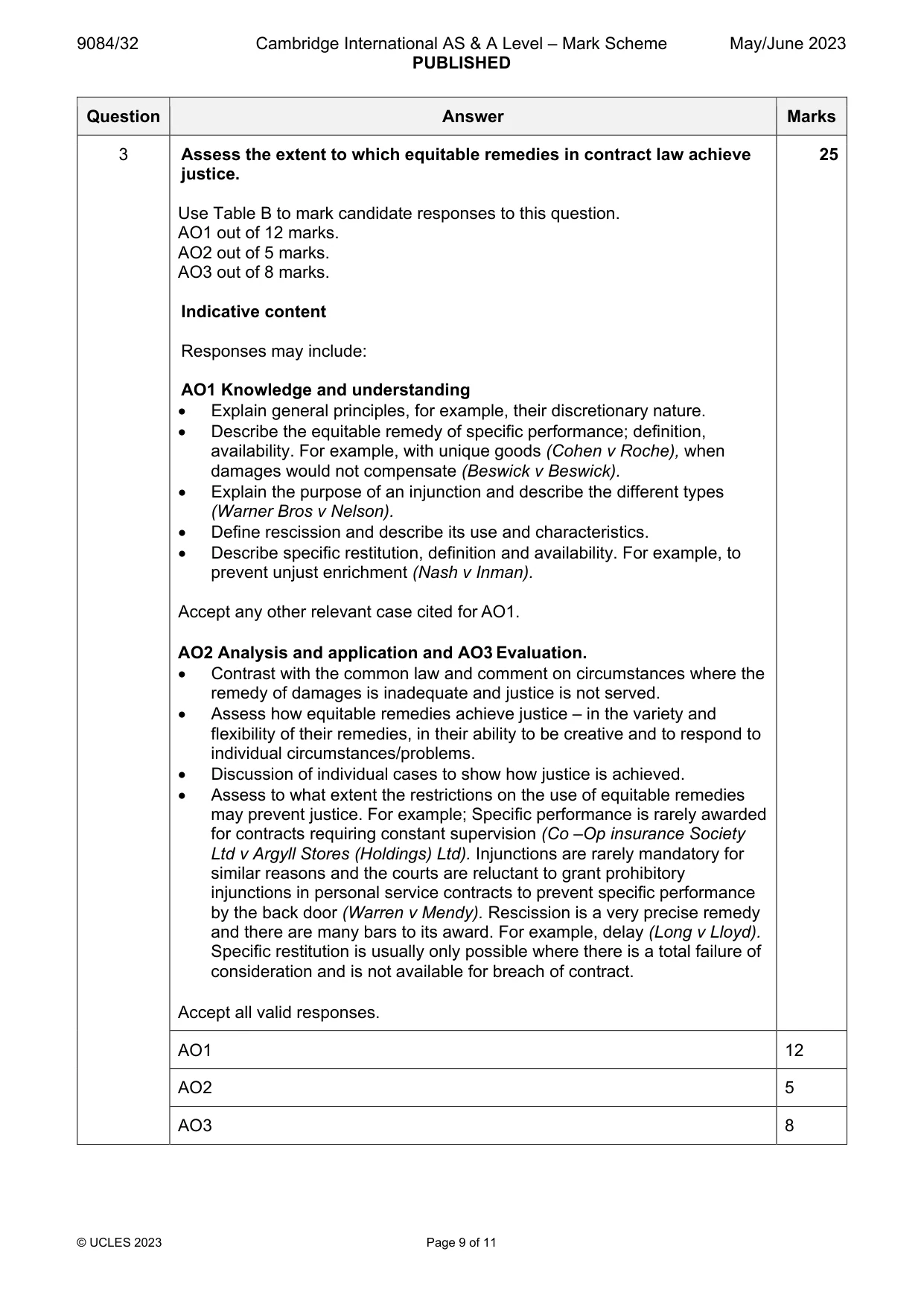
9084/32 Cambridge International AS & A Level – Mark Scheme PUBLISHED May/June 2023 © UCLES 2023 Page 9 of 11 Question Answer Marks 3 Assess the extent to which equitable remedies in contract law achieve justice. Use Table B to mark candidate responses to this question. AO1 out of 12 marks. AO2 out of 5 marks. AO3 out of 8 marks. Indicative content Responses may include: AO1 Knowledge and understanding Explain general principles, for example, their discretionary nature. Describe the equitable remedy of specific performance; definition, availability. For example, with unique goods (Cohen v Roche), when damages would not compensate (Beswick v Beswick). Explain the purpose of an injunction and describe the different types (Warner Bros v Nelson). Define rescission and describe its use and characteristics. Describe specific restitution, definition and availability. For example, to prevent unjust enrichment (Nash v Inman). Accept any other relevant case cited for AO1. AO2 Analysis and application and AO3 Evaluation. Contrast with the common law and comment on circumstances where the remedy of damages is inadequate and justice is not served. Assess how equitable remedies achieve justice – in the variety and flexibility of their remedies, in their ability to be creative and to respond to individual circumstances/problems. Discussion of individual cases to show how justice is achieved. Assess to what extent the restrictions on the use of equitable remedies may prevent justice. For example; Specific performance is rarely awarded for contracts requiring constant supervision (Co –Op insurance Society Ltd v Argyll Stores (Holdings) Ltd). Injunctions are rarely mandatory for similar reasons and the courts are reluctant to grant prohibitory injunctions in personal service contracts to prevent specific performance by the back door (Warren v Mendy). Rescission is a very precise remedy and there are many bars to its award. For example, delay (Long v Lloyd). Specific restitution is usually only possible where there is a total failure of consideration and is not available for breach of contract. Accept all valid responses. 25 AO1 12 AO2 5 AO3 8
Mark scheme, page 10
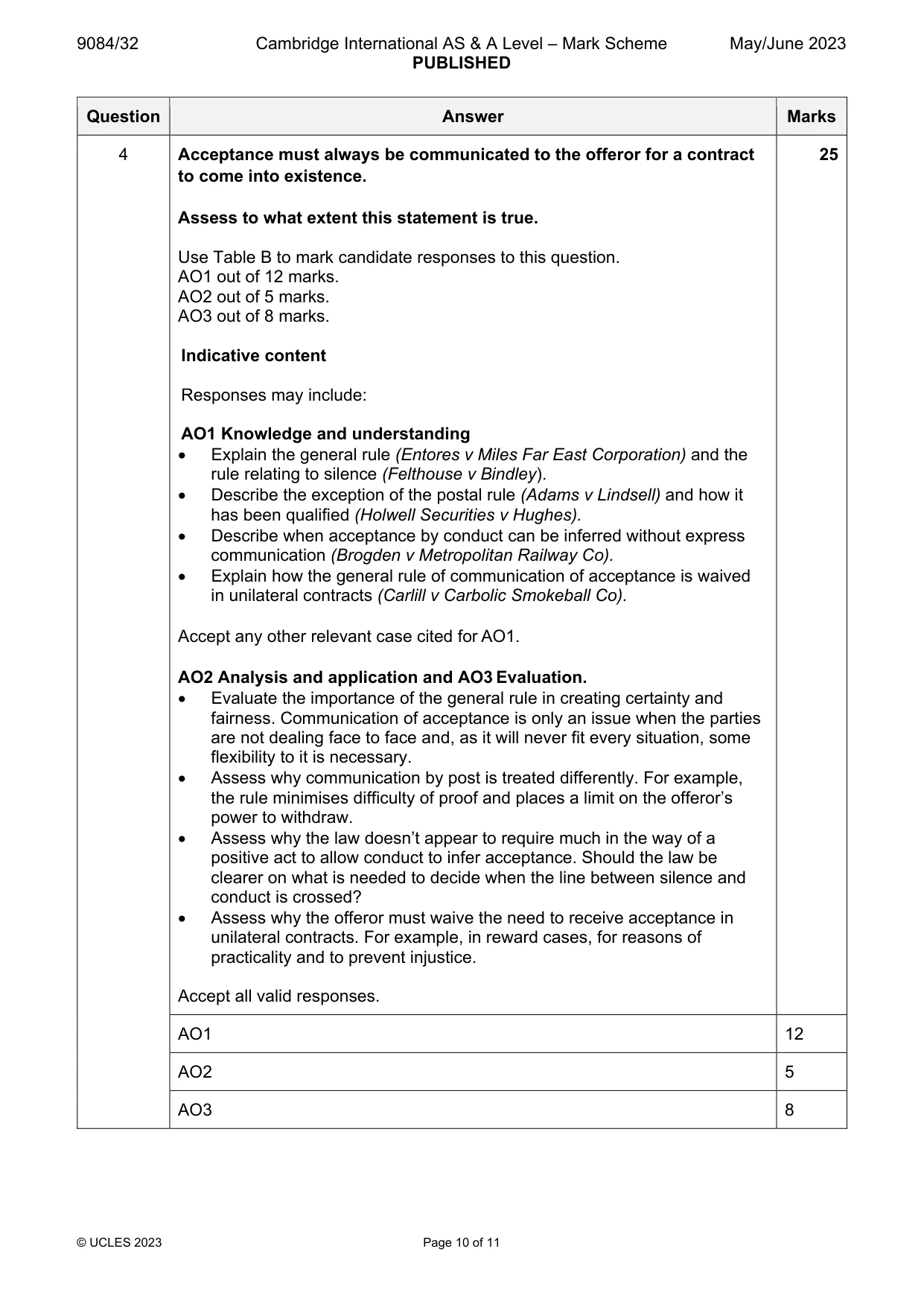
9084/32 Cambridge International AS & A Level – Mark Scheme PUBLISHED May/June 2023 © UCLES 2023 Page 10 of 11 Question Answer Marks 4 Acceptance must always be communicated to the offeror for a contract to come into existence. Assess to what extent this statement is true. Use Table B to mark candidate responses to this question. AO1 out of 12 marks. AO2 out of 5 marks. AO3 out of 8 marks. Indicative content Responses may include: AO1 Knowledge and understanding Explain the general rule (Entores v Miles Far East Corporation) and the rule relating to silence (Felthouse v Bindley). Describe the exception of the postal rule (Adams v Lindsell) and how it has been qualified (Holwell Securities v Hughes). Describe when acceptance by conduct can be inferred without express communication (Brogden v Metropolitan Railway Co). Explain how the general rule of communication of acceptance is waived in unilateral contracts (Carlill v Carbolic Smokeball Co). Accept any other relevant case cited for AO1. AO2 Analysis and application and AO3 Evaluation. Evaluate the importance of the general rule in creating certainty and fairness. Communication of acceptance is only an issue when the parties are not dealing face to face and, as it will never fit every situation, some flexibility to it is necessary. Assess why communication by post is treated differently. For example, the rule minimises difficulty of proof and places a limit on the offeror’s power to withdraw. Assess why the law doesn’t appear to require much in the way of a positive act to allow conduct to infer acceptance. Should the law be clearer on what is needed to decide when the line between silence and conduct is crossed? Assess why the offeror must waive the need to receive acceptance in unilateral contracts. For example, in reward cases, for reasons of practicality and to prevent injustice. Accept all valid responses. 25 AO1 12 AO2 5 AO3 8
Mark scheme, page 11
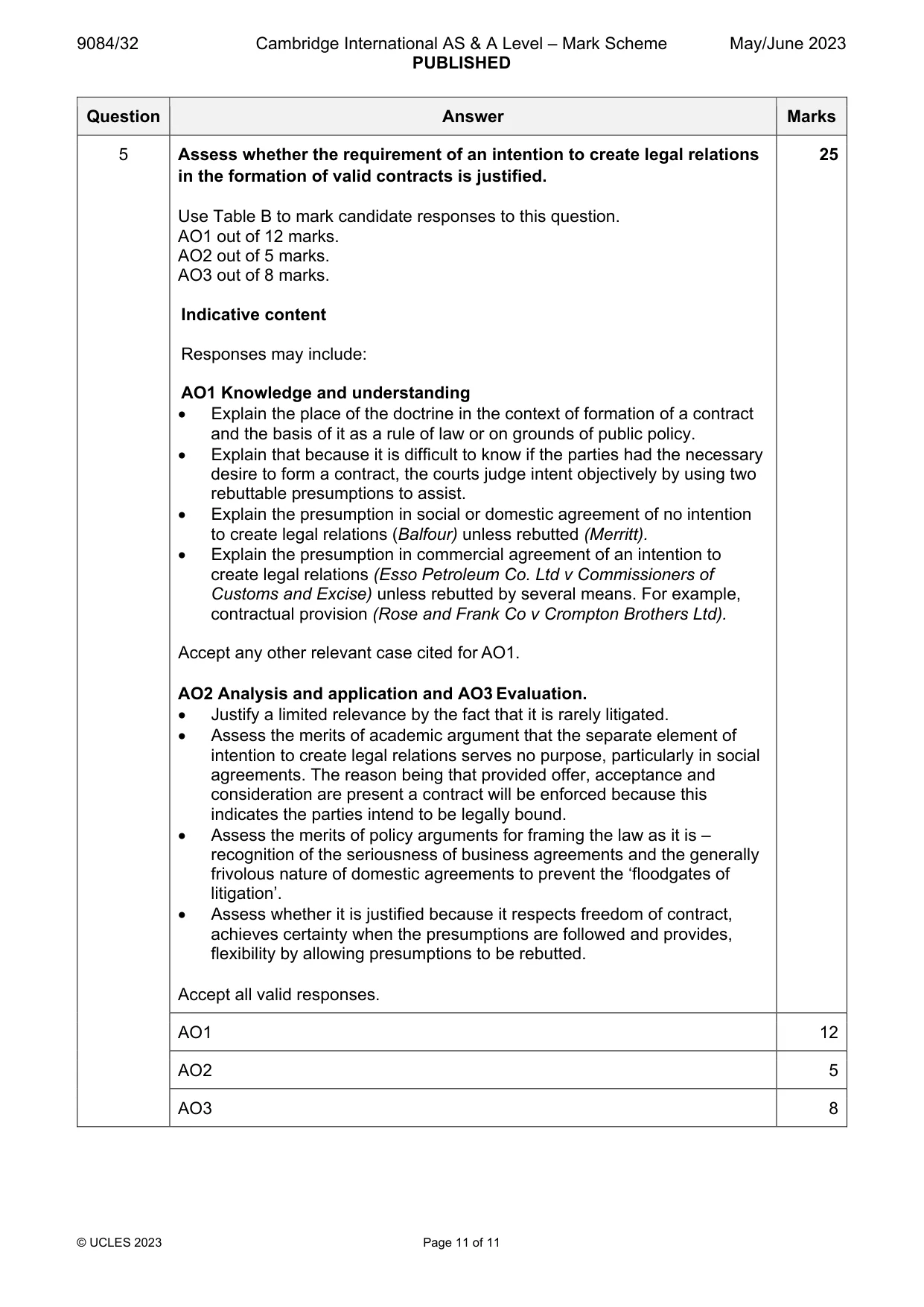
9084/32 Cambridge International AS & A Level – Mark Scheme PUBLISHED May/June 2023 © UCLES 2023 Page 11 of 11 Question Answer Marks 5 Assess whether the requirement of an intention to create legal relations in the formation of valid contracts is justified. Use Table B to mark candidate responses to this question. AO1 out of 12 marks. AO2 out of 5 marks. AO3 out of 8 marks. Indicative content Responses may include: AO1 Knowledge and understanding Explain the place of the doctrine in the context of formation of a contract and the basis of it as a rule of law or on grounds of public policy. Explain that because it is difficult to know if the parties had the necessary desire to form a contract, the courts judge intent objectively by using two rebuttable presumptions to assist. Explain the presumption in social or domestic agreement of no intention to create legal relations (Balfour) unless rebutted (Merritt). Explain the presumption in commercial agreement of an intention to create legal relations (Esso Petroleum Co. Ltd v Commissioners of Customs and Excise) unless rebutted by several means. For example, contractual provision (Rose and Frank Co v Crompton Brothers Ltd). Accept any other relevant case cited for AO1. AO2 Analysis and application and AO3 Evaluation. Justify a limited relevance by the fact that it is rarely litigated. Assess the merits of academic argument that the separate element of intention to create legal relations serves no purpose, particularly in social agreements. The reason being that provided offer, acceptance and consideration are present a contract will be enforced because this indicates the parties intend to be legally bound. Assess the merits of policy arguments for framing the law as it is – recognition of the seriousness of business agreements and the generally frivolous nature of domestic agreements to prevent the ‘floodgates of litigation’. Assess whether it is justified because it respects freedom of contract, achieves certainty when the presumptions are followed and provides, flexibility by allowing presumptions to be rebutted. Accept all valid responses. 25 AO1 12 AO2 5 AO3 8
What you needed in this session
Cambridge’s own grade thresholds for 2023 May/June, Paper 3 · Variant 2. A higher threshold means an easier paper — the bar moves with how the cohort did.