Cambridge A Level Law 9084 — 2023 May/June Paper 3 · Variant 1
9084/31/M/J/23 · 75 marks · ≈84 min
The question paper and its mark scheme, free to read here and free to download. This is Cambridge’s own paper, exactly as it was sat.
Question paper4 pages

Mark scheme11 pages
Answers below. Sit the paper first if you are practising.
Paper as text
Question paper, page 1
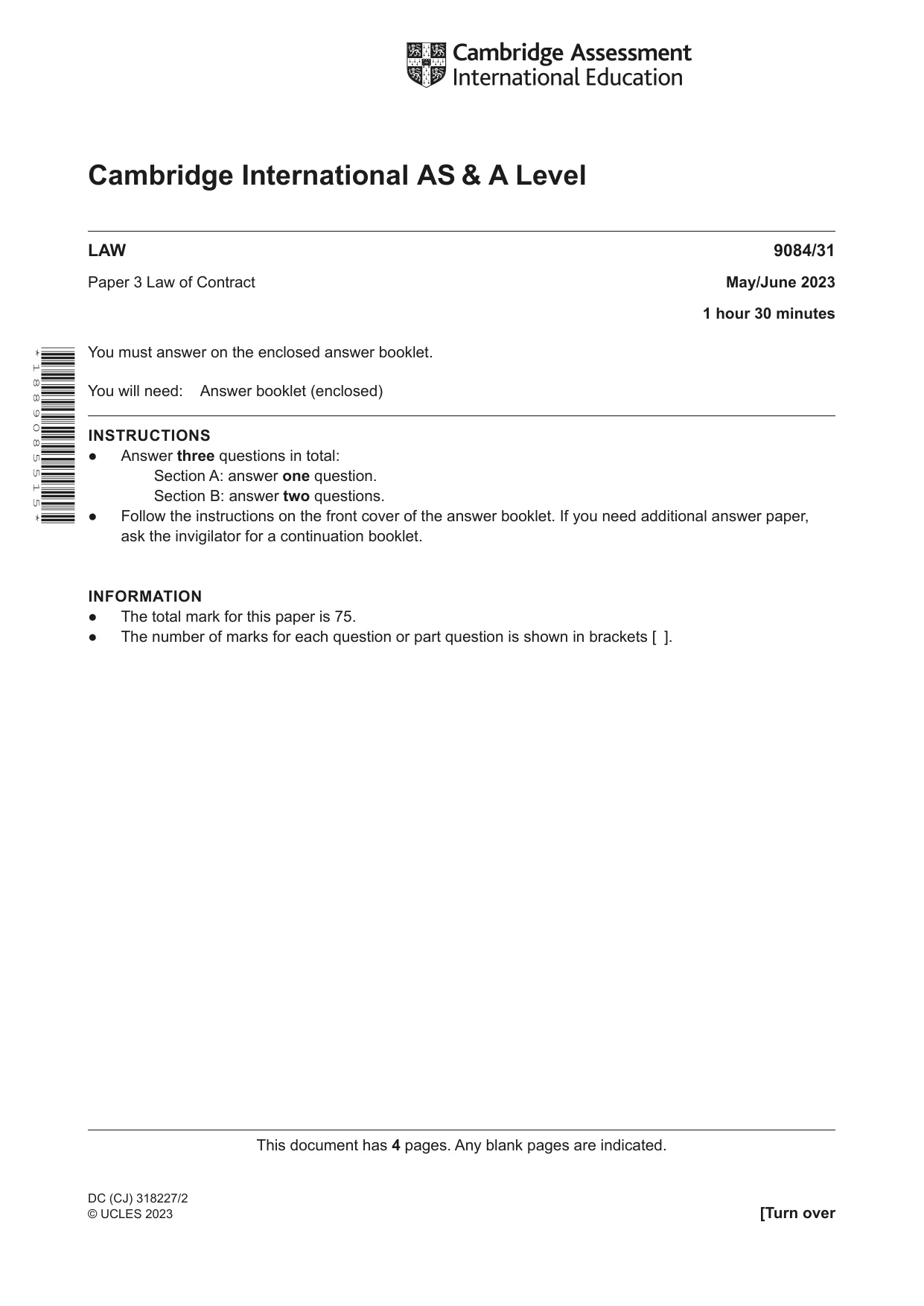
This document has 4 pages. Any blank pages are indicated. [Turn over Cambridge International AS & A Level LAW 9084/31 Paper 3 Law of Contract May/June 2023 1 hour 30 minutes You must answer on the enclosed answer booklet. You will need: Answer booklet (enclosed) INSTRUCTIONS ● Answer three questions in total: Section A: answer one question. Section B: answer two questions. ● Follow the instructions on the front cover of the answer booklet. If you need additional answer paper, ask the invigilator for a continuation booklet. INFORMATION ● The total mark for this paper is 75. ● The number of marks for each question or part question is shown in brackets [ ]. * 1 8 8 9 0 8 5 5 1 5 * DC (CJ) 318227/2 © UCLES 2023
Question paper, page 2
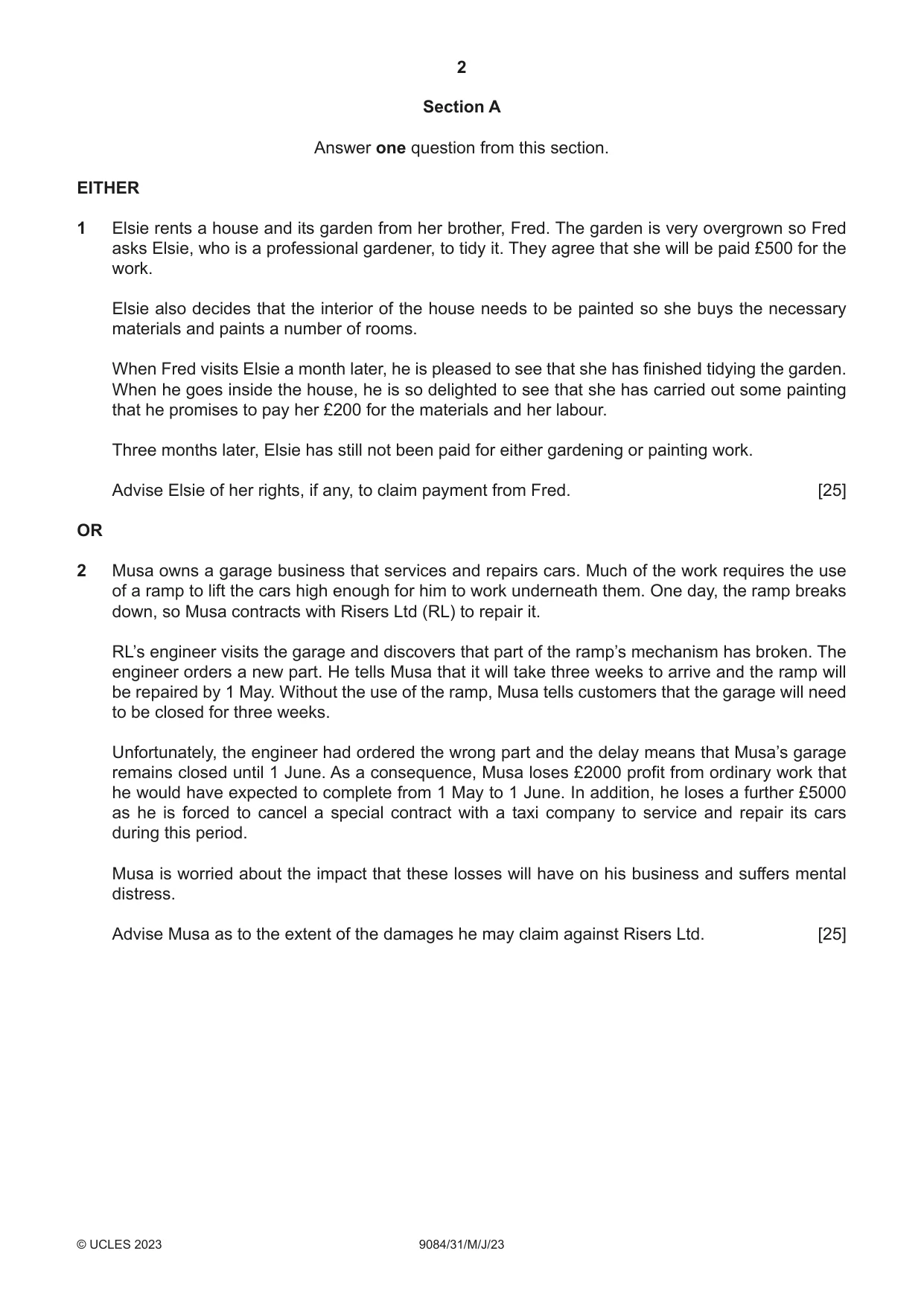
2 9084/31/M/J/23 © UCLES 2023 Section A Answer one question from this section. EITHER 1 Elsie rents a house and its garden from her brother, Fred. The garden is very overgrown so Fred asks Elsie, who is a professional gardener, to tidy it. They agree that she will be paid £500 for the work. Elsie also decides that the interior of the house needs to be painted so she buys the necessary materials and paints a number of rooms. When Fred visits Elsie a month later, he is pleased to see that she has finished tidying the garden. When he goes inside the house, he is so delighted to see that she has carried out some painting that he promises to pay her £200 for the materials and her labour. Three months later, Elsie has still not been paid for either gardening or painting work. Advise Elsie of her rights, if any, to claim payment from Fred. [25] OR 2 Musa owns a garage business that services and repairs cars. Much of the work requires the use of a ramp to lift the cars high enough for him to work underneath them. One day, the ramp breaks down, so Musa contracts with Risers Ltd (RL) to repair it. RL’s engineer visits the garage and discovers that part of the ramp’s mechanism has broken. The engineer orders a new part. He tells Musa that it will take three weeks to arrive and the ramp will be repaired by 1 May. Without the use of the ramp, Musa tells customers that the garage will need to be closed for three weeks. Unfortunately, the engineer had ordered the wrong part and the delay means that Musa’s garage remains closed until 1 June. As a consequence, Musa loses £2000 profit from ordinary work that he would have expected to complete from 1 May to 1 June. In addition, he loses a further £5000 as he is forced to cancel a special contract with a taxi company to service and repair its cars during this period. Musa is worried about the impact that these losses will have on his business and suffers mental distress. Advise Musa as to the extent of the damages he may claim against Risers Ltd. [25]
Question paper, page 3
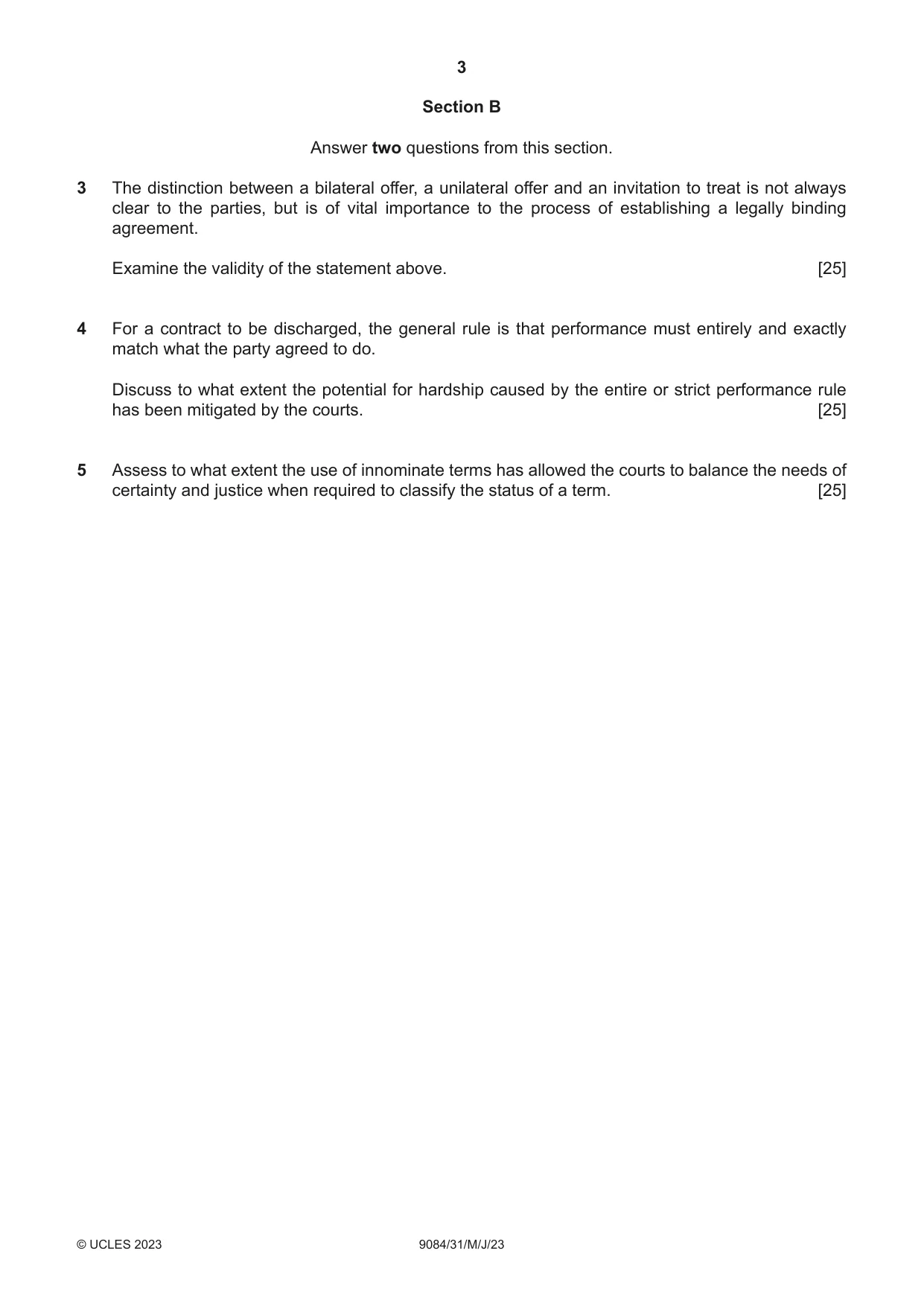
3 9084/31/M/J/23 © UCLES 2023 Section B Answer two questions from this section. 3 The distinction between a bilateral offer, a unilateral offer and an invitation to treat is not always clear to the parties, but is of vital importance to the process of establishing a legally binding agreement. Examine the validity of the statement above. [25] 4 For a contract to be discharged, the general rule is that performance must entirely and exactly match what the party agreed to do. Discuss to what extent the potential for hardship caused by the entire or strict performance rule has been mitigated by the courts. [25] 5 Assess to what extent the use of innominate terms has allowed the courts to balance the needs of certainty and justice when required to classify the status of a term. [25]
Question paper, page 4
4 9084/31/M/J/23 © UCLES 2023 Permission to reproduce items where third-party owned material protected by copyright is included has been sought and cleared where possible. Every reasonable effort has been made by the publisher (UCLES) to trace copyright holders, but if any items requiring clearance have unwittingly been included, the publisher will be pleased to make amends at the earliest possible opportunity. To avoid the issue of disclosure of answer-related information to candidates, all copyright acknowledgements are reproduced online in the Cambridge Assessment International Education Copyright Acknowledgements Booklet. This is produced for each series of examinations and is freely available to download at www.cambridgeinternational.org after the live examination series. Cambridge Assessment International Education is part of Cambridge Assessment. Cambridge Assessment is the brand name of the University of Cambridge Local Examinations Syndicate (UCLES), which is a department of the University of Cambridge. BLANK PAGE
Mark scheme, page 1
This document consists of 11 printed pages. © UCLES 2023 [Turn over Cambridge International AS & A Level LAW 9084/31 Paper 3 May/June 2023 MARK SCHEME Maximum Mark: 75 Published This mark scheme is published as an aid to teachers and candidates, to indicate the requirements of the examination. It shows the basis on which Examiners were instructed to award marks. It does not indicate the details of the discussions that took place at an Examiners’ meeting before marking began, which would have considered the acceptability of alternative answers. Mark schemes should be read in conjunction with the question paper and the Principal Examiner Report for Teachers. Cambridge International will not enter into discussions about these mark schemes. Cambridge International is publishing the mark schemes for the May/June 2023 series for most Cambridge IGCSE, Cambridge International A and AS Level and Cambridge Pre-U components, and some Cambridge O Level components.
Mark scheme, page 2
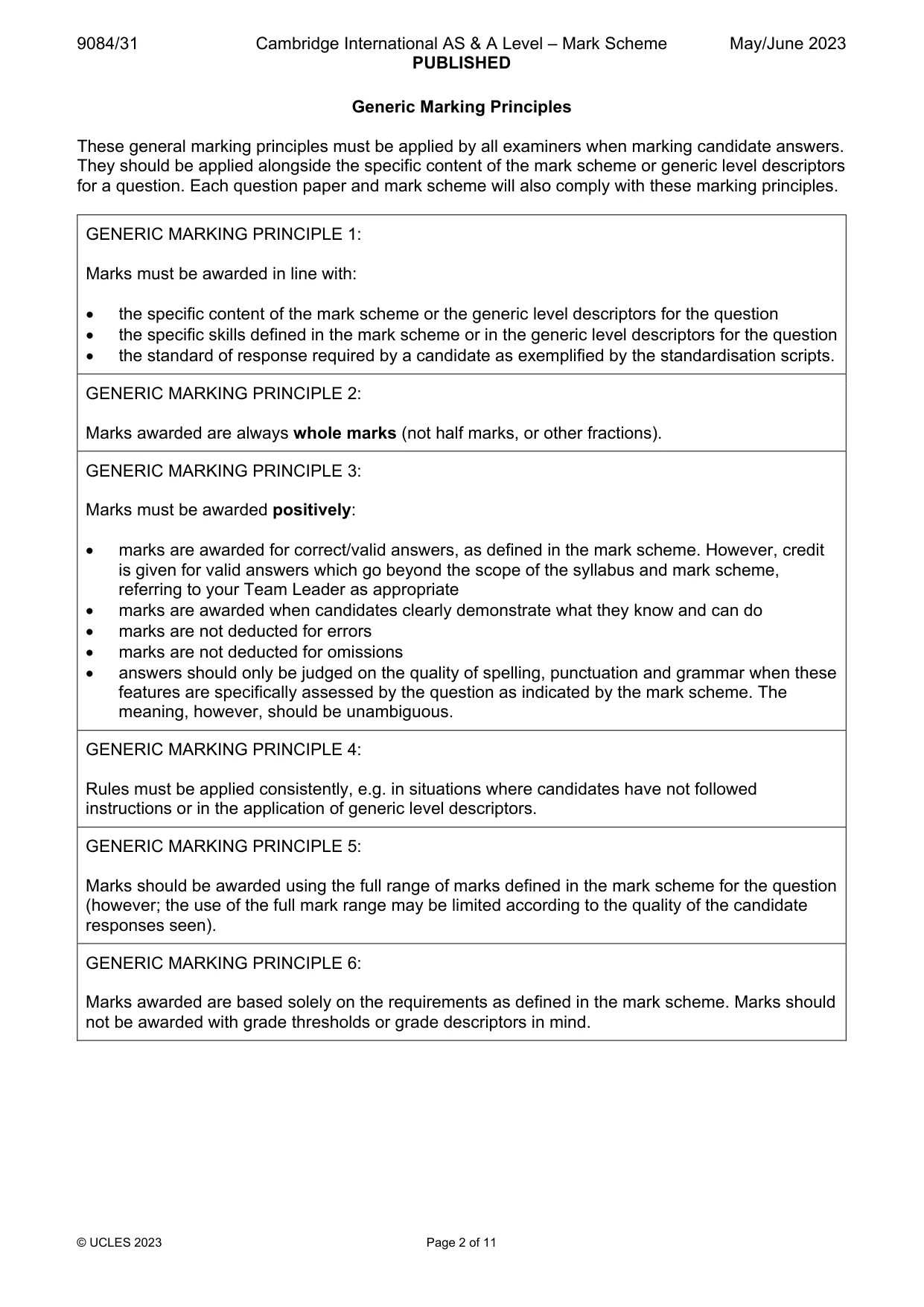
9084/31 Cambridge International AS & A Level – Mark Scheme PUBLISHED May/June 2023 © UCLES 2023 Page 2 of 11 Generic Marking Principles These general marking principles must be applied by all examiners when marking candidate answers. They should be applied alongside the specific content of the mark scheme or generic level descriptors for a question. Each question paper and mark scheme will also comply with these marking principles. GENERIC MARKING PRINCIPLE 1: Marks must be awarded in line with: the specific content of the mark scheme or the generic level descriptors for the question the specific skills defined in the mark scheme or in the generic level descriptors for the question the standard of response required by a candidate as exemplified by the standardisation scripts. GENERIC MARKING PRINCIPLE 2: Marks awarded are always whole marks (not half marks, or other fractions). GENERIC MARKING PRINCIPLE 3: Marks must be awarded positively: marks are awarded for correct/valid answers, as defined in the mark scheme. However, credit is given for valid answers which go beyond the scope of the syllabus and mark scheme, referring to your Team Leader as appropriate marks are awarded when candidates clearly demonstrate what they know and can do marks are not deducted for errors marks are not deducted for omissions answers should only be judged on the quality of spelling, punctuation and grammar when these features are specifically assessed by the question as indicated by the mark scheme. The meaning, however, should be unambiguous. GENERIC MARKING PRINCIPLE 4: Rules must be applied consistently, e.g. in situations where candidates have not followed instructions or in the application of generic level descriptors. GENERIC MARKING PRINCIPLE 5: Marks should be awarded using the full range of marks defined in the mark scheme for the question (however; the use of the full mark range may be limited according to the quality of the candidate responses seen). GENERIC MARKING PRINCIPLE 6: Marks awarded are based solely on the requirements as defined in the mark scheme. Marks should not be awarded with grade thresholds or grade descriptors in mind.
Mark scheme, page 3
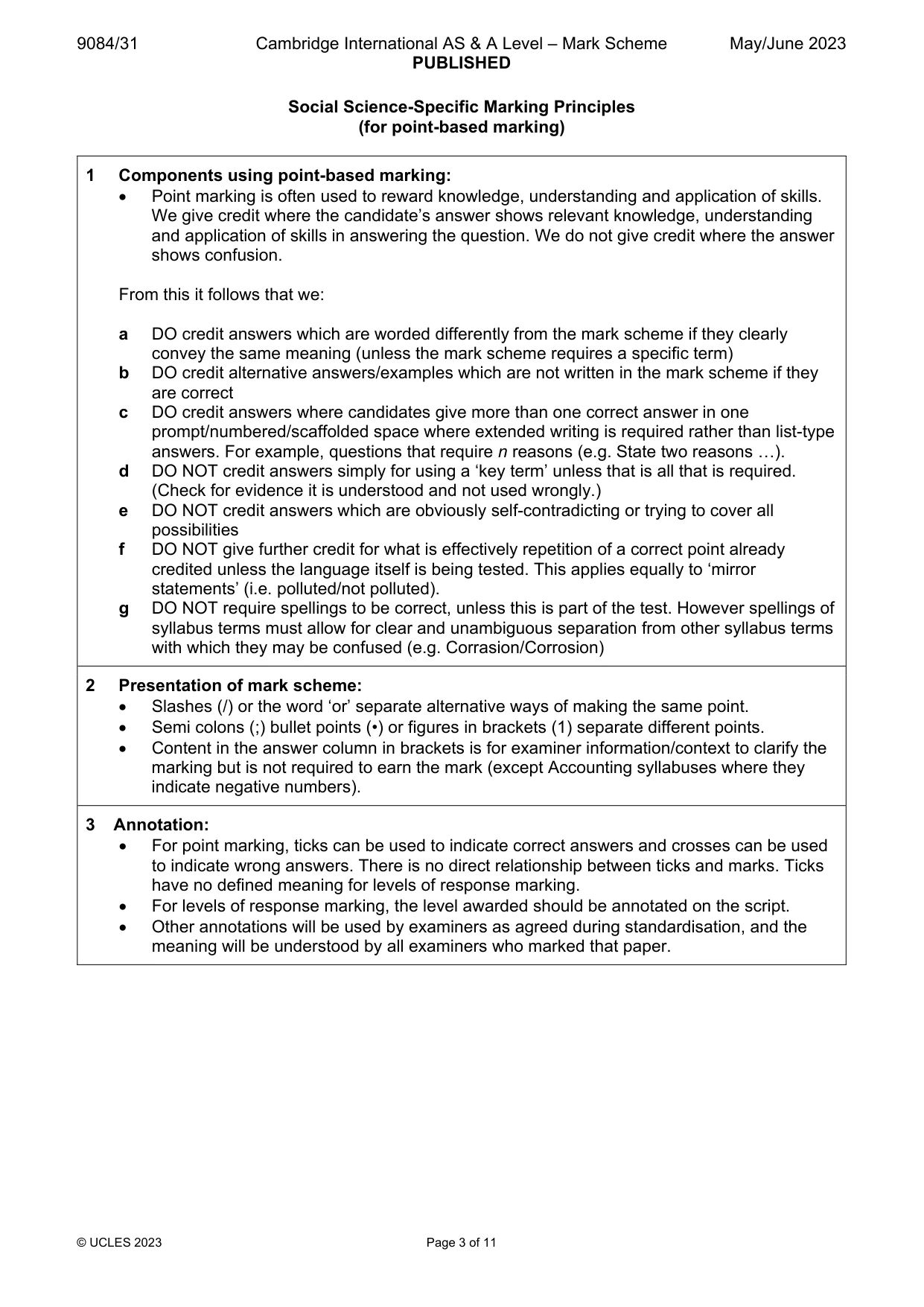
9084/31 Cambridge International AS & A Level – Mark Scheme PUBLISHED May/June 2023 © UCLES 2023 Page 3 of 11 Social Science-Specific Marking Principles (for point-based marking) 1 Components using point-based marking: Point marking is often used to reward knowledge, understanding and application of skills. We give credit where the candidate’s answer shows relevant knowledge, understanding and application of skills in answering the question. We do not give credit where the answer shows confusion. From this it follows that we: a DO credit answers which are worded differently from the mark scheme if they clearly convey the same meaning (unless the mark scheme requires a specific term) b DO credit alternative answers/examples which are not written in the mark scheme if they are correct c DO credit answers where candidates give more than one correct answer in one prompt/numbered/scaffolded space where extended writing is required rather than list-type answers. For example, questions that require n reasons (e.g. State two reasons …). d DO NOT credit answers simply for using a ‘key term’ unless that is all that is required. (Check for evidence it is understood and not used wrongly.) e DO NOT credit answers which are obviously self-contradicting or trying to cover all possibilities f DO NOT give further credit for what is effectively repetition of a correct point already credited unless the language itself is being tested. This applies equally to ‘mirror statements’ (i.e. polluted/not polluted). g DO NOT require spellings to be correct, unless this is part of the test. However spellings of syllabus terms must allow for clear and unambiguous separation from other syllabus terms with which they may be confused (e.g. Corrasion/Corrosion) 2 Presentation of mark scheme: Slashes (/) or the word ‘or’ separate alternative ways of making the same point. Semi colons (;) bullet points (•) or figures in brackets (1) separate different points. Content in the answer column in brackets is for examiner information/context to clarify the marking but is not required to earn the mark (except Accounting syllabuses where they indicate negative numbers). 3 Annotation: For point marking, ticks can be used to indicate correct answers and crosses can be used to indicate wrong answers. There is no direct relationship between ticks and marks. Ticks have no defined meaning for levels of response marking. For levels of response marking, the level awarded should be annotated on the script. Other annotations will be used by examiners as agreed during standardisation, and the meaning will be understood by all examiners who marked that paper.
Mark scheme, page 4
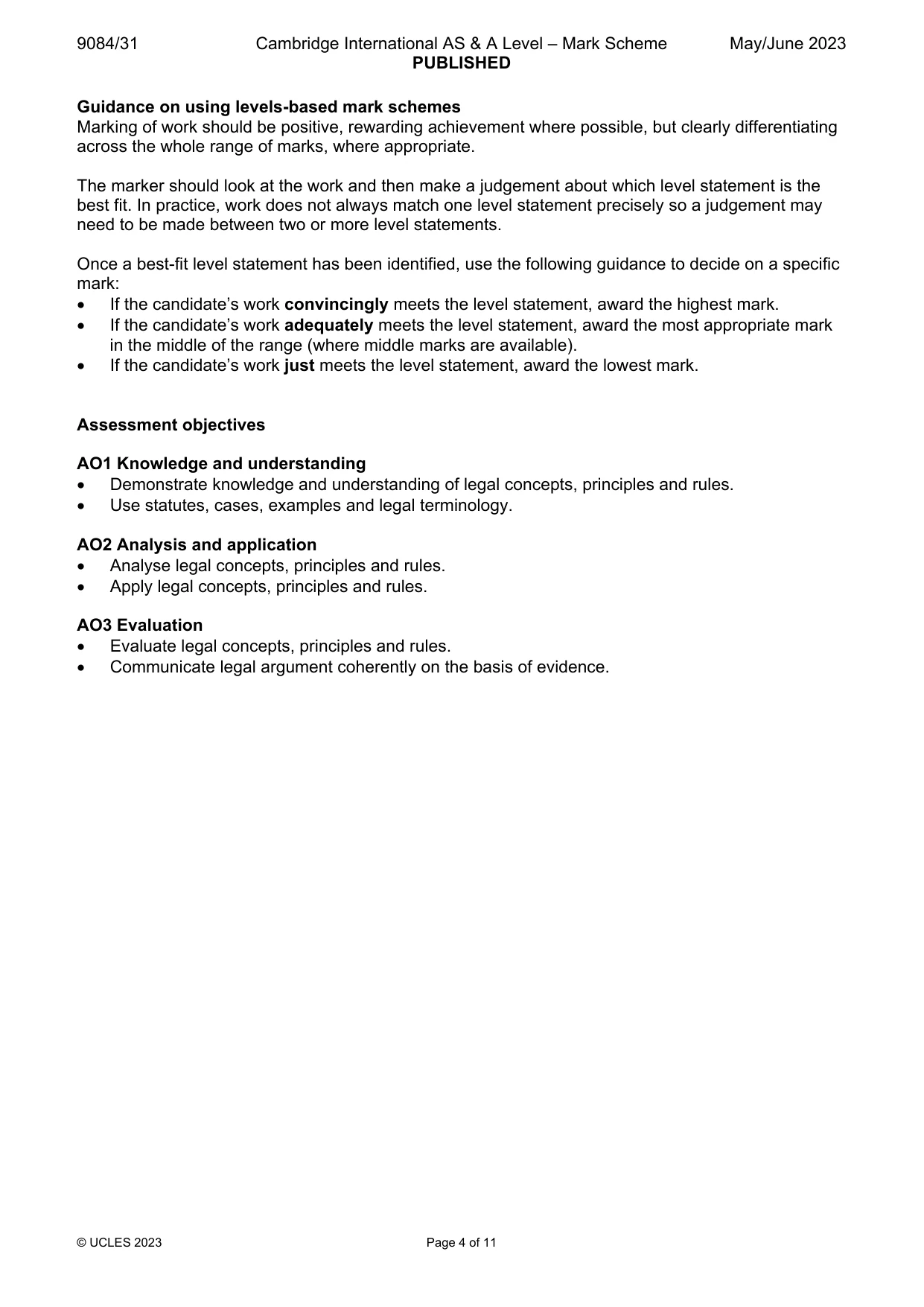
9084/31 Cambridge International AS & A Level – Mark Scheme PUBLISHED May/June 2023 © UCLES 2023 Page 4 of 11 Guidance on using levels-based mark schemes Marking of work should be positive, rewarding achievement where possible, but clearly differentiating across the whole range of marks, where appropriate. The marker should look at the work and then make a judgement about which level statement is the best fit. In practice, work does not always match one level statement precisely so a judgement may need to be made between two or more level statements. Once a best-fit level statement has been identified, use the following guidance to decide on a specific mark: If the candidate’s work convincingly meets the level statement, award the highest mark. If the candidate’s work adequately meets the level statement, award the most appropriate mark in the middle of the range (where middle marks are available). If the candidate’s work just meets the level statement, award the lowest mark. Assessment objectives AO1 Knowledge and understanding Demonstrate knowledge and understanding of legal concepts, principles and rules. Use statutes, cases, examples and legal terminology. AO2 Analysis and application Analyse legal concepts, principles and rules. Apply legal concepts, principles and rules. AO3 Evaluation Evaluate legal concepts, principles and rules. Communicate legal argument coherently on the basis of evidence.
Mark scheme, page 5
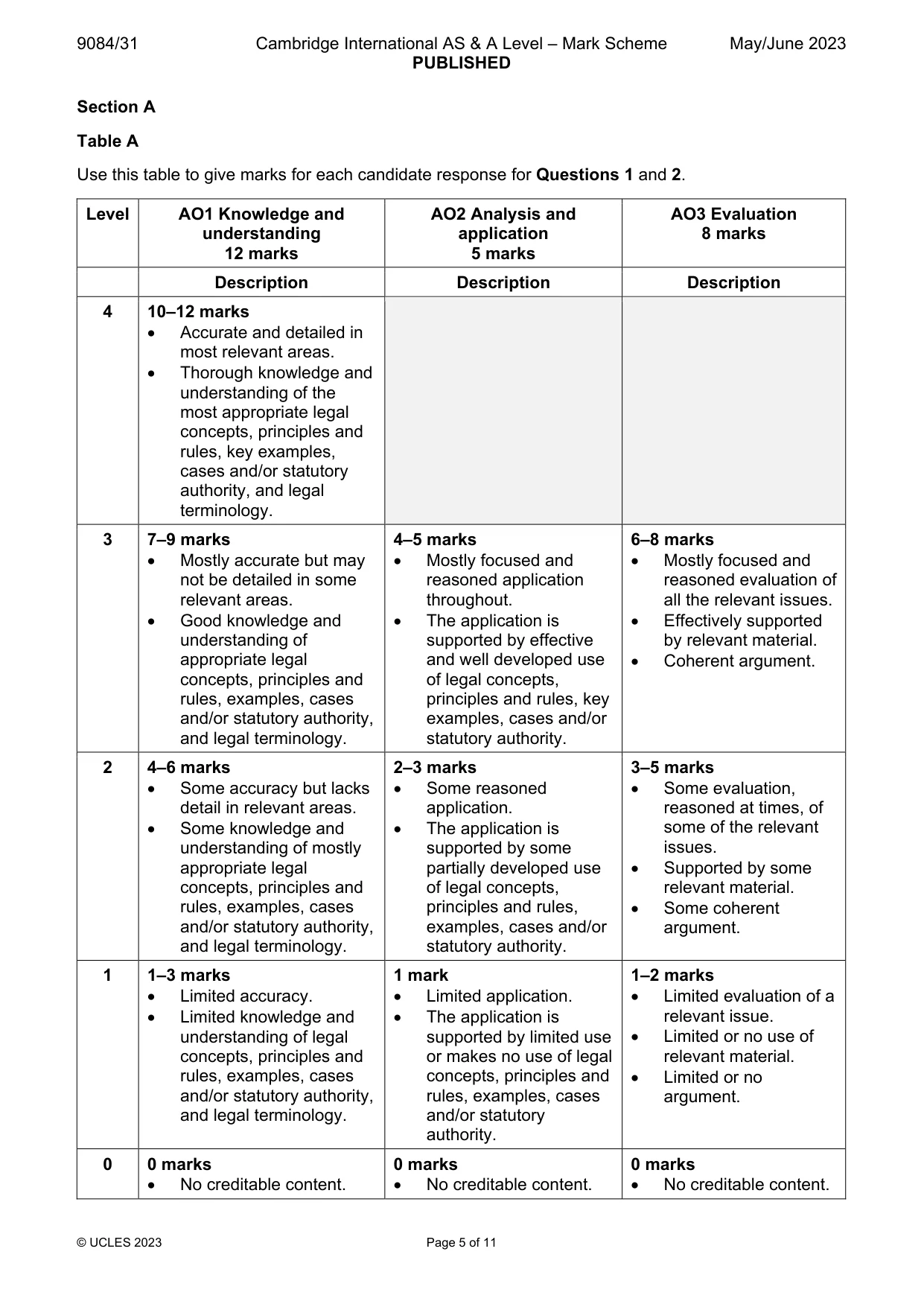
9084/31 Cambridge International AS & A Level – Mark Scheme PUBLISHED May/June 2023 © UCLES 2023 Page 5 of 11 Section A Table A Use this table to give marks for each candidate response for Questions 1 and 2. Level AO1 Knowledge and understanding 12 marks AO2 Analysis and application 5 marks AO3 Evaluation 8 marks Description Description Description 4 10–12 marks Accurate and detailed in most relevant areas. Thorough knowledge and understanding of the most appropriate legal concepts, principles and rules, key examples, cases and/or statutory authority, and legal terminology. 3 7–9 marks Mostly accurate but may not be detailed in some relevant areas. Good knowledge and understanding of appropriate legal concepts, principles and rules, examples, cases and/or statutory authority, and legal terminology. 4–5 marks Mostly focused and reasoned application throughout. The application is supported by effective and well developed use of legal concepts, principles and rules, key examples, cases and/or statutory authority. 6–8 marks Mostly focused and reasoned evaluation of all the relevant issues. Effectively supported by relevant material. Coherent argument. 2 4–6 marks Some accuracy but lacks detail in relevant areas. Some knowledge and understanding of mostly appropriate legal concepts, principles and rules, examples, cases and/or statutory authority, and legal terminology. 2–3 marks Some reasoned application. The application is supported by some partially developed use of legal concepts, principles and rules, examples, cases and/or statutory authority. 3–5 marks Some evaluation, reasoned at times, of some of the relevant issues. Supported by some relevant material. Some coherent argument. 1 1–3 marks Limited accuracy. Limited knowledge and understanding of legal concepts, principles and rules, examples, cases and/or statutory authority, and legal terminology. 1 mark Limited application. The application is supported by limited use or makes no use of legal concepts, principles and rules, examples, cases and/or statutory authority. 1–2 marks Limited evaluation of a relevant issue. Limited or no use of relevant material. Limited or no argument. 0 0 marks No creditable content. 0 marks No creditable content. 0 marks No creditable content.
Mark scheme, page 6
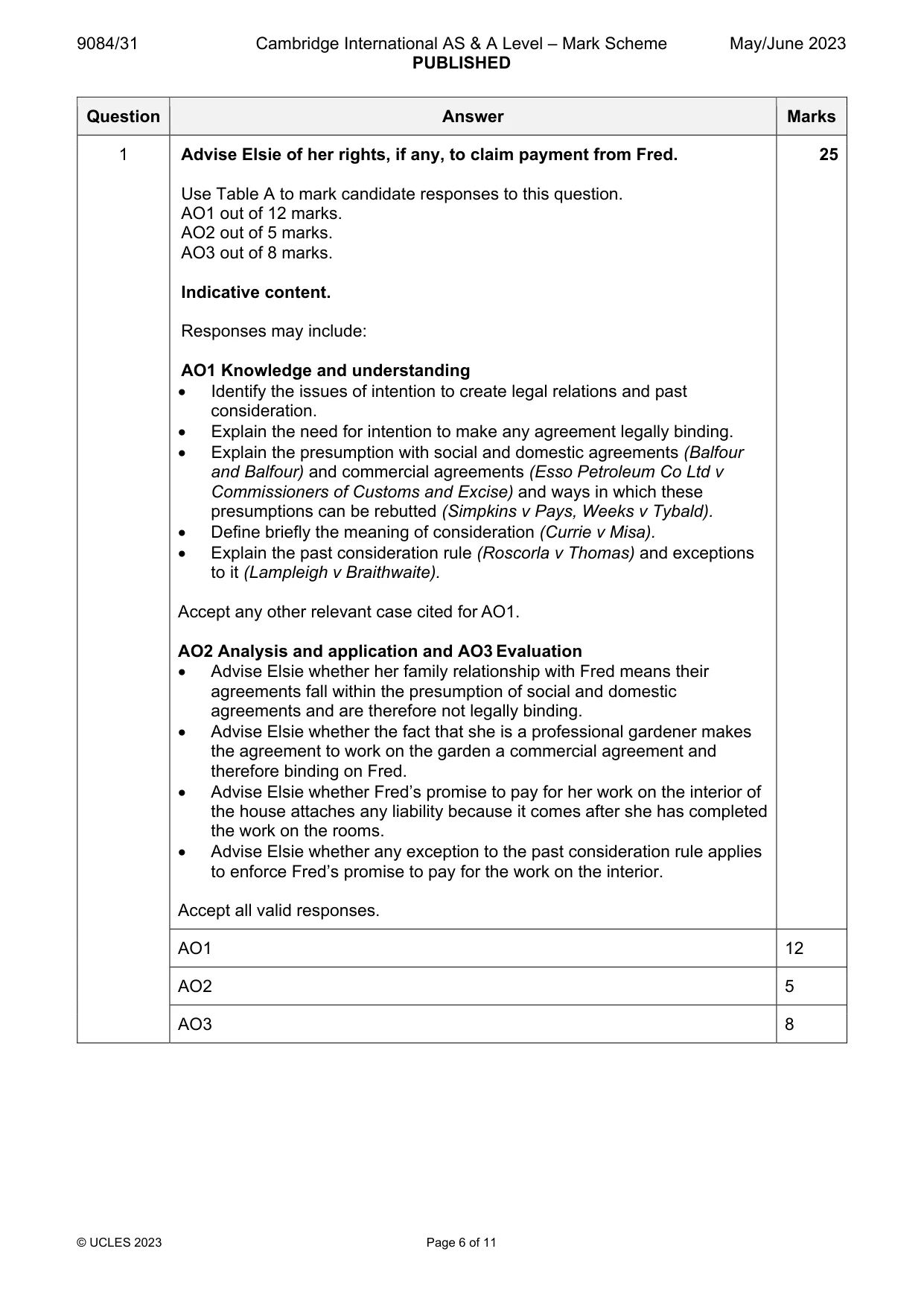
9084/31 Cambridge International AS & A Level – Mark Scheme PUBLISHED May/June 2023 © UCLES 2023 Page 6 of 11 Question Answer Marks 1 Advise Elsie of her rights, if any, to claim payment from Fred. Use Table A to mark candidate responses to this question. AO1 out of 12 marks. AO2 out of 5 marks. AO3 out of 8 marks. Indicative content. Responses may include: AO1 Knowledge and understanding Identify the issues of intention to create legal relations and past consideration. Explain the need for intention to make any agreement legally binding. Explain the presumption with social and domestic agreements (Balfour and Balfour) and commercial agreements (Esso Petroleum Co Ltd v Commissioners of Customs and Excise) and ways in which these presumptions can be rebutted (Simpkins v Pays, Weeks v Tybald). Define briefly the meaning of consideration (Currie v Misa). Explain the past consideration rule (Roscorla v Thomas) and exceptions to it (Lampleigh v Braithwaite). Accept any other relevant case cited for AO1. AO2 Analysis and application and AO3 Evaluation Advise Elsie whether her family relationship with Fred means their agreements fall within the presumption of social and domestic agreements and are therefore not legally binding. Advise Elsie whether the fact that she is a professional gardener makes the agreement to work on the garden a commercial agreement and therefore binding on Fred. Advise Elsie whether Fred’s promise to pay for her work on the interior of the house attaches any liability because it comes after she has completed the work on the rooms. Advise Elsie whether any exception to the past consideration rule applies to enforce Fred’s promise to pay for the work on the interior. Accept all valid responses. 25 AO1 12 AO2 5 AO3 8
Mark scheme, page 7
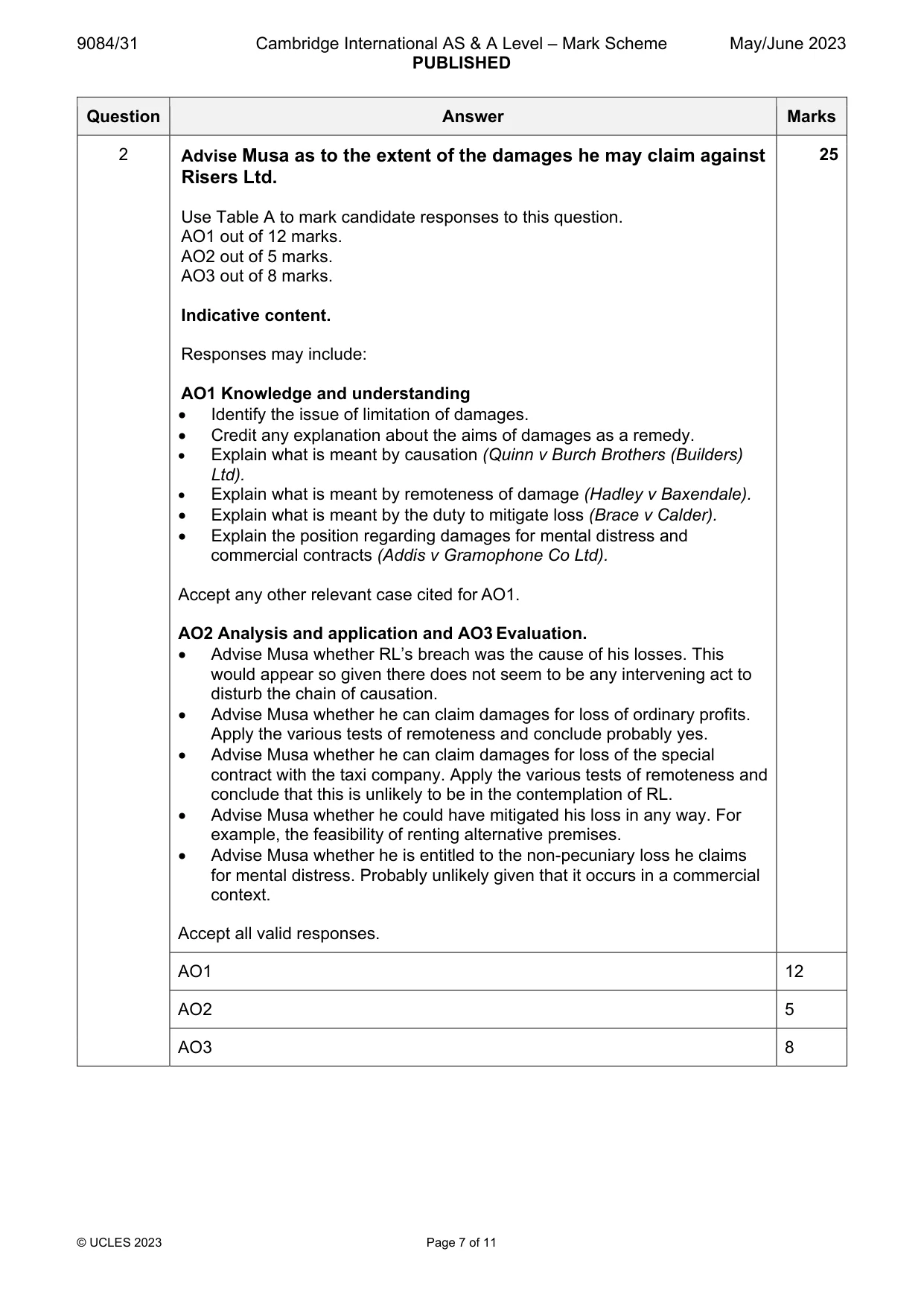
9084/31 Cambridge International AS & A Level – Mark Scheme PUBLISHED May/June 2023 © UCLES 2023 Page 7 of 11 Question Answer Marks 2 Advise Musa as to the extent of the damages he may claim against Risers Ltd. Use Table A to mark candidate responses to this question. AO1 out of 12 marks. AO2 out of 5 marks. AO3 out of 8 marks. Indicative content. Responses may include: AO1 Knowledge and understanding Identify the issue of limitation of damages. Credit any explanation about the aims of damages as a remedy. Explain what is meant by causation (Quinn v Burch Brothers (Builders) Ltd). Explain what is meant by remoteness of damage (Hadley v Baxendale). Explain what is meant by the duty to mitigate loss (Brace v Calder). Explain the position regarding damages for mental distress and commercial contracts (Addis v Gramophone Co Ltd). Accept any other relevant case cited for AO1. AO2 Analysis and application and AO3 Evaluation. Advise Musa whether RL’s breach was the cause of his losses. This would appear so given there does not seem to be any intervening act to disturb the chain of causation. Advise Musa whether he can claim damages for loss of ordinary profits. Apply the various tests of remoteness and conclude probably yes. Advise Musa whether he can claim damages for loss of the special contract with the taxi company. Apply the various tests of remoteness and conclude that this is unlikely to be in the contemplation of RL. Advise Musa whether he could have mitigated his loss in any way. For example, the feasibility of renting alternative premises. Advise Musa whether he is entitled to the non-pecuniary loss he claims for mental distress. Probably unlikely given that it occurs in a commercial context. Accept all valid responses. 25 AO1 12 AO2 5 AO3 8
Mark scheme, page 8
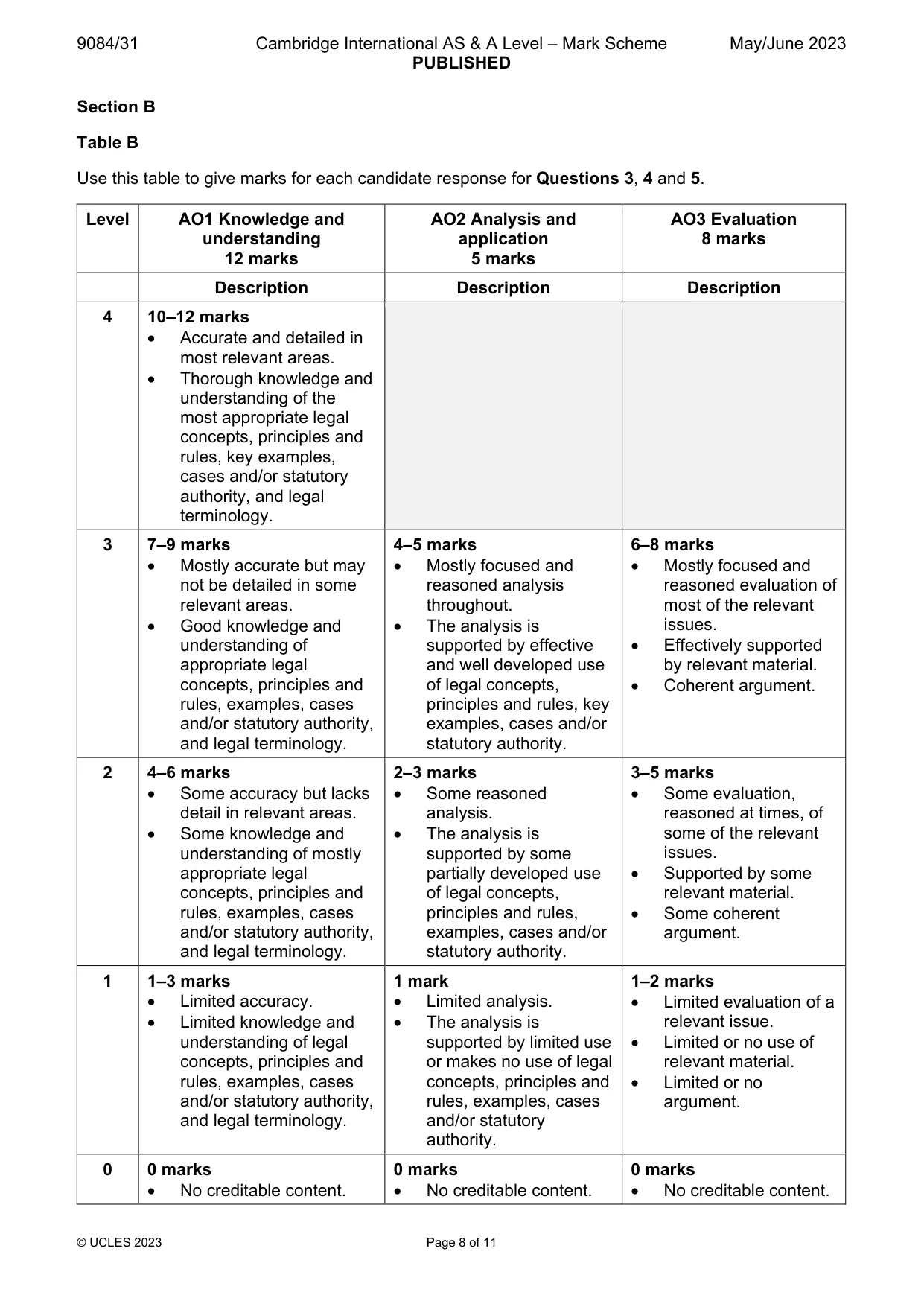
9084/31 Cambridge International AS & A Level – Mark Scheme PUBLISHED May/June 2023 © UCLES 2023 Page 8 of 11 Section B Table B Use this table to give marks for each candidate response for Questions 3, 4 and 5. Level AO1 Knowledge and understanding 12 marks AO2 Analysis and application 5 marks AO3 Evaluation 8 marks Description Description Description 4 10–12 marks Accurate and detailed in most relevant areas. Thorough knowledge and understanding of the most appropriate legal concepts, principles and rules, key examples, cases and/or statutory authority, and legal terminology. 3 7–9 marks Mostly accurate but may not be detailed in some relevant areas. Good knowledge and understanding of appropriate legal concepts, principles and rules, examples, cases and/or statutory authority, and legal terminology. 4–5 marks Mostly focused and reasoned analysis throughout. The analysis is supported by effective and well developed use of legal concepts, principles and rules, key examples, cases and/or statutory authority. 6–8 marks Mostly focused and reasoned evaluation of most of the relevant issues. Effectively supported by relevant material. Coherent argument. 2 4–6 marks Some accuracy but lacks detail in relevant areas. Some knowledge and understanding of mostly appropriate legal concepts, principles and rules, examples, cases and/or statutory authority, and legal terminology. 2–3 marks Some reasoned analysis. The analysis is supported by some partially developed use of legal concepts, principles and rules, examples, cases and/or statutory authority. 3–5 marks Some evaluation, reasoned at times, of some of the relevant issues. Supported by some relevant material. Some coherent argument. 1 1–3 marks Limited accuracy. Limited knowledge and understanding of legal concepts, principles and rules, examples, cases and/or statutory authority, and legal terminology. 1 mark Limited analysis. The analysis is supported by limited use or makes no use of legal concepts, principles and rules, examples, cases and/or statutory authority. 1–2 marks Limited evaluation of a relevant issue. Limited or no use of relevant material. Limited or no argument. 0 0 marks No creditable content. 0 marks No creditable content. 0 marks No creditable content.
Mark scheme, page 9
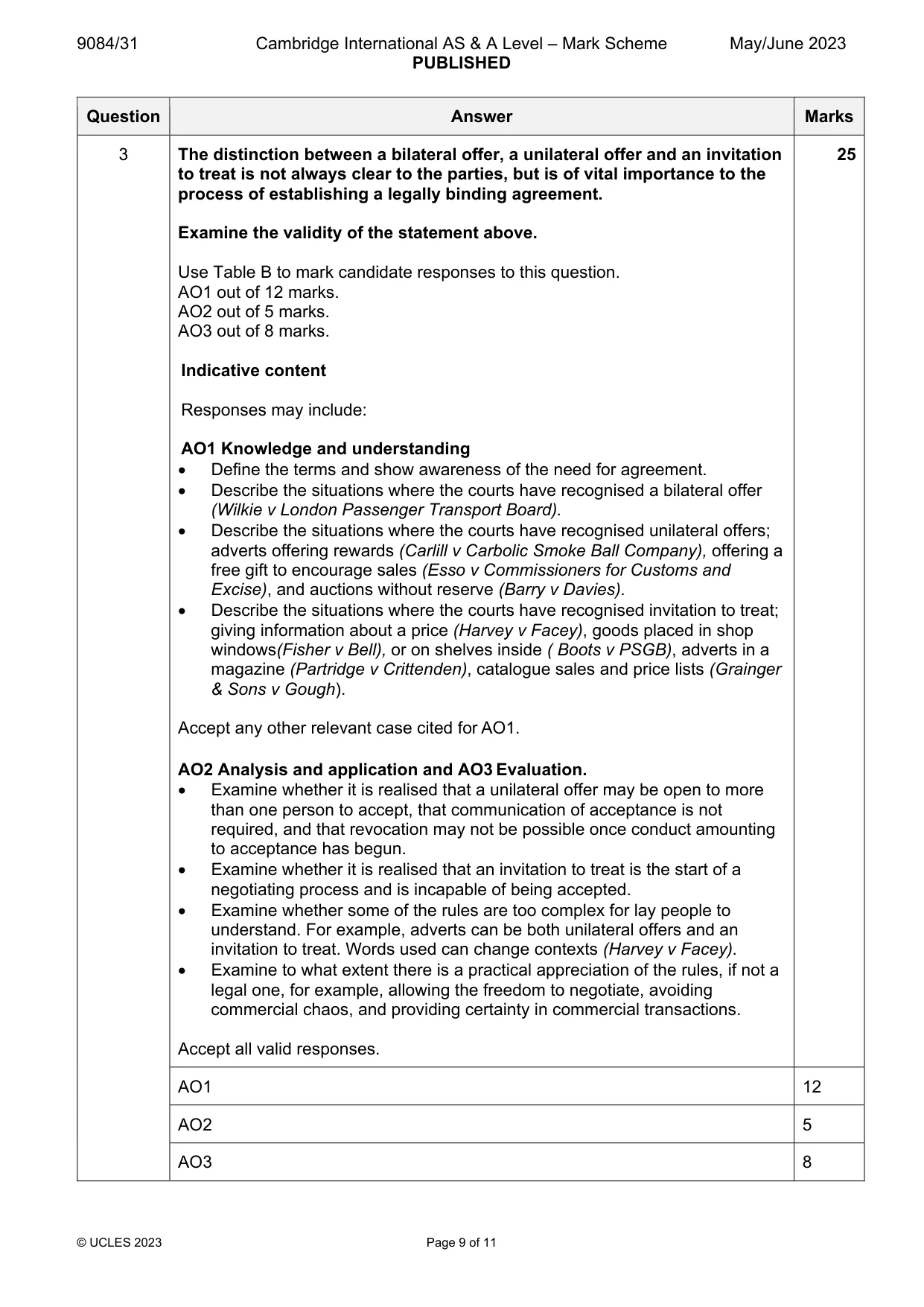
9084/31 Cambridge International AS & A Level – Mark Scheme PUBLISHED May/June 2023 © UCLES 2023 Page 9 of 11 Question Answer Marks 3 The distinction between a bilateral offer, a unilateral offer and an invitation to treat is not always clear to the parties, but is of vital importance to the process of establishing a legally binding agreement. Examine the validity of the statement above. Use Table B to mark candidate responses to this question. AO1 out of 12 marks. AO2 out of 5 marks. AO3 out of 8 marks. Indicative content Responses may include: AO1 Knowledge and understanding Define the terms and show awareness of the need for agreement. Describe the situations where the courts have recognised a bilateral offer (Wilkie v London Passenger Transport Board). Describe the situations where the courts have recognised unilateral offers; adverts offering rewards (Carlill v Carbolic Smoke Ball Company), offering a free gift to encourage sales (Esso v Commissioners for Customs and Excise), and auctions without reserve (Barry v Davies). Describe the situations where the courts have recognised invitation to treat; giving information about a price (Harvey v Facey), goods placed in shop windows(Fisher v Bell), or on shelves inside ( Boots v PSGB), adverts in a magazine (Partridge v Crittenden), catalogue sales and price lists (Grainger & Sons v Gough). Accept any other relevant case cited for AO1. AO2 Analysis and application and AO3 Evaluation. Examine whether it is realised that a unilateral offer may be open to more than one person to accept, that communication of acceptance is not required, and that revocation may not be possible once conduct amounting to acceptance has begun. Examine whether it is realised that an invitation to treat is the start of a negotiating process and is incapable of being accepted. Examine whether some of the rules are too complex for lay people to understand. For example, adverts can be both unilateral offers and an invitation to treat. Words used can change contexts (Harvey v Facey). Examine to what extent there is a practical appreciation of the rules, if not a legal one, for example, allowing the freedom to negotiate, avoiding commercial chaos, and providing certainty in commercial transactions. Accept all valid responses. 25 AO1 12 AO2 5 AO3 8
Mark scheme, page 10
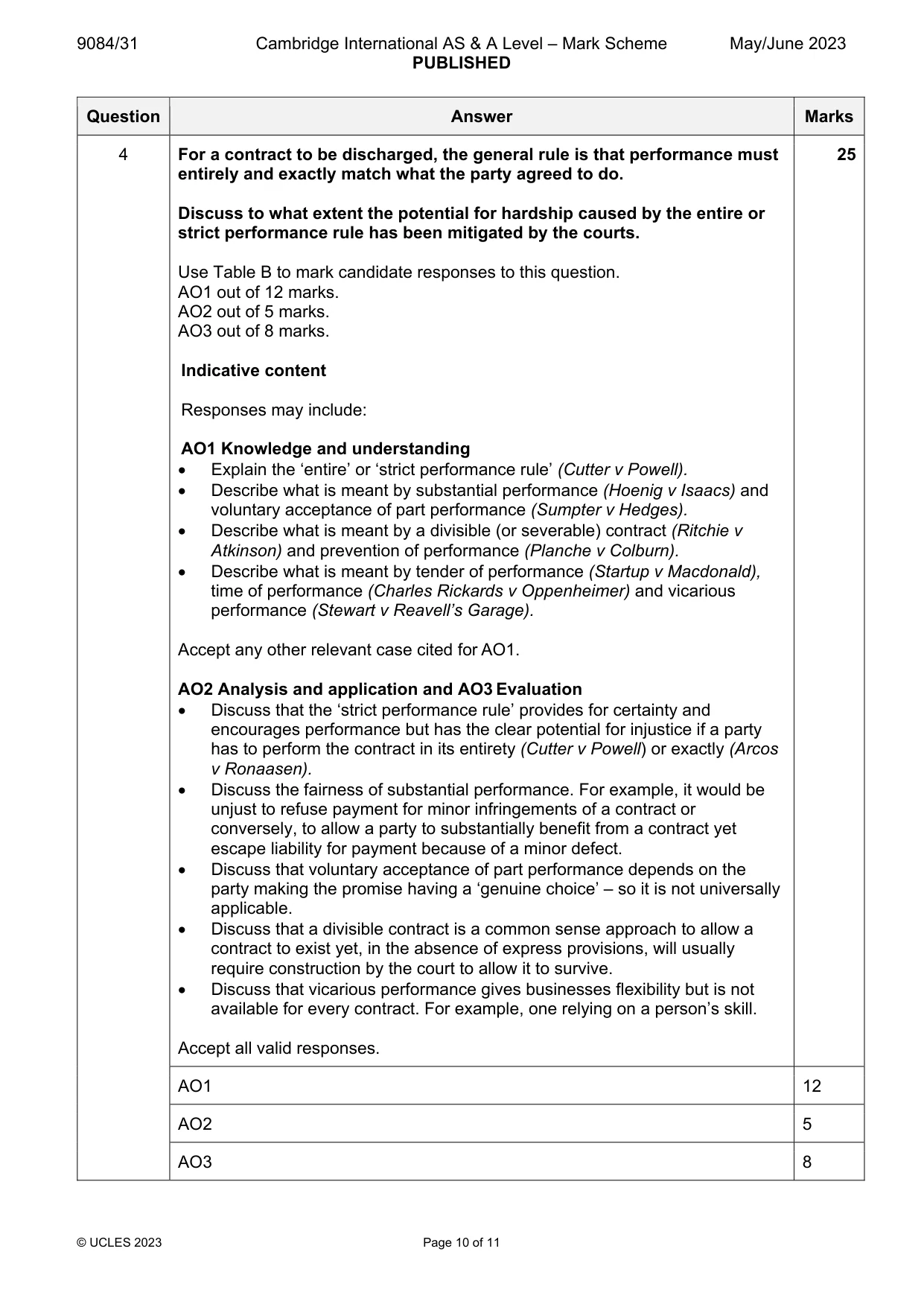
9084/31 Cambridge International AS & A Level – Mark Scheme PUBLISHED May/June 2023 © UCLES 2023 Page 10 of 11 Question Answer Marks 4 For a contract to be discharged, the general rule is that performance must entirely and exactly match what the party agreed to do. Discuss to what extent the potential for hardship caused by the entire or strict performance rule has been mitigated by the courts. Use Table B to mark candidate responses to this question. AO1 out of 12 marks. AO2 out of 5 marks. AO3 out of 8 marks. Indicative content Responses may include: AO1 Knowledge and understanding Explain the ‘entire’ or ‘strict performance rule’ (Cutter v Powell). Describe what is meant by substantial performance (Hoenig v Isaacs) and voluntary acceptance of part performance (Sumpter v Hedges). Describe what is meant by a divisible (or severable) contract (Ritchie v Atkinson) and prevention of performance (Planche v Colburn). Describe what is meant by tender of performance (Startup v Macdonald), time of performance (Charles Rickards v Oppenheimer) and vicarious performance (Stewart v Reavell’s Garage). Accept any other relevant case cited for AO1. AO2 Analysis and application and AO3 Evaluation Discuss that the ‘strict performance rule’ provides for certainty and encourages performance but has the clear potential for injustice if a party has to perform the contract in its entirety (Cutter v Powell) or exactly (Arcos v Ronaasen). Discuss the fairness of substantial performance. For example, it would be unjust to refuse payment for minor infringements of a contract or conversely, to allow a party to substantially benefit from a contract yet escape liability for payment because of a minor defect. Discuss that voluntary acceptance of part performance depends on the party making the promise having a ‘genuine choice’ – so it is not universally applicable. Discuss that a divisible contract is a common sense approach to allow a contract to exist yet, in the absence of express provisions, will usually require construction by the court to allow it to survive. Discuss that vicarious performance gives businesses flexibility but is not available for every contract. For example, one relying on a person’s skill. Accept all valid responses. 25 AO1 12 AO2 5 AO3 8
Mark scheme, page 11
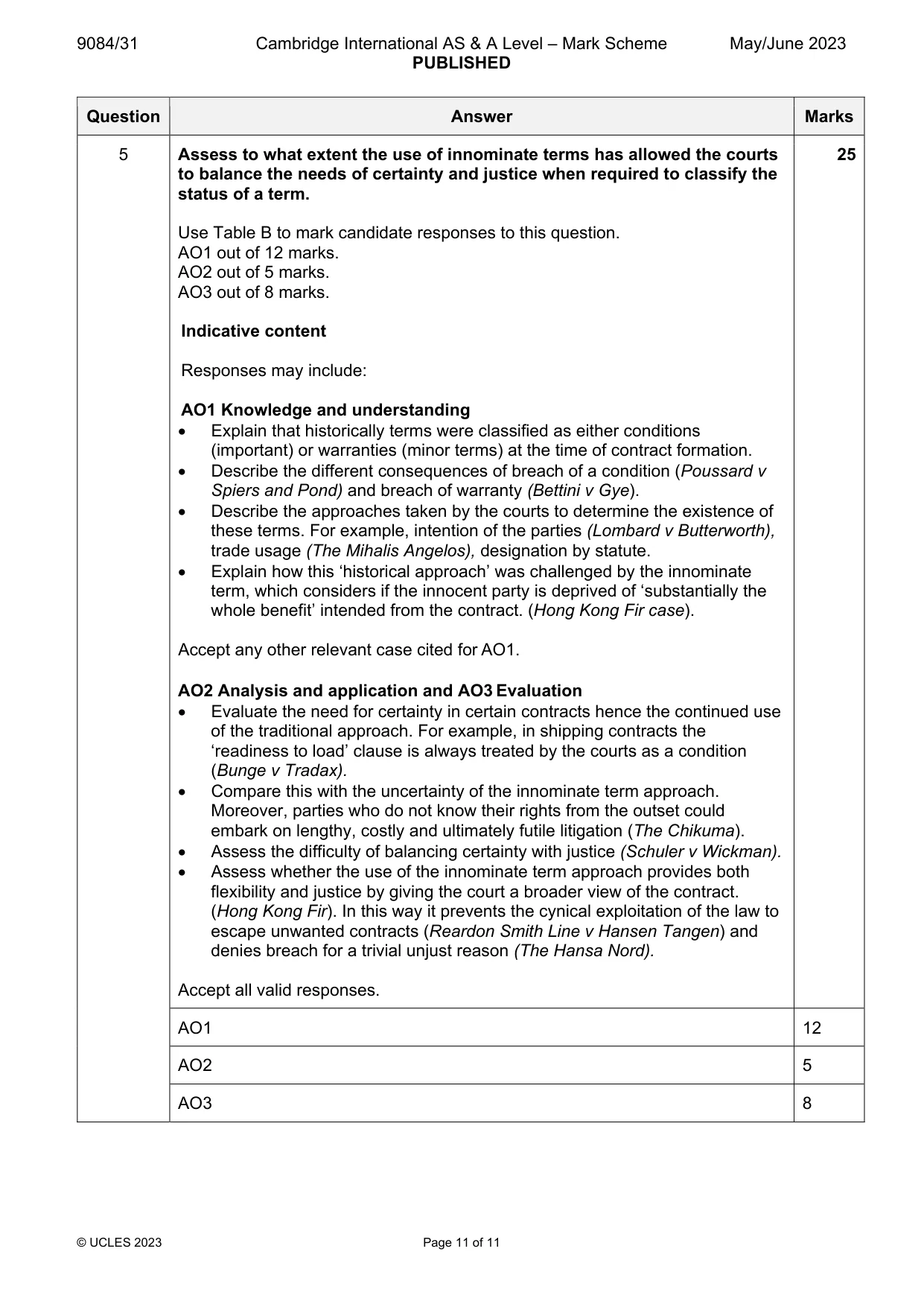
9084/31 Cambridge International AS & A Level – Mark Scheme PUBLISHED May/June 2023 © UCLES 2023 Page 11 of 11 Question Answer Marks 5 Assess to what extent the use of innominate terms has allowed the courts to balance the needs of certainty and justice when required to classify the status of a term. Use Table B to mark candidate responses to this question. AO1 out of 12 marks. AO2 out of 5 marks. AO3 out of 8 marks. Indicative content Responses may include: AO1 Knowledge and understanding Explain that historically terms were classified as either conditions (important) or warranties (minor terms) at the time of contract formation. Describe the different consequences of breach of a condition (Poussard v Spiers and Pond) and breach of warranty (Bettini v Gye). Describe the approaches taken by the courts to determine the existence of these terms. For example, intention of the parties (Lombard v Butterworth), trade usage (The Mihalis Angelos), designation by statute. Explain how this ‘historical approach’ was challenged by the innominate term, which considers if the innocent party is deprived of ‘substantially the whole benefit’ intended from the contract. (Hong Kong Fir case). Accept any other relevant case cited for AO1. AO2 Analysis and application and AO3 Evaluation Evaluate the need for certainty in certain contracts hence the continued use of the traditional approach. For example, in shipping contracts the ‘readiness to load’ clause is always treated by the courts as a condition (Bunge v Tradax). Compare this with the uncertainty of the innominate term approach. Moreover, parties who do not know their rights from the outset could embark on lengthy, costly and ultimately futile litigation (The Chikuma). Assess the difficulty of balancing certainty with justice (Schuler v Wickman). Assess whether the use of the innominate term approach provides both flexibility and justice by giving the court a broader view of the contract. (Hong Kong Fir). In this way it prevents the cynical exploitation of the law to escape unwanted contracts (Reardon Smith Line v Hansen Tangen) and denies breach for a trivial unjust reason (The Hansa Nord). Accept all valid responses. 25 AO1 12 AO2 5 AO3 8
What you needed in this session
Cambridge’s own grade thresholds for 2023 May/June, Paper 3 · Variant 1. A higher threshold means an easier paper — the bar moves with how the cohort did.