Cambridge A Level Law 9084 — 2024 May/June Paper 3 · Variant 3
9084/33/M/J/24 · 75 marks · ≈84 min
The question paper and its mark scheme, free to read here and free to download. This is Cambridge’s own paper, exactly as it was sat.
Question paper4 pages

Mark scheme18 pages
Answers below. Sit the paper first if you are practising.

Paper as text
Question paper, page 1
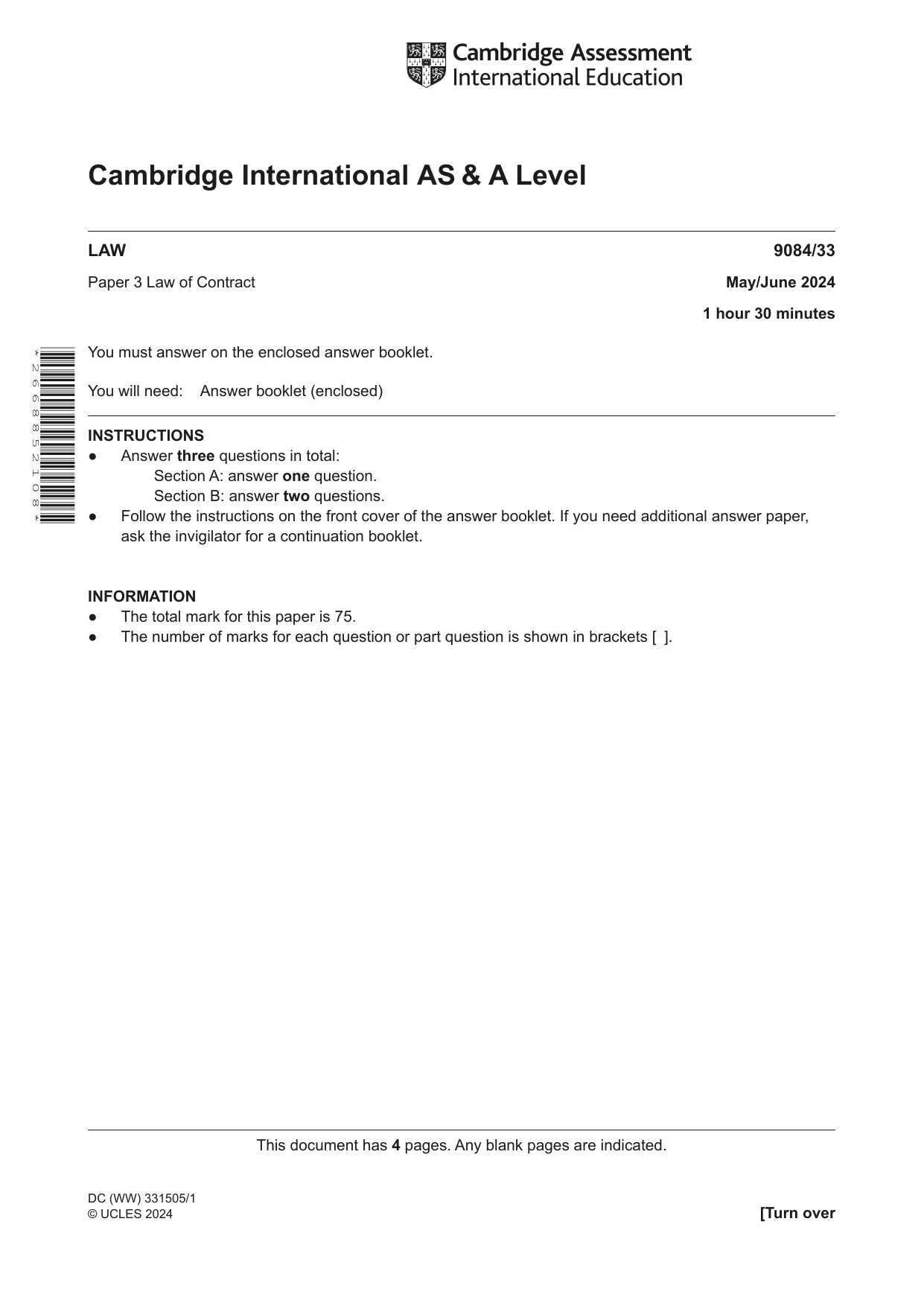
[Turn over Cambridge International AS & A Level This document has 4 pages. Any blank pages are indicated. DC (WW) 331505/1 © UCLES 2024 * 2 6 6 8 8 5 2 1 0 8 * LAW 9084/33 Paper 3 Law of Contract May/June 2024 1 hour 30 minutes You must answer on the enclosed answer booklet. You will need: Answer booklet (enclosed) INSTRUCTIONS ● Answer three questions in total: Section A: answer one question. Section B: answer two questions. ● Follow the instructions on the front cover of the answer booklet. If you need additional answer paper, ask the invigilator for a continuation booklet. INFORMATION ● The total mark for this paper is 75. ● The number of marks for each question or part question is shown in brackets [ ].
Question paper, page 2
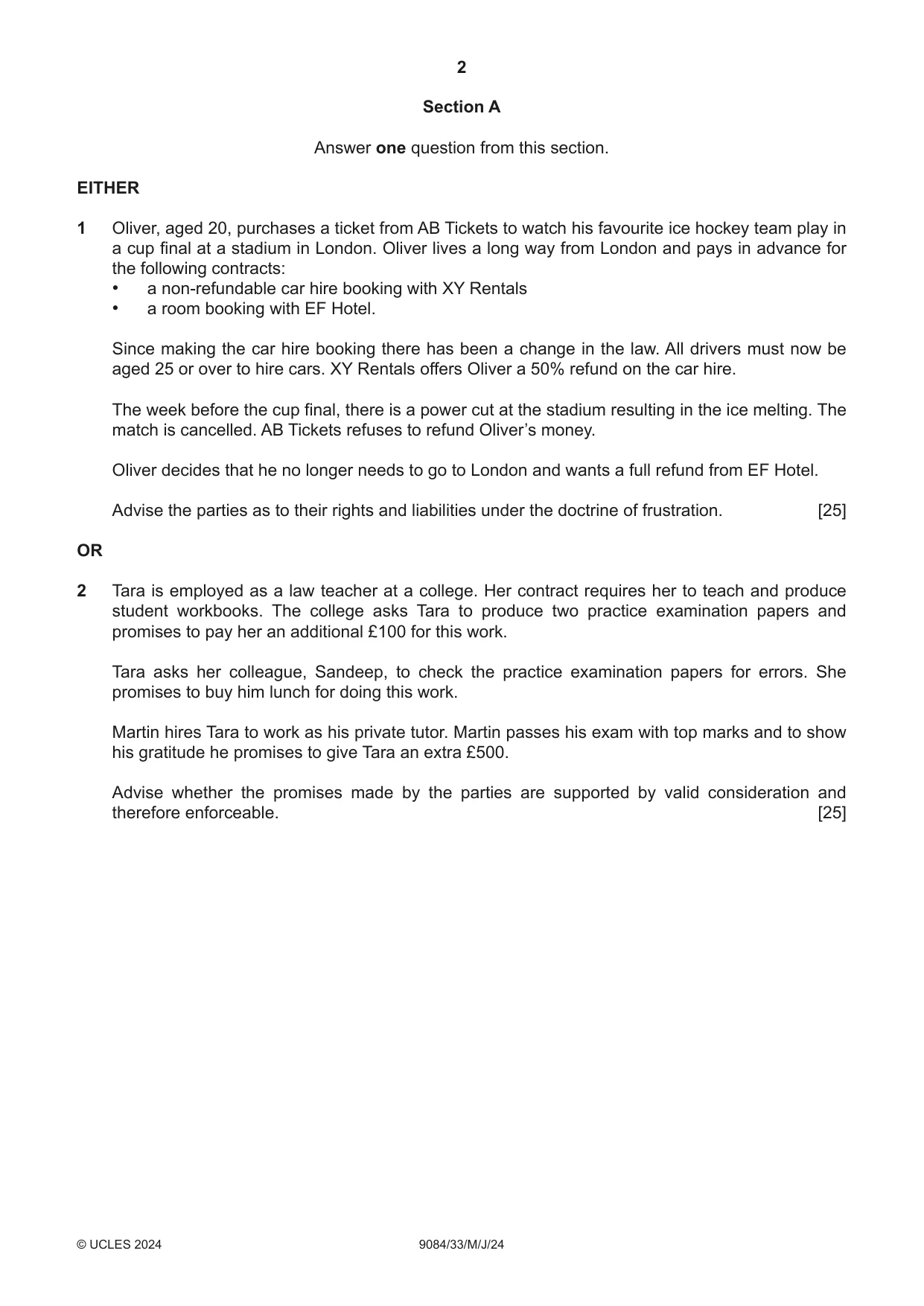
2 9084/33/M/J/24 © UCLES 2024 Section A Answer one question from this section. EITHER 1 Oliver, aged 20, purchases a ticket from AB Tickets to watch his favourite ice hockey team play in a cup final at a stadium in London. Oliver lives a long way from London and pays in advance for the following contracts: • a non-refundable car hire booking with XY Rentals • a room booking with EF Hotel. Since making the car hire booking there has been a change in the law. All drivers must now be aged 25 or over to hire cars. XY Rentals offers Oliver a 50% refund on the car hire. The week before the cup final, there is a power cut at the stadium resulting in the ice melting. The match is cancelled. AB Tickets refuses to refund Oliver’s money. Oliver decides that he no longer needs to go to London and wants a full refund from EF Hotel. Advise the parties as to their rights and liabilities under the doctrine of frustration. [25] OR 2 Tara is employed as a law teacher at a college. Her contract requires her to teach and produce student workbooks. The college asks Tara to produce two practice examination papers and promises to pay her an additional £100 for this work. Tara asks her colleague, Sandeep, to check the practice examination papers for errors. She promises to buy him lunch for doing this work. Martin hires Tara to work as his private tutor. Martin passes his exam with top marks and to show his gratitude he promises to give Tara an extra £500. Advise whether the promises made by the parties are supported by valid consideration and therefore enforceable. [25]
Question paper, page 3
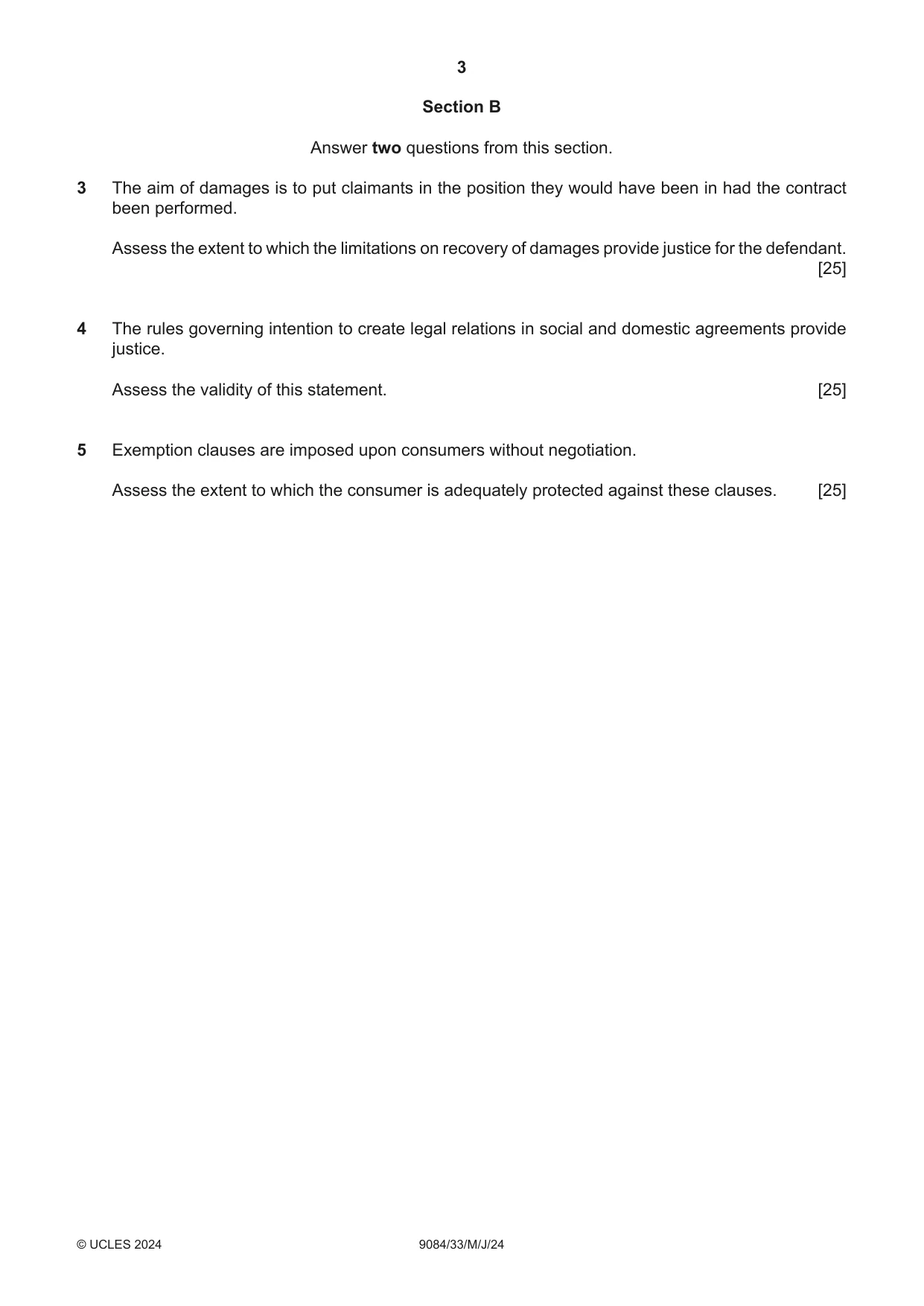
3 9084/33/M/J/24 © UCLES 2024 Section B Answer two questions from this section. 3 The aim of damages is to put claimants in the position they would have been in had the contract been performed. Assess the extent to which the limitations on recovery of damages provide justice for the defendant. [25] 4 The rules governing intention to create legal relations in social and domestic agreements provide justice. Assess the validity of this statement. [25] 5 Exemption clauses are imposed upon consumers without negotiation. Assess the extent to which the consumer is adequately protected against these clauses. [25]
Question paper, page 4
4 9084/33/M/J/24 © UCLES 2024 Permission to reproduce items where third-party owned material protected by copyright is included has been sought and cleared where possible. Every reasonable effort has been made by the publisher (UCLES) to trace copyright holders, but if any items requiring clearance have unwittingly been included, the publisher will be pleased to make amends at the earliest possible opportunity. To avoid the issue of disclosure of answer-related information to candidates, all copyright acknowledgements are reproduced online in the Cambridge Assessment International Education Copyright Acknowledgements Booklet. This is produced for each series of examinations and is freely available to download at www.cambridgeinternational.org after the live examination series. Cambridge Assessment International Education is part of Cambridge Assessment. Cambridge Assessment is the brand name of the University of Cambridge Local Examinations Syndicate (UCLES), which is a department of the University of Cambridge. BLANK PAGE
Mark scheme, page 1
This document consists of 18 printed pages. © Cambridge University Press & Assessment 2024 [Turn over Cambridge International AS & A Level LAW 9084/33 Paper 3 May/June 2024 MARK SCHEME Maximum Mark: 75 Published This mark scheme is published as an aid to teachers and candidates, to indicate the requirements of the examination. It shows the basis on which Examiners were instructed to award marks. It does not indicate the details of the discussions that took place at an Examiners’ meeting before marking began, which would have considered the acceptability of alternative answers. Mark schemes should be read in conjunction with the question paper and the Principal Examiner Report for Teachers. Cambridge International will not enter into discussions about these mark schemes. Cambridge International is publishing the mark schemes for the May/June 2024 series for most Cambridge IGCSE, Cambridge International A and AS Level and Cambridge Pre-U components, and some Cambridge O Level components.
Mark scheme, page 2
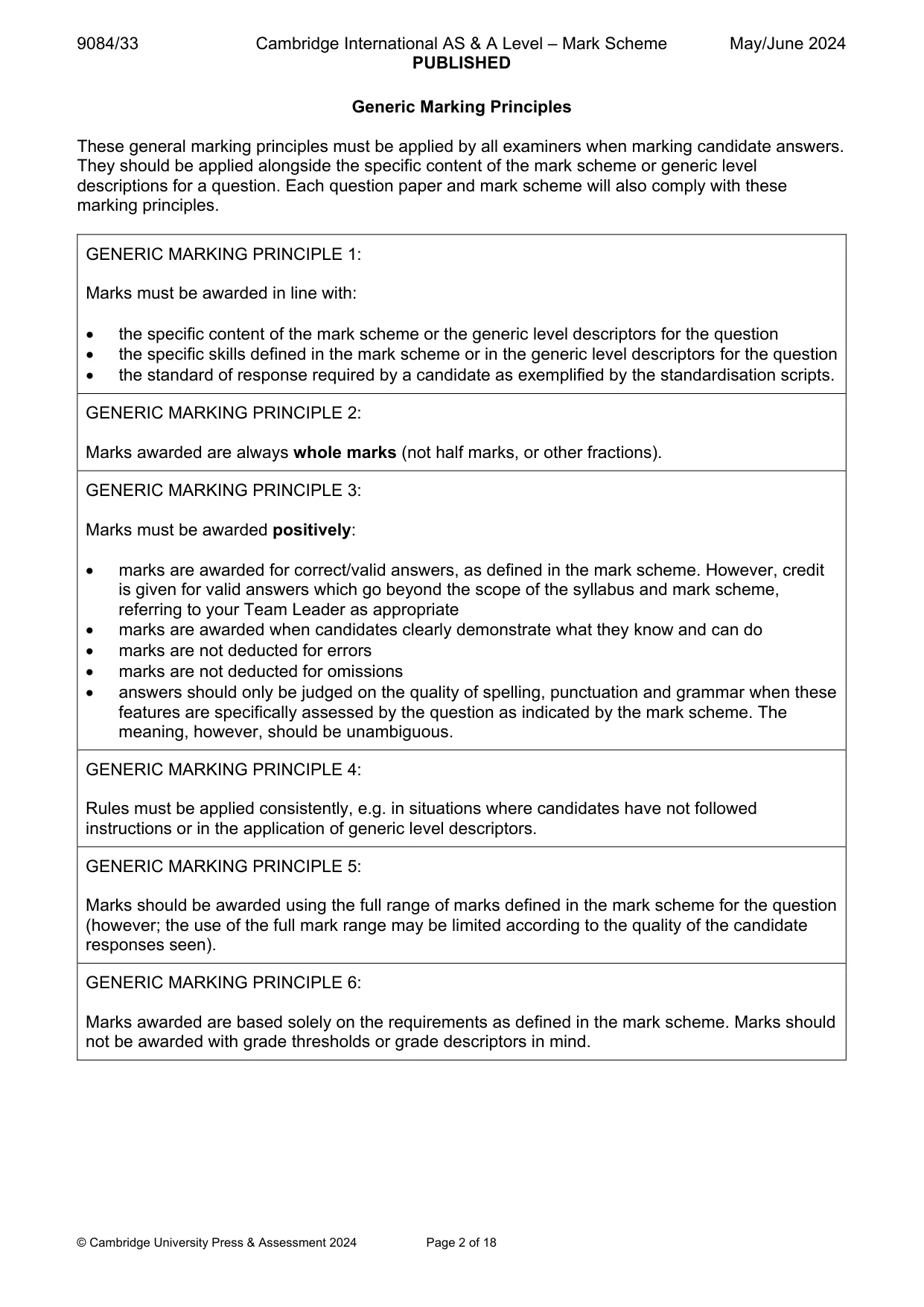
9084/33 Cambridge International AS & A Level – Mark Scheme PUBLISHED May/June 2024 © Cambridge University Press & Assessment 2024 Page 2 of 18 Generic Marking Principles These general marking principles must be applied by all examiners when marking candidate answers. They should be applied alongside the specific content of the mark scheme or generic level descriptions for a question. Each question paper and mark scheme will also comply with these marking principles. GENERIC MARKING PRINCIPLE 1: Marks must be awarded in line with: the specific content of the mark scheme or the generic level descriptors for the question the specific skills defined in the mark scheme or in the generic level descriptors for the question the standard of response required by a candidate as exemplified by the standardisation scripts. GENERIC MARKING PRINCIPLE 2: Marks awarded are always whole marks (not half marks, or other fractions). GENERIC MARKING PRINCIPLE 3: Marks must be awarded positively: marks are awarded for correct/valid answers, as defined in the mark scheme. However, credit is given for valid answers which go beyond the scope of the syllabus and mark scheme, referring to your Team Leader as appropriate marks are awarded when candidates clearly demonstrate what they know and can do marks are not deducted for errors marks are not deducted for omissions answers should only be judged on the quality of spelling, punctuation and grammar when these features are specifically assessed by the question as indicated by the mark scheme. The meaning, however, should be unambiguous. GENERIC MARKING PRINCIPLE 4: Rules must be applied consistently, e.g. in situations where candidates have not followed instructions or in the application of generic level descriptors. GENERIC MARKING PRINCIPLE 5: Marks should be awarded using the full range of marks defined in the mark scheme for the question (however; the use of the full mark range may be limited according to the quality of the candidate responses seen). GENERIC MARKING PRINCIPLE 6: Marks awarded are based solely on the requirements as defined in the mark scheme. Marks should not be awarded with grade thresholds or grade descriptors in mind.
Mark scheme, page 3
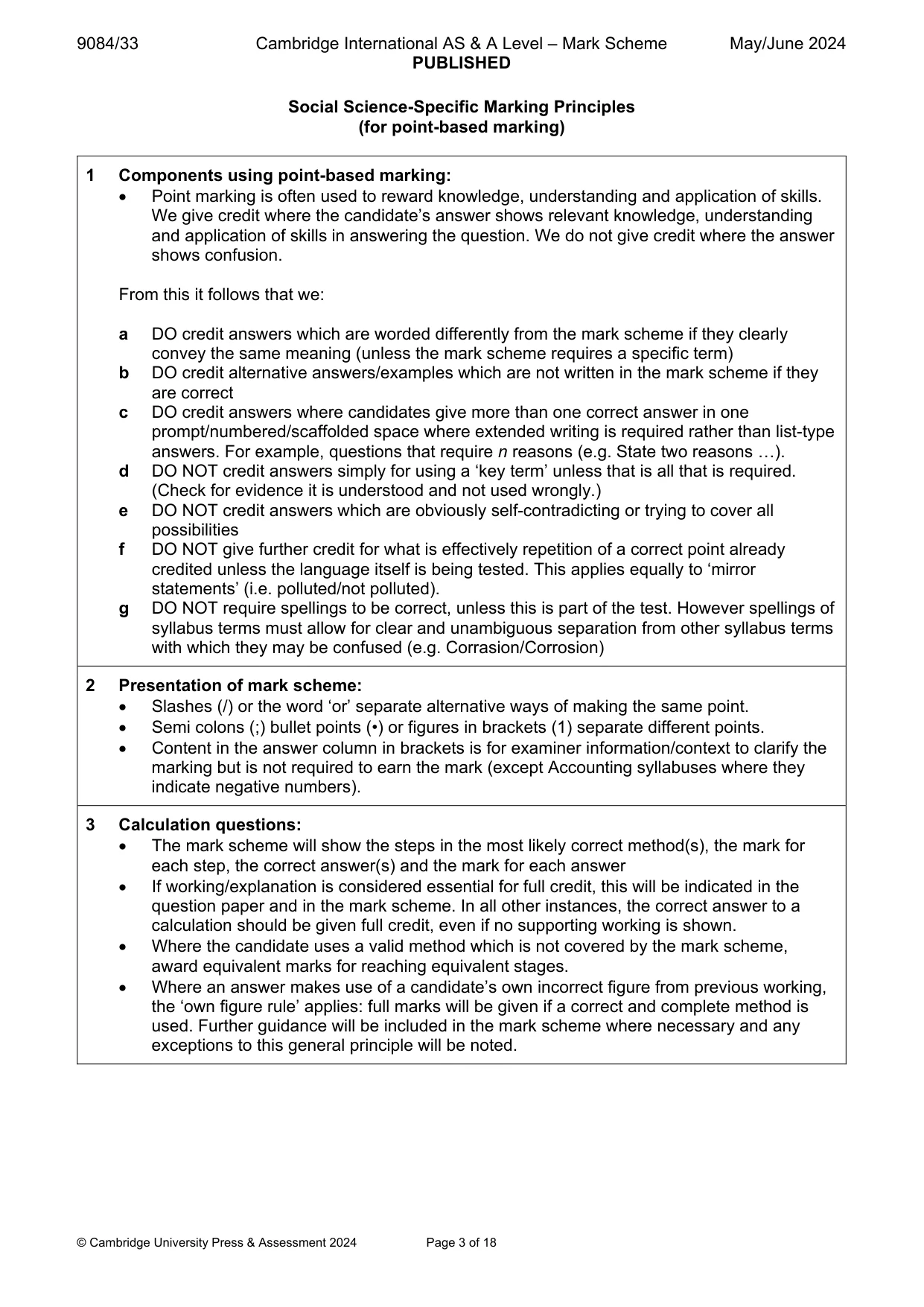
9084/33 Cambridge International AS & A Level – Mark Scheme PUBLISHED May/June 2024 © Cambridge University Press & Assessment 2024 Page 3 of 18 Social Science-Specific Marking Principles (for point-based marking) 1 Components using point-based marking: Point marking is often used to reward knowledge, understanding and application of skills. We give credit where the candidate’s answer shows relevant knowledge, understanding and application of skills in answering the question. We do not give credit where the answer shows confusion. From this it follows that we: a DO credit answers which are worded differently from the mark scheme if they clearly convey the same meaning (unless the mark scheme requires a specific term) b DO credit alternative answers/examples which are not written in the mark scheme if they are correct c DO credit answers where candidates give more than one correct answer in one prompt/numbered/scaffolded space where extended writing is required rather than list-type answers. For example, questions that require n reasons (e.g. State two reasons …). d DO NOT credit answers simply for using a ‘key term’ unless that is all that is required. (Check for evidence it is understood and not used wrongly.) e DO NOT credit answers which are obviously self-contradicting or trying to cover all possibilities f DO NOT give further credit for what is effectively repetition of a correct point already credited unless the language itself is being tested. This applies equally to ‘mirror statements’ (i.e. polluted/not polluted). g DO NOT require spellings to be correct, unless this is part of the test. However spellings of syllabus terms must allow for clear and unambiguous separation from other syllabus terms with which they may be confused (e.g. Corrasion/Corrosion) 2 Presentation of mark scheme: Slashes (/) or the word ‘or’ separate alternative ways of making the same point. Semi colons (;) bullet points (•) or figures in brackets (1) separate different points. Content in the answer column in brackets is for examiner information/context to clarify the marking but is not required to earn the mark (except Accounting syllabuses where they indicate negative numbers). 3 Calculation questions: The mark scheme will show the steps in the most likely correct method(s), the mark for each step, the correct answer(s) and the mark for each answer If working/explanation is considered essential for full credit, this will be indicated in the question paper and in the mark scheme. In all other instances, the correct answer to a calculation should be given full credit, even if no supporting working is shown. Where the candidate uses a valid method which is not covered by the mark scheme, award equivalent marks for reaching equivalent stages. Where an answer makes use of a candidate’s own incorrect figure from previous working, the ‘own figure rule’ applies: full marks will be given if a correct and complete method is used. Further guidance will be included in the mark scheme where necessary and any exceptions to this general principle will be noted.
Mark scheme, page 4
9084/33 Cambridge International AS & A Level – Mark Scheme PUBLISHED May/June 2024 © Cambridge University Press & Assessment 2024 Page 4 of 18 4 Annotation: For point marking, ticks can be used to indicate correct answers and crosses can be used to indicate wrong answers. There is no direct relationship between ticks and marks. Ticks have no defined meaning for levels of response marking. For levels of response marking, the level awarded should be annotated on the script. Other annotations will be used by examiners as agreed during standardisation, and the meaning will be understood by all examiners who marked that paper.
Mark scheme, page 5
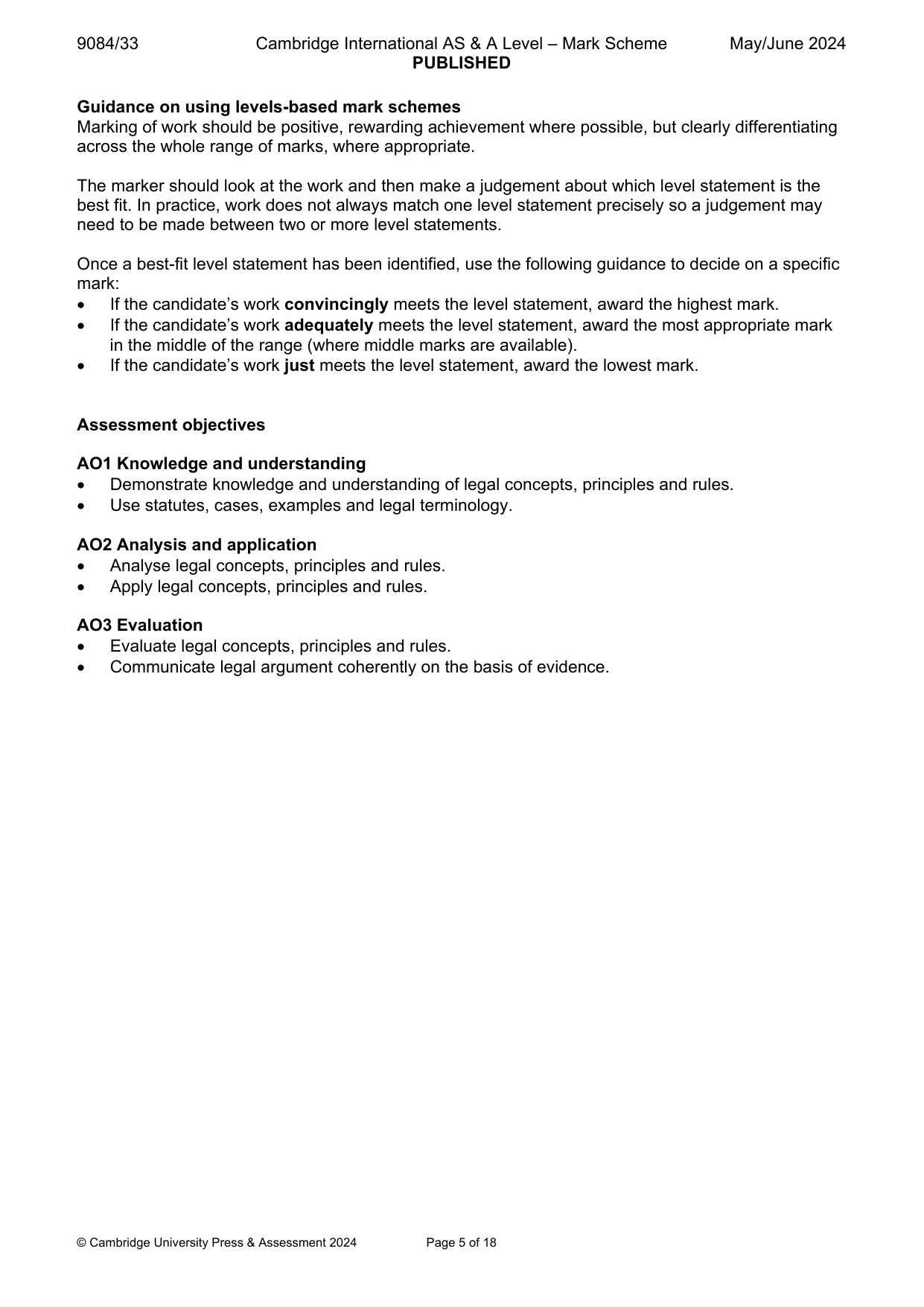
9084/33 Cambridge International AS & A Level – Mark Scheme PUBLISHED May/June 2024 © Cambridge University Press & Assessment 2024 Page 5 of 18 Guidance on using levels-based mark schemes Marking of work should be positive, rewarding achievement where possible, but clearly differentiating across the whole range of marks, where appropriate. The marker should look at the work and then make a judgement about which level statement is the best fit. In practice, work does not always match one level statement precisely so a judgement may need to be made between two or more level statements. Once a best-fit level statement has been identified, use the following guidance to decide on a specific mark: If the candidate’s work convincingly meets the level statement, award the highest mark. If the candidate’s work adequately meets the level statement, award the most appropriate mark in the middle of the range (where middle marks are available). If the candidate’s work just meets the level statement, award the lowest mark. Assessment objectives AO1 Knowledge and understanding Demonstrate knowledge and understanding of legal concepts, principles and rules. Use statutes, cases, examples and legal terminology. AO2 Analysis and application Analyse legal concepts, principles and rules. Apply legal concepts, principles and rules. AO3 Evaluation Evaluate legal concepts, principles and rules. Communicate legal argument coherently on the basis of evidence.
Mark scheme, page 6
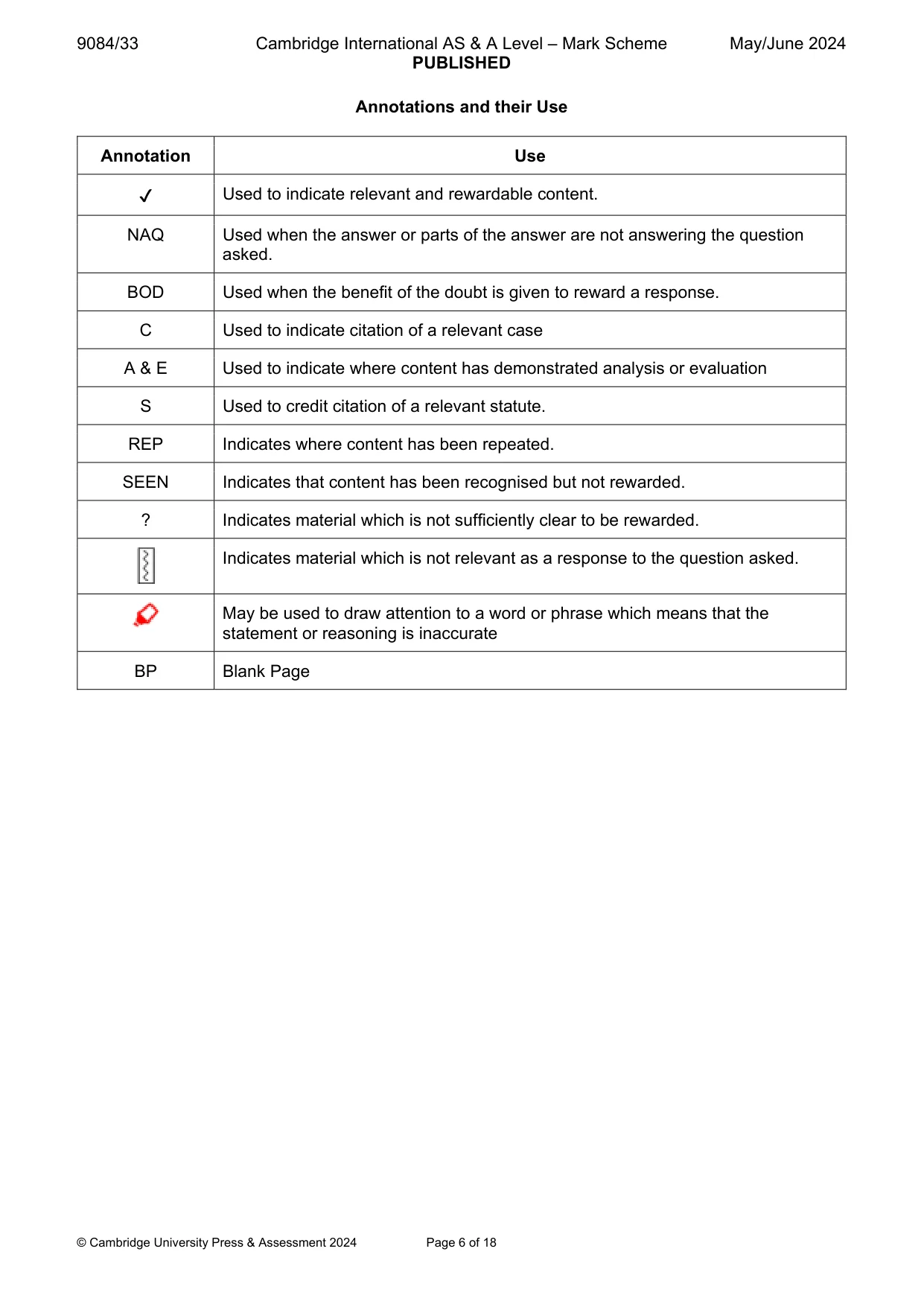
9084/33 Cambridge International AS & A Level – Mark Scheme PUBLISHED May/June 2024 © Cambridge University Press & Assessment 2024 Page 6 of 18 Annotations and their Use Annotation Use ✔ Used to indicate relevant and rewardable content. NAQ Used when the answer or parts of the answer are not answering the question asked. BOD Used when the benefit of the doubt is given to reward a response. C Used to indicate citation of a relevant case A & E Used to indicate where content has demonstrated analysis or evaluation S Used to credit citation of a relevant statute. REP Indicates where content has been repeated. SEEN Indicates that content has been recognised but not rewarded. ? Indicates material which is not sufficiently clear to be rewarded. Indicates material which is not relevant as a response to the question asked. May be used to draw attention to a word or phrase which means that the statement or reasoning is inaccurate BP Blank Page
Mark scheme, page 7
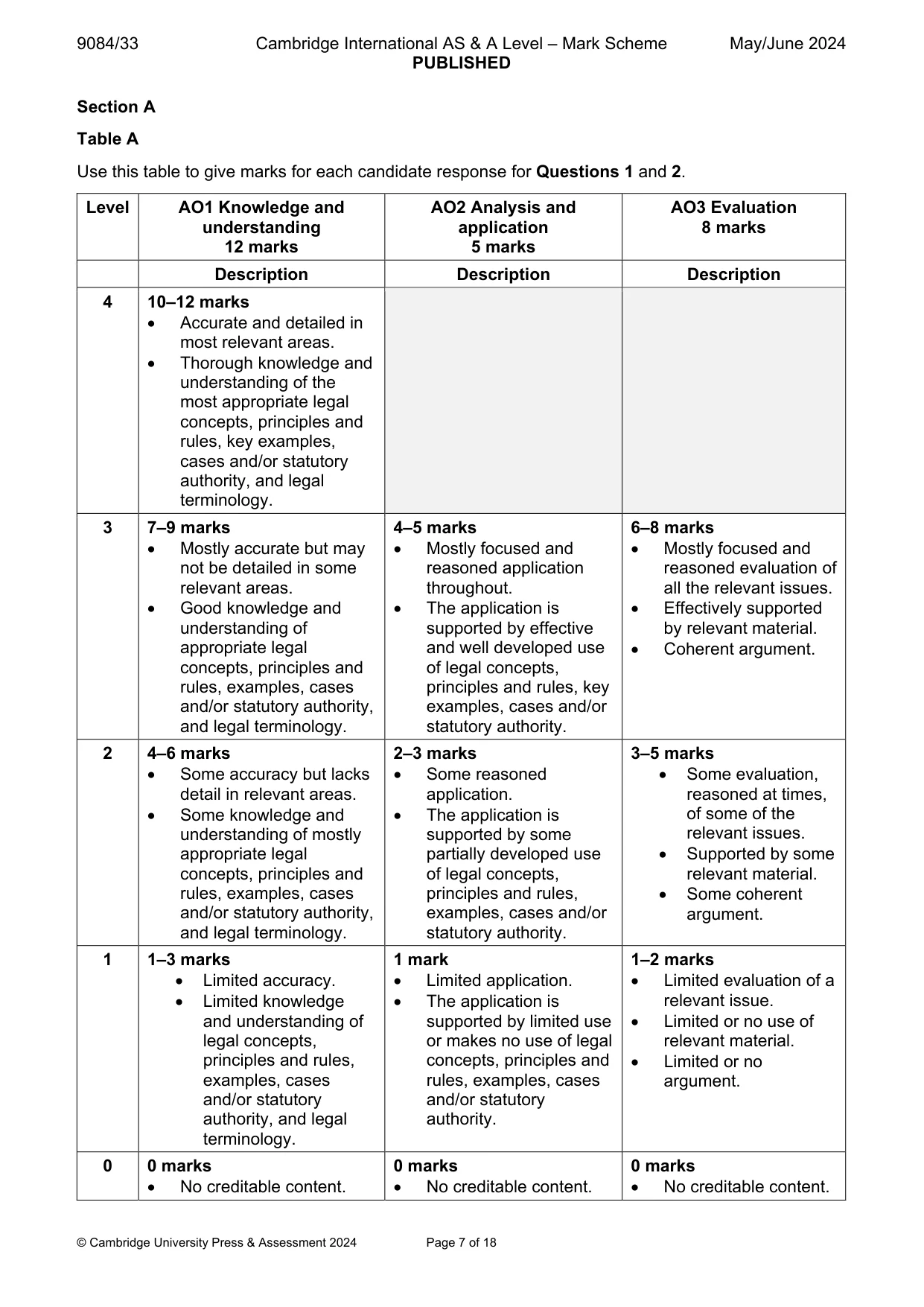
9084/33 Cambridge International AS & A Level – Mark Scheme PUBLISHED May/June 2024 © Cambridge University Press & Assessment 2024 Page 7 of 18 Section A Table A Use this table to give marks for each candidate response for Questions 1 and 2. Level AO1 Knowledge and understanding 12 marks AO2 Analysis and application 5 marks AO3 Evaluation 8 marks Description Description Description 4 10–12 marks Accurate and detailed in most relevant areas. Thorough knowledge and understanding of the most appropriate legal concepts, principles and rules, key examples, cases and/or statutory authority, and legal terminology. 3 7–9 marks Mostly accurate but may not be detailed in some relevant areas. Good knowledge and understanding of appropriate legal concepts, principles and rules, examples, cases and/or statutory authority, and legal terminology. 4–5 marks Mostly focused and reasoned application throughout. The application is supported by effective and well developed use of legal concepts, principles and rules, key examples, cases and/or statutory authority. 6–8 marks Mostly focused and reasoned evaluation of all the relevant issues. Effectively supported by relevant material. Coherent argument. 2 4–6 marks Some accuracy but lacks detail in relevant areas. Some knowledge and understanding of mostly appropriate legal concepts, principles and rules, examples, cases and/or statutory authority, and legal terminology. 2–3 marks Some reasoned application. The application is supported by some partially developed use of legal concepts, principles and rules, examples, cases and/or statutory authority. 3–5 marks Some evaluation, reasoned at times, of some of the relevant issues. Supported by some relevant material. Some coherent argument. 1 1–3 marks Limited accuracy. Limited knowledge and understanding of legal concepts, principles and rules, examples, cases and/or statutory authority, and legal terminology. 1 mark Limited application. The application is supported by limited use or makes no use of legal concepts, principles and rules, examples, cases and/or statutory authority. 1–2 marks Limited evaluation of a relevant issue. Limited or no use of relevant material. Limited or no argument. 0 0 marks No creditable content. 0 marks No creditable content. 0 marks No creditable content.
Mark scheme, page 8
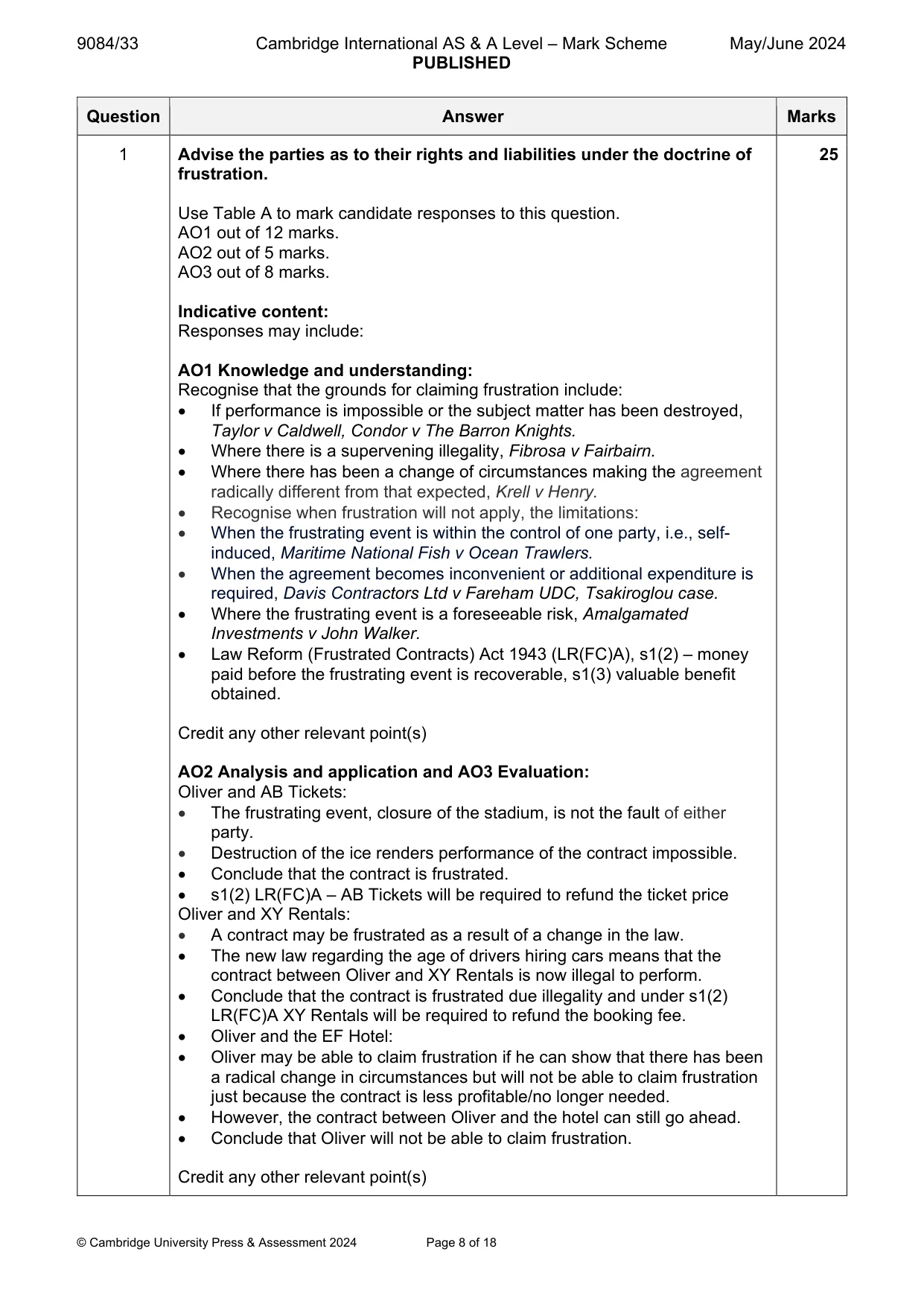
9084/33 Cambridge International AS & A Level – Mark Scheme PUBLISHED May/June 2024 © Cambridge University Press & Assessment 2024 Page 8 of 18 Question Answer Marks 1 Advise the parties as to their rights and liabilities under the doctrine of frustration. Use Table A to mark candidate responses to this question. AO1 out of 12 marks. AO2 out of 5 marks. AO3 out of 8 marks. Indicative content: Responses may include: AO1 Knowledge and understanding: Recognise that the grounds for claiming frustration include: If performance is impossible or the subject matter has been destroyed, Taylor v Caldwell, Condor v The Barron Knights. Where there is a supervening illegality, Fibrosa v Fairbairn. Where there has been a change of circumstances making the agreement radically different from that expected, Krell v Henry. Recognise when frustration will not apply, the limitations: When the frustrating event is within the control of one party, i.e., self- induced, Maritime National Fish v Ocean Trawlers. When the agreement becomes inconvenient or additional expenditure is required, Davis Contractors Ltd v Fareham UDC, Tsakiroglou case. Where the frustrating event is a foreseeable risk, Amalgamated Investments v John Walker. Law Reform (Frustrated Contracts) Act 1943 (LR(FC)A), s1(2) – money paid before the frustrating event is recoverable, s1(3) valuable benefit obtained. Credit any other relevant point(s) AO2 Analysis and application and AO3 Evaluation: Oliver and AB Tickets: The frustrating event, closure of the stadium, is not the fault of either party. Destruction of the ice renders performance of the contract impossible. Conclude that the contract is frustrated. s1(2) LR(FC)A – AB Tickets will be required to refund the ticket price Oliver and XY Rentals: A contract may be frustrated as a result of a change in the law. The new law regarding the age of drivers hiring cars means that the contract between Oliver and XY Rentals is now illegal to perform. Conclude that the contract is frustrated due illegality and under s1(2) LR(FC)A XY Rentals will be required to refund the booking fee. Oliver and the EF Hotel: Oliver may be able to claim frustration if he can show that there has been a radical change in circumstances but will not be able to claim frustration just because the contract is less profitable/no longer needed. However, the contract between Oliver and the hotel can still go ahead. Conclude that Oliver will not be able to claim frustration. Credit any other relevant point(s) 25
Mark scheme, page 9
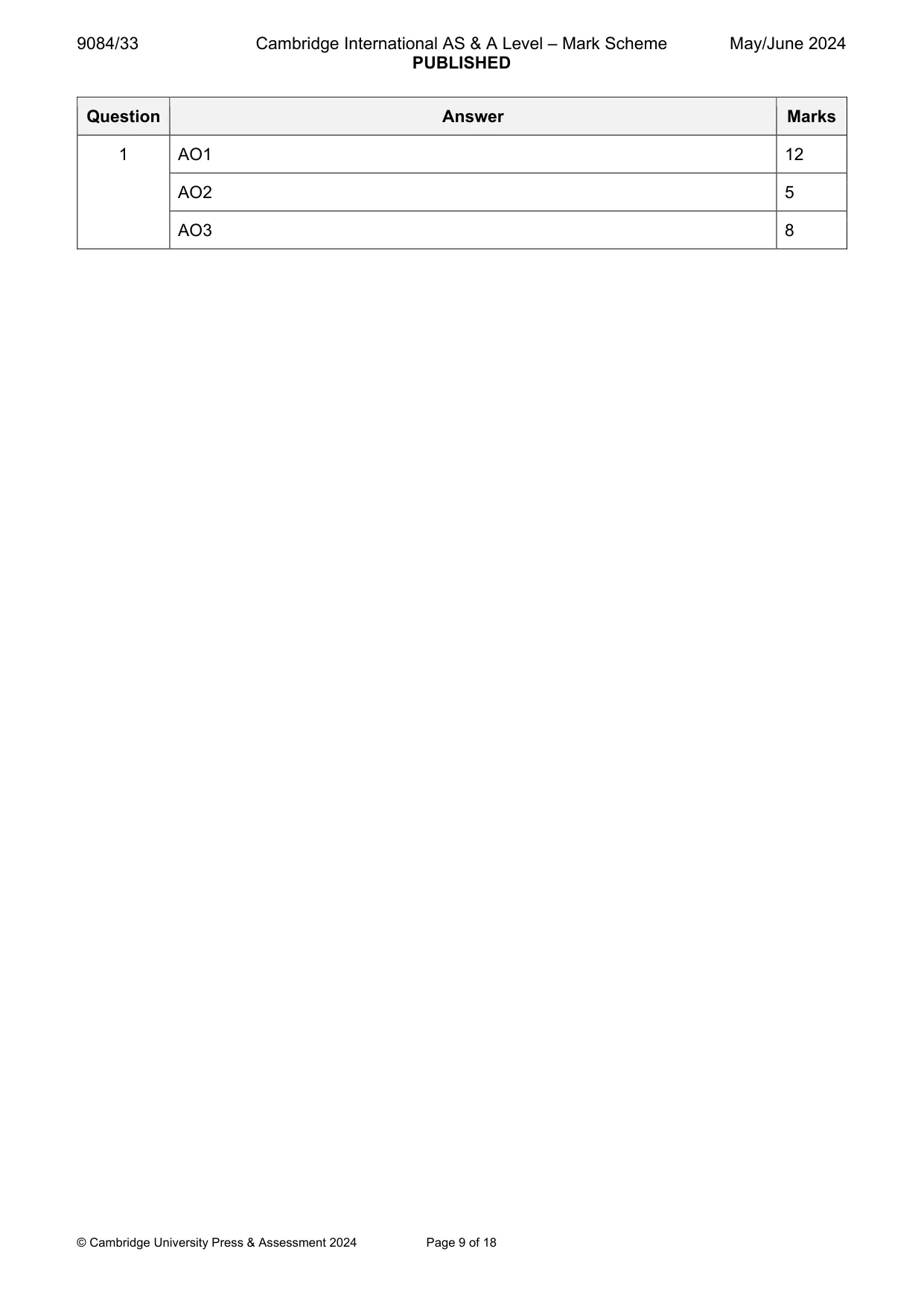
9084/33 Cambridge International AS & A Level – Mark Scheme PUBLISHED May/June 2024 © Cambridge University Press & Assessment 2024 Page 9 of 18 Question Answer Marks 1 AO1 12 AO2 5 AO3 8
Mark scheme, page 10
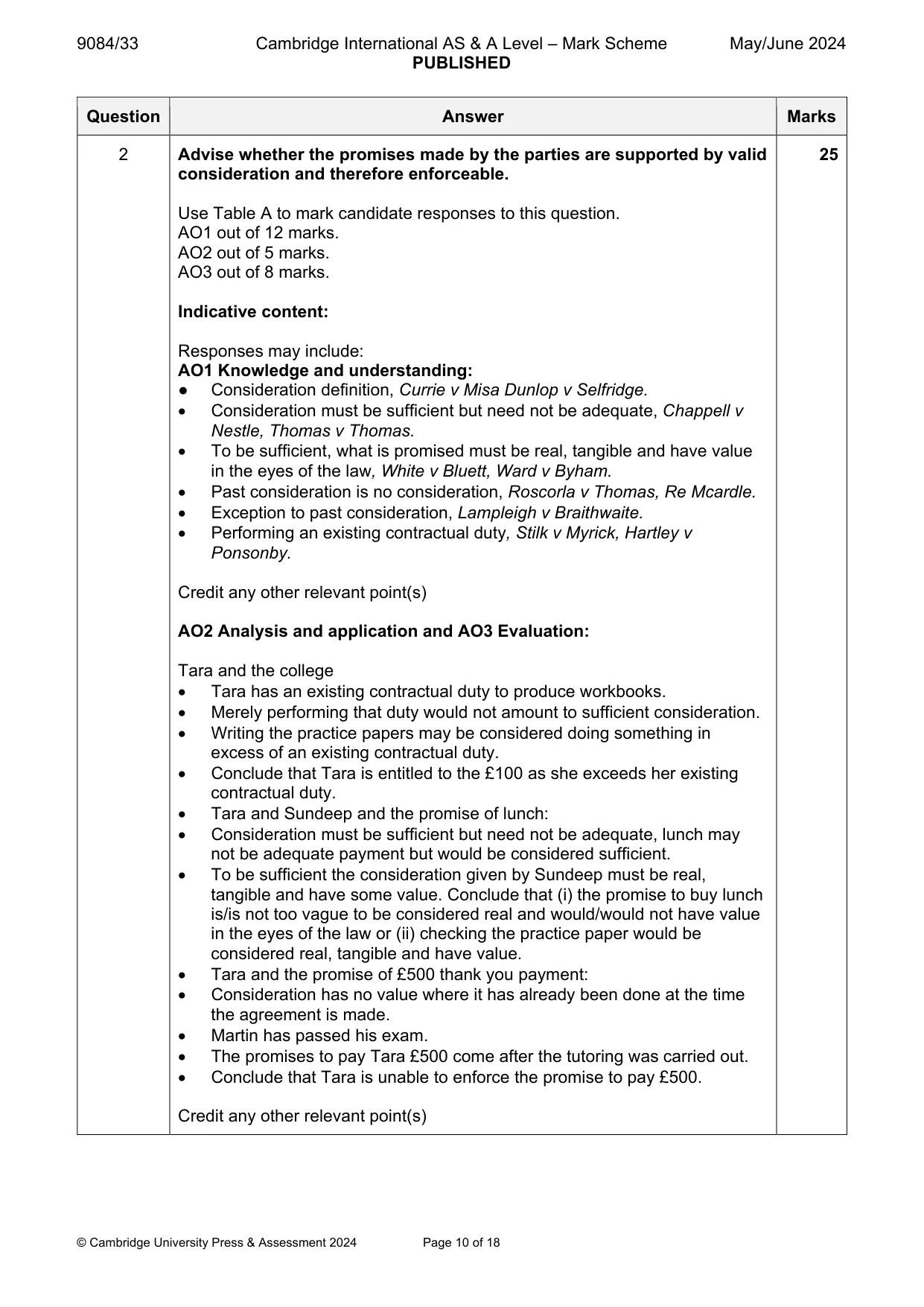
9084/33 Cambridge International AS & A Level – Mark Scheme PUBLISHED May/June 2024 © Cambridge University Press & Assessment 2024 Page 10 of 18 Question Answer Marks 2 Advise whether the promises made by the parties are supported by valid consideration and therefore enforceable. Use Table A to mark candidate responses to this question. AO1 out of 12 marks. AO2 out of 5 marks. AO3 out of 8 marks. Indicative content: Responses may include: AO1 Knowledge and understanding: ● Consideration definition, Currie v Misa Dunlop v Selfridge. Consideration must be sufficient but need not be adequate, Chappell v Nestle, Thomas v Thomas. To be sufficient, what is promised must be real, tangible and have value in the eyes of the law, White v Bluett, Ward v Byham. Past consideration is no consideration, Roscorla v Thomas, Re Mcardle. Exception to past consideration, Lampleigh v Braithwaite. Performing an existing contractual duty, Stilk v Myrick, Hartley v Ponsonby. Credit any other relevant point(s) AO2 Analysis and application and AO3 Evaluation: Tara and the college Tara has an existing contractual duty to produce workbooks. Merely performing that duty would not amount to sufficient consideration. Writing the practice papers may be considered doing something in excess of an existing contractual duty. Conclude that Tara is entitled to the £100 as she exceeds her existing contractual duty. Tara and Sundeep and the promise of lunch: Consideration must be sufficient but need not be adequate, lunch may not be adequate payment but would be considered sufficient. To be sufficient the consideration given by Sundeep must be real, tangible and have some value. Conclude that (i) the promise to buy lunch is/is not too vague to be considered real and would/would not have value in the eyes of the law or (ii) checking the practice paper would be considered real, tangible and have value. Tara and the promise of £500 thank you payment: Consideration has no value where it has already been done at the time the agreement is made. Martin has passed his exam. The promises to pay Tara £500 come after the tutoring was carried out. Conclude that Tara is unable to enforce the promise to pay £500. Credit any other relevant point(s) 25
Mark scheme, page 11
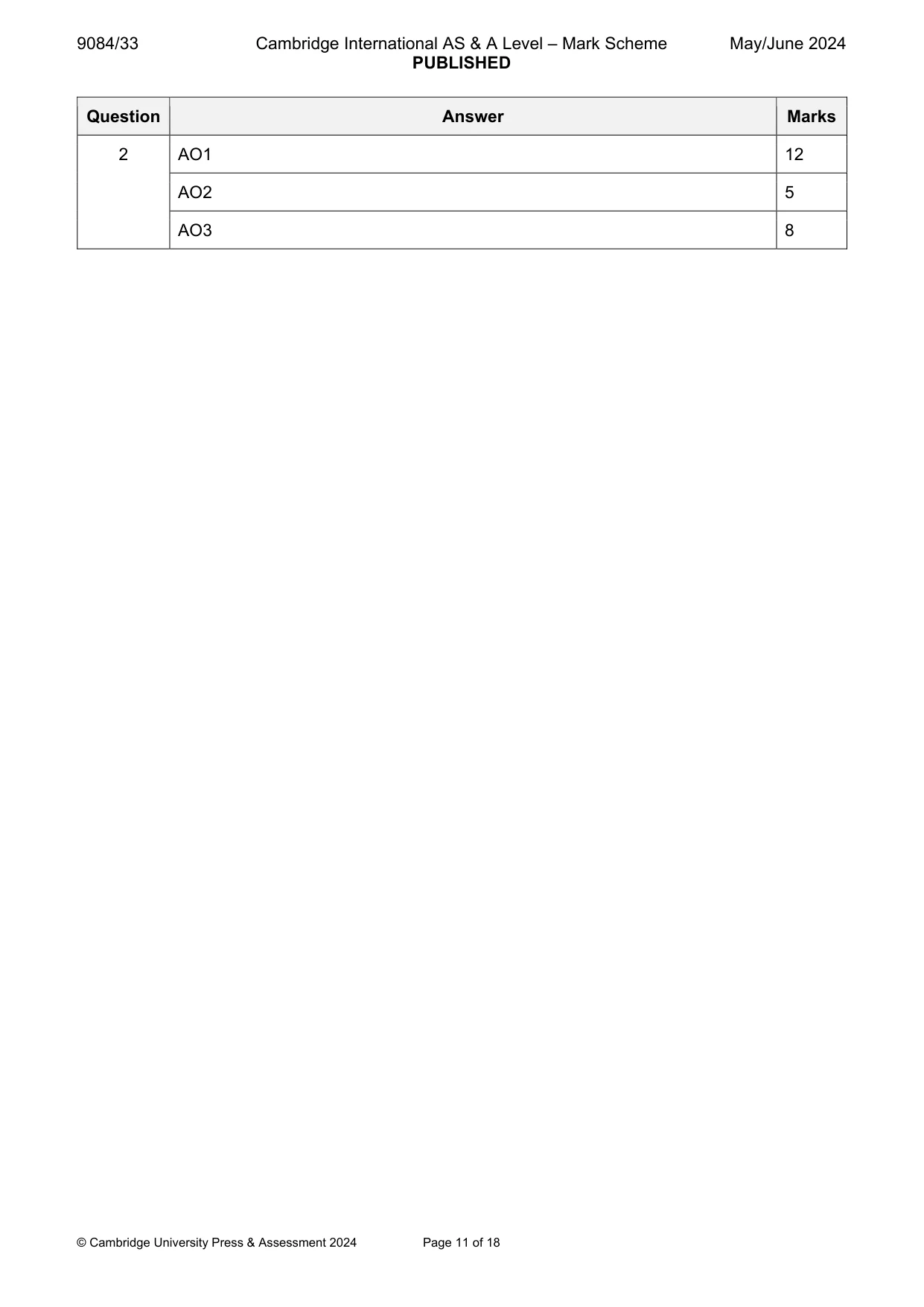
9084/33 Cambridge International AS & A Level – Mark Scheme PUBLISHED May/June 2024 © Cambridge University Press & Assessment 2024 Page 11 of 18 Question Answer Marks 2 AO1 12 AO2 5 AO3 8
Mark scheme, page 12
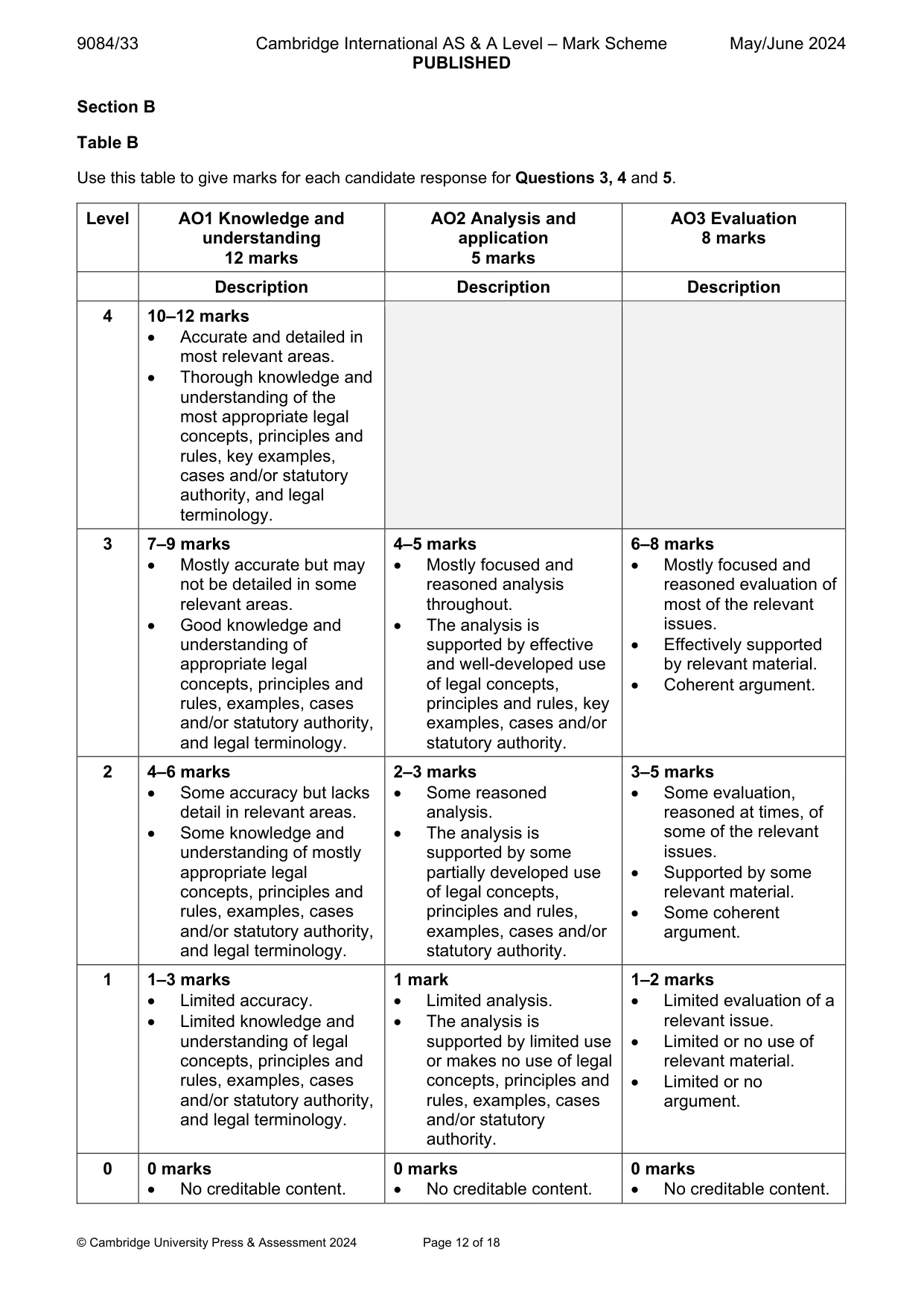
9084/33 Cambridge International AS & A Level – Mark Scheme PUBLISHED May/June 2024 © Cambridge University Press & Assessment 2024 Page 12 of 18 Section B Table B Use this table to give marks for each candidate response for Questions 3, 4 and 5. Level AO1 Knowledge and understanding 12 marks AO2 Analysis and application 5 marks AO3 Evaluation 8 marks Description Description Description 4 10–12 marks Accurate and detailed in most relevant areas. Thorough knowledge and understanding of the most appropriate legal concepts, principles and rules, key examples, cases and/or statutory authority, and legal terminology. 3 7–9 marks Mostly accurate but may not be detailed in some relevant areas. Good knowledge and understanding of appropriate legal concepts, principles and rules, examples, cases and/or statutory authority, and legal terminology. 4–5 marks Mostly focused and reasoned analysis throughout. The analysis is supported by effective and well-developed use of legal concepts, principles and rules, key examples, cases and/or statutory authority. 6–8 marks Mostly focused and reasoned evaluation of most of the relevant issues. Effectively supported by relevant material. Coherent argument. 2 4–6 marks Some accuracy but lacks detail in relevant areas. Some knowledge and understanding of mostly appropriate legal concepts, principles and rules, examples, cases and/or statutory authority, and legal terminology. 2–3 marks Some reasoned analysis. The analysis is supported by some partially developed use of legal concepts, principles and rules, examples, cases and/or statutory authority. 3–5 marks Some evaluation, reasoned at times, of some of the relevant issues. Supported by some relevant material. Some coherent argument. 1 1–3 marks Limited accuracy. Limited knowledge and understanding of legal concepts, principles and rules, examples, cases and/or statutory authority, and legal terminology. 1 mark Limited analysis. The analysis is supported by limited use or makes no use of legal concepts, principles and rules, examples, cases and/or statutory authority. 1–2 marks Limited evaluation of a relevant issue. Limited or no use of relevant material. Limited or no argument. 0 0 marks No creditable content. 0 marks No creditable content. 0 marks No creditable content.
Mark scheme, page 13
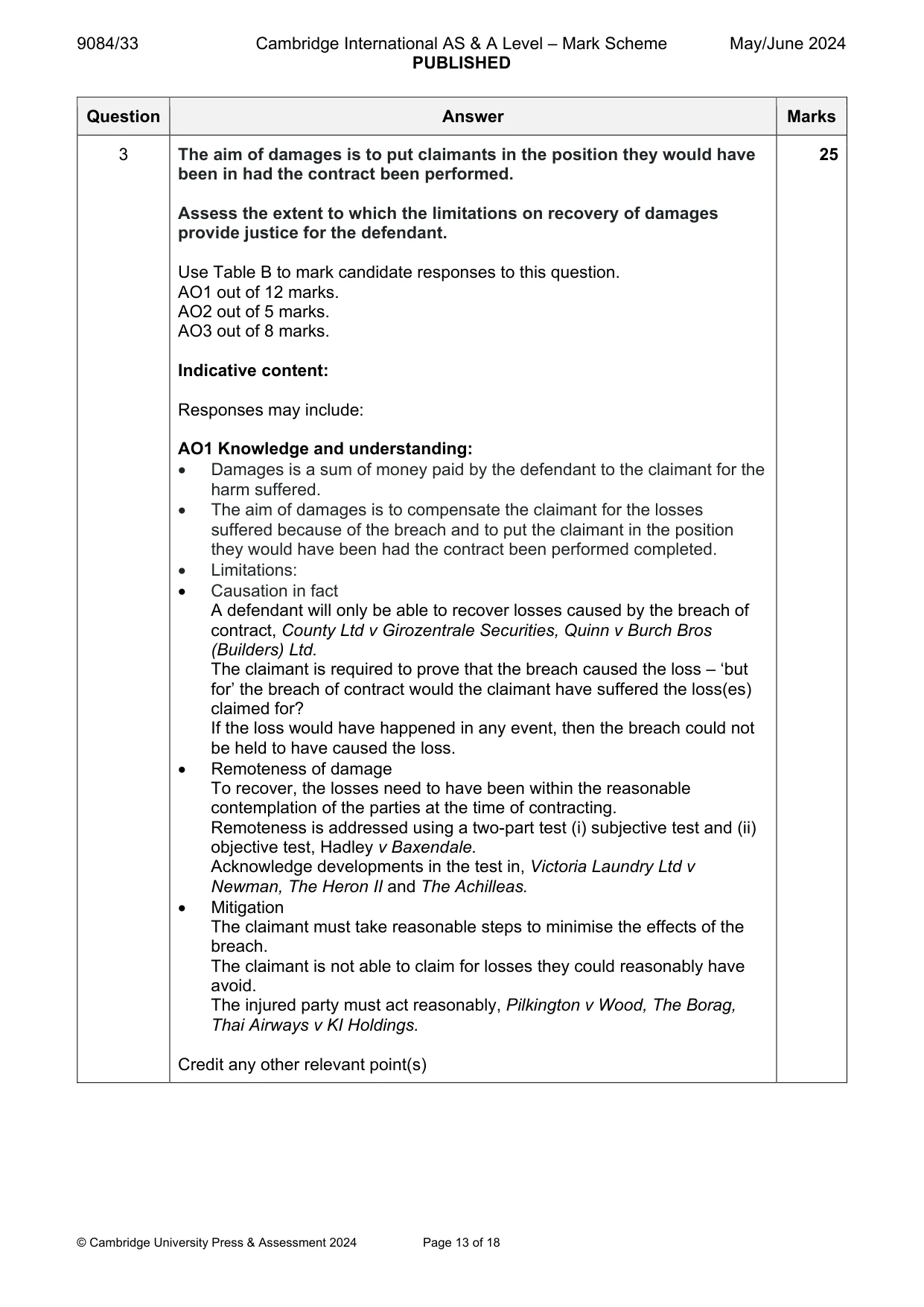
9084/33 Cambridge International AS & A Level – Mark Scheme PUBLISHED May/June 2024 © Cambridge University Press & Assessment 2024 Page 13 of 18 Question Answer Marks 3 The aim of damages is to put claimants in the position they would have been in had the contract been performed. Assess the extent to which the limitations on recovery of damages provide justice for the defendant. Use Table B to mark candidate responses to this question. AO1 out of 12 marks. AO2 out of 5 marks. AO3 out of 8 marks. Indicative content: Responses may include: AO1 Knowledge and understanding: Damages is a sum of money paid by the defendant to the claimant for the harm suffered. The aim of damages is to compensate the claimant for the losses suffered because of the breach and to put the claimant in the position they would have been had the contract been performed completed. Limitations: Causation in fact A defendant will only be able to recover losses caused by the breach of contract, County Ltd v Girozentrale Securities, Quinn v Burch Bros (Builders) Ltd. The claimant is required to prove that the breach caused the loss – ‘but for’ the breach of contract would the claimant have suffered the loss(es) claimed for? If the loss would have happened in any event, then the breach could not be held to have caused the loss. Remoteness of damage To recover, the losses need to have been within the reasonable contemplation of the parties at the time of contracting. Remoteness is addressed using a two-part test (i) subjective test and (ii) objective test, Hadley v Baxendale. Acknowledge developments in the test in, Victoria Laundry Ltd v Newman, The Heron II and The Achilleas. Mitigation The claimant must take reasonable steps to minimise the effects of the breach. The claimant is not able to claim for losses they could reasonably have avoid. The injured party must act reasonably, Pilkington v Wood, The Borag, Thai Airways v KI Holdings. Credit any other relevant point(s) 25
Mark scheme, page 14
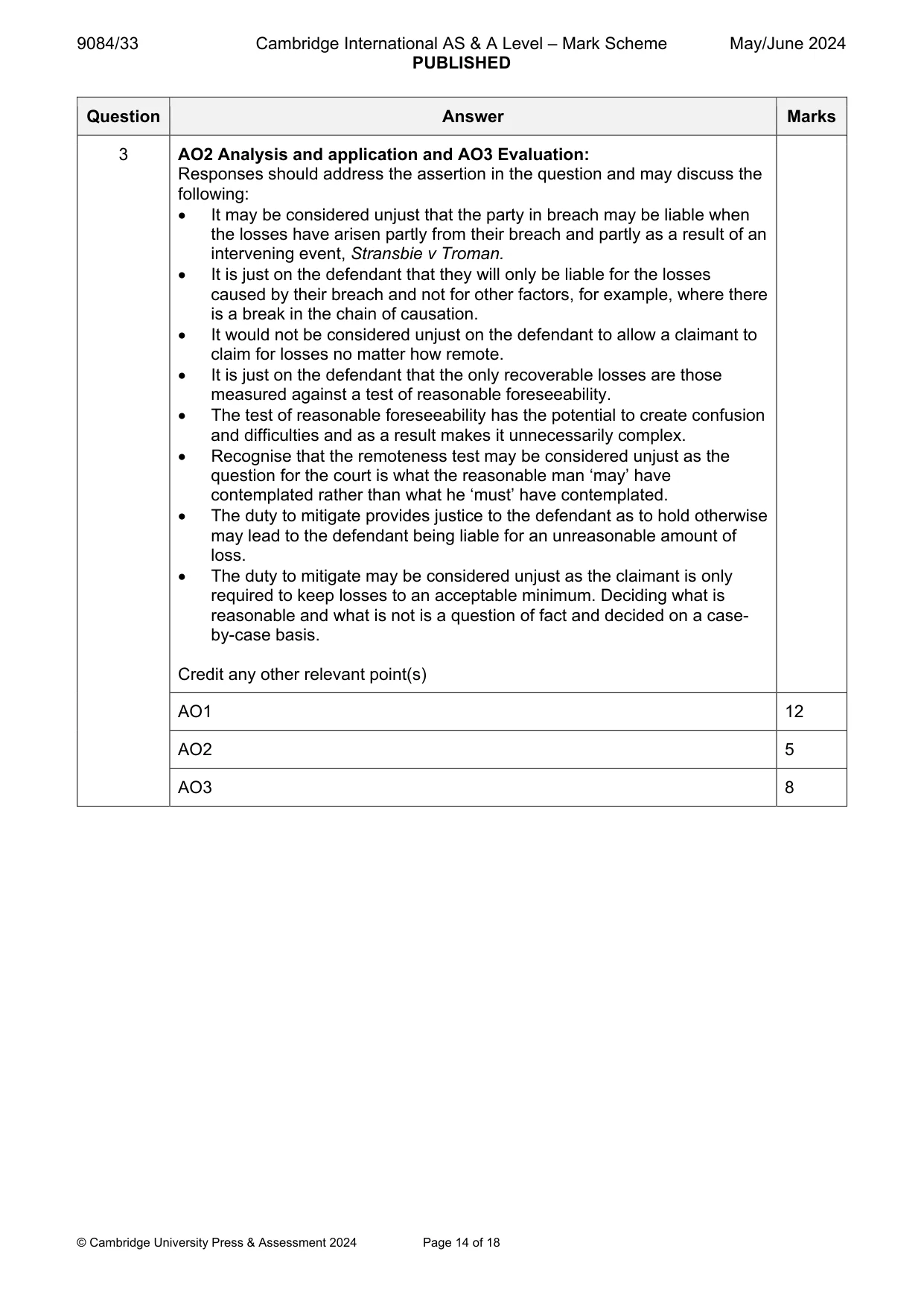
9084/33 Cambridge International AS & A Level – Mark Scheme PUBLISHED May/June 2024 © Cambridge University Press & Assessment 2024 Page 14 of 18 Question Answer Marks 3 AO2 Analysis and application and AO3 Evaluation: Responses should address the assertion in the question and may discuss the following: It may be considered unjust that the party in breach may be liable when the losses have arisen partly from their breach and partly as a result of an intervening event, Stransbie v Troman. It is just on the defendant that they will only be liable for the losses caused by their breach and not for other factors, for example, where there is a break in the chain of causation. It would not be considered unjust on the defendant to allow a claimant to claim for losses no matter how remote. It is just on the defendant that the only recoverable losses are those measured against a test of reasonable foreseeability. The test of reasonable foreseeability has the potential to create confusion and difficulties and as a result makes it unnecessarily complex. Recognise that the remoteness test may be considered unjust as the question for the court is what the reasonable man ‘may’ have contemplated rather than what he ‘must’ have contemplated. The duty to mitigate provides justice to the defendant as to hold otherwise may lead to the defendant being liable for an unreasonable amount of loss. The duty to mitigate may be considered unjust as the claimant is only required to keep losses to an acceptable minimum. Deciding what is reasonable and what is not is a question of fact and decided on a case- by-case basis. Credit any other relevant point(s) AO1 12 AO2 5 AO3 8
Mark scheme, page 15
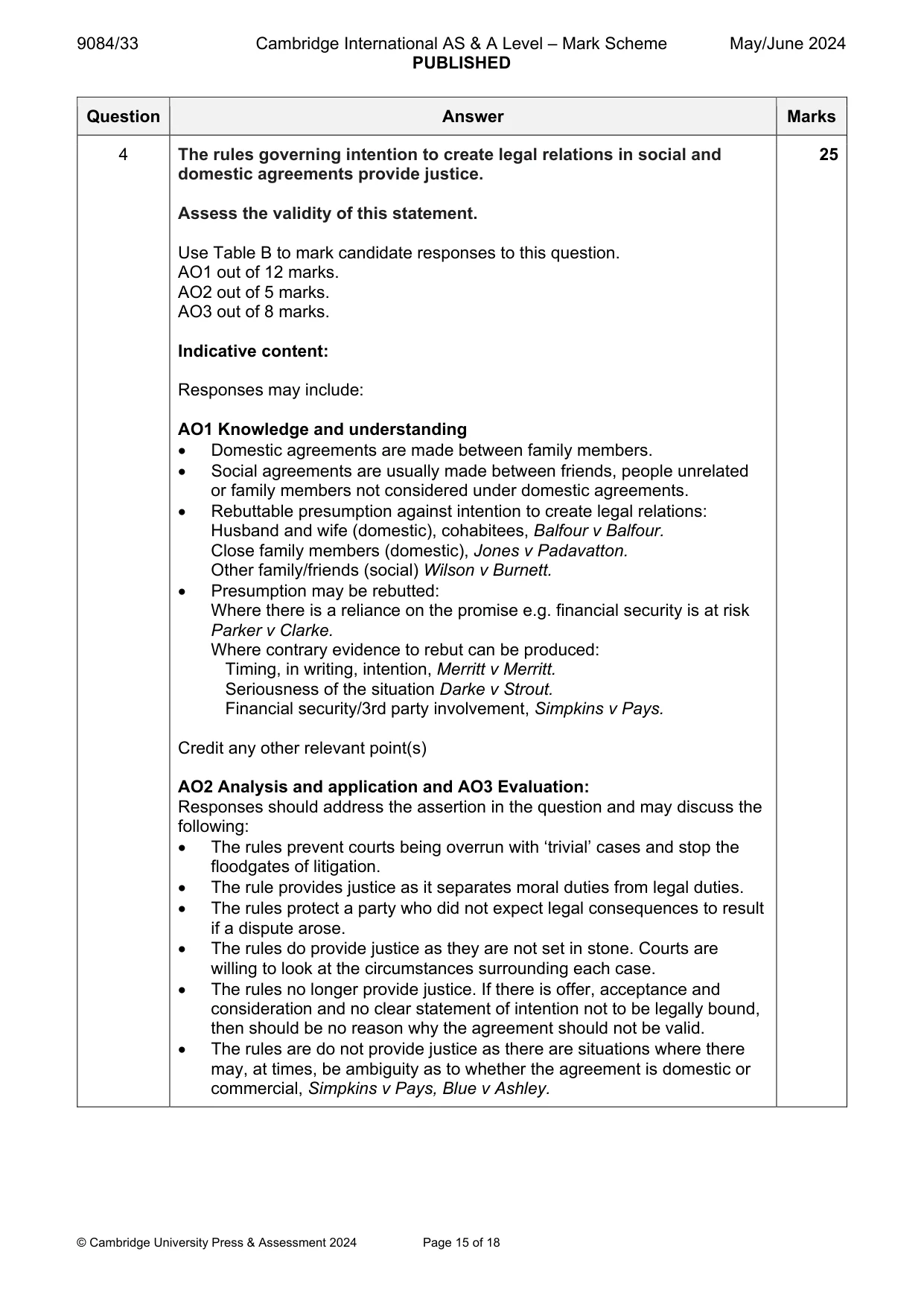
9084/33 Cambridge International AS & A Level – Mark Scheme PUBLISHED May/June 2024 © Cambridge University Press & Assessment 2024 Page 15 of 18 Question Answer Marks 4 The rules governing intention to create legal relations in social and domestic agreements provide justice. Assess the validity of this statement. Use Table B to mark candidate responses to this question. AO1 out of 12 marks. AO2 out of 5 marks. AO3 out of 8 marks. Indicative content: Responses may include: AO1 Knowledge and understanding Domestic agreements are made between family members. Social agreements are usually made between friends, people unrelated or family members not considered under domestic agreements. Rebuttable presumption against intention to create legal relations: Husband and wife (domestic), cohabitees, Balfour v Balfour. Close family members (domestic), Jones v Padavatton. Other family/friends (social) Wilson v Burnett. Presumption may be rebutted: Where there is a reliance on the promise e.g. financial security is at risk Parker v Clarke. Where contrary evidence to rebut can be produced: Timing, in writing, intention, Merritt v Merritt. Seriousness of the situation Darke v Strout. Financial security/3rd party involvement, Simpkins v Pays. Credit any other relevant point(s) AO2 Analysis and application and AO3 Evaluation: Responses should address the assertion in the question and may discuss the following: The rules prevent courts being overrun with ‘trivial’ cases and stop the floodgates of litigation. The rule provides justice as it separates moral duties from legal duties. The rules protect a party who did not expect legal consequences to result if a dispute arose. The rules do provide justice as they are not set in stone. Courts are willing to look at the circumstances surrounding each case. The rules no longer provide justice. If there is offer, acceptance and consideration and no clear statement of intention not to be legally bound, then should be no reason why the agreement should not be valid. The rules are do not provide justice as there are situations where there may, at times, be ambiguity as to whether the agreement is domestic or commercial, Simpkins v Pays, Blue v Ashley. 25
Mark scheme, page 16
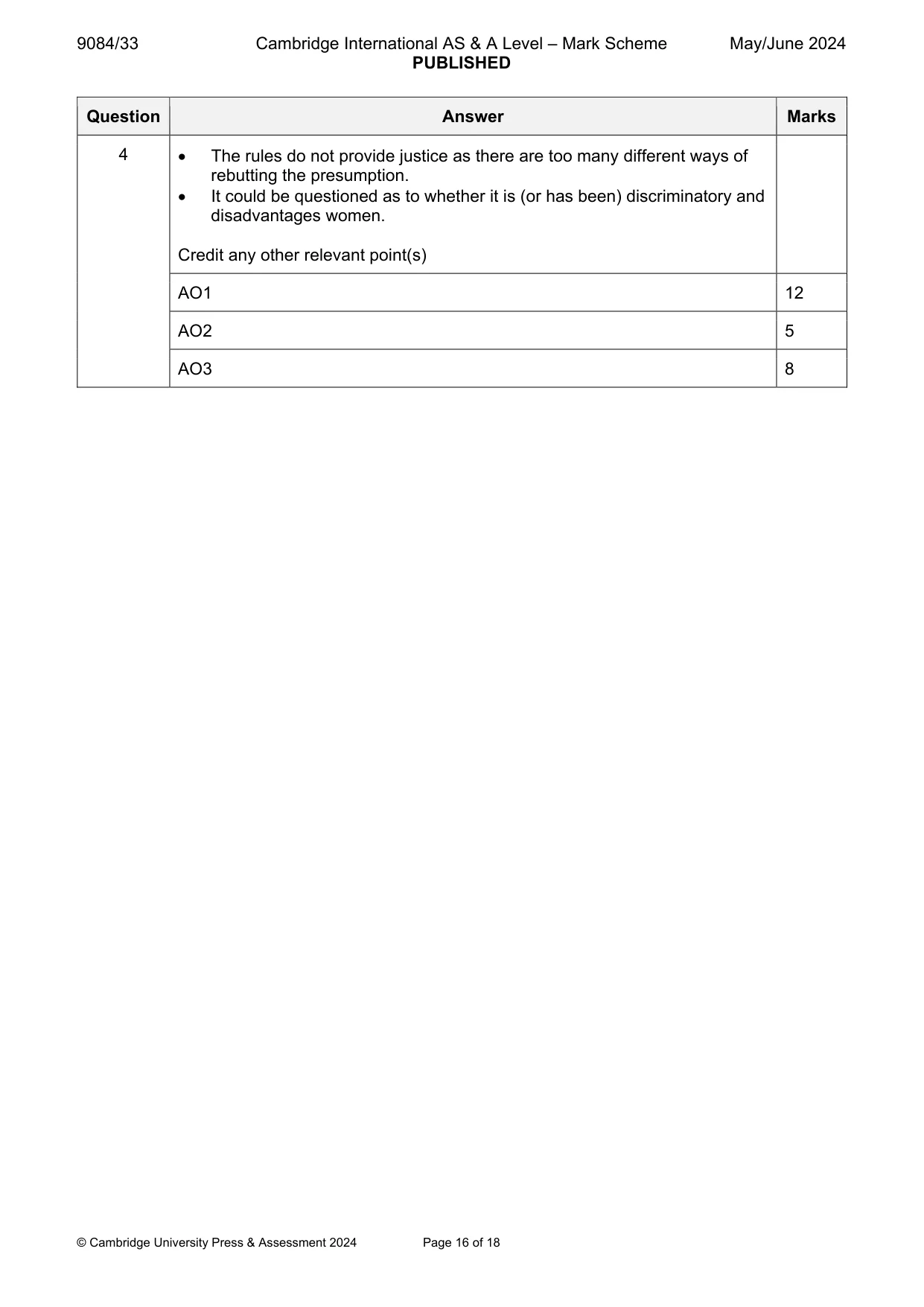
9084/33 Cambridge International AS & A Level – Mark Scheme PUBLISHED May/June 2024 © Cambridge University Press & Assessment 2024 Page 16 of 18 Question Answer Marks 4 The rules do not provide justice as there are too many different ways of rebutting the presumption. It could be questioned as to whether it is (or has been) discriminatory and disadvantages women. Credit any other relevant point(s) AO1 12 AO2 5 AO3 8
Mark scheme, page 17
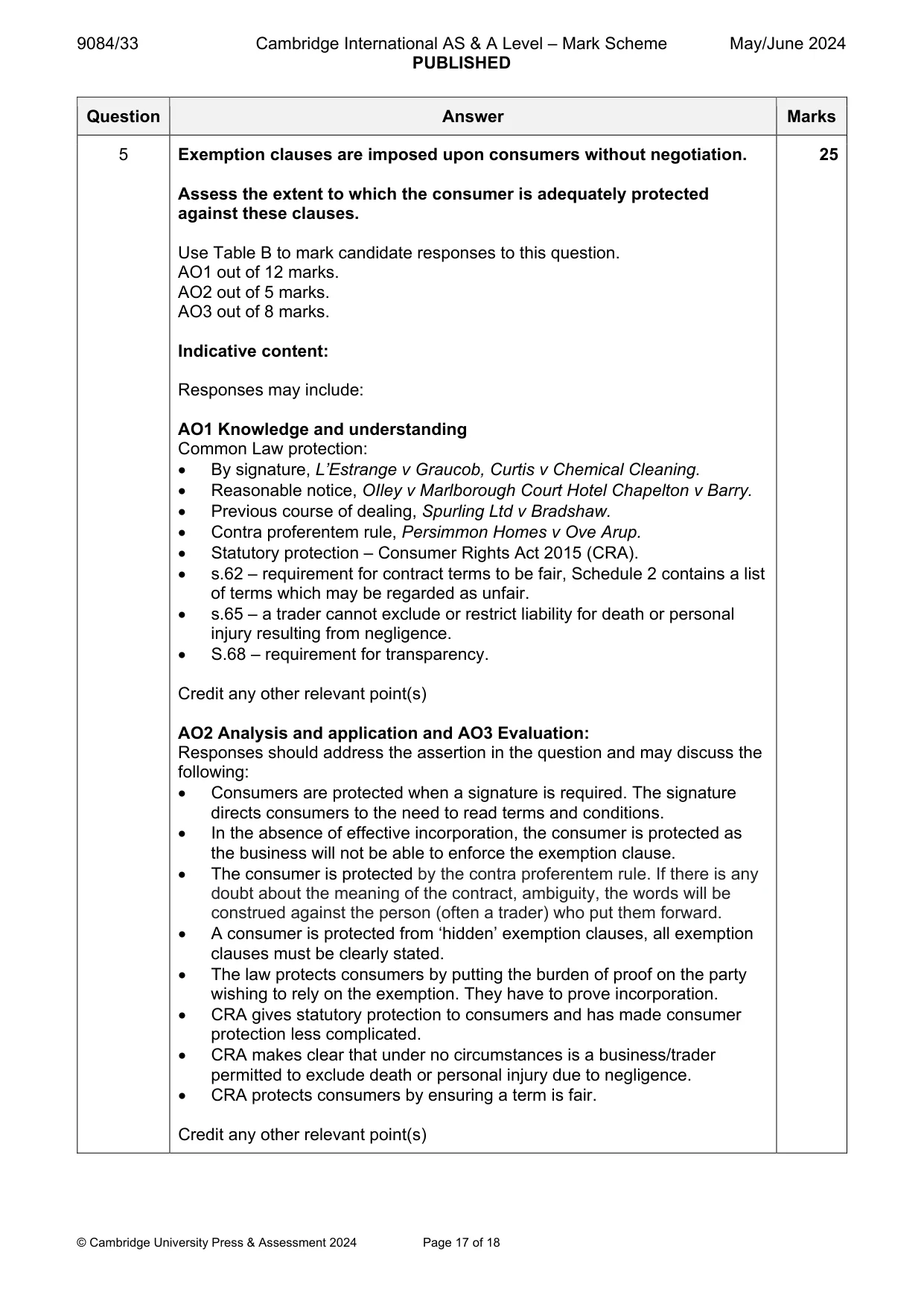
9084/33 Cambridge International AS & A Level – Mark Scheme PUBLISHED May/June 2024 © Cambridge University Press & Assessment 2024 Page 17 of 18 Question Answer Marks 5 Exemption clauses are imposed upon consumers without negotiation. Assess the extent to which the consumer is adequately protected against these clauses. Use Table B to mark candidate responses to this question. AO1 out of 12 marks. AO2 out of 5 marks. AO3 out of 8 marks. Indicative content: Responses may include: AO1 Knowledge and understanding Common Law protection: By signature, L’Estrange v Graucob, Curtis v Chemical Cleaning. Reasonable notice, OIley v Marlborough Court Hotel Chapelton v Barry. Previous course of dealing, Spurling Ltd v Bradshaw. Contra proferentem rule, Persimmon Homes v Ove Arup. Statutory protection – Consumer Rights Act 2015 (CRA). s.62 – requirement for contract terms to be fair, Schedule 2 contains a list of terms which may be regarded as unfair. s.65 – a trader cannot exclude or restrict liability for death or personal injury resulting from negligence. S.68 – requirement for transparency. Credit any other relevant point(s) AO2 Analysis and application and AO3 Evaluation: Responses should address the assertion in the question and may discuss the following: Consumers are protected when a signature is required. The signature directs consumers to the need to read terms and conditions. In the absence of effective incorporation, the consumer is protected as the business will not be able to enforce the exemption clause. The consumer is protected by the contra proferentem rule. If there is any doubt about the meaning of the contract, ambiguity, the words will be construed against the person (often a trader) who put them forward. A consumer is protected from ‘hidden’ exemption clauses, all exemption clauses must be clearly stated. The law protects consumers by putting the burden of proof on the party wishing to rely on the exemption. They have to prove incorporation. CRA gives statutory protection to consumers and has made consumer protection less complicated. CRA makes clear that under no circumstances is a business/trader permitted to exclude death or personal injury due to negligence. CRA protects consumers by ensuring a term is fair. Credit any other relevant point(s) 25
Mark scheme, page 18
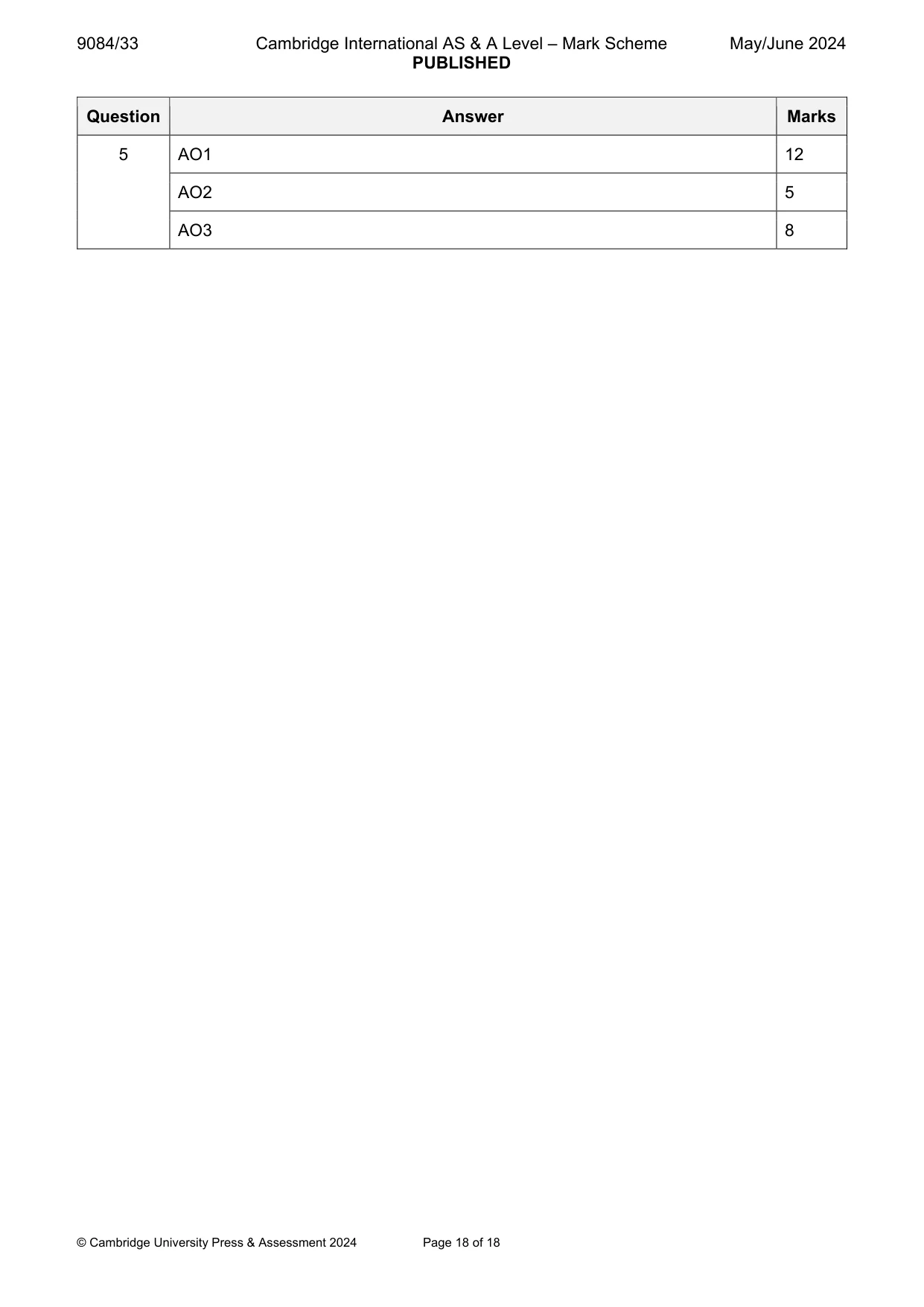
9084/33 Cambridge International AS & A Level – Mark Scheme PUBLISHED May/June 2024 © Cambridge University Press & Assessment 2024 Page 18 of 18 Question Answer Marks 5 AO1 12 AO2 5 AO3 8
What you needed in this session
Cambridge’s own grade thresholds for 2024 May/June, Paper 3 · Variant 3. A higher threshold means an easier paper — the bar moves with how the cohort did.