Cambridge A Level Law 9084 — 2021 May/June Paper 3 · Variant 3
9084/33/M/J/21 · 75 marks · ≈84 min
The question paper and its mark scheme, free to read here and free to download. This is Cambridge’s own paper, exactly as it was sat.
Question paper4 pages

Mark scheme10 pages
Answers below. Sit the paper first if you are practising.
Paper as text
Question paper, page 1
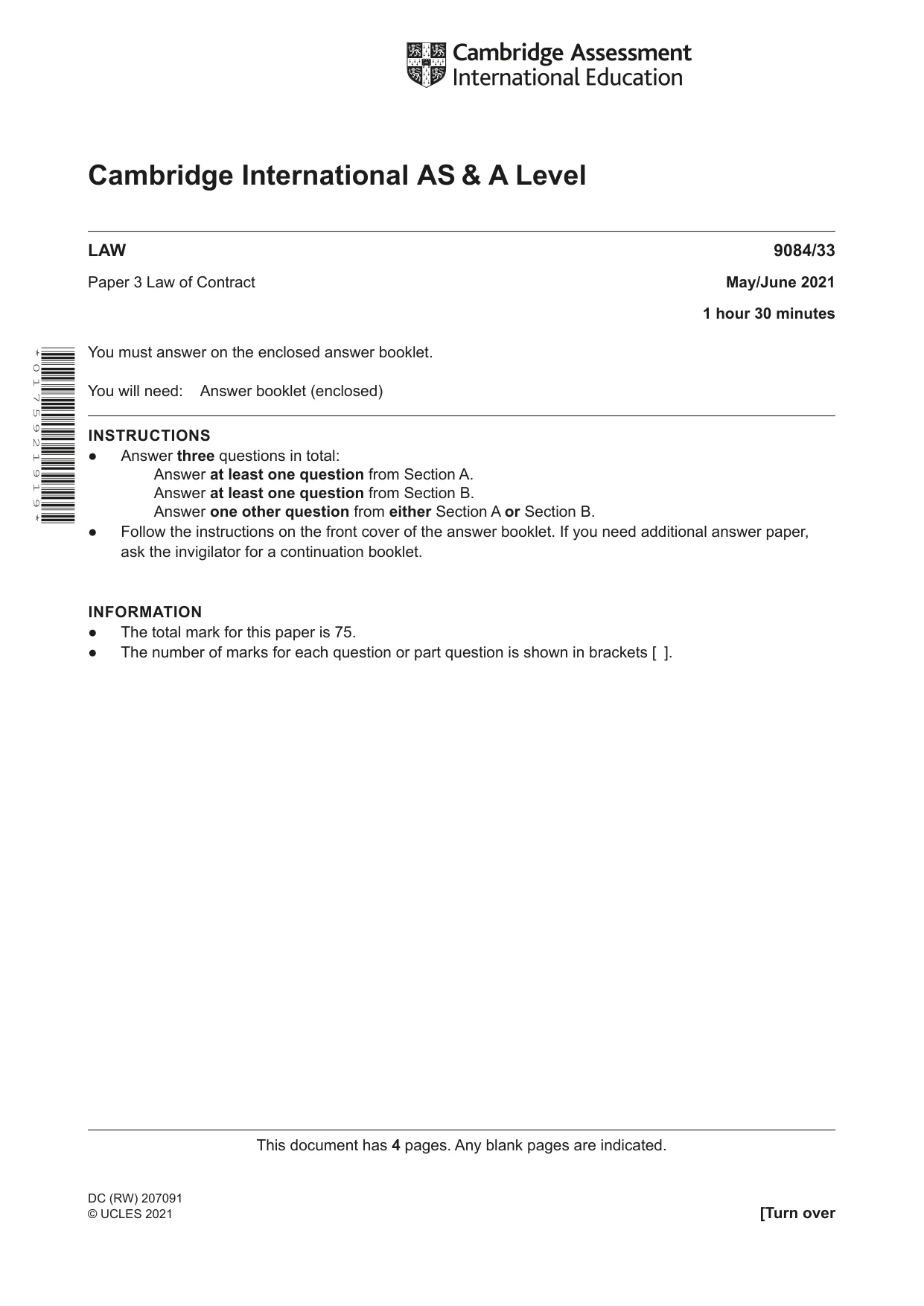
This document has 4 pages. Any blank pages are indicated. DC (RW) 207091 © UCLES 2021 [Turn over * 0 1 7 5 9 2 1 9 1 9 * Cambridge International AS & A Level LAW 9084/33 Paper 3 Law of Contract May/June 2021 1 hour 30 minutes You must answer on the enclosed answer booklet. You will need: Answer booklet (enclosed) INSTRUCTIONS ● Answer three questions in total: Answer at least one question from Section A. Answer at least one question from Section B. Answer one other question from either Section A or Section B. ● Follow the instructions on the front cover of the answer booklet. If you need additional answer paper, ask the invigilator for a continuation booklet. INFORMATION ● The total mark for this paper is 75. ● The number of marks for each question or part question is shown in brackets [ ].
Question paper, page 2
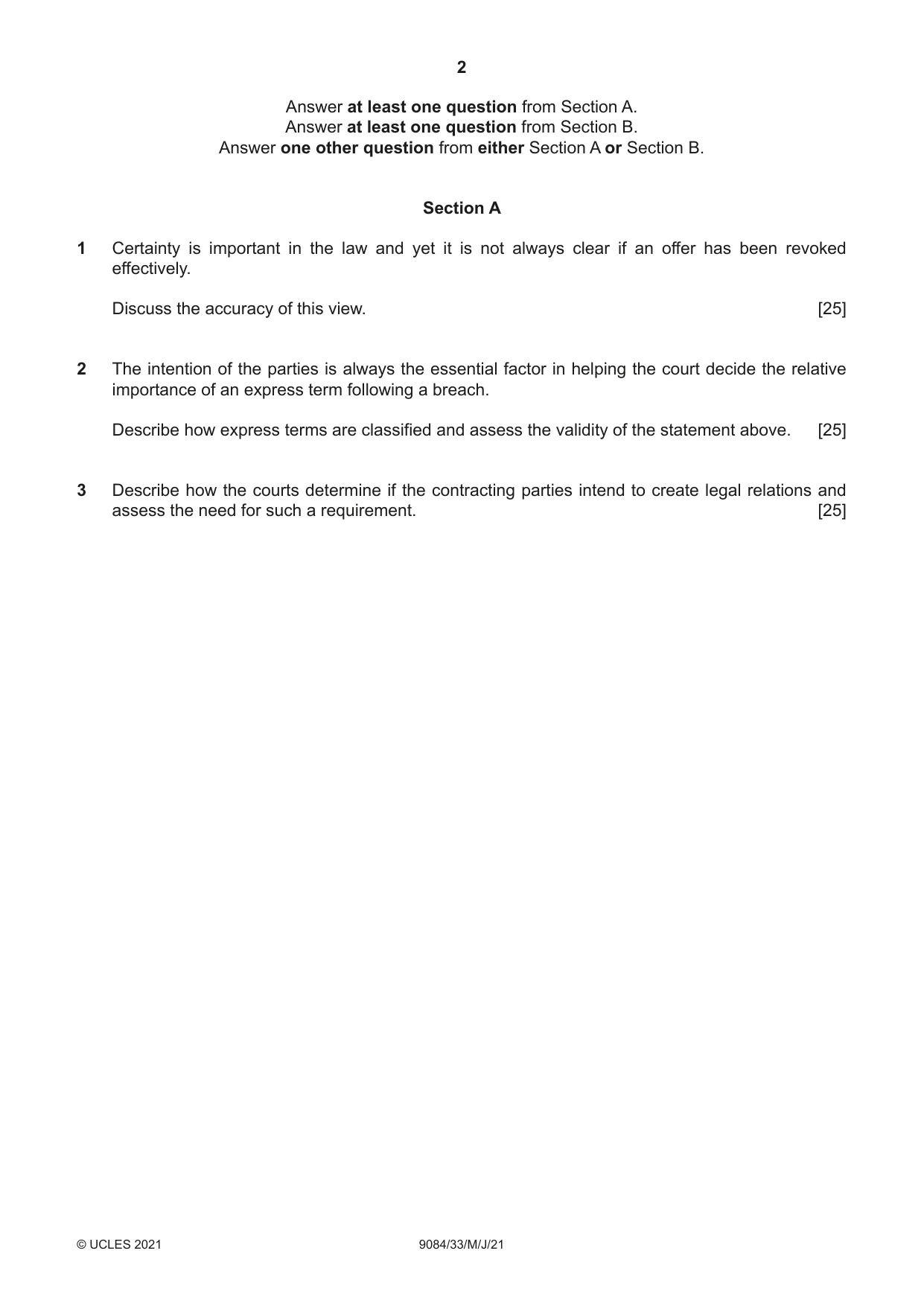
2 9084/33/M/J/21 © UCLES 2021 Answer at least one question from Section A. Answer at least one question from Section B. Answer one other question from either Section A or Section B. Section A 1 Certainty is important in the law and yet it is not always clear if an offer has been revoked effectively. Discuss the accuracy of this view. [25] 2 The intention of the parties is always the essential factor in helping the court decide the relative importance of an express term following a breach. Describe how express terms are classified and assess the validity of the statement above. [25] 3 Describe how the courts determine if the contracting parties intend to create legal relations and assess the need for such a requirement. [25]
Question paper, page 3
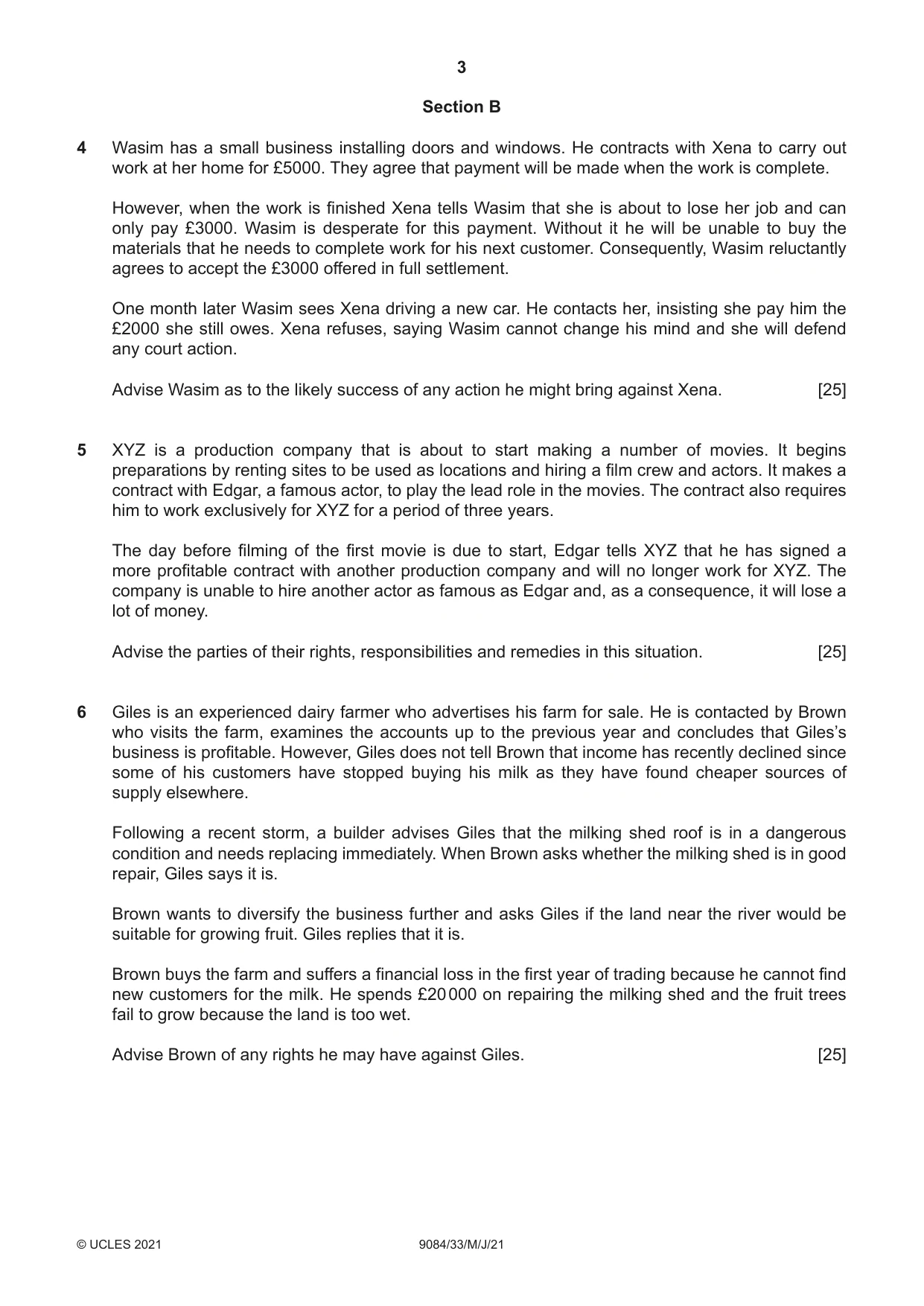
3 9084/33/M/J/21 © UCLES 2021 Section B 4 Wasim has a small business installing doors and windows. He contracts with Xena to carry out work at her home for £5000. They agree that payment will be made when the work is complete. However, when the work is finished Xena tells Wasim that she is about to lose her job and can only pay £3000. Wasim is desperate for this payment. Without it he will be unable to buy the materials that he needs to complete work for his next customer. Consequently, Wasim reluctantly agrees to accept the £3000 offered in full settlement. One month later Wasim sees Xena driving a new car. He contacts her, insisting she pay him the £2000 she still owes. Xena refuses, saying Wasim cannot change his mind and she will defend any court action. Advise Wasim as to the likely success of any action he might bring against Xena. [25] 5 XYZ is a production company that is about to start making a number of movies. It begins preparations by renting sites to be used as locations and hiring a film crew and actors. It makes a contract with Edgar, a famous actor, to play the lead role in the movies. The contract also requires him to work exclusively for XYZ for a period of three years. The day before filming of the first movie is due to start, Edgar tells XYZ that he has signed a more profitable contract with another production company and will no longer work for XYZ. The company is unable to hire another actor as famous as Edgar and, as a consequence, it will lose a lot of money. Advise the parties of their rights, responsibilities and remedies in this situation. [25] 6 Giles is an experienced dairy farmer who advertises his farm for sale. He is contacted by Brown who visits the farm, examines the accounts up to the previous year and concludes that Giles’s business is profitable. However, Giles does not tell Brown that income has recently declined since some of his customers have stopped buying his milk as they have found cheaper sources of supply elsewhere. Following a recent storm, a builder advises Giles that the milking shed roof is in a dangerous condition and needs replacing immediately. When Brown asks whether the milking shed is in good repair, Giles says it is. Brown wants to diversify the business further and asks Giles if the land near the river would be suitable for growing fruit. Giles replies that it is. Brown buys the farm and suffers a financial loss in the first year of trading because he cannot find new customers for the milk. He spends £20 000 on repairing the milking shed and the fruit trees fail to grow because the land is too wet. Advise Brown of any rights he may have against Giles. [25]
Question paper, page 4
4 9084/33/M/J/21 © UCLES 2021 Permission to reproduce items where third-party owned material protected by copyright is included has been sought and cleared where possible. Every reasonable effort has been made by the publisher (UCLES) to trace copyright holders, but if any items requiring clearance have unwittingly been included, the publisher will be pleased to make amends at the earliest possible opportunity. To avoid the issue of disclosure of answer-related information to candidates, all copyright acknowledgements are reproduced online in the Cambridge Assessment International Education Copyright Acknowledgements Booklet. This is produced for each series of examinations and is freely available to download at www.cambridgeinternational.org after the live examination series. Cambridge Assessment International Education is part of the Cambridge Assessment Group. Cambridge Assessment is the brand name of the University of Cambridge Local Examinations Syndicate (UCLES), which itself is a department of the University of Cambridge. BLANK PAGE
Mark scheme, page 1
This document consists of 10 printed pages. © UCLES 2021 [Turn over Cambridge International AS & A Level LAW 9084/33 Paper 3 May/June 2021 MARK SCHEME Maximum Mark: 752 Published This mark scheme is published as an aid to teachers and candidates, to indicate the requirements of the examination. It shows the basis on which Examiners were instructed to award marks. It does not indicate the details of the discussions that took place at an Examiners’ meeting before marking began, which would have considered the acceptability of alternative answers. Mark schemes should be read in conjunction with the question paper and the Principal Examiner Report for Teachers. Cambridge International will not enter into discussions about these mark schemes. Cambridge International is publishing the mark schemes for the May/June 2021 series for most Cambridge IGCSE™, Cambridge International A and AS Level components and some Cambridge O Level components.
Mark scheme, page 2
9084/33 Cambridge International AS & A Level – Mark Scheme PUBLISHED May/June 2021 © UCLES 2021 Page 2 of 10 Generic Marking Principles These general marking principles must be applied by all examiners when marking candidate answers. They should be applied alongside the specific content of the mark scheme or generic level descriptors for a question. Each question paper and mark scheme will also comply with these marking principles. GENERIC MARKING PRINCIPLE 1: Marks must be awarded in line with: • the specific content of the mark scheme or the generic level descriptors for the question • the specific skills defined in the mark scheme or in the generic level descriptors for the question • the standard of response required by a candidate as exemplified by the standardisation scripts. GENERIC MARKING PRINCIPLE 2: Marks awarded are always whole marks (not half marks, or other fractions). GENERIC MARKING PRINCIPLE 3: Marks must be awarded positively: • marks are awarded for correct/valid answers, as defined in the mark scheme. However, credit is given for valid answers which go beyond the scope of the syllabus and mark scheme, referring to your Team Leader as appropriate • marks are awarded when candidates clearly demonstrate what they know and can do • marks are not deducted for errors • marks are not deducted for omissions • answers should only be judged on the quality of spelling, punctuation and grammar when these features are specifically assessed by the question as indicated by the mark scheme. The meaning, however, should be unambiguous. GENERIC MARKING PRINCIPLE 4: Rules must be applied consistently, e.g. in situations where candidates have not followed instructions or in the application of generic level descriptors. GENERIC MARKING PRINCIPLE 5: Marks should be awarded using the full range of marks defined in the mark scheme for the question (however; the use of the full mark range may be limited according to the quality of the candidate responses seen). GENERIC MARKING PRINCIPLE 6: Marks awarded are based solely on the requirements as defined in the mark scheme. Marks should not be awarded with grade thresholds or grade descriptors in mind.
Mark scheme, page 3
9084/33 Cambridge International AS & A Level – Mark Scheme PUBLISHED May/June 2021 © UCLES 2021 Page 3 of 10 Social Science-Specific Marking Principles (for point-based marking) 1 Components using point-based marking: • Point marking is often used to reward knowledge, understanding and application of skills. We give credit where the candidate’s answer shows relevant knowledge, understanding and application of skills in answering the question. We do not give credit where the answer shows confusion. From this it follows that we: a DO credit answers which are worded differently from the mark scheme if they clearly convey the same meaning (unless the mark scheme requires a specific term) b DO credit alternative answers/examples which are not written in the mark scheme if they are correct c DO credit answers where candidates give more than one correct answer in one prompt/numbered/scaffolded space where extended writing is required rather than list-type answers. For example, questions that require n reasons (e.g. State two reasons …). d DO NOT credit answers simply for using a ‘key term’ unless that is all that is required. (Check for evidence it is understood and not used wrongly.) e DO NOT credit answers which are obviously self-contradicting or trying to cover all possibilities f DO NOT give further credit for what is effectively repetition of a correct point already credited unless the language itself is being tested. This applies equally to ‘mirror statements’ (i.e. polluted/not polluted). g DO NOT require spellings to be correct, unless this is part of the test. However spellings of syllabus terms must allow for clear and unambiguous separation from other syllabus terms with which they may be confused (e.g. Corrasion/Corrosion) 2 Presentation of mark scheme: • Slashes (/) or the word ‘or’ separate alternative ways of making the same point. • Semi colons (;) bullet points (•) or figures in brackets (1) separate different points. • Content in the answer column in brackets is for examiner information/context to clarify the marking but is not required to earn the mark (except Accounting syllabuses where they indicate negative numbers). 3 Annotation: • For point marking, ticks can be used to indicate correct answers and crosses can be used to indicate wrong answers. There is no direct relationship between ticks and marks. Ticks have no defined meaning for levels of response marking. • For levels of response marking, the level awarded should be annotated on the script. • Other annotations will be used by examiners as agreed during standardisation, and the meaning will be understood by all examiners who marked that paper.
Mark scheme, page 4
9084/33 Cambridge International AS & A Level – Mark Scheme PUBLISHED May/June 2021 © UCLES 2021 Page 4 of 10 The mark bands and descriptors applicable to all questions on the paper are as follows. Band 1 [0 marks] The answer contains no relevant material. Band 2 [1–6 marks] The candidate introduces fragments of information or unexplained examples from which no coherent explanation or analysis can emerge. OR The candidate attempts to introduce an explanation and/or analysis but it is so fundamentally undermined by error and confusion that it remains substantially incoherent. Band 3 [7–12 marks] The candidate begins to indicate some capacity for explanation and analysis by introducing some of the issues, but explanations are limited and superficial OR The candidate adopts an approach in which there is concentration on explanation in terms of facts presented rather than through the development and explanation of legal principles and rules OR The candidate attempts to introduce material across the range of potential content, but it is weak or confused so that no real explanation or conclusion emerges. Band 4 [13–19 marks] Where there is more than one issue, the candidate demonstrates a clear understanding of one of the main issues of the question, giving explanations and using illustrations so that a full and detailed picture is presented of this issue OR The candidate presents a more limited explanation of all parts of the answer, but there is some lack of detail or superficiality in respect of either or both so that the answer is not fully rounded. Band 5 [20–25 marks] The candidate presents a detailed explanation and discussion of all areas of relevant law and, while there may be some minor inaccuracies and/or imbalance, a coherent explanation emerges.
Mark scheme, page 5
9084/33 Cambridge International AS & A Level – Mark Scheme PUBLISHED May/June 2021 © UCLES 2021 Page 5 of 10 Question Answer Marks 1 Certainty is important in the law and yet it is not always clear if an offer has been revoked effectively. Discuss the accuracy of this view. Candidates should be credited for making general comments about the freedom given to an individual to withdraw an offer and explaining that contracts cannot exist without offer and an unqualified acceptance. Candidates should then identify the ways an offer can cease to exist. These can include where the offeree accepts or rejects the offer, by the offeror notifying the other party of an intention to revoke any time before acceptance (Byrne v Van Tienhovan) and this notification can be given by a reliable third party (Dickenson v Dodds), by lapse of a reasonable time (Ramsgate Victoria Hotel v Montefiore), by means of a counter offer (Hyde v Wrench), the failure of a precondition (Financings Ltd v Stimson), death of the offeree (Reynolds v Atherton). To reach Band 4, candidates should appreciate the complexities of the law in this area. While some of the ways used to revoke the offer are usually non- contentious, for example where the offeree accepts or rejects the offer, other methods may give credence to the statement. Indeed the factors outlined above may not necessarily bring an offer to an end. Issues that could be explored include the difficulties posed in revoking unilateral contracts while the offeree is performing (Carlill v Carbolic Smokeball Co, Errington v Errington and Woods), how clear is it in determining what amounts to a reasonable time, a request for further information should not extinguish the offer (Stevenson v McLean) but is that always self-evident?, who is considered a reliable third party? (Recommendations of the Law Revision Committee Cmd 5449, 1937 and Law Commission Working Paper No. 60, 1975), the death of the offeror might not always terminate the offer (Bradbury v Morgan). Credit any reasoned conclusion and any other relevant argument or citation. 25
Mark scheme, page 6
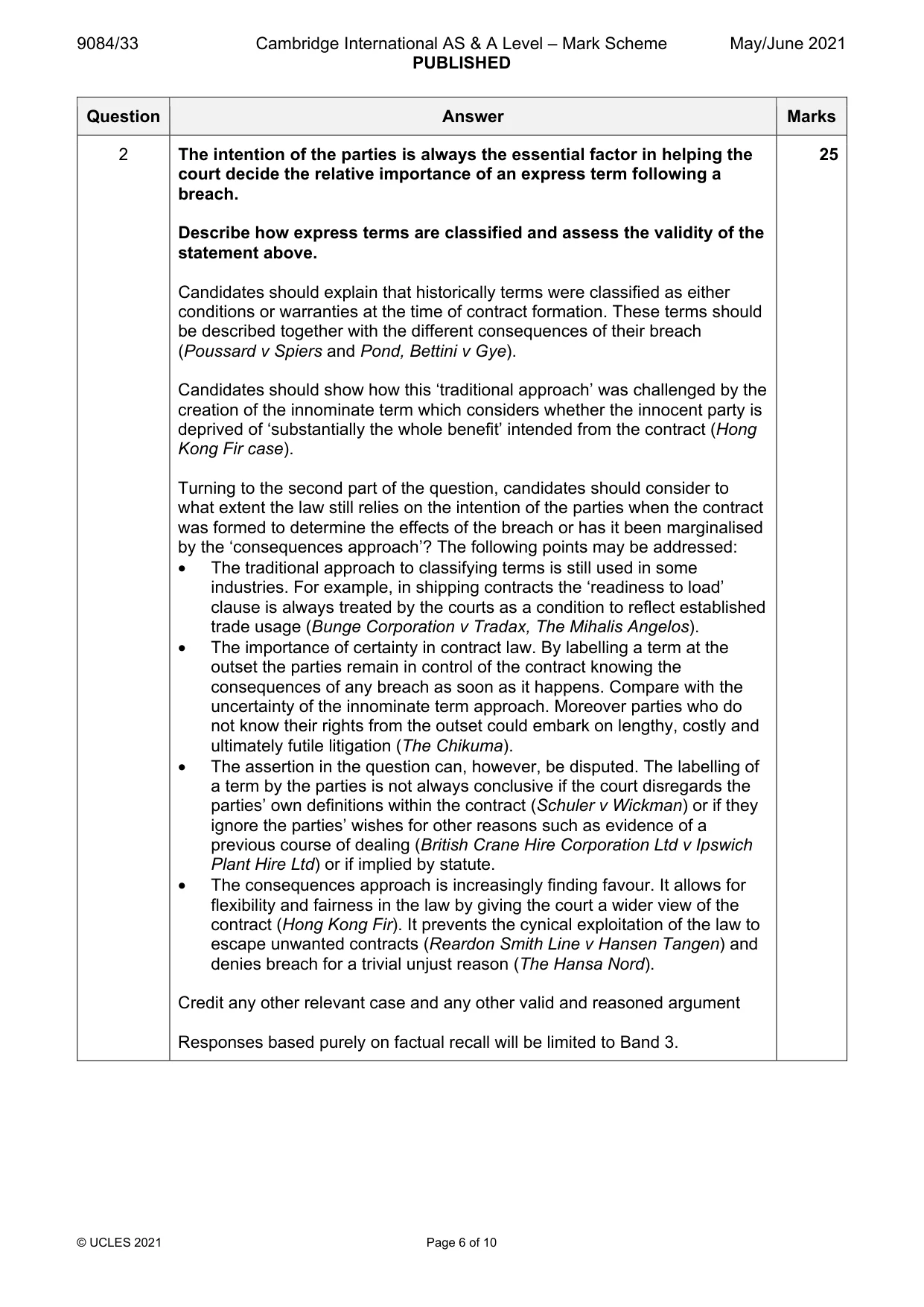
9084/33 Cambridge International AS & A Level – Mark Scheme PUBLISHED May/June 2021 © UCLES 2021 Page 6 of 10 Question Answer Marks 2 The intention of the parties is always the essential factor in helping the court decide the relative importance of an express term following a breach. Describe how express terms are classified and assess the validity of the statement above. Candidates should explain that historically terms were classified as either conditions or warranties at the time of contract formation. These terms should be described together with the different consequences of their breach (Poussard v Spiers and Pond, Bettini v Gye). Candidates should show how this ‘traditional approach’ was challenged by the creation of the innominate term which considers whether the innocent party is deprived of ‘substantially the whole benefit’ intended from the contract (Hong Kong Fir case). Turning to the second part of the question, candidates should consider to what extent the law still relies on the intention of the parties when the contract was formed to determine the effects of the breach or has it been marginalised by the ‘consequences approach’? The following points may be addressed: • The traditional approach to classifying terms is still used in some industries. For example, in shipping contracts the ‘readiness to load’ clause is always treated by the courts as a condition to reflect established trade usage (Bunge Corporation v Tradax, The Mihalis Angelos). • The importance of certainty in contract law. By labelling a term at the outset the parties remain in control of the contract knowing the consequences of any breach as soon as it happens. Compare with the uncertainty of the innominate term approach. Moreover parties who do not know their rights from the outset could embark on lengthy, costly and ultimately futile litigation (The Chikuma). • The assertion in the question can, however, be disputed. The labelling of a term by the parties is not always conclusive if the court disregards the parties’ own definitions within the contract (Schuler v Wickman) or if they ignore the parties’ wishes for other reasons such as evidence of a previous course of dealing (British Crane Hire Corporation Ltd v Ipswich Plant Hire Ltd) or if implied by statute. • The consequences approach is increasingly finding favour. It allows for flexibility and fairness in the law by giving the court a wider view of the contract (Hong Kong Fir). It prevents the cynical exploitation of the law to escape unwanted contracts (Reardon Smith Line v Hansen Tangen) and denies breach for a trivial unjust reason (The Hansa Nord). Credit any other relevant case and any other valid and reasoned argument Responses based purely on factual recall will be limited to Band 3. 25
Mark scheme, page 7
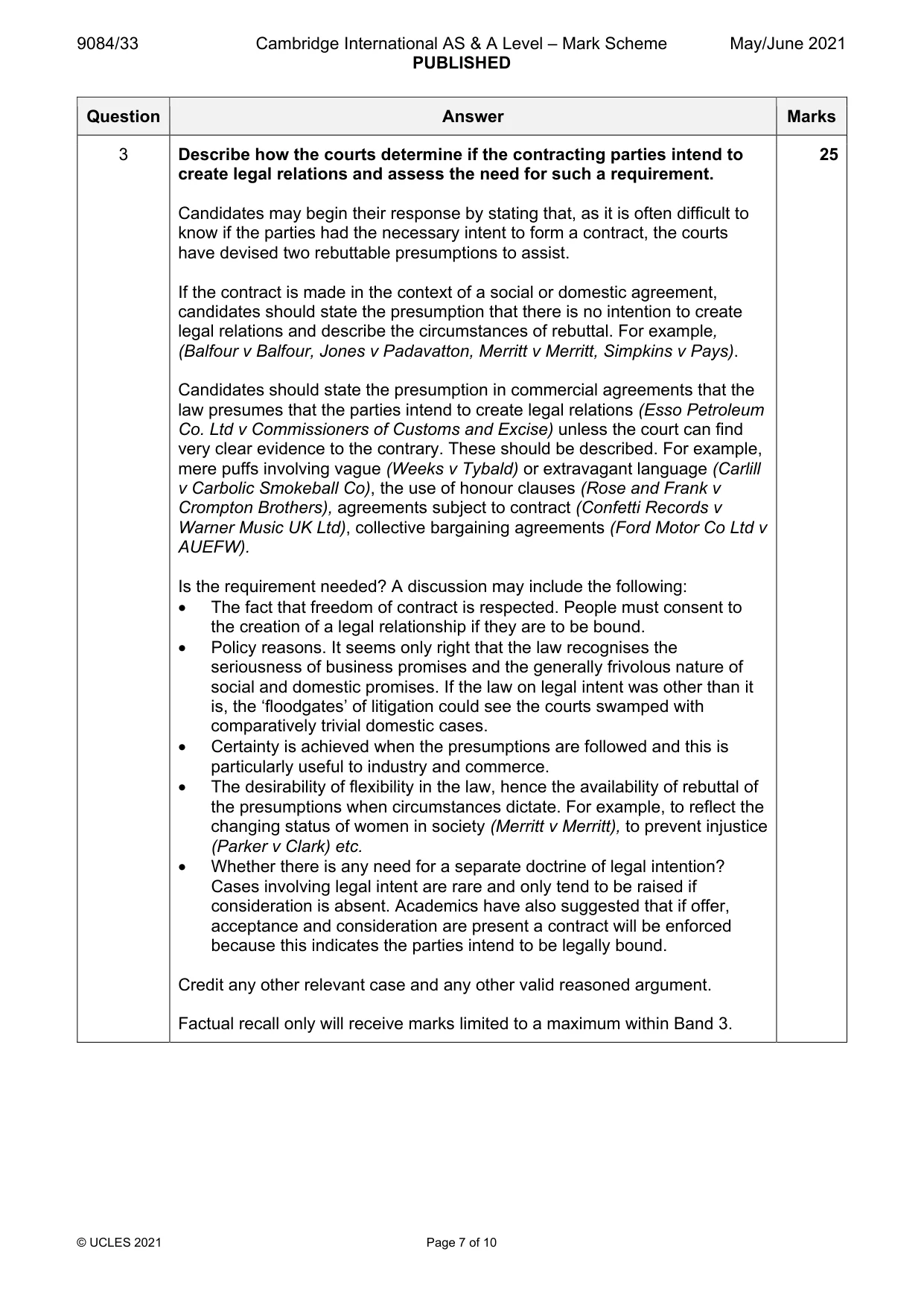
9084/33 Cambridge International AS & A Level – Mark Scheme PUBLISHED May/June 2021 © UCLES 2021 Page 7 of 10 Question Answer Marks 3 Describe how the courts determine if the contracting parties intend to create legal relations and assess the need for such a requirement. Candidates may begin their response by stating that, as it is often difficult to know if the parties had the necessary intent to form a contract, the courts have devised two rebuttable presumptions to assist. If the contract is made in the context of a social or domestic agreement, candidates should state the presumption that there is no intention to create legal relations and describe the circumstances of rebuttal. For example, (Balfour v Balfour, Jones v Padavatton, Merritt v Merritt, Simpkins v Pays). Candidates should state the presumption in commercial agreements that the law presumes that the parties intend to create legal relations (Esso Petroleum Co. Ltd v Commissioners of Customs and Excise) unless the court can find very clear evidence to the contrary. These should be described. For example, mere puffs involving vague (Weeks v Tybald) or extravagant language (Carlill v Carbolic Smokeball Co), the use of honour clauses (Rose and Frank v Crompton Brothers), agreements subject to contract (Confetti Records v Warner Music UK Ltd), collective bargaining agreements (Ford Motor Co Ltd v AUEFW). Is the requirement needed? A discussion may include the following: • The fact that freedom of contract is respected. People must consent to the creation of a legal relationship if they are to be bound. • Policy reasons. It seems only right that the law recognises the seriousness of business promises and the generally frivolous nature of social and domestic promises. If the law on legal intent was other than it is, the ‘floodgates’ of litigation could see the courts swamped with comparatively trivial domestic cases. • Certainty is achieved when the presumptions are followed and this is particularly useful to industry and commerce. • The desirability of flexibility in the law, hence the availability of rebuttal of the presumptions when circumstances dictate. For example, to reflect the changing status of women in society (Merritt v Merritt), to prevent injustice (Parker v Clark) etc. • Whether there is any need for a separate doctrine of legal intention? Cases involving legal intent are rare and only tend to be raised if consideration is absent. Academics have also suggested that if offer, acceptance and consideration are present a contract will be enforced because this indicates the parties intend to be legally bound. Credit any other relevant case and any other valid reasoned argument. Factual recall only will receive marks limited to a maximum within Band 3. 25
Mark scheme, page 8
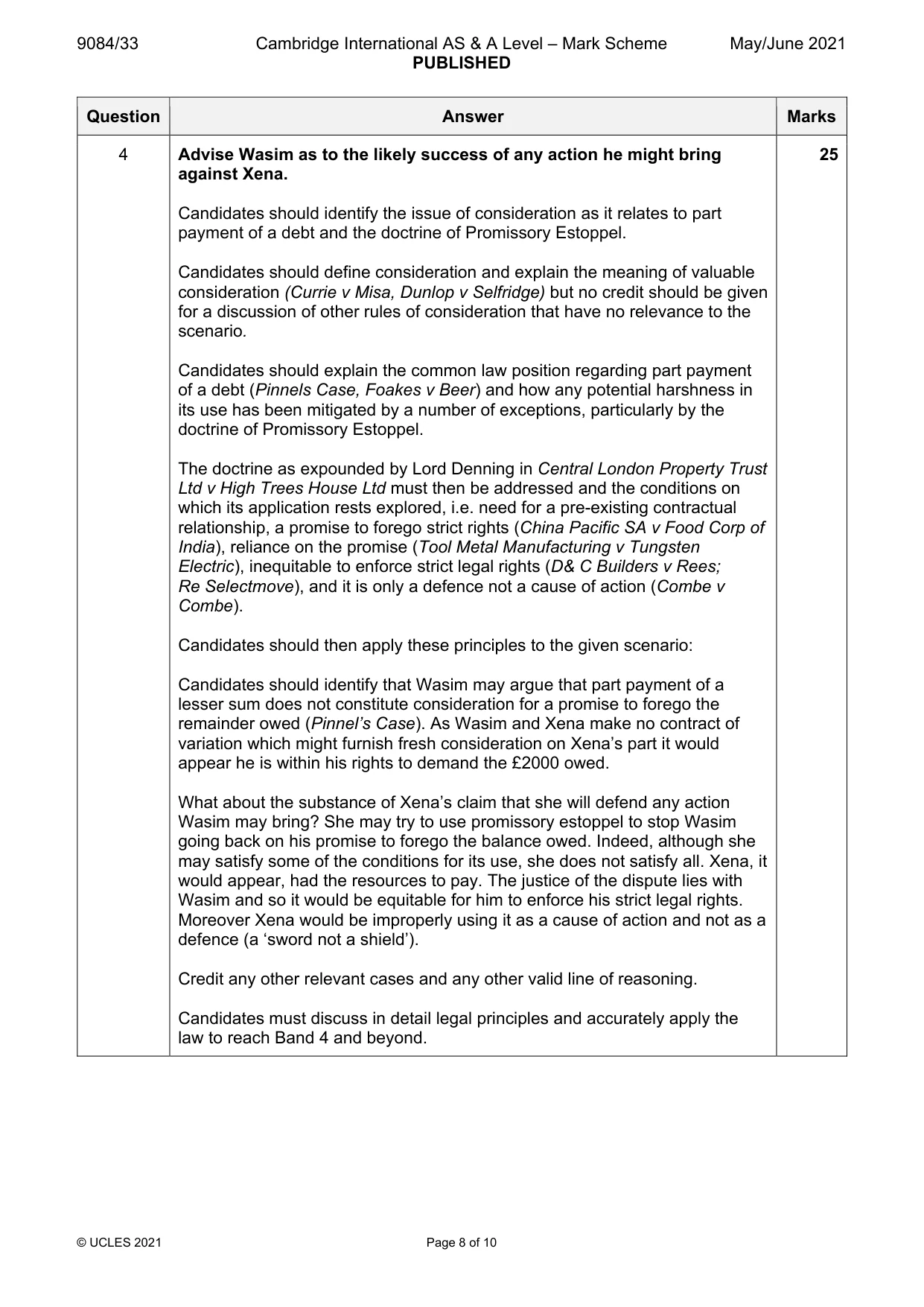
9084/33 Cambridge International AS & A Level – Mark Scheme PUBLISHED May/June 2021 © UCLES 2021 Page 8 of 10 Question Answer Marks 4 Advise Wasim as to the likely success of any action he might bring against Xena. Candidates should identify the issue of consideration as it relates to part payment of a debt and the doctrine of Promissory Estoppel. Candidates should define consideration and explain the meaning of valuable consideration (Currie v Misa, Dunlop v Selfridge) but no credit should be given for a discussion of other rules of consideration that have no relevance to the scenario. Candidates should explain the common law position regarding part payment of a debt (Pinnels Case, Foakes v Beer) and how any potential harshness in its use has been mitigated by a number of exceptions, particularly by the doctrine of Promissory Estoppel. The doctrine as expounded by Lord Denning in Central London Property Trust Ltd v High Trees House Ltd must then be addressed and the conditions on which its application rests explored, i.e. need for a pre-existing contractual relationship, a promise to forego strict rights (China Pacific SA v Food Corp of India), reliance on the promise (Tool Metal Manufacturing v Tungsten Electric), inequitable to enforce strict legal rights (D& C Builders v Rees; Re Selectmove), and it is only a defence not a cause of action (Combe v Combe). Candidates should then apply these principles to the given scenario: Candidates should identify that Wasim may argue that part payment of a lesser sum does not constitute consideration for a promise to forego the remainder owed (Pinnel’s Case). As Wasim and Xena make no contract of variation which might furnish fresh consideration on Xena’s part it would appear he is within his rights to demand the £2000 owed. What about the substance of Xena’s claim that she will defend any action Wasim may bring? She may try to use promissory estoppel to stop Wasim going back on his promise to forego the balance owed. Indeed, although she may satisfy some of the conditions for its use, she does not satisfy all. Xena, it would appear, had the resources to pay. The justice of the dispute lies with Wasim and so it would be equitable for him to enforce his strict legal rights. Moreover Xena would be improperly using it as a cause of action and not as a defence (a ‘sword not a shield’). Credit any other relevant cases and any other valid line of reasoning. Candidates must discuss in detail legal principles and accurately apply the law to reach Band 4 and beyond. 25
Mark scheme, page 9
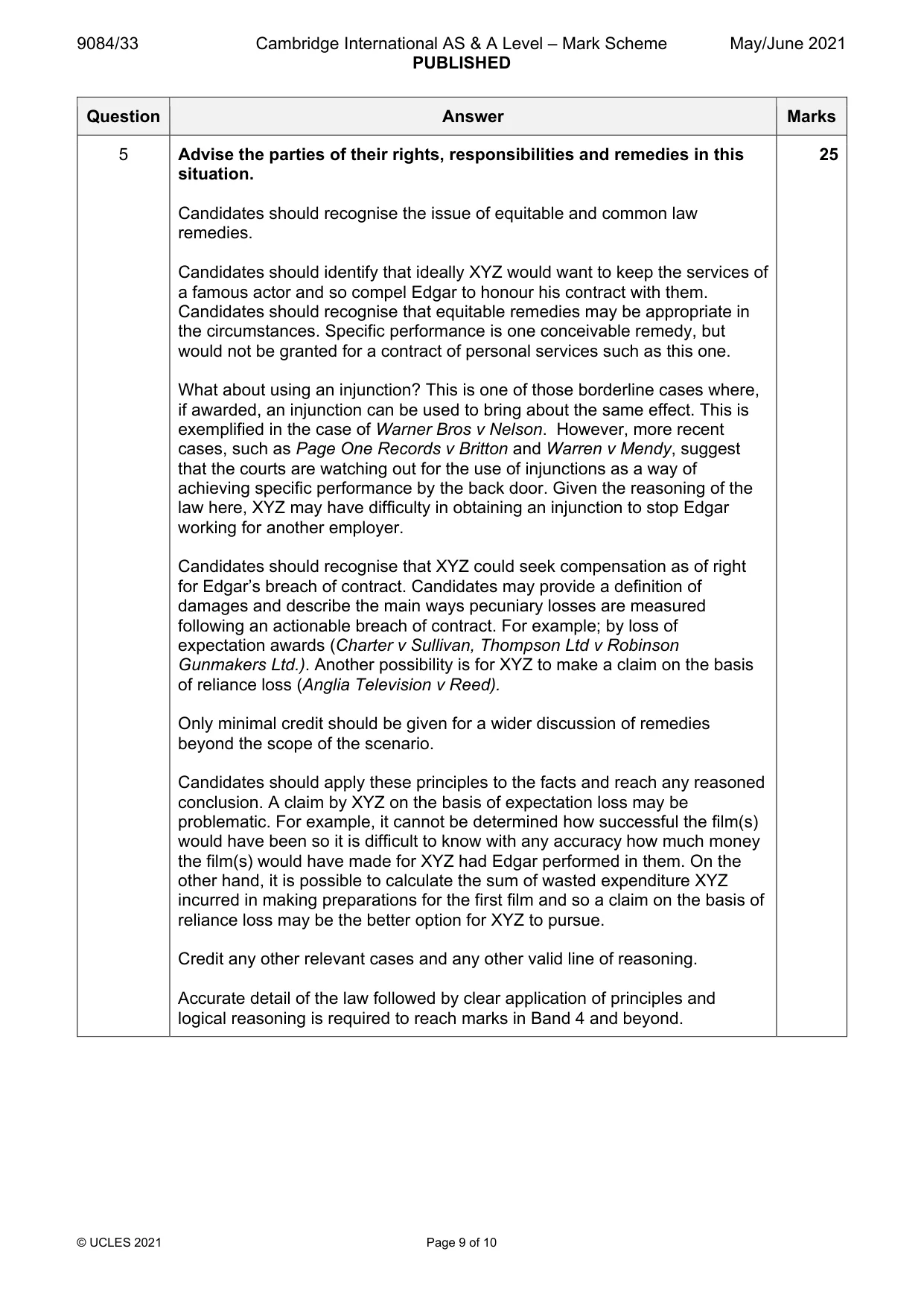
9084/33 Cambridge International AS & A Level – Mark Scheme PUBLISHED May/June 2021 © UCLES 2021 Page 9 of 10 Question Answer Marks 5 Advise the parties of their rights, responsibilities and remedies in this situation. Candidates should recognise the issue of equitable and common law remedies. Candidates should identify that ideally XYZ would want to keep the services of a famous actor and so compel Edgar to honour his contract with them. Candidates should recognise that equitable remedies may be appropriate in the circumstances. Specific performance is one conceivable remedy, but would not be granted for a contract of personal services such as this one. What about using an injunction? This is one of those borderline cases where, if awarded, an injunction can be used to bring about the same effect. This is exemplified in the case of Warner Bros v Nelson. However, more recent cases, such as Page One Records v Britton and Warren v Mendy, suggest that the courts are watching out for the use of injunctions as a way of achieving specific performance by the back door. Given the reasoning of the law here, XYZ may have difficulty in obtaining an injunction to stop Edgar working for another employer. Candidates should recognise that XYZ could seek compensation as of right for Edgar’s breach of contract. Candidates may provide a definition of damages and describe the main ways pecuniary losses are measured following an actionable breach of contract. For example; by loss of expectation awards (Charter v Sullivan, Thompson Ltd v Robinson Gunmakers Ltd.). Another possibility is for XYZ to make a claim on the basis of reliance loss (Anglia Television v Reed). Only minimal credit should be given for a wider discussion of remedies beyond the scope of the scenario. Candidates should apply these principles to the facts and reach any reasoned conclusion. A claim by XYZ on the basis of expectation loss may be problematic. For example, it cannot be determined how successful the film(s) would have been so it is difficult to know with any accuracy how much money the film(s) would have made for XYZ had Edgar performed in them. On the other hand, it is possible to calculate the sum of wasted expenditure XYZ incurred in making preparations for the first film and so a claim on the basis of reliance loss may be the better option for XYZ to pursue. Credit any other relevant cases and any other valid line of reasoning. Accurate detail of the law followed by clear application of principles and logical reasoning is required to reach marks in Band 4 and beyond. 25
Mark scheme, page 10
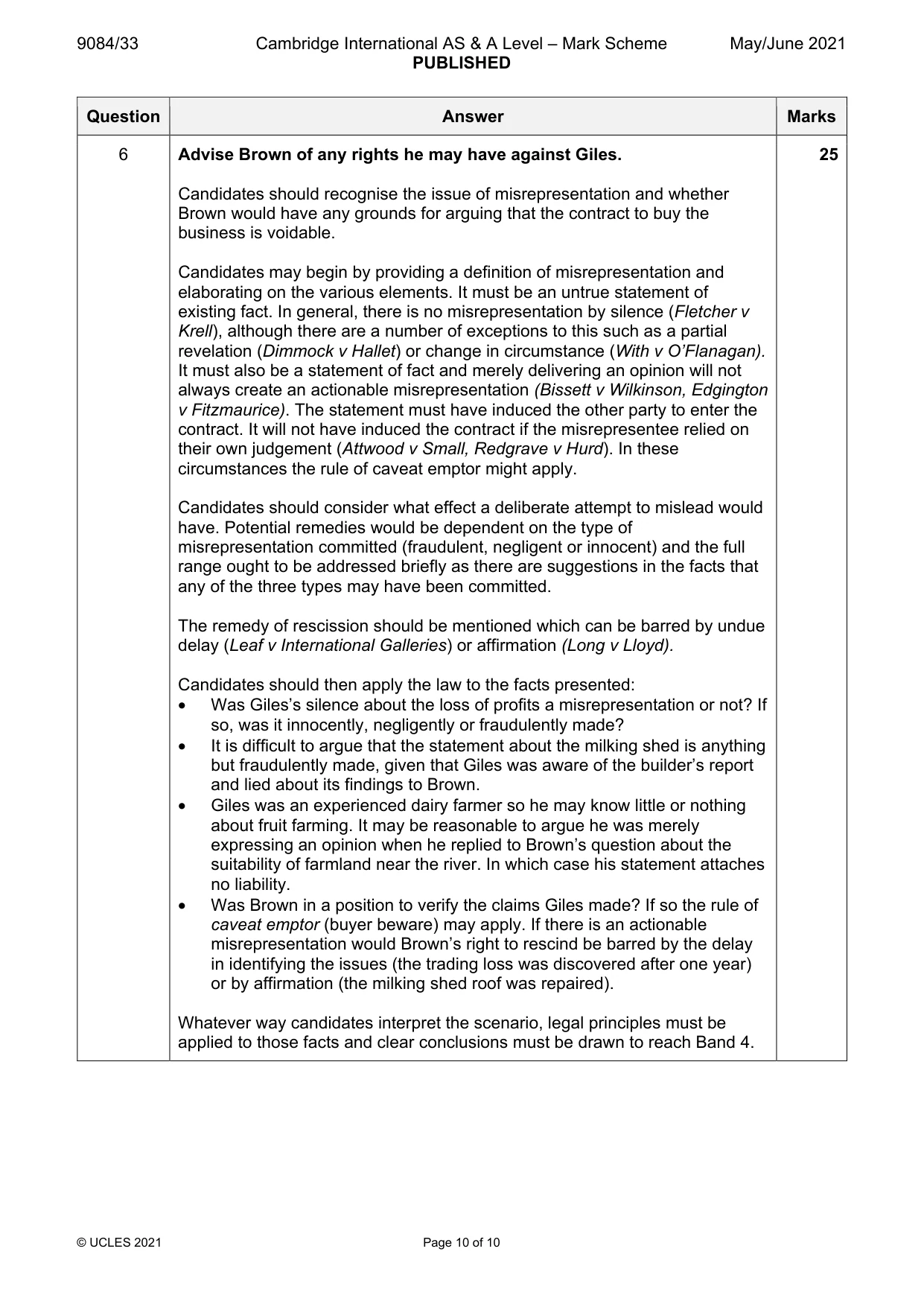
9084/33 Cambridge International AS & A Level – Mark Scheme PUBLISHED May/June 2021 © UCLES 2021 Page 10 of 10 Question Answer Marks 6 Advise Brown of any rights he may have against Giles. Candidates should recognise the issue of misrepresentation and whether Brown would have any grounds for arguing that the contract to buy the business is voidable. Candidates may begin by providing a definition of misrepresentation and elaborating on the various elements. It must be an untrue statement of existing fact. In general, there is no misrepresentation by silence (Fletcher v Krell), although there are a number of exceptions to this such as a partial revelation (Dimmock v Hallet) or change in circumstance (With v O’Flanagan). It must also be a statement of fact and merely delivering an opinion will not always create an actionable misrepresentation (Bissett v Wilkinson, Edgington v Fitzmaurice). The statement must have induced the other party to enter the contract. It will not have induced the contract if the misrepresentee relied on their own judgement (Attwood v Small, Redgrave v Hurd). In these circumstances the rule of caveat emptor might apply. Candidates should consider what effect a deliberate attempt to mislead would have. Potential remedies would be dependent on the type of misrepresentation committed (fraudulent, negligent or innocent) and the full range ought to be addressed briefly as there are suggestions in the facts that any of the three types may have been committed. The remedy of rescission should be mentioned which can be barred by undue delay (Leaf v International Galleries) or affirmation (Long v Lloyd). Candidates should then apply the law to the facts presented: • Was Giles’s silence about the loss of profits a misrepresentation or not? If so, was it innocently, negligently or fraudulently made? • It is difficult to argue that the statement about the milking shed is anything but fraudulently made, given that Giles was aware of the builder’s report and lied about its findings to Brown. • Giles was an experienced dairy farmer so he may know little or nothing about fruit farming. It may be reasonable to argue he was merely expressing an opinion when he replied to Brown’s question about the suitability of farmland near the river. In which case his statement attaches no liability. • Was Brown in a position to verify the claims Giles made? If so the rule of caveat emptor (buyer beware) may apply. If there is an actionable misrepresentation would Brown’s right to rescind be barred by the delay in identifying the issues (the trading loss was discovered after one year) or by affirmation (the milking shed roof was repaired). Whatever way candidates interpret the scenario, legal principles must be applied to those facts and clear conclusions must be drawn to reach Band 4. 25
What you needed in this session
Cambridge’s own grade thresholds for 2021 May/June, Paper 3 · Variant 3. A higher threshold means an easier paper — the bar moves with how the cohort did.