Cambridge A Level Law 9084 — 2021 Oct/Nov Paper 3 · Variant 3
9084/33/O/N/21 · 75 marks · ≈84 min
The question paper and its mark scheme, free to read here and free to download. This is Cambridge’s own paper, exactly as it was sat.
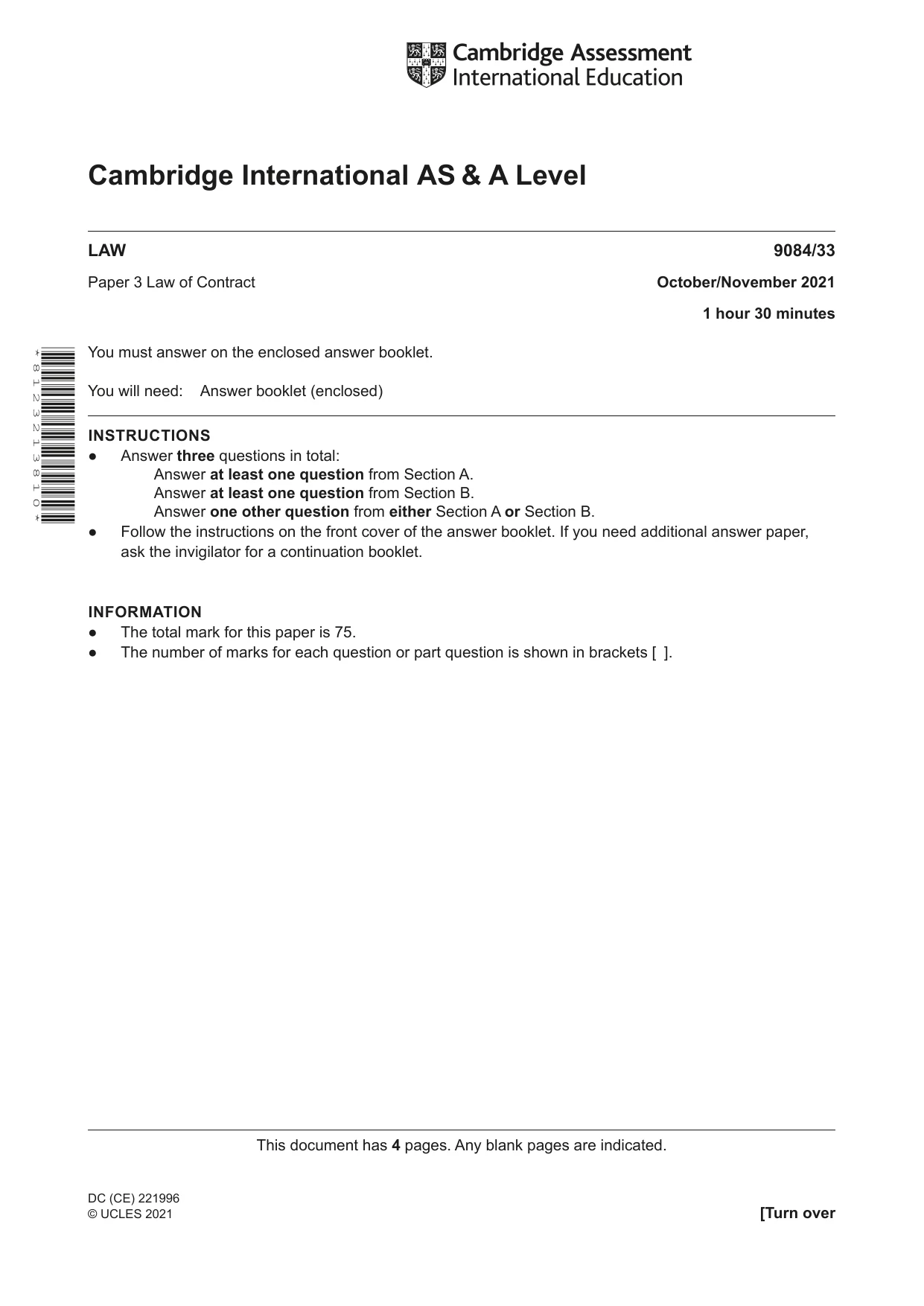
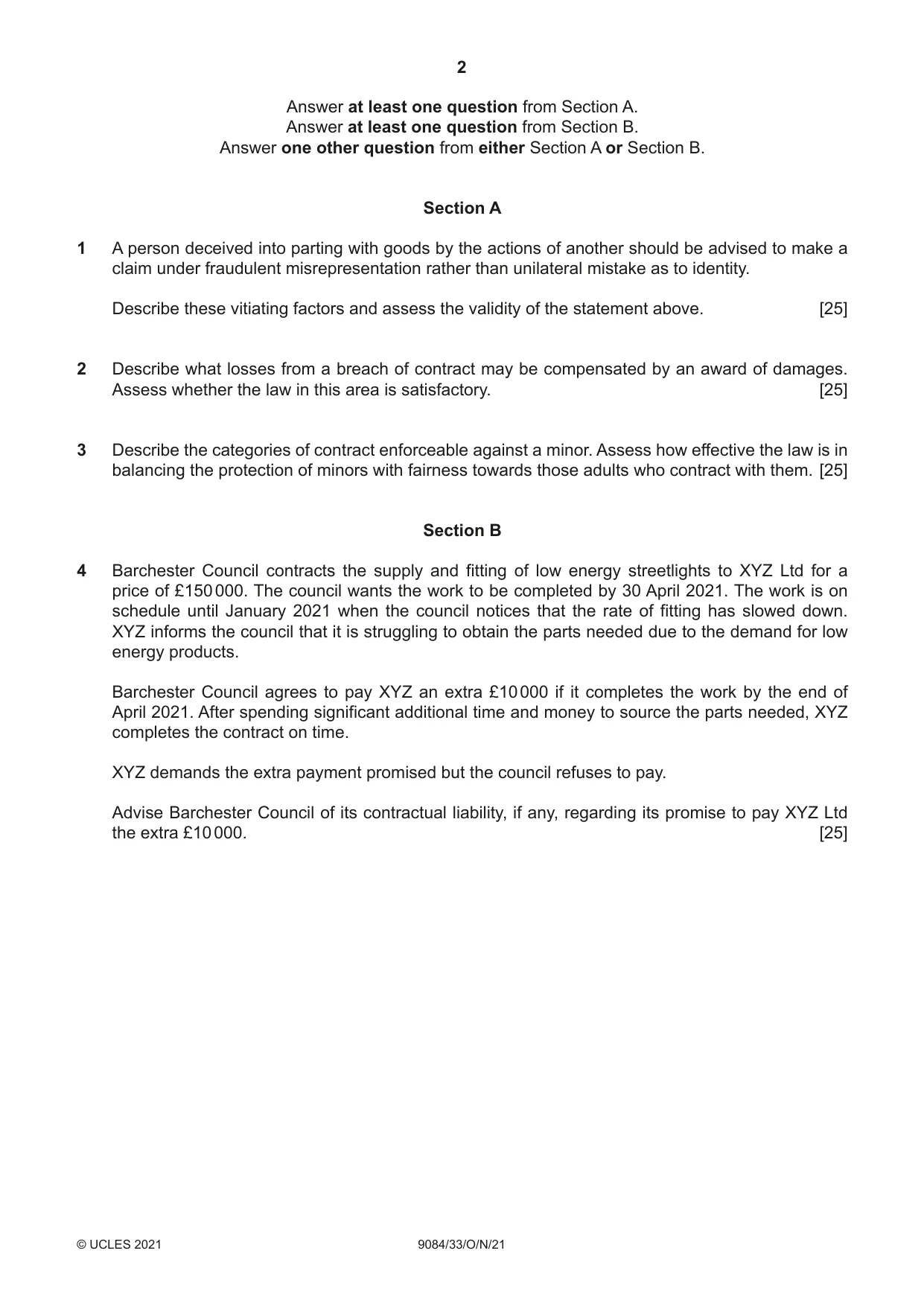
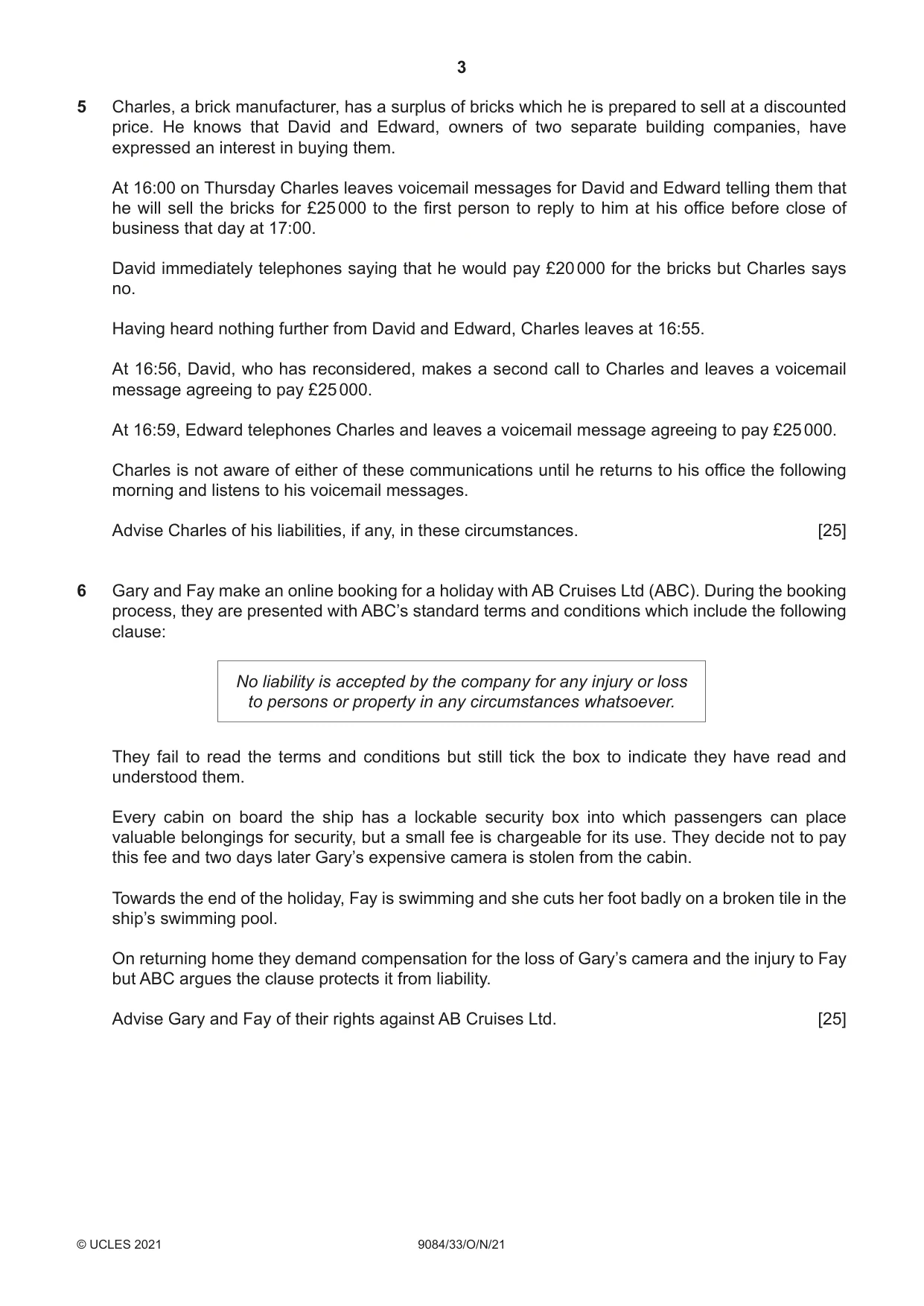
Question paper4 pages

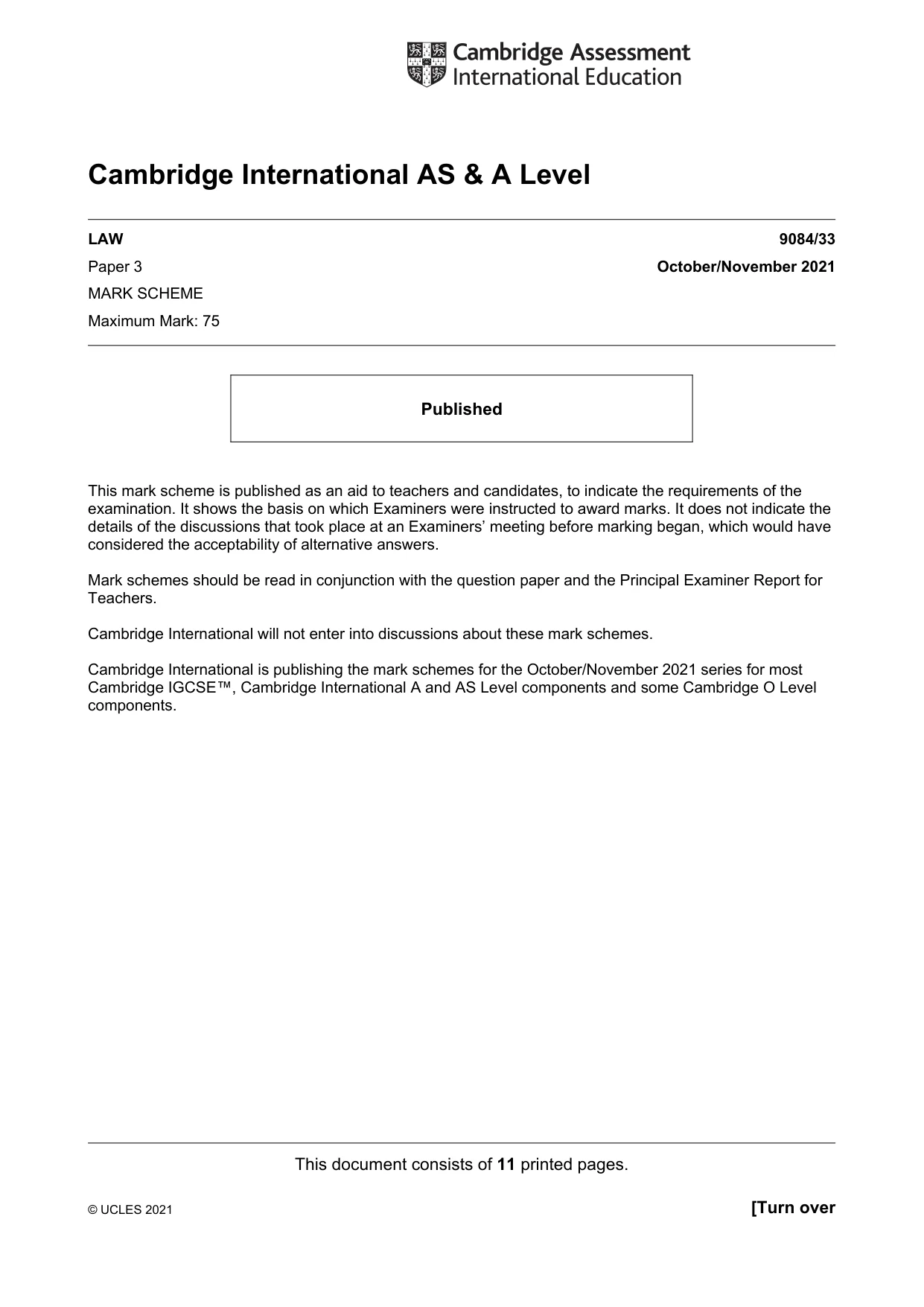
Mark scheme11 pages
Answers below. Sit the paper first if you are practising.
Paper as text
Question paper, page 1
This document has 4 pages. Any blank pages are indicated. Cambridge International AS & A Level * 8 1 2 3 2 1 3 8 1 0 * LAW 9084/33 Paper 3 Law of Contract October/November 2021 1 hour 30 minutes You must answer on the enclosed answer booklet. You will need: Answer booklet (enclosed) INSTRUCTIONS ● Answer three questions in total: Answer at least one question from Section A. Answer at least one question from Section B. Answer one other question from either Section A or Section B. ● Follow the instructions on the front cover of the answer booklet. If you need additional answer paper, ask the invigilator for a continuation booklet. INFORMATION ● The total mark for this paper is 75. ● The number of marks for each question or part question is shown in brackets [ ]. DC (CE) 221996 © UCLES 2021 [Turn over
Question paper, page 2
2 9084/33/O/N/21 © UCLES 2021 Answer at least one question from Section A. Answer at least one question from Section B. Answer one other question from either Section A or Section B. Section A 1 A person deceived into parting with goods by the actions of another should be advised to make a claim under fraudulent misrepresentation rather than unilateral mistake as to identity. Describe these vitiating factors and assess the validity of the statement above. [25] 2 Describe what losses from a breach of contract may be compensated by an award of damages. Assess whether the law in this area is satisfactory. [25] 3 Describe the categories of contract enforceable against a minor. Assess how effective the law is in balancing the protection of minors with fairness towards those adults who contract with them. [25] Section B 4 Barchester Council contracts the supply and fitting of low energy streetlights to XYZ Ltd for a price of £150 000. The council wants the work to be completed by 30 April 2021. The work is on schedule until January 2021 when the council notices that the rate of fitting has slowed down. XYZ informs the council that it is struggling to obtain the parts needed due to the demand for low energy products. Barchester Council agrees to pay XYZ an extra £10 000 if it completes the work by the end of April 2021. After spending significant additional time and money to source the parts needed, XYZ completes the contract on time. XYZ demands the extra payment promised but the council refuses to pay. Advise Barchester Council of its contractual liability, if any, regarding its promise to pay XYZ Ltd the extra £10 000. [25]
Question paper, page 3
3 9084/33/O/N/21 © UCLES 2021 5 Charles, a brick manufacturer, has a surplus of bricks which he is prepared to sell at a discounted price. He knows that David and Edward, owners of two separate building companies, have expressed an interest in buying them. At 16:00 on Thursday Charles leaves voicemail messages for David and Edward telling them that he will sell the bricks for £25 000 to the first person to reply to him at his office before close of business that day at 17:00. David immediately telephones saying that he would pay £20 000 for the bricks but Charles says no. Having heard nothing further from David and Edward, Charles leaves at 16:55. At 16:56, David, who has reconsidered, makes a second call to Charles and leaves a voicemail message agreeing to pay £25 000. At 16:59, Edward telephones Charles and leaves a voicemail message agreeing to pay £25 000. Charles is not aware of either of these communications until he returns to his office the following morning and listens to his voicemail messages. Advise Charles of his liabilities, if any, in these circumstances. [25] 6 Gary and Fay make an online booking for a holiday with AB Cruises Ltd (ABC). During the booking process, they are presented with ABC’s standard terms and conditions which include the following clause: No liability is accepted by the company for any injury or loss to persons or property in any circumstances whatsoever. They fail to read the terms and conditions but still tick the box to indicate they have read and understood them. Every cabin on board the ship has a lockable security box into which passengers can place valuable belongings for security, but a small fee is chargeable for its use. They decide not to pay this fee and two days later Gary’s expensive camera is stolen from the cabin. Towards the end of the holiday, Fay is swimming and she cuts her foot badly on a broken tile in the ship’s swimming pool. On returning home they demand compensation for the loss of Gary’s camera and the injury to Fay but ABC argues the clause protects it from liability. Advise Gary and Fay of their rights against AB Cruises Ltd. [25]
Question paper, page 4
4 9084/33/O/N/21 © UCLES 2021 Permission to reproduce items where third-party owned material protected by copyright is included has been sought and cleared where possible. Every reasonable effort has been made by the publisher (UCLES) to trace copyright holders, but if any items requiring clearance have unwittingly been included, the publisher will be pleased to make amends at the earliest possible opportunity. To avoid the issue of disclosure of answer-related information to candidates, all copyright acknowledgements are reproduced online in the Cambridge Assessment International Education Copyright Acknowledgements Booklet. This is produced for each series of examinations and is freely available to download at www.cambridgeinternational.org after the live examination series. Cambridge Assessment International Education is part of the Cambridge Assessment Group. Cambridge Assessment is the brand name of the University of Cambridge Local Examinations Syndicate (UCLES), which itself is a department of the University of Cambridge. BLANK PAGE
Mark scheme, page 1
This document consists of 11 printed pages. © UCLES 2021 [Turn over Cambridge International AS & A Level LAW 9084/33 Paper 3 October/November 2021 MARK SCHEME Maximum Mark: 75 Published This mark scheme is published as an aid to teachers and candidates, to indicate the requirements of the examination. It shows the basis on which Examiners were instructed to award marks. It does not indicate the details of the discussions that took place at an Examiners’ meeting before marking began, which would have considered the acceptability of alternative answers. Mark schemes should be read in conjunction with the question paper and the Principal Examiner Report for Teachers. Cambridge International will not enter into discussions about these mark schemes. Cambridge International is publishing the mark schemes for the October/November 2021 series for most Cambridge IGCSE™, Cambridge International A and AS Level components and some Cambridge O Level components.
Mark scheme, page 2
9084/33 Cambridge International AS & A Level – Mark Scheme PUBLISHED October/November 2021 © UCLES 2021 Page 2 of 11 Generic Marking Principles These general marking principles must be applied by all examiners when marking candidate answers. They should be applied alongside the specific content of the mark scheme or generic level descriptors for a question. Each question paper and mark scheme will also comply with these marking principles. GENERIC MARKING PRINCIPLE 1: Marks must be awarded in line with: • the specific content of the mark scheme or the generic level descriptors for the question • the specific skills defined in the mark scheme or in the generic level descriptors for the question • the standard of response required by a candidate as exemplified by the standardisation scripts. GENERIC MARKING PRINCIPLE 2: Marks awarded are always whole marks (not half marks, or other fractions). GENERIC MARKING PRINCIPLE 3: Marks must be awarded positively: • marks are awarded for correct/valid answers, as defined in the mark scheme. However, credit is given for valid answers which go beyond the scope of the syllabus and mark scheme, referring to your Team Leader as appropriate • marks are awarded when candidates clearly demonstrate what they know and can do • marks are not deducted for errors • marks are not deducted for omissions • answers should only be judged on the quality of spelling, punctuation and grammar when these features are specifically assessed by the question as indicated by the mark scheme. The meaning, however, should be unambiguous. GENERIC MARKING PRINCIPLE 4: Rules must be applied consistently, e.g. in situations where candidates have not followed instructions or in the application of generic level descriptors. GENERIC MARKING PRINCIPLE 5: Marks should be awarded using the full range of marks defined in the mark scheme for the question (however; the use of the full mark range may be limited according to the quality of the candidate responses seen). GENERIC MARKING PRINCIPLE 6: Marks awarded are based solely on the requirements as defined in the mark scheme. Marks should not be awarded with grade thresholds or grade descriptors in mind.
Mark scheme, page 3
9084/33 Cambridge International AS & A Level – Mark Scheme PUBLISHED October/November 2021 © UCLES 2021 Page 3 of 11 Social Science-Specific Marking Principles (for point-based marking) 1 Components using point-based marking: • Point marking is often used to reward knowledge, understanding and application of skills. We give credit where the candidate’s answer shows relevant knowledge, understanding and application of skills in answering the question. We do not give credit where the answer shows confusion. From this it follows that we: a DO credit answers which are worded differently from the mark scheme if they clearly convey the same meaning (unless the mark scheme requires a specific term) b DO credit alternative answers/examples which are not written in the mark scheme if they are correct c DO credit answers where candidates give more than one correct answer in one prompt/numbered/scaffolded space where extended writing is required rather than list-type answers. For example, questions that require n reasons (e.g. State two reasons …). d DO NOT credit answers simply for using a ‘key term’ unless that is all that is required. (Check for evidence it is understood and not used wrongly.) e DO NOT credit answers which are obviously self-contradicting or trying to cover all possibilities f DO NOT give further credit for what is effectively repetition of a correct point already credited unless the language itself is being tested. This applies equally to ‘mirror statements’ (i.e. polluted/not polluted). g DO NOT require spellings to be correct, unless this is part of the test. However spellings of syllabus terms must allow for clear and unambiguous separation from other syllabus terms with which they may be confused (e.g. Corrasion/Corrosion) 2 Presentation of mark scheme: • Slashes (/) or the word ‘or’ separate alternative ways of making the same point. • Semi colons (;) bullet points (•) or figures in brackets (1) separate different points. • Content in the answer column in brackets is for examiner information/context to clarify the marking but is not required to earn the mark (except Accounting syllabuses where they indicate negative numbers). 3 Annotation: • For point marking, ticks can be used to indicate correct answers and crosses can be used to indicate wrong answers. There is no direct relationship between ticks and marks. Ticks have no defined meaning for levels of response marking. • For levels of response marking, the level awarded should be annotated on the script. • Other annotations will be used by examiners as agreed during standardisation, and the meaning will be understood by all examiners who marked that paper.
Mark scheme, page 4
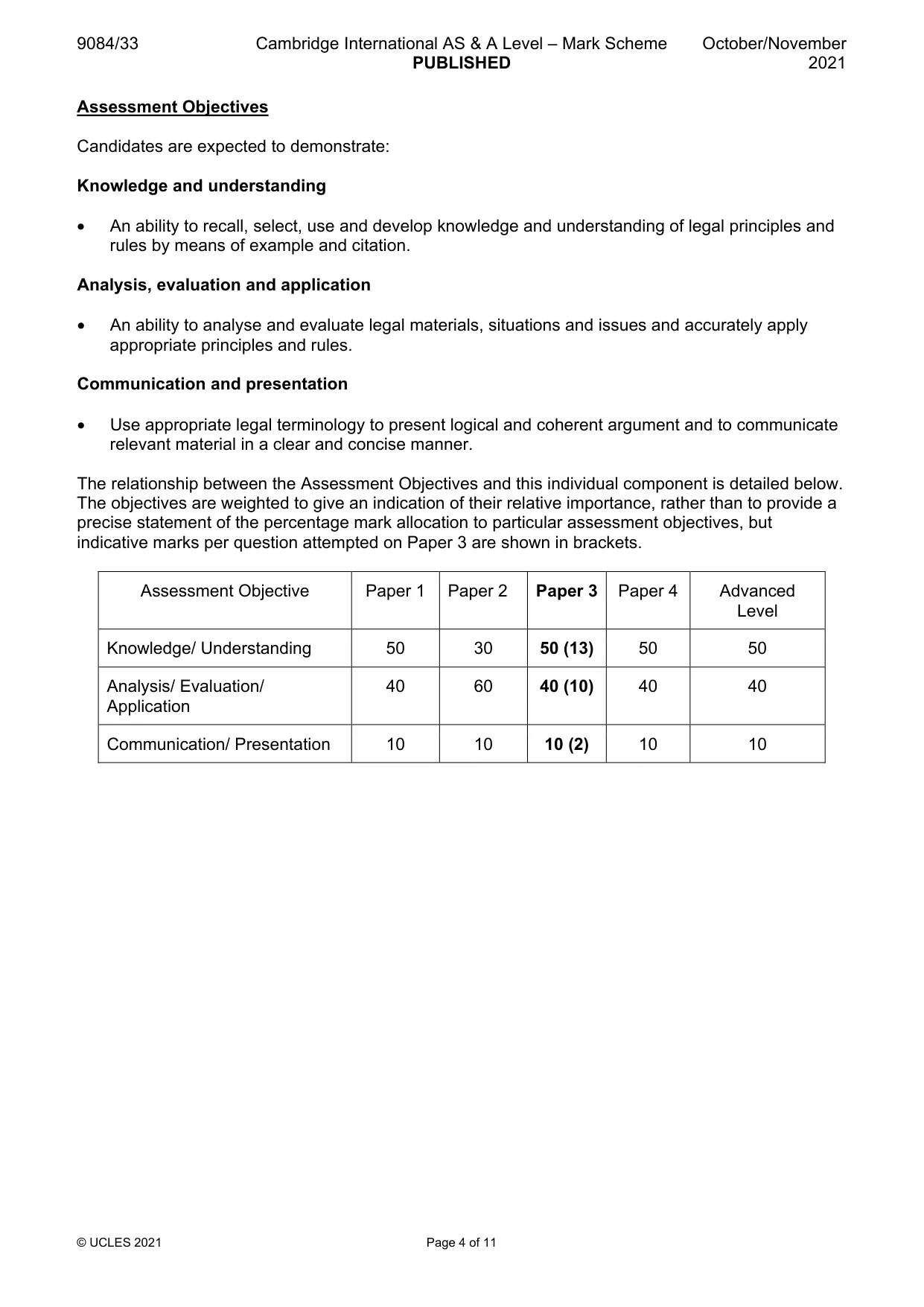
9084/33 Cambridge International AS & A Level – Mark Scheme PUBLISHED October/November 2021 © UCLES 2021 Page 4 of 11 Assessment Objectives Candidates are expected to demonstrate: Knowledge and understanding • An ability to recall, select, use and develop knowledge and understanding of legal principles and rules by means of example and citation. Analysis, evaluation and application • An ability to analyse and evaluate legal materials, situations and issues and accurately apply appropriate principles and rules. Communication and presentation • Use appropriate legal terminology to present logical and coherent argument and to communicate relevant material in a clear and concise manner. The relationship between the Assessment Objectives and this individual component is detailed below. The objectives are weighted to give an indication of their relative importance, rather than to provide a precise statement of the percentage mark allocation to particular assessment objectives, but indicative marks per question attempted on Paper 3 are shown in brackets. Assessment Objective Paper 1 Paper 2 Paper 3 Paper 4 Advanced Level Knowledge/ Understanding 50 30 50 (13) 50 50 Analysis/ Evaluation/ Application 40 60 40 (10) 40 40 Communication/ Presentation 10 10 10 (2) 10 10
Mark scheme, page 5
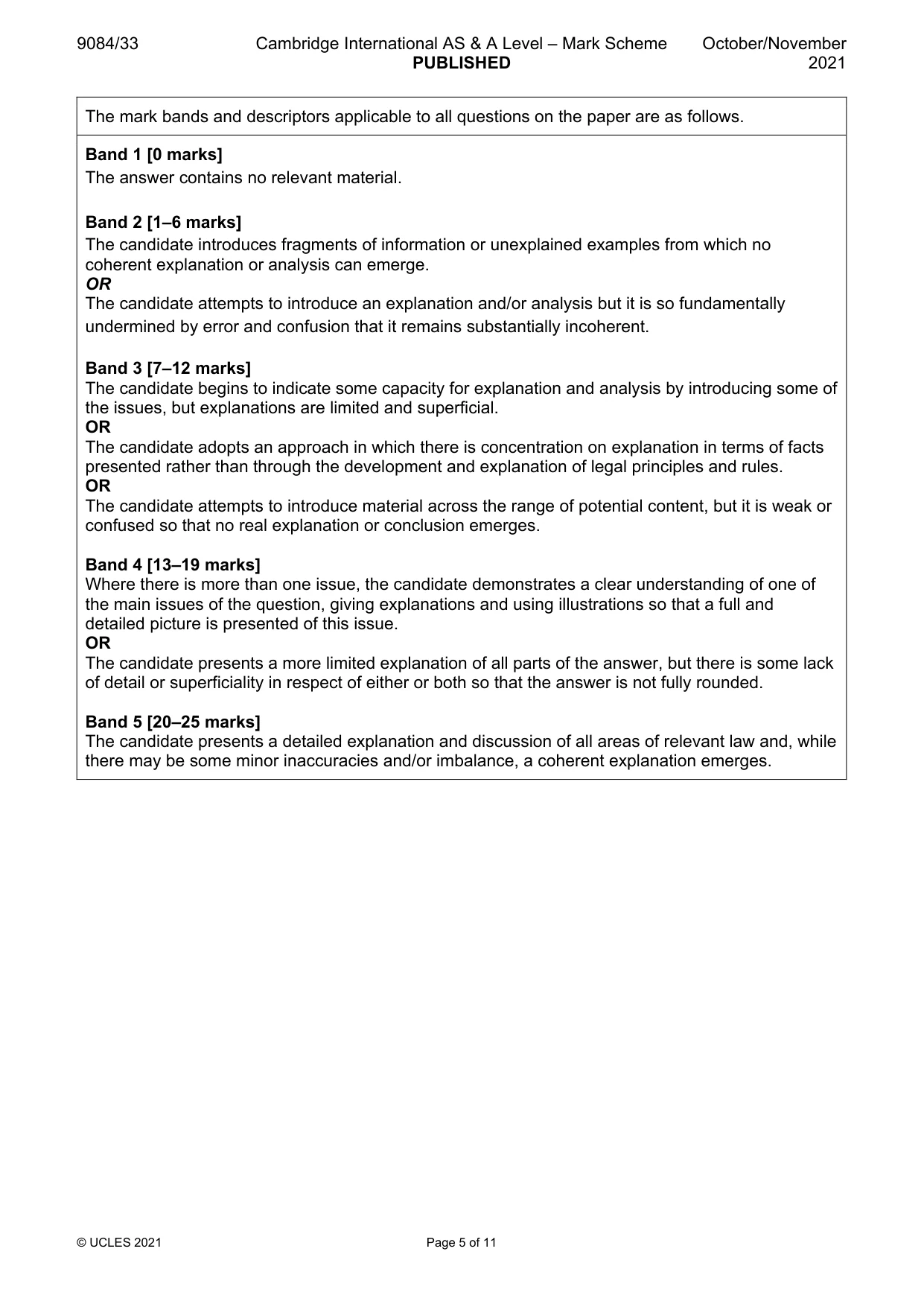
9084/33 Cambridge International AS & A Level – Mark Scheme PUBLISHED October/November 2021 © UCLES 2021 Page 5 of 11 The mark bands and descriptors applicable to all questions on the paper are as follows. Band 1 [0 marks] The answer contains no relevant material. Band 2 [1–6 marks] The candidate introduces fragments of information or unexplained examples from which no coherent explanation or analysis can emerge. OR The candidate attempts to introduce an explanation and/or analysis but it is so fundamentally undermined by error and confusion that it remains substantially incoherent. Band 3 [7–12 marks] The candidate begins to indicate some capacity for explanation and analysis by introducing some of the issues, but explanations are limited and superficial. OR The candidate adopts an approach in which there is concentration on explanation in terms of facts presented rather than through the development and explanation of legal principles and rules. OR The candidate attempts to introduce material across the range of potential content, but it is weak or confused so that no real explanation or conclusion emerges. Band 4 [13–19 marks] Where there is more than one issue, the candidate demonstrates a clear understanding of one of the main issues of the question, giving explanations and using illustrations so that a full and detailed picture is presented of this issue. OR The candidate presents a more limited explanation of all parts of the answer, but there is some lack of detail or superficiality in respect of either or both so that the answer is not fully rounded. Band 5 [20–25 marks] The candidate presents a detailed explanation and discussion of all areas of relevant law and, while there may be some minor inaccuracies and/or imbalance, a coherent explanation emerges.
Mark scheme, page 6
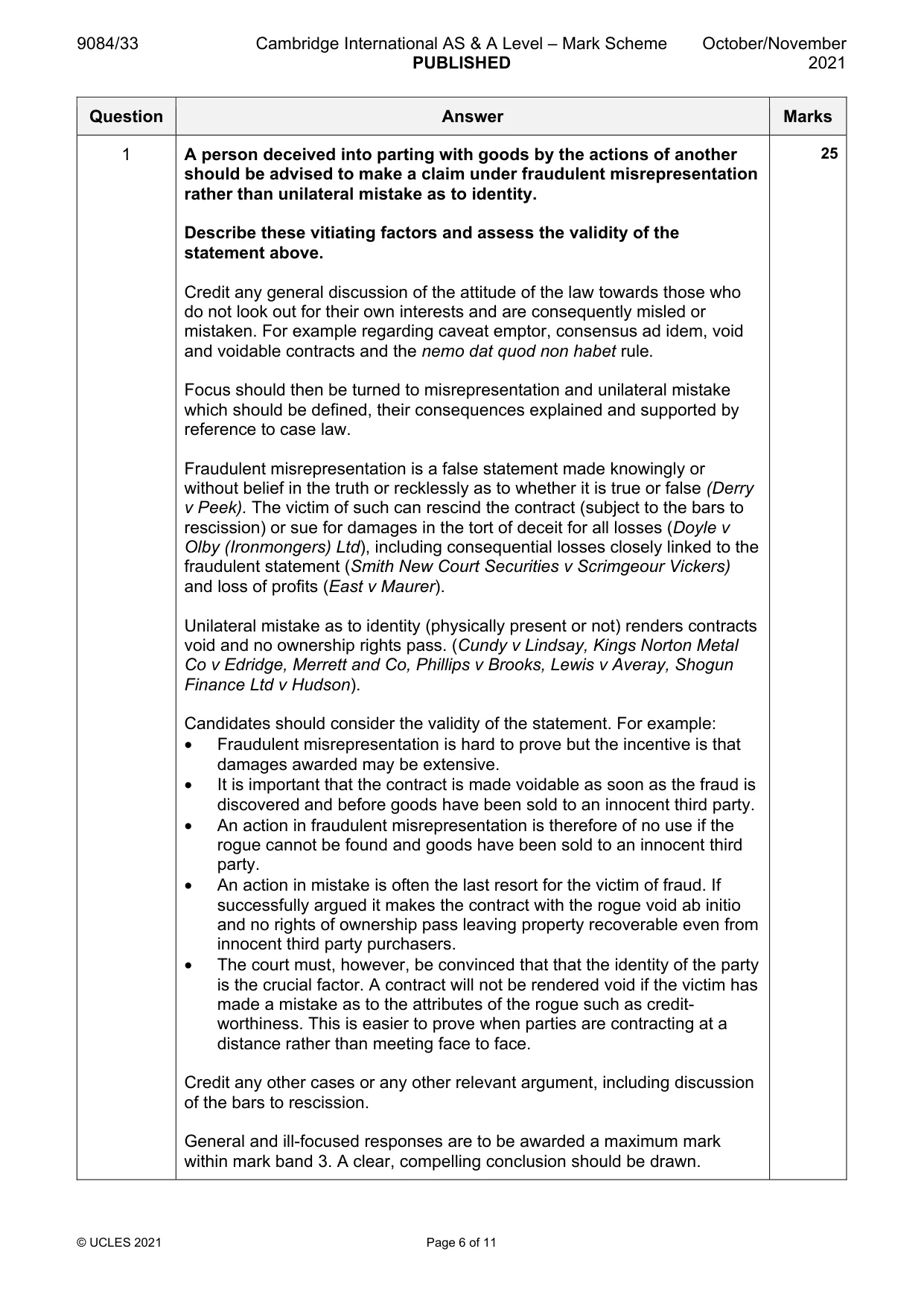
9084/33 Cambridge International AS & A Level – Mark Scheme PUBLISHED October/November 2021 © UCLES 2021 Page 6 of 11 Question Answer Marks 1 A person deceived into parting with goods by the actions of another should be advised to make a claim under fraudulent misrepresentation rather than unilateral mistake as to identity. Describe these vitiating factors and assess the validity of the statement above. Credit any general discussion of the attitude of the law towards those who do not look out for their own interests and are consequently misled or mistaken. For example regarding caveat emptor, consensus ad idem, void and voidable contracts and the nemo dat quod non habet rule. Focus should then be turned to misrepresentation and unilateral mistake which should be defined, their consequences explained and supported by reference to case law. Fraudulent misrepresentation is a false statement made knowingly or without belief in the truth or recklessly as to whether it is true or false (Derry v Peek). The victim of such can rescind the contract (subject to the bars to rescission) or sue for damages in the tort of deceit for all losses (Doyle v Olby (Ironmongers) Ltd), including consequential losses closely linked to the fraudulent statement (Smith New Court Securities v Scrimgeour Vickers) and loss of profits (East v Maurer). Unilateral mistake as to identity (physically present or not) renders contracts void and no ownership rights pass. (Cundy v Lindsay, Kings Norton Metal Co v Edridge, Merrett and Co, Phillips v Brooks, Lewis v Averay, Shogun Finance Ltd v Hudson). Candidates should consider the validity of the statement. For example: • Fraudulent misrepresentation is hard to prove but the incentive is that damages awarded may be extensive. • It is important that the contract is made voidable as soon as the fraud is discovered and before goods have been sold to an innocent third party. • An action in fraudulent misrepresentation is therefore of no use if the rogue cannot be found and goods have been sold to an innocent third party. • An action in mistake is often the last resort for the victim of fraud. If successfully argued it makes the contract with the rogue void ab initio and no rights of ownership pass leaving property recoverable even from innocent third party purchasers. • The court must, however, be convinced that that the identity of the party is the crucial factor. A contract will not be rendered void if the victim has made a mistake as to the attributes of the rogue such as credit- worthiness. This is easier to prove when parties are contracting at a distance rather than meeting face to face. Credit any other cases or any other relevant argument, including discussion of the bars to rescission. General and ill-focused responses are to be awarded a maximum mark within mark band 3. A clear, compelling conclusion should be drawn. 25
Mark scheme, page 7
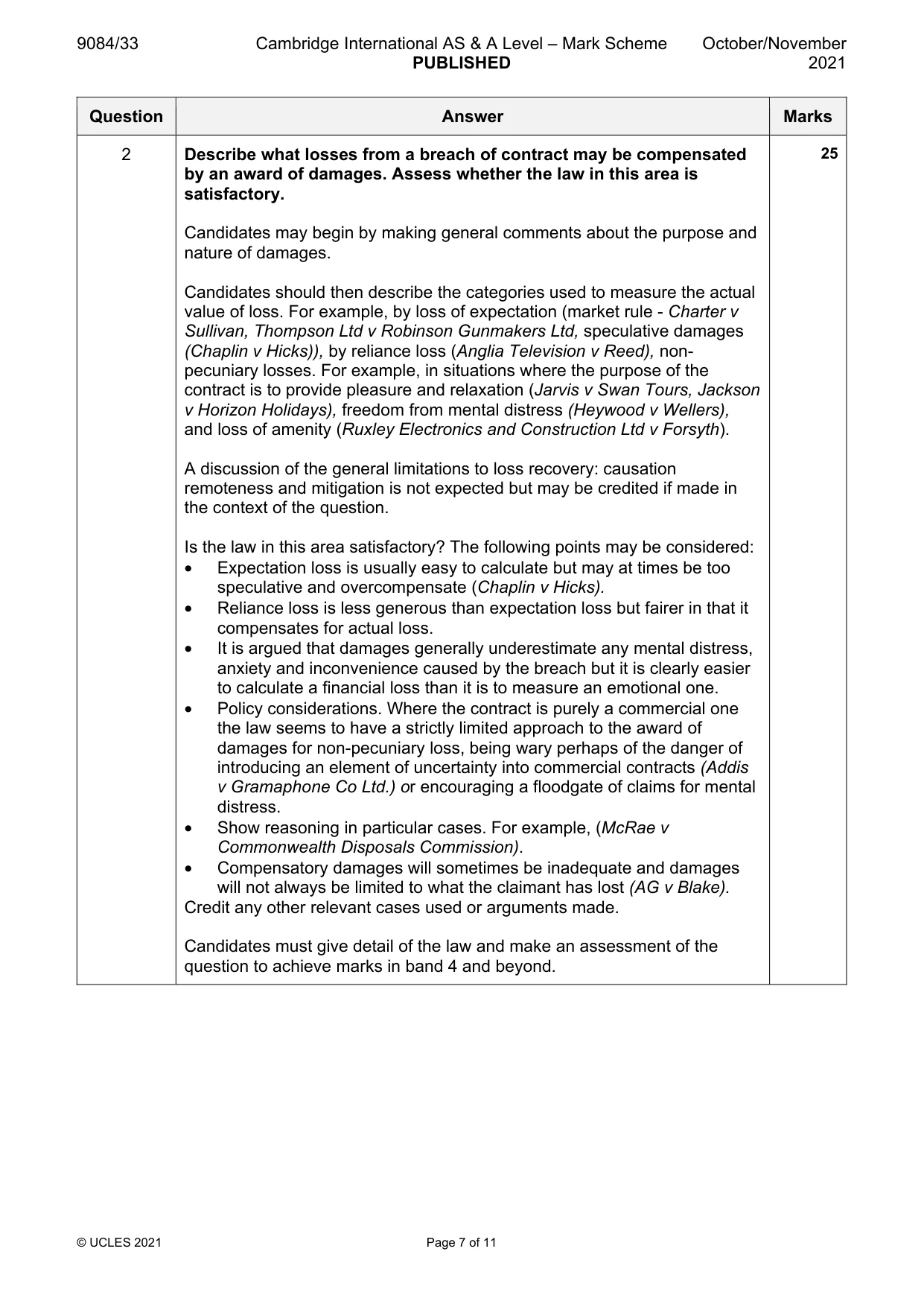
9084/33 Cambridge International AS & A Level – Mark Scheme PUBLISHED October/November 2021 © UCLES 2021 Page 7 of 11 Question Answer Marks 2 Describe what losses from a breach of contract may be compensated by an award of damages. Assess whether the law in this area is satisfactory. Candidates may begin by making general comments about the purpose and nature of damages. Candidates should then describe the categories used to measure the actual value of loss. For example, by loss of expectation (market rule - Charter v Sullivan, Thompson Ltd v Robinson Gunmakers Ltd, speculative damages (Chaplin v Hicks)), by reliance loss (Anglia Television v Reed), non- pecuniary losses. For example, in situations where the purpose of the contract is to provide pleasure and relaxation (Jarvis v Swan Tours, Jackson v Horizon Holidays), freedom from mental distress (Heywood v Wellers), and loss of amenity (Ruxley Electronics and Construction Ltd v Forsyth). A discussion of the general limitations to loss recovery: causation remoteness and mitigation is not expected but may be credited if made in the context of the question. Is the law in this area satisfactory? The following points may be considered: • Expectation loss is usually easy to calculate but may at times be too speculative and overcompensate (Chaplin v Hicks). • Reliance loss is less generous than expectation loss but fairer in that it compensates for actual loss. • It is argued that damages generally underestimate any mental distress, anxiety and inconvenience caused by the breach but it is clearly easier to calculate a financial loss than it is to measure an emotional one. • Policy considerations. Where the contract is purely a commercial one the law seems to have a strictly limited approach to the award of damages for non-pecuniary loss, being wary perhaps of the danger of introducing an element of uncertainty into commercial contracts (Addis v Gramaphone Co Ltd.) or encouraging a floodgate of claims for mental distress. • Show reasoning in particular cases. For example, (McRae v Commonwealth Disposals Commission). • Compensatory damages will sometimes be inadequate and damages will not always be limited to what the claimant has lost (AG v Blake). Credit any other relevant cases used or arguments made. Candidates must give detail of the law and make an assessment of the question to achieve marks in band 4 and beyond. 25
Mark scheme, page 8
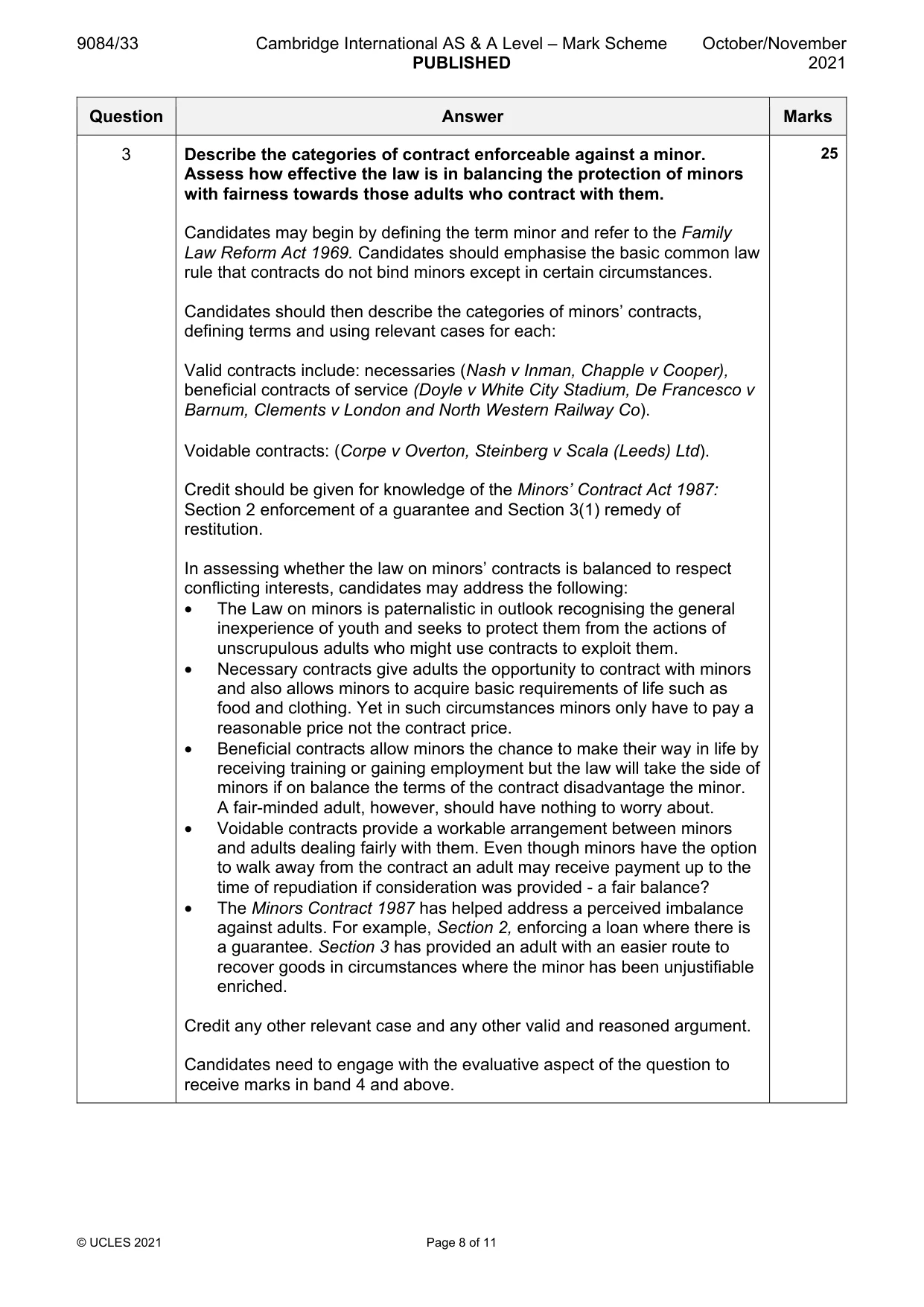
9084/33 Cambridge International AS & A Level – Mark Scheme PUBLISHED October/November 2021 © UCLES 2021 Page 8 of 11 Question Answer Marks 3 Describe the categories of contract enforceable against a minor. Assess how effective the law is in balancing the protection of minors with fairness towards those adults who contract with them. Candidates may begin by defining the term minor and refer to the Family Law Reform Act 1969. Candidates should emphasise the basic common law rule that contracts do not bind minors except in certain circumstances. Candidates should then describe the categories of minors’ contracts, defining terms and using relevant cases for each: Valid contracts include: necessaries (Nash v Inman, Chapple v Cooper), beneficial contracts of service (Doyle v White City Stadium, De Francesco v Barnum, Clements v London and North Western Railway Co). Voidable contracts: (Corpe v Overton, Steinberg v Scala (Leeds) Ltd). Credit should be given for knowledge of the Minors’ Contract Act 1987: Section 2 enforcement of a guarantee and Section 3(1) remedy of restitution. In assessing whether the law on minors’ contracts is balanced to respect conflicting interests, candidates may address the following: • The Law on minors is paternalistic in outlook recognising the general inexperience of youth and seeks to protect them from the actions of unscrupulous adults who might use contracts to exploit them. • Necessary contracts give adults the opportunity to contract with minors and also allows minors to acquire basic requirements of life such as food and clothing. Yet in such circumstances minors only have to pay a reasonable price not the contract price. • Beneficial contracts allow minors the chance to make their way in life by receiving training or gaining employment but the law will take the side of minors if on balance the terms of the contract disadvantage the minor. A fair-minded adult, however, should have nothing to worry about. • Voidable contracts provide a workable arrangement between minors and adults dealing fairly with them. Even though minors have the option to walk away from the contract an adult may receive payment up to the time of repudiation if consideration was provided - a fair balance? • The Minors Contract 1987 has helped address a perceived imbalance against adults. For example, Section 2, enforcing a loan where there is a guarantee. Section 3 has provided an adult with an easier route to recover goods in circumstances where the minor has been unjustifiable enriched. Credit any other relevant case and any other valid and reasoned argument. Candidates need to engage with the evaluative aspect of the question to receive marks in band 4 and above. 25
Mark scheme, page 9
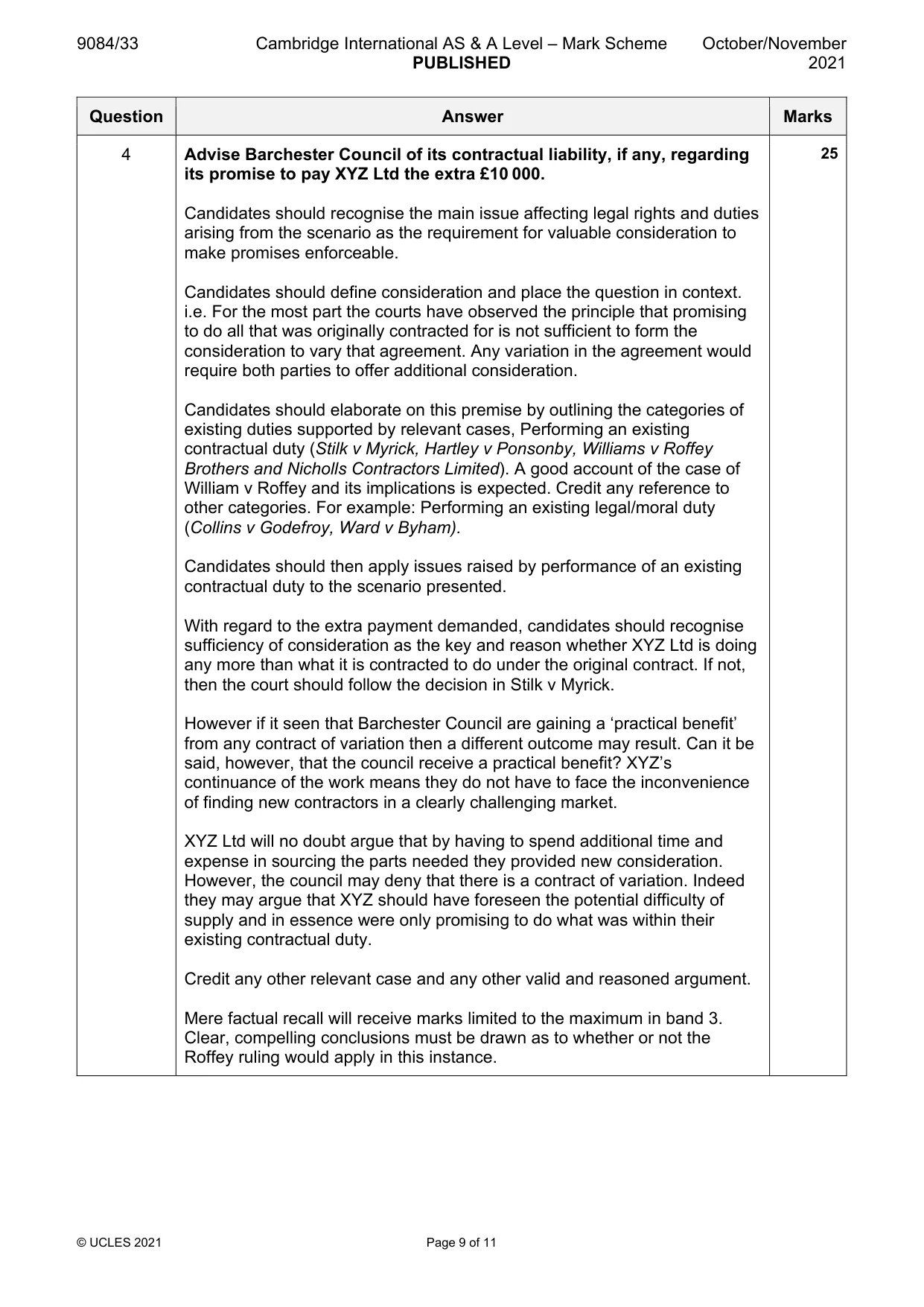
9084/33 Cambridge International AS & A Level – Mark Scheme PUBLISHED October/November 2021 © UCLES 2021 Page 9 of 11 Question Answer Marks 4 Advise Barchester Council of its contractual liability, if any, regarding its promise to pay XYZ Ltd the extra £10 000. Candidates should recognise the main issue affecting legal rights and duties arising from the scenario as the requirement for valuable consideration to make promises enforceable. Candidates should define consideration and place the question in context. i.e. For the most part the courts have observed the principle that promising to do all that was originally contracted for is not sufficient to form the consideration to vary that agreement. Any variation in the agreement would require both parties to offer additional consideration. Candidates should elaborate on this premise by outlining the categories of existing duties supported by relevant cases, Performing an existing contractual duty (Stilk v Myrick, Hartley v Ponsonby, Williams v Roffey Brothers and Nicholls Contractors Limited). A good account of the case of William v Roffey and its implications is expected. Credit any reference to other categories. For example: Performing an existing legal/moral duty (Collins v Godefroy, Ward v Byham). Candidates should then apply issues raised by performance of an existing contractual duty to the scenario presented. With regard to the extra payment demanded, candidates should recognise sufficiency of consideration as the key and reason whether XYZ Ltd is doing any more than what it is contracted to do under the original contract. If not, then the court should follow the decision in Stilk v Myrick. However if it seen that Barchester Council are gaining a ‘practical benefit’ from any contract of variation then a different outcome may result. Can it be said, however, that the council receive a practical benefit? XYZ’s continuance of the work means they do not have to face the inconvenience of finding new contractors in a clearly challenging market. XYZ Ltd will no doubt argue that by having to spend additional time and expense in sourcing the parts needed they provided new consideration. However, the council may deny that there is a contract of variation. Indeed they may argue that XYZ should have foreseen the potential difficulty of supply and in essence were only promising to do what was within their existing contractual duty. Credit any other relevant case and any other valid and reasoned argument. Mere factual recall will receive marks limited to the maximum in band 3. Clear, compelling conclusions must be drawn as to whether or not the Roffey ruling would apply in this instance. 25
Mark scheme, page 10
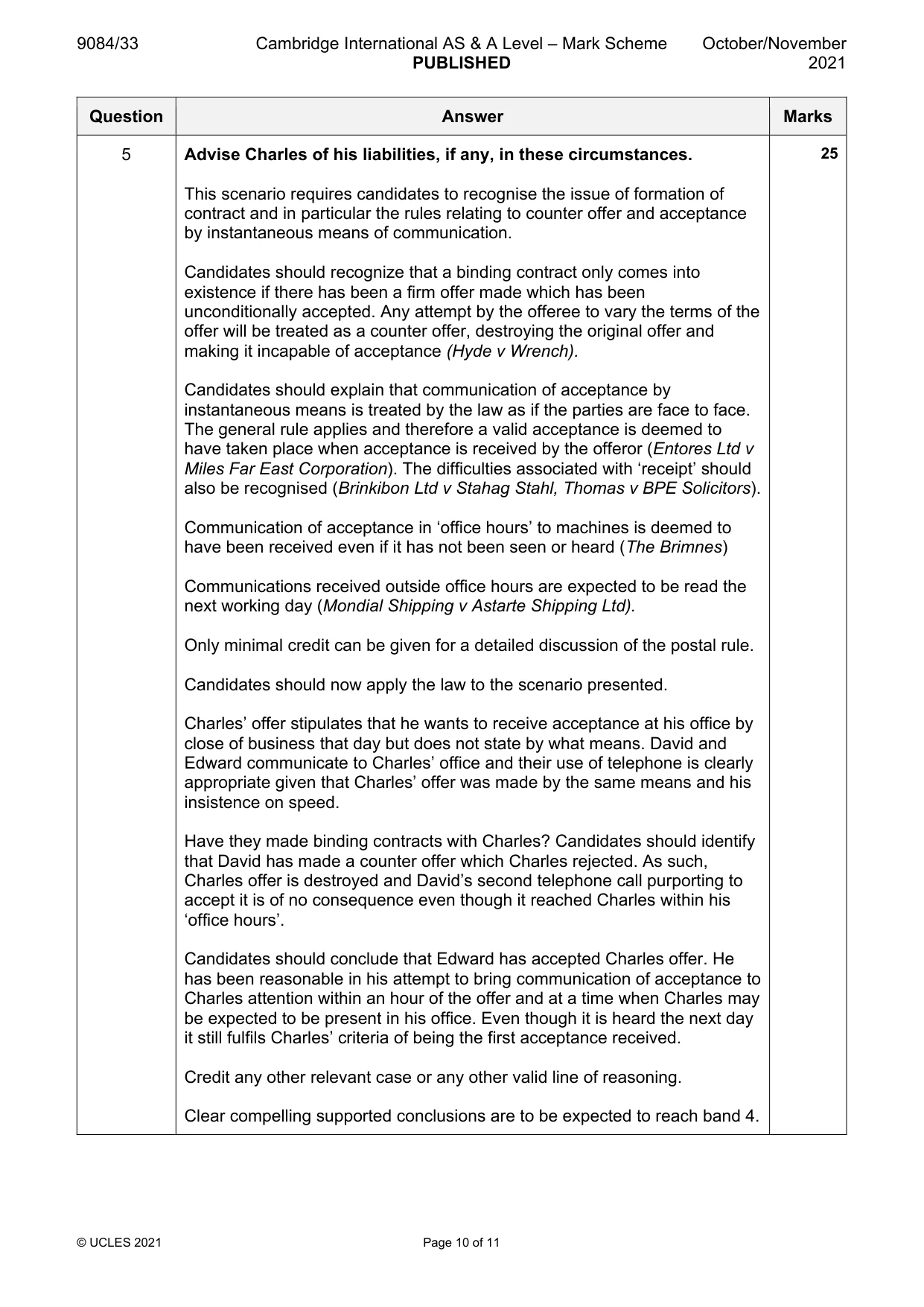
9084/33 Cambridge International AS & A Level – Mark Scheme PUBLISHED October/November 2021 © UCLES 2021 Page 10 of 11 Question Answer Marks 5 Advise Charles of his liabilities, if any, in these circumstances. This scenario requires candidates to recognise the issue of formation of contract and in particular the rules relating to counter offer and acceptance by instantaneous means of communication. Candidates should recognize that a binding contract only comes into existence if there has been a firm offer made which has been unconditionally accepted. Any attempt by the offeree to vary the terms of the offer will be treated as a counter offer, destroying the original offer and making it incapable of acceptance (Hyde v Wrench). Candidates should explain that communication of acceptance by instantaneous means is treated by the law as if the parties are face to face. The general rule applies and therefore a valid acceptance is deemed to have taken place when acceptance is received by the offeror (Entores Ltd v Miles Far East Corporation). The difficulties associated with ‘receipt’ should also be recognised (Brinkibon Ltd v Stahag Stahl, Thomas v BPE Solicitors). Communication of acceptance in ‘office hours’ to machines is deemed to have been received even if it has not been seen or heard (The Brimnes) Communications received outside office hours are expected to be read the next working day (Mondial Shipping v Astarte Shipping Ltd). Only minimal credit can be given for a detailed discussion of the postal rule. Candidates should now apply the law to the scenario presented. Charles’ offer stipulates that he wants to receive acceptance at his office by close of business that day but does not state by what means. David and Edward communicate to Charles’ office and their use of telephone is clearly appropriate given that Charles’ offer was made by the same means and his insistence on speed. Have they made binding contracts with Charles? Candidates should identify that David has made a counter offer which Charles rejected. As such, Charles offer is destroyed and David’s second telephone call purporting to accept it is of no consequence even though it reached Charles within his ‘office hours’. Candidates should conclude that Edward has accepted Charles offer. He has been reasonable in his attempt to bring communication of acceptance to Charles attention within an hour of the offer and at a time when Charles may be expected to be present in his office. Even though it is heard the next day it still fulfils Charles’ criteria of being the first acceptance received. Credit any other relevant case or any other valid line of reasoning. Clear compelling supported conclusions are to be expected to reach band 4. 25
Mark scheme, page 11
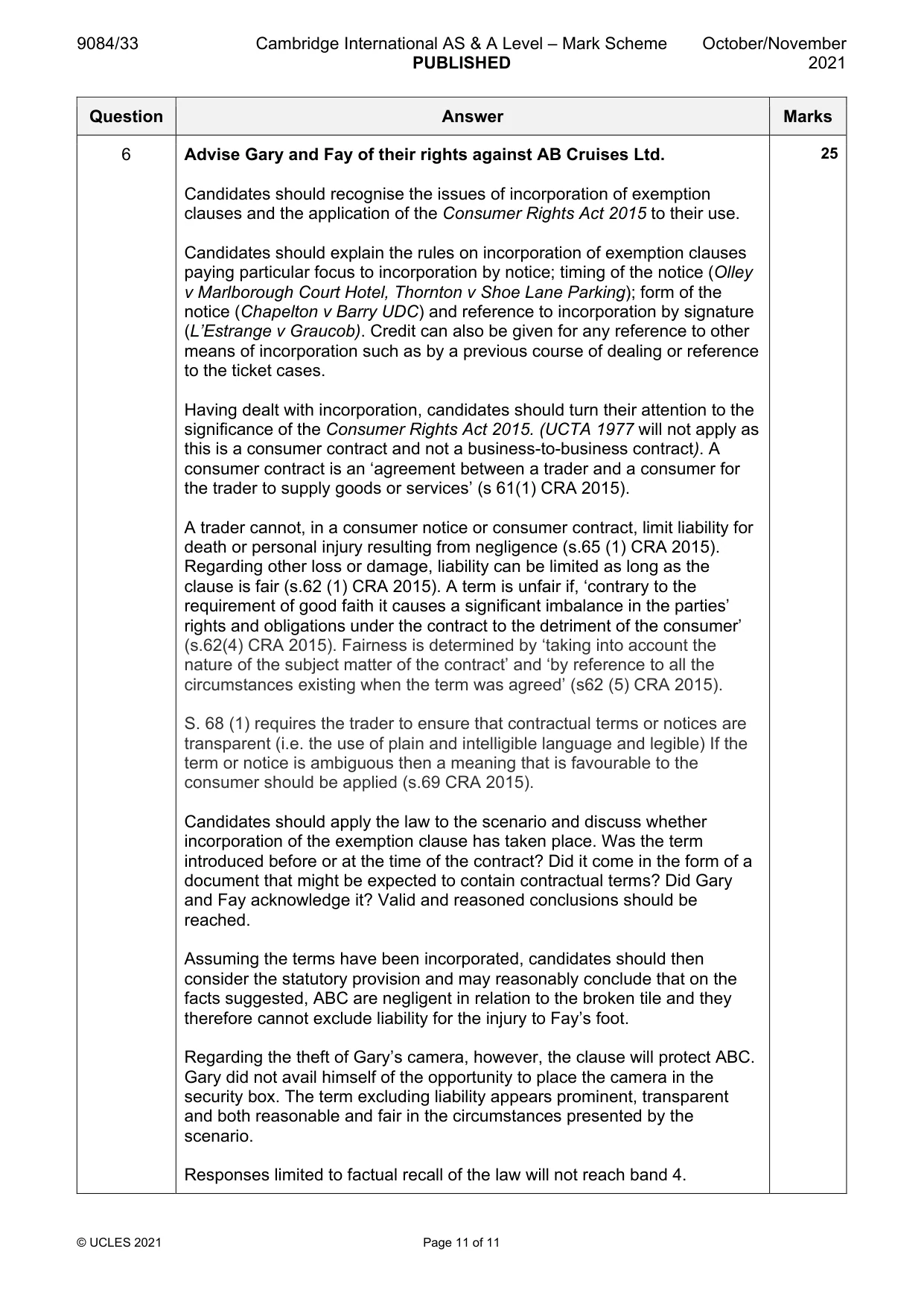
9084/33 Cambridge International AS & A Level – Mark Scheme PUBLISHED October/November 2021 © UCLES 2021 Page 11 of 11 Question Answer Marks 6 Advise Gary and Fay of their rights against AB Cruises Ltd. Candidates should recognise the issues of incorporation of exemption clauses and the application of the Consumer Rights Act 2015 to their use. Candidates should explain the rules on incorporation of exemption clauses paying particular focus to incorporation by notice; timing of the notice (Olley v Marlborough Court Hotel, Thornton v Shoe Lane Parking); form of the notice (Chapelton v Barry UDC) and reference to incorporation by signature (L’Estrange v Graucob). Credit can also be given for any reference to other means of incorporation such as by a previous course of dealing or reference to the ticket cases. Having dealt with incorporation, candidates should turn their attention to the significance of the Consumer Rights Act 2015. (UCTA 1977 will not apply as this is a consumer contract and not a business-to-business contract). A consumer contract is an ‘agreement between a trader and a consumer for the trader to supply goods or services’ (s 61(1) CRA 2015). A trader cannot, in a consumer notice or consumer contract, limit liability for death or personal injury resulting from negligence (s.65 (1) CRA 2015). Regarding other loss or damage, liability can be limited as long as the clause is fair (s.62 (1) CRA 2015). A term is unfair if, ‘contrary to the requirement of good faith it causes a significant imbalance in the parties’ rights and obligations under the contract to the detriment of the consumer’ (s.62(4) CRA 2015). Fairness is determined by ‘taking into account the nature of the subject matter of the contract’ and ‘by reference to all the circumstances existing when the term was agreed’ (s62 (5) CRA 2015). S. 68 (1) requires the trader to ensure that contractual terms or notices are transparent (i.e. the use of plain and intelligible language and legible) If the term or notice is ambiguous then a meaning that is favourable to the consumer should be applied (s.69 CRA 2015). Candidates should apply the law to the scenario and discuss whether incorporation of the exemption clause has taken place. Was the term introduced before or at the time of the contract? Did it come in the form of a document that might be expected to contain contractual terms? Did Gary and Fay acknowledge it? Valid and reasoned conclusions should be reached. Assuming the terms have been incorporated, candidates should then consider the statutory provision and may reasonably conclude that on the facts suggested, ABC are negligent in relation to the broken tile and they therefore cannot exclude liability for the injury to Fay’s foot. Regarding the theft of Gary’s camera, however, the clause will protect ABC. Gary did not avail himself of the opportunity to place the camera in the security box. The term excluding liability appears prominent, transparent and both reasonable and fair in the circumstances presented by the scenario. Responses limited to factual recall of the law will not reach band 4. 25
What you needed in this session
Cambridge’s own grade thresholds for 2021 Oct/Nov, Paper 3 · Variant 3. A higher threshold means an easier paper — the bar moves with how the cohort did.