Cambridge A Level Law 9084 — 2022 May/June Paper 3 · Variant 2
9084/32/M/J/22 · 75 marks · ≈84 min
The question paper and its mark scheme, free to read here and free to download. This is Cambridge’s own paper, exactly as it was sat.
Question paper4 pages

Mark scheme10 pages
Answers below. Sit the paper first if you are practising.
Paper as text
Question paper, page 1
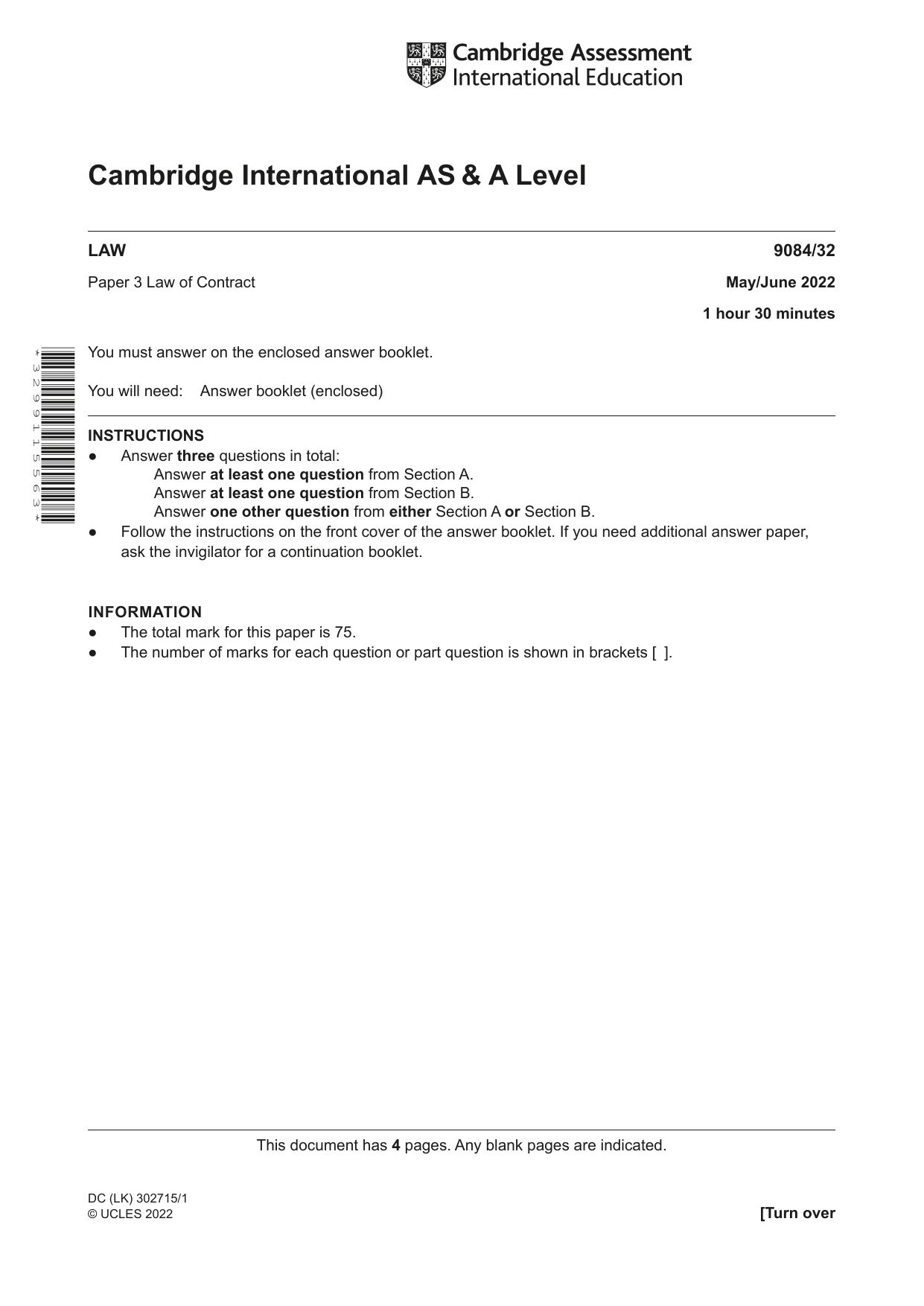
This document has 4 pages. Any blank pages are indicated. [Turn over Cambridge International AS & A Level DC (LK) 302715/1 © UCLES 2022 LAW 9084/32 Paper 3 Law of Contract May/June 2022 1 hour 30 minutes You must answer on the enclosed answer booklet. You will need: Answer booklet (enclosed) INSTRUCTIONS ● Answer three questions in total: Answer at least one question from Section A. Answer at least one question from Section B. Answer one other question from either Section A or Section B. ● Follow the instructions on the front cover of the answer booklet. If you need additional answer paper, ask the invigilator for a continuation booklet. INFORMATION ● The total mark for this paper is 75. ● The number of marks for each question or part question is shown in brackets [ ]. * 3 2 9 9 1 1 5 5 6 3 *
Question paper, page 2
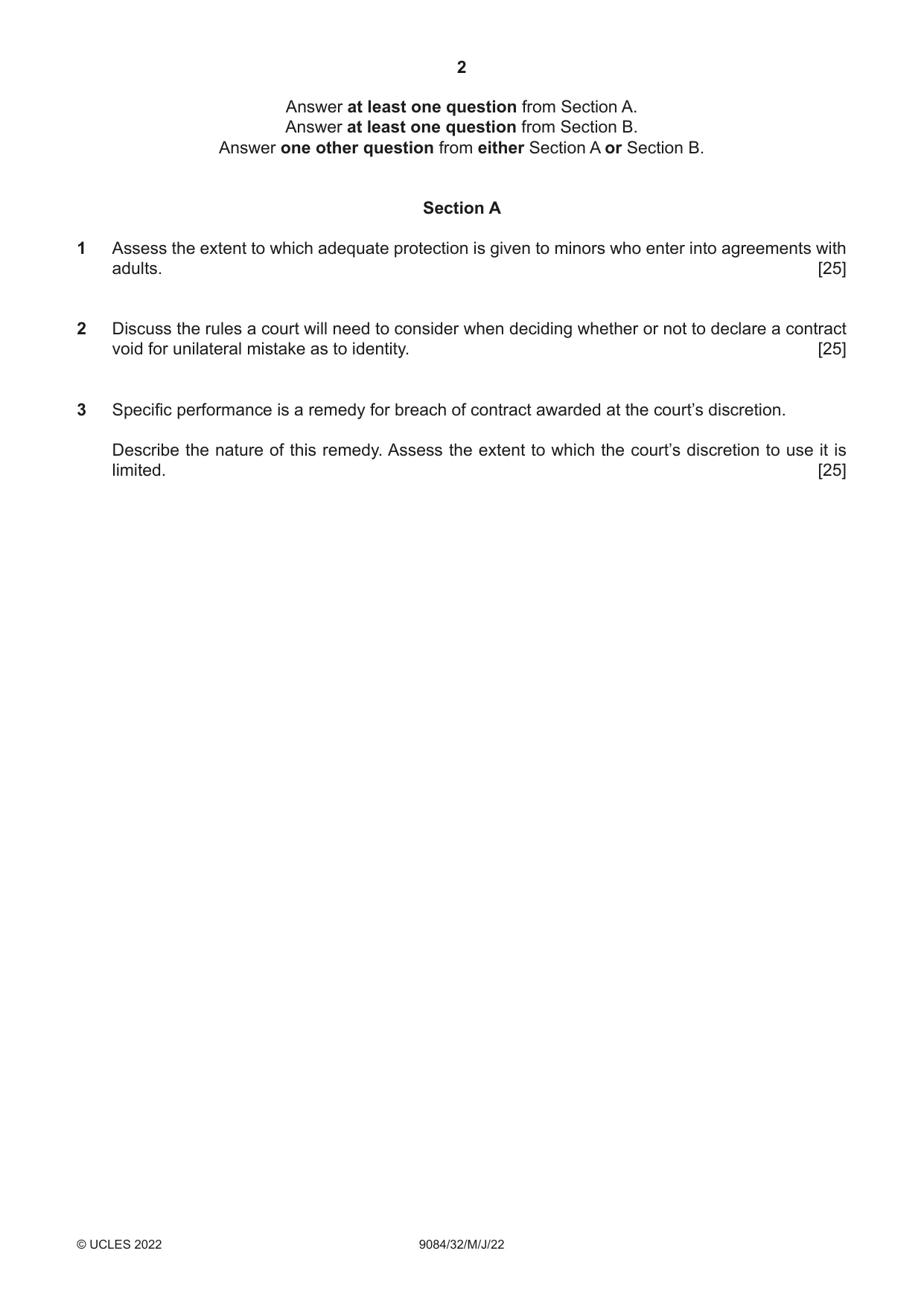
2 9084/32/M/J/22 © UCLES 2022 Answer at least one question from Section A. Answer at least one question from Section B. Answer one other question from either Section A or Section B. Section A 1 Assess the extent to which adequate protection is given to minors who enter into agreements with adults. [25] 2 Discuss the rules a court will need to consider when deciding whether or not to declare a contract void for unilateral mistake as to identity. [25] 3 Specific performance is a remedy for breach of contract awarded at the court’s discretion. Describe the nature of this remedy. Assess the extent to which the court’s discretion to use it is limited. [25]
Question paper, page 3
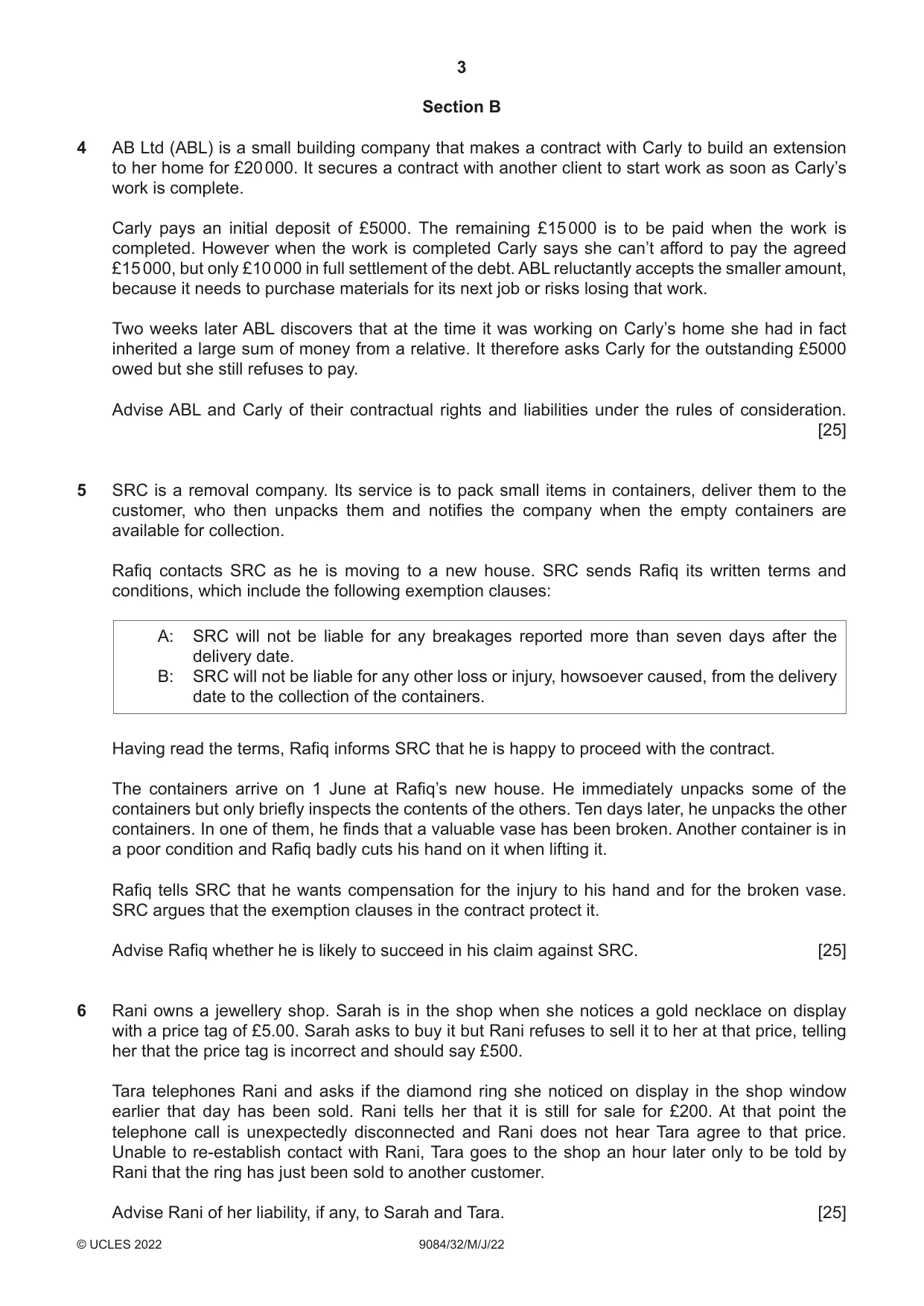
3 9084/32/M/J/22 © UCLES 2022 Section B 4 AB Ltd (ABL) is a small building company that makes a contract with Carly to build an extension to her home for £20 000. It secures a contract with another client to start work as soon as Carly’s work is complete. Carly pays an initial deposit of £5000. The remaining £15 000 is to be paid when the work is completed. However when the work is completed Carly says she can’t afford to pay the agreed £15 000, but only £10 000 in full settlement of the debt. ABL reluctantly accepts the smaller amount, because it needs to purchase materials for its next job or risks losing that work. Two weeks later ABL discovers that at the time it was working on Carly’s home she had in fact inherited a large sum of money from a relative. It therefore asks Carly for the outstanding £5000 owed but she still refuses to pay. Advise ABL and Carly of their contractual rights and liabilities under the rules of consideration. [25] 5 SRC is a removal company. Its service is to pack small items in containers, deliver them to the customer, who then unpacks them and notifies the company when the empty containers are available for collection. Rafiq contacts SRC as he is moving to a new house. SRC sends Rafiq its written terms and conditions, which include the following exemption clauses: A: SRC will not be liable for any breakages reported more than seven days after the delivery date. B: SRC will not be liable for any other loss or injury, howsoever caused, from the delivery date to the collection of the containers. Having read the terms, Rafiq informs SRC that he is happy to proceed with the contract. The containers arrive on 1 June at Rafiq’s new house. He immediately unpacks some of the containers but only briefly inspects the contents of the others. Ten days later, he unpacks the other containers. In one of them, he finds that a valuable vase has been broken. Another container is in a poor condition and Rafiq badly cuts his hand on it when lifting it. Rafiq tells SRC that he wants compensation for the injury to his hand and for the broken vase. SRC argues that the exemption clauses in the contract protect it. Advise Rafiq whether he is likely to succeed in his claim against SRC. [25] 6 Rani owns a jewellery shop. Sarah is in the shop when she notices a gold necklace on display with a price tag of £5.00. Sarah asks to buy it but Rani refuses to sell it to her at that price, telling her that the price tag is incorrect and should say £500. Tara telephones Rani and asks if the diamond ring she noticed on display in the shop window earlier that day has been sold. Rani tells her that it is still for sale for £200. At that point the telephone call is unexpectedly disconnected and Rani does not hear Tara agree to that price. Unable to re-establish contact with Rani, Tara goes to the shop an hour later only to be told by Rani that the ring has just been sold to another customer. Advise Rani of her liability, if any, to Sarah and Tara. [25]
Question paper, page 4
4 9084/32/M/J/22 © UCLES 2022 Permission to reproduce items where third-party owned material protected by copyright is included has been sought and cleared where possible. Every reasonable effort has been made by the publisher (UCLES) to trace copyright holders, but if any items requiring clearance have unwittingly been included, the publisher will be pleased to make amends at the earliest possible opportunity. To avoid the issue of disclosure of answer-related information to candidates, all copyright acknowledgements are reproduced online in the Cambridge Assessment International Education Copyright Acknowledgements Booklet. This is produced for each series of examinations and is freely available to download at www.cambridgeinternational.org after the live examination series. Cambridge Assessment International Education is part of Cambridge Assessment. Cambridge Assessment is the brand name of the University of Cambridge Local Examinations Syndicate (UCLES), which is a department of the University of Cambridge. BLANK PAGE
Mark scheme, page 1
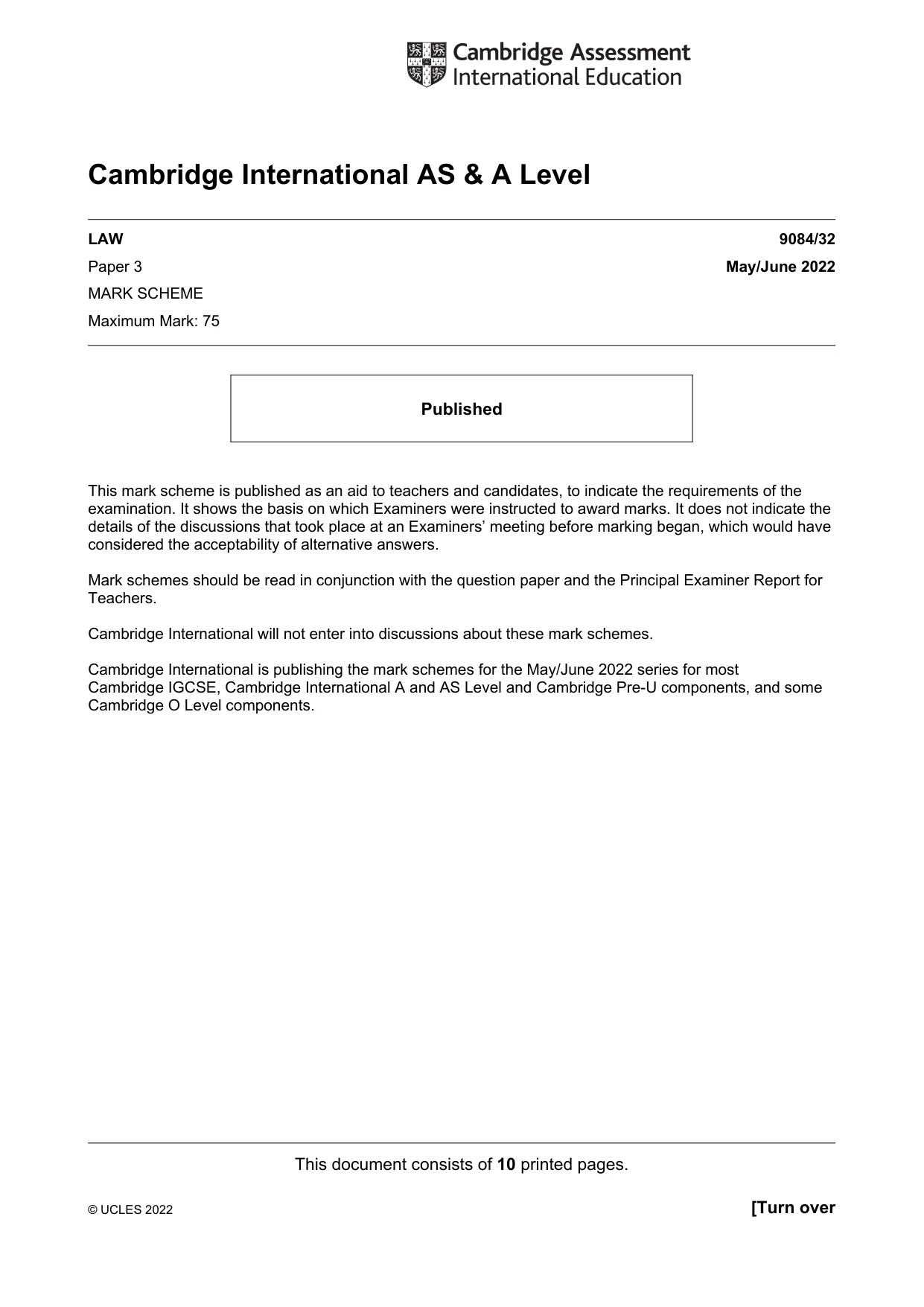
This document consists of 10 printed pages. © UCLES 2022 [Turn over Cambridge International AS & A Level LAW 9084/32 Paper 3 May/June 2022 MARK SCHEME Maximum Mark: 75 Published This mark scheme is published as an aid to teachers and candidates, to indicate the requirements of the examination. It shows the basis on which Examiners were instructed to award marks. It does not indicate the details of the discussions that took place at an Examiners’ meeting before marking began, which would have considered the acceptability of alternative answers. Mark schemes should be read in conjunction with the question paper and the Principal Examiner Report for Teachers. Cambridge International will not enter into discussions about these mark schemes. Cambridge International is publishing the mark schemes for the May/June 2022 series for most Cambridge IGCSE, Cambridge International A and AS Level and Cambridge Pre-U components, and some Cambridge O Level components.
Mark scheme, page 2
9084/32 Cambridge International AS & A Level – Mark Scheme PUBLISHED May/June 2022 © UCLES 2022 Page 2 of 10 Generic Marking Principles These general marking principles must be applied by all examiners when marking candidate answers. They should be applied alongside the specific content of the mark scheme or generic level descriptors for a question. Each question paper and mark scheme will also comply with these marking principles. GENERIC MARKING PRINCIPLE 1: Marks must be awarded in line with: the specific content of the mark scheme or the generic level descriptors for the question the specific skills defined in the mark scheme or in the generic level descriptors for the question the standard of response required by a candidate as exemplified by the standardisation scripts. GENERIC MARKING PRINCIPLE 2: Marks awarded are always whole marks (not half marks, or other fractions). GENERIC MARKING PRINCIPLE 3: Marks must be awarded positively: marks are awarded for correct/valid answers, as defined in the mark scheme. However, credit is given for valid answers which go beyond the scope of the syllabus and mark scheme, referring to your Team Leader as appropriate marks are awarded when candidates clearly demonstrate what they know and can do marks are not deducted for errors marks are not deducted for omissions answers should only be judged on the quality of spelling, punctuation and grammar when these features are specifically assessed by the question as indicated by the mark scheme. The meaning, however, should be unambiguous. GENERIC MARKING PRINCIPLE 4: Rules must be applied consistently, e.g. in situations where candidates have not followed instructions or in the application of generic level descriptors. GENERIC MARKING PRINCIPLE 5: Marks should be awarded using the full range of marks defined in the mark scheme for the question (however; the use of the full mark range may be limited according to the quality of the candidate responses seen). GENERIC MARKING PRINCIPLE 6: Marks awarded are based solely on the requirements as defined in the mark scheme. Marks should not be awarded with grade thresholds or grade descriptors in mind.
Mark scheme, page 3
9084/32 Cambridge International AS & A Level – Mark Scheme PUBLISHED May/June 2022 © UCLES 2022 Page 3 of 10 Social Science-Specific Marking Principles (for point-based marking) 1 Components using point-based marking: Point marking is often used to reward knowledge, understanding and application of skills. We give credit where the candidate’s answer shows relevant knowledge, understanding and application of skills in answering the question. We do not give credit where the answer shows confusion. From this it follows that we: a DO credit answers which are worded differently from the mark scheme if they clearly convey the same meaning (unless the mark scheme requires a specific term) b DO credit alternative answers/examples which are not written in the mark scheme if they are correct c DO credit answers where candidates give more than one correct answer in one prompt/numbered/scaffolded space where extended writing is required rather than list-type answers. For example, questions that require n reasons (e.g. State two reasons …). d DO NOT credit answers simply for using a ‘key term’ unless that is all that is required. (Check for evidence it is understood and not used wrongly.) e DO NOT credit answers which are obviously self-contradicting or trying to cover all possibilities f DO NOT give further credit for what is effectively repetition of a correct point already credited unless the language itself is being tested. This applies equally to ‘mirror statements’ (i.e. polluted/not polluted). g DO NOT require spellings to be correct, unless this is part of the test. However spellings of syllabus terms must allow for clear and unambiguous separation from other syllabus terms with which they may be confused (e.g. Corrasion/Corrosion) 2 Presentation of mark scheme: Slashes (/) or the word ‘or’ separate alternative ways of making the same point. Semi colons (;) bullet points (•) or figures in brackets (1) separate different points. Content in the answer column in brackets is for examiner information/context to clarify the marking but is not required to earn the mark (except Accounting syllabuses where they indicate negative numbers). 3 Annotation: For point marking, ticks can be used to indicate correct answers and crosses can be used to indicate wrong answers. There is no direct relationship between ticks and marks. Ticks have no defined meaning for levels of response marking. For levels of response marking, the level awarded should be annotated on the script. Other annotations will be used by examiners as agreed during standardisation, and the meaning will be understood by all examiners who marked that paper.
Mark scheme, page 4
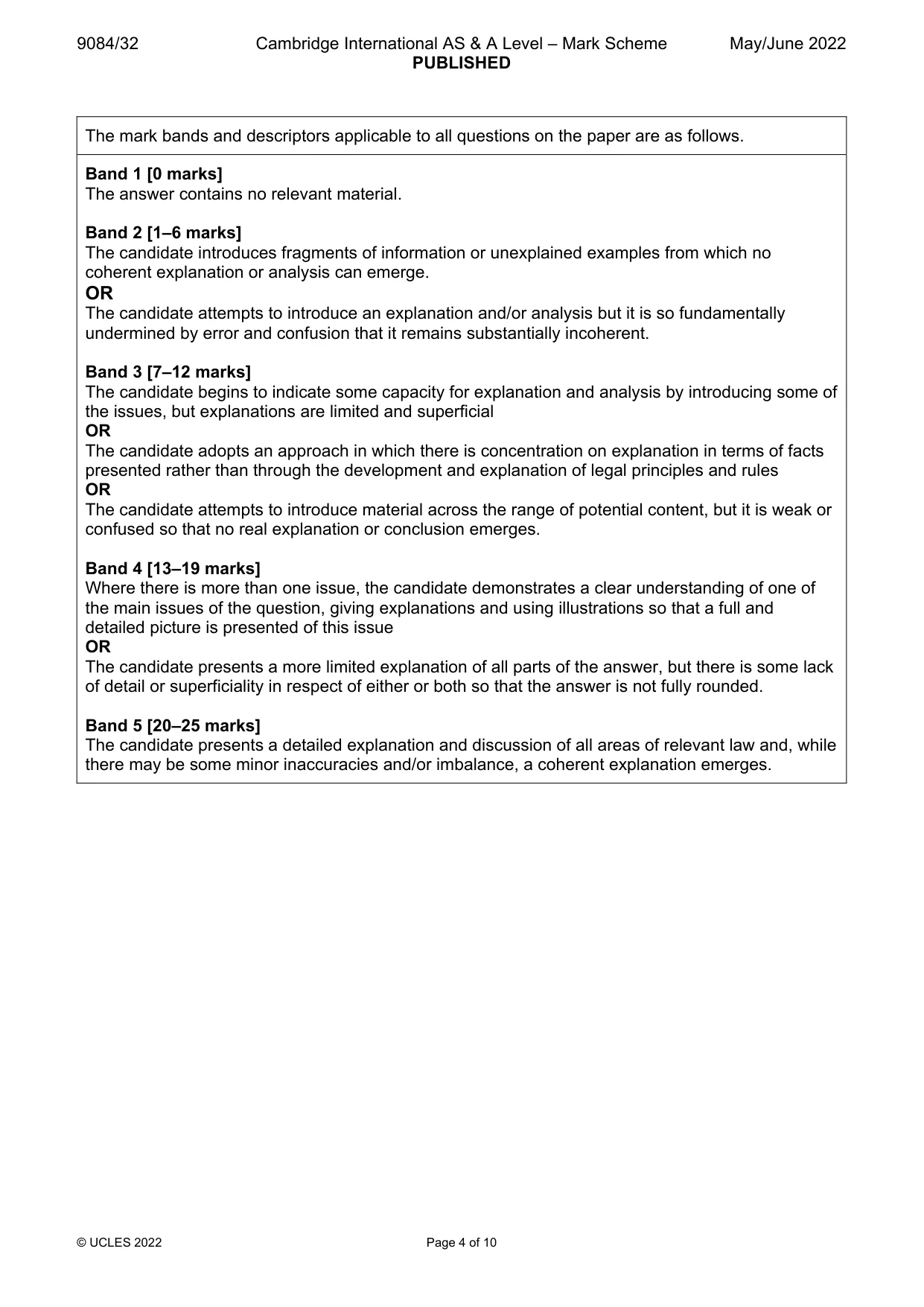
9084/32 Cambridge International AS & A Level – Mark Scheme PUBLISHED May/June 2022 © UCLES 2022 Page 4 of 10 The mark bands and descriptors applicable to all questions on the paper are as follows. Band 1 [0 marks] The answer contains no relevant material. Band 2 [1–6 marks] The candidate introduces fragments of information or unexplained examples from which no coherent explanation or analysis can emerge. OR The candidate attempts to introduce an explanation and/or analysis but it is so fundamentally undermined by error and confusion that it remains substantially incoherent. Band 3 [7–12 marks] The candidate begins to indicate some capacity for explanation and analysis by introducing some of the issues, but explanations are limited and superficial OR The candidate adopts an approach in which there is concentration on explanation in terms of facts presented rather than through the development and explanation of legal principles and rules OR The candidate attempts to introduce material across the range of potential content, but it is weak or confused so that no real explanation or conclusion emerges. Band 4 [13–19 marks] Where there is more than one issue, the candidate demonstrates a clear understanding of one of the main issues of the question, giving explanations and using illustrations so that a full and detailed picture is presented of this issue OR The candidate presents a more limited explanation of all parts of the answer, but there is some lack of detail or superficiality in respect of either or both so that the answer is not fully rounded. Band 5 [20–25 marks] The candidate presents a detailed explanation and discussion of all areas of relevant law and, while there may be some minor inaccuracies and/or imbalance, a coherent explanation emerges.
Mark scheme, page 5
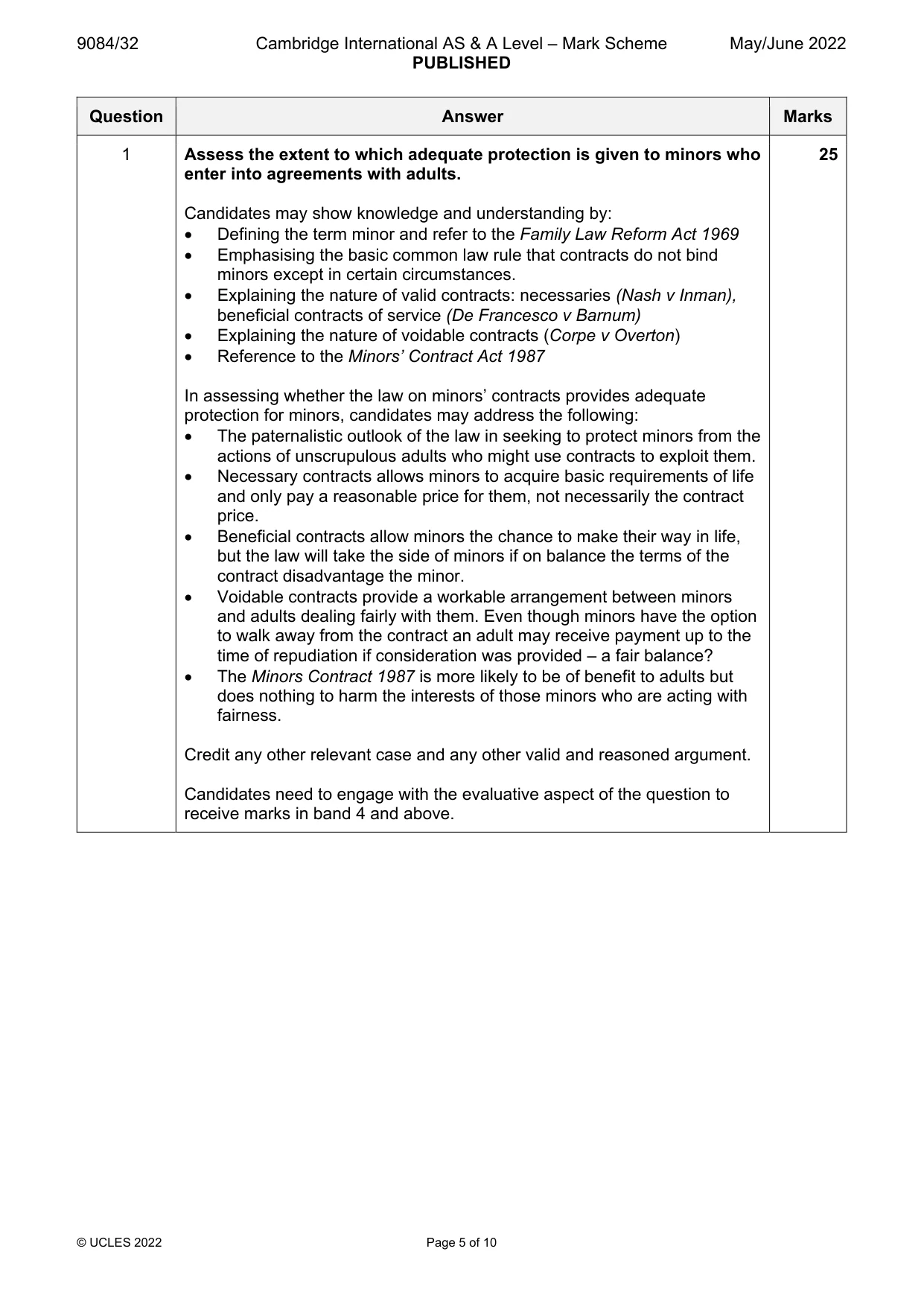
9084/32 Cambridge International AS & A Level – Mark Scheme PUBLISHED May/June 2022 © UCLES 2022 Page 5 of 10 Question Answer Marks 1 Assess the extent to which adequate protection is given to minors who enter into agreements with adults. Candidates may show knowledge and understanding by: Defining the term minor and refer to the Family Law Reform Act 1969 Emphasising the basic common law rule that contracts do not bind minors except in certain circumstances. Explaining the nature of valid contracts: necessaries (Nash v Inman), beneficial contracts of service (De Francesco v Barnum) Explaining the nature of voidable contracts (Corpe v Overton) Reference to the Minors’ Contract Act 1987 In assessing whether the law on minors’ contracts provides adequate protection for minors, candidates may address the following: The paternalistic outlook of the law in seeking to protect minors from the actions of unscrupulous adults who might use contracts to exploit them. Necessary contracts allows minors to acquire basic requirements of life and only pay a reasonable price for them, not necessarily the contract price. Beneficial contracts allow minors the chance to make their way in life, but the law will take the side of minors if on balance the terms of the contract disadvantage the minor. Voidable contracts provide a workable arrangement between minors and adults dealing fairly with them. Even though minors have the option to walk away from the contract an adult may receive payment up to the time of repudiation if consideration was provided – a fair balance? The Minors Contract 1987 is more likely to be of benefit to adults but does nothing to harm the interests of those minors who are acting with fairness. Credit any other relevant case and any other valid and reasoned argument. Candidates need to engage with the evaluative aspect of the question to receive marks in band 4 and above. 25
Mark scheme, page 6
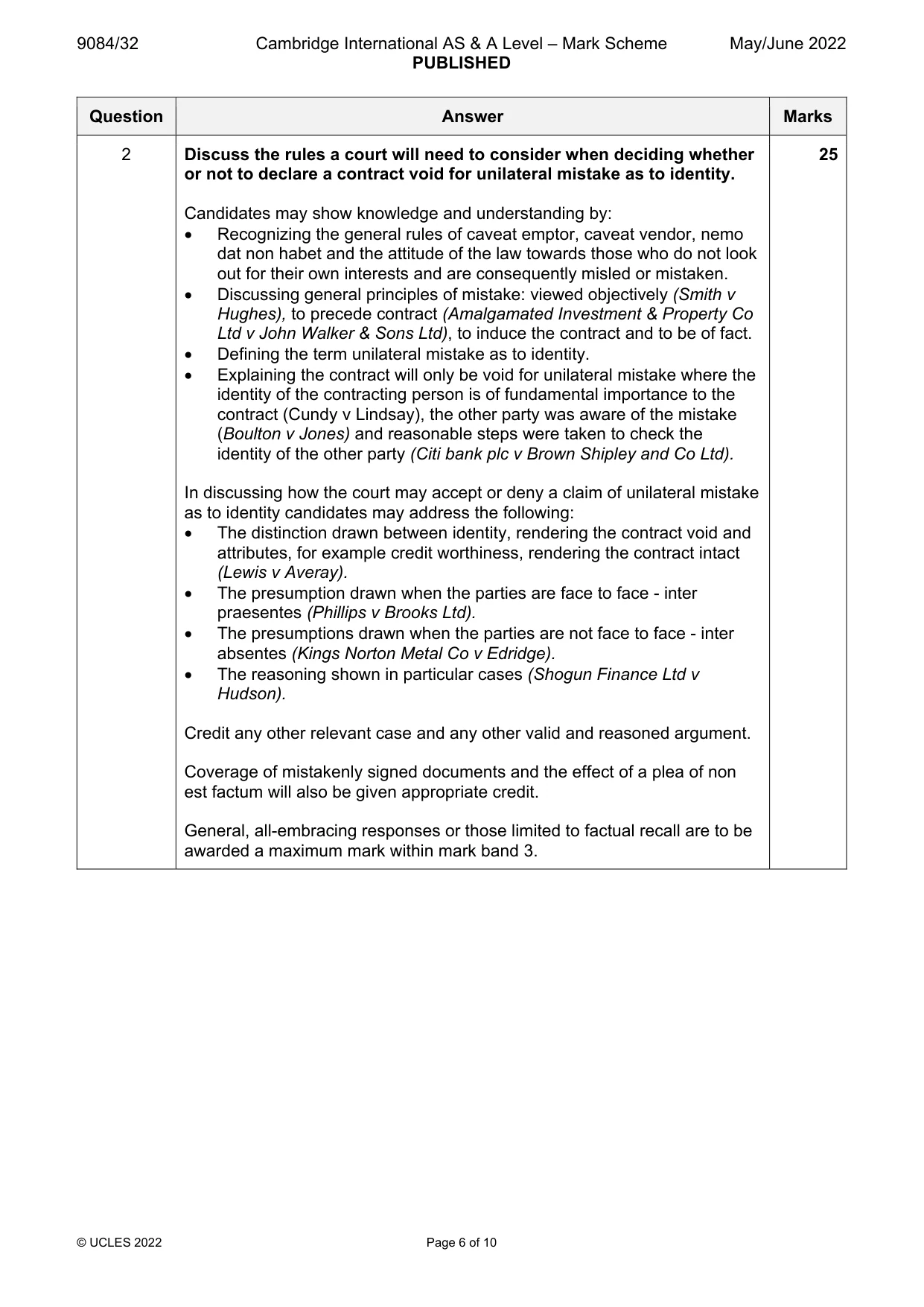
9084/32 Cambridge International AS & A Level – Mark Scheme PUBLISHED May/June 2022 © UCLES 2022 Page 6 of 10 Question Answer Marks 2 Discuss the rules a court will need to consider when deciding whether or not to declare a contract void for unilateral mistake as to identity. Candidates may show knowledge and understanding by: Recognizing the general rules of caveat emptor, caveat vendor, nemo dat non habet and the attitude of the law towards those who do not look out for their own interests and are consequently misled or mistaken. Discussing general principles of mistake: viewed objectively (Smith v Hughes), to precede contract (Amalgamated Investment & Property Co Ltd v John Walker & Sons Ltd), to induce the contract and to be of fact. Defining the term unilateral mistake as to identity. Explaining the contract will only be void for unilateral mistake where the identity of the contracting person is of fundamental importance to the contract (Cundy v Lindsay), the other party was aware of the mistake (Boulton v Jones) and reasonable steps were taken to check the identity of the other party (Citi bank plc v Brown Shipley and Co Ltd). In discussing how the court may accept or deny a claim of unilateral mistake as to identity candidates may address the following: The distinction drawn between identity, rendering the contract void and attributes, for example credit worthiness, rendering the contract intact (Lewis v Averay). The presumption drawn when the parties are face to face - inter praesentes (Phillips v Brooks Ltd). The presumptions drawn when the parties are not face to face - inter absentes (Kings Norton Metal Co v Edridge). The reasoning shown in particular cases (Shogun Finance Ltd v Hudson). Credit any other relevant case and any other valid and reasoned argument. Coverage of mistakenly signed documents and the effect of a plea of non est factum will also be given appropriate credit. General, all-embracing responses or those limited to factual recall are to be awarded a maximum mark within mark band 3. 25
Mark scheme, page 7
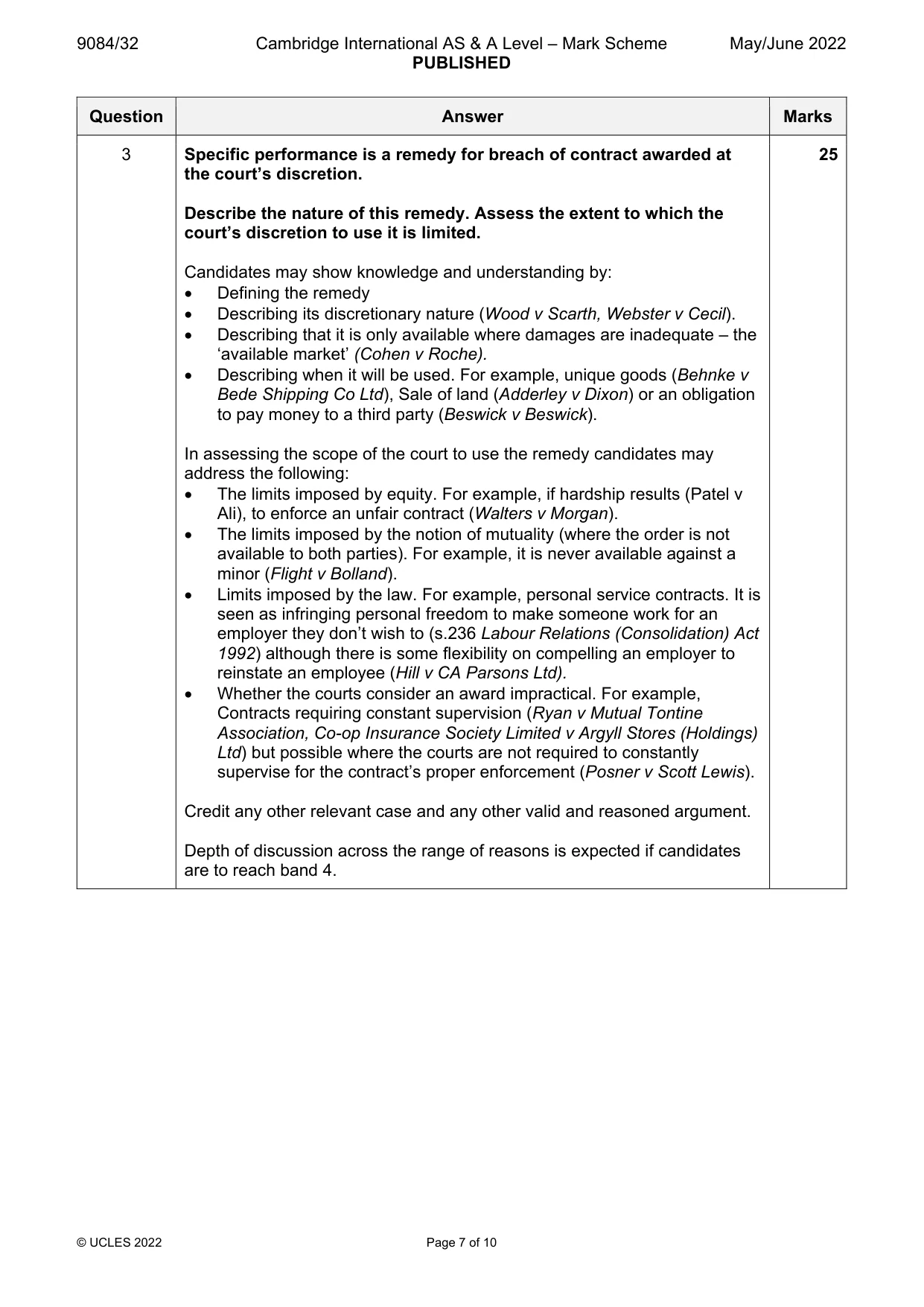
9084/32 Cambridge International AS & A Level – Mark Scheme PUBLISHED May/June 2022 © UCLES 2022 Page 7 of 10 Question Answer Marks 3 Specific performance is a remedy for breach of contract awarded at the court’s discretion. Describe the nature of this remedy. Assess the extent to which the court’s discretion to use it is limited. Candidates may show knowledge and understanding by: Defining the remedy Describing its discretionary nature (Wood v Scarth, Webster v Cecil). Describing that it is only available where damages are inadequate – the ‘available market’ (Cohen v Roche). Describing when it will be used. For example, unique goods (Behnke v Bede Shipping Co Ltd), Sale of land (Adderley v Dixon) or an obligation to pay money to a third party (Beswick v Beswick). In assessing the scope of the court to use the remedy candidates may address the following: The limits imposed by equity. For example, if hardship results (Patel v Ali), to enforce an unfair contract (Walters v Morgan). The limits imposed by the notion of mutuality (where the order is not available to both parties). For example, it is never available against a minor (Flight v Bolland). Limits imposed by the law. For example, personal service contracts. It is seen as infringing personal freedom to make someone work for an employer they don’t wish to (s.236 Labour Relations (Consolidation) Act 1992) although there is some flexibility on compelling an employer to reinstate an employee (Hill v CA Parsons Ltd). Whether the courts consider an award impractical. For example, Contracts requiring constant supervision (Ryan v Mutual Tontine Association, Co-op Insurance Society Limited v Argyll Stores (Holdings) Ltd) but possible where the courts are not required to constantly supervise for the contract’s proper enforcement (Posner v Scott Lewis). Credit any other relevant case and any other valid and reasoned argument. Depth of discussion across the range of reasons is expected if candidates are to reach band 4. 25
Mark scheme, page 8
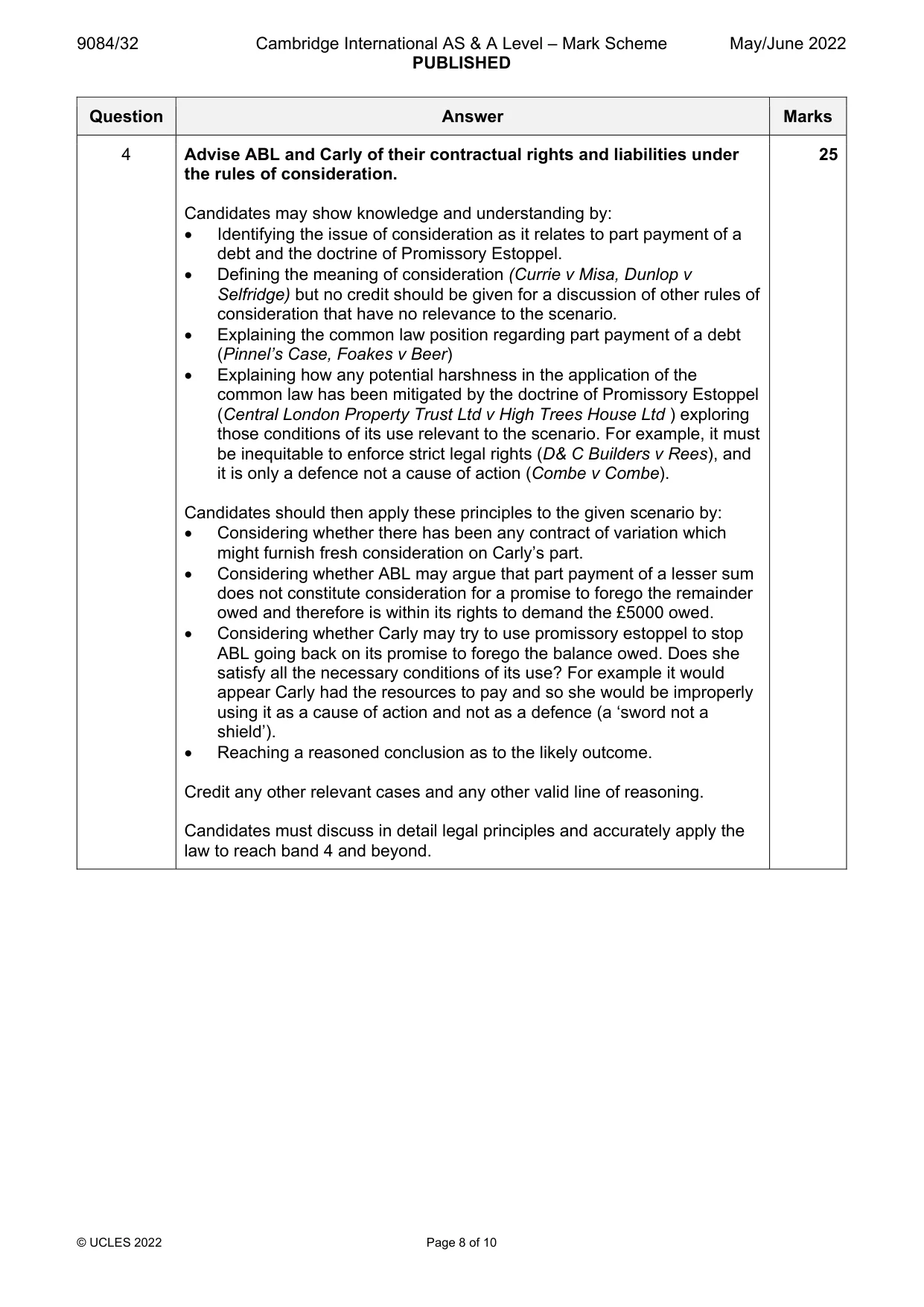
9084/32 Cambridge International AS & A Level – Mark Scheme PUBLISHED May/June 2022 © UCLES 2022 Page 8 of 10 Question Answer Marks 4 Advise ABL and Carly of their contractual rights and liabilities under the rules of consideration. Candidates may show knowledge and understanding by: Identifying the issue of consideration as it relates to part payment of a debt and the doctrine of Promissory Estoppel. Defining the meaning of consideration (Currie v Misa, Dunlop v Selfridge) but no credit should be given for a discussion of other rules of consideration that have no relevance to the scenario. Explaining the common law position regarding part payment of a debt (Pinnel’s Case, Foakes v Beer) Explaining how any potential harshness in the application of the common law has been mitigated by the doctrine of Promissory Estoppel (Central London Property Trust Ltd v High Trees House Ltd ) exploring those conditions of its use relevant to the scenario. For example, it must be inequitable to enforce strict legal rights (D& C Builders v Rees), and it is only a defence not a cause of action (Combe v Combe). Candidates should then apply these principles to the given scenario by: Considering whether there has been any contract of variation which might furnish fresh consideration on Carly’s part. Considering whether ABL may argue that part payment of a lesser sum does not constitute consideration for a promise to forego the remainder owed and therefore is within its rights to demand the £5000 owed. Considering whether Carly may try to use promissory estoppel to stop ABL going back on its promise to forego the balance owed. Does she satisfy all the necessary conditions of its use? For example it would appear Carly had the resources to pay and so she would be improperly using it as a cause of action and not as a defence (a ‘sword not a shield’). Reaching a reasoned conclusion as to the likely outcome. Credit any other relevant cases and any other valid line of reasoning. Candidates must discuss in detail legal principles and accurately apply the law to reach band 4 and beyond. 25
Mark scheme, page 9
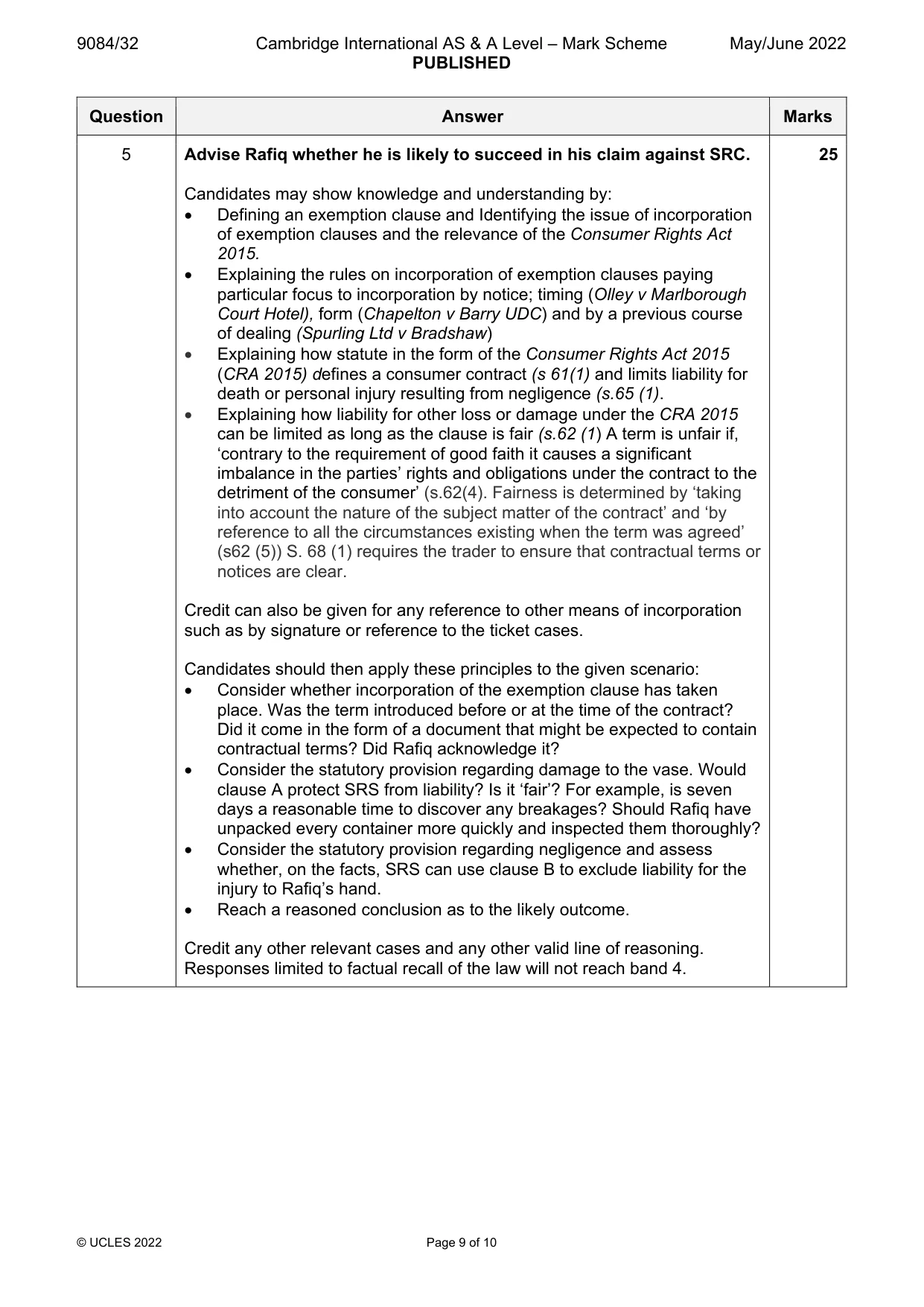
9084/32 Cambridge International AS & A Level – Mark Scheme PUBLISHED May/June 2022 © UCLES 2022 Page 9 of 10 Question Answer Marks 5 Advise Rafiq whether he is likely to succeed in his claim against SRC. Candidates may show knowledge and understanding by: Defining an exemption clause and Identifying the issue of incorporation of exemption clauses and the relevance of the Consumer Rights Act 2015. Explaining the rules on incorporation of exemption clauses paying particular focus to incorporation by notice; timing (Olley v Marlborough Court Hotel), form (Chapelton v Barry UDC) and by a previous course of dealing (Spurling Ltd v Bradshaw) Explaining how statute in the form of the Consumer Rights Act 2015 (CRA 2015) defines a consumer contract (s 61(1) and limits liability for death or personal injury resulting from negligence (s.65 (1). Explaining how liability for other loss or damage under the CRA 2015 can be limited as long as the clause is fair (s.62 (1) A term is unfair if, ‘contrary to the requirement of good faith it causes a significant imbalance in the parties’ rights and obligations under the contract to the detriment of the consumer’ (s.62(4). Fairness is determined by ‘taking into account the nature of the subject matter of the contract’ and ‘by reference to all the circumstances existing when the term was agreed’ (s62 (5)) S. 68 (1) requires the trader to ensure that contractual terms or notices are clear. Credit can also be given for any reference to other means of incorporation such as by signature or reference to the ticket cases. Candidates should then apply these principles to the given scenario: Consider whether incorporation of the exemption clause has taken place. Was the term introduced before or at the time of the contract? Did it come in the form of a document that might be expected to contain contractual terms? Did Rafiq acknowledge it? Consider the statutory provision regarding damage to the vase. Would clause A protect SRS from liability? Is it ‘fair’? For example, is seven days a reasonable time to discover any breakages? Should Rafiq have unpacked every container more quickly and inspected them thoroughly? Consider the statutory provision regarding negligence and assess whether, on the facts, SRS can use clause B to exclude liability for the injury to Rafiq’s hand. Reach a reasoned conclusion as to the likely outcome. Credit any other relevant cases and any other valid line of reasoning. Responses limited to factual recall of the law will not reach band 4. 25
Mark scheme, page 10
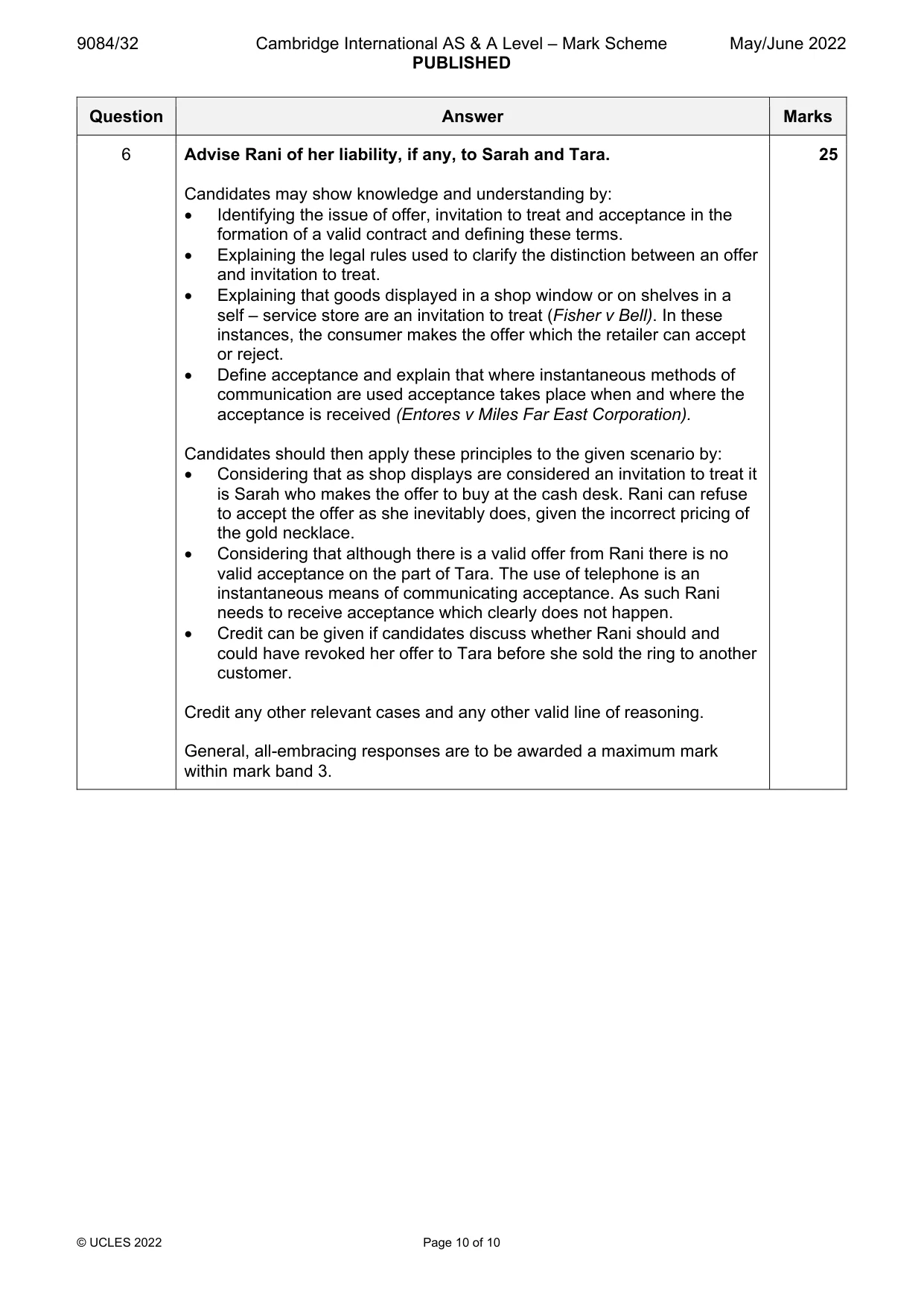
9084/32 Cambridge International AS & A Level – Mark Scheme PUBLISHED May/June 2022 © UCLES 2022 Page 10 of 10 Question Answer Marks 6 Advise Rani of her liability, if any, to Sarah and Tara. Candidates may show knowledge and understanding by: Identifying the issue of offer, invitation to treat and acceptance in the formation of a valid contract and defining these terms. Explaining the legal rules used to clarify the distinction between an offer and invitation to treat. Explaining that goods displayed in a shop window or on shelves in a self – service store are an invitation to treat (Fisher v Bell). In these instances, the consumer makes the offer which the retailer can accept or reject. Define acceptance and explain that where instantaneous methods of communication are used acceptance takes place when and where the acceptance is received (Entores v Miles Far East Corporation). Candidates should then apply these principles to the given scenario by: Considering that as shop displays are considered an invitation to treat it is Sarah who makes the offer to buy at the cash desk. Rani can refuse to accept the offer as she inevitably does, given the incorrect pricing of the gold necklace. Considering that although there is a valid offer from Rani there is no valid acceptance on the part of Tara. The use of telephone is an instantaneous means of communicating acceptance. As such Rani needs to receive acceptance which clearly does not happen. Credit can be given if candidates discuss whether Rani should and could have revoked her offer to Tara before she sold the ring to another customer. Credit any other relevant cases and any other valid line of reasoning. General, all-embracing responses are to be awarded a maximum mark within mark band 3. 25
What you needed in this session
Cambridge’s own grade thresholds for 2022 May/June, Paper 3 · Variant 2. A higher threshold means an easier paper — the bar moves with how the cohort did.