Cambridge A Level Law 9084 — 2022 May/June Paper 3 · Variant 1
9084/31/M/J/22 · 75 marks · ≈84 min
The question paper and its mark scheme, free to read here and free to download. This is Cambridge’s own paper, exactly as it was sat.
Question paper4 pages

Mark scheme10 pages
Answers below. Sit the paper first if you are practising.
Paper as text
Question paper, page 1
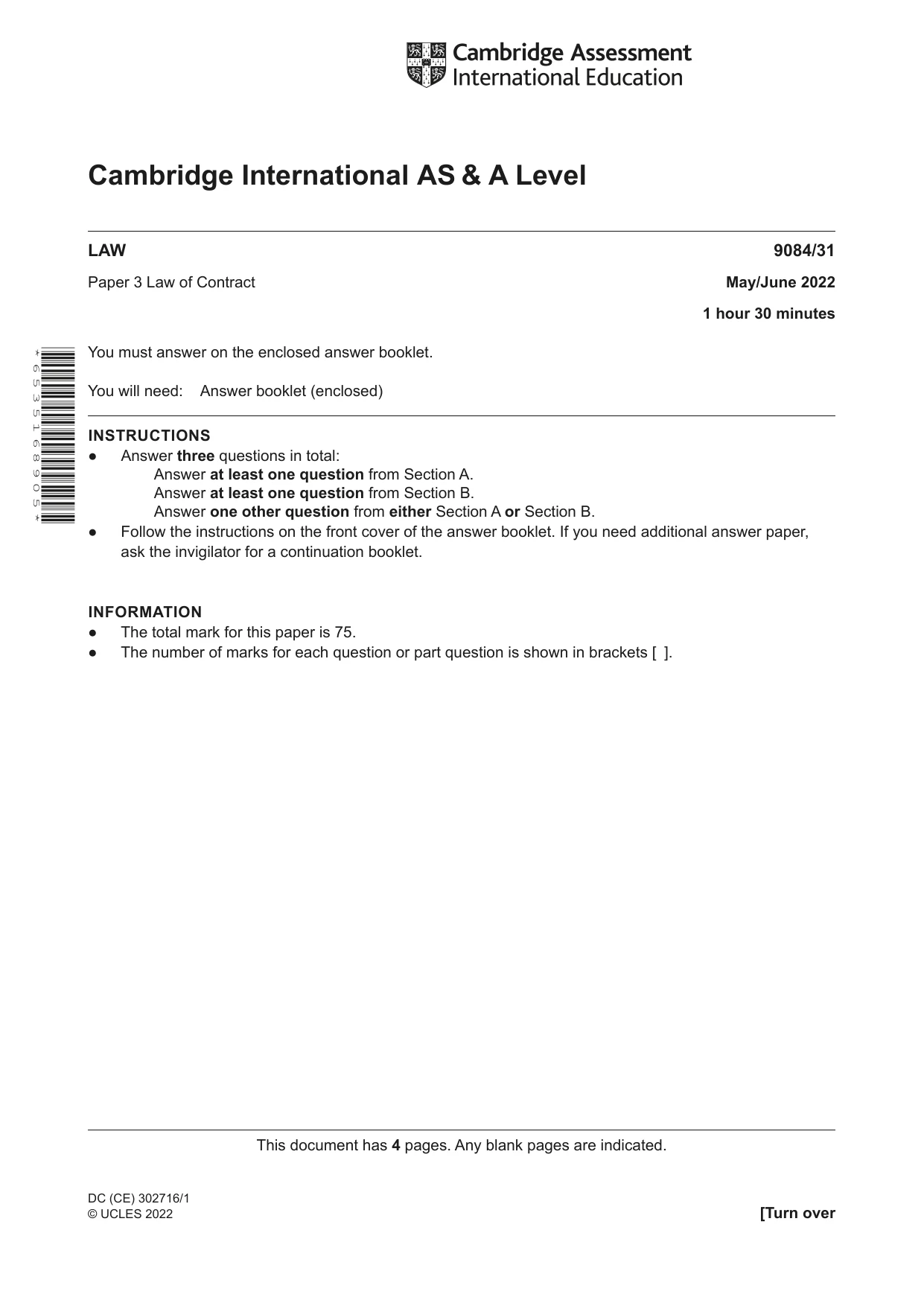
This document has 4 pages. Any blank pages are indicated. [Turn over Cambridge International AS & A Level * 6 5 3 5 1 6 8 9 0 5 * LAW 9084/31 Paper 3 Law of Contract May/June 2022 1 hour 30 minutes You must answer on the enclosed answer booklet. You will need: Answer booklet (enclosed) INSTRUCTIONS ● Answer three questions in total: Answer at least one question from Section A. Answer at least one question from Section B. Answer one other question from either Section A or Section B. ● Follow the instructions on the front cover of the answer booklet. If you need additional answer paper, ask the invigilator for a continuation booklet. INFORMATION ● The total mark for this paper is 75. ● The number of marks for each question or part question is shown in brackets [ ]. DC (CE) 302716/1 © UCLES 2022
Question paper, page 2
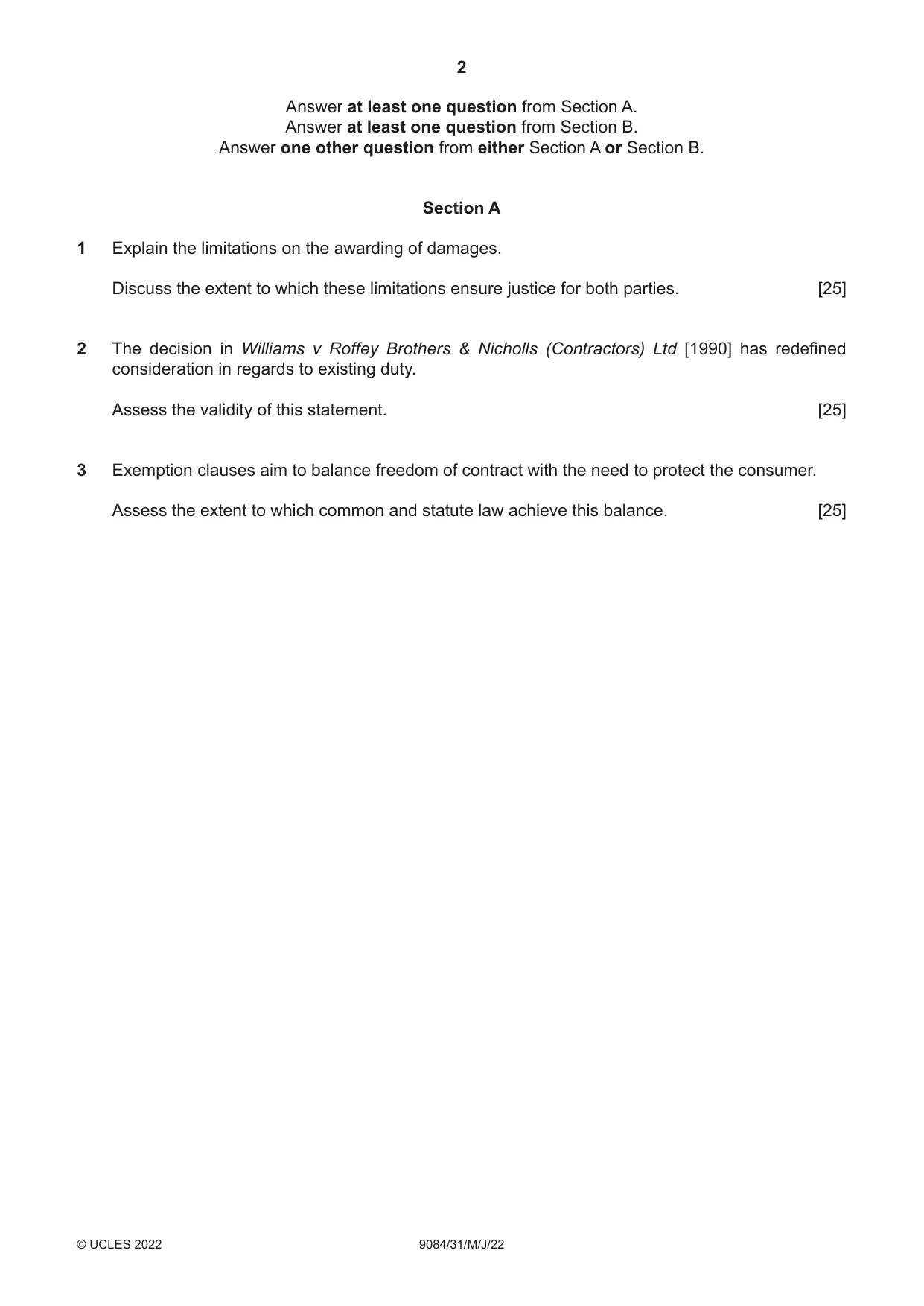
2 9084/31/M/J/22 © UCLES 2022 Answer at least one question from Section A. Answer at least one question from Section B. Answer one other question from either Section A or Section B. Section A 1 Explain the limitations on the awarding of damages. Discuss the extent to which these limitations ensure justice for both parties. [25] 2 The decision in Williams v Roffey Brothers & Nicholls (Contractors) Ltd [1990] has redefined consideration in regards to existing duty. Assess the validity of this statement. [25] 3 Exemption clauses aim to balance freedom of contract with the need to protect the consumer. Assess the extent to which common and statute law achieve this balance. [25]
Question paper, page 3
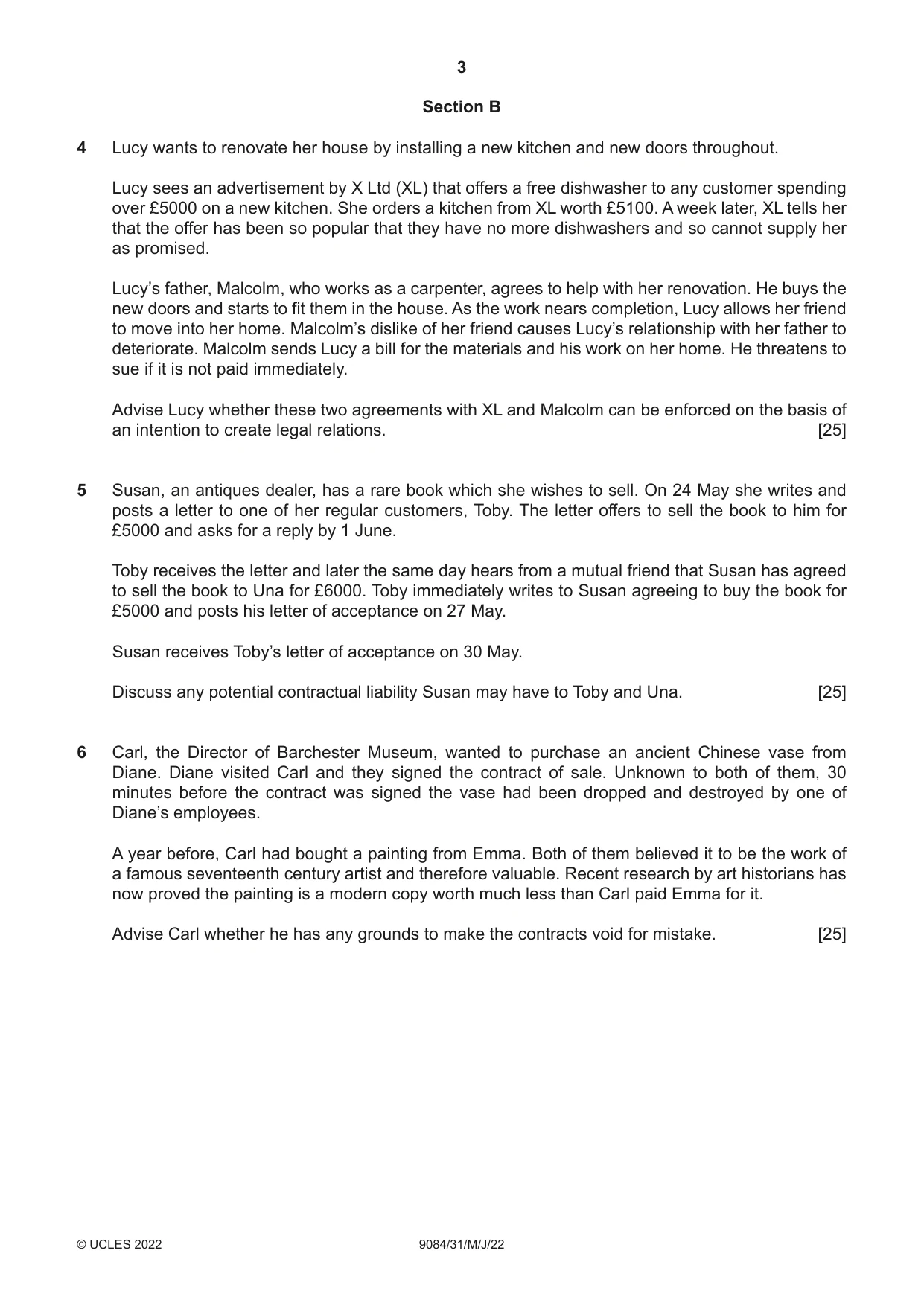
3 9084/31/M/J/22 © UCLES 2022 Section B 4 Lucy wants to renovate her house by installing a new kitchen and new doors throughout. Lucy sees an advertisement by X Ltd (XL) that offers a free dishwasher to any customer spending over £5000 on a new kitchen. She orders a kitchen from XL worth £5100. A week later, XL tells her that the offer has been so popular that they have no more dishwashers and so cannot supply her as promised. Lucy’s father, Malcolm, who works as a carpenter, agrees to help with her renovation. He buys the new doors and starts to fit them in the house. As the work nears completion, Lucy allows her friend to move into her home. Malcolm’s dislike of her friend causes Lucy’s relationship with her father to deteriorate. Malcolm sends Lucy a bill for the materials and his work on her home. He threatens to sue if it is not paid immediately. Advise Lucy whether these two agreements with XL and Malcolm can be enforced on the basis of an intention to create legal relations. [25] 5 Susan, an antiques dealer, has a rare book which she wishes to sell. On 24 May she writes and posts a letter to one of her regular customers, Toby. The letter offers to sell the book to him for £5000 and asks for a reply by 1 June. Toby receives the letter and later the same day hears from a mutual friend that Susan has agreed to sell the book to Una for £6000. Toby immediately writes to Susan agreeing to buy the book for £5000 and posts his letter of acceptance on 27 May. Susan receives Toby’s letter of acceptance on 30 May. Discuss any potential contractual liability Susan may have to Toby and Una. [25] 6 Carl, the Director of Barchester Museum, wanted to purchase an ancient Chinese vase from Diane. Diane visited Carl and they signed the contract of sale. Unknown to both of them, 30 minutes before the contract was signed the vase had been dropped and destroyed by one of Diane’s employees. A year before, Carl had bought a painting from Emma. Both of them believed it to be the work of a famous seventeenth century artist and therefore valuable. Recent research by art historians has now proved the painting is a modern copy worth much less than Carl paid Emma for it. Advise Carl whether he has any grounds to make the contracts void for mistake. [25]
Question paper, page 4
4 9084/31/M/J/22 © UCLES 2022 Permission to reproduce items where third-party owned material protected by copyright is included has been sought and cleared where possible. Every reasonable effort has been made by the publisher (UCLES) to trace copyright holders, but if any items requiring clearance have unwittingly been included, the publisher will be pleased to make amends at the earliest possible opportunity. To avoid the issue of disclosure of answer-related information to candidates, all copyright acknowledgements are reproduced online in the Cambridge Assessment International Education Copyright Acknowledgements Booklet. This is produced for each series of examinations and is freely available to download at www.cambridgeinternational.org after the live examination series. Cambridge Assessment International Education is part of Cambridge Assessment. Cambridge Assessment is the brand name of the University of Cambridge Local Examinations Syndicate (UCLES), which is a department of the University of Cambridge. BLANK PAGE
Mark scheme, page 1
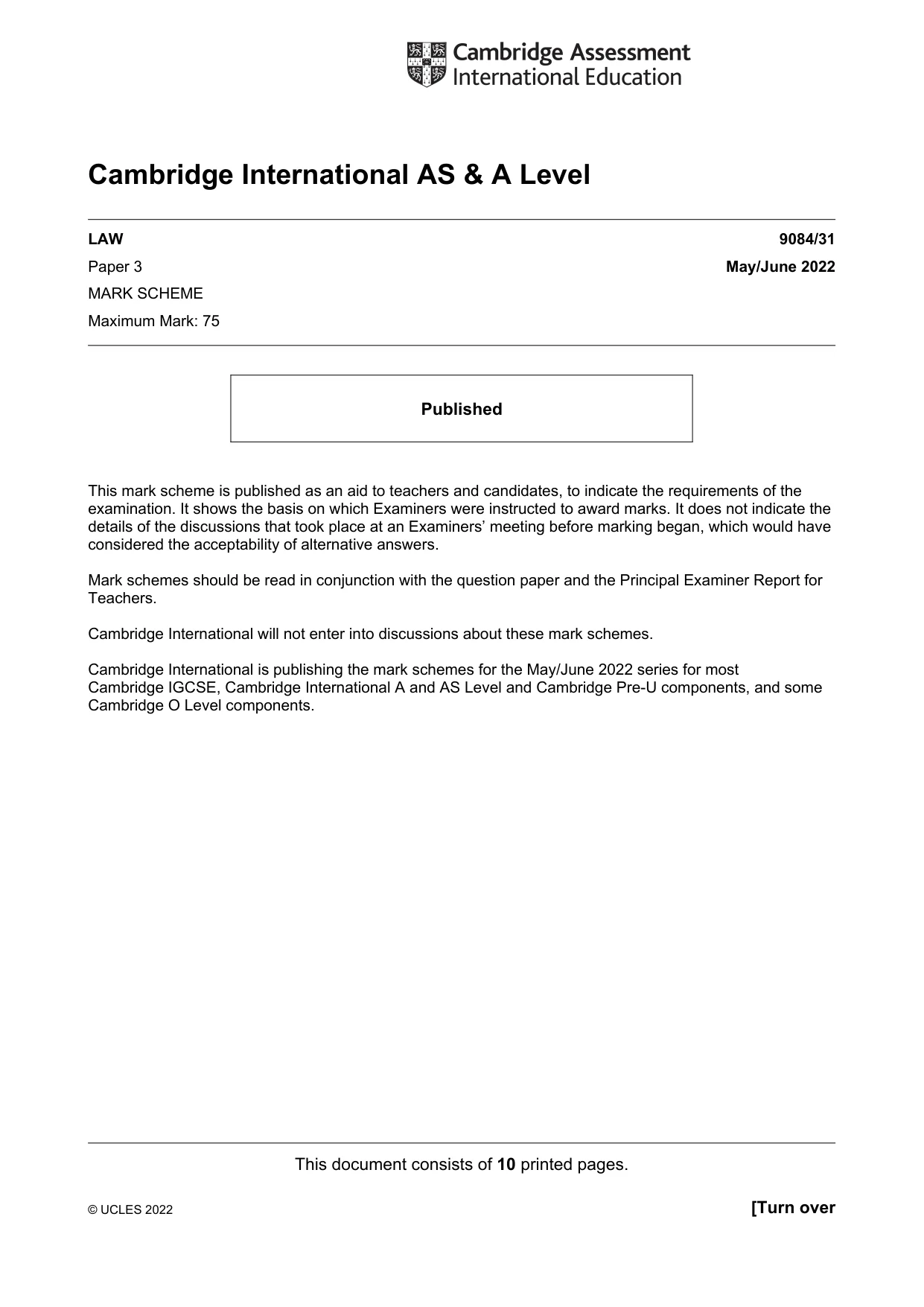
This document consists of 10 printed pages. © UCLES 2022 [Turn over Cambridge International AS & A Level LAW 9084/31 Paper 3 May/June 2022 MARK SCHEME Maximum Mark: 75 Published This mark scheme is published as an aid to teachers and candidates, to indicate the requirements of the examination. It shows the basis on which Examiners were instructed to award marks. It does not indicate the details of the discussions that took place at an Examiners’ meeting before marking began, which would have considered the acceptability of alternative answers. Mark schemes should be read in conjunction with the question paper and the Principal Examiner Report for Teachers. Cambridge International will not enter into discussions about these mark schemes. Cambridge International is publishing the mark schemes for the May/June 2022 series for most Cambridge IGCSE, Cambridge International A and AS Level and Cambridge Pre-U components, and some Cambridge O Level components.
Mark scheme, page 2
9084/31 Cambridge International AS & A Level – Mark Scheme PUBLISHED May/June 2022 © UCLES 2022 Page 2 of 10 Generic Marking Principles These general marking principles must be applied by all examiners when marking candidate answers. They should be applied alongside the specific content of the mark scheme or generic level descriptors for a question. Each question paper and mark scheme will also comply with these marking principles. GENERIC MARKING PRINCIPLE 1: Marks must be awarded in line with: the specific content of the mark scheme or the generic level descriptors for the question the specific skills defined in the mark scheme or in the generic level descriptors for the question the standard of response required by a candidate as exemplified by the standardisation scripts. GENERIC MARKING PRINCIPLE 2: Marks awarded are always whole marks (not half marks, or other fractions). GENERIC MARKING PRINCIPLE 3: Marks must be awarded positively: marks are awarded for correct/valid answers, as defined in the mark scheme. However, credit is given for valid answers which go beyond the scope of the syllabus and mark scheme, referring to your Team Leader as appropriate marks are awarded when candidates clearly demonstrate what they know and can do marks are not deducted for errors marks are not deducted for omissions answers should only be judged on the quality of spelling, punctuation and grammar when these features are specifically assessed by the question as indicated by the mark scheme. The meaning, however, should be unambiguous. GENERIC MARKING PRINCIPLE 4: Rules must be applied consistently, e.g. in situations where candidates have not followed instructions or in the application of generic level descriptors. GENERIC MARKING PRINCIPLE 5: Marks should be awarded using the full range of marks defined in the mark scheme for the question (however; the use of the full mark range may be limited according to the quality of the candidate responses seen). GENERIC MARKING PRINCIPLE 6: Marks awarded are based solely on the requirements as defined in the mark scheme. Marks should not be awarded with grade thresholds or grade descriptors in mind.
Mark scheme, page 3
9084/31 Cambridge International AS & A Level – Mark Scheme PUBLISHED May/June 2022 © UCLES 2022 Page 3 of 10 Social Science-Specific Marking Principles (for point-based marking) 1 Components using point-based marking: Point marking is often used to reward knowledge, understanding and application of skills. We give credit where the candidate’s answer shows relevant knowledge, understanding and application of skills in answering the question. We do not give credit where the answer shows confusion. From this it follows that we: a DO credit answers which are worded differently from the mark scheme if they clearly convey the same meaning (unless the mark scheme requires a specific term) b DO credit alternative answers/examples which are not written in the mark scheme if they are correct c DO credit answers where candidates give more than one correct answer in one prompt/numbered/scaffolded space where extended writing is required rather than list-type answers. For example, questions that require n reasons (e.g. State two reasons …). d DO NOT credit answers simply for using a ‘key term’ unless that is all that is required. (Check for evidence it is understood and not used wrongly.) e DO NOT credit answers which are obviously self-contradicting or trying to cover all possibilities f DO NOT give further credit for what is effectively repetition of a correct point already credited unless the language itself is being tested. This applies equally to ‘mirror statements’ (i.e. polluted/not polluted). g DO NOT require spellings to be correct, unless this is part of the test. However spellings of syllabus terms must allow for clear and unambiguous separation from other syllabus terms with which they may be confused (e.g. Corrasion/Corrosion) 2 Presentation of mark scheme: Slashes (/) or the word ‘or’ separate alternative ways of making the same point. Semi colons (;) bullet points (•) or figures in brackets (1) separate different points. Content in the answer column in brackets is for examiner information/context to clarify the marking but is not required to earn the mark (except Accounting syllabuses where they indicate negative numbers). 3 Annotation: For point marking, ticks can be used to indicate correct answers and crosses can be used to indicate wrong answers. There is no direct relationship between ticks and marks. Ticks have no defined meaning for levels of response marking. For levels of response marking, the level awarded should be annotated on the script. Other annotations will be used by examiners as agreed during standardisation, and the meaning will be understood by all examiners who marked that paper.
Mark scheme, page 4
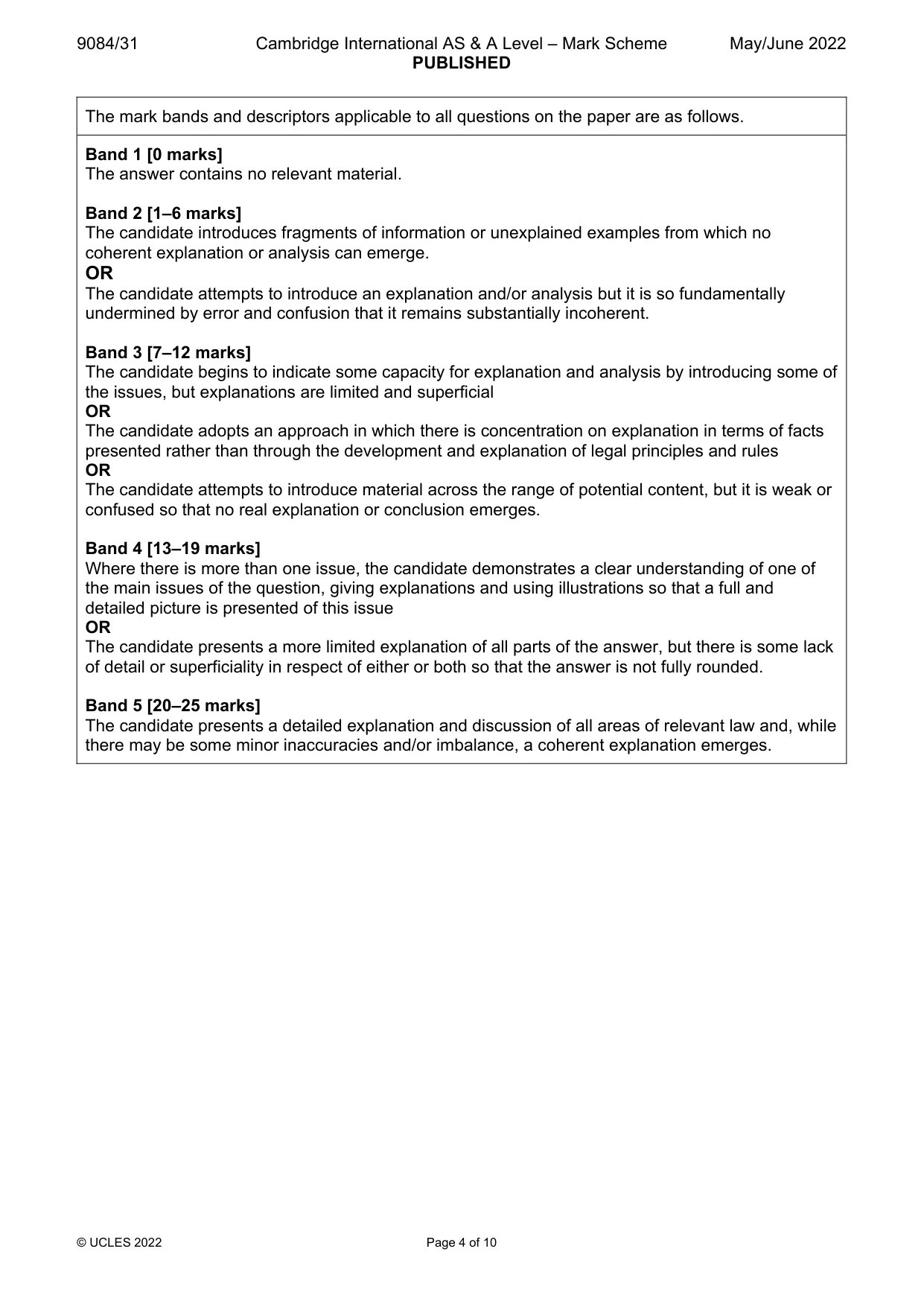
9084/31 Cambridge International AS & A Level – Mark Scheme PUBLISHED May/June 2022 © UCLES 2022 Page 4 of 10 The mark bands and descriptors applicable to all questions on the paper are as follows. Band 1 [0 marks] The answer contains no relevant material. Band 2 [1–6 marks] The candidate introduces fragments of information or unexplained examples from which no coherent explanation or analysis can emerge. OR The candidate attempts to introduce an explanation and/or analysis but it is so fundamentally undermined by error and confusion that it remains substantially incoherent. Band 3 [7–12 marks] The candidate begins to indicate some capacity for explanation and analysis by introducing some of the issues, but explanations are limited and superficial OR The candidate adopts an approach in which there is concentration on explanation in terms of facts presented rather than through the development and explanation of legal principles and rules OR The candidate attempts to introduce material across the range of potential content, but it is weak or confused so that no real explanation or conclusion emerges. Band 4 [13–19 marks] Where there is more than one issue, the candidate demonstrates a clear understanding of one of the main issues of the question, giving explanations and using illustrations so that a full and detailed picture is presented of this issue OR The candidate presents a more limited explanation of all parts of the answer, but there is some lack of detail or superficiality in respect of either or both so that the answer is not fully rounded. Band 5 [20–25 marks] The candidate presents a detailed explanation and discussion of all areas of relevant law and, while there may be some minor inaccuracies and/or imbalance, a coherent explanation emerges.
Mark scheme, page 5
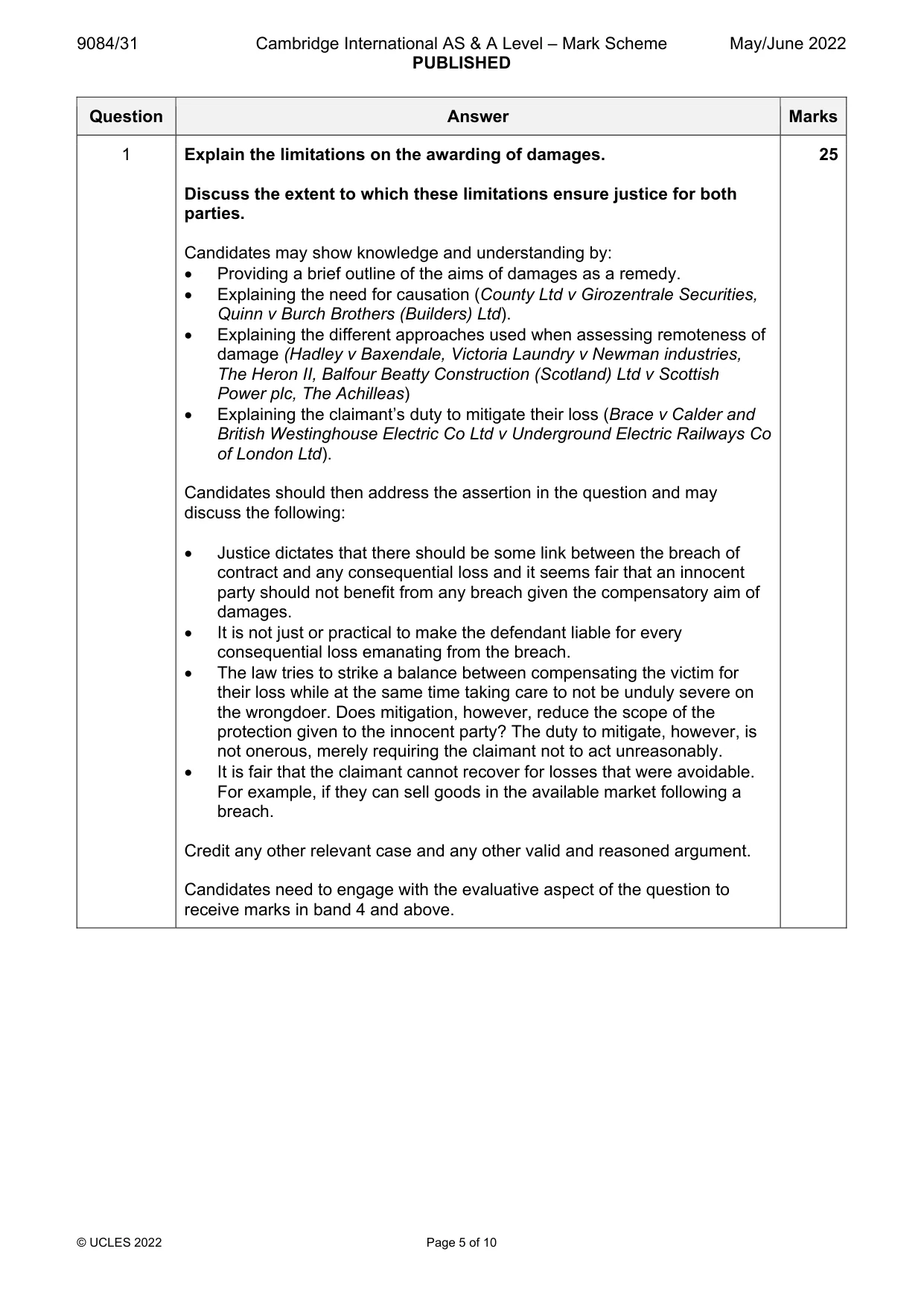
9084/31 Cambridge International AS & A Level – Mark Scheme PUBLISHED May/June 2022 © UCLES 2022 Page 5 of 10 Question Answer Marks 1 Explain the limitations on the awarding of damages. Discuss the extent to which these limitations ensure justice for both parties. Candidates may show knowledge and understanding by: Providing a brief outline of the aims of damages as a remedy. Explaining the need for causation (County Ltd v Girozentrale Securities, Quinn v Burch Brothers (Builders) Ltd). Explaining the different approaches used when assessing remoteness of damage (Hadley v Baxendale, Victoria Laundry v Newman industries, The Heron II, Balfour Beatty Construction (Scotland) Ltd v Scottish Power plc, The Achilleas) Explaining the claimant’s duty to mitigate their loss (Brace v Calder and British Westinghouse Electric Co Ltd v Underground Electric Railways Co of London Ltd). Candidates should then address the assertion in the question and may discuss the following: Justice dictates that there should be some link between the breach of contract and any consequential loss and it seems fair that an innocent party should not benefit from any breach given the compensatory aim of damages. It is not just or practical to make the defendant liable for every consequential loss emanating from the breach. The law tries to strike a balance between compensating the victim for their loss while at the same time taking care to not be unduly severe on the wrongdoer. Does mitigation, however, reduce the scope of the protection given to the innocent party? The duty to mitigate, however, is not onerous, merely requiring the claimant not to act unreasonably. It is fair that the claimant cannot recover for losses that were avoidable. For example, if they can sell goods in the available market following a breach. Credit any other relevant case and any other valid and reasoned argument. Candidates need to engage with the evaluative aspect of the question to receive marks in band 4 and above. 25
Mark scheme, page 6
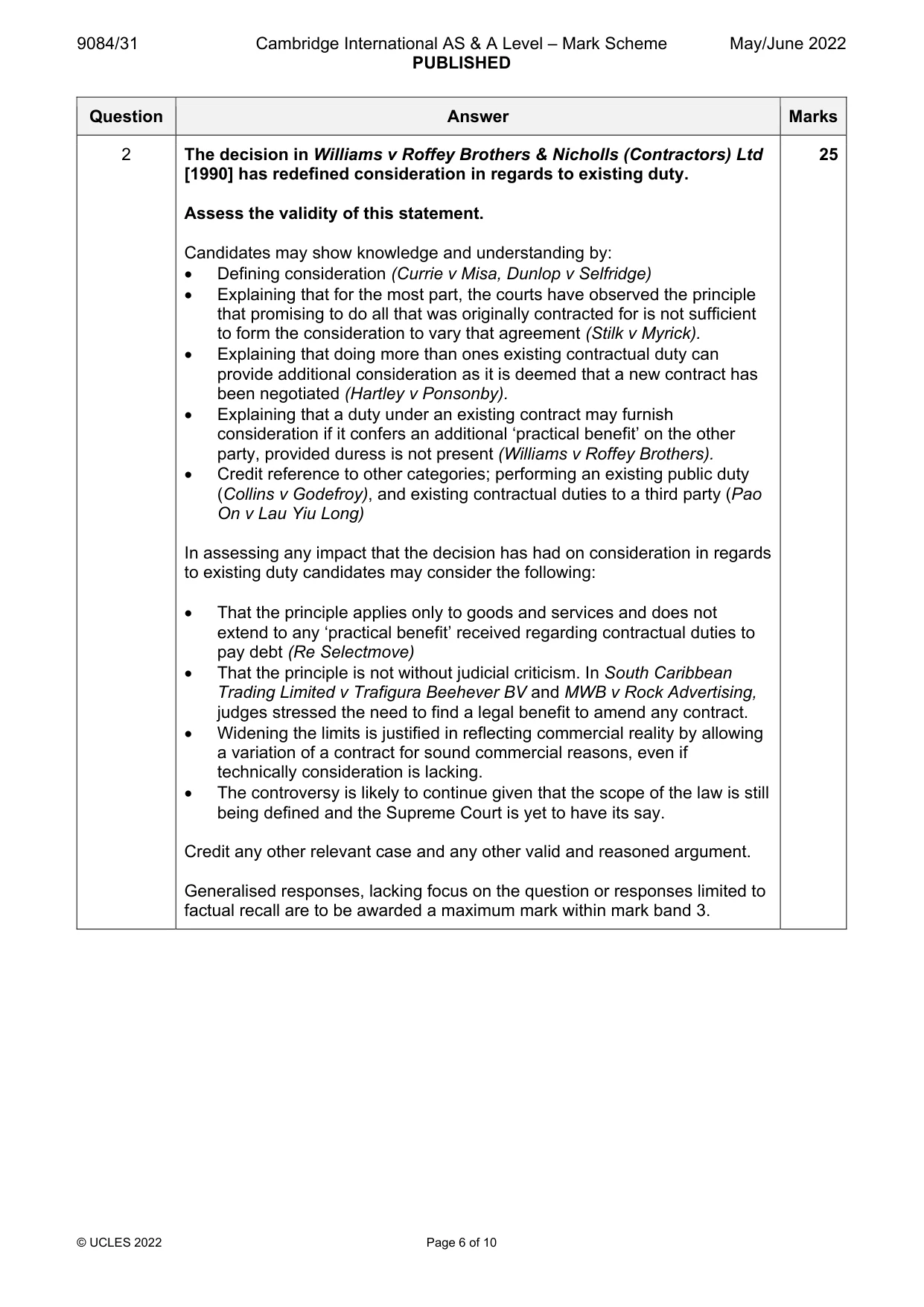
9084/31 Cambridge International AS & A Level – Mark Scheme PUBLISHED May/June 2022 © UCLES 2022 Page 6 of 10 Question Answer Marks 2 The decision in Williams v Roffey Brothers & Nicholls (Contractors) Ltd [1990] has redefined consideration in regards to existing duty. Assess the validity of this statement. Candidates may show knowledge and understanding by: Defining consideration (Currie v Misa, Dunlop v Selfridge) Explaining that for the most part, the courts have observed the principle that promising to do all that was originally contracted for is not sufficient to form the consideration to vary that agreement (Stilk v Myrick). Explaining that doing more than ones existing contractual duty can provide additional consideration as it is deemed that a new contract has been negotiated (Hartley v Ponsonby). Explaining that a duty under an existing contract may furnish consideration if it confers an additional ‘practical benefit’ on the other party, provided duress is not present (Williams v Roffey Brothers). Credit reference to other categories; performing an existing public duty (Collins v Godefroy), and existing contractual duties to a third party (Pao On v Lau Yiu Long) In assessing any impact that the decision has had on consideration in regards to existing duty candidates may consider the following: That the principle applies only to goods and services and does not extend to any ‘practical benefit’ received regarding contractual duties to pay debt (Re Selectmove) That the principle is not without judicial criticism. In South Caribbean Trading Limited v Trafigura Beehever BV and MWB v Rock Advertising, judges stressed the need to find a legal benefit to amend any contract. Widening the limits is justified in reflecting commercial reality by allowing a variation of a contract for sound commercial reasons, even if technically consideration is lacking. The controversy is likely to continue given that the scope of the law is still being defined and the Supreme Court is yet to have its say. Credit any other relevant case and any other valid and reasoned argument. Generalised responses, lacking focus on the question or responses limited to factual recall are to be awarded a maximum mark within mark band 3. 25
Mark scheme, page 7
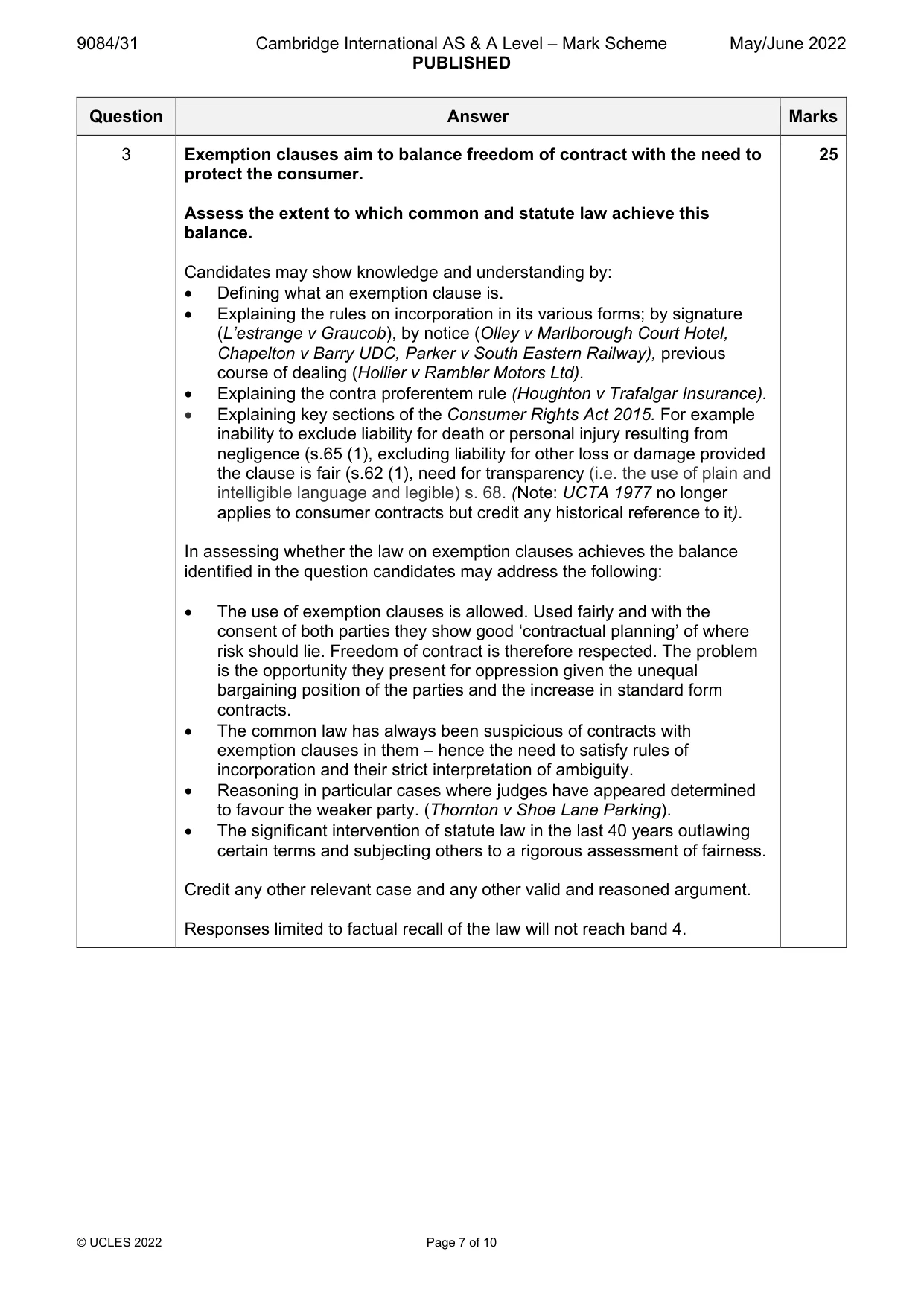
9084/31 Cambridge International AS & A Level – Mark Scheme PUBLISHED May/June 2022 © UCLES 2022 Page 7 of 10 Question Answer Marks 3 Exemption clauses aim to balance freedom of contract with the need to protect the consumer. Assess the extent to which common and statute law achieve this balance. Candidates may show knowledge and understanding by: Defining what an exemption clause is. Explaining the rules on incorporation in its various forms; by signature (L’estrange v Graucob), by notice (Olley v Marlborough Court Hotel, Chapelton v Barry UDC, Parker v South Eastern Railway), previous course of dealing (Hollier v Rambler Motors Ltd). Explaining the contra proferentem rule (Houghton v Trafalgar Insurance). Explaining key sections of the Consumer Rights Act 2015. For example inability to exclude liability for death or personal injury resulting from negligence (s.65 (1), excluding liability for other loss or damage provided the clause is fair (s.62 (1), need for transparency (i.e. the use of plain and intelligible language and legible) s. 68. (Note: UCTA 1977 no longer applies to consumer contracts but credit any historical reference to it). In assessing whether the law on exemption clauses achieves the balance identified in the question candidates may address the following: The use of exemption clauses is allowed. Used fairly and with the consent of both parties they show good ‘contractual planning’ of where risk should lie. Freedom of contract is therefore respected. The problem is the opportunity they present for oppression given the unequal bargaining position of the parties and the increase in standard form contracts. The common law has always been suspicious of contracts with exemption clauses in them – hence the need to satisfy rules of incorporation and their strict interpretation of ambiguity. Reasoning in particular cases where judges have appeared determined to favour the weaker party. (Thornton v Shoe Lane Parking). The significant intervention of statute law in the last 40 years outlawing certain terms and subjecting others to a rigorous assessment of fairness. Credit any other relevant case and any other valid and reasoned argument. Responses limited to factual recall of the law will not reach band 4. 25
Mark scheme, page 8
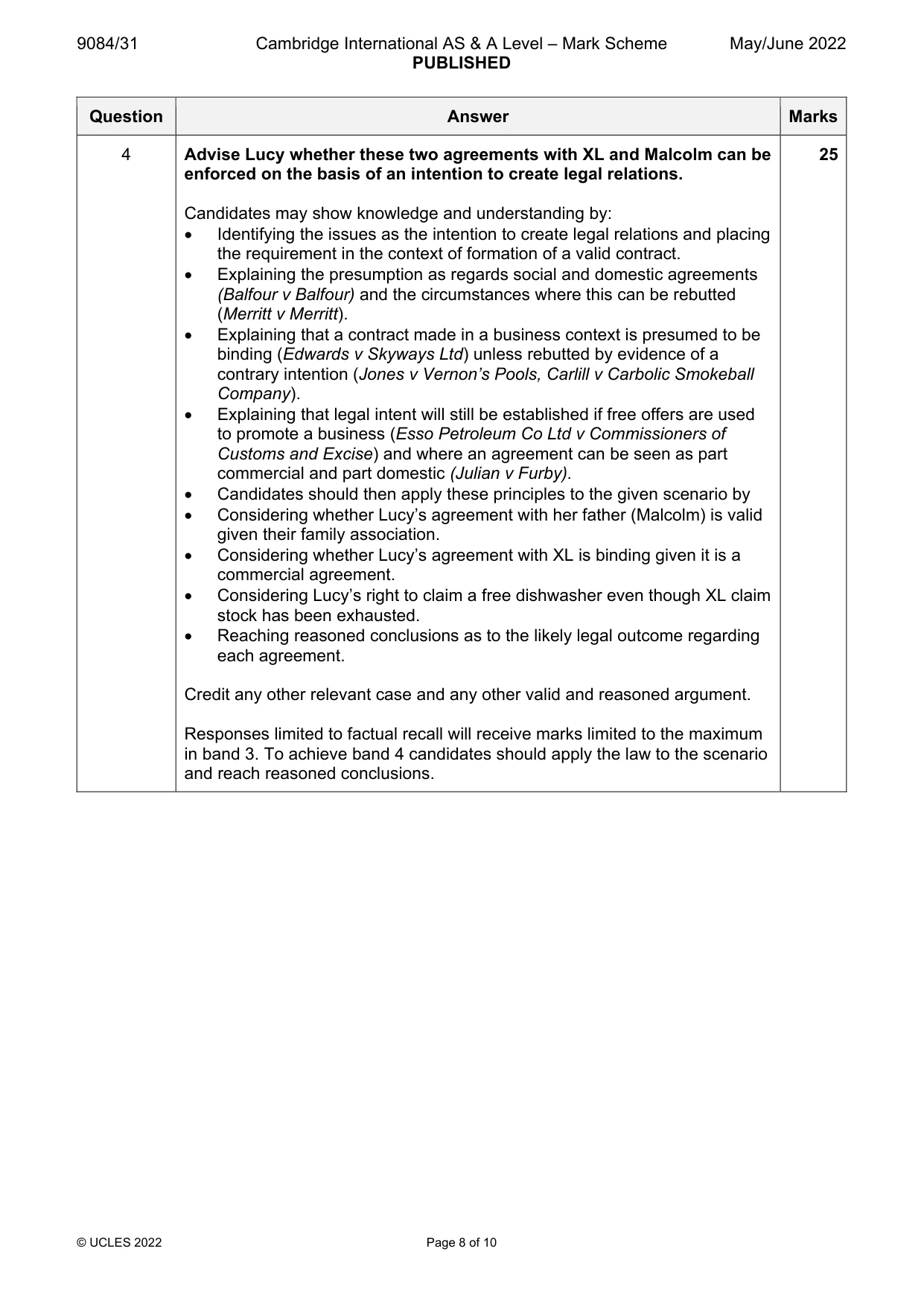
9084/31 Cambridge International AS & A Level – Mark Scheme PUBLISHED May/June 2022 © UCLES 2022 Page 8 of 10 Question Answer Marks 4 Advise Lucy whether these two agreements with XL and Malcolm can be enforced on the basis of an intention to create legal relations. Candidates may show knowledge and understanding by: Identifying the issues as the intention to create legal relations and placing the requirement in the context of formation of a valid contract. Explaining the presumption as regards social and domestic agreements (Balfour v Balfour) and the circumstances where this can be rebutted (Merritt v Merritt). Explaining that a contract made in a business context is presumed to be binding (Edwards v Skyways Ltd) unless rebutted by evidence of a contrary intention (Jones v Vernon’s Pools, Carlill v Carbolic Smokeball Company). Explaining that legal intent will still be established if free offers are used to promote a business (Esso Petroleum Co Ltd v Commissioners of Customs and Excise) and where an agreement can be seen as part commercial and part domestic (Julian v Furby). Candidates should then apply these principles to the given scenario by Considering whether Lucy’s agreement with her father (Malcolm) is valid given their family association. Considering whether Lucy’s agreement with XL is binding given it is a commercial agreement. Considering Lucy’s right to claim a free dishwasher even though XL claim stock has been exhausted. Reaching reasoned conclusions as to the likely legal outcome regarding each agreement. Credit any other relevant case and any other valid and reasoned argument. Responses limited to factual recall will receive marks limited to the maximum in band 3. To achieve band 4 candidates should apply the law to the scenario and reach reasoned conclusions. 25
Mark scheme, page 9
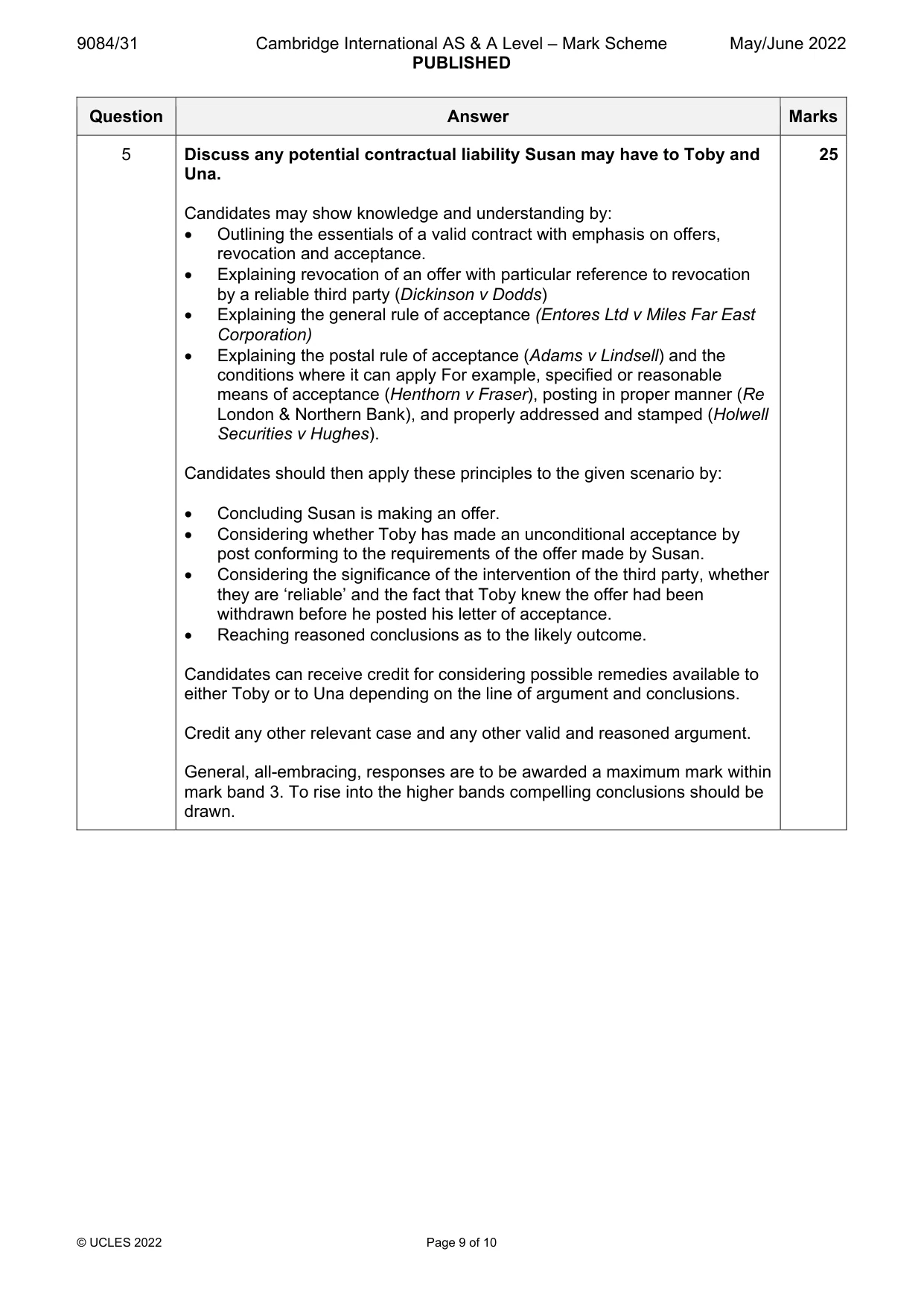
9084/31 Cambridge International AS & A Level – Mark Scheme PUBLISHED May/June 2022 © UCLES 2022 Page 9 of 10 Question Answer Marks 5 Discuss any potential contractual liability Susan may have to Toby and Una. Candidates may show knowledge and understanding by: Outlining the essentials of a valid contract with emphasis on offers, revocation and acceptance. Explaining revocation of an offer with particular reference to revocation by a reliable third party (Dickinson v Dodds) Explaining the general rule of acceptance (Entores Ltd v Miles Far East Corporation) Explaining the postal rule of acceptance (Adams v Lindsell) and the conditions where it can apply For example, specified or reasonable means of acceptance (Henthorn v Fraser), posting in proper manner (Re London & Northern Bank), and properly addressed and stamped (Holwell Securities v Hughes). Candidates should then apply these principles to the given scenario by: Concluding Susan is making an offer. Considering whether Toby has made an unconditional acceptance by post conforming to the requirements of the offer made by Susan. Considering the significance of the intervention of the third party, whether they are ‘reliable’ and the fact that Toby knew the offer had been withdrawn before he posted his letter of acceptance. Reaching reasoned conclusions as to the likely outcome. Candidates can receive credit for considering possible remedies available to either Toby or to Una depending on the line of argument and conclusions. Credit any other relevant case and any other valid and reasoned argument. General, all-embracing, responses are to be awarded a maximum mark within mark band 3. To rise into the higher bands compelling conclusions should be drawn. 25
Mark scheme, page 10
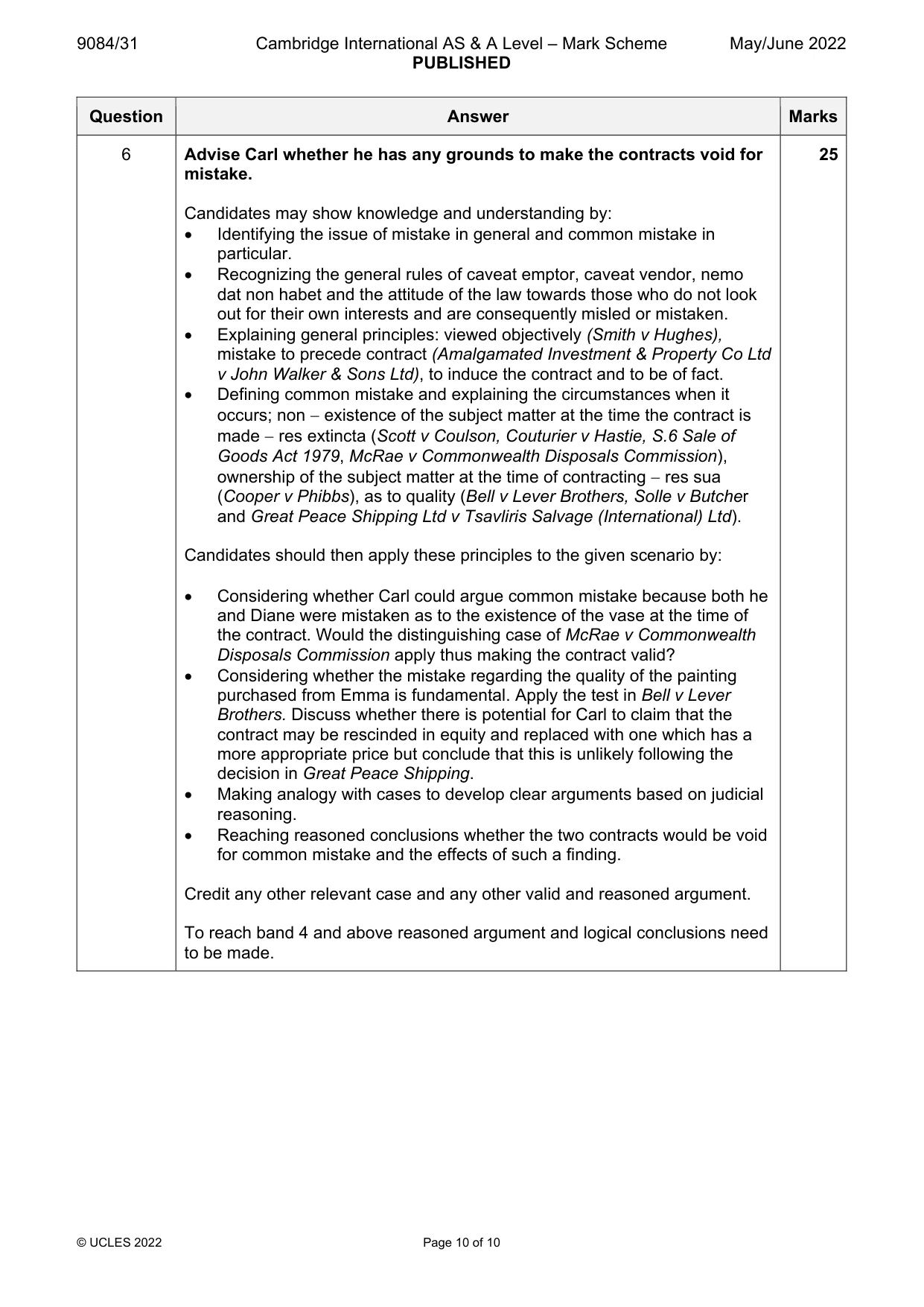
9084/31 Cambridge International AS & A Level – Mark Scheme PUBLISHED May/June 2022 © UCLES 2022 Page 10 of 10 Question Answer Marks 6 Advise Carl whether he has any grounds to make the contracts void for mistake. Candidates may show knowledge and understanding by: Identifying the issue of mistake in general and common mistake in particular. Recognizing the general rules of caveat emptor, caveat vendor, nemo dat non habet and the attitude of the law towards those who do not look out for their own interests and are consequently misled or mistaken. Explaining general principles: viewed objectively (Smith v Hughes), mistake to precede contract (Amalgamated Investment & Property Co Ltd v John Walker & Sons Ltd), to induce the contract and to be of fact. Defining common mistake and explaining the circumstances when it occurs; non existence of the subject matter at the time the contract is made res extincta (Scott v Coulson, Couturier v Hastie, S.6 Sale of Goods Act 1979, McRae v Commonwealth Disposals Commission), ownership of the subject matter at the time of contracting res sua (Cooper v Phibbs), as to quality (Bell v Lever Brothers, Solle v Butcher and Great Peace Shipping Ltd v Tsavliris Salvage (International) Ltd). Candidates should then apply these principles to the given scenario by: Considering whether Carl could argue common mistake because both he and Diane were mistaken as to the existence of the vase at the time of the contract. Would the distinguishing case of McRae v Commonwealth Disposals Commission apply thus making the contract valid? Considering whether the mistake regarding the quality of the painting purchased from Emma is fundamental. Apply the test in Bell v Lever Brothers. Discuss whether there is potential for Carl to claim that the contract may be rescinded in equity and replaced with one which has a more appropriate price but conclude that this is unlikely following the decision in Great Peace Shipping. Making analogy with cases to develop clear arguments based on judicial reasoning. Reaching reasoned conclusions whether the two contracts would be void for common mistake and the effects of such a finding. Credit any other relevant case and any other valid and reasoned argument. To reach band 4 and above reasoned argument and logical conclusions need to be made. 25
What you needed in this session
Cambridge’s own grade thresholds for 2022 May/June, Paper 3 · Variant 1. A higher threshold means an easier paper — the bar moves with how the cohort did.