Cambridge A Level Law 9084 — 2021 May/June Paper 3 · Variant 2
9084/32/M/J/21 · 75 marks · ≈84 min
The question paper and its mark scheme, free to read here and free to download. This is Cambridge’s own paper, exactly as it was sat.
Question paper4 pages

Mark scheme10 pages
Answers below. Sit the paper first if you are practising.
Paper as text
Question paper, page 1
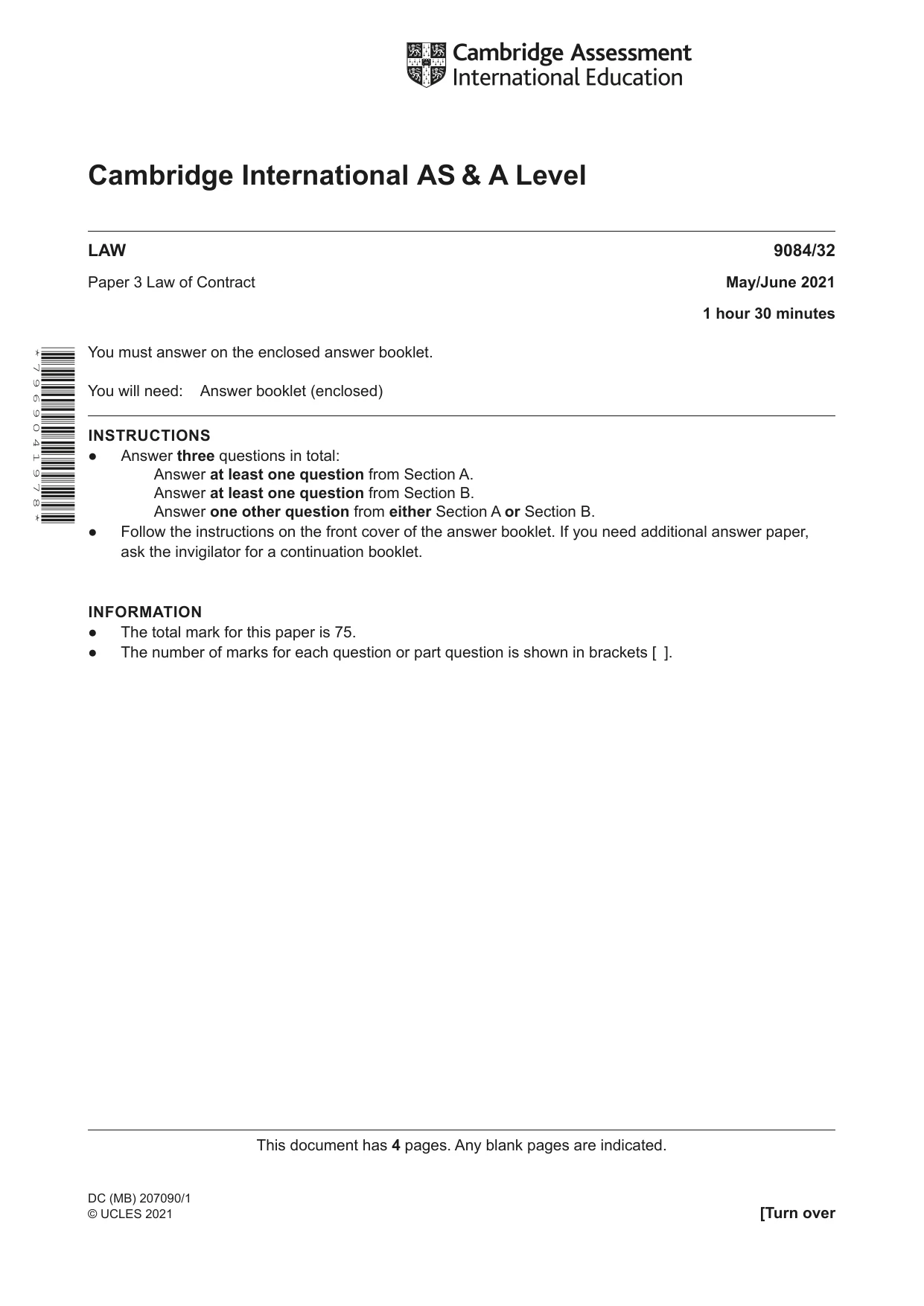
This document has 4 pages. Any blank pages are indicated. Cambridge International AS & A Level LAW 9084/32 Paper 3 Law of Contract May/June 2021 1 hour 30 minutes You must answer on the enclosed answer booklet. You will need: Answer booklet (enclosed) INSTRUCTIONS ● Answer three questions in total: Answer at least one question from Section A. Answer at least one question from Section B. Answer one other question from either Section A or Section B. ● Follow the instructions on the front cover of the answer booklet. If you need additional answer paper, ask the invigilator for a continuation booklet. INFORMATION ● The total mark for this paper is 75. ● The number of marks for each question or part question is shown in brackets [ ]. DC (MB) 207090/1 © UCLES 2021 [Turn over * 7 9 6 9 0 4 1 9 7 8 *
Question paper, page 2
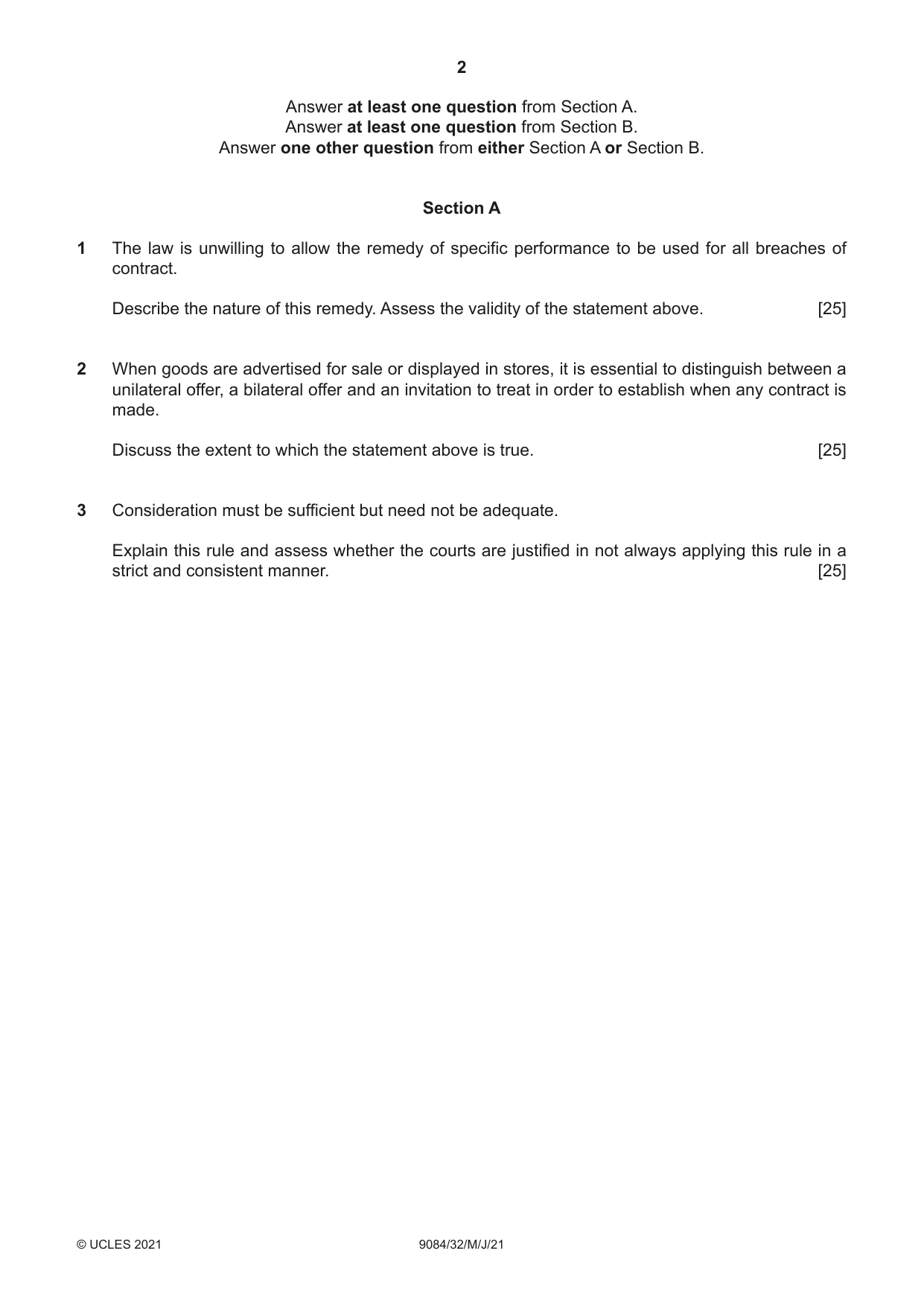
2 9084/32/M/J/21 © UCLES 2021 Answer at least one question from Section A. Answer at least one question from Section B. Answer one other question from either Section A or Section B. Section A 1 The law is unwilling to allow the remedy of specific performance to be used for all breaches of contract. Describe the nature of this remedy. Assess the validity of the statement above. [25] 2 When goods are advertised for sale or displayed in stores, it is essential to distinguish between a unilateral offer, a bilateral offer and an invitation to treat in order to establish when any contract is made. Discuss the extent to which the statement above is true. [25] 3 Consideration must be sufficient but need not be adequate. Explain this rule and assess whether the courts are justified in not always applying this rule in a strict and consistent manner. [25]
Question paper, page 3
3 9084/32/M/J/21 © UCLES 2021 Section B 4 Karim is a talented motorcycle racer and his ambition is to ride professionally. He secures a £15 000 loan from a bank and purchases a high powered motorcycle. The loan is guaranteed by his parents as he has only just celebrated his 17th birthday. He also buys a stylish protective helmet and clothing on credit even though he already has a helmet and clothing. In order to store and service his motorcycle between races Karim leases a secure garage near his home for a period of one year. Six months later Karim has won every race he has entered and moves overseas to ride professionally for an international racing team. Karim stops leasing the garage and neglects to make his regular loan and credit repayments. Advise Karim of his liability, if any, regarding the contracts he has made for the loan, the protective helmet and clothing and the lease of the garage. [25] 5 Swerve, an English premier league footballer, agrees a four-year contract with an energy drink manufacturer, T Ltd, to participate in various promotional activities to advertise its energy drink. The contract includes the following terms: A that within the first month Swerve attends a rehearsal and participates in the production of a television advert. B that within two years Swerve takes part in six photographic sessions to create billboard posters. C that T Ltd has the right to terminate the contract immediately if Swerve conducts himself in a manner damaging to its commercial interests. Within the first month Swerve misses the rehearsal for the television advert but takes part in the production and the advert is recorded successfully. Swerve only takes part in three photographic sessions during the first two years, although the billboard posters are well received and lead to an increase in T Ltd’s share of the energy drinks market. Halfway through the contract, footage emerges on social media of Swerve drinking an energy drink from a rival company and making negative comments about T Ltd’s product. Advise T Ltd of its rights and any remedy it might have against Swerve in these circumstances. [25] 6 Deb is the owner of a clothing manufacturing business. Evan is employed as her assistant. Minutes before Deb is due at an important business meeting, Evan presents her with several documents to sign telling her that they are the usual authorisations to pay their suppliers. In fact, one of them is a contract with Frank, the landlord of a new apartment Evan is about to move into. Under this contract, Deb agrees to make rental payments to Frank, should Evan fail to do so. She hurriedly signs all the documents without reading them properly. After the meeting, Deb takes a phone call from her regular fabric supplier, Gail, and agrees delivery of fabric at ‘the usual price’. Deb believes the usual price is £8 per metre but the last two deliveries from Gail have been at £12 per metre. It is only when Deb receives Gail’s invoice charging £12 per metre that she realises her error. Several months later Evan has failed to keep up with his rental payments and Frank demands the arrears from Deb as provided for by the contract she signed. Advise Deb of any liability she may have to Frank and Gail. [25]
Question paper, page 4
4 9084/32/M/J/21 © UCLES 2021 Permission to reproduce items where third-party owned material protected by copyright is included has been sought and cleared where possible. Every reasonable effort has been made by the publisher (UCLES) to trace copyright holders, but if any items requiring clearance have unwittingly been included, the publisher will be pleased to make amends at the earliest possible opportunity. To avoid the issue of disclosure of answer-related information to candidates, all copyright acknowledgements are reproduced online in the Cambridge Assessment International Education Copyright Acknowledgements Booklet. This is produced for each series of examinations and is freely available to download at www.cambridgeinternational.org after the live examination series. Cambridge Assessment International Education is part of the Cambridge Assessment Group. Cambridge Assessment is the brand name of the University of Cambridge Local Examinations Syndicate (UCLES), which itself is a department of the University of Cambridge. BLANK PAGE
Mark scheme, page 1
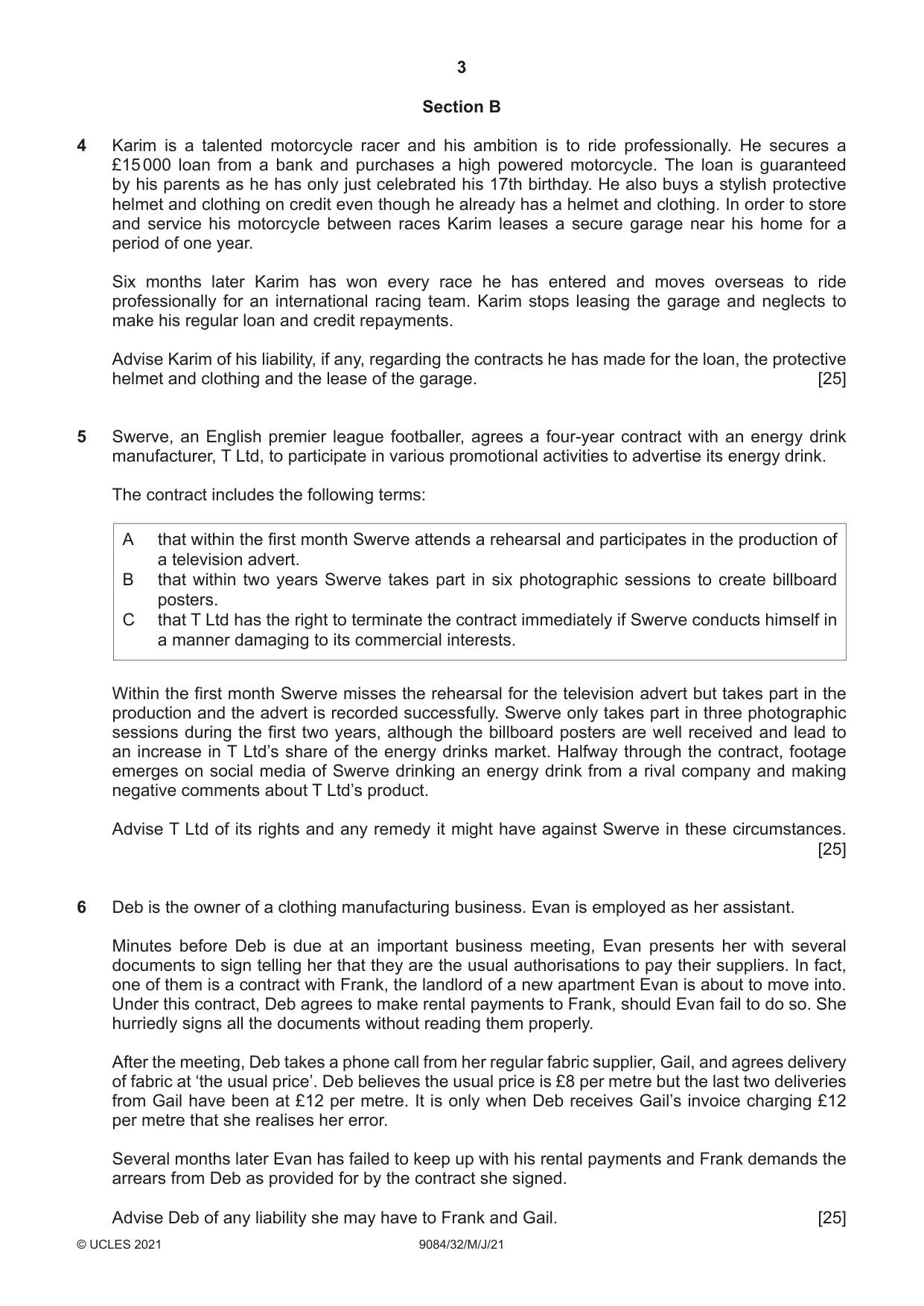
This document consists of 10 printed pages. © UCLES 2021 [Turn over Cambridge International AS & A Level LAW 9084/32 Paper 3 May/June 2021 MARK SCHEME Maximum Mark: 75 Published This mark scheme is published as an aid to teachers and candidates, to indicate the requirements of the examination. It shows the basis on which Examiners were instructed to award marks. It does not indicate the details of the discussions that took place at an Examiners’ meeting before marking began, which would have considered the acceptability of alternative answers. Mark schemes should be read in conjunction with the question paper and the Principal Examiner Report for Teachers. Cambridge International will not enter into discussions about these mark schemes. Cambridge International is publishing the mark schemes for the May/June 2021 series for most Cambridge IGCSE™, Cambridge International A and AS Level components and some Cambridge O Level components.
Mark scheme, page 2
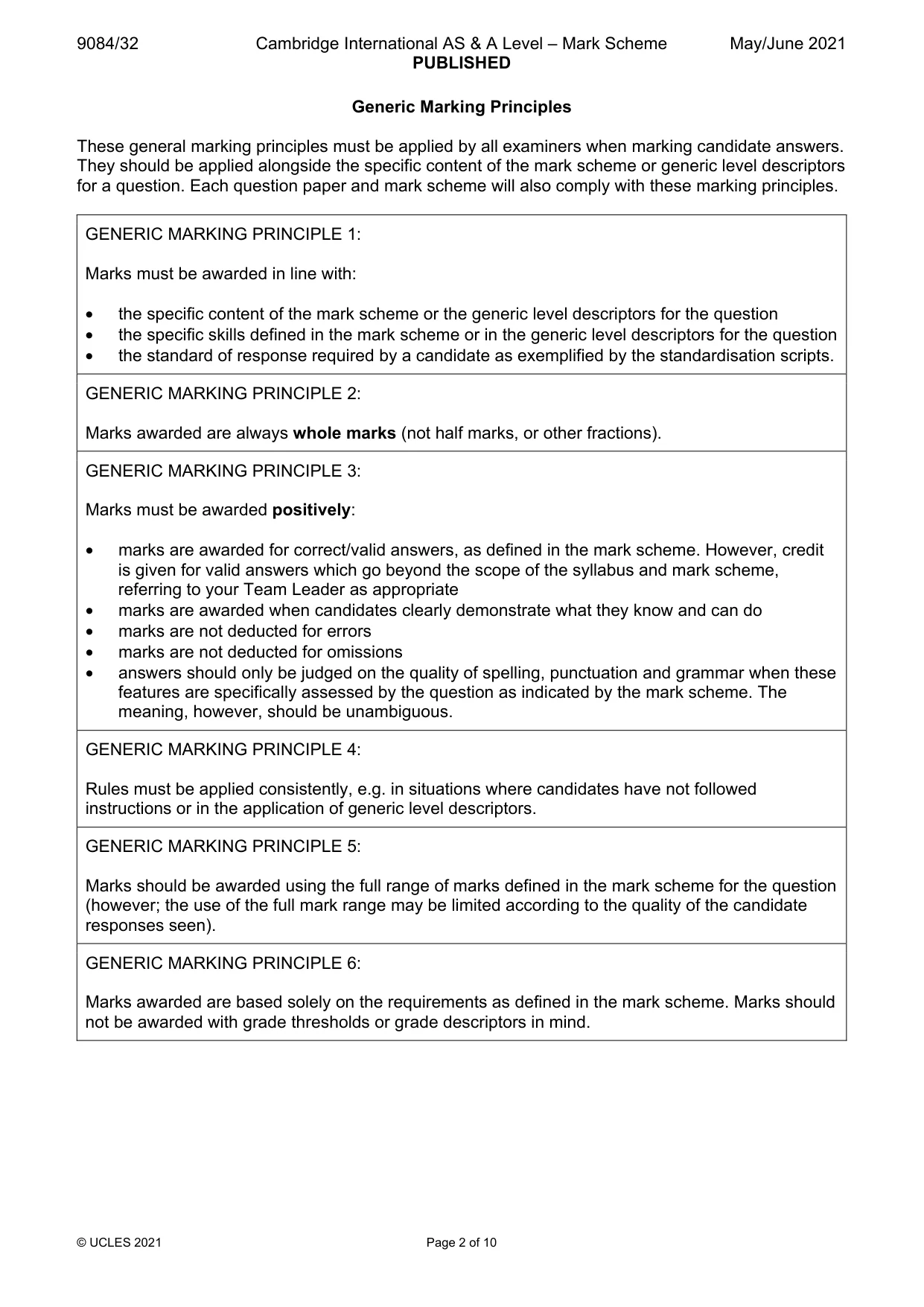
9084/32 Cambridge International AS & A Level – Mark Scheme PUBLISHED May/June 2021 © UCLES 2021 Page 2 of 10 Generic Marking Principles These general marking principles must be applied by all examiners when marking candidate answers. They should be applied alongside the specific content of the mark scheme or generic level descriptors for a question. Each question paper and mark scheme will also comply with these marking principles. GENERIC MARKING PRINCIPLE 1: Marks must be awarded in line with: • the specific content of the mark scheme or the generic level descriptors for the question • the specific skills defined in the mark scheme or in the generic level descriptors for the question • the standard of response required by a candidate as exemplified by the standardisation scripts. GENERIC MARKING PRINCIPLE 2: Marks awarded are always whole marks (not half marks, or other fractions). GENERIC MARKING PRINCIPLE 3: Marks must be awarded positively: • marks are awarded for correct/valid answers, as defined in the mark scheme. However, credit is given for valid answers which go beyond the scope of the syllabus and mark scheme, referring to your Team Leader as appropriate • marks are awarded when candidates clearly demonstrate what they know and can do • marks are not deducted for errors • marks are not deducted for omissions • answers should only be judged on the quality of spelling, punctuation and grammar when these features are specifically assessed by the question as indicated by the mark scheme. The meaning, however, should be unambiguous. GENERIC MARKING PRINCIPLE 4: Rules must be applied consistently, e.g. in situations where candidates have not followed instructions or in the application of generic level descriptors. GENERIC MARKING PRINCIPLE 5: Marks should be awarded using the full range of marks defined in the mark scheme for the question (however; the use of the full mark range may be limited according to the quality of the candidate responses seen). GENERIC MARKING PRINCIPLE 6: Marks awarded are based solely on the requirements as defined in the mark scheme. Marks should not be awarded with grade thresholds or grade descriptors in mind.
Mark scheme, page 3
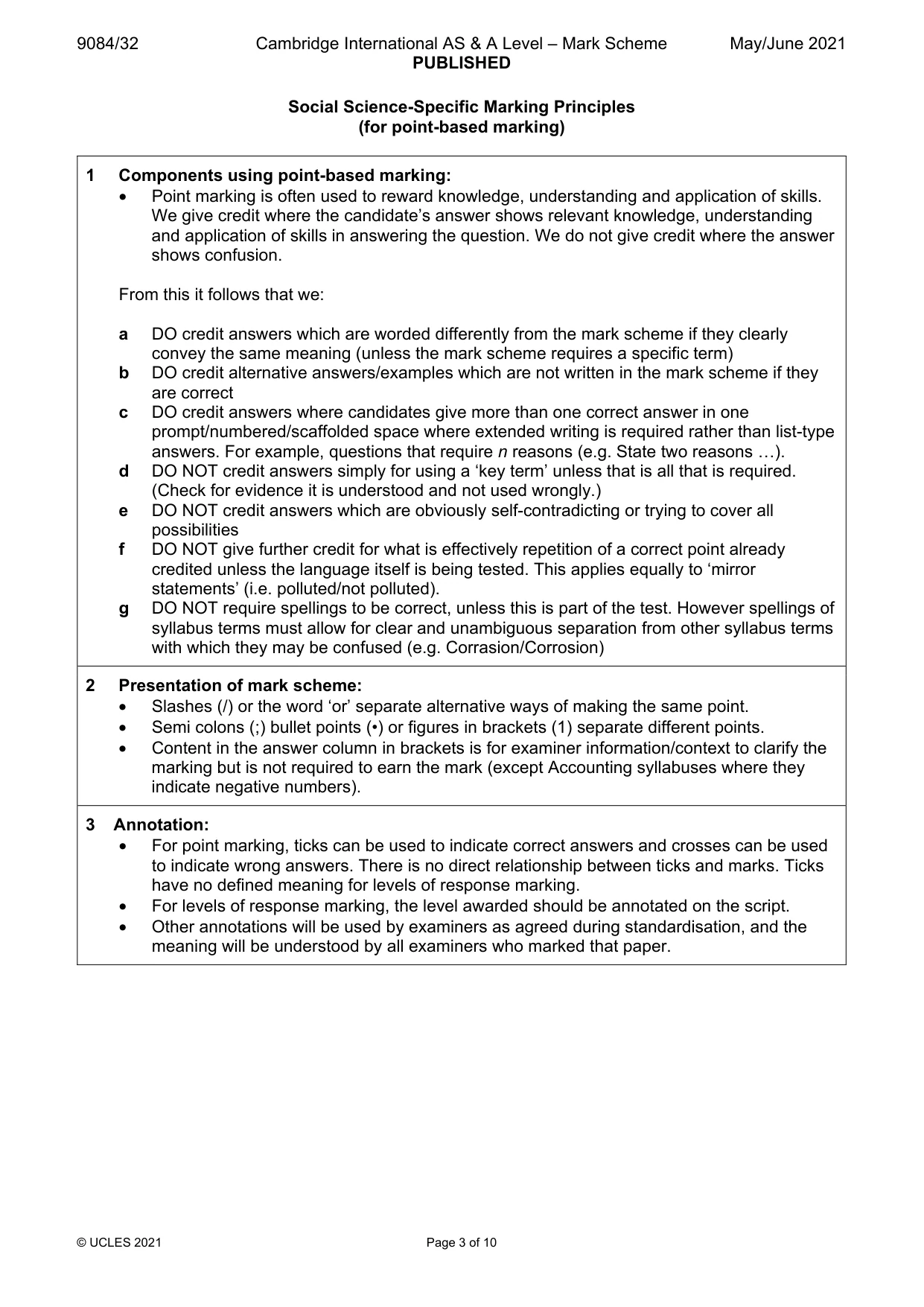
9084/32 Cambridge International AS & A Level – Mark Scheme PUBLISHED May/June 2021 © UCLES 2021 Page 3 of 10 Social Science-Specific Marking Principles (for point-based marking) 1 Components using point-based marking: • Point marking is often used to reward knowledge, understanding and application of skills. We give credit where the candidate’s answer shows relevant knowledge, understanding and application of skills in answering the question. We do not give credit where the answer shows confusion. From this it follows that we: a DO credit answers which are worded differently from the mark scheme if they clearly convey the same meaning (unless the mark scheme requires a specific term) b DO credit alternative answers/examples which are not written in the mark scheme if they are correct c DO credit answers where candidates give more than one correct answer in one prompt/numbered/scaffolded space where extended writing is required rather than list-type answers. For example, questions that require n reasons (e.g. State two reasons …). d DO NOT credit answers simply for using a ‘key term’ unless that is all that is required. (Check for evidence it is understood and not used wrongly.) e DO NOT credit answers which are obviously self-contradicting or trying to cover all possibilities f DO NOT give further credit for what is effectively repetition of a correct point already credited unless the language itself is being tested. This applies equally to ‘mirror statements’ (i.e. polluted/not polluted). g DO NOT require spellings to be correct, unless this is part of the test. However spellings of syllabus terms must allow for clear and unambiguous separation from other syllabus terms with which they may be confused (e.g. Corrasion/Corrosion) 2 Presentation of mark scheme: • Slashes (/) or the word ‘or’ separate alternative ways of making the same point. • Semi colons (;) bullet points (•) or figures in brackets (1) separate different points. • Content in the answer column in brackets is for examiner information/context to clarify the marking but is not required to earn the mark (except Accounting syllabuses where they indicate negative numbers). 3 Annotation: • For point marking, ticks can be used to indicate correct answers and crosses can be used to indicate wrong answers. There is no direct relationship between ticks and marks. Ticks have no defined meaning for levels of response marking. • For levels of response marking, the level awarded should be annotated on the script. • Other annotations will be used by examiners as agreed during standardisation, and the meaning will be understood by all examiners who marked that paper.
Mark scheme, page 4
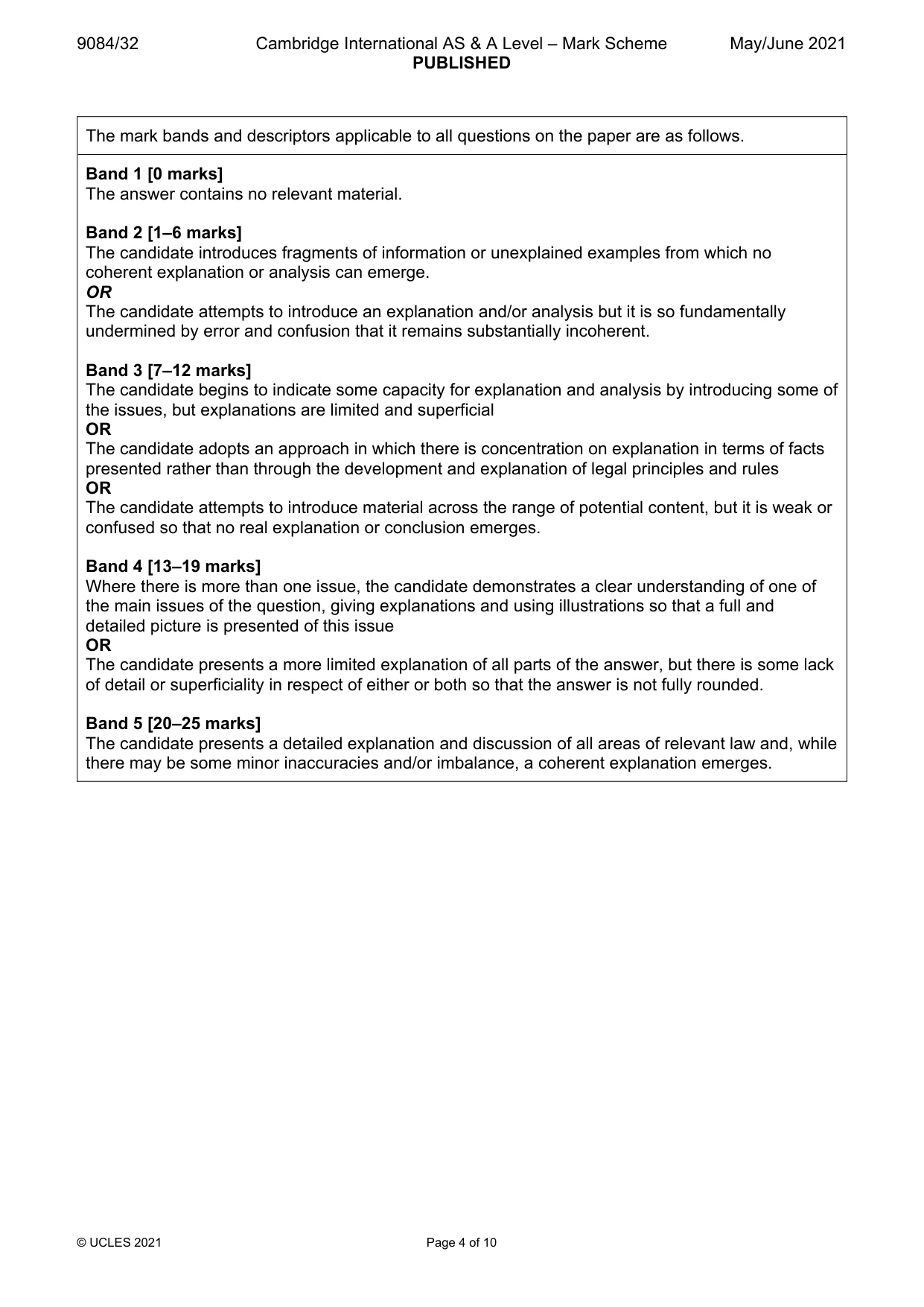
9084/32 Cambridge International AS & A Level – Mark Scheme PUBLISHED May/June 2021 © UCLES 2021 Page 4 of 10 The mark bands and descriptors applicable to all questions on the paper are as follows. Band 1 [0 marks] The answer contains no relevant material. Band 2 [1–6 marks] The candidate introduces fragments of information or unexplained examples from which no coherent explanation or analysis can emerge. OR The candidate attempts to introduce an explanation and/or analysis but it is so fundamentally undermined by error and confusion that it remains substantially incoherent. Band 3 [7–12 marks] The candidate begins to indicate some capacity for explanation and analysis by introducing some of the issues, but explanations are limited and superficial OR The candidate adopts an approach in which there is concentration on explanation in terms of facts presented rather than through the development and explanation of legal principles and rules OR The candidate attempts to introduce material across the range of potential content, but it is weak or confused so that no real explanation or conclusion emerges. Band 4 [13–19 marks] Where there is more than one issue, the candidate demonstrates a clear understanding of one of the main issues of the question, giving explanations and using illustrations so that a full and detailed picture is presented of this issue OR The candidate presents a more limited explanation of all parts of the answer, but there is some lack of detail or superficiality in respect of either or both so that the answer is not fully rounded. Band 5 [20–25 marks] The candidate presents a detailed explanation and discussion of all areas of relevant law and, while there may be some minor inaccuracies and/or imbalance, a coherent explanation emerges.
Mark scheme, page 5
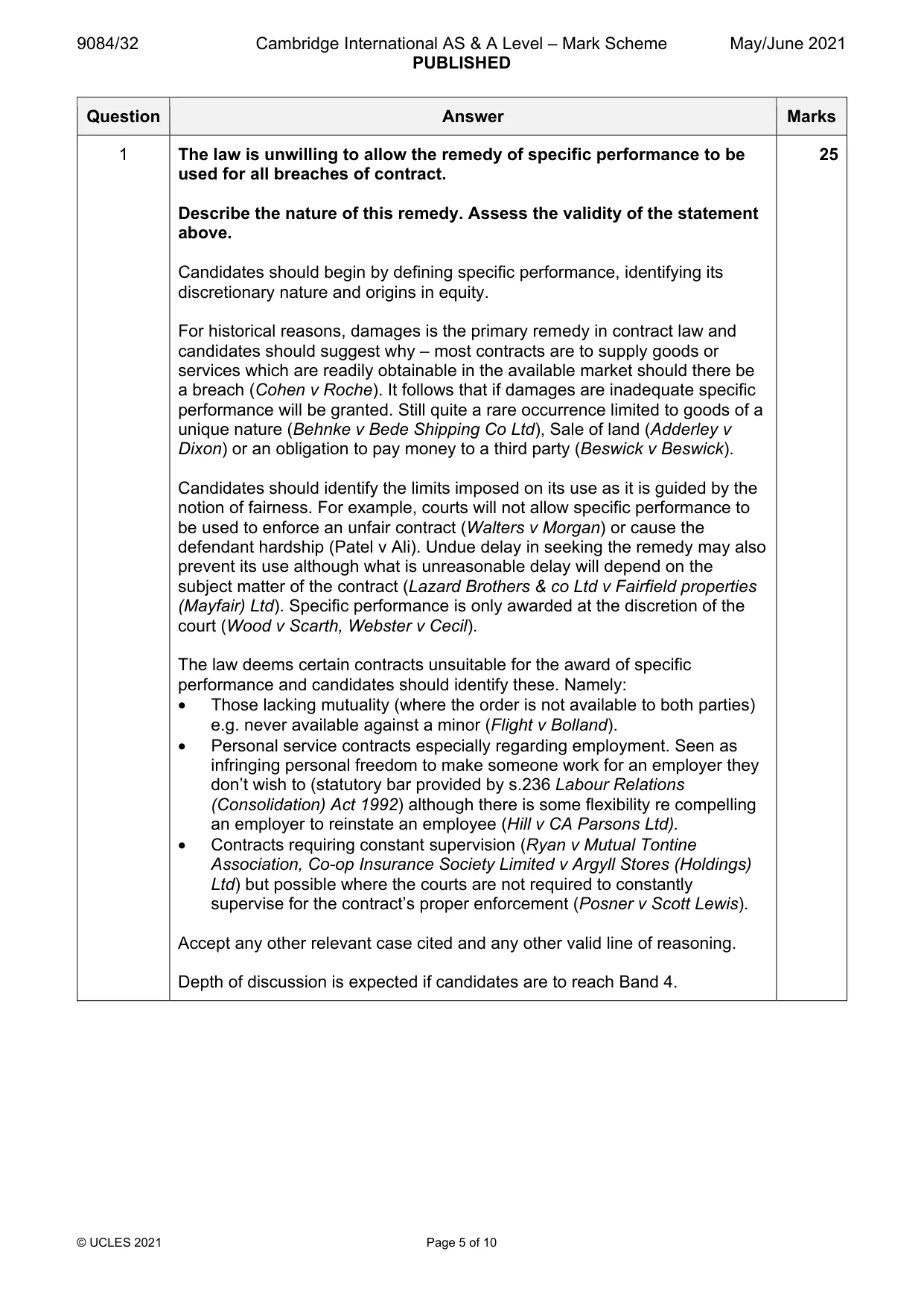
9084/32 Cambridge International AS & A Level – Mark Scheme PUBLISHED May/June 2021 © UCLES 2021 Page 5 of 10 Question Answer Marks 1 The law is unwilling to allow the remedy of specific performance to be used for all breaches of contract. Describe the nature of this remedy. Assess the validity of the statement above. Candidates should begin by defining specific performance, identifying its discretionary nature and origins in equity. For historical reasons, damages is the primary remedy in contract law and candidates should suggest why – most contracts are to supply goods or services which are readily obtainable in the available market should there be a breach (Cohen v Roche). It follows that if damages are inadequate specific performance will be granted. Still quite a rare occurrence limited to goods of a unique nature (Behnke v Bede Shipping Co Ltd), Sale of land (Adderley v Dixon) or an obligation to pay money to a third party (Beswick v Beswick). Candidates should identify the limits imposed on its use as it is guided by the notion of fairness. For example, courts will not allow specific performance to be used to enforce an unfair contract (Walters v Morgan) or cause the defendant hardship (Patel v Ali). Undue delay in seeking the remedy may also prevent its use although what is unreasonable delay will depend on the subject matter of the contract (Lazard Brothers & co Ltd v Fairfield properties (Mayfair) Ltd). Specific performance is only awarded at the discretion of the court (Wood v Scarth, Webster v Cecil). The law deems certain contracts unsuitable for the award of specific performance and candidates should identify these. Namely: • Those lacking mutuality (where the order is not available to both parties) e.g. never available against a minor (Flight v Bolland). • Personal service contracts especially regarding employment. Seen as infringing personal freedom to make someone work for an employer they don’t wish to (statutory bar provided by s.236 Labour Relations (Consolidation) Act 1992) although there is some flexibility re compelling an employer to reinstate an employee (Hill v CA Parsons Ltd). • Contracts requiring constant supervision (Ryan v Mutual Tontine Association, Co-op Insurance Society Limited v Argyll Stores (Holdings) Ltd) but possible where the courts are not required to constantly supervise for the contract’s proper enforcement (Posner v Scott Lewis). Accept any other relevant case cited and any other valid line of reasoning. Depth of discussion is expected if candidates are to reach Band 4. 25
Mark scheme, page 6
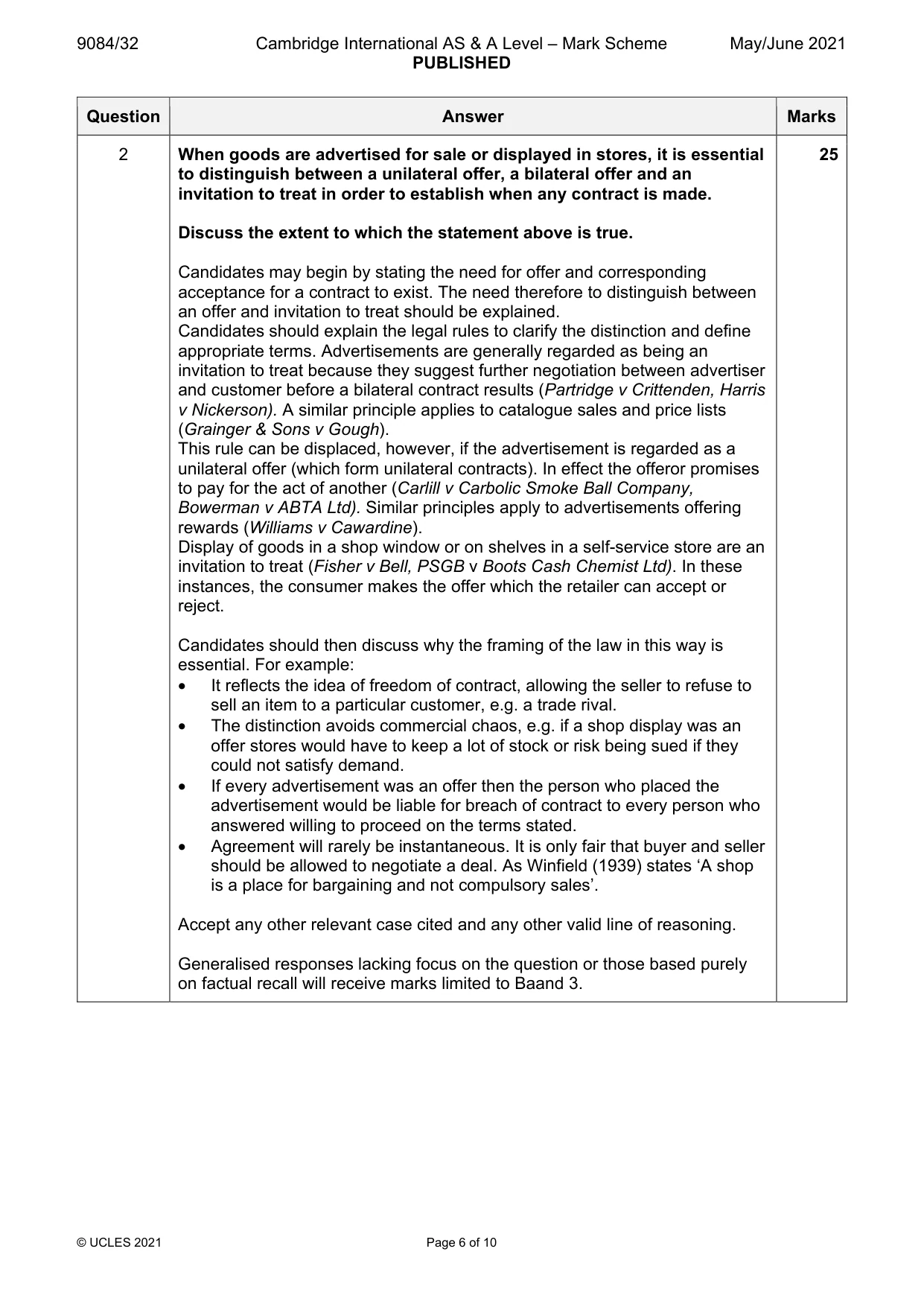
9084/32 Cambridge International AS & A Level – Mark Scheme PUBLISHED May/June 2021 © UCLES 2021 Page 6 of 10 Question Answer Marks 2 When goods are advertised for sale or displayed in stores, it is essential to distinguish between a unilateral offer, a bilateral offer and an invitation to treat in order to establish when any contract is made. Discuss the extent to which the statement above is true. Candidates may begin by stating the need for offer and corresponding acceptance for a contract to exist. The need therefore to distinguish between an offer and invitation to treat should be explained. Candidates should explain the legal rules to clarify the distinction and define appropriate terms. Advertisements are generally regarded as being an invitation to treat because they suggest further negotiation between advertiser and customer before a bilateral contract results (Partridge v Crittenden, Harris v Nickerson). A similar principle applies to catalogue sales and price lists (Grainger & Sons v Gough). This rule can be displaced, however, if the advertisement is regarded as a unilateral offer (which form unilateral contracts). In effect the offeror promises to pay for the act of another (Carlill v Carbolic Smoke Ball Company, Bowerman v ABTA Ltd). Similar principles apply to advertisements offering rewards (Williams v Cawardine). Display of goods in a shop window or on shelves in a self-service store are an invitation to treat (Fisher v Bell, PSGB v Boots Cash Chemist Ltd). In these instances, the consumer makes the offer which the retailer can accept or reject. Candidates should then discuss why the framing of the law in this way is essential. For example: • It reflects the idea of freedom of contract, allowing the seller to refuse to sell an item to a particular customer, e.g. a trade rival. • The distinction avoids commercial chaos, e.g. if a shop display was an offer stores would have to keep a lot of stock or risk being sued if they could not satisfy demand. • If every advertisement was an offer then the person who placed the advertisement would be liable for breach of contract to every person who answered willing to proceed on the terms stated. • Agreement will rarely be instantaneous. It is only fair that buyer and seller should be allowed to negotiate a deal. As Winfield (1939) states ‘A shop is a place for bargaining and not compulsory sales’. Accept any other relevant case cited and any other valid line of reasoning. Generalised responses lacking focus on the question or those based purely on factual recall will receive marks limited to Baand 3. 25
Mark scheme, page 7
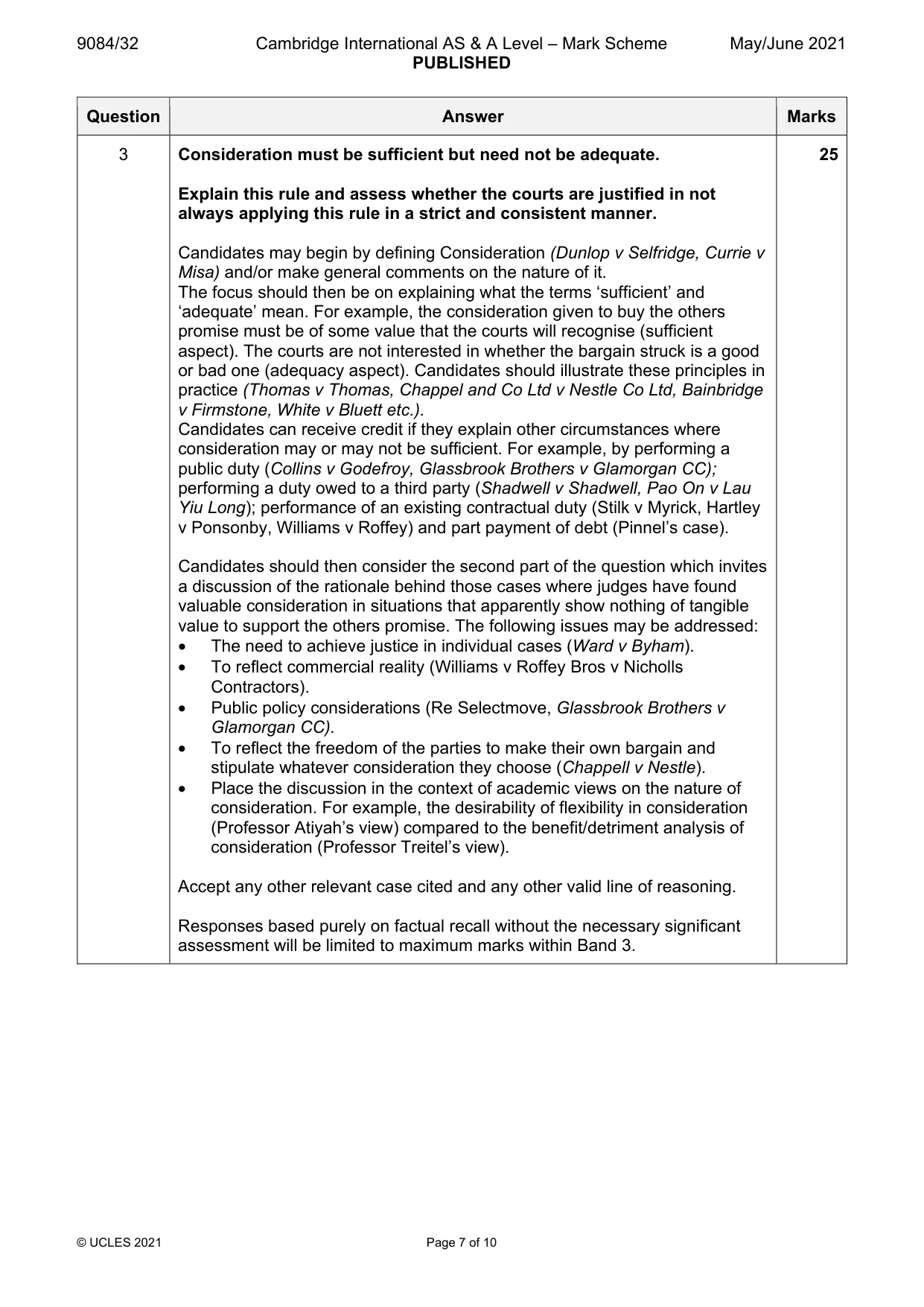
9084/32 Cambridge International AS & A Level – Mark Scheme PUBLISHED May/June 2021 © UCLES 2021 Page 7 of 10 Question Answer Marks 3 Consideration must be sufficient but need not be adequate. Explain this rule and assess whether the courts are justified in not always applying this rule in a strict and consistent manner. Candidates may begin by defining Consideration (Dunlop v Selfridge, Currie v Misa) and/or make general comments on the nature of it. The focus should then be on explaining what the terms ‘sufficient’ and ‘adequate’ mean. For example, the consideration given to buy the others promise must be of some value that the courts will recognise (sufficient aspect). The courts are not interested in whether the bargain struck is a good or bad one (adequacy aspect). Candidates should illustrate these principles in practice (Thomas v Thomas, Chappel and Co Ltd v Nestle Co Ltd, Bainbridge v Firmstone, White v Bluett etc.). Candidates can receive credit if they explain other circumstances where consideration may or may not be sufficient. For example, by performing a public duty (Collins v Godefroy, Glassbrook Brothers v Glamorgan CC); performing a duty owed to a third party (Shadwell v Shadwell, Pao On v Lau Yiu Long); performance of an existing contractual duty (Stilk v Myrick, Hartley v Ponsonby, Williams v Roffey) and part payment of debt (Pinnel’s case). Candidates should then consider the second part of the question which invites a discussion of the rationale behind those cases where judges have found valuable consideration in situations that apparently show nothing of tangible value to support the others promise. The following issues may be addressed: • The need to achieve justice in individual cases (Ward v Byham). • To reflect commercial reality (Williams v Roffey Bros v Nicholls Contractors). • Public policy considerations (Re Selectmove, Glassbrook Brothers v Glamorgan CC). • To reflect the freedom of the parties to make their own bargain and stipulate whatever consideration they choose (Chappell v Nestle). • Place the discussion in the context of academic views on the nature of consideration. For example, the desirability of flexibility in consideration (Professor Atiyah’s view) compared to the benefit/detriment analysis of consideration (Professor Treitel’s view). Accept any other relevant case cited and any other valid line of reasoning. Responses based purely on factual recall without the necessary significant assessment will be limited to maximum marks within Band 3. 25
Mark scheme, page 8
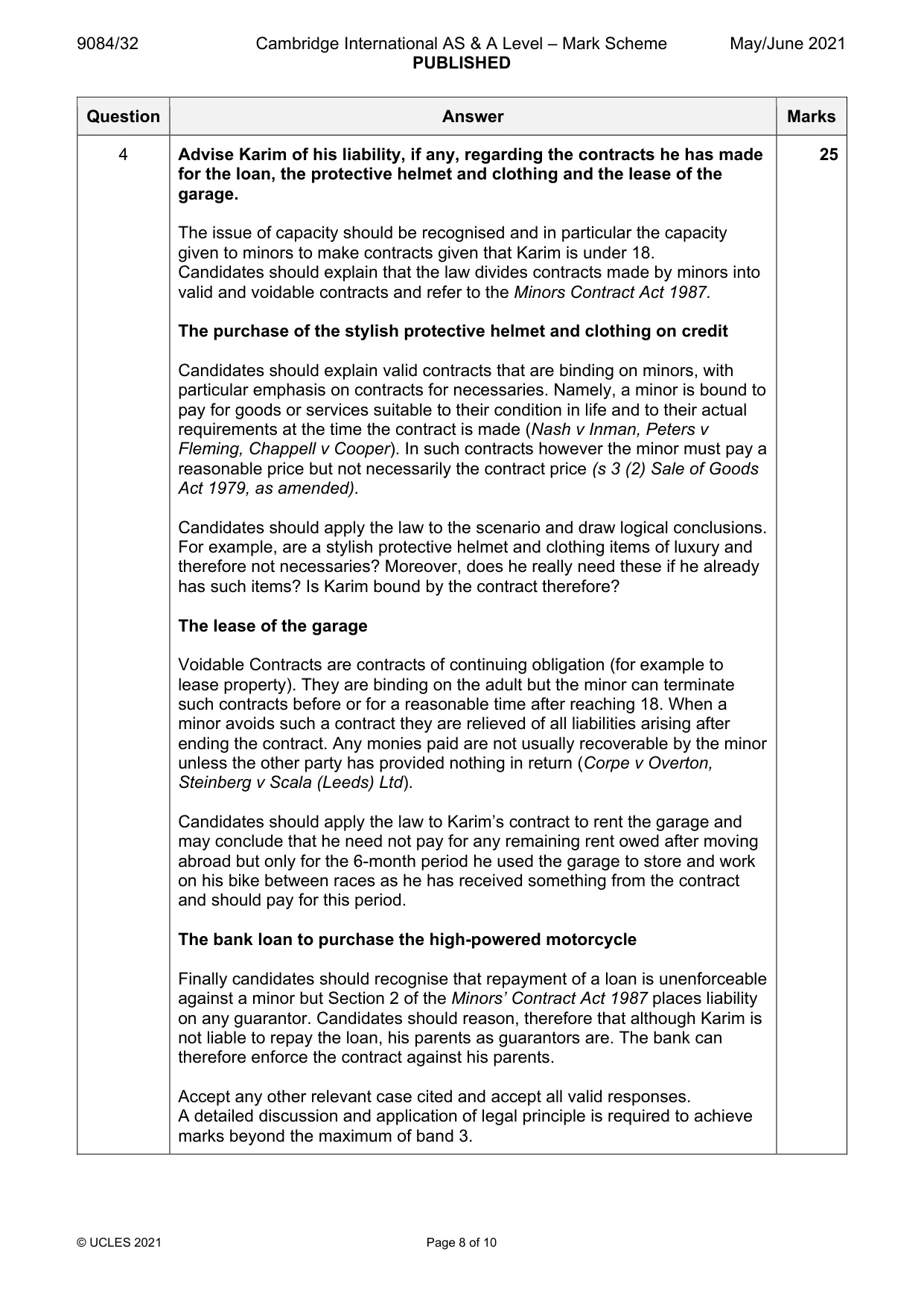
9084/32 Cambridge International AS & A Level – Mark Scheme PUBLISHED May/June 2021 © UCLES 2021 Page 8 of 10 Question Answer Marks 4 Advise Karim of his liability, if any, regarding the contracts he has made for the loan, the protective helmet and clothing and the lease of the garage. The issue of capacity should be recognised and in particular the capacity given to minors to make contracts given that Karim is under 18. Candidates should explain that the law divides contracts made by minors into valid and voidable contracts and refer to the Minors Contract Act 1987. The purchase of the stylish protective helmet and clothing on credit Candidates should explain valid contracts that are binding on minors, with particular emphasis on contracts for necessaries. Namely, a minor is bound to pay for goods or services suitable to their condition in life and to their actual requirements at the time the contract is made (Nash v Inman, Peters v Fleming, Chappell v Cooper). In such contracts however the minor must pay a reasonable price but not necessarily the contract price (s 3 (2) Sale of Goods Act 1979, as amended). Candidates should apply the law to the scenario and draw logical conclusions. For example, are a stylish protective helmet and clothing items of luxury and therefore not necessaries? Moreover, does he really need these if he already has such items? Is Karim bound by the contract therefore? The lease of the garage Voidable Contracts are contracts of continuing obligation (for example to lease property). They are binding on the adult but the minor can terminate such contracts before or for a reasonable time after reaching 18. When a minor avoids such a contract they are relieved of all liabilities arising after ending the contract. Any monies paid are not usually recoverable by the minor unless the other party has provided nothing in return (Corpe v Overton, Steinberg v Scala (Leeds) Ltd). Candidates should apply the law to Karim’s contract to rent the garage and may conclude that he need not pay for any remaining rent owed after moving abroad but only for the 6-month period he used the garage to store and work on his bike between races as he has received something from the contract and should pay for this period. The bank loan to purchase the high-powered motorcycle Finally candidates should recognise that repayment of a loan is unenforceable against a minor but Section 2 of the Minors’ Contract Act 1987 places liability on any guarantor. Candidates should reason, therefore that although Karim is not liable to repay the loan, his parents as guarantors are. The bank can therefore enforce the contract against his parents. Accept any other relevant case cited and accept all valid responses. A detailed discussion and application of legal principle is required to achieve marks beyond the maximum of band 3. 25
Mark scheme, page 9
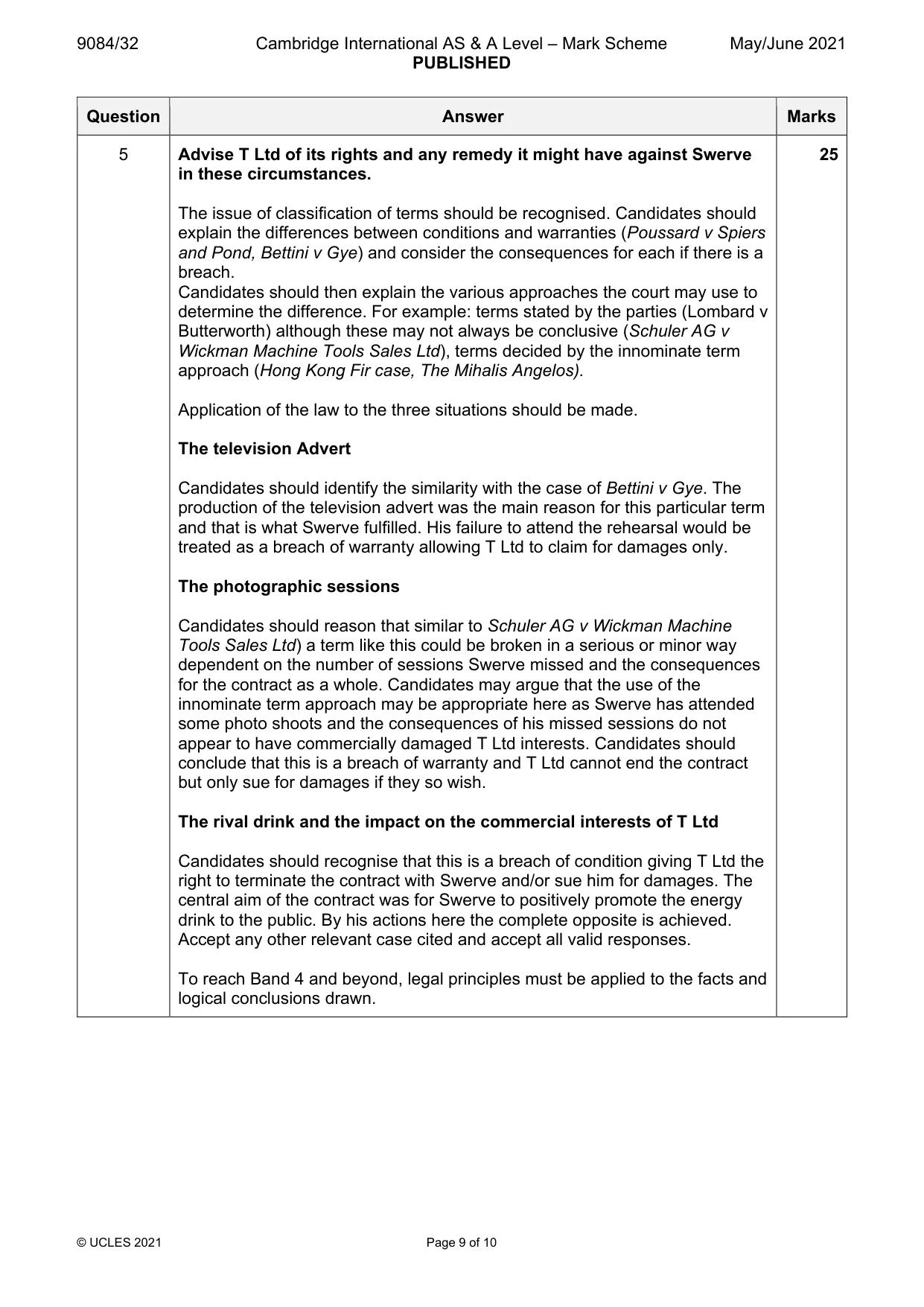
9084/32 Cambridge International AS & A Level – Mark Scheme PUBLISHED May/June 2021 © UCLES 2021 Page 9 of 10 Question Answer Marks 5 Advise T Ltd of its rights and any remedy it might have against Swerve in these circumstances. The issue of classification of terms should be recognised. Candidates should explain the differences between conditions and warranties (Poussard v Spiers and Pond, Bettini v Gye) and consider the consequences for each if there is a breach. Candidates should then explain the various approaches the court may use to determine the difference. For example: terms stated by the parties (Lombard v Butterworth) although these may not always be conclusive (Schuler AG v Wickman Machine Tools Sales Ltd), terms decided by the innominate term approach (Hong Kong Fir case, The Mihalis Angelos). Application of the law to the three situations should be made. The television Advert Candidates should identify the similarity with the case of Bettini v Gye. The production of the television advert was the main reason for this particular term and that is what Swerve fulfilled. His failure to attend the rehearsal would be treated as a breach of warranty allowing T Ltd to claim for damages only. The photographic sessions Candidates should reason that similar to Schuler AG v Wickman Machine Tools Sales Ltd) a term like this could be broken in a serious or minor way dependent on the number of sessions Swerve missed and the consequences for the contract as a whole. Candidates may argue that the use of the innominate term approach may be appropriate here as Swerve has attended some photo shoots and the consequences of his missed sessions do not appear to have commercially damaged T Ltd interests. Candidates should conclude that this is a breach of warranty and T Ltd cannot end the contract but only sue for damages if they so wish. The rival drink and the impact on the commercial interests of T Ltd Candidates should recognise that this is a breach of condition giving T Ltd the right to terminate the contract with Swerve and/or sue him for damages. The central aim of the contract was for Swerve to positively promote the energy drink to the public. By his actions here the complete opposite is achieved. Accept any other relevant case cited and accept all valid responses. To reach Band 4 and beyond, legal principles must be applied to the facts and logical conclusions drawn. 25
Mark scheme, page 10
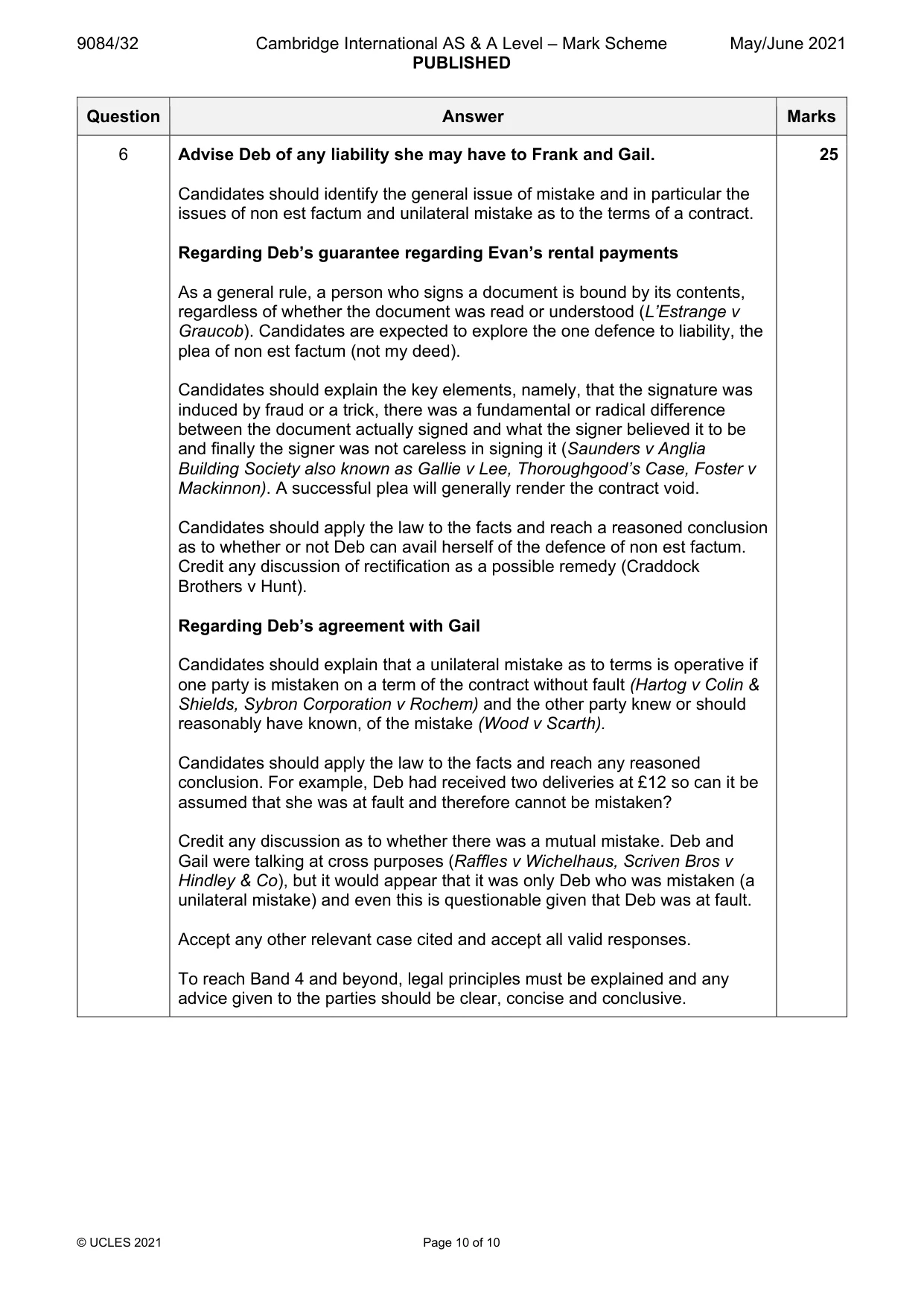
9084/32 Cambridge International AS & A Level – Mark Scheme PUBLISHED May/June 2021 © UCLES 2021 Page 10 of 10 Question Answer Marks 6 Advise Deb of any liability she may have to Frank and Gail. Candidates should identify the general issue of mistake and in particular the issues of non est factum and unilateral mistake as to the terms of a contract. Regarding Deb’s guarantee regarding Evan’s rental payments As a general rule, a person who signs a document is bound by its contents, regardless of whether the document was read or understood (L’Estrange v Graucob). Candidates are expected to explore the one defence to liability, the plea of non est factum (not my deed). Candidates should explain the key elements, namely, that the signature was induced by fraud or a trick, there was a fundamental or radical difference between the document actually signed and what the signer believed it to be and finally the signer was not careless in signing it (Saunders v Anglia Building Society also known as Gallie v Lee, Thoroughgood’s Case, Foster v Mackinnon). A successful plea will generally render the contract void. Candidates should apply the law to the facts and reach a reasoned conclusion as to whether or not Deb can avail herself of the defence of non est factum. Credit any discussion of rectification as a possible remedy (Craddock Brothers v Hunt). Regarding Deb’s agreement with Gail Candidates should explain that a unilateral mistake as to terms is operative if one party is mistaken on a term of the contract without fault (Hartog v Colin & Shields, Sybron Corporation v Rochem) and the other party knew or should reasonably have known, of the mistake (Wood v Scarth). Candidates should apply the law to the facts and reach any reasoned conclusion. For example, Deb had received two deliveries at £12 so can it be assumed that she was at fault and therefore cannot be mistaken? Credit any discussion as to whether there was a mutual mistake. Deb and Gail were talking at cross purposes (Raffles v Wichelhaus, Scriven Bros v Hindley & Co), but it would appear that it was only Deb who was mistaken (a unilateral mistake) and even this is questionable given that Deb was at fault. Accept any other relevant case cited and accept all valid responses. To reach Band 4 and beyond, legal principles must be explained and any advice given to the parties should be clear, concise and conclusive. 25
What you needed in this session
Cambridge’s own grade thresholds for 2021 May/June, Paper 3 · Variant 2. A higher threshold means an easier paper — the bar moves with how the cohort did.