Cambridge A Level Law 9084 — 2021 May/June Paper 3 · Variant 1
9084/31/M/J/21 · 75 marks · ≈84 min
The question paper and its mark scheme, free to read here and free to download. This is Cambridge’s own paper, exactly as it was sat.
Question paper4 pages

Mark scheme10 pages
Answers below. Sit the paper first if you are practising.
Paper as text
Question paper, page 1
This document has 4 pages. Any blank pages are indicated. DC (RW) 207089/1 © UCLES 2021 [Turn over * 3 7 8 6 8 2 1 2 3 5 * Cambridge International AS & A Level LAW 9084/31 Paper 3 Law of Contract May/June 2021 1 hour 30 minutes You must answer on the enclosed answer booklet. You will need: Answer booklet (enclosed) INSTRUCTIONS ● Answer three questions in total: Answer at least one question from Section A. Answer at least one question from Section B. Answer one other question from either Section A or Section B. ● Follow the instructions on the front cover of the answer booklet. If you need additional answer paper, ask the invigilator for a continuation booklet. INFORMATION ● The total mark for this paper is 75. ● The number of marks for each question or part question is shown in brackets [ ].
Question paper, page 2
2 9084/31/M/J/21 © UCLES 2021 Answer at least one question from Section A. Answer at least one question from Section B. Answer one other question from either Section A or Section B. Section A 1 All untrue statements made with the intention of inducing another person to enter into a contract will amount to an actionable misrepresentation. Outline the requirements for an actionable misrepresentation and assess the validity of the statement above. [25] 2 Describe the different categories of minors’ contracts. Assess the extent to which it is necessary for adults to be particularly cautious when making contracts with minors. [25] 3 Statute law regarding exemption clauses means that common law principles are now largely irrelevant. Describe the common law rules regarding incorporation and construction of exemption clauses. Assess the validity of the statement above. [25]
Question paper, page 3
3 9084/31/M/J/21 © UCLES 2021 Section B 4 Roger owns a transport business. In May 2018 he entered into an agreement with ABC Ltd to transport stone extracted from its quarry for a period of five years. A term of this agreement stated: ‘This arrangement is not entered into as a formal legal agreement.’ Roger’s daughter, Tina, is a 20-year-old university student. Roger has agreed to pay Tina to work in his office during her summer vacation so that she can gain business experience. In May 2021 Tina has been working for Roger for just three weeks when ABC Ltd informs Roger that it is terminating the agreement with immediate effect. The sudden loss of income forces Roger to tell Tina that he cannot now afford to pay her as promised. Advise the parties of their respective rights and liabilities in contract law. [25] 5 Jim leaves his job as a potter with a large company in order to establish his own business. He contracts with DEF Ltd for the construction of a pottery workshop next to his home, with a completion date of 1 May. In fact the workshop is not finished until 1 September because DEF Ltd prioritises other jobs. This delay causes Jim to lose £10 000 in revenue from contracts he had planned to complete during this four-month period. In addition he loses a special contract worth £5000 with a local school to provide pottery classes in his workshop to its art students. These setbacks cause Jim to worry about the long-term future of his business and he experiences considerable mental distress. Advise DEF Ltd of any contractual liability it may have for the losses experienced by Jim. [25] 6 Two valuable paintings have been stolen from Barchester Gallery (BG). BG places an advertisement in the local newspaper offering a £10 000 reward to anyone who provides information leading to the recovery of each painting. Gina is walking in woodland with her dog when she finds one of the paintings partly concealed under a bush. Gina is unaware of the reward so takes it to the nearest police station. Gina only becomes aware of the reward the next day when viewing a TV news report featuring the safe return of the picture to the gallery. She then contacts BG to claim the reward. Three months later, Frank finds the other painting inside an abandoned car. He has seen the reward advertised and contacts BG to claim it. Advise Frank and Gina as to their contractual right to claim the rewards. [25]
Question paper, page 4
4 9084/31/M/J/21 © UCLES 2021 Permission to reproduce items where third-party owned material protected by copyright is included has been sought and cleared where possible. Every reasonable effort has been made by the publisher (UCLES) to trace copyright holders, but if any items requiring clearance have unwittingly been included, the publisher will be pleased to make amends at the earliest possible opportunity. To avoid the issue of disclosure of answer-related information to candidates, all copyright acknowledgements are reproduced online in the Cambridge Assessment International Education Copyright Acknowledgements Booklet. This is produced for each series of examinations and is freely available to download at www.cambridgeinternational.org after the live examination series. Cambridge Assessment International Education is part of the Cambridge Assessment Group. Cambridge Assessment is the brand name of the University of Cambridge Local Examinations Syndicate (UCLES), which itself is a department of the University of Cambridge. BLANK PAGE
Mark scheme, page 1
This document consists of 10 printed pages. © UCLES 2021 [Turn over Cambridge International AS & A Level LAW 9084/31 Paper 3 Law of Contract May/June 2021 MARK SCHEME Maximum Mark: 75 Published This mark scheme is published as an aid to teachers and candidates, to indicate the requirements of the examination. It shows the basis on which Examiners were instructed to award marks. It does not indicate the details of the discussions that took place at an Examiners’ meeting before marking began, which would have considered the acceptability of alternative answers. Mark schemes should be read in conjunction with the question paper and the Principal Examiner Report for Teachers. Cambridge International will not enter into discussions about these mark schemes. Cambridge International is publishing the mark schemes for the May/June 2021 series for most Cambridge IGCSE™, Cambridge International A and AS Level components and some Cambridge O Level components.
Mark scheme, page 2
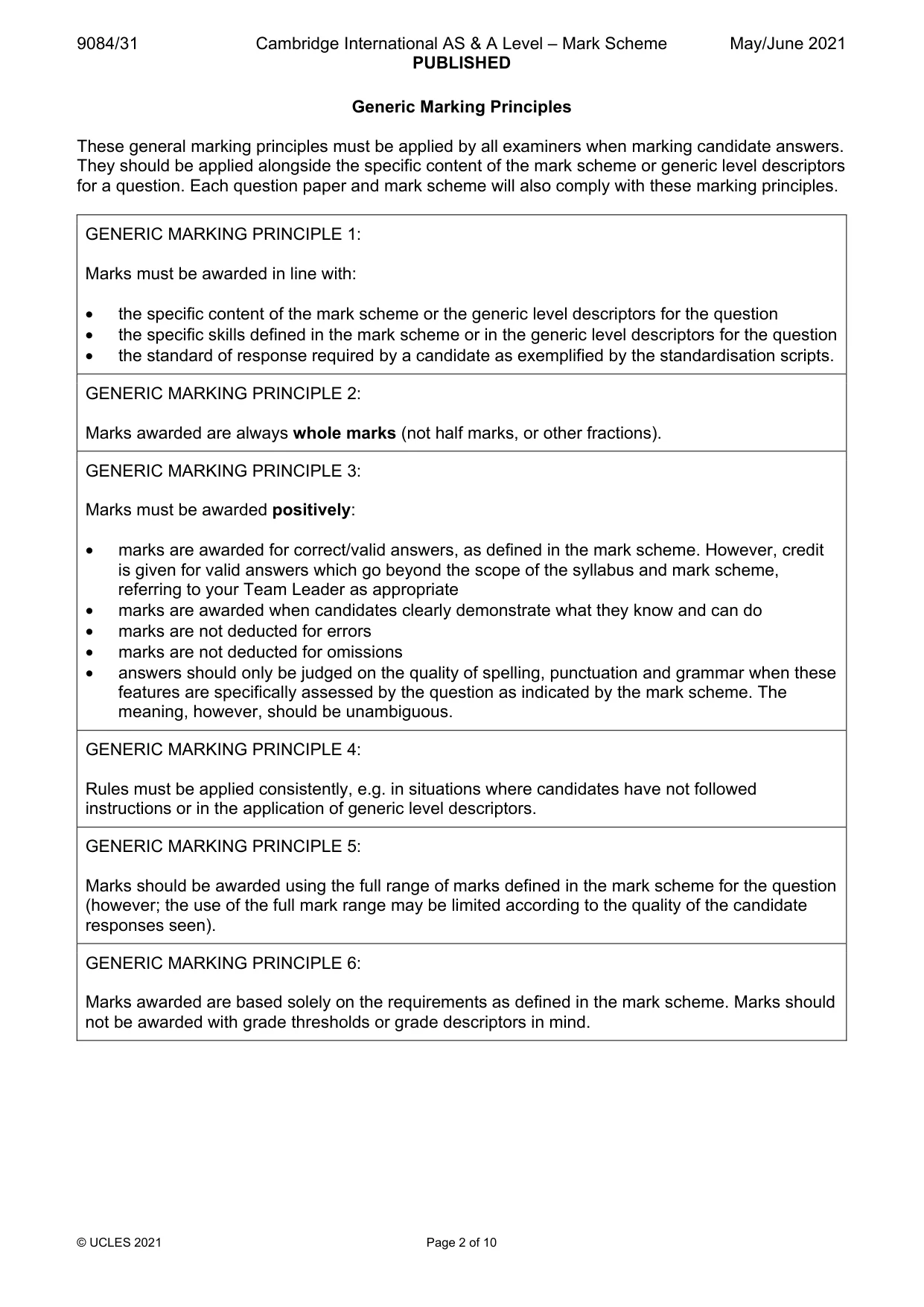
9084/31 Cambridge International AS & A Level – Mark Scheme PUBLISHED May/June 2021 © UCLES 2021 Page 2 of 10 Generic Marking Principles These general marking principles must be applied by all examiners when marking candidate answers. They should be applied alongside the specific content of the mark scheme or generic level descriptors for a question. Each question paper and mark scheme will also comply with these marking principles. GENERIC MARKING PRINCIPLE 1: Marks must be awarded in line with: • the specific content of the mark scheme or the generic level descriptors for the question • the specific skills defined in the mark scheme or in the generic level descriptors for the question • the standard of response required by a candidate as exemplified by the standardisation scripts. GENERIC MARKING PRINCIPLE 2: Marks awarded are always whole marks (not half marks, or other fractions). GENERIC MARKING PRINCIPLE 3: Marks must be awarded positively: • marks are awarded for correct/valid answers, as defined in the mark scheme. However, credit is given for valid answers which go beyond the scope of the syllabus and mark scheme, referring to your Team Leader as appropriate • marks are awarded when candidates clearly demonstrate what they know and can do • marks are not deducted for errors • marks are not deducted for omissions • answers should only be judged on the quality of spelling, punctuation and grammar when these features are specifically assessed by the question as indicated by the mark scheme. The meaning, however, should be unambiguous. GENERIC MARKING PRINCIPLE 4: Rules must be applied consistently, e.g. in situations where candidates have not followed instructions or in the application of generic level descriptors. GENERIC MARKING PRINCIPLE 5: Marks should be awarded using the full range of marks defined in the mark scheme for the question (however; the use of the full mark range may be limited according to the quality of the candidate responses seen). GENERIC MARKING PRINCIPLE 6: Marks awarded are based solely on the requirements as defined in the mark scheme. Marks should not be awarded with grade thresholds or grade descriptors in mind.
Mark scheme, page 3
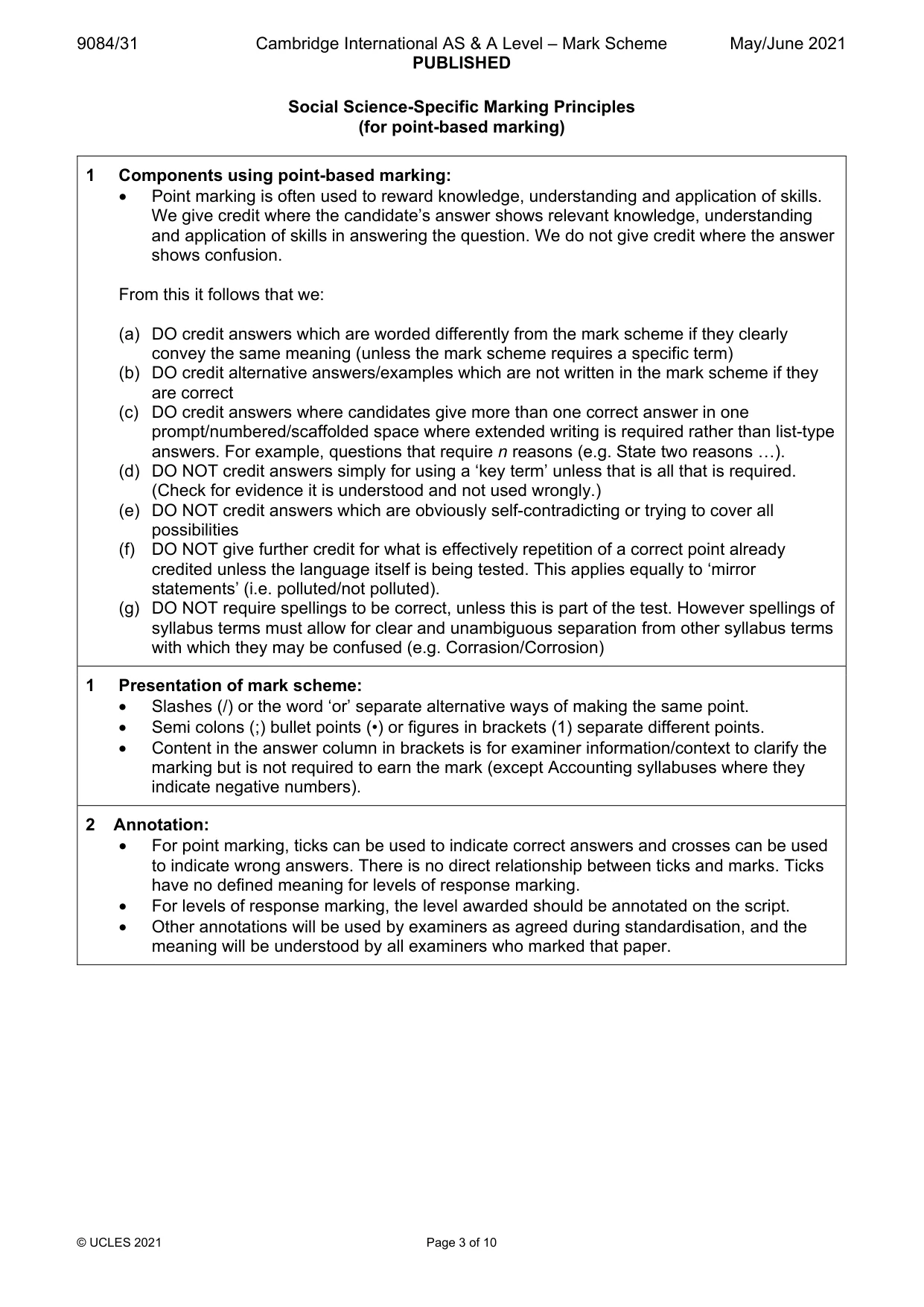
9084/31 Cambridge International AS & A Level – Mark Scheme PUBLISHED May/June 2021 © UCLES 2021 Page 3 of 10 Social Science-Specific Marking Principles (for point-based marking) 1 Components using point-based marking: • Point marking is often used to reward knowledge, understanding and application of skills. We give credit where the candidate’s answer shows relevant knowledge, understanding and application of skills in answering the question. We do not give credit where the answer shows confusion. From this it follows that we: (a) DO credit answers which are worded differently from the mark scheme if they clearly convey the same meaning (unless the mark scheme requires a specific term) (b) DO credit alternative answers/examples which are not written in the mark scheme if they are correct (c) DO credit answers where candidates give more than one correct answer in one prompt/numbered/scaffolded space where extended writing is required rather than list-type answers. For example, questions that require n reasons (e.g. State two reasons …). (d) DO NOT credit answers simply for using a ‘key term’ unless that is all that is required. (Check for evidence it is understood and not used wrongly.) (e) DO NOT credit answers which are obviously self-contradicting or trying to cover all possibilities (f) DO NOT give further credit for what is effectively repetition of a correct point already credited unless the language itself is being tested. This applies equally to ‘mirror statements’ (i.e. polluted/not polluted). (g) DO NOT require spellings to be correct, unless this is part of the test. However spellings of syllabus terms must allow for clear and unambiguous separation from other syllabus terms with which they may be confused (e.g. Corrasion/Corrosion) 1 Presentation of mark scheme: • Slashes (/) or the word ‘or’ separate alternative ways of making the same point. • Semi colons (;) bullet points (•) or figures in brackets (1) separate different points. • Content in the answer column in brackets is for examiner information/context to clarify the marking but is not required to earn the mark (except Accounting syllabuses where they indicate negative numbers). 2 Annotation: • For point marking, ticks can be used to indicate correct answers and crosses can be used to indicate wrong answers. There is no direct relationship between ticks and marks. Ticks have no defined meaning for levels of response marking. • For levels of response marking, the level awarded should be annotated on the script. • Other annotations will be used by examiners as agreed during standardisation, and the meaning will be understood by all examiners who marked that paper.
Mark scheme, page 4
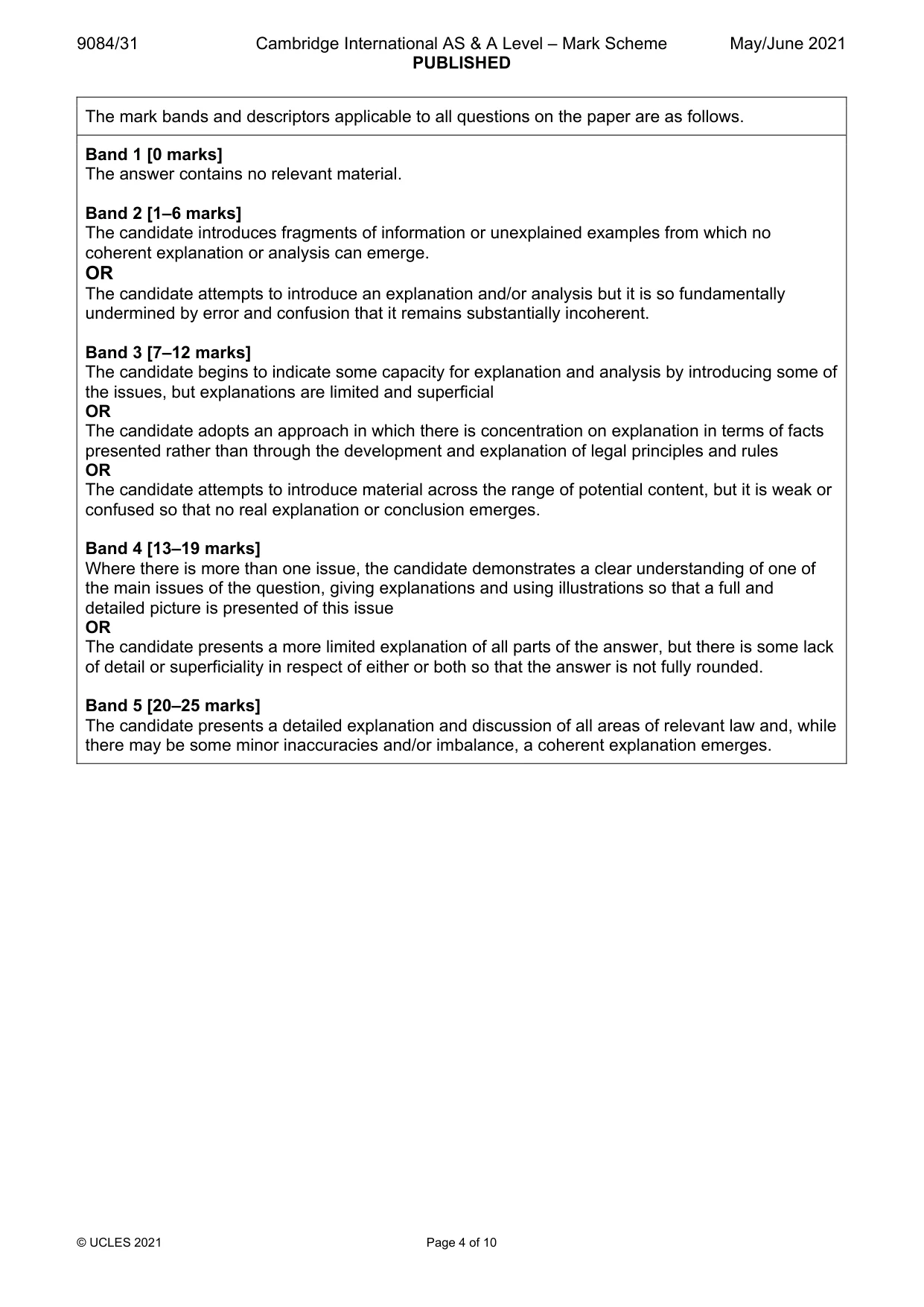
9084/31 Cambridge International AS & A Level – Mark Scheme PUBLISHED May/June 2021 © UCLES 2021 Page 4 of 10 The mark bands and descriptors applicable to all questions on the paper are as follows. Band 1 [0 marks] The answer contains no relevant material. Band 2 [1–6 marks] The candidate introduces fragments of information or unexplained examples from which no coherent explanation or analysis can emerge. OR The candidate attempts to introduce an explanation and/or analysis but it is so fundamentally undermined by error and confusion that it remains substantially incoherent. Band 3 [7–12 marks] The candidate begins to indicate some capacity for explanation and analysis by introducing some of the issues, but explanations are limited and superficial OR The candidate adopts an approach in which there is concentration on explanation in terms of facts presented rather than through the development and explanation of legal principles and rules OR The candidate attempts to introduce material across the range of potential content, but it is weak or confused so that no real explanation or conclusion emerges. Band 4 [13–19 marks] Where there is more than one issue, the candidate demonstrates a clear understanding of one of the main issues of the question, giving explanations and using illustrations so that a full and detailed picture is presented of this issue OR The candidate presents a more limited explanation of all parts of the answer, but there is some lack of detail or superficiality in respect of either or both so that the answer is not fully rounded. Band 5 [20–25 marks] The candidate presents a detailed explanation and discussion of all areas of relevant law and, while there may be some minor inaccuracies and/or imbalance, a coherent explanation emerges.
Mark scheme, page 5
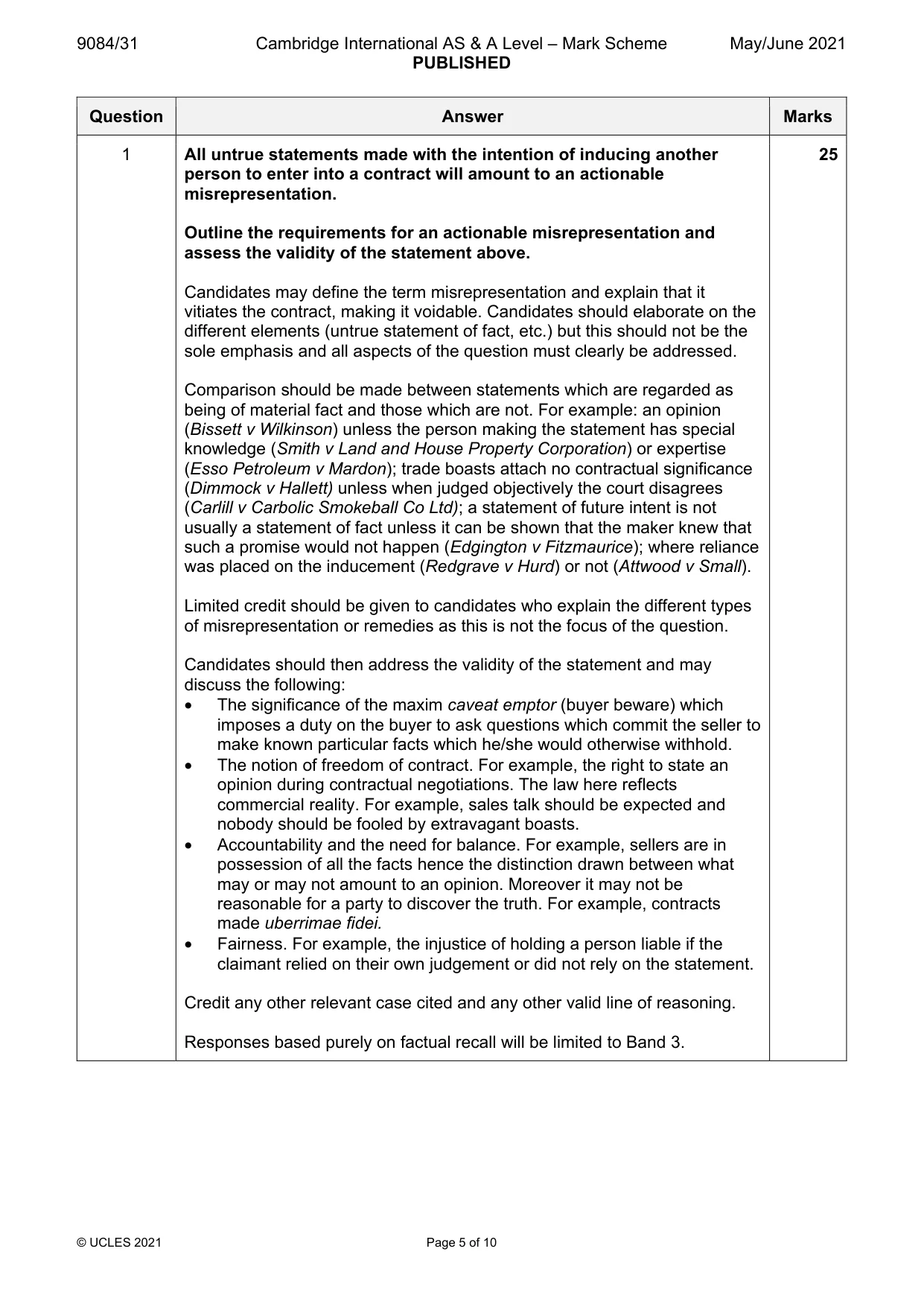
9084/31 Cambridge International AS & A Level – Mark Scheme PUBLISHED May/June 2021 © UCLES 2021 Page 5 of 10 Question Answer Marks 1 All untrue statements made with the intention of inducing another person to enter into a contract will amount to an actionable misrepresentation. Outline the requirements for an actionable misrepresentation and assess the validity of the statement above. Candidates may define the term misrepresentation and explain that it vitiates the contract, making it voidable. Candidates should elaborate on the different elements (untrue statement of fact, etc.) but this should not be the sole emphasis and all aspects of the question must clearly be addressed. Comparison should be made between statements which are regarded as being of material fact and those which are not. For example: an opinion (Bissett v Wilkinson) unless the person making the statement has special knowledge (Smith v Land and House Property Corporation) or expertise (Esso Petroleum v Mardon); trade boasts attach no contractual significance (Dimmock v Hallett) unless when judged objectively the court disagrees (Carlill v Carbolic Smokeball Co Ltd); a statement of future intent is not usually a statement of fact unless it can be shown that the maker knew that such a promise would not happen (Edgington v Fitzmaurice); where reliance was placed on the inducement (Redgrave v Hurd) or not (Attwood v Small). Limited credit should be given to candidates who explain the different types of misrepresentation or remedies as this is not the focus of the question. Candidates should then address the validity of the statement and may discuss the following: • The significance of the maxim caveat emptor (buyer beware) which imposes a duty on the buyer to ask questions which commit the seller to make known particular facts which he/she would otherwise withhold. • The notion of freedom of contract. For example, the right to state an opinion during contractual negotiations. The law here reflects commercial reality. For example, sales talk should be expected and nobody should be fooled by extravagant boasts. • Accountability and the need for balance. For example, sellers are in possession of all the facts hence the distinction drawn between what may or may not amount to an opinion. Moreover it may not be reasonable for a party to discover the truth. For example, contracts made uberrimae fidei. • Fairness. For example, the injustice of holding a person liable if the claimant relied on their own judgement or did not rely on the statement. Credit any other relevant case cited and any other valid line of reasoning. Responses based purely on factual recall will be limited to Band 3. 25
Mark scheme, page 6
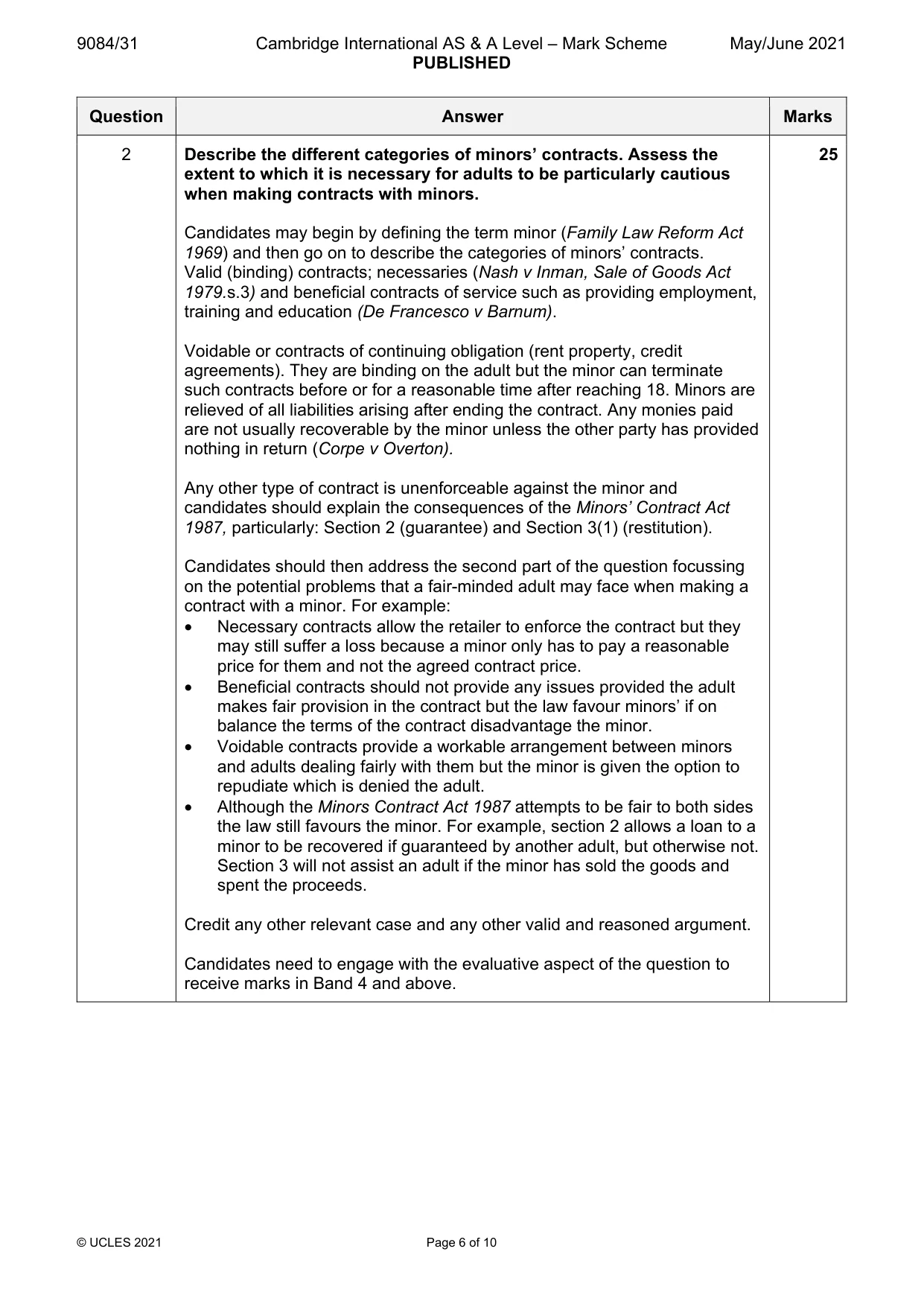
9084/31 Cambridge International AS & A Level – Mark Scheme PUBLISHED May/June 2021 © UCLES 2021 Page 6 of 10 Question Answer Marks 2 Describe the different categories of minors’ contracts. Assess the extent to which it is necessary for adults to be particularly cautious when making contracts with minors. Candidates may begin by defining the term minor (Family Law Reform Act 1969) and then go on to describe the categories of minors’ contracts. Valid (binding) contracts; necessaries (Nash v Inman, Sale of Goods Act 1979.s.3) and beneficial contracts of service such as providing employment, training and education (De Francesco v Barnum). Voidable or contracts of continuing obligation (rent property, credit agreements). They are binding on the adult but the minor can terminate such contracts before or for a reasonable time after reaching 18. Minors are relieved of all liabilities arising after ending the contract. Any monies paid are not usually recoverable by the minor unless the other party has provided nothing in return (Corpe v Overton). Any other type of contract is unenforceable against the minor and candidates should explain the consequences of the Minors’ Contract Act 1987, particularly: Section 2 (guarantee) and Section 3(1) (restitution). Candidates should then address the second part of the question focussing on the potential problems that a fair-minded adult may face when making a contract with a minor. For example: • Necessary contracts allow the retailer to enforce the contract but they may still suffer a loss because a minor only has to pay a reasonable price for them and not the agreed contract price. • Beneficial contracts should not provide any issues provided the adult makes fair provision in the contract but the law favour minors’ if on balance the terms of the contract disadvantage the minor. • Voidable contracts provide a workable arrangement between minors and adults dealing fairly with them but the minor is given the option to repudiate which is denied the adult. • Although the Minors Contract Act 1987 attempts to be fair to both sides the law still favours the minor. For example, section 2 allows a loan to a minor to be recovered if guaranteed by another adult, but otherwise not. Section 3 will not assist an adult if the minor has sold the goods and spent the proceeds. Credit any other relevant case and any other valid and reasoned argument. Candidates need to engage with the evaluative aspect of the question to receive marks in Band 4 and above. 25
Mark scheme, page 7
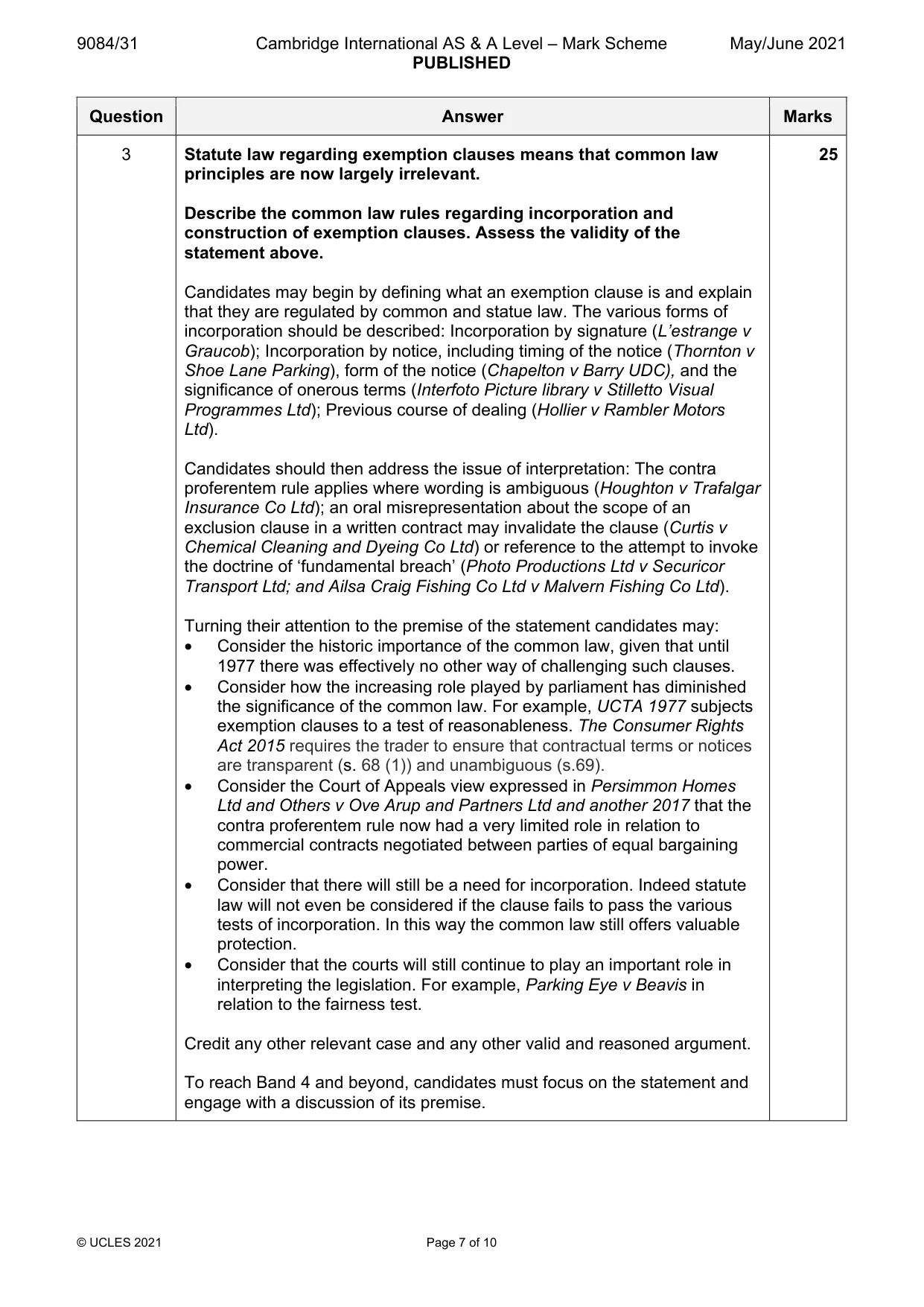
9084/31 Cambridge International AS & A Level – Mark Scheme PUBLISHED May/June 2021 © UCLES 2021 Page 7 of 10 Question Answer Marks 3 Statute law regarding exemption clauses means that common law principles are now largely irrelevant. Describe the common law rules regarding incorporation and construction of exemption clauses. Assess the validity of the statement above. Candidates may begin by defining what an exemption clause is and explain that they are regulated by common and statue law. The various forms of incorporation should be described: Incorporation by signature (L’estrange v Graucob); Incorporation by notice, including timing of the notice (Thornton v Shoe Lane Parking), form of the notice (Chapelton v Barry UDC), and the significance of onerous terms (Interfoto Picture library v Stilletto Visual Programmes Ltd); Previous course of dealing (Hollier v Rambler Motors Ltd). Candidates should then address the issue of interpretation: The contra proferentem rule applies where wording is ambiguous (Houghton v Trafalgar Insurance Co Ltd); an oral misrepresentation about the scope of an exclusion clause in a written contract may invalidate the clause (Curtis v Chemical Cleaning and Dyeing Co Ltd) or reference to the attempt to invoke the doctrine of ‘fundamental breach’ (Photo Productions Ltd v Securicor Transport Ltd; and Ailsa Craig Fishing Co Ltd v Malvern Fishing Co Ltd). Turning their attention to the premise of the statement candidates may: • Consider the historic importance of the common law, given that until 1977 there was effectively no other way of challenging such clauses. • Consider how the increasing role played by parliament has diminished the significance of the common law. For example, UCTA 1977 subjects exemption clauses to a test of reasonableness. The Consumer Rights Act 2015 requires the trader to ensure that contractual terms or notices are transparent (s. 68 (1)) and unambiguous (s.69). • Consider the Court of Appeals view expressed in Persimmon Homes Ltd and Others v Ove Arup and Partners Ltd and another 2017 that the contra proferentem rule now had a very limited role in relation to commercial contracts negotiated between parties of equal bargaining power. • Consider that there will still be a need for incorporation. Indeed statute law will not even be considered if the clause fails to pass the various tests of incorporation. In this way the common law still offers valuable protection. • Consider that the courts will still continue to play an important role in interpreting the legislation. For example, Parking Eye v Beavis in relation to the fairness test. Credit any other relevant case and any other valid and reasoned argument. To reach Band 4 and beyond, candidates must focus on the statement and engage with a discussion of its premise. 25
Mark scheme, page 8
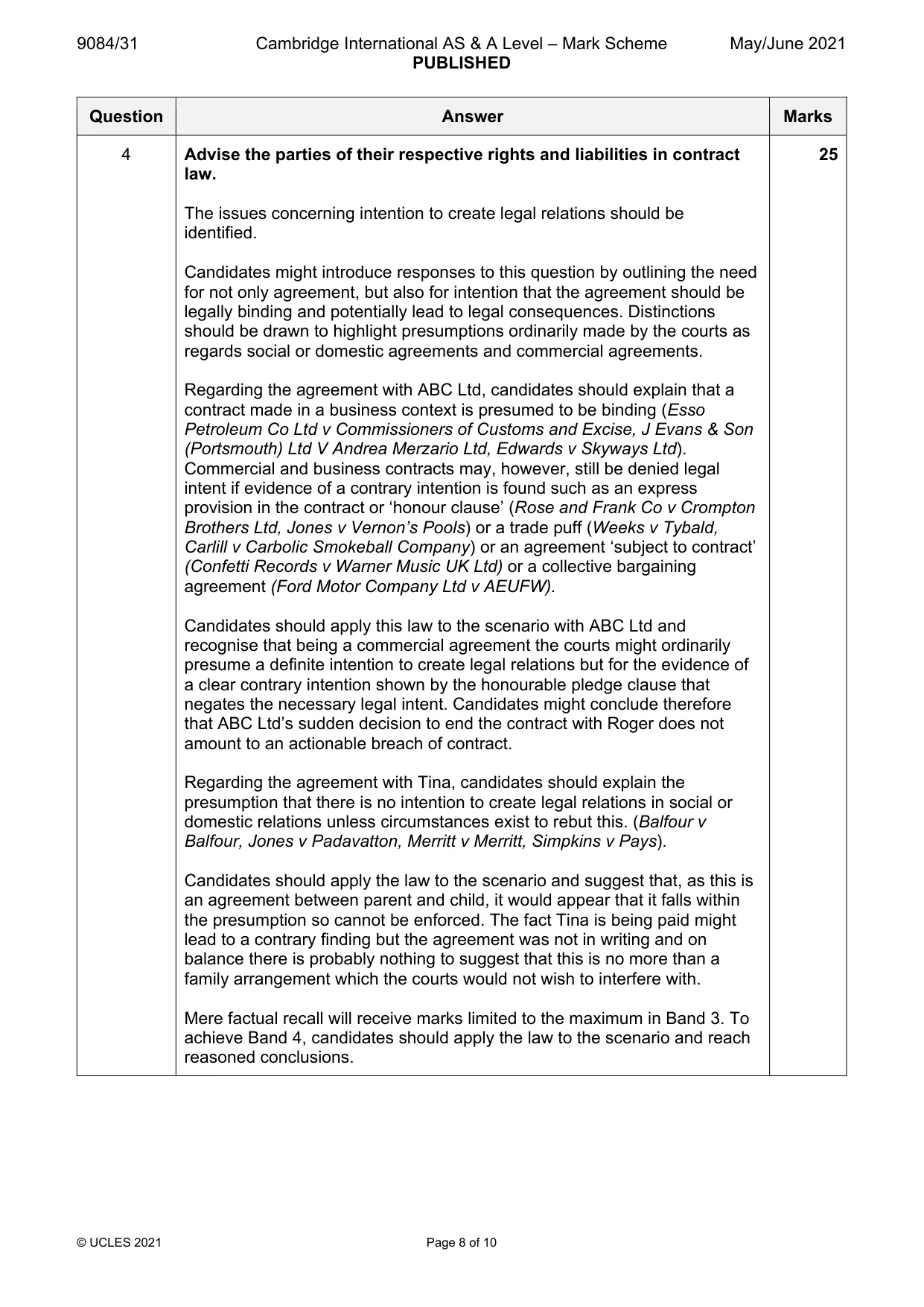
9084/31 Cambridge International AS & A Level – Mark Scheme PUBLISHED May/June 2021 © UCLES 2021 Page 8 of 10 Question Answer Marks 4 Advise the parties of their respective rights and liabilities in contract law. The issues concerning intention to create legal relations should be identified. Candidates might introduce responses to this question by outlining the need for not only agreement, but also for intention that the agreement should be legally binding and potentially lead to legal consequences. Distinctions should be drawn to highlight presumptions ordinarily made by the courts as regards social or domestic agreements and commercial agreements. Regarding the agreement with ABC Ltd, candidates should explain that a contract made in a business context is presumed to be binding (Esso Petroleum Co Ltd v Commissioners of Customs and Excise, J Evans & Son (Portsmouth) Ltd V Andrea Merzario Ltd, Edwards v Skyways Ltd). Commercial and business contracts may, however, still be denied legal intent if evidence of a contrary intention is found such as an express provision in the contract or ‘honour clause’ (Rose and Frank Co v Crompton Brothers Ltd, Jones v Vernon’s Pools) or a trade puff (Weeks v Tybald, Carlill v Carbolic Smokeball Company) or an agreement ‘subject to contract’ (Confetti Records v Warner Music UK Ltd) or a collective bargaining agreement (Ford Motor Company Ltd v AEUFW). Candidates should apply this law to the scenario with ABC Ltd and recognise that being a commercial agreement the courts might ordinarily presume a definite intention to create legal relations but for the evidence of a clear contrary intention shown by the honourable pledge clause that negates the necessary legal intent. Candidates might conclude therefore that ABC Ltd’s sudden decision to end the contract with Roger does not amount to an actionable breach of contract. Regarding the agreement with Tina, candidates should explain the presumption that there is no intention to create legal relations in social or domestic relations unless circumstances exist to rebut this. (Balfour v Balfour, Jones v Padavatton, Merritt v Merritt, Simpkins v Pays). Candidates should apply the law to the scenario and suggest that, as this is an agreement between parent and child, it would appear that it falls within the presumption so cannot be enforced. The fact Tina is being paid might lead to a contrary finding but the agreement was not in writing and on balance there is probably nothing to suggest that this is no more than a family arrangement which the courts would not wish to interfere with. Mere factual recall will receive marks limited to the maximum in Band 3. To achieve Band 4, candidates should apply the law to the scenario and reach reasoned conclusions. 25
Mark scheme, page 9
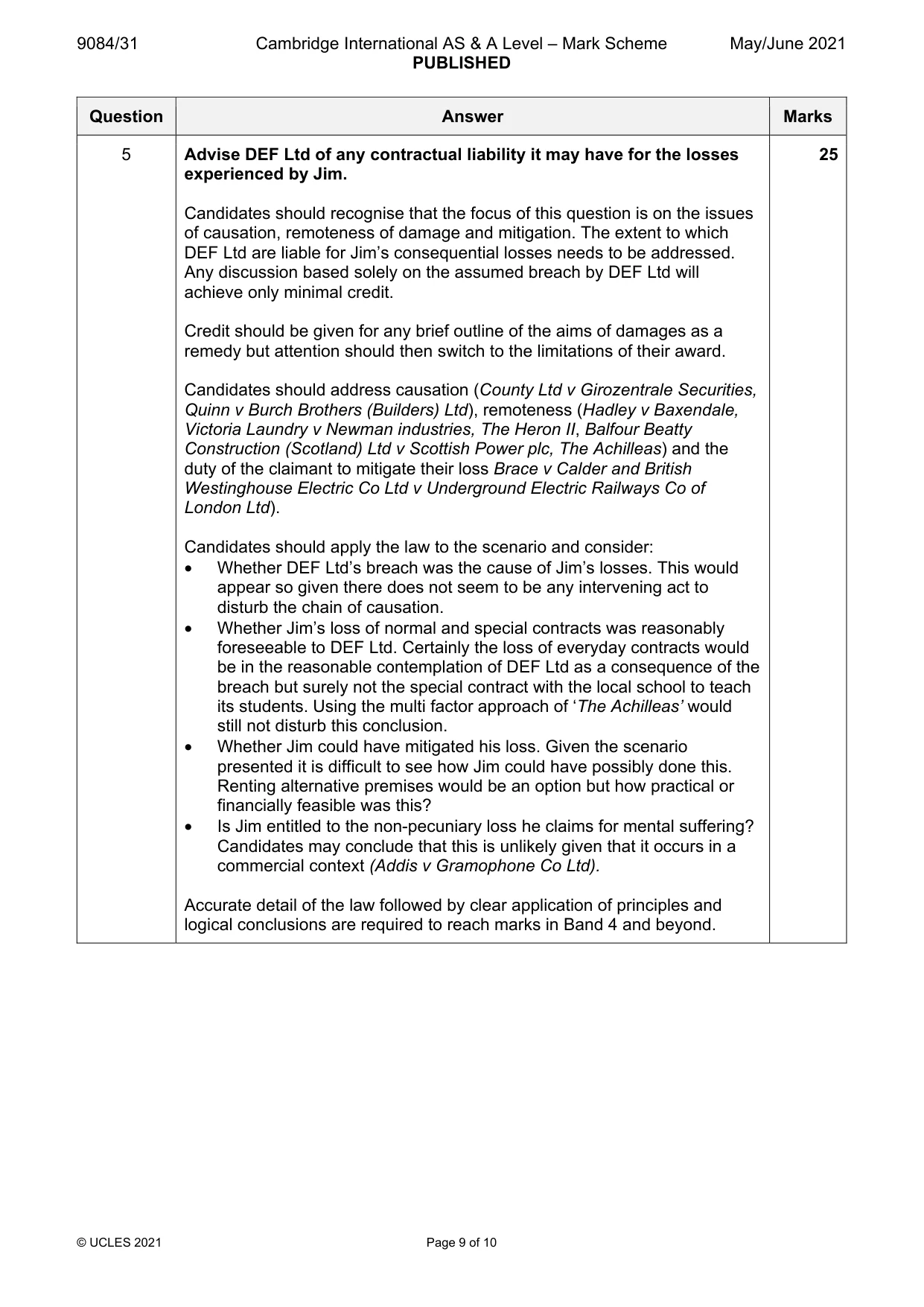
9084/31 Cambridge International AS & A Level – Mark Scheme PUBLISHED May/June 2021 © UCLES 2021 Page 9 of 10 Question Answer Marks 5 Advise DEF Ltd of any contractual liability it may have for the losses experienced by Jim. Candidates should recognise that the focus of this question is on the issues of causation, remoteness of damage and mitigation. The extent to which DEF Ltd are liable for Jim’s consequential losses needs to be addressed. Any discussion based solely on the assumed breach by DEF Ltd will achieve only minimal credit. Credit should be given for any brief outline of the aims of damages as a remedy but attention should then switch to the limitations of their award. Candidates should address causation (County Ltd v Girozentrale Securities, Quinn v Burch Brothers (Builders) Ltd), remoteness (Hadley v Baxendale, Victoria Laundry v Newman industries, The Heron II, Balfour Beatty Construction (Scotland) Ltd v Scottish Power plc, The Achilleas) and the duty of the claimant to mitigate their loss Brace v Calder and British Westinghouse Electric Co Ltd v Underground Electric Railways Co of London Ltd). Candidates should apply the law to the scenario and consider: • Whether DEF Ltd’s breach was the cause of Jim’s losses. This would appear so given there does not seem to be any intervening act to disturb the chain of causation. • Whether Jim’s loss of normal and special contracts was reasonably foreseeable to DEF Ltd. Certainly the loss of everyday contracts would be in the reasonable contemplation of DEF Ltd as a consequence of the breach but surely not the special contract with the local school to teach its students. Using the multi factor approach of ‘The Achilleas’ would still not disturb this conclusion. • Whether Jim could have mitigated his loss. Given the scenario presented it is difficult to see how Jim could have possibly done this. Renting alternative premises would be an option but how practical or financially feasible was this? • Is Jim entitled to the non-pecuniary loss he claims for mental suffering? Candidates may conclude that this is unlikely given that it occurs in a commercial context (Addis v Gramophone Co Ltd). Accurate detail of the law followed by clear application of principles and logical conclusions are required to reach marks in Band 4 and beyond. 25
Mark scheme, page 10
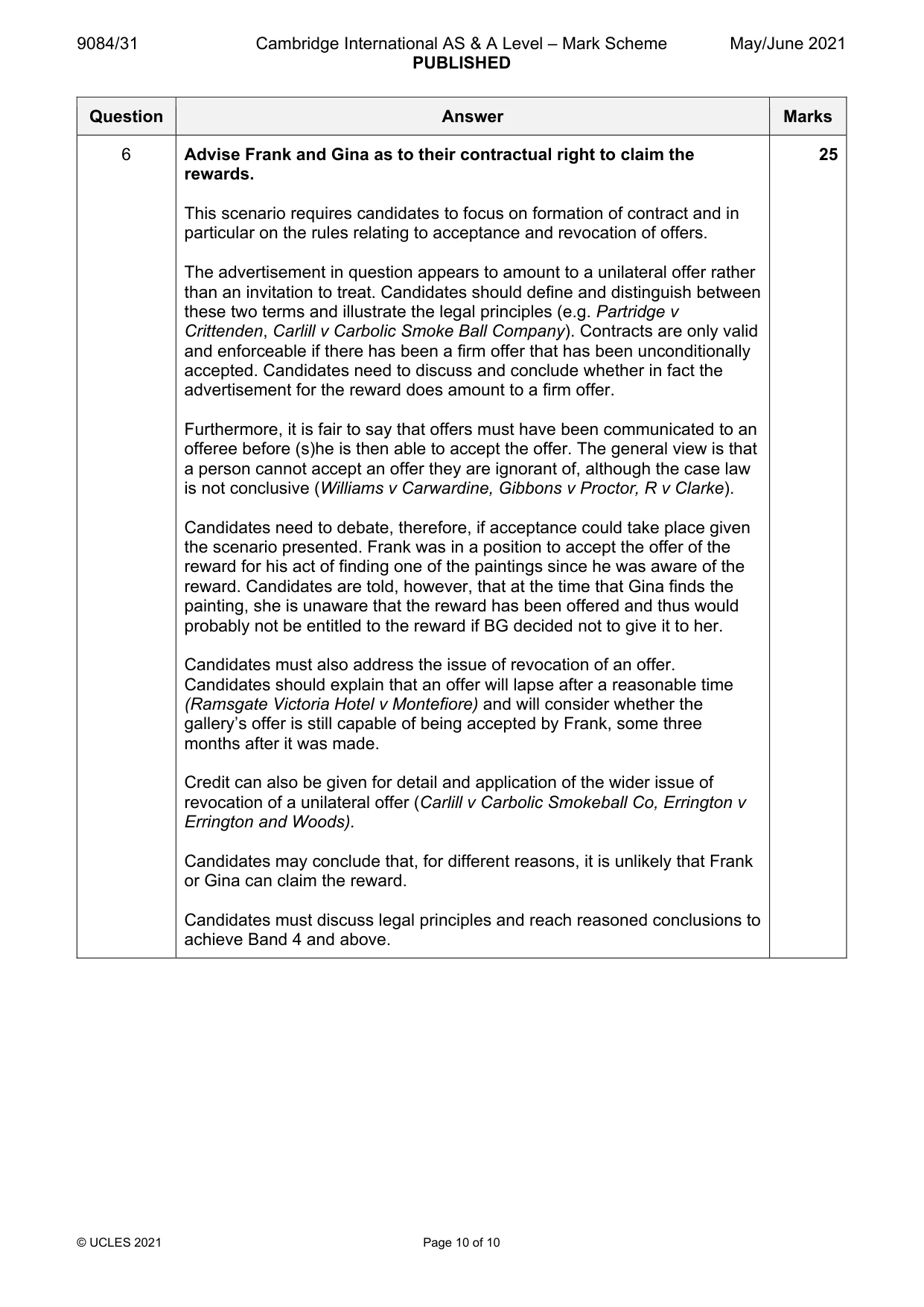
9084/31 Cambridge International AS & A Level – Mark Scheme PUBLISHED May/June 2021 © UCLES 2021 Page 10 of 10 Question Answer Marks 6 Advise Frank and Gina as to their contractual right to claim the rewards. This scenario requires candidates to focus on formation of contract and in particular on the rules relating to acceptance and revocation of offers. The advertisement in question appears to amount to a unilateral offer rather than an invitation to treat. Candidates should define and distinguish between these two terms and illustrate the legal principles (e.g. Partridge v Crittenden, Carlill v Carbolic Smoke Ball Company). Contracts are only valid and enforceable if there has been a firm offer that has been unconditionally accepted. Candidates need to discuss and conclude whether in fact the advertisement for the reward does amount to a firm offer. Furthermore, it is fair to say that offers must have been communicated to an offeree before (s)he is then able to accept the offer. The general view is that a person cannot accept an offer they are ignorant of, although the case law is not conclusive (Williams v Carwardine, Gibbons v Proctor, R v Clarke). Candidates need to debate, therefore, if acceptance could take place given the scenario presented. Frank was in a position to accept the offer of the reward for his act of finding one of the paintings since he was aware of the reward. Candidates are told, however, that at the time that Gina finds the painting, she is unaware that the reward has been offered and thus would probably not be entitled to the reward if BG decided not to give it to her. Candidates must also address the issue of revocation of an offer. Candidates should explain that an offer will lapse after a reasonable time (Ramsgate Victoria Hotel v Montefiore) and will consider whether the gallery’s offer is still capable of being accepted by Frank, some three months after it was made. Credit can also be given for detail and application of the wider issue of revocation of a unilateral offer (Carlill v Carbolic Smokeball Co, Errington v Errington and Woods). Candidates may conclude that, for different reasons, it is unlikely that Frank or Gina can claim the reward. Candidates must discuss legal principles and reach reasoned conclusions to achieve Band 4 and above. 25
What you needed in this session
Cambridge’s own grade thresholds for 2021 May/June, Paper 3 · Variant 1. A higher threshold means an easier paper — the bar moves with how the cohort did.