Cambridge A Level Law 9084 — 2019 May/June Paper 3 · Variant 3
9084/33/M/J/19 · 75 marks · ≈84 min
The question paper and its mark scheme, free to read here and free to download. This is Cambridge’s own paper, exactly as it was sat.
Question paper4 pages

Mark scheme10 pages
Answers below. Sit the paper first if you are practising.
Paper as text
Question paper, page 1
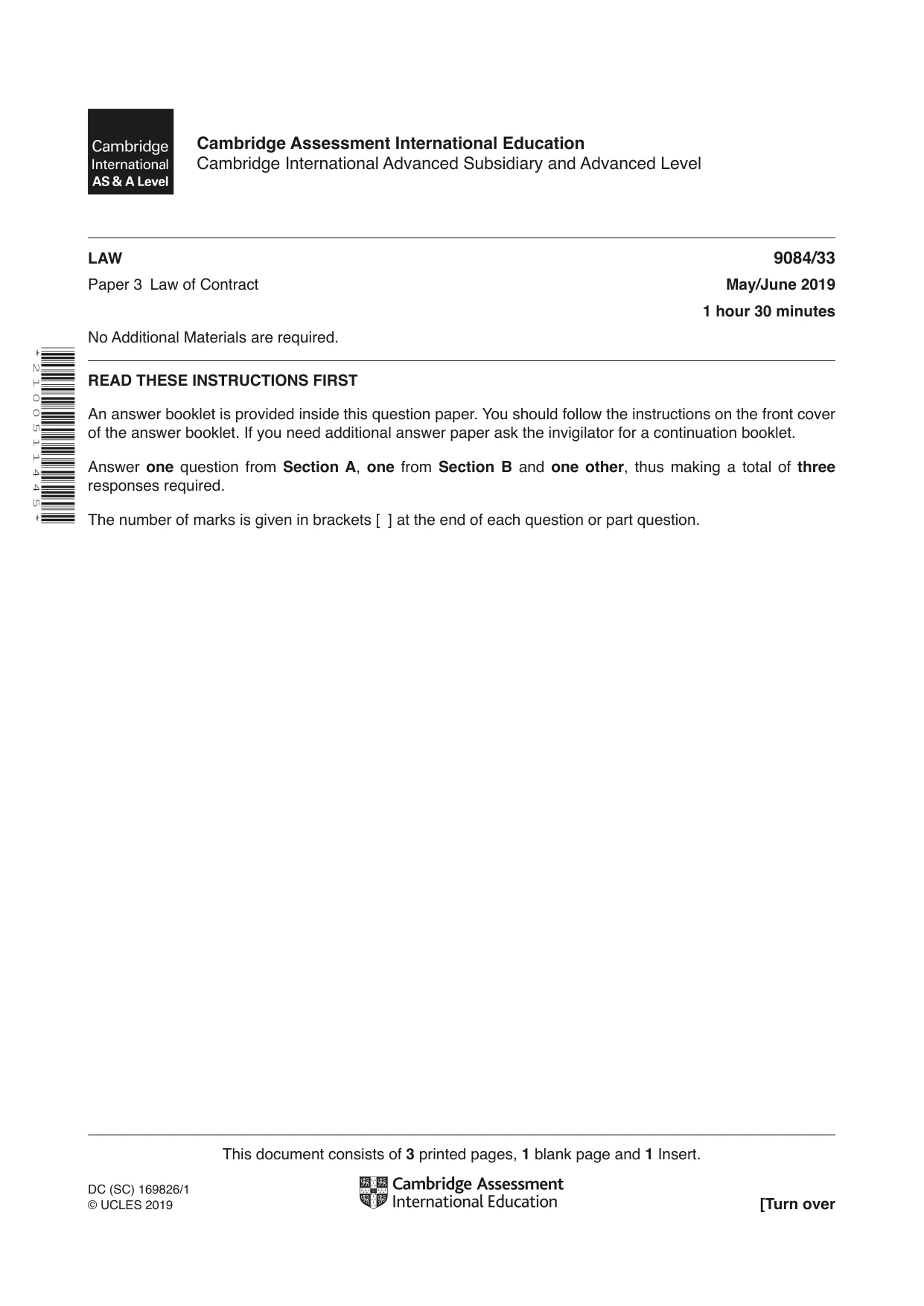
This document consists of 3 printed pages, 1 blank page and 1 Insert. DC (SC) 169826/1 © UCLES 2019 [Turn over Cambridge Assessment International Education Cambridge International Advanced Subsidiary and Advanced Level * 2 1 0 0 5 1 1 4 4 5 * LAW 9084/33 Paper 3 Law of Contract May/June 2019 1 hour 30 minutes No Additional Materials are required. READ THESE INSTRUCTIONS FIRST An answer booklet is provided inside this question paper. You should follow the instructions on the front cover of the answer booklet. If you need additional answer paper ask the invigilator for a continuation booklet. Answer one question from Section A, one from Section B and one other, thus making a total of three responses required. The number of marks is given in brackets [ ] at the end of each question or part question.
Question paper, page 2
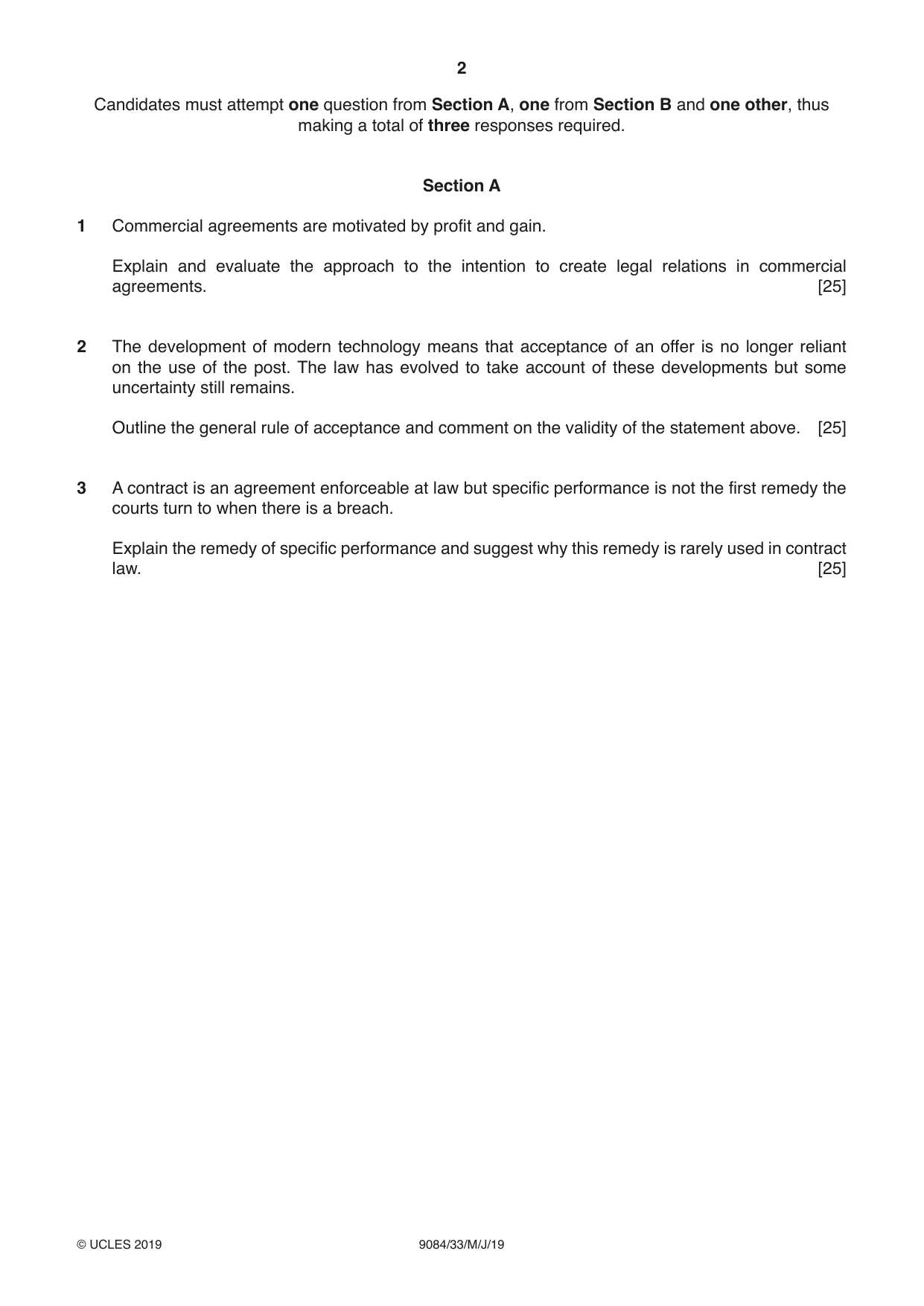
2 9084/33/M/J/19 © UCLES 2019 Candidates must attempt one question from Section A, one from Section B and one other, thus making a total of three responses required. Section A 1 Commercial agreements are motivated by profit and gain. Explain and evaluate the approach to the intention to create legal relations in commercial agreements. [25] 2 The development of modern technology means that acceptance of an offer is no longer reliant on the use of the post. The law has evolved to take account of these developments but some uncertainty still remains. Outline the general rule of acceptance and comment on the validity of the statement above. [25] 3 A contract is an agreement enforceable at law but specific performance is not the first remedy the courts turn to when there is a breach. Explain the remedy of specific performance and suggest why this remedy is rarely used in contract law. [25]
Question paper, page 3
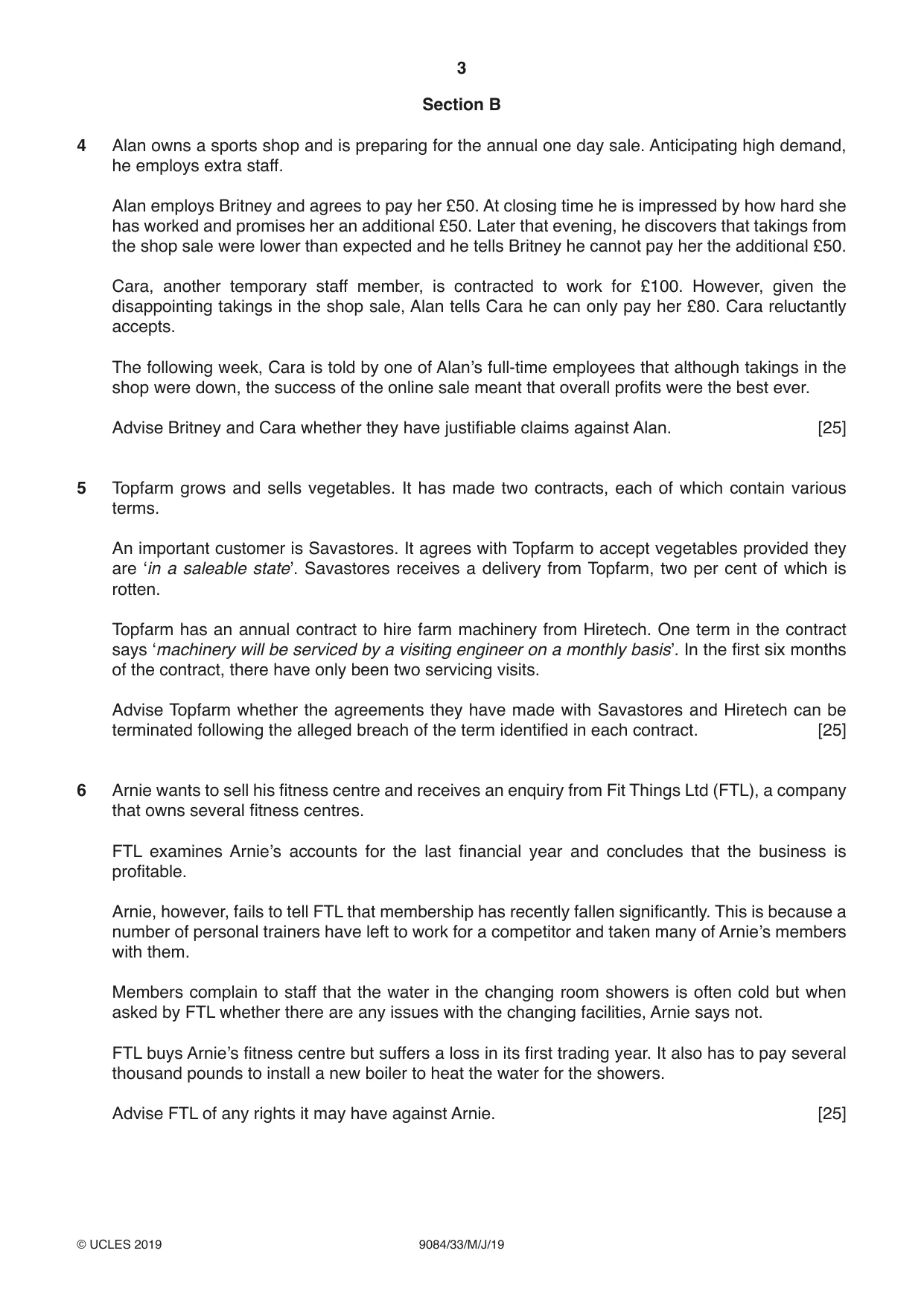
3 9084/33/M/J/19 © UCLES 2019 Section B 4 Alan owns a sports shop and is preparing for the annual one day sale. Anticipating high demand, he employs extra staff. Alan employs Britney and agrees to pay her £50. At closing time he is impressed by how hard she has worked and promises her an additional £50. Later that evening, he discovers that takings from the shop sale were lower than expected and he tells Britney he cannot pay her the additional £50. Cara, another temporary staff member, is contracted to work for £100. However, given the disappointing takings in the shop sale, Alan tells Cara he can only pay her £80. Cara reluctantly accepts. The following week, Cara is told by one of Alan’s full-time employees that although takings in the shop were down, the success of the online sale meant that overall profits were the best ever. Advise Britney and Cara whether they have justifiable claims against Alan. [25] 5 Topfarm grows and sells vegetables. It has made two contracts, each of which contain various terms. An important customer is Savastores. It agrees with Topfarm to accept vegetables provided they are ‘in a saleable state’. Savastores receives a delivery from Topfarm, two per cent of which is rotten. Topfarm has an annual contract to hire farm machinery from Hiretech. One term in the contract says ‘machinery will be serviced by a visiting engineer on a monthly basis’. In the first six months of the contract, there have only been two servicing visits. Advise Topfarm whether the agreements they have made with Savastores and Hiretech can be terminated following the alleged breach of the term identified in each contract. [25] 6 Arnie wants to sell his fitness centre and receives an enquiry from Fit Things Ltd (FTL), a company that owns several fitness centres. FTL examines Arnie’s accounts for the last financial year and concludes that the business is profitable. Arnie, however, fails to tell FTL that membership has recently fallen significantly. This is because a number of personal trainers have left to work for a competitor and taken many of Arnie’s members with them. Members complain to staff that the water in the changing room showers is often cold but when asked by FTL whether there are any issues with the changing facilities, Arnie says not. FTL buys Arnie’s fitness centre but suffers a loss in its first trading year. It also has to pay several thousand pounds to install a new boiler to heat the water for the showers. Advise FTL of any rights it may have against Arnie. [25]
Question paper, page 4
4 9084/33/M/J/19 © UCLES 2019 BLANK PAGE Permission to reproduce items where third-party owned material protected by copyright is included has been sought and cleared where possible. Every reasonable effort has been made by the publisher (UCLES) to trace copyright holders, but if any items requiring clearance have unwittingly been included, the publisher will be pleased to make amends at the earliest possible opportunity. To avoid the issue of disclosure of answer-related information to candidates, all copyright acknowledgements are reproduced online in the Cambridge Assessment International Education Copyright Acknowledgements Booklet. This is produced for each series of examinations and is freely available to download at www.cambridgeinternational.org after the live examination series. Cambridge Assessment International Education is part of the Cambridge Assessment Group. Cambridge Assessment is the brand name of the University of Cambridge Local Examinations Syndicate (UCLES), which itself is a department of the University of Cambridge.
Mark scheme, page 1
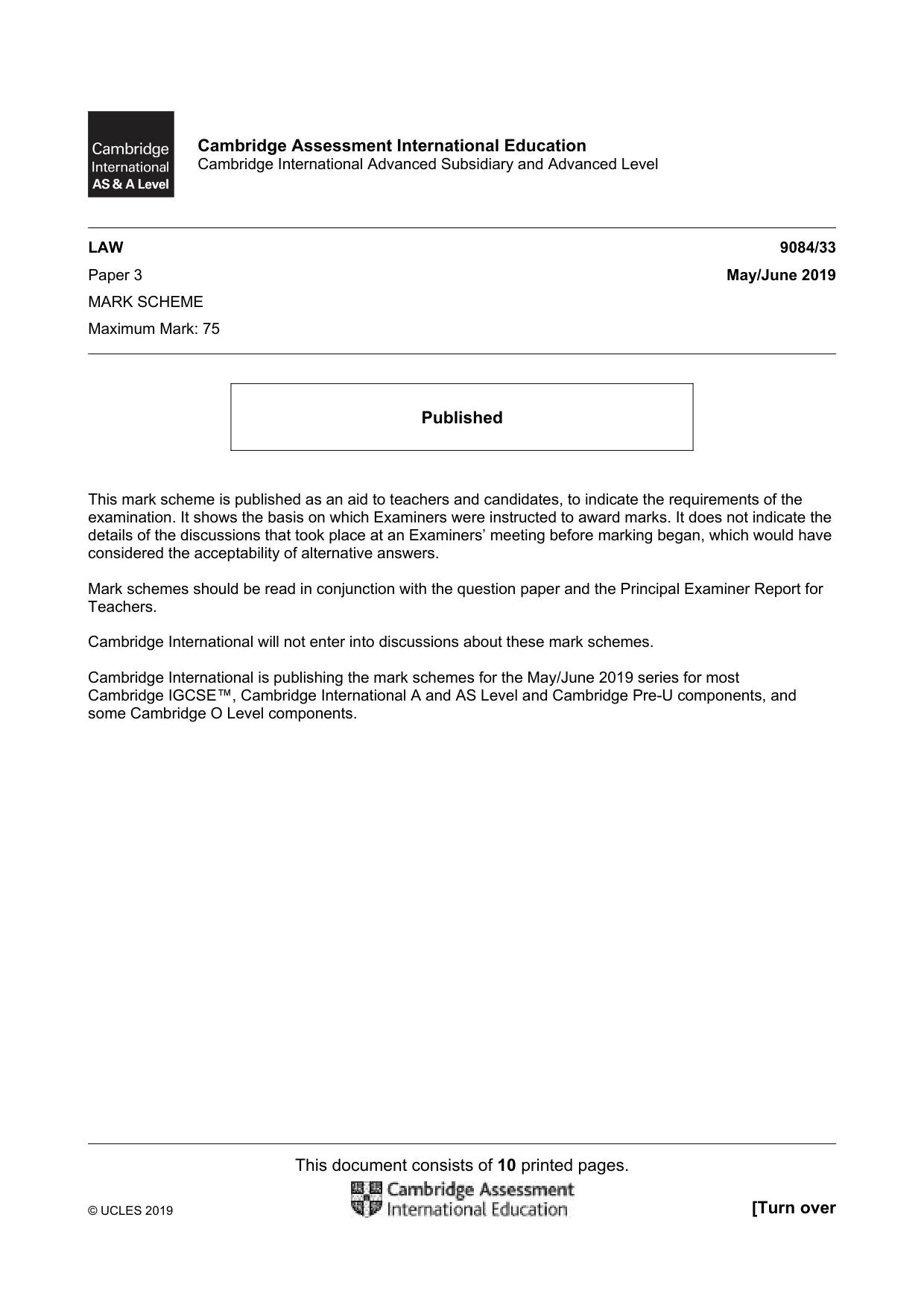
This document consists of 10 printed pages. © UCLES 2019 [Turn over Cambridge Assessment International Education Cambridge International Advanced Subsidiary and Advanced Level LAW 9084/33 Paper 3 May/June 2019 MARK SCHEME Maximum Mark: 75 Published This mark scheme is published as an aid to teachers and candidates, to indicate the requirements of the examination. It shows the basis on which Examiners were instructed to award marks. It does not indicate the details of the discussions that took place at an Examiners’ meeting before marking began, which would have considered the acceptability of alternative answers. Mark schemes should be read in conjunction with the question paper and the Principal Examiner Report for Teachers. Cambridge International will not enter into discussions about these mark schemes. Cambridge International is publishing the mark schemes for the May/June 2019 series for most Cambridge IGCSE™, Cambridge International A and AS Level and Cambridge Pre-U components, and some Cambridge O Level components.
Mark scheme, page 2
9084/33 Cambridge International AS/A Level – Mark Scheme PUBLISHED May/June 2019 © UCLES 2019 Page 2 of 10 Generic Marking Principles These general marking principles must be applied by all examiners when marking candidate answers. They should be applied alongside the specific content of the mark scheme or generic level descriptors for a question. Each question paper and mark scheme will also comply with these marking principles. GENERIC MARKING PRINCIPLE 1: Marks must be awarded in line with: • the specific content of the mark scheme or the generic level descriptors for the question • the specific skills defined in the mark scheme or in the generic level descriptors for the question • the standard of response required by a candidate as exemplified by the standardisation scripts. GENERIC MARKING PRINCIPLE 2: Marks awarded are always whole marks (not half marks, or other fractions). GENERIC MARKING PRINCIPLE 3: Marks must be awarded positively: • marks are awarded for correct/valid answers, as defined in the mark scheme. However, credit is given for valid answers which go beyond the scope of the syllabus and mark scheme, referring to your Team Leader as appropriate • marks are awarded when candidates clearly demonstrate what they know and can do • marks are not deducted for errors • marks are not deducted for omissions • answers should only be judged on the quality of spelling, punctuation and grammar when these features are specifically assessed by the question as indicated by the mark scheme. The meaning, however, should be unambiguous. GENERIC MARKING PRINCIPLE 4: Rules must be applied consistently e.g. in situations where candidates have not followed instructions or in the application of generic level descriptors. GENERIC MARKING PRINCIPLE 5: Marks should be awarded using the full range of marks defined in the mark scheme for the question (however; the use of the full mark range may be limited according to the quality of the candidate responses seen). GENERIC MARKING PRINCIPLE 6: Marks awarded are based solely on the requirements as defined in the mark scheme. Marks should not be awarded with grade thresholds or grade descriptors in mind.
Mark scheme, page 3
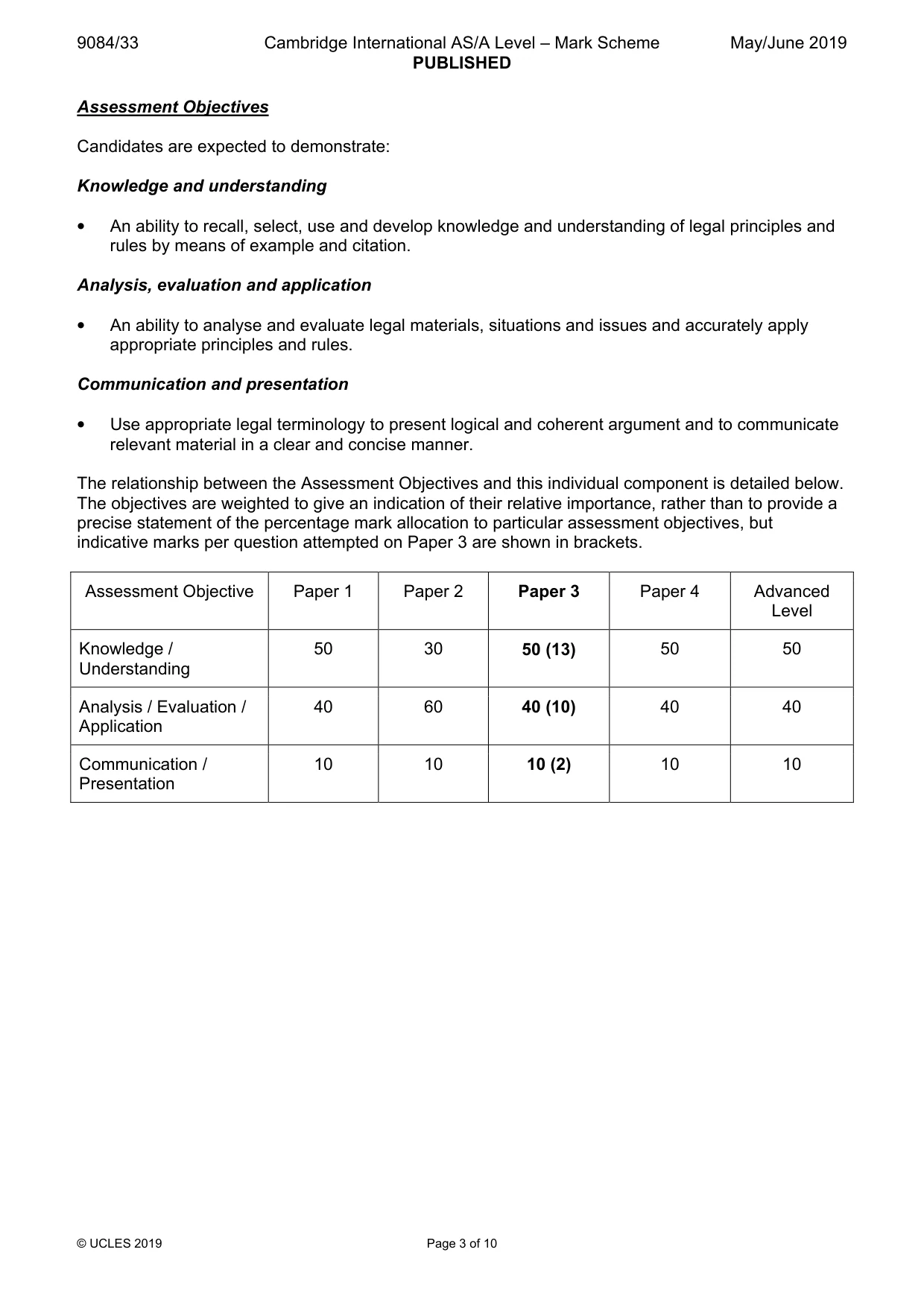
9084/33 Cambridge International AS/A Level – Mark Scheme PUBLISHED May/June 2019 © UCLES 2019 Page 3 of 10 Assessment Objectives Candidates are expected to demonstrate: Knowledge and understanding • An ability to recall, select, use and develop knowledge and understanding of legal principles and rules by means of example and citation. Analysis, evaluation and application • An ability to analyse and evaluate legal materials, situations and issues and accurately apply appropriate principles and rules. Communication and presentation • Use appropriate legal terminology to present logical and coherent argument and to communicate relevant material in a clear and concise manner. The relationship between the Assessment Objectives and this individual component is detailed below. The objectives are weighted to give an indication of their relative importance, rather than to provide a precise statement of the percentage mark allocation to particular assessment objectives, but indicative marks per question attempted on Paper 3 are shown in brackets. Assessment Objective Paper 1 Paper 2 Paper 3 Paper 4 Advanced Level Knowledge / Understanding 50 30 50 (13) 50 50 Analysis / Evaluation / Application 40 60 40 (10) 40 40 Communication / Presentation 10 10 10 (2) 10 10
Mark scheme, page 4
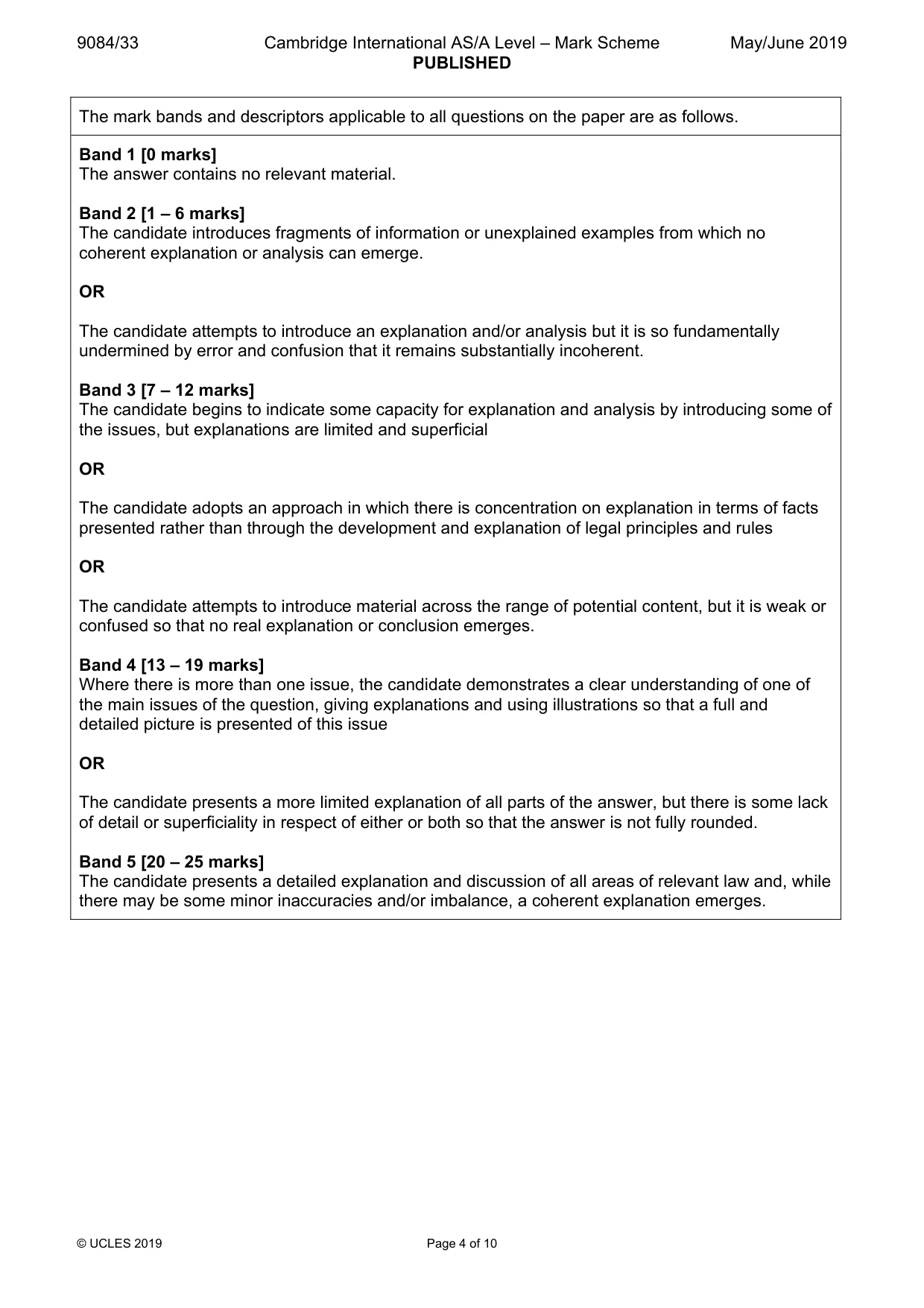
9084/33 Cambridge International AS/A Level – Mark Scheme PUBLISHED May/June 2019 © UCLES 2019 Page 4 of 10 The mark bands and descriptors applicable to all questions on the paper are as follows. Band 1 [0 marks] The answer contains no relevant material. Band 2 [1 – 6 marks] The candidate introduces fragments of information or unexplained examples from which no coherent explanation or analysis can emerge. OR The candidate attempts to introduce an explanation and/or analysis but it is so fundamentally undermined by error and confusion that it remains substantially incoherent. Band 3 [7 – 12 marks] The candidate begins to indicate some capacity for explanation and analysis by introducing some of the issues, but explanations are limited and superficial OR The candidate adopts an approach in which there is concentration on explanation in terms of facts presented rather than through the development and explanation of legal principles and rules OR The candidate attempts to introduce material across the range of potential content, but it is weak or confused so that no real explanation or conclusion emerges. Band 4 [13 – 19 marks] Where there is more than one issue, the candidate demonstrates a clear understanding of one of the main issues of the question, giving explanations and using illustrations so that a full and detailed picture is presented of this issue OR The candidate presents a more limited explanation of all parts of the answer, but there is some lack of detail or superficiality in respect of either or both so that the answer is not fully rounded. Band 5 [20 – 25 marks] The candidate presents a detailed explanation and discussion of all areas of relevant law and, while there may be some minor inaccuracies and/or imbalance, a coherent explanation emerges.
Mark scheme, page 5
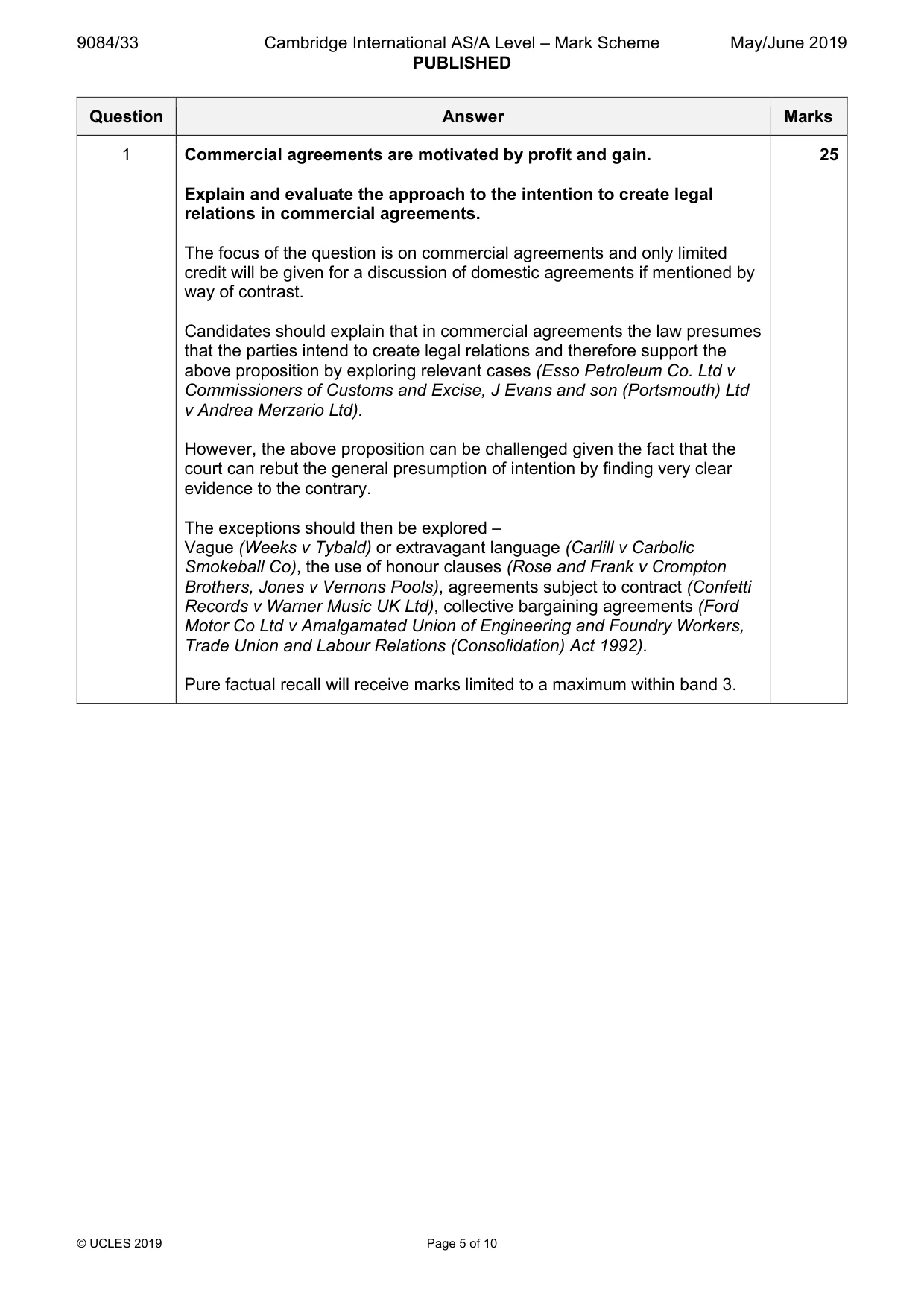
9084/33 Cambridge International AS/A Level – Mark Scheme PUBLISHED May/June 2019 © UCLES 2019 Page 5 of 10 Question Answer Marks 1 Commercial agreements are motivated by profit and gain. Explain and evaluate the approach to the intention to create legal relations in commercial agreements. The focus of the question is on commercial agreements and only limited credit will be given for a discussion of domestic agreements if mentioned by way of contrast. Candidates should explain that in commercial agreements the law presumes that the parties intend to create legal relations and therefore support the above proposition by exploring relevant cases (Esso Petroleum Co. Ltd v Commissioners of Customs and Excise, J Evans and son (Portsmouth) Ltd v Andrea Merzario Ltd). However, the above proposition can be challenged given the fact that the court can rebut the general presumption of intention by finding very clear evidence to the contrary. The exceptions should then be explored – Vague (Weeks v Tybald) or extravagant language (Carlill v Carbolic Smokeball Co), the use of honour clauses (Rose and Frank v Crompton Brothers, Jones v Vernons Pools), agreements subject to contract (Confetti Records v Warner Music UK Ltd), collective bargaining agreements (Ford Motor Co Ltd v Amalgamated Union of Engineering and Foundry Workers, Trade Union and Labour Relations (Consolidation) Act 1992). Pure factual recall will receive marks limited to a maximum within band 3. 25
Mark scheme, page 6
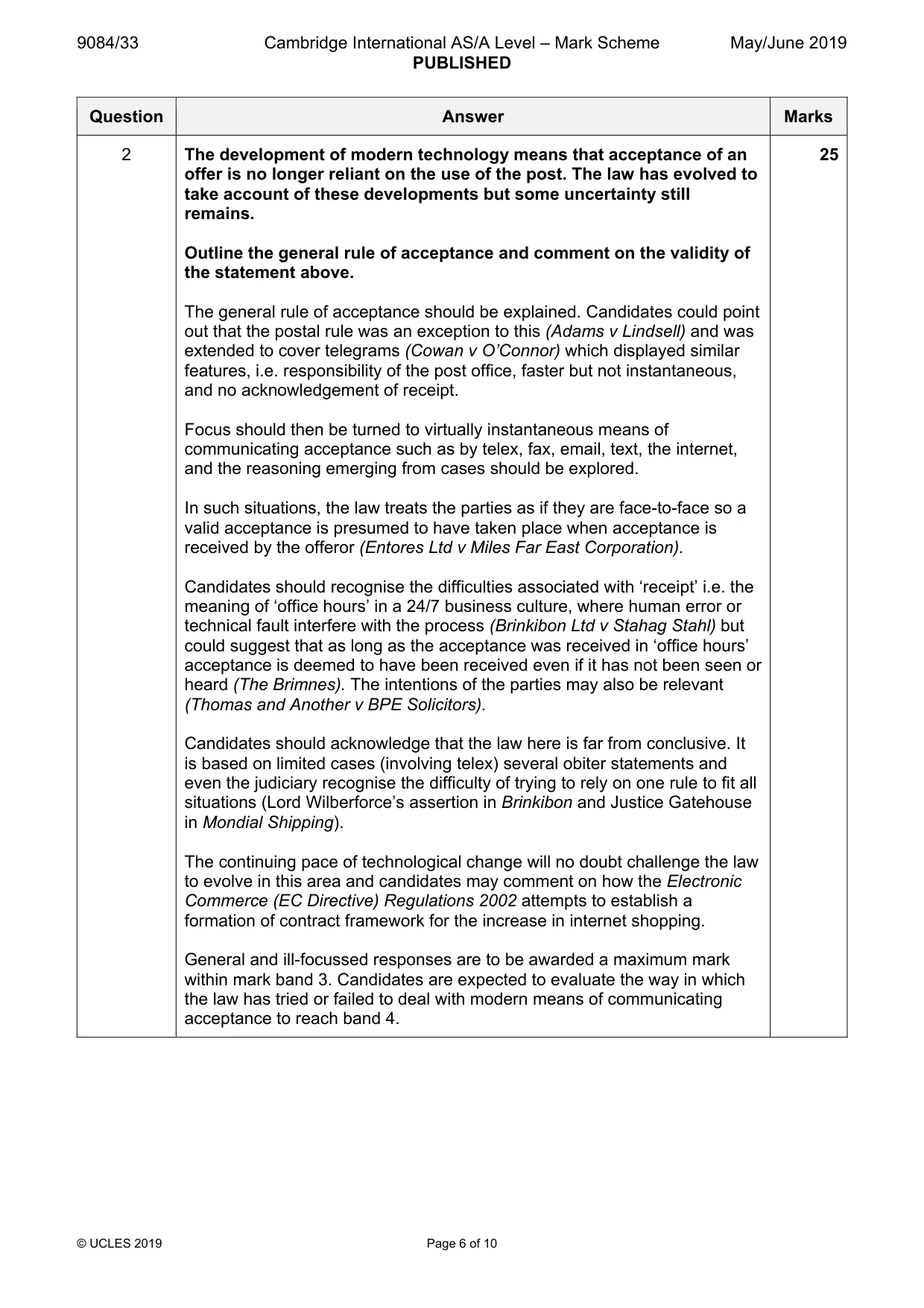
9084/33 Cambridge International AS/A Level – Mark Scheme PUBLISHED May/June 2019 © UCLES 2019 Page 6 of 10 Question Answer Marks 2 The development of modern technology means that acceptance of an offer is no longer reliant on the use of the post. The law has evolved to take account of these developments but some uncertainty still remains. Outline the general rule of acceptance and comment on the validity of the statement above. The general rule of acceptance should be explained. Candidates could point out that the postal rule was an exception to this (Adams v Lindsell) and was extended to cover telegrams (Cowan v O’Connor) which displayed similar features, i.e. responsibility of the post office, faster but not instantaneous, and no acknowledgement of receipt. Focus should then be turned to virtually instantaneous means of communicating acceptance such as by telex, fax, email, text, the internet, and the reasoning emerging from cases should be explored. In such situations, the law treats the parties as if they are face-to-face so a valid acceptance is presumed to have taken place when acceptance is received by the offeror (Entores Ltd v Miles Far East Corporation). Candidates should recognise the difficulties associated with ‘receipt’ i.e. the meaning of ‘office hours’ in a 24/7 business culture, where human error or technical fault interfere with the process (Brinkibon Ltd v Stahag Stahl) but could suggest that as long as the acceptance was received in ‘office hours’ acceptance is deemed to have been received even if it has not been seen or heard (The Brimnes). The intentions of the parties may also be relevant (Thomas and Another v BPE Solicitors). Candidates should acknowledge that the law here is far from conclusive. It is based on limited cases (involving telex) several obiter statements and even the judiciary recognise the difficulty of trying to rely on one rule to fit all situations (Lord Wilberforce’s assertion in Brinkibon and Justice Gatehouse in Mondial Shipping). The continuing pace of technological change will no doubt challenge the law to evolve in this area and candidates may comment on how the Electronic Commerce (EC Directive) Regulations 2002 attempts to establish a formation of contract framework for the increase in internet shopping. General and ill-focussed responses are to be awarded a maximum mark within mark band 3. Candidates are expected to evaluate the way in which the law has tried or failed to deal with modern means of communicating acceptance to reach band 4. 25
Mark scheme, page 7
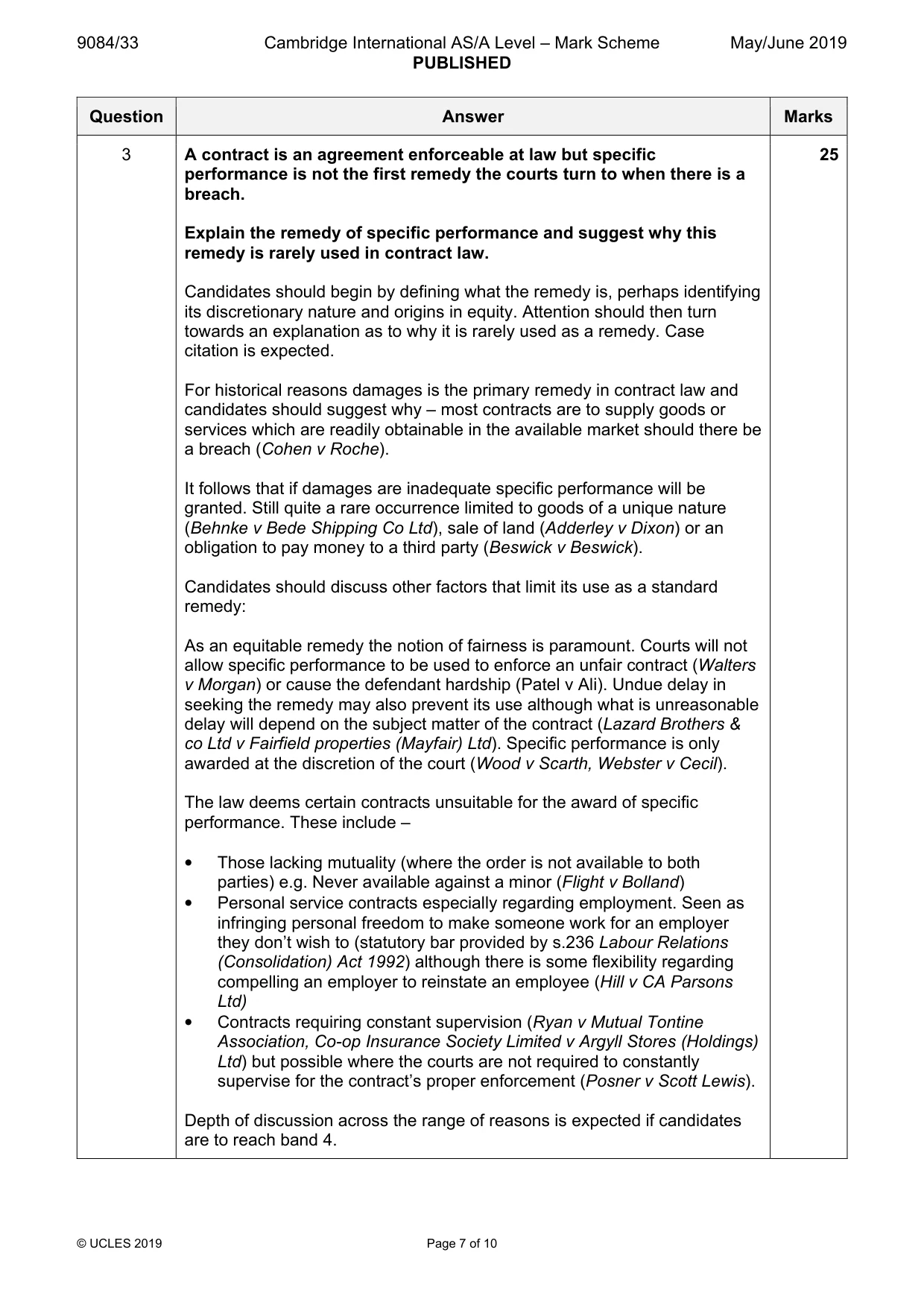
9084/33 Cambridge International AS/A Level – Mark Scheme PUBLISHED May/June 2019 © UCLES 2019 Page 7 of 10 Question Answer Marks 3 A contract is an agreement enforceable at law but specific performance is not the first remedy the courts turn to when there is a breach. Explain the remedy of specific performance and suggest why this remedy is rarely used in contract law. Candidates should begin by defining what the remedy is, perhaps identifying its discretionary nature and origins in equity. Attention should then turn towards an explanation as to why it is rarely used as a remedy. Case citation is expected. For historical reasons damages is the primary remedy in contract law and candidates should suggest why – most contracts are to supply goods or services which are readily obtainable in the available market should there be a breach (Cohen v Roche). It follows that if damages are inadequate specific performance will be granted. Still quite a rare occurrence limited to goods of a unique nature (Behnke v Bede Shipping Co Ltd), sale of land (Adderley v Dixon) or an obligation to pay money to a third party (Beswick v Beswick). Candidates should discuss other factors that limit its use as a standard remedy: As an equitable remedy the notion of fairness is paramount. Courts will not allow specific performance to be used to enforce an unfair contract (Walters v Morgan) or cause the defendant hardship (Patel v Ali). Undue delay in seeking the remedy may also prevent its use although what is unreasonable delay will depend on the subject matter of the contract (Lazard Brothers & co Ltd v Fairfield properties (Mayfair) Ltd). Specific performance is only awarded at the discretion of the court (Wood v Scarth, Webster v Cecil). The law deems certain contracts unsuitable for the award of specific performance. These include – • Those lacking mutuality (where the order is not available to both parties) e.g. Never available against a minor (Flight v Bolland) • Personal service contracts especially regarding employment. Seen as infringing personal freedom to make someone work for an employer they don’t wish to (statutory bar provided by s.236 Labour Relations (Consolidation) Act 1992) although there is some flexibility regarding compelling an employer to reinstate an employee (Hill v CA Parsons Ltd) • Contracts requiring constant supervision (Ryan v Mutual Tontine Association, Co-op Insurance Society Limited v Argyll Stores (Holdings) Ltd) but possible where the courts are not required to constantly supervise for the contract’s proper enforcement (Posner v Scott Lewis). Depth of discussion across the range of reasons is expected if candidates are to reach band 4. 25
Mark scheme, page 8
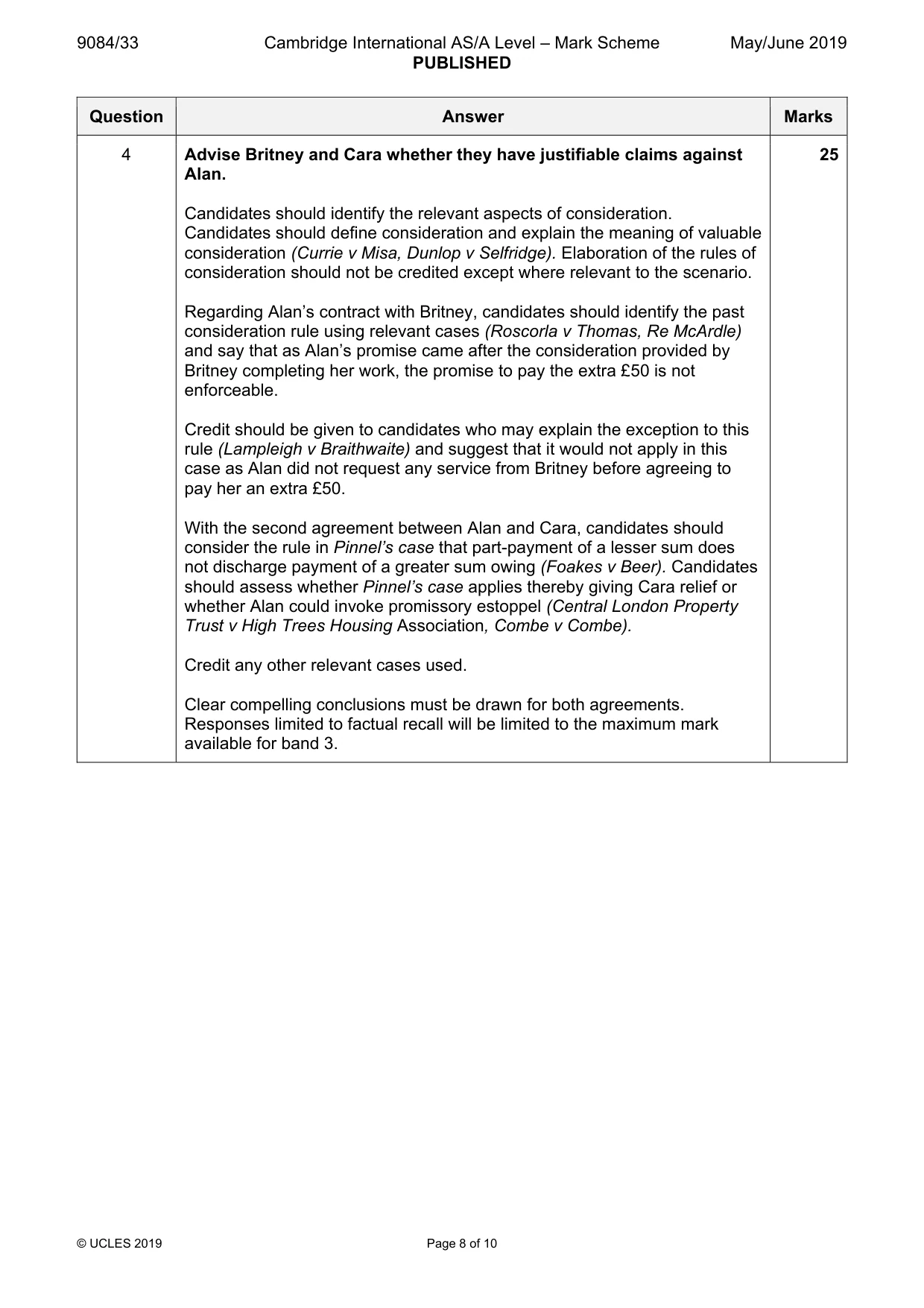
9084/33 Cambridge International AS/A Level – Mark Scheme PUBLISHED May/June 2019 © UCLES 2019 Page 8 of 10 Question Answer Marks 4 Advise Britney and Cara whether they have justifiable claims against Alan. Candidates should identify the relevant aspects of consideration. Candidates should define consideration and explain the meaning of valuable consideration (Currie v Misa, Dunlop v Selfridge). Elaboration of the rules of consideration should not be credited except where relevant to the scenario. Regarding Alan’s contract with Britney, candidates should identify the past consideration rule using relevant cases (Roscorla v Thomas, Re McArdle) and say that as Alan’s promise came after the consideration provided by Britney completing her work, the promise to pay the extra £50 is not enforceable. Credit should be given to candidates who may explain the exception to this rule (Lampleigh v Braithwaite) and suggest that it would not apply in this case as Alan did not request any service from Britney before agreeing to pay her an extra £50. With the second agreement between Alan and Cara, candidates should consider the rule in Pinnel’s case that part-payment of a lesser sum does not discharge payment of a greater sum owing (Foakes v Beer). Candidates should assess whether Pinnel’s case applies thereby giving Cara relief or whether Alan could invoke promissory estoppel (Central London Property Trust v High Trees Housing Association, Combe v Combe). Credit any other relevant cases used. Clear compelling conclusions must be drawn for both agreements. Responses limited to factual recall will be limited to the maximum mark available for band 3. 25
Mark scheme, page 9
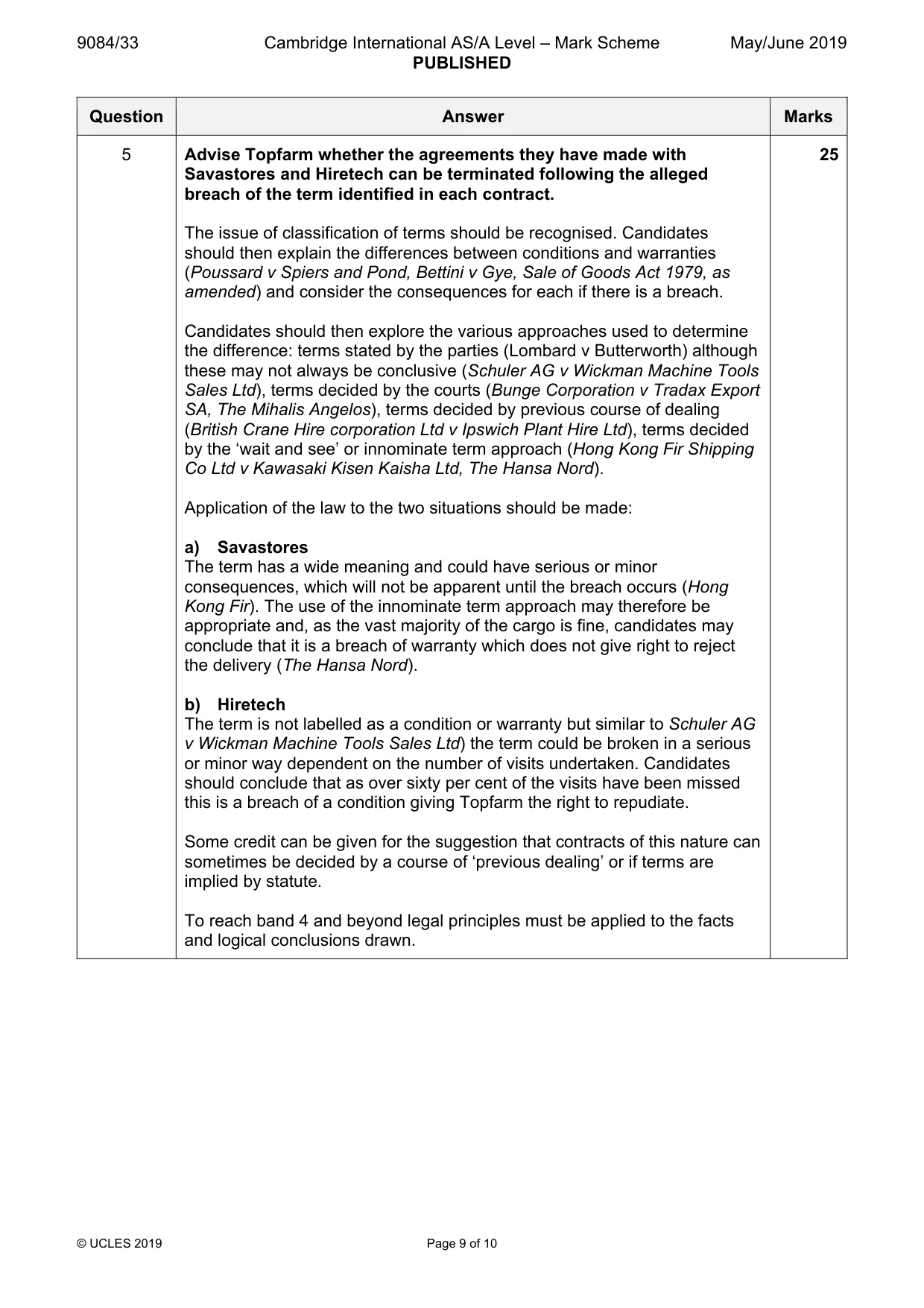
9084/33 Cambridge International AS/A Level – Mark Scheme PUBLISHED May/June 2019 © UCLES 2019 Page 9 of 10 Question Answer Marks 5 Advise Topfarm whether the agreements they have made with Savastores and Hiretech can be terminated following the alleged breach of the term identified in each contract. The issue of classification of terms should be recognised. Candidates should then explain the differences between conditions and warranties (Poussard v Spiers and Pond, Bettini v Gye, Sale of Goods Act 1979, as amended) and consider the consequences for each if there is a breach. Candidates should then explore the various approaches used to determine the difference: terms stated by the parties (Lombard v Butterworth) although these may not always be conclusive (Schuler AG v Wickman Machine Tools Sales Ltd), terms decided by the courts (Bunge Corporation v Tradax Export SA, The Mihalis Angelos), terms decided by previous course of dealing (British Crane Hire corporation Ltd v Ipswich Plant Hire Ltd), terms decided by the ‘wait and see’ or innominate term approach (Hong Kong Fir Shipping Co Ltd v Kawasaki Kisen Kaisha Ltd, The Hansa Nord). Application of the law to the two situations should be made: a) Savastores The term has a wide meaning and could have serious or minor consequences, which will not be apparent until the breach occurs (Hong Kong Fir). The use of the innominate term approach may therefore be appropriate and, as the vast majority of the cargo is fine, candidates may conclude that it is a breach of warranty which does not give right to reject the delivery (The Hansa Nord). b) Hiretech The term is not labelled as a condition or warranty but similar to Schuler AG v Wickman Machine Tools Sales Ltd) the term could be broken in a serious or minor way dependent on the number of visits undertaken. Candidates should conclude that as over sixty per cent of the visits have been missed this is a breach of a condition giving Topfarm the right to repudiate. Some credit can be given for the suggestion that contracts of this nature can sometimes be decided by a course of ‘previous dealing’ or if terms are implied by statute. To reach band 4 and beyond legal principles must be applied to the facts and logical conclusions drawn. 25
Mark scheme, page 10
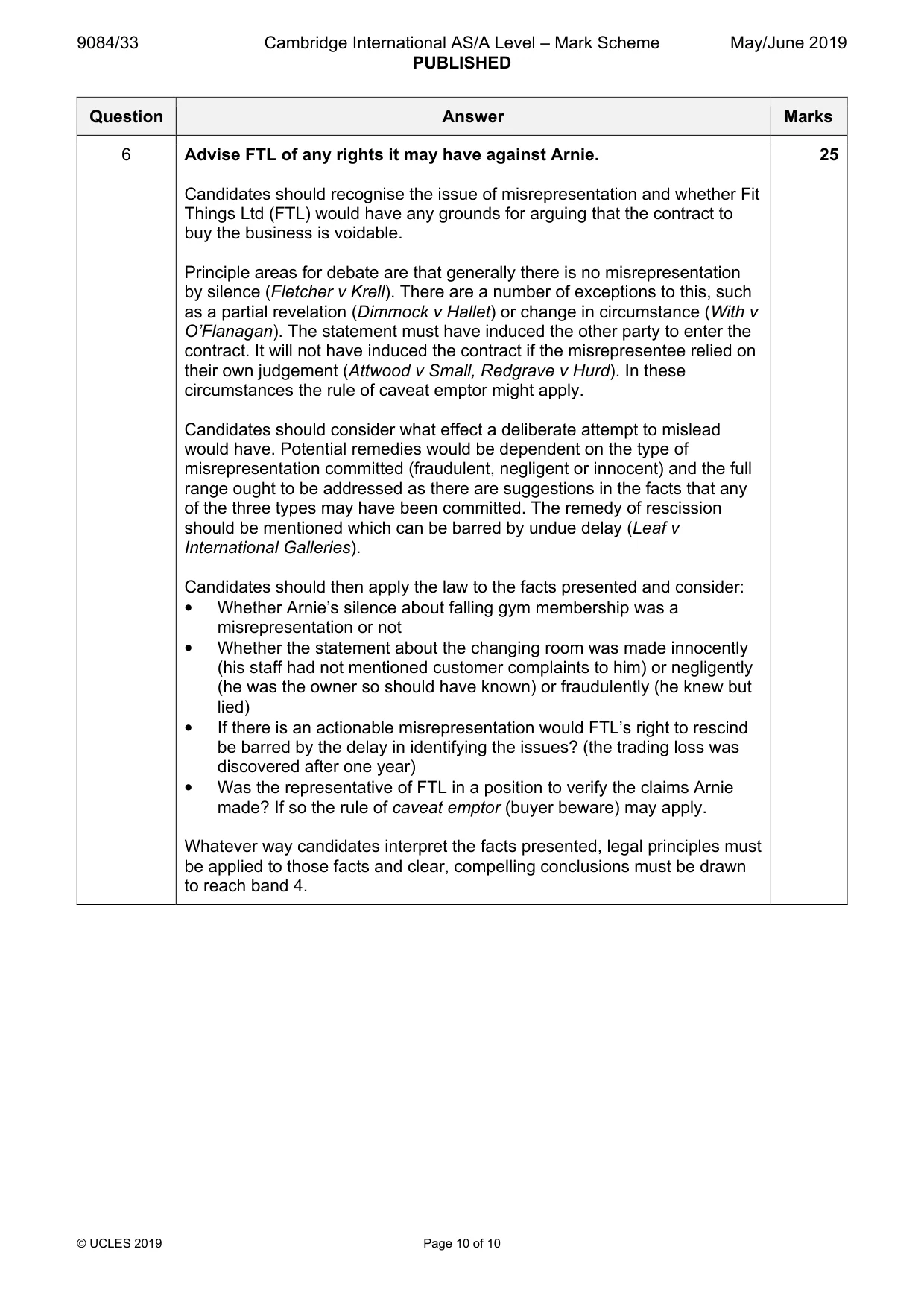
9084/33 Cambridge International AS/A Level – Mark Scheme PUBLISHED May/June 2019 © UCLES 2019 Page 10 of 10 Question Answer Marks 6 Advise FTL of any rights it may have against Arnie. Candidates should recognise the issue of misrepresentation and whether Fit Things Ltd (FTL) would have any grounds for arguing that the contract to buy the business is voidable. Principle areas for debate are that generally there is no misrepresentation by silence (Fletcher v Krell). There are a number of exceptions to this, such as a partial revelation (Dimmock v Hallet) or change in circumstance (With v O’Flanagan). The statement must have induced the other party to enter the contract. It will not have induced the contract if the misrepresentee relied on their own judgement (Attwood v Small, Redgrave v Hurd). In these circumstances the rule of caveat emptor might apply. Candidates should consider what effect a deliberate attempt to mislead would have. Potential remedies would be dependent on the type of misrepresentation committed (fraudulent, negligent or innocent) and the full range ought to be addressed as there are suggestions in the facts that any of the three types may have been committed. The remedy of rescission should be mentioned which can be barred by undue delay (Leaf v International Galleries). Candidates should then apply the law to the facts presented and consider: • Whether Arnie’s silence about falling gym membership was a misrepresentation or not • Whether the statement about the changing room was made innocently (his staff had not mentioned customer complaints to him) or negligently (he was the owner so should have known) or fraudulently (he knew but lied) • If there is an actionable misrepresentation would FTL’s right to rescind be barred by the delay in identifying the issues? (the trading loss was discovered after one year) • Was the representative of FTL in a position to verify the claims Arnie made? If so the rule of caveat emptor (buyer beware) may apply. Whatever way candidates interpret the facts presented, legal principles must be applied to those facts and clear, compelling conclusions must be drawn to reach band 4. 25
What you needed in this session
Cambridge’s own grade thresholds for 2019 May/June, Paper 3 · Variant 3. A higher threshold means an easier paper — the bar moves with how the cohort did.