Cambridge A Level Law 9084 — 2019 May/June Paper 3 · Variant 2
9084/32/M/J/19 · 75 marks · ≈84 min
The question paper and its mark scheme, free to read here and free to download. This is Cambridge’s own paper, exactly as it was sat.
Question paper4 pages

Mark scheme10 pages
Answers below. Sit the paper first if you are practising.
Paper as text
Question paper, page 1
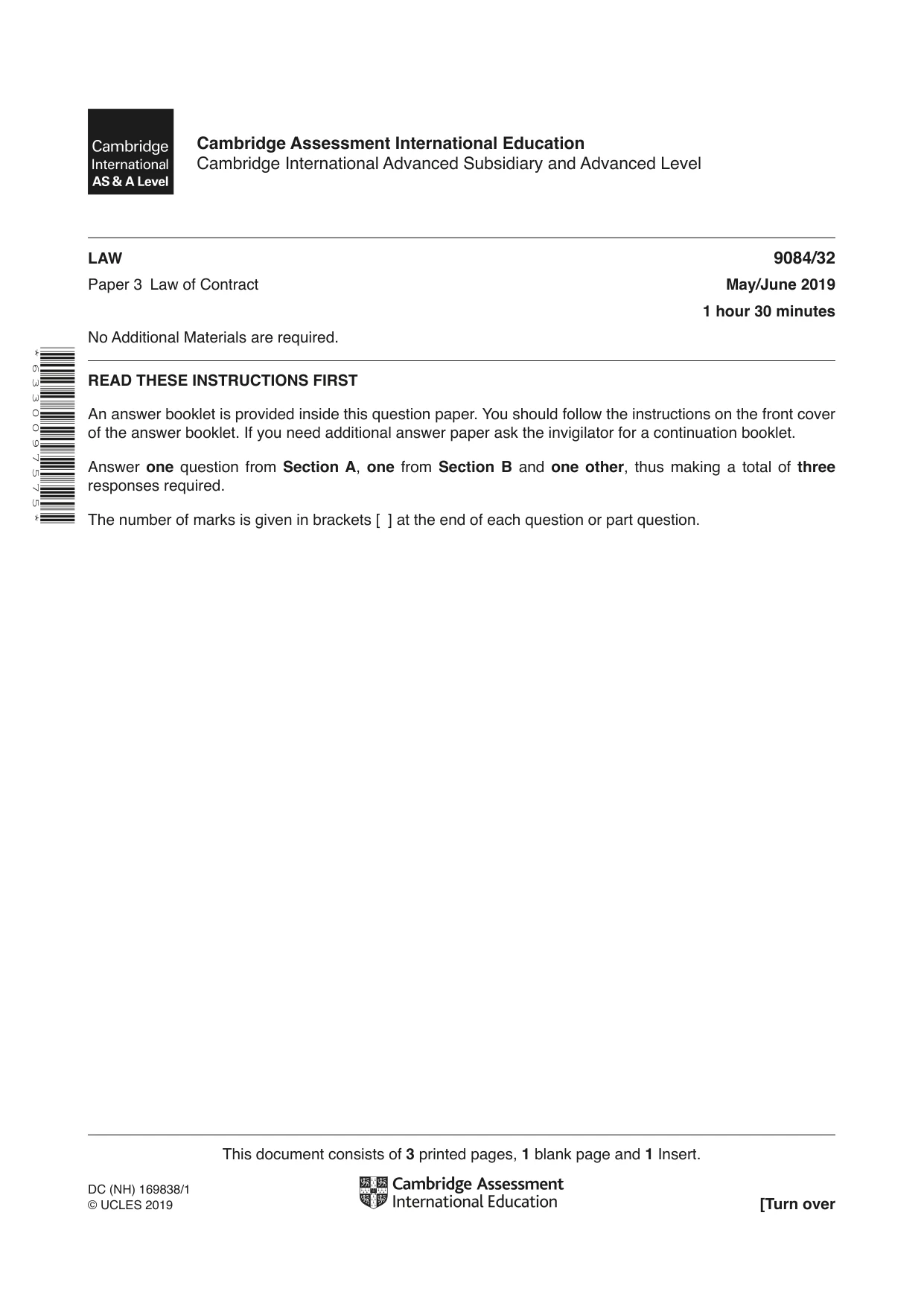
This document consists of 3 printed pages, 1 blank page and 1 Insert. DC (NH) 169838/1 © UCLES 2019 [Turn over Cambridge Assessment International Education Cambridge International Advanced Subsidiary and Advanced Level * 6 3 3 0 0 9 7 5 7 5 * LAW 9084/32 Paper 3 Law of Contract May/June 2019 1 hour 30 minutes No Additional Materials are required. READ THESE INSTRUCTIONS FIRST An answer booklet is provided inside this question paper. You should follow the instructions on the front cover of the answer booklet. If you need additional answer paper ask the invigilator for a continuation booklet. Answer one question from Section A, one from Section B and one other, thus making a total of three responses required. The number of marks is given in brackets [ ] at the end of each question or part question.
Question paper, page 2
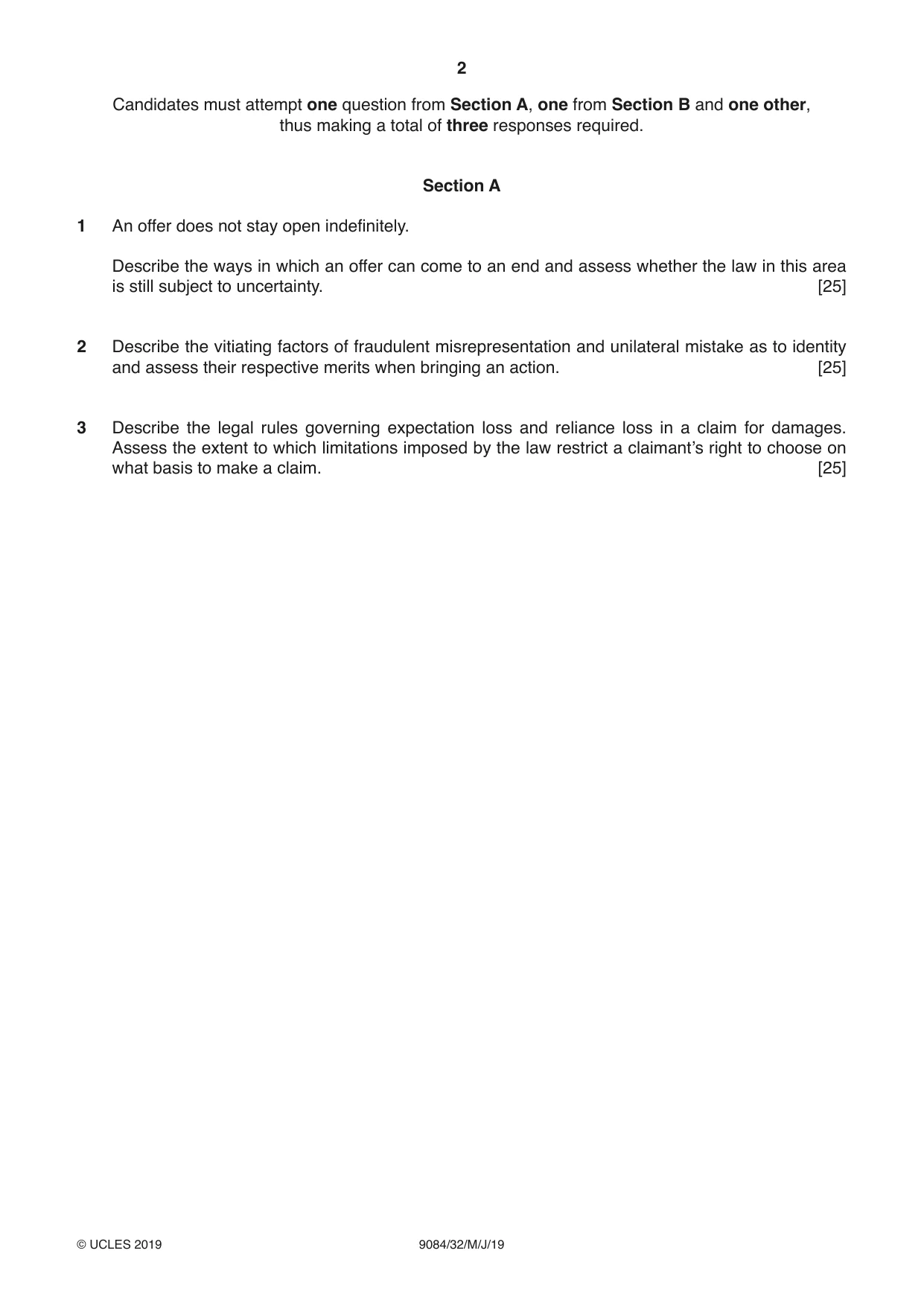
2 9084/32/M/J/19 © UCLES 2019 Candidates must attempt one question from Section A, one from Section B and one other, thus making a total of three responses required. Section A 1 An offer does not stay open indefinitely. Describe the ways in which an offer can come to an end and assess whether the law in this area is still subject to uncertainty. [25] 2 Describe the vitiating factors of fraudulent misrepresentation and unilateral mistake as to identity and assess their respective merits when bringing an action. [25] 3 Describe the legal rules governing expectation loss and reliance loss in a claim for damages. Assess the extent to which limitations imposed by the law restrict a claimant’s right to choose on what basis to make a claim. [25]
Question paper, page 3
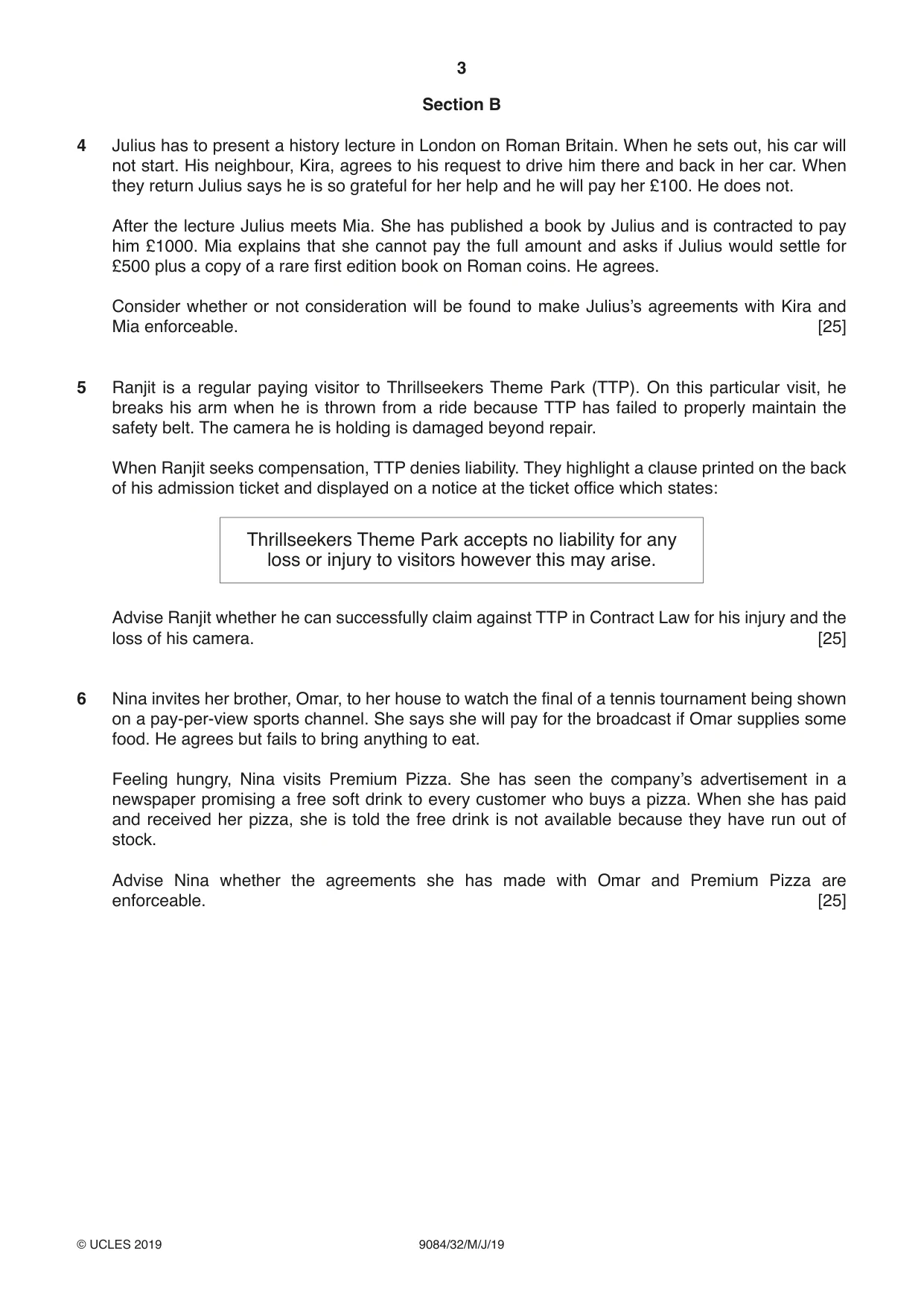
3 9084/32/M/J/19 © UCLES 2019 Section B 4 Julius has to present a history lecture in London on Roman Britain. When he sets out, his car will not start. His neighbour, Kira, agrees to his request to drive him there and back in her car. When they return Julius says he is so grateful for her help and he will pay her £100. He does not. After the lecture Julius meets Mia. She has published a book by Julius and is contracted to pay him £1000. Mia explains that she cannot pay the full amount and asks if Julius would settle for £500 plus a copy of a rare first edition book on Roman coins. He agrees. Consider whether or not consideration will be found to make Julius’s agreements with Kira and Mia enforceable. [25] 5 Ranjit is a regular paying visitor to Thrillseekers Theme Park (TTP). On this particular visit, he breaks his arm when he is thrown from a ride because TTP has failed to properly maintain the safety belt. The camera he is holding is damaged beyond repair. When Ranjit seeks compensation, TTP denies liability. They highlight a clause printed on the back of his admission ticket and displayed on a notice at the ticket office which states: Thrillseekers Theme Park accepts no liability for any loss or injury to visitors however this may arise. Advise Ranjit whether he can successfully claim against TTP in Contract Law for his injury and the loss of his camera. [25] 6 Nina invites her brother, Omar, to her house to watch the final of a tennis tournament being shown on a pay-per-view sports channel. She says she will pay for the broadcast if Omar supplies some food. He agrees but fails to bring anything to eat. Feeling hungry, Nina visits Premium Pizza. She has seen the company’s advertisement in a newspaper promising a free soft drink to every customer who buys a pizza. When she has paid and received her pizza, she is told the free drink is not available because they have run out of stock. Advise Nina whether the agreements she has made with Omar and Premium Pizza are enforceable. [25]
Question paper, page 4
4 9084/32/M/J/19 © UCLES 2019 BLANK PAGE Permission to reproduce items where third-party owned material protected by copyright is included has been sought and cleared where possible. Every reasonable effort has been made by the publisher (UCLES) to trace copyright holders, but if any items requiring clearance have unwittingly been included, the publisher will be pleased to make amends at the earliest possible opportunity. To avoid the issue of disclosure of answer-related information to candidates, all copyright acknowledgements are reproduced online in the Cambridge Assessment International Education Copyright Acknowledgements Booklet. This is produced for each series of examinations and is freely available to download at www.cambridgeinternational.org after the live examination series. Cambridge Assessment International Education is part of the Cambridge Assessment Group. Cambridge Assessment is the brand name of the University of Cambridge Local Examinations Syndicate (UCLES), which itself is a department of the University of Cambridge.
Mark scheme, page 1
This document consists of 10 printed pages. © UCLES 2019 [Turn over Cambridge Assessment International Education Cambridge International Advanced Subsidiary and Advanced Level LAW 9084/32 Paper 3 May/June 2019 MARK SCHEME Maximum Mark: 75 Published This mark scheme is published as an aid to teachers and candidates, to indicate the requirements of the examination. It shows the basis on which Examiners were instructed to award marks. It does not indicate the details of the discussions that took place at an Examiners’ meeting before marking began, which would have considered the acceptability of alternative answers. Mark schemes should be read in conjunction with the question paper and the Principal Examiner Report for Teachers. Cambridge International will not enter into discussions about these mark schemes. Cambridge International is publishing the mark schemes for the May/June 2019 series for most Cambridge IGCSE™, Cambridge International A and AS Level and Cambridge Pre-U components, and some Cambridge O Level components.
Mark scheme, page 2
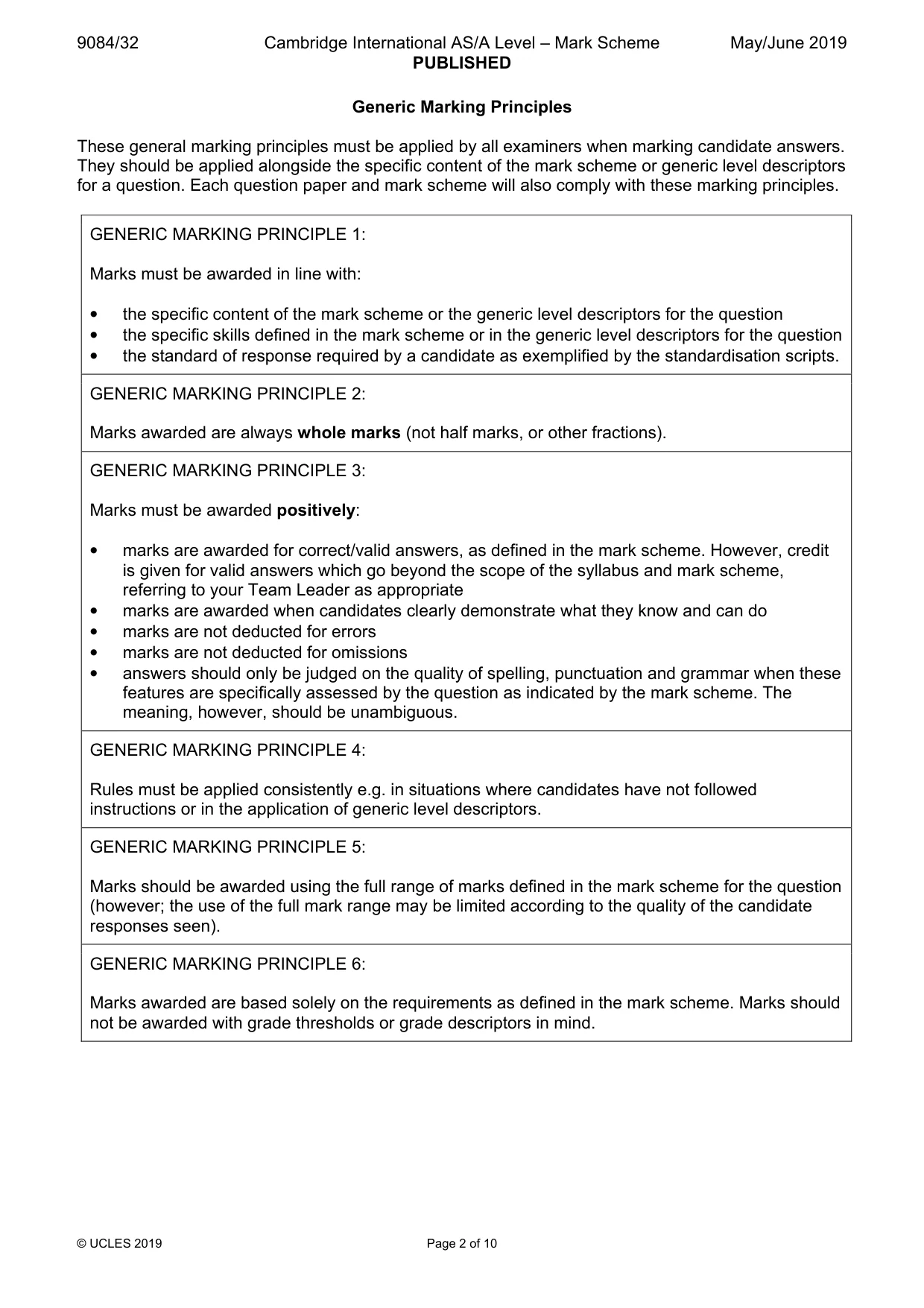
9084/32 Cambridge International AS/A Level – Mark Scheme PUBLISHED May/June 2019 © UCLES 2019 Page 2 of 10 Generic Marking Principles These general marking principles must be applied by all examiners when marking candidate answers. They should be applied alongside the specific content of the mark scheme or generic level descriptors for a question. Each question paper and mark scheme will also comply with these marking principles. GENERIC MARKING PRINCIPLE 1: Marks must be awarded in line with: • the specific content of the mark scheme or the generic level descriptors for the question • the specific skills defined in the mark scheme or in the generic level descriptors for the question • the standard of response required by a candidate as exemplified by the standardisation scripts. GENERIC MARKING PRINCIPLE 2: Marks awarded are always whole marks (not half marks, or other fractions). GENERIC MARKING PRINCIPLE 3: Marks must be awarded positively: • marks are awarded for correct/valid answers, as defined in the mark scheme. However, credit is given for valid answers which go beyond the scope of the syllabus and mark scheme, referring to your Team Leader as appropriate • marks are awarded when candidates clearly demonstrate what they know and can do • marks are not deducted for errors • marks are not deducted for omissions • answers should only be judged on the quality of spelling, punctuation and grammar when these features are specifically assessed by the question as indicated by the mark scheme. The meaning, however, should be unambiguous. GENERIC MARKING PRINCIPLE 4: Rules must be applied consistently e.g. in situations where candidates have not followed instructions or in the application of generic level descriptors. GENERIC MARKING PRINCIPLE 5: Marks should be awarded using the full range of marks defined in the mark scheme for the question (however; the use of the full mark range may be limited according to the quality of the candidate responses seen). GENERIC MARKING PRINCIPLE 6: Marks awarded are based solely on the requirements as defined in the mark scheme. Marks should not be awarded with grade thresholds or grade descriptors in mind.
Mark scheme, page 3
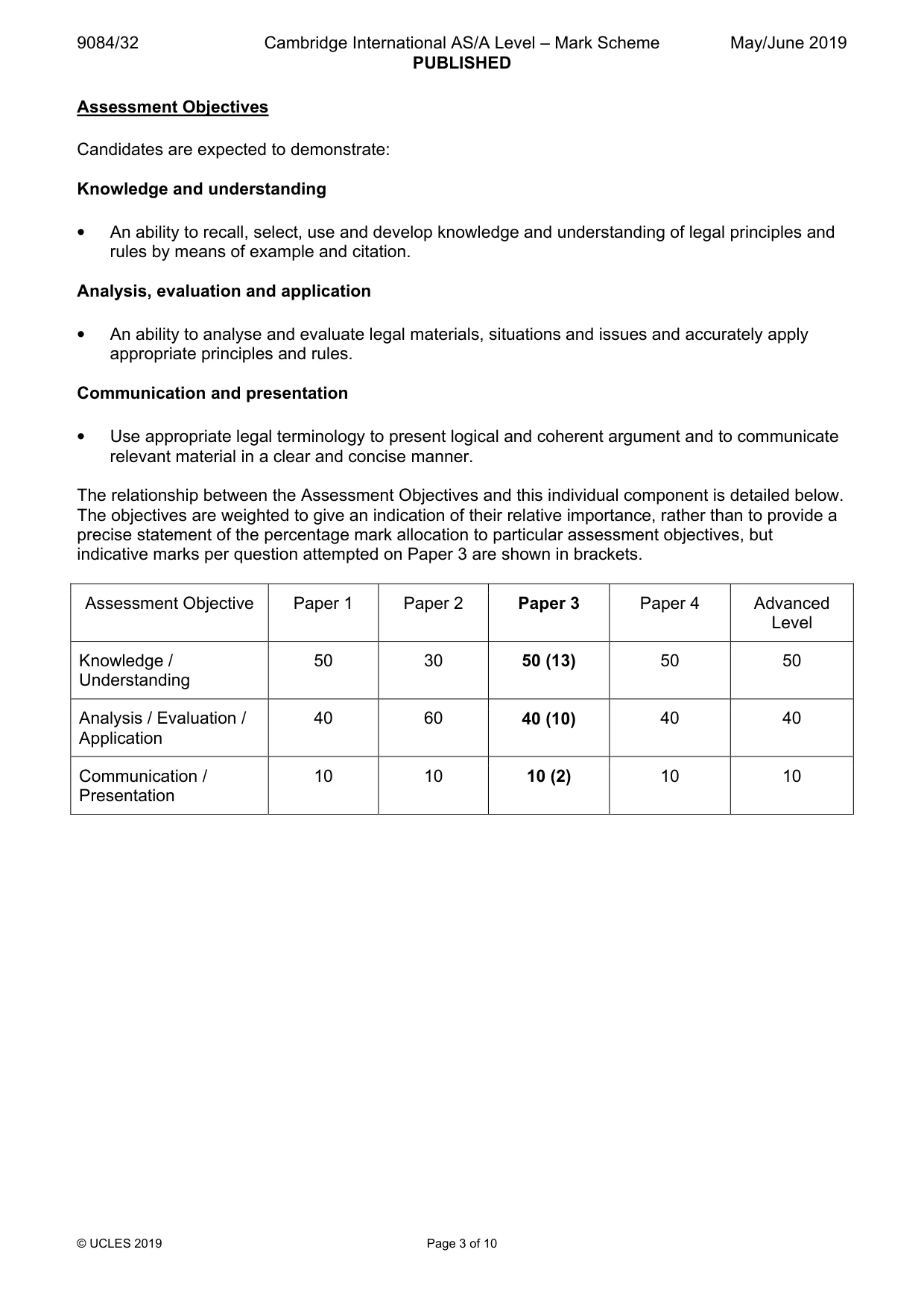
9084/32 Cambridge International AS/A Level – Mark Scheme PUBLISHED May/June 2019 © UCLES 2019 Page 3 of 10 Assessment Objectives Candidates are expected to demonstrate: Knowledge and understanding • An ability to recall, select, use and develop knowledge and understanding of legal principles and rules by means of example and citation. Analysis, evaluation and application • An ability to analyse and evaluate legal materials, situations and issues and accurately apply appropriate principles and rules. Communication and presentation • Use appropriate legal terminology to present logical and coherent argument and to communicate relevant material in a clear and concise manner. The relationship between the Assessment Objectives and this individual component is detailed below. The objectives are weighted to give an indication of their relative importance, rather than to provide a precise statement of the percentage mark allocation to particular assessment objectives, but indicative marks per question attempted on Paper 3 are shown in brackets. Assessment Objective Paper 1 Paper 2 Paper 3 Paper 4 Advanced Level Knowledge / Understanding 50 30 50 (13) 50 50 Analysis / Evaluation / Application 40 60 40 (10) 40 40 Communication / Presentation 10 10 10 (2) 10 10
Mark scheme, page 4
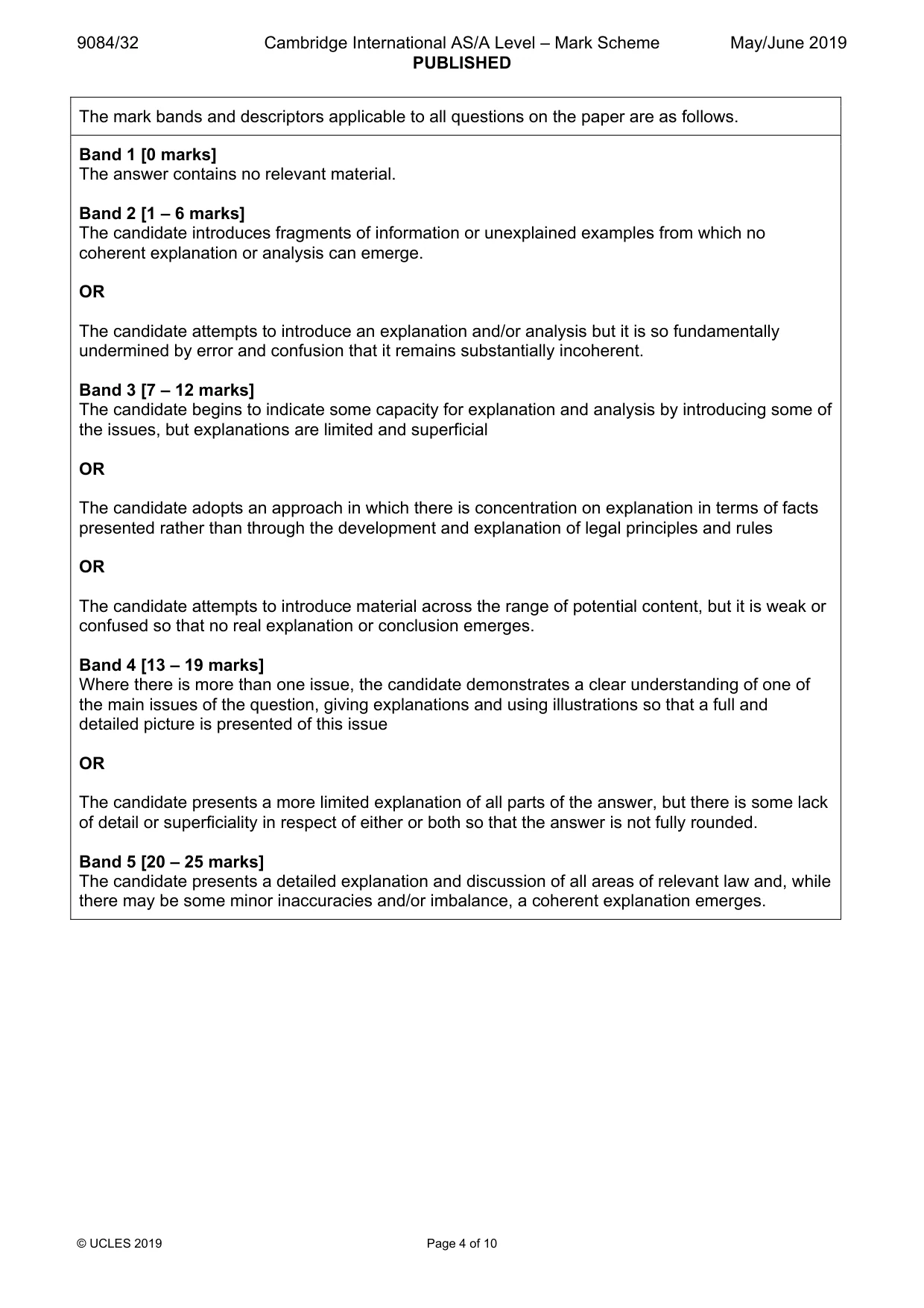
9084/32 Cambridge International AS/A Level – Mark Scheme PUBLISHED May/June 2019 © UCLES 2019 Page 4 of 10 The mark bands and descriptors applicable to all questions on the paper are as follows. Band 1 [0 marks] The answer contains no relevant material. Band 2 [1 – 6 marks] The candidate introduces fragments of information or unexplained examples from which no coherent explanation or analysis can emerge. OR The candidate attempts to introduce an explanation and/or analysis but it is so fundamentally undermined by error and confusion that it remains substantially incoherent. Band 3 [7 – 12 marks] The candidate begins to indicate some capacity for explanation and analysis by introducing some of the issues, but explanations are limited and superficial OR The candidate adopts an approach in which there is concentration on explanation in terms of facts presented rather than through the development and explanation of legal principles and rules OR The candidate attempts to introduce material across the range of potential content, but it is weak or confused so that no real explanation or conclusion emerges. Band 4 [13 – 19 marks] Where there is more than one issue, the candidate demonstrates a clear understanding of one of the main issues of the question, giving explanations and using illustrations so that a full and detailed picture is presented of this issue OR The candidate presents a more limited explanation of all parts of the answer, but there is some lack of detail or superficiality in respect of either or both so that the answer is not fully rounded. Band 5 [20 – 25 marks] The candidate presents a detailed explanation and discussion of all areas of relevant law and, while there may be some minor inaccuracies and/or imbalance, a coherent explanation emerges.
Mark scheme, page 5
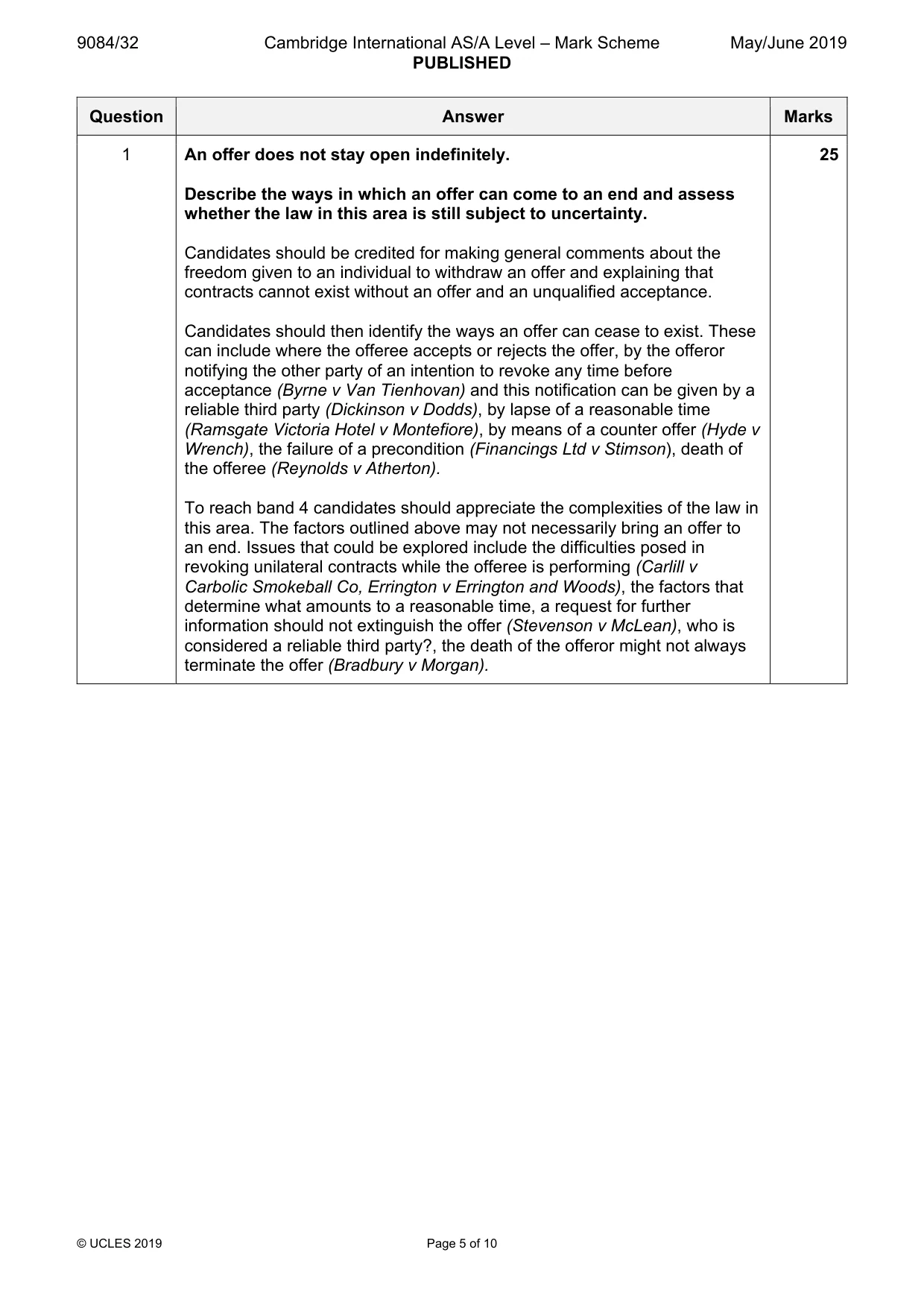
9084/32 Cambridge International AS/A Level – Mark Scheme PUBLISHED May/June 2019 © UCLES 2019 Page 5 of 10 Question Answer Marks 1 An offer does not stay open indefinitely. Describe the ways in which an offer can come to an end and assess whether the law in this area is still subject to uncertainty. Candidates should be credited for making general comments about the freedom given to an individual to withdraw an offer and explaining that contracts cannot exist without an offer and an unqualified acceptance. Candidates should then identify the ways an offer can cease to exist. These can include where the offeree accepts or rejects the offer, by the offeror notifying the other party of an intention to revoke any time before acceptance (Byrne v Van Tienhovan) and this notification can be given by a reliable third party (Dickinson v Dodds), by lapse of a reasonable time (Ramsgate Victoria Hotel v Montefiore), by means of a counter offer (Hyde v Wrench), the failure of a precondition (Financings Ltd v Stimson), death of the offeree (Reynolds v Atherton). To reach band 4 candidates should appreciate the complexities of the law in this area. The factors outlined above may not necessarily bring an offer to an end. Issues that could be explored include the difficulties posed in revoking unilateral contracts while the offeree is performing (Carlill v Carbolic Smokeball Co, Errington v Errington and Woods), the factors that determine what amounts to a reasonable time, a request for further information should not extinguish the offer (Stevenson v McLean), who is considered a reliable third party?, the death of the offeror might not always terminate the offer (Bradbury v Morgan). 25
Mark scheme, page 6
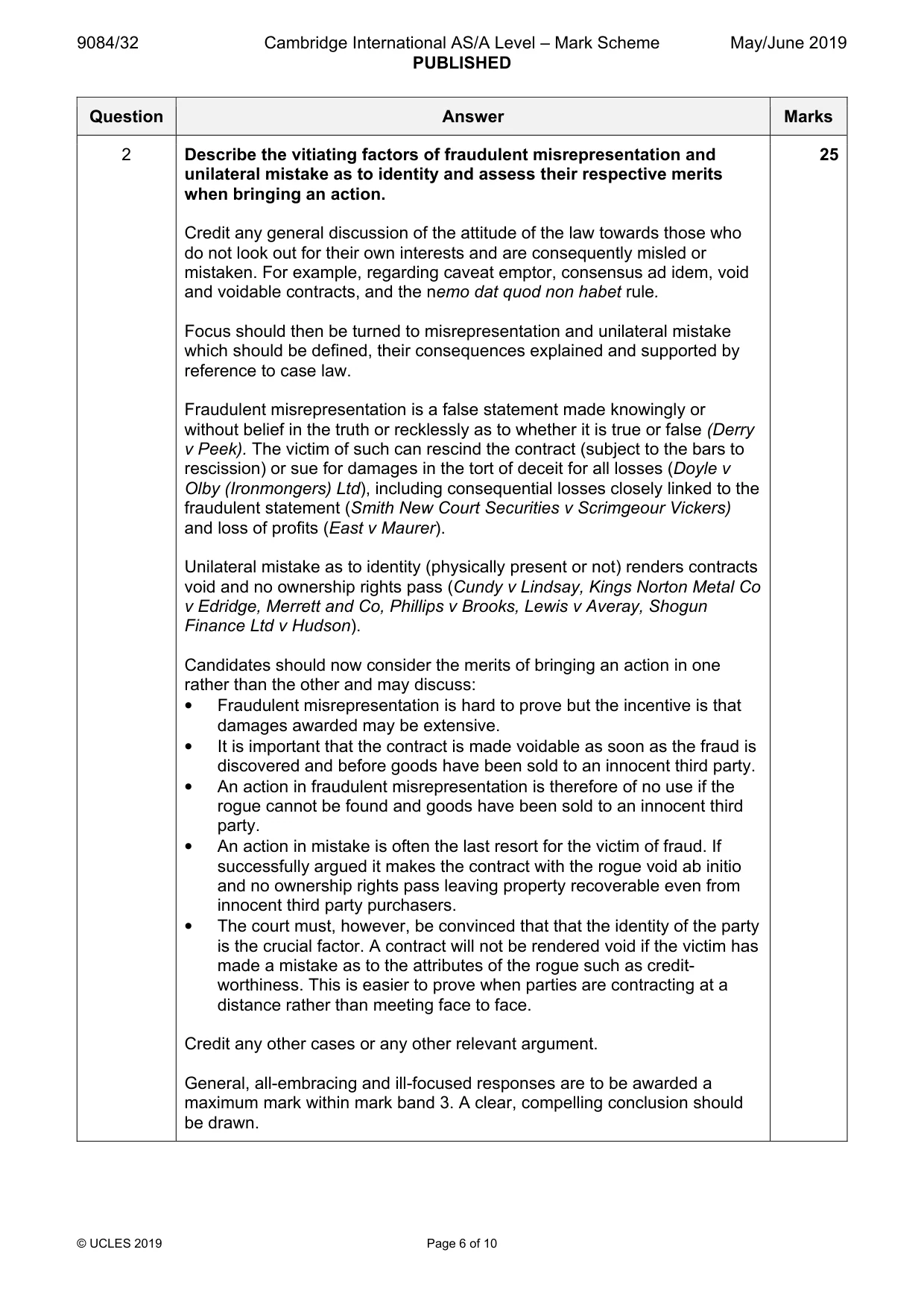
9084/32 Cambridge International AS/A Level – Mark Scheme PUBLISHED May/June 2019 © UCLES 2019 Page 6 of 10 Question Answer Marks 2 Describe the vitiating factors of fraudulent misrepresentation and unilateral mistake as to identity and assess their respective merits when bringing an action. Credit any general discussion of the attitude of the law towards those who do not look out for their own interests and are consequently misled or mistaken. For example, regarding caveat emptor, consensus ad idem, void and voidable contracts, and the nemo dat quod non habet rule. Focus should then be turned to misrepresentation and unilateral mistake which should be defined, their consequences explained and supported by reference to case law. Fraudulent misrepresentation is a false statement made knowingly or without belief in the truth or recklessly as to whether it is true or false (Derry v Peek). The victim of such can rescind the contract (subject to the bars to rescission) or sue for damages in the tort of deceit for all losses (Doyle v Olby (Ironmongers) Ltd), including consequential losses closely linked to the fraudulent statement (Smith New Court Securities v Scrimgeour Vickers) and loss of profits (East v Maurer). Unilateral mistake as to identity (physically present or not) renders contracts void and no ownership rights pass (Cundy v Lindsay, Kings Norton Metal Co v Edridge, Merrett and Co, Phillips v Brooks, Lewis v Averay, Shogun Finance Ltd v Hudson). Candidates should now consider the merits of bringing an action in one rather than the other and may discuss: • Fraudulent misrepresentation is hard to prove but the incentive is that damages awarded may be extensive. • It is important that the contract is made voidable as soon as the fraud is discovered and before goods have been sold to an innocent third party. • An action in fraudulent misrepresentation is therefore of no use if the rogue cannot be found and goods have been sold to an innocent third party. • An action in mistake is often the last resort for the victim of fraud. If successfully argued it makes the contract with the rogue void ab initio and no ownership rights pass leaving property recoverable even from innocent third party purchasers. • The court must, however, be convinced that that the identity of the party is the crucial factor. A contract will not be rendered void if the victim has made a mistake as to the attributes of the rogue such as credit- worthiness. This is easier to prove when parties are contracting at a distance rather than meeting face to face. Credit any other cases or any other relevant argument. General, all-embracing and ill-focused responses are to be awarded a maximum mark within mark band 3. A clear, compelling conclusion should be drawn. 25
Mark scheme, page 7
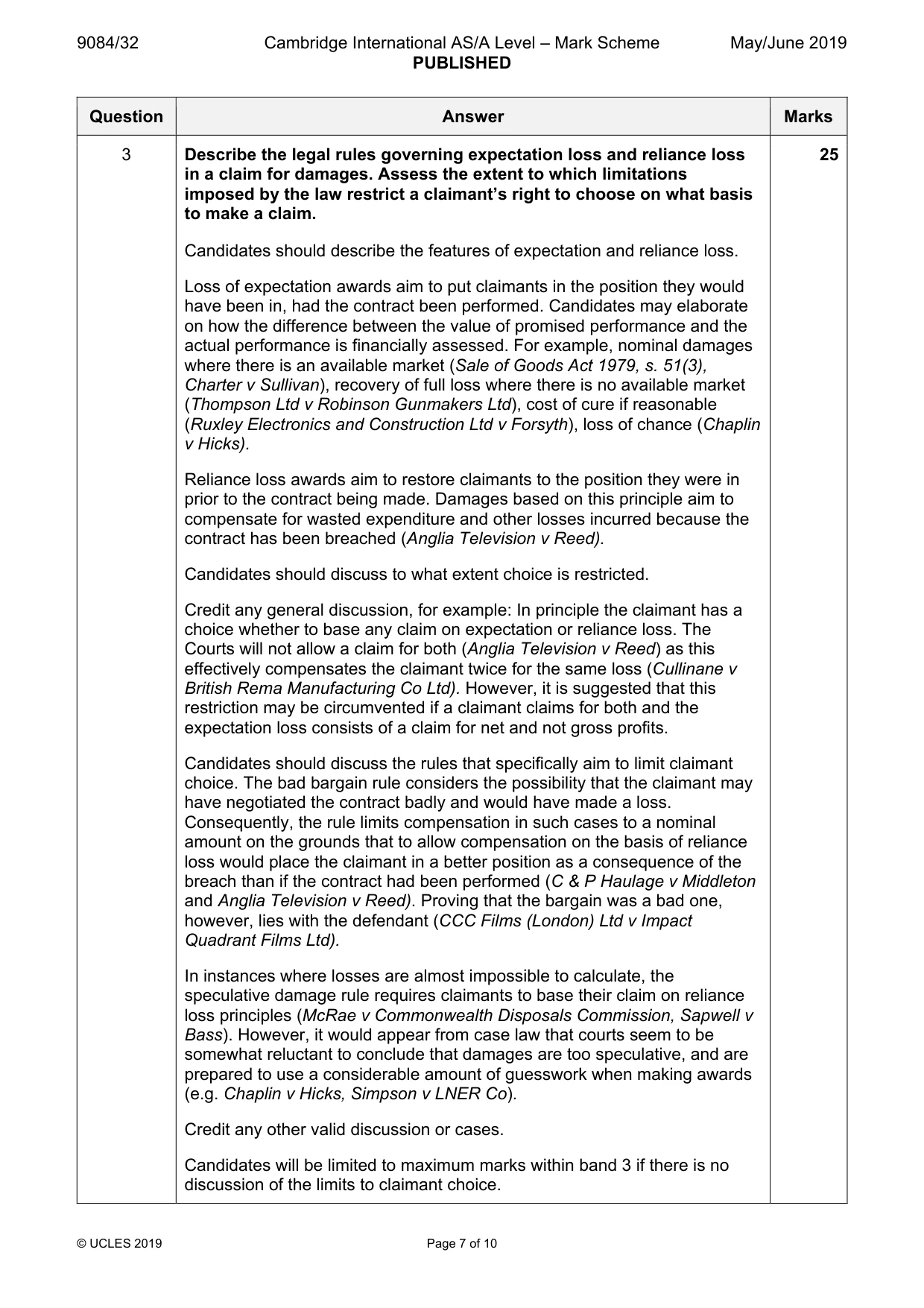
9084/32 Cambridge International AS/A Level – Mark Scheme PUBLISHED May/June 2019 © UCLES 2019 Page 7 of 10 Question Answer Marks 3 Describe the legal rules governing expectation loss and reliance loss in a claim for damages. Assess the extent to which limitations imposed by the law restrict a claimant’s right to choose on what basis to make a claim. Candidates should describe the features of expectation and reliance loss. Loss of expectation awards aim to put claimants in the position they would have been in, had the contract been performed. Candidates may elaborate on how the difference between the value of promised performance and the actual performance is financially assessed. For example, nominal damages where there is an available market (Sale of Goods Act 1979, s. 51(3), Charter v Sullivan), recovery of full loss where there is no available market (Thompson Ltd v Robinson Gunmakers Ltd), cost of cure if reasonable (Ruxley Electronics and Construction Ltd v Forsyth), loss of chance (Chaplin v Hicks). Reliance loss awards aim to restore claimants to the position they were in prior to the contract being made. Damages based on this principle aim to compensate for wasted expenditure and other losses incurred because the contract has been breached (Anglia Television v Reed). Candidates should discuss to what extent choice is restricted. Credit any general discussion, for example: In principle the claimant has a choice whether to base any claim on expectation or reliance loss. The Courts will not allow a claim for both (Anglia Television v Reed) as this effectively compensates the claimant twice for the same loss (Cullinane v British Rema Manufacturing Co Ltd). However, it is suggested that this restriction may be circumvented if a claimant claims for both and the expectation loss consists of a claim for net and not gross profits. Candidates should discuss the rules that specifically aim to limit claimant choice. The bad bargain rule considers the possibility that the claimant may have negotiated the contract badly and would have made a loss. Consequently, the rule limits compensation in such cases to a nominal amount on the grounds that to allow compensation on the basis of reliance loss would place the claimant in a better position as a consequence of the breach than if the contract had been performed (C & P Haulage v Middleton and Anglia Television v Reed). Proving that the bargain was a bad one, however, lies with the defendant (CCC Films (London) Ltd v Impact Quadrant Films Ltd). In instances where losses are almost impossible to calculate, the speculative damage rule requires claimants to base their claim on reliance loss principles (McRae v Commonwealth Disposals Commission, Sapwell v Bass). However, it would appear from case law that courts seem to be somewhat reluctant to conclude that damages are too speculative, and are prepared to use a considerable amount of guesswork when making awards (e.g. Chaplin v Hicks, Simpson v LNER Co). Credit any other valid discussion or cases. Candidates will be limited to maximum marks within band 3 if there is no discussion of the limits to claimant choice. 25
Mark scheme, page 8
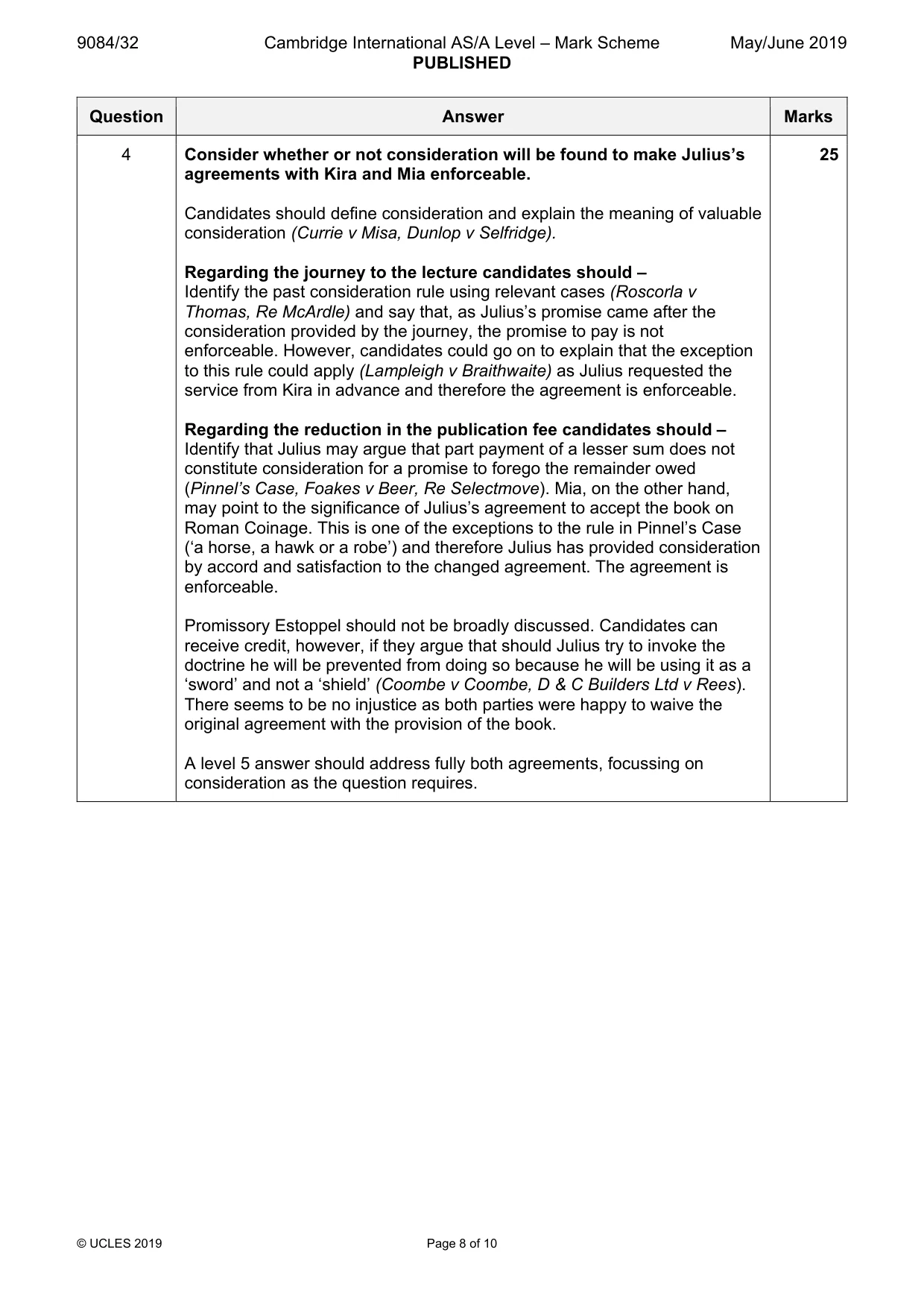
9084/32 Cambridge International AS/A Level – Mark Scheme PUBLISHED May/June 2019 © UCLES 2019 Page 8 of 10 Question Answer Marks 4 Consider whether or not consideration will be found to make Julius’s agreements with Kira and Mia enforceable. Candidates should define consideration and explain the meaning of valuable consideration (Currie v Misa, Dunlop v Selfridge). Regarding the journey to the lecture candidates should – Identify the past consideration rule using relevant cases (Roscorla v Thomas, Re McArdle) and say that, as Julius’s promise came after the consideration provided by the journey, the promise to pay is not enforceable. However, candidates could go on to explain that the exception to this rule could apply (Lampleigh v Braithwaite) as Julius requested the service from Kira in advance and therefore the agreement is enforceable. Regarding the reduction in the publication fee candidates should – Identify that Julius may argue that part payment of a lesser sum does not constitute consideration for a promise to forego the remainder owed (Pinnel’s Case, Foakes v Beer, Re Selectmove). Mia, on the other hand, may point to the significance of Julius’s agreement to accept the book on Roman Coinage. This is one of the exceptions to the rule in Pinnel’s Case (‘a horse, a hawk or a robe’) and therefore Julius has provided consideration by accord and satisfaction to the changed agreement. The agreement is enforceable. Promissory Estoppel should not be broadly discussed. Candidates can receive credit, however, if they argue that should Julius try to invoke the doctrine he will be prevented from doing so because he will be using it as a ‘sword’ and not a ‘shield’ (Coombe v Coombe, D & C Builders Ltd v Rees). There seems to be no injustice as both parties were happy to waive the original agreement with the provision of the book. A level 5 answer should address fully both agreements, focussing on consideration as the question requires. 25
Mark scheme, page 9
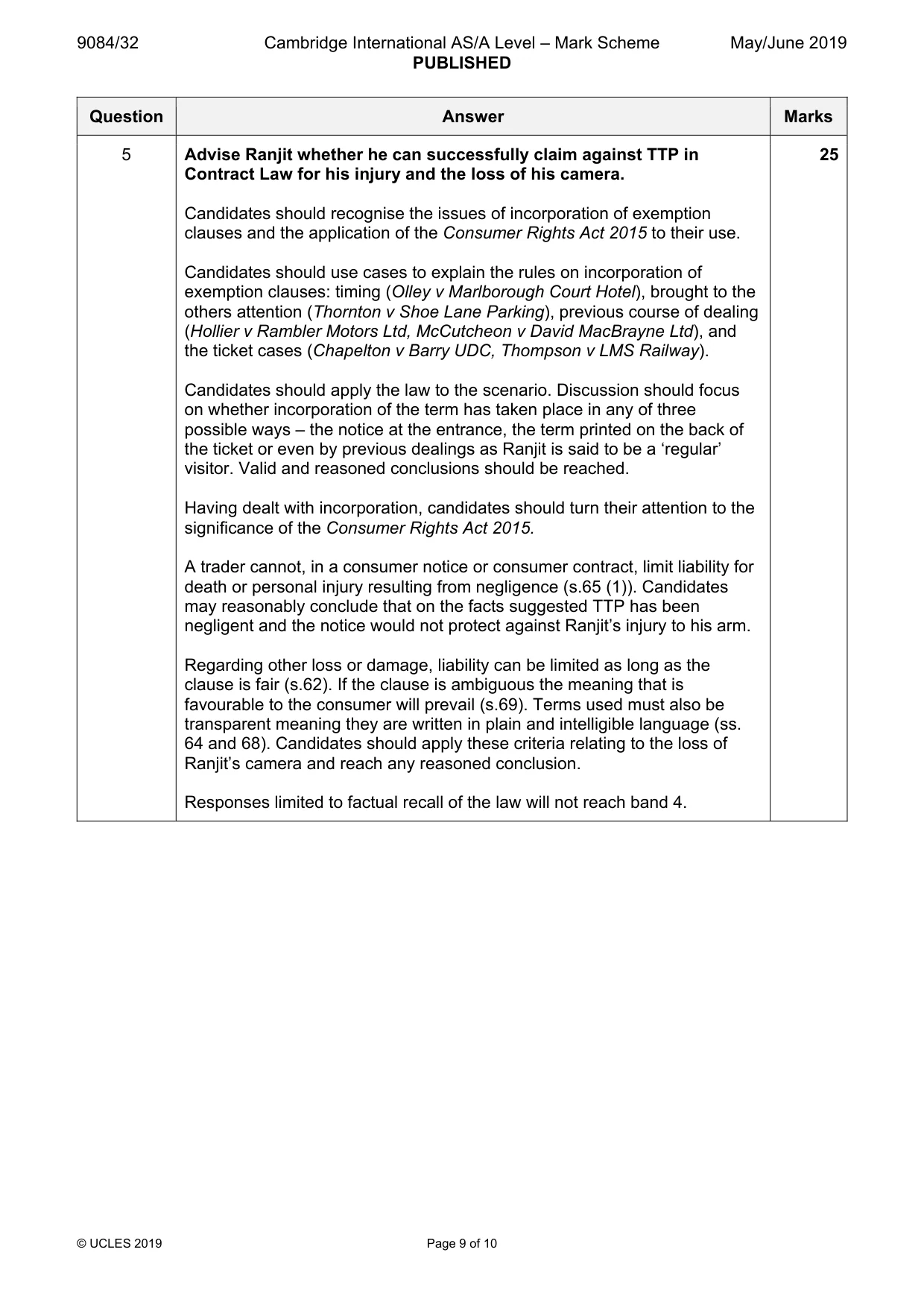
9084/32 Cambridge International AS/A Level – Mark Scheme PUBLISHED May/June 2019 © UCLES 2019 Page 9 of 10 Question Answer Marks 5 Advise Ranjit whether he can successfully claim against TTP in Contract Law for his injury and the loss of his camera. Candidates should recognise the issues of incorporation of exemption clauses and the application of the Consumer Rights Act 2015 to their use. Candidates should use cases to explain the rules on incorporation of exemption clauses: timing (Olley v Marlborough Court Hotel), brought to the others attention (Thornton v Shoe Lane Parking), previous course of dealing (Hollier v Rambler Motors Ltd, McCutcheon v David MacBrayne Ltd), and the ticket cases (Chapelton v Barry UDC, Thompson v LMS Railway). Candidates should apply the law to the scenario. Discussion should focus on whether incorporation of the term has taken place in any of three possible ways – the notice at the entrance, the term printed on the back of the ticket or even by previous dealings as Ranjit is said to be a ‘regular’ visitor. Valid and reasoned conclusions should be reached. Having dealt with incorporation, candidates should turn their attention to the significance of the Consumer Rights Act 2015. A trader cannot, in a consumer notice or consumer contract, limit liability for death or personal injury resulting from negligence (s.65 (1)). Candidates may reasonably conclude that on the facts suggested TTP has been negligent and the notice would not protect against Ranjit’s injury to his arm. Regarding other loss or damage, liability can be limited as long as the clause is fair (s.62). If the clause is ambiguous the meaning that is favourable to the consumer will prevail (s.69). Terms used must also be transparent meaning they are written in plain and intelligible language (ss. 64 and 68). Candidates should apply these criteria relating to the loss of Ranjit’s camera and reach any reasoned conclusion. Responses limited to factual recall of the law will not reach band 4. 25
Mark scheme, page 10
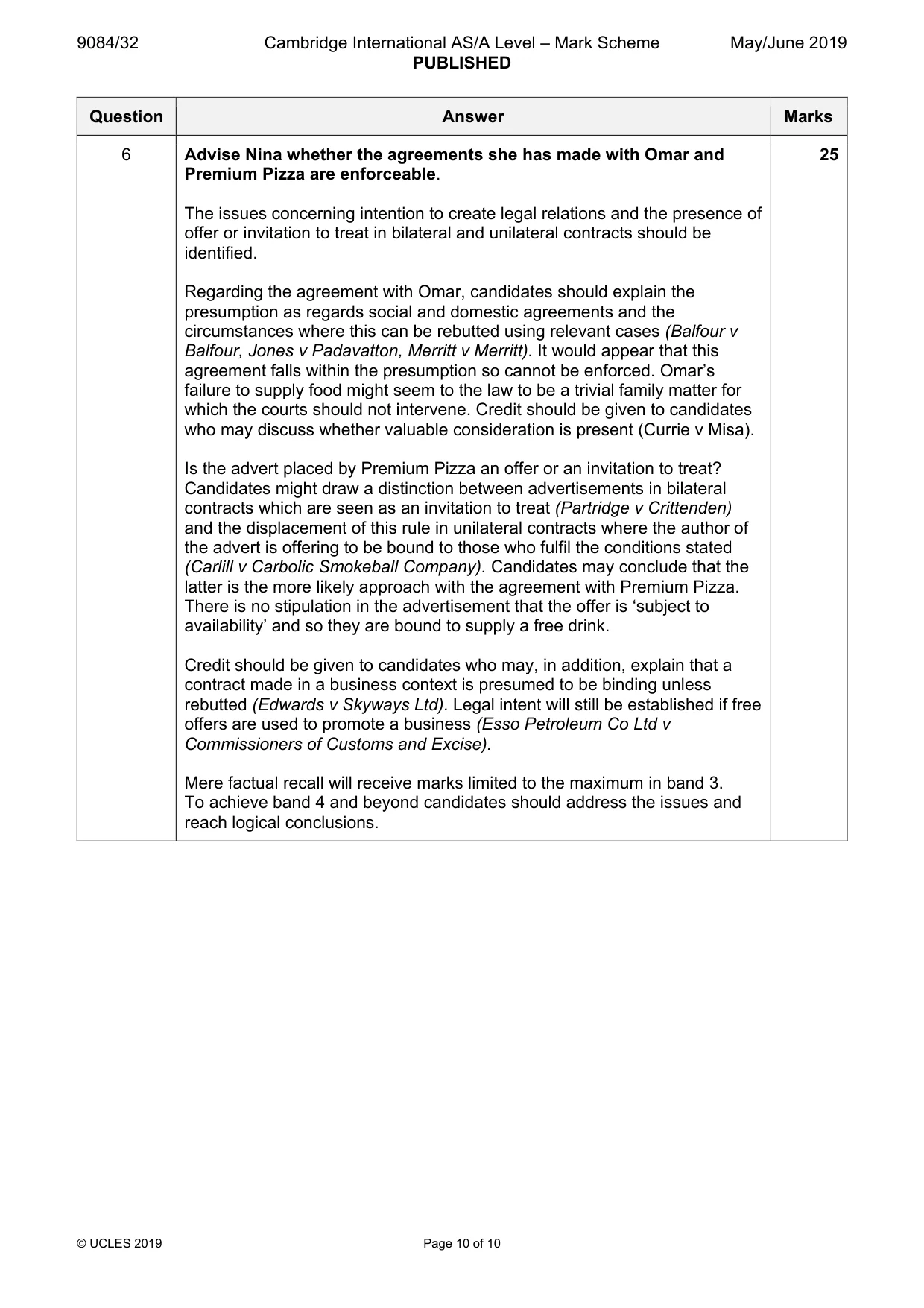
9084/32 Cambridge International AS/A Level – Mark Scheme PUBLISHED May/June 2019 © UCLES 2019 Page 10 of 10 Question Answer Marks 6 Advise Nina whether the agreements she has made with Omar and Premium Pizza are enforceable. The issues concerning intention to create legal relations and the presence of offer or invitation to treat in bilateral and unilateral contracts should be identified. Regarding the agreement with Omar, candidates should explain the presumption as regards social and domestic agreements and the circumstances where this can be rebutted using relevant cases (Balfour v Balfour, Jones v Padavatton, Merritt v Merritt). It would appear that this agreement falls within the presumption so cannot be enforced. Omar’s failure to supply food might seem to the law to be a trivial family matter for which the courts should not intervene. Credit should be given to candidates who may discuss whether valuable consideration is present (Currie v Misa). Is the advert placed by Premium Pizza an offer or an invitation to treat? Candidates might draw a distinction between advertisements in bilateral contracts which are seen as an invitation to treat (Partridge v Crittenden) and the displacement of this rule in unilateral contracts where the author of the advert is offering to be bound to those who fulfil the conditions stated (Carlill v Carbolic Smokeball Company). Candidates may conclude that the latter is the more likely approach with the agreement with Premium Pizza. There is no stipulation in the advertisement that the offer is ‘subject to availability’ and so they are bound to supply a free drink. Credit should be given to candidates who may, in addition, explain that a contract made in a business context is presumed to be binding unless rebutted (Edwards v Skyways Ltd). Legal intent will still be established if free offers are used to promote a business (Esso Petroleum Co Ltd v Commissioners of Customs and Excise). Mere factual recall will receive marks limited to the maximum in band 3. To achieve band 4 and beyond candidates should address the issues and reach logical conclusions. 25
What you needed in this session
Cambridge’s own grade thresholds for 2019 May/June, Paper 3 · Variant 2. A higher threshold means an easier paper — the bar moves with how the cohort did.