Cambridge A Level Law 9084 — 2019 May/June Paper 3 · Variant 1
9084/31/M/J/19 · 75 marks · ≈84 min
The question paper and its mark scheme, free to read here and free to download. This is Cambridge’s own paper, exactly as it was sat.
Question paper4 pages

Mark scheme10 pages
Answers below. Sit the paper first if you are practising.
Paper as text
Question paper, page 1
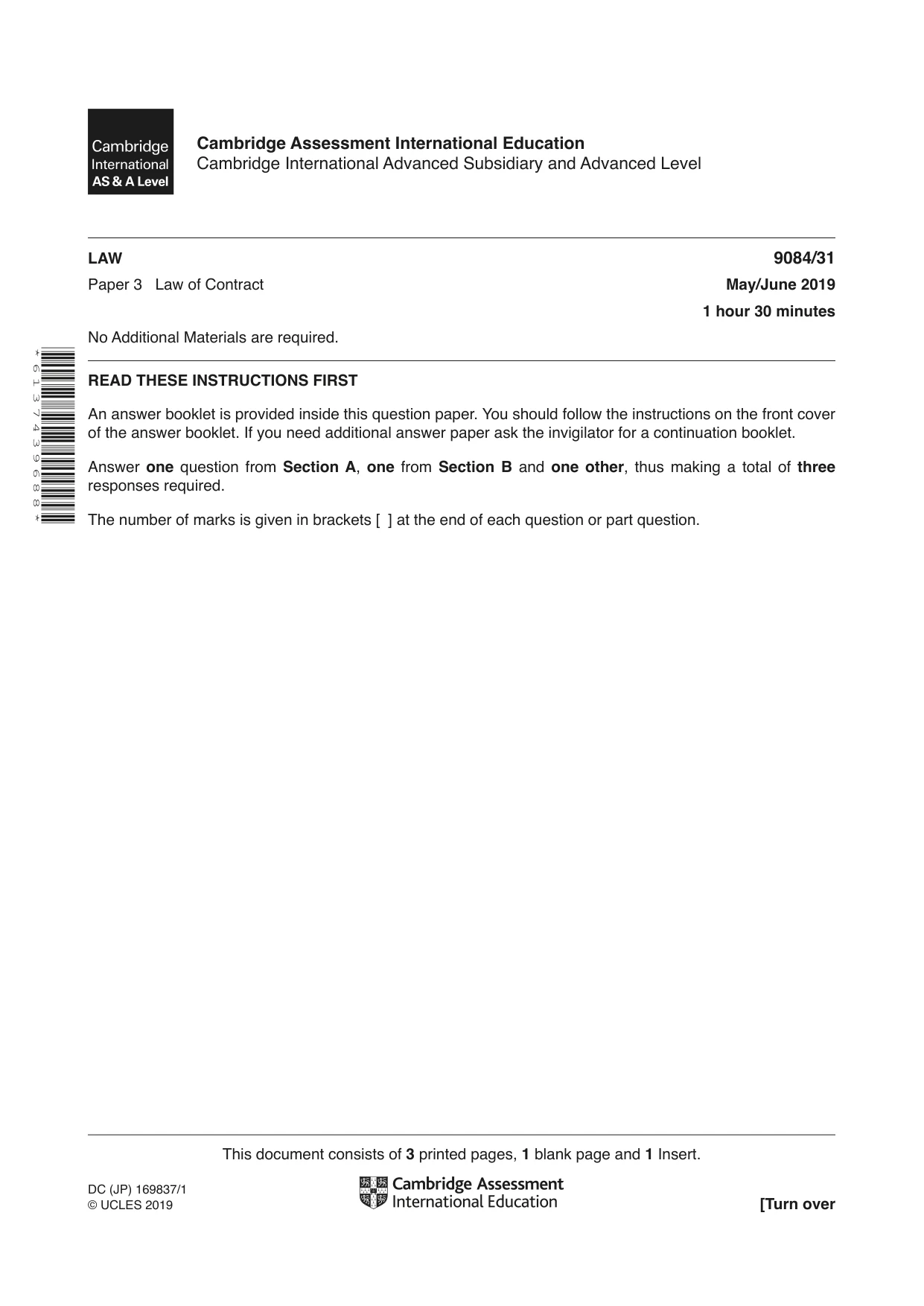
This document consists of 3 printed pages, 1 blank page and 1 Insert. DC (JP) 169837/1 © UCLES 2019 [Turn over Cambridge Assessment International Education Cambridge International Advanced Subsidiary and Advanced Level * 6 1 3 7 4 3 9 6 8 8 * LAW 9084/31 Paper 3 Law of Contract May/June 2019 1 hour 30 minutes No Additional Materials are required. READ THESE INSTRUCTIONS FIRST An answer booklet is provided inside this question paper. You should follow the instructions on the front cover of the answer booklet. If you need additional answer paper ask the invigilator for a continuation booklet. Answer one question from Section A, one from Section B and one other, thus making a total of three responses required. The number of marks is given in brackets [ ] at the end of each question or part question.
Question paper, page 2
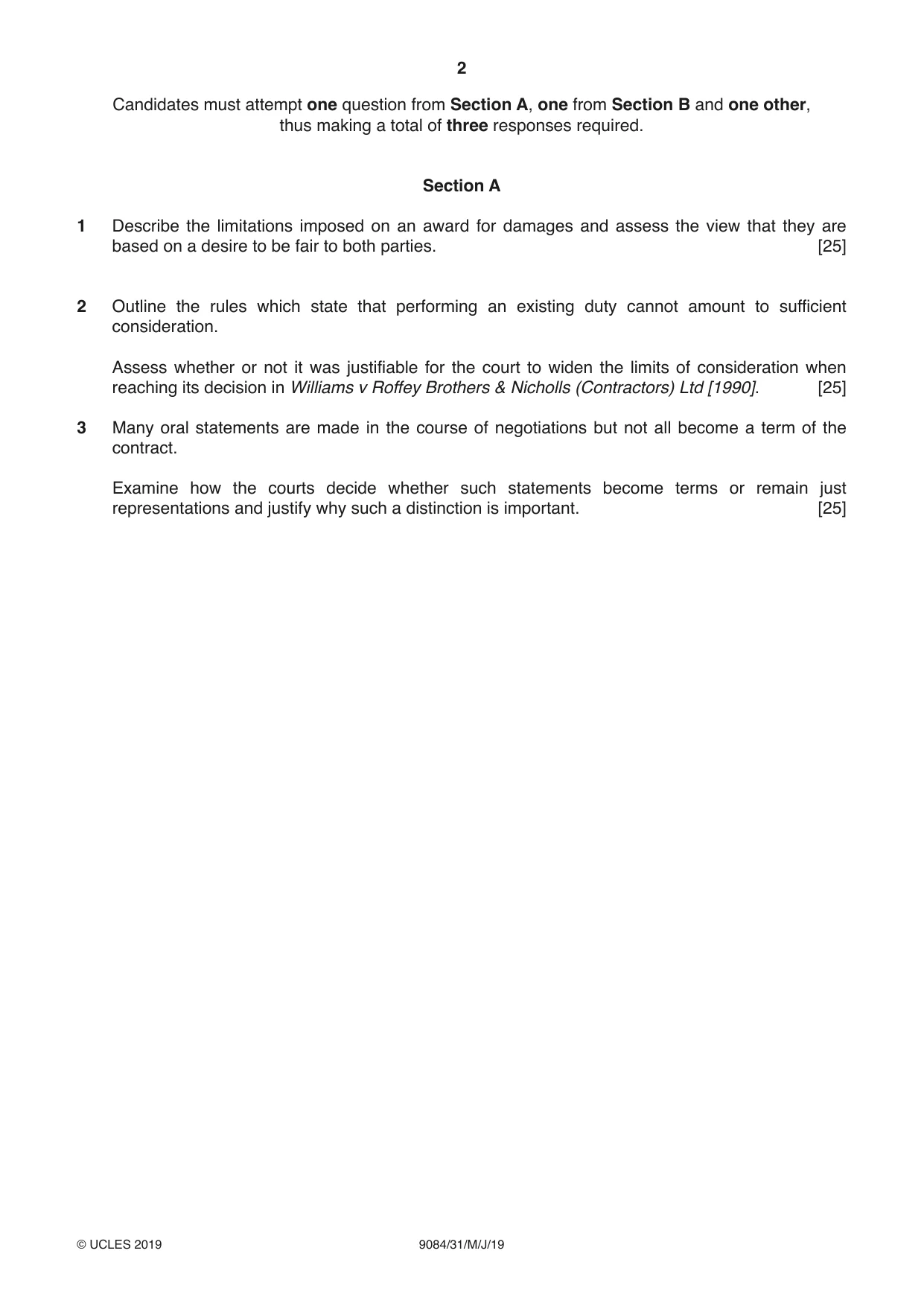
2 9084/31/M/J/19 © UCLES 2019 Candidates must attempt one question from Section A, one from Section B and one other, thus making a total of three responses required. Section A 1 Describe the limitations imposed on an award for damages and assess the view that they are based on a desire to be fair to both parties. [25] 2 Outline the rules which state that performing an existing duty cannot amount to sufficient consideration. Assess whether or not it was justifiable for the court to widen the limits of consideration when reaching its decision in Williams v Roffey Brothers & Nicholls (Contractors) Ltd [1990]. [25] 3 Many oral statements are made in the course of negotiations but not all become a term of the contract. Examine how the courts decide whether such statements become terms or remain just representations and justify why such a distinction is important. [25]
Question paper, page 3
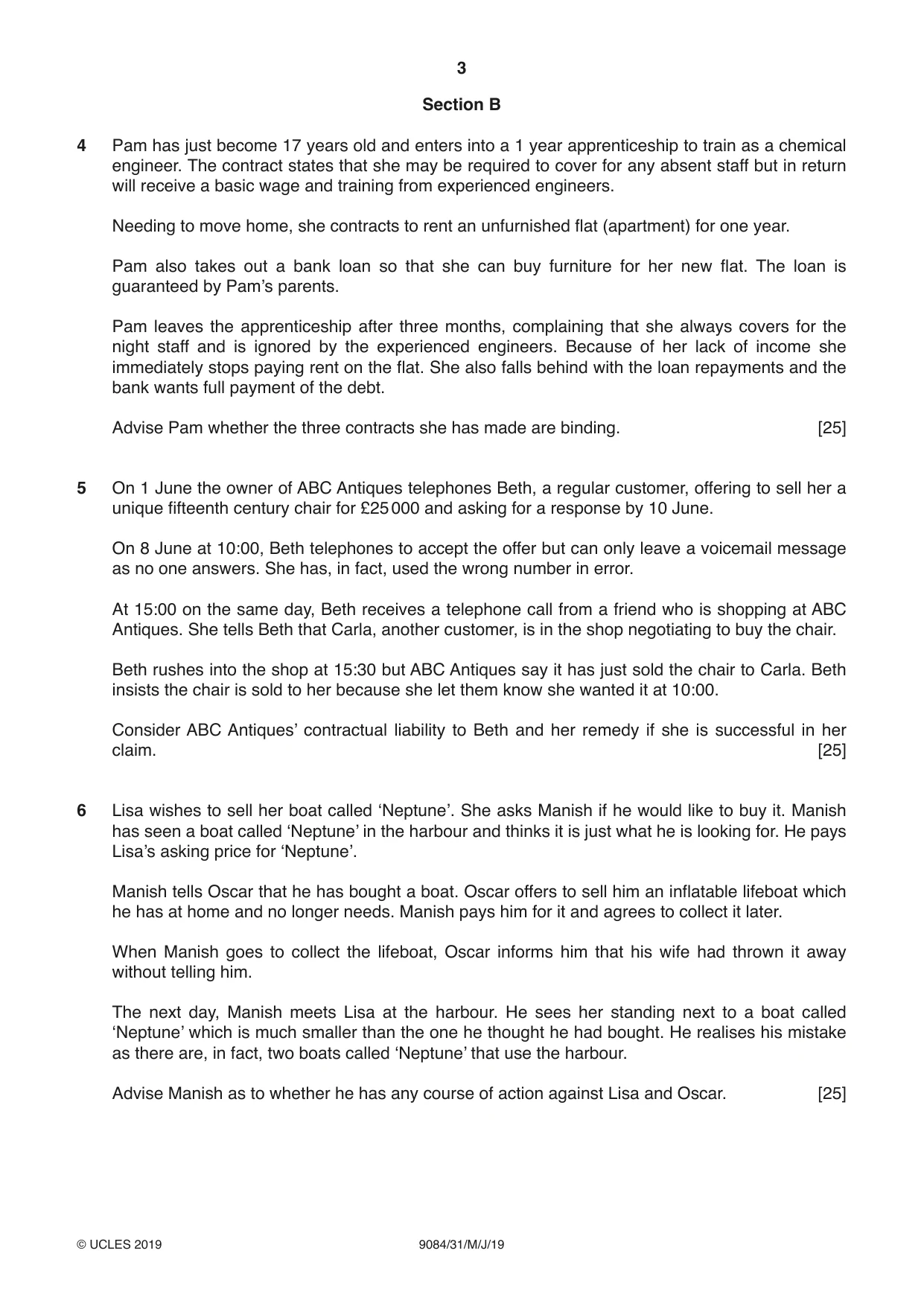
3 9084/31/M/J/19 © UCLES 2019 Section B 4 Pam has just become 17 years old and enters into a 1 year apprenticeship to train as a chemical engineer. The contract states that she may be required to cover for any absent staff but in return will receive a basic wage and training from experienced engineers. Needing to move home, she contracts to rent an unfurnished flat (apartment) for one year. Pam also takes out a bank loan so that she can buy furniture for her new flat. The loan is guaranteed by Pam’s parents. Pam leaves the apprenticeship after three months, complaining that she always covers for the night staff and is ignored by the experienced engineers. Because of her lack of income she immediately stops paying rent on the flat. She also falls behind with the loan repayments and the bank wants full payment of the debt. Advise Pam whether the three contracts she has made are binding. [25] 5 On 1 June the owner of ABC Antiques telephones Beth, a regular customer, offering to sell her a unique fifteenth century chair for £25 000 and asking for a response by 10 June. On 8 June at 10:00, Beth telephones to accept the offer but can only leave a voicemail message as no one answers. She has, in fact, used the wrong number in error. At 15:00 on the same day, Beth receives a telephone call from a friend who is shopping at ABC Antiques. She tells Beth that Carla, another customer, is in the shop negotiating to buy the chair. Beth rushes into the shop at 15:30 but ABC Antiques say it has just sold the chair to Carla. Beth insists the chair is sold to her because she let them know she wanted it at 10:00. Consider ABC Antiques’ contractual liability to Beth and her remedy if she is successful in her claim. [25] 6 Lisa wishes to sell her boat called ‘Neptune’. She asks Manish if he would like to buy it. Manish has seen a boat called ‘Neptune’ in the harbour and thinks it is just what he is looking for. He pays Lisa’s asking price for ‘Neptune’. Manish tells Oscar that he has bought a boat. Oscar offers to sell him an inflatable lifeboat which he has at home and no longer needs. Manish pays him for it and agrees to collect it later. When Manish goes to collect the lifeboat, Oscar informs him that his wife had thrown it away without telling him. The next day, Manish meets Lisa at the harbour. He sees her standing next to a boat called ‘Neptune’ which is much smaller than the one he thought he had bought. He realises his mistake as there are, in fact, two boats called ‘Neptune’ that use the harbour. Advise Manish as to whether he has any course of action against Lisa and Oscar. [25]
Question paper, page 4
4 9084/31/M/J/19 © UCLES 2019 BLANK PAGE Permission to reproduce items where third-party owned material protected by copyright is included has been sought and cleared where possible. Every reasonable effort has been made by the publisher (UCLES) to trace copyright holders, but if any items requiring clearance have unwittingly been included, the publisher will be pleased to make amends at the earliest possible opportunity. To avoid the issue of disclosure of answer-related information to candidates, all copyright acknowledgements are reproduced online in the Cambridge Assessment International Education Copyright Acknowledgements Booklet. This is produced for each series of examinations and is freely available to download at www.cambridgeinternational.org after the live examination series. Cambridge Assessment International Education is part of the Cambridge Assessment Group. Cambridge Assessment is the brand name of the University of Cambridge Local Examinations Syndicate (UCLES), which itself is a department of the University of Cambridge.
Mark scheme, page 1
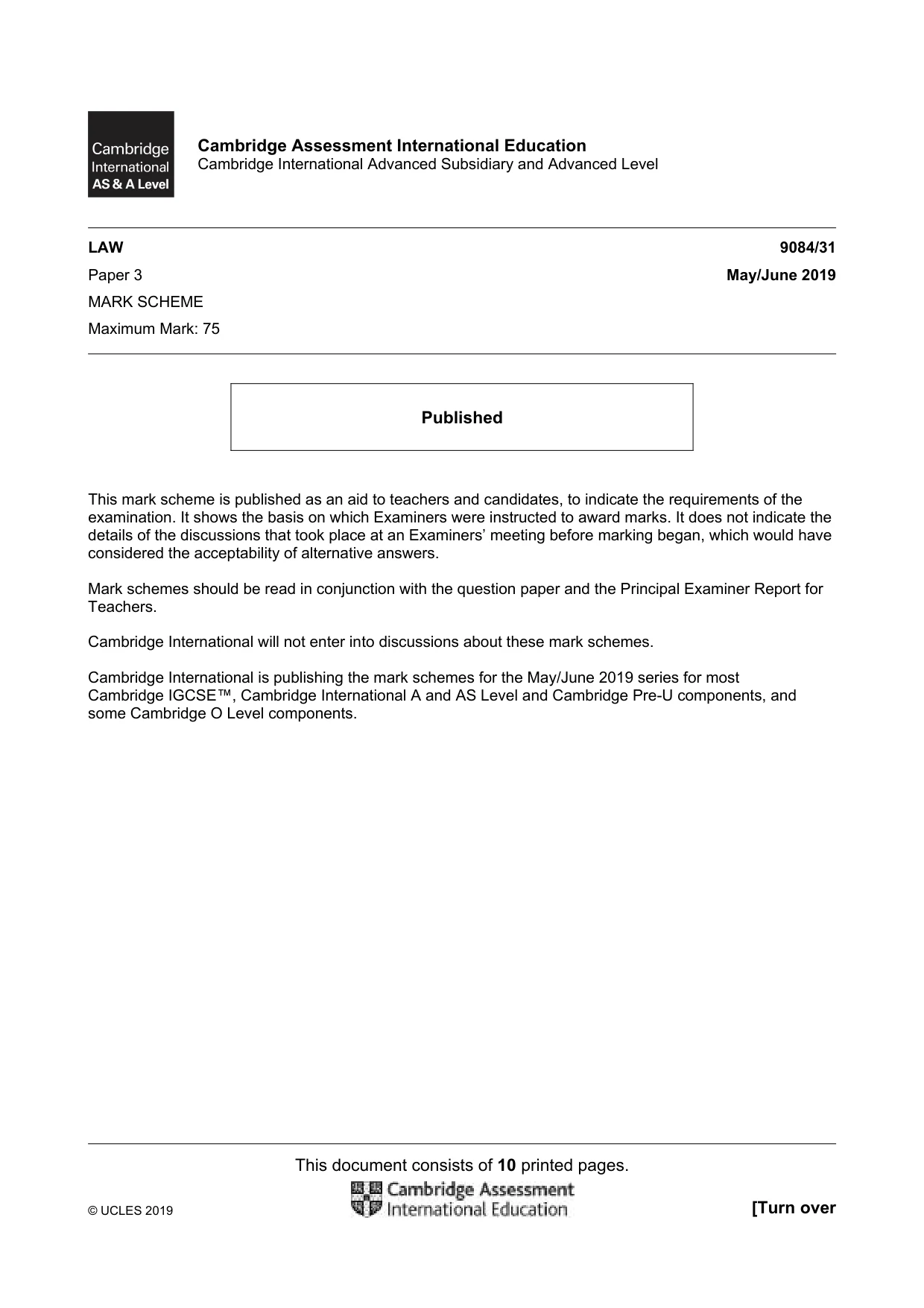
This document consists of 10 printed pages. © UCLES 2019 [Turn over Cambridge Assessment International Education Cambridge International Advanced Subsidiary and Advanced Level LAW 9084/31 Paper 3 May/June 2019 MARK SCHEME Maximum Mark: 75 Published This mark scheme is published as an aid to teachers and candidates, to indicate the requirements of the examination. It shows the basis on which Examiners were instructed to award marks. It does not indicate the details of the discussions that took place at an Examiners’ meeting before marking began, which would have considered the acceptability of alternative answers. Mark schemes should be read in conjunction with the question paper and the Principal Examiner Report for Teachers. Cambridge International will not enter into discussions about these mark schemes. Cambridge International is publishing the mark schemes for the May/June 2019 series for most Cambridge IGCSE™, Cambridge International A and AS Level and Cambridge Pre-U components, and some Cambridge O Level components.
Mark scheme, page 2
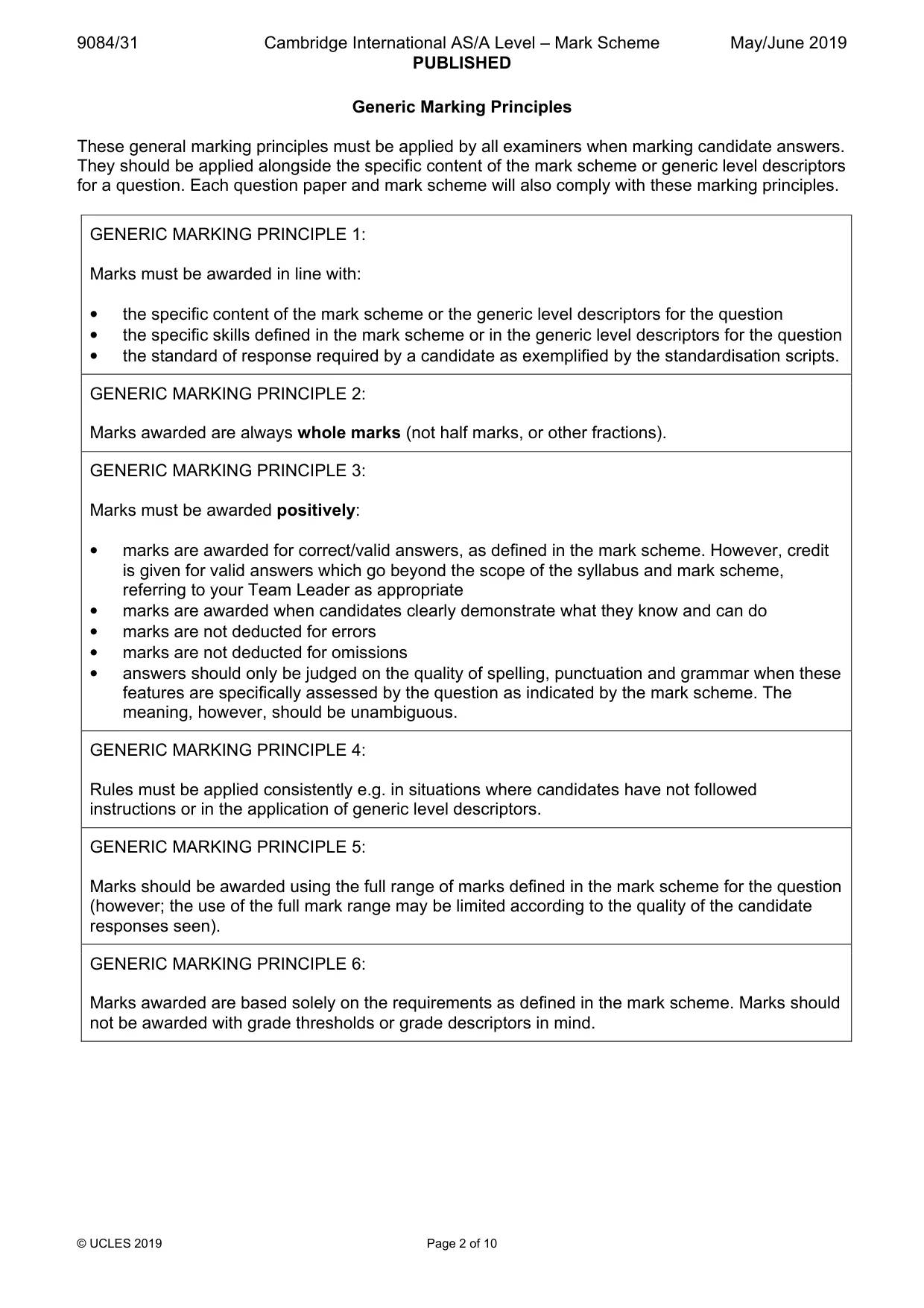
9084/31 Cambridge International AS/A Level – Mark Scheme PUBLISHED May/June 2019 © UCLES 2019 Page 2 of 10 Generic Marking Principles These general marking principles must be applied by all examiners when marking candidate answers. They should be applied alongside the specific content of the mark scheme or generic level descriptors for a question. Each question paper and mark scheme will also comply with these marking principles. GENERIC MARKING PRINCIPLE 1: Marks must be awarded in line with: • the specific content of the mark scheme or the generic level descriptors for the question • the specific skills defined in the mark scheme or in the generic level descriptors for the question • the standard of response required by a candidate as exemplified by the standardisation scripts. GENERIC MARKING PRINCIPLE 2: Marks awarded are always whole marks (not half marks, or other fractions). GENERIC MARKING PRINCIPLE 3: Marks must be awarded positively: • marks are awarded for correct/valid answers, as defined in the mark scheme. However, credit is given for valid answers which go beyond the scope of the syllabus and mark scheme, referring to your Team Leader as appropriate • marks are awarded when candidates clearly demonstrate what they know and can do • marks are not deducted for errors • marks are not deducted for omissions • answers should only be judged on the quality of spelling, punctuation and grammar when these features are specifically assessed by the question as indicated by the mark scheme. The meaning, however, should be unambiguous. GENERIC MARKING PRINCIPLE 4: Rules must be applied consistently e.g. in situations where candidates have not followed instructions or in the application of generic level descriptors. GENERIC MARKING PRINCIPLE 5: Marks should be awarded using the full range of marks defined in the mark scheme for the question (however; the use of the full mark range may be limited according to the quality of the candidate responses seen). GENERIC MARKING PRINCIPLE 6: Marks awarded are based solely on the requirements as defined in the mark scheme. Marks should not be awarded with grade thresholds or grade descriptors in mind.
Mark scheme, page 3
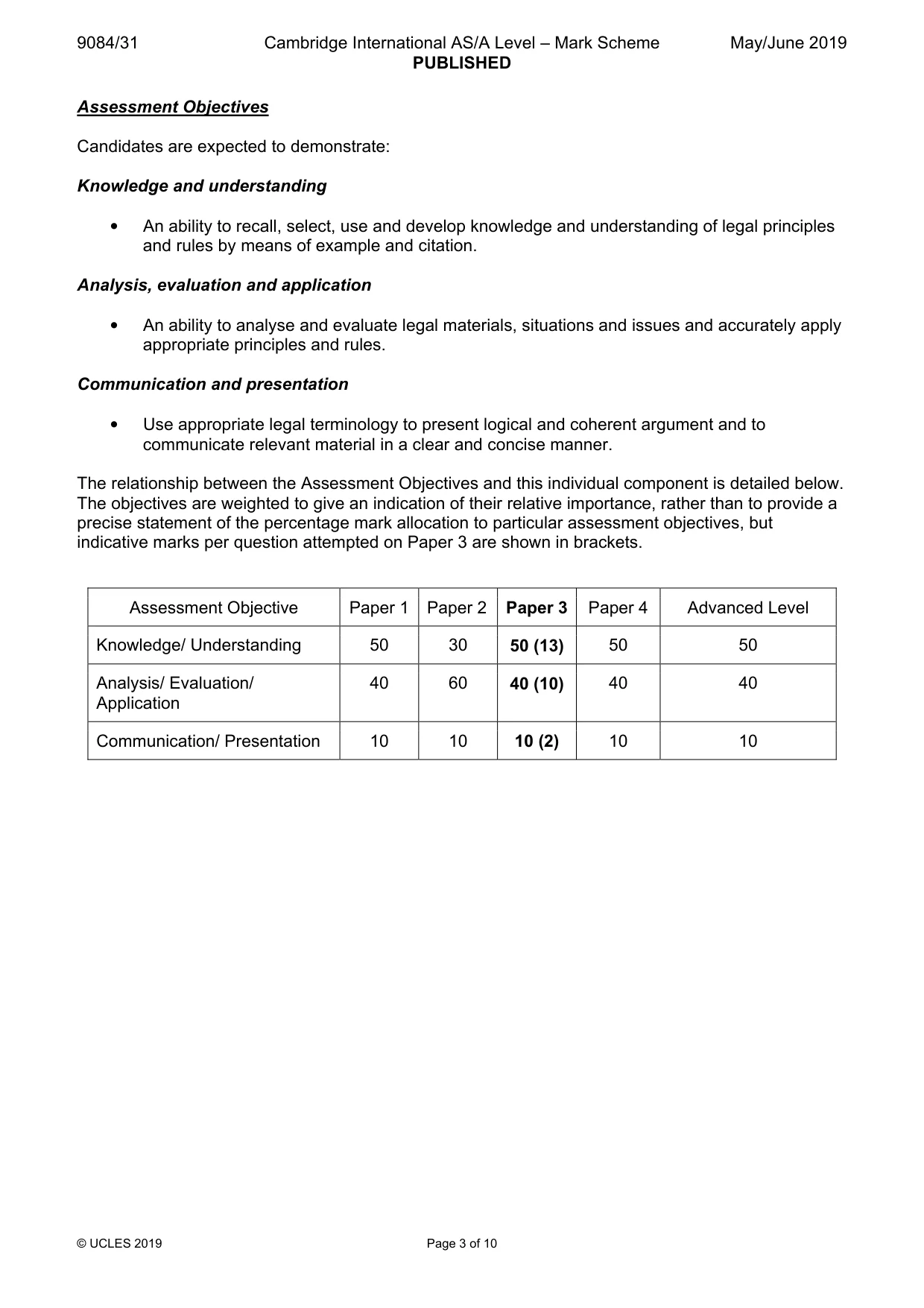
9084/31 Cambridge International AS/A Level – Mark Scheme PUBLISHED May/June 2019 © UCLES 2019 Page 3 of 10 Assessment Objectives Candidates are expected to demonstrate: Knowledge and understanding • An ability to recall, select, use and develop knowledge and understanding of legal principles and rules by means of example and citation. Analysis, evaluation and application • An ability to analyse and evaluate legal materials, situations and issues and accurately apply appropriate principles and rules. Communication and presentation • Use appropriate legal terminology to present logical and coherent argument and to communicate relevant material in a clear and concise manner. The relationship between the Assessment Objectives and this individual component is detailed below. The objectives are weighted to give an indication of their relative importance, rather than to provide a precise statement of the percentage mark allocation to particular assessment objectives, but indicative marks per question attempted on Paper 3 are shown in brackets. Assessment Objective Paper 1 Paper 2 Paper 3 Paper 4 Advanced Level Knowledge/ Understanding 50 30 50 (13) 50 50 Analysis/ Evaluation/ Application 40 60 40 (10) 40 40 Communication/ Presentation 10 10 10 (2) 10 10
Mark scheme, page 4
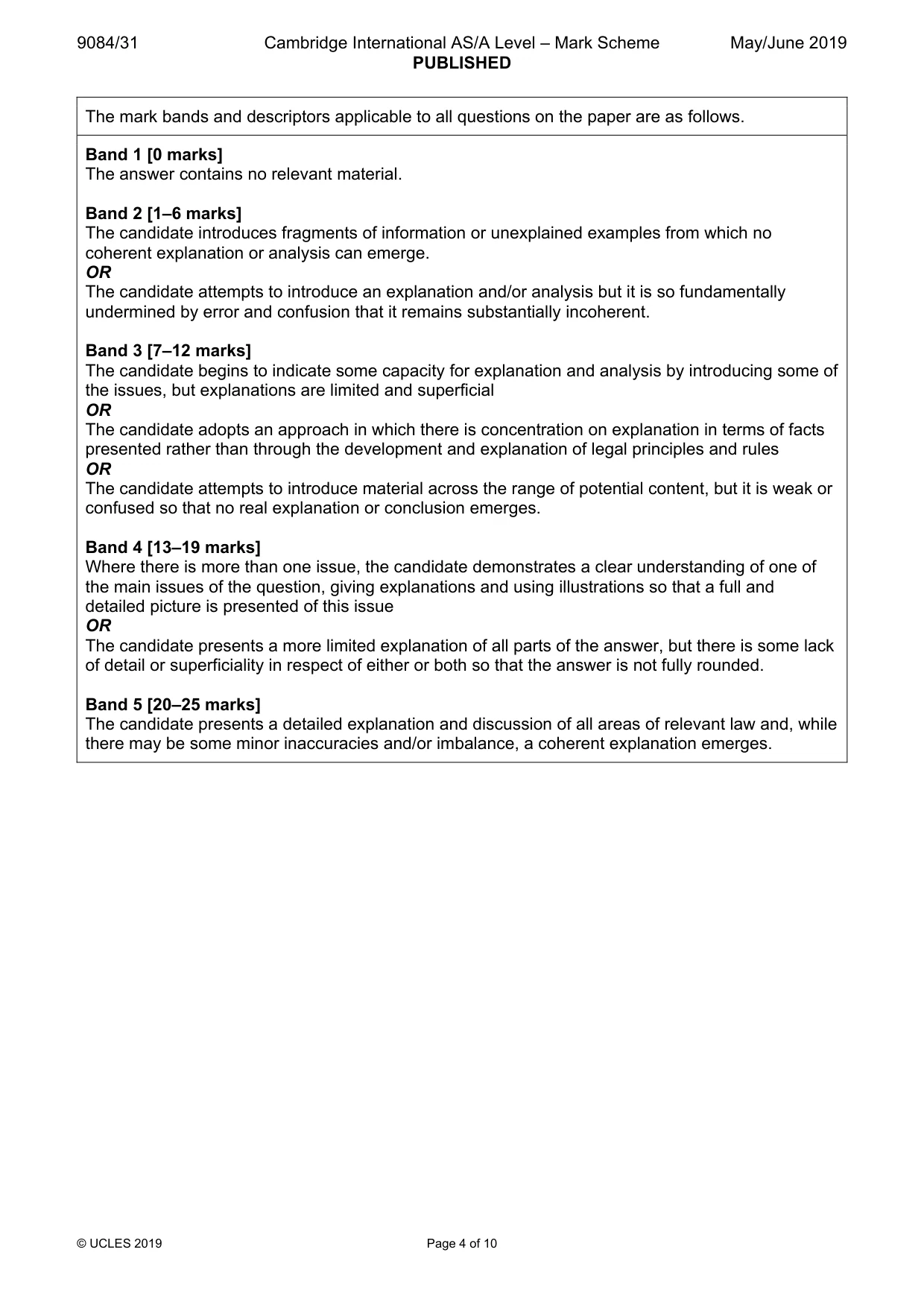
9084/31 Cambridge International AS/A Level – Mark Scheme PUBLISHED May/June 2019 © UCLES 2019 Page 4 of 10 The mark bands and descriptors applicable to all questions on the paper are as follows. Band 1 [0 marks] The answer contains no relevant material. Band 2 [1–6 marks] The candidate introduces fragments of information or unexplained examples from which no coherent explanation or analysis can emerge. OR The candidate attempts to introduce an explanation and/or analysis but it is so fundamentally undermined by error and confusion that it remains substantially incoherent. Band 3 [7–12 marks] The candidate begins to indicate some capacity for explanation and analysis by introducing some of the issues, but explanations are limited and superficial OR The candidate adopts an approach in which there is concentration on explanation in terms of facts presented rather than through the development and explanation of legal principles and rules OR The candidate attempts to introduce material across the range of potential content, but it is weak or confused so that no real explanation or conclusion emerges. Band 4 [13–19 marks] Where there is more than one issue, the candidate demonstrates a clear understanding of one of the main issues of the question, giving explanations and using illustrations so that a full and detailed picture is presented of this issue OR The candidate presents a more limited explanation of all parts of the answer, but there is some lack of detail or superficiality in respect of either or both so that the answer is not fully rounded. Band 5 [20–25 marks] The candidate presents a detailed explanation and discussion of all areas of relevant law and, while there may be some minor inaccuracies and/or imbalance, a coherent explanation emerges.
Mark scheme, page 5
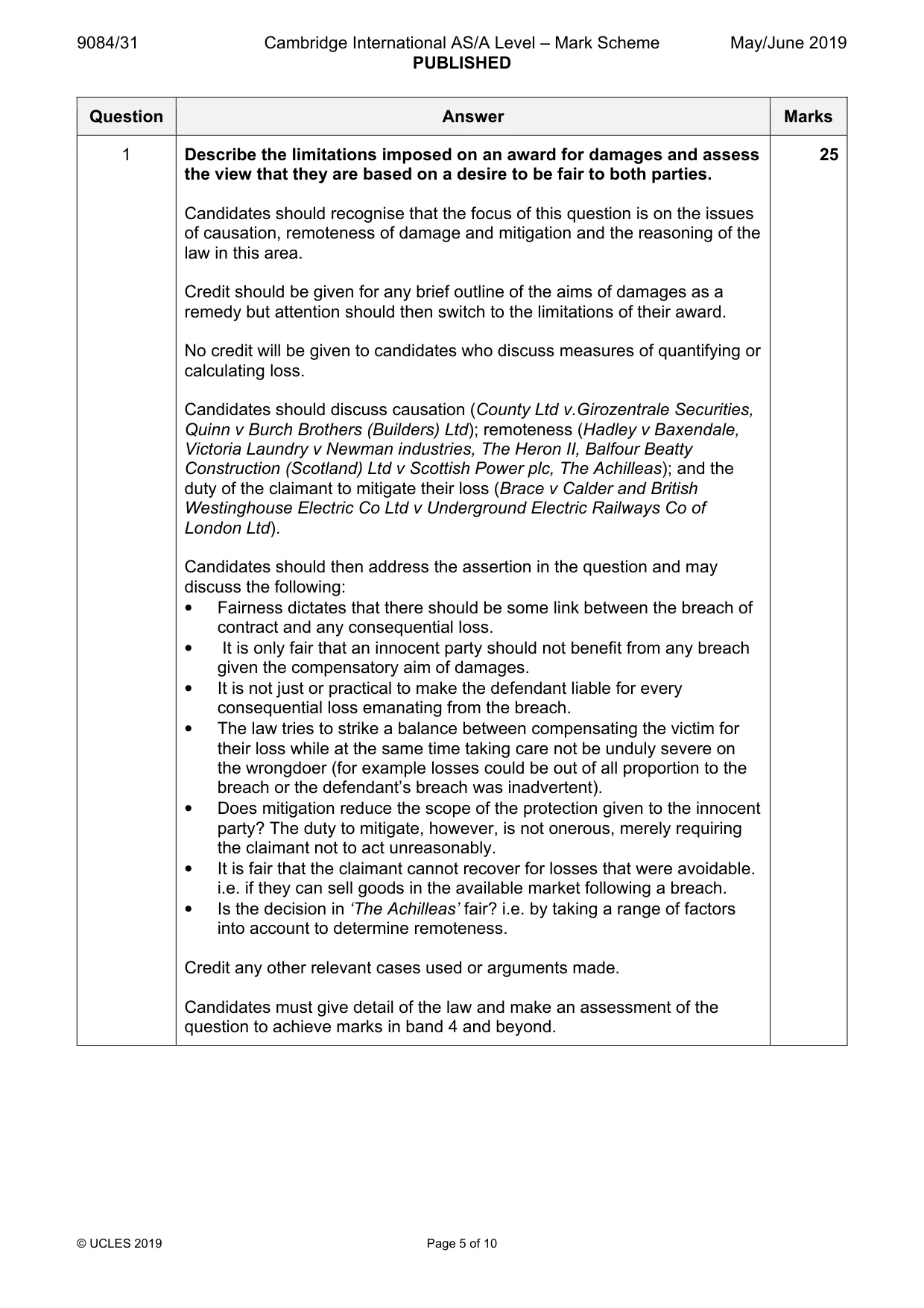
9084/31 Cambridge International AS/A Level – Mark Scheme PUBLISHED May/June 2019 © UCLES 2019 Page 5 of 10 Question Answer Marks 1 Describe the limitations imposed on an award for damages and assess the view that they are based on a desire to be fair to both parties. Candidates should recognise that the focus of this question is on the issues of causation, remoteness of damage and mitigation and the reasoning of the law in this area. Credit should be given for any brief outline of the aims of damages as a remedy but attention should then switch to the limitations of their award. No credit will be given to candidates who discuss measures of quantifying or calculating loss. Candidates should discuss causation (County Ltd v.Girozentrale Securities, Quinn v Burch Brothers (Builders) Ltd); remoteness (Hadley v Baxendale, Victoria Laundry v Newman industries, The Heron II, Balfour Beatty Construction (Scotland) Ltd v Scottish Power plc, The Achilleas); and the duty of the claimant to mitigate their loss (Brace v Calder and British Westinghouse Electric Co Ltd v Underground Electric Railways Co of London Ltd). Candidates should then address the assertion in the question and may discuss the following: • Fairness dictates that there should be some link between the breach of contract and any consequential loss. • It is only fair that an innocent party should not benefit from any breach given the compensatory aim of damages. • It is not just or practical to make the defendant liable for every consequential loss emanating from the breach. • The law tries to strike a balance between compensating the victim for their loss while at the same time taking care not be unduly severe on the wrongdoer (for example losses could be out of all proportion to the breach or the defendant’s breach was inadvertent). • Does mitigation reduce the scope of the protection given to the innocent party? The duty to mitigate, however, is not onerous, merely requiring the claimant not to act unreasonably. • It is fair that the claimant cannot recover for losses that were avoidable. i.e. if they can sell goods in the available market following a breach. • Is the decision in ‘The Achilleas’ fair? i.e. by taking a range of factors into account to determine remoteness. Credit any other relevant cases used or arguments made. Candidates must give detail of the law and make an assessment of the question to achieve marks in band 4 and beyond. 25
Mark scheme, page 6
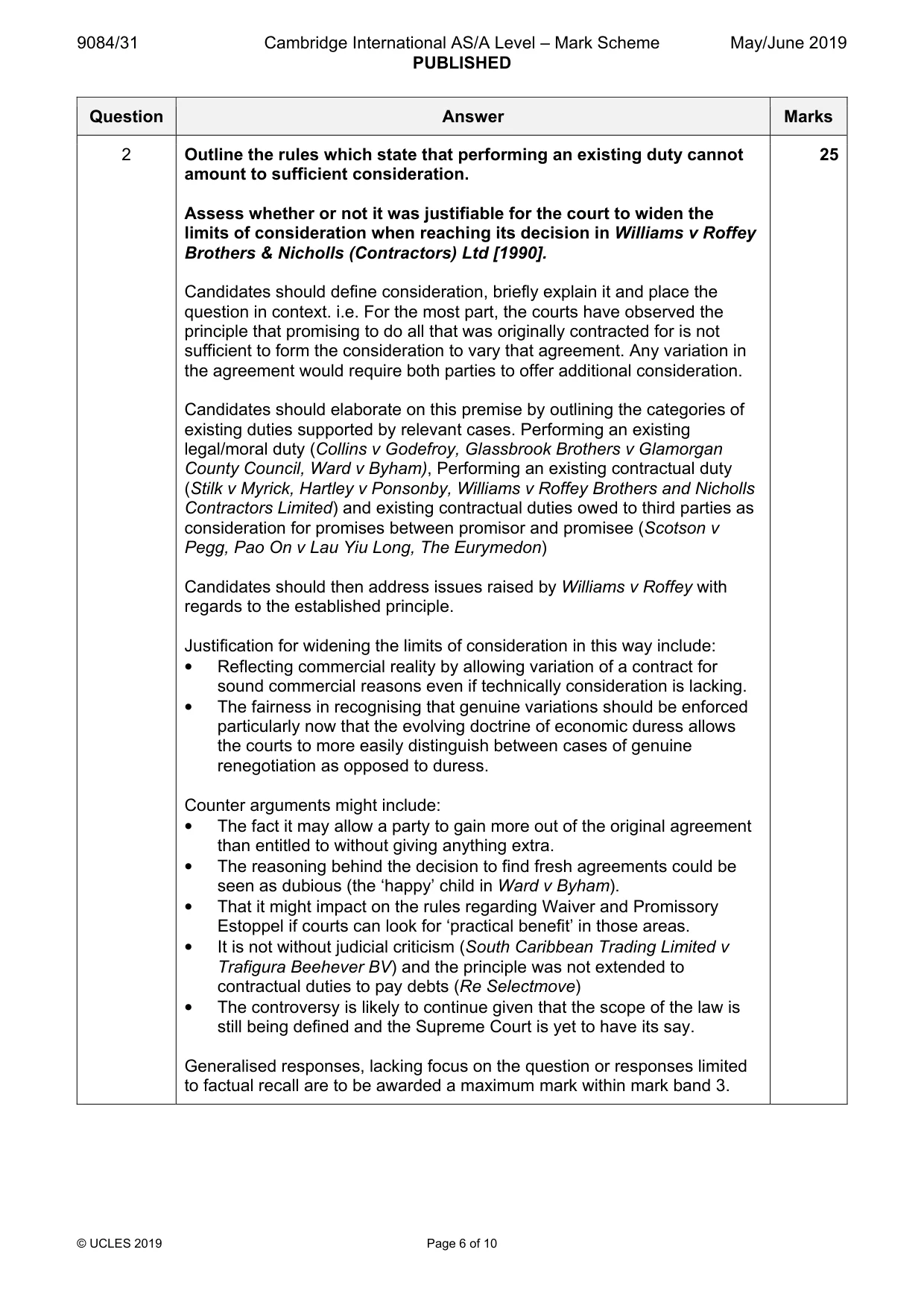
9084/31 Cambridge International AS/A Level – Mark Scheme PUBLISHED May/June 2019 © UCLES 2019 Page 6 of 10 Question Answer Marks 2 Outline the rules which state that performing an existing duty cannot amount to sufficient consideration. Assess whether or not it was justifiable for the court to widen the limits of consideration when reaching its decision in Williams v Roffey Brothers & Nicholls (Contractors) Ltd [1990]. Candidates should define consideration, briefly explain it and place the question in context. i.e. For the most part, the courts have observed the principle that promising to do all that was originally contracted for is not sufficient to form the consideration to vary that agreement. Any variation in the agreement would require both parties to offer additional consideration. Candidates should elaborate on this premise by outlining the categories of existing duties supported by relevant cases. Performing an existing legal/moral duty (Collins v Godefroy, Glassbrook Brothers v Glamorgan County Council, Ward v Byham), Performing an existing contractual duty (Stilk v Myrick, Hartley v Ponsonby, Williams v Roffey Brothers and Nicholls Contractors Limited) and existing contractual duties owed to third parties as consideration for promises between promisor and promisee (Scotson v Pegg, Pao On v Lau Yiu Long, The Eurymedon) Candidates should then address issues raised by Williams v Roffey with regards to the established principle. Justification for widening the limits of consideration in this way include: • Reflecting commercial reality by allowing variation of a contract for sound commercial reasons even if technically consideration is lacking. • The fairness in recognising that genuine variations should be enforced particularly now that the evolving doctrine of economic duress allows the courts to more easily distinguish between cases of genuine renegotiation as opposed to duress. Counter arguments might include: • The fact it may allow a party to gain more out of the original agreement than entitled to without giving anything extra. • The reasoning behind the decision to find fresh agreements could be seen as dubious (the ‘happy’ child in Ward v Byham). • That it might impact on the rules regarding Waiver and Promissory Estoppel if courts can look for ‘practical benefit’ in those areas. • It is not without judicial criticism (South Caribbean Trading Limited v Trafigura Beehever BV) and the principle was not extended to contractual duties to pay debts (Re Selectmove) • The controversy is likely to continue given that the scope of the law is still being defined and the Supreme Court is yet to have its say. Generalised responses, lacking focus on the question or responses limited to factual recall are to be awarded a maximum mark within mark band 3. 25
Mark scheme, page 7
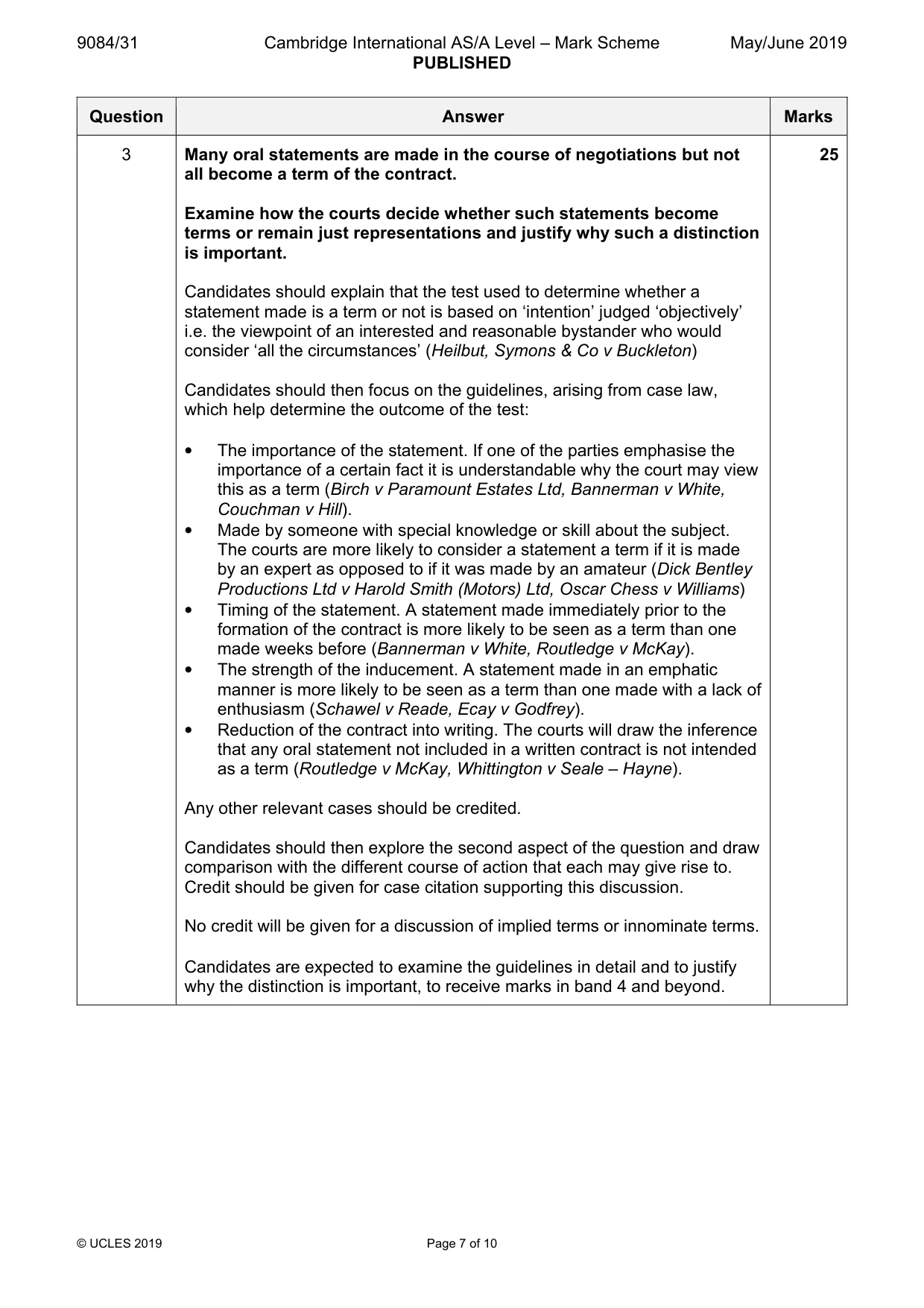
9084/31 Cambridge International AS/A Level – Mark Scheme PUBLISHED May/June 2019 © UCLES 2019 Page 7 of 10 Question Answer Marks 3 Many oral statements are made in the course of negotiations but not all become a term of the contract. Examine how the courts decide whether such statements become terms or remain just representations and justify why such a distinction is important. Candidates should explain that the test used to determine whether a statement made is a term or not is based on ‘intention’ judged ‘objectively’ i.e. the viewpoint of an interested and reasonable bystander who would consider ‘all the circumstances’ (Heilbut, Symons & Co v Buckleton) Candidates should then focus on the guidelines, arising from case law, which help determine the outcome of the test: • The importance of the statement. If one of the parties emphasise the importance of a certain fact it is understandable why the court may view this as a term (Birch v Paramount Estates Ltd, Bannerman v White, Couchman v Hill). • Made by someone with special knowledge or skill about the subject. The courts are more likely to consider a statement a term if it is made by an expert as opposed to if it was made by an amateur (Dick Bentley Productions Ltd v Harold Smith (Motors) Ltd, Oscar Chess v Williams) • Timing of the statement. A statement made immediately prior to the formation of the contract is more likely to be seen as a term than one made weeks before (Bannerman v White, Routledge v McKay). • The strength of the inducement. A statement made in an emphatic manner is more likely to be seen as a term than one made with a lack of enthusiasm (Schawel v Reade, Ecay v Godfrey). • Reduction of the contract into writing. The courts will draw the inference that any oral statement not included in a written contract is not intended as a term (Routledge v McKay, Whittington v Seale – Hayne). Any other relevant cases should be credited. Candidates should then explore the second aspect of the question and draw comparison with the different course of action that each may give rise to. Credit should be given for case citation supporting this discussion. No credit will be given for a discussion of implied terms or innominate terms. Candidates are expected to examine the guidelines in detail and to justify why the distinction is important, to receive marks in band 4 and beyond. 25
Mark scheme, page 8
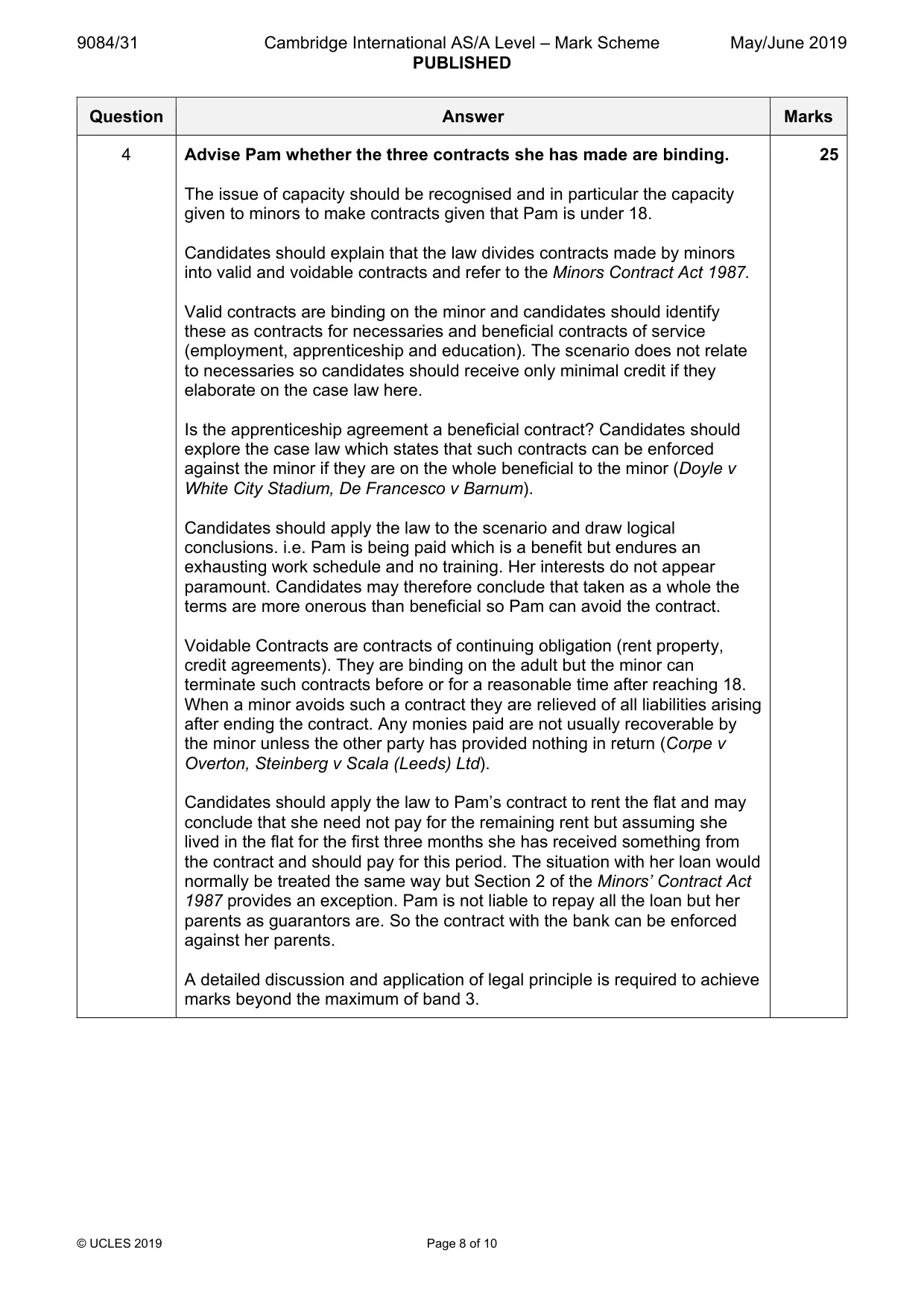
9084/31 Cambridge International AS/A Level – Mark Scheme PUBLISHED May/June 2019 © UCLES 2019 Page 8 of 10 Question Answer Marks 4 Advise Pam whether the three contracts she has made are binding. The issue of capacity should be recognised and in particular the capacity given to minors to make contracts given that Pam is under 18. Candidates should explain that the law divides contracts made by minors into valid and voidable contracts and refer to the Minors Contract Act 1987. Valid contracts are binding on the minor and candidates should identify these as contracts for necessaries and beneficial contracts of service (employment, apprenticeship and education). The scenario does not relate to necessaries so candidates should receive only minimal credit if they elaborate on the case law here. Is the apprenticeship agreement a beneficial contract? Candidates should explore the case law which states that such contracts can be enforced against the minor if they are on the whole beneficial to the minor (Doyle v White City Stadium, De Francesco v Barnum). Candidates should apply the law to the scenario and draw logical conclusions. i.e. Pam is being paid which is a benefit but endures an exhausting work schedule and no training. Her interests do not appear paramount. Candidates may therefore conclude that taken as a whole the terms are more onerous than beneficial so Pam can avoid the contract. Voidable Contracts are contracts of continuing obligation (rent property, credit agreements). They are binding on the adult but the minor can terminate such contracts before or for a reasonable time after reaching 18. When a minor avoids such a contract they are relieved of all liabilities arising after ending the contract. Any monies paid are not usually recoverable by the minor unless the other party has provided nothing in return (Corpe v Overton, Steinberg v Scala (Leeds) Ltd). Candidates should apply the law to Pam’s contract to rent the flat and may conclude that she need not pay for the remaining rent but assuming she lived in the flat for the first three months she has received something from the contract and should pay for this period. The situation with her loan would normally be treated the same way but Section 2 of the Minors’ Contract Act 1987 provides an exception. Pam is not liable to repay all the loan but her parents as guarantors are. So the contract with the bank can be enforced against her parents. A detailed discussion and application of legal principle is required to achieve marks beyond the maximum of band 3. 25
Mark scheme, page 9
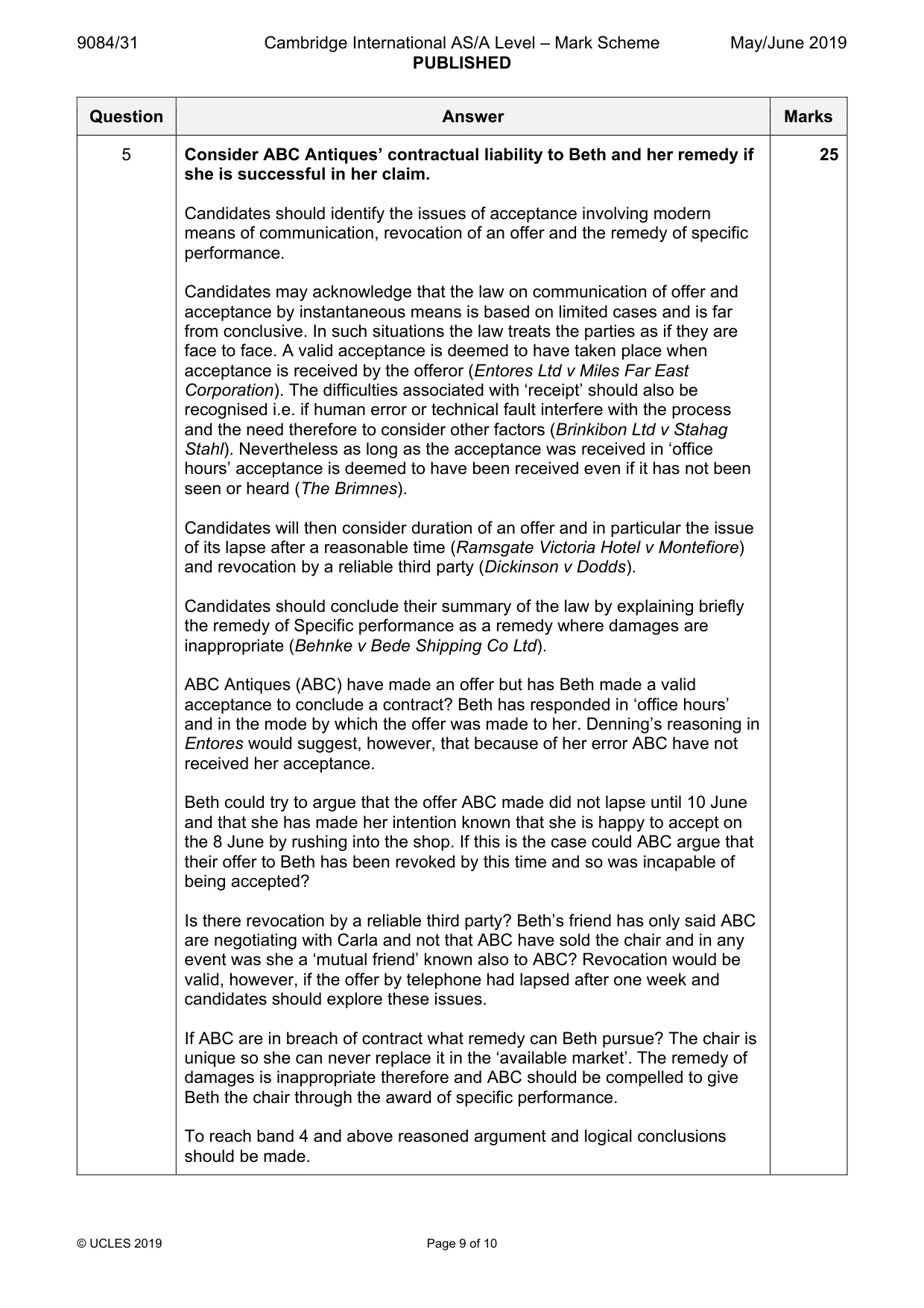
9084/31 Cambridge International AS/A Level – Mark Scheme PUBLISHED May/June 2019 © UCLES 2019 Page 9 of 10 Question Answer Marks 5 Consider ABC Antiques’ contractual liability to Beth and her remedy if she is successful in her claim. Candidates should identify the issues of acceptance involving modern means of communication, revocation of an offer and the remedy of specific performance. Candidates may acknowledge that the law on communication of offer and acceptance by instantaneous means is based on limited cases and is far from conclusive. In such situations the law treats the parties as if they are face to face. A valid acceptance is deemed to have taken place when acceptance is received by the offeror (Entores Ltd v Miles Far East Corporation). The difficulties associated with ‘receipt’ should also be recognised i.e. if human error or technical fault interfere with the process and the need therefore to consider other factors (Brinkibon Ltd v Stahag Stahl). Nevertheless as long as the acceptance was received in ‘office hours’ acceptance is deemed to have been received even if it has not been seen or heard (The Brimnes). Candidates will then consider duration of an offer and in particular the issue of its lapse after a reasonable time (Ramsgate Victoria Hotel v Montefiore) and revocation by a reliable third party (Dickinson v Dodds). Candidates should conclude their summary of the law by explaining briefly the remedy of Specific performance as a remedy where damages are inappropriate (Behnke v Bede Shipping Co Ltd). ABC Antiques (ABC) have made an offer but has Beth made a valid acceptance to conclude a contract? Beth has responded in ‘office hours’ and in the mode by which the offer was made to her. Denning’s reasoning in Entores would suggest, however, that because of her error ABC have not received her acceptance. Beth could try to argue that the offer ABC made did not lapse until 10 June and that she has made her intention known that she is happy to accept on the 8 June by rushing into the shop. If this is the case could ABC argue that their offer to Beth has been revoked by this time and so was incapable of being accepted? Is there revocation by a reliable third party? Beth’s friend has only said ABC are negotiating with Carla and not that ABC have sold the chair and in any event was she a ‘mutual friend’ known also to ABC? Revocation would be valid, however, if the offer by telephone had lapsed after one week and candidates should explore these issues. If ABC are in breach of contract what remedy can Beth pursue? The chair is unique so she can never replace it in the ‘available market’. The remedy of damages is inappropriate therefore and ABC should be compelled to give Beth the chair through the award of specific performance. To reach band 4 and above reasoned argument and logical conclusions should be made. 25
Mark scheme, page 10
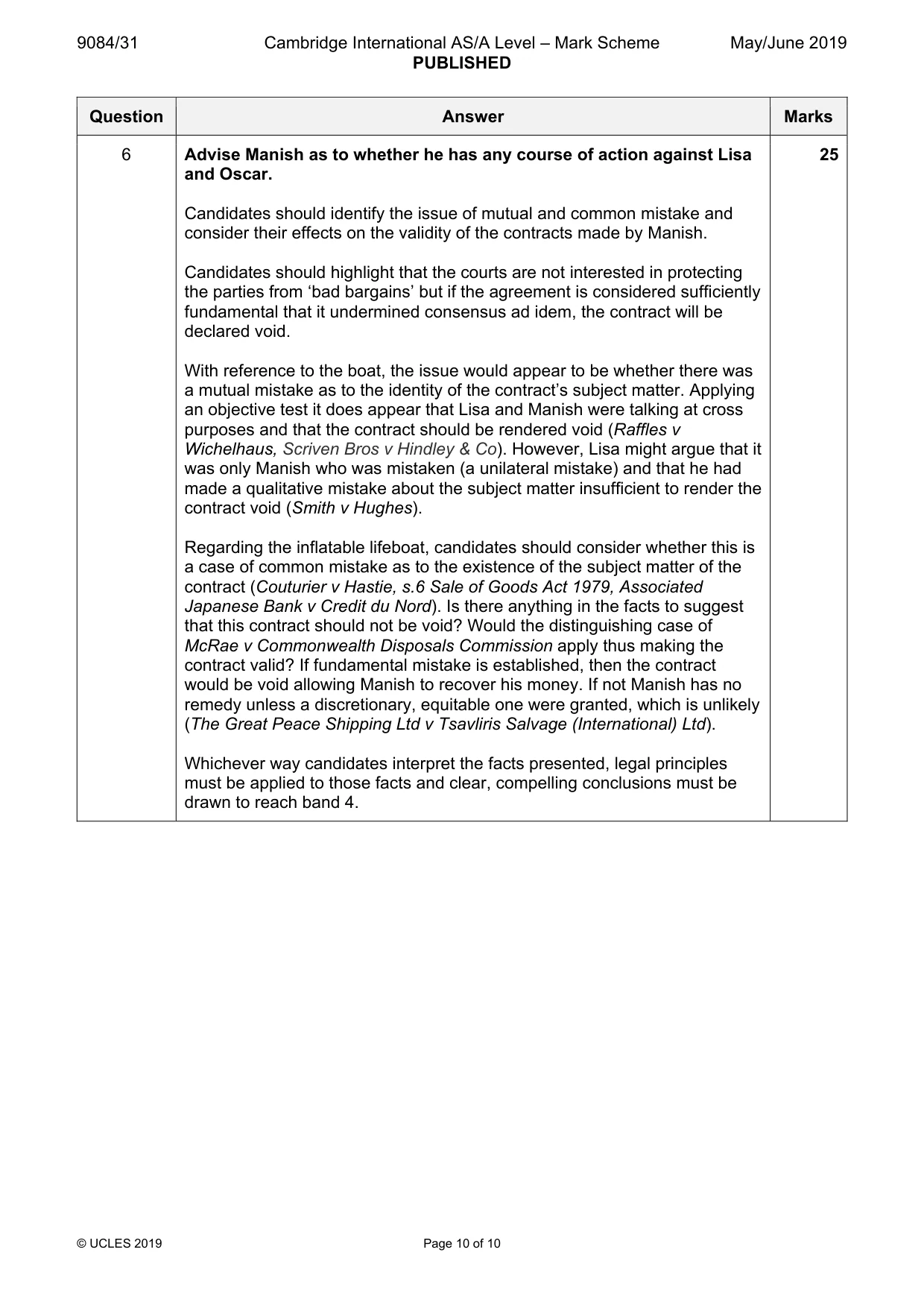
9084/31 Cambridge International AS/A Level – Mark Scheme PUBLISHED May/June 2019 © UCLES 2019 Page 10 of 10 Question Answer Marks 6 Advise Manish as to whether he has any course of action against Lisa and Oscar. Candidates should identify the issue of mutual and common mistake and consider their effects on the validity of the contracts made by Manish. Candidates should highlight that the courts are not interested in protecting the parties from ‘bad bargains’ but if the agreement is considered sufficiently fundamental that it undermined consensus ad idem, the contract will be declared void. With reference to the boat, the issue would appear to be whether there was a mutual mistake as to the identity of the contract’s subject matter. Applying an objective test it does appear that Lisa and Manish were talking at cross purposes and that the contract should be rendered void (Raffles v Wichelhaus, Scriven Bros v Hindley & Co). However, Lisa might argue that it was only Manish who was mistaken (a unilateral mistake) and that he had made a qualitative mistake about the subject matter insufficient to render the contract void (Smith v Hughes). Regarding the inflatable lifeboat, candidates should consider whether this is a case of common mistake as to the existence of the subject matter of the contract (Couturier v Hastie, s.6 Sale of Goods Act 1979, Associated Japanese Bank v Credit du Nord). Is there anything in the facts to suggest that this contract should not be void? Would the distinguishing case of McRae v Commonwealth Disposals Commission apply thus making the contract valid? If fundamental mistake is established, then the contract would be void allowing Manish to recover his money. If not Manish has no remedy unless a discretionary, equitable one were granted, which is unlikely (The Great Peace Shipping Ltd v Tsavliris Salvage (International) Ltd). Whichever way candidates interpret the facts presented, legal principles must be applied to those facts and clear, compelling conclusions must be drawn to reach band 4. 25
What you needed in this session
Cambridge’s own grade thresholds for 2019 May/June, Paper 3 · Variant 1. A higher threshold means an easier paper — the bar moves with how the cohort did.