Cambridge A Level Law 9084 — 2018 May/June Paper 3 · Variant 3
9084/33/M/J/18 · 75 marks · ≈84 min
The question paper and its mark scheme, free to read here and free to download. This is Cambridge’s own paper, exactly as it was sat.
Question paper4 pages

Mark scheme10 pages
Answers below. Sit the paper first if you are practising.
Paper as text
Question paper, page 1
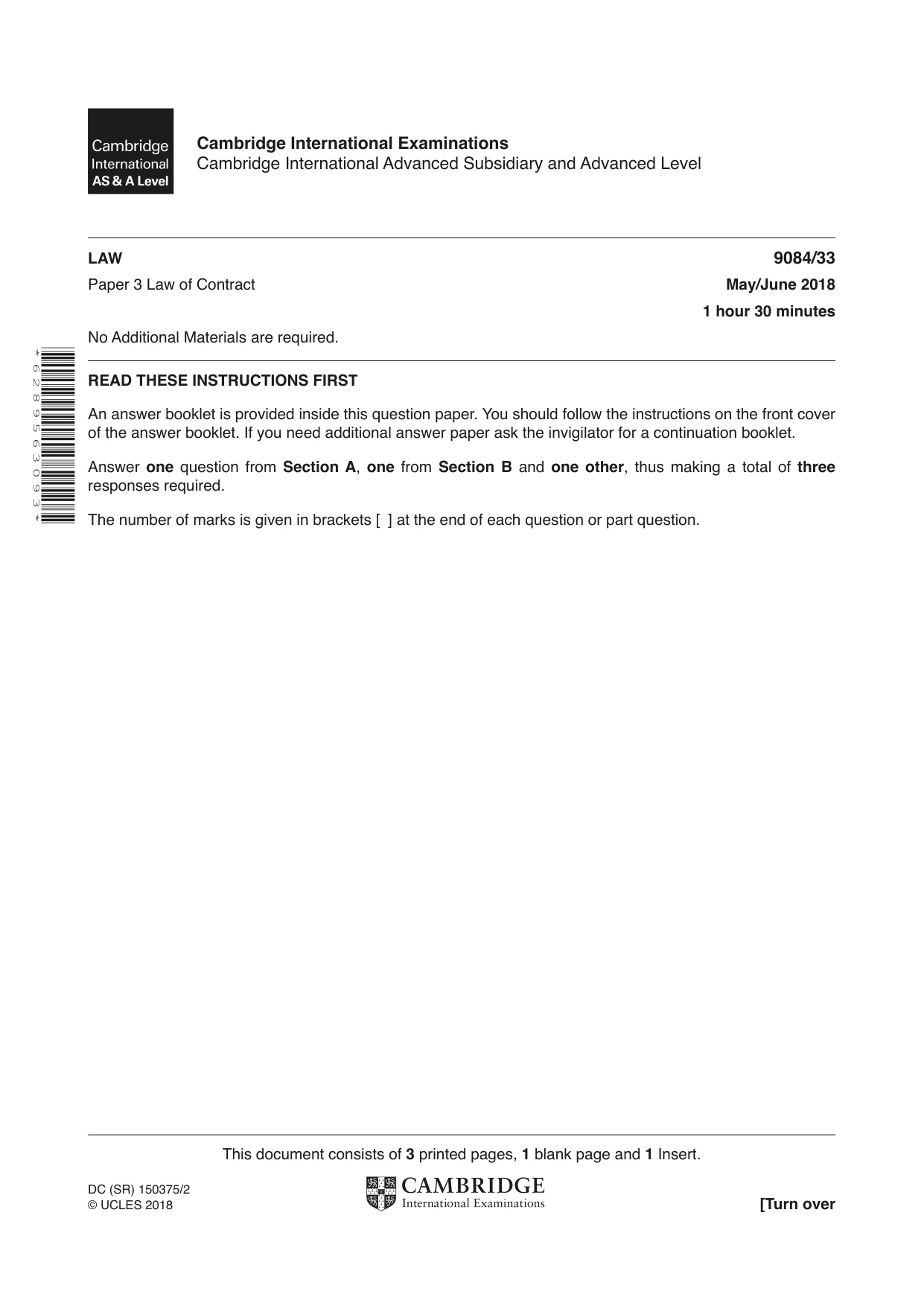
* 6 2 8 9 5 6 3 0 9 3 * This document consists of 3 printed pages, 1 blank page and 1 Insert. DC (SR) 150375/2 © UCLES 2018 [Turn over LAW 9084/33 Paper 3 Law of Contract May/June 2018 1 hour 30 minutes No Additional Materials are required. READ THESE INSTRUCTIONS FIRST An answer booklet is provided inside this question paper. You should follow the instructions on the front cover of the answer booklet. If you need additional answer paper ask the invigilator for a continuation booklet. Answer one question from Section A, one from Section B and one other, thus making a total of three responses required. The number of marks is given in brackets [ ] at the end of each question or part question. Cambridge International Examinations Cambridge International Advanced Subsidiary and Advanced Level
Question paper, page 2
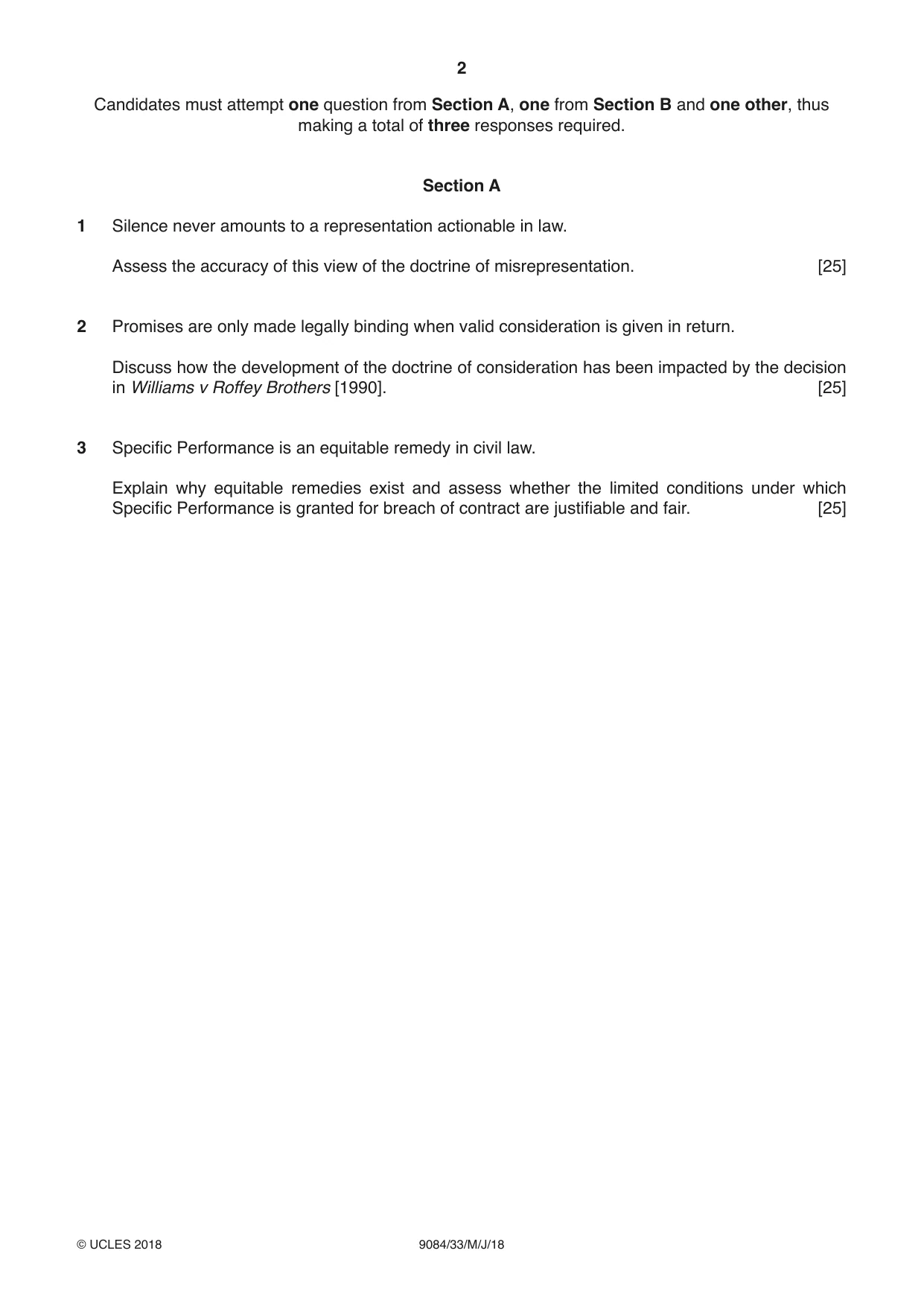
2 9084/33/M/J/18 © UCLES 2018 Candidates must attempt one question from Section A, one from Section B and one other, thus making a total of three responses required. Section A 1 Silence never amounts to a representation actionable in law. Assess the accuracy of this view of the doctrine of misrepresentation. [25] 2 Promises are only made legally binding when valid consideration is given in return. Discuss how the development of the doctrine of consideration has been impacted by the decision in Williams v Roffey Brothers [1990]. [25] 3 Specific Performance is an equitable remedy in civil law. Explain why equitable remedies exist and assess whether the limited conditions under which Specific Performance is granted for breach of contract are justifiable and fair. [25]
Question paper, page 3
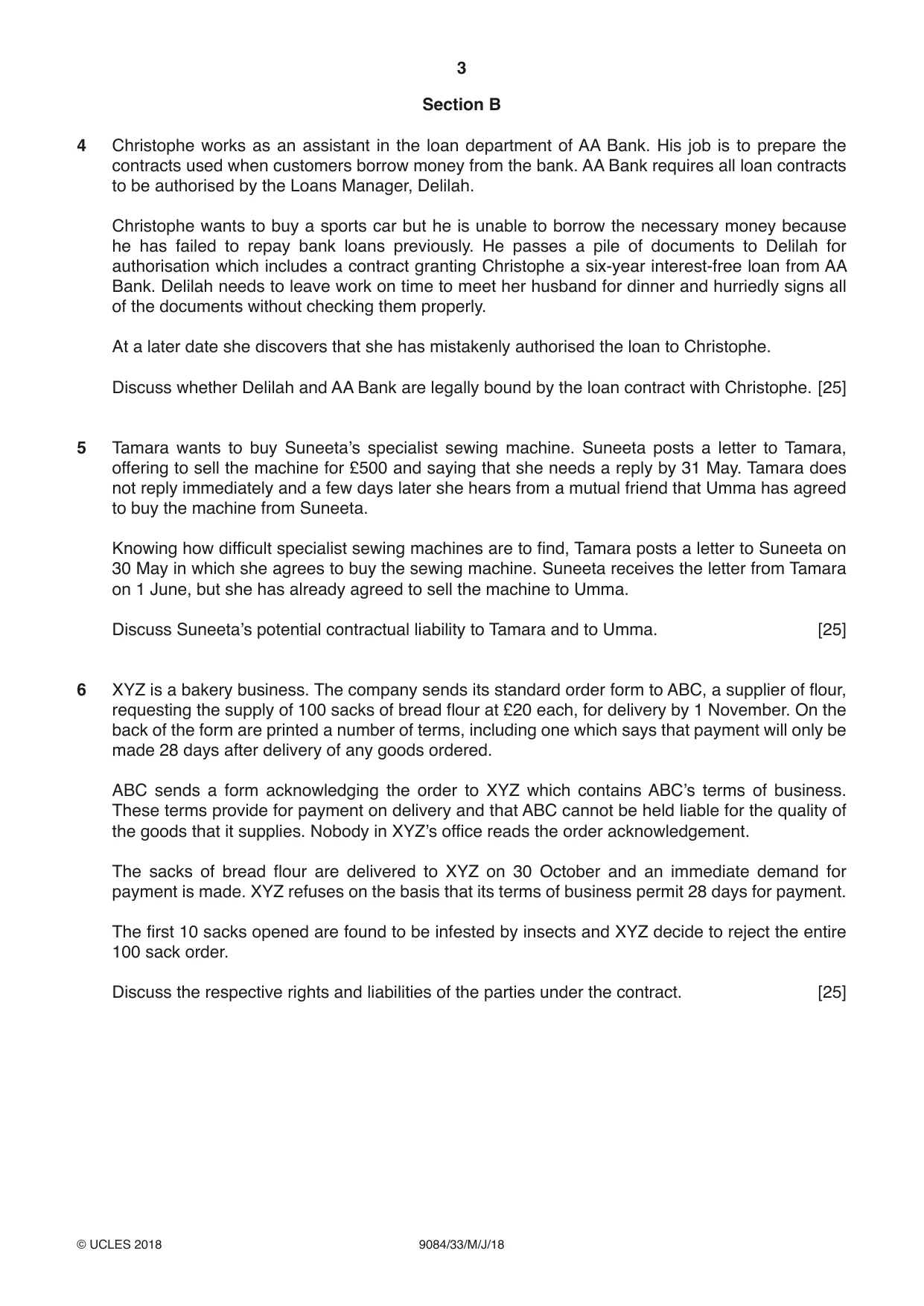
3 9084/33/M/J/18 © UCLES 2018 Section B 4 Christophe works as an assistant in the loan department of AA Bank. His job is to prepare the contracts used when customers borrow money from the bank. AA Bank requires all loan contracts to be authorised by the Loans Manager, Delilah. Christophe wants to buy a sports car but he is unable to borrow the necessary money because he has failed to repay bank loans previously. He passes a pile of documents to Delilah for authorisation which includes a contract granting Christophe a six-year interest-free loan from AA Bank. Delilah needs to leave work on time to meet her husband for dinner and hurriedly signs all of the documents without checking them properly. At a later date she discovers that she has mistakenly authorised the loan to Christophe. Discuss whether Delilah and AA Bank are legally bound by the loan contract with Christophe. [25] 5 Tamara wants to buy Suneeta’s specialist sewing machine. Suneeta posts a letter to Tamara, offering to sell the machine for £500 and saying that she needs a reply by 31 May. Tamara does not reply immediately and a few days later she hears from a mutual friend that Umma has agreed to buy the machine from Suneeta. Knowing how difficult specialist sewing machines are to find, Tamara posts a letter to Suneeta on 30 May in which she agrees to buy the sewing machine. Suneeta receives the letter from Tamara on 1 June, but she has already agreed to sell the machine to Umma. Discuss Suneeta’s potential contractual liability to Tamara and to Umma. [25] 6 XYZ is a bakery business. The company sends its standard order form to ABC, a supplier of flour, requesting the supply of 100 sacks of bread flour at £20 each, for delivery by 1 November. On the back of the form are printed a number of terms, including one which says that payment will only be made 28 days after delivery of any goods ordered. ABC sends a form acknowledging the order to XYZ which contains ABC’s terms of business. These terms provide for payment on delivery and that ABC cannot be held liable for the quality of the goods that it supplies. Nobody in XYZ’s office reads the order acknowledgement. The sacks of bread flour are delivered to XYZ on 30 October and an immediate demand for payment is made. XYZ refuses on the basis that its terms of business permit 28 days for payment. The first 10 sacks opened are found to be infested by insects and XYZ decide to reject the entire 100 sack order. Discuss the respective rights and liabilities of the parties under the contract. [25]
Question paper, page 4
4 9084/33/M/J/18 © UCLES 2018 BLANK PAGE Permission to reproduce items where third-party owned material protected by copyright is included has been sought and cleared where possible. Every reasonable effort has been made by the publisher (UCLES) to trace copyright holders, but if any items requiring clearance have unwittingly been included, the publisher will be pleased to make amends at the earliest possible opportunity. To avoid the issue of disclosure of answer-related information to candidates, all copyright acknowledgements are reproduced online in the Cambridge International Examinations Copyright Acknowledgements Booklet. This is produced for each series of examinations and is freely available to download at www.cie.org.uk after the live examination series. Cambridge International Examinations is part of the Cambridge Assessment Group. Cambridge Assessment is the brand name of University of Cambridge Local Examinations Syndicate (UCLES), which is itself a department of the University of Cambridge.
Mark scheme, page 1
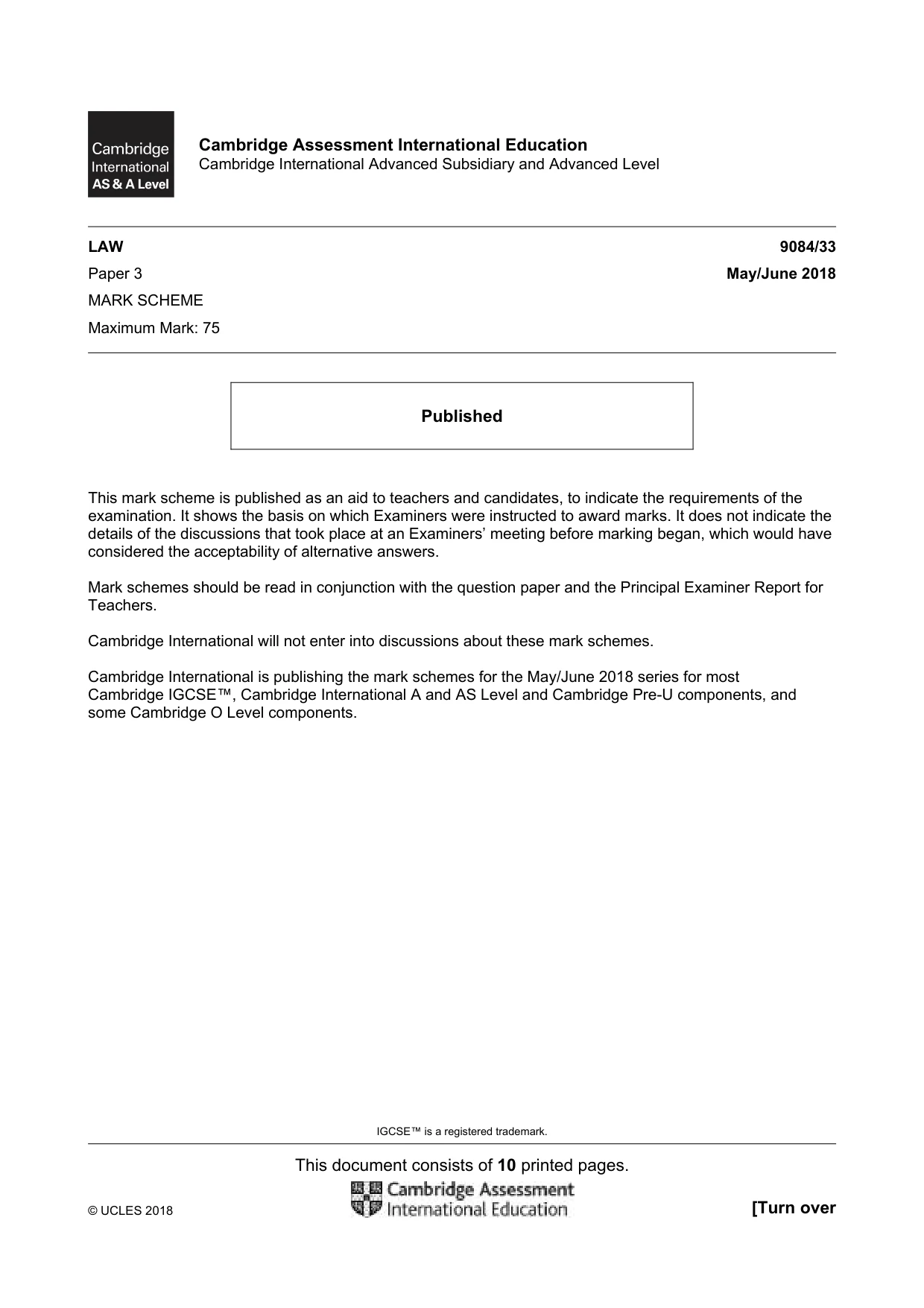
IGCSE™ is a registered trademark. This document consists of 10 printed pages. © UCLES 2018 [Turn over Cambridge Assessment International Education Cambridge International Advanced Subsidiary and Advanced Level LAW 9084/33 Paper 3 May/June 2018 MARK SCHEME Maximum Mark: 75 Published This mark scheme is published as an aid to teachers and candidates, to indicate the requirements of the examination. It shows the basis on which Examiners were instructed to award marks. It does not indicate the details of the discussions that took place at an Examiners’ meeting before marking began, which would have considered the acceptability of alternative answers. Mark schemes should be read in conjunction with the question paper and the Principal Examiner Report for Teachers. Cambridge International will not enter into discussions about these mark schemes. Cambridge International is publishing the mark schemes for the May/June 2018 series for most Cambridge IGCSE™, Cambridge International A and AS Level and Cambridge Pre-U components, and some Cambridge O Level components.
Mark scheme, page 2
9084/33 Cambridge International AS/A Level – Mark Scheme PUBLISHED May/June 2018 © UCLES 2018 Page 2 of 10 Generic Marking Principles These general marking principles must be applied by all examiners when marking candidate answers. They should be applied alongside the specific content of the mark scheme or generic level descriptors for a question. Each question paper and mark scheme will also comply with these marking principles. GENERIC MARKING PRINCIPLE 1: Marks must be awarded in line with: • the specific content of the mark scheme or the generic level descriptors for the question • the specific skills defined in the mark scheme or in the generic level descriptors for the question • the standard of response required by a candidate as exemplified by the standardisation scripts. GENERIC MARKING PRINCIPLE 2: Marks awarded are always whole marks (not half marks, or other fractions). GENERIC MARKING PRINCIPLE 3: Marks must be awarded positively: • marks are awarded for correct/valid answers, as defined in the mark scheme. However, credit is given for valid answers which go beyond the scope of the syllabus and mark scheme, referring to your Team Leader as appropriate • marks are awarded when candidates clearly demonstrate what they know and can do • marks are not deducted for errors • marks are not deducted for omissions • answers should only be judged on the quality of spelling, punctuation and grammar when these features are specifically assessed by the question as indicated by the mark scheme. The meaning, however, should be unambiguous. GENERIC MARKING PRINCIPLE 4: Rules must be applied consistently e.g. in situations where candidates have not followed instructions or in the application of generic level descriptors. GENERIC MARKING PRINCIPLE 5: Marks should be awarded using the full range of marks defined in the mark scheme for the question (however; the use of the full mark range may be limited according to the quality of the candidate responses seen). GENERIC MARKING PRINCIPLE 6: Marks awarded are based solely on the requirements as defined in the mark scheme. Marks should not be awarded with grade thresholds or grade descriptors in mind.
Mark scheme, page 3
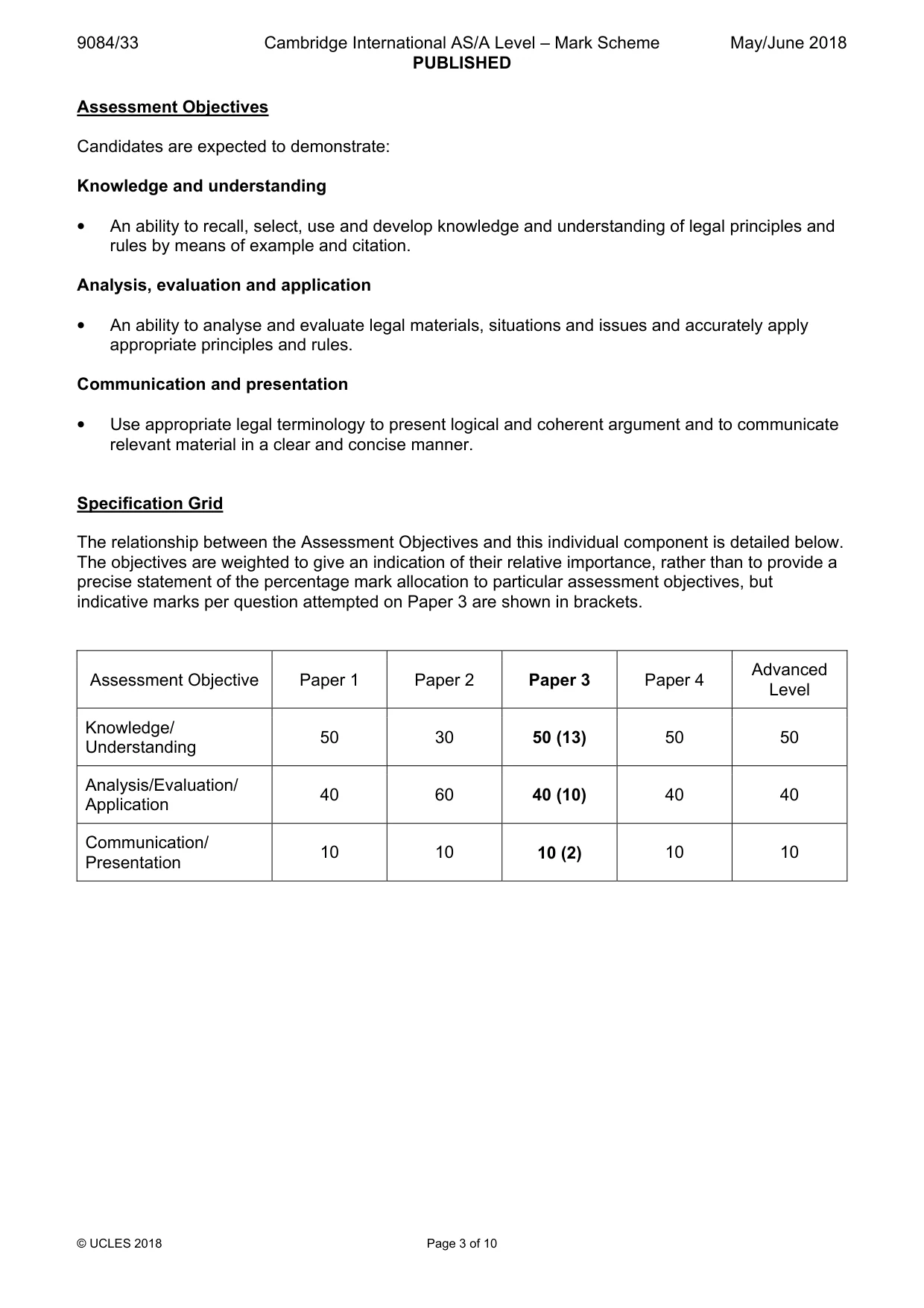
9084/33 Cambridge International AS/A Level – Mark Scheme PUBLISHED May/June 2018 © UCLES 2018 Page 3 of 10 Assessment Objectives Candidates are expected to demonstrate: Knowledge and understanding • An ability to recall, select, use and develop knowledge and understanding of legal principles and rules by means of example and citation. Analysis, evaluation and application • An ability to analyse and evaluate legal materials, situations and issues and accurately apply appropriate principles and rules. Communication and presentation • Use appropriate legal terminology to present logical and coherent argument and to communicate relevant material in a clear and concise manner. Specification Grid The relationship between the Assessment Objectives and this individual component is detailed below. The objectives are weighted to give an indication of their relative importance, rather than to provide a precise statement of the percentage mark allocation to particular assessment objectives, but indicative marks per question attempted on Paper 3 are shown in brackets. Assessment Objective Paper 1 Paper 2 Paper 3 Paper 4 Advanced Level Knowledge/ Understanding 50 30 50 (13) 50 50 Analysis/Evaluation/ Application 40 60 40 (10) 40 40 Communication/ Presentation 10 10 10 (2) 10 10
Mark scheme, page 4
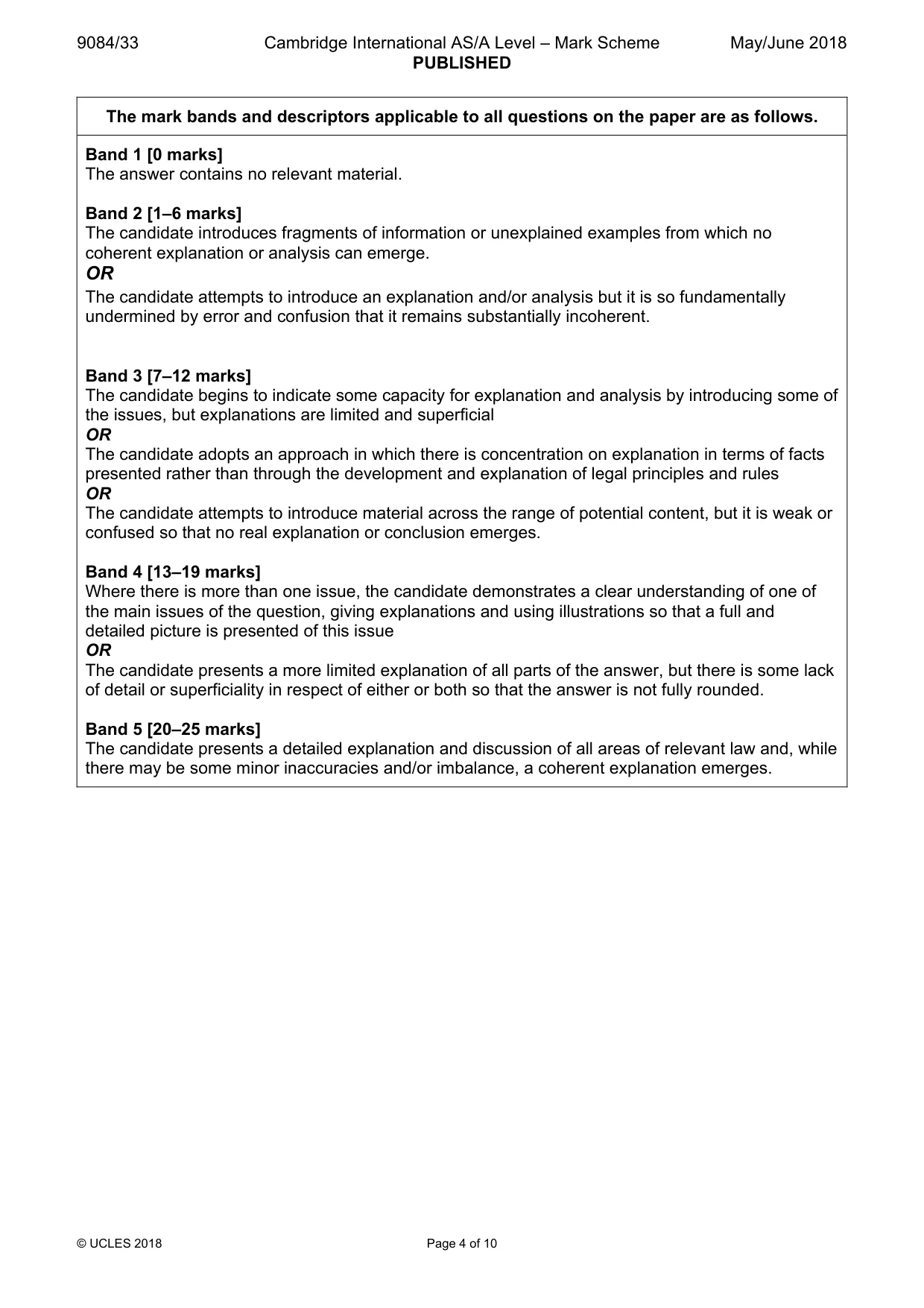
9084/33 Cambridge International AS/A Level – Mark Scheme PUBLISHED May/June 2018 © UCLES 2018 Page 4 of 10 The mark bands and descriptors applicable to all questions on the paper are as follows. Band 1 [0 marks] The answer contains no relevant material. Band 2 [1–6 marks] The candidate introduces fragments of information or unexplained examples from which no coherent explanation or analysis can emerge. OR The candidate attempts to introduce an explanation and/or analysis but it is so fundamentally undermined by error and confusion that it remains substantially incoherent. Band 3 [7–12 marks] The candidate begins to indicate some capacity for explanation and analysis by introducing some of the issues, but explanations are limited and superficial OR The candidate adopts an approach in which there is concentration on explanation in terms of facts presented rather than through the development and explanation of legal principles and rules OR The candidate attempts to introduce material across the range of potential content, but it is weak or confused so that no real explanation or conclusion emerges. Band 4 [13–19 marks] Where there is more than one issue, the candidate demonstrates a clear understanding of one of the main issues of the question, giving explanations and using illustrations so that a full and detailed picture is presented of this issue OR The candidate presents a more limited explanation of all parts of the answer, but there is some lack of detail or superficiality in respect of either or both so that the answer is not fully rounded. Band 5 [20–25 marks] The candidate presents a detailed explanation and discussion of all areas of relevant law and, while there may be some minor inaccuracies and/or imbalance, a coherent explanation emerges.
Mark scheme, page 5
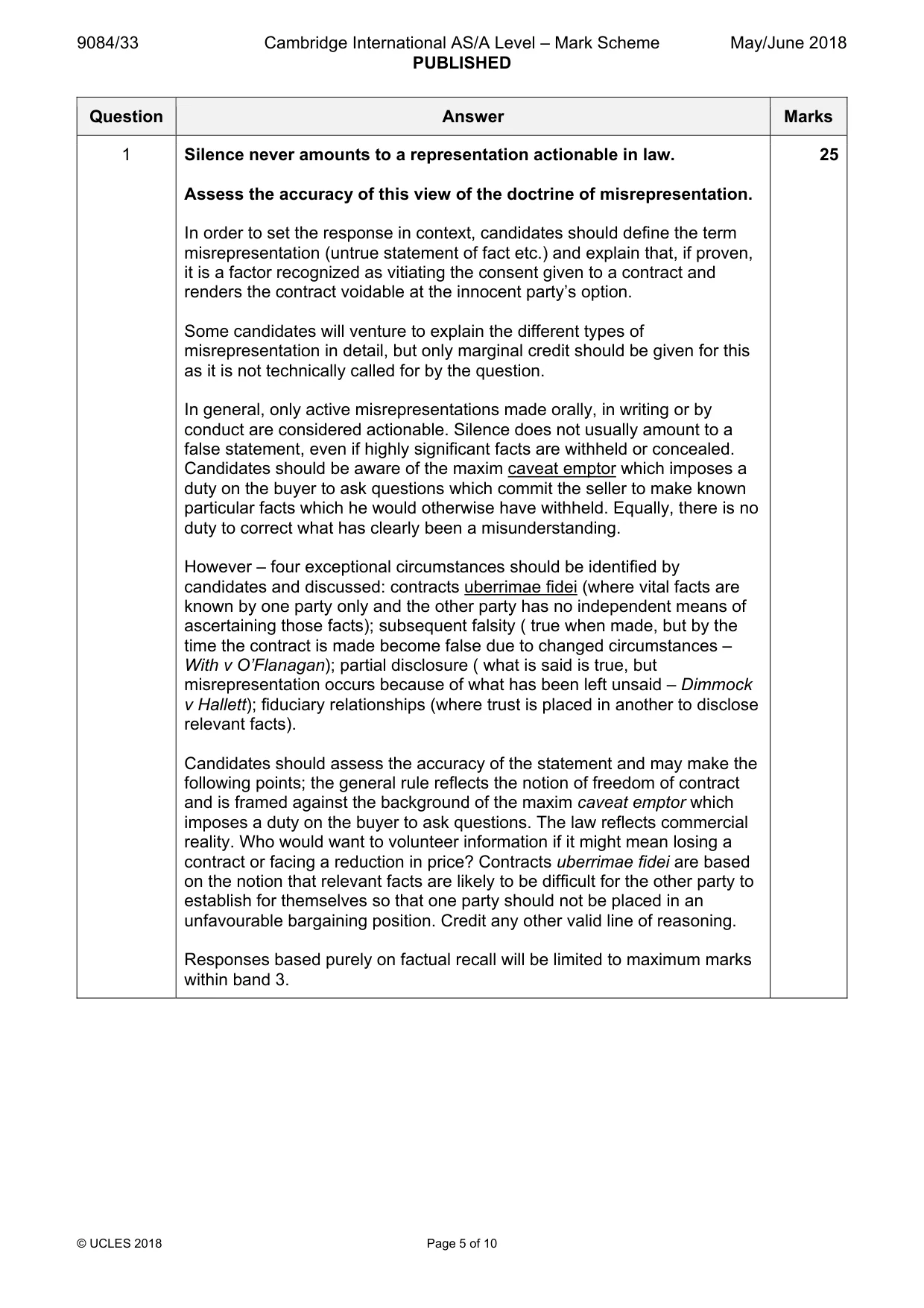
9084/33 Cambridge International AS/A Level – Mark Scheme PUBLISHED May/June 2018 © UCLES 2018 Page 5 of 10 Question Answer Marks 1 Silence never amounts to a representation actionable in law. Assess the accuracy of this view of the doctrine of misrepresentation. In order to set the response in context, candidates should define the term misrepresentation (untrue statement of fact etc.) and explain that, if proven, it is a factor recognized as vitiating the consent given to a contract and renders the contract voidable at the innocent party’s option. Some candidates will venture to explain the different types of misrepresentation in detail, but only marginal credit should be given for this as it is not technically called for by the question. In general, only active misrepresentations made orally, in writing or by conduct are considered actionable. Silence does not usually amount to a false statement, even if highly significant facts are withheld or concealed. Candidates should be aware of the maxim caveat emptor which imposes a duty on the buyer to ask questions which commit the seller to make known particular facts which he would otherwise have withheld. Equally, there is no duty to correct what has clearly been a misunderstanding. However – four exceptional circumstances should be identified by candidates and discussed: contracts uberrimae fidei (where vital facts are known by one party only and the other party has no independent means of ascertaining those facts); subsequent falsity ( true when made, but by the time the contract is made become false due to changed circumstances – With v O’Flanagan); partial disclosure ( what is said is true, but misrepresentation occurs because of what has been left unsaid – Dimmock v Hallett); fiduciary relationships (where trust is placed in another to disclose relevant facts). Candidates should assess the accuracy of the statement and may make the following points; the general rule reflects the notion of freedom of contract and is framed against the background of the maxim caveat emptor which imposes a duty on the buyer to ask questions. The law reflects commercial reality. Who would want to volunteer information if it might mean losing a contract or facing a reduction in price? Contracts uberrimae fidei are based on the notion that relevant facts are likely to be difficult for the other party to establish for themselves so that one party should not be placed in an unfavourable bargaining position. Credit any other valid line of reasoning. Responses based purely on factual recall will be limited to maximum marks within band 3. 25
Mark scheme, page 6
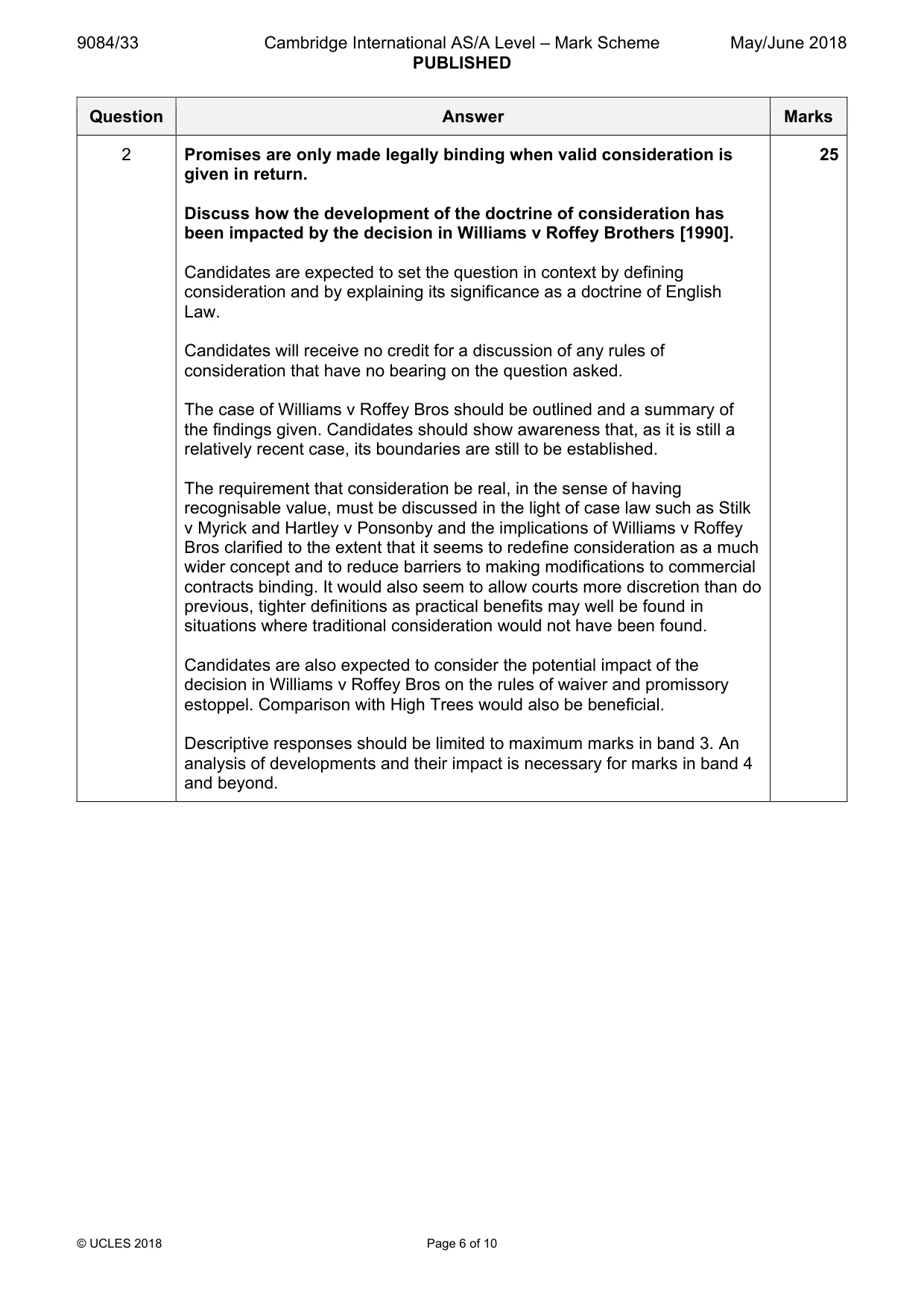
9084/33 Cambridge International AS/A Level – Mark Scheme PUBLISHED May/June 2018 © UCLES 2018 Page 6 of 10 Question Answer Marks 2 Promises are only made legally binding when valid consideration is given in return. Discuss how the development of the doctrine of consideration has been impacted by the decision in Williams v Roffey Brothers [1990]. Candidates are expected to set the question in context by defining consideration and by explaining its significance as a doctrine of English Law. Candidates will receive no credit for a discussion of any rules of consideration that have no bearing on the question asked. The case of Williams v Roffey Bros should be outlined and a summary of the findings given. Candidates should show awareness that, as it is still a relatively recent case, its boundaries are still to be established. The requirement that consideration be real, in the sense of having recognisable value, must be discussed in the light of case law such as Stilk v Myrick and Hartley v Ponsonby and the implications of Williams v Roffey Bros clarified to the extent that it seems to redefine consideration as a much wider concept and to reduce barriers to making modifications to commercial contracts binding. It would also seem to allow courts more discretion than do previous, tighter definitions as practical benefits may well be found in situations where traditional consideration would not have been found. Candidates are also expected to consider the potential impact of the decision in Williams v Roffey Bros on the rules of waiver and promissory estoppel. Comparison with High Trees would also be beneficial. Descriptive responses should be limited to maximum marks in band 3. An analysis of developments and their impact is necessary for marks in band 4 and beyond. 25
Mark scheme, page 7
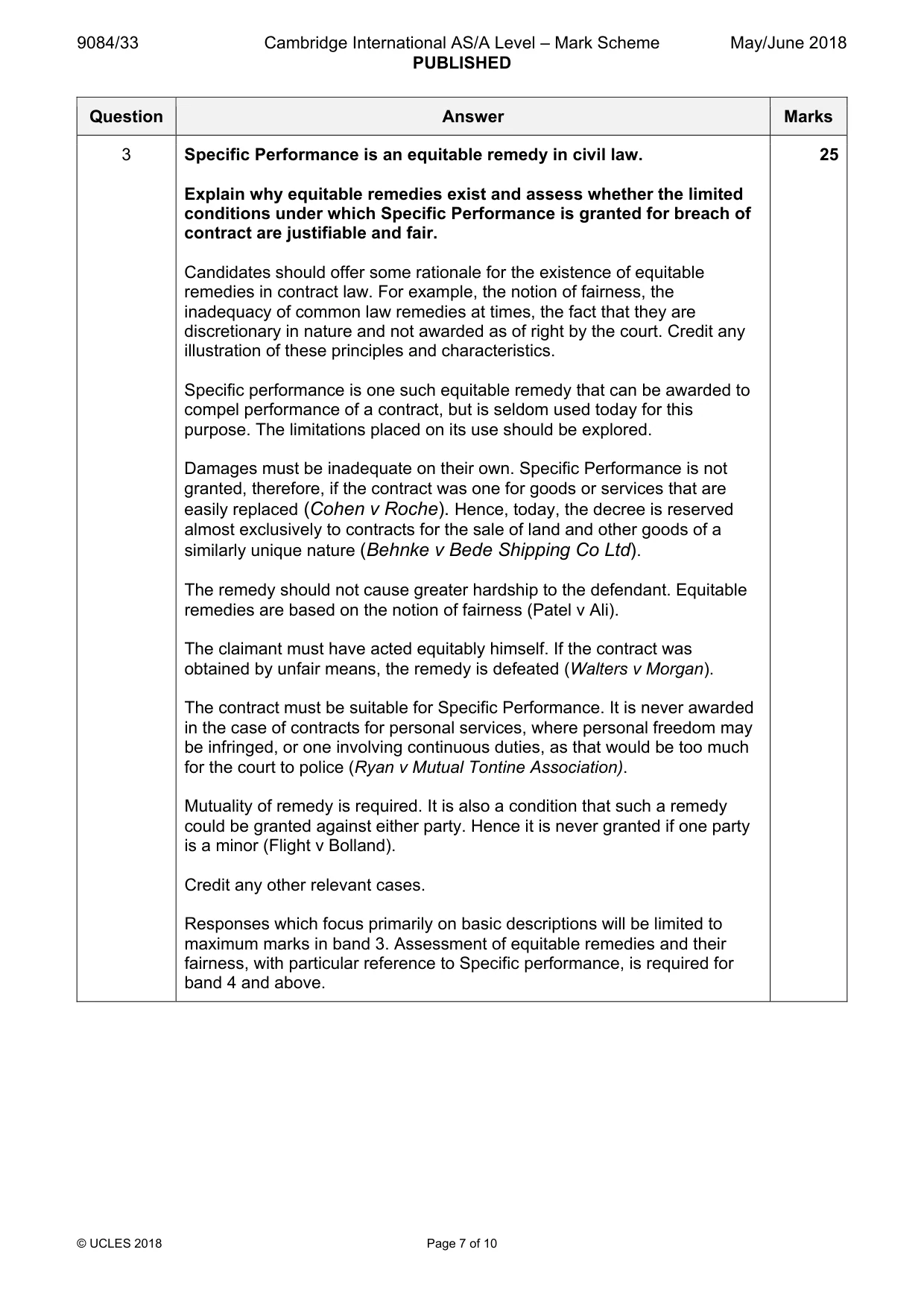
9084/33 Cambridge International AS/A Level – Mark Scheme PUBLISHED May/June 2018 © UCLES 2018 Page 7 of 10 Question Answer Marks 3 Specific Performance is an equitable remedy in civil law. Explain why equitable remedies exist and assess whether the limited conditions under which Specific Performance is granted for breach of contract are justifiable and fair. Candidates should offer some rationale for the existence of equitable remedies in contract law. For example, the notion of fairness, the inadequacy of common law remedies at times, the fact that they are discretionary in nature and not awarded as of right by the court. Credit any illustration of these principles and characteristics. Specific performance is one such equitable remedy that can be awarded to compel performance of a contract, but is seldom used today for this purpose. The limitations placed on its use should be explored. Damages must be inadequate on their own. Specific Performance is not granted, therefore, if the contract was one for goods or services that are easily replaced (Cohen v Roche). Hence, today, the decree is reserved almost exclusively to contracts for the sale of land and other goods of a similarly unique nature (Behnke v Bede Shipping Co Ltd). The remedy should not cause greater hardship to the defendant. Equitable remedies are based on the notion of fairness (Patel v Ali). The claimant must have acted equitably himself. If the contract was obtained by unfair means, the remedy is defeated (Walters v Morgan). The contract must be suitable for Specific Performance. It is never awarded in the case of contracts for personal services, where personal freedom may be infringed, or one involving continuous duties, as that would be too much for the court to police (Ryan v Mutual Tontine Association). Mutuality of remedy is required. It is also a condition that such a remedy could be granted against either party. Hence it is never granted if one party is a minor (Flight v Bolland). Credit any other relevant cases. Responses which focus primarily on basic descriptions will be limited to maximum marks in band 3. Assessment of equitable remedies and their fairness, with particular reference to Specific performance, is required for band 4 and above. 25
Mark scheme, page 8
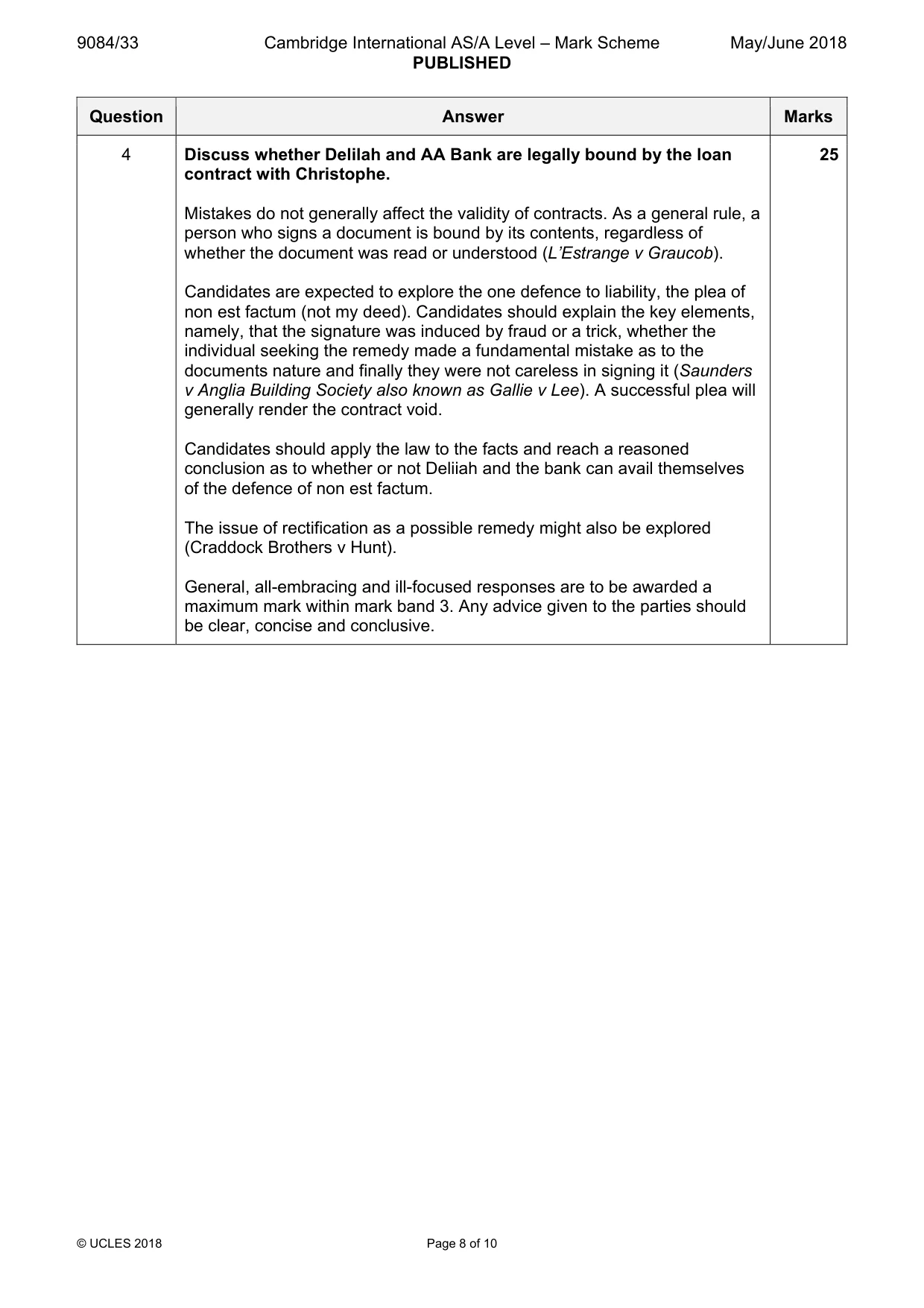
9084/33 Cambridge International AS/A Level – Mark Scheme PUBLISHED May/June 2018 © UCLES 2018 Page 8 of 10 Question Answer Marks 4 Discuss whether Delilah and AA Bank are legally bound by the loan contract with Christophe. Mistakes do not generally affect the validity of contracts. As a general rule, a person who signs a document is bound by its contents, regardless of whether the document was read or understood (L’Estrange v Graucob). Candidates are expected to explore the one defence to liability, the plea of non est factum (not my deed). Candidates should explain the key elements, namely, that the signature was induced by fraud or a trick, whether the individual seeking the remedy made a fundamental mistake as to the documents nature and finally they were not careless in signing it (Saunders v Anglia Building Society also known as Gallie v Lee). A successful plea will generally render the contract void. Candidates should apply the law to the facts and reach a reasoned conclusion as to whether or not Deliiah and the bank can avail themselves of the defence of non est factum. The issue of rectification as a possible remedy might also be explored (Craddock Brothers v Hunt). General, all-embracing and ill-focused responses are to be awarded a maximum mark within mark band 3. Any advice given to the parties should be clear, concise and conclusive. 25
Mark scheme, page 9
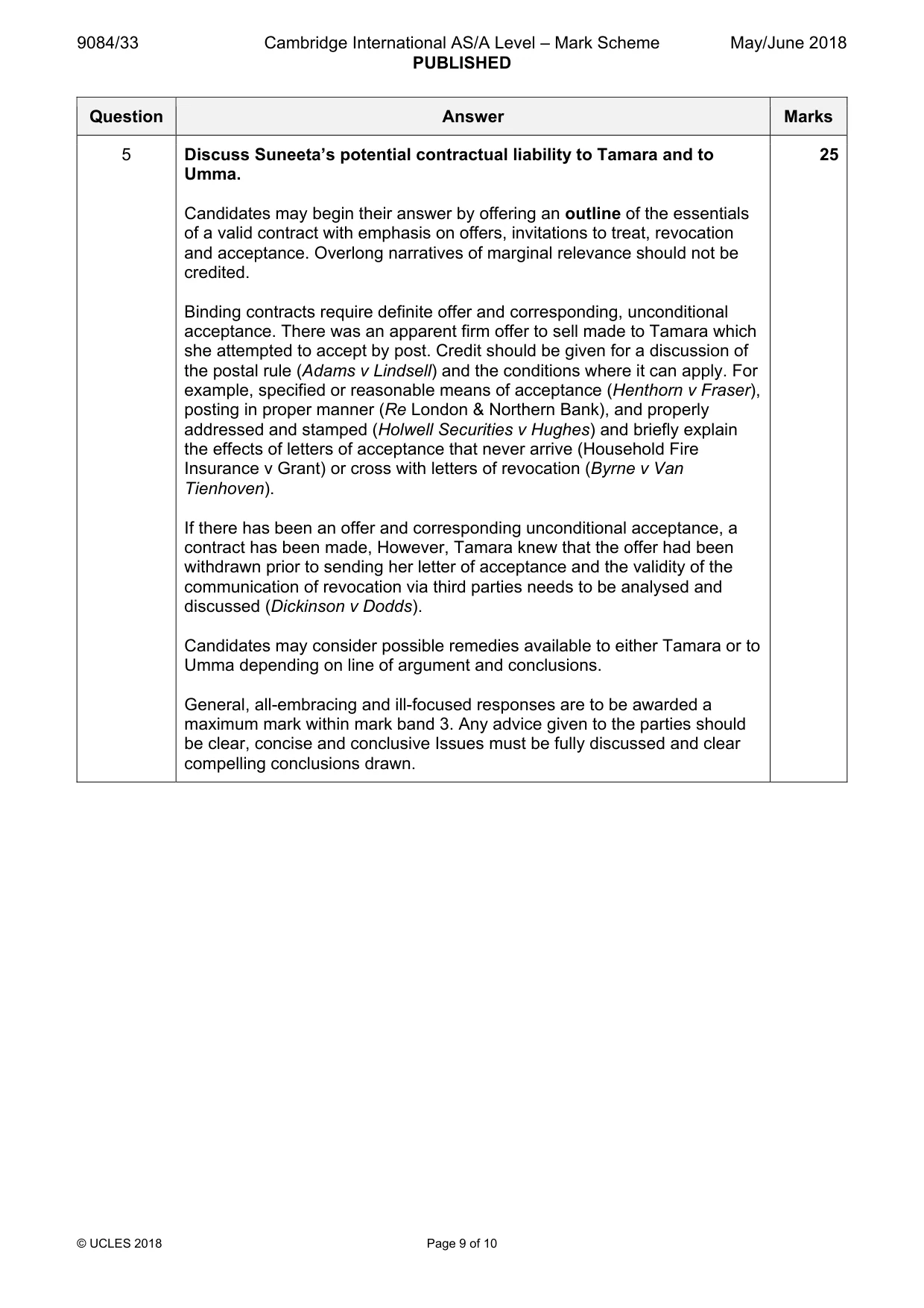
9084/33 Cambridge International AS/A Level – Mark Scheme PUBLISHED May/June 2018 © UCLES 2018 Page 9 of 10 Question Answer Marks 5 Discuss Suneeta’s potential contractual liability to Tamara and to Umma. Candidates may begin their answer by offering an outline of the essentials of a valid contract with emphasis on offers, invitations to treat, revocation and acceptance. Overlong narratives of marginal relevance should not be credited. Binding contracts require definite offer and corresponding, unconditional acceptance. There was an apparent firm offer to sell made to Tamara which she attempted to accept by post. Credit should be given for a discussion of the postal rule (Adams v Lindsell) and the conditions where it can apply. For example, specified or reasonable means of acceptance (Henthorn v Fraser), posting in proper manner (Re London & Northern Bank), and properly addressed and stamped (Holwell Securities v Hughes) and briefly explain the effects of letters of acceptance that never arrive (Household Fire Insurance v Grant) or cross with letters of revocation (Byrne v Van Tienhoven). If there has been an offer and corresponding unconditional acceptance, a contract has been made, However, Tamara knew that the offer had been withdrawn prior to sending her letter of acceptance and the validity of the communication of revocation via third parties needs to be analysed and discussed (Dickinson v Dodds). Candidates may consider possible remedies available to either Tamara or to Umma depending on line of argument and conclusions. General, all-embracing and ill-focused responses are to be awarded a maximum mark within mark band 3. Any advice given to the parties should be clear, concise and conclusive Issues must be fully discussed and clear compelling conclusions drawn. 25
Mark scheme, page 10
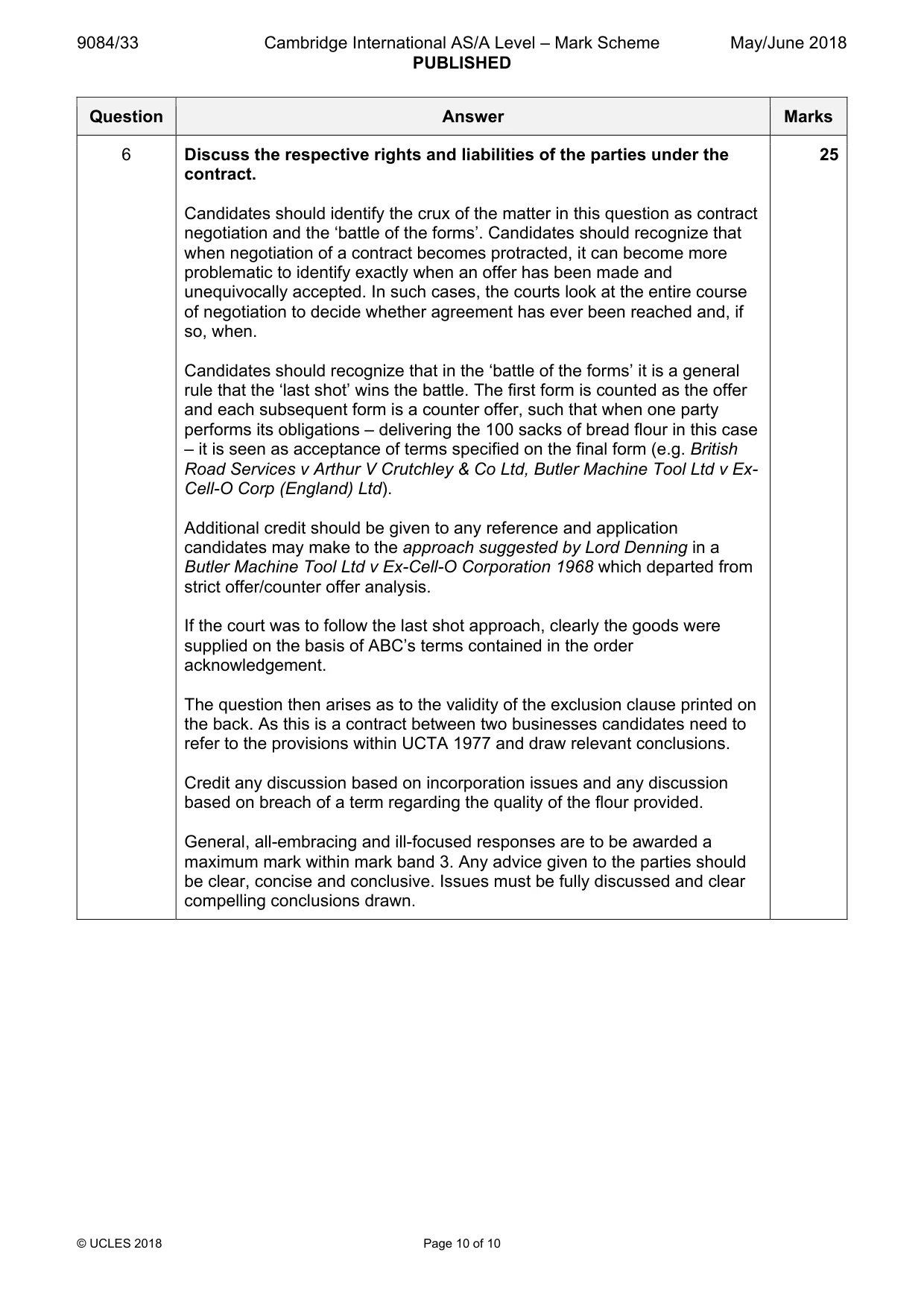
9084/33 Cambridge International AS/A Level – Mark Scheme PUBLISHED May/June 2018 © UCLES 2018 Page 10 of 10 Question Answer Marks 6 Discuss the respective rights and liabilities of the parties under the contract. Candidates should identify the crux of the matter in this question as contract negotiation and the ‘battle of the forms’. Candidates should recognize that when negotiation of a contract becomes protracted, it can become more problematic to identify exactly when an offer has been made and unequivocally accepted. In such cases, the courts look at the entire course of negotiation to decide whether agreement has ever been reached and, if so, when. Candidates should recognize that in the ‘battle of the forms’ it is a general rule that the ‘last shot’ wins the battle. The first form is counted as the offer and each subsequent form is a counter offer, such that when one party performs its obligations – delivering the 100 sacks of bread flour in this case – it is seen as acceptance of terms specified on the final form (e.g. British Road Services v Arthur V Crutchley & Co Ltd, Butler Machine Tool Ltd v Ex- Cell-O Corp (England) Ltd). Additional credit should be given to any reference and application candidates may make to the approach suggested by Lord Denning in a Butler Machine Tool Ltd v Ex-Cell-O Corporation 1968 which departed from strict offer/counter offer analysis. If the court was to follow the last shot approach, clearly the goods were supplied on the basis of ABC’s terms contained in the order acknowledgement. The question then arises as to the validity of the exclusion clause printed on the back. As this is a contract between two businesses candidates need to refer to the provisions within UCTA 1977 and draw relevant conclusions. Credit any discussion based on incorporation issues and any discussion based on breach of a term regarding the quality of the flour provided. General, all-embracing and ill-focused responses are to be awarded a maximum mark within mark band 3. Any advice given to the parties should be clear, concise and conclusive. Issues must be fully discussed and clear compelling conclusions drawn. 25
What you needed in this session
Cambridge’s own grade thresholds for 2018 May/June, Paper 3 · Variant 3. A higher threshold means an easier paper — the bar moves with how the cohort did.