Cambridge A Level Law 9084 — 2018 May/June Paper 3 · Variant 2
9084/32/M/J/18 · 75 marks · ≈84 min
The question paper and its mark scheme, free to read here and free to download. This is Cambridge’s own paper, exactly as it was sat.
Question paper4 pages

Mark scheme10 pages
Answers below. Sit the paper first if you are practising.
Paper as text
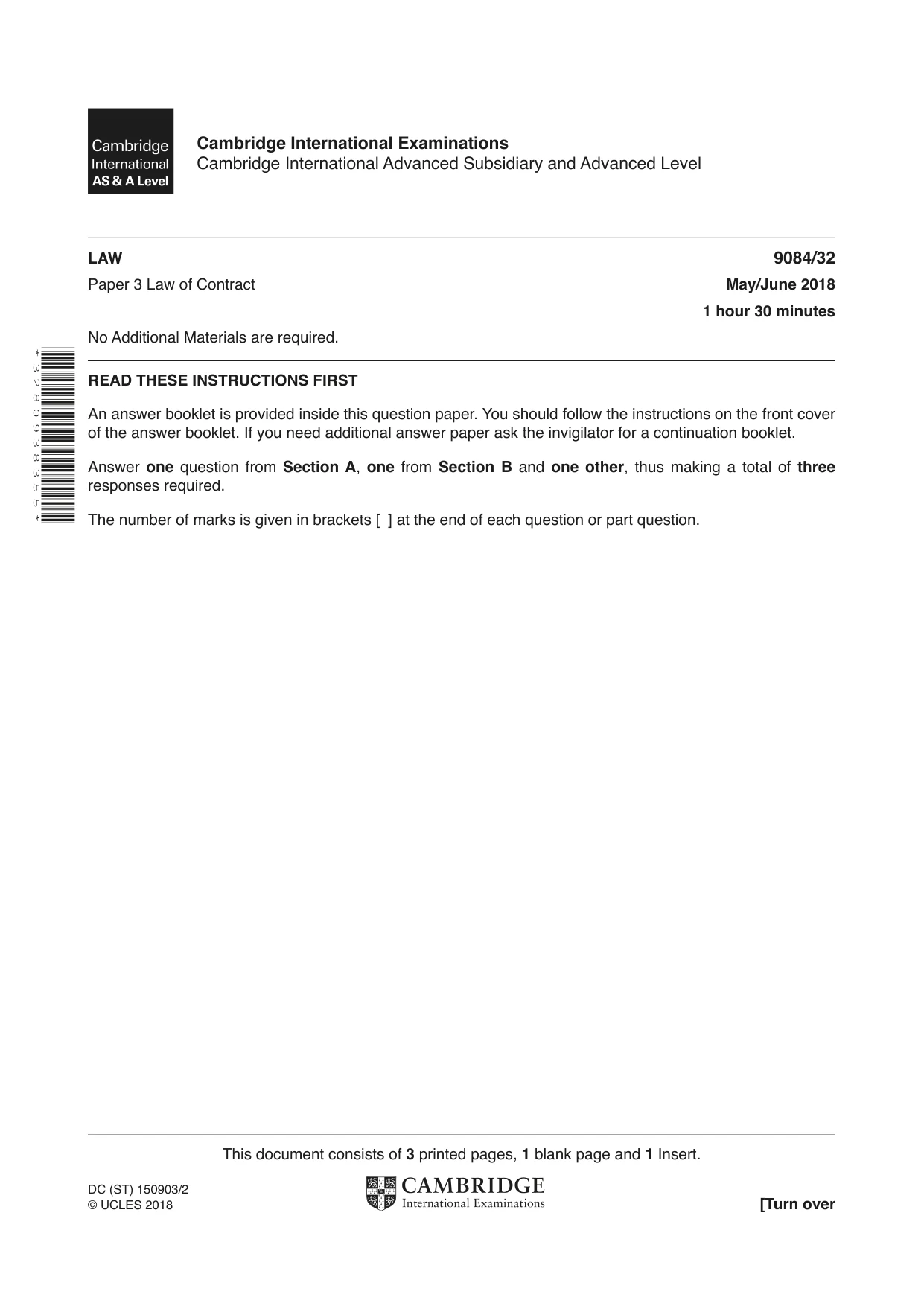
Question paper, page 1
* 3 2 8 0 9 3 8 3 5 5 * This document consists of 3 printed pages, 1 blank page and 1 Insert. DC (ST) 150903/2 © UCLES 2018 [Turn over Cambridge International Examinations Cambridge International Advanced Subsidiary and Advanced Level LAW 9084/32 Paper 3 Law of Contract May/June 2018 1 hour 30 minutes No Additional Materials are required. READ THESE INSTRUCTIONS FIRST An answer booklet is provided inside this question paper. You should follow the instructions on the front cover of the answer booklet. If you need additional answer paper ask the invigilator for a continuation booklet. Answer one question from Section A, one from Section B and one other, thus making a total of three responses required. The number of marks is given in brackets [ ] at the end of each question or part question.
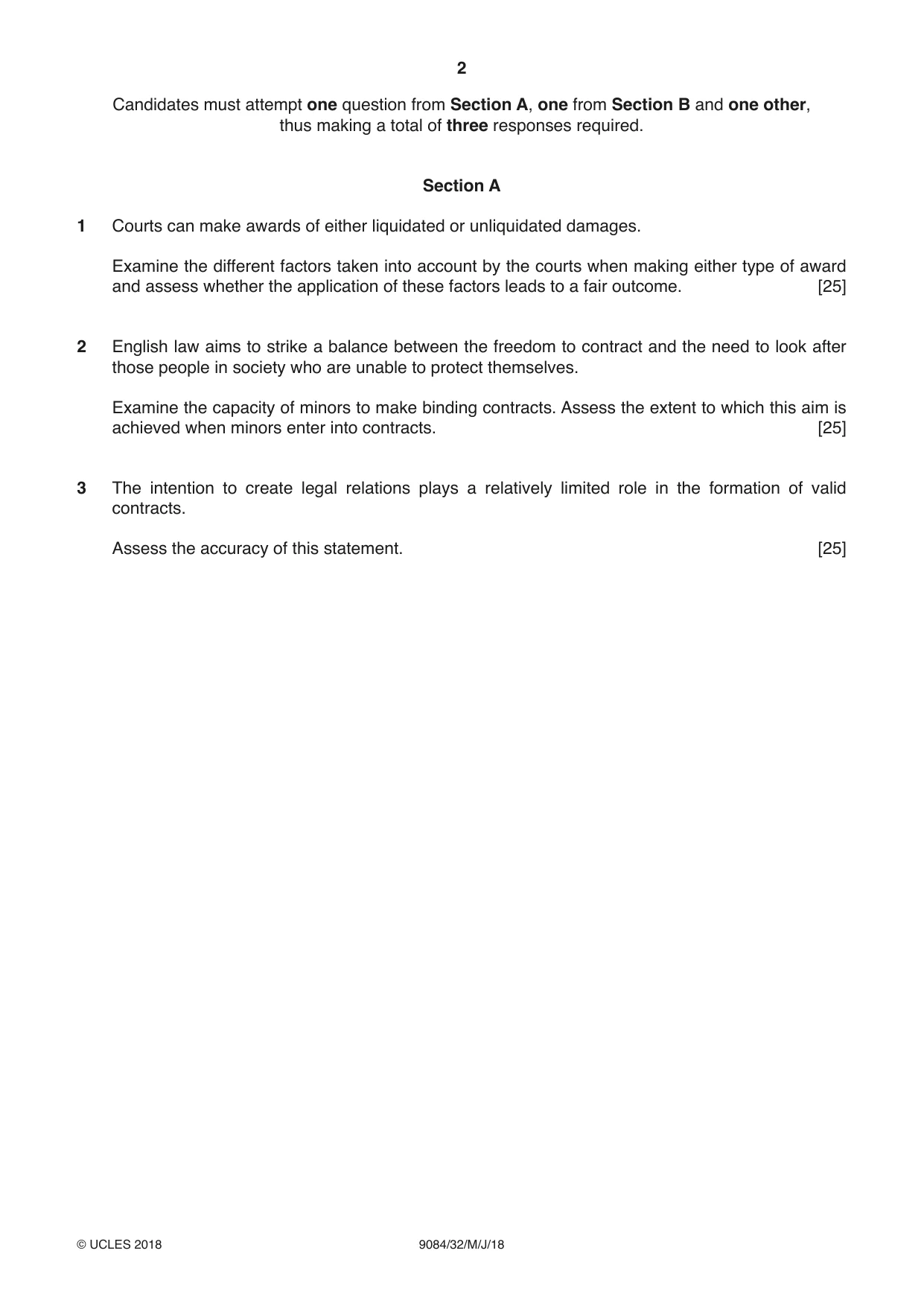
Question paper, page 2
2 9084/32/M/J/18 © UCLES 2018 Candidates must attempt one question from Section A, one from Section B and one other, thus making a total of three responses required. Section A 1 Courts can make awards of either liquidated or unliquidated damages. Examine the different factors taken into account by the courts when making either type of award and assess whether the application of these factors leads to a fair outcome. [25] 2 English law aims to strike a balance between the freedom to contract and the need to look after those people in society who are unable to protect themselves. Examine the capacity of minors to make binding contracts. Assess the extent to which this aim is achieved when minors enter into contracts. [25] 3 The intention to create legal relations plays a relatively limited role in the formation of valid contracts. Assess the accuracy of this statement. [25]
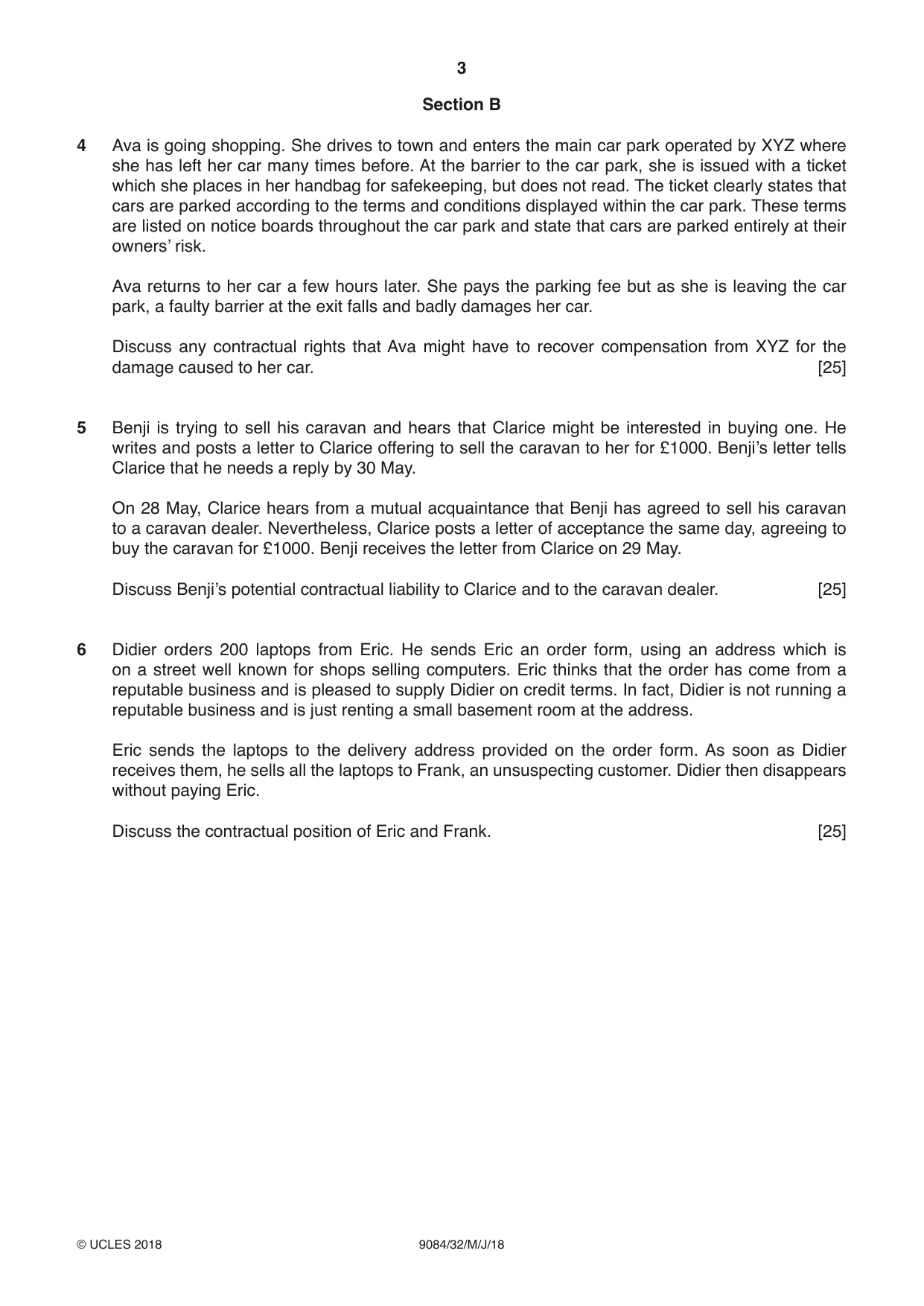
Question paper, page 3
3 9084/32/M/J/18 © UCLES 2018 Section B 4 Ava is going shopping. She drives to town and enters the main car park operated by XYZ where she has left her car many times before. At the barrier to the car park, she is issued with a ticket which she places in her handbag for safekeeping, but does not read. The ticket clearly states that cars are parked according to the terms and conditions displayed within the car park. These terms are listed on notice boards throughout the car park and state that cars are parked entirely at their owners’ risk. Ava returns to her car a few hours later. She pays the parking fee but as she is leaving the car park, a faulty barrier at the exit falls and badly damages her car. Discuss any contractual rights that Ava might have to recover compensation from XYZ for the damage caused to her car. [25] 5 Benji is trying to sell his caravan and hears that Clarice might be interested in buying one. He writes and posts a letter to Clarice offering to sell the caravan to her for £1000. Benji’s letter tells Clarice that he needs a reply by 30 May. On 28 May, Clarice hears from a mutual acquaintance that Benji has agreed to sell his caravan to a caravan dealer. Nevertheless, Clarice posts a letter of acceptance the same day, agreeing to buy the caravan for £1000. Benji receives the letter from Clarice on 29 May. Discuss Benji’s potential contractual liability to Clarice and to the caravan dealer. [25] 6 Didier orders 200 laptops from Eric. He sends Eric an order form, using an address which is on a street well known for shops selling computers. Eric thinks that the order has come from a reputable business and is pleased to supply Didier on credit terms. In fact, Didier is not running a reputable business and is just renting a small basement room at the address. Eric sends the laptops to the delivery address provided on the order form. As soon as Didier receives them, he sells all the laptops to Frank, an unsuspecting customer. Didier then disappears without paying Eric. Discuss the contractual position of Eric and Frank. [25]
Question paper, page 4
4 9084/32/M/J/18 © UCLES 2018 Permission to reproduce items where third-party owned material protected by copyright is included has been sought and cleared where possible. Every reasonable effort has been made by the publisher (UCLES) to trace copyright holders, but if any items requiring clearance have unwittingly been included, the publisher will be pleased to make amends at the earliest possible opportunity. To avoid the issue of disclosure of answer-related information to candidates, all copyright acknowledgements are reproduced online in the Cambridge International Examinations Copyright Acknowledgements Booklet. This is produced for each series of examinations and is freely available to download at www.cie.org.uk after the live examination series. Cambridge International Examinations is part of the Cambridge Assessment Group. Cambridge Assessment is the brand name of University of Cambridge Local Examinations Syndicate (UCLES), which is itself a department of the University of Cambridge. BLANK PAGE
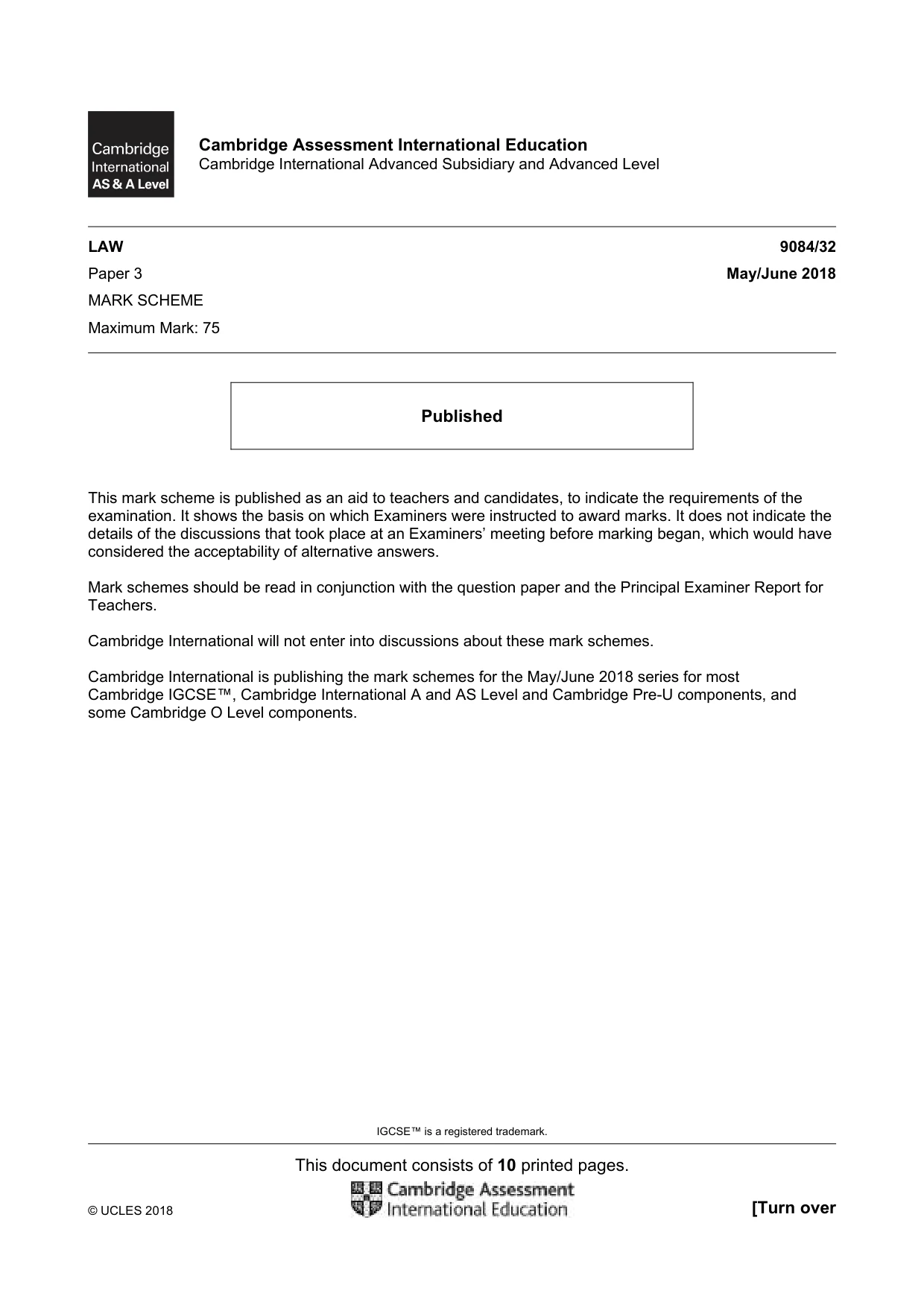
Mark scheme, page 1
IGCSE™ is a registered trademark. This document consists of 10 printed pages. © UCLES 2018 [Turn over Cambridge Assessment International Education Cambridge International Advanced Subsidiary and Advanced Level LAW 9084/32 Paper 3 May/June 2018 MARK SCHEME Maximum Mark: 75 Published This mark scheme is published as an aid to teachers and candidates, to indicate the requirements of the examination. It shows the basis on which Examiners were instructed to award marks. It does not indicate the details of the discussions that took place at an Examiners’ meeting before marking began, which would have considered the acceptability of alternative answers. Mark schemes should be read in conjunction with the question paper and the Principal Examiner Report for Teachers. Cambridge International will not enter into discussions about these mark schemes. Cambridge International is publishing the mark schemes for the May/June 2018 series for most Cambridge IGCSE™, Cambridge International A and AS Level and Cambridge Pre-U components, and some Cambridge O Level components.
Mark scheme, page 2
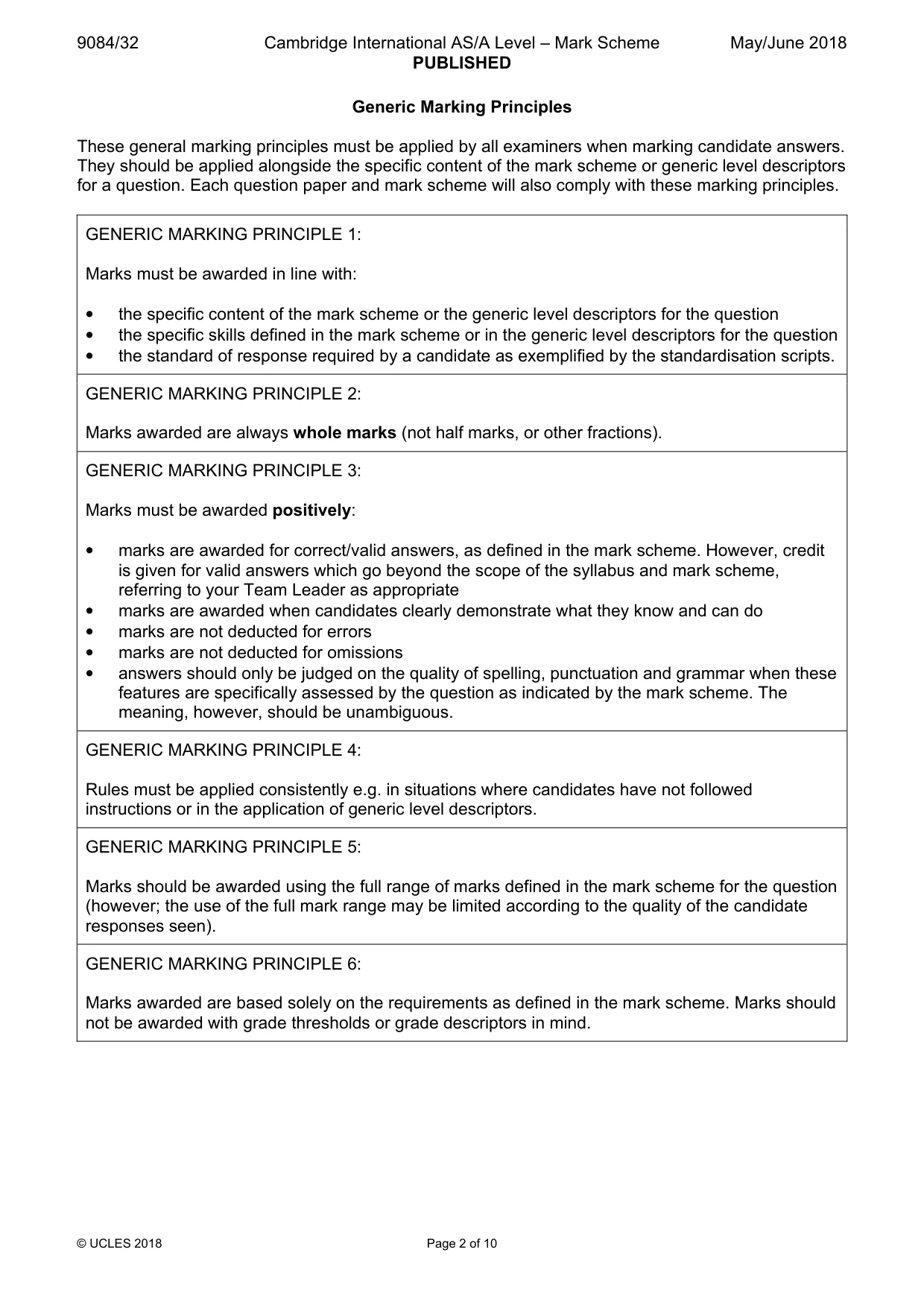
9084/32 Cambridge International AS/A Level – Mark Scheme PUBLISHED May/June 2018 © UCLES 2018 Page 2 of 10 Generic Marking Principles These general marking principles must be applied by all examiners when marking candidate answers. They should be applied alongside the specific content of the mark scheme or generic level descriptors for a question. Each question paper and mark scheme will also comply with these marking principles. GENERIC MARKING PRINCIPLE 1: Marks must be awarded in line with: • the specific content of the mark scheme or the generic level descriptors for the question • the specific skills defined in the mark scheme or in the generic level descriptors for the question • the standard of response required by a candidate as exemplified by the standardisation scripts. GENERIC MARKING PRINCIPLE 2: Marks awarded are always whole marks (not half marks, or other fractions). GENERIC MARKING PRINCIPLE 3: Marks must be awarded positively: • marks are awarded for correct/valid answers, as defined in the mark scheme. However, credit is given for valid answers which go beyond the scope of the syllabus and mark scheme, referring to your Team Leader as appropriate • marks are awarded when candidates clearly demonstrate what they know and can do • marks are not deducted for errors • marks are not deducted for omissions • answers should only be judged on the quality of spelling, punctuation and grammar when these features are specifically assessed by the question as indicated by the mark scheme. The meaning, however, should be unambiguous. GENERIC MARKING PRINCIPLE 4: Rules must be applied consistently e.g. in situations where candidates have not followed instructions or in the application of generic level descriptors. GENERIC MARKING PRINCIPLE 5: Marks should be awarded using the full range of marks defined in the mark scheme for the question (however; the use of the full mark range may be limited according to the quality of the candidate responses seen). GENERIC MARKING PRINCIPLE 6: Marks awarded are based solely on the requirements as defined in the mark scheme. Marks should not be awarded with grade thresholds or grade descriptors in mind.
Mark scheme, page 3
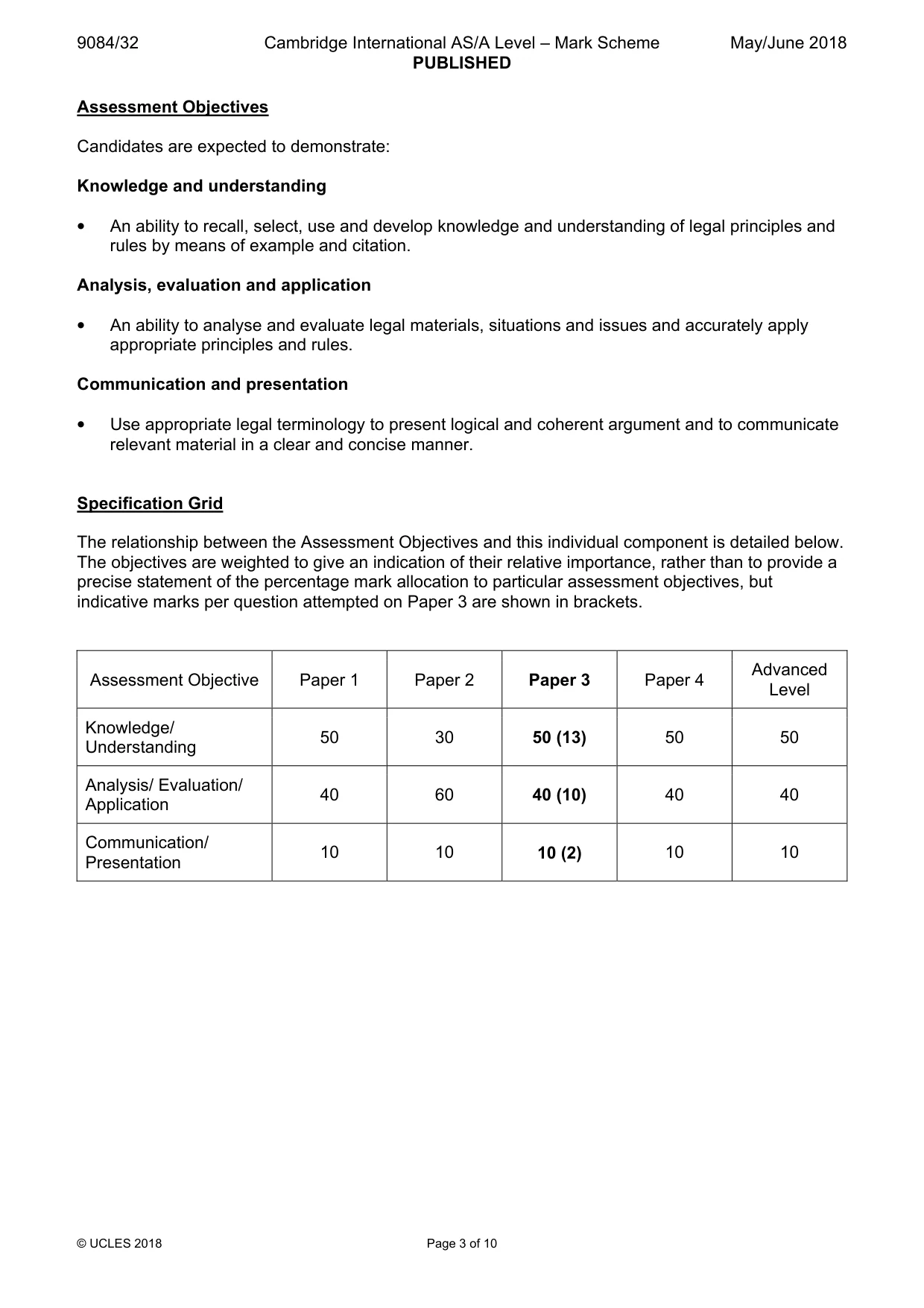
9084/32 Cambridge International AS/A Level – Mark Scheme PUBLISHED May/June 2018 © UCLES 2018 Page 3 of 10 Assessment Objectives Candidates are expected to demonstrate: Knowledge and understanding • An ability to recall, select, use and develop knowledge and understanding of legal principles and rules by means of example and citation. Analysis, evaluation and application • An ability to analyse and evaluate legal materials, situations and issues and accurately apply appropriate principles and rules. Communication and presentation • Use appropriate legal terminology to present logical and coherent argument and to communicate relevant material in a clear and concise manner. Specification Grid The relationship between the Assessment Objectives and this individual component is detailed below. The objectives are weighted to give an indication of their relative importance, rather than to provide a precise statement of the percentage mark allocation to particular assessment objectives, but indicative marks per question attempted on Paper 3 are shown in brackets. Assessment Objective Paper 1 Paper 2 Paper 3 Paper 4 Advanced Level Knowledge/ Understanding 50 30 50 (13) 50 50 Analysis/ Evaluation/ Application 40 60 40 (10) 40 40 Communication/ Presentation 10 10 10 (2) 10 10
Mark scheme, page 4
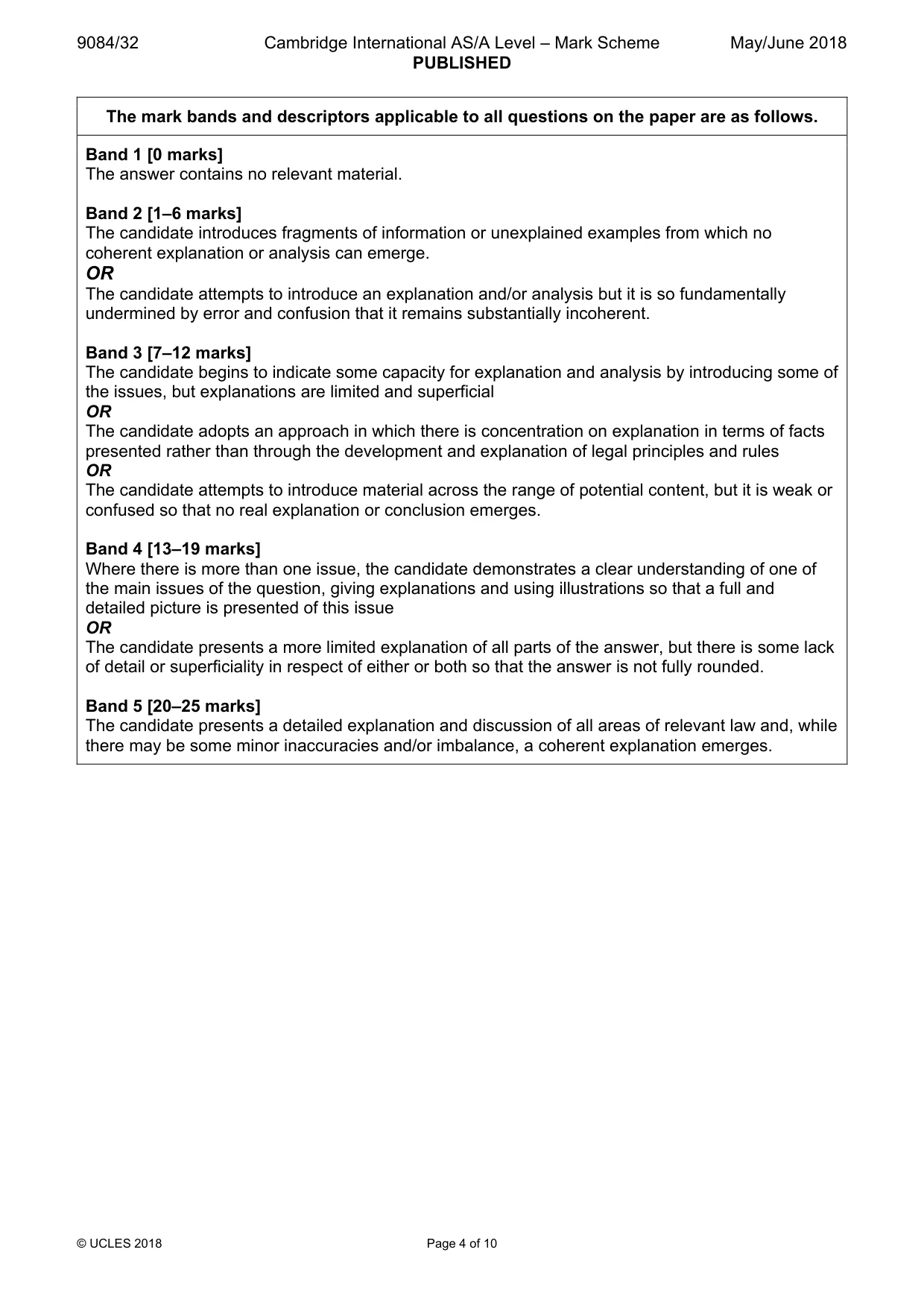
9084/32 Cambridge International AS/A Level – Mark Scheme PUBLISHED May/June 2018 © UCLES 2018 Page 4 of 10 The mark bands and descriptors applicable to all questions on the paper are as follows. Band 1 [0 marks] The answer contains no relevant material. Band 2 [1–6 marks] The candidate introduces fragments of information or unexplained examples from which no coherent explanation or analysis can emerge. OR The candidate attempts to introduce an explanation and/or analysis but it is so fundamentally undermined by error and confusion that it remains substantially incoherent. Band 3 [7–12 marks] The candidate begins to indicate some capacity for explanation and analysis by introducing some of the issues, but explanations are limited and superficial OR The candidate adopts an approach in which there is concentration on explanation in terms of facts presented rather than through the development and explanation of legal principles and rules OR The candidate attempts to introduce material across the range of potential content, but it is weak or confused so that no real explanation or conclusion emerges. Band 4 [13–19 marks] Where there is more than one issue, the candidate demonstrates a clear understanding of one of the main issues of the question, giving explanations and using illustrations so that a full and detailed picture is presented of this issue OR The candidate presents a more limited explanation of all parts of the answer, but there is some lack of detail or superficiality in respect of either or both so that the answer is not fully rounded. Band 5 [20–25 marks] The candidate presents a detailed explanation and discussion of all areas of relevant law and, while there may be some minor inaccuracies and/or imbalance, a coherent explanation emerges.
Mark scheme, page 5
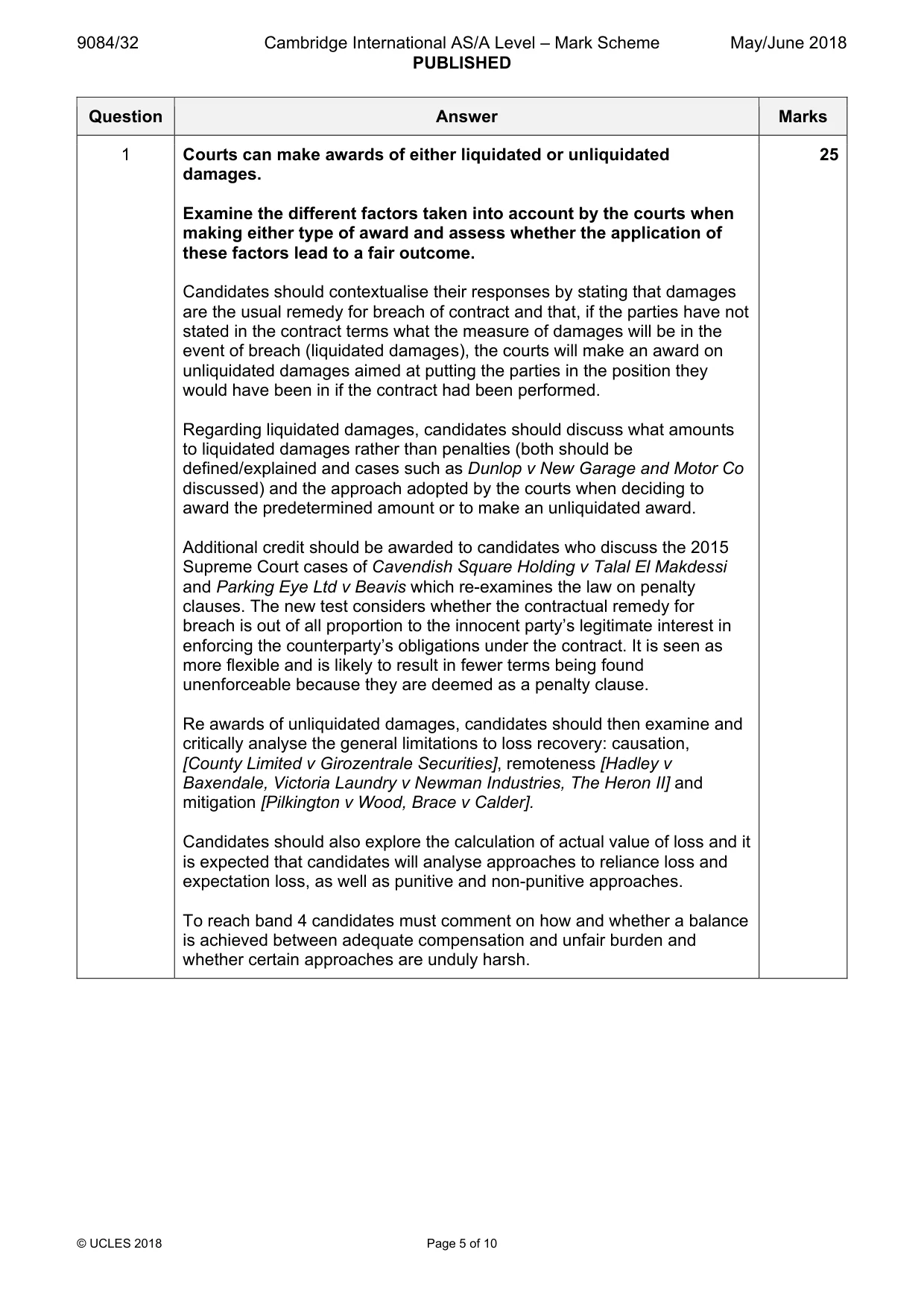
9084/32 Cambridge International AS/A Level – Mark Scheme PUBLISHED May/June 2018 © UCLES 2018 Page 5 of 10 Question Answer Marks 1 Courts can make awards of either liquidated or unliquidated damages. Examine the different factors taken into account by the courts when making either type of award and assess whether the application of these factors lead to a fair outcome. Candidates should contextualise their responses by stating that damages are the usual remedy for breach of contract and that, if the parties have not stated in the contract terms what the measure of damages will be in the event of breach (liquidated damages), the courts will make an award on unliquidated damages aimed at putting the parties in the position they would have been in if the contract had been performed. Regarding liquidated damages, candidates should discuss what amounts to liquidated damages rather than penalties (both should be defined/explained and cases such as Dunlop v New Garage and Motor Co discussed) and the approach adopted by the courts when deciding to award the predetermined amount or to make an unliquidated award. Additional credit should be awarded to candidates who discuss the 2015 Supreme Court cases of Cavendish Square Holding v Talal El Makdessi and Parking Eye Ltd v Beavis which re-examines the law on penalty clauses. The new test considers whether the contractual remedy for breach is out of all proportion to the innocent party’s legitimate interest in enforcing the counterparty’s obligations under the contract. It is seen as more flexible and is likely to result in fewer terms being found unenforceable because they are deemed as a penalty clause. Re awards of unliquidated damages, candidates should then examine and critically analyse the general limitations to loss recovery: causation, [County Limited v Girozentrale Securities], remoteness [Hadley v Baxendale, Victoria Laundry v Newman Industries, The Heron II] and mitigation [Pilkington v Wood, Brace v Calder]. Candidates should also explore the calculation of actual value of loss and it is expected that candidates will analyse approaches to reliance loss and expectation loss, as well as punitive and non-punitive approaches. To reach band 4 candidates must comment on how and whether a balance is achieved between adequate compensation and unfair burden and whether certain approaches are unduly harsh. 25
Mark scheme, page 6
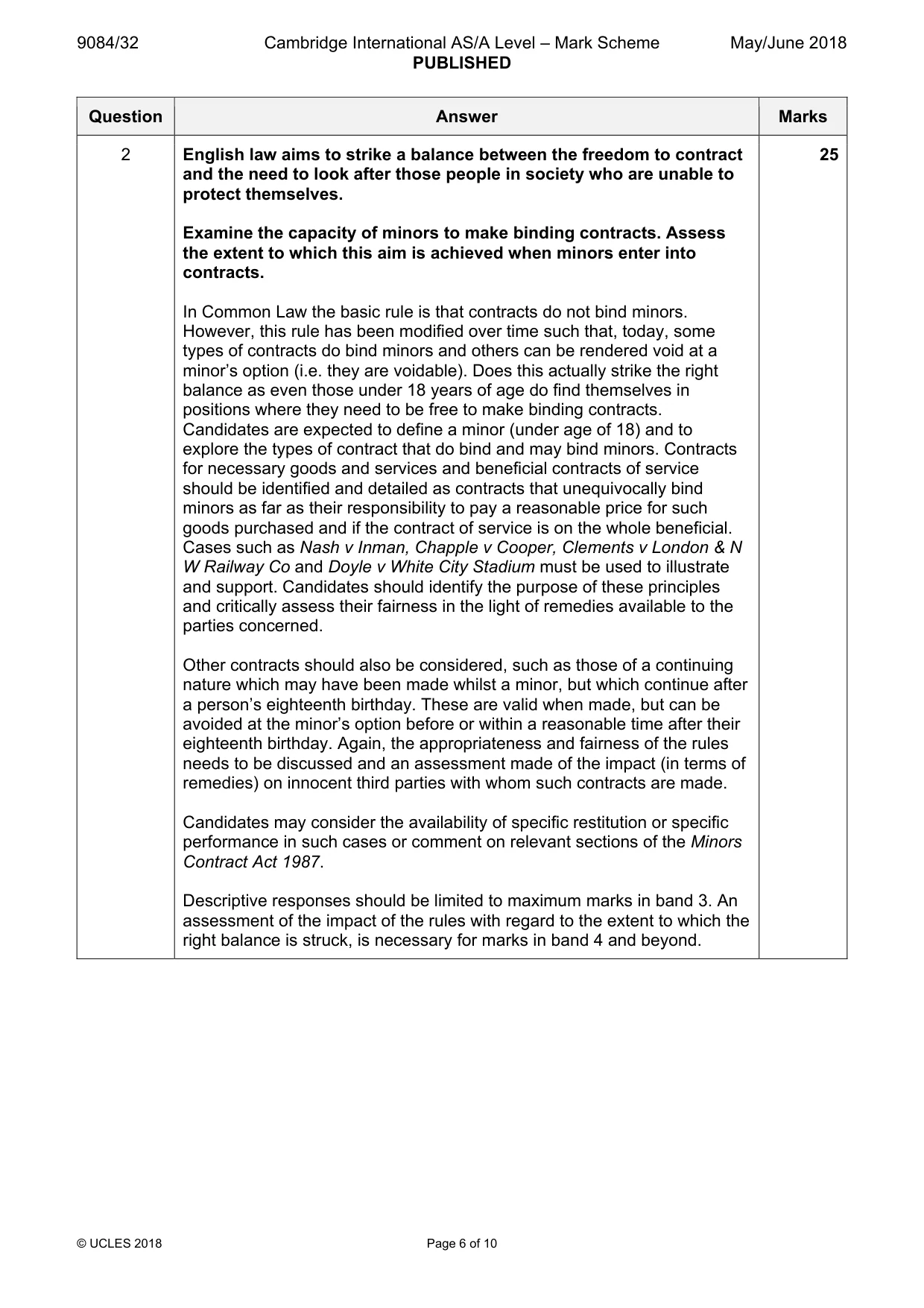
9084/32 Cambridge International AS/A Level – Mark Scheme PUBLISHED May/June 2018 © UCLES 2018 Page 6 of 10 Question Answer Marks 2 English law aims to strike a balance between the freedom to contract and the need to look after those people in society who are unable to protect themselves. Examine the capacity of minors to make binding contracts. Assess the extent to which this aim is achieved when minors enter into contracts. In Common Law the basic rule is that contracts do not bind minors. However, this rule has been modified over time such that, today, some types of contracts do bind minors and others can be rendered void at a minor’s option (i.e. they are voidable). Does this actually strike the right balance as even those under 18 years of age do find themselves in positions where they need to be free to make binding contracts. Candidates are expected to define a minor (under age of 18) and to explore the types of contract that do bind and may bind minors. Contracts for necessary goods and services and beneficial contracts of service should be identified and detailed as contracts that unequivocally bind minors as far as their responsibility to pay a reasonable price for such goods purchased and if the contract of service is on the whole beneficial. Cases such as Nash v Inman, Chapple v Cooper, Clements v London & N W Railway Co and Doyle v White City Stadium must be used to illustrate and support. Candidates should identify the purpose of these principles and critically assess their fairness in the light of remedies available to the parties concerned. Other contracts should also be considered, such as those of a continuing nature which may have been made whilst a minor, but which continue after a person’s eighteenth birthday. These are valid when made, but can be avoided at the minor’s option before or within a reasonable time after their eighteenth birthday. Again, the appropriateness and fairness of the rules needs to be discussed and an assessment made of the impact (in terms of remedies) on innocent third parties with whom such contracts are made. Candidates may consider the availability of specific restitution or specific performance in such cases or comment on relevant sections of the Minors Contract Act 1987. Descriptive responses should be limited to maximum marks in band 3. An assessment of the impact of the rules with regard to the extent to which the right balance is struck, is necessary for marks in band 4 and beyond. 25
Mark scheme, page 7
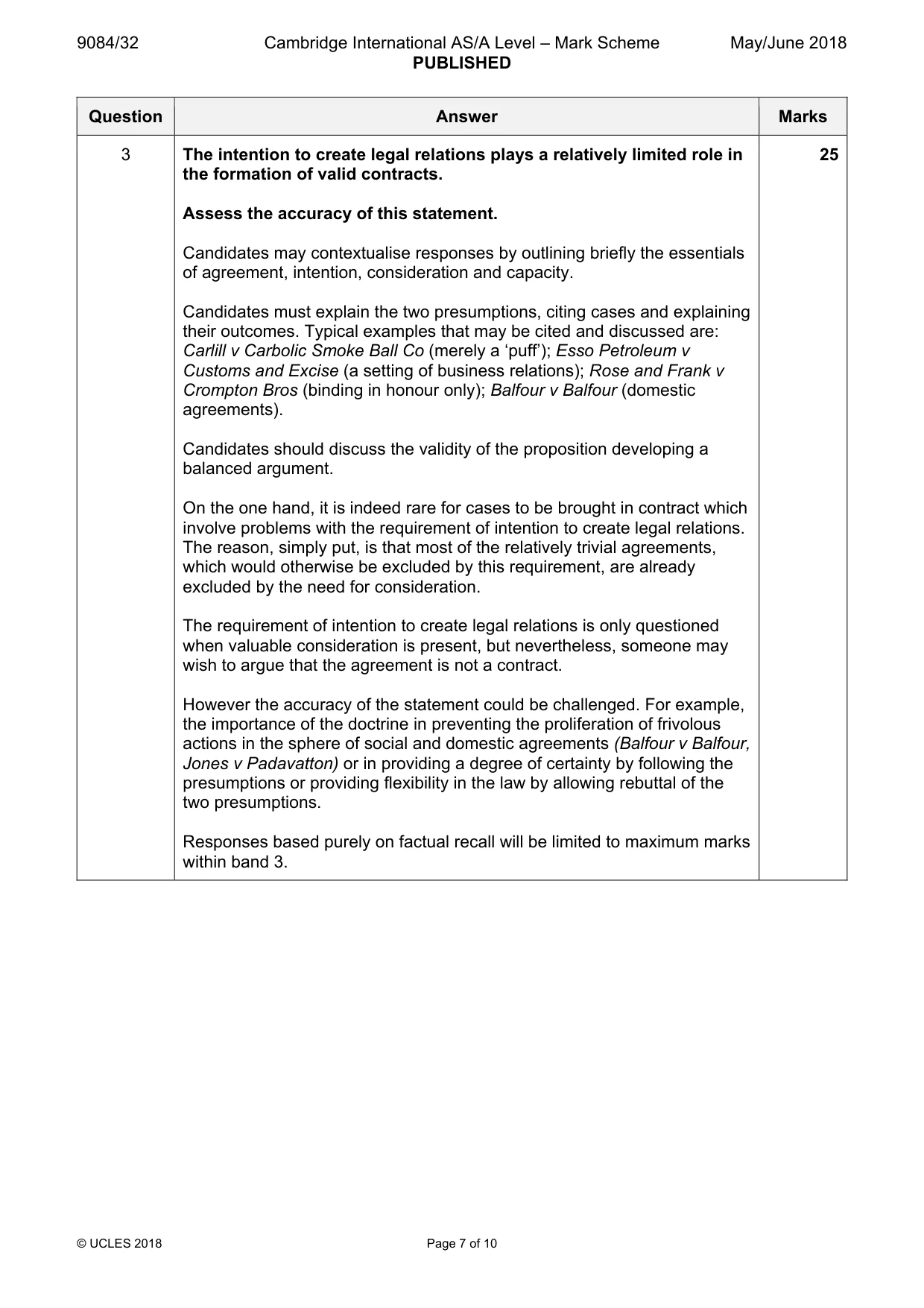
9084/32 Cambridge International AS/A Level – Mark Scheme PUBLISHED May/June 2018 © UCLES 2018 Page 7 of 10 Question Answer Marks 3 The intention to create legal relations plays a relatively limited role in the formation of valid contracts. Assess the accuracy of this statement. Candidates may contextualise responses by outlining briefly the essentials of agreement, intention, consideration and capacity. Candidates must explain the two presumptions, citing cases and explaining their outcomes. Typical examples that may be cited and discussed are: Carlill v Carbolic Smoke Ball Co (merely a ‘puff’); Esso Petroleum v Customs and Excise (a setting of business relations); Rose and Frank v Crompton Bros (binding in honour only); Balfour v Balfour (domestic agreements). Candidates should discuss the validity of the proposition developing a balanced argument. On the one hand, it is indeed rare for cases to be brought in contract which involve problems with the requirement of intention to create legal relations. The reason, simply put, is that most of the relatively trivial agreements, which would otherwise be excluded by this requirement, are already excluded by the need for consideration. The requirement of intention to create legal relations is only questioned when valuable consideration is present, but nevertheless, someone may wish to argue that the agreement is not a contract. However the accuracy of the statement could be challenged. For example, the importance of the doctrine in preventing the proliferation of frivolous actions in the sphere of social and domestic agreements (Balfour v Balfour, Jones v Padavatton) or in providing a degree of certainty by following the presumptions or providing flexibility in the law by allowing rebuttal of the two presumptions. Responses based purely on factual recall will be limited to maximum marks within band 3. 25
Mark scheme, page 8
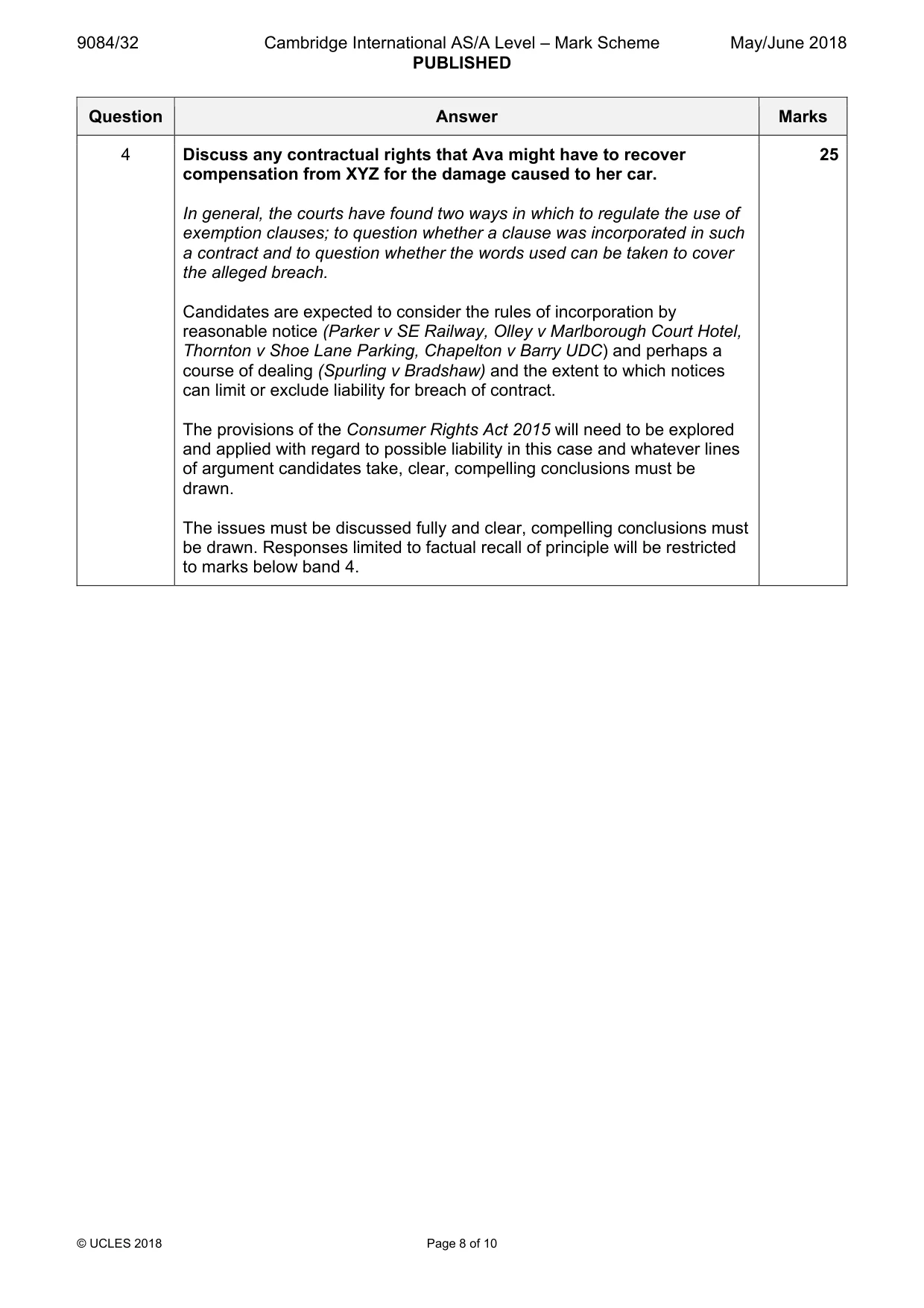
9084/32 Cambridge International AS/A Level – Mark Scheme PUBLISHED May/June 2018 © UCLES 2018 Page 8 of 10 Question Answer Marks 4 Discuss any contractual rights that Ava might have to recover compensation from XYZ for the damage caused to her car. In general, the courts have found two ways in which to regulate the use of exemption clauses; to question whether a clause was incorporated in such a contract and to question whether the words used can be taken to cover the alleged breach. Candidates are expected to consider the rules of incorporation by reasonable notice (Parker v SE Railway, Olley v Marlborough Court Hotel, Thornton v Shoe Lane Parking, Chapelton v Barry UDC) and perhaps a course of dealing (Spurling v Bradshaw) and the extent to which notices can limit or exclude liability for breach of contract. The provisions of the Consumer Rights Act 2015 will need to be explored and applied with regard to possible liability in this case and whatever lines of argument candidates take, clear, compelling conclusions must be drawn. The issues must be discussed fully and clear, compelling conclusions must be drawn. Responses limited to factual recall of principle will be restricted to marks below band 4. 25
Mark scheme, page 9
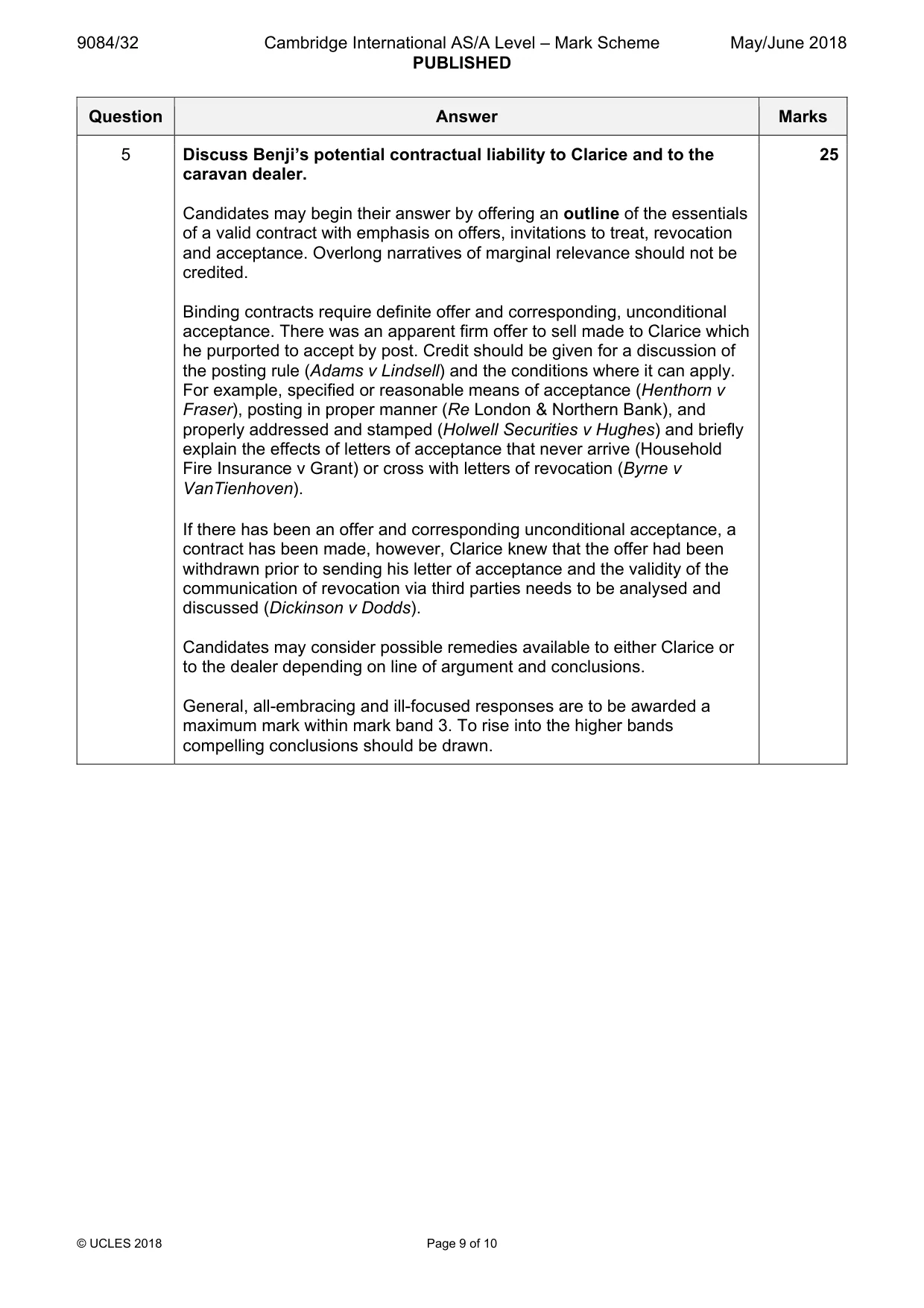
9084/32 Cambridge International AS/A Level – Mark Scheme PUBLISHED May/June 2018 © UCLES 2018 Page 9 of 10 Question Answer Marks 5 Discuss Benji’s potential contractual liability to Clarice and to the caravan dealer. Candidates may begin their answer by offering an outline of the essentials of a valid contract with emphasis on offers, invitations to treat, revocation and acceptance. Overlong narratives of marginal relevance should not be credited. Binding contracts require definite offer and corresponding, unconditional acceptance. There was an apparent firm offer to sell made to Clarice which he purported to accept by post. Credit should be given for a discussion of the posting rule (Adams v Lindsell) and the conditions where it can apply. For example, specified or reasonable means of acceptance (Henthorn v Fraser), posting in proper manner (Re London & Northern Bank), and properly addressed and stamped (Holwell Securities v Hughes) and briefly explain the effects of letters of acceptance that never arrive (Household Fire Insurance v Grant) or cross with letters of revocation (Byrne v VanTienhoven). If there has been an offer and corresponding unconditional acceptance, a contract has been made, however, Clarice knew that the offer had been withdrawn prior to sending his letter of acceptance and the validity of the communication of revocation via third parties needs to be analysed and discussed (Dickinson v Dodds). Candidates may consider possible remedies available to either Clarice or to the dealer depending on line of argument and conclusions. General, all-embracing and ill-focused responses are to be awarded a maximum mark within mark band 3. To rise into the higher bands compelling conclusions should be drawn. 25
Mark scheme, page 10
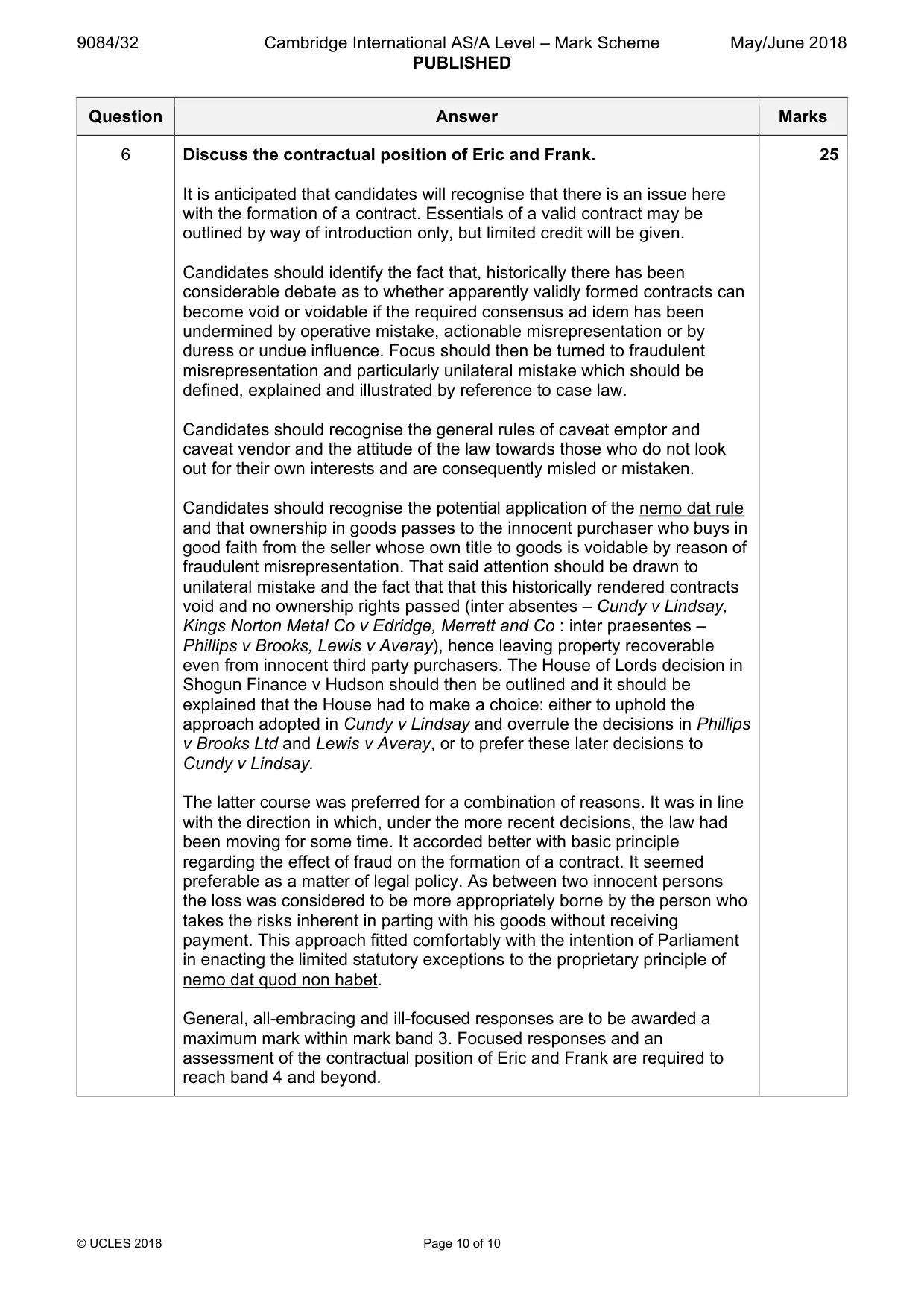
9084/32 Cambridge International AS/A Level – Mark Scheme PUBLISHED May/June 2018 © UCLES 2018 Page 10 of 10 Question Answer Marks 6 Discuss the contractual position of Eric and Frank. It is anticipated that candidates will recognise that there is an issue here with the formation of a contract. Essentials of a valid contract may be outlined by way of introduction only, but limited credit will be given. Candidates should identify the fact that, historically there has been considerable debate as to whether apparently validly formed contracts can become void or voidable if the required consensus ad idem has been undermined by operative mistake, actionable misrepresentation or by duress or undue influence. Focus should then be turned to fraudulent misrepresentation and particularly unilateral mistake which should be defined, explained and illustrated by reference to case law. Candidates should recognise the general rules of caveat emptor and caveat vendor and the attitude of the law towards those who do not look out for their own interests and are consequently misled or mistaken. Candidates should recognise the potential application of the nemo dat rule and that ownership in goods passes to the innocent purchaser who buys in good faith from the seller whose own title to goods is voidable by reason of fraudulent misrepresentation. That said attention should be drawn to unilateral mistake and the fact that that this historically rendered contracts void and no ownership rights passed (inter absentes – Cundy v Lindsay, Kings Norton Metal Co v Edridge, Merrett and Co : inter praesentes – Phillips v Brooks, Lewis v Averay), hence leaving property recoverable even from innocent third party purchasers. The House of Lords decision in Shogun Finance v Hudson should then be outlined and it should be explained that the House had to make a choice: either to uphold the approach adopted in Cundy v Lindsay and overrule the decisions in Phillips v Brooks Ltd and Lewis v Averay, or to prefer these later decisions to Cundy v Lindsay. The latter course was preferred for a combination of reasons. It was in line with the direction in which, under the more recent decisions, the law had been moving for some time. It accorded better with basic principle regarding the effect of fraud on the formation of a contract. It seemed preferable as a matter of legal policy. As between two innocent persons the loss was considered to be more appropriately borne by the person who takes the risks inherent in parting with his goods without receiving payment. This approach fitted comfortably with the intention of Parliament in enacting the limited statutory exceptions to the proprietary principle of nemo dat quod non habet. General, all-embracing and ill-focused responses are to be awarded a maximum mark within mark band 3. Focused responses and an assessment of the contractual position of Eric and Frank are required to reach band 4 and beyond. 25
What you needed in this session
Cambridge’s own grade thresholds for 2018 May/June, Paper 3 · Variant 2. A higher threshold means an easier paper — the bar moves with how the cohort did.