Cambridge A Level Law 9084 — 2018 May/June Paper 3 · Variant 1
9084/31/M/J/18 · 75 marks · ≈84 min
The question paper and its mark scheme, free to read here and free to download. This is Cambridge’s own paper, exactly as it was sat.
Question paper4 pages

Mark scheme9 pages
Answers below. Sit the paper first if you are practising.
Paper as text
Question paper, page 1
* 6 6 3 9 7 8 2 5 6 4 * This document consists of 3 printed pages, 1 blank page and 1 Insert. DC (LK) 150913/2 © UCLES 2018 [Turn over LAW 9084/31 Paper 3 Law of Contract May/June 2018 1 hour 30 minutes No Additional Materials are required. READ THESE INSTRUCTIONS FIRST An answer booklet is provided inside this question paper. You should follow the instructions on the front cover of the answer booklet. If you need additional answer paper ask the invigilator for a continuation booklet. Answer one question from Section A, one from Section B and one other, thus making a total of three responses required. The number of marks is given in brackets [ ] at the end of each question or part question. Cambridge International Examinations Cambridge International Advanced Subsidiary and Advanced Level
Question paper, page 2
2 9084/31/M/J/18 © UCLES 2018 Candidates must attempt one question from Section A, one from Section B and one other, thus making a total of three responses required. Section A 1 Specific Performance has limited importance as a remedy in the law of contract. Explain the nature of this remedy and assess the accuracy of the statement above. [25] 2 Assess the extent to which mistakes made by the parties during the formation stage might invalidate the resulting contract. [25] 3 Valid consideration is essential to the formation of binding contracts. Explain the Rule in Pinnel’s Case and assess the extent to which its application has been mitigated by the development of the doctrine of promissory estoppel. [25]
Question paper, page 3
3 9084/31/M/J/18 © UCLES 2018 Section B 4 Arvind buys a ticket to fly to India to visit his family. He prints the boarding pass and, without reading it thoroughly, places it in his desk drawer for safe keeping. On the day of travel, he puts the boarding pass in his pocket and heads for the airport. As Arvind boards, he slips on some oil on the aeroplane steps and falls, severely injuring his back. He also smashes a very expensive antique jug which he was carrying in his hand luggage as a present for his mother. Arvind’s injuries prevent him from returning to work for six months. When Arvind demands compensation for his injuries and for the broken jug, the airline seeks to rely on one of the terms of contract referred to on its boarding passes. The term in question states that the airline is not liable for any loss sustained by its passengers. Discuss the rights of Arvind to claim for the losses he has sustained. [25] 5 Blanche is a taxi driver. She owns her own taxi, but it has been involved in an accident recently and has been so badly damaged that she needs to replace it. She visits a motor dealer’s showroom in April and orders a new taxi; the motor dealer says that delivery should be by the end of the month. However, the vehicle is not delivered to Blanche until the middle of June. By the time she takes delivery of the new taxi, Blanche has lost regular bookings to the value of £10 000. She has also had to turn down a special job to drive the chairman of a large company to a conference in Switzerland on 1 June. She would have been paid £5000 for this. Blanche claims compensation from the motor dealer. He alleges that there has been no breach of contract and says that she should have temporarily rented another vehicle to use for her business. Discuss the potential legal liability of the motor dealer for the losses suffered by Blanche. [25] 6 Carlo leaves home on the day of his seventeenth birthday to start a job as a trainee engineer in a factory owned by Django. He finds an apartment close to the factory and enters into an agreement with Elmo, the apartment owner, to lease it for two years. Four weeks later, Carlo borrows £5000 from his work colleague, Fernando, and uses it to buy a car. As Carlo is a trainee, the pay is very low and six months later he has run out of money. Carlo quits his job, leaves his apartment, and drives in his car to live with his uncle 200 kilometres away. He also fails to repay the money he borrowed from Fernando. Discuss Carlo’s potential liability to Django, Elmo and Fernando and any remedies that might be awarded to them. [25]
Question paper, page 4
4 9084/31/M/J/18 © UCLES 2018 Permission to reproduce items where third-party owned material protected by copyright is included has been sought and cleared where possible. Every reasonable effort has been made by the publisher (UCLES) to trace copyright holders, but if any items requiring clearance have unwittingly been included, the publisher will be pleased to make amends at the earliest possible opportunity. To avoid the issue of disclosure of answer-related information to candidates, all copyright acknowledgements are reproduced online in the Cambridge International Examinations Copyright Acknowledgements Booklet. This is produced for each series of examinations and is freely available to download at www.cie.org.uk after the live examination series. Cambridge International Examinations is part of the Cambridge Assessment Group. Cambridge Assessment is the brand name of University of Cambridge Local Examinations Syndicate (UCLES), which is itself a department of the University of Cambridge. BLANK PAGE
Mark scheme, page 1
IGCSE™ is a registered trademark. This document consists of 9 printed pages. © UCLES 2018 [Turn over Cambridge Assessment International Education Cambridge International Advanced Subsidiary and Advanced Level LAW 9084/31 Paper 3 May/June 2018 MARK SCHEME Maximum Mark: 75 Published This mark scheme is published as an aid to teachers and candidates, to indicate the requirements of the examination. It shows the basis on which Examiners were instructed to award marks. It does not indicate the details of the discussions that took place at an Examiners’ meeting before marking began, which would have considered the acceptability of alternative answers. Mark schemes should be read in conjunction with the question paper and the Principal Examiner Report for Teachers. Cambridge International will not enter into discussions about these mark schemes. Cambridge International is publishing the mark schemes for the May/June 2018 series for most Cambridge IGCSE™, Cambridge International A and AS Level and Cambridge Pre-U components, and some Cambridge O Level components.
Mark scheme, page 2
9084/31 Cambridge International AS/A Level – Mark Scheme PUBLISHED May/June 2018 © UCLES 2018 Page 2 of 9 Generic Marking Principles These general marking principles must be applied by all examiners when marking candidate answers. They should be applied alongside the specific content of the mark scheme or generic level descriptors for a question. Each question paper and mark scheme will also comply with these marking principles. GENERIC MARKING PRINCIPLE 1: Marks must be awarded in line with: • the specific content of the mark scheme or the generic level descriptors for the question • the specific skills defined in the mark scheme or in the generic level descriptors for the question • the standard of response required by a candidate as exemplified by the standardisation scripts. GENERIC MARKING PRINCIPLE 2: Marks awarded are always whole marks (not half marks, or other fractions). GENERIC MARKING PRINCIPLE 3: Marks must be awarded positively: • marks are awarded for correct/valid answers, as defined in the mark scheme. However, credit is given for valid answers which go beyond the scope of the syllabus and mark scheme, referring to your Team Leader as appropriate • marks are awarded when candidates clearly demonstrate what they know and can do • marks are not deducted for errors • marks are not deducted for omissions • answers should only be judged on the quality of spelling, punctuation and grammar when these features are specifically assessed by the question as indicated by the mark scheme. The meaning, however, should be unambiguous. GENERIC MARKING PRINCIPLE 4: Rules must be applied consistently e.g. in situations where candidates have not followed instructions or in the application of generic level descriptors. GENERIC MARKING PRINCIPLE 5: Marks should be awarded using the full range of marks defined in the mark scheme for the question (however; the use of the full mark range may be limited according to the quality of the candidate responses seen). GENERIC MARKING PRINCIPLE 6: Marks awarded are based solely on the requirements as defined in the mark scheme. Marks should not be awarded with grade thresholds or grade descriptors in mind.
Mark scheme, page 3
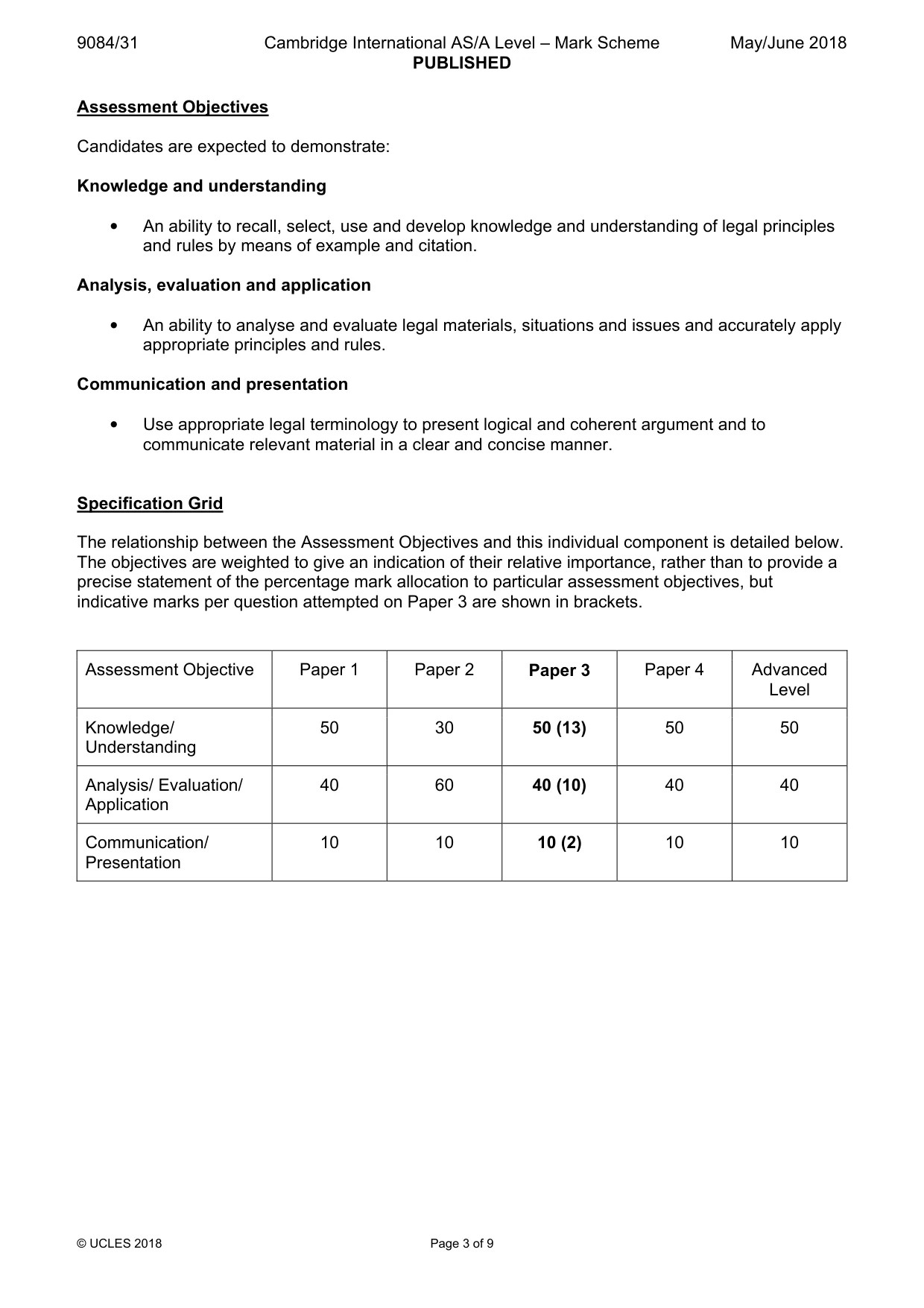
9084/31 Cambridge International AS/A Level – Mark Scheme PUBLISHED May/June 2018 © UCLES 2018 Page 3 of 9 Assessment Objectives Candidates are expected to demonstrate: Knowledge and understanding • An ability to recall, select, use and develop knowledge and understanding of legal principles and rules by means of example and citation. Analysis, evaluation and application • An ability to analyse and evaluate legal materials, situations and issues and accurately apply appropriate principles and rules. Communication and presentation • Use appropriate legal terminology to present logical and coherent argument and to communicate relevant material in a clear and concise manner. Specification Grid The relationship between the Assessment Objectives and this individual component is detailed below. The objectives are weighted to give an indication of their relative importance, rather than to provide a precise statement of the percentage mark allocation to particular assessment objectives, but indicative marks per question attempted on Paper 3 are shown in brackets. Assessment Objective Paper 1 Paper 2 Paper 3 Paper 4 Advanced Level Knowledge/ Understanding 50 30 50 (13) 50 50 Analysis/ Evaluation/ Application 40 60 40 (10) 40 40 Communication/ Presentation 10 10 10 (2) 10 10
Mark scheme, page 4
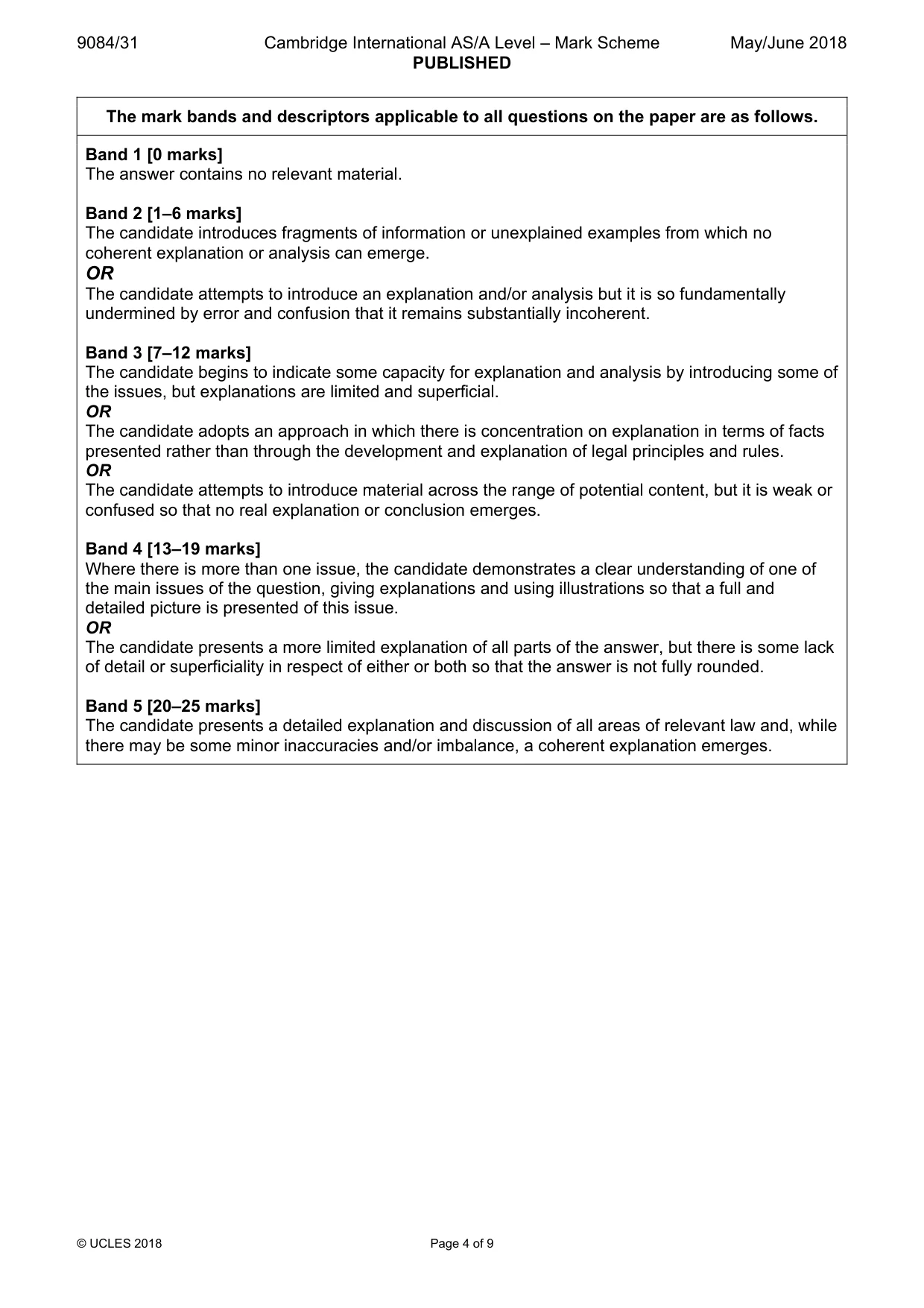
9084/31 Cambridge International AS/A Level – Mark Scheme PUBLISHED May/June 2018 © UCLES 2018 Page 4 of 9 The mark bands and descriptors applicable to all questions on the paper are as follows. Band 1 [0 marks] The answer contains no relevant material. Band 2 [1–6 marks] The candidate introduces fragments of information or unexplained examples from which no coherent explanation or analysis can emerge. OR The candidate attempts to introduce an explanation and/or analysis but it is so fundamentally undermined by error and confusion that it remains substantially incoherent. Band 3 [7–12 marks] The candidate begins to indicate some capacity for explanation and analysis by introducing some of the issues, but explanations are limited and superficial. OR The candidate adopts an approach in which there is concentration on explanation in terms of facts presented rather than through the development and explanation of legal principles and rules. OR The candidate attempts to introduce material across the range of potential content, but it is weak or confused so that no real explanation or conclusion emerges. Band 4 [13–19 marks] Where there is more than one issue, the candidate demonstrates a clear understanding of one of the main issues of the question, giving explanations and using illustrations so that a full and detailed picture is presented of this issue. OR The candidate presents a more limited explanation of all parts of the answer, but there is some lack of detail or superficiality in respect of either or both so that the answer is not fully rounded. Band 5 [20–25 marks] The candidate presents a detailed explanation and discussion of all areas of relevant law and, while there may be some minor inaccuracies and/or imbalance, a coherent explanation emerges.
Mark scheme, page 5
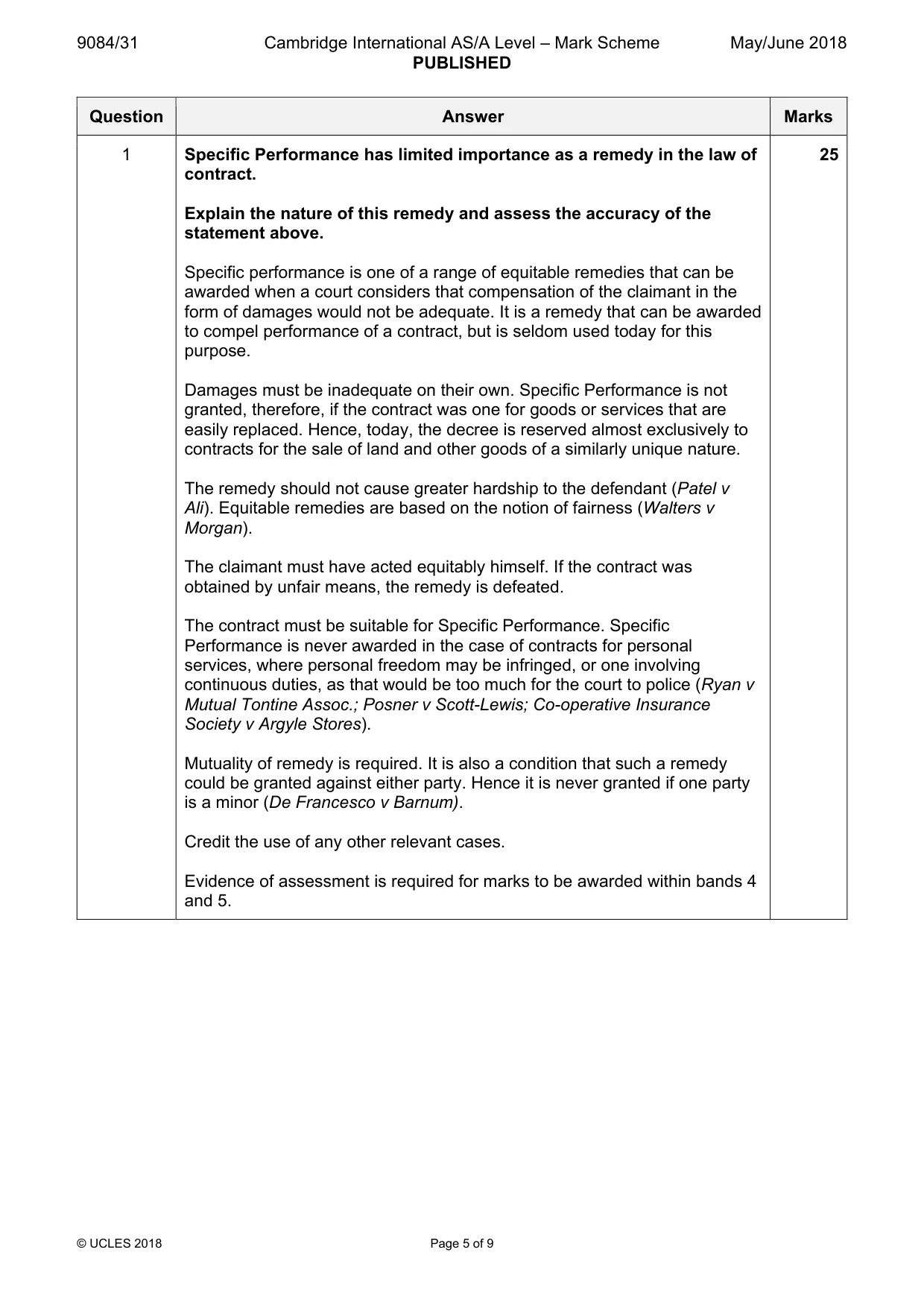
9084/31 Cambridge International AS/A Level – Mark Scheme PUBLISHED May/June 2018 © UCLES 2018 Page 5 of 9 Question Answer Marks 1 Specific Performance has limited importance as a remedy in the law of contract. Explain the nature of this remedy and assess the accuracy of the statement above. Specific performance is one of a range of equitable remedies that can be awarded when a court considers that compensation of the claimant in the form of damages would not be adequate. It is a remedy that can be awarded to compel performance of a contract, but is seldom used today for this purpose. Damages must be inadequate on their own. Specific Performance is not granted, therefore, if the contract was one for goods or services that are easily replaced. Hence, today, the decree is reserved almost exclusively to contracts for the sale of land and other goods of a similarly unique nature. The remedy should not cause greater hardship to the defendant (Patel v Ali). Equitable remedies are based on the notion of fairness (Walters v Morgan). The claimant must have acted equitably himself. If the contract was obtained by unfair means, the remedy is defeated. The contract must be suitable for Specific Performance. Specific Performance is never awarded in the case of contracts for personal services, where personal freedom may be infringed, or one involving continuous duties, as that would be too much for the court to police (Ryan v Mutual Tontine Assoc.; Posner v Scott-Lewis; Co-operative Insurance Society v Argyle Stores). Mutuality of remedy is required. It is also a condition that such a remedy could be granted against either party. Hence it is never granted if one party is a minor (De Francesco v Barnum). Credit the use of any other relevant cases. Evidence of assessment is required for marks to be awarded within bands 4 and 5. 25
Mark scheme, page 6
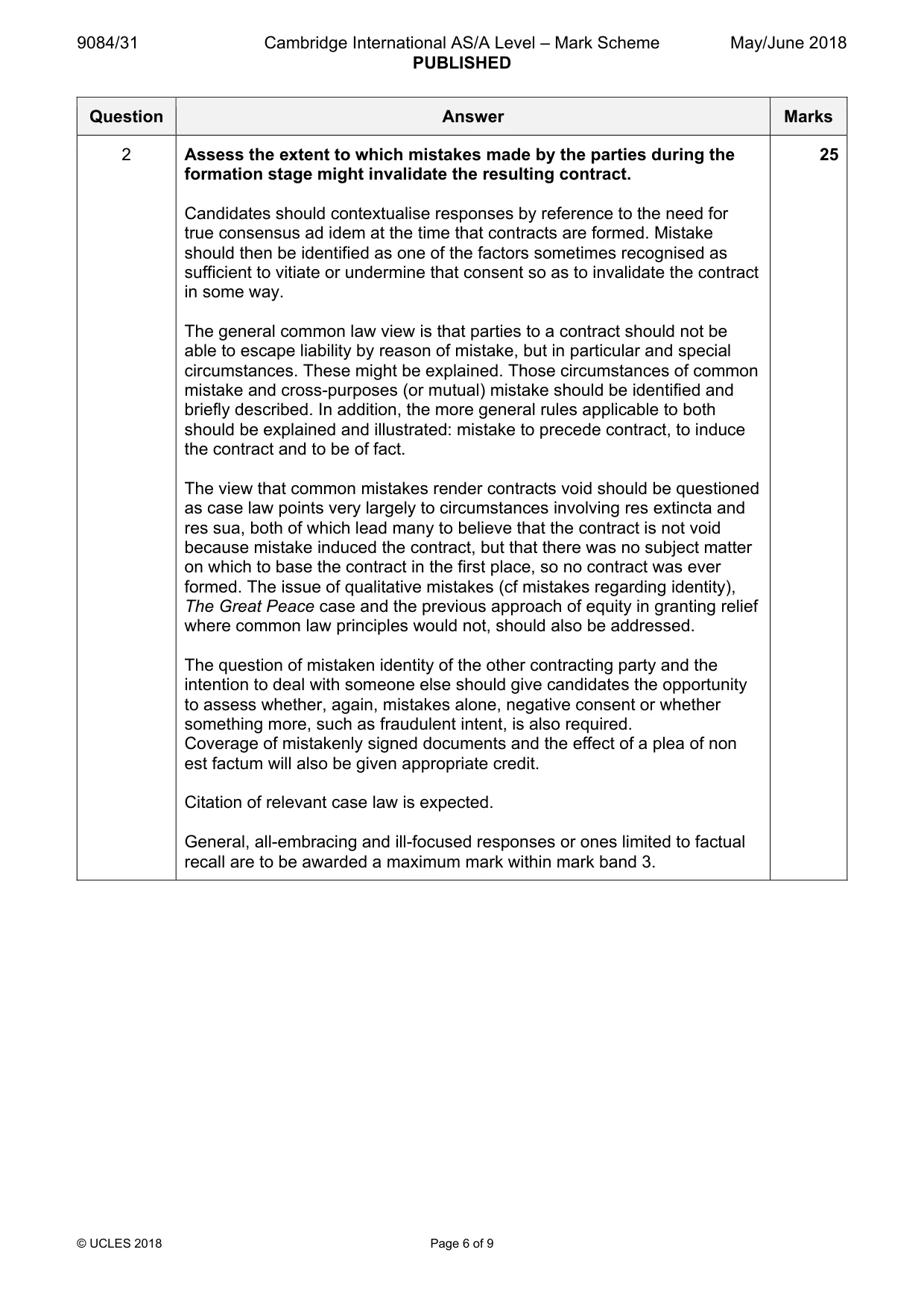
9084/31 Cambridge International AS/A Level – Mark Scheme PUBLISHED May/June 2018 © UCLES 2018 Page 6 of 9 Question Answer Marks 2 Assess the extent to which mistakes made by the parties during the formation stage might invalidate the resulting contract. Candidates should contextualise responses by reference to the need for true consensus ad idem at the time that contracts are formed. Mistake should then be identified as one of the factors sometimes recognised as sufficient to vitiate or undermine that consent so as to invalidate the contract in some way. The general common law view is that parties to a contract should not be able to escape liability by reason of mistake, but in particular and special circumstances. These might be explained. Those circumstances of common mistake and cross-purposes (or mutual) mistake should be identified and briefly described. In addition, the more general rules applicable to both should be explained and illustrated: mistake to precede contract, to induce the contract and to be of fact. The view that common mistakes render contracts void should be questioned as case law points very largely to circumstances involving res extincta and res sua, both of which lead many to believe that the contract is not void because mistake induced the contract, but that there was no subject matter on which to base the contract in the first place, so no contract was ever formed. The issue of qualitative mistakes (cf mistakes regarding identity), The Great Peace case and the previous approach of equity in granting relief where common law principles would not, should also be addressed. The question of mistaken identity of the other contracting party and the intention to deal with someone else should give candidates the opportunity to assess whether, again, mistakes alone, negative consent or whether something more, such as fraudulent intent, is also required. Coverage of mistakenly signed documents and the effect of a plea of non est factum will also be given appropriate credit. Citation of relevant case law is expected. General, all-embracing and ill-focused responses or ones limited to factual recall are to be awarded a maximum mark within mark band 3. 25
Mark scheme, page 7
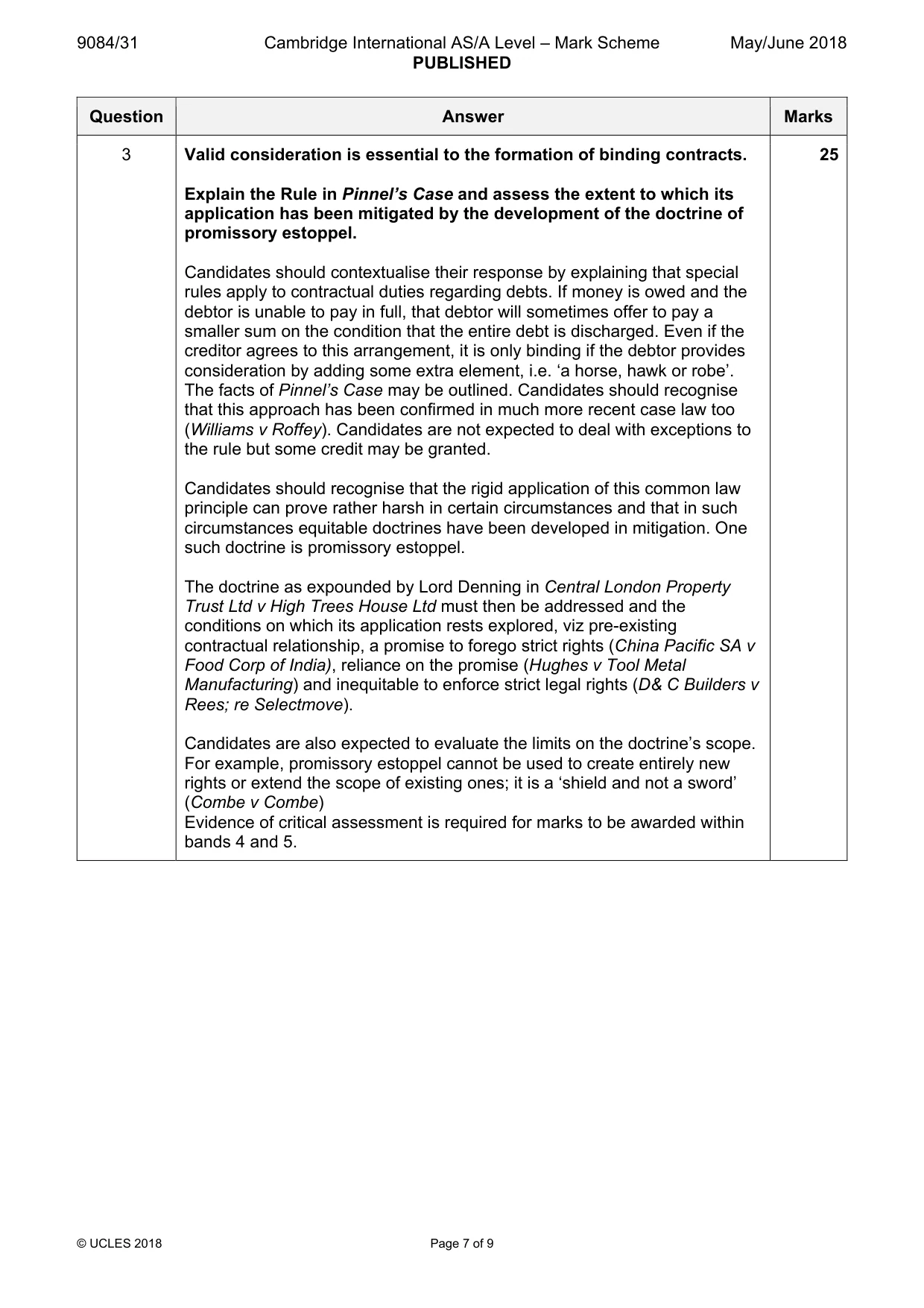
9084/31 Cambridge International AS/A Level – Mark Scheme PUBLISHED May/June 2018 © UCLES 2018 Page 7 of 9 Question Answer Marks 3 Valid consideration is essential to the formation of binding contracts. Explain the Rule in Pinnel’s Case and assess the extent to which its application has been mitigated by the development of the doctrine of promissory estoppel. Candidates should contextualise their response by explaining that special rules apply to contractual duties regarding debts. If money is owed and the debtor is unable to pay in full, that debtor will sometimes offer to pay a smaller sum on the condition that the entire debt is discharged. Even if the creditor agrees to this arrangement, it is only binding if the debtor provides consideration by adding some extra element, i.e. ‘a horse, hawk or robe’. The facts of Pinnel’s Case may be outlined. Candidates should recognise that this approach has been confirmed in much more recent case law too (Williams v Roffey). Candidates are not expected to deal with exceptions to the rule but some credit may be granted. Candidates should recognise that the rigid application of this common law principle can prove rather harsh in certain circumstances and that in such circumstances equitable doctrines have been developed in mitigation. One such doctrine is promissory estoppel. The doctrine as expounded by Lord Denning in Central London Property Trust Ltd v High Trees House Ltd must then be addressed and the conditions on which its application rests explored, viz pre-existing contractual relationship, a promise to forego strict rights (China Pacific SA v Food Corp of India), reliance on the promise (Hughes v Tool Metal Manufacturing) and inequitable to enforce strict legal rights (D& C Builders v Rees; re Selectmove). Candidates are also expected to evaluate the limits on the doctrine’s scope. For example, promissory estoppel cannot be used to create entirely new rights or extend the scope of existing ones; it is a ‘shield and not a sword’ (Combe v Combe) Evidence of critical assessment is required for marks to be awarded within bands 4 and 5. 25
Mark scheme, page 8
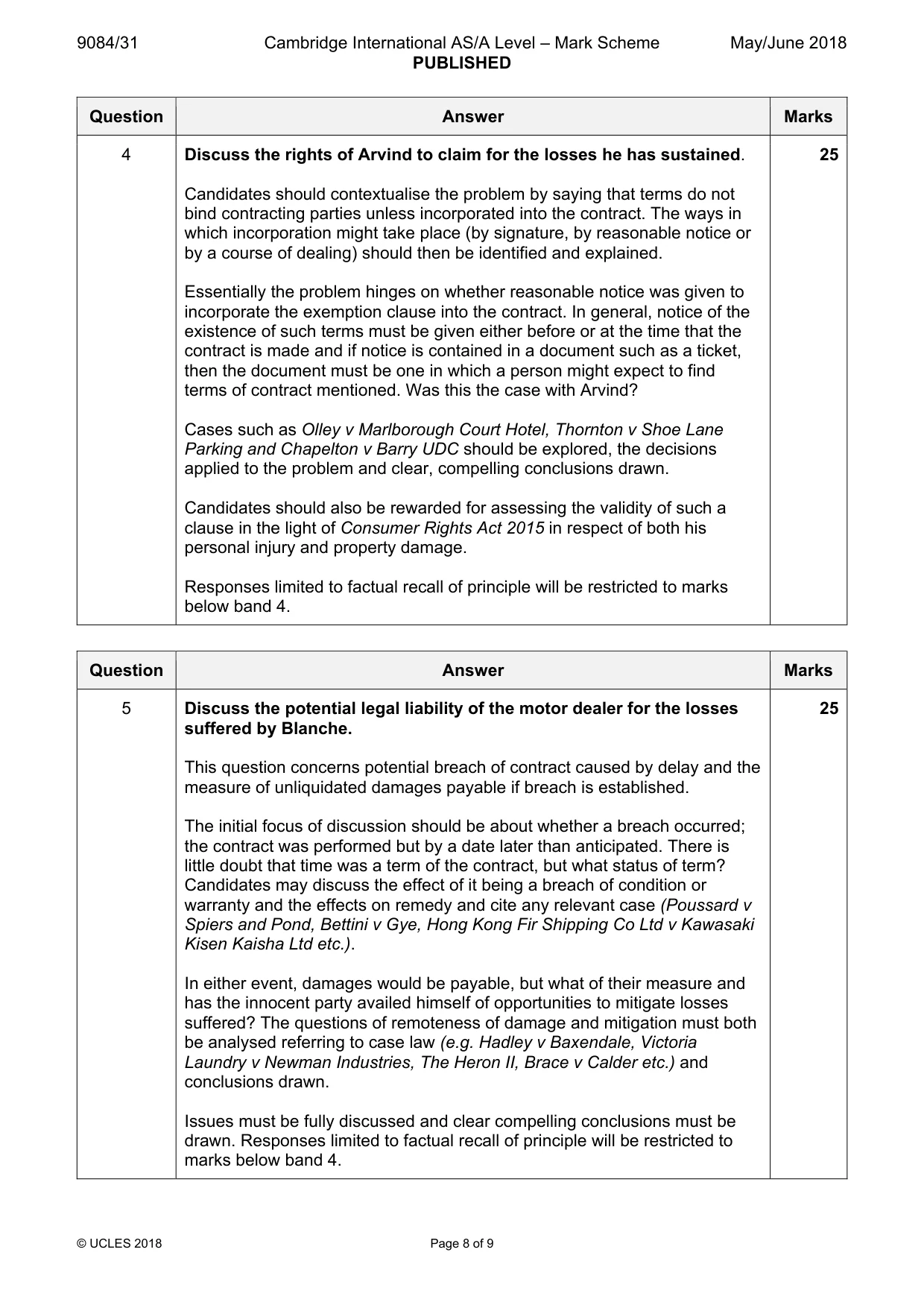
9084/31 Cambridge International AS/A Level – Mark Scheme PUBLISHED May/June 2018 © UCLES 2018 Page 8 of 9 Question Answer Marks 4 Discuss the rights of Arvind to claim for the losses he has sustained. Candidates should contextualise the problem by saying that terms do not bind contracting parties unless incorporated into the contract. The ways in which incorporation might take place (by signature, by reasonable notice or by a course of dealing) should then be identified and explained. Essentially the problem hinges on whether reasonable notice was given to incorporate the exemption clause into the contract. In general, notice of the existence of such terms must be given either before or at the time that the contract is made and if notice is contained in a document such as a ticket, then the document must be one in which a person might expect to find terms of contract mentioned. Was this the case with Arvind? Cases such as Olley v Marlborough Court Hotel, Thornton v Shoe Lane Parking and Chapelton v Barry UDC should be explored, the decisions applied to the problem and clear, compelling conclusions drawn. Candidates should also be rewarded for assessing the validity of such a clause in the light of Consumer Rights Act 2015 in respect of both his personal injury and property damage. Responses limited to factual recall of principle will be restricted to marks below band 4. 25 Question Answer Marks 5 Discuss the potential legal liability of the motor dealer for the losses suffered by Blanche. This question concerns potential breach of contract caused by delay and the measure of unliquidated damages payable if breach is established. The initial focus of discussion should be about whether a breach occurred; the contract was performed but by a date later than anticipated. There is little doubt that time was a term of the contract, but what status of term? Candidates may discuss the effect of it being a breach of condition or warranty and the effects on remedy and cite any relevant case (Poussard v Spiers and Pond, Bettini v Gye, Hong Kong Fir Shipping Co Ltd v Kawasaki Kisen Kaisha Ltd etc.). In either event, damages would be payable, but what of their measure and has the innocent party availed himself of opportunities to mitigate losses suffered? The questions of remoteness of damage and mitigation must both be analysed referring to case law (e.g. Hadley v Baxendale, Victoria Laundry v Newman Industries, The Heron II, Brace v Calder etc.) and conclusions drawn. Issues must be fully discussed and clear compelling conclusions must be drawn. Responses limited to factual recall of principle will be restricted to marks below band 4. 25
Mark scheme, page 9
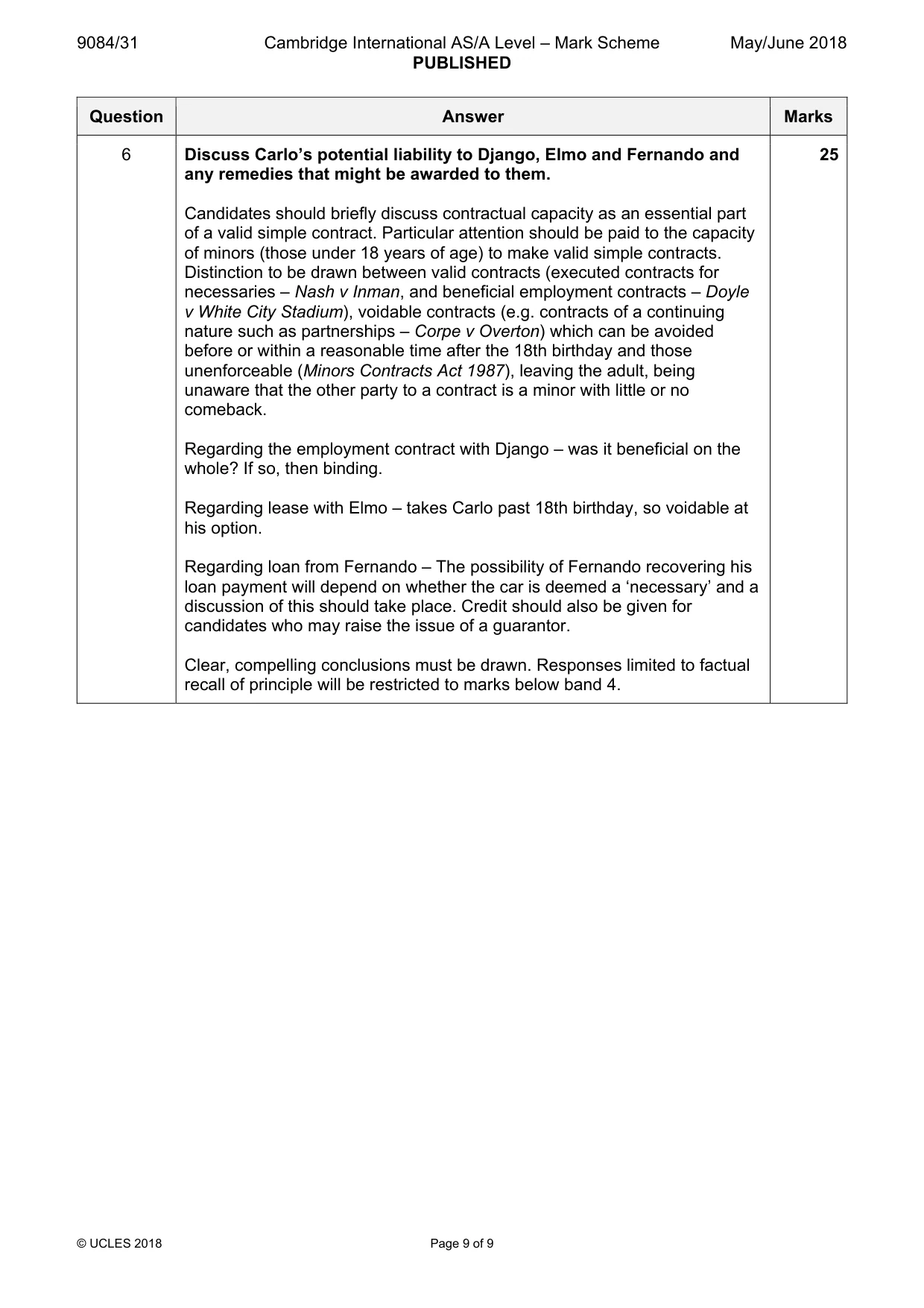
9084/31 Cambridge International AS/A Level – Mark Scheme PUBLISHED May/June 2018 © UCLES 2018 Page 9 of 9 Question Answer Marks 6 Discuss Carlo’s potential liability to Django, Elmo and Fernando and any remedies that might be awarded to them. Candidates should briefly discuss contractual capacity as an essential part of a valid simple contract. Particular attention should be paid to the capacity of minors (those under 18 years of age) to make valid simple contracts. Distinction to be drawn between valid contracts (executed contracts for necessaries – Nash v Inman, and beneficial employment contracts – Doyle v White City Stadium), voidable contracts (e.g. contracts of a continuing nature such as partnerships – Corpe v Overton) which can be avoided before or within a reasonable time after the 18th birthday and those unenforceable (Minors Contracts Act 1987), leaving the adult, being unaware that the other party to a contract is a minor with little or no comeback. Regarding the employment contract with Django – was it beneficial on the whole? If so, then binding. Regarding lease with Elmo – takes Carlo past 18th birthday, so voidable at his option. Regarding loan from Fernando – The possibility of Fernando recovering his loan payment will depend on whether the car is deemed a ‘necessary’ and a discussion of this should take place. Credit should also be given for candidates who may raise the issue of a guarantor. Clear, compelling conclusions must be drawn. Responses limited to factual recall of principle will be restricted to marks below band 4. 25
What you needed in this session
Cambridge’s own grade thresholds for 2018 May/June, Paper 3 · Variant 1. A higher threshold means an easier paper — the bar moves with how the cohort did.