Cambridge A Level Law 9084 — 2015 Oct/Nov Paper 2 · Variant 2
9084/22/O/N/15
The question paper and its mark scheme, free to read here and free to download. This is Cambridge’s own paper, exactly as it was sat.
Question paper4 pages
Mark scheme
No mark scheme is in the library for this paper.
Paper as text
Question paper, page 1
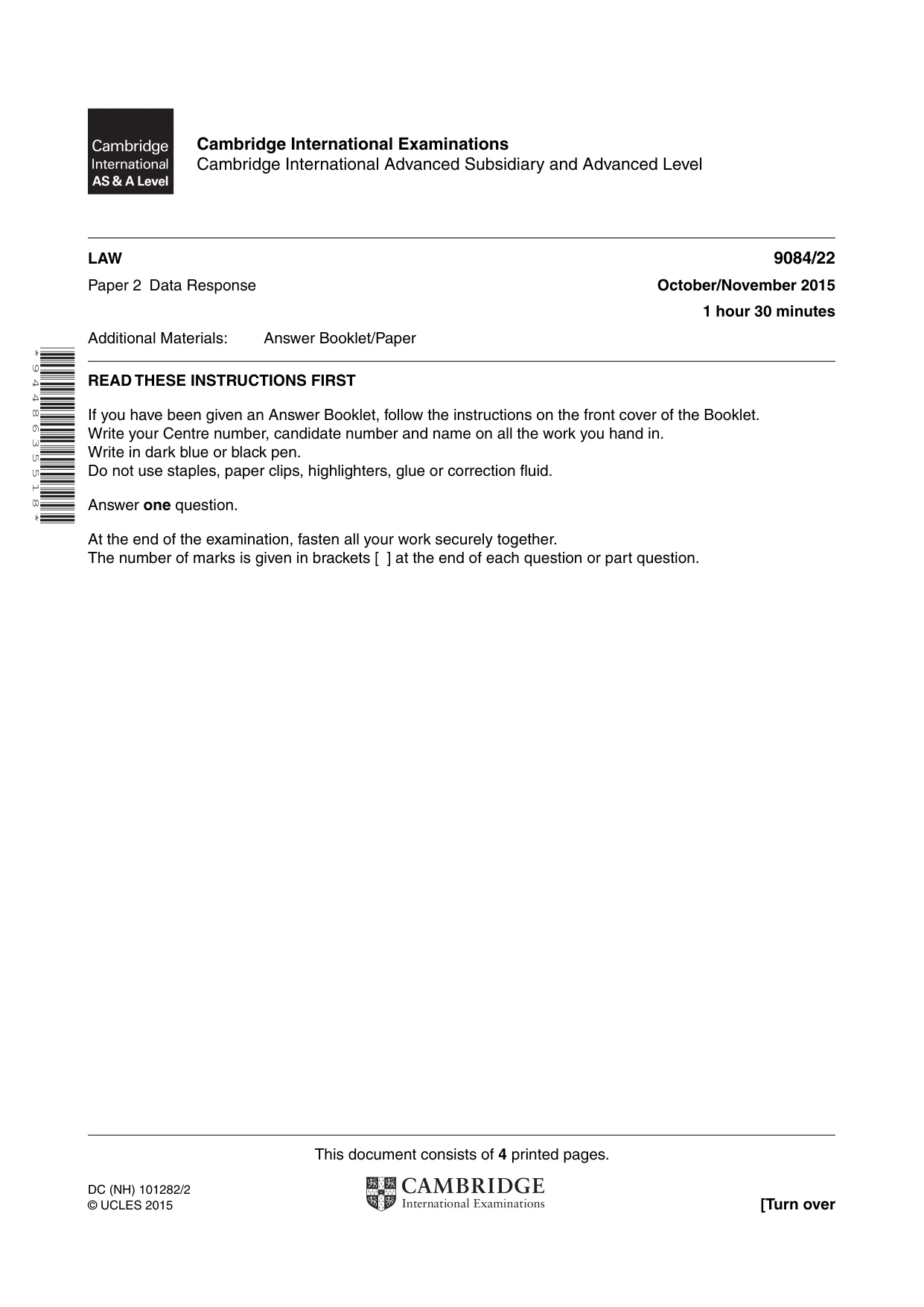
This document consists of 4 printed pages. DC (NH) 101282/2 © UCLES 2015 [Turn over * 9 4 4 8 6 3 5 5 1 8 * LAW 9084/22 Paper 2 Data Response October/November 2015 1 hour 30 minutes Additional Materials: Answer Booklet/Paper READ THESE INSTRUCTIONS FIRST If you have been given an Answer Booklet, follow the instructions on the front cover of the Booklet. Write your Centre number, candidate number and name on all the work you hand in. Write in dark blue or black pen. Do not use staples, paper clips, highlighters, glue or correction fluid. Answer one question. At the end of the examination, fasten all your work securely together. The number of marks is given in brackets [ ] at the end of each question or part question. Cambridge International Examinations Cambridge International Advanced Subsidiary and Advanced Level
Question paper, page 2
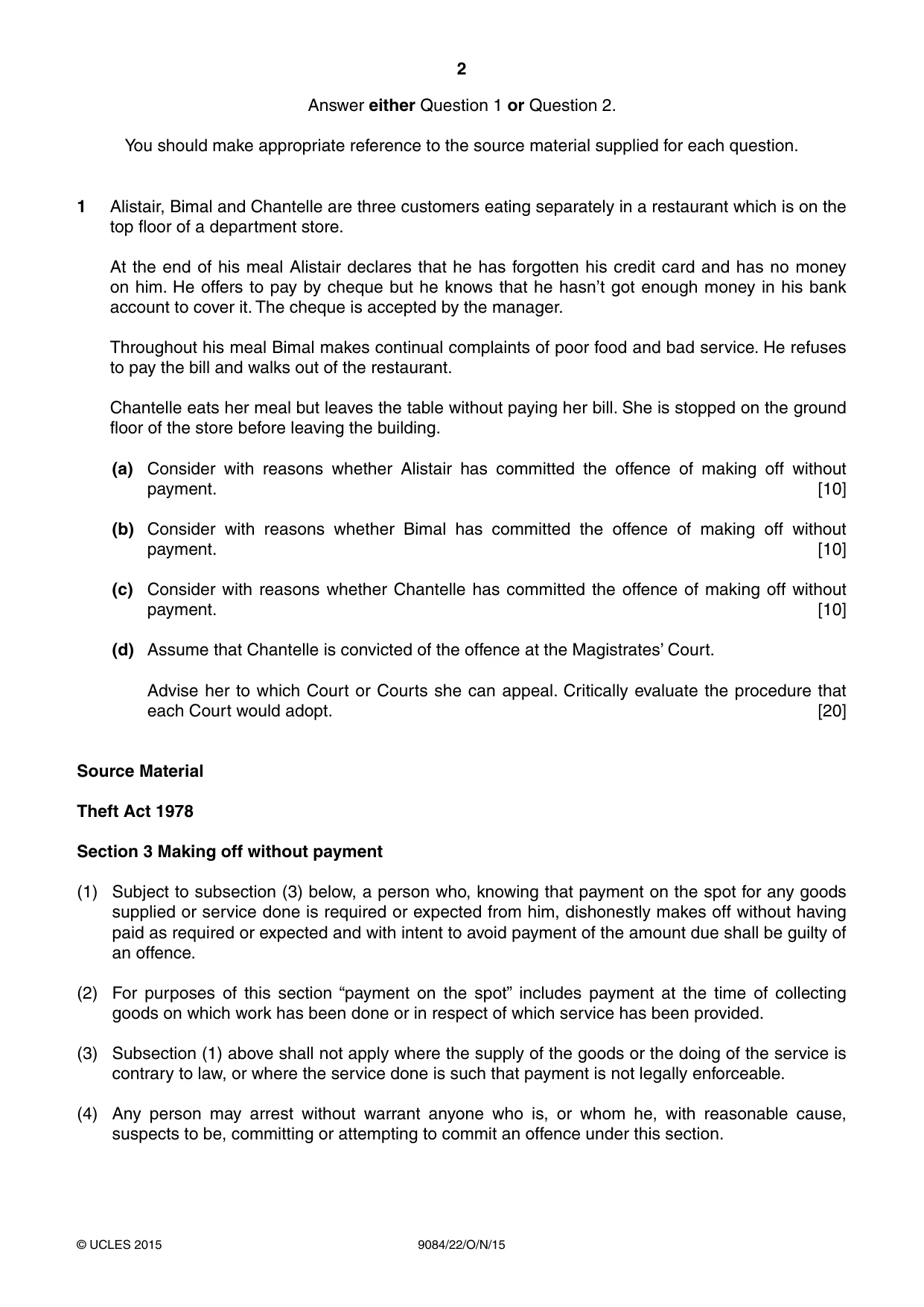
2 9084/22/O/N/15 © UCLES 2015 Answer either Question 1 or Question 2. You should make appropriate reference to the source material supplied for each question. 1 Alistair, Bimal and Chantelle are three customers eating separately in a restaurant which is on the top floor of a department store. At the end of his meal Alistair declares that he has forgotten his credit card and has no money on him. He offers to pay by cheque but he knows that he hasn’t got enough money in his bank account to cover it. The cheque is accepted by the manager. Throughout his meal Bimal makes continual complaints of poor food and bad service. He refuses to pay the bill and walks out of the restaurant. Chantelle eats her meal but leaves the table without paying her bill. She is stopped on the ground floor of the store before leaving the building. (a) Consider with reasons whether Alistair has committed the offence of making off without payment. [10] (b) Consider with reasons whether Bimal has committed the offence of making off without payment. [10] (c) Consider with reasons whether Chantelle has committed the offence of making off without payment. [10] (d) Assume that Chantelle is convicted of the offence at the Magistrates’ Court. Advise her to which Court or Courts she can appeal. Critically evaluate the procedure that each Court would adopt. [20] Source Material Theft Act 1978 Section 3 Making off without payment (1) Subject to subsection (3) below, a person who, knowing that payment on the spot for any goods supplied or service done is required or expected from him, dishonestly makes off without having paid as required or expected and with intent to avoid payment of the amount due shall be guilty of an offence. (2) For purposes of this section “payment on the spot” includes payment at the time of collecting goods on which work has been done or in respect of which service has been provided. (3) Subsection (1) above shall not apply where the supply of the goods or the doing of the service is contrary to law, or where the service done is such that payment is not legally enforceable. (4) Any person may arrest without warrant anyone who is, or whom he, with reasonable cause, suspects to be, committing or attempting to commit an offence under this section.
Question paper, page 3
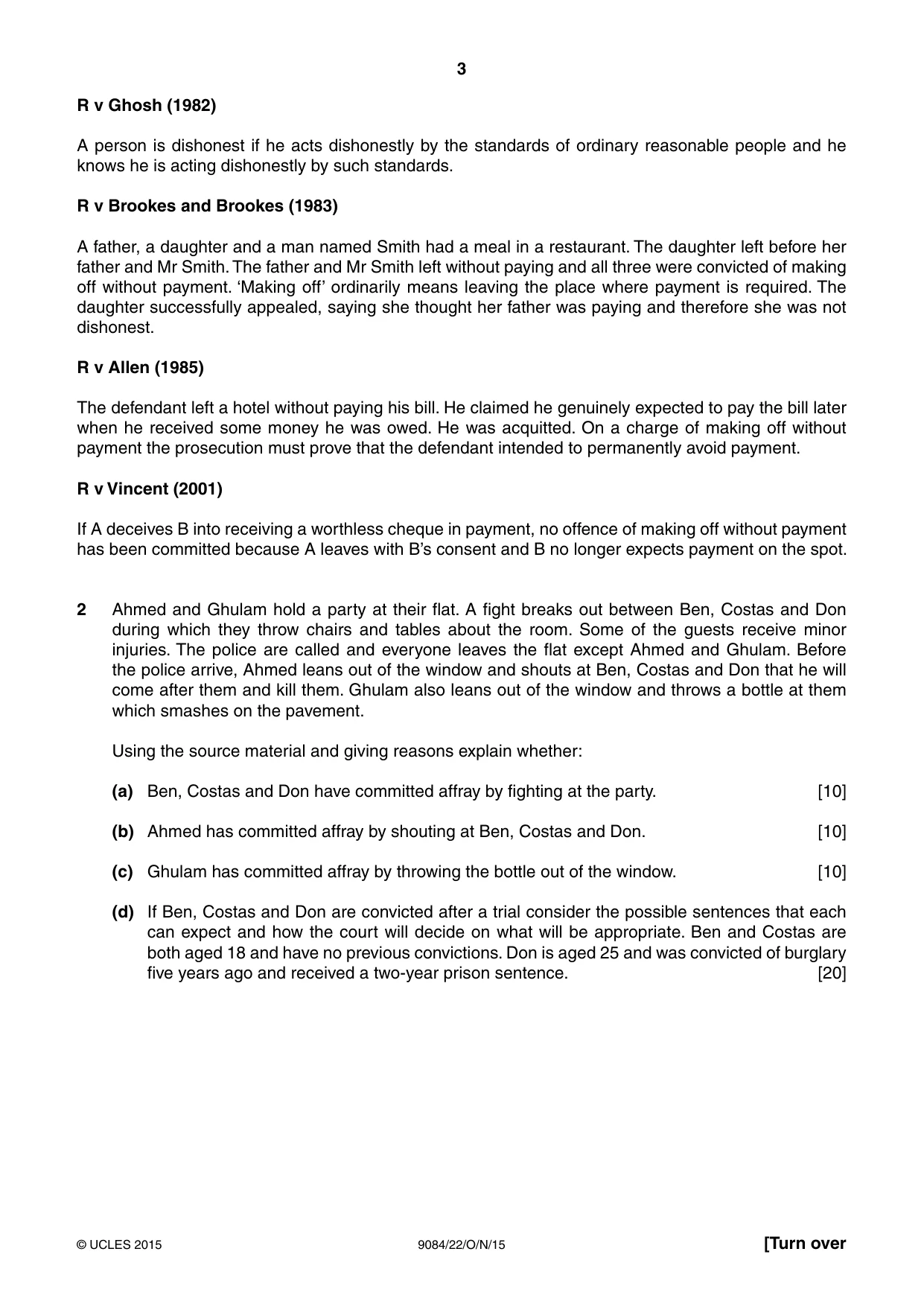
3 9084/22/O/N/15 © UCLES 2015 [Turn over R v Ghosh (1982) A person is dishonest if he acts dishonestly by the standards of ordinary reasonable people and he knows he is acting dishonestly by such standards. R v Brookes and Brookes (1983) A father, a daughter and a man named Smith had a meal in a restaurant. The daughter left before her father and Mr Smith. The father and Mr Smith left without paying and all three were convicted of making off without payment. ‘Making off’ ordinarily means leaving the place where payment is required. The daughter successfully appealed, saying she thought her father was paying and therefore she was not dishonest. R v Allen (1985) The defendant left a hotel without paying his bill. He claimed he genuinely expected to pay the bill later when he received some money he was owed. He was acquitted. On a charge of making off without payment the prosecution must prove that the defendant intended to permanently avoid payment. R v Vincent (2001) If A deceives B into receiving a worthless cheque in payment, no offence of making off without payment has been committed because A leaves with B’s consent and B no longer expects payment on the spot. 2 Ahmed and Ghulam hold a party at their flat. A fight breaks out between Ben, Costas and Don during which they throw chairs and tables about the room. Some of the guests receive minor injuries. The police are called and everyone leaves the flat except Ahmed and Ghulam. Before the police arrive, Ahmed leans out of the window and shouts at Ben, Costas and Don that he will come after them and kill them. Ghulam also leans out of the window and throws a bottle at them which smashes on the pavement. Using the source material and giving reasons explain whether: (a) Ben, Costas and Don have committed affray by fighting at the party. [10] (b) Ahmed has committed affray by shouting at Ben, Costas and Don. [10] (c) Ghulam has committed affray by throwing the bottle out of the window. [10] (d) If Ben, Costas and Don are convicted after a trial consider the possible sentences that each can expect and how the court will decide on what will be appropriate. Ben and Costas are both aged 18 and have no previous convictions. Don is aged 25 and was convicted of burglary five years ago and received a two-year prison sentence. [20]
Question paper, page 4
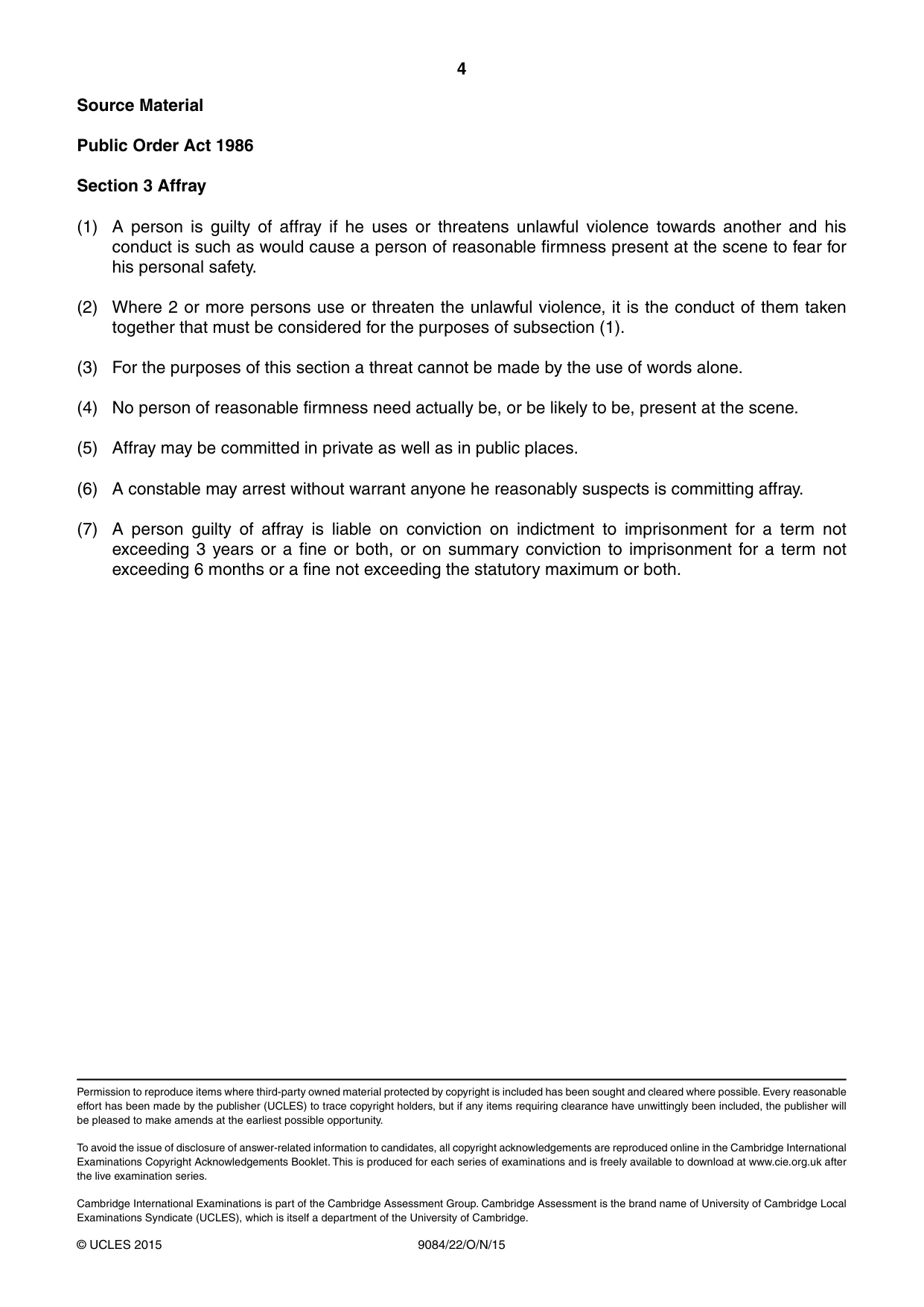
4 9084/22/O/N/15 © UCLES 2015 Source Material Public Order Act 1986 Section 3 Affray (1) A person is guilty of affray if he uses or threatens unlawful violence towards another and his conduct is such as would cause a person of reasonable firmness present at the scene to fear for his personal safety. (2) Where 2 or more persons use or threaten the unlawful violence, it is the conduct of them taken together that must be considered for the purposes of subsection (1). (3) For the purposes of this section a threat cannot be made by the use of words alone. (4) No person of reasonable firmness need actually be, or be likely to be, present at the scene. (5) Affray may be committed in private as well as in public places. (6) A constable may arrest without warrant anyone he reasonably suspects is committing affray. (7) A person guilty of affray is liable on conviction on indictment to imprisonment for a term not exceeding 3 years or a fine or both, or on summary conviction to imprisonment for a term not exceeding 6 months or a fine not exceeding the statutory maximum or both. Permission to reproduce items where third-party owned material protected by copyright is included has been sought and cleared where possible. Every reasonable effort has been made by the publisher (UCLES) to trace copyright holders, but if any items requiring clearance have unwittingly been included, the publisher will be pleased to make amends at the earliest possible opportunity. To avoid the issue of disclosure of answer-related information to candidates, all copyright acknowledgements are reproduced online in the Cambridge International Examinations Copyright Acknowledgements Booklet. This is produced for each series of examinations and is freely available to download at www.cie.org.uk after the live examination series. Cambridge International Examinations is part of the Cambridge Assessment Group. Cambridge Assessment is the brand name of University of Cambridge Local Examinations Syndicate (UCLES), which is itself a department of the University of Cambridge.