Cambridge A Level Law 9084 — 2015 Oct/Nov Paper 2 · Variant 1
9084/21/O/N/15
The question paper and its mark scheme, free to read here and free to download. This is Cambridge’s own paper, exactly as it was sat.
Question paper4 pages
Mark scheme5 pages
Answers below. Sit the paper first if you are practising.
Paper as text
Question paper, page 1
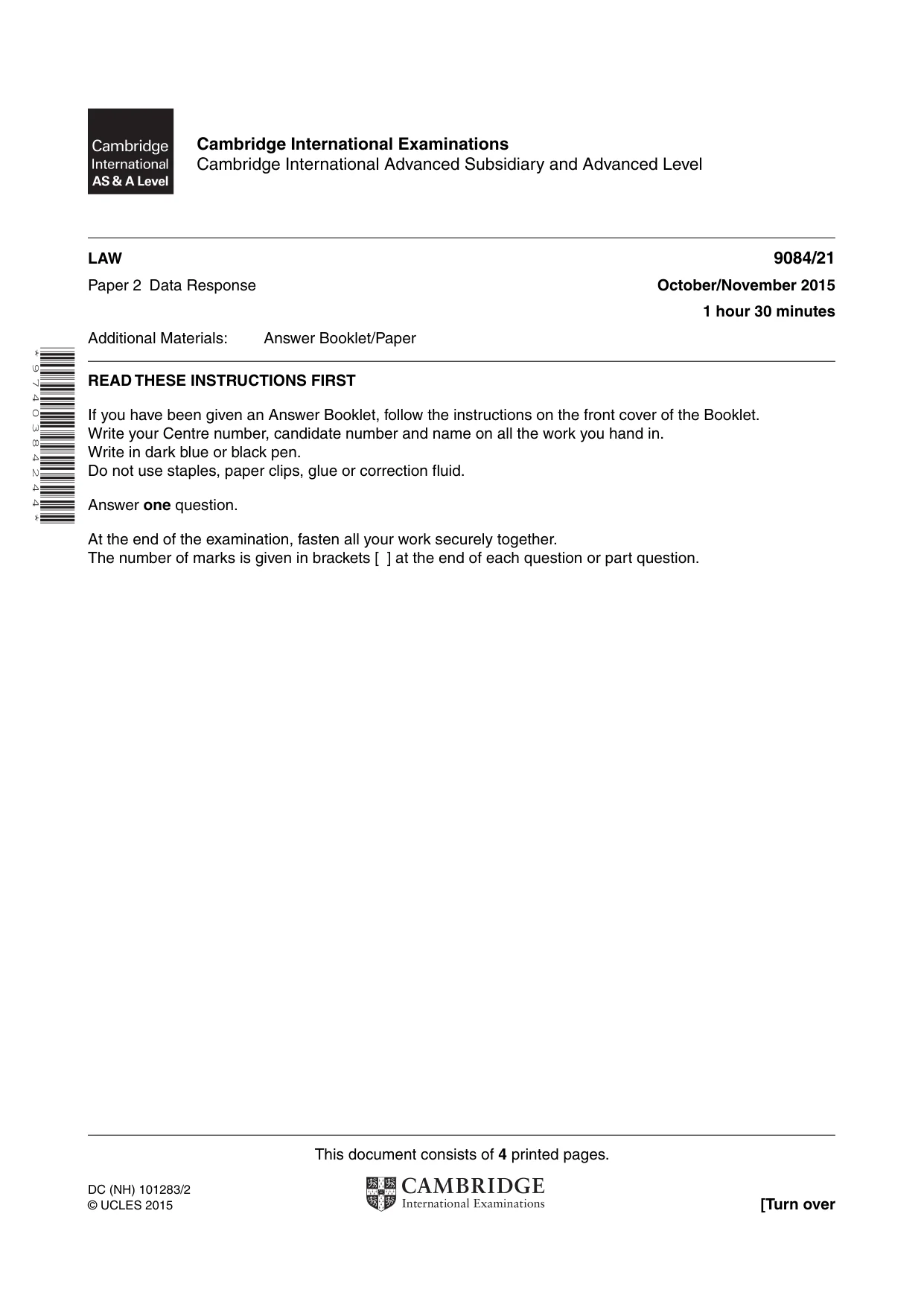
This document consists of 4 printed pages. DC (NH) 101283/2 © UCLES 2015 [Turn over * 9 7 4 0 3 8 4 2 4 4 * LAW 9084/21 Paper 2 Data Response October/November 2015 1 hour 30 minutes Additional Materials: Answer Booklet/Paper READ THESE INSTRUCTIONS FIRST If you have been given an Answer Booklet, follow the instructions on the front cover of the Booklet. Write your Centre number, candidate number and name on all the work you hand in. Write in dark blue or black pen. Do not use staples, paper clips, glue or correction fluid. Answer one question. At the end of the examination, fasten all your work securely together. The number of marks is given in brackets [ ] at the end of each question or part question. Cambridge International Examinations Cambridge International Advanced Subsidiary and Advanced Level
Question paper, page 2
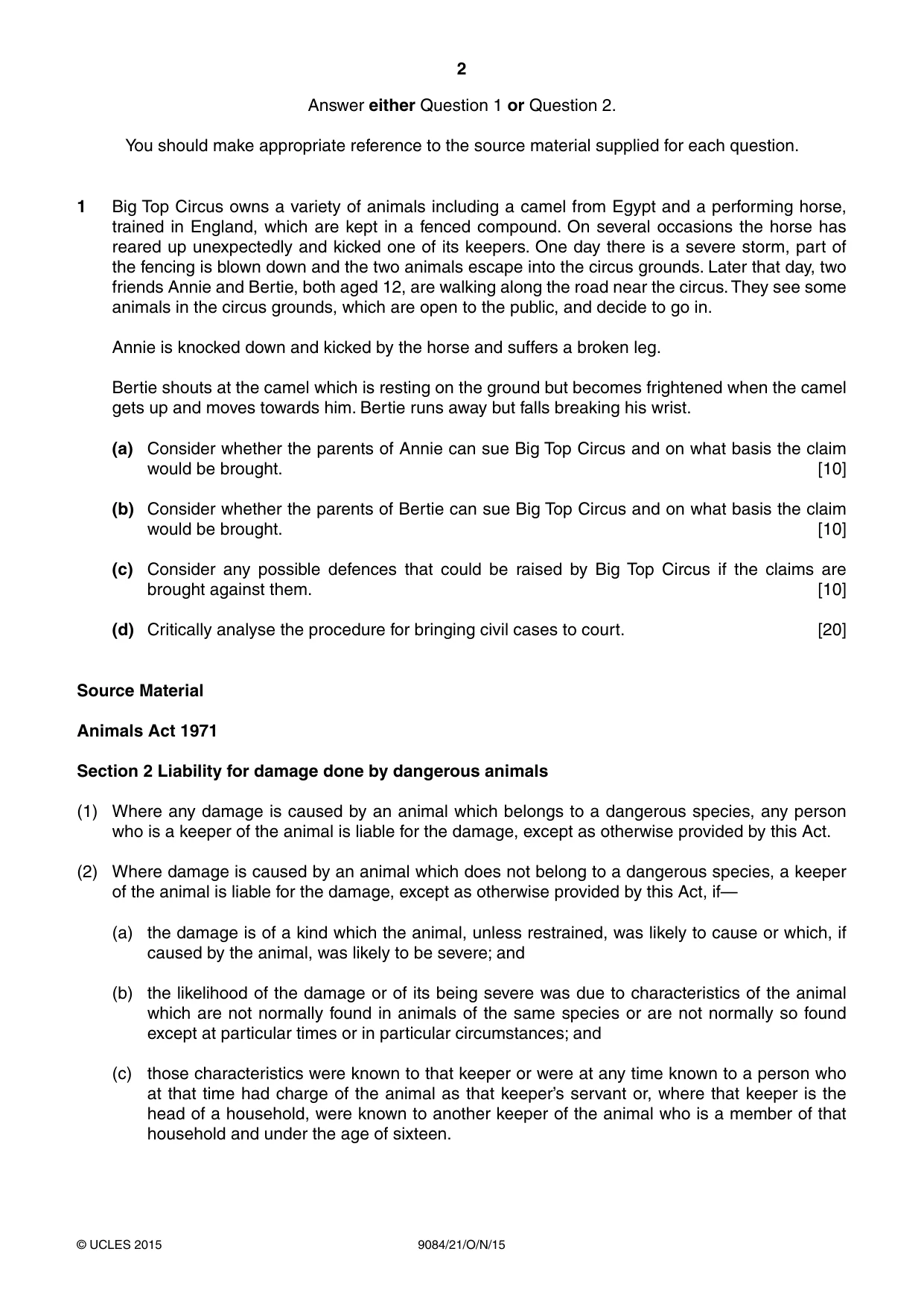
2 9084/21/O/N/15 © UCLES 2015 Answer either Question 1 or Question 2. You should make appropriate reference to the source material supplied for each question. 1 Big Top Circus owns a variety of animals including a camel from Egypt and a performing horse, trained in England, which are kept in a fenced compound. On several occasions the horse has reared up unexpectedly and kicked one of its keepers. One day there is a severe storm, part of the fencing is blown down and the two animals escape into the circus grounds. Later that day, two friends Annie and Bertie, both aged 12, are walking along the road near the circus. They see some animals in the circus grounds, which are open to the public, and decide to go in. Annie is knocked down and kicked by the horse and suffers a broken leg. Bertie shouts at the camel which is resting on the ground but becomes frightened when the camel gets up and moves towards him. Bertie runs away but falls breaking his wrist. (a) Consider whether the parents of Annie can sue Big Top Circus and on what basis the claim would be brought. [10] (b) Consider whether the parents of Bertie can sue Big Top Circus and on what basis the claim would be brought. [10] (c) Consider any possible defences that could be raised by Big Top Circus if the claims are brought against them. [10] (d) Critically analyse the procedure for bringing civil cases to court. [20] Source Material Animals Act 1971 Section 2 Liability for damage done by dangerous animals (1) Where any damage is caused by an animal which belongs to a dangerous species, any person who is a keeper of the animal is liable for the damage, except as otherwise provided by this Act. (2) Where damage is caused by an animal which does not belong to a dangerous species, a keeper of the animal is liable for the damage, except as otherwise provided by this Act, if— (a) the damage is of a kind which the animal, unless restrained, was likely to cause or which, if caused by the animal, was likely to be severe; and (b) the likelihood of the damage or of its being severe was due to characteristics of the animal which are not normally found in animals of the same species or are not normally so found except at particular times or in particular circumstances; and (c) those characteristics were known to that keeper or were at any time known to a person who at that time had charge of the animal as that keeper’s servant or, where that keeper is the head of a household, were known to another keeper of the animal who is a member of that household and under the age of sixteen.
Question paper, page 3
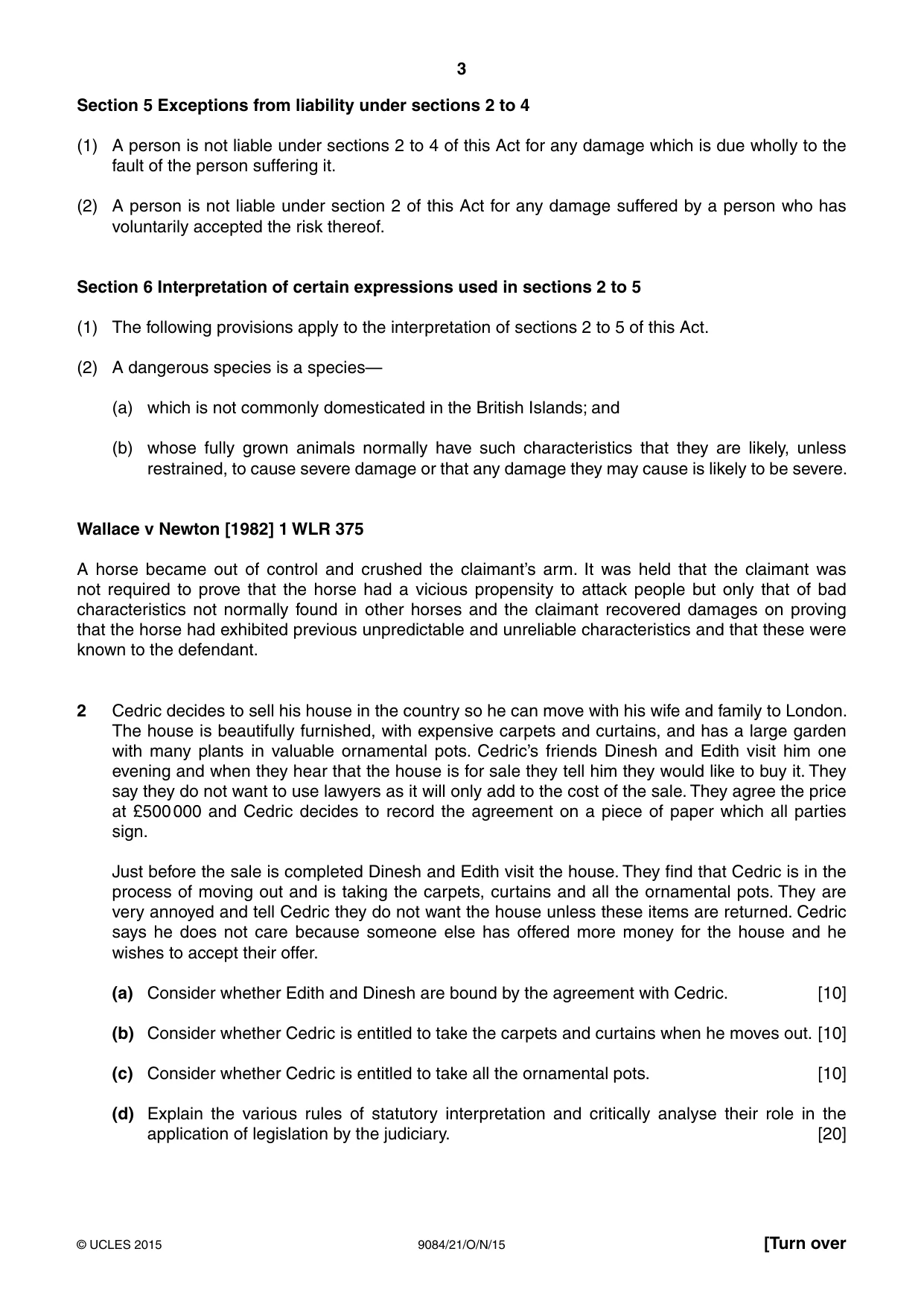
3 9084/21/O/N/15 © UCLES 2015 [Turn over Section 5 Exceptions from liability under sections 2 to 4 (1) A person is not liable under sections 2 to 4 of this Act for any damage which is due wholly to the fault of the person suffering it. (2) A person is not liable under section 2 of this Act for any damage suffered by a person who has voluntarily accepted the risk thereof. Section 6 Interpretation of certain expressions used in sections 2 to 5 (1) The following provisions apply to the interpretation of sections 2 to 5 of this Act. (2) A dangerous species is a species— (a) which is not commonly domesticated in the British Islands; and (b) whose fully grown animals normally have such characteristics that they are likely, unless restrained, to cause severe damage or that any damage they may cause is likely to be severe. Wallace v Newton [1982] 1 WLR 375 A horse became out of control and crushed the claimant’s arm. It was held that the claimant was not required to prove that the horse had a vicious propensity to attack people but only that of bad characteristics not normally found in other horses and the claimant recovered damages on proving that the horse had exhibited previous unpredictable and unreliable characteristics and that these were known to the defendant. 2 Cedric decides to sell his house in the country so he can move with his wife and family to London. The house is beautifully furnished, with expensive carpets and curtains, and has a large garden with many plants in valuable ornamental pots. Cedric’s friends Dinesh and Edith visit him one evening and when they hear that the house is for sale they tell him they would like to buy it. They say they do not want to use lawyers as it will only add to the cost of the sale. They agree the price at £500 000 and Cedric decides to record the agreement on a piece of paper which all parties sign. Just before the sale is completed Dinesh and Edith visit the house. They find that Cedric is in the process of moving out and is taking the carpets, curtains and all the ornamental pots. They are very annoyed and tell Cedric they do not want the house unless these items are returned. Cedric says he does not care because someone else has offered more money for the house and he wishes to accept their offer. (a) Consider whether Edith and Dinesh are bound by the agreement with Cedric. [10] (b) Consider whether Cedric is entitled to take the carpets and curtains when he moves out. [10] (c) Consider whether Cedric is entitled to take all the ornamental pots. [10] (d) Explain the various rules of statutory interpretation and critically analyse their role in the application of legislation by the judiciary. [20]
Question paper, page 4
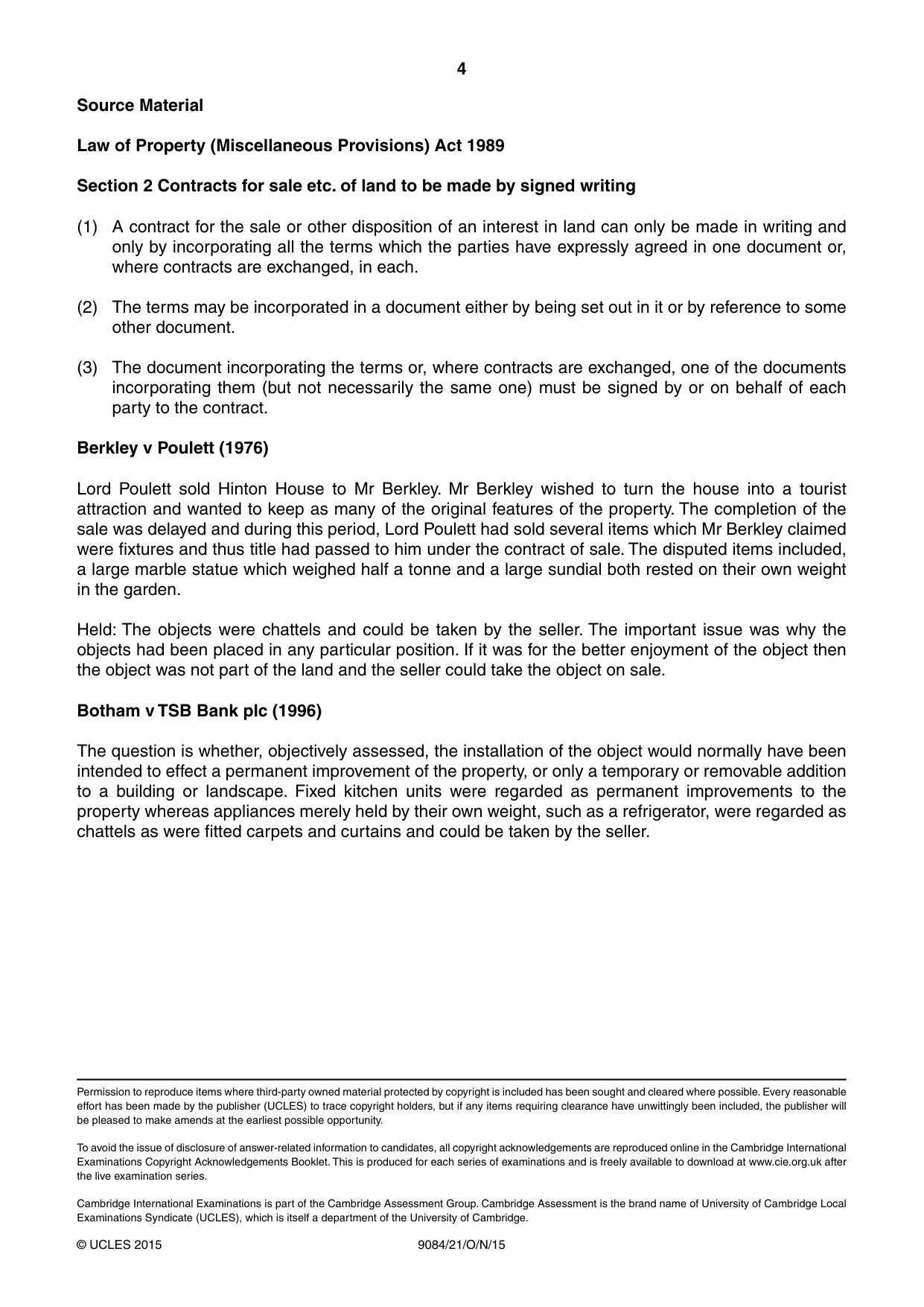
4 9084/21/O/N/15 © UCLES 2015 Source Material Law of Property (Miscellaneous Provisions) Act 1989 Section 2 Contracts for sale etc. of land to be made by signed writing (1) A contract for the sale or other disposition of an interest in land can only be made in writing and only by incorporating all the terms which the parties have expressly agreed in one document or, where contracts are exchanged, in each. (2) The terms may be incorporated in a document either by being set out in it or by reference to some other document. (3) The document incorporating the terms or, where contracts are exchanged, one of the documents incorporating them (but not necessarily the same one) must be signed by or on behalf of each party to the contract. Berkley v Poulett (1976) Lord Poulett sold Hinton House to Mr Berkley. Mr Berkley wished to turn the house into a tourist attraction and wanted to keep as many of the original features of the property. The completion of the sale was delayed and during this period, Lord Poulett had sold several items which Mr Berkley claimed were fixtures and thus title had passed to him under the contract of sale. The disputed items included, a large marble statue which weighed half a tonne and a large sundial both rested on their own weight in the garden. Held: The objects were chattels and could be taken by the seller. The important issue was why the objects had been placed in any particular position. If it was for the better enjoyment of the object then the object was not part of the land and the seller could take the object on sale. Botham v TSB Bank plc (1996) The question is whether, objectively assessed, the installation of the object would normally have been intended to effect a permanent improvement of the property, or only a temporary or removable addition to a building or landscape. Fixed kitchen units were regarded as permanent improvements to the property whereas appliances merely held by their own weight, such as a refrigerator, were regarded as chattels as were fitted carpets and curtains and could be taken by the seller. Permission to reproduce items where third-party owned material protected by copyright is included has been sought and cleared where possible. Every reasonable effort has been made by the publisher (UCLES) to trace copyright holders, but if any items requiring clearance have unwittingly been included, the publisher will be pleased to make amends at the earliest possible opportunity. To avoid the issue of disclosure of answer-related information to candidates, all copyright acknowledgements are reproduced online in the Cambridge International Examinations Copyright Acknowledgements Booklet. This is produced for each series of examinations and is freely available to download at www.cie.org.uk after the live examination series. Cambridge International Examinations is part of the Cambridge Assessment Group. Cambridge Assessment is the brand name of University of Cambridge Local Examinations Syndicate (UCLES), which is itself a department of the University of Cambridge.
Mark scheme, page 1
® IGCSE is the registered trademark of Cambridge International Examinations. CAMBRIDGE INTERNATIONAL EXAMINATIONS Cambridge International Advanced Subsidiary and Advanced Level MARK SCHEME for the October/November 2015 series 9084 LAW 9084/21 Paper 2, maximum raw mark 50 This mark scheme is published as an aid to teachers and candidates, to indicate the requirements of the examination. It shows the basis on which Examiners were instructed to award marks. It does not indicate the details of the discussions that took place at an Examiners’ meeting before marking began, which would have considered the acceptability of alternative answers. Mark schemes should be read in conjunction with the question paper and the Principal Examiner Report for Teachers. Cambridge will not enter into discussions about these mark schemes. Cambridge is publishing the mark schemes for the October/November 2015 series for most Cambridge IGCSE®, Cambridge International A and AS Level components and some Cambridge O Level components.
Mark scheme, page 2
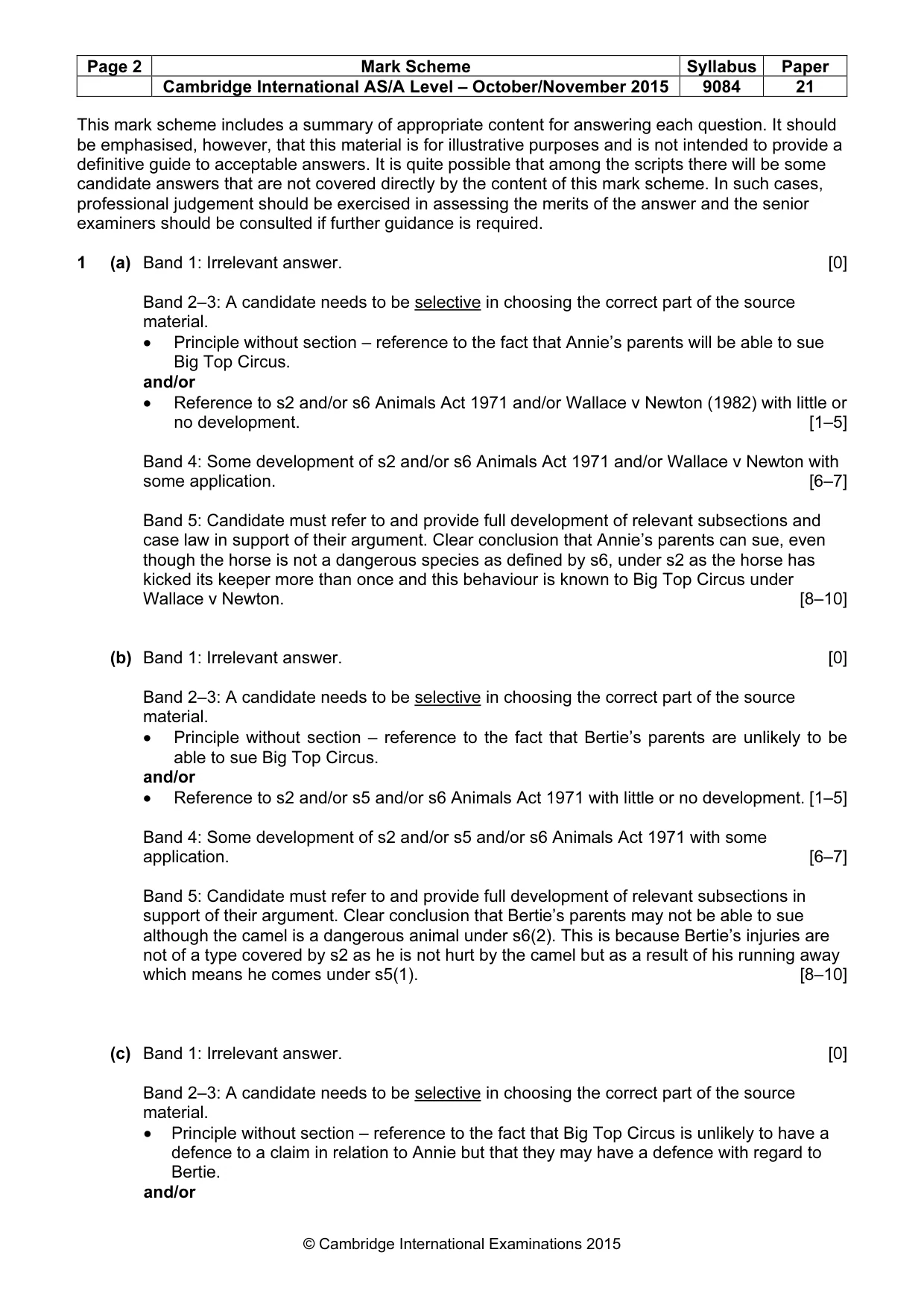
Page 2 Mark Scheme Syllabus Paper Cambridge International AS/A Level – October/November 2015 9084 21 © Cambridge International Examinations 2015 This mark scheme includes a summary of appropriate content for answering each question. It should be emphasised, however, that this material is for illustrative purposes and is not intended to provide a definitive guide to acceptable answers. It is quite possible that among the scripts there will be some candidate answers that are not covered directly by the content of this mark scheme. In such cases, professional judgement should be exercised in assessing the merits of the answer and the senior examiners should be consulted if further guidance is required. 1 (a) Band 1: Irrelevant answer. [0] Band 2–3: A candidate needs to be selective in choosing the correct part of the source material. • Principle without section – reference to the fact that Annie’s parents will be able to sue Big Top Circus. and/or • Reference to s2 and/or s6 Animals Act 1971 and/or Wallace v Newton (1982) with little or no development. [1–5] Band 4: Some development of s2 and/or s6 Animals Act 1971 and/or Wallace v Newton with some application. [6–7] Band 5: Candidate must refer to and provide full development of relevant subsections and case law in support of their argument. Clear conclusion that Annie’s parents can sue, even though the horse is not a dangerous species as defined by s6, under s2 as the horse has kicked its keeper more than once and this behaviour is known to Big Top Circus under Wallace v Newton. [8–10] (b) Band 1: Irrelevant answer. [0] Band 2–3: A candidate needs to be selective in choosing the correct part of the source material. • Principle without section – reference to the fact that Bertie’s parents are unlikely to be able to sue Big Top Circus. and/or • Reference to s2 and/or s5 and/or s6 Animals Act 1971 with little or no development. [1–5] Band 4: Some development of s2 and/or s5 and/or s6 Animals Act 1971 with some application. [6–7] Band 5: Candidate must refer to and provide full development of relevant subsections in support of their argument. Clear conclusion that Bertie’s parents may not be able to sue although the camel is a dangerous animal under s6(2). This is because Bertie’s injuries are not of a type covered by s2 as he is not hurt by the camel but as a result of his running away which means he comes under s5(1). [8–10] (c) Band 1: Irrelevant answer. [0] Band 2–3: A candidate needs to be selective in choosing the correct part of the source material. • Principle without section – reference to the fact that Big Top Circus is unlikely to have a defence to a claim in relation to Annie but that they may have a defence with regard to Bertie. and/or
Mark scheme, page 3
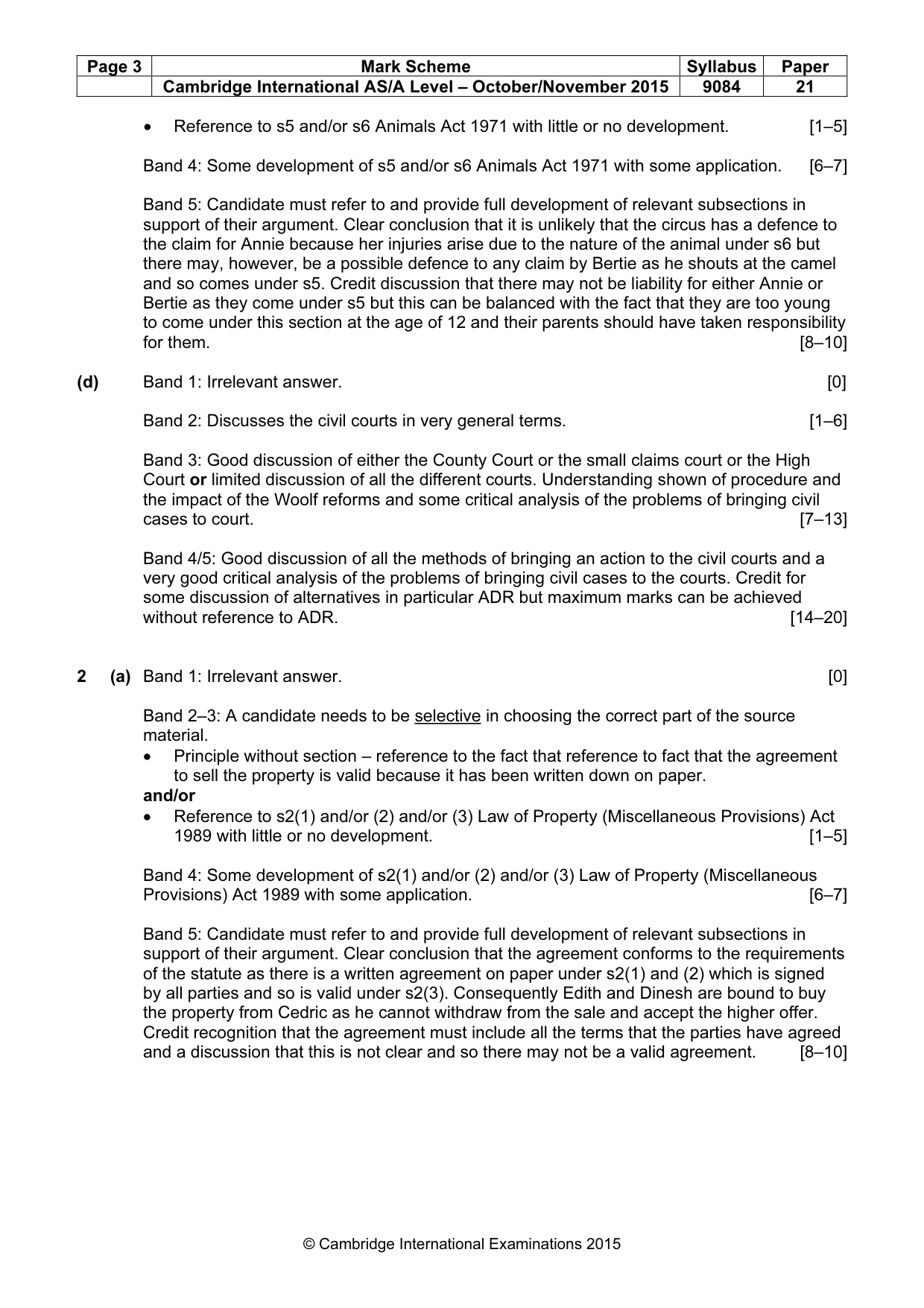
Page 3 Mark Scheme Syllabus Paper Cambridge International AS/A Level – October/November 2015 9084 21 © Cambridge International Examinations 2015 • Reference to s5 and/or s6 Animals Act 1971 with little or no development. [1–5] Band 4: Some development of s5 and/or s6 Animals Act 1971 with some application. [6–7] Band 5: Candidate must refer to and provide full development of relevant subsections in support of their argument. Clear conclusion that it is unlikely that the circus has a defence to the claim for Annie because her injuries arise due to the nature of the animal under s6 but there may, however, be a possible defence to any claim by Bertie as he shouts at the camel and so comes under s5. Credit discussion that there may not be liability for either Annie or Bertie as they come under s5 but this can be balanced with the fact that they are too young to come under this section at the age of 12 and their parents should have taken responsibility for them. [8–10] (d) Band 1: Irrelevant answer. [0] Band 2: Discusses the civil courts in very general terms. [1–6] Band 3: Good discussion of either the County Court or the small claims court or the High Court or limited discussion of all the different courts. Understanding shown of procedure and the impact of the Woolf reforms and some critical analysis of the problems of bringing civil cases to court. [7–13] Band 4/5: Good discussion of all the methods of bringing an action to the civil courts and a very good critical analysis of the problems of bringing civil cases to the courts. Credit for some discussion of alternatives in particular ADR but maximum marks can be achieved without reference to ADR. [14–20] 2 (a) Band 1: Irrelevant answer. [0] Band 2–3: A candidate needs to be selective in choosing the correct part of the source material. • Principle without section – reference to the fact that reference to fact that the agreement to sell the property is valid because it has been written down on paper. and/or • Reference to s2(1) and/or (2) and/or (3) Law of Property (Miscellaneous Provisions) Act 1989 with little or no development. [1–5] Band 4: Some development of s2(1) and/or (2) and/or (3) Law of Property (Miscellaneous Provisions) Act 1989 with some application. [6–7] Band 5: Candidate must refer to and provide full development of relevant subsections in support of their argument. Clear conclusion that the agreement conforms to the requirements of the statute as there is a written agreement on paper under s2(1) and (2) which is signed by all parties and so is valid under s2(3). Consequently Edith and Dinesh are bound to buy the property from Cedric as he cannot withdraw from the sale and accept the higher offer. Credit recognition that the agreement must include all the terms that the parties have agreed and a discussion that this is not clear and so there may not be a valid agreement. [8–10]
Mark scheme, page 4
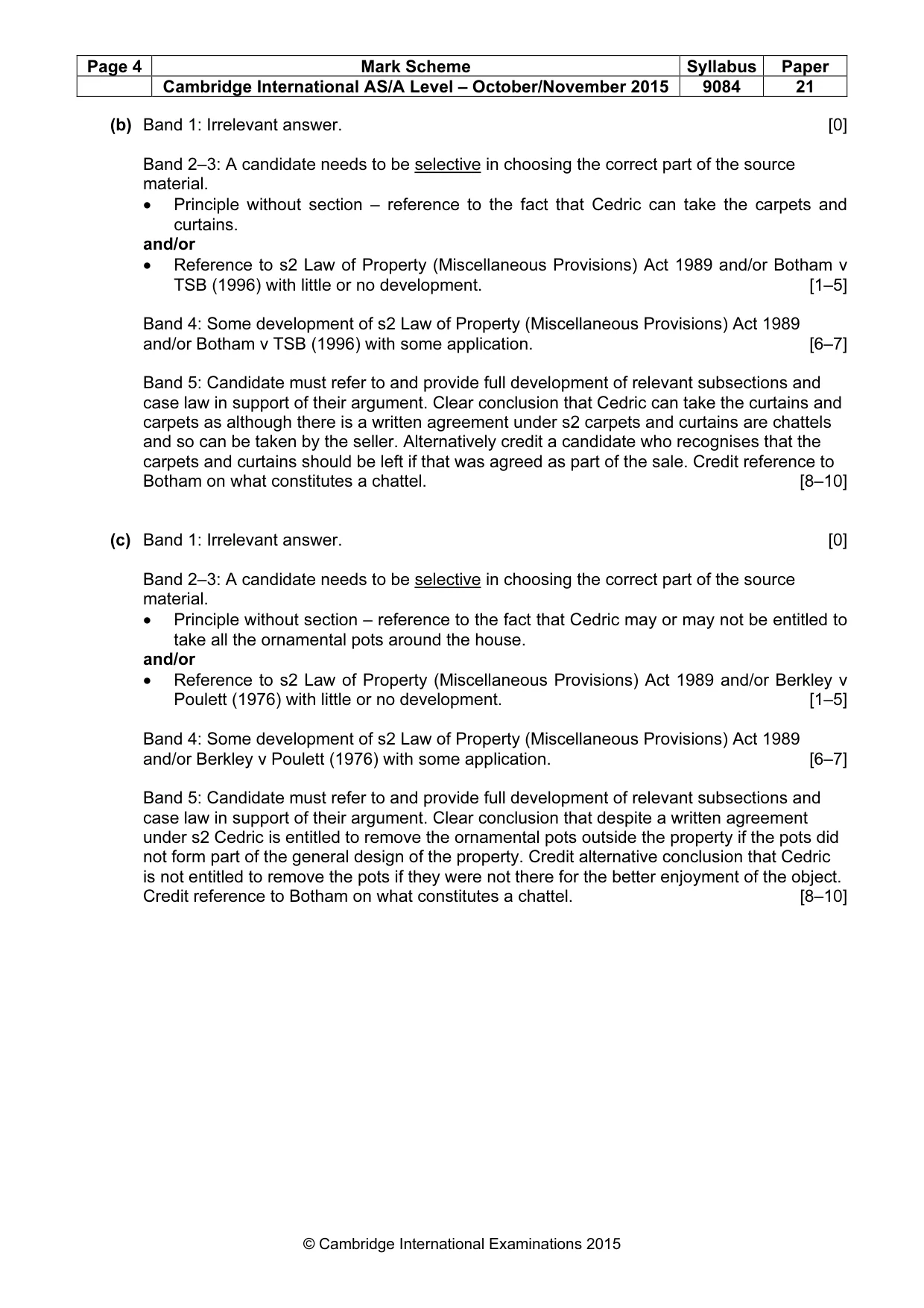
Page 4 Mark Scheme Syllabus Paper Cambridge International AS/A Level – October/November 2015 9084 21 © Cambridge International Examinations 2015 (b) Band 1: Irrelevant answer. [0] Band 2–3: A candidate needs to be selective in choosing the correct part of the source material. • Principle without section – reference to the fact that Cedric can take the carpets and curtains. and/or • Reference to s2 Law of Property (Miscellaneous Provisions) Act 1989 and/or Botham v TSB (1996) with little or no development. [1–5] Band 4: Some development of s2 Law of Property (Miscellaneous Provisions) Act 1989 and/or Botham v TSB (1996) with some application. [6–7] Band 5: Candidate must refer to and provide full development of relevant subsections and case law in support of their argument. Clear conclusion that Cedric can take the curtains and carpets as although there is a written agreement under s2 carpets and curtains are chattels and so can be taken by the seller. Alternatively credit a candidate who recognises that the carpets and curtains should be left if that was agreed as part of the sale. Credit reference to Botham on what constitutes a chattel. [8–10] (c) Band 1: Irrelevant answer. [0] Band 2–3: A candidate needs to be selective in choosing the correct part of the source material. • Principle without section – reference to the fact that Cedric may or may not be entitled to take all the ornamental pots around the house. and/or • Reference to s2 Law of Property (Miscellaneous Provisions) Act 1989 and/or Berkley v Poulett (1976) with little or no development. [1–5] Band 4: Some development of s2 Law of Property (Miscellaneous Provisions) Act 1989 and/or Berkley v Poulett (1976) with some application. [6–7] Band 5: Candidate must refer to and provide full development of relevant subsections and case law in support of their argument. Clear conclusion that despite a written agreement under s2 Cedric is entitled to remove the ornamental pots outside the property if the pots did not form part of the general design of the property. Credit alternative conclusion that Cedric is not entitled to remove the pots if they were not there for the better enjoyment of the object. Credit reference to Botham on what constitutes a chattel. [8–10]
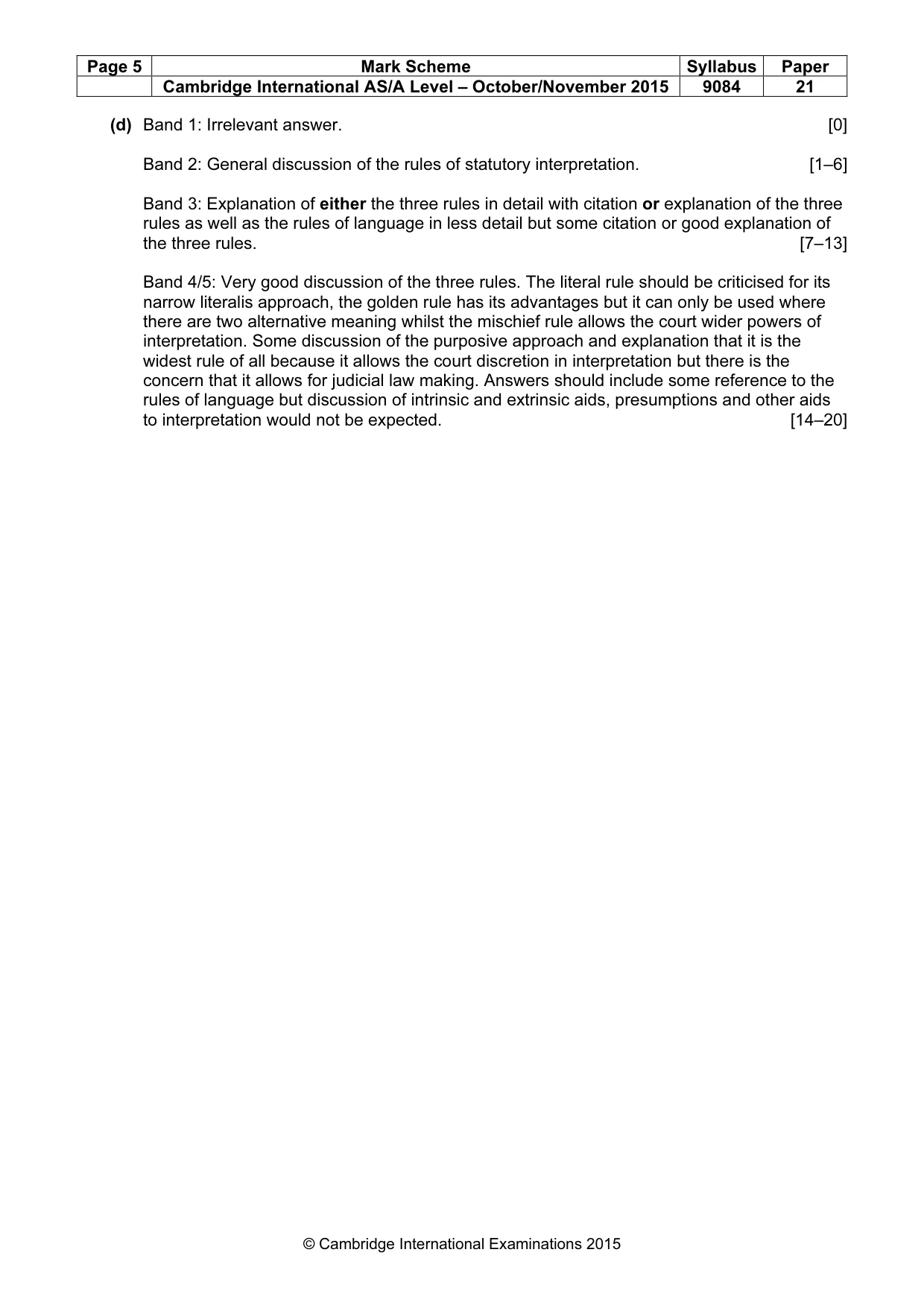
Mark scheme, page 5
Page 5 Mark Scheme Syllabus Paper Cambridge International AS/A Level – October/November 2015 9084 21 © Cambridge International Examinations 2015 (d) Band 1: Irrelevant answer. [0] Band 2: General discussion of the rules of statutory interpretation. [1–6] Band 3: Explanation of either the three rules in detail with citation or explanation of the three rules as well as the rules of language in less detail but some citation or good explanation of the three rules. [7–13] Band 4/5: Very good discussion of the three rules. The literal rule should be criticised for its narrow literalis approach, the golden rule has its advantages but it can only be used where there are two alternative meaning whilst the mischief rule allows the court wider powers of interpretation. Some discussion of the purposive approach and explanation that it is the widest rule of all because it allows the court discretion in interpretation but there is the concern that it allows for judicial law making. Answers should include some reference to the rules of language but discussion of intrinsic and extrinsic aids, presumptions and other aids to interpretation would not be expected. [14–20]