Cambridge A Level Law 9084 — 2014 Oct/Nov Paper 2 · Variant 2
9084/22/O/N/14 · 50 marks · ≈56 min
The question paper and its mark scheme, free to read here and free to download. This is Cambridge’s own paper, exactly as it was sat.
Question paper4 pages

Mark scheme5 pages
Answers below. Sit the paper first if you are practising.
Paper as text
Question paper, page 1
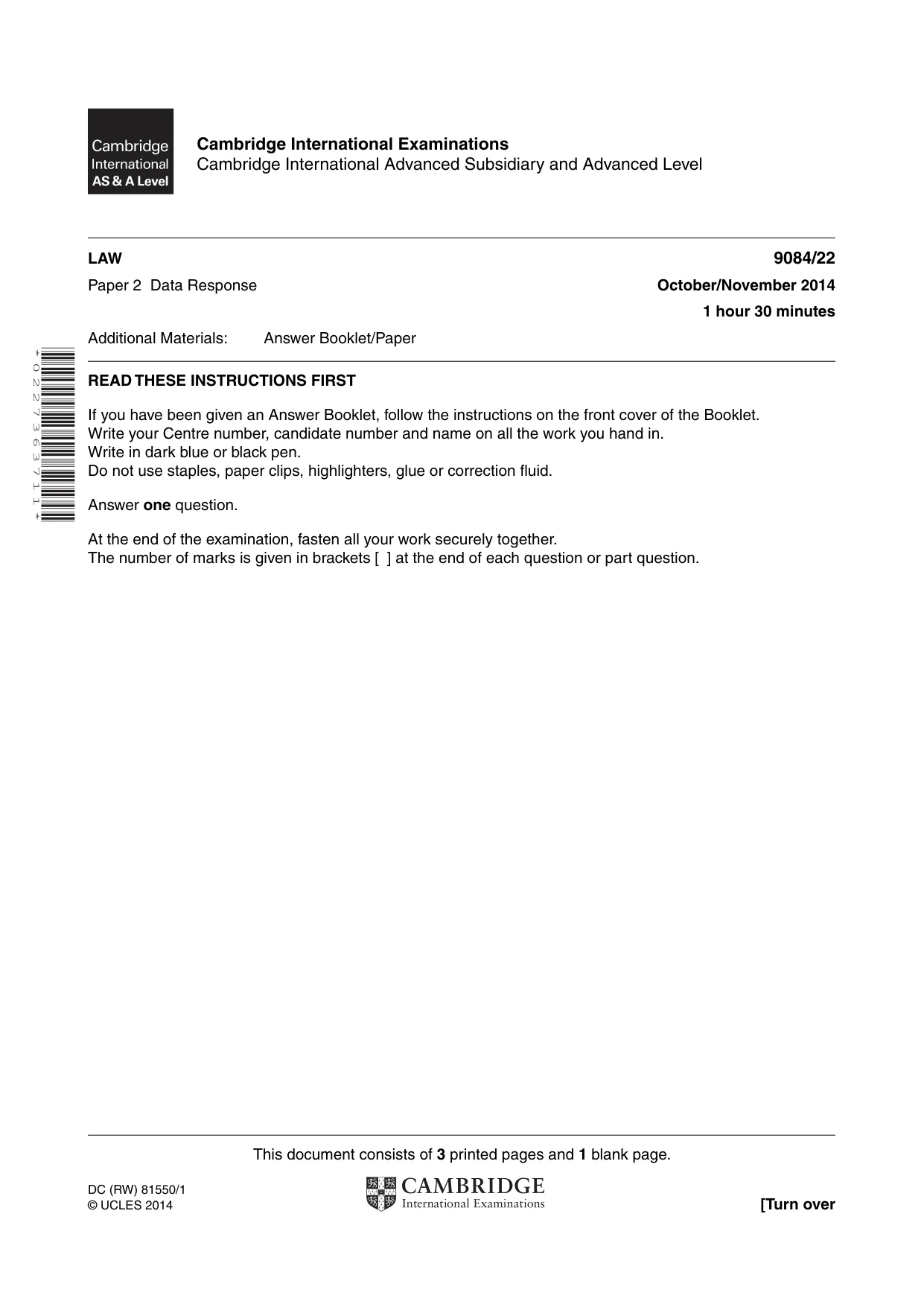
This document consists of 3 printed pages and 1 blank page. DC (RW) 81550/1 © UCLES 2014 [Turn over Cambridge International Examinations Cambridge International Advanced Subsidiary and Advanced Level * 0 2 2 7 3 6 3 7 1 1 * LAW 9084/22 Paper 2 Data Response October/November 2014 1 hour 30 minutes Additional Materials: Answer Booklet/Paper READ THESE INSTRUCTIONS FIRST If you have been given an Answer Booklet, follow the instructions on the front cover of the Booklet. Write your Centre number, candidate number and name on all the work you hand in. Write in dark blue or black pen. Do not use staples, paper clips, highlighters, glue or correction fluid. Answer one question. At the end of the examination, fasten all your work securely together. The number of marks is given in brackets [ ] at the end of each question or part question.
Question paper, page 2
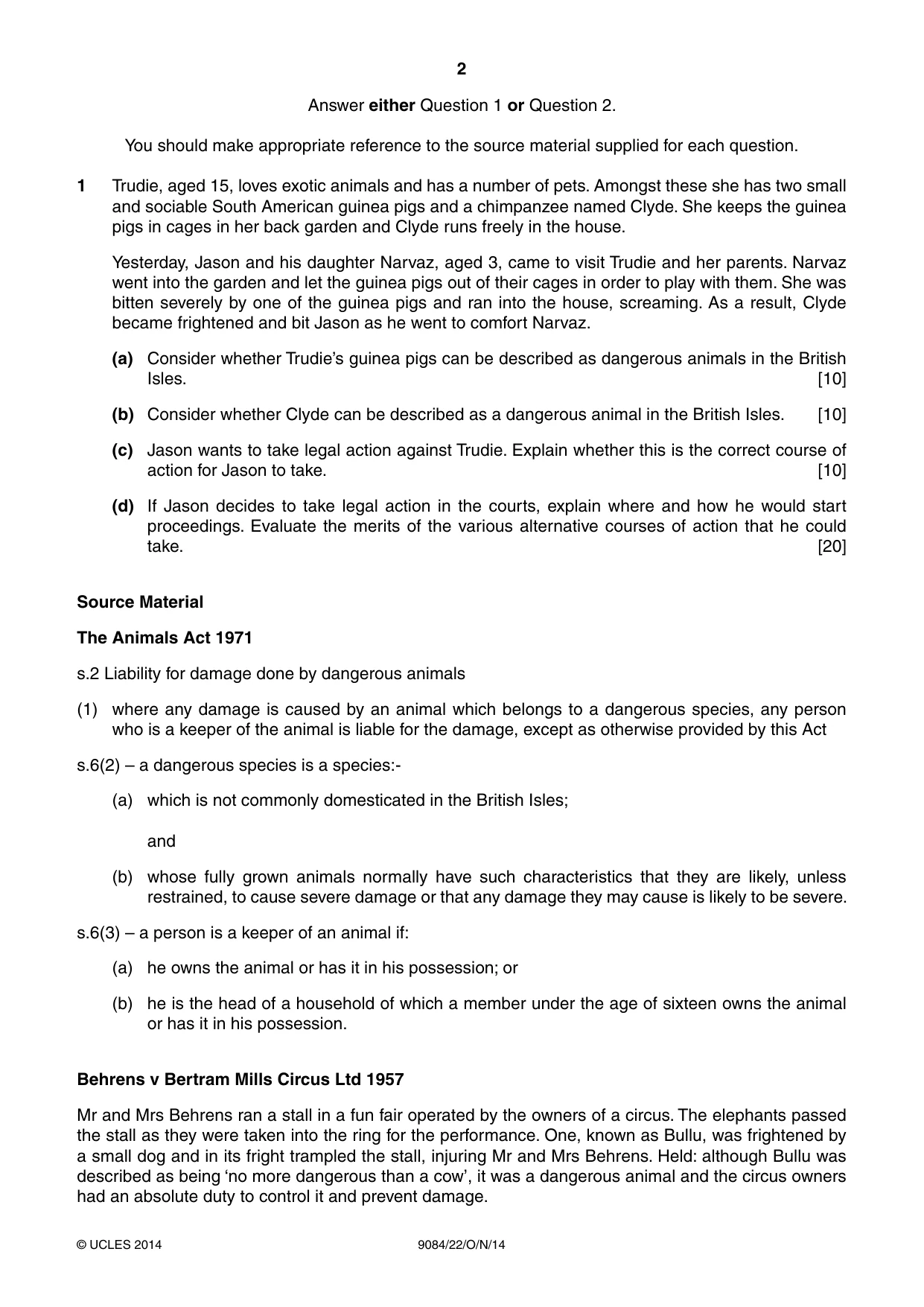
2 9084/22/O/N/14 © UCLES 2014 Answer either Question 1 or Question 2. You should make appropriate reference to the source material supplied for each question. 1 Trudie, aged 15, loves exotic animals and has a number of pets. Amongst these she has two small and sociable South American guinea pigs and a chimpanzee named Clyde. She keeps the guinea pigs in cages in her back garden and Clyde runs freely in the house. Yesterday, Jason and his daughter Narvaz, aged 3, came to visit Trudie and her parents. Narvaz went into the garden and let the guinea pigs out of their cages in order to play with them. She was bitten severely by one of the guinea pigs and ran into the house, screaming. As a result, Clyde became frightened and bit Jason as he went to comfort Narvaz. (a) Consider whether Trudie’s guinea pigs can be described as dangerous animals in the British Isles. [10] (b) Consider whether Clyde can be described as a dangerous animal in the British Isles. [10] (c) Jason wants to take legal action against Trudie. Explain whether this is the correct course of action for Jason to take. [10] (d) If Jason decides to take legal action in the courts, explain where and how he would start proceedings. Evaluate the merits of the various alternative courses of action that he could take. [20] Source Material The Animals Act 1971 s.2 Liability for damage done by dangerous animals (1) where any damage is caused by an animal which belongs to a dangerous species, any person who is a keeper of the animal is liable for the damage, except as otherwise provided by this Act s.6(2) – a dangerous species is a species:- (a) which is not commonly domesticated in the British Isles; and (b) whose fully grown animals normally have such characteristics that they are likely, unless restrained, to cause severe damage or that any damage they may cause is likely to be severe. s.6(3) – a person is a keeper of an animal if: (a) he owns the animal or has it in his possession; or (b) he is the head of a household of which a member under the age of sixteen owns the animal or has it in his possession. Behrens v Bertram Mills Circus Ltd 1957 Mr and Mrs Behrens ran a stall in a fun fair operated by the owners of a circus. The elephants passed the stall as they were taken into the ring for the performance. One, known as Bullu, was frightened by a small dog and in its fright trampled the stall, injuring Mr and Mrs Behrens. Held: although Bullu was described as being ‘no more dangerous than a cow’, it was a dangerous animal and the circus owners had an absolute duty to control it and prevent damage.
Question paper, page 3
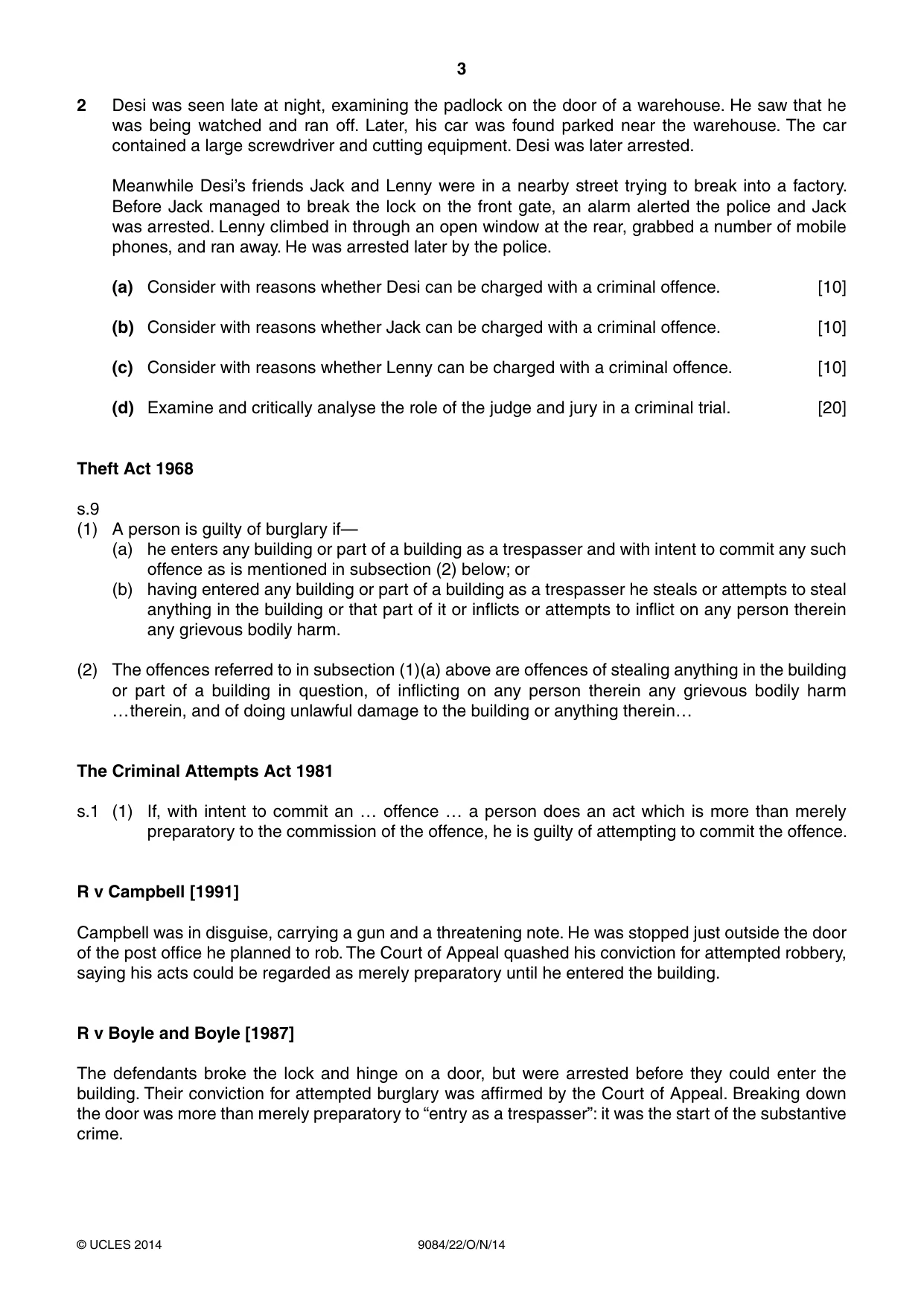
3 9084/22/O/N/14 © UCLES 2014 2 Desi was seen late at night, examining the padlock on the door of a warehouse. He saw that he was being watched and ran off. Later, his car was found parked near the warehouse. The car contained a large screwdriver and cutting equipment. Desi was later arrested. Meanwhile Desi’s friends Jack and Lenny were in a nearby street trying to break into a factory. Before Jack managed to break the lock on the front gate, an alarm alerted the police and Jack was arrested. Lenny climbed in through an open window at the rear, grabbed a number of mobile phones, and ran away. He was arrested later by the police. (a) Consider with reasons whether Desi can be charged with a criminal offence. [10] (b) Consider with reasons whether Jack can be charged with a criminal offence. [10] (c) Consider with reasons whether Lenny can be charged with a criminal offence. [10] (d) Examine and critically analyse the role of the judge and jury in a criminal trial. [20] Theft Act 1968 s.9 (1) A person is guilty of burglary if— (a) he enters any building or part of a building as a trespasser and with intent to commit any such offence as is mentioned in subsection (2) below; or (b) having entered any building or part of a building as a trespasser he steals or attempts to steal anything in the building or that part of it or inflicts or attempts to inflict on any person therein any grievous bodily harm. (2) The offences referred to in subsection (1)(a) above are offences of stealing anything in the building or part of a building in question, of inflicting on any person therein any grievous bodily harm … therein, and of doing unlawful damage to the building or anything therein… The Criminal Attempts Act 1981 s.1 (1) If, with intent to commit an … offence … a person does an act which is more than merely preparatory to the commission of the offence, he is guilty of attempting to commit the offence. R v Campbell [1991] Campbell was in disguise, carrying a gun and a threatening note. He was stopped just outside the door of the post office he planned to rob. The Court of Appeal quashed his conviction for attempted robbery, saying his acts could be regarded as merely preparatory until he entered the building. R v Boyle and Boyle [1987] The defendants broke the lock and hinge on a door, but were arrested before they could enter the building. Their conviction for attempted burglary was affirmed by the Court of Appeal. Breaking down the door was more than merely preparatory to “entry as a trespasser”: it was the start of the substantive crime.
Question paper, page 4
4 9084/22/O/N/14 © UCLES 2014 Permission to reproduce items where third-party owned material protected by copyright is included has been sought and cleared where possible. Every reasonable effort has been made by the publisher (UCLES) to trace copyright holders, but if any items requiring clearance have unwittingly been included, the publisher will be pleased to make amends at the earliest possible opportunity. Cambridge International Examinations is part of the Cambridge Assessment Group. Cambridge Assessment is the brand name of University of Cambridge Local Examinations Syndicate (UCLES), which is itself a department of the University of Cambridge. BLANK PAGE
Mark scheme, page 1
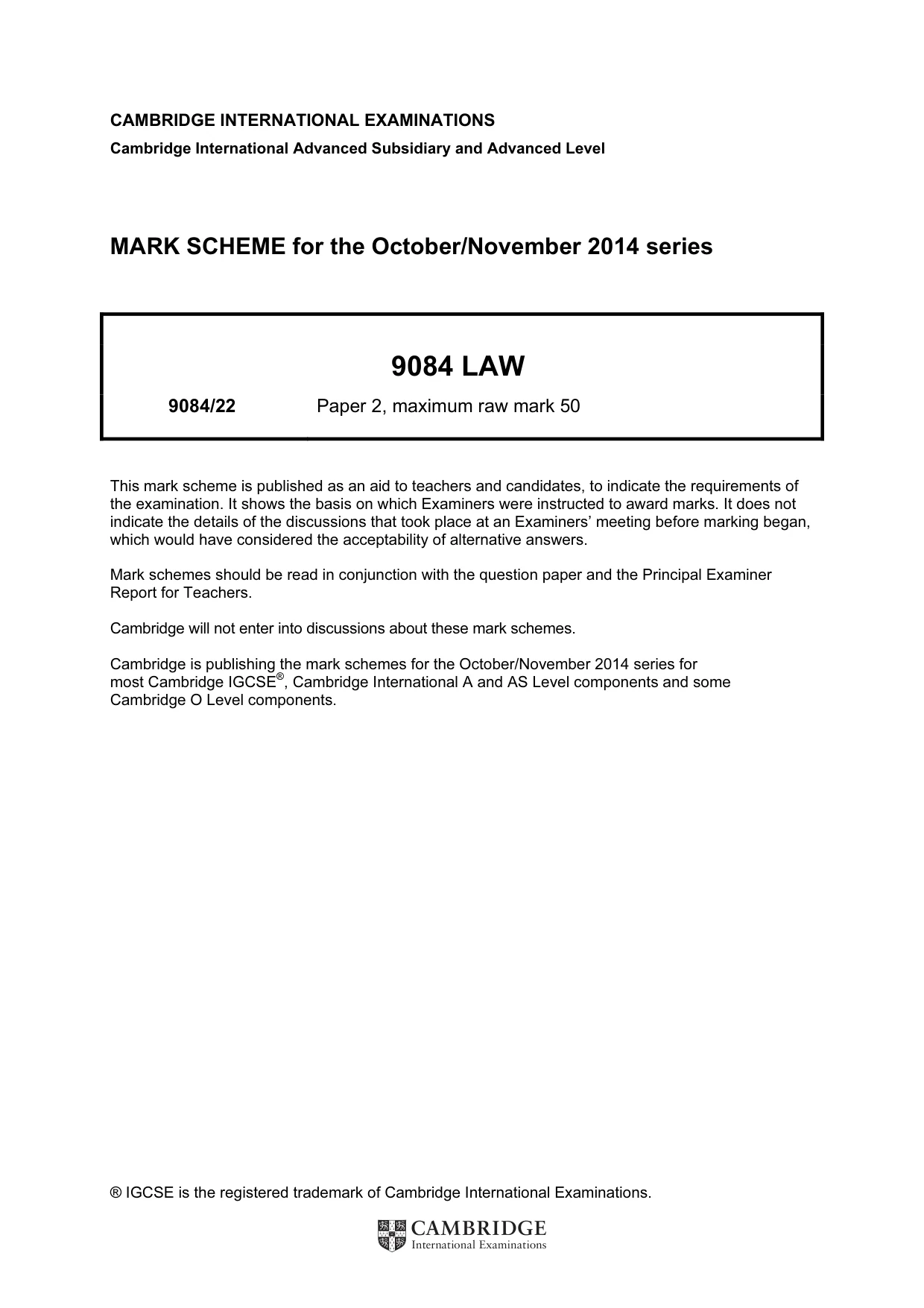
® IGCSE is the registered trademark of Cambridge International Examinations. CAMBRIDGE INTERNATIONAL EXAMINATIONS Cambridge International Advanced Subsidiary and Advanced Level MARK SCHEME for the October/November 2014 series 9084 LAW 9084/22 Paper 2, maximum raw mark 50 This mark scheme is published as an aid to teachers and candidates, to indicate the requirements of the examination. It shows the basis on which Examiners were instructed to award marks. It does not indicate the details of the discussions that took place at an Examiners’ meeting before marking began, which would have considered the acceptability of alternative answers. Mark schemes should be read in conjunction with the question paper and the Principal Examiner Report for Teachers. Cambridge will not enter into discussions about these mark schemes. Cambridge is publishing the mark schemes for the October/November 2014 series for most Cambridge IGCSE®, Cambridge International A and AS Level components and some Cambridge O Level components.
Mark scheme, page 2
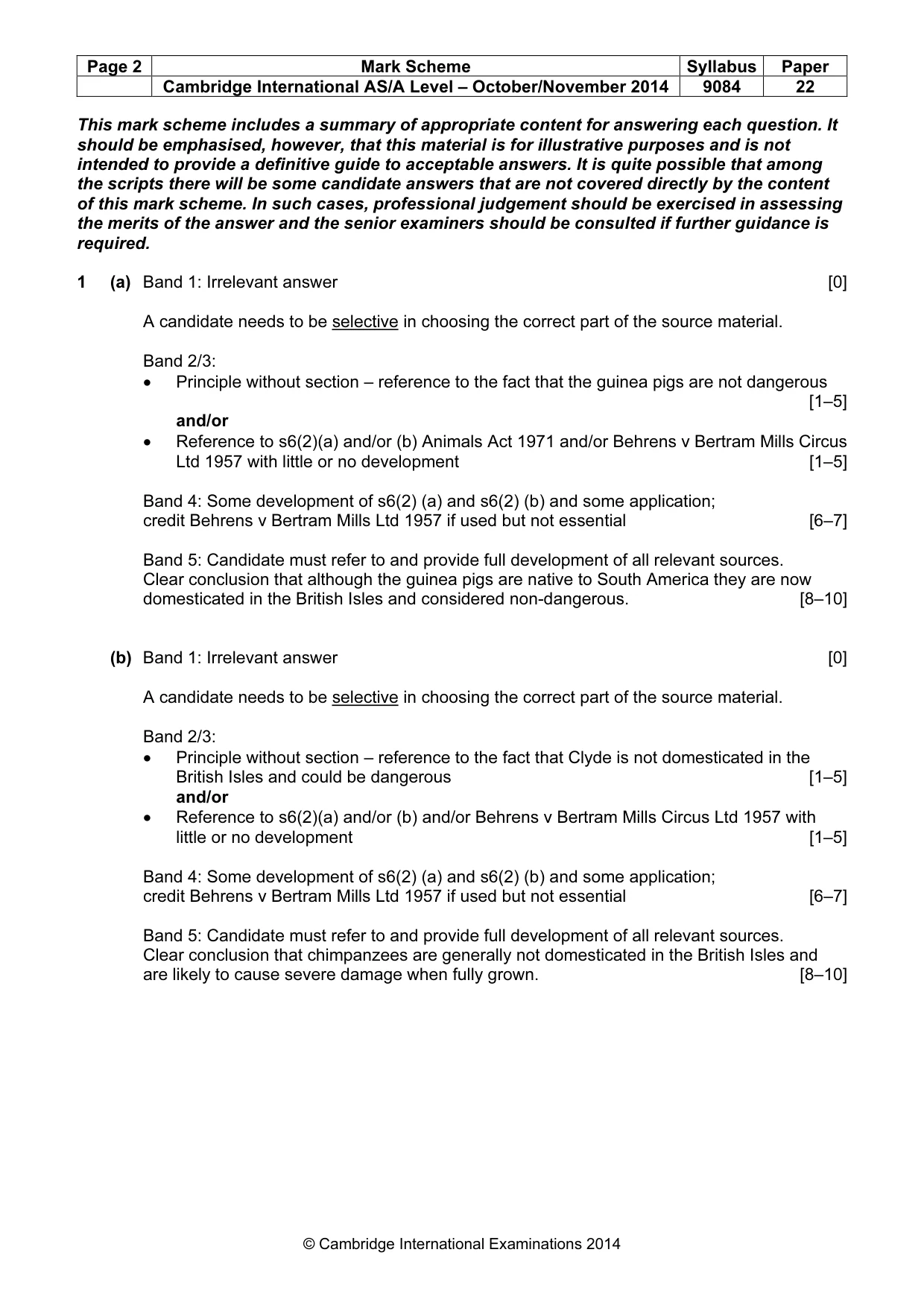
Page 2 Mark Scheme Syllabus Paper Cambridge International AS/A Level – October/November 2014 9084 22 © Cambridge International Examinations 2014 This mark scheme includes a summary of appropriate content for answering each question. It should be emphasised, however, that this material is for illustrative purposes and is not intended to provide a definitive guide to acceptable answers. It is quite possible that among the scripts there will be some candidate answers that are not covered directly by the content of this mark scheme. In such cases, professional judgement should be exercised in assessing the merits of the answer and the senior examiners should be consulted if further guidance is required. 1 (a) Band 1: Irrelevant answer [0] A candidate needs to be selective in choosing the correct part of the source material. Band 2/3: • Principle without section – reference to the fact that the guinea pigs are not dangerous [1–5] and/or • Reference to s6(2)(a) and/or (b) Animals Act 1971 and/or Behrens v Bertram Mills Circus Ltd 1957 with little or no development [1–5] Band 4: Some development of s6(2) (a) and s6(2) (b) and some application; credit Behrens v Bertram Mills Ltd 1957 if used but not essential [6–7] Band 5: Candidate must refer to and provide full development of all relevant sources. Clear conclusion that although the guinea pigs are native to South America they are now domesticated in the British Isles and considered non-dangerous. [8–10] (b) Band 1: Irrelevant answer [0] A candidate needs to be selective in choosing the correct part of the source material. Band 2/3: • Principle without section – reference to the fact that Clyde is not domesticated in the British Isles and could be dangerous [1–5] and/or • Reference to s6(2)(a) and/or (b) and/or Behrens v Bertram Mills Circus Ltd 1957 with little or no development [1–5] Band 4: Some development of s6(2) (a) and s6(2) (b) and some application; credit Behrens v Bertram Mills Ltd 1957 if used but not essential [6–7] Band 5: Candidate must refer to and provide full development of all relevant sources. Clear conclusion that chimpanzees are generally not domesticated in the British Isles and are likely to cause severe damage when fully grown. [8–10]
Mark scheme, page 3
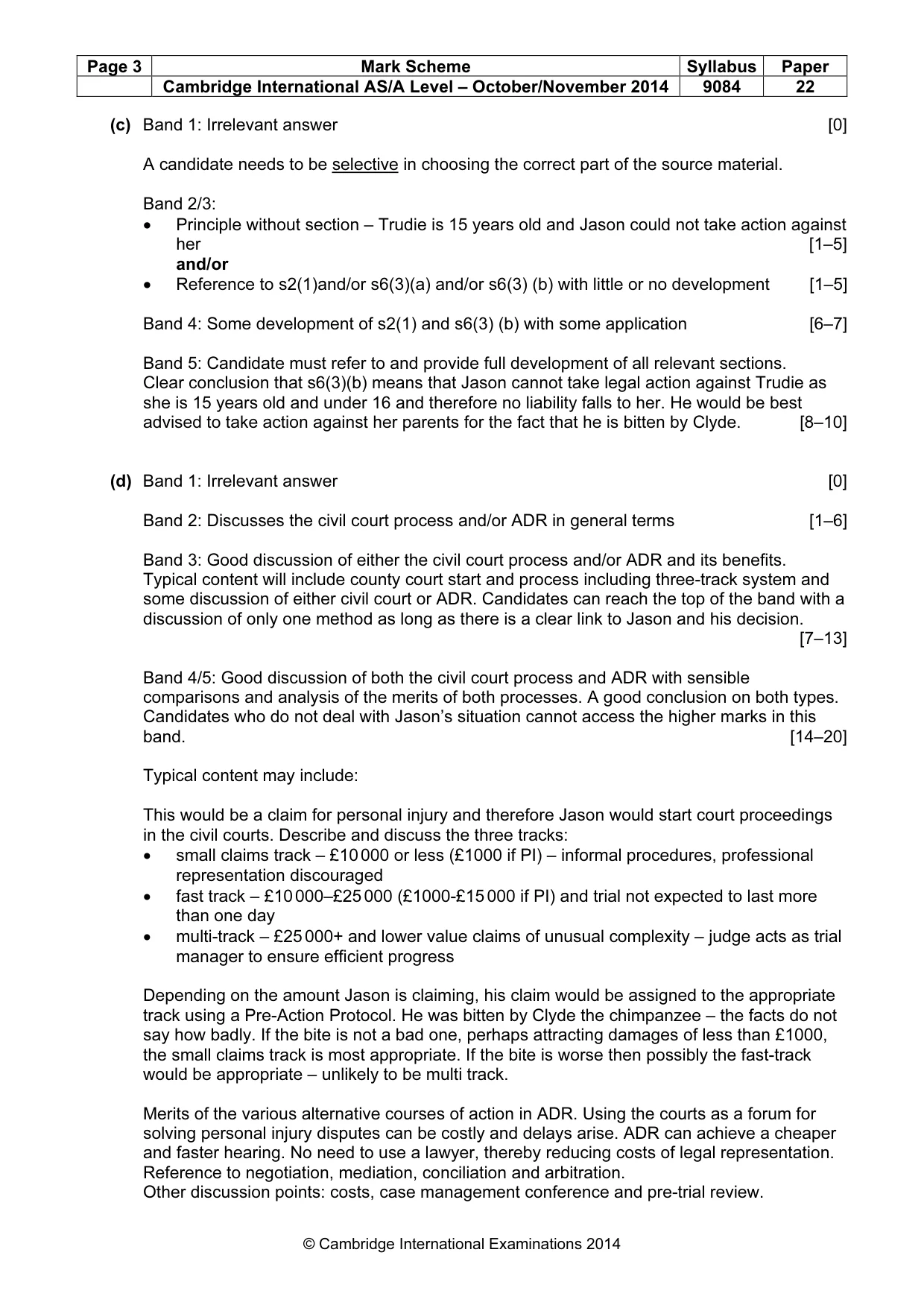
Page 3 Mark Scheme Syllabus Paper Cambridge International AS/A Level – October/November 2014 9084 22 © Cambridge International Examinations 2014 (c) Band 1: Irrelevant answer [0] A candidate needs to be selective in choosing the correct part of the source material. Band 2/3: • Principle without section – Trudie is 15 years old and Jason could not take action against her [1–5] and/or • Reference to s2(1)and/or s6(3)(a) and/or s6(3) (b) with little or no development [1–5] Band 4: Some development of s2(1) and s6(3) (b) with some application [6–7] Band 5: Candidate must refer to and provide full development of all relevant sections. Clear conclusion that s6(3)(b) means that Jason cannot take legal action against Trudie as she is 15 years old and under 16 and therefore no liability falls to her. He would be best advised to take action against her parents for the fact that he is bitten by Clyde. [8–10] (d) Band 1: Irrelevant answer [0] Band 2: Discusses the civil court process and/or ADR in general terms [1–6] Band 3: Good discussion of either the civil court process and/or ADR and its benefits. Typical content will include county court start and process including three-track system and some discussion of either civil court or ADR. Candidates can reach the top of the band with a discussion of only one method as long as there is a clear link to Jason and his decision. [7–13] Band 4/5: Good discussion of both the civil court process and ADR with sensible comparisons and analysis of the merits of both processes. A good conclusion on both types. Candidates who do not deal with Jason’s situation cannot access the higher marks in this band. [14–20] Typical content may include: This would be a claim for personal injury and therefore Jason would start court proceedings in the civil courts. Describe and discuss the three tracks: • small claims track – £10 000 or less (£1000 if PI) – informal procedures, professional representation discouraged • fast track – £10 000–£25 000 (£1000-£15 000 if PI) and trial not expected to last more than one day • multi-track – £25 000+ and lower value claims of unusual complexity – judge acts as trial manager to ensure efficient progress Depending on the amount Jason is claiming, his claim would be assigned to the appropriate track using a Pre-Action Protocol. He was bitten by Clyde the chimpanzee – the facts do not say how badly. If the bite is not a bad one, perhaps attracting damages of less than £1000, the small claims track is most appropriate. If the bite is worse then possibly the fast-track would be appropriate – unlikely to be multi track. Merits of the various alternative courses of action in ADR. Using the courts as a forum for solving personal injury disputes can be costly and delays arise. ADR can achieve a cheaper and faster hearing. No need to use a lawyer, thereby reducing costs of legal representation. Reference to negotiation, mediation, conciliation and arbitration. Other discussion points: costs, case management conference and pre-trial review.
Mark scheme, page 4
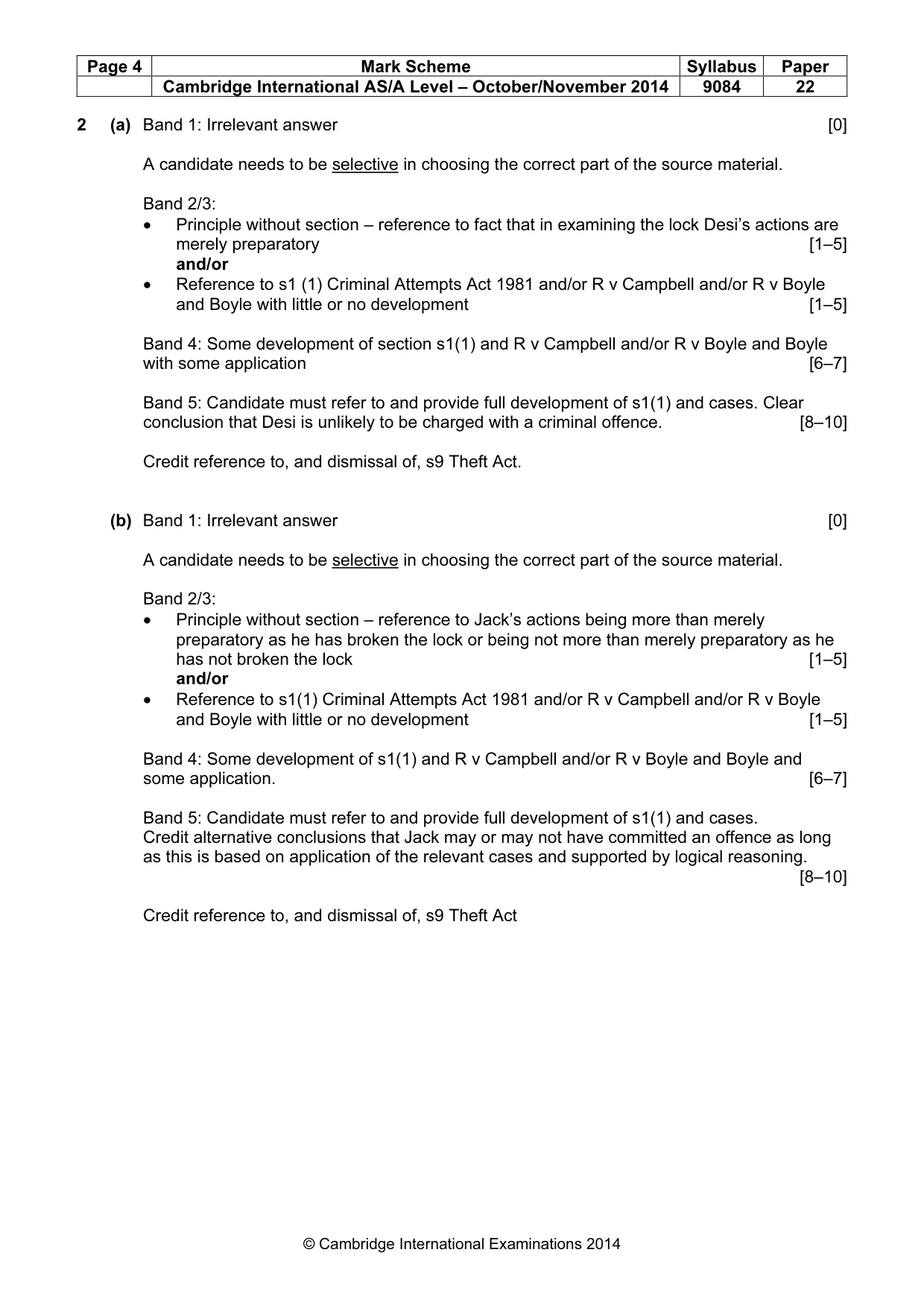
Page 4 Mark Scheme Syllabus Paper Cambridge International AS/A Level – October/November 2014 9084 22 © Cambridge International Examinations 2014 2 (a) Band 1: Irrelevant answer [0] A candidate needs to be selective in choosing the correct part of the source material. Band 2/3: • Principle without section – reference to fact that in examining the lock Desi’s actions are merely preparatory [1–5] and/or • Reference to s1 (1) Criminal Attempts Act 1981 and/or R v Campbell and/or R v Boyle and Boyle with little or no development [1–5] Band 4: Some development of section s1(1) and R v Campbell and/or R v Boyle and Boyle with some application [6–7] Band 5: Candidate must refer to and provide full development of s1(1) and cases. Clear conclusion that Desi is unlikely to be charged with a criminal offence. [8–10] Credit reference to, and dismissal of, s9 Theft Act. (b) Band 1: Irrelevant answer [0] A candidate needs to be selective in choosing the correct part of the source material. Band 2/3: • Principle without section – reference to Jack’s actions being more than merely preparatory as he has broken the lock or being not more than merely preparatory as he has not broken the lock [1–5] and/or • Reference to s1(1) Criminal Attempts Act 1981 and/or R v Campbell and/or R v Boyle and Boyle with little or no development [1–5] Band 4: Some development of s1(1) and R v Campbell and/or R v Boyle and Boyle and some application. [6–7] Band 5: Candidate must refer to and provide full development of s1(1) and cases. Credit alternative conclusions that Jack may or may not have committed an offence as long as this is based on application of the relevant cases and supported by logical reasoning. [8–10] Credit reference to, and dismissal of, s9 Theft Act
Mark scheme, page 5
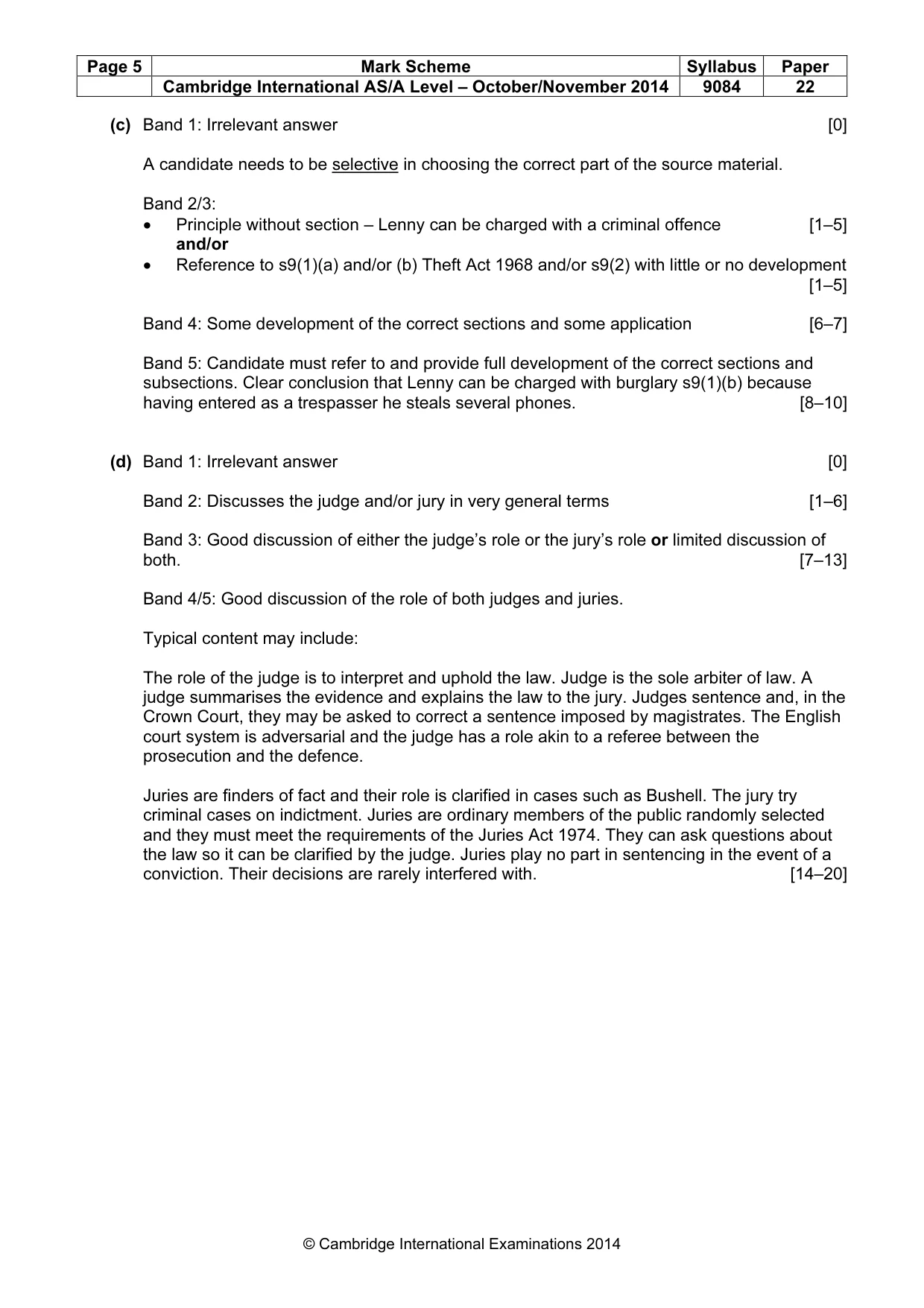
Page 5 Mark Scheme Syllabus Paper Cambridge International AS/A Level – October/November 2014 9084 22 © Cambridge International Examinations 2014 (c) Band 1: Irrelevant answer [0] A candidate needs to be selective in choosing the correct part of the source material. Band 2/3: • Principle without section – Lenny can be charged with a criminal offence [1–5] and/or • Reference to s9(1)(a) and/or (b) Theft Act 1968 and/or s9(2) with little or no development [1–5] Band 4: Some development of the correct sections and some application [6–7] Band 5: Candidate must refer to and provide full development of the correct sections and subsections. Clear conclusion that Lenny can be charged with burglary s9(1)(b) because having entered as a trespasser he steals several phones. [8–10] (d) Band 1: Irrelevant answer [0] Band 2: Discusses the judge and/or jury in very general terms [1–6] Band 3: Good discussion of either the judge’s role or the jury’s role or limited discussion of both. [7–13] Band 4/5: Good discussion of the role of both judges and juries. Typical content may include: The role of the judge is to interpret and uphold the law. Judge is the sole arbiter of law. A judge summarises the evidence and explains the law to the jury. Judges sentence and, in the Crown Court, they may be asked to correct a sentence imposed by magistrates. The English court system is adversarial and the judge has a role akin to a referee between the prosecution and the defence. Juries are finders of fact and their role is clarified in cases such as Bushell. The jury try criminal cases on indictment. Juries are ordinary members of the public randomly selected and they must meet the requirements of the Juries Act 1974. They can ask questions about the law so it can be clarified by the judge. Juries play no part in sentencing in the event of a conviction. Their decisions are rarely interfered with. [14–20]
What you needed in this session
Cambridge’s own grade thresholds for 2014 Oct/Nov, Paper 2 · Variant 2. A higher threshold means an easier paper — the bar moves with how the cohort did.