Cambridge A Level Law 9084 — 2014 Oct/Nov Paper 2 · Variant 1
9084/21/O/N/14 · 50 marks · ≈56 min
The question paper and its mark scheme, free to read here and free to download. This is Cambridge’s own paper, exactly as it was sat.
Question paper4 pages

Mark scheme6 pages
Answers below. Sit the paper first if you are practising.
Paper as text
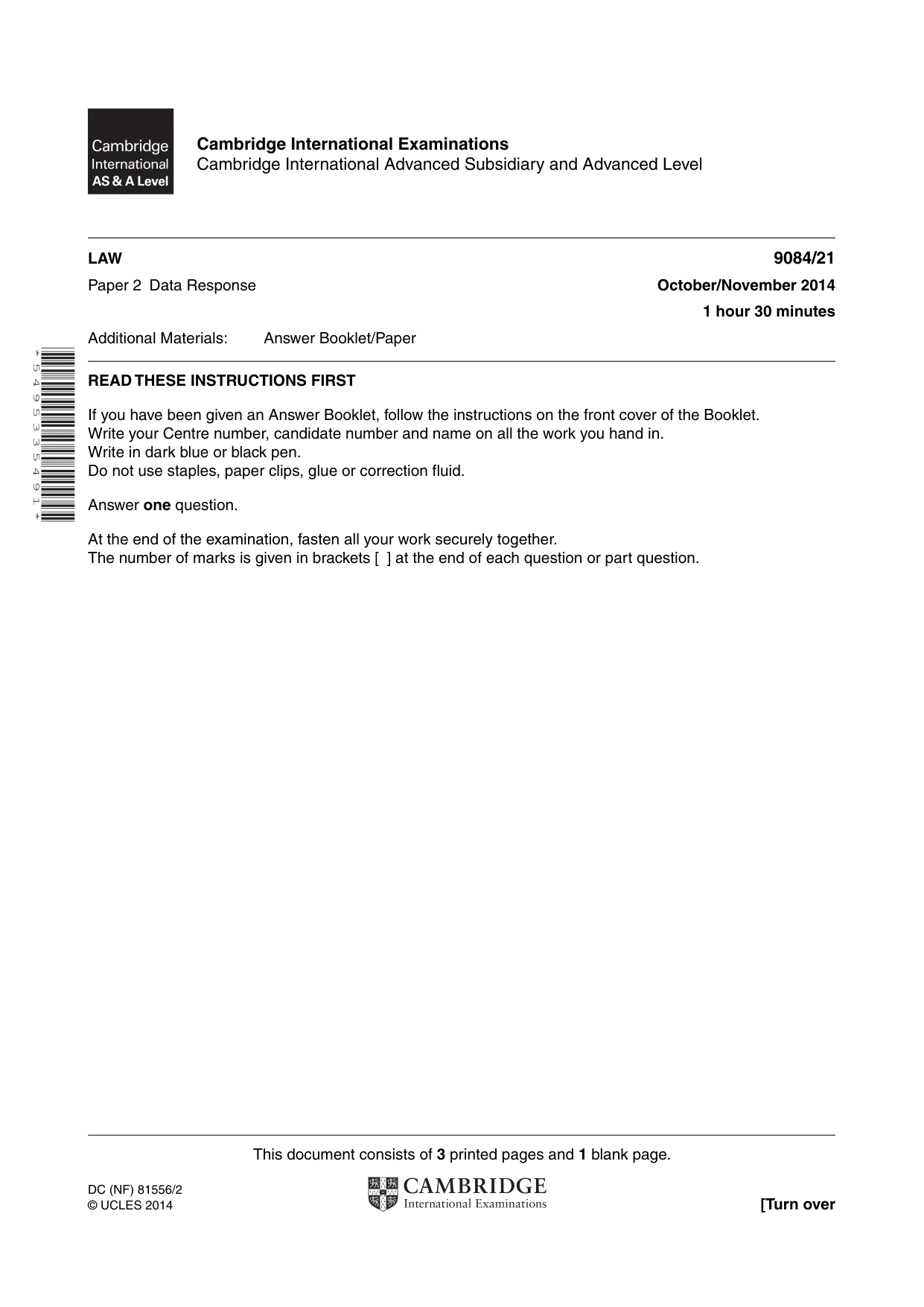
Question paper, page 1
This document consists of 3 printed pages and 1 blank page. DC (NF) 81556/2 © UCLES 2014 [Turn over Cambridge International Examinations Cambridge International Advanced Subsidiary and Advanced Level * 5 4 9 5 3 3 5 4 9 1 * LAW 9084/21 Paper 2 Data Response October/November 2014 1 hour 30 minutes Additional Materials: Answer Booklet/Paper READ THESE INSTRUCTIONS FIRST If you have been given an Answer Booklet, follow the instructions on the front cover of the Booklet. Write your Centre number, candidate number and name on all the work you hand in. Write in dark blue or black pen. Do not use staples, paper clips, glue or correction fluid. Answer one question. At the end of the examination, fasten all your work securely together. The number of marks is given in brackets [ ] at the end of each question or part question.
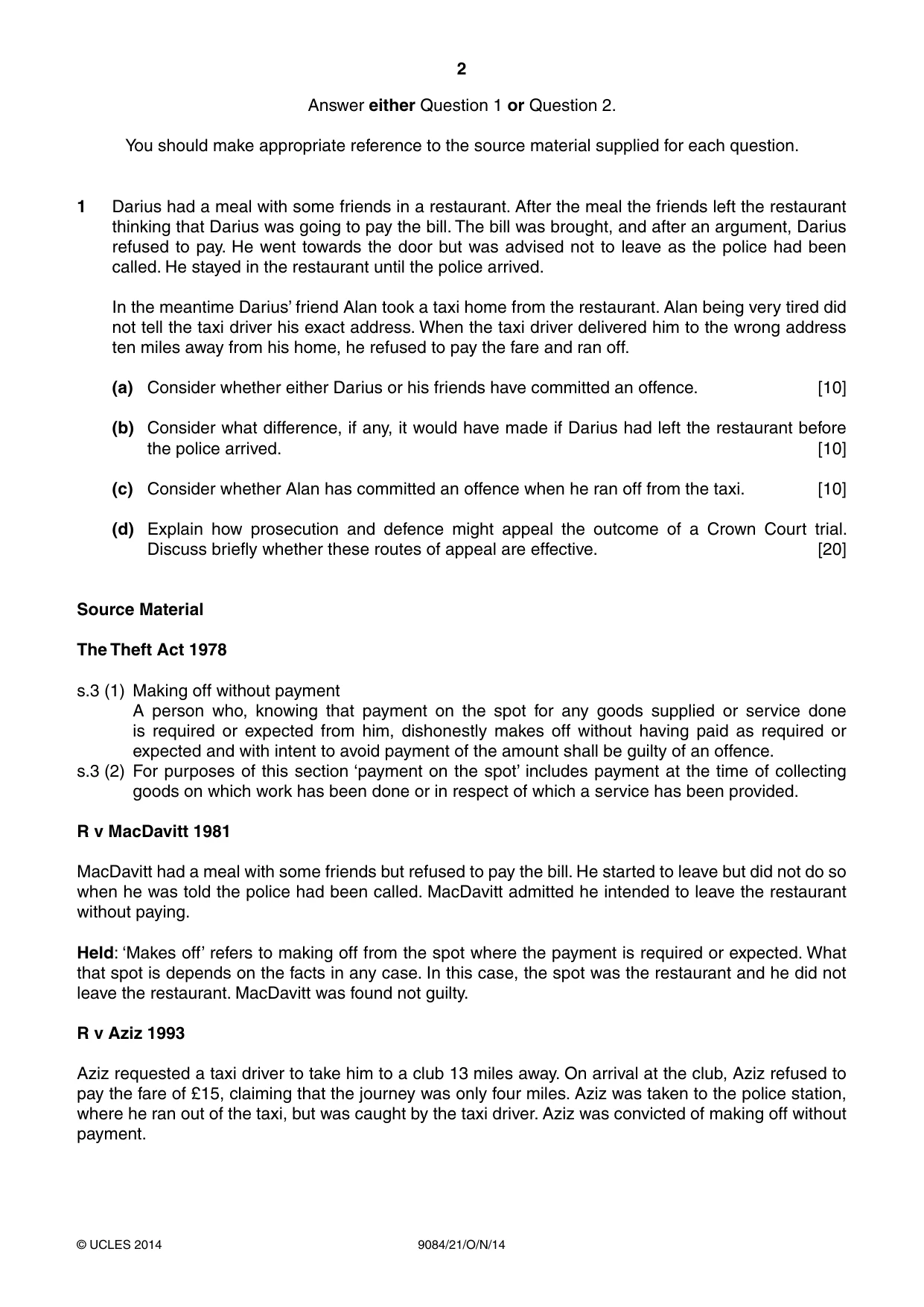
Question paper, page 2
2 9084/21/O/N/14 © UCLES 2014 Answer either Question 1 or Question 2. You should make appropriate reference to the source material supplied for each question. 1 Darius had a meal with some friends in a restaurant. After the meal the friends left the restaurant thinking that Darius was going to pay the bill. The bill was brought, and after an argument, Darius refused to pay. He went towards the door but was advised not to leave as the police had been called. He stayed in the restaurant until the police arrived. In the meantime Darius’ friend Alan took a taxi home from the restaurant. Alan being very tired did not tell the taxi driver his exact address. When the taxi driver delivered him to the wrong address ten miles away from his home, he refused to pay the fare and ran off. (a) Consider whether either Darius or his friends have committed an offence. [10] (b) Consider what difference, if any, it would have made if Darius had left the restaurant before the police arrived. [10] (c) Consider whether Alan has committed an offence when he ran off from the taxi. [10] (d) Explain how prosecution and defence might appeal the outcome of a Crown Court trial. Discuss briefly whether these routes of appeal are effective. [20] Source Material The Theft Act 1978 s.3 (1) Making off without payment A person who, knowing that payment on the spot for any goods supplied or service done is required or expected from him, dishonestly makes off without having paid as required or expected and with intent to avoid payment of the amount shall be guilty of an offence. s.3 (2) For purposes of this section ‘payment on the spot’ includes payment at the time of collecting goods on which work has been done or in respect of which a service has been provided. R v MacDavitt 1981 MacDavitt had a meal with some friends but refused to pay the bill. He started to leave but did not do so when he was told the police had been called. MacDavitt admitted he intended to leave the restaurant without paying. Held: ‘Makes off’ refers to making off from the spot where the payment is required or expected. What that spot is depends on the facts in any case. In this case, the spot was the restaurant and he did not leave the restaurant. MacDavitt was found not guilty. R v Aziz 1993 Aziz requested a taxi driver to take him to a club 13 miles away. On arrival at the club, Aziz refused to pay the fare of £15, claiming that the journey was only four miles. Aziz was taken to the police station, where he ran out of the taxi, but was caught by the taxi driver. Aziz was convicted of making off without payment.
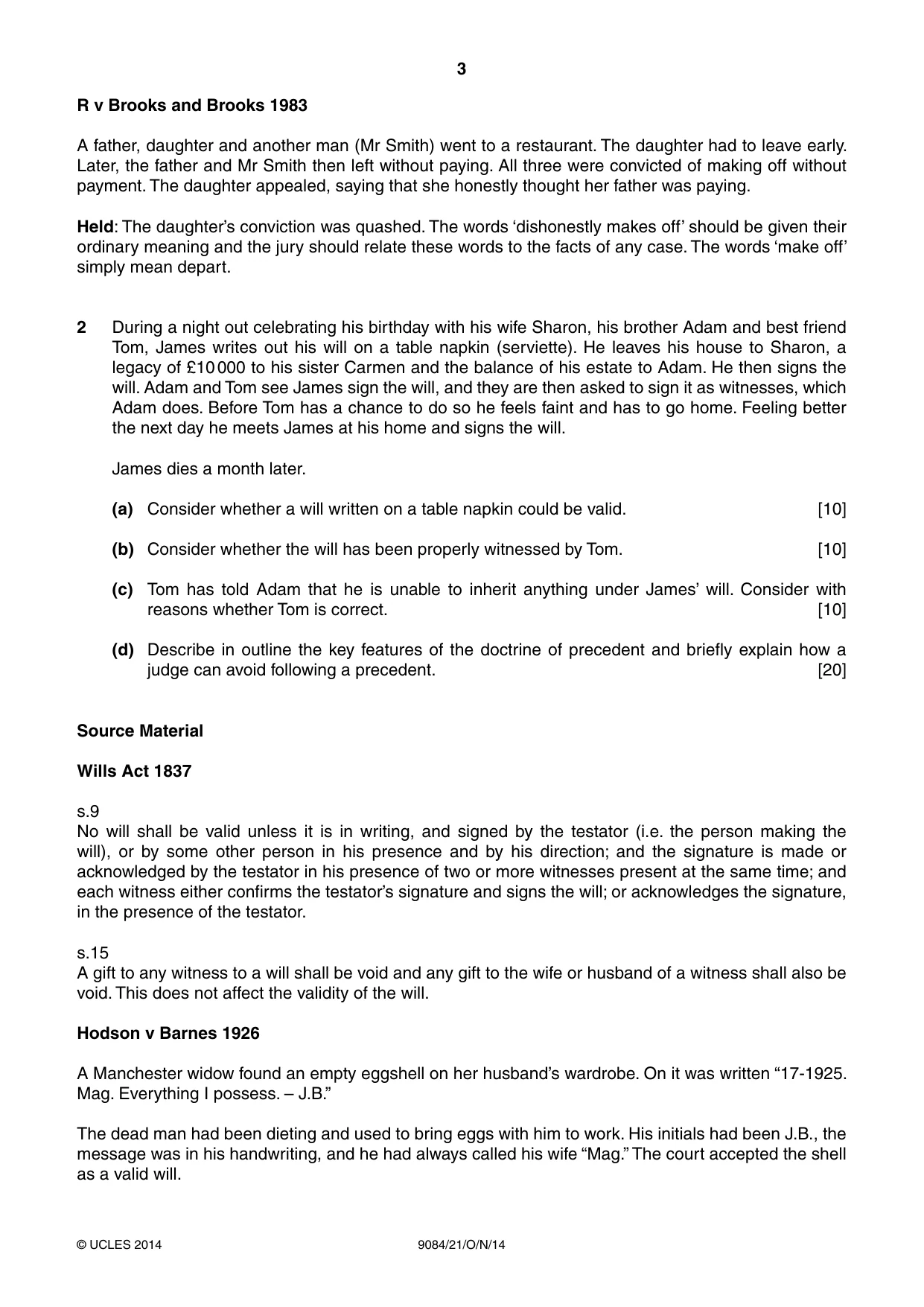
Question paper, page 3
3 9084/21/O/N/14 © UCLES 2014 R v Brooks and Brooks 1983 A father, daughter and another man (Mr Smith) went to a restaurant. The daughter had to leave early. Later, the father and Mr Smith then left without paying. All three were convicted of making off without payment. The daughter appealed, saying that she honestly thought her father was paying. Held: The daughter’s conviction was quashed. The words ‘dishonestly makes off’ should be given their ordinary meaning and the jury should relate these words to the facts of any case. The words ‘make off’ simply mean depart. 2 During a night out celebrating his birthday with his wife Sharon, his brother Adam and best friend Tom, James writes out his will on a table napkin (serviette). He leaves his house to Sharon, a legacy of £10 000 to his sister Carmen and the balance of his estate to Adam. He then signs the will. Adam and Tom see James sign the will, and they are then asked to sign it as witnesses, which Adam does. Before Tom has a chance to do so he feels faint and has to go home. Feeling better the next day he meets James at his home and signs the will. James dies a month later. (a) Consider whether a will written on a table napkin could be valid. [10] (b) Consider whether the will has been properly witnessed by Tom. [10] (c) Tom has told Adam that he is unable to inherit anything under James’ will. Consider with reasons whether Tom is correct. [10] (d) Describe in outline the key features of the doctrine of precedent and briefly explain how a judge can avoid following a precedent. [20] Source Material Wills Act 1837 s.9 No will shall be valid unless it is in writing, and signed by the testator (i.e. the person making the will), or by some other person in his presence and by his direction; and the signature is made or acknowledged by the testator in his presence of two or more witnesses present at the same time; and each witness either confirms the testator’s signature and signs the will; or acknowledges the signature, in the presence of the testator. s.15 A gift to any witness to a will shall be void and any gift to the wife or husband of a witness shall also be void. This does not affect the validity of the will. Hodson v Barnes 1926 A Manchester widow found an empty eggshell on her husband’s wardrobe. On it was written “17-1925. Mag. Everything I possess. – J.B.” The dead man had been dieting and used to bring eggs with him to work. His initials had been J.B., the message was in his handwriting, and he had always called his wife “Mag.” The court accepted the shell as a valid will.
Question paper, page 4
4 9084/21/O/N/14 © UCLES 2014 BLANK PAGE Permission to reproduce items where third-party owned material protected by copyright is included has been sought and cleared where possible. Every reasonable effort has been made by the publisher (UCLES) to trace copyright holders, but if any items requiring clearance have unwittingly been included, the publisher will be pleased to make amends at the earliest possible opportunity. Cambridge International Examinations is part of the Cambridge Assessment Group. Cambridge Assessment is the brand name of University of Cambridge Local Examinations Syndicate (UCLES), which is itself a department of the University of Cambridge.
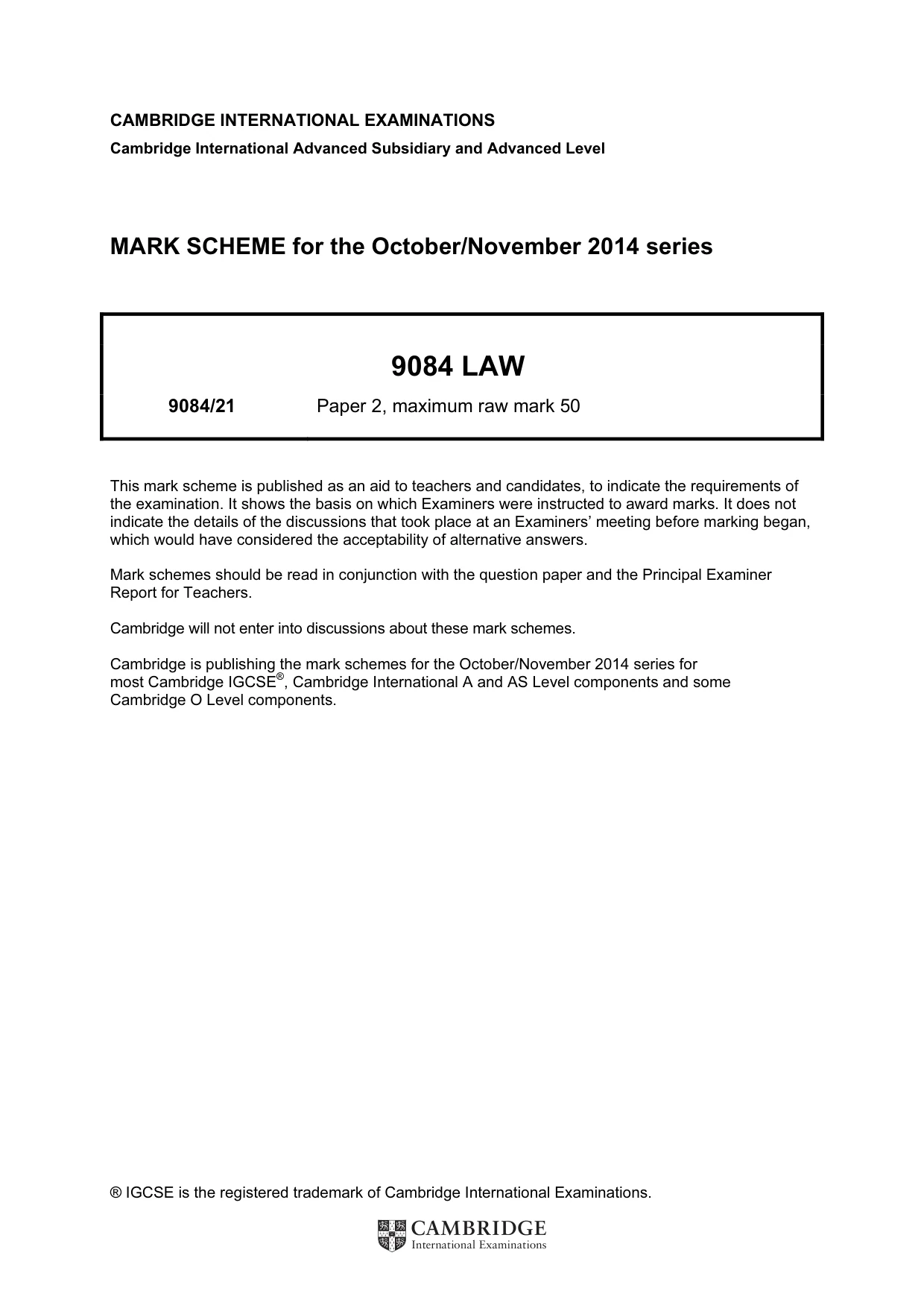
Mark scheme, page 1
® IGCSE is the registered trademark of Cambridge International Examinations. CAMBRIDGE INTERNATIONAL EXAMINATIONS Cambridge International Advanced Subsidiary and Advanced Level MARK SCHEME for the October/November 2014 series 9084 LAW 9084/21 Paper 2, maximum raw mark 50 This mark scheme is published as an aid to teachers and candidates, to indicate the requirements of the examination. It shows the basis on which Examiners were instructed to award marks. It does not indicate the details of the discussions that took place at an Examiners’ meeting before marking began, which would have considered the acceptability of alternative answers. Mark schemes should be read in conjunction with the question paper and the Principal Examiner Report for Teachers. Cambridge will not enter into discussions about these mark schemes. Cambridge is publishing the mark schemes for the October/November 2014 series for most Cambridge IGCSE®, Cambridge International A and AS Level components and some Cambridge O Level components.
Mark scheme, page 2
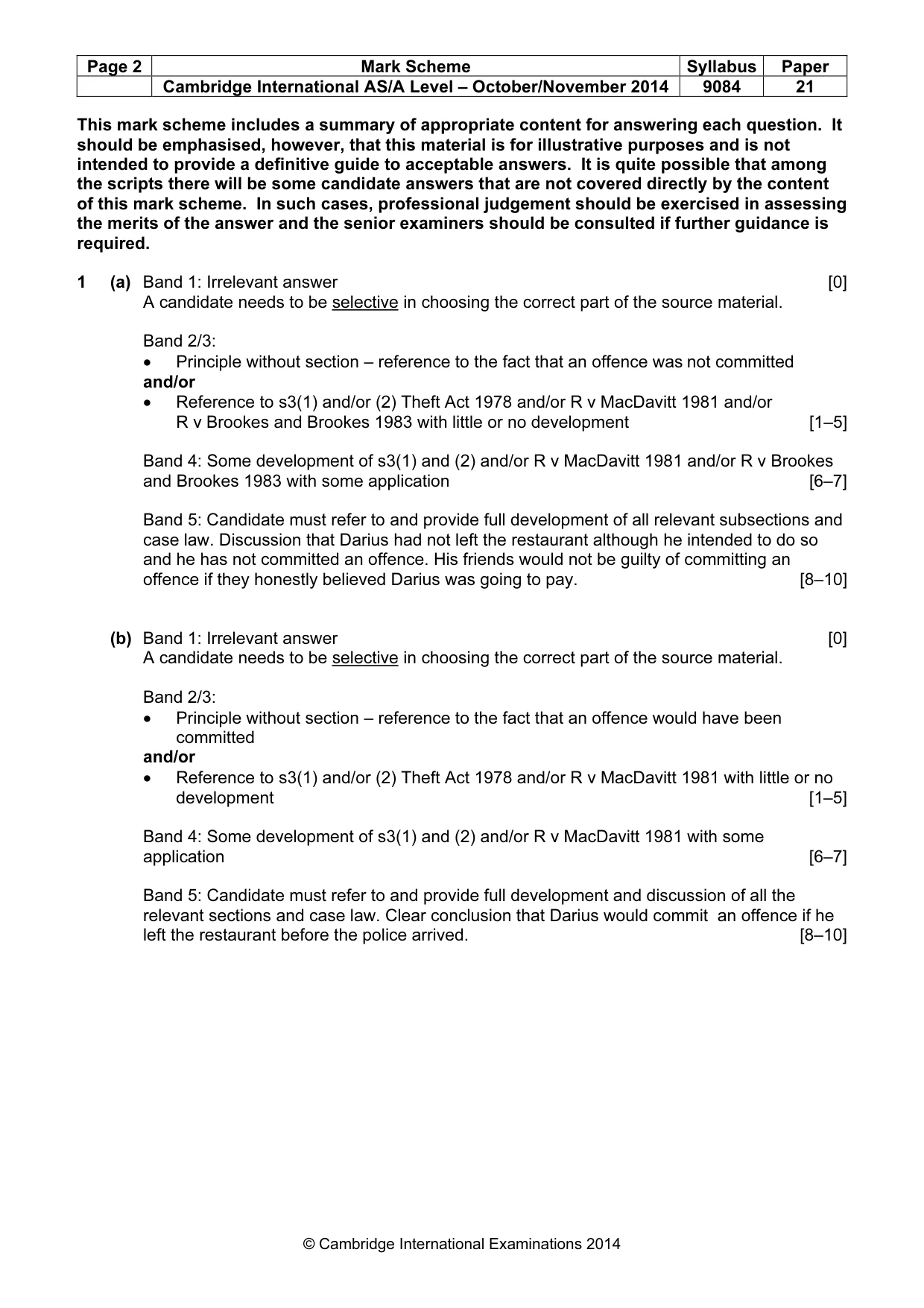
Page 2 Mark Scheme Syllabus Paper Cambridge International AS/A Level – October/November 2014 9084 21 © Cambridge International Examinations 2014 This mark scheme includes a summary of appropriate content for answering each question. It should be emphasised, however, that this material is for illustrative purposes and is not intended to provide a definitive guide to acceptable answers. It is quite possible that among the scripts there will be some candidate answers that are not covered directly by the content of this mark scheme. In such cases, professional judgement should be exercised in assessing the merits of the answer and the senior examiners should be consulted if further guidance is required. 1 (a) Band 1: Irrelevant answer [0] A candidate needs to be selective in choosing the correct part of the source material. Band 2/3: • Principle without section – reference to the fact that an offence was not committed and/or • Reference to s3(1) and/or (2) Theft Act 1978 and/or R v MacDavitt 1981 and/or R v Brookes and Brookes 1983 with little or no development [1–5] Band 4: Some development of s3(1) and (2) and/or R v MacDavitt 1981 and/or R v Brookes and Brookes 1983 with some application [6–7] Band 5: Candidate must refer to and provide full development of all relevant subsections and case law. Discussion that Darius had not left the restaurant although he intended to do so and he has not committed an offence. His friends would not be guilty of committing an offence if they honestly believed Darius was going to pay. [8–10] (b) Band 1: Irrelevant answer [0] A candidate needs to be selective in choosing the correct part of the source material. Band 2/3: • Principle without section – reference to the fact that an offence would have been committed and/or • Reference to s3(1) and/or (2) Theft Act 1978 and/or R v MacDavitt 1981 with little or no development [1–5] Band 4: Some development of s3(1) and (2) and/or R v MacDavitt 1981 with some application [6–7] Band 5: Candidate must refer to and provide full development and discussion of all the relevant sections and case law. Clear conclusion that Darius would commit an offence if he left the restaurant before the police arrived. [8–10]
Mark scheme, page 3
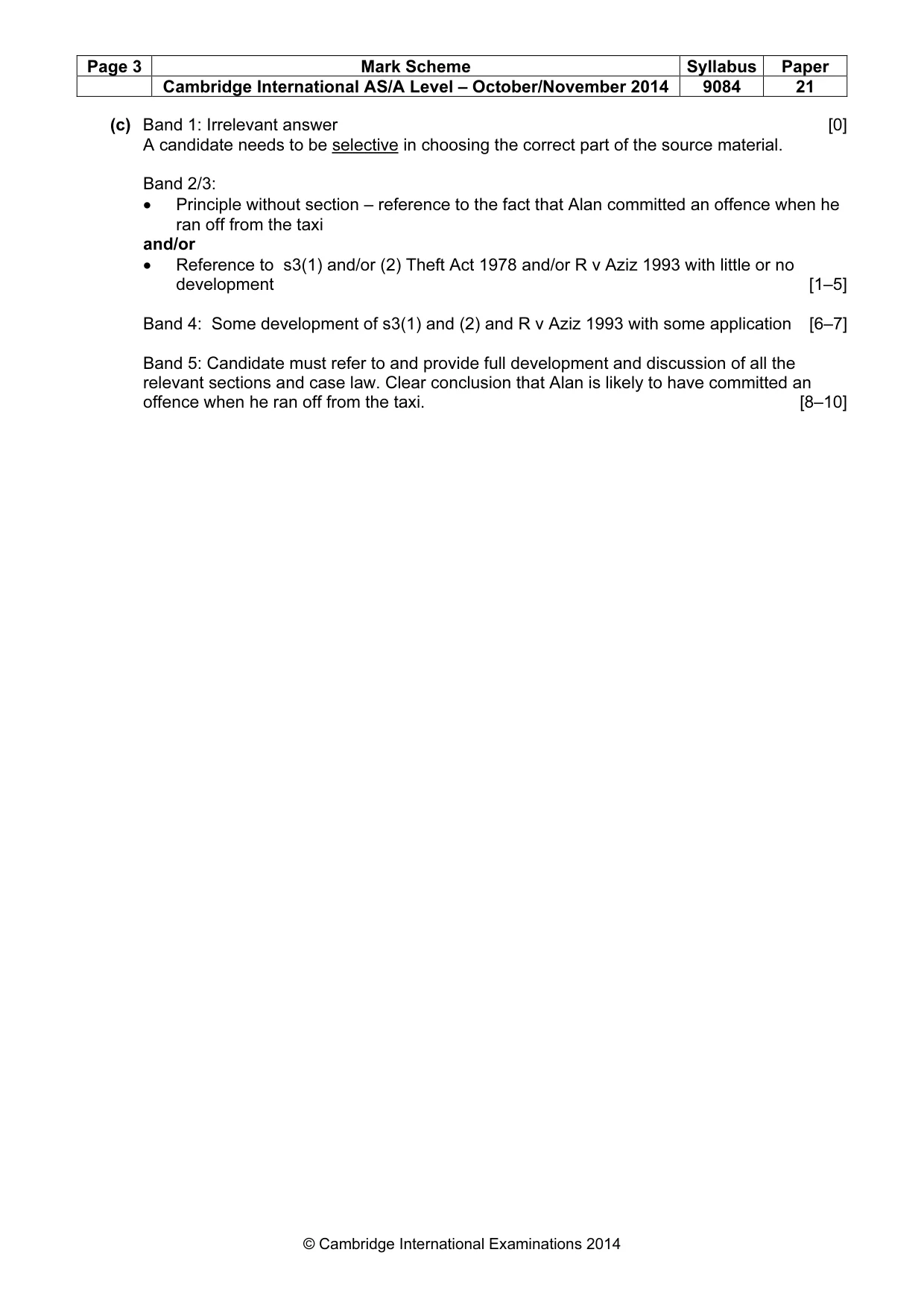
Page 3 Mark Scheme Syllabus Paper Cambridge International AS/A Level – October/November 2014 9084 21 © Cambridge International Examinations 2014 (c) Band 1: Irrelevant answer [0] A candidate needs to be selective in choosing the correct part of the source material. Band 2/3: • Principle without section – reference to the fact that Alan committed an offence when he ran off from the taxi and/or • Reference to s3(1) and/or (2) Theft Act 1978 and/or R v Aziz 1993 with little or no development [1–5] Band 4: Some development of s3(1) and (2) and R v Aziz 1993 with some application [6–7] Band 5: Candidate must refer to and provide full development and discussion of all the relevant sections and case law. Clear conclusion that Alan is likely to have committed an offence when he ran off from the taxi. [8–10]
Mark scheme, page 4
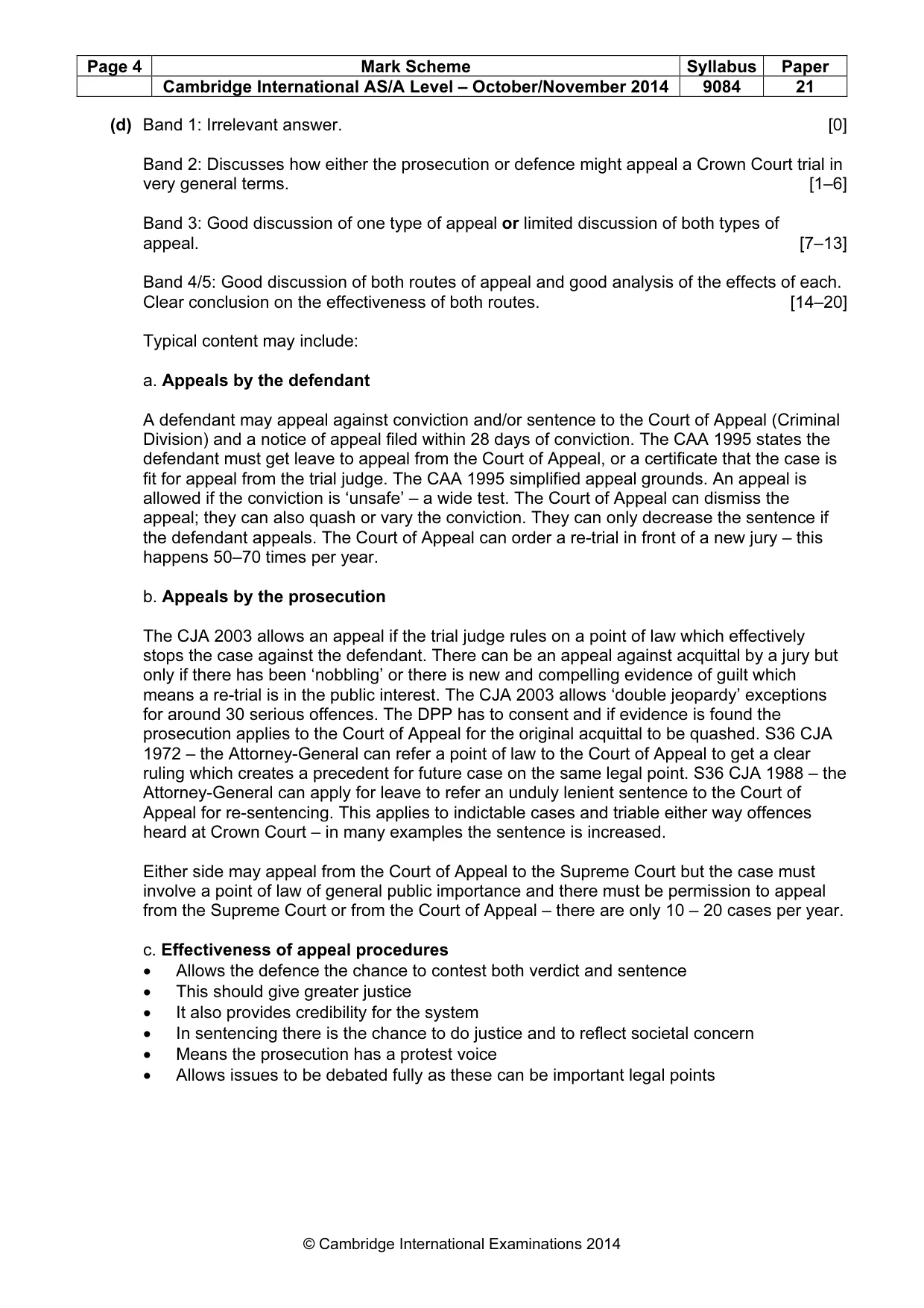
Page 4 Mark Scheme Syllabus Paper Cambridge International AS/A Level – October/November 2014 9084 21 © Cambridge International Examinations 2014 (d) Band 1: Irrelevant answer. [0] Band 2: Discusses how either the prosecution or defence might appeal a Crown Court trial in very general terms. [1–6] Band 3: Good discussion of one type of appeal or limited discussion of both types of appeal. [7–13] Band 4/5: Good discussion of both routes of appeal and good analysis of the effects of each. Clear conclusion on the effectiveness of both routes. [14–20] Typical content may include: a. Appeals by the defendant A defendant may appeal against conviction and/or sentence to the Court of Appeal (Criminal Division) and a notice of appeal filed within 28 days of conviction. The CAA 1995 states the defendant must get leave to appeal from the Court of Appeal, or a certificate that the case is fit for appeal from the trial judge. The CAA 1995 simplified appeal grounds. An appeal is allowed if the conviction is ‘unsafe’ – a wide test. The Court of Appeal can dismiss the appeal; they can also quash or vary the conviction. They can only decrease the sentence if the defendant appeals. The Court of Appeal can order a re-trial in front of a new jury – this happens 50–70 times per year. b. Appeals by the prosecution The CJA 2003 allows an appeal if the trial judge rules on a point of law which effectively stops the case against the defendant. There can be an appeal against acquittal by a jury but only if there has been ‘nobbling’ or there is new and compelling evidence of guilt which means a re-trial is in the public interest. The CJA 2003 allows ‘double jeopardy’ exceptions for around 30 serious offences. The DPP has to consent and if evidence is found the prosecution applies to the Court of Appeal for the original acquittal to be quashed. S36 CJA 1972 – the Attorney-General can refer a point of law to the Court of Appeal to get a clear ruling which creates a precedent for future case on the same legal point. S36 CJA 1988 – the Attorney-General can apply for leave to refer an unduly lenient sentence to the Court of Appeal for re-sentencing. This applies to indictable cases and triable either way offences heard at Crown Court – in many examples the sentence is increased. Either side may appeal from the Court of Appeal to the Supreme Court but the case must involve a point of law of general public importance and there must be permission to appeal from the Supreme Court or from the Court of Appeal – there are only 10 – 20 cases per year. c. Effectiveness of appeal procedures • Allows the defence the chance to contest both verdict and sentence • This should give greater justice • It also provides credibility for the system • In sentencing there is the chance to do justice and to reflect societal concern • Means the prosecution has a protest voice • Allows issues to be debated fully as these can be important legal points
Mark scheme, page 5
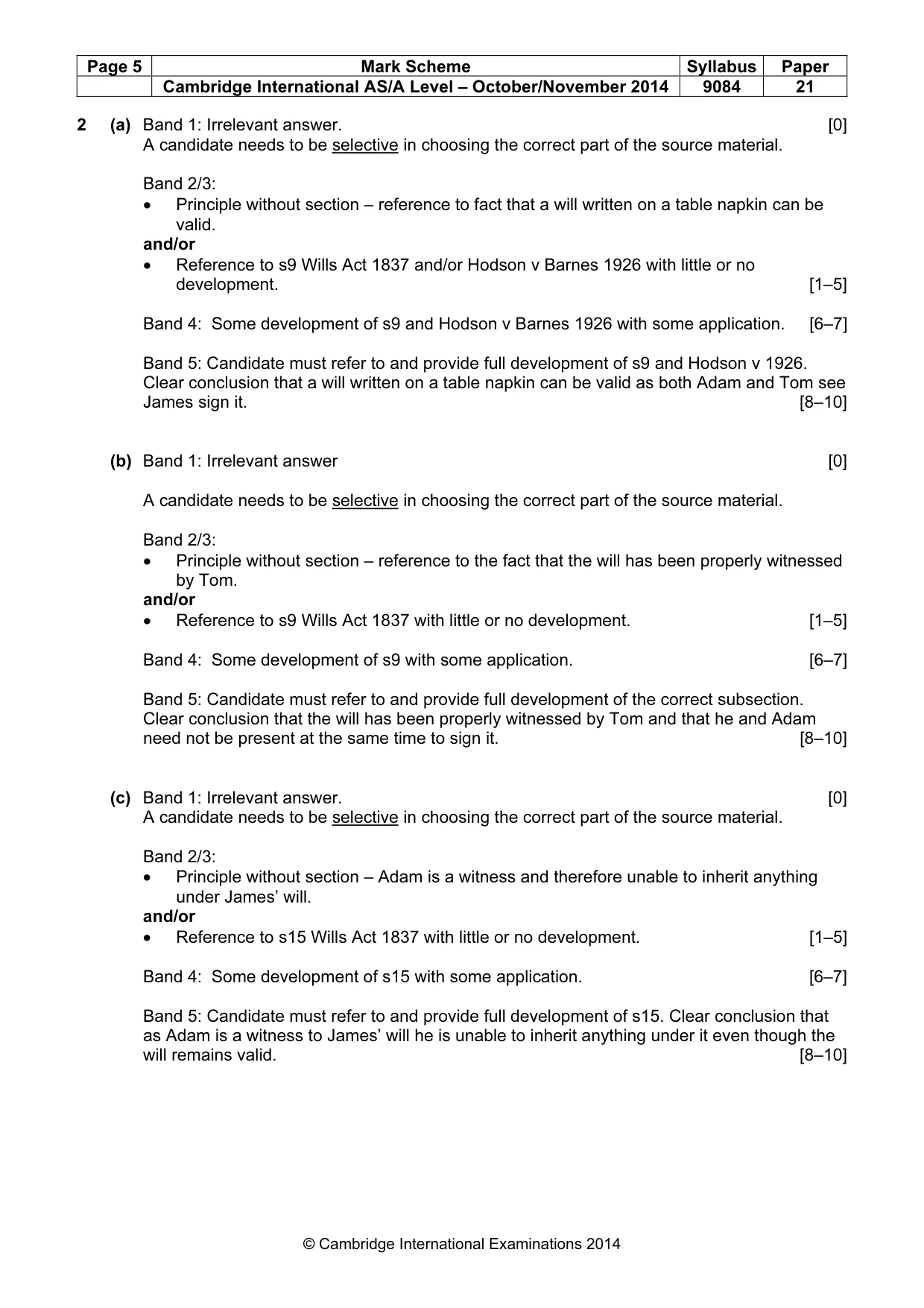
Page 5 Mark Scheme Syllabus Paper Cambridge International AS/A Level – October/November 2014 9084 21 © Cambridge International Examinations 2014 2 (a) Band 1: Irrelevant answer. [0] A candidate needs to be selective in choosing the correct part of the source material. Band 2/3: • Principle without section – reference to fact that a will written on a table napkin can be valid. and/or • Reference to s9 Wills Act 1837 and/or Hodson v Barnes 1926 with little or no development. [1–5] Band 4: Some development of s9 and Hodson v Barnes 1926 with some application. [6–7] Band 5: Candidate must refer to and provide full development of s9 and Hodson v 1926. Clear conclusion that a will written on a table napkin can be valid as both Adam and Tom see James sign it. [8–10] (b) Band 1: Irrelevant answer [0] A candidate needs to be selective in choosing the correct part of the source material. Band 2/3: • Principle without section – reference to the fact that the will has been properly witnessed by Tom. and/or • Reference to s9 Wills Act 1837 with little or no development. [1–5] Band 4: Some development of s9 with some application. [6–7] Band 5: Candidate must refer to and provide full development of the correct subsection. Clear conclusion that the will has been properly witnessed by Tom and that he and Adam need not be present at the same time to sign it. [8–10] (c) Band 1: Irrelevant answer. [0] A candidate needs to be selective in choosing the correct part of the source material. Band 2/3: • Principle without section – Adam is a witness and therefore unable to inherit anything under James’ will. and/or • Reference to s15 Wills Act 1837 with little or no development. [1–5] Band 4: Some development of s15 with some application. [6–7] Band 5: Candidate must refer to and provide full development of s15. Clear conclusion that as Adam is a witness to James’ will he is unable to inherit anything under it even though the will remains valid. [8–10]
Mark scheme, page 6
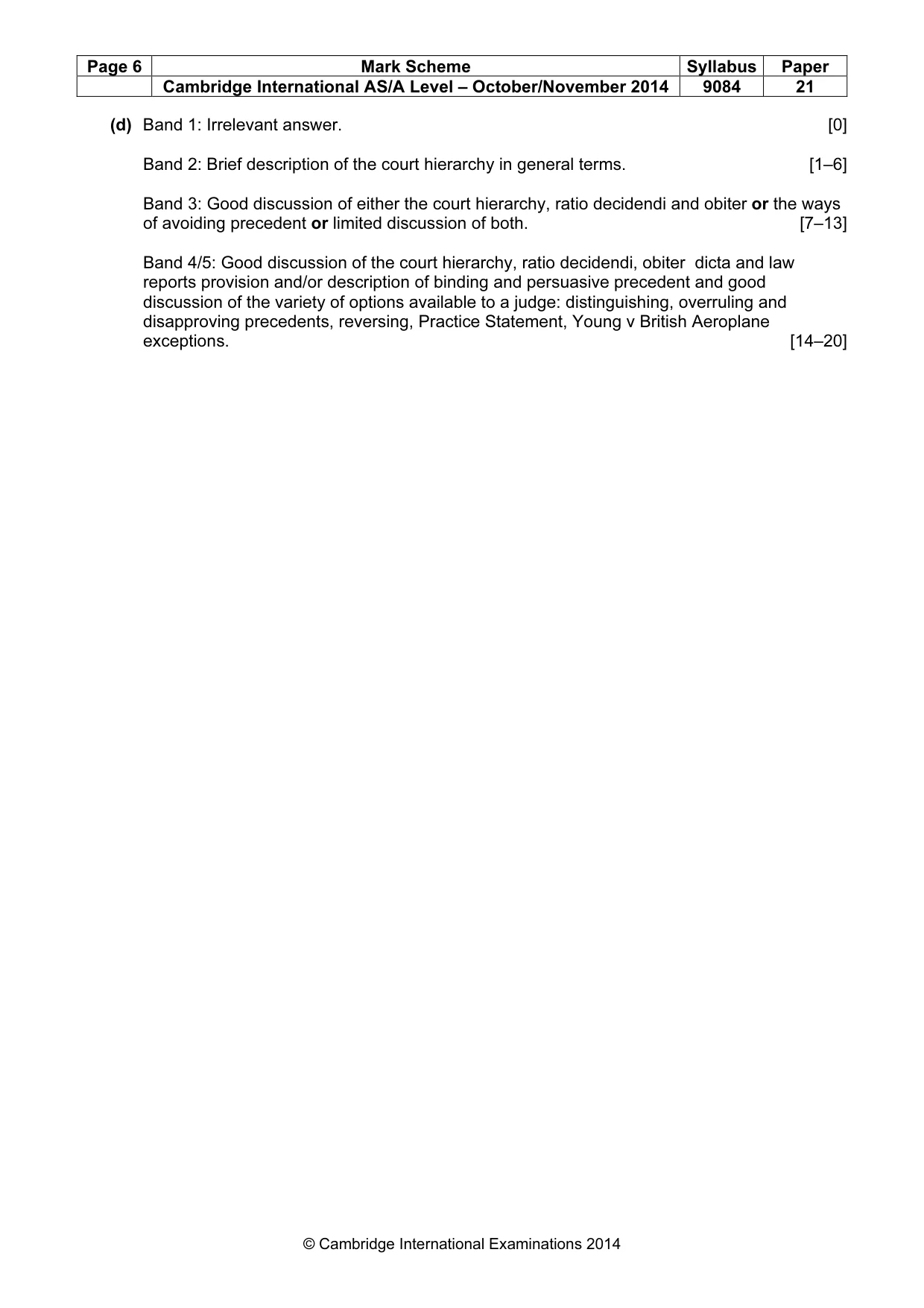
Page 6 Mark Scheme Syllabus Paper Cambridge International AS/A Level – October/November 2014 9084 21 © Cambridge International Examinations 2014 (d) Band 1: Irrelevant answer. [0] Band 2: Brief description of the court hierarchy in general terms. [1–6] Band 3: Good discussion of either the court hierarchy, ratio decidendi and obiter or the ways of avoiding precedent or limited discussion of both. [7–13] Band 4/5: Good discussion of the court hierarchy, ratio decidendi, obiter dicta and law reports provision and/or description of binding and persuasive precedent and good discussion of the variety of options available to a judge: distinguishing, overruling and disapproving precedents, reversing, Practice Statement, Young v British Aeroplane exceptions. [14–20]
What you needed in this session
Cambridge’s own grade thresholds for 2014 Oct/Nov, Paper 2 · Variant 1. A higher threshold means an easier paper — the bar moves with how the cohort did.