Cambridge A Level Law 9084 — 2013 Oct/Nov Paper 2 · Variant 2
9084/22/O/N/13 · 50 marks · ≈56 min
The question paper and its mark scheme, free to read here and free to download. This is Cambridge’s own paper, exactly as it was sat.
Question paper4 pages
Mark scheme5 pages
Answers below. Sit the paper first if you are practising.
Paper as text
Question paper, page 1
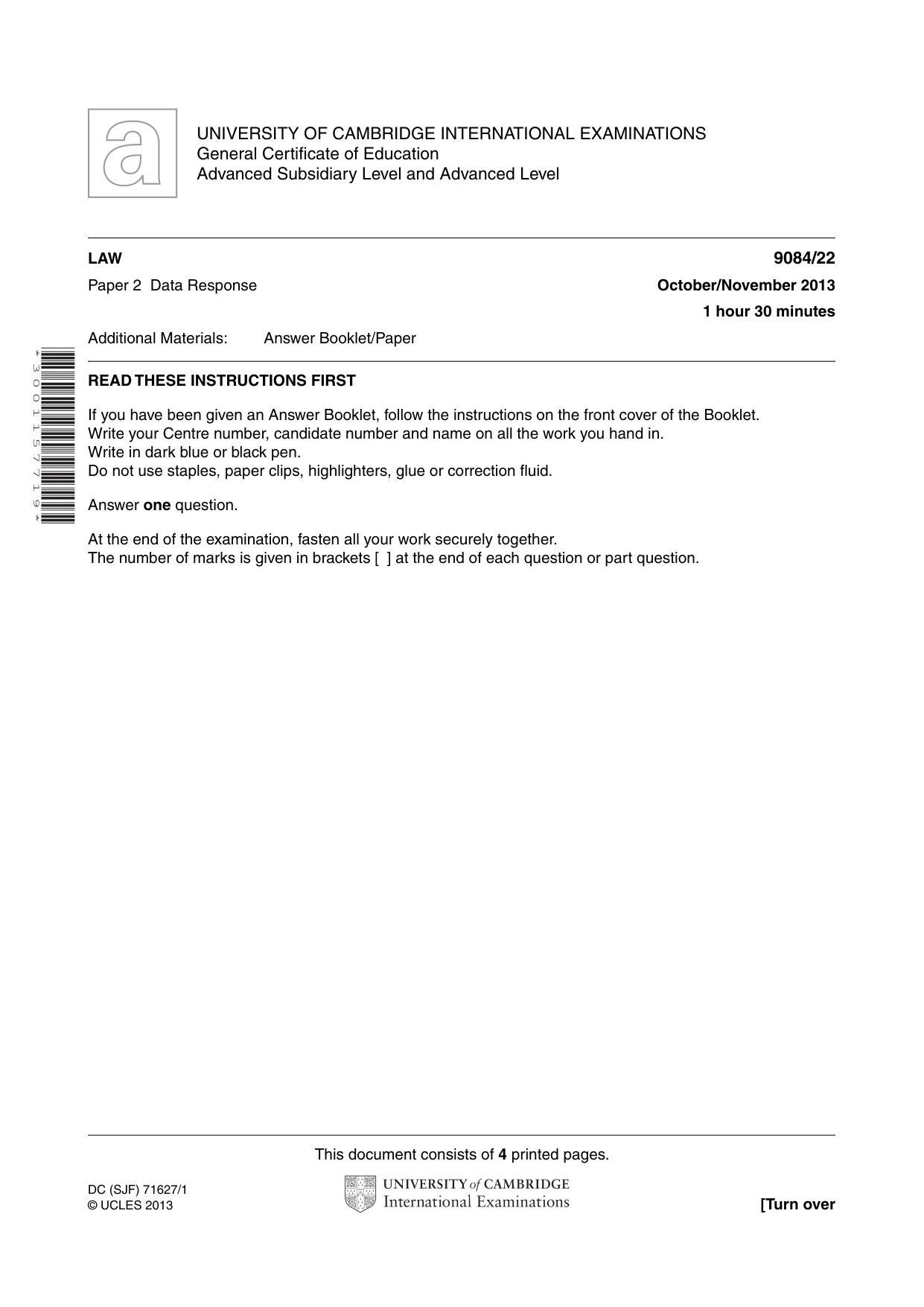
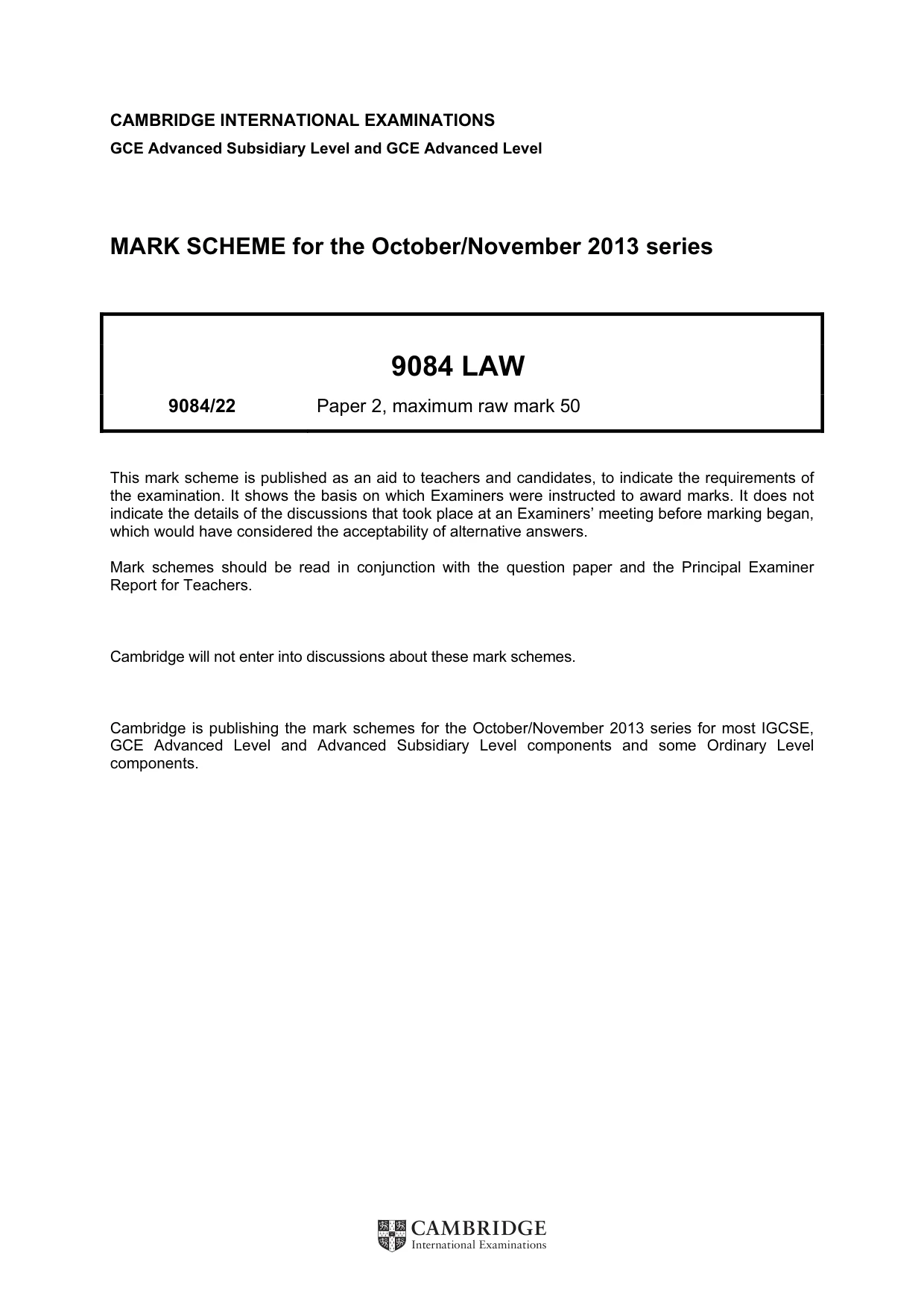
This document consists of 4 printed pages. DC (SJF) 71627/1 © UCLES 2013 [Turn over UNIVERSITY OF CAMBRIDGE INTERNATIONAL EXAMINATIONS General Certificate of Education Advanced Subsidiary Level and Advanced Level * 3 0 0 1 1 5 7 7 1 9 * LAW 9084/22 Paper 2 Data Response October/November 2013 1 hour 30 minutes Additional Materials: Answer Booklet/Paper READ THESE INSTRUCTIONS FIRST If you have been given an Answer Booklet, follow the instructions on the front cover of the Booklet. Write your Centre number, candidate number and name on all the work you hand in. Write in dark blue or black pen. Do not use staples, paper clips, highlighters, glue or correction fluid. Answer one question. At the end of the examination, fasten all your work securely together. The number of marks is given in brackets [ ] at the end of each question or part question.
Question paper, page 2
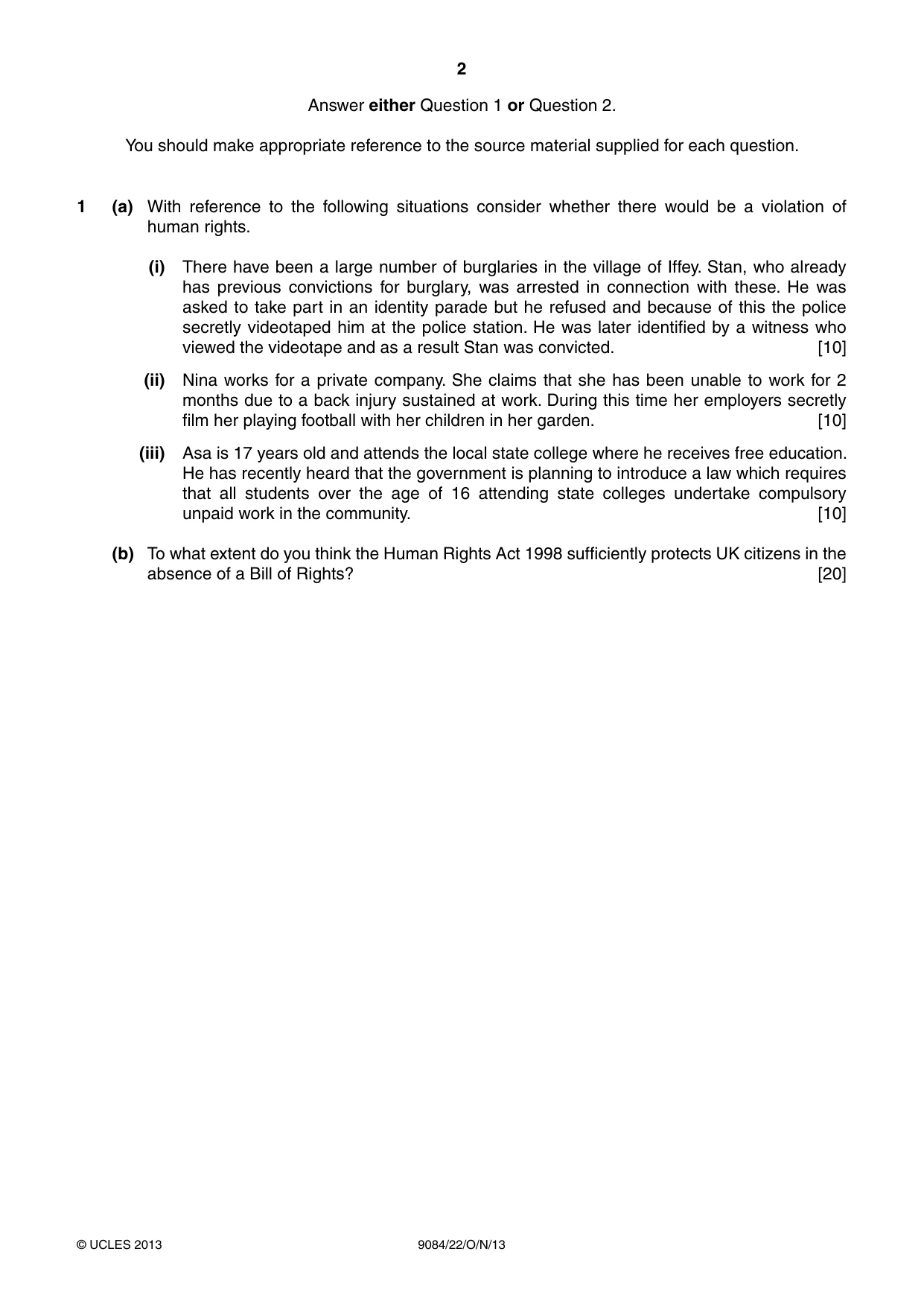
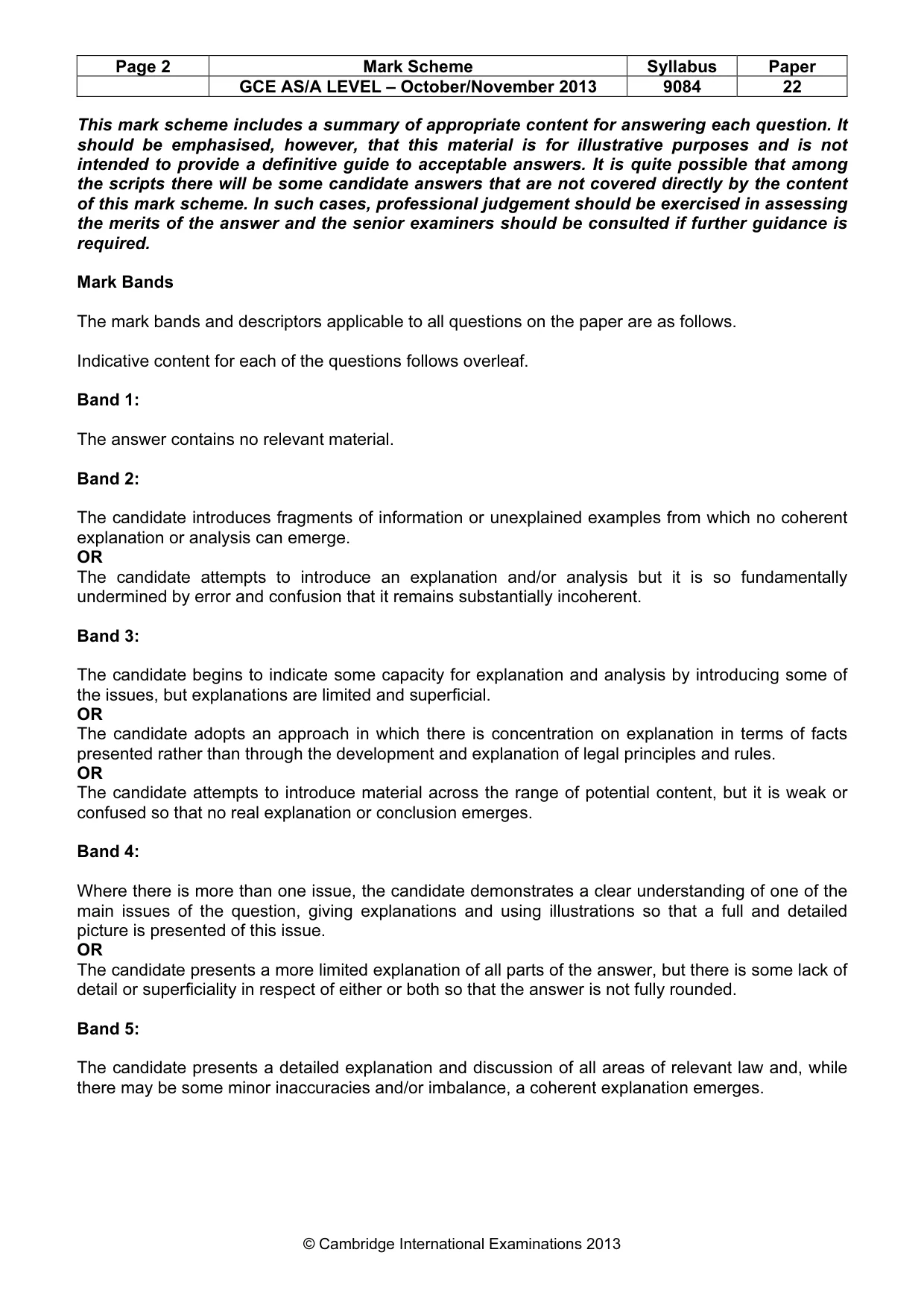
2 9084/22/O/N/13 © UCLES 2013 Answer either Question 1 or Question 2. You should make appropriate reference to the source material supplied for each question. 1 (a) With reference to the following situations consider whether there would be a violation of human rights. (i) There have been a large number of burglaries in the village of Iffey. Stan, who already has previous convictions for burglary, was arrested in connection with these. He was asked to take part in an identity parade but he refused and because of this the police secretly videotaped him at the police station. He was later identified by a witness who viewed the videotape and as a result Stan was convicted. [10] (ii) Nina works for a private company. She claims that she has been unable to work for 2 months due to a back injury sustained at work. During this time her employers secretly film her playing football with her children in her garden. [10] (iii) Asa is 17 years old and attends the local state college where he receives free education. He has recently heard that the government is planning to introduce a law which requires that all students over the age of 16 attending state colleges undertake compulsory unpaid work in the community. [10] (b) To what extent do you think the Human Rights Act 1998 sufficiently protects UK citizens in the absence of a Bill of Rights? [20]
Question paper, page 3
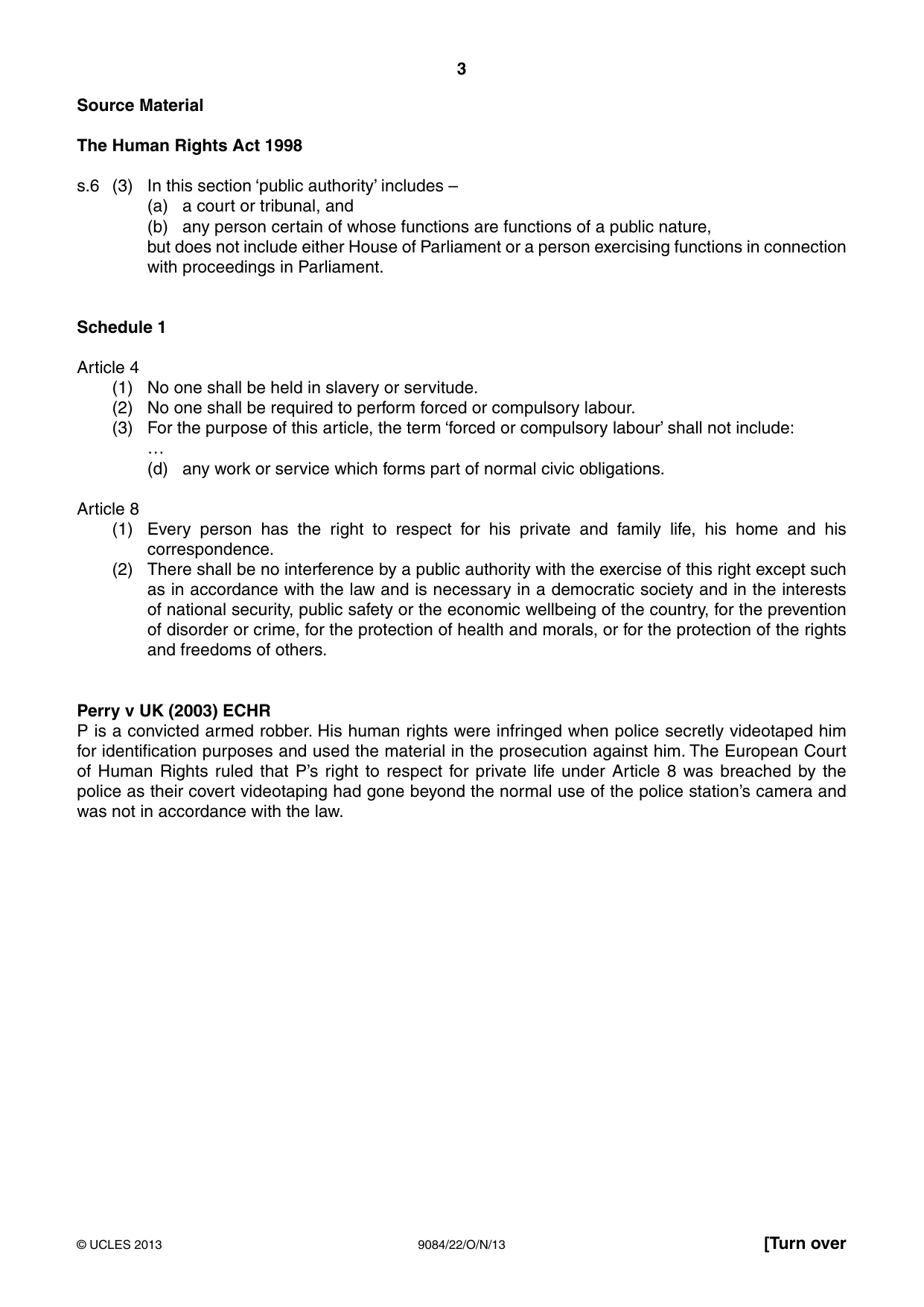
3 9084/22/O/N/13 © UCLES 2013 [Turn over Source Material The Human Rights Act 1998 s.6 (3) In this section ‘public authority’ includes – (a) a court or tribunal, and (b) any person certain of whose functions are functions of a public nature, but does not include either House of Parliament or a person exercising functions in connection with proceedings in Parliament. Schedule 1 Article 4 (1) No one shall be held in slavery or servitude. (2) No one shall be required to perform forced or compulsory labour. (3) For the purpose of this article, the term ‘forced or compulsory labour’ shall not include: … (d) any work or service which forms part of normal civic obligations. Article 8 (1) Every person has the right to respect for his private and family life, his home and his correspondence. (2) There shall be no interference by a public authority with the exercise of this right except such as in accordance with the law and is necessary in a democratic society and in the interests of national security, public safety or the economic wellbeing of the country, for the prevention of disorder or crime, for the protection of health and morals, or for the protection of the rights and freedoms of others. Perry v UK (2003) ECHR P is a convicted armed robber. His human rights were infringed when police secretly videotaped him for identification purposes and used the material in the prosecution against him. The European Court of Human Rights ruled that P’s right to respect for private life under Article 8 was breached by the police as their covert videotaping had gone beyond the normal use of the police station’s camera and was not in accordance with the law.
Question paper, page 4
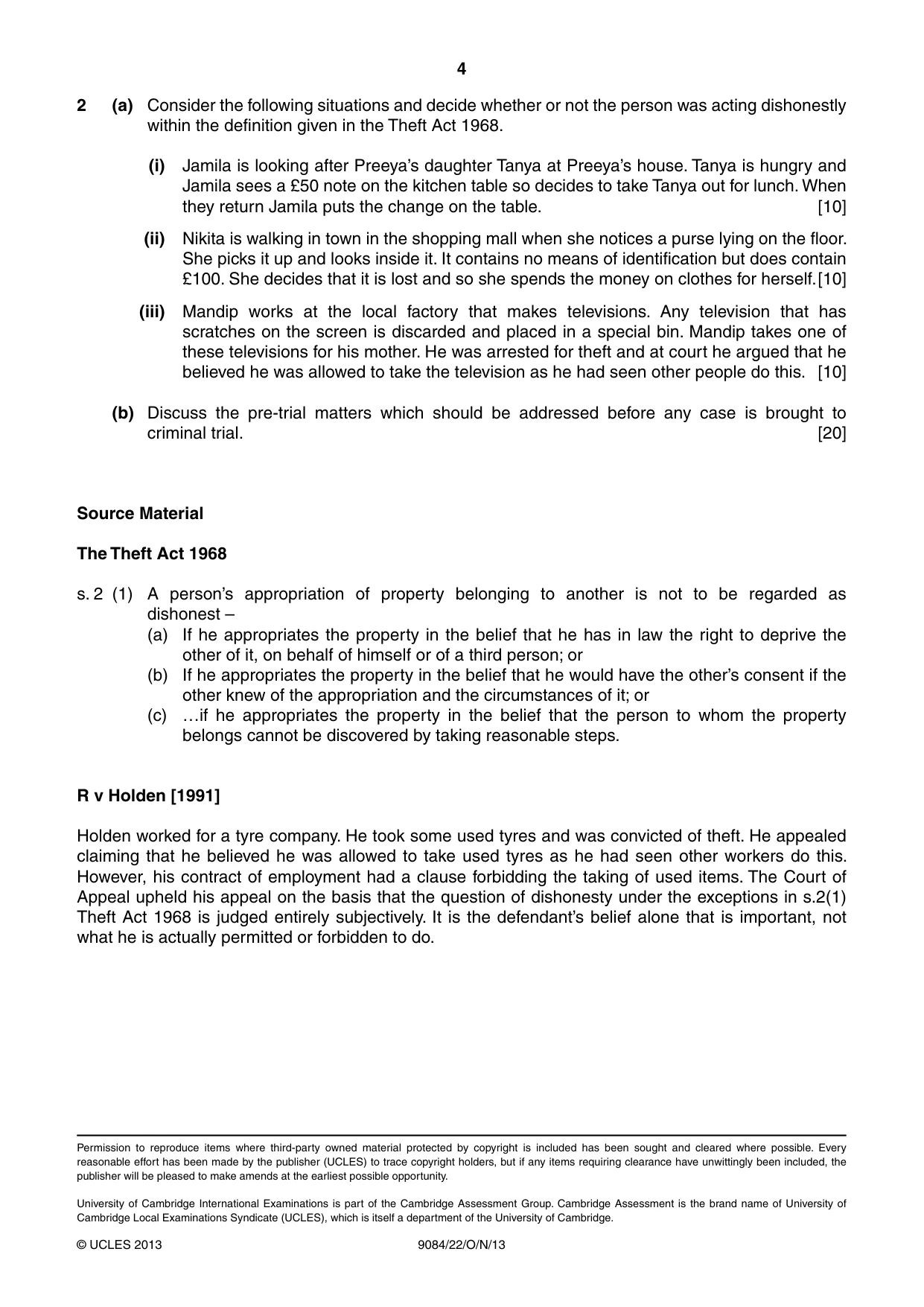
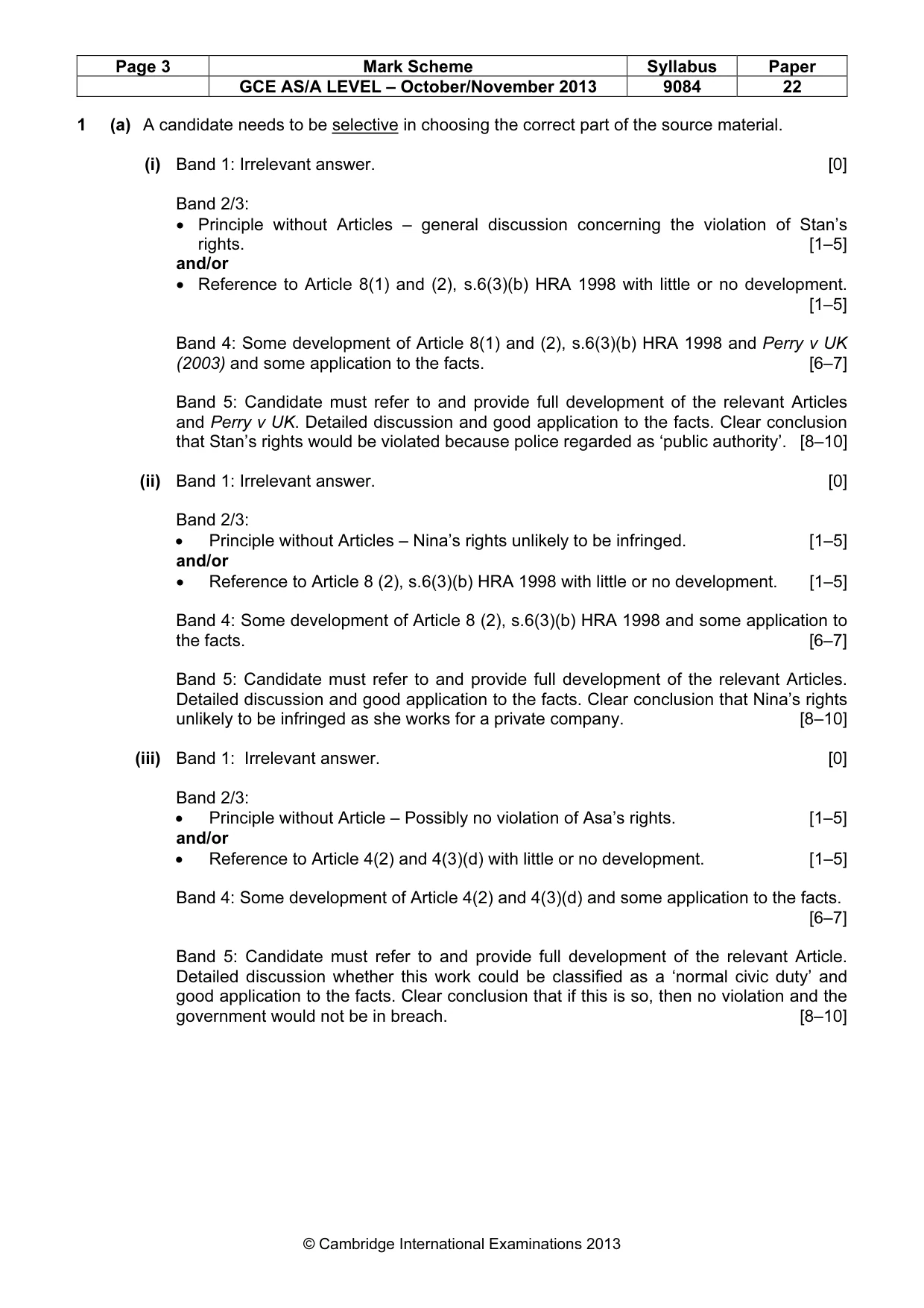
4 9084/22/O/N/13 © UCLES 2013 2 (a) Consider the following situations and decide whether or not the person was acting dishonestly within the definition given in the Theft Act 1968. (i) Jamila is looking after Preeya’s daughter Tanya at Preeya’s house. Tanya is hungry and Jamila sees a £50 note on the kitchen table so decides to take Tanya out for lunch. When they return Jamila puts the change on the table. [10] (ii) Nikita is walking in town in the shopping mall when she notices a purse lying on the floor. She picks it up and looks inside it. It contains no means of identification but does contain £100. She decides that it is lost and so she spends the money on clothes for herself. [10] (iii) Mandip works at the local factory that makes televisions. Any television that has scratches on the screen is discarded and placed in a special bin. Mandip takes one of these televisions for his mother. He was arrested for theft and at court he argued that he believed he was allowed to take the television as he had seen other people do this. [10] (b) Discuss the pre-trial matters which should be addressed before any case is brought to criminal trial. [20] Source Material The Theft Act 1968 s. 2 (1) A person’s appropriation of property belonging to another is not to be regarded as dishonest – (a) If he appropriates the property in the belief that he has in law the right to deprive the other of it, on behalf of himself or of a third person; or (b) If he appropriates the property in the belief that he would have the other’s consent if the other knew of the appropriation and the circumstances of it; or (c) …if he appropriates the property in the belief that the person to whom the property belongs cannot be discovered by taking reasonable steps. R v Holden [1991] Holden worked for a tyre company. He took some used tyres and was convicted of theft. He appealed claiming that he believed he was allowed to take used tyres as he had seen other workers do this. However, his contract of employment had a clause forbidding the taking of used items. The Court of Appeal upheld his appeal on the basis that the question of dishonesty under the exceptions in s.2(1) Theft Act 1968 is judged entirely subjectively. It is the defendant’s belief alone that is important, not what he is actually permitted or forbidden to do. Permission to reproduce items where third-party owned material protected by copyright is included has been sought and cleared where possible. Every reasonable effort has been made by the publisher (UCLES) to trace copyright holders, but if any items requiring clearance have unwittingly been included, the publisher will be pleased to make amends at the earliest possible opportunity. University of Cambridge International Examinations is part of the Cambridge Assessment Group. Cambridge Assessment is the brand name of University of Cambridge Local Examinations Syndicate (UCLES), which is itself a department of the University of Cambridge.
Mark scheme, page 1
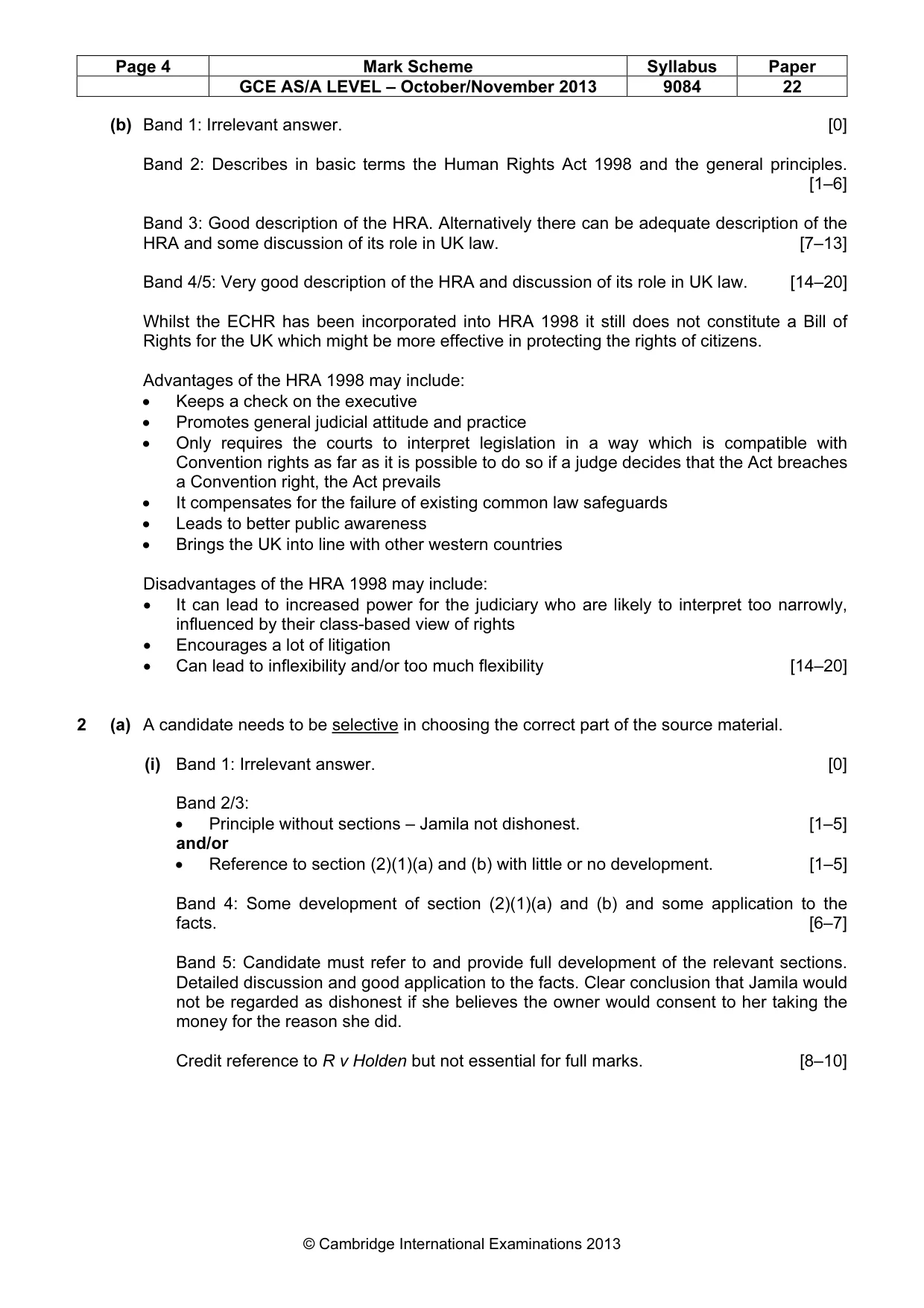
CAMBRIDGE INTERNATIONAL EXAMINATIONS GCE Advanced Subsidiary Level and GCE Advanced Level MARK SCHEME for the October/November 2013 series 9084 LAW 9084/22 Paper 2, maximum raw mark 50 This mark scheme is published as an aid to teachers and candidates, to indicate the requirements of the examination. It shows the basis on which Examiners were instructed to award marks. It does not indicate the details of the discussions that took place at an Examiners’ meeting before marking began, which would have considered the acceptability of alternative answers. Mark schemes should be read in conjunction with the question paper and the Principal Examiner Report for Teachers. Cambridge will not enter into discussions about these mark schemes. Cambridge is publishing the mark schemes for the October/November 2013 series for most IGCSE, GCE Advanced Level and Advanced Subsidiary Level components and some Ordinary Level components.
Mark scheme, page 2
Page 2 Mark Scheme Syllabus Paper GCE AS/A LEVEL – October/November 2013 9084 22 © Cambridge International Examinations 2013 This mark scheme includes a summary of appropriate content for answering each question. It should be emphasised, however, that this material is for illustrative purposes and is not intended to provide a definitive guide to acceptable answers. It is quite possible that among the scripts there will be some candidate answers that are not covered directly by the content of this mark scheme. In such cases, professional judgement should be exercised in assessing the merits of the answer and the senior examiners should be consulted if further guidance is required. Mark Bands The mark bands and descriptors applicable to all questions on the paper are as follows. Indicative content for each of the questions follows overleaf. Band 1: The answer contains no relevant material. Band 2: The candidate introduces fragments of information or unexplained examples from which no coherent explanation or analysis can emerge. OR The candidate attempts to introduce an explanation and/or analysis but it is so fundamentally undermined by error and confusion that it remains substantially incoherent. Band 3: The candidate begins to indicate some capacity for explanation and analysis by introducing some of the issues, but explanations are limited and superficial. OR The candidate adopts an approach in which there is concentration on explanation in terms of facts presented rather than through the development and explanation of legal principles and rules. OR The candidate attempts to introduce material across the range of potential content, but it is weak or confused so that no real explanation or conclusion emerges. Band 4: Where there is more than one issue, the candidate demonstrates a clear understanding of one of the main issues of the question, giving explanations and using illustrations so that a full and detailed picture is presented of this issue. OR The candidate presents a more limited explanation of all parts of the answer, but there is some lack of detail or superficiality in respect of either or both so that the answer is not fully rounded. Band 5: The candidate presents a detailed explanation and discussion of all areas of relevant law and, while there may be some minor inaccuracies and/or imbalance, a coherent explanation emerges.
Mark scheme, page 3
Page 3 Mark Scheme Syllabus Paper GCE AS/A LEVEL – October/November 2013 9084 22 © Cambridge International Examinations 2013 1 (a) A candidate needs to be selective in choosing the correct part of the source material. (i) Band 1: Irrelevant answer. [0] Band 2/3: • Principle without Articles – general discussion concerning the violation of Stan’s rights. [1–5] and/or • Reference to Article 8(1) and (2), s.6(3)(b) HRA 1998 with little or no development. [1–5] Band 4: Some development of Article 8(1) and (2), s.6(3)(b) HRA 1998 and Perry v UK (2003) and some application to the facts. [6–7] Band 5: Candidate must refer to and provide full development of the relevant Articles and Perry v UK. Detailed discussion and good application to the facts. Clear conclusion that Stan’s rights would be violated because police regarded as ‘public authority’. [8–10] (ii) Band 1: Irrelevant answer. [0] Band 2/3: • Principle without Articles – Nina’s rights unlikely to be infringed. [1–5] and/or • Reference to Article 8 (2), s.6(3)(b) HRA 1998 with little or no development. [1–5] Band 4: Some development of Article 8 (2), s.6(3)(b) HRA 1998 and some application to the facts. [6–7] Band 5: Candidate must refer to and provide full development of the relevant Articles. Detailed discussion and good application to the facts. Clear conclusion that Nina’s rights unlikely to be infringed as she works for a private company. [8–10] (iii) Band 1: Irrelevant answer. [0] Band 2/3: • Principle without Article – Possibly no violation of Asa’s rights. [1–5] and/or • Reference to Article 4(2) and 4(3)(d) with little or no development. [1–5] Band 4: Some development of Article 4(2) and 4(3)(d) and some application to the facts. [6–7] Band 5: Candidate must refer to and provide full development of the relevant Article. Detailed discussion whether this work could be classified as a ‘normal civic duty’ and good application to the facts. Clear conclusion that if this is so, then no violation and the government would not be in breach. [8–10]
Mark scheme, page 4
Page 4 Mark Scheme Syllabus Paper GCE AS/A LEVEL – October/November 2013 9084 22 © Cambridge International Examinations 2013 (b) Band 1: Irrelevant answer. [0] Band 2: Describes in basic terms the Human Rights Act 1998 and the general principles. [1–6] Band 3: Good description of the HRA. Alternatively there can be adequate description of the HRA and some discussion of its role in UK law. [7–13] Band 4/5: Very good description of the HRA and discussion of its role in UK law. [14–20] Whilst the ECHR has been incorporated into HRA 1998 it still does not constitute a Bill of Rights for the UK which might be more effective in protecting the rights of citizens. Advantages of the HRA 1998 may include: • Keeps a check on the executive • Promotes general judicial attitude and practice • Only requires the courts to interpret legislation in a way which is compatible with Convention rights as far as it is possible to do so if a judge decides that the Act breaches a Convention right, the Act prevails • It compensates for the failure of existing common law safeguards • Leads to better public awareness • Brings the UK into line with other western countries Disadvantages of the HRA 1998 may include: • It can lead to increased power for the judiciary who are likely to interpret too narrowly, influenced by their class-based view of rights • Encourages a lot of litigation • Can lead to inflexibility and/or too much flexibility [14–20] 2 (a) A candidate needs to be selective in choosing the correct part of the source material. (i) Band 1: Irrelevant answer. [0] Band 2/3: • Principle without sections – Jamila not dishonest. [1–5] and/or • Reference to section (2)(1)(a) and (b) with little or no development. [1–5] Band 4: Some development of section (2)(1)(a) and (b) and some application to the facts. [6–7] Band 5: Candidate must refer to and provide full development of the relevant sections. Detailed discussion and good application to the facts. Clear conclusion that Jamila would not be regarded as dishonest if she believes the owner would consent to her taking the money for the reason she did. Credit reference to R v Holden but not essential for full marks. [8–10]
Mark scheme, page 5
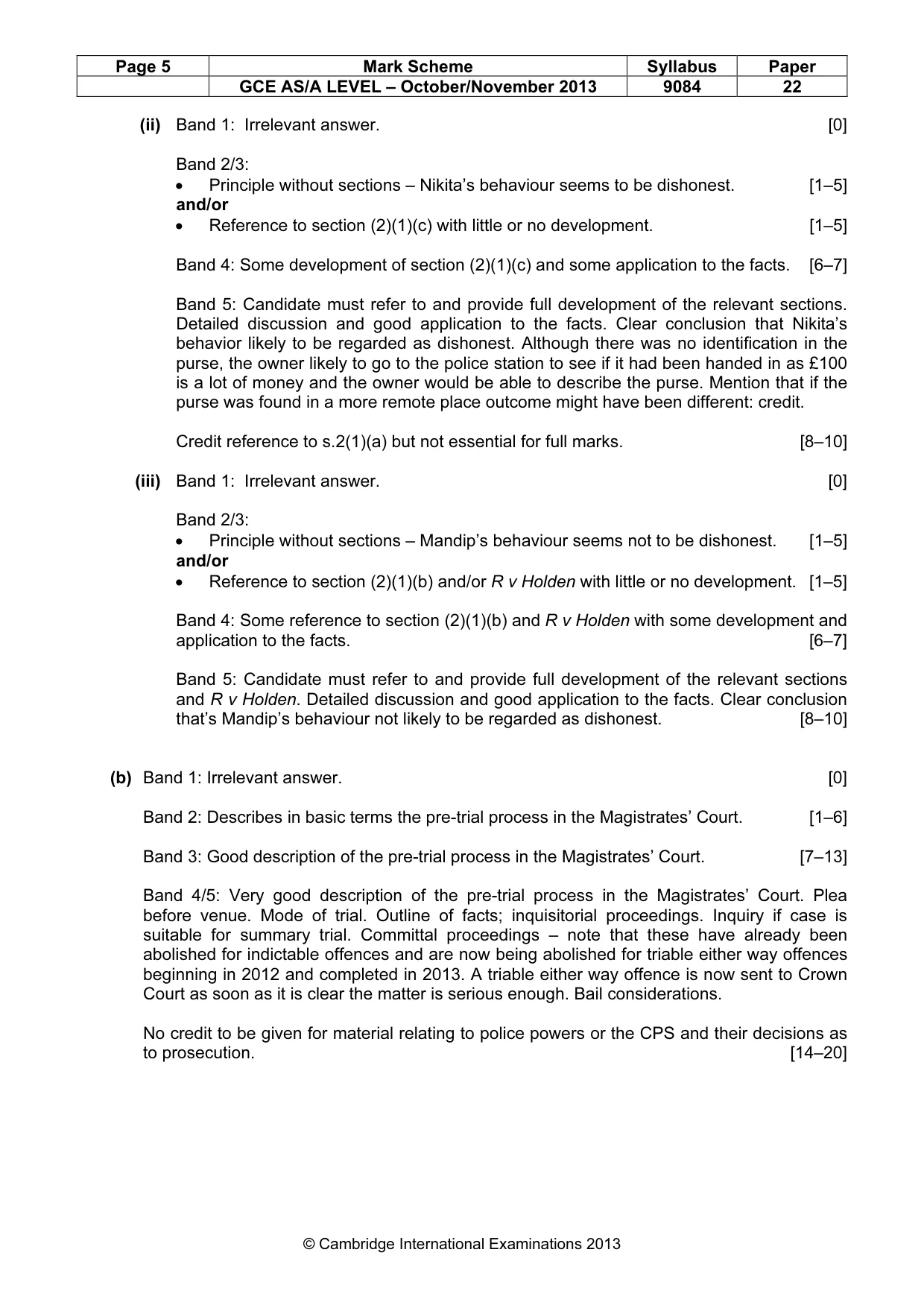
Page 5 Mark Scheme Syllabus Paper GCE AS/A LEVEL – October/November 2013 9084 22 © Cambridge International Examinations 2013 (ii) Band 1: Irrelevant answer. [0] Band 2/3: • Principle without sections – Nikita’s behaviour seems to be dishonest. [1–5] and/or • Reference to section (2)(1)(c) with little or no development. [1–5] Band 4: Some development of section (2)(1)(c) and some application to the facts. [6–7] Band 5: Candidate must refer to and provide full development of the relevant sections. Detailed discussion and good application to the facts. Clear conclusion that Nikita’s behavior likely to be regarded as dishonest. Although there was no identification in the purse, the owner likely to go to the police station to see if it had been handed in as £100 is a lot of money and the owner would be able to describe the purse. Mention that if the purse was found in a more remote place outcome might have been different: credit. Credit reference to s.2(1)(a) but not essential for full marks. [8–10] (iii) Band 1: Irrelevant answer. [0] Band 2/3: • Principle without sections – Mandip’s behaviour seems not to be dishonest. [1–5] and/or • Reference to section (2)(1)(b) and/or R v Holden with little or no development. [1–5] Band 4: Some reference to section (2)(1)(b) and R v Holden with some development and application to the facts. [6–7] Band 5: Candidate must refer to and provide full development of the relevant sections and R v Holden. Detailed discussion and good application to the facts. Clear conclusion that’s Mandip’s behaviour not likely to be regarded as dishonest. [8–10] (b) Band 1: Irrelevant answer. [0] Band 2: Describes in basic terms the pre-trial process in the Magistrates’ Court. [1–6] Band 3: Good description of the pre-trial process in the Magistrates’ Court. [7–13] Band 4/5: Very good description of the pre-trial process in the Magistrates’ Court. Plea before venue. Mode of trial. Outline of facts; inquisitorial proceedings. Inquiry if case is suitable for summary trial. Committal proceedings – note that these have already been abolished for indictable offences and are now being abolished for triable either way offences beginning in 2012 and completed in 2013. A triable either way offence is now sent to Crown Court as soon as it is clear the matter is serious enough. Bail considerations. No credit to be given for material relating to police powers or the CPS and their decisions as to prosecution. [14–20]
What you needed in this session
Cambridge’s own grade thresholds for 2013 Oct/Nov, Paper 2 · Variant 2. A higher threshold means an easier paper — the bar moves with how the cohort did.