Cambridge A Level Law 9084 — 2013 Oct/Nov Paper 2 · Variant 3
9084/23/O/N/13 · 50 marks · ≈56 min
The question paper and its mark scheme, free to read here and free to download. This is Cambridge’s own paper, exactly as it was sat.
Question paper8 pages



Mark scheme6 pages
Answers below. Sit the paper first if you are practising.
Paper as text
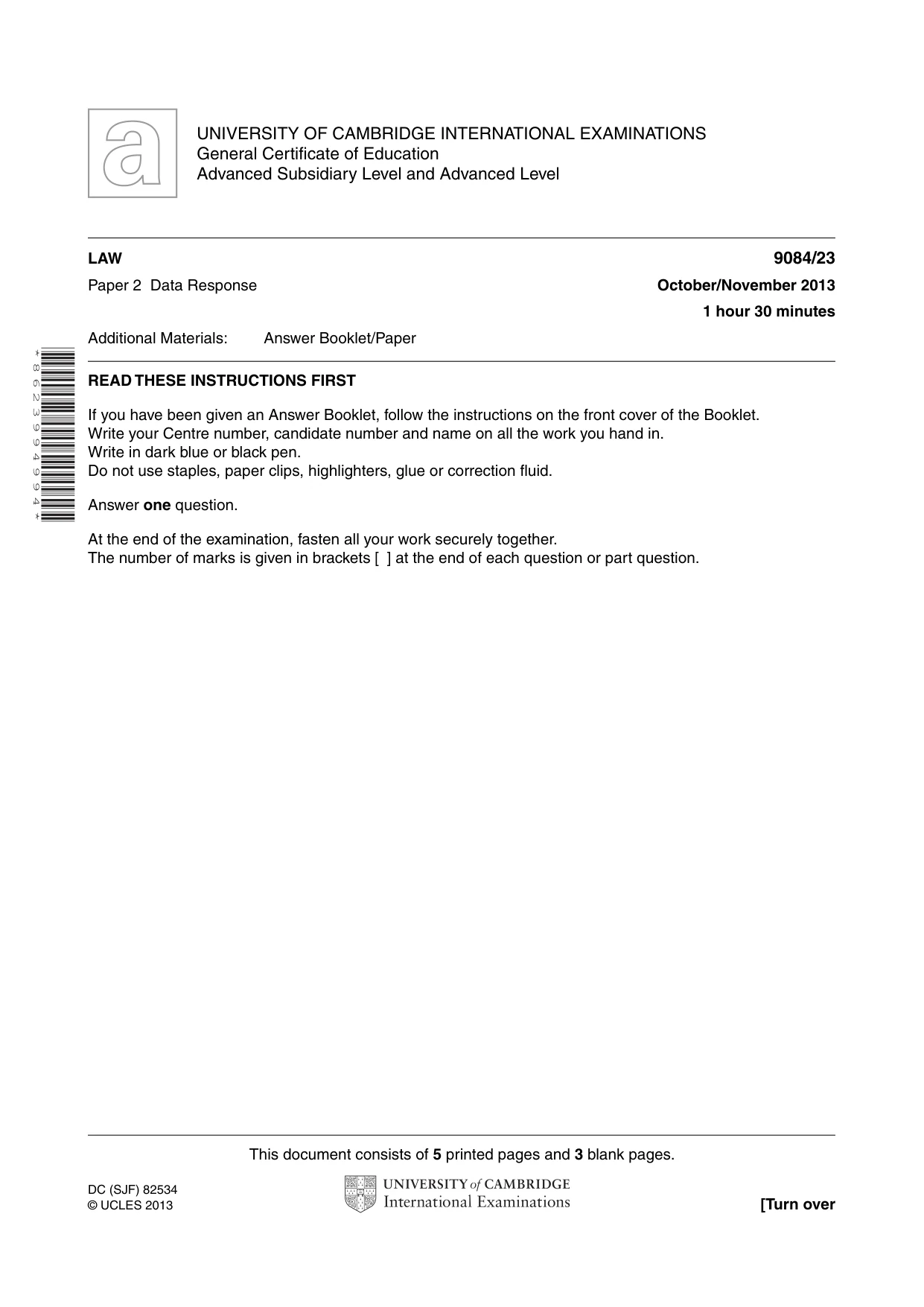
Question paper, page 1
This document consists of 5 printed pages and 3 blank pages. DC (SJF) 82534 © UCLES 2013 [Turn over UNIVERSITY OF CAMBRIDGE INTERNATIONAL EXAMINATIONS General Certificate of Education Advanced Subsidiary Level and Advanced Level * 8 6 2 3 9 9 4 9 9 4 * LAW 9084/23 Paper 2 Data Response October/November 2013 1 hour 30 minutes Additional Materials: Answer Booklet/Paper READ THESE INSTRUCTIONS FIRST If you have been given an Answer Booklet, follow the instructions on the front cover of the Booklet. Write your Centre number, candidate number and name on all the work you hand in. Write in dark blue or black pen. Do not use staples, paper clips, highlighters, glue or correction fluid. Answer one question. At the end of the examination, fasten all your work securely together. The number of marks is given in brackets [ ] at the end of each question or part question.
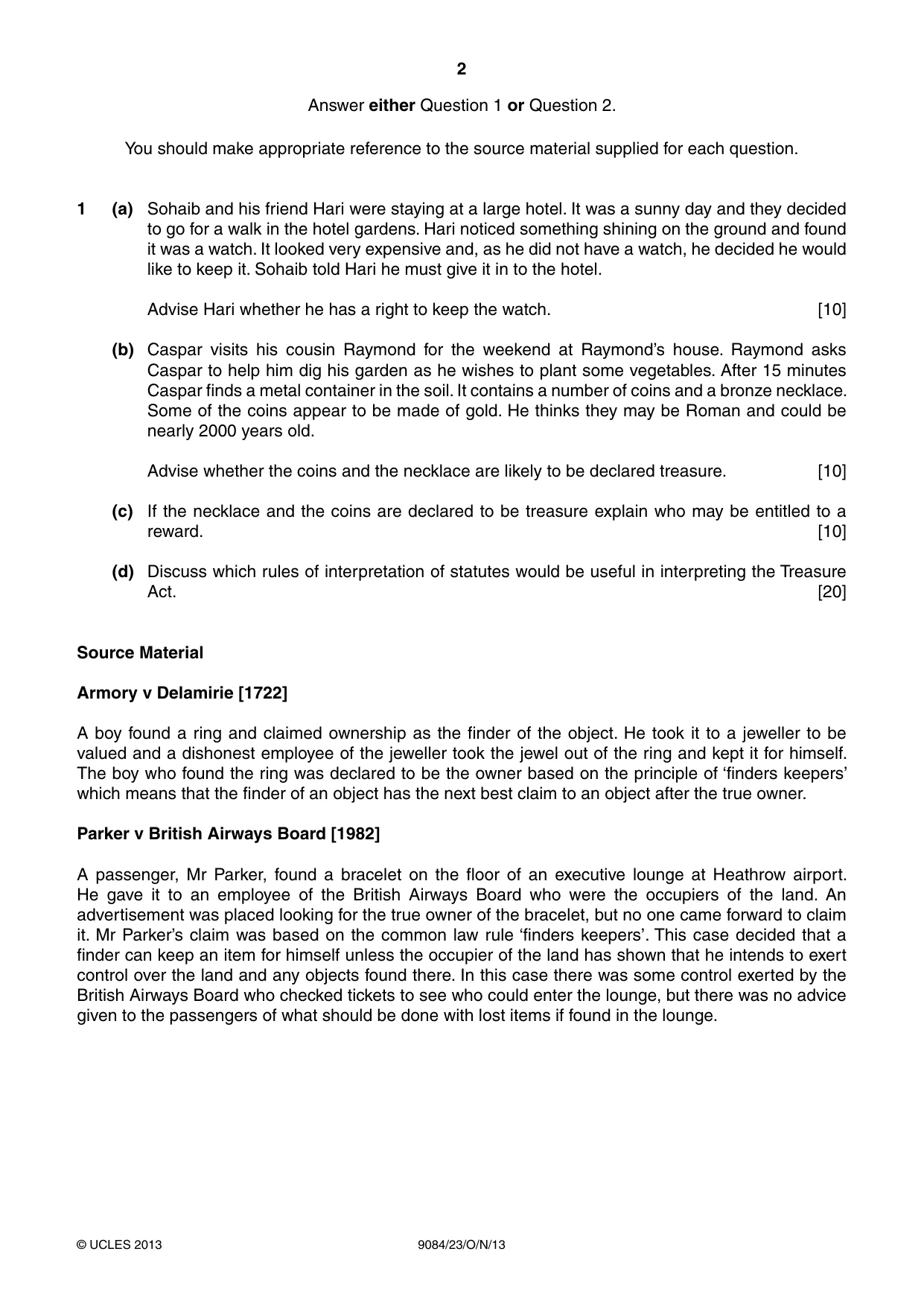
Question paper, page 2
2 9084/23/O/N/13 © UCLES 2013 Answer either Question 1 or Question 2. You should make appropriate reference to the source material supplied for each question. 1 (a) Sohaib and his friend Hari were staying at a large hotel. It was a sunny day and they decided to go for a walk in the hotel gardens. Hari noticed something shining on the ground and found it was a watch. It looked very expensive and, as he did not have a watch, he decided he would like to keep it. Sohaib told Hari he must give it in to the hotel. Advise Hari whether he has a right to keep the watch. [10] (b) Caspar visits his cousin Raymond for the weekend at Raymond’s house. Raymond asks Caspar to help him dig his garden as he wishes to plant some vegetables. After 15 minutes Caspar finds a metal container in the soil. It contains a number of coins and a bronze necklace. Some of the coins appear to be made of gold. He thinks they may be Roman and could be nearly 2000 years old. Advise whether the coins and the necklace are likely to be declared treasure. [10] (c) If the necklace and the coins are declared to be treasure explain who may be entitled to a reward. [10] (d) Discuss which rules of interpretation of statutes would be useful in interpreting the Treasure Act. [20] Source Material Armory v Delamirie [1722] A boy found a ring and claimed ownership as the finder of the object. He took it to a jeweller to be valued and a dishonest employee of the jeweller took the jewel out of the ring and kept it for himself. The boy who found the ring was declared to be the owner based on the principle of ‘finders keepers’ which means that the finder of an object has the next best claim to an object after the true owner. Parker v British Airways Board [1982] A passenger, Mr Parker, found a bracelet on the floor of an executive lounge at Heathrow airport. He gave it to an employee of the British Airways Board who were the occupiers of the land. An advertisement was placed looking for the true owner of the bracelet, but no one came forward to claim it. Mr Parker’s claim was based on the common law rule ‘finders keepers’. This case decided that a finder can keep an item for himself unless the occupier of the land has shown that he intends to exert control over the land and any objects found there. In this case there was some control exerted by the British Airways Board who checked tickets to see who could enter the lounge, but there was no advice given to the passengers of what should be done with lost items if found in the lounge.
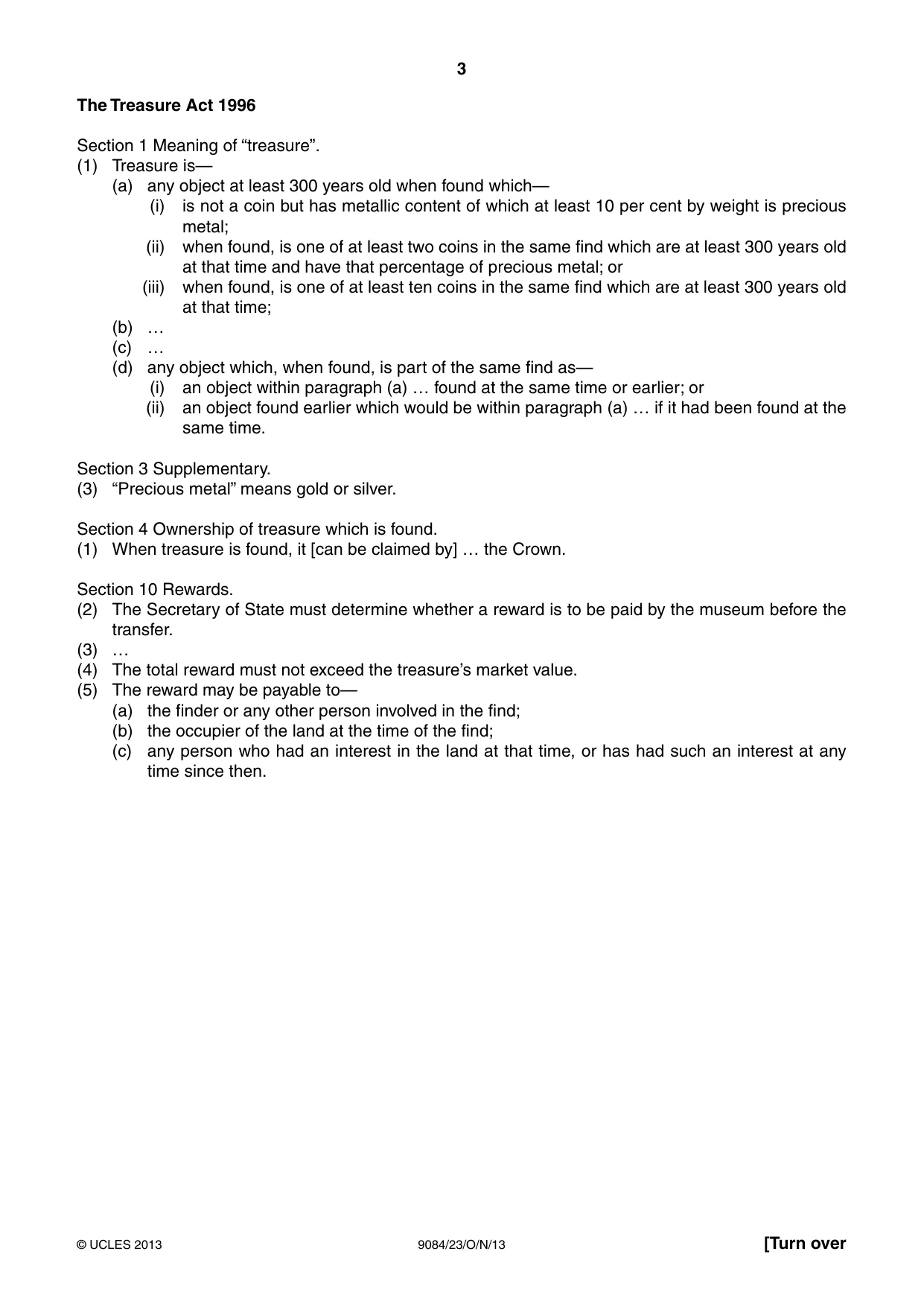
Question paper, page 3
3 9084/23/O/N/13 © UCLES 2013 [Turn over The Treasure Act 1996 Section 1 Meaning of “treasure”. (1) Treasure is— (a) any object at least 300 years old when found which— (i) is not a coin but has metallic content of which at least 10 per cent by weight is precious metal; (ii) when found, is one of at least two coins in the same find which are at least 300 years old at that time and have that percentage of precious metal; or (iii) when found, is one of at least ten coins in the same find which are at least 300 years old at that time; (b) … (c) … (d) any object which, when found, is part of the same find as— (i) an object within paragraph (a) … found at the same time or earlier; or (ii) an object found earlier which would be within paragraph (a) … if it had been found at the same time. Section 3 Supplementary. (3) “Precious metal” means gold or silver. Section 4 Ownership of treasure which is found. (1) When treasure is found, it [can be claimed by] … the Crown. Section 10 Rewards. (2) The Secretary of State must determine whether a reward is to be paid by the museum before the transfer. (3) … (4) The total reward must not exceed the treasure’s market value. (5) The reward may be payable to— (a) the finder or any other person involved in the find; (b) the occupier of the land at the time of the find; (c) any person who had an interest in the land at that time, or has had such an interest at any time since then.
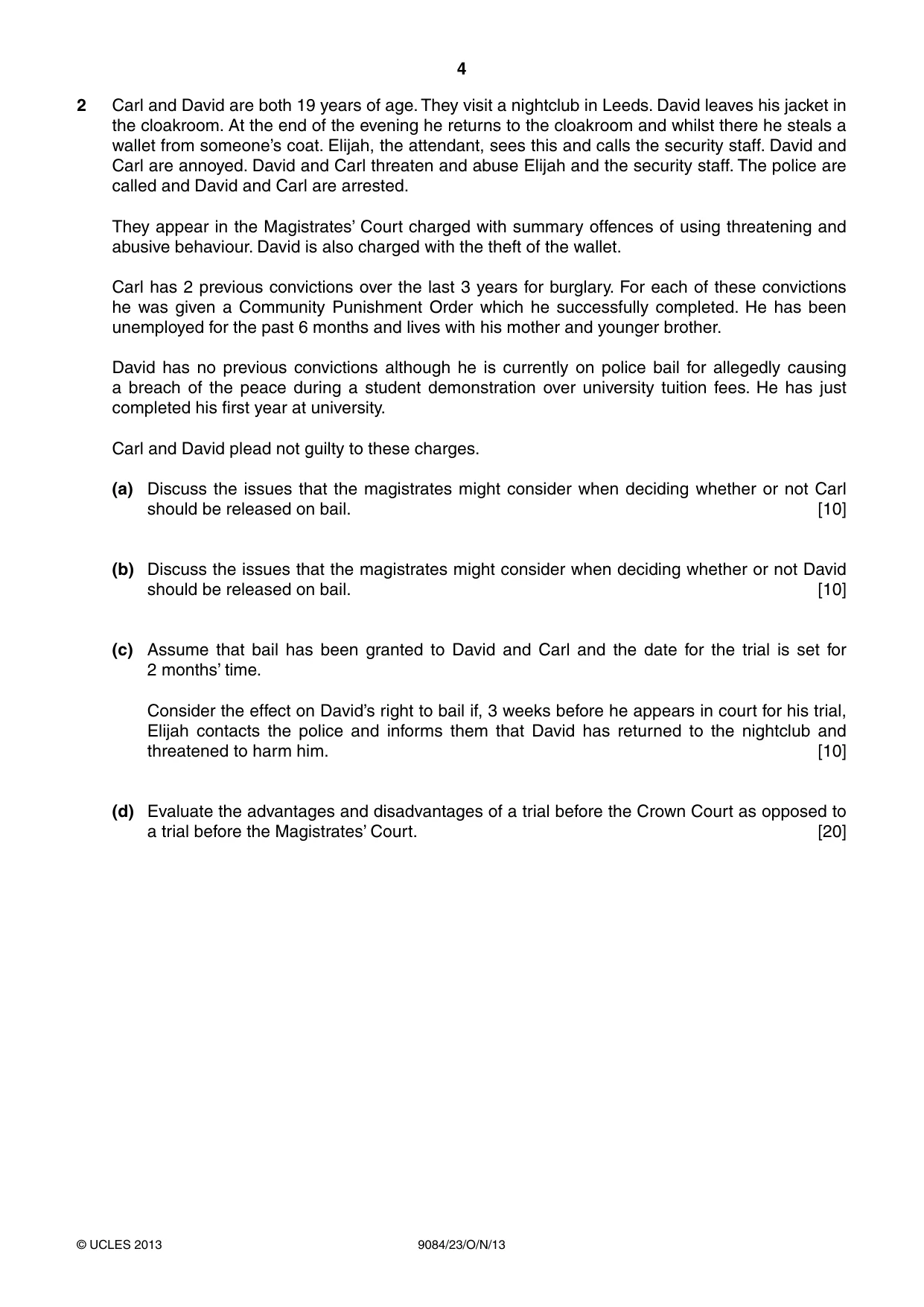
Question paper, page 4
4 9084/23/O/N/13 © UCLES 2013 2 Carl and David are both 19 years of age. They visit a nightclub in Leeds. David leaves his jacket in the cloakroom. At the end of the evening he returns to the cloakroom and whilst there he steals a wallet from someone’s coat. Elijah, the attendant, sees this and calls the security staff. David and Carl are annoyed. David and Carl threaten and abuse Elijah and the security staff. The police are called and David and Carl are arrested. They appear in the Magistrates’ Court charged with summary offences of using threatening and abusive behaviour. David is also charged with the theft of the wallet. Carl has 2 previous convictions over the last 3 years for burglary. For each of these convictions he was given a Community Punishment Order which he successfully completed. He has been unemployed for the past 6 months and lives with his mother and younger brother. David has no previous convictions although he is currently on police bail for allegedly causing a breach of the peace during a student demonstration over university tuition fees. He has just completed his first year at university. Carl and David plead not guilty to these charges. (a) Discuss the issues that the magistrates might consider when deciding whether or not Carl should be released on bail. [10] (b) Discuss the issues that the magistrates might consider when deciding whether or not David should be released on bail. [10] (c) Assume that bail has been granted to David and Carl and the date for the trial is set for 2 months’ time. Consider the effect on David’s right to bail if, 3 weeks before he appears in court for his trial, Elijah contacts the police and informs them that David has returned to the nightclub and threatened to harm him. [10] (d) Evaluate the advantages and disadvantages of a trial before the Crown Court as opposed to a trial before the Magistrates’ Court. [20]
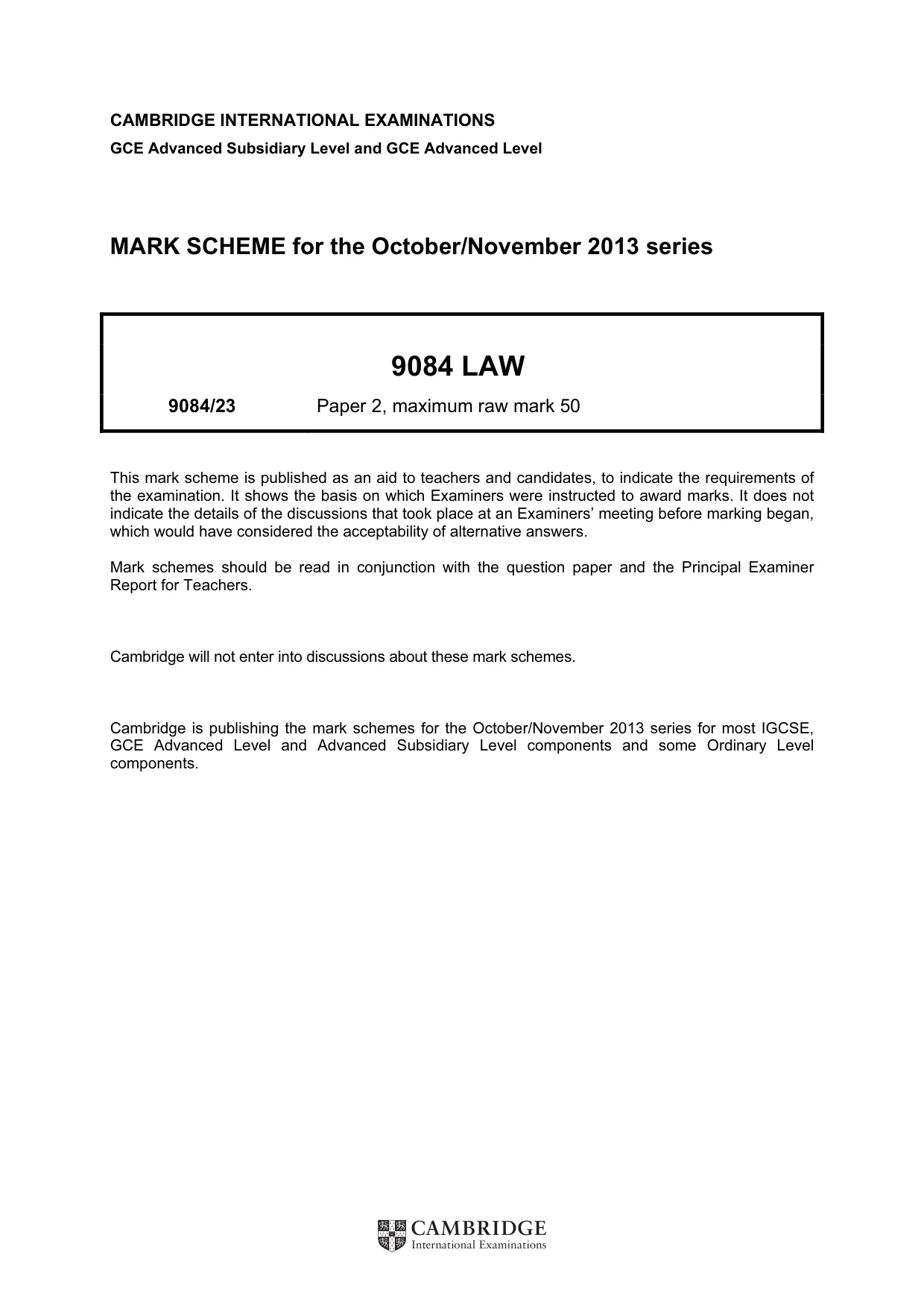
Question paper, page 5
5 9084/23/O/N/13 © UCLES 2013 Source Material Extracts from the Bail Act 1976 Schedule 1 Para 2(1) The defendant need not be granted bail if the court is satisfied that there are substantial grounds for believing that the defendant, if released on bail (whether subject to conditions or not) would: (a) fail to surrender to custody; or (b) commit an offence whilst on bail; or (c) interfere with witnesses or otherwise obstruct the course of justice, whether in relation to himself or any other person. Para 2A The defendant need not be granted bail if: (a) the offence is an indictable offence or an offence triable either way; and (b) it appears to the court that he was on bail in criminal proceedings on the date of the offence. R(F) v Southampton Crown Court [2009] The court had refused to grant bail because it was not sure that the accused would stay out of trouble. The Court of Appeal found there had to be substantial grounds for believing that the defendant would breach the terms of his bail under Schedule 1 if bail was to be refused. Note Under the Theft Act 1968 theft is a triable either way offence.
Question paper, page 6
6 9084/23/O/N/13 © UCLES 2013 BLANK PAGE
Question paper, page 7
7 9084/23/O/N/13 © UCLES 2013 BLANK PAGE
Question paper, page 8
8 9084/23/O/N/13 © UCLES 2013 BLANK PAGE Permission to reproduce items where third-party owned material protected by copyright is included has been sought and cleared where possible. Every reasonable effort has been made by the publisher (UCLES) to trace copyright holders, but if any items requiring clearance have unwittingly been included, the publisher will be pleased to make amends at the earliest possible opportunity. University of Cambridge International Examinations is part of the Cambridge Assessment Group. Cambridge Assessment is the brand name of University of Cambridge Local Examinations Syndicate (UCLES), which is itself a department of the University of Cambridge.
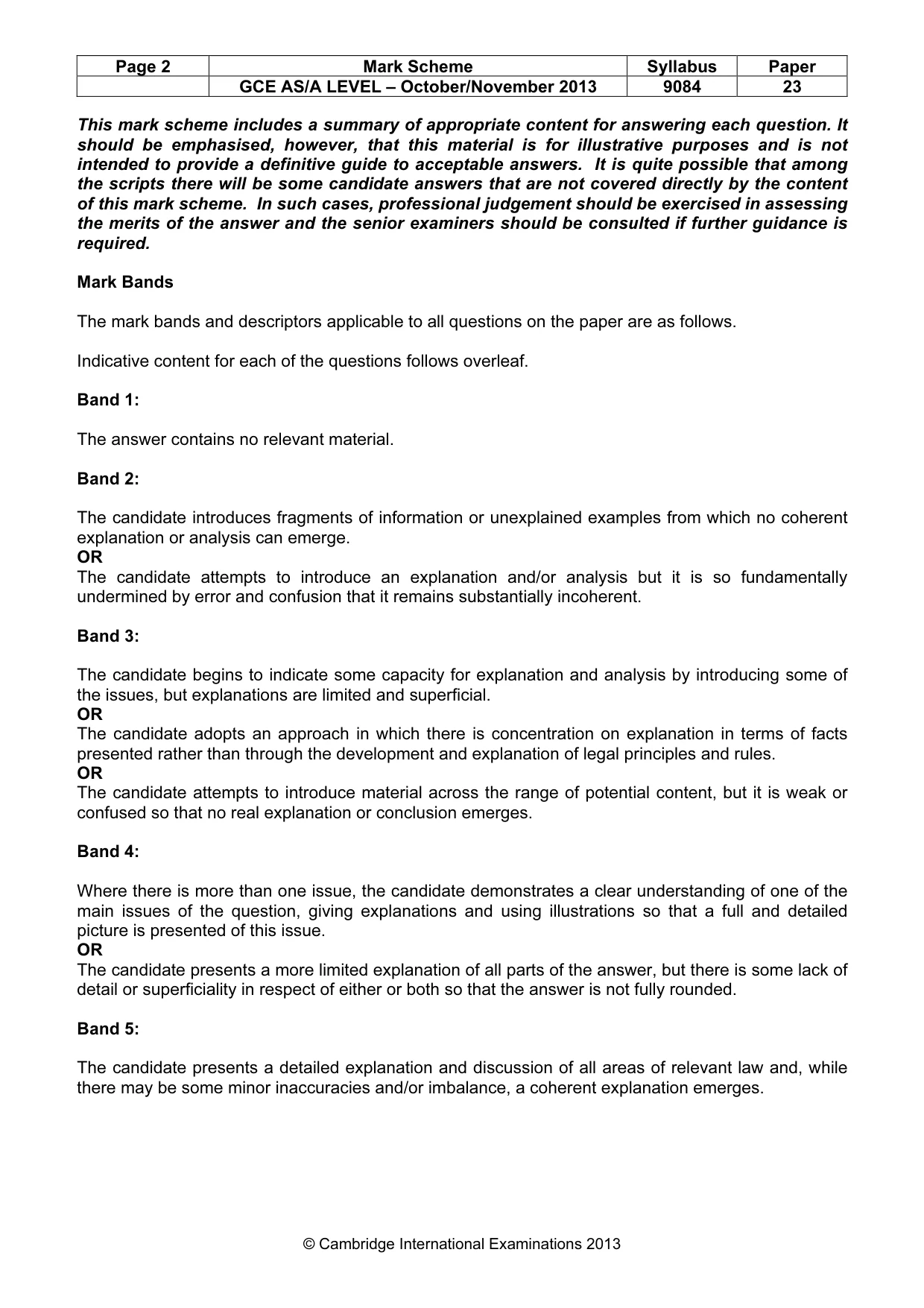
Mark scheme, page 1
CAMBRIDGE INTERNATIONAL EXAMINATIONS GCE Advanced Subsidiary Level and GCE Advanced Level MARK SCHEME for the October/November 2013 series 9084 LAW 9084/23 Paper 2, maximum raw mark 50 This mark scheme is published as an aid to teachers and candidates, to indicate the requirements of the examination. It shows the basis on which Examiners were instructed to award marks. It does not indicate the details of the discussions that took place at an Examiners’ meeting before marking began, which would have considered the acceptability of alternative answers. Mark schemes should be read in conjunction with the question paper and the Principal Examiner Report for Teachers. Cambridge will not enter into discussions about these mark schemes. Cambridge is publishing the mark schemes for the October/November 2013 series for most IGCSE, GCE Advanced Level and Advanced Subsidiary Level components and some Ordinary Level components.
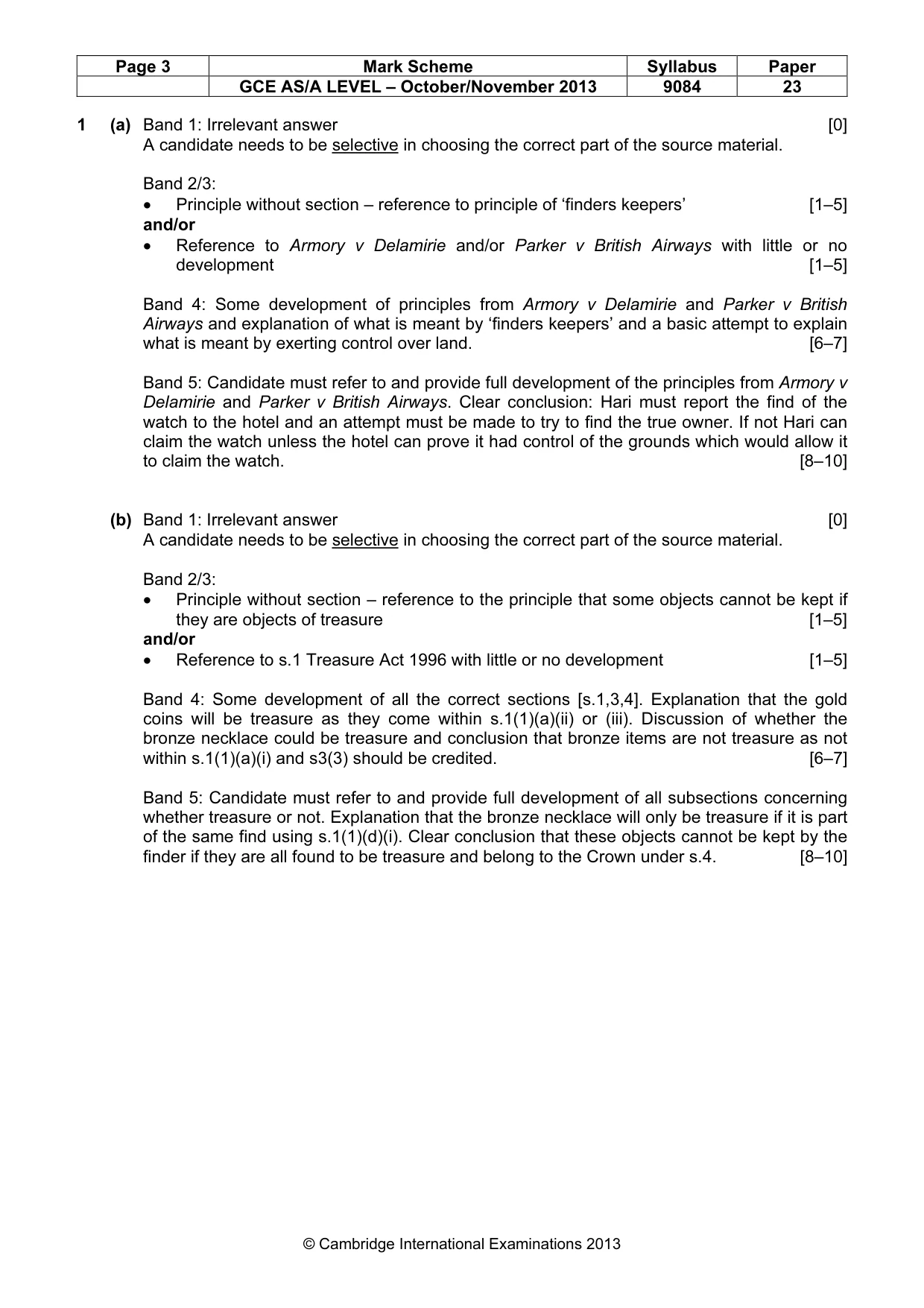
Mark scheme, page 2
Page 2 Mark Scheme Syllabus Paper GCE AS/A LEVEL – October/November 2013 9084 23 © Cambridge International Examinations 2013 This mark scheme includes a summary of appropriate content for answering each question. It should be emphasised, however, that this material is for illustrative purposes and is not intended to provide a definitive guide to acceptable answers. It is quite possible that among the scripts there will be some candidate answers that are not covered directly by the content of this mark scheme. In such cases, professional judgement should be exercised in assessing the merits of the answer and the senior examiners should be consulted if further guidance is required. Mark Bands The mark bands and descriptors applicable to all questions on the paper are as follows. Indicative content for each of the questions follows overleaf. Band 1: The answer contains no relevant material. Band 2: The candidate introduces fragments of information or unexplained examples from which no coherent explanation or analysis can emerge. OR The candidate attempts to introduce an explanation and/or analysis but it is so fundamentally undermined by error and confusion that it remains substantially incoherent. Band 3: The candidate begins to indicate some capacity for explanation and analysis by introducing some of the issues, but explanations are limited and superficial. OR The candidate adopts an approach in which there is concentration on explanation in terms of facts presented rather than through the development and explanation of legal principles and rules. OR The candidate attempts to introduce material across the range of potential content, but it is weak or confused so that no real explanation or conclusion emerges. Band 4: Where there is more than one issue, the candidate demonstrates a clear understanding of one of the main issues of the question, giving explanations and using illustrations so that a full and detailed picture is presented of this issue. OR The candidate presents a more limited explanation of all parts of the answer, but there is some lack of detail or superficiality in respect of either or both so that the answer is not fully rounded. Band 5: The candidate presents a detailed explanation and discussion of all areas of relevant law and, while there may be some minor inaccuracies and/or imbalance, a coherent explanation emerges.
Mark scheme, page 3
Page 3 Mark Scheme Syllabus Paper GCE AS/A LEVEL – October/November 2013 9084 23 © Cambridge International Examinations 2013 1 (a) Band 1: Irrelevant answer [0] A candidate needs to be selective in choosing the correct part of the source material. Band 2/3: • Principle without section – reference to principle of ‘finders keepers’ [1–5] and/or • Reference to Armory v Delamirie and/or Parker v British Airways with little or no development [1–5] Band 4: Some development of principles from Armory v Delamirie and Parker v British Airways and explanation of what is meant by ‘finders keepers’ and a basic attempt to explain what is meant by exerting control over land. [6–7] Band 5: Candidate must refer to and provide full development of the principles from Armory v Delamirie and Parker v British Airways. Clear conclusion: Hari must report the find of the watch to the hotel and an attempt must be made to try to find the true owner. If not Hari can claim the watch unless the hotel can prove it had control of the grounds which would allow it to claim the watch. [8–10] (b) Band 1: Irrelevant answer [0] A candidate needs to be selective in choosing the correct part of the source material. Band 2/3: • Principle without section – reference to the principle that some objects cannot be kept if they are objects of treasure [1–5] and/or • Reference to s.1 Treasure Act 1996 with little or no development [1–5] Band 4: Some development of all the correct sections [s.1,3,4]. Explanation that the gold coins will be treasure as they come within s.1(1)(a)(ii) or (iii). Discussion of whether the bronze necklace could be treasure and conclusion that bronze items are not treasure as not within s.1(1)(a)(i) and s3(3) should be credited. [6–7] Band 5: Candidate must refer to and provide full development of all subsections concerning whether treasure or not. Explanation that the bronze necklace will only be treasure if it is part of the same find using s.1(1)(d)(i). Clear conclusion that these objects cannot be kept by the finder if they are all found to be treasure and belong to the Crown under s.4. [8–10]
Mark scheme, page 4
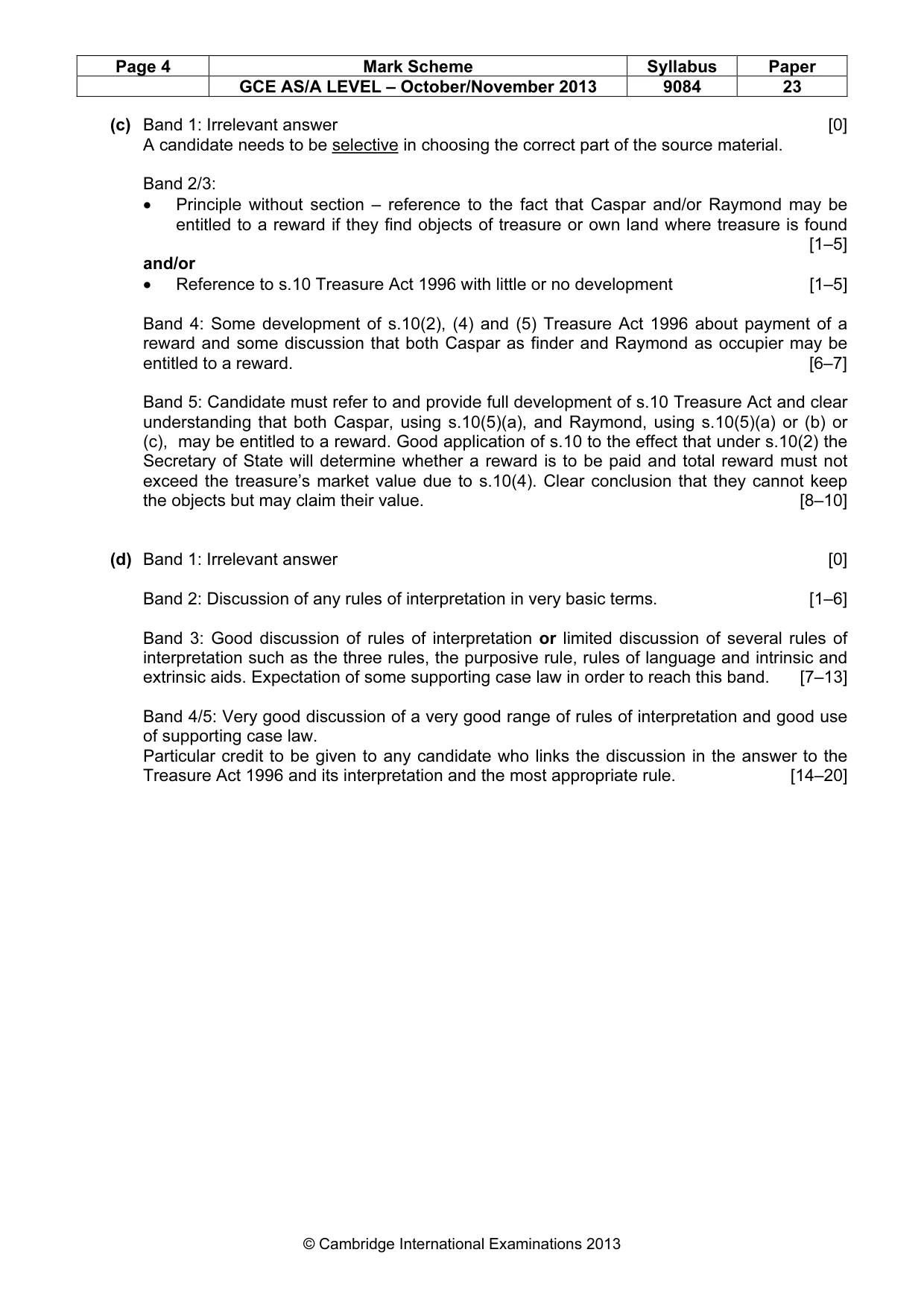
Page 4 Mark Scheme Syllabus Paper GCE AS/A LEVEL – October/November 2013 9084 23 © Cambridge International Examinations 2013 (c) Band 1: Irrelevant answer [0] A candidate needs to be selective in choosing the correct part of the source material. Band 2/3: • Principle without section – reference to the fact that Caspar and/or Raymond may be entitled to a reward if they find objects of treasure or own land where treasure is found [1–5] and/or • Reference to s.10 Treasure Act 1996 with little or no development [1–5] Band 4: Some development of s.10(2), (4) and (5) Treasure Act 1996 about payment of a reward and some discussion that both Caspar as finder and Raymond as occupier may be entitled to a reward. [6–7] Band 5: Candidate must refer to and provide full development of s.10 Treasure Act and clear understanding that both Caspar, using s.10(5)(a), and Raymond, using s.10(5)(a) or (b) or (c), may be entitled to a reward. Good application of s.10 to the effect that under s.10(2) the Secretary of State will determine whether a reward is to be paid and total reward must not exceed the treasure’s market value due to s.10(4). Clear conclusion that they cannot keep the objects but may claim their value. [8–10] (d) Band 1: Irrelevant answer [0] Band 2: Discussion of any rules of interpretation in very basic terms. [1–6] Band 3: Good discussion of rules of interpretation or limited discussion of several rules of interpretation such as the three rules, the purposive rule, rules of language and intrinsic and extrinsic aids. Expectation of some supporting case law in order to reach this band. [7–13] Band 4/5: Very good discussion of a very good range of rules of interpretation and good use of supporting case law. Particular credit to be given to any candidate who links the discussion in the answer to the Treasure Act 1996 and its interpretation and the most appropriate rule. [14–20]
Mark scheme, page 5
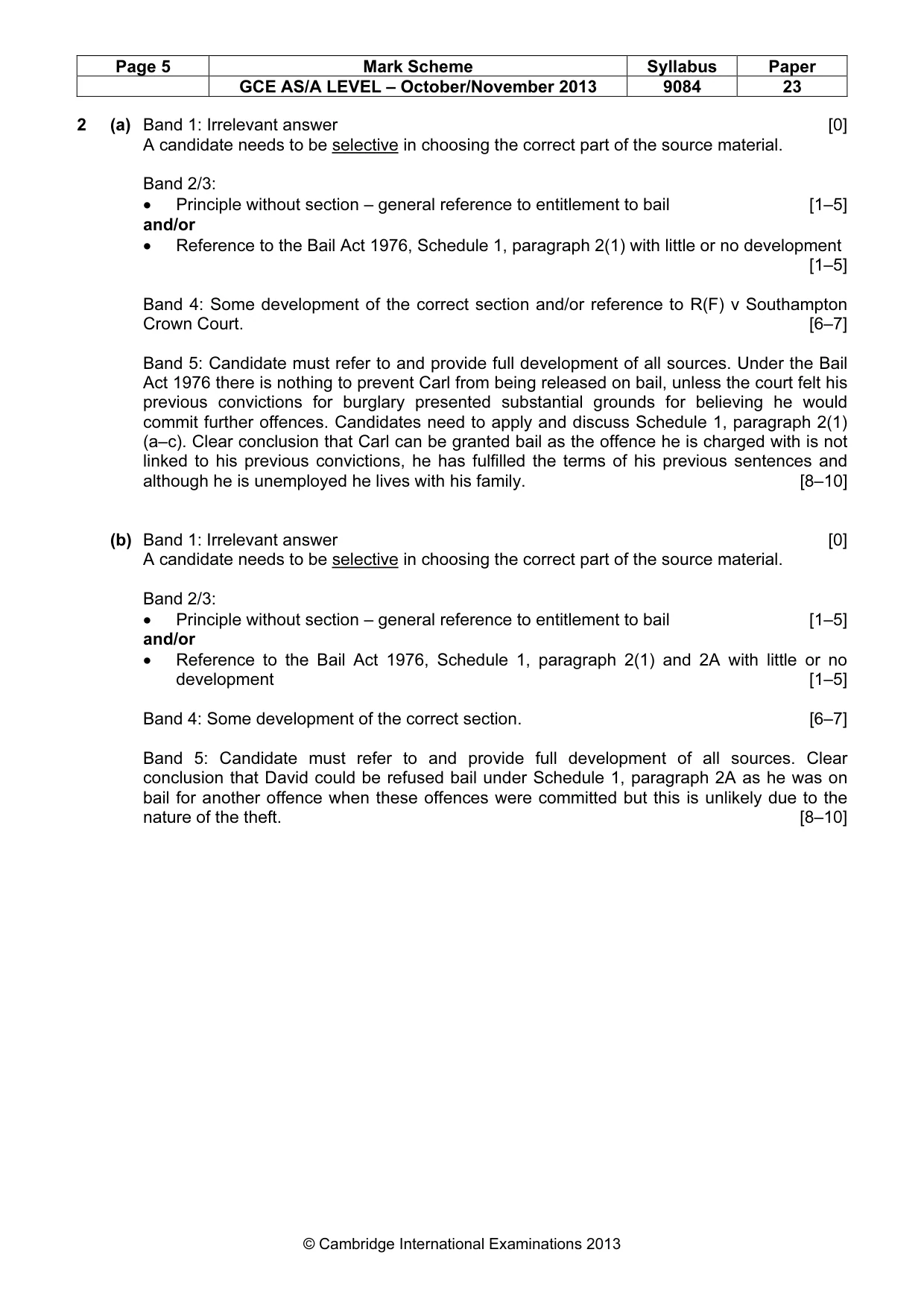
Page 5 Mark Scheme Syllabus Paper GCE AS/A LEVEL – October/November 2013 9084 23 © Cambridge International Examinations 2013 2 (a) Band 1: Irrelevant answer [0] A candidate needs to be selective in choosing the correct part of the source material. Band 2/3: • Principle without section – general reference to entitlement to bail [1–5] and/or • Reference to the Bail Act 1976, Schedule 1, paragraph 2(1) with little or no development [1–5] Band 4: Some development of the correct section and/or reference to R(F) v Southampton Crown Court. [6–7] Band 5: Candidate must refer to and provide full development of all sources. Under the Bail Act 1976 there is nothing to prevent Carl from being released on bail, unless the court felt his previous convictions for burglary presented substantial grounds for believing he would commit further offences. Candidates need to apply and discuss Schedule 1, paragraph 2(1) (a–c). Clear conclusion that Carl can be granted bail as the offence he is charged with is not linked to his previous convictions, he has fulfilled the terms of his previous sentences and although he is unemployed he lives with his family. [8–10] (b) Band 1: Irrelevant answer [0] A candidate needs to be selective in choosing the correct part of the source material. Band 2/3: • Principle without section – general reference to entitlement to bail [1–5] and/or • Reference to the Bail Act 1976, Schedule 1, paragraph 2(1) and 2A with little or no development [1–5] Band 4: Some development of the correct section. [6–7] Band 5: Candidate must refer to and provide full development of all sources. Clear conclusion that David could be refused bail under Schedule 1, paragraph 2A as he was on bail for another offence when these offences were committed but this is unlikely due to the nature of the theft. [8–10]
Mark scheme, page 6
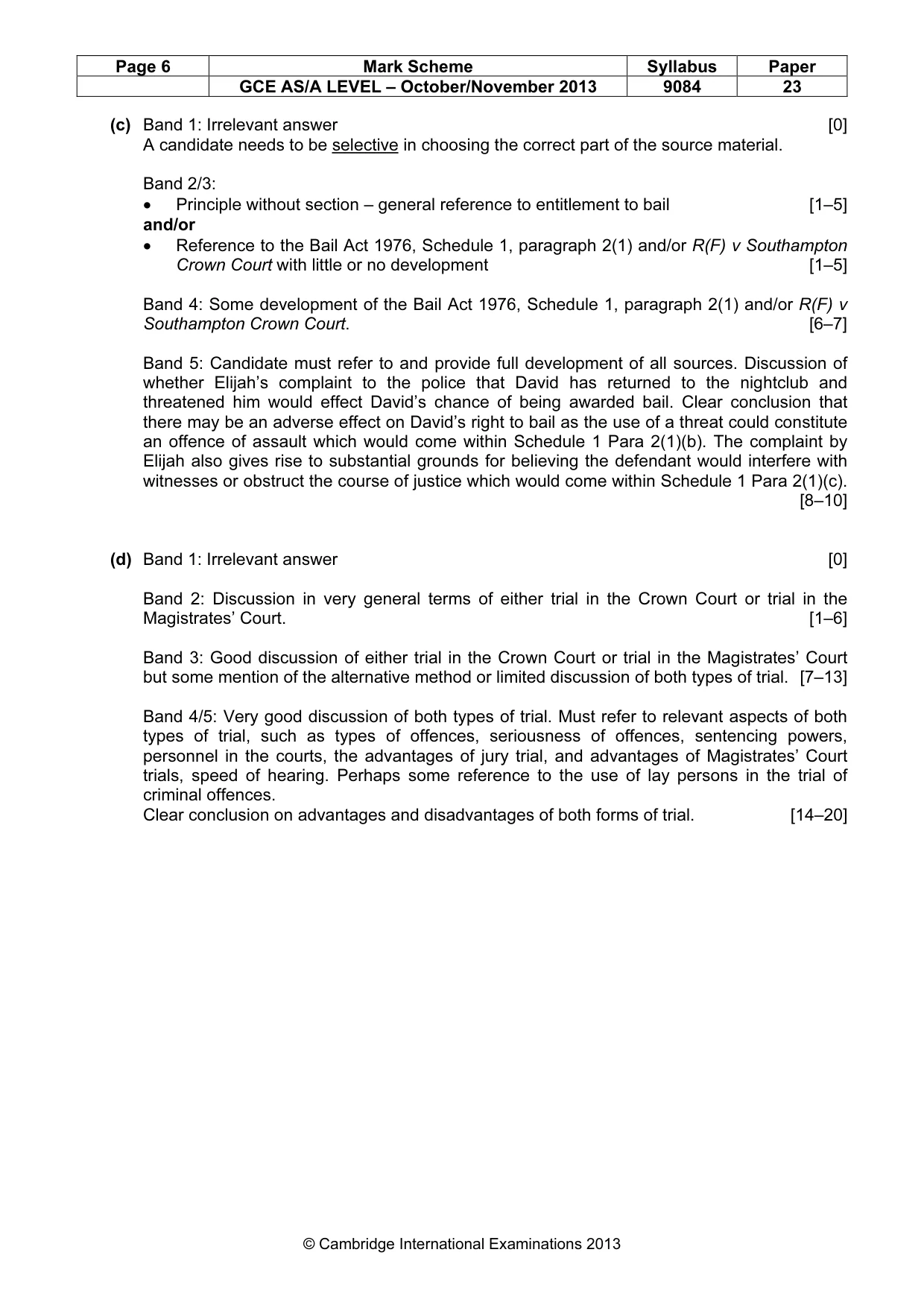
Page 6 Mark Scheme Syllabus Paper GCE AS/A LEVEL – October/November 2013 9084 23 © Cambridge International Examinations 2013 (c) Band 1: Irrelevant answer [0] A candidate needs to be selective in choosing the correct part of the source material. Band 2/3: • Principle without section – general reference to entitlement to bail [1–5] and/or • Reference to the Bail Act 1976, Schedule 1, paragraph 2(1) and/or R(F) v Southampton Crown Court with little or no development [1–5] Band 4: Some development of the Bail Act 1976, Schedule 1, paragraph 2(1) and/or R(F) v Southampton Crown Court. [6–7] Band 5: Candidate must refer to and provide full development of all sources. Discussion of whether Elijah’s complaint to the police that David has returned to the nightclub and threatened him would effect David’s chance of being awarded bail. Clear conclusion that there may be an adverse effect on David’s right to bail as the use of a threat could constitute an offence of assault which would come within Schedule 1 Para 2(1)(b). The complaint by Elijah also gives rise to substantial grounds for believing the defendant would interfere with witnesses or obstruct the course of justice which would come within Schedule 1 Para 2(1)(c). [8–10] (d) Band 1: Irrelevant answer [0] Band 2: Discussion in very general terms of either trial in the Crown Court or trial in the Magistrates’ Court. [1–6] Band 3: Good discussion of either trial in the Crown Court or trial in the Magistrates’ Court but some mention of the alternative method or limited discussion of both types of trial. [7–13] Band 4/5: Very good discussion of both types of trial. Must refer to relevant aspects of both types of trial, such as types of offences, seriousness of offences, sentencing powers, personnel in the courts, the advantages of jury trial, and advantages of Magistrates’ Court trials, speed of hearing. Perhaps some reference to the use of lay persons in the trial of criminal offences. Clear conclusion on advantages and disadvantages of both forms of trial. [14–20]
What you needed in this session
Cambridge’s own grade thresholds for 2013 Oct/Nov, Paper 2 · Variant 3. A higher threshold means an easier paper — the bar moves with how the cohort did.