Cambridge A Level Law 9084 — 2012 Oct/Nov Paper 2 · Variant 2
9084/22/O/N/12 · 50 marks · ≈56 min
The question paper and its mark scheme, free to read here and free to download. This is Cambridge’s own paper, exactly as it was sat.
Question paper4 pages
Mark scheme6 pages
Answers below. Sit the paper first if you are practising.
Paper as text
Question paper, page 1
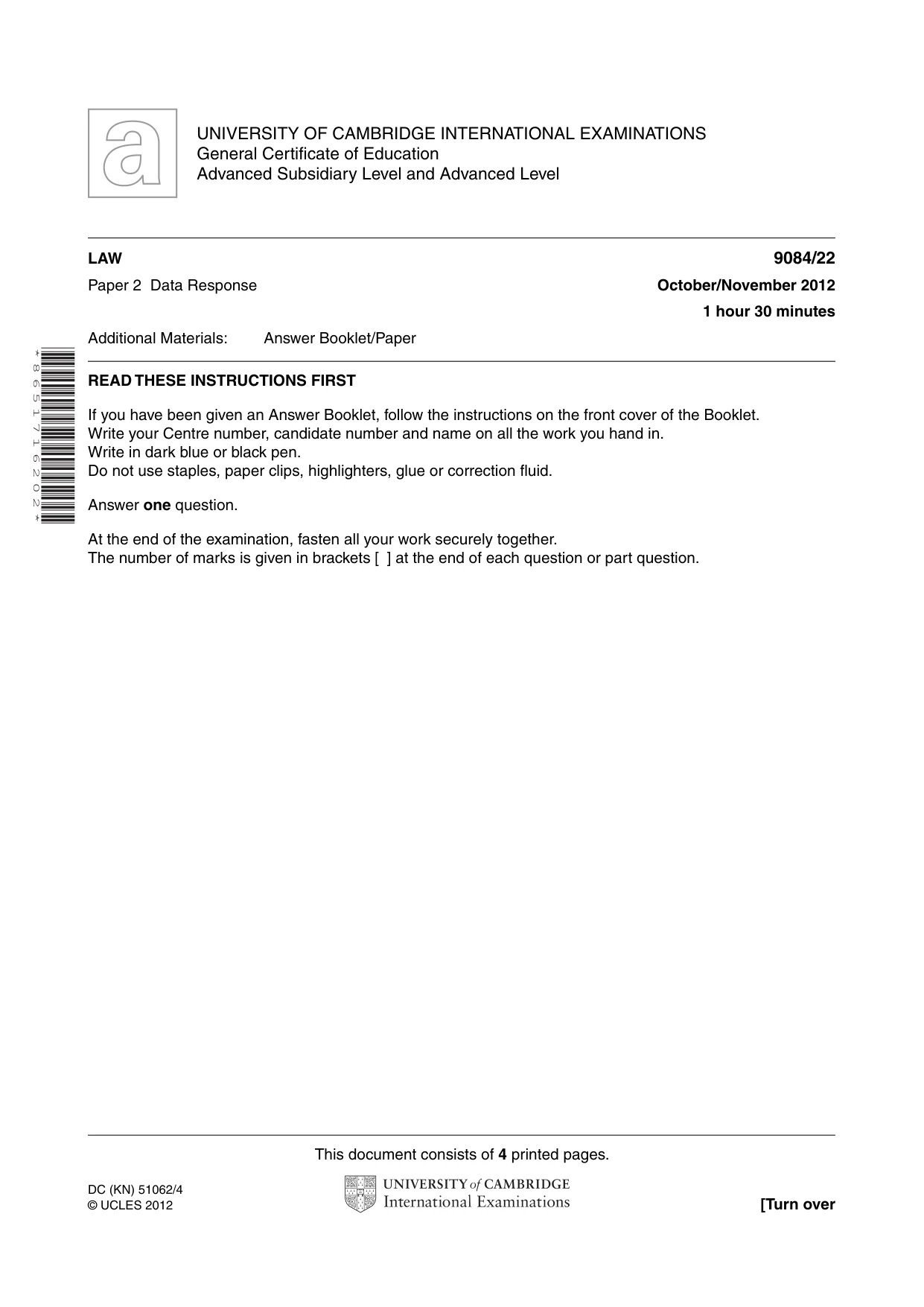
This document consists of 4 printed pages. DC (KN) 51062/4 © UCLES 2012 [Turn over UNIVERSITY OF CAMBRIDGE INTERNATIONAL EXAMINATIONS General Certificate of Education Advanced Subsidiary Level and Advanced Level * 8 6 5 1 7 1 6 2 0 2 * LAW 9084/22 Paper 2 Data Response October/November 2012 1 hour 30 minutes Additional Materials: Answer Booklet/Paper READ THESE INSTRUCTIONS FIRST If you have been given an Answer Booklet, follow the instructions on the front cover of the Booklet. Write your Centre number, candidate number and name on all the work you hand in. Write in dark blue or black pen. Do not use staples, paper clips, highlighters, glue or correction fluid. Answer one question. At the end of the examination, fasten all your work securely together. The number of marks is given in brackets [ ] at the end of each question or part question.
Question paper, page 2
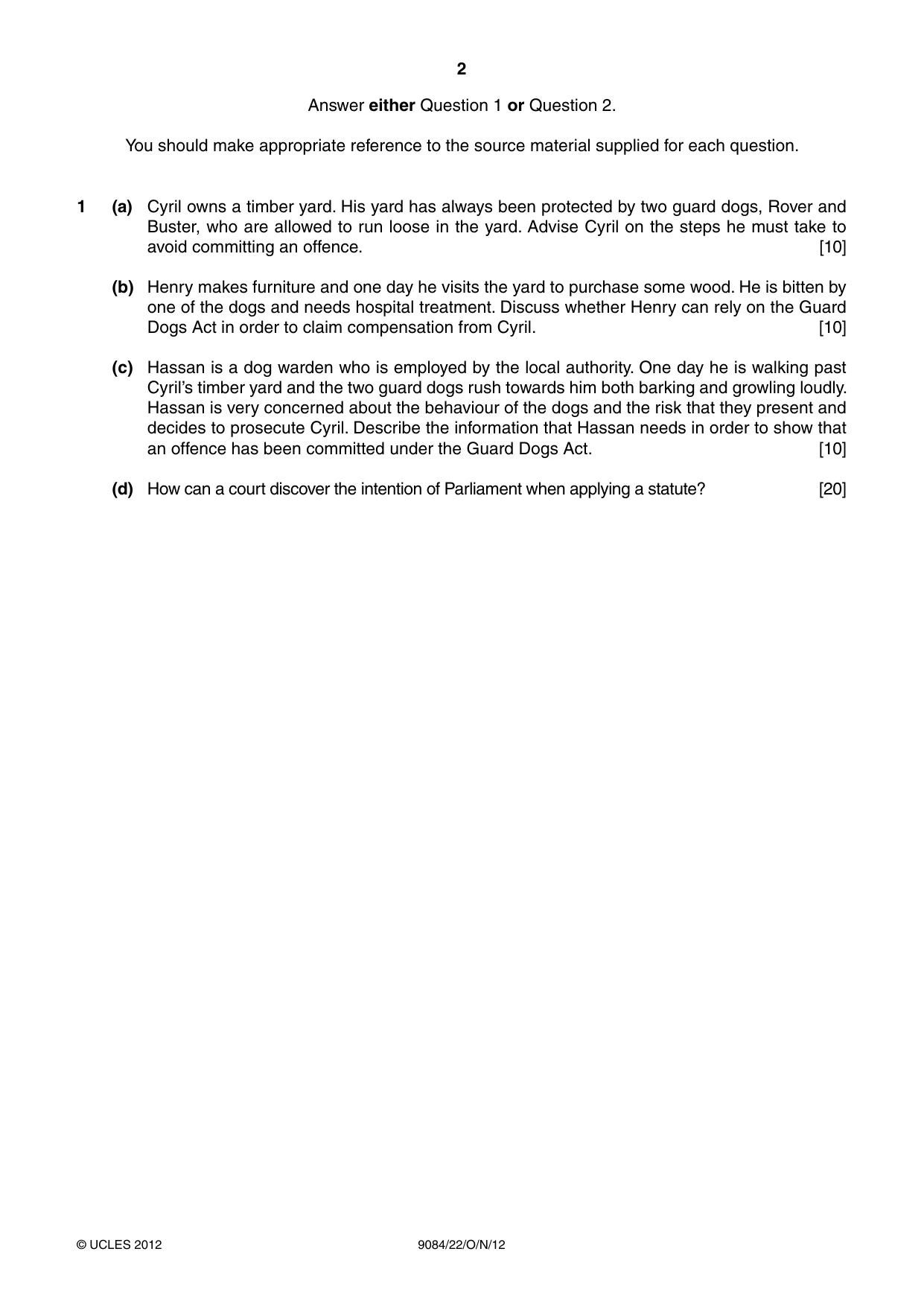
2 9084/22/O/N/12 © UCLES 2012 Answer either Question 1 or Question 2. You should make appropriate reference to the source material supplied for each question. 1 (a) Cyril owns a timber yard. His yard has always been protected by two guard dogs, Rover and Buster, who are allowed to run loose in the yard. Advise Cyril on the steps he must take to avoid committing an offence. [10] (b) Henry makes furniture and one day he visits the yard to purchase some wood. He is bitten by one of the dogs and needs hospital treatment. Discuss whether Henry can rely on the Guard Dogs Act in order to claim compensation from Cyril. [10] (c) Hassan is a dog warden who is employed by the local authority. One day he is walking past Cyril’s timber yard and the two guard dogs rush towards him both barking and growling loudly. Hassan is very concerned about the behaviour of the dogs and the risk that they present and decides to prosecute Cyril. Describe the information that Hassan needs in order to show that an offence has been committed under the Guard Dogs Act. [10] (d) How can a court discover the intention of Parliament when applying a statute? [20]
Question paper, page 3
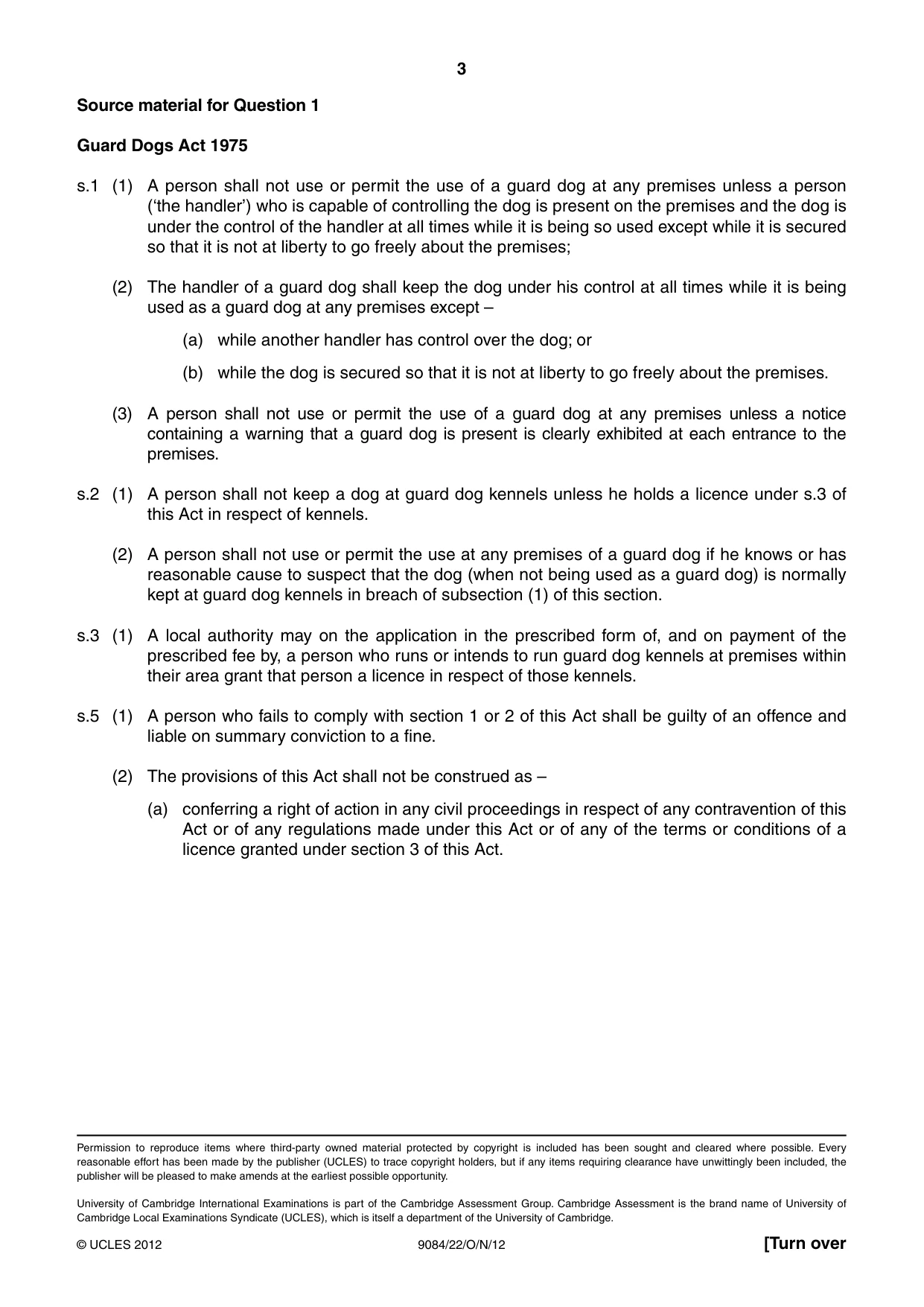
3 9084/22/O/N/12 © UCLES 2012 [Turn over Source material for Question 1 Guard Dogs Act 1975 s.1 (1) A person shall not use or permit the use of a guard dog at any premises unless a person (‘the handler’) who is capable of controlling the dog is present on the premises and the dog is under the control of the handler at all times while it is being so used except while it is secured so that it is not at liberty to go freely about the premises; (2) The handler of a guard dog shall keep the dog under his control at all times while it is being used as a guard dog at any premises except – (a) while another handler has control over the dog; or (b) while the dog is secured so that it is not at liberty to go freely about the premises. (3) A person shall not use or permit the use of a guard dog at any premises unless a notice containing a warning that a guard dog is present is clearly exhibited at each entrance to the premises. s.2 (1) A person shall not keep a dog at guard dog kennels unless he holds a licence under s.3 of this Act in respect of kennels. (2) A person shall not use or permit the use at any premises of a guard dog if he knows or has reasonable cause to suspect that the dog (when not being used as a guard dog) is normally kept at guard dog kennels in breach of subsection (1) of this section. s.3 (1) A local authority may on the application in the prescribed form of, and on payment of the prescribed fee by, a person who runs or intends to run guard dog kennels at premises within their area grant that person a licence in respect of those kennels. s.5 (1) A person who fails to comply with section 1 or 2 of this Act shall be guilty of an offence and liable on summary conviction to a fine. (2) The provisions of this Act shall not be construed as – (a) conferring a right of action in any civil proceedings in respect of any contravention of this Act or of any regulations made under this Act or of any of the terms or conditions of a licence granted under section 3 of this Act. Permission to reproduce items where third-party owned material protected by copyright is included has been sought and cleared where possible. Every reasonable effort has been made by the publisher (UCLES) to trace copyright holders, but if any items requiring clearance have unwittingly been included, the publisher will be pleased to make amends at the earliest possible opportunity. University of Cambridge International Examinations is part of the Cambridge Assessment Group. Cambridge Assessment is the brand name of University of Cambridge Local Examinations Syndicate (UCLES), which is itself a department of the University of Cambridge.
Question paper, page 4
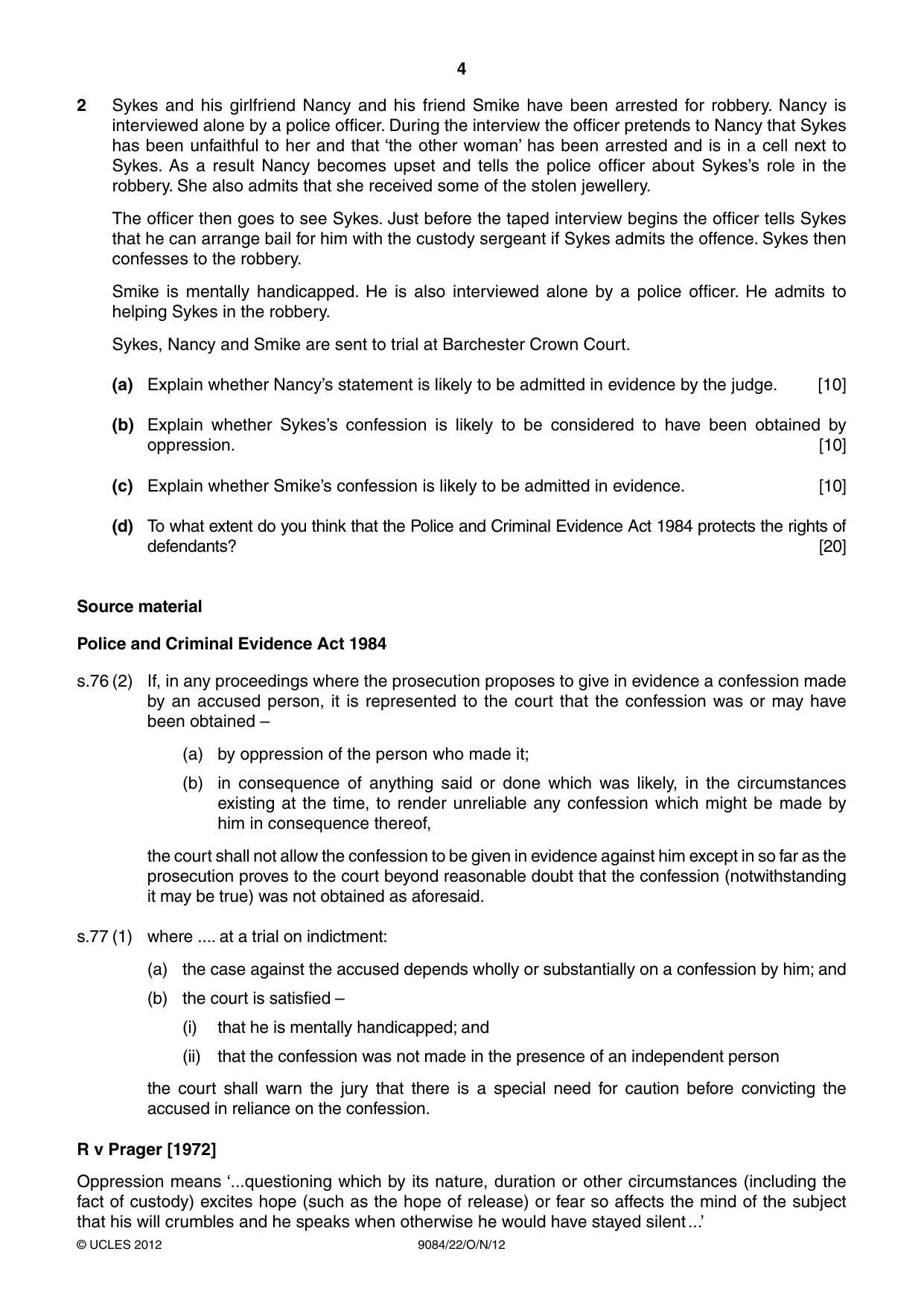
4 9084/22/O/N/12 © UCLES 2012 2 Sykes and his girlfriend Nancy and his friend Smike have been arrested for robbery. Nancy is interviewed alone by a police officer. During the interview the officer pretends to Nancy that Sykes has been unfaithful to her and that ‘the other woman’ has been arrested and is in a cell next to Sykes. As a result Nancy becomes upset and tells the police officer about Sykes’s role in the robbery. She also admits that she received some of the stolen jewellery. The officer then goes to see Sykes. Just before the taped interview begins the officer tells Sykes that he can arrange bail for him with the custody sergeant if Sykes admits the offence. Sykes then confesses to the robbery. Smike is mentally handicapped. He is also interviewed alone by a police officer. He admits to helping Sykes in the robbery. Sykes, Nancy and Smike are sent to trial at Barchester Crown Court. (a) Explain whether Nancy’s statement is likely to be admitted in evidence by the judge. [10] (b) Explain whether Sykes’s confession is likely to be considered to have been obtained by oppression. [10] (c) Explain whether Smike’s confession is likely to be admitted in evidence. [10] (d) To what extent do you think that the Police and Criminal Evidence Act 1984 protects the rights of defendants? [20] Source material Police and Criminal Evidence Act 1984 s.76 (2) If, in any proceedings where the prosecution proposes to give in evidence a confession made by an accused person, it is represented to the court that the confession was or may have been obtained – (a) by oppression of the person who made it; (b) in consequence of anything said or done which was likely, in the circumstances existing at the time, to render unreliable any confession which might be made by him in consequence thereof, the court shall not allow the confession to be given in evidence against him except in so far as the prosecution proves to the court beyond reasonable doubt that the confession (notwithstanding it may be true) was not obtained as aforesaid. s.77 (1) where … at a trial on indictment: (a) the case against the accused depends wholly or substantially on a confession by him; and (b) the court is satisfied – (i) that he is mentally handicapped; and (ii) that the confession was not made in the presence of an independent person the court shall warn the jury that there is a special need for caution before convicting the accused in reliance on the confession. R v Prager [1972] Oppression means ‘...questioning which by its nature, duration or other circumstances (including the fact of custody) excites hope (such as the hope of release) or fear so affects the mind of the subject that his will crumbles and he speaks when otherwise he would have stayed silent ...’
Mark scheme, page 1
CAMBRIDGE INTERNATIONAL EXAMINATIONS GCE Advanced Subsidiary Level and GCE Advanced Level MARK SCHEME for the October/November 2012 series 9084 LAW 9084/22 Paper 2, maximum raw mark 50 This mark scheme is published as an aid to teachers and candidates, to indicate the requirements of the examination. It shows the basis on which Examiners were instructed to award marks. It does not indicate the details of the discussions that took place at an Examiners’ meeting before marking began, which would have considered the acceptability of alternative answers. Mark schemes should be read in conjunction with the question paper and the Principal Examiner Report for Teachers. Cambridge will not enter into discussions about these mark schemes. Cambridge is publishing the mark schemes for the October/November 2012 series for most IGCSE, GCE Advanced Level and Advanced Subsidiary Level components and some Ordinary Level components.
Mark scheme, page 2
Page 2 Mark Scheme Syllabus Paper GCE AS/A LEVEL – October/November 2012 9084 22 © Cambridge International Examinations 2012 This mark scheme includes a summary of appropriate content for answering each question. It should be emphasised, however, that this material is for illustrative purposes and is not intended to provide a definitive guide to acceptable answers. It is quite possible that among the scripts there will be some candidate answers that are not covered directly by the content of this mark scheme. In such cases, professional judgement should be exercised in assessing the merits of the answer and the senior examiners should be consulted if further guidance is required. Mark Bands The mark bands and descriptors applicable to all questions on the paper are as follows. Maximum mark allocations are indicated in the mark scheme for each question or question part. Indicative content for each of the questions follows overleaf. Band 1: The answer contains no relevant material. Band 2: The candidate introduces fragments of information or unexplained examples from which no coherent explanation or analysis can emerge. OR The candidate attempts to introduce an explanation and/or analysis but it is so fundamentally undermined by error and confusion that it remains substantially incoherent. Band 3: The candidate begins to indicate some capacity for explanation and analysis by introducing some of the issues, but explanations are limited and superficial. OR The candidate adopts an approach in which there is concentration on explanation in terms of facts presented rather than through the development and explanation of legal principles and rules. OR The candidate attempts to introduce material across the range of potential content, but it is weak or confused so that no real explanation or conclusion emerges. Band 4: Where there is more than one issue, the candidate demonstrates a clear understanding of one of the main issues of the question, giving explanations and using illustrations so that a full and detailed picture is presented of this issue. OR The candidate presents a more limited explanation of all parts of the answer, but there is some lack of detail or superficiality in respect of either or both, so that the answer is not fully rounded. Band 5: The candidate presents a detailed explanation and discussion of all areas of relevant law and, while there may be some minor inaccuracies and/or imbalance, a coherent explanation emerges.
Mark scheme, page 3
Page 3 Mark Scheme Syllabus Paper GCE AS/A LEVEL – October/November 2012 9084 22 © Cambridge International Examinations 2012 1 (a) Band 1: Irrelevant answer [0] A candidate needs to be selective in choosing the correct part of the source material. Band 2/3: • Principle without section [1–5] and/or • Reference to s.1(1),(2),(3) Guard Dogs Act 1975 with little or no development [1–5] Band 4: Some development of all the correct subsections. Where there is a sensible discussion of s.2 this can be credited instead of any subsection of s.1. [6–7] Band 5: Candidate must refer to and provide full development of all subsections. Clear conclusion. [8–10] Cyril will need to comply with ss.1(1),(2),(3) Guard Dogs Act 1975 in order to avoid committing a criminal offence. He must have a handler on the premises who is in control of the dogs, except where the dogs are secured (s.1(2)(b)). He will also need to display warning signs explaining that a guard dog is present in order to satisfy s.1(3). Reference to need for a licence in some circumstances will be credited. (b) Band 1: Irrelevant answer [0] A candidate needs to be selective in choosing the correct part of the source material. Band 2/3: • Principle without section [1–5] and/or • Reference to s.5(2)(a) Guard Dogs Act 1975 with little or no development [1–5] Band 4: Some development of the correct section and application to the facts. [6–7] Comparison between the criminal sanction under the act and the exclusion of civil liability should be credited. Band 5: Candidate must refer to and provide full development of the subsection. Discussion of civil liability outside the Act e.g. Occupiers’ Liability Act 1957 should be credited. Clear conclusion. [8–10] Note that Henry cannot rely on the Act to claim compensation because under s.5(2)(a) it expressly states that the Act does not provide a civil right of action. Credit should be given to any sensible discussion of a civil claim for compensation/negligence or an action through the civil courts. This cannot be credited where it is specifically linked to the Guard Dogs Act 1975. (c) Band 1: Irrelevant answer [0] A candidate needs to be selective in choosing the correct part of the source material. Band 2/3: • Principle without section – reference to the need to have proof that a criminal offence has been committed and general reference to points about the need for the dogs to be restrained, the dogs to have a handler and the need for a warning notice. Not all points need to be noted in order to reach the top of the band [1–5] and/or • Reference to s.1(1)(2)(3) Guard Dogs Act 1975 with little or no development. Not all sections need be discussed in order to reach top of this band [1–5] Band 4: Some development of all the correct sections and subsections. [6–7]
Mark scheme, page 4
Page 4 Mark Scheme Syllabus Paper GCE AS/A LEVEL – October/November 2012 9084 22 © Cambridge International Examinations 2012 Band 5: Candidate must refer to and provide full development of all subsections. Clear conclusion. [8–10] Hassan should obtain information about whether or not the dogs are at liberty to go freely about the premises. This may depend on whether the dogs are restrained in any way at all. If so, consider the length of the chain and size of the premises, as this will be relevant to any prosecution. Hassan should consider also whether there are warning signs displayed about the premises and whether Cyril has employed a handler. Special emphasis on how this information will be used as evidence in court to prove a criminal offence has been committed. Credit for any reference to the fact that Hassan is a dog handler and should be aware of the law in this area. Credit also where the candidate refers to the criminal offence under s.5(1) and then discusses the need for proof. A sensible discussion of s.2(1),(2) and s.3(1) may also be credited where the candidate explains that proof is needed to show that Cyril is aware that the kennel from which the dogs have come is not licensed. (d) Band 1: Irrelevant answer [0] Band 2: Limited discussion on statutory interpretation [1–6] Band 3: Good discussion of statutory interpretation. Should include the three rules and some supporting case law. [7–13] Band 4/5: Very good discussion of statutory interpretation. Must include some critical analysis which could include reference to Bennion and the purposive rule and also the split of the roles between the legislature and the judiciary. [14–20] Candidates should consider the role of parliament as the legislator and the role of the judiciary as interpreter. A good answer will discuss why legislation requires interpretation. The traditional use of the literal rule limits the role of the judiciary whereas the purposive rule gives the judiciary more freedom to interpret legislation. Candidates should consider what is the intention of parliament and how this can be discovered. Consider the use of other aids and in particular the use of Hansard (expect Pepper v Hart), other extrinsic aids and also intrinsic aids. 2 (a) Band 1: Irrelevant answer [0] A candidate needs to be selective in choosing the correct part of the source material. Band 2/3: • Principle without section – reference to fact that a confession has been made by Nancy but may not be admitted because of the circumstances in which it was received. [1–5] and/or • Reference to s.76(2)(b) PACE with little or no development [1–5] Band 4: Some development of the correct section. [6–7] Band 5: Candidate must refer to and provide full development of correct subsection. Clear conclusion. The confession of Nancy should not be admitted in court. [8–10] The confession of Nancy has been obtained by oppression [s.76(2)(b)] and under the Act the court shall not allow the confession to be given in evidence against either her or as evidence against Sykes. Where a candidate discusses s.76(2)(a) credit should be given if there is a sensible discussion of what constitutes oppression.
Mark scheme, page 5
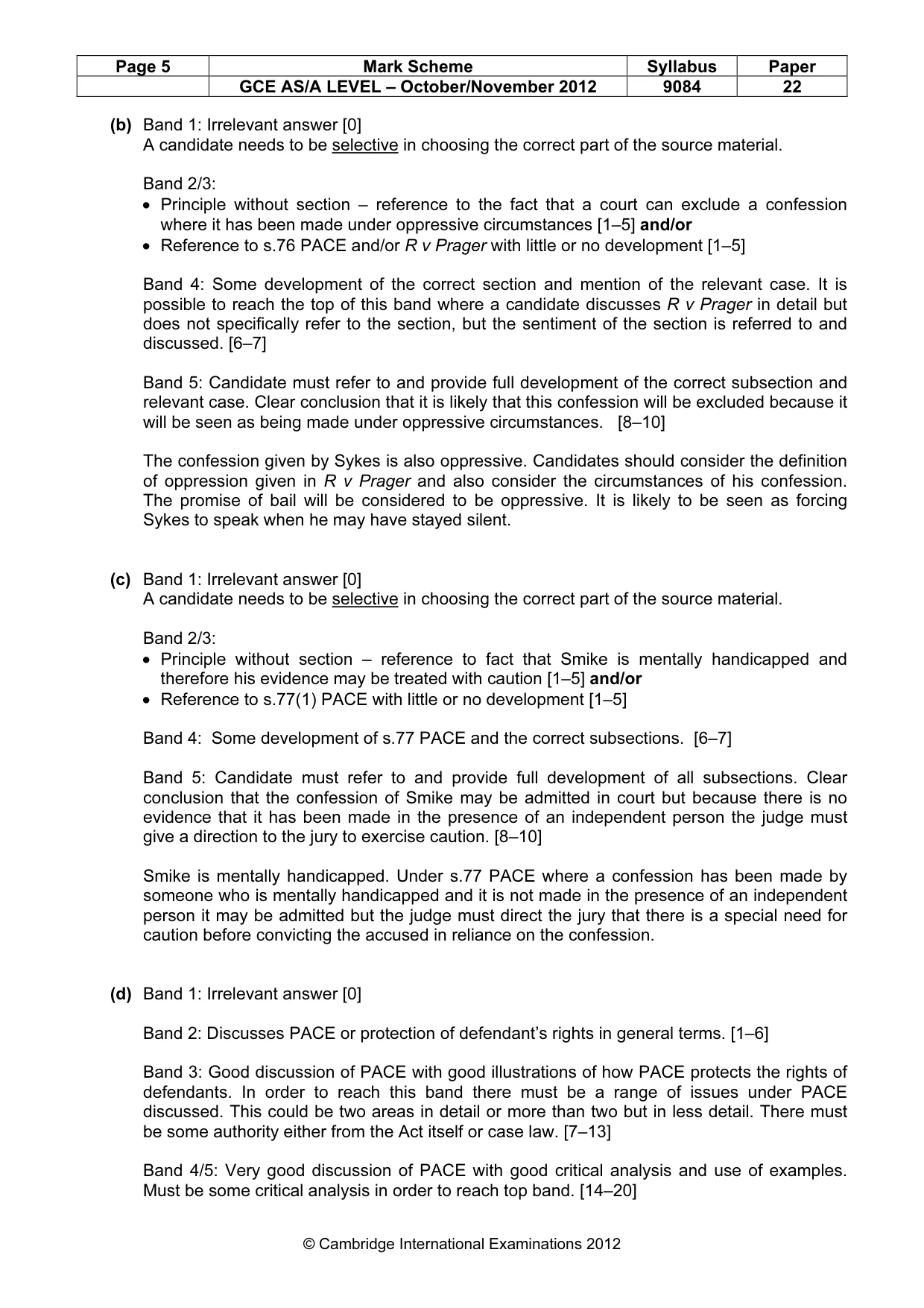
Page 5 Mark Scheme Syllabus Paper GCE AS/A LEVEL – October/November 2012 9084 22 © Cambridge International Examinations 2012 (b) Band 1: Irrelevant answer [0] A candidate needs to be selective in choosing the correct part of the source material. Band 2/3: • Principle without section – reference to the fact that a court can exclude a confession where it has been made under oppressive circumstances [1–5] and/or • Reference to s.76 PACE and/or R v Prager with little or no development [1–5] Band 4: Some development of the correct section and mention of the relevant case. It is possible to reach the top of this band where a candidate discusses R v Prager in detail but does not specifically refer to the section, but the sentiment of the section is referred to and discussed. [6–7] Band 5: Candidate must refer to and provide full development of the correct subsection and relevant case. Clear conclusion that it is likely that this confession will be excluded because it will be seen as being made under oppressive circumstances. [8–10] The confession given by Sykes is also oppressive. Candidates should consider the definition of oppression given in R v Prager and also consider the circumstances of his confession. The promise of bail will be considered to be oppressive. It is likely to be seen as forcing Sykes to speak when he may have stayed silent. (c) Band 1: Irrelevant answer [0] A candidate needs to be selective in choosing the correct part of the source material. Band 2/3: • Principle without section – reference to fact that Smike is mentally handicapped and therefore his evidence may be treated with caution [1–5] and/or • Reference to s.77(1) PACE with little or no development [1–5] Band 4: Some development of s.77 PACE and the correct subsections. [6–7] Band 5: Candidate must refer to and provide full development of all subsections. Clear conclusion that the confession of Smike may be admitted in court but because there is no evidence that it has been made in the presence of an independent person the judge must give a direction to the jury to exercise caution. [8–10] Smike is mentally handicapped. Under s.77 PACE where a confession has been made by someone who is mentally handicapped and it is not made in the presence of an independent person it may be admitted but the judge must direct the jury that there is a special need for caution before convicting the accused in reliance on the confession. (d) Band 1: Irrelevant answer [0] Band 2: Discusses PACE or protection of defendant’s rights in general terms. [1–6] Band 3: Good discussion of PACE with good illustrations of how PACE protects the rights of defendants. In order to reach this band there must be a range of issues under PACE discussed. This could be two areas in detail or more than two but in less detail. There must be some authority either from the Act itself or case law. [7–13] Band 4/5: Very good discussion of PACE with good critical analysis and use of examples. Must be some critical analysis in order to reach top band. [14–20]
Mark scheme, page 6
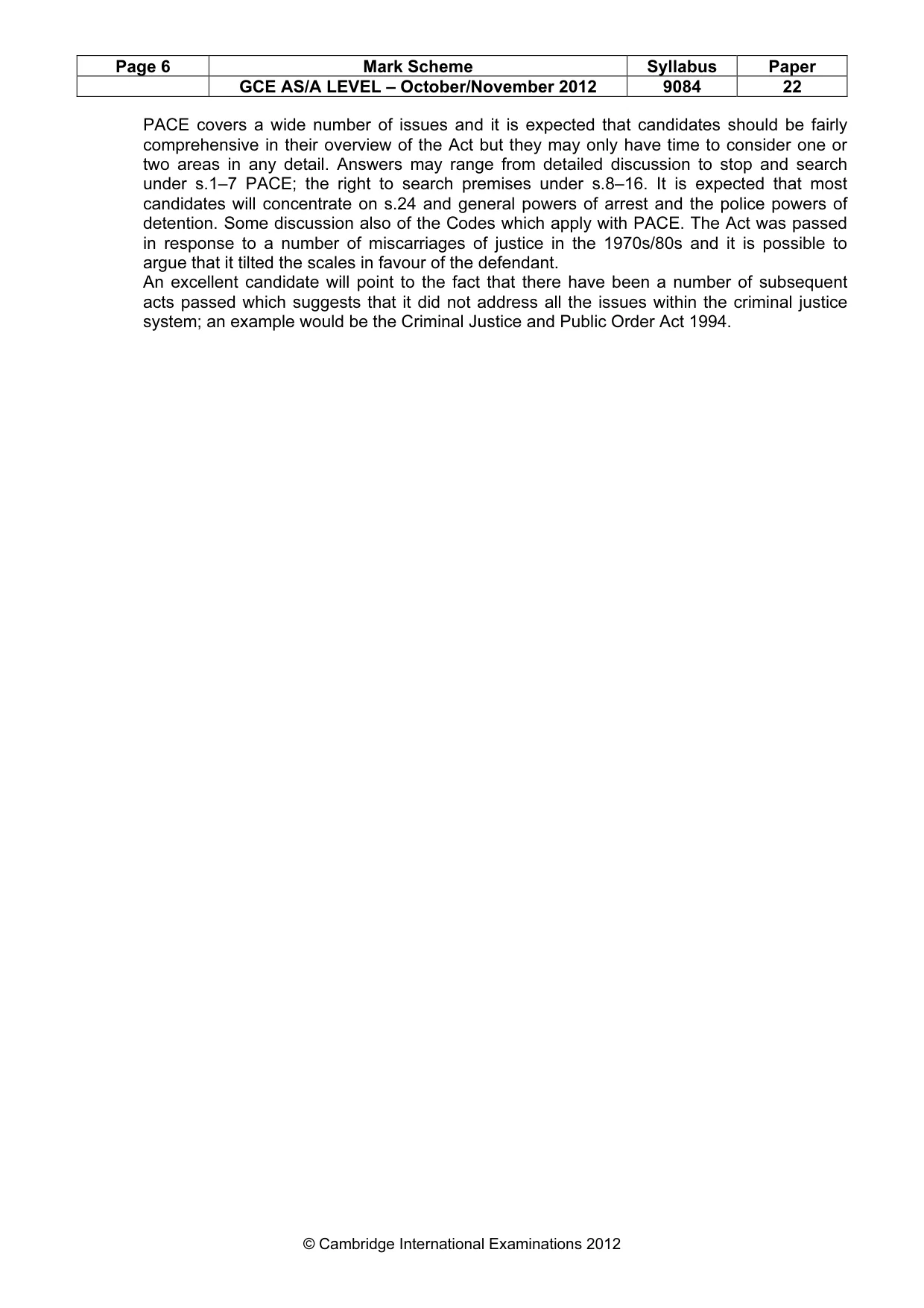
Page 6 Mark Scheme Syllabus Paper GCE AS/A LEVEL – October/November 2012 9084 22 © Cambridge International Examinations 2012 PACE covers a wide number of issues and it is expected that candidates should be fairly comprehensive in their overview of the Act but they may only have time to consider one or two areas in any detail. Answers may range from detailed discussion to stop and search under s.1–7 PACE; the right to search premises under s.8–16. It is expected that most candidates will concentrate on s.24 and general powers of arrest and the police powers of detention. Some discussion also of the Codes which apply with PACE. The Act was passed in response to a number of miscarriages of justice in the 1970s/80s and it is possible to argue that it tilted the scales in favour of the defendant. An excellent candidate will point to the fact that there have been a number of subsequent acts passed which suggests that it did not address all the issues within the criminal justice system; an example would be the Criminal Justice and Public Order Act 1994.
What you needed in this session
Cambridge’s own grade thresholds for 2012 Oct/Nov, Paper 2 · Variant 2. A higher threshold means an easier paper — the bar moves with how the cohort did.