Cambridge A Level Law 9084 — 2012 Oct/Nov Paper 2 · Variant 3
9084/23/O/N/12 · 50 marks · ≈56 min
The question paper and its mark scheme, free to read here and free to download. This is Cambridge’s own paper, exactly as it was sat.
Question paper4 pages
Mark scheme5 pages
Answers below. Sit the paper first if you are practising.
Paper as text
Question paper, page 1
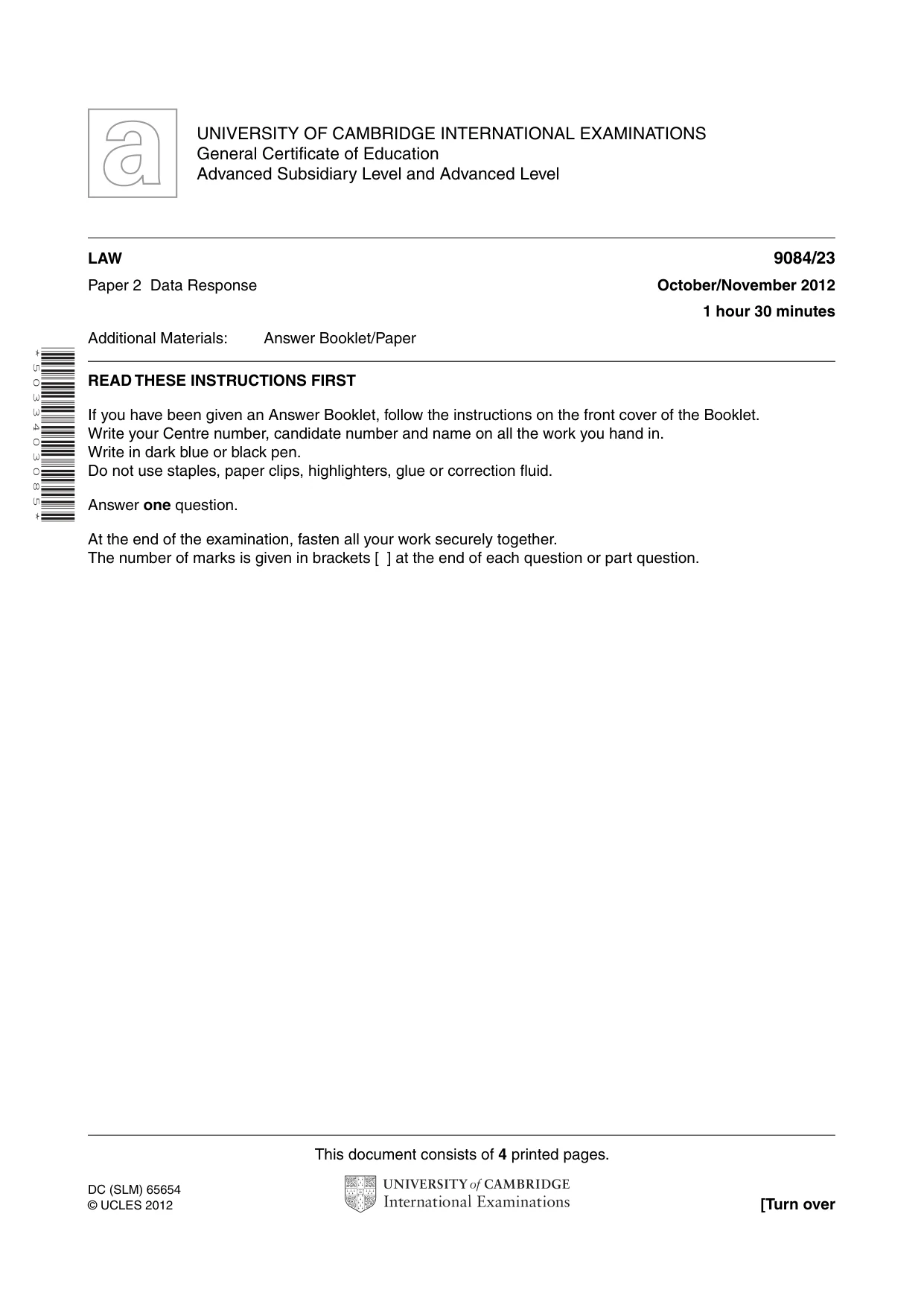
This document consists of 4 printed pages. DC (SLM) 65654 © UCLES 2012 [Turn over UNIVERSITY OF CAMBRIDGE INTERNATIONAL EXAMINATIONS General Certificate of Education Advanced Subsidiary Level and Advanced Level * 5 0 3 3 4 0 3 0 8 5 * LAW 9084/23 Paper 2 Data Response October/November 2012 1 hour 30 minutes Additional Materials: Answer Booklet/Paper READ THESE INSTRUCTIONS FIRST If you have been given an Answer Booklet, follow the instructions on the front cover of the Booklet. Write your Centre number, candidate number and name on all the work you hand in. Write in dark blue or black pen. Do not use staples, paper clips, highlighters, glue or correction fluid. Answer one question. At the end of the examination, fasten all your work securely together. The number of marks is given in brackets [ ] at the end of each question or part question.
Question paper, page 2
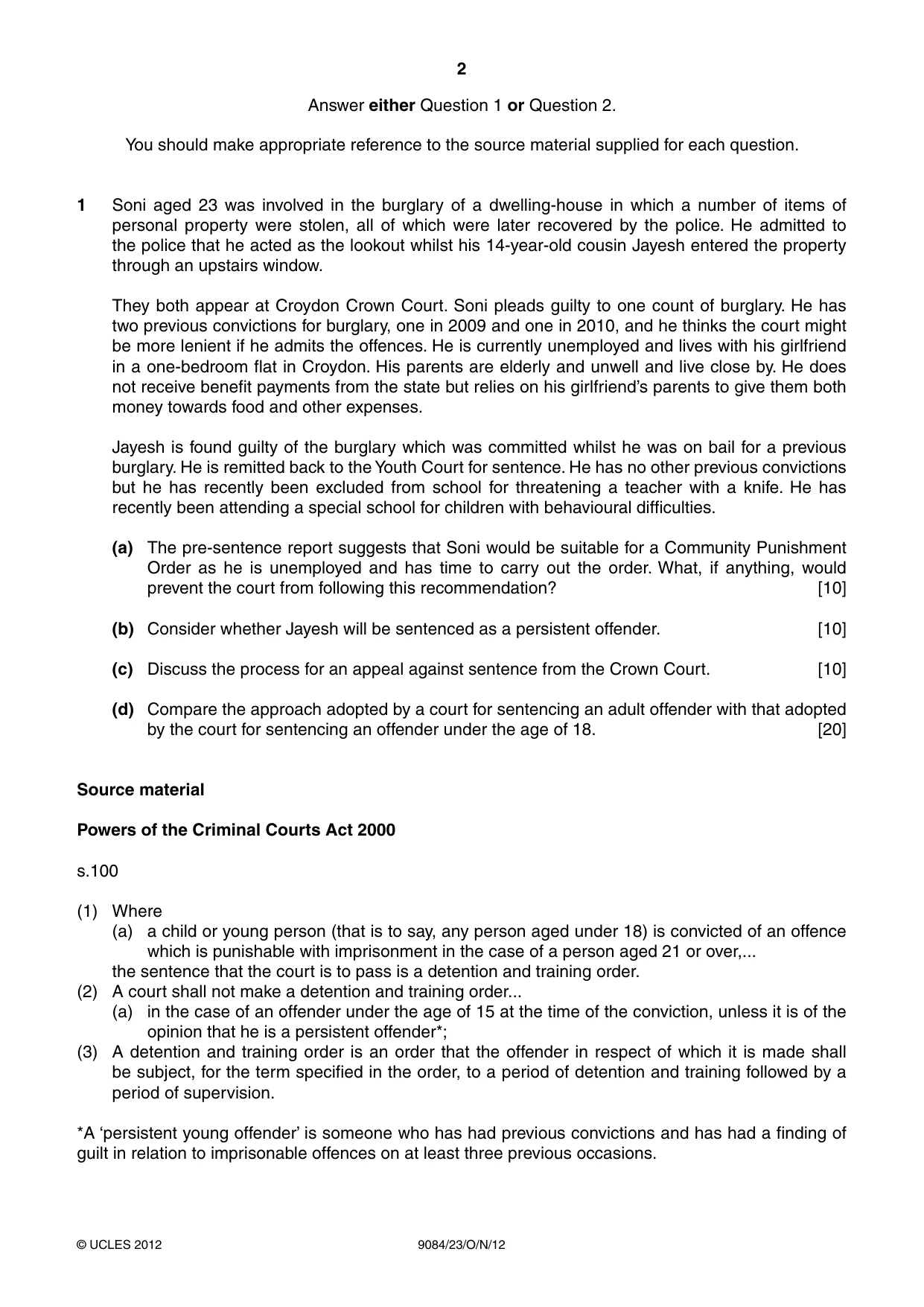
2 9084/23/O/N/12 © UCLES 2012 Answer either Question 1 or Question 2. You should make appropriate reference to the source material supplied for each question. 1 Soni aged 23 was involved in the burglary of a dwelling-house in which a number of items of personal property were stolen, all of which were later recovered by the police. He admitted to the police that he acted as the lookout whilst his 14-year-old cousin Jayesh entered the property through an upstairs window. They both appear at Croydon Crown Court. Soni pleads guilty to one count of burglary. He has two previous convictions for burglary, one in 2009 and one in 2010, and he thinks the court might be more lenient if he admits the offences. He is currently unemployed and lives with his girlfriend in a one-bedroom flat in Croydon. His parents are elderly and unwell and live close by. He does not receive benefit payments from the state but relies on his girlfriend’s parents to give them both money towards food and other expenses. Jayesh is found guilty of the burglary which was committed whilst he was on bail for a previous burglary. He is remitted back to the Youth Court for sentence. He has no other previous convictions but he has recently been excluded from school for threatening a teacher with a knife. He has recently been attending a special school for children with behavioural difficulties. (a) The pre-sentence report suggests that Soni would be suitable for a Community Punishment Order as he is unemployed and has time to carry out the order. What, if anything, would prevent the court from following this recommendation? [10] (b) Consider whether Jayesh will be sentenced as a persistent offender. [10] (c) Discuss the process for an appeal against sentence from the Crown Court. [10] (d) Compare the approach adopted by a court for sentencing an adult offender with that adopted by the court for sentencing an offender under the age of 18. [20] Source material Powers of the Criminal Courts Act 2000 s.100 (1) Where (a) a child or young person (that is to say, any person aged under 18) is convicted of an offence which is punishable with imprisonment in the case of a person aged 21 or over,... the sentence that the court is to pass is a detention and training order. (2) A court shall not make a detention and training order... (a) in the case of an offender under the age of 15 at the time of the conviction, unless it is of the opinion that he is a persistent offender*; (3) A detention and training order is an order that the offender in respect of which it is made shall be subject, for the term specified in the order, to a period of detention and training followed by a period of supervision. *A ‘persistent young offender’ is someone who has had previous convictions and has had a finding of guilt in relation to imprisonable offences on at least three previous occasions.
Question paper, page 3
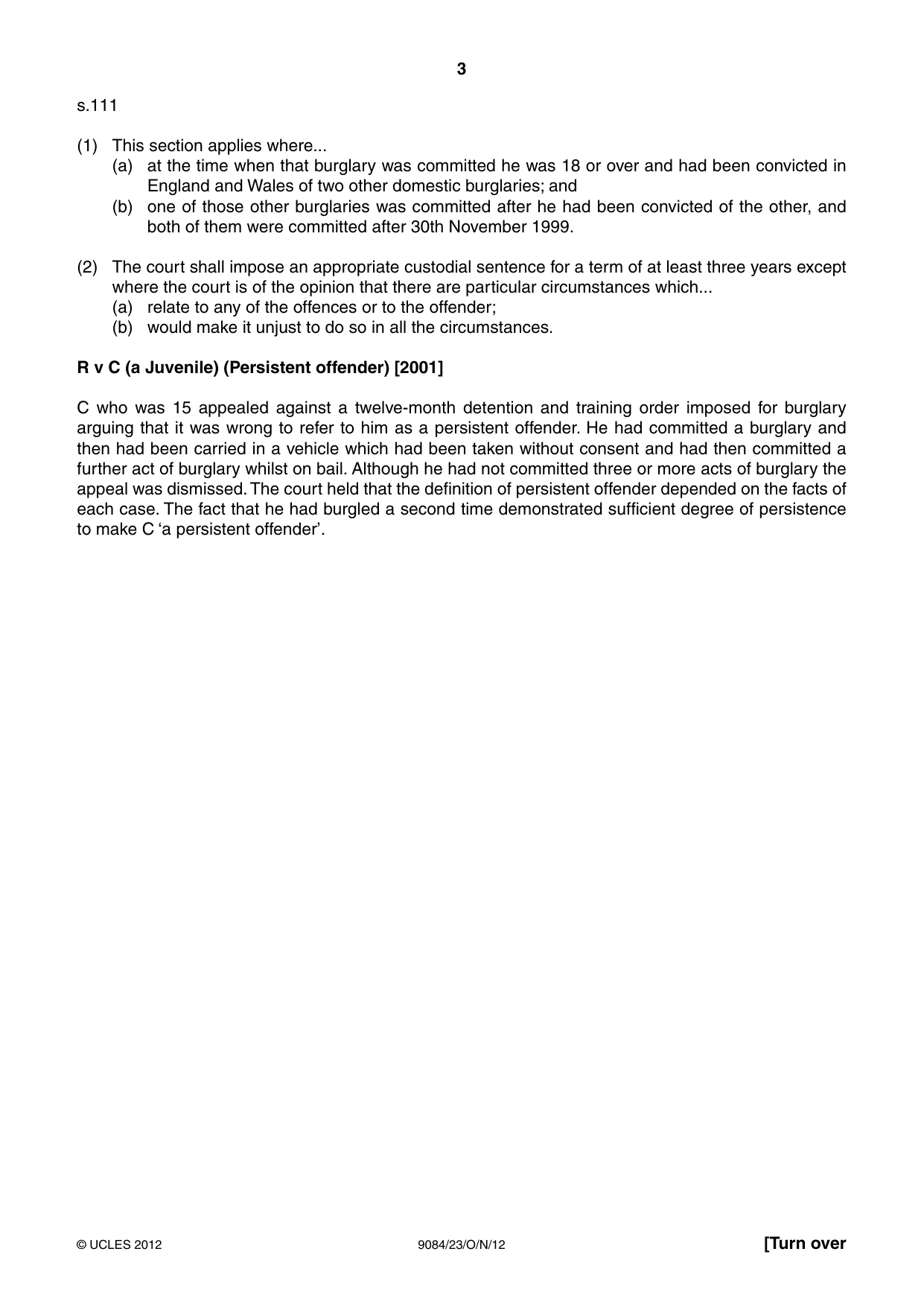
3 9084/23/O/N/12 © UCLES 2012 [Turn over s.111 (1) This section applies where... (a) at the time when that burglary was committed he was 18 or over and had been convicted in England and Wales of two other domestic burglaries; and (b) one of those other burglaries was committed after he had been convicted of the other, and both of them were committed after 30th November 1999. (2) The court shall impose an appropriate custodial sentence for a term of at least three years except where the court is of the opinion that there are particular circumstances which... (a) relate to any of the offences or to the offender; (b) would make it unjust to do so in all the circumstances. R v C (a Juvenile) (Persistent offender) [2001] C who was 15 appealed against a twelve-month detention and training order imposed for burglary arguing that it was wrong to refer to him as a persistent offender. He had committed a burglary and then had been carried in a vehicle which had been taken without consent and had then committed a further act of burglary whilst on bail. Although he had not committed three or more acts of burglary the appeal was dismissed. The court held that the definition of persistent offender depended on the facts of each case. The fact that he had burgled a second time demonstrated sufficient degree of persistence to make C ‘a persistent offender’.
Question paper, page 4
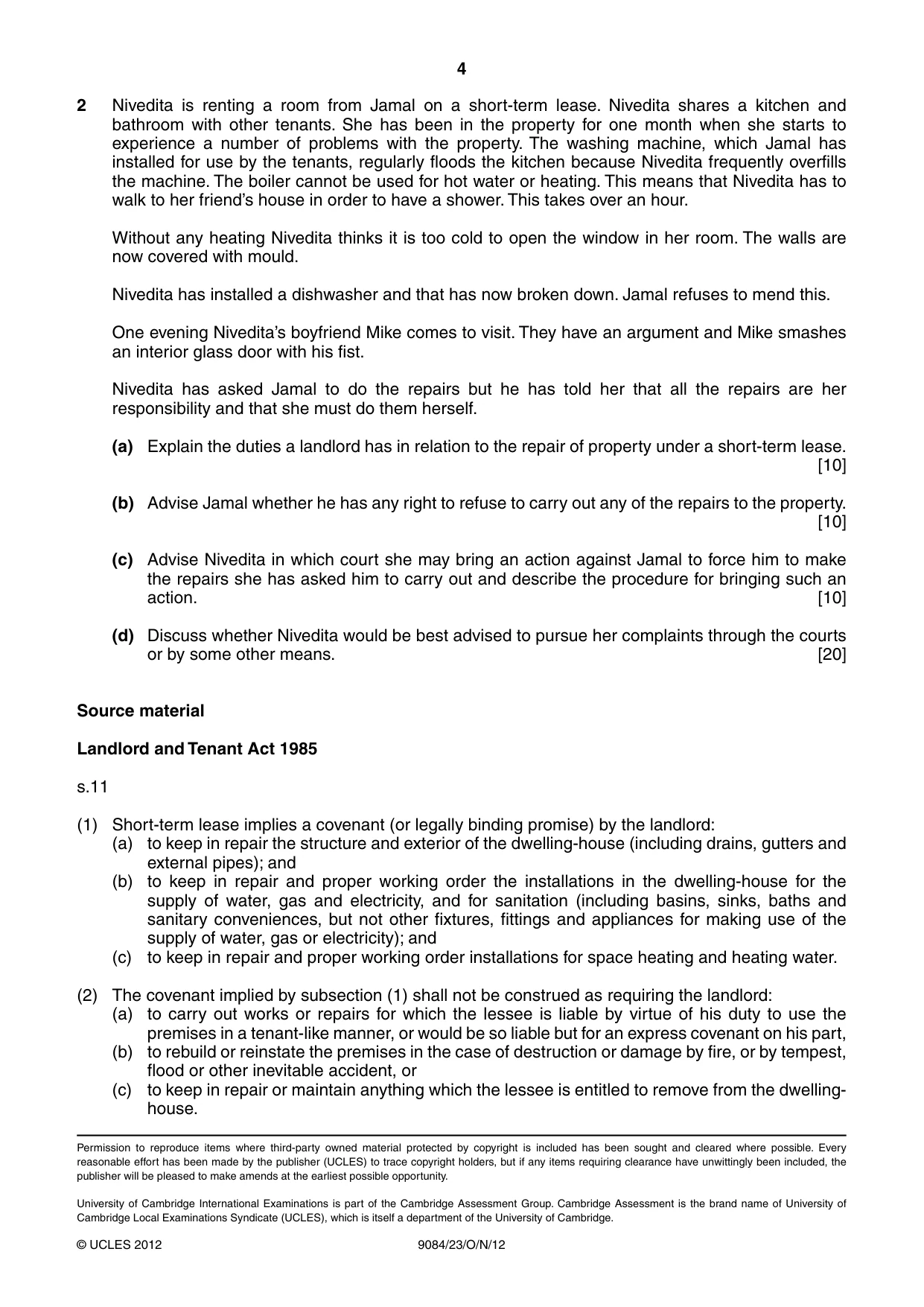
4 9084/23/O/N/12 © UCLES 2012 2 Nivedita is renting a room from Jamal on a short-term lease. Nivedita shares a kitchen and bathroom with other tenants. She has been in the property for one month when she starts to experience a number of problems with the property. The washing machine, which Jamal has installed for use by the tenants, regularly floods the kitchen because Nivedita frequently overfills the machine. The boiler cannot be used for hot water or heating. This means that Nivedita has to walk to her friend’s house in order to have a shower. This takes over an hour. Without any heating Nivedita thinks it is too cold to open the window in her room. The walls are now covered with mould. Nivedita has installed a dishwasher and that has now broken down. Jamal refuses to mend this. One evening Nivedita’s boyfriend Mike comes to visit. They have an argument and Mike smashes an interior glass door with his fist. Nivedita has asked Jamal to do the repairs but he has told her that all the repairs are her responsibility and that she must do them herself. (a) Explain the duties a landlord has in relation to the repair of property under a short-term lease. [10] (b) Advise Jamal whether he has any right to refuse to carry out any of the repairs to the property. [10] (c) Advise Nivedita in which court she may bring an action against Jamal to force him to make the repairs she has asked him to carry out and describe the procedure for bringing such an action. [10] (d) Discuss whether Nivedita would be best advised to pursue her complaints through the courts or by some other means. [20] Source material Landlord and Tenant Act 1985 s.11 (1) Short-term lease implies a covenant (or legally binding promise) by the landlord: (a) to keep in repair the structure and exterior of the dwelling-house (including drains, gutters and external pipes); and (b) to keep in repair and proper working order the installations in the dwelling-house for the supply of water, gas and electricity, and for sanitation (including basins, sinks, baths and sanitary conveniences, but not other fixtures, fittings and appliances for making use of the supply of water, gas or electricity); and (c) to keep in repair and proper working order installations for space heating and heating water. (2) The covenant implied by subsection (1) shall not be construed as requiring the landlord: (a) to carry out works or repairs for which the lessee is liable by virtue of his duty to use the premises in a tenant-like manner, or would be so liable but for an express covenant on his part, (b) to rebuild or reinstate the premises in the case of destruction or damage by fire, or by tempest, flood or other inevitable accident, or (c) to keep in repair or maintain anything which the lessee is entitled to remove from the dwelling- house. Permission to reproduce items where third-party owned material protected by copyright is included has been sought and cleared where possible. Every reasonable effort has been made by the publisher (UCLES) to trace copyright holders, but if any items requiring clearance have unwittingly been included, the publisher will be pleased to make amends at the earliest possible opportunity. University of Cambridge International Examinations is part of the Cambridge Assessment Group. Cambridge Assessment is the brand name of University of Cambridge Local Examinations Syndicate (UCLES), which is itself a department of the University of Cambridge.
Mark scheme, page 1
CAMBRIDGE INTERNATIONAL EXAMINATIONS GCE Advanced Subsidiary Level and GCE Advanced Level MARK SCHEME for the October/November 2012 series 9084 LAW 9084/23 Paper 2, maximum raw mark 50 This mark scheme is published as an aid to teachers and candidates, to indicate the requirements of the examination. It shows the basis on which Examiners were instructed to award marks. It does not indicate the details of the discussions that took place at an Examiners’ meeting before marking began, which would have considered the acceptability of alternative answers. Mark schemes should be read in conjunction with the question paper and the Principal Examiner Report for Teachers. Cambridge will not enter into discussions about these mark schemes. Cambridge is publishing the mark schemes for the October/November 2012 series for most IGCSE, GCE Advanced Level and Advanced Subsidiary Level components and some Ordinary Level components.
Mark scheme, page 2
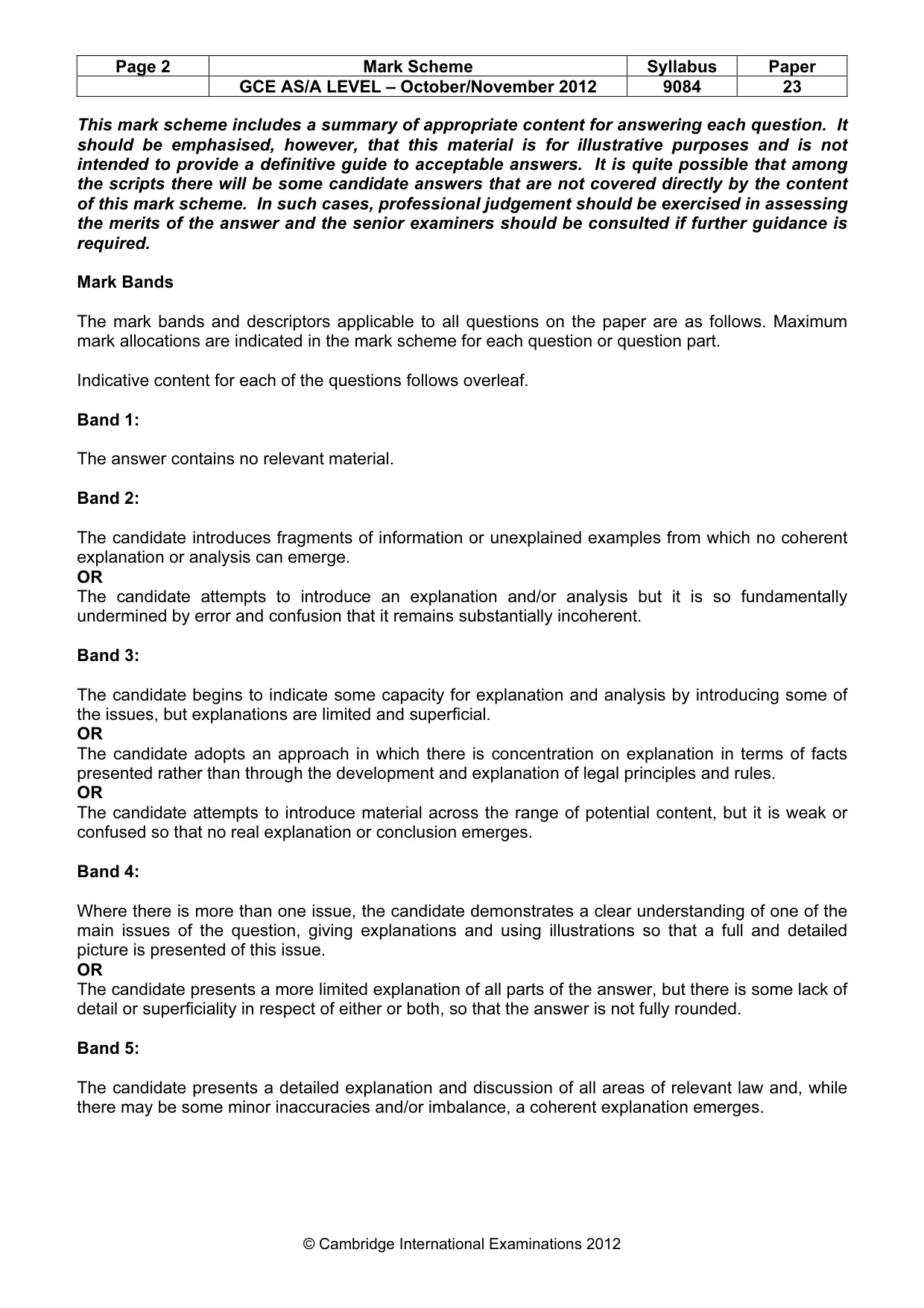
Page 2 Mark Scheme Syllabus Paper GCE AS/A LEVEL – October/November 2012 9084 23 © Cambridge International Examinations 2012 This mark scheme includes a summary of appropriate content for answering each question. It should be emphasised, however, that this material is for illustrative purposes and is not intended to provide a definitive guide to acceptable answers. It is quite possible that among the scripts there will be some candidate answers that are not covered directly by the content of this mark scheme. In such cases, professional judgement should be exercised in assessing the merits of the answer and the senior examiners should be consulted if further guidance is required. Mark Bands The mark bands and descriptors applicable to all questions on the paper are as follows. Maximum mark allocations are indicated in the mark scheme for each question or question part. Indicative content for each of the questions follows overleaf. Band 1: The answer contains no relevant material. Band 2: The candidate introduces fragments of information or unexplained examples from which no coherent explanation or analysis can emerge. OR The candidate attempts to introduce an explanation and/or analysis but it is so fundamentally undermined by error and confusion that it remains substantially incoherent. Band 3: The candidate begins to indicate some capacity for explanation and analysis by introducing some of the issues, but explanations are limited and superficial. OR The candidate adopts an approach in which there is concentration on explanation in terms of facts presented rather than through the development and explanation of legal principles and rules. OR The candidate attempts to introduce material across the range of potential content, but it is weak or confused so that no real explanation or conclusion emerges. Band 4: Where there is more than one issue, the candidate demonstrates a clear understanding of one of the main issues of the question, giving explanations and using illustrations so that a full and detailed picture is presented of this issue. OR The candidate presents a more limited explanation of all parts of the answer, but there is some lack of detail or superficiality in respect of either or both, so that the answer is not fully rounded. Band 5: The candidate presents a detailed explanation and discussion of all areas of relevant law and, while there may be some minor inaccuracies and/or imbalance, a coherent explanation emerges.
Mark scheme, page 3
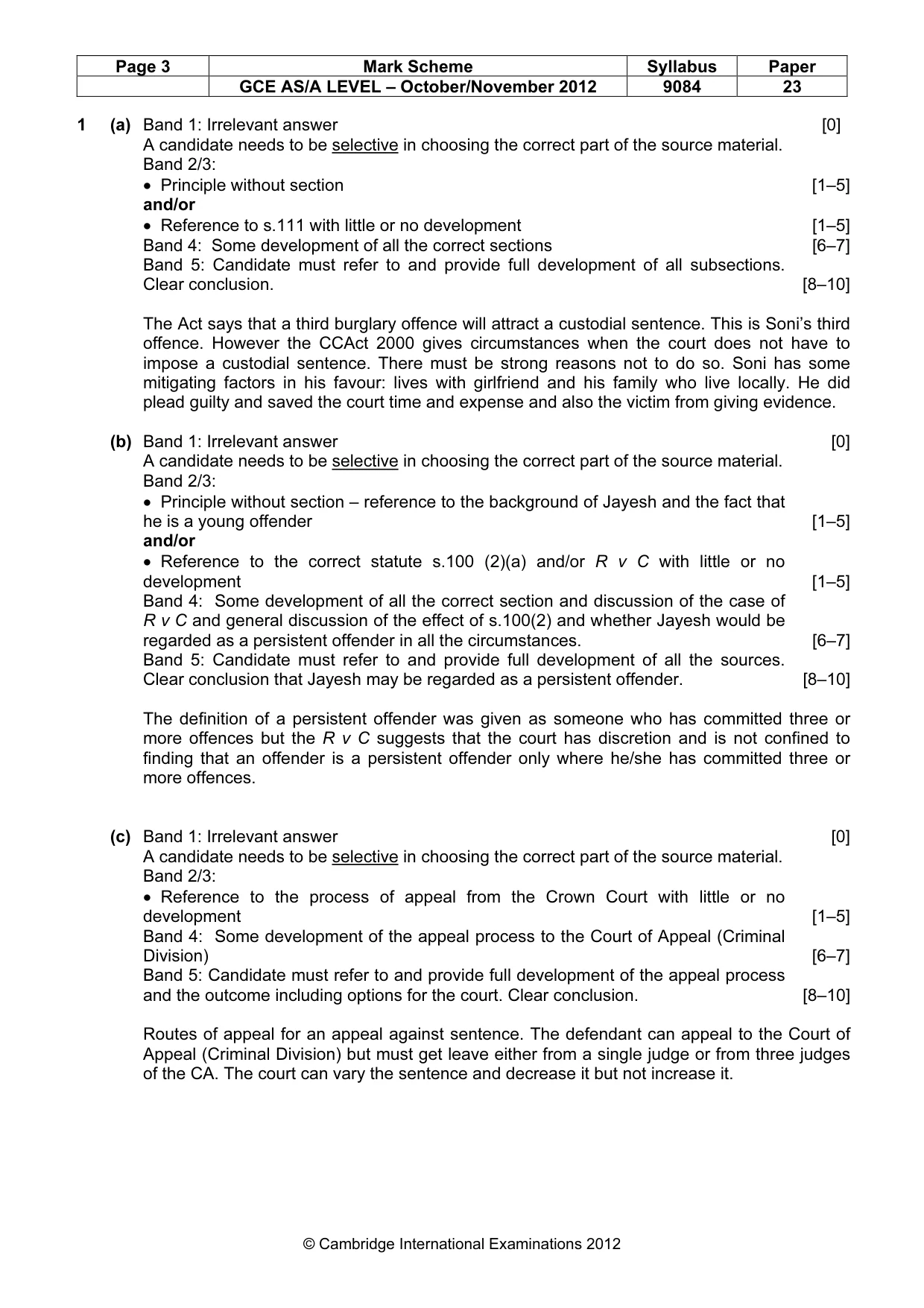
Page 3 Mark Scheme Syllabus Paper GCE AS/A LEVEL – October/November 2012 9084 23 © Cambridge International Examinations 2012 1 (a) Band 1: Irrelevant answer [0] A candidate needs to be selective in choosing the correct part of the source material. Band 2/3: • Principle without section [1–5] and/or • Reference to s.111 with little or no development [1–5] Band 4: Some development of all the correct sections [6–7] Band 5: Candidate must refer to and provide full development of all subsections. Clear conclusion. [8–10] The Act says that a third burglary offence will attract a custodial sentence. This is Soni’s third offence. However the CCAct 2000 gives circumstances when the court does not have to impose a custodial sentence. There must be strong reasons not to do so. Soni has some mitigating factors in his favour: lives with girlfriend and his family who live locally. He did plead guilty and saved the court time and expense and also the victim from giving evidence. (b) Band 1: Irrelevant answer [0] A candidate needs to be selective in choosing the correct part of the source material. Band 2/3: • Principle without section – reference to the background of Jayesh and the fact that he is a young offender [1–5] and/or • Reference to the correct statute s.100 (2)(a) and/or R v C with little or no development [1–5] Band 4: Some development of all the correct section and discussion of the case of R v C and general discussion of the effect of s.100(2) and whether Jayesh would be regarded as a persistent offender in all the circumstances. [6–7] Band 5: Candidate must refer to and provide full development of all the sources. Clear conclusion that Jayesh may be regarded as a persistent offender. [8–10] The definition of a persistent offender was given as someone who has committed three or more offences but the R v C suggests that the court has discretion and is not confined to finding that an offender is a persistent offender only where he/she has committed three or more offences. (c) Band 1: Irrelevant answer [0] A candidate needs to be selective in choosing the correct part of the source material. Band 2/3: • Reference to the process of appeal from the Crown Court with little or no development [1–5] Band 4: Some development of the appeal process to the Court of Appeal (Criminal Division) [6–7] Band 5: Candidate must refer to and provide full development of the appeal process and the outcome including options for the court. Clear conclusion. [8–10] Routes of appeal for an appeal against sentence. The defendant can appeal to the Court of Appeal (Criminal Division) but must get leave either from a single judge or from three judges of the CA. The court can vary the sentence and decrease it but not increase it.
Mark scheme, page 4
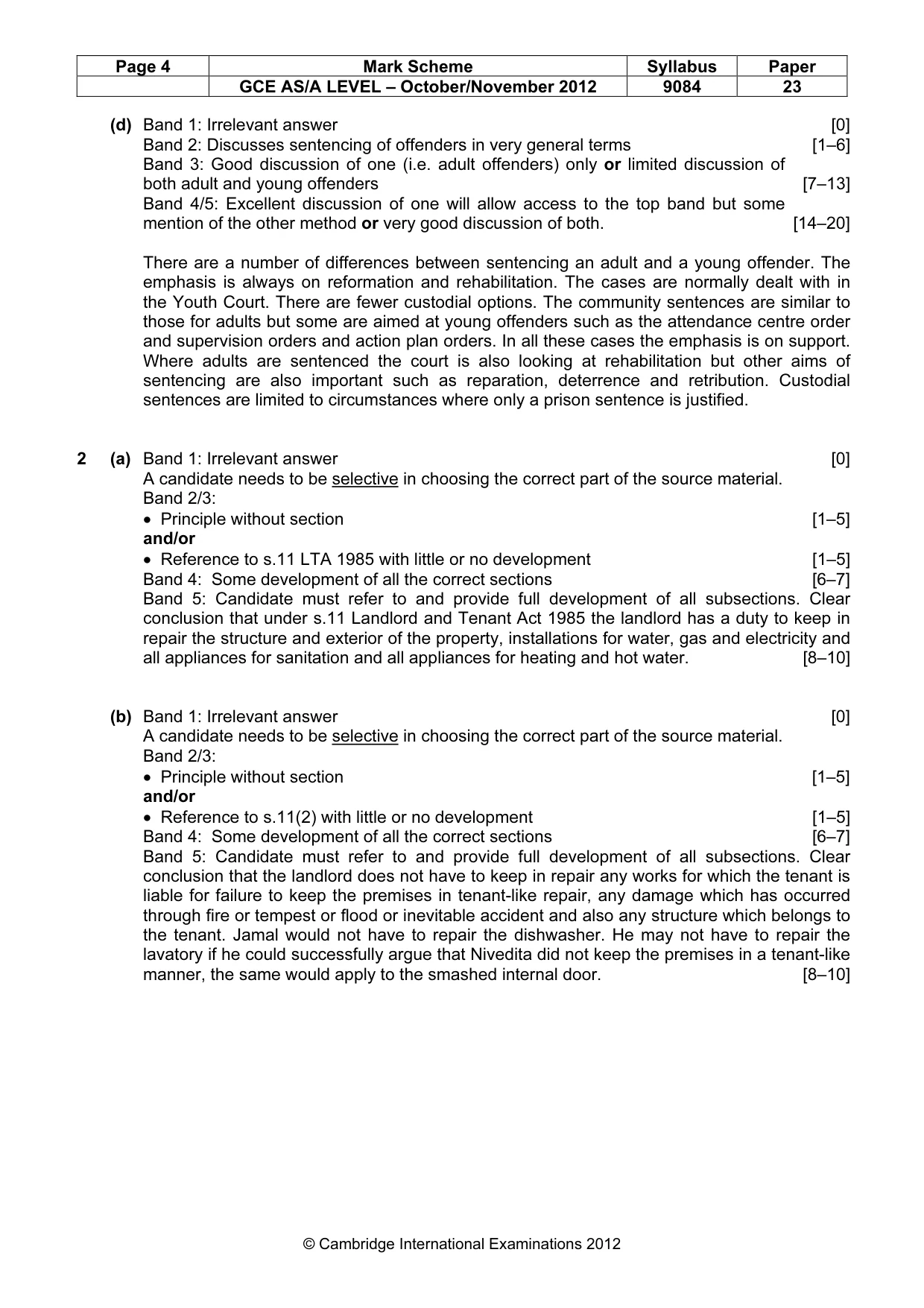
Page 4 Mark Scheme Syllabus Paper GCE AS/A LEVEL – October/November 2012 9084 23 © Cambridge International Examinations 2012 (d) Band 1: Irrelevant answer [0] Band 2: Discusses sentencing of offenders in very general terms [1–6] Band 3: Good discussion of one (i.e. adult offenders) only or limited discussion of both adult and young offenders [7–13] Band 4/5: Excellent discussion of one will allow access to the top band but some mention of the other method or very good discussion of both. [14–20] There are a number of differences between sentencing an adult and a young offender. The emphasis is always on reformation and rehabilitation. The cases are normally dealt with in the Youth Court. There are fewer custodial options. The community sentences are similar to those for adults but some are aimed at young offenders such as the attendance centre order and supervision orders and action plan orders. In all these cases the emphasis is on support. Where adults are sentenced the court is also looking at rehabilitation but other aims of sentencing are also important such as reparation, deterrence and retribution. Custodial sentences are limited to circumstances where only a prison sentence is justified. 2 (a) Band 1: Irrelevant answer [0] A candidate needs to be selective in choosing the correct part of the source material. Band 2/3: • Principle without section [1–5] and/or • Reference to s.11 LTA 1985 with little or no development [1–5] Band 4: Some development of all the correct sections [6–7] Band 5: Candidate must refer to and provide full development of all subsections. Clear conclusion that under s.11 Landlord and Tenant Act 1985 the landlord has a duty to keep in repair the structure and exterior of the property, installations for water, gas and electricity and all appliances for sanitation and all appliances for heating and hot water. [8–10] (b) Band 1: Irrelevant answer [0] A candidate needs to be selective in choosing the correct part of the source material. Band 2/3: • Principle without section [1–5] and/or • Reference to s.11(2) with little or no development [1–5] Band 4: Some development of all the correct sections [6–7] Band 5: Candidate must refer to and provide full development of all subsections. Clear conclusion that the landlord does not have to keep in repair any works for which the tenant is liable for failure to keep the premises in tenant-like repair, any damage which has occurred through fire or tempest or flood or inevitable accident and also any structure which belongs to the tenant. Jamal would not have to repair the dishwasher. He may not have to repair the lavatory if he could successfully argue that Nivedita did not keep the premises in a tenant-like manner, the same would apply to the smashed internal door. [8–10]
Mark scheme, page 5
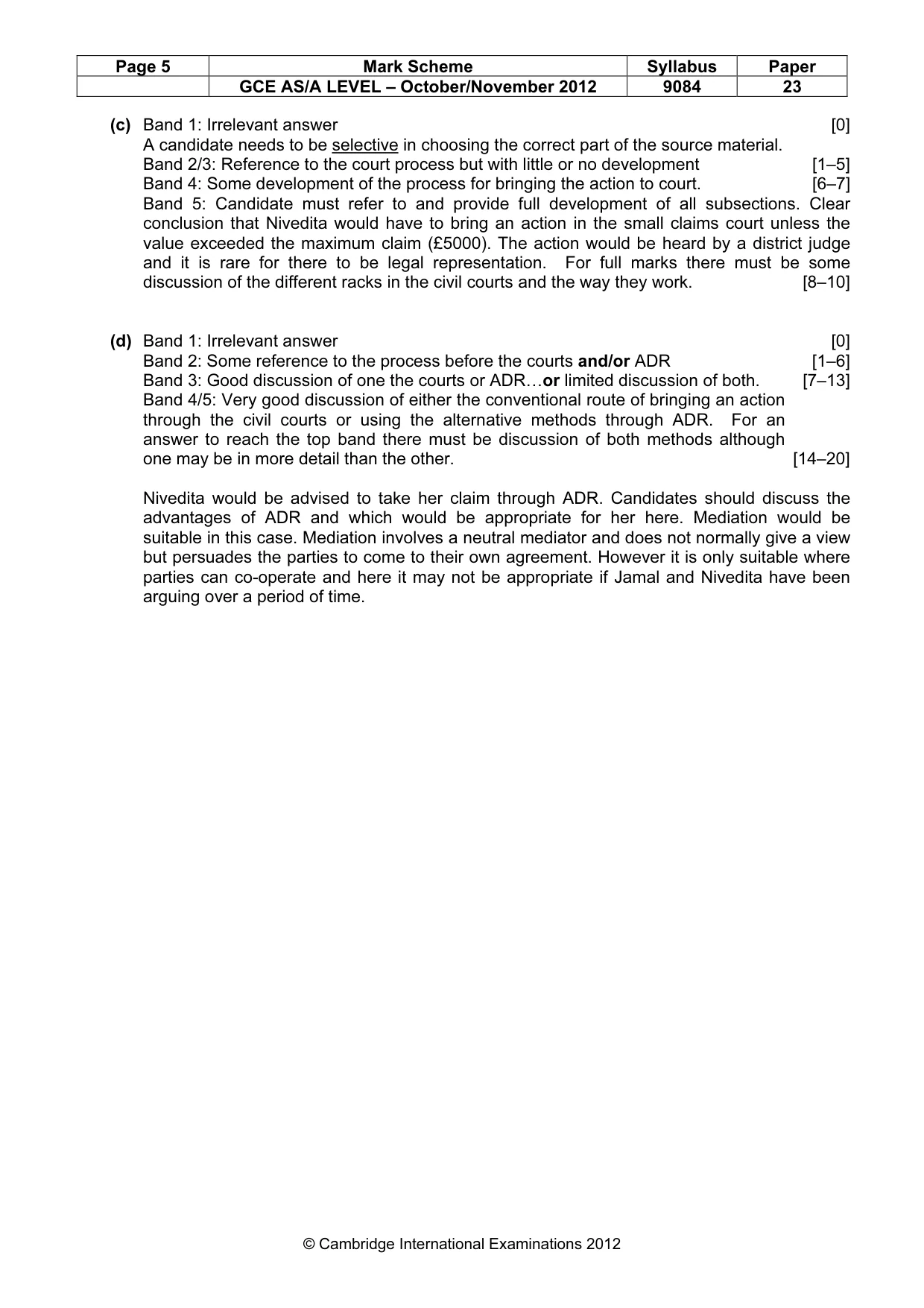
Page 5 Mark Scheme Syllabus Paper GCE AS/A LEVEL – October/November 2012 9084 23 © Cambridge International Examinations 2012 (c) Band 1: Irrelevant answer [0] A candidate needs to be selective in choosing the correct part of the source material. Band 2/3: Reference to the court process but with little or no development [1–5] Band 4: Some development of the process for bringing the action to court. [6–7] Band 5: Candidate must refer to and provide full development of all subsections. Clear conclusion that Nivedita would have to bring an action in the small claims court unless the value exceeded the maximum claim (£5000). The action would be heard by a district judge and it is rare for there to be legal representation. For full marks there must be some discussion of the different racks in the civil courts and the way they work. [8–10] (d) Band 1: Irrelevant answer [0] Band 2: Some reference to the process before the courts and/or ADR [1–6] Band 3: Good discussion of one the courts or ADR…or limited discussion of both. [7–13] Band 4/5: Very good discussion of either the conventional route of bringing an action through the civil courts or using the alternative methods through ADR. For an answer to reach the top band there must be discussion of both methods although one may be in more detail than the other. [14–20] Nivedita would be advised to take her claim through ADR. Candidates should discuss the advantages of ADR and which would be appropriate for her here. Mediation would be suitable in this case. Mediation involves a neutral mediator and does not normally give a view but persuades the parties to come to their own agreement. However it is only suitable where parties can co-operate and here it may not be appropriate if Jamal and Nivedita have been arguing over a period of time.
What you needed in this session
Cambridge’s own grade thresholds for 2012 Oct/Nov, Paper 2 · Variant 3. A higher threshold means an easier paper — the bar moves with how the cohort did.