Cambridge A Level Law 9084 — 2011 Oct/Nov Paper 2 · Variant 2
9084/22/O/N/11 · 50 marks · ≈56 min
The question paper and its mark scheme, free to read here and free to download. This is Cambridge’s own paper, exactly as it was sat.
Question paper4 pages
Mark scheme4 pages
Answers below. Sit the paper first if you are practising.
Paper as text
Question paper, page 1
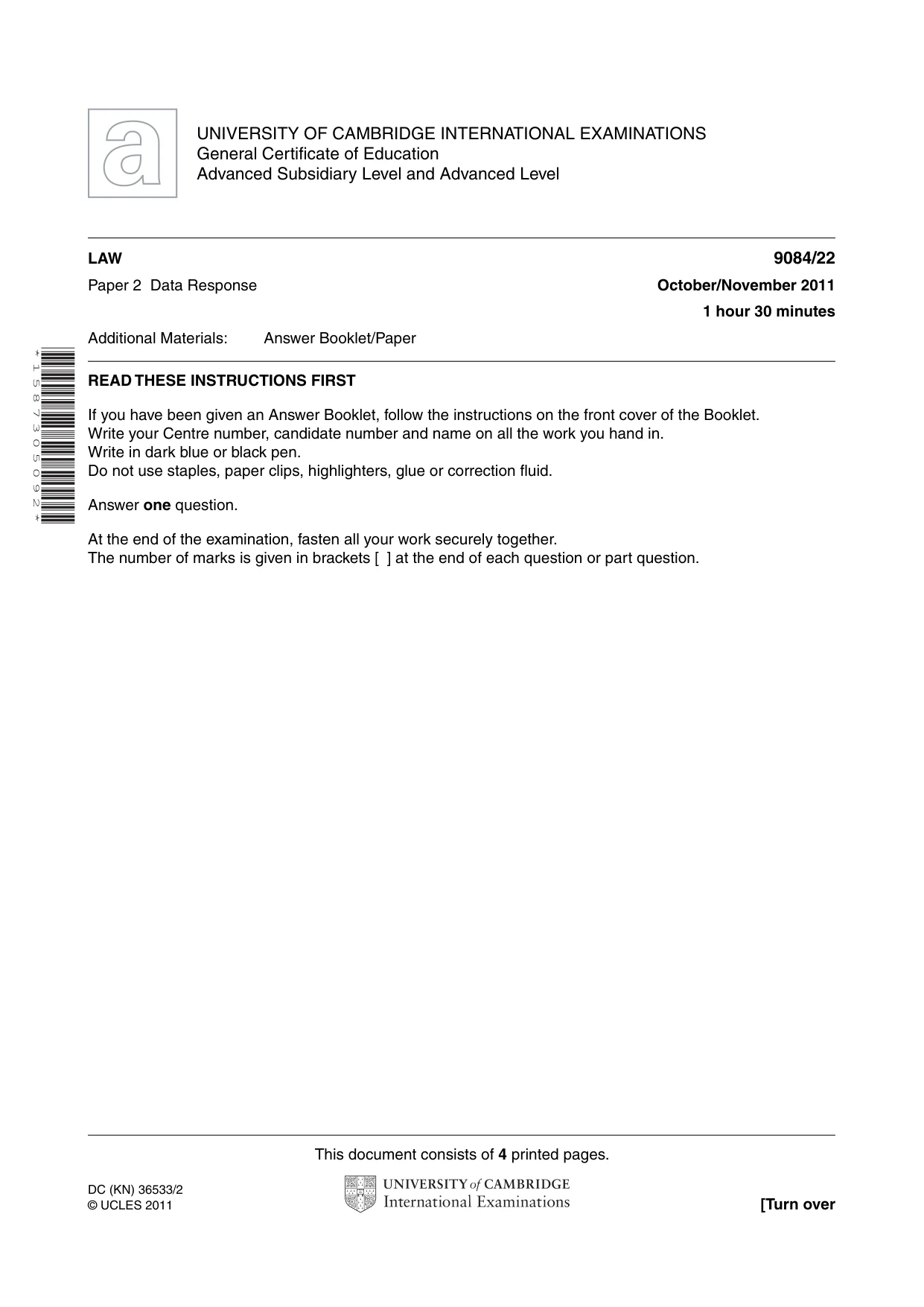
This document consists of 4 printed pages. DC (KN) 36533/2 © UCLES 2011 [Turn over UNIVERSITY OF CAMBRIDGE INTERNATIONAL EXAMINATIONS General Certificate of Education Advanced Subsidiary Level and Advanced Level * 1 5 8 7 3 0 5 0 9 2 * LAW 9084/22 Paper 2 Data Response October/November 2011 1 hour 30 minutes Additional Materials: Answer Booklet/Paper READ THESE INSTRUCTIONS FIRST If you have been given an Answer Booklet, follow the instructions on the front cover of the Booklet. Write your Centre number, candidate number and name on all the work you hand in. Write in dark blue or black pen. Do not use staples, paper clips, highlighters, glue or correction fluid. Answer one question. At the end of the examination, fasten all your work securely together. The number of marks is given in brackets [ ] at the end of each question or part question.
Question paper, page 2
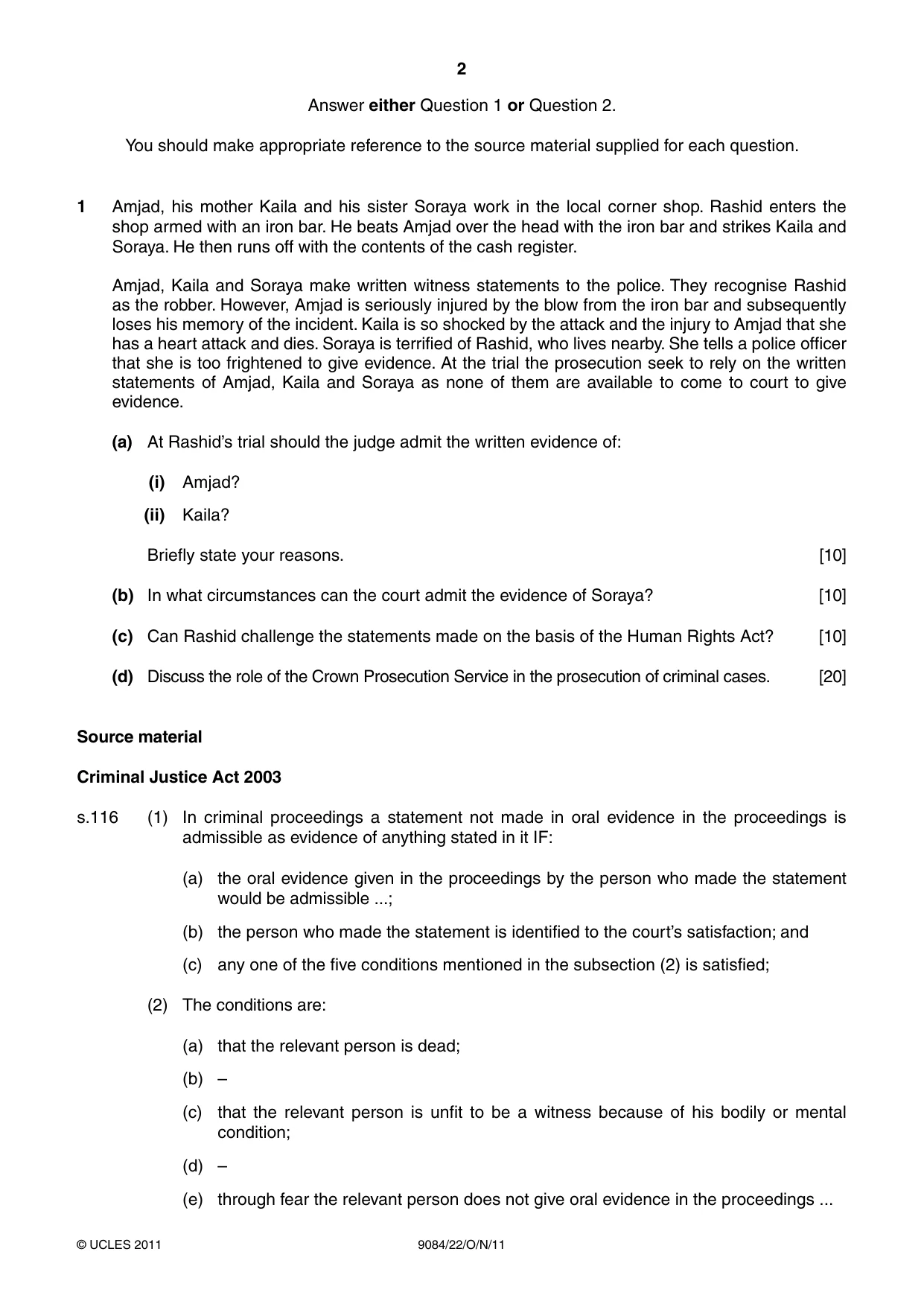
2 9084/22/O/N/11 © UCLES 2011 Answer either Question 1 or Question 2. You should make appropriate reference to the source material supplied for each question. 1 Amjad, his mother Kaila and his sister Soraya work in the local corner shop. Rashid enters the shop armed with an iron bar. He beats Amjad over the head with the iron bar and strikes Kaila and Soraya. He then runs off with the contents of the cash register. Amjad, Kaila and Soraya make written witness statements to the police. They recognise Rashid as the robber. However, Amjad is seriously injured by the blow from the iron bar and subsequently loses his memory of the incident. Kaila is so shocked by the attack and the injury to Amjad that she has a heart attack and dies. Soraya is terrified of Rashid, who lives nearby. She tells a police officer that she is too frightened to give evidence. At the trial the prosecution seek to rely on the written statements of Amjad, Kaila and Soraya as none of them are available to come to court to give evidence. (a) At Rashid’s trial should the judge admit the written evidence of: (i) Amjad? (ii) Kaila? Briefly state your reasons. [10] (b) In what circumstances can the court admit the evidence of Soraya? [10] (c) Can Rashid challenge the statements made on the basis of the Human Rights Act? [10] (d) Discuss the role of the Crown Prosecution Service in the prosecution of criminal cases. [20] Source material Criminal Justice Act 2003 s.116 (1) In criminal proceedings a statement not made in oral evidence in the proceedings is admissible as evidence of anything stated in it IF: (a) the oral evidence given in the proceedings by the person who made the statement would be admissible ...; (b) the person who made the statement is identified to the court’s satisfaction; and (c) any one of the five conditions mentioned in the subsection (2) is satisfied; (2) The conditions are: (a) that the relevant person is dead; (b) – (c) that the relevant person is unfit to be a witness because of his bodily or mental condition; (d) – (e) through fear the relevant person does not give oral evidence in the proceedings ...
Question paper, page 3
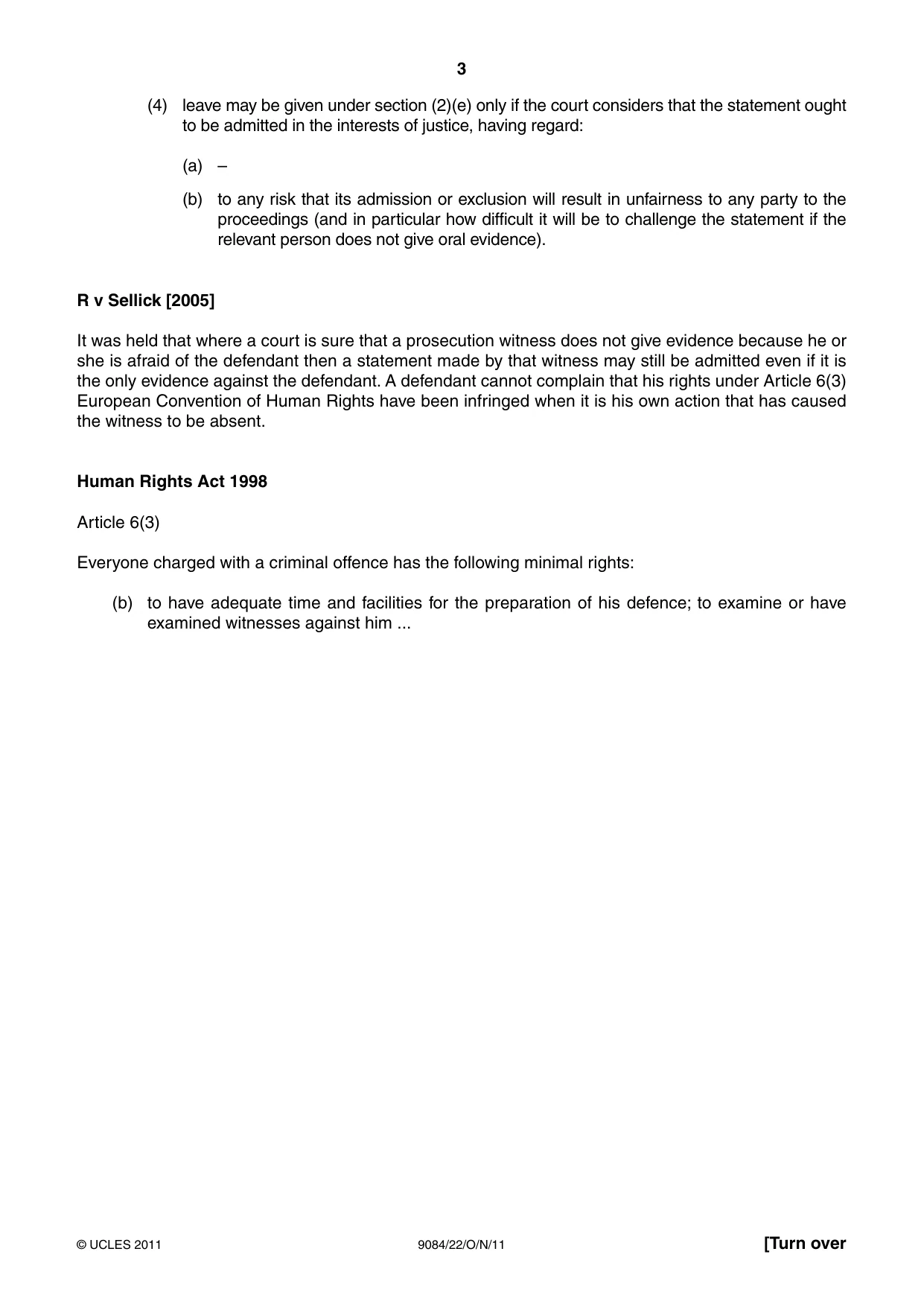
3 9084/22/O/N/11 © UCLES 2011 [Turn over (4) leave may be given under section (2)(e) only if the court considers that the statement ought to be admitted in the interests of justice, having regard: (a) – (b) to any risk that its admission or exclusion will result in unfairness to any party to the proceedings (and in particular how difficult it will be to challenge the statement if the relevant person does not give oral evidence). R v Sellick [2005] It was held that where a court is sure that a prosecution witness does not give evidence because he or she is afraid of the defendant then a statement made by that witness may still be admitted even if it is the only evidence against the defendant. A defendant cannot complain that his rights under Article 6(3) European Convention of Human Rights have been infringed when it is his own action that has caused the witness to be absent. Human Rights Act 1998 Article 6(3) Everyone charged with a criminal offence has the following minimal rights: (b) to have adequate time and facilities for the preparation of his defence; to examine or have examined witnesses against him ...
Question paper, page 4
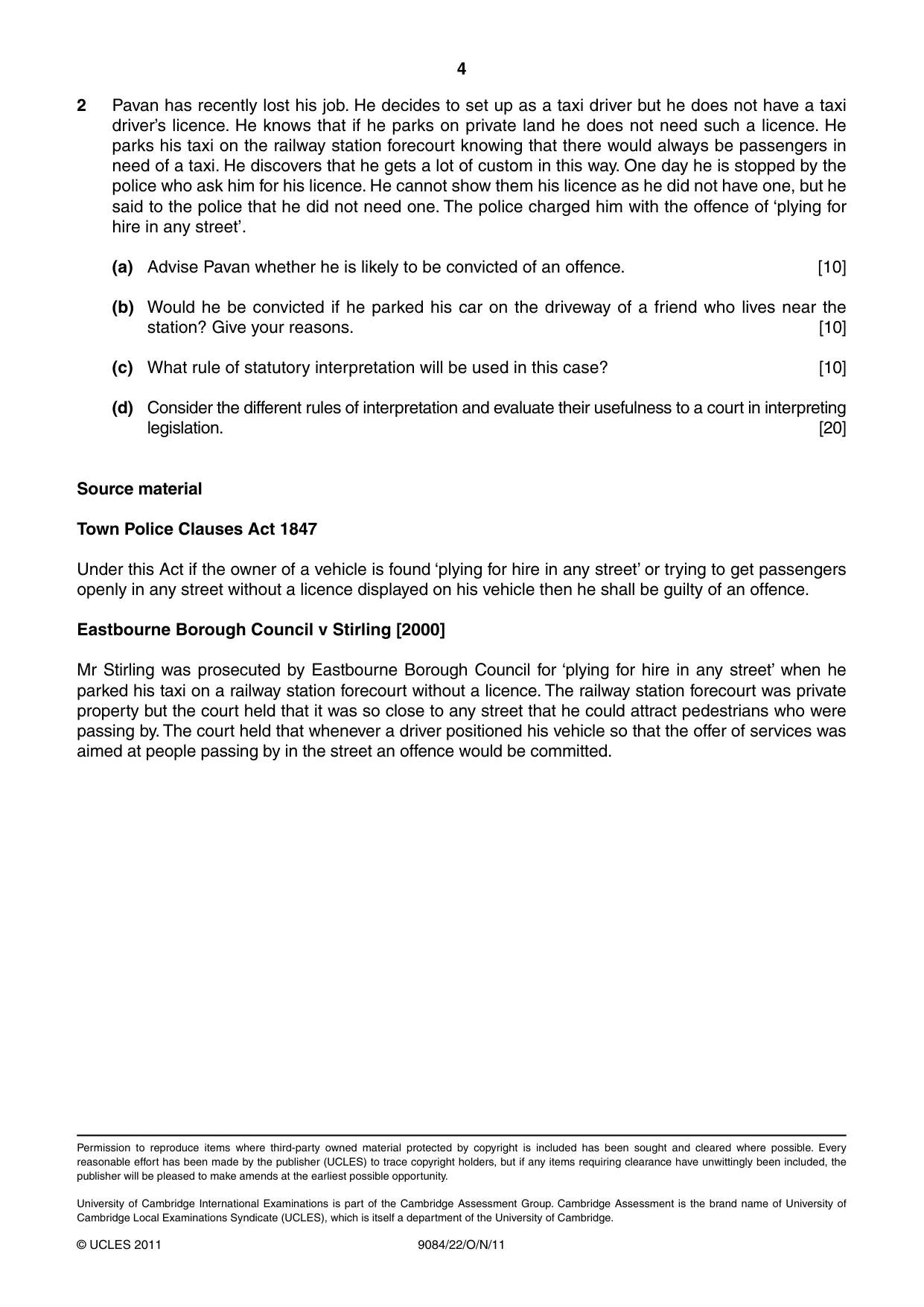
4 9084/22/O/N/11 © UCLES 2011 2 Pavan has recently lost his job. He decides to set up as a taxi driver but he does not have a taxi driver’s licence. He knows that if he parks on private land he does not need such a licence. He parks his taxi on the railway station forecourt knowing that there would always be passengers in need of a taxi. He discovers that he gets a lot of custom in this way. One day he is stopped by the police who ask him for his licence. He cannot show them his licence as he did not have one, but he said to the police that he did not need one. The police charged him with the offence of ‘plying for hire in any street’. (a) Advise Pavan whether he is likely to be convicted of an offence. [10] (b) Would he be convicted if he parked his car on the driveway of a friend who lives near the station? Give your reasons. [10] (c) What rule of statutory interpretation will be used in this case? [10] (d) Consider the different rules of interpretation and evaluate their usefulness to a court in interpreting legislation. [20] Source material Town Police Clauses Act 1847 Under this Act if the owner of a vehicle is found ‘plying for hire in any street’ or trying to get passengers openly in any street without a licence displayed on his vehicle then he shall be guilty of an offence. Eastbourne Borough Council v Stirling [2000] Mr Stirling was prosecuted by Eastbourne Borough Council for ‘plying for hire in any street’ when he parked his taxi on a railway station forecourt without a licence. The railway station forecourt was private property but the court held that it was so close to any street that he could attract pedestrians who were passing by. The court held that whenever a driver positioned his vehicle so that the offer of services was aimed at people passing by in the street an offence would be committed. Permission to reproduce items where third-party owned material protected by copyright is included has been sought and cleared where possible. Every reasonable effort has been made by the publisher (UCLES) to trace copyright holders, but if any items requiring clearance have unwittingly been included, the publisher will be pleased to make amends at the earliest possible opportunity. University of Cambridge International Examinations is part of the Cambridge Assessment Group. Cambridge Assessment is the brand name of University of Cambridge Local Examinations Syndicate (UCLES), which is itself a department of the University of Cambridge.
Mark scheme, page 1
UNIVERSITY OF CAMBRIDGE INTERNATIONAL EXAMINATIONS GCE Advanced Subsidiary Level and GCE Advanced Level MARK SCHEME for the October/November 2011 question paper for the guidance of teachers 9084 LAW 9084/22 Paper 2, maximum raw mark 50 This mark scheme is published as an aid to teachers and candidates, to indicate the requirements of the examination. It shows the basis on which Examiners were instructed to award marks. It does not indicate the details of the discussions that took place at an Examiners’ meeting before marking began, which would have considered the acceptability of alternative answers. Mark schemes must be read in conjunction with the question papers and the report on the examination. • Cambridge will not enter into discussions or correspondence in connection with these mark schemes. Cambridge is publishing the mark schemes for the October/November 2011 question papers for most IGCSE, GCE Advanced Level and Advanced Subsidiary Level syllabuses and some Ordinary Level syllabuses.
Mark scheme, page 2
Page 2 Mark Scheme: Teachers’ version Syllabus Paper GCE AS/A LEVEL – October/November 2011 9084 22 © University of Cambridge International Examinations 2011 This mark scheme includes a summary of appropriate content for answering each question. It should be emphasised, however, that this material is for illustrative purposes and is not intended to provide a definitive guide to acceptable answers. It is quite possible that among the scripts there will be some candidate answers that are not covered directly by the content of this mark scheme. In such cases, professional judgement should be exercised in assessing the merits of the answer. Mark Bands The mark bands and descriptors applicable to all questions on the paper are as follows. Maximum mark allocations are indicated in the mark scheme for each question or question part. Indicative content for each of the questions follows overleaf. Band 1: The answer contains no relevant material. Band 2: The candidate introduces fragments of information or unexplained examples from which no coherent explanation or analysis can emerge. OR The candidate attempts to introduce an explanation and/or analysis but it is so fundamentally undermined by error and confusion that it remains substantially incoherent. Band 3: The candidate begins to indicate some capacity for explanation and analysis by introducing some of the issues, but explanations are limited and superficial. OR The candidate adopts an approach in which there is concentration on explanation in terms of facts presented rather than through the development and explanation of legal principles and rules. OR The candidate attempts to introduce material across the range of potential content, but it is weak or confused so that no real explanation or conclusion emerges. Band 4: Where there is more than one issue, the candidate demonstrates a clear understanding of one of the main issues of the question, giving explanations and using illustrations so that a full and detailed picture is presented of this issue. OR The candidate presents a more limited explanation of all parts of the answer, but there is some lack of detail or superficiality in respect of either or both, so that the answer is not fully rounded. Band 5: The candidate presents a detailed explanation and discussion of all areas of relevant law and, while there may be some minor inaccuracies and/or imbalance, a coherent explanation emerges.
Mark scheme, page 3
Page 3 Mark Scheme: Teachers’ version Syllabus Paper GCE AS/A LEVEL – October/November 2011 9084 22 © University of Cambridge International Examinations 2011 1 (a) Under the Criminal Justice Act (CJA) 2003 a statement made not in oral evidence can be admitted under s.116(1) if the court is satisfied that the evidence is admissible, the person is identified and one of the five conditions is satisfied. In this case Amjad is too ill to come to court to give evidence and under s.116(2)(c) the court will admit his evidence. Under the CJA 2003 a statement could be admitted under s.116(2)(a) subject to the conditions in s.116(1); Kaila cannot come to court as she has died as a result of the attack. For Band 4, answers must include a conclusion. (b) Soraya cannot come to court because she is too frightened. Under s.116(2)(e) she can be excused from giving oral evidence but the court must give leave and state that to admit this statement it is in the interests of justice, having regard to any risk that its admission or exclusion will result in unfairness to any party. For Band 4, answers must include a conclusion. (c) Rashid cannot challenge these statements on the basis of the Human Rights Act and seek to have these statements withheld because it was his action that caused the witness to be absent and according to R v Sellick [2005] the defendant cannot later complain that his rights under Article 6(3) have been infringed. For max marks (8–10) answers must discuss correct article of the European Court of Human Rights. For Band 4, answers must include a conclusion. (d) The Criminal Prosecution Service (CPS) was introduced in 1986 as an independent agency to prosecute cases; it is headed by the Director of Public Prosecutions. The functions of the CPS are to give advice to the police about the admissibility of evidence before a charge is brought; to review all cases passed to them by the police to see if there is sufficient evidence for the case to proceed; and also to be responsible for all cases passed to them by the police. They are also responsible for conducting cases through the Crown Court and the Magistrates’ Court. Good answers will include a definition of who the CPS comprises, a description of their function and a discussion of their background. To obtain 14–20 marks answers must include a discussion of the way cases come to court for criminal trial. 2 (a) Pavan would be found liable for an offence under the Town Police Clauses Act 1847 as, although he was parked on private land, the position of his vehicle was such that he appeared to be ‘plying for hire’ and his taxi appeared to be positioned in such a way that the offer of services was aimed at people in the street. To obtain 7–10 marks answers must include a comparison between the two scenarios, e.g. how he could escape prosecution and why he may be prosecuted and some mention of the case Eastbourne Borough Council v Stirling. For Band 4, answers must include a conclusion.
Mark scheme, page 4
Page 4 Mark Scheme: Teachers’ version Syllabus Paper GCE AS/A LEVEL – October/November 2011 9084 22 © University of Cambridge International Examinations 2011 (b) Pavan would only be guilty of an offence under Town Police Clauses Act 1847 when he parked in his friend’s drive if he could be said to have positioned his car in such a way that he had aimed to attract people from the street. If someone happened to ask him to take him somewhere in the taxi, Pavan would not have committed an offence. As in (a), for answers in top band 7–10 marks there must be a comparison between the two scenarios, e.g. how he could escape prosecution and why he may be prosecuted and some mention of the case Eastbourne Borough Council v Stirling. For Band 4, answers must include a conclusion. (c) Credit for any sensible discussion of any of the rules of interpretation, literal, golden, mischief and purposive. The mischief rule would be appropriate in this case. There are similarities with Smith v Hughes (1960). For marks in band 7–10 there should be discussion of a court’s approach in this case, e.g. to look at the mischief aimed at in the Act, which in this case was to prevent taxi drivers from operating without a licence and competing with taxi drivers who were properly licensed. Max 5 marks for discussion and application of the literal rule. Candidates who discuss the literal rule and suggest the golden rule can be credited with the full range of marks where they justify its use. All answers should have some citation. Max 7 marks for no case law apart from Stirling. (d) Discussion of the three rules. The literal rule should be criticised for its narrow literalist approach. The golden rule has its advantages but it can only be used where there are two alternative meanings. The mischief rule of course allows the court wider powers of interpretation. The purposive rule is the widest rule of all because it allows the court discretion in interpretation but there is the concern that it allows for judicial law-making. Answers should include some reference to the rules of language but discussion of intrinsic and extrinsic aids, presumptions and other aids to interpretation would not be expected. Band 2: very general discussion of main rules of statutory interpretation. Band 3: explanation of either the three rules in detail with citation or explanation of the three rules as well as the rules of language in less detail but some citation or good explanation of the three rules. Band 4: fully developed answer on three rules of statutory interpretation and some mention of rules of language. Good use of supporting cases. Some discussion of purposive approach. Answers in range 18–20 marks should be selective in the use of both rules and cases and should include a critical analysis of statutory interpretation. Very good answers which discuss the three rules and the purposive approach can reach max 16 marks without the rules of language.
What you needed in this session
Cambridge’s own grade thresholds for 2011 Oct/Nov, Paper 2 · Variant 2. A higher threshold means an easier paper — the bar moves with how the cohort did.