Cambridge A Level Law 9084 — 2011 Oct/Nov Paper 2 · Variant 1
9084/21/O/N/11 · 50 marks · ≈56 min
The question paper and its mark scheme, free to read here and free to download. This is Cambridge’s own paper, exactly as it was sat.
Question paper4 pages

Mark scheme3 pages
Answers below. Sit the paper first if you are practising.
Paper as text
Question paper, page 1
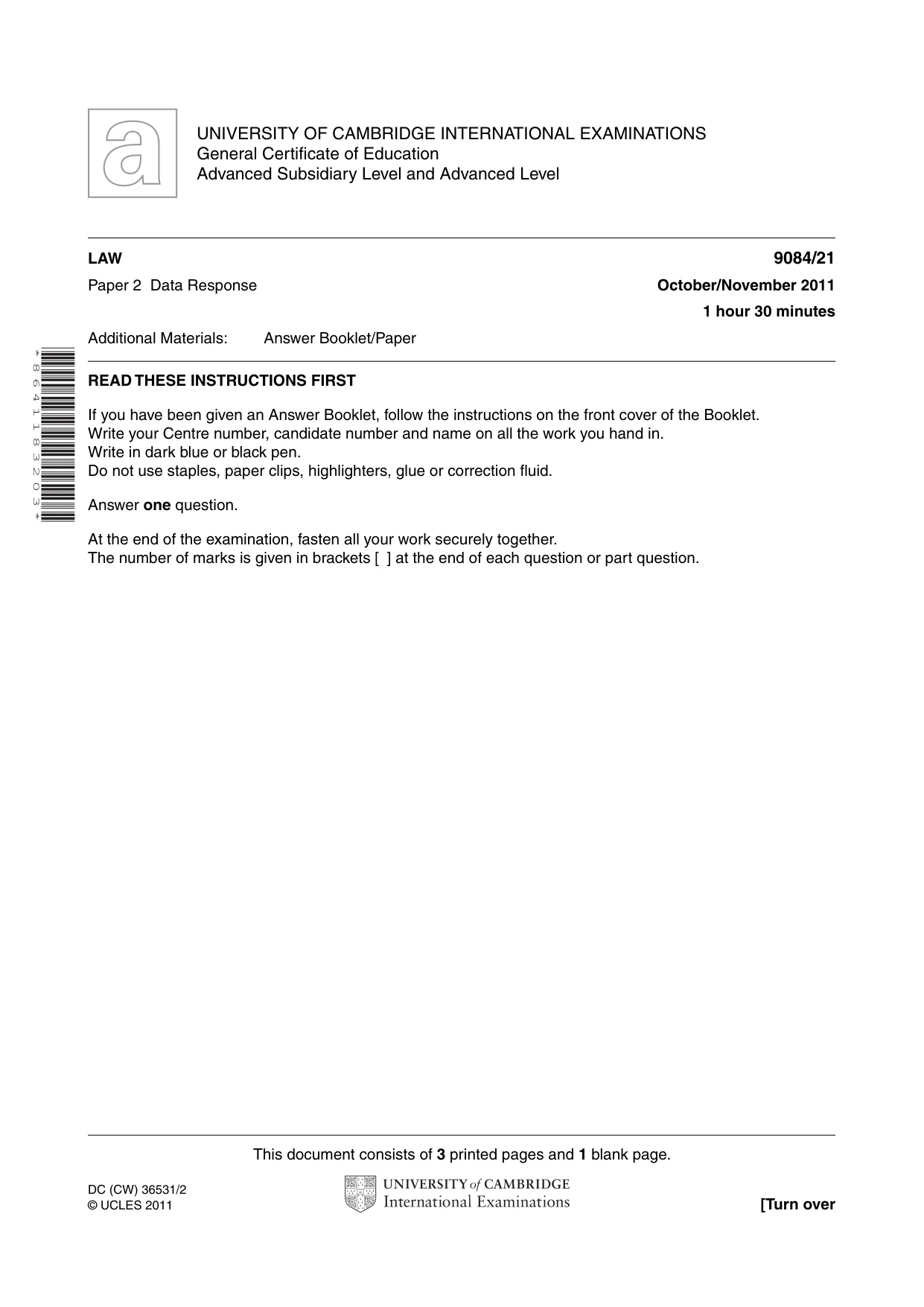
This document consists of 3 printed pages and 1 blank page. DC (CW) 36531/2 © UCLES 2011 [Turn over UNIVERSITY OF CAMBRIDGE INTERNATIONAL EXAMINATIONS General Certificate of Education Advanced Subsidiary Level and Advanced Level * 8 6 4 1 1 8 3 2 0 3 * LAW 9084/21 Paper 2 Data Response October/November 2011 1 hour 30 minutes Additional Materials: Answer Booklet/Paper READ THESE INSTRUCTIONS FIRST If you have been given an Answer Booklet, follow the instructions on the front cover of the Booklet. Write your Centre number, candidate number and name on all the work you hand in. Write in dark blue or black pen. Do not use staples, paper clips, highlighters, glue or correction fluid. Answer one question. At the end of the examination, fasten all your work securely together. The number of marks is given in brackets [ ] at the end of each question or part question.
Question paper, page 2
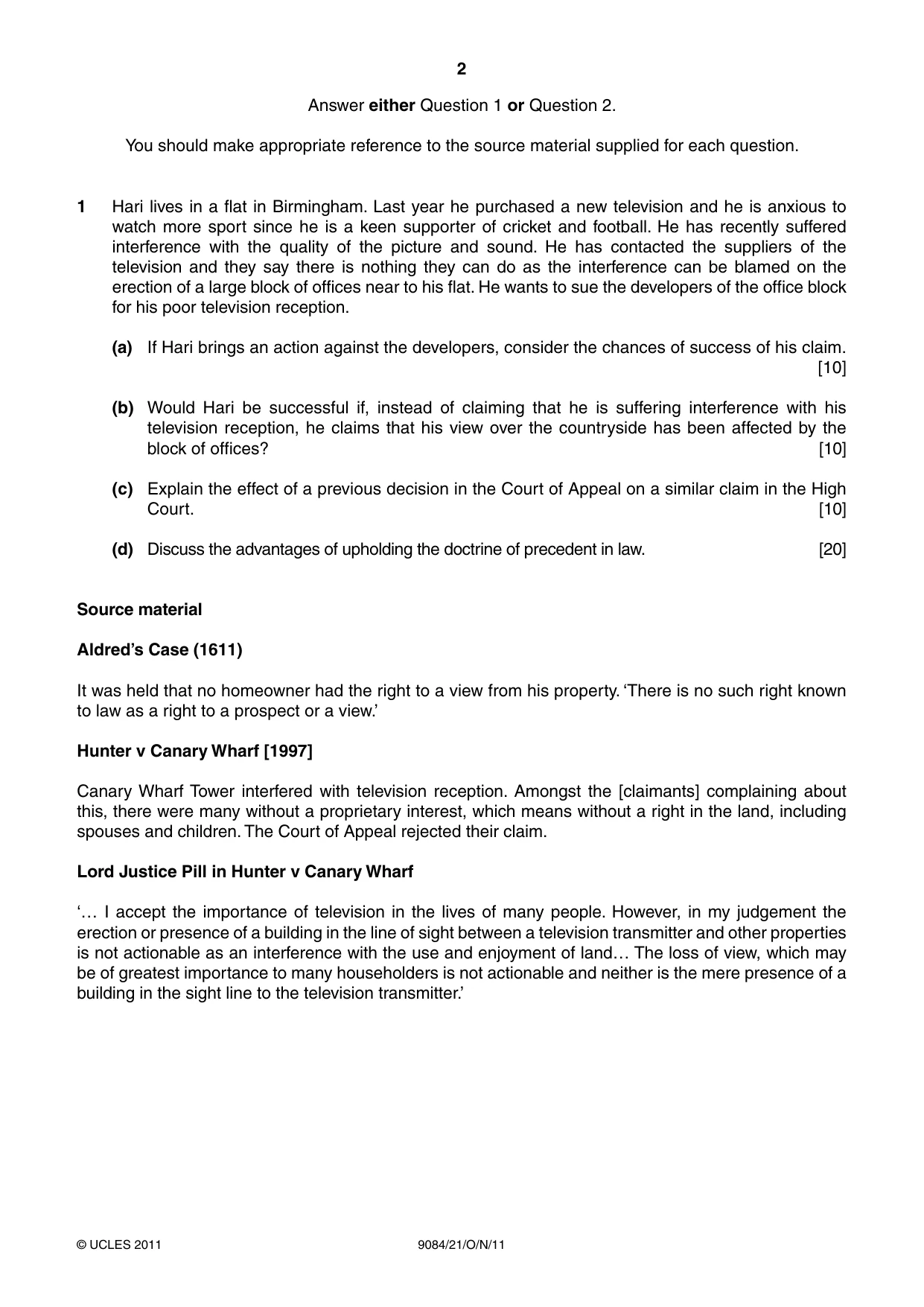
2 9084/21/O/N/11 © UCLES 2011 Answer either Question 1 or Question 2. You should make appropriate reference to the source material supplied for each question. 1 Hari lives in a flat in Birmingham. Last year he purchased a new television and he is anxious to watch more sport since he is a keen supporter of cricket and football. He has recently suffered interference with the quality of the picture and sound. He has contacted the suppliers of the television and they say there is nothing they can do as the interference can be blamed on the erection of a large block of offices near to his flat. He wants to sue the developers of the office block for his poor television reception. (a) If Hari brings an action against the developers, consider the chances of success of his claim. [10] (b) Would Hari be successful if, instead of claiming that he is suffering interference with his television reception, he claims that his view over the countryside has been affected by the block of offices? [10] (c) Explain the effect of a previous decision in the Court of Appeal on a similar claim in the High Court. [10] (d) Discuss the advantages of upholding the doctrine of precedent in law. [20] Source material Aldred’s Case (1611) It was held that no homeowner had the right to a view from his property. ‘There is no such right known to law as a right to a prospect or a view.’ Hunter v Canary Wharf [1997] Canary Wharf Tower interfered with television reception. Amongst the [claimants] complaining about this, there were many without a proprietary interest, which means without a right in the land, including spouses and children. The Court of Appeal rejected their claim. Lord Justice Pill in Hunter v Canary Wharf ‘… I accept the importance of television in the lives of many people. However, in my judgement the erection or presence of a building in the line of sight between a television transmitter and other properties is not actionable as an interference with the use and enjoyment of land… The loss of view, which may be of greatest importance to many householders is not actionable and neither is the mere presence of a building in the sight line to the television transmitter.’
Question paper, page 3
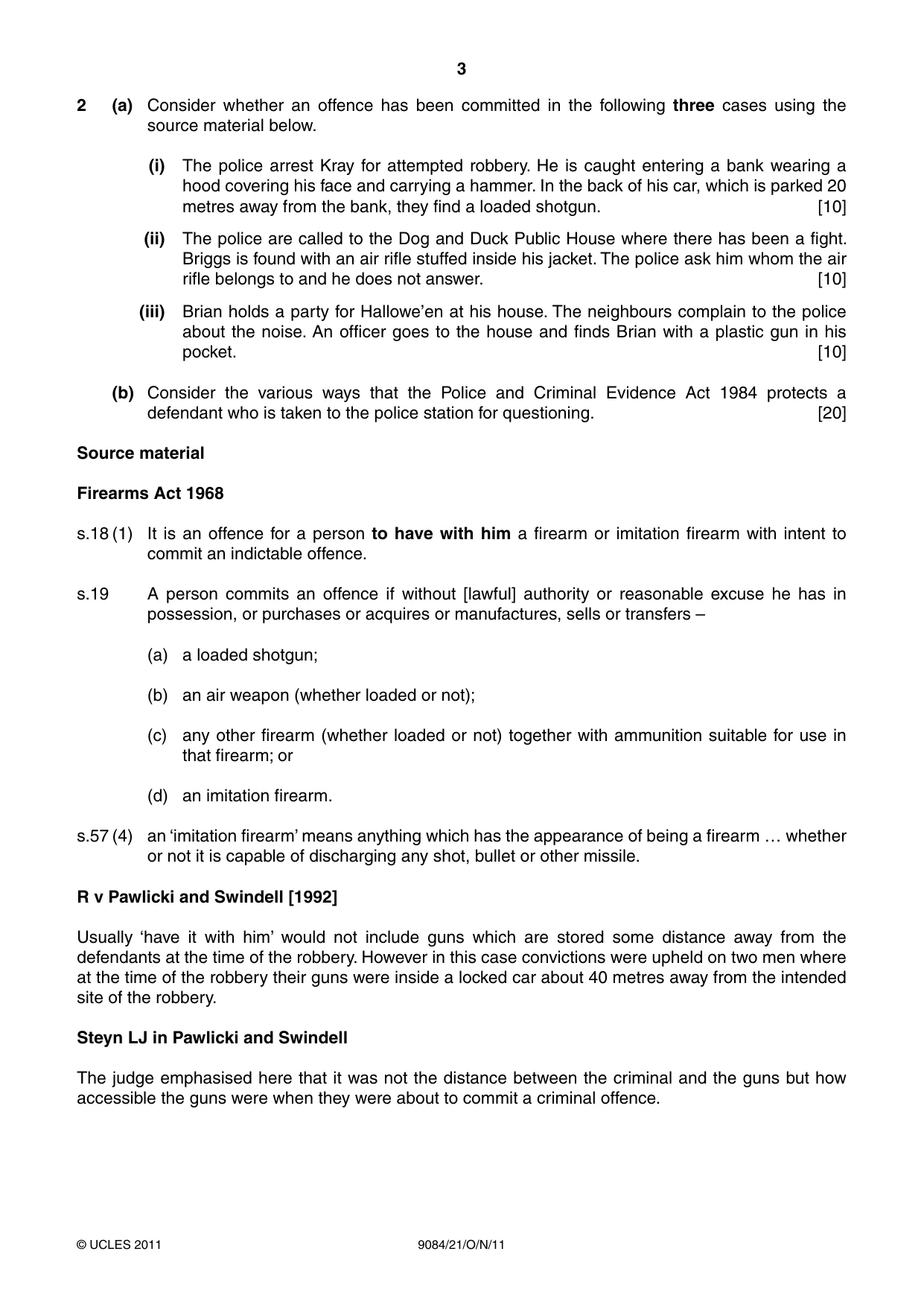
3 9084/21/O/N/11 © UCLES 2011 2 (a) Consider whether an offence has been committed in the following three cases using the source material below. (i) The police arrest Kray for attempted robbery. He is caught entering a bank wearing a hood covering his face and carrying a hammer. In the back of his car, which is parked 20 metres away from the bank, they find a loaded shotgun. [10] (ii) The police are called to the Dog and Duck Public House where there has been a fight. Briggs is found with an air rifle stuffed inside his jacket. The police ask him whom the air rifle belongs to and he does not answer. [10] (iii) Brian holds a party for Hallowe’en at his house. The neighbours complain to the police about the noise. An officer goes to the house and finds Brian with a plastic gun in his pocket. [10] (b) Consider the various ways that the Police and Criminal Evidence Act 1984 protects a defendant who is taken to the police station for questioning. [20] Source material Firearms Act 1968 s.18 (1) It is an offence for a person to have with him a firearm or imitation firearm with intent to commit an indictable offence. s.19 A person commits an offence if without [lawful] authority or reasonable excuse he has in possession, or purchases or acquires or manufactures, sells or transfers – (a) a loaded shotgun; (b) an air weapon (whether loaded or not); (c) any other firearm (whether loaded or not) together with ammunition suitable for use in that firearm; or (d) an imitation firearm. s.57 (4) an ‘imitation firearm’ means anything which has the appearance of being a firearm … whether or not it is capable of discharging any shot, bullet or other missile. R v Pawlicki and Swindell [1992] Usually ‘have it with him’ would not include guns which are stored some distance away from the defendants at the time of the robbery. However in this case convictions were upheld on two men where at the time of the robbery their guns were inside a locked car about 40 metres away from the intended site of the robbery. Steyn LJ in Pawlicki and Swindell The judge emphasised here that it was not the distance between the criminal and the guns but how accessible the guns were when they were about to commit a criminal offence.
Question paper, page 4
4 9084/21/O/N/11 © UCLES 2011 BLANK PAGE Permission to reproduce items where third-party owned material protected by copyright is included has been sought and cleared where possible. Every reasonable effort has been made by the publisher (UCLES) to trace copyright holders, but if any items requiring clearance have unwittingly been included, the publisher will be pleased to make amends at the earliest possible opportunity. University of Cambridge International Examinations is part of the Cambridge Assessment Group. Cambridge Assessment is the brand name of University of Cambridge Local Examinations Syndicate (UCLES), which is itself a department of the University of Cambridge.
Mark scheme, page 1
UNIVERSITY OF CAMBRIDGE INTERNATIONAL EXAMINATIONS GCE Advanced Subsidiary Level and GCE Advanced Level MARK SCHEME for the October/November 2011 question paper for the guidance of teachers 9084 LAW 9084/21 Paper 2, maximum raw mark 50 This mark scheme is published as an aid to teachers and candidates, to indicate the requirements of the examination. It shows the basis on which Examiners were instructed to award marks. It does not indicate the details of the discussions that took place at an Examiners’ meeting before marking began, which would have considered the acceptability of alternative answers. Mark schemes must be read in conjunction with the question papers and the report on the examination. • Cambridge will not enter into discussions or correspondence in connection with these mark schemes. Cambridge is publishing the mark schemes for the October/November 2011 question papers for most IGCSE, GCE Advanced Level and Advanced Subsidiary Level syllabuses and some Ordinary Level syllabuses.
Mark scheme, page 2
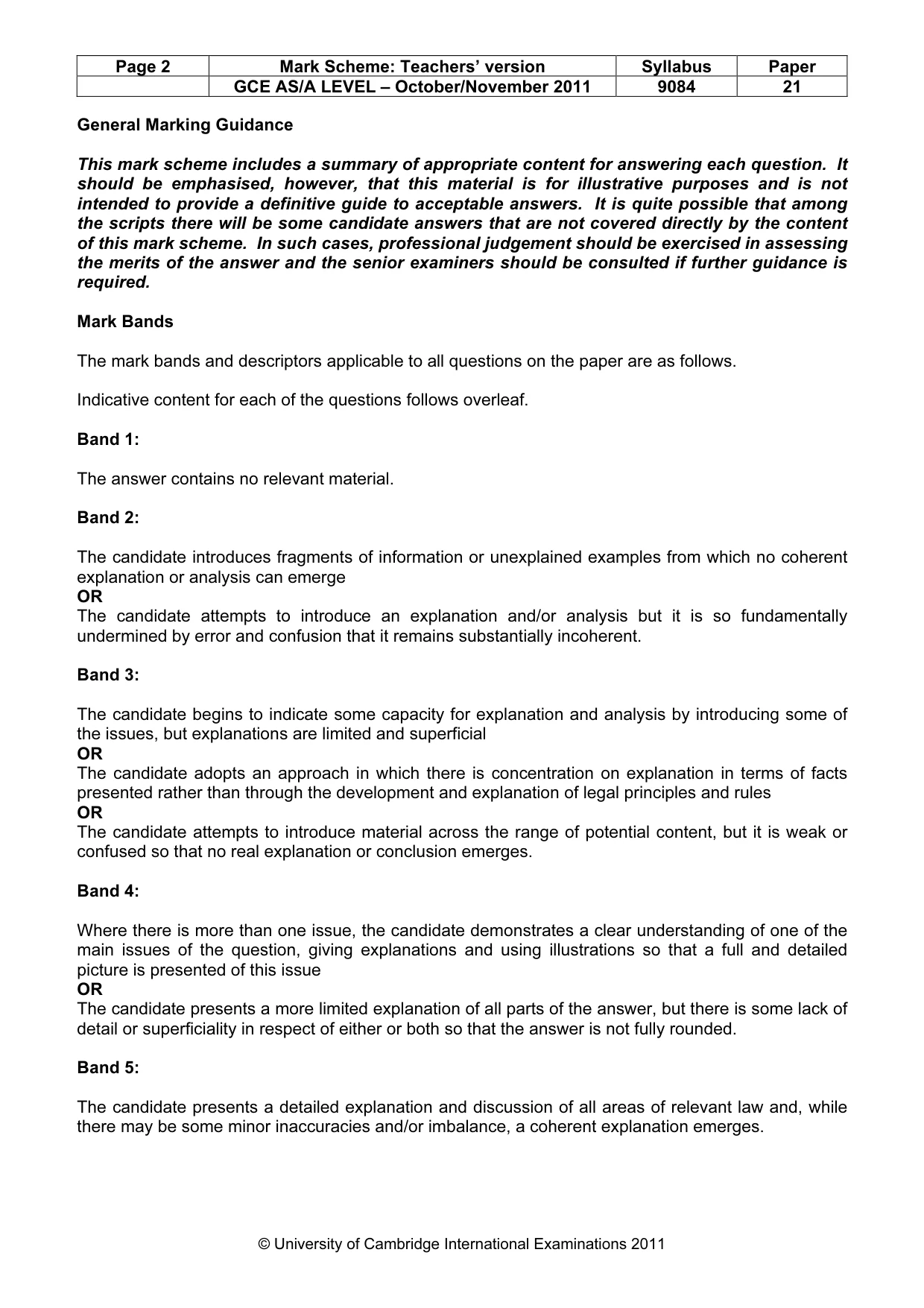
Page 2 Mark Scheme: Teachers’ version Syllabus Paper GCE AS/A LEVEL – October/November 2011 9084 21 © University of Cambridge International Examinations 2011 General Marking Guidance This mark scheme includes a summary of appropriate content for answering each question. It should be emphasised, however, that this material is for illustrative purposes and is not intended to provide a definitive guide to acceptable answers. It is quite possible that among the scripts there will be some candidate answers that are not covered directly by the content of this mark scheme. In such cases, professional judgement should be exercised in assessing the merits of the answer and the senior examiners should be consulted if further guidance is required. Mark Bands The mark bands and descriptors applicable to all questions on the paper are as follows. Indicative content for each of the questions follows overleaf. Band 1: The answer contains no relevant material. Band 2: The candidate introduces fragments of information or unexplained examples from which no coherent explanation or analysis can emerge OR The candidate attempts to introduce an explanation and/or analysis but it is so fundamentally undermined by error and confusion that it remains substantially incoherent. Band 3: The candidate begins to indicate some capacity for explanation and analysis by introducing some of the issues, but explanations are limited and superficial OR The candidate adopts an approach in which there is concentration on explanation in terms of facts presented rather than through the development and explanation of legal principles and rules OR The candidate attempts to introduce material across the range of potential content, but it is weak or confused so that no real explanation or conclusion emerges. Band 4: Where there is more than one issue, the candidate demonstrates a clear understanding of one of the main issues of the question, giving explanations and using illustrations so that a full and detailed picture is presented of this issue OR The candidate presents a more limited explanation of all parts of the answer, but there is some lack of detail or superficiality in respect of either or both so that the answer is not fully rounded. Band 5: The candidate presents a detailed explanation and discussion of all areas of relevant law and, while there may be some minor inaccuracies and/or imbalance, a coherent explanation emerges.
Mark scheme, page 3
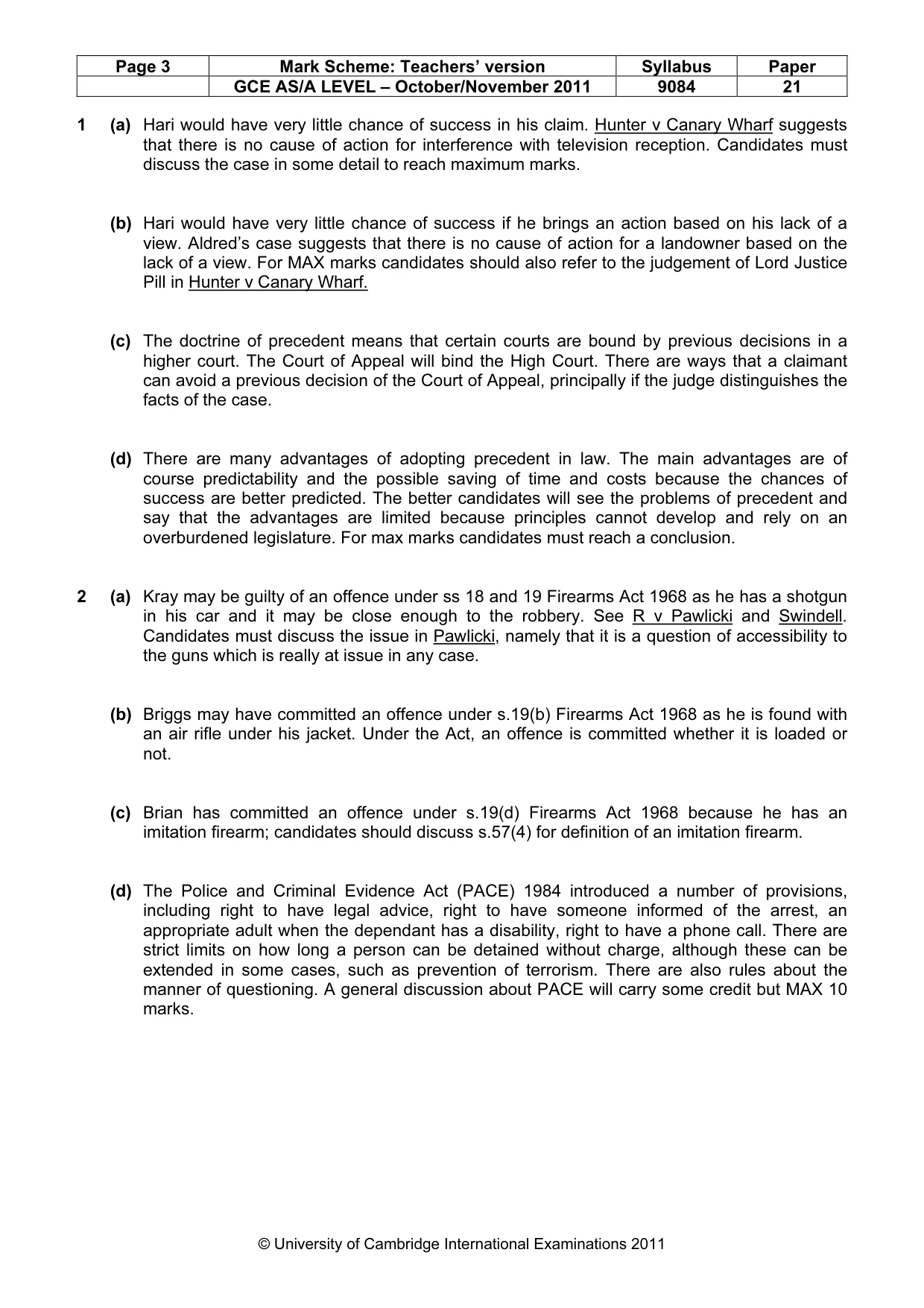
Page 3 Mark Scheme: Teachers’ version Syllabus Paper GCE AS/A LEVEL – October/November 2011 9084 21 © University of Cambridge International Examinations 2011 1 (a) Hari would have very little chance of success in his claim. Hunter v Canary Wharf suggests that there is no cause of action for interference with television reception. Candidates must discuss the case in some detail to reach maximum marks. (b) Hari would have very little chance of success if he brings an action based on his lack of a view. Aldred’s case suggests that there is no cause of action for a landowner based on the lack of a view. For MAX marks candidates should also refer to the judgement of Lord Justice Pill in Hunter v Canary Wharf. (c) The doctrine of precedent means that certain courts are bound by previous decisions in a higher court. The Court of Appeal will bind the High Court. There are ways that a claimant can avoid a previous decision of the Court of Appeal, principally if the judge distinguishes the facts of the case. (d) There are many advantages of adopting precedent in law. The main advantages are of course predictability and the possible saving of time and costs because the chances of success are better predicted. The better candidates will see the problems of precedent and say that the advantages are limited because principles cannot develop and rely on an overburdened legislature. For max marks candidates must reach a conclusion. 2 (a) Kray may be guilty of an offence under ss 18 and 19 Firearms Act 1968 as he has a shotgun in his car and it may be close enough to the robbery. See R v Pawlicki and Swindell. Candidates must discuss the issue in Pawlicki, namely that it is a question of accessibility to the guns which is really at issue in any case. (b) Briggs may have committed an offence under s.19(b) Firearms Act 1968 as he is found with an air rifle under his jacket. Under the Act, an offence is committed whether it is loaded or not. (c) Brian has committed an offence under s.19(d) Firearms Act 1968 because he has an imitation firearm; candidates should discuss s.57(4) for definition of an imitation firearm. (d) The Police and Criminal Evidence Act (PACE) 1984 introduced a number of provisions, including right to have legal advice, right to have someone informed of the arrest, an appropriate adult when the dependant has a disability, right to have a phone call. There are strict limits on how long a person can be detained without charge, although these can be extended in some cases, such as prevention of terrorism. There are also rules about the manner of questioning. A general discussion about PACE will carry some credit but MAX 10 marks.
What you needed in this session
Cambridge’s own grade thresholds for 2011 Oct/Nov, Paper 2 · Variant 1. A higher threshold means an easier paper — the bar moves with how the cohort did.