Cambridge A Level Law 9084 — 2010 May/June Paper 2 · Variant 2
9084/22/M/J/10 · 50 marks · ≈56 min
The question paper and its mark scheme, free to read here and free to download. This is Cambridge’s own paper, exactly as it was sat.
Question paper4 pages

Mark scheme3 pages
Answers below. Sit the paper first if you are practising.
Paper as text
Question paper, page 1
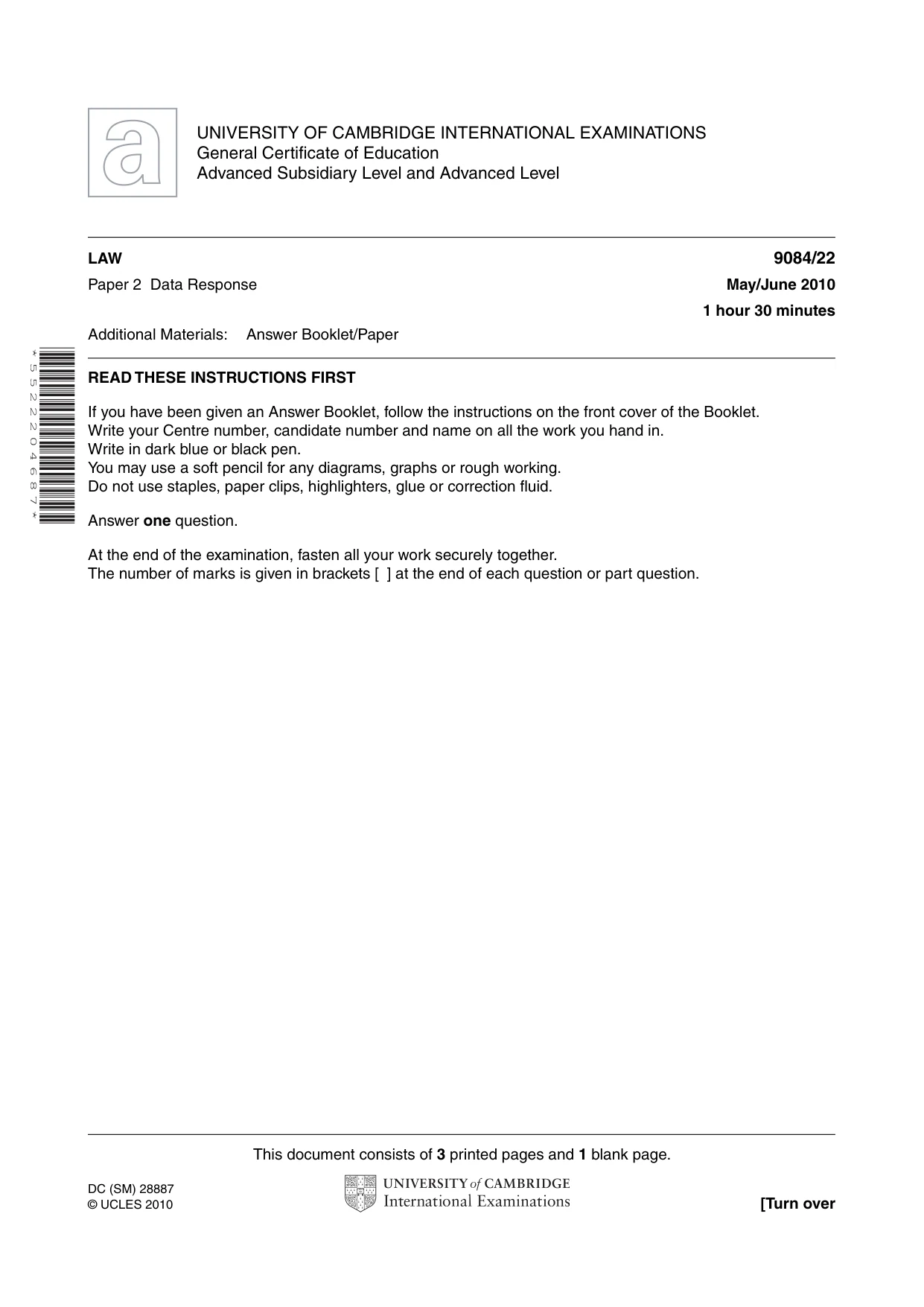
This document consists of 3 printed pages and 1 blank page. DC (SM) 28887 © UCLES 2010 [Turn over UNIVERSITY OF CAMBRIDGE INTERNATIONAL EXAMINATIONS General Certificate of Education Advanced Subsidiary Level and Advanced Level READ THESE INSTRUCTIONS FIRST If you have been given an Answer Booklet, follow the instructions on the front cover of the Booklet. Write your Centre number, candidate number and name on all the work you hand in. Write in dark blue or black pen. You may use a soft pencil for any diagrams, graphs or rough working. Do not use staples, paper clips, highlighters, glue or correction fluid. Answer one question. At the end of the examination, fasten all your work securely together. The number of marks is given in brackets [ ] at the end of each question or part question. * 5 5 2 2 2 0 4 6 8 7 * LAW 9084/22 Paper 2 Data Response May/June 2010 1 hour 30 minutes Additional Materials: Answer Booklet/Paper
Question paper, page 2
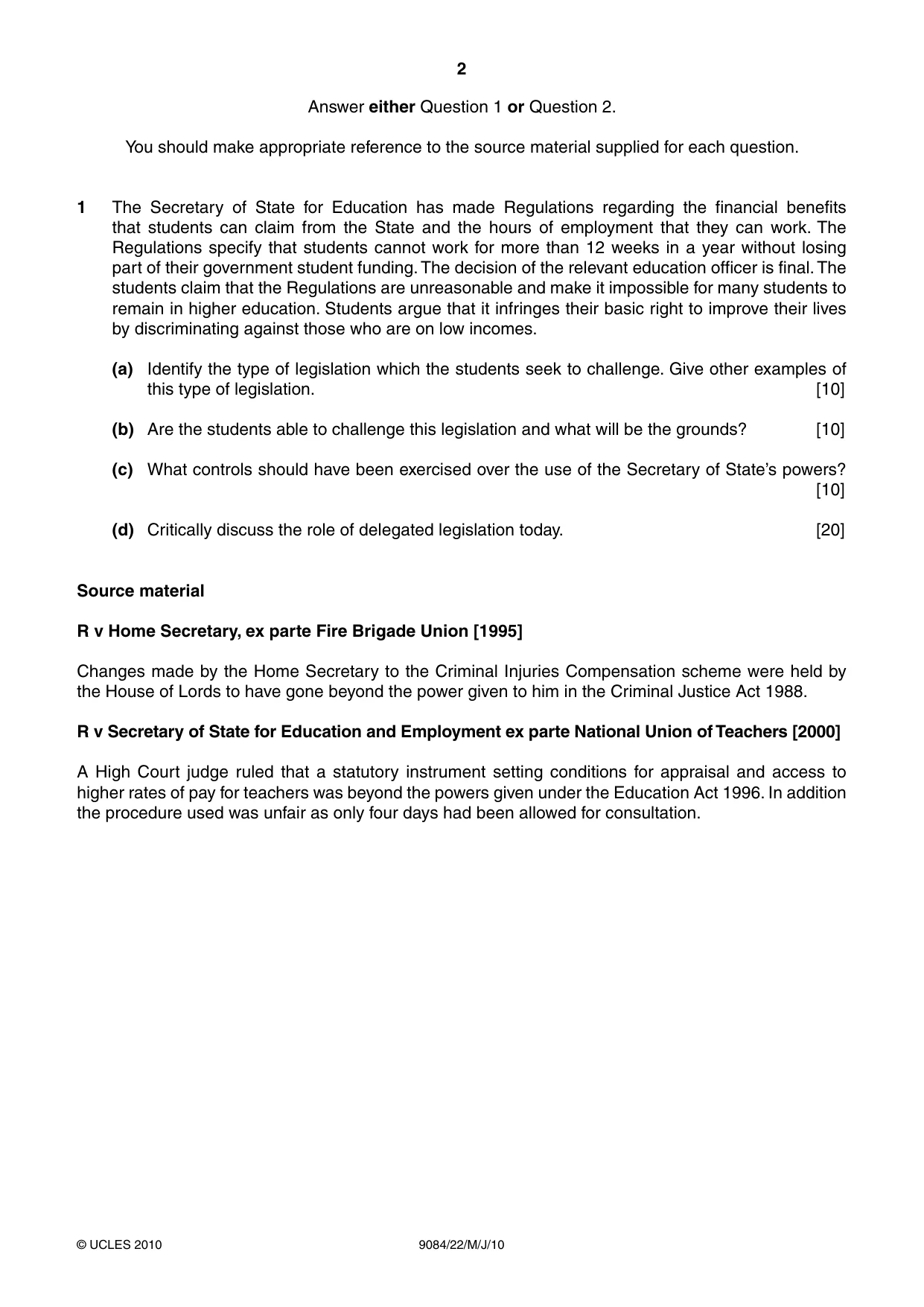
2 9084/22/M/J/10 © UCLES 2010 Answer either Question 1 or Question 2. You should make appropriate reference to the source material supplied for each question. 1 The Secretary of State for Education has made Regulations regarding the financial benefits that students can claim from the State and the hours of employment that they can work. The Regulations specify that students cannot work for more than 12 weeks in a year without losing part of their government student funding. The decision of the relevant education officer is final. The students claim that the Regulations are unreasonable and make it impossible for many students to remain in higher education. Students argue that it infringes their basic right to improve their lives by discriminating against those who are on low incomes. (a) Identify the type of legislation which the students seek to challenge. Give other examples of this type of legislation. [10] (b) Are the students able to challenge this legislation and what will be the grounds? [10] (c) What controls should have been exercised over the use of the Secretary of State’s powers? [10] (d) Critically discuss the role of delegated legislation today. [20] Source material R v Home Secretary, ex parte Fire Brigade Union [1995] Changes made by the Home Secretary to the Criminal Injuries Compensation scheme were held by the House of Lords to have gone beyond the power given to him in the Criminal Justice Act 1988. R v Secretary of State for Education and Employment ex parte National Union of Teachers [2000] A High Court judge ruled that a statutory instrument setting conditions for appraisal and access to higher rates of pay for teachers was beyond the powers given under the Education Act 1996. In addition the procedure used was unfair as only four days had been allowed for consultation.
Question paper, page 3
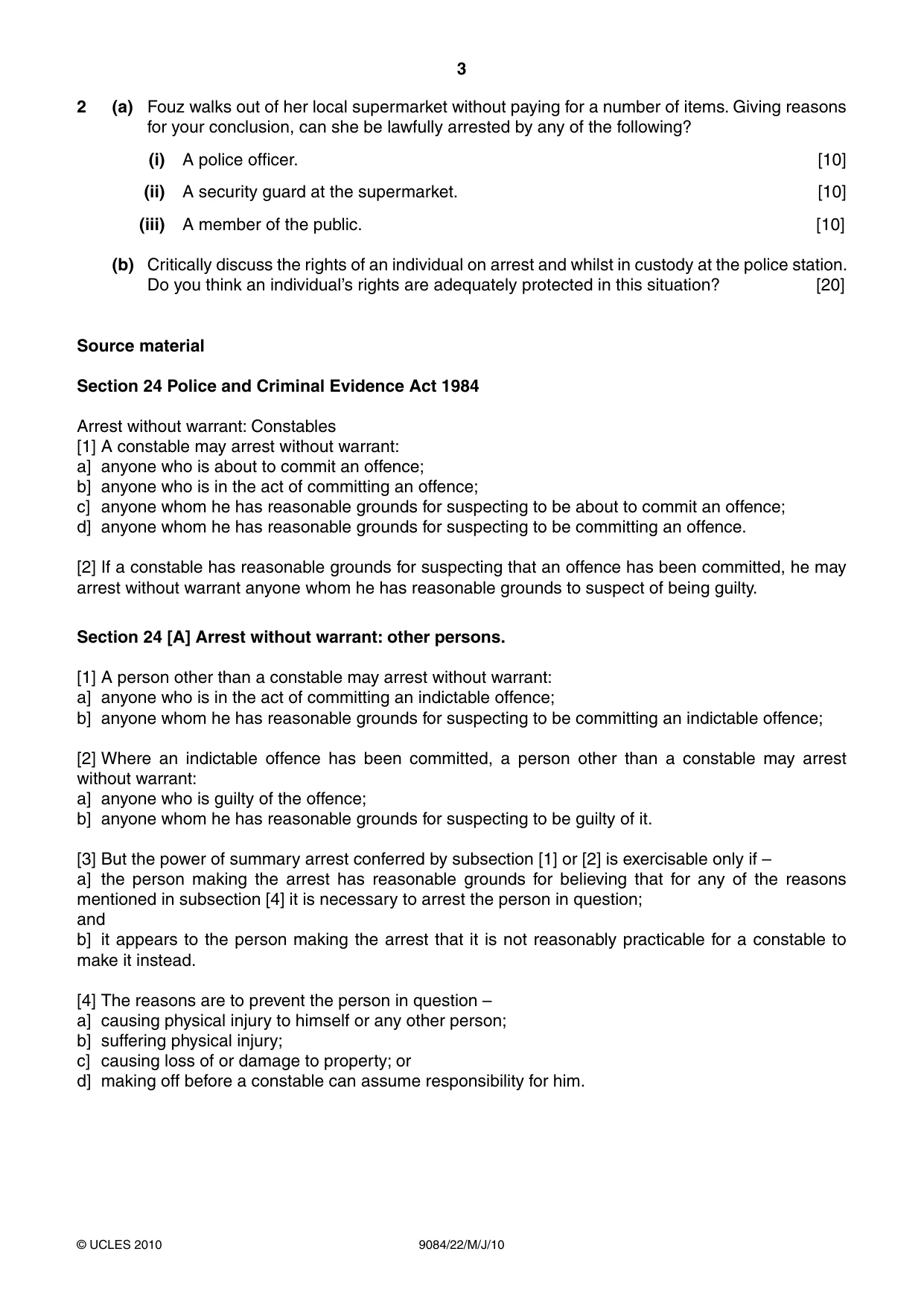
3 9084/22/M/J/10 © UCLES 2010 2 (a) Fouz walks out of her local supermarket without paying for a number of items. Giving reasons for your conclusion, can she be lawfully arrested by any of the following? (i) A police officer. [10] (ii) A security guard at the supermarket. [10] (iii) A member of the public. [10] (b) Critically discuss the rights of an individual on arrest and whilst in custody at the police station. Do you think an individual’s rights are adequately protected in this situation? [20] Source material Section 24 Police and Criminal Evidence Act 1984 Arrest without warrant: Constables [1] A constable may arrest without warrant: a] anyone who is about to commit an offence; b] anyone who is in the act of committing an offence; c] anyone whom he has reasonable grounds for suspecting to be about to commit an offence; d] anyone whom he has reasonable grounds for suspecting to be committing an offence. [2] If a constable has reasonable grounds for suspecting that an offence has been committed, he may arrest without warrant anyone whom he has reasonable grounds to suspect of being guilty. Section 24 [A] Arrest without warrant: other persons. [1] A person other than a constable may arrest without warrant: a] anyone who is in the act of committing an indictable offence; b] anyone whom he has reasonable grounds for suspecting to be committing an indictable offence; [2] Where an indictable offence has been committed, a person other than a constable may arrest without warrant: a] anyone who is guilty of the offence; b] anyone whom he has reasonable grounds for suspecting to be guilty of it. [3] But the power of summary arrest conferred by subsection [1] or [2] is exercisable only if – a] the person making the arrest has reasonable grounds for believing that for any of the reasons mentioned in subsection [4] it is necessary to arrest the person in question; and b] it appears to the person making the arrest that it is not reasonably practicable for a constable to make it instead. [4] The reasons are to prevent the person in question – a] causing physical injury to himself or any other person; b] suffering physical injury; c] causing loss of or damage to property; or d] making off before a constable can assume responsibility for him.
Question paper, page 4
4 9084/22/M/J/10 © UCLES 2010 BLANK PAGE Permission to reproduce items where third-party owned material protected by copyright is included has been sought and cleared where possible. Every reasonable effort has been made by the publisher (UCLES) to trace copyright holders, but if any items requiring clearance have unwittingly been included, the publisher will be pleased to make amends at the earliest possible opportunity. University of Cambridge International Examinations is part of the Cambridge Assessment Group. Cambridge Assessment is the brand name of University of Cambridge Local Examinations Syndicate (UCLES), which is itself a department of the University of Cambridge.
Mark scheme, page 1
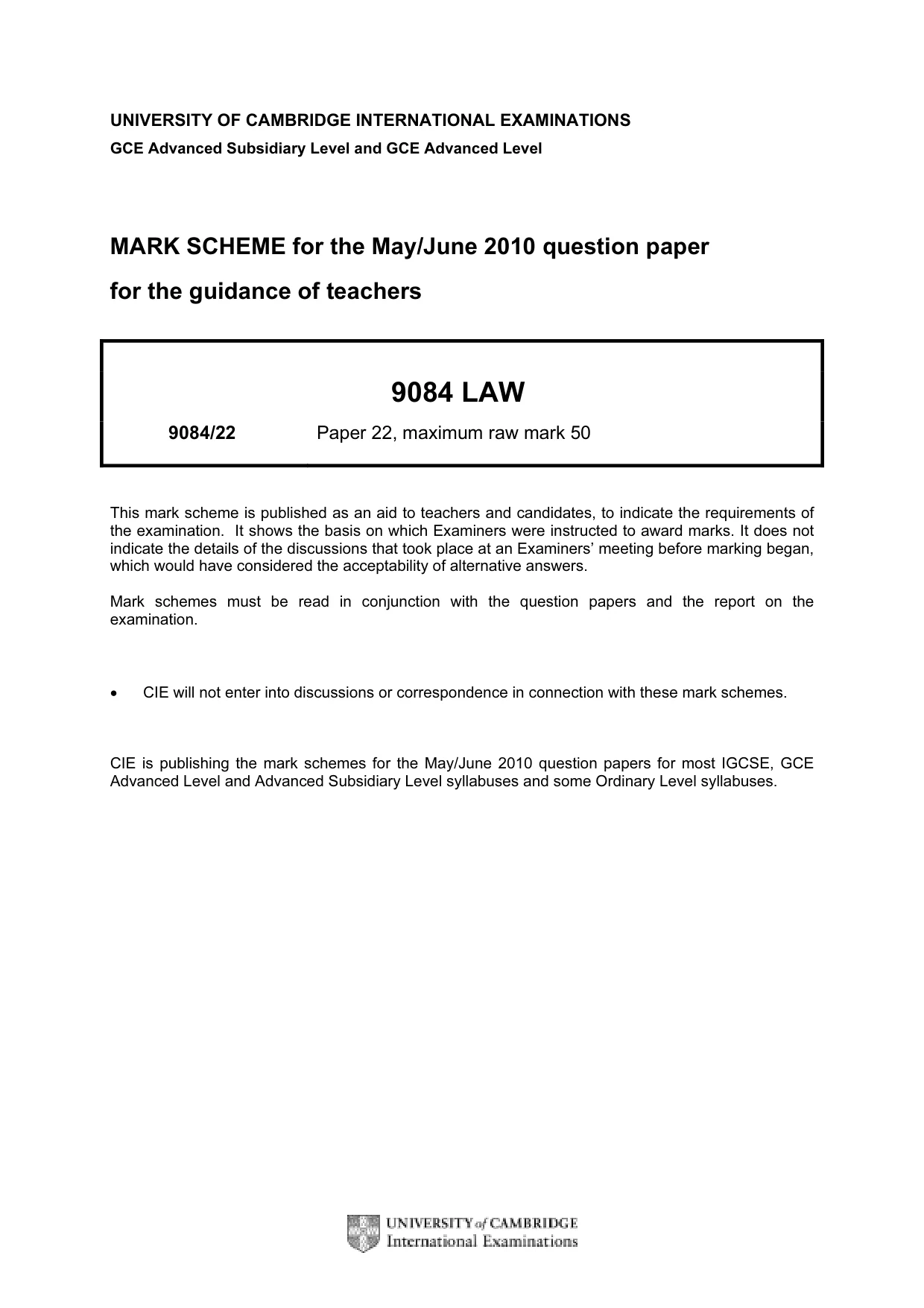
UNIVERSITY OF CAMBRIDGE INTERNATIONAL EXAMINATIONS GCE Advanced Subsidiary Level and GCE Advanced Level MARK SCHEME for the May/June 2010 question paper for the guidance of teachers 9084 LAW 9084/22 Paper 22, maximum raw mark 50 This mark scheme is published as an aid to teachers and candidates, to indicate the requirements of the examination. It shows the basis on which Examiners were instructed to award marks. It does not indicate the details of the discussions that took place at an Examiners’ meeting before marking began, which would have considered the acceptability of alternative answers. Mark schemes must be read in conjunction with the question papers and the report on the examination. • CIE will not enter into discussions or correspondence in connection with these mark schemes. CIE is publishing the mark schemes for the May/June 2010 question papers for most IGCSE, GCE Advanced Level and Advanced Subsidiary Level syllabuses and some Ordinary Level syllabuses.
Mark scheme, page 2
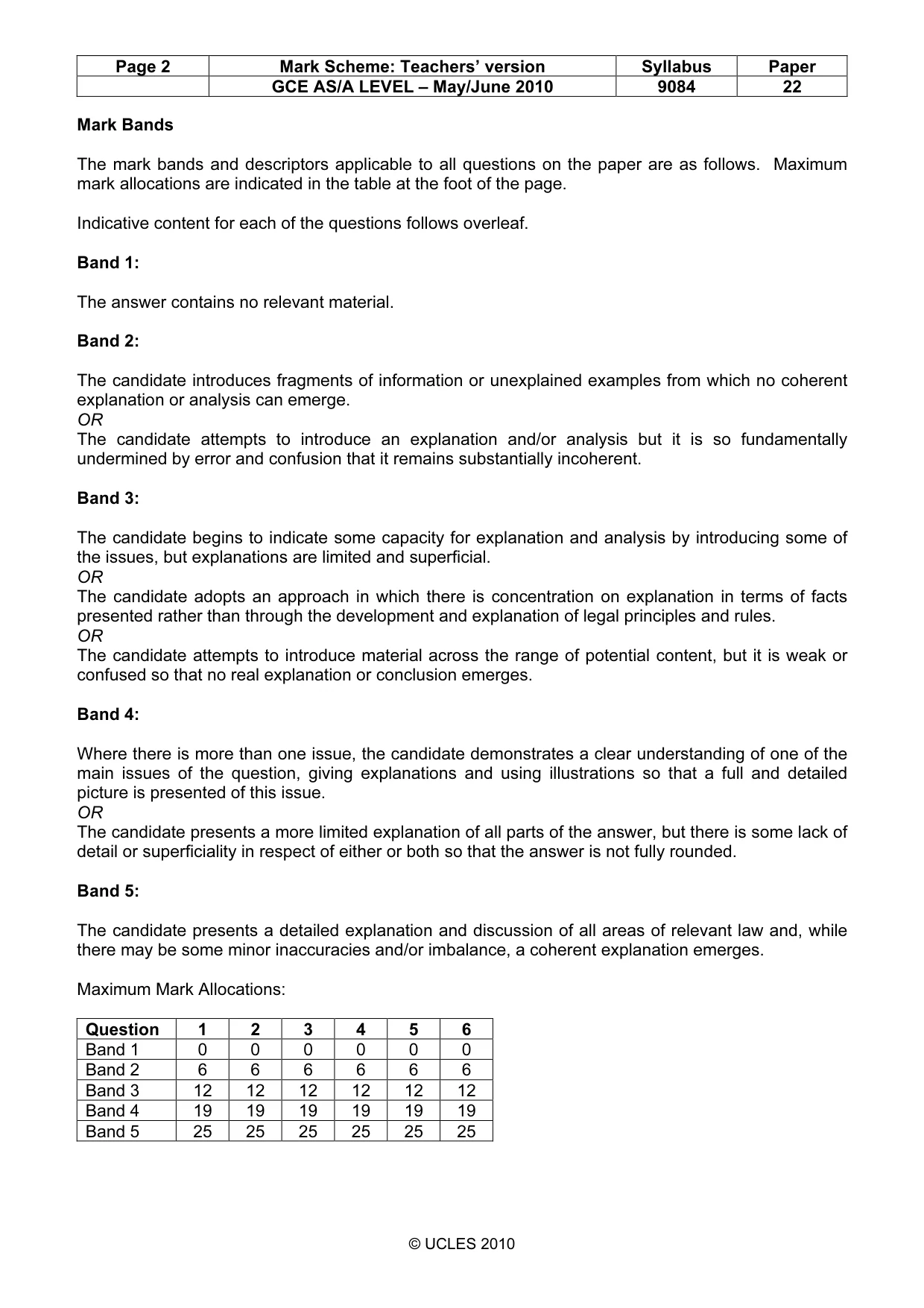
Page 2 Mark Scheme: Teachers’ version Syllabus Paper GCE AS/A LEVEL – May/June 2010 9084 22 © UCLES 2010 Mark Bands The mark bands and descriptors applicable to all questions on the paper are as follows. Maximum mark allocations are indicated in the table at the foot of the page. Indicative content for each of the questions follows overleaf. Band 1: The answer contains no relevant material. Band 2: The candidate introduces fragments of information or unexplained examples from which no coherent explanation or analysis can emerge. OR The candidate attempts to introduce an explanation and/or analysis but it is so fundamentally undermined by error and confusion that it remains substantially incoherent. Band 3: The candidate begins to indicate some capacity for explanation and analysis by introducing some of the issues, but explanations are limited and superficial. OR The candidate adopts an approach in which there is concentration on explanation in terms of facts presented rather than through the development and explanation of legal principles and rules. OR The candidate attempts to introduce material across the range of potential content, but it is weak or confused so that no real explanation or conclusion emerges. Band 4: Where there is more than one issue, the candidate demonstrates a clear understanding of one of the main issues of the question, giving explanations and using illustrations so that a full and detailed picture is presented of this issue. OR The candidate presents a more limited explanation of all parts of the answer, but there is some lack of detail or superficiality in respect of either or both so that the answer is not fully rounded. Band 5: The candidate presents a detailed explanation and discussion of all areas of relevant law and, while there may be some minor inaccuracies and/or imbalance, a coherent explanation emerges. Maximum Mark Allocations: Question 1 2 3 4 5 6 Band 1 0 0 0 0 0 0 Band 2 6 6 6 6 6 6 Band 3 12 12 12 12 12 12 Band 4 19 19 19 19 19 19 Band 5 25 25 25 25 25 25
Mark scheme, page 3
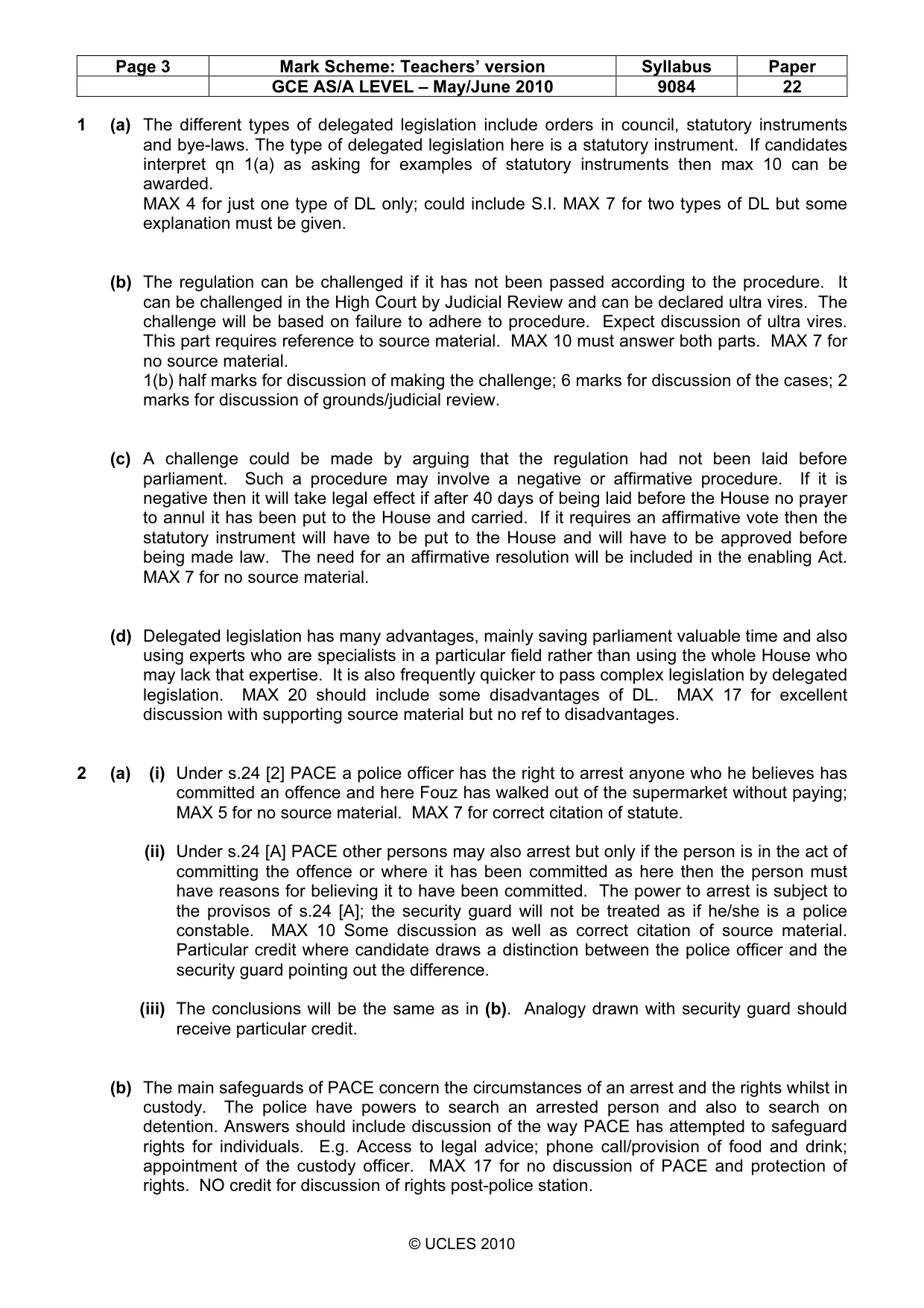
Page 3 Mark Scheme: Teachers’ version Syllabus Paper GCE AS/A LEVEL – May/June 2010 9084 22 © UCLES 2010 1 (a) The different types of delegated legislation include orders in council, statutory instruments and bye-laws. The type of delegated legislation here is a statutory instrument. If candidates interpret qn 1(a) as asking for examples of statutory instruments then max 10 can be awarded. MAX 4 for just one type of DL only; could include S.I. MAX 7 for two types of DL but some explanation must be given. (b) The regulation can be challenged if it has not been passed according to the procedure. It can be challenged in the High Court by Judicial Review and can be declared ultra vires. The challenge will be based on failure to adhere to procedure. Expect discussion of ultra vires. This part requires reference to source material. MAX 10 must answer both parts. MAX 7 for no source material. 1(b) half marks for discussion of making the challenge; 6 marks for discussion of the cases; 2 marks for discussion of grounds/judicial review. (c) A challenge could be made by arguing that the regulation had not been laid before parliament. Such a procedure may involve a negative or affirmative procedure. If it is negative then it will take legal effect if after 40 days of being laid before the House no prayer to annul it has been put to the House and carried. If it requires an affirmative vote then the statutory instrument will have to be put to the House and will have to be approved before being made law. The need for an affirmative resolution will be included in the enabling Act. MAX 7 for no source material. (d) Delegated legislation has many advantages, mainly saving parliament valuable time and also using experts who are specialists in a particular field rather than using the whole House who may lack that expertise. It is also frequently quicker to pass complex legislation by delegated legislation. MAX 20 should include some disadvantages of DL. MAX 17 for excellent discussion with supporting source material but no ref to disadvantages. 2 (a) (i) Under s.24 [2] PACE a police officer has the right to arrest anyone who he believes has committed an offence and here Fouz has walked out of the supermarket without paying; MAX 5 for no source material. MAX 7 for correct citation of statute. (ii) Under s.24 [A] PACE other persons may also arrest but only if the person is in the act of committing the offence or where it has been committed as here then the person must have reasons for believing it to have been committed. The power to arrest is subject to the provisos of s.24 [A]; the security guard will not be treated as if he/she is a police constable. MAX 10 Some discussion as well as correct citation of source material. Particular credit where candidate draws a distinction between the police officer and the security guard pointing out the difference. (iii) The conclusions will be the same as in (b). Analogy drawn with security guard should receive particular credit. (b) The main safeguards of PACE concern the circumstances of an arrest and the rights whilst in custody. The police have powers to search an arrested person and also to search on detention. Answers should include discussion of the way PACE has attempted to safeguard rights for individuals. E.g. Access to legal advice; phone call/provision of food and drink; appointment of the custody officer. MAX 17 for no discussion of PACE and protection of rights. NO credit for discussion of rights post-police station.
What you needed in this session
Cambridge’s own grade thresholds for 2010 May/June, Paper 2 · Variant 2. A higher threshold means an easier paper — the bar moves with how the cohort did.