Cambridge A Level Law 9084 — 2010 May/June Paper 2 · Variant 3
9084/23/M/J/10 · 50 marks · ≈56 min
The question paper and its mark scheme, free to read here and free to download. This is Cambridge’s own paper, exactly as it was sat.
Question paper4 pages

Mark scheme3 pages
Answers below. Sit the paper first if you are practising.
Paper as text
Question paper, page 1
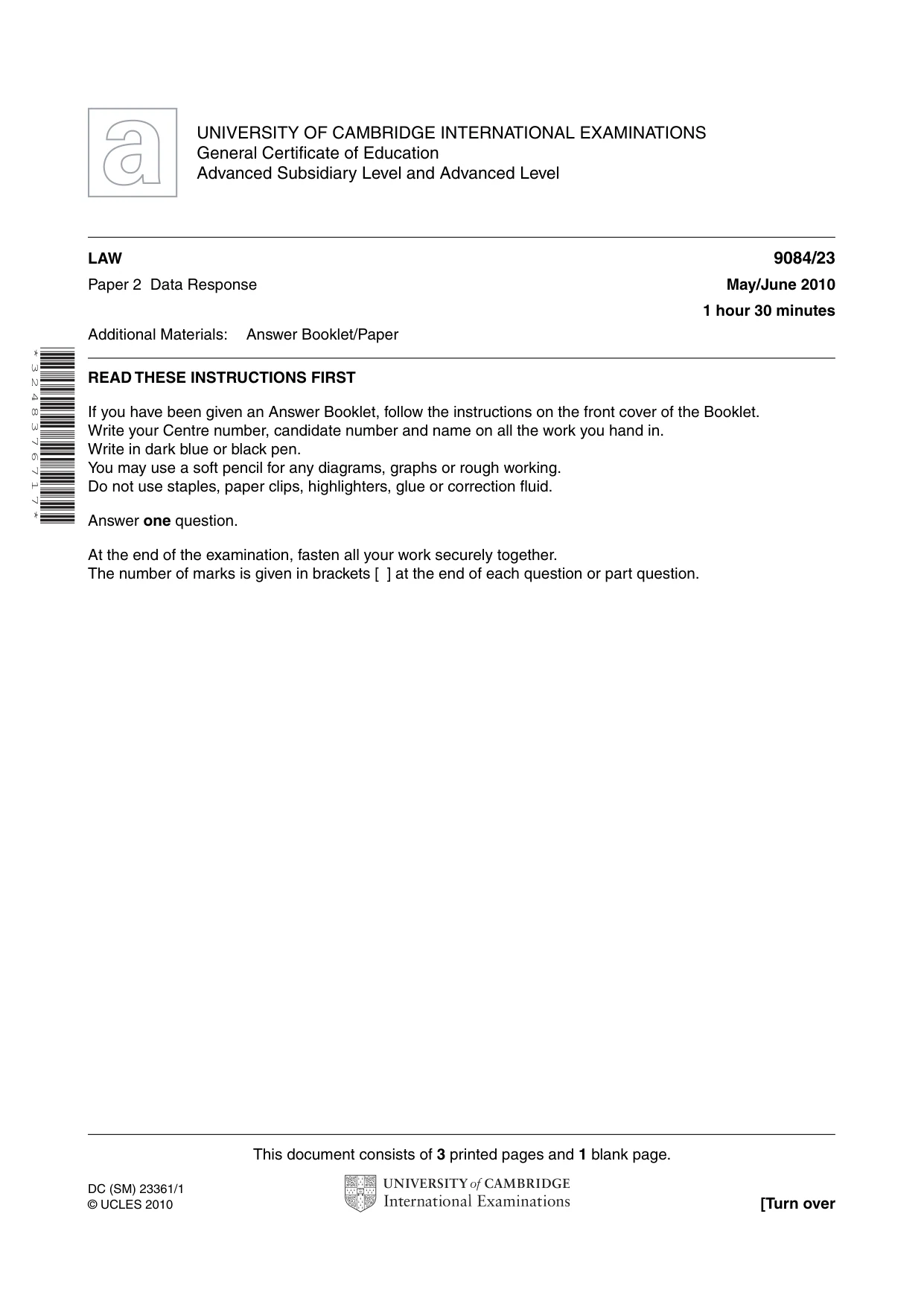
This document consists of 3 printed pages and 1 blank page. DC (SM) 23361/1 © UCLES 2010 [Turn over UNIVERSITY OF CAMBRIDGE INTERNATIONAL EXAMINATIONS General Certificate of Education Advanced Subsidiary Level and Advanced Level READ THESE INSTRUCTIONS FIRST If you have been given an Answer Booklet, follow the instructions on the front cover of the Booklet. Write your Centre number, candidate number and name on all the work you hand in. Write in dark blue or black pen. You may use a soft pencil for any diagrams, graphs or rough working. Do not use staples, paper clips, highlighters, glue or correction fluid. Answer one question. At the end of the examination, fasten all your work securely together. The number of marks is given in brackets [ ] at the end of each question or part question. * 3 2 4 8 3 7 6 7 1 7 * LAW 9084/23 Paper 2 Data Response May/June 2010 1 hour 30 minutes Additional Materials: Answer Booklet/Paper
Question paper, page 2
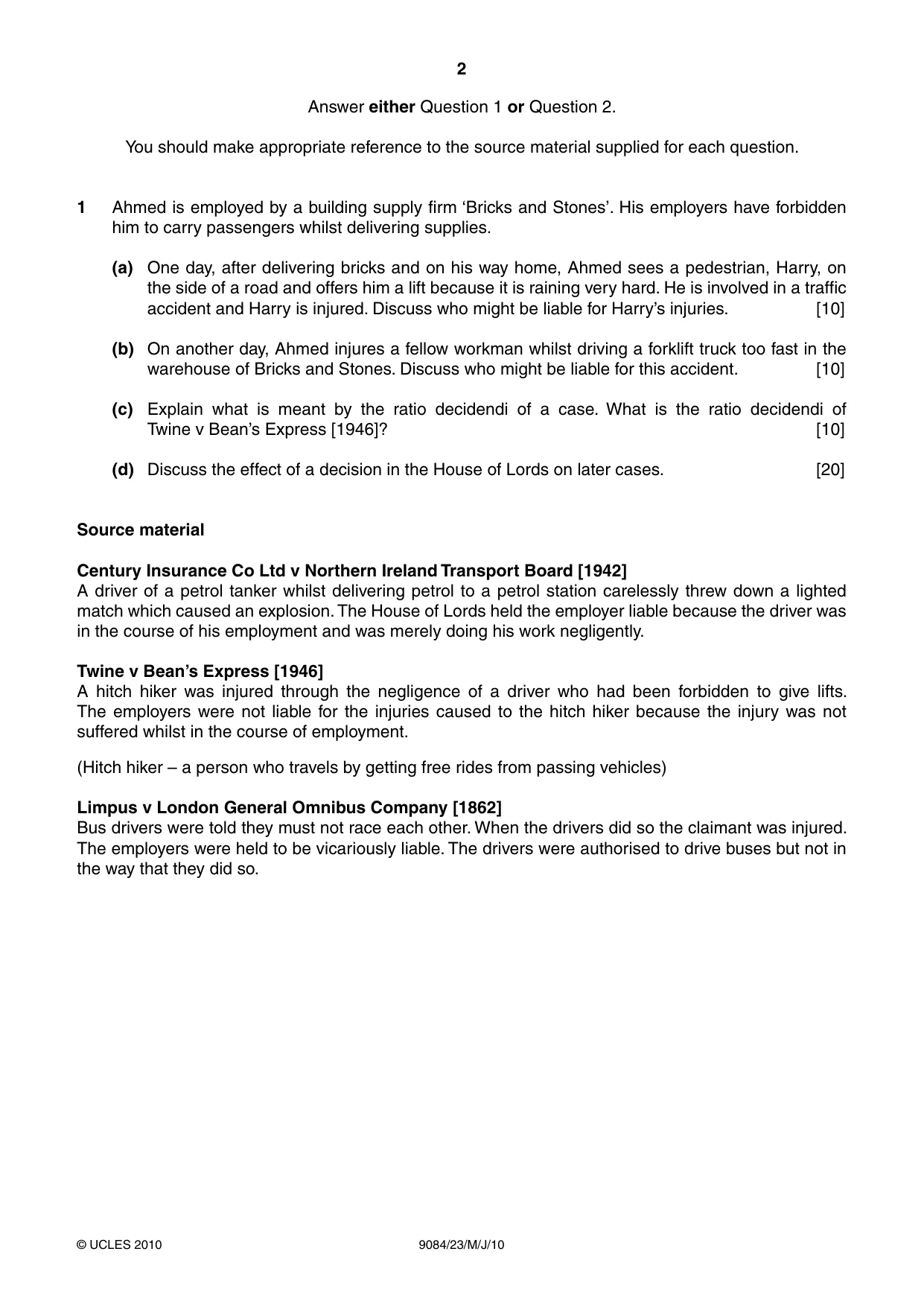
2 9084/23/M/J/10 © UCLES 2010 Answer either Question 1 or Question 2. You should make appropriate reference to the source material supplied for each question. 1 Ahmed is employed by a building supply firm ‘Bricks and Stones’. His employers have forbidden him to carry passengers whilst delivering supplies. (a) One day, after delivering bricks and on his way home, Ahmed sees a pedestrian, Harry, on the side of a road and offers him a lift because it is raining very hard. He is involved in a traffic accident and Harry is injured. Discuss who might be liable for Harry’s injuries. [10] (b) On another day, Ahmed injures a fellow workman whilst driving a forklift truck too fast in the warehouse of Bricks and Stones. Discuss who might be liable for this accident. [10] (c) Explain what is meant by the ratio decidendi of a case. What is the ratio decidendi of Twine v Bean’s Express [1946]? [10] (d) Discuss the effect of a decision in the House of Lords on later cases. [20] Source material Century Insurance Co Ltd v Northern Ireland Transport Board [1942] A driver of a petrol tanker whilst delivering petrol to a petrol station carelessly threw down a lighted match which caused an explosion. The House of Lords held the employer liable because the driver was in the course of his employment and was merely doing his work negligently. Twine v Bean’s Express [1946] A hitch hiker was injured through the negligence of a driver who had been forbidden to give lifts. The employers were not liable for the injuries caused to the hitch hiker because the injury was not suffered whilst in the course of employment. (Hitch hiker – a person who travels by getting free rides from passing vehicles) Limpus v London General Omnibus Company [1862] Bus drivers were told they must not race each other. When the drivers did so the claimant was injured. The employers were held to be vicariously liable. The drivers were authorised to drive buses but not in the way that they did so.
Question paper, page 3
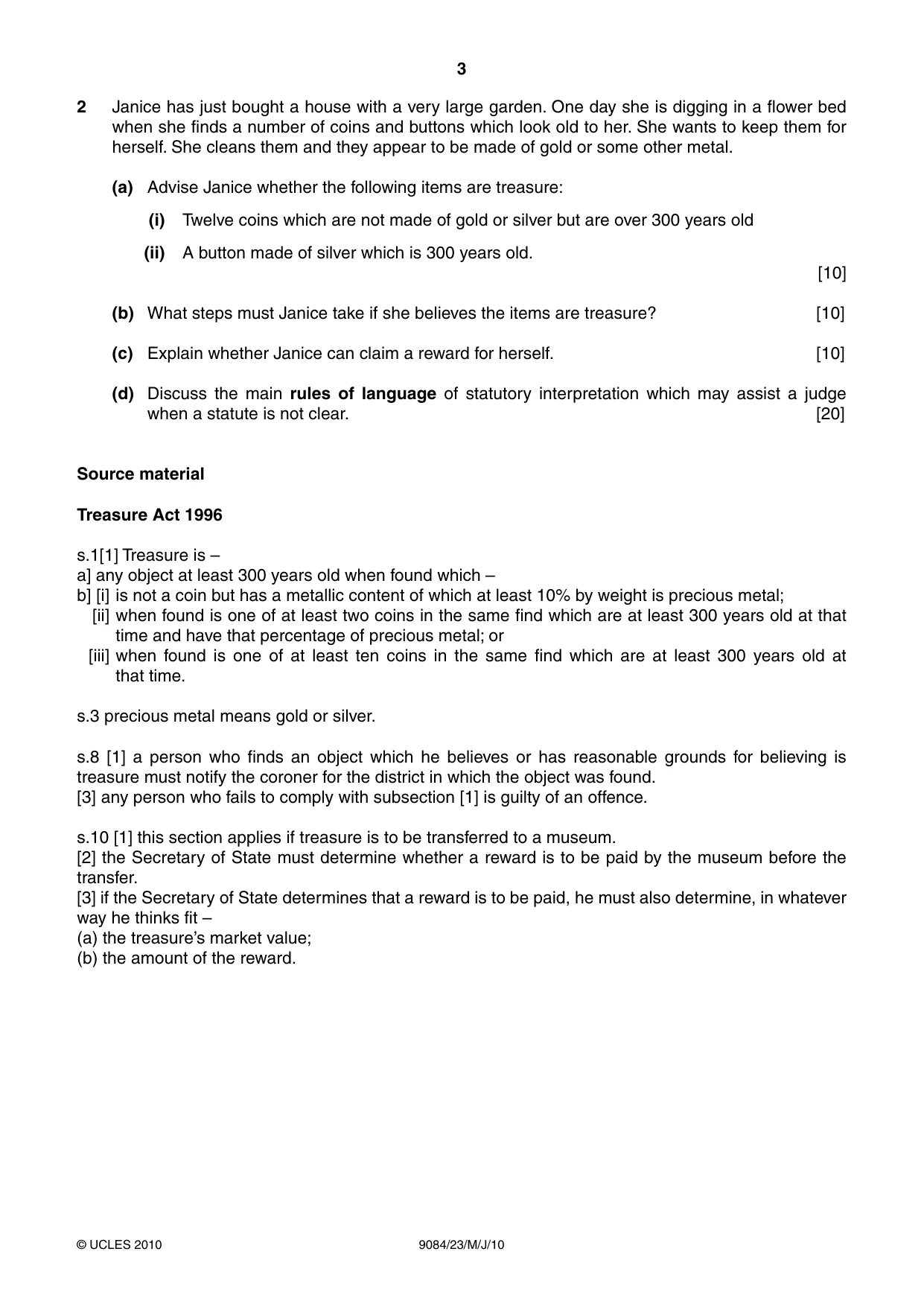
3 9084/23/M/J/10 © UCLES 2010 2 Janice has just bought a house with a very large garden. One day she is digging in a flower bed when she finds a number of coins and buttons which look old to her. She wants to keep them for herself. She cleans them and they appear to be made of gold or some other metal. (a) Advise Janice whether the following items are treasure: (i) Twelve coins which are not made of gold or silver but are over 300 years old (ii) A button made of silver which is 300 years old. [10] (b) What steps must Janice take if she believes the items are treasure? [10] (c) Explain whether Janice can claim a reward for herself. [10] (d) Discuss the main rules of language of statutory interpretation which may assist a judge when a statute is not clear. [20] Source material Treasure Act 1996 s.1[1] Treasure is – a] any object at least 300 years old when found which – b] [i] is not a coin but has a metallic content of which at least 10% by weight is precious metal; [ii] when found is one of at least two coins in the same find which are at least 300 years old at that time and have that percentage of precious metal; or [iii] when found is one of at least ten coins in the same find which are at least 300 years old at that time. s.3 precious metal means gold or silver. s.8 [1] a person who finds an object which he believes or has reasonable grounds for believing is treasure must notify the coroner for the district in which the object was found. [3] any person who fails to comply with subsection [1] is guilty of an offence. s.10 [1] this section applies if treasure is to be transferred to a museum. [2] the Secretary of State must determine whether a reward is to be paid by the museum before the transfer. [3] if the Secretary of State determines that a reward is to be paid, he must also determine, in whatever way he thinks fit – (a) the treasure’s market value; (b) the amount of the reward.
Question paper, page 4
4 9084/23/M/J/10 © UCLES 2010 BLANK PAGE Permission to reproduce items where third-party owned material protected by copyright is included has been sought and cleared where possible. Every reasonable effort has been made by the publisher (UCLES) to trace copyright holders, but if any items requiring clearance have unwittingly been included, the publisher will be pleased to make amends at the earliest possible opportunity. University of Cambridge International Examinations is part of the Cambridge Assessment Group. Cambridge Assessment is the brand name of University of Cambridge Local Examinations Syndicate (UCLES), which is itself a department of the University of Cambridge.
Mark scheme, page 1
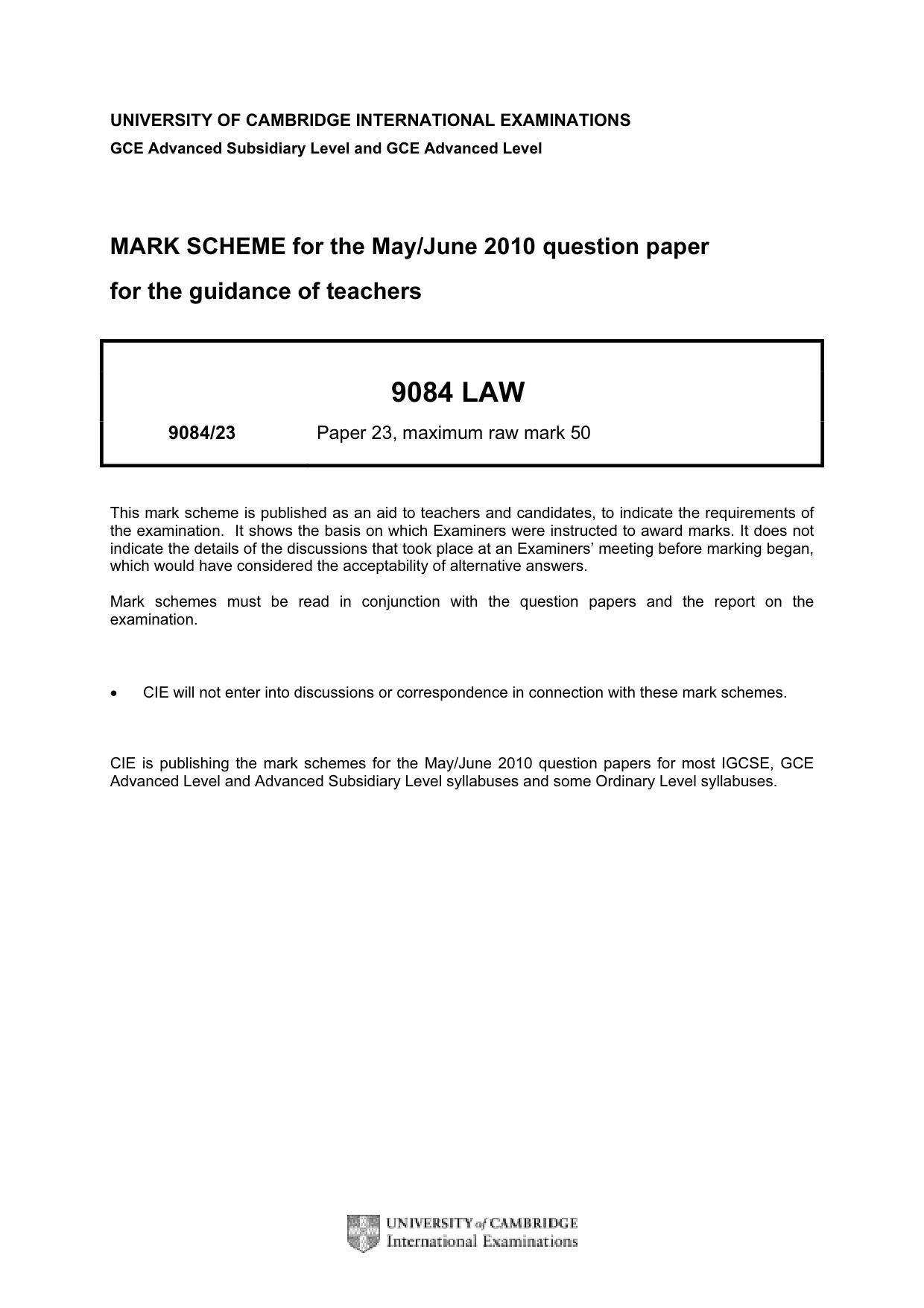
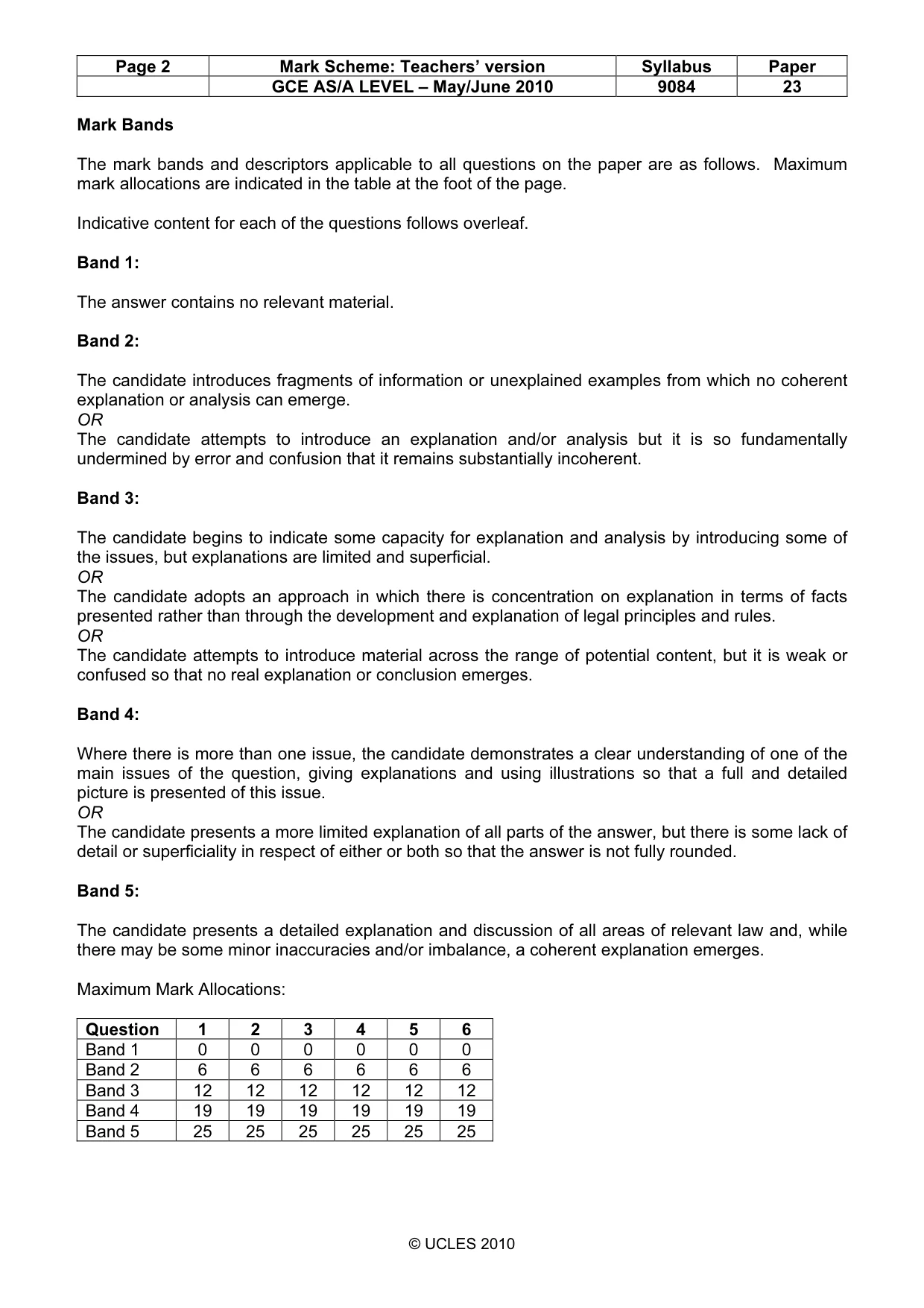
UNIVERSITY OF CAMBRIDGE INTERNATIONAL EXAMINATIONS GCE Advanced Subsidiary Level and GCE Advanced Level MARK SCHEME for the May/June 2010 question paper for the guidance of teachers 9084 LAW 9084/23 Paper 23, maximum raw mark 50 This mark scheme is published as an aid to teachers and candidates, to indicate the requirements of the examination. It shows the basis on which Examiners were instructed to award marks. It does not indicate the details of the discussions that took place at an Examiners’ meeting before marking began, which would have considered the acceptability of alternative answers. Mark schemes must be read in conjunction with the question papers and the report on the examination. • CIE will not enter into discussions or correspondence in connection with these mark schemes. CIE is publishing the mark schemes for the May/June 2010 question papers for most IGCSE, GCE Advanced Level and Advanced Subsidiary Level syllabuses and some Ordinary Level syllabuses.
Mark scheme, page 2
Page 2 Mark Scheme: Teachers’ version Syllabus Paper GCE AS/A LEVEL – May/June 2010 9084 23 © UCLES 2010 Mark Bands The mark bands and descriptors applicable to all questions on the paper are as follows. Maximum mark allocations are indicated in the table at the foot of the page. Indicative content for each of the questions follows overleaf. Band 1: The answer contains no relevant material. Band 2: The candidate introduces fragments of information or unexplained examples from which no coherent explanation or analysis can emerge. OR The candidate attempts to introduce an explanation and/or analysis but it is so fundamentally undermined by error and confusion that it remains substantially incoherent. Band 3: The candidate begins to indicate some capacity for explanation and analysis by introducing some of the issues, but explanations are limited and superficial. OR The candidate adopts an approach in which there is concentration on explanation in terms of facts presented rather than through the development and explanation of legal principles and rules. OR The candidate attempts to introduce material across the range of potential content, but it is weak or confused so that no real explanation or conclusion emerges. Band 4: Where there is more than one issue, the candidate demonstrates a clear understanding of one of the main issues of the question, giving explanations and using illustrations so that a full and detailed picture is presented of this issue. OR The candidate presents a more limited explanation of all parts of the answer, but there is some lack of detail or superficiality in respect of either or both so that the answer is not fully rounded. Band 5: The candidate presents a detailed explanation and discussion of all areas of relevant law and, while there may be some minor inaccuracies and/or imbalance, a coherent explanation emerges. Maximum Mark Allocations: Question 1 2 3 4 5 6 Band 1 0 0 0 0 0 0 Band 2 6 6 6 6 6 6 Band 3 12 12 12 12 12 12 Band 4 19 19 19 19 19 19 Band 5 25 25 25 25 25 25
Mark scheme, page 3
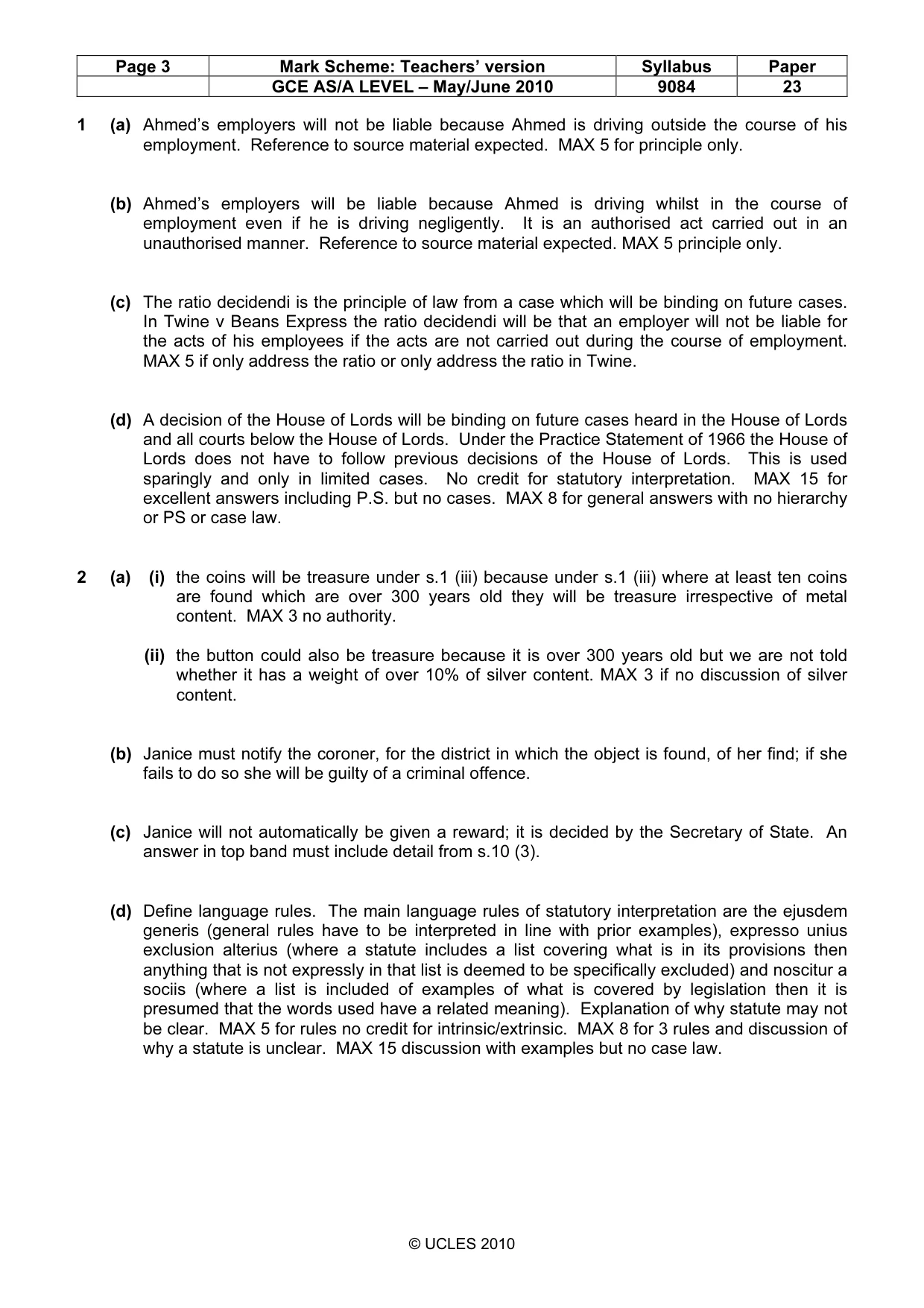
Page 3 Mark Scheme: Teachers’ version Syllabus Paper GCE AS/A LEVEL – May/June 2010 9084 23 © UCLES 2010 1 (a) Ahmed’s employers will not be liable because Ahmed is driving outside the course of his employment. Reference to source material expected. MAX 5 for principle only. (b) Ahmed’s employers will be liable because Ahmed is driving whilst in the course of employment even if he is driving negligently. It is an authorised act carried out in an unauthorised manner. Reference to source material expected. MAX 5 principle only. (c) The ratio decidendi is the principle of law from a case which will be binding on future cases. In Twine v Beans Express the ratio decidendi will be that an employer will not be liable for the acts of his employees if the acts are not carried out during the course of employment. MAX 5 if only address the ratio or only address the ratio in Twine. (d) A decision of the House of Lords will be binding on future cases heard in the House of Lords and all courts below the House of Lords. Under the Practice Statement of 1966 the House of Lords does not have to follow previous decisions of the House of Lords. This is used sparingly and only in limited cases. No credit for statutory interpretation. MAX 15 for excellent answers including P.S. but no cases. MAX 8 for general answers with no hierarchy or PS or case law. 2 (a) (i) the coins will be treasure under s.1 (iii) because under s.1 (iii) where at least ten coins are found which are over 300 years old they will be treasure irrespective of metal content. MAX 3 no authority. (ii) the button could also be treasure because it is over 300 years old but we are not told whether it has a weight of over 10% of silver content. MAX 3 if no discussion of silver content. (b) Janice must notify the coroner, for the district in which the object is found, of her find; if she fails to do so she will be guilty of a criminal offence. (c) Janice will not automatically be given a reward; it is decided by the Secretary of State. An answer in top band must include detail from s.10 (3). (d) Define language rules. The main language rules of statutory interpretation are the ejusdem generis (general rules have to be interpreted in line with prior examples), expresso unius exclusion alterius (where a statute includes a list covering what is in its provisions then anything that is not expressly in that list is deemed to be specifically excluded) and noscitur a sociis (where a list is included of examples of what is covered by legislation then it is presumed that the words used have a related meaning). Explanation of why statute may not be clear. MAX 5 for rules no credit for intrinsic/extrinsic. MAX 8 for 3 rules and discussion of why a statute is unclear. MAX 15 discussion with examples but no case law.
What you needed in this session
Cambridge’s own grade thresholds for 2010 May/June, Paper 2 · Variant 3. A higher threshold means an easier paper — the bar moves with how the cohort did.