Questions as text
Q1 · A company sells replacement windows for customers’ homes 9626/32 May/June 2018
5 A company sells replacement windows for customers’ homes. A salesman visits customers’ homes to measure the windows. The salesman usually takes a company laptop on the visit. The salesman is away from the office most of the day. When the salesman is back in the office he has to type up a report on the visit and create quotations to send to the customers. He needs access to a variety of documents including those found on the internet. The salesman also needs to be able to communicate with customers in a variety of ways. The company managers are considering replacing the laptop with a new smartphone for the salesman to take on the visit. The salesman has made a comparison of the two devices. Explain why the salesman has told the company managers that both devices are needed for the visits. … … … … … … … … … … … … … … … … … … … … [8]
8 marks
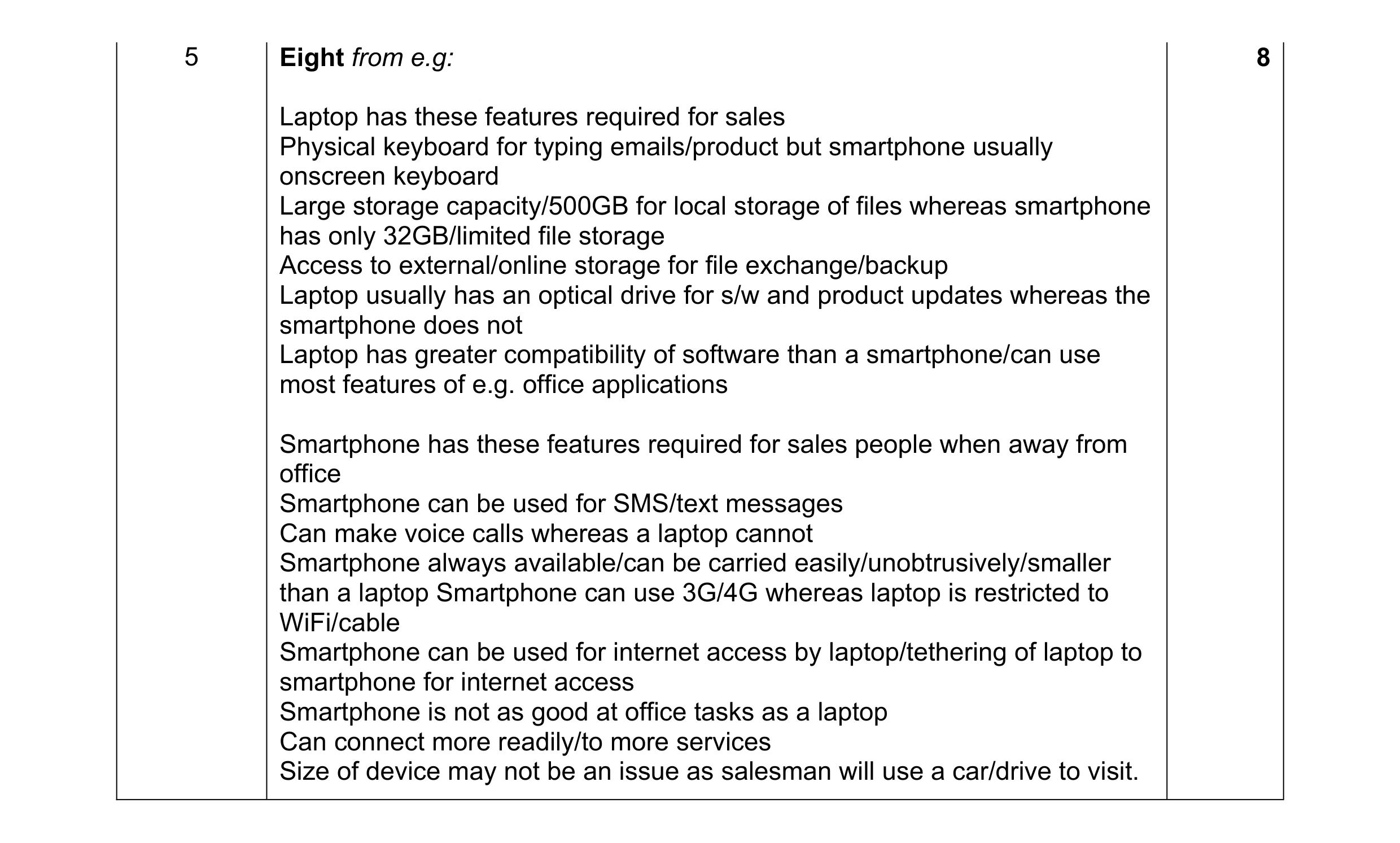
Mark scheme: 5 Eight from e.g: 8 Laptop has these features required for sales Physical keyboard for typing emails/product but smartphone usually onscreen keyboard Large storage capacity/500GB for local storage of files whereas smartphone has only 32GB/limited file storage Access to external/online storage for file exchange/backup Laptop usually has an optical drive for s/w and product updates whereas the smartphone does not Laptop has greater compatibility of software than a smartphone/can use most features of e.g. office applications Smartphone has these features required for sales people when away from office Smartphone can be used for SMS/text messages Can make voice calls whereas a laptop cannot Smartphone always available/can be carried easily/unobtrusively/smaller than a laptop Smartphone can use 3G/4G whereas laptop is restricted to WiFi/cable Smartphone can be used for internet access by laptop/tethering of laptop to smartphone for internet access Smartphone is not as good at office tasks as a laptop Can connect more readily/to more services Size of device may not be an issue as salesman will use a car/drive to visit.
This question in 9626/32 May/June 2018
Q2 · Discuss the benefits and drawbacks of using satellites for television and radio… 9626/33 May/June 2018
11 Discuss the benefits and drawbacks of using satellites for television and radio broadcasting. … … … … … … … … … … … … … … … … … … … … [8]
8 marks
Mark scheme: 11 Eight from: 8 Geographical area that can be covered is much greater than other broadcasting methods Costs are less over greater distances/areas... No need for terrestrial transmitters to homes Can cover difficult terrain more cheaply Allows greater bandwidth for data transmission... Higher definition for TV/bit rate for radio for higher quality broadcasts More TV/radio channels are possible due to greater capacity Requires users/viewers/listeners to have (suitable) receiving equipment ...broadcasters may have a limited audience if few people have satellite receivers ...need line of sight view to satellite to be able to receive ...need to be professionally installed which takes time and can be costly Satellite technology has a huge setup cost Satellites do not have an unlimited lifespan ...may become space junk when lifespan is over Repair of orbiting satellites is almost impossible Signals to ground can be subject to interference/blockage due to weather/other signals Significant delays in signal propagation/travel time of signals/distance from uplink to receiver can cause anomalies e.g. time differences of several seconds in transmissions. Max six for all positives or all negatives. 1 mark available for a reasoned conclusion/opinion.
This question in 9626/33 May/June 2018
Q3 · Describe how the features of a 4G cellular communications system improve the ability of a… 9626/32 May/June 2019
1 (a) Describe how the features of a 4G cellular communications system improve the ability of a smartphone to complete the download of a video file from the internet. … … … … … … … … … … [4] (b) 5G cellular communications systems promise significant improvements compared to 4G. Describe two ways that these improvements may affect the use of smartphones. 1 … … … 2 … … … [2]
6 marks
Mark scheme: Question Answer Marks 1(a) Four from: 4 Download speeds are typically 2 to 5 times that of 3G Provides bandwidths of up to 100Mps (typically 15 to 20) c.f. 3G’s 6 to 10Mps Uses OFDM (orthogonal frequency division multiplexing) / same technology as WiFi and digital TV which reduces latency as data is split and sent in parallel ‘chunks’ to increase capacity Uses MIMO (multiple input and multiple output) with multiple antenna arrays at transmitter and receiver to increase performance Common configuration is 2×2 MIMO for smartphones Reduces power requirements Reduces the need for additional bandwidth Does not require extra data allowance to be used Can revert seamlessly to 3G if 4G is not available Provides smoother online streaming than 3G Is an IP-based network. 1(b) Two from: 2 Continuous coverage in urban areas / better coverage of urban and rural areas by providing a dense network Lower costs of data transfer / download Allows higher number of simultaneously connected devices / mobiles More available spectrum Fewer dropouts / poor signal issues / more reliable connections Lower power requirements by phones so longer battery life / smaller batteries Provides greater download speeds for data than 4G Has low latency which improves gaming / streaming experience.
This question in 9626/32 May/June 2019
Q4 · Satellite communication systems can be used to provide internet access to users in areas… 9626/31 May/June 2021
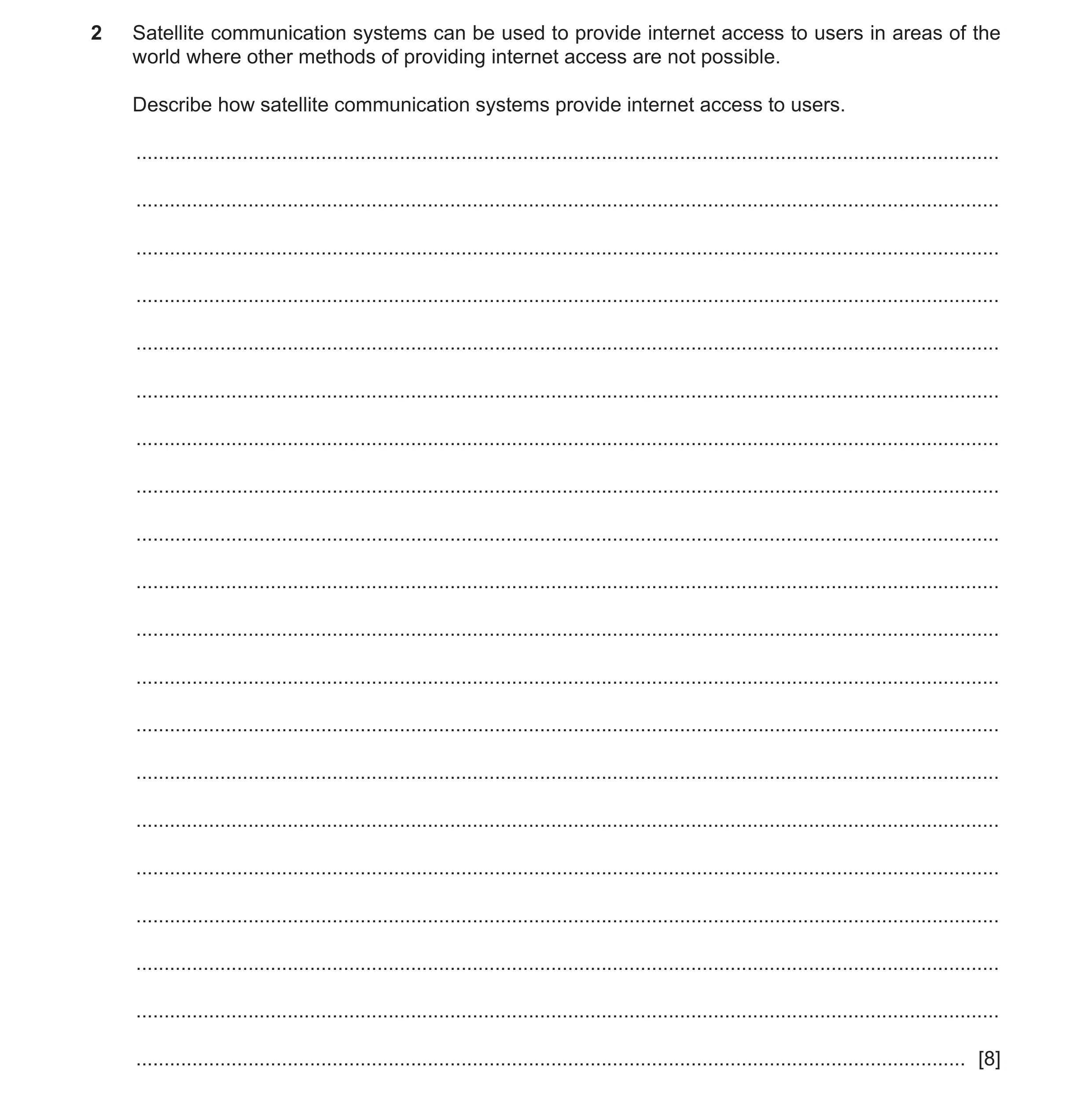
2 Satellite communication systems can be used to provide internet access to users in areas of the world where other methods of providing internet access are not possible. Describe how satellite communication systems provide internet access to users. … … … … … … … … … … … … … … … … … … … … [8]
8 marks
Mark scheme: 2 Eight from: 8 Max 7 from: Satellite remains in orbit (over equator)/follows rotation over Earth so appears stationary over desired target area Multiple satellites (could be) arranged in constellation each providing coverage of small area of surface Multiple satellites arranged in constellation in low/non-geostationary orbits can cover areas farthest from equator/target specific areas of Earth Satellite uses spot beams to target specific areas/users on Earth surface Spot beams provide high(er) bandwidth connection to many users by re- use/multiple use of link frequencies Ground stations/Gateway Earth Stations maintain permanent (microwave) links with satellites Both uplink and downlink connections are maintained from a ground station via antenna/dishes User has (smaller) dish with transceiver via LNB pointed at (chosen) satellite User’s dish needs line of sight contact with satellite/in Northern hemisphere dish points in southerly direction/in Southern hemisphere dish points in northerly direction. To gain full marks there must be at least 1 mark from: Ground/gateway stations have (broadband) connection to internet/relay user internet data to from satellite Ground/gateway stations convert data carried by satellite signals to/from IP packets Satellite serves to receive, amplify and re-transmit signal (without processing of data) User has satellite modem/router to receive/transmit/modulate/demodulate data to/from/between local IP packets and satellite link signals.
This question in 9626/31 May/June 2021
Q5 · The introduction of 5G cellular communication systems will provide increased bandwidth… 9626/31 May/June 2021
6 The introduction of 5G cellular communication systems will provide increased bandwidth for users. (a) 5G cellular communication systems will enable video delivery to users to be more reliable. Describe two other improvements that 5G will be able to provide. … … … … … … [2] (b) Describe two drawbacks of the introduction of 5G cellular communication systems. … … … … … … [2]
4 marks
Mark scheme: 6(a) Two from e.g.: 2 Low latency/near-instant connectivity between devices such as self-driving cars/machine assembly robots/machine-to-machine connections Densely built-up areas to have better coverage/very high bandwidth connections Use of remote sensors without latency/delay from cloud-based systems May gradually replace land-line connections for internet connections Allow use of UHD/ultra-high definition video on-demand. 6(b) Two from: 2 Reduced coverage so more cell towers Shortage of/crowded radio frequencies Can interfere with existing use of radio spectrum New devices required to access 5G/not all devices support 5G New technology/technician training required to implement 5G Potential for cyber-attacks Lower latency means almost any device can be controlled remotely High infrastructure costs e.g. for new masts.
This question in 9626/31 May/June 2021
Q6 · John wants to know how a Global Positioning System (GPS) works 9626/31 May/June 2021
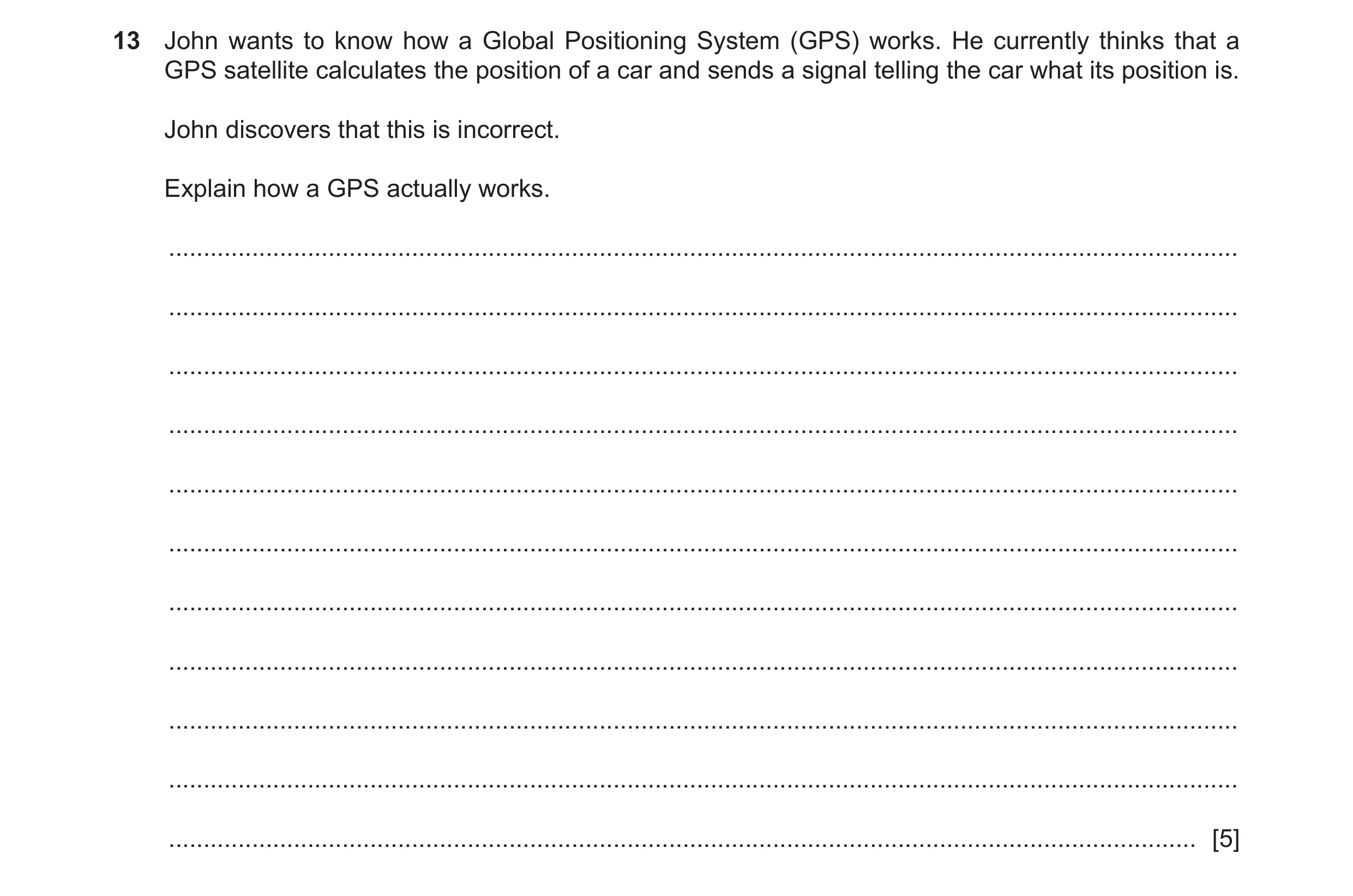
13 John wants to know how a Global Positioning System (GPS) works. He currently thinks that a GPS satellite calculates the position of a car and sends a signal telling the car what its position is. John discovers that this is incorrect. Explain how a GPS actually works. … … … … … … … … … … … [5]
5 marks
Mark scheme: 13 Five from: 5 GPS receiver ‘sees’/receives signals from (at least) three (3) satellites (simultaneously)/must have line of sight to (at least) three (3) satellites Satellite transmit (their atomic clock) time to GPS receiver GPS receiver uses times from (3 or 4) satellites to calculate current time/allow for inaccuracies in GPS receiver clock/reset GPS reset GPS receiver clock Satellite and GPS receivers time are synchronised GPS receiver uses almanac/database/list of satellite positions/updated from satellite signals Satellites transmit (pseudo random) code at set time GPS receiver runs same code and compares code with that from satellite GPS receiver uses difference in code timing/lag of code to calculate the time it takes signals to travel from satellite to it GPS receiver analyses the radio signals to determine/calculates distance between it and satellites GPS receiver analyses the radio signals to determine/calculates location of (three) satellites Error correction techniques allow for atmospheric issues/inaccurate satellite data Uses (2D or 3D) trilateration to calculate position GPS receivers overlay calculated positions/latitude and longitude on stored maps GPS receiver shows visual representation of position of/displays car amongst images of terrain on screen.
This question in 9626/31 May/June 2021
Q7 · Satellite communication systems can be used to provide internet access to users in areas… 9626/33 May/June 2021
2 Satellite communication systems can be used to provide internet access to users in areas of the world where other methods of providing internet access are not possible. Describe how satellite communication systems provide internet access to users. … … … … … … … … … … … … … … … … … … … … [8]
8 marks
Mark scheme: 2 Eight from: 8 Max 7 from: Satellite remains in orbit (over equator)/follows rotation over Earth so appears stationary over desired target area Multiple satellites (could be) arranged in constellation each providing coverage of small area of surface Multiple satellites arranged in constellation in low/non-geostationary orbits can cover areas farthest from equator/target specific areas of Earth Satellite uses spot beams to target specific areas/users on Earth surface Spot beams provide high(er) bandwidth connection to many users by re- use/multiple use of link frequencies Ground stations/Gateway Earth Stations maintain permanent (microwave) links with satellites Both uplink and downlink connections are maintained from a ground station via antenna/dishes User has (smaller) dish with transceiver via LNB pointed at (chosen) satellite User’s dish needs line of sight contact with satellite/in Northern hemisphere dish points in southerly direction/in Southern hemisphere dish points in northerly direction. To gain full marks there must be at least 1 mark from: Ground/gateway stations have (broadband) connection to internet/relay user internet data to from satellite Ground/gateway stations convert data carried by satellite signals to/from IP packets Satellite serves to receive, amplify and re-transmit signal (without processing of data) User has satellite modem/router to receive/transmit/modulate/demodulate data to/from/between local IP packets and satellite link signals.
This question in 9626/33 May/June 2021
Q8 · The introduction of 5G cellular communication systems will provide increased bandwidth… 9626/33 May/June 2021
6 The introduction of 5G cellular communication systems will provide increased bandwidth for users. (a) 5G cellular communication systems will enable video delivery to users to be more reliable. Describe two other improvements that 5G will be able to provide. … … … … … … [2] (b) Describe two drawbacks of the introduction of 5G cellular communication systems. … … … … … … [2]
4 marks
Mark scheme: 6(a) Two from e.g.: 2 Low latency/near-instant connectivity between devices such as self-driving cars/machine assembly robots/machine-to-machine connections Densely built-up areas to have better coverage/very high bandwidth connections Use of remote sensors without latency/delay from cloud-based systems May gradually replace land-line connections for internet connections Allow use of UHD/ultra-high definition video on-demand. 6(b) Two from: 2 Reduced coverage so more cell towers Shortage of/crowded radio frequencies Can interfere with existing use of radio spectrum New devices required to access 5G/not all devices support 5G New technology/technician training required to implement 5G Potential for cyber-attacks Lower latency means almost any device can be controlled remotely High infrastructure costs e.g. for new masts.
This question in 9626/33 May/June 2021
Q9 · John wants to know how a Global Positioning System (GPS) works 9626/33 May/June 2021
13 John wants to know how a Global Positioning System (GPS) works. He currently thinks that a GPS satellite calculates the position of a car and sends a signal telling the car what its position is. John discovers that this is incorrect. Explain how a GPS actually works. … … … … … … … … … … … [5]
5 marks
Mark scheme: 13 Five from: 5 GPS receiver ‘sees’/receives signals from (at least) three (3) satellites (simultaneously)/must have line of sight to (at least) three (3) satellites Satellite transmit (their atomic clock) time to GPS receiver GPS receiver uses times from (3 or 4) satellites to calculate current time/allow for inaccuracies in GPS receiver clock/reset GPS reset GPS receiver clock Satellite and GPS receivers time are synchronised GPS receiver uses almanac/database/list of satellite positions/updated from satellite signals Satellites transmit (pseudo random) code at set time GPS receiver runs same code and compares code with that from satellite GPS receiver uses difference in code timing/lag of code to calculate the time it takes signals to travel from satellite to it GPS receiver analyses the radio signals to determine/calculates distance between it and satellites GPS receiver analyses the radio signals to determine/calculates location of (three) satellites Error correction techniques allow for atmospheric issues/inaccurate satellite data Uses (2D or 3D) trilateration to calculate position GPS receivers overlay calculated positions/latitude and longitude on stored maps GPS receiver shows visual representation of position of/displays car amongst images of terrain on screen.
This question in 9626/33 May/June 2021
Q10 · Discuss the advantages and disadvantages of using satellite communication systems to… 9626/31 Oct/Nov 2021
5 Discuss the advantages and disadvantages of using satellite communication systems to provide data transfer connections. … … … … … … … … … … … … … … … … … … … … [8]
8 marks
Mark scheme: 5 Eight from e.g.: 8 Advantages: Satellites in geostationary orbit so ground stations for uplink can point directly at them so less power needed Receiving dishes can point directly at satellite resulting in less fluctuation in signal Low/medium orbit satellites provide low latency connections with high speeds Physical connections not required so access can be from anywhere/remote areas in sight of satellite No need for extensive ground-based infrastructure Can be used by aircraft/ships to provide internet connections to passengers Satellite coverage can be optimised for data transfer to provide high speed/bandwidth broadband connections Disadvantages: Satellites in geostationary orbit are c. 18 000 km high so signal has to travel c. 36 000 km resulting in delay Delay in signals can result in latency worse than for dial-up connections Long latency can affect secure connections (SSL) which may not succeed TCP protocols may not function when using high latency connections so internet connections may be limited in service provision Interference by weather conditions can reduce signal quality/connection usability Must be line of sight to satellite/physical obstructions block signals Reflections from objects near path of signal can reduce signal quality by phase cancellation effects. Must be at least 2 of each for full marks. Must be a proper discussion for full marks. Max 6 marks if bullets/list of points.
This question in 9626/31 Oct/Nov 2021
Q11 · Discuss the advantages and disadvantages of using satellite communication systems to… 9626/33 Oct/Nov 2021
5 Discuss the advantages and disadvantages of using satellite communication systems to provide data transfer connections. … … … … … … … … … … … … … … … … … … … … [8]
8 marks
Mark scheme: 5 Eight from e.g.: 8 Advantages: Satellites in geostationary orbit so ground stations for uplink can point directly at them so less power needed Receiving dishes can point directly at satellite resulting in less fluctuation in signal Low/medium orbit satellites provide low latency connections with high speeds Physical connections not required so access can be from anywhere/remote areas in sight of satellite No need for extensive ground-based infrastructure Can be used by aircraft/ships to provide internet connections to passengers Satellite coverage can be optimised for data transfer to provide high speed/bandwidth broadband connections Disadvantages: Satellites in geostationary orbit are c. 18 000 km high so signal has to travel c. 36 000 km resulting in delay Delay in signals can result in latency worse than for dial-up connections Long latency can affect secure connections (SSL) which may not succeed TCP protocols may not function when using high latency connections so internet connections may be limited in service provision Interference by weather conditions can reduce signal quality/connection usability Must be line of sight to satellite/physical obstructions block signals Reflections from objects near path of signal can reduce signal quality by phase cancellation effects. Must be at least 2 of each for full marks. Must be a proper discussion for full marks. Max 6 marks if bullets/list of points.
This question in 9626/33 Oct/Nov 2021
Q12 · Cellular networks use 3G, 4G and 5G systems for mobile communications so that users can… 9626/32 Feb/March 2023
1 Cellular networks use 3G, 4G and 5G systems for mobile communications so that users can access internet services. (a) Explain how 4G cellular networks provide a better service than 3G networks for smartphone users accessing internet services. … … … … … … … … … … [4] (b) Describe two features of 5G mobile communication systems that make them suitable for connecting smart devices together into large networks. … … … … … … [2]
6 marks
Mark scheme: Question Answer Marks 1(a) Four from: 4 • Increased rate of data transfer/higher bandwidth – provides faster download/more buffering capacity/less waiting for data to download – Web pages/content loads faster – due to use of higher range of frequencies – due to use of Multiple input and multiple output (MIMO) using multiple transmit/receive antenna to increase capacity/use of transmission channels – connections use (frequency/time/code) multiplex division to share – due to use of spread spectrum technology to allow multiple connections on same (set of) frequencies • Handovers between base stations are ‘smoother’/less subject to interruptions/loss of connection • Use (only) packet switching technology instead of circuit switching (as in 3G) – so IP packets can be carried/based on IP packet switched technology • Packet switching allows data/voice packets to be multiplexed/interleaved with other packets (give increased rates of data flow) 1(b) Two from: 2 • Very large capacity for connection of devices/up to a million devices per km2 • Very high bandwidth for transferring data between multiple devices • Very low latency in the connections for fast/instant responses • Seamless handover between base stations • Use of ‘beam-forming’ techniques (by base stations) to direct signal/improve connections to (specific) devices.
This question in 9626/32 Feb/March 2023
Q13 · Cellular networks are used to provide mobile communications for users 9626/32 Oct/Nov 2023
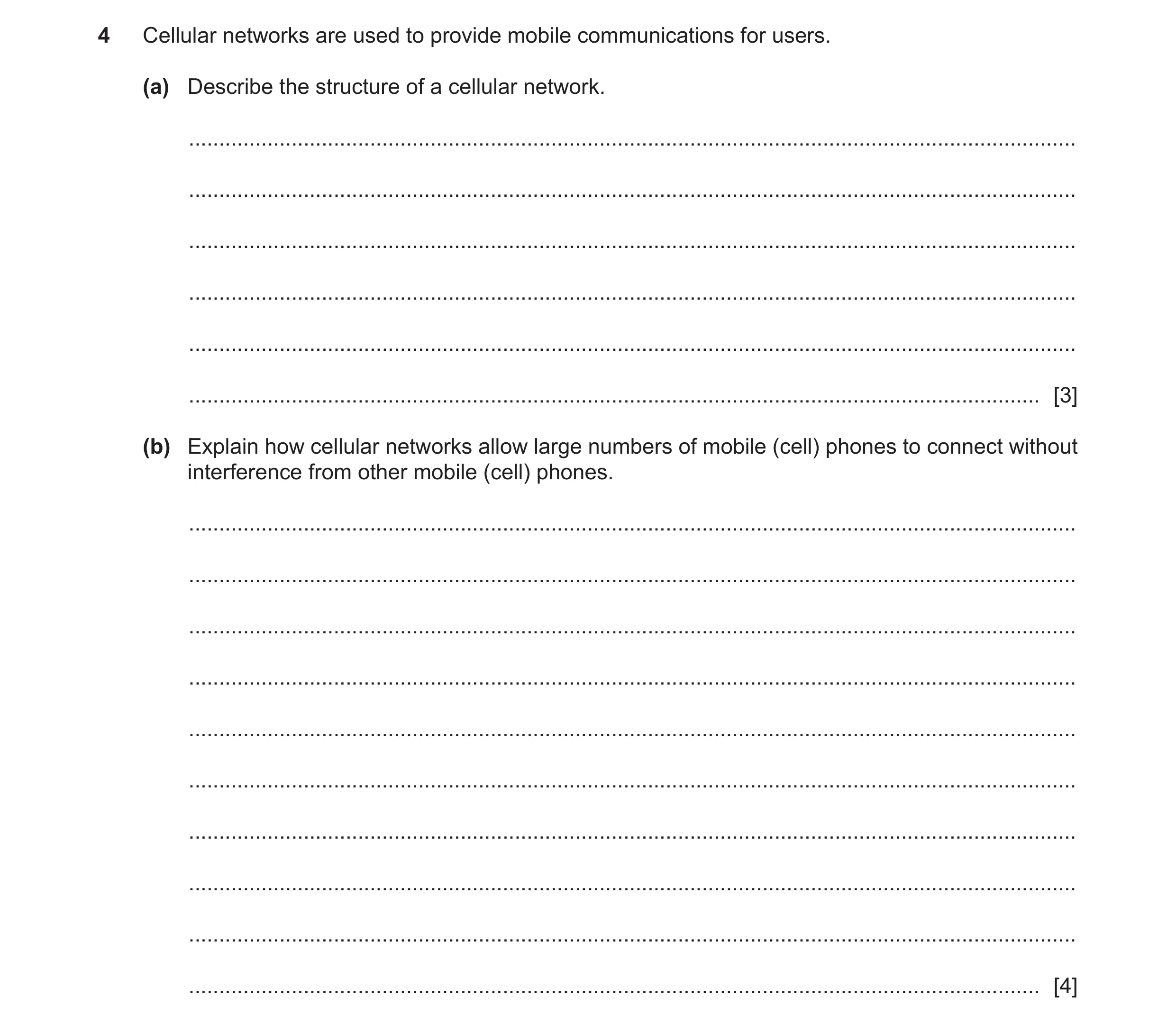
4 Cellular networks are used to provide mobile communications for users. (a) Describe the structure of a cellular network. … … … … … … [3] (b) Explain how cellular networks allow large numbers of mobile (cell) phones to connect without interference from other mobile (cell) phones. … … … … … … … … … … [4]
7 marks
Mark scheme: 4(a) Three from: 3 • Base stations (in a cell/cellular subsystem) for (wireless) connection to end user • Core/central switched network for handling voice calls/text messages • Packet switched network for handling (mobile) data/internet traffic • Public switched telecommunications/telephone network for connection into the global telephone networks. 4(b) Four from: 4 • Connections use (frequency/time/code) multiplex division to share frequencies • Spread spectrum technology is used to allow multiple connections on same (set of) frequencies • Multiple input and multiple output (MIMO) using multiple transmit/receive antenna to increase capacity/use of transmission channels/increased data flow • Antennae from base stations/towers can be/are directional to avoid interference from other towers/reflections • Adjacent cells use different frequencies from neighbouring cells • Connection/wireless frequencies are re-used by cells distant from each other to increase capacity (where ranges of frequencies are limited).
This question in 9626/32 Oct/Nov 2023
Q14 · Discuss the benefits and drawbacks of mobile networks 9626/32 May/June 2025
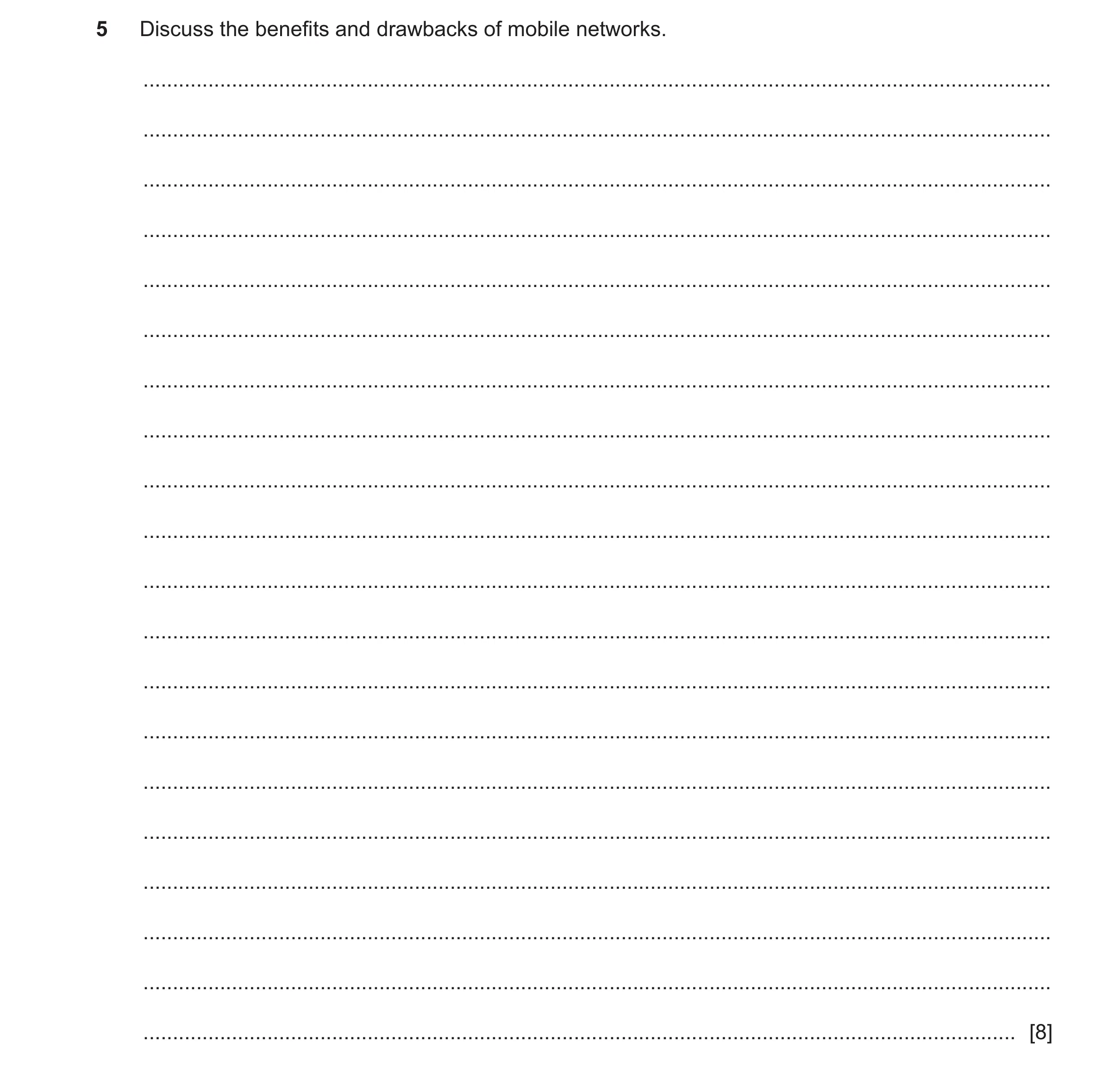
5 Discuss the benefits and drawbacks of mobile networks. … … … … … … … … … … … … … … … … … … … … [8]
8 marks
Mark scheme: 5 Command word: Discuss – write about issues(s) or topic(s) in a structured way. 8 EIGHT from: Max SIX from: Benefits: e.g.: • Allows use of mobile devices in (almost) any location • Have a large area coverage • Users are not restricted to wired / fixed locations • Enables users to move about while connected • So can communicate while travelling • Can work while travelling / away from office / home • Can be used to find your location • Using GPRS / internet (facilities / services) • Can access internet / entertainment services while mobile • Valid example of use e.g. use of social media Max SIX from: Drawbacks: e.g.: • connectivity issues / problems / lack of coverage (1st) cannot communicate (1) • risk of theft / robbery of mobile device (1st) more likely than when at home / in office (1) • security of data is at higher risk (1st) compared to fixed / cabled / in office / at home connection (1) • can lead to wasting time (1st) distraction of social media / gaming / gambling (1) • cost of use / connection is higher than fixed (1st) may restrict use / impact on other life choices (1) creates digital divide (1)
This question in 9626/32 May/June 2025
Q15 · Cellular networks provide mobile communication systems 9626/33 Oct/Nov 2025
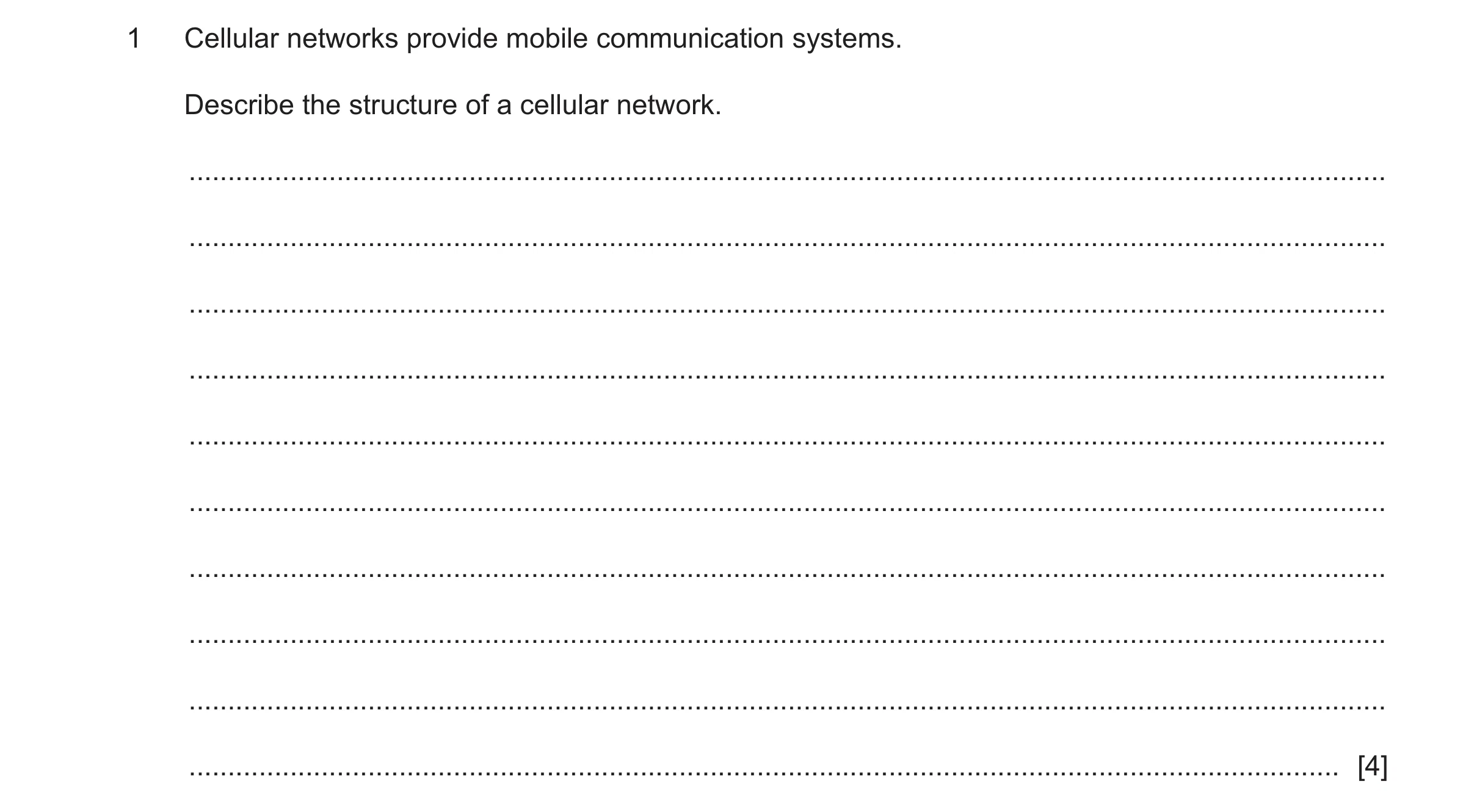
1 Cellular networks provide mobile communication systems. Describe the structure of a cellular network. … … … … … … … … … … [4]
4 marks
Mark scheme: Question Answer Marks 1 Four from: 4 • Base station connected to public telecommunications network / service provider that connects to public telecoms (1st) – Has antenna / receiver / transmitter (1) • Uses low power / short range • Radio / signals / wireless communications • (Each base station) has range of / 10–50 frequencies allocated • Different set of frequencies to adjacent base stations • Base station serves / covers small geographical area / terrain landscape • Base station uses towers (to increase height of antennae) • Many base stations used to cover large areas / cities • Handoff system to allow seamless movement from one base station to next (as users connect / disconnect from base stations as they move from place to place)
This question in 9626/33 Oct/Nov 2025
 1 / 13
 2 / 13
 3 / 13
 4 / 13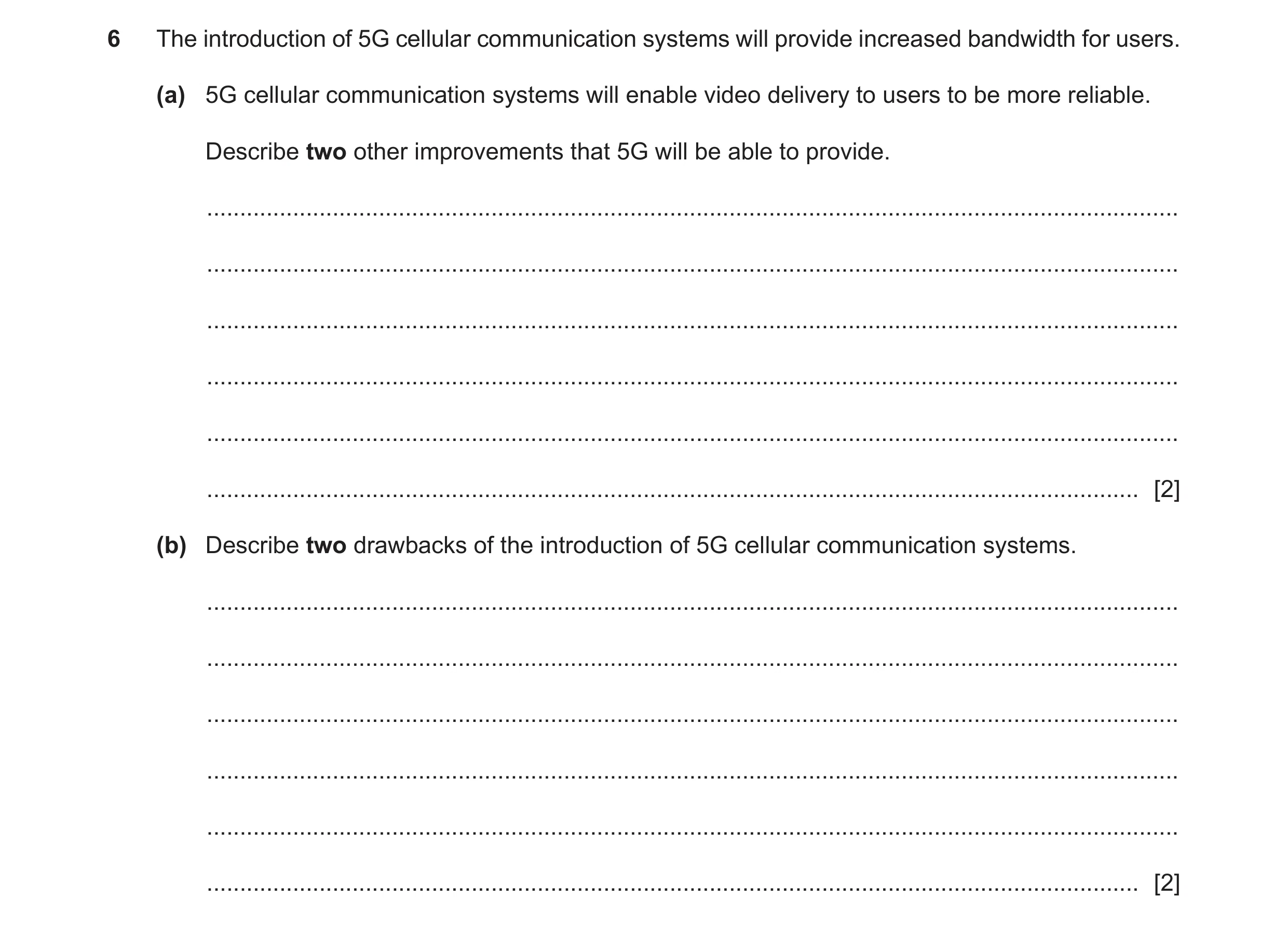
 5 / 13
 6 / 13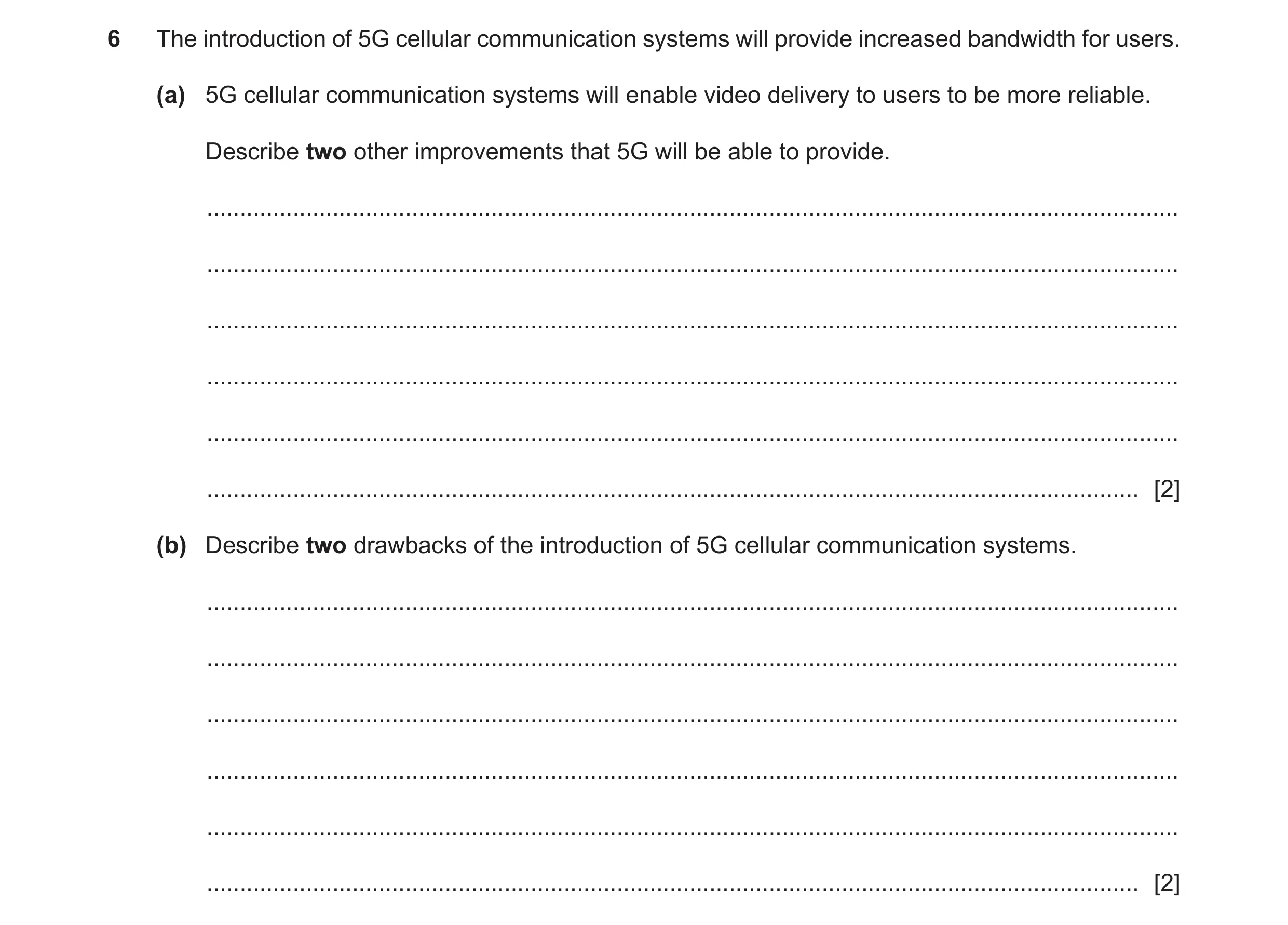
 7 / 13
 8 / 13
 9 / 13
 10 / 13
 11 / 13
 12 / 13
 13 / 13
 8
8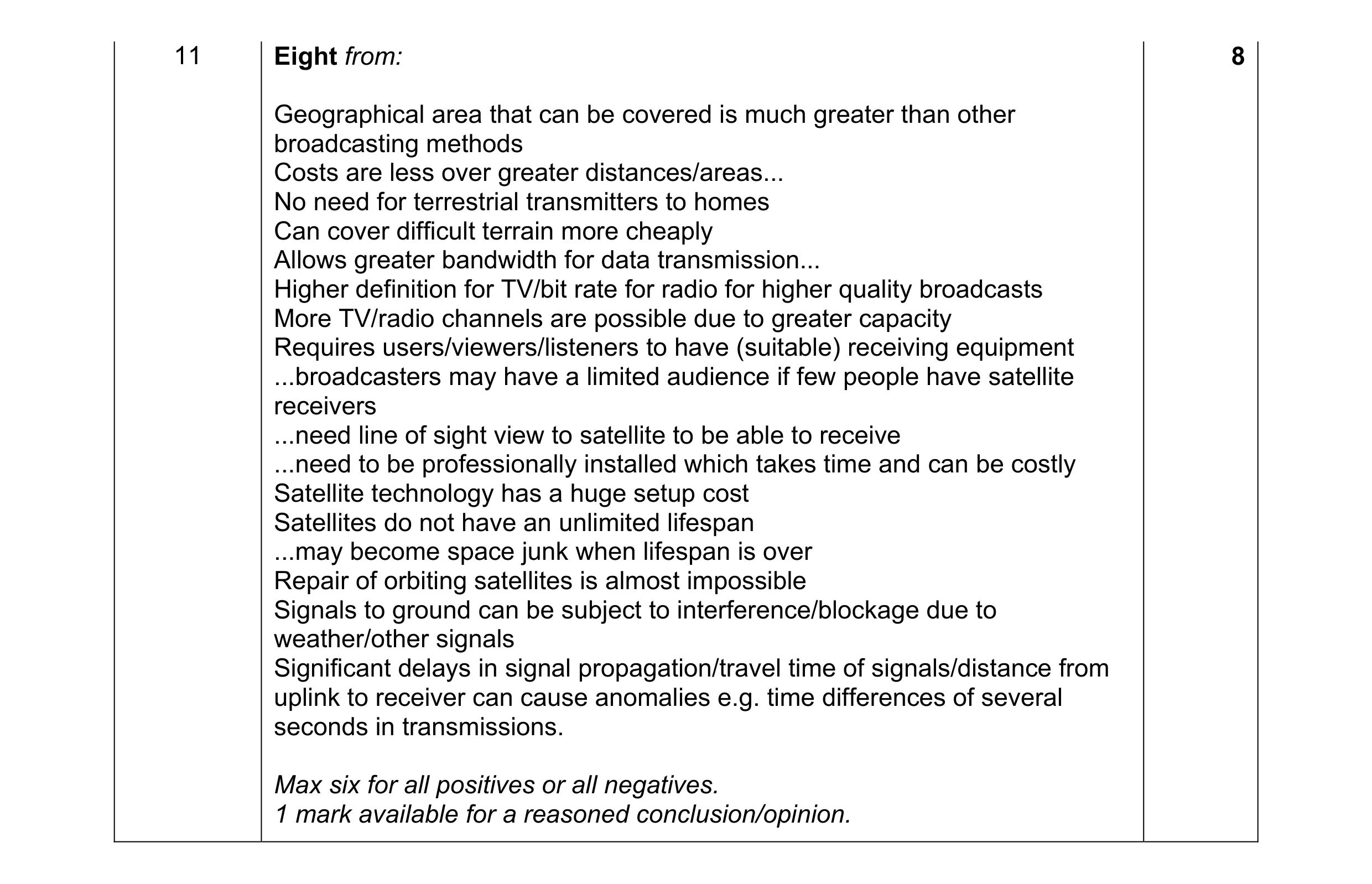 8
8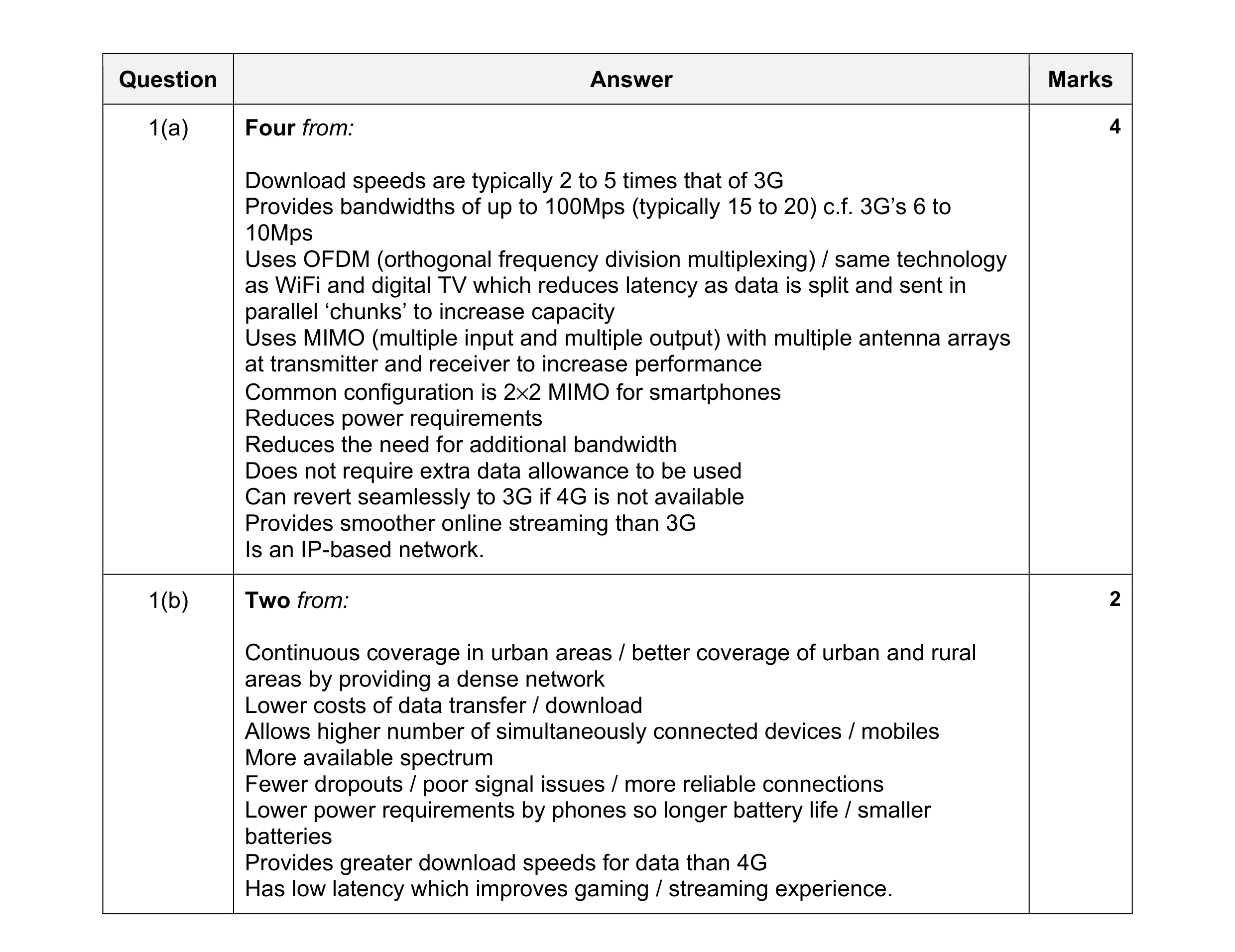 6
6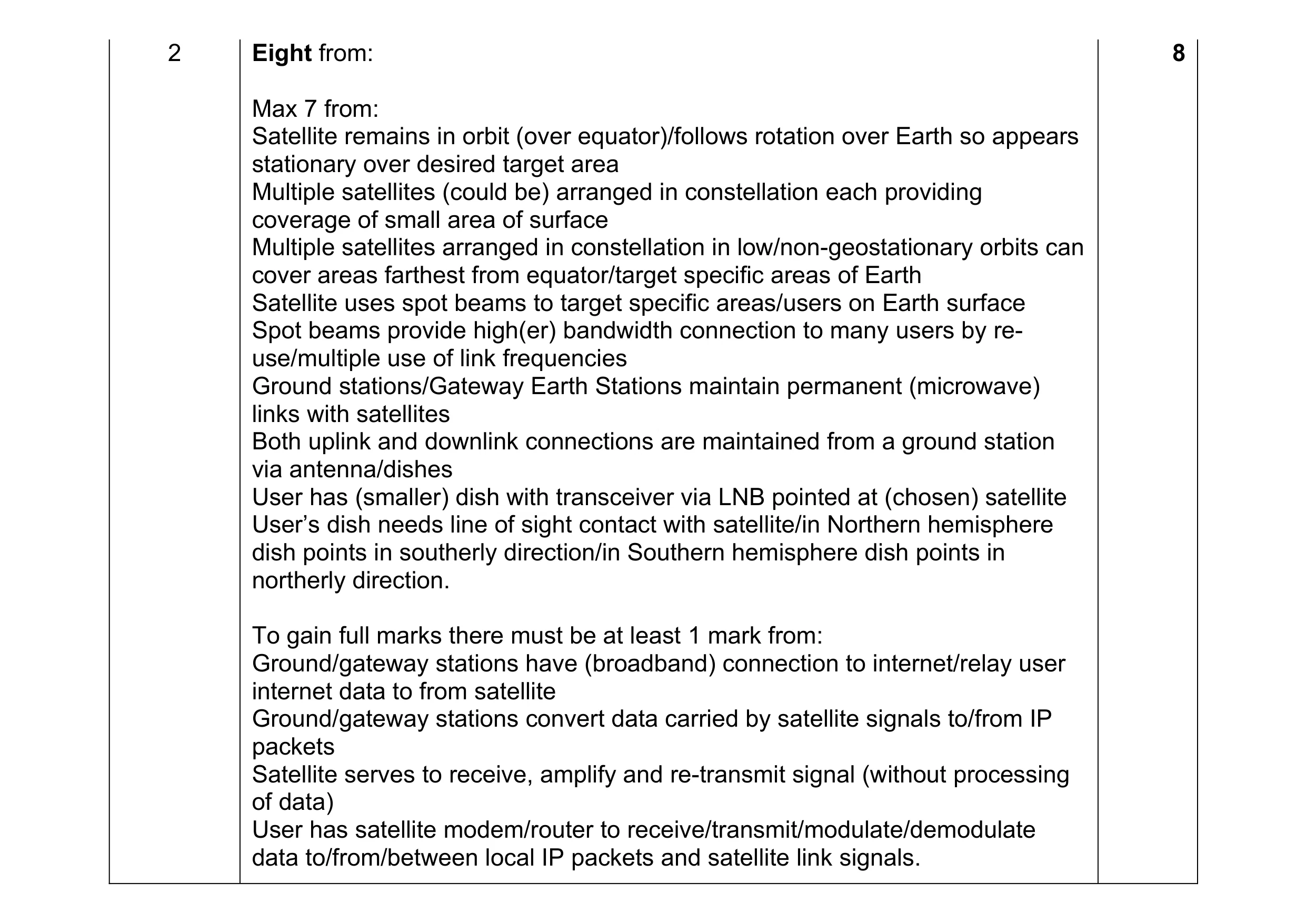 8
8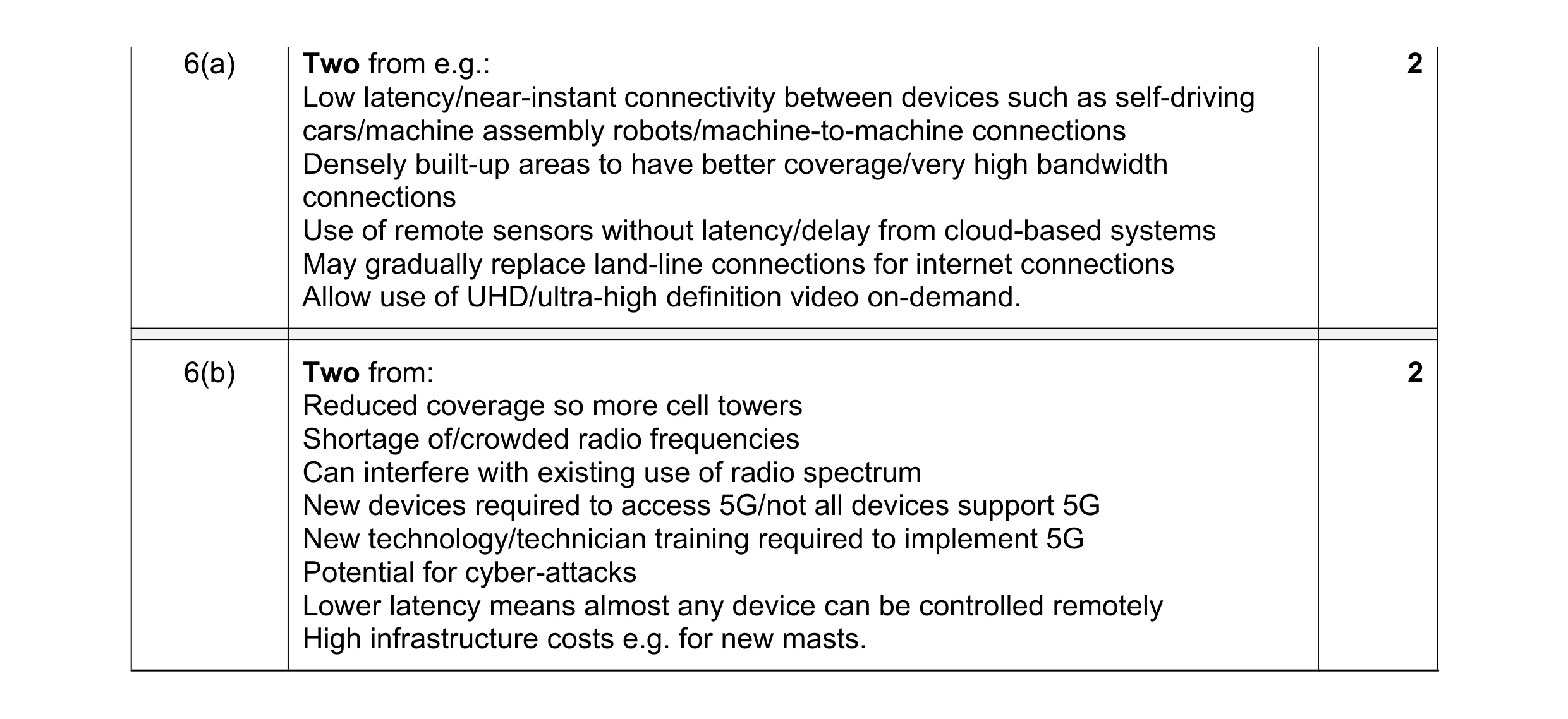 4
4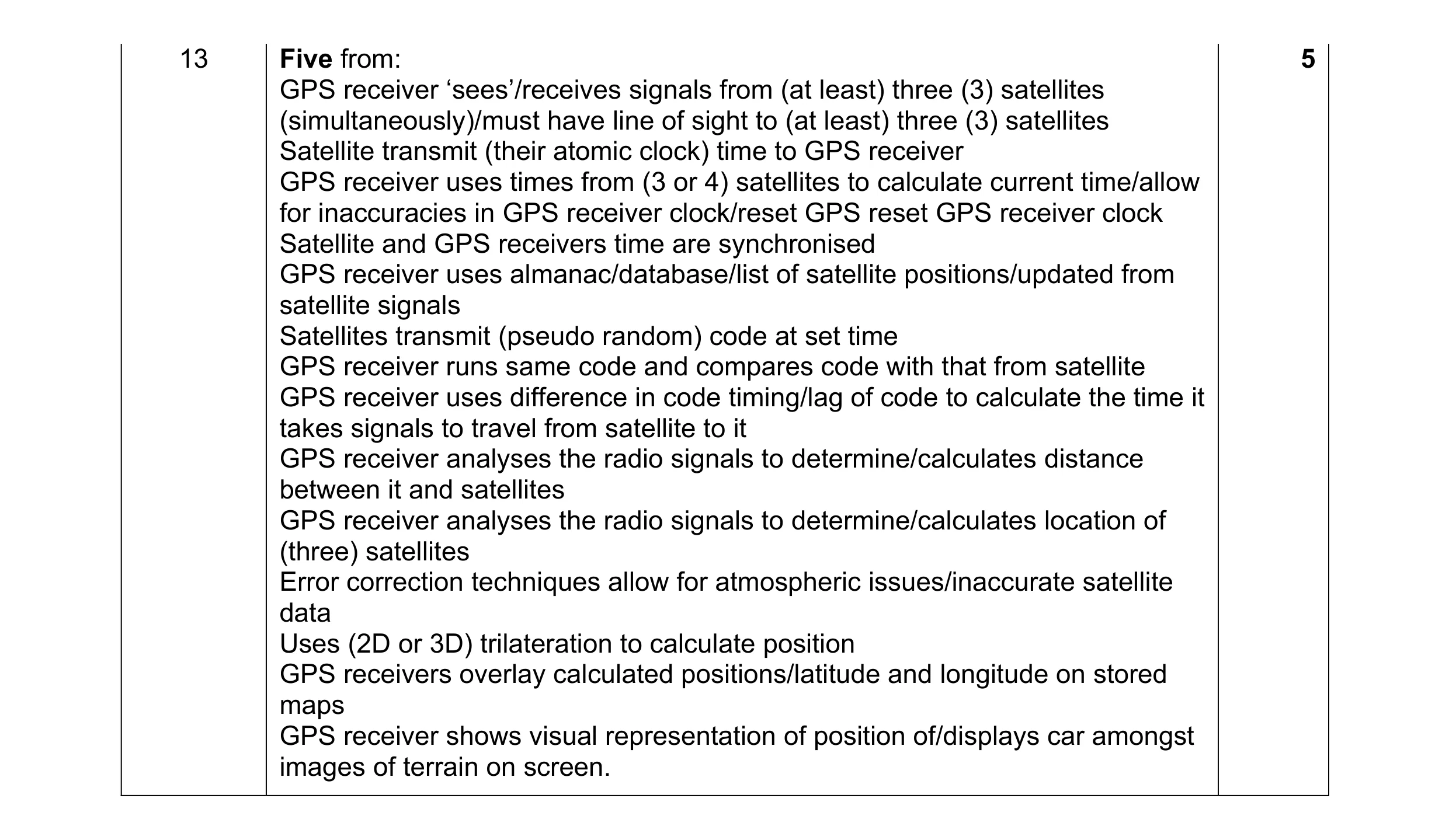 5
5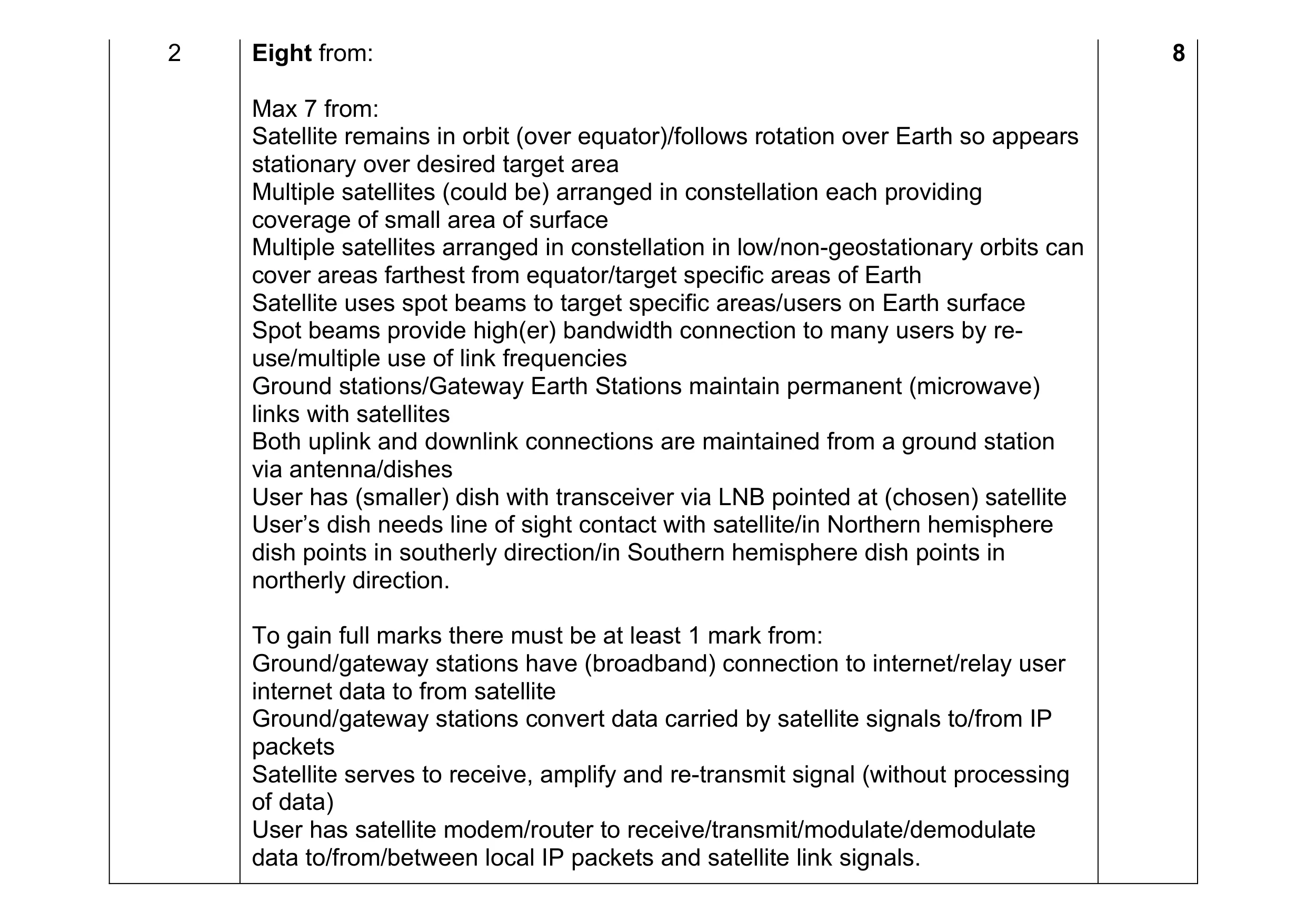 8
8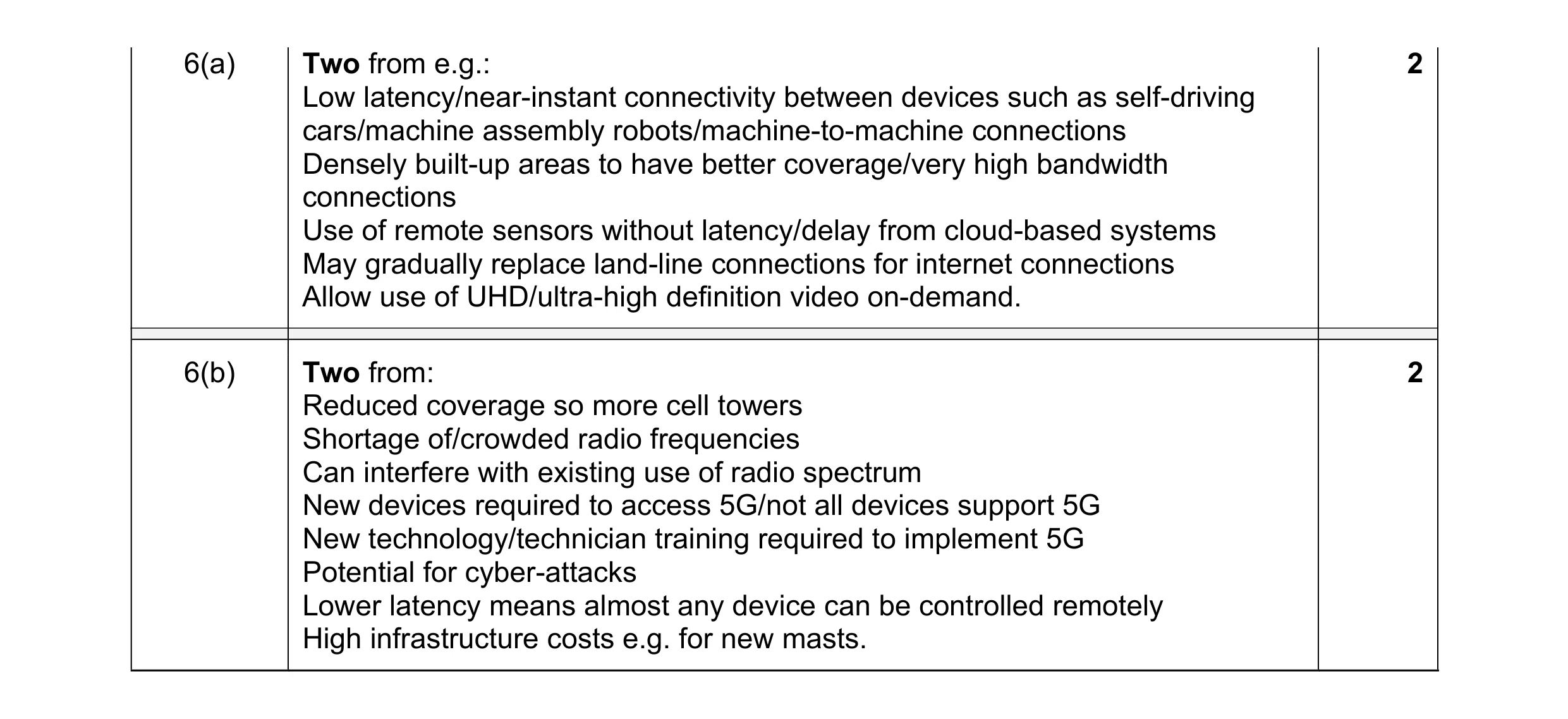 4
4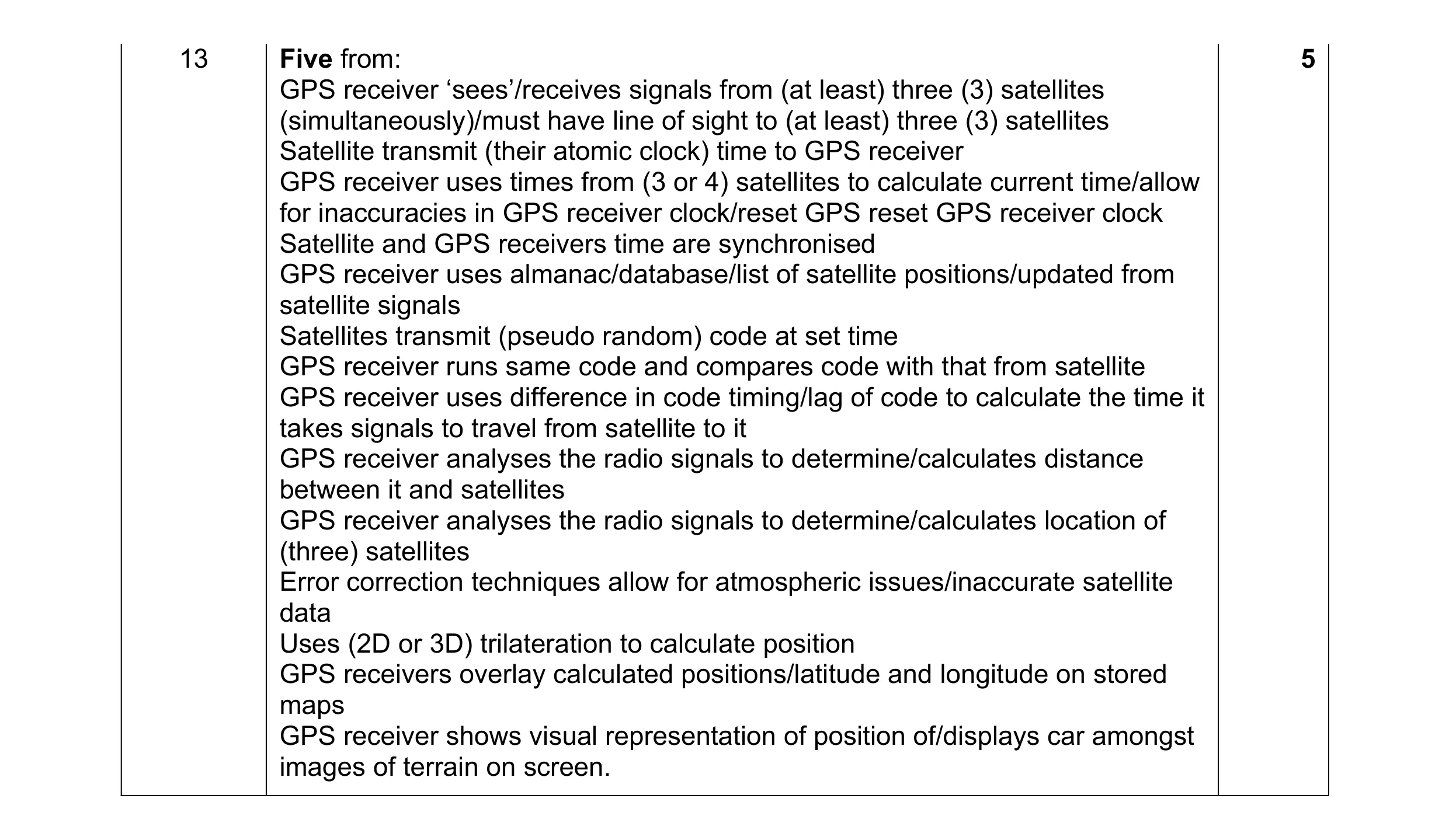 5
5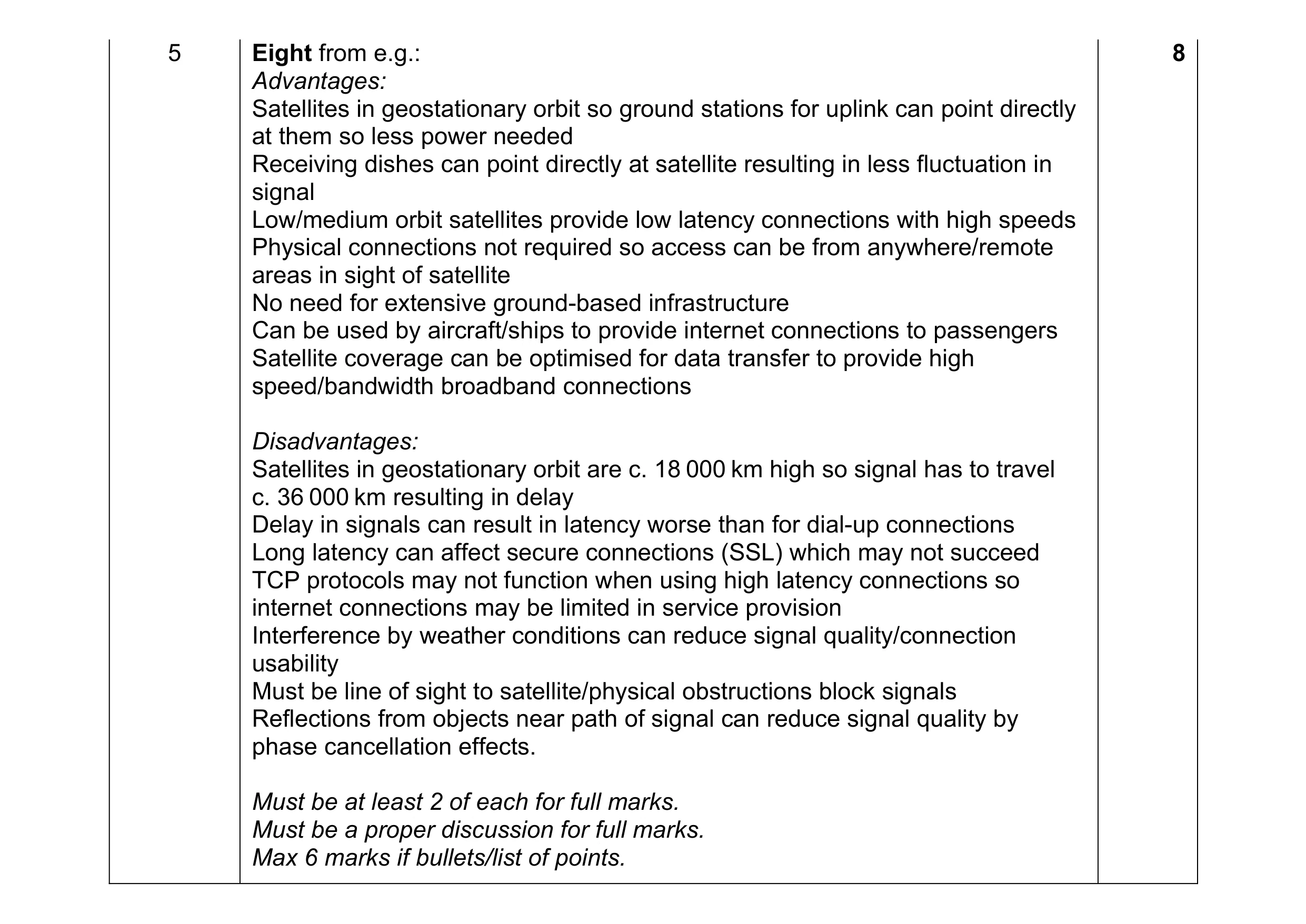 8
8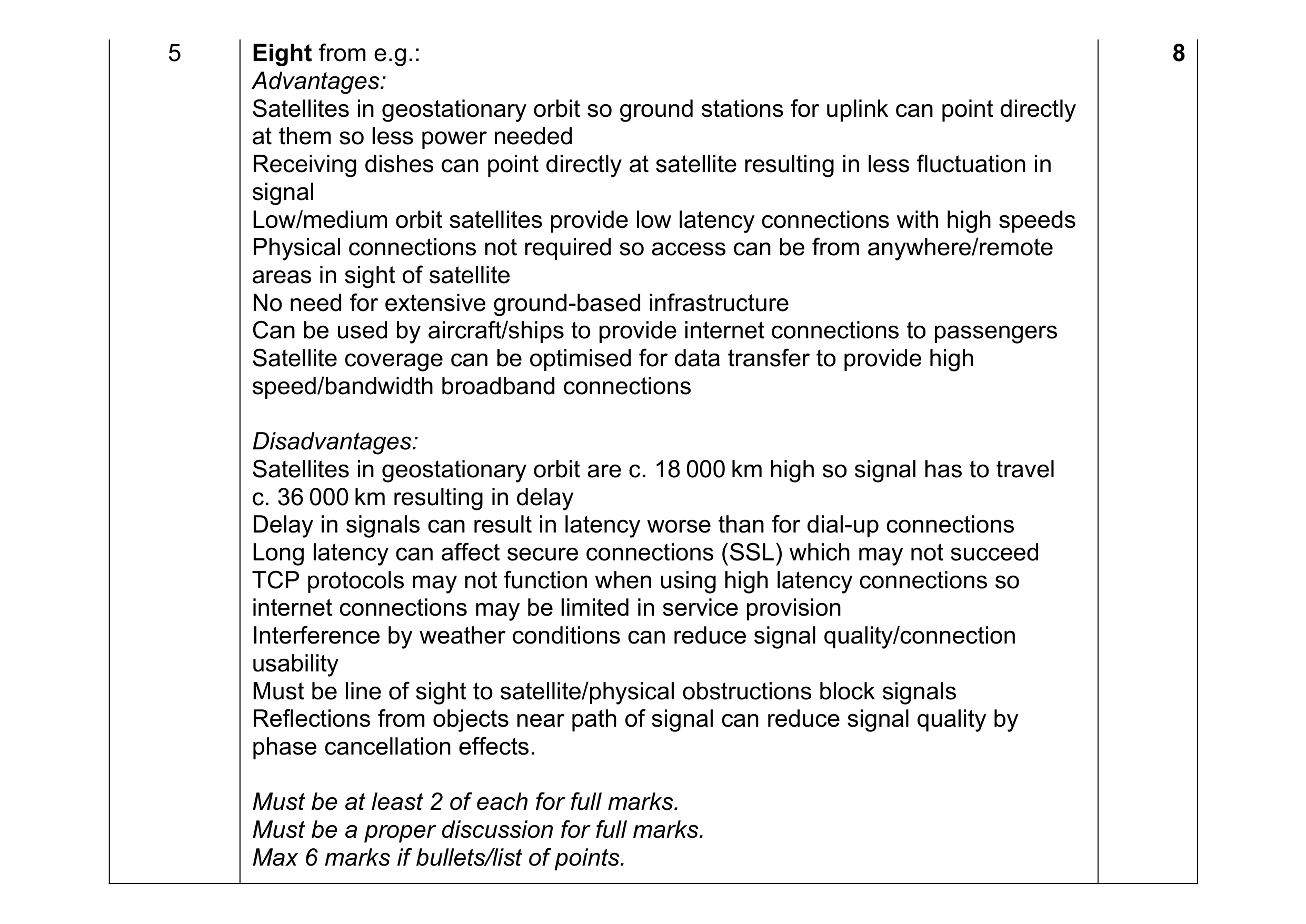 8
8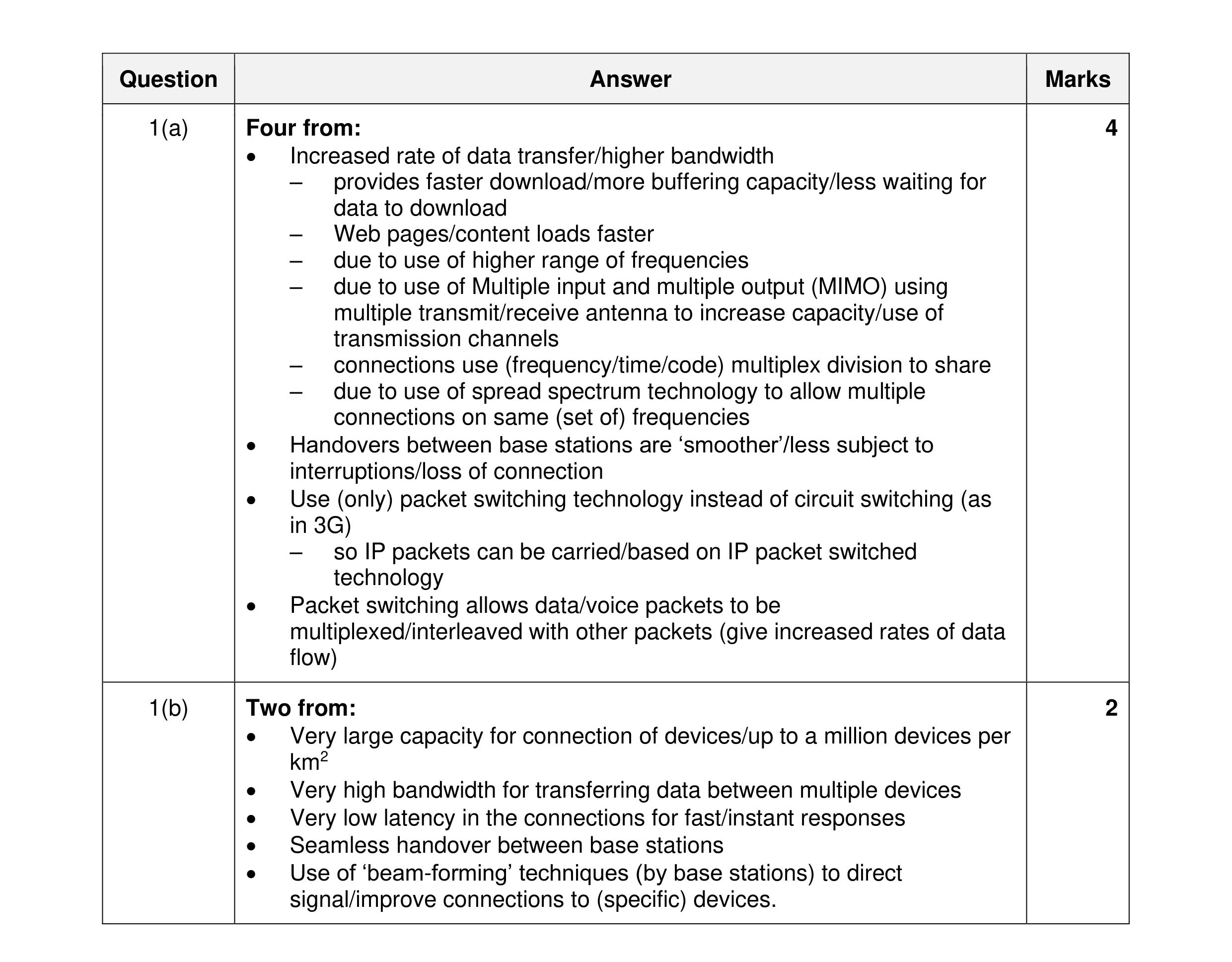 6
6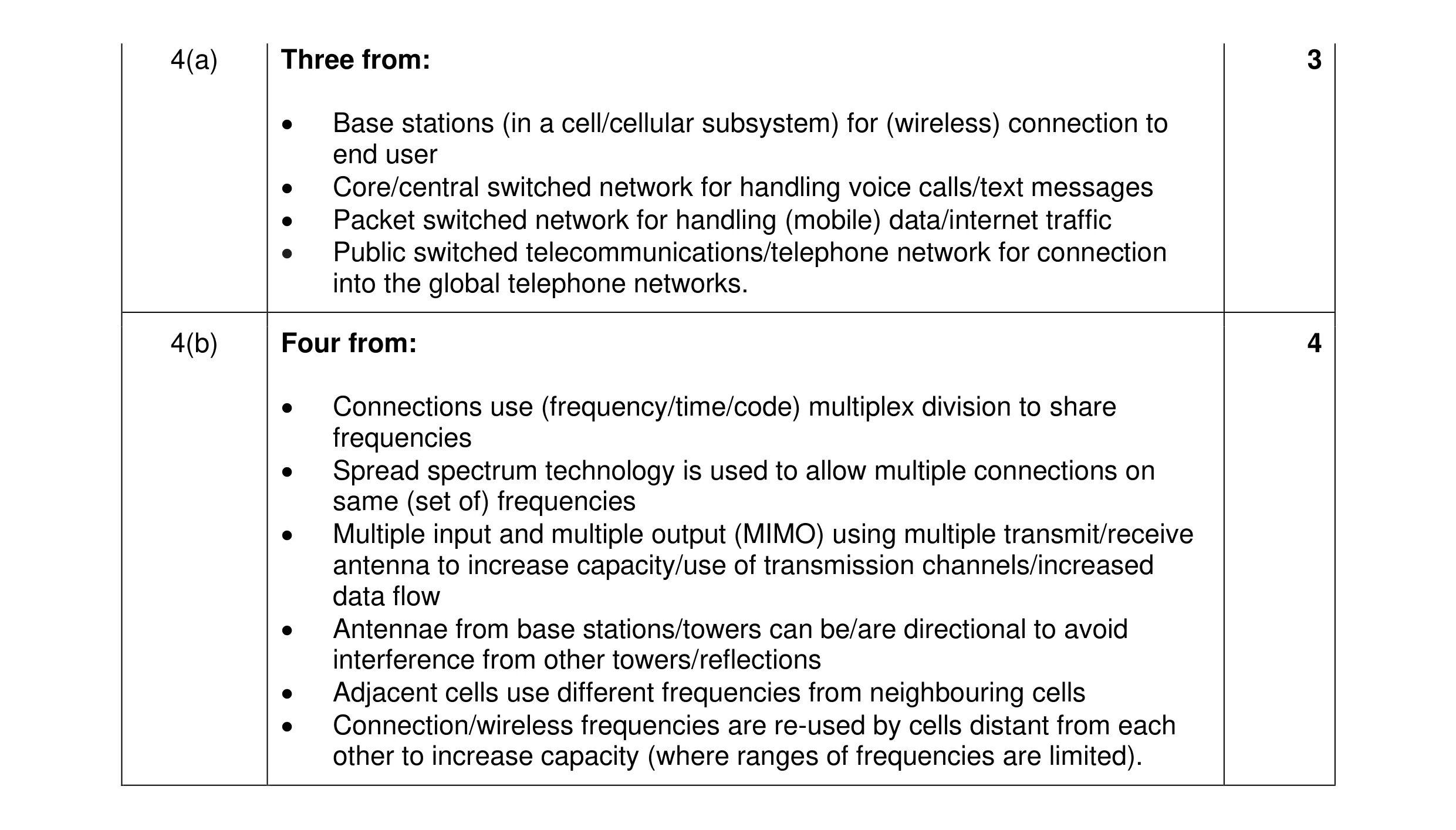 7
7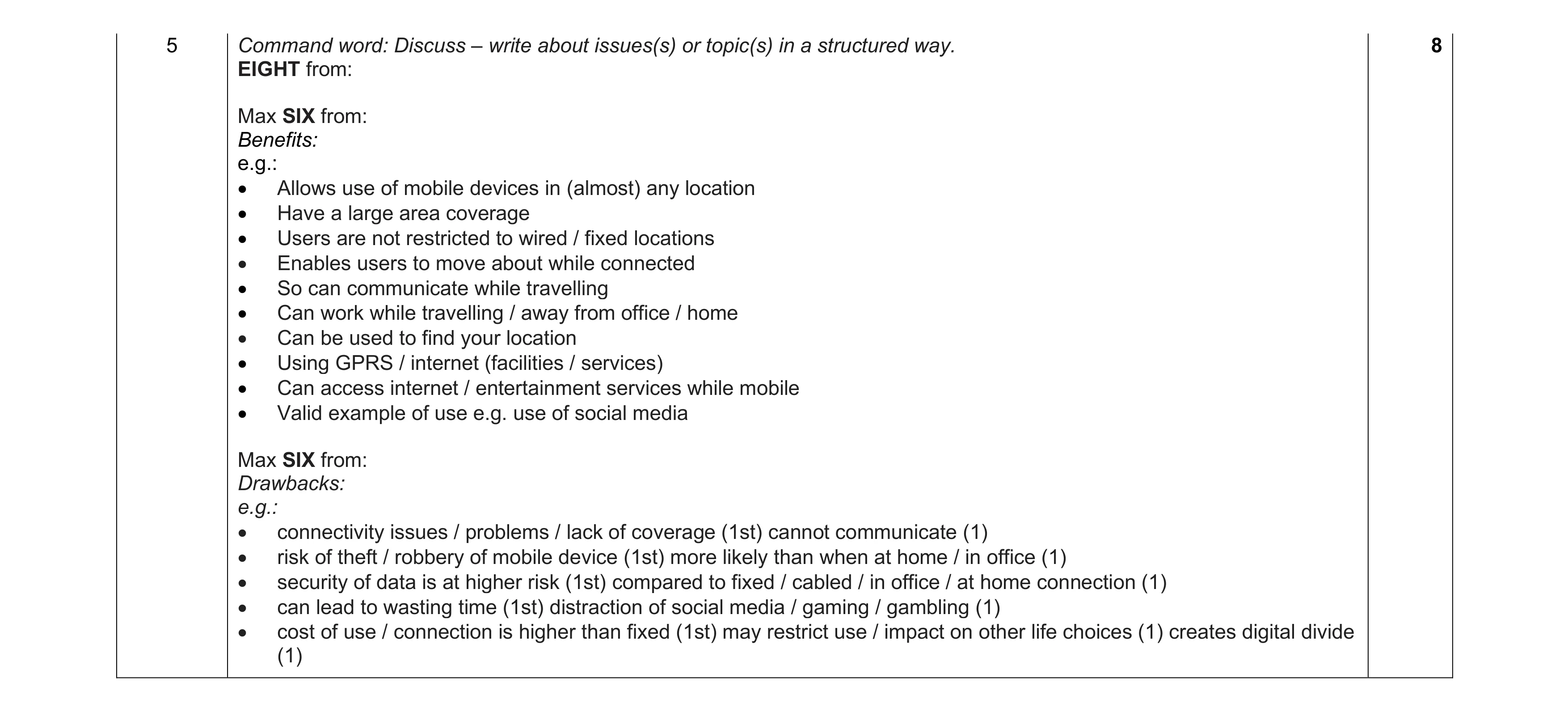 8
8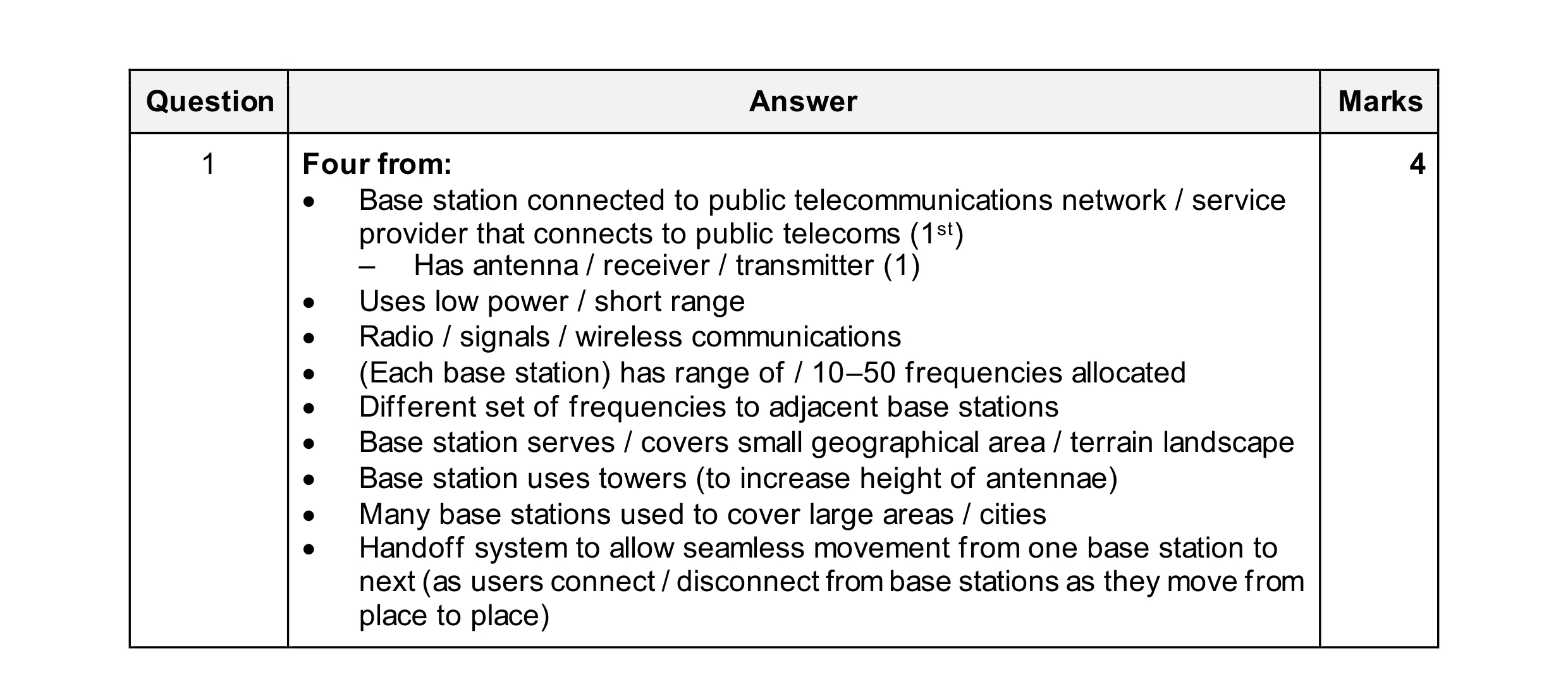 4
4