Cambridge A Level History 9489 — 2025 Oct/Nov Paper 1 · Variant 1
9489/11/O/N/25 · 40 marks · ≈45 min
The question paper and its mark scheme, free to read here and free to download. This is Cambridge’s own paper, exactly as it was sat.
Question paper8 pages

Mark scheme17 pages
Answers below. Sit the paper first if you are practising.
Paper as text
Question paper, page 1
[Turn over Cambridge International AS & A Level DC (WW/CB) 342928/2 © UCLES 2025 This document has 8 pages. Any blank pages are indicated. * 6 4 6 5 5 1 0 8 1 9 * HISTORY 9489/11 Paper 1 Document Question October/November 2025 1 hour 15 minutes You must answer on the enclosed answer booklet. You will need: Answer booklet (enclosed) INSTRUCTIONS ● Answer one question from one section only. Section A: European option Section B: American option Section C: International option ● Follow the instructions on the front cover of the answer booklet. If you need additional answer paper, ask the invigilator for a continuation booklet. INFORMATION ● The total mark for this paper is 40. ● The number of marks for each question or part question is shown in brackets [ ].
Question paper, page 2
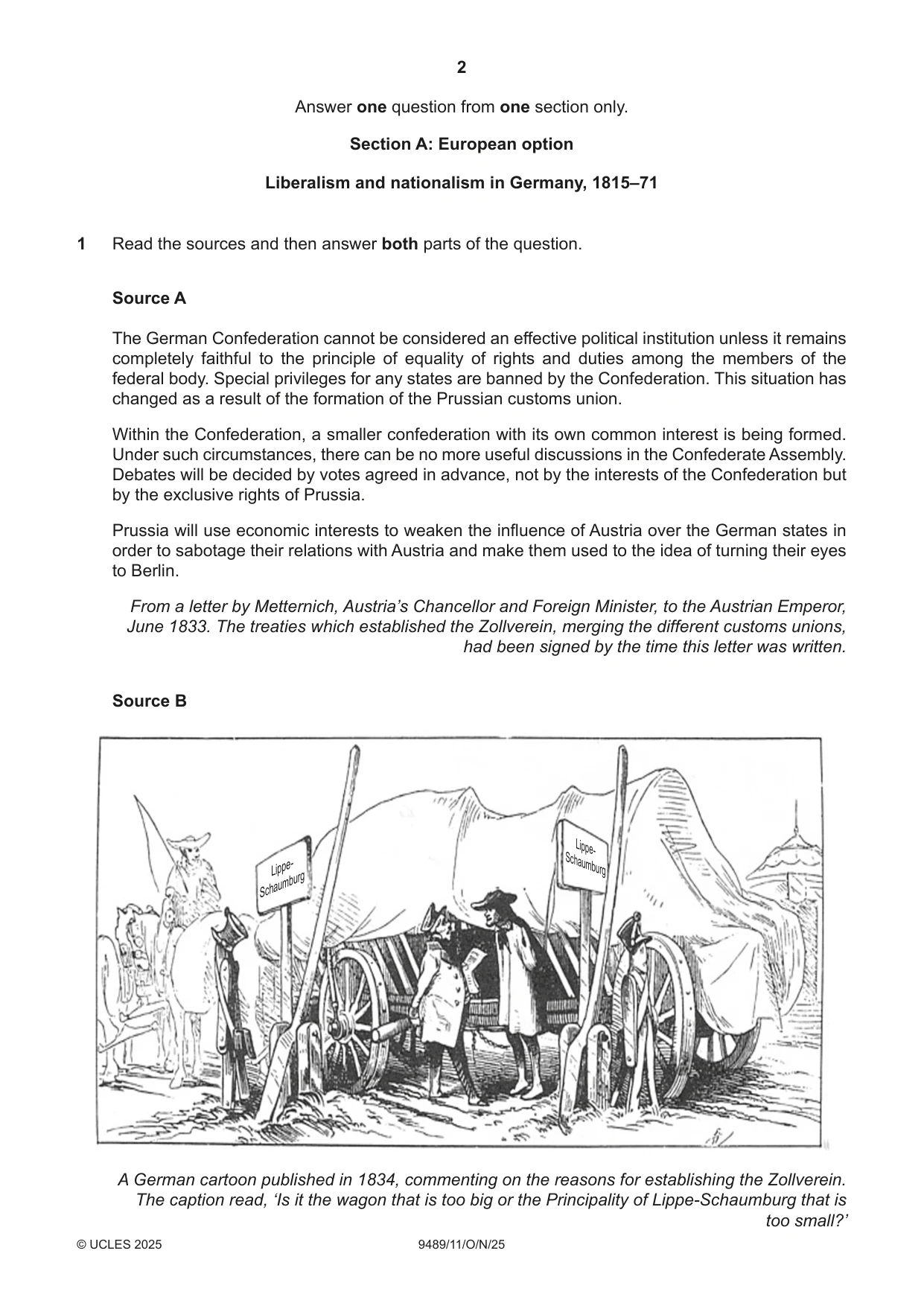
2 9489/11/O/N/25 © UCLES 2025 Answer one question from one section only. Section A: European option Liberalism and nationalism in Germany, 1815–71 1 Read the sources and then answer both parts of the question. Source A The German Confederation cannot be considered an effective political institution unless it remains completely faithful to the principle of equality of rights and duties among the members of the federal body. Special privileges for any states are banned by the Confederation. This situation has changed as a result of the formation of the Prussian customs union. Within the Confederation, a smaller confederation with its own common interest is being formed. Under such circumstances, there can be no more useful discussions in the Confederate Assembly. Debates will be decided by votes agreed in advance, not by the interests of the Confederation but by the exclusive rights of Prussia. Prussia will use economic interests to weaken the influence of Austria over the German states in order to sabotage their relations with Austria and make them used to the idea of turning their eyes to Berlin. From a letter by Metternich, Austria’s Chancellor and Foreign Minister, to the Austrian Emperor, June 1833. The treaties which established the Zollverein, merging the different customs unions, had been signed by the time this letter was written. Source B Lippe- Schaumburg Lippe- Schaumburg A German cartoon published in 1834, commenting on the reasons for establishing the Zollverein. The caption read, ‘Is it the wagon that is too big or the Principality of Lippe-Schaumburg that is too small?’
Question paper, page 3
3 9489/11/O/N/25 © UCLES 2025 [Turn over Source C I cannot pass over the probable political consequences of the establishment of the Zollverein. They were certainly not lost sight of by its founders. The connection between commercial and political interests is obvious. The supporters of this customs union understood that no political alliance would be so strong as that based upon a community of economic and social interests. It has prepared the way for political nationality. It has subdued much local feeling, prejudice and habit and replaced them with a wider and stronger element of German nationality. By directing investment to internal rather than external trade, the Zollverein has already had a great influence in improving the roads, the canals, the means of travelling, in a word in giving additional impulse to inland communications of every sort. Railways are being constructed in many parts of German territory – steamboats are crowding German ports and coasting along German shores – everything is transported with greater cheapness and rapidity. From a report on the Zollverein written by a member of the British Parliament in 1840. Source D Nothing profitable can be expected from the Assembly of the Confederation with regard to national unification. It has not carried out its duty in respect of representative governments or free trade. The press is censored, the procedures of the Assembly are cloaked in darkness and obstacles are placed in the path of liberal development. The only bond of common German interests, the Zollverein, was not created by the Confederation but by agreements reached between individual German states within the Confederation. The aim of German unification, with a German policy, common direction and protection of national interests, will be more easily achieved when the public support the extension of this customs union to a German society. The customs union already directs a whole series of common economic interests and has established treaties with outside states. Through its further development, the customs union will act as an irresistible attraction for the participation of the remaining German states. It will bring about unification with the Austrian states and thus lead to the establishment of true German power. From a newspaper report of a meeting of liberal representatives of the southwestern German states in 1847. Answer both parts of the question with reference to the sources. (a) Read Source A and Source D. Compare and contrast these two sources as evidence about the Confederation. [15] (b) Read all of the sources. ‘The most important impact of the Zollverein was to strengthen the economies of the German states.’ How far do the sources support this view? [25]
Question paper, page 4
4 9489/11/O/N/25 © UCLES 2025 Section B: American option The origins of the Civil War, 1820–61 2 Read the sources and then answer both parts of the question. Source A The greatest injustice that will arise from the 1850 Compromise will be the Fugitive Slave Law. It must be opposed as it violates the liberties which were laid down in our Constitution. It will provoke great anger in the North. It will drive many of those who dislike the abolitionists and their attitudes into supporting their radical cause. Fugitives will be denied trial by jury and the right to give evidence on their own behalf. Paying Federal Commissioners $10 if the fugitive is found to be a slave and $5 if he is not makes it clear what is intended in this Act. It could well further the cause of those who wish to end the Union. From a speech in Congress by a Representative from Massachusetts, July 1851. Source B This battle in the town of Christiana, where the slaveowner is dead and his son wounded, is the first blow in our Civil War. Our state was invaded by armed men from Maryland determined to impose their will and seize their ‘property’ by force. Attempting to defend themselves from an unwarranted assault, some of our citizens were compelled to fire back, leading to the death of Mr Gorsuch. The invaders felt they had the protection of the law and the government, with the United States marshal there to support them, but they were driven back under fire to their own state. We follow a much higher law than they do. We must trample this Fugitive Law under our feet. It is to be denounced, resisted and disobeyed. We are moral and religious men here and we cannot obey an immoral and irreligious law. Our vigilance committee will do all it can to prevent these ‘man stealers’ who wish to destroy liberty. We urge all to make their feelings known to them and would warn them that this city cannot guarantee their safety. From the ‘Jeffersonian Republican’, a Pennsylvanian newspaper, 18 September 1851. Source C What has occurred in Christiana is an act of insurrection. It is an armed rebellion determined to destroy our laws and our government. It would never have taken place but for the incitement by those in the North. Mr Gorsuch entered the town peacefully and legally, accompanied by a United States marshal, to rightly claim back what was his property, a runaway slave. He was murdered in cold blood and his son wounded. To avoid further bloodshed, his son and the officers of the law returned peacefully to Maryland. It is believed his slaves have since fled to Canada. It is the fanatics of the ‘higher law’ belief that have incited this conflict in Christiana. They oppose the Fugitive Law arguing that there are laws superior to those passed by Congress and guaranteed under our Constitution. This gives them a right to break those laws. This is nonsense. Their opposition is truly based on a wish to destroy our way of life and impose their values upon us. They are jealous of what we have. From the ‘Cecil Whig’, a Maryland newspaper, 22 September 1851.
Question paper, page 5
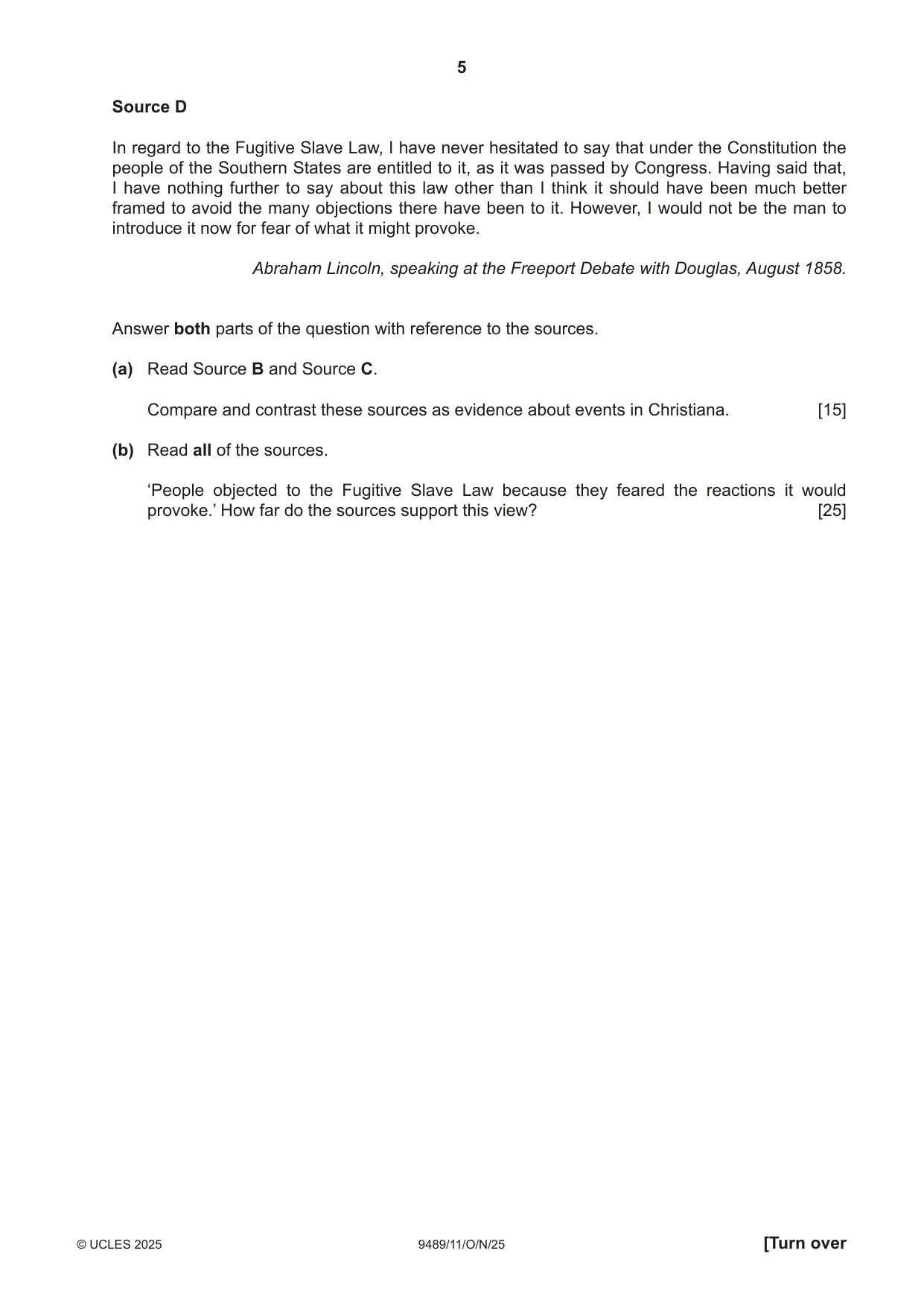
5 9489/11/O/N/25 © UCLES 2025 [Turn over Source D In regard to the Fugitive Slave Law, I have never hesitated to say that under the Constitution the people of the Southern States are entitled to it, as it was passed by Congress. Having said that, I have nothing further to say about this law other than I think it should have been much better framed to avoid the many objections there have been to it. However, I would not be the man to introduce it now for fear of what it might provoke. Abraham Lincoln, speaking at the Freeport Debate with Douglas, August 1858. Answer both parts of the question with reference to the sources. (a) Read Source B and Source C. Compare and contrast these sources as evidence about events in Christiana. [15] (b) Read all of the sources. ‘People objected to the Fugitive Slave Law because they feared the reactions it would provoke.’ How far do the sources support this view? [25]
Question paper, page 6
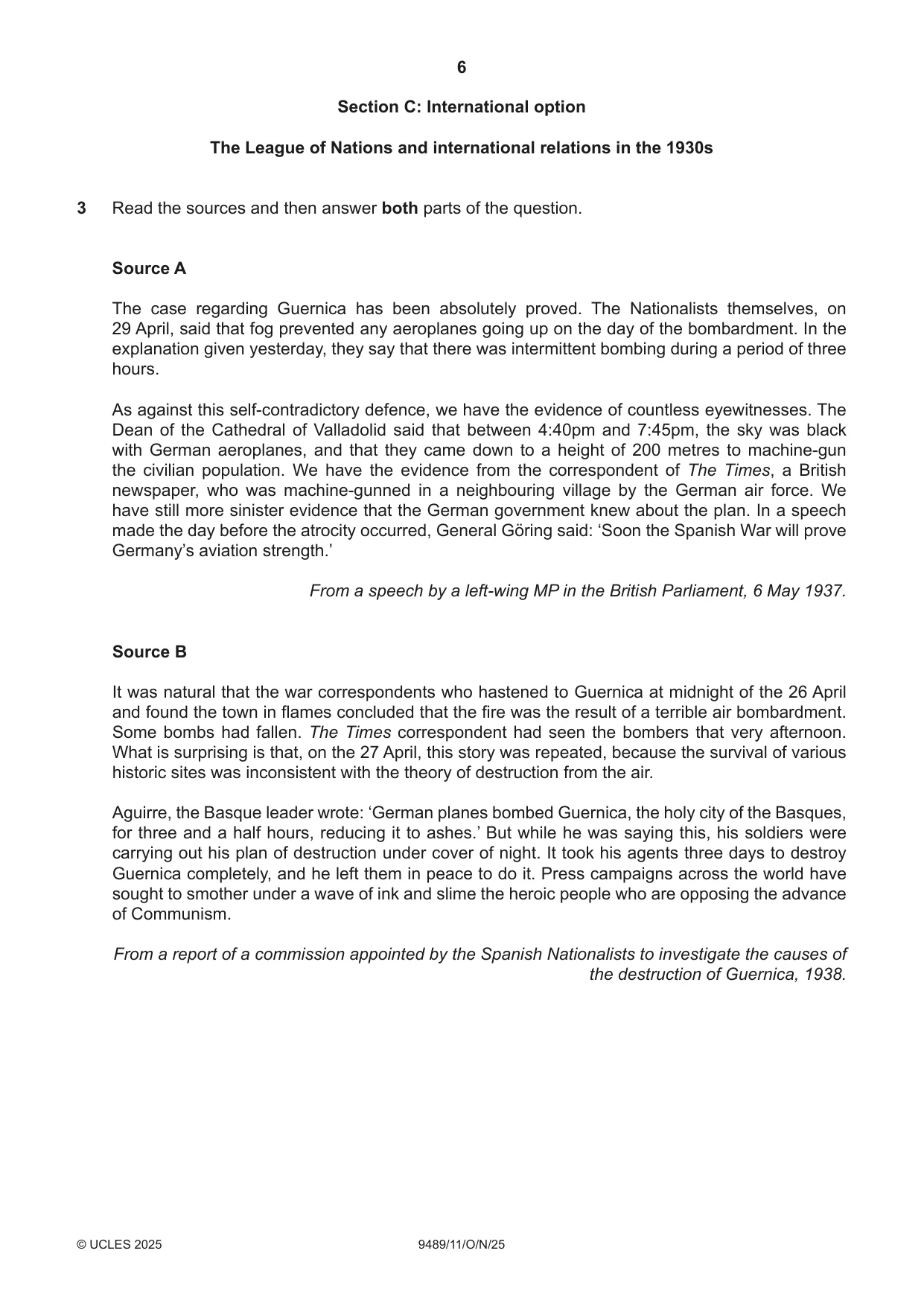
6 9489/11/O/N/25 © UCLES 2025 Section C: International option The League of Nations and international relations in the 1930s 3 Read the sources and then answer both parts of the question. Source A The case regarding Guernica has been absolutely proved. The Nationalists themselves, on 29 April, said that fog prevented any aeroplanes going up on the day of the bombardment. In the explanation given yesterday, they say that there was intermittent bombing during a period of three hours. As against this self-contradictory defence, we have the evidence of countless eyewitnesses. The Dean of the Cathedral of Valladolid said that between 4:40pm and 7:45pm, the sky was black with German aeroplanes, and that they came down to a height of 200 metres to machine-gun the civilian population. We have the evidence from the correspondent of The Times, a British newspaper, who was machine-gunned in a neighbouring village by the German air force. We have still more sinister evidence that the German government knew about the plan. In a speech made the day before the atrocity occurred, General Göring said: ‘Soon the Spanish War will prove Germany’s aviation strength.’ From a speech by a left-wing MP in the British Parliament, 6 May 1937. Source B It was natural that the war correspondents who hastened to Guernica at midnight of the 26 April and found the town in flames concluded that the fire was the result of a terrible air bombardment. Some bombs had fallen. The Times correspondent had seen the bombers that very afternoon. What is surprising is that, on the 27 April, this story was repeated, because the survival of various historic sites was inconsistent with the theory of destruction from the air. Aguirre, the Basque leader wrote: ‘German planes bombed Guernica, the holy city of the Basques, for three and a half hours, reducing it to ashes.’ But while he was saying this, his soldiers were carrying out his plan of destruction under cover of night. It took his agents three days to destroy Guernica completely, and he left them in peace to do it. Press campaigns across the world have sought to smother under a wave of ink and slime the heroic people who are opposing the advance of Communism. From a report of a commission appointed by the Spanish Nationalists to investigate the causes of the destruction of Guernica, 1938.
Question paper, page 7
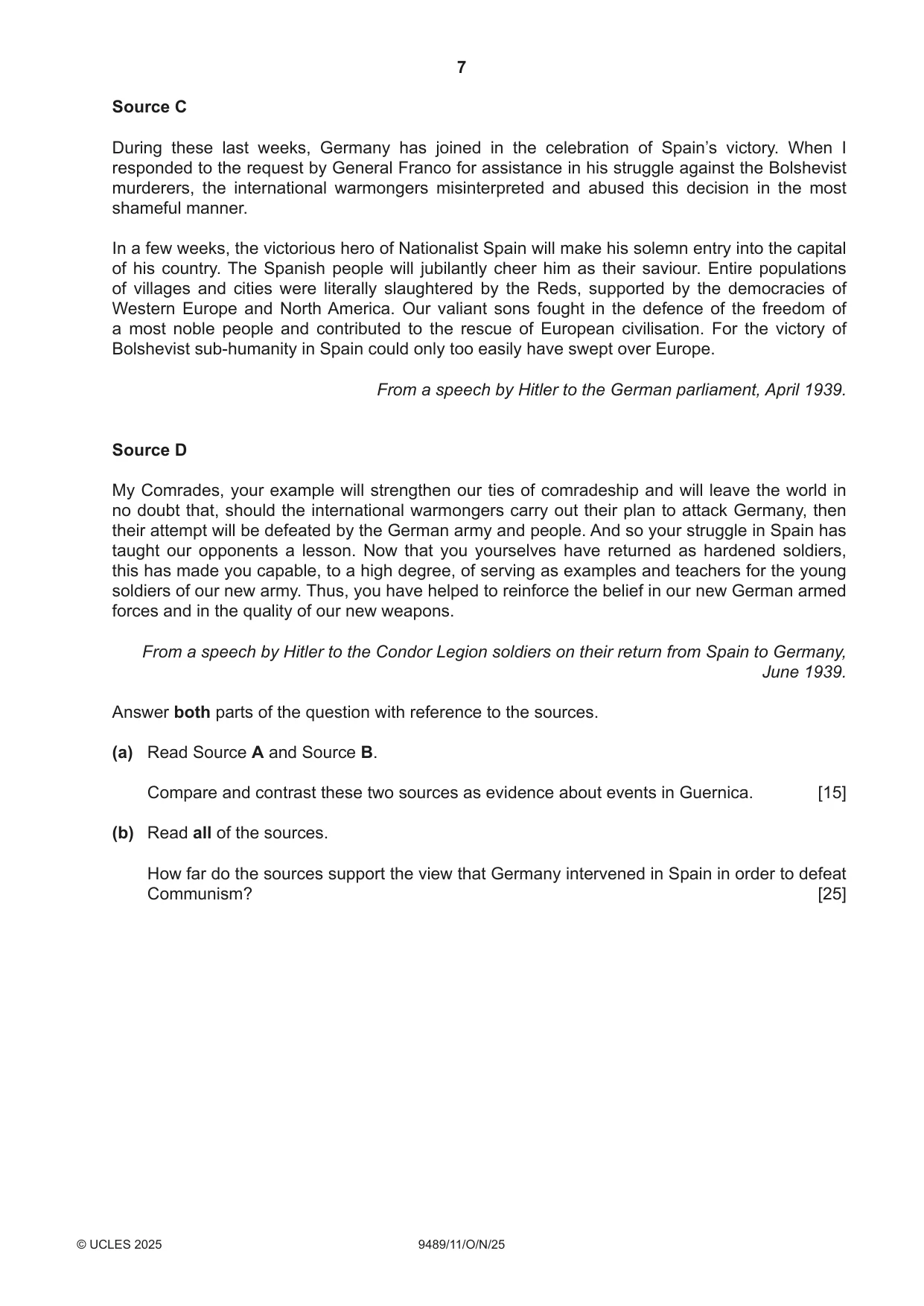
7 9489/11/O/N/25 © UCLES 2025 Source C During these last weeks, Germany has joined in the celebration of Spain’s victory. When I responded to the request by General Franco for assistance in his struggle against the Bolshevist murderers, the international warmongers misinterpreted and abused this decision in the most shameful manner. In a few weeks, the victorious hero of Nationalist Spain will make his solemn entry into the capital of his country. The Spanish people will jubilantly cheer him as their saviour. Entire populations of villages and cities were literally slaughtered by the Reds, supported by the democracies of Western Europe and North America. Our valiant sons fought in the defence of the freedom of a most noble people and contributed to the rescue of European civilisation. For the victory of Bolshevist sub-humanity in Spain could only too easily have swept over Europe. From a speech by Hitler to the German parliament, April 1939. Source D My Comrades, your example will strengthen our ties of comradeship and will leave the world in no doubt that, should the international warmongers carry out their plan to attack Germany, then their attempt will be defeated by the German army and people. And so your struggle in Spain has taught our opponents a lesson. Now that you yourselves have returned as hardened soldiers, this has made you capable, to a high degree, of serving as examples and teachers for the young soldiers of our new army. Thus, you have helped to reinforce the belief in our new German armed forces and in the quality of our new weapons. From a speech by Hitler to the Condor Legion soldiers on their return from Spain to Germany, June 1939. Answer both parts of the question with reference to the sources. (a) Read Source A and Source B. Compare and contrast these two sources as evidence about events in Guernica. [15] (b) Read all of the sources. How far do the sources support the view that Germany intervened in Spain in order to defeat Communism? [25]
Question paper, page 8
8 9489/11/O/N/25 © UCLES 2025 Permission to reproduce items where third-party owned material protected by copyright is included has been sought and cleared where possible. Every reasonable effort has been made by the publisher (UCLES) to trace copyright holders, but if any items requiring clearance have unwittingly been included, the publisher will be pleased to make amends at the earliest possible opportunity. To avoid the issue of disclosure of answer-related information to candidates, all copyright acknowledgements are reproduced online in the Cambridge Assessment International Education Copyright Acknowledgements Booklet. This is produced for each series of examinations and is freely available to download at www.cambridgeinternational.org after the live examination series. Cambridge Assessment International Education is part of Cambridge Assessment. Cambridge Assessment is the brand name of the University of Cambridge Local Examinations Syndicate (UCLES), which is a department of the University of Cambridge. BLANK PAGE
Mark scheme, page 1
This document consists of 17 printed pages. © Cambridge University Press & Assessment 2025 [Turn over Cambridge International AS & A Level HISTORY 9489/11 Paper 1 Document Question October/November 2025 MARK SCHEME Maximum Mark: 40 Published This mark scheme is published as an aid to teachers and candidates, to indicate the requirements of the examination. It shows the basis on which Examiners were instructed to award marks. It does not indicate the details of the discussions that took place at an Examiners’ meeting before marking began, which would have considered the acceptability of alternative answers. Mark schemes should be read in conjunction with the question paper and the Principal Examiner Report for Teachers. Cambridge International will not enter into discussions about these mark schemes. Cambridge International is publishing the mark schemes for the October/November 2025 series for most Cambridge IGCSE, Cambridge International A and AS Level components, and some Cambridge O Level components.
Mark scheme, page 2
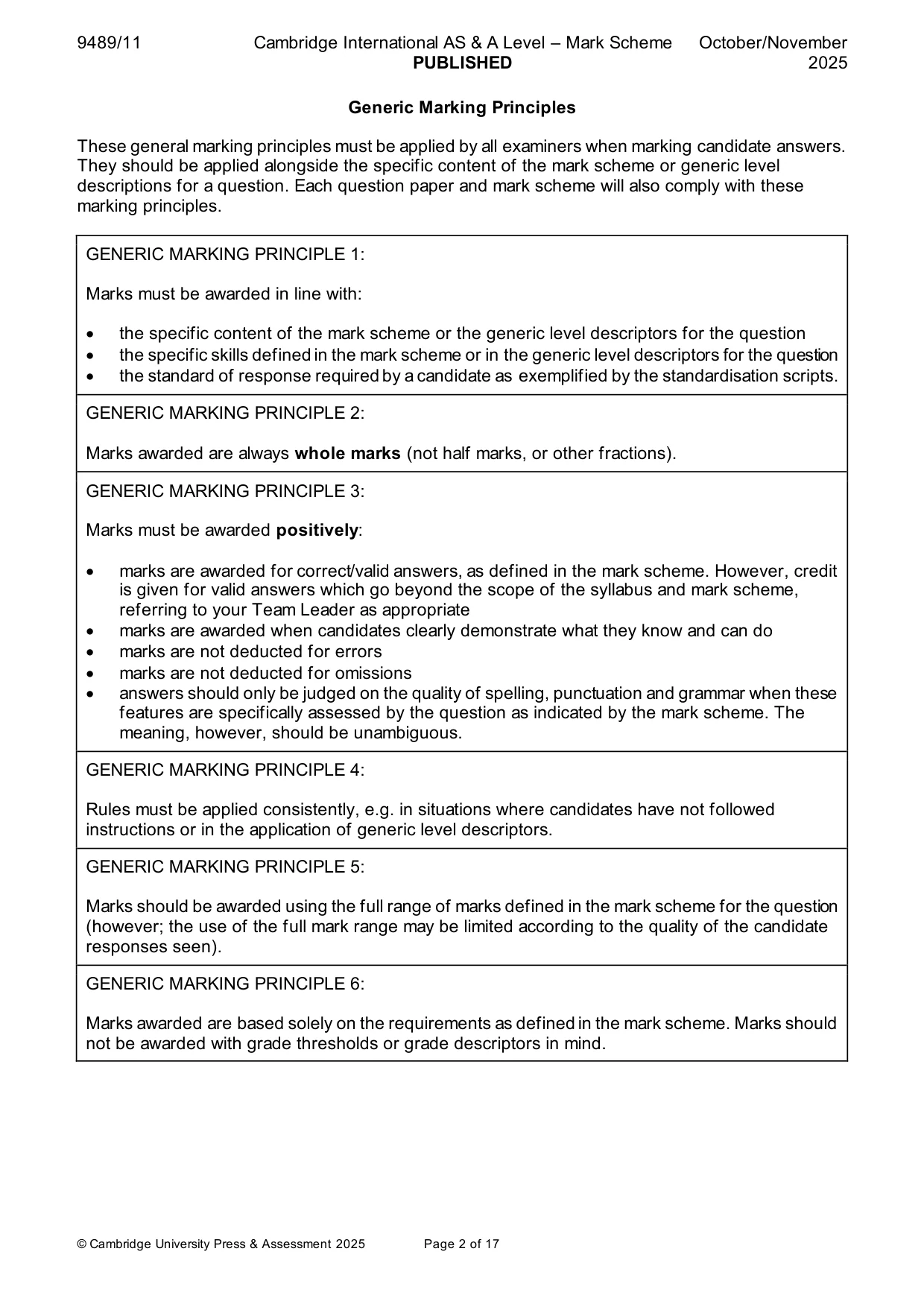
9489/11 Cambridge International AS & A Level – Mark Scheme PUBLISHED October/November 2025 © Cambridge University Press & Assessment 2025 Page 2 of 17 Generic Marking Principles These general marking principles must be applied by all examiners when marking candidate answers. They should be applied alongside the specific content of the mark scheme or generic level descriptions for a question. Each question paper and mark scheme will also comply with these marking principles. GENERIC MARKING PRINCIPLE 1: Marks must be awarded in line with: • the specific content of the mark scheme or the generic level descriptors for the question • the specific skills defined in the mark scheme or in the generic level descriptors for the question • the standard of response required by a candidate as exemplified by the standardisation scripts. GENERIC MARKING PRINCIPLE 2: Marks awarded are always whole marks (not half marks, or other fractions). GENERIC MARKING PRINCIPLE 3: Marks must be awarded positively: • marks are awarded for correct/valid answers, as defined in the mark scheme. However, credit is given for valid answers which go beyond the scope of the syllabus and mark scheme, referring to your Team Leader as appropriate • marks are awarded when candidates clearly demonstrate what they know and can do • marks are not deducted for errors • marks are not deducted for omissions • answers should only be judged on the quality of spelling, punctuation and grammar when these features are specifically assessed by the question as indicated by the mark scheme. The meaning, however, should be unambiguous. GENERIC MARKING PRINCIPLE 4: Rules must be applied consistently, e.g. in situations where candidates have not followed instructions or in the application of generic level descriptors. GENERIC MARKING PRINCIPLE 5: Marks should be awarded using the full range of marks defined in the mark scheme for the question (however; the use of the full mark range may be limited according to the quality of the candidate responses seen). GENERIC MARKING PRINCIPLE 6: Marks awarded are based solely on the requirements as defined in the mark scheme. Marks should not be awarded with grade thresholds or grade descriptors in mind.
Mark scheme, page 3
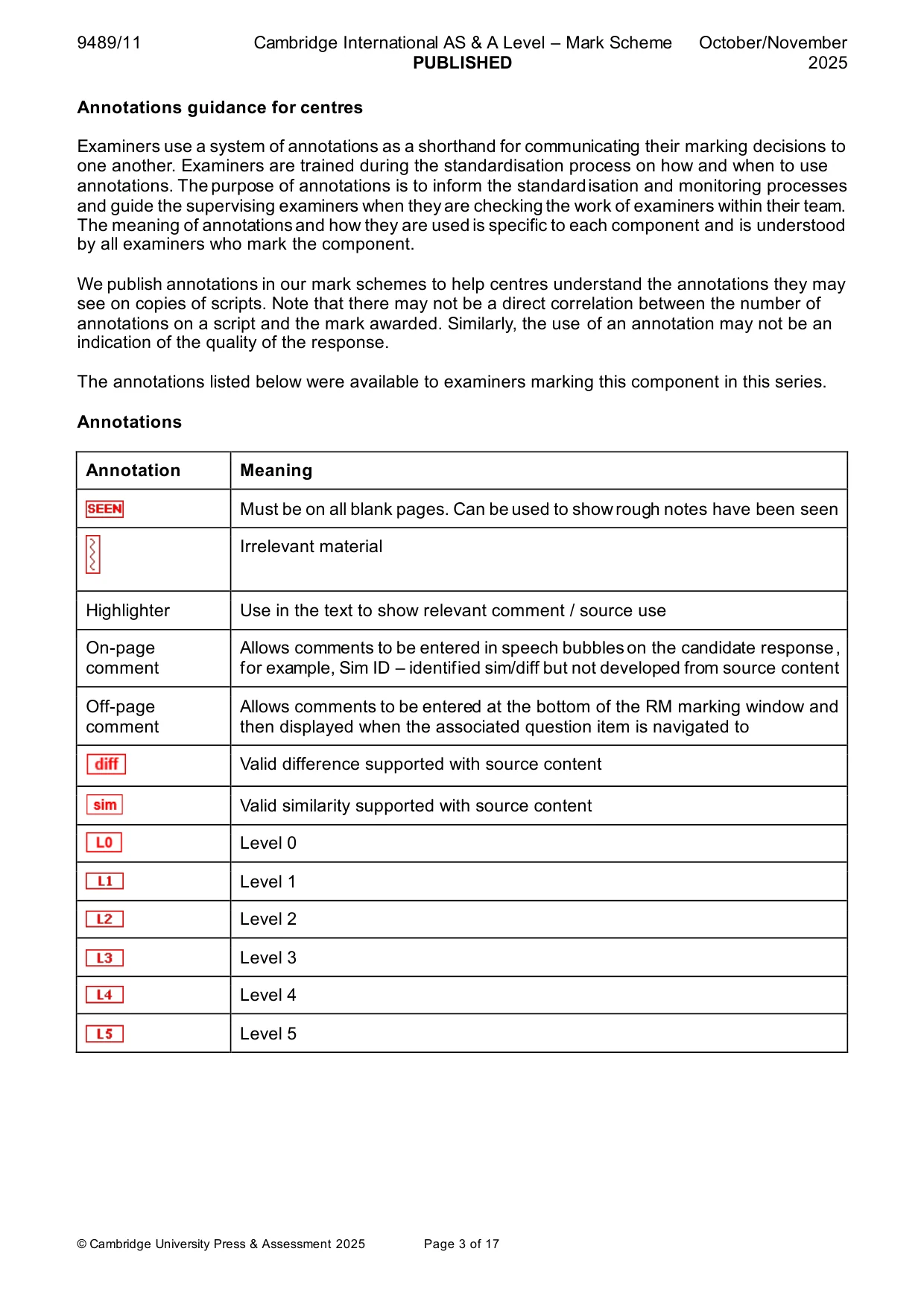
9489/11 Cambridge International AS & A Level – Mark Scheme PUBLISHED October/November 2025 © Cambridge University Press & Assessment 2025 Page 3 of 17 Annotations guidance for centres Examiners use a system of annotations as a shorthand for communicating their marking decisions to one another. Examiners are trained during the standardisation process on how and when to use annotations. The purpose of annotations is to inform the standardisation and monitoring processes and guide the supervising examiners when they are checking the work of examiners within their team. The meaning of annotations and how they are used is specific to each component and is understood by all examiners who mark the component. We publish annotations in our mark schemes to help centres understand the annotations they may see on copies of scripts. Note that there may not be a direct correlation between the number of annotations on a script and the mark awarded. Similarly, the use of an annotation may not be an indication of the quality of the response. The annotations listed below were available to examiners marking this component in this series. Annotations Annotation Meaning Must be on all blank pages. Can be used to show rough notes have been seen Irrelevant material Highlighter Use in the text to show relevant comment / source use On-page comment Allows comments to be entered in speech bubbles on the candidate response, for example, Sim ID – identified sim/diff but not developed from source content Off-page comment Allows comments to be entered at the bottom of the RM marking window and then displayed when the associated question item is navigated to Valid difference supported with source content Valid similarity supported with source content Level 0 Level 1 Level 2 Level 3 Level 4 Level 5
Mark scheme, page 4
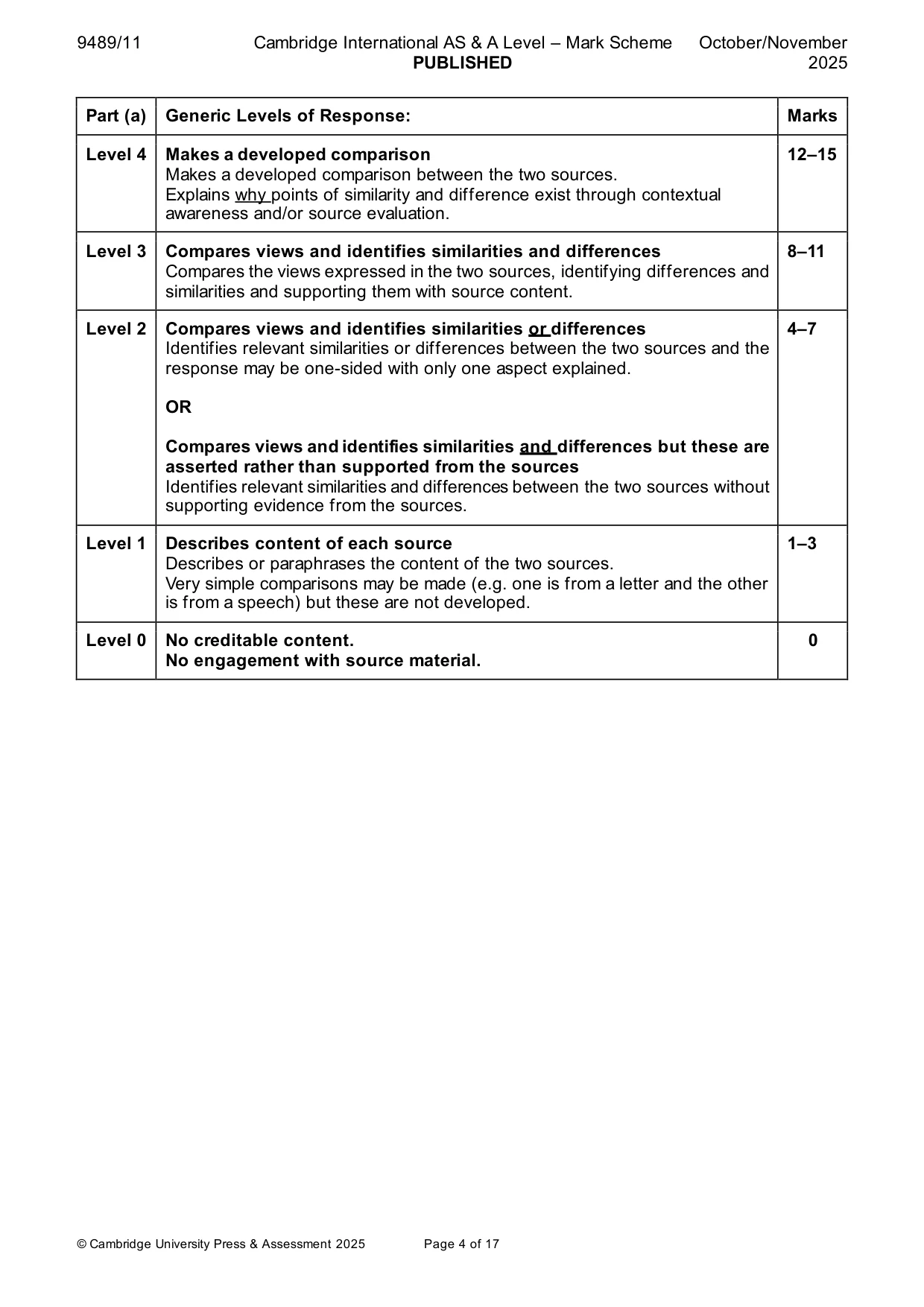
9489/11 Cambridge International AS & A Level – Mark Scheme PUBLISHED October/November 2025 © Cambridge University Press & Assessment 2025 Page 4 of 17 Part (a) Generic Levels of Response: Marks Level 4 Makes a developed comparison Makes a developed comparison between the two sources. Explains why points of similarity and difference exist through contextual awareness and/or source evaluation. 12–15 Level 3 Compares views and identifies similarities and differences Compares the views expressed in the two sources, identifying differences and similarities and supporting them with source content. 8–11 Level 2 Compares views and identifies similarities or differences Identifies relevant similarities or differences between the two sources and the response may be one-sided with only one aspect explained. OR Compares views and identifies similarities and differences but these are asserted rather than supported from the sources Identifies relevant similarities and differences between the two sources without supporting evidence from the sources. 4–7 Level 1 Describes content of each source Describes or paraphrases the content of the two sources. Very simple comparisons may be made (e.g. one is from a letter and the other is from a speech) but these are not developed. 1–3 Level 0 No creditable content. No engagement with source material. 0
Mark scheme, page 5
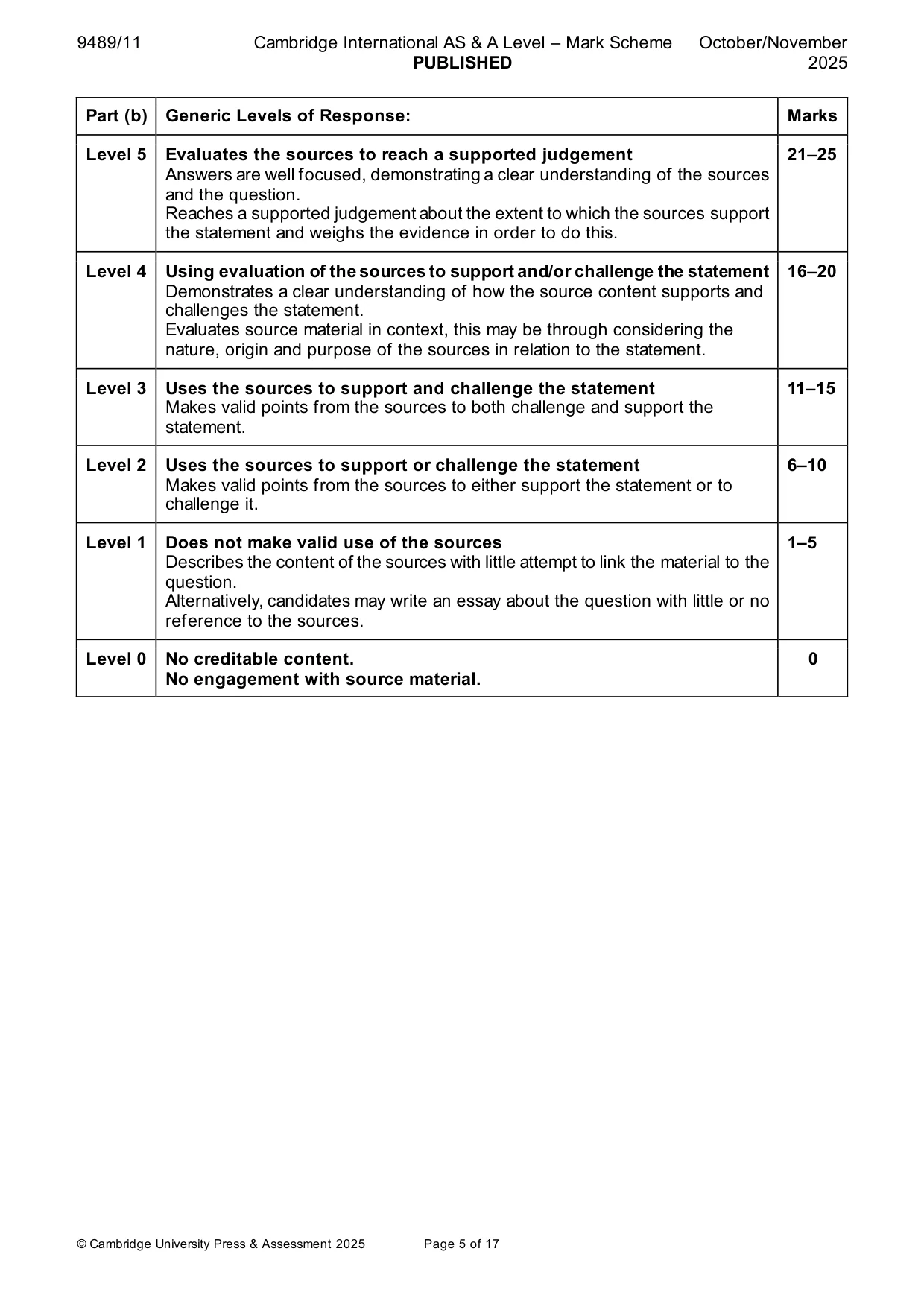
9489/11 Cambridge International AS & A Level – Mark Scheme PUBLISHED October/November 2025 © Cambridge University Press & Assessment 2025 Page 5 of 17 Part (b) Generic Levels of Response: Marks Level 5 Evaluates the sources to reach a supported judgement Answers are well focused, demonstrating a clear understanding of the sources and the question. Reaches a supported judgement about the extent to which the sources support the statement and weighs the evidence in order to do this. 21–25 Level 4 Using evaluation of the sources to support and/or challenge the statement Demonstrates a clear understanding of how the source content supports and challenges the statement. Evaluates source material in context, this may be through considering the nature, origin and purpose of the sources in relation to the statement. 16–20 Level 3 Uses the sources to support and challenge the statement Makes valid points from the sources to both challenge and support the statement. 11–15 Level 2 Uses the sources to support or challenge the statement Makes valid points from the sources to either support the statement or to challenge it. 6–10 Level 1 Does not make valid use of the sources Describes the content of the sources with little attempt to link the material to the question. Alternatively, candidates may write an essay about the question with little or no reference to the sources. 1–5 Level 0 No creditable content. No engagement with source material. 0
Mark scheme, page 6
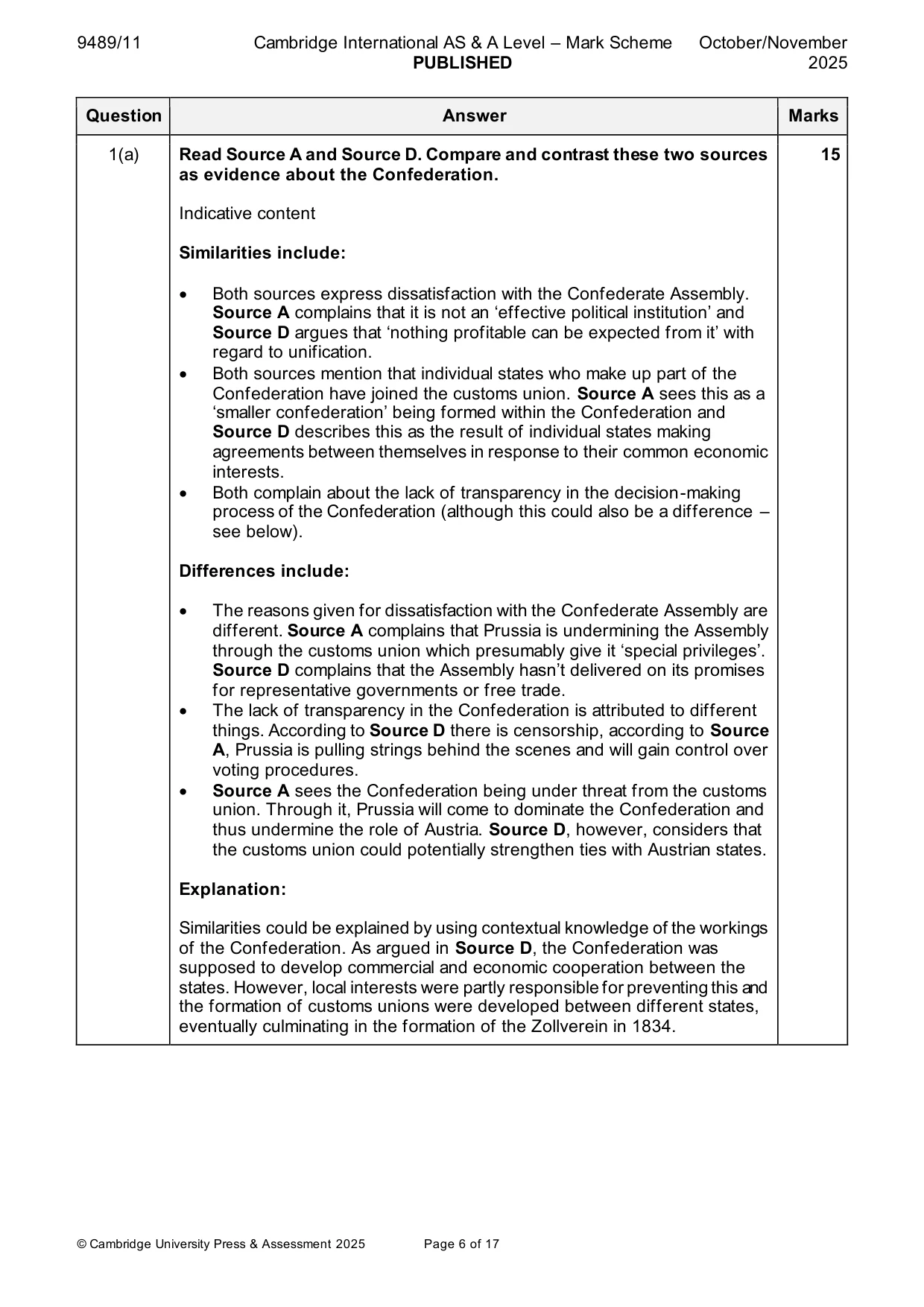
9489/11 Cambridge International AS & A Level – Mark Scheme PUBLISHED October/November 2025 © Cambridge University Press & Assessment 2025 Page 6 of 17 Question Answer Marks 1(a) Read Source A and Source D. Compare and contrast these two sources as evidence about the Confederation. Indicative content Similarities include: • Both sources express dissatisfaction with the Confederate Assembly. Source A complains that it is not an ‘effective political institution’ and Source D argues that ‘nothing profitable can be expected from it’ with regard to unification. • Both sources mention that individual states who make up part of the Confederation have joined the customs union. Source A sees this as a ‘smaller confederation’ being formed within the Confederation and Source D describes this as the result of individual states making agreements between themselves in response to their common economic interests. • Both complain about the lack of transparency in the decision-making process of the Confederation (although this could also be a difference – see below). Differences include: • The reasons given for dissatisfaction with the Confederate Assembly are different. Source A complains that Prussia is undermining the Assembly through the customs union which presumably give it ‘special privileges’. Source D complains that the Assembly hasn’t delivered on its promises for representative governments or free trade. • The lack of transparency in the Confederation is attributed to different things. According to Source D there is censorship, according to Source A, Prussia is pulling strings behind the scenes and will gain control over voting procedures. • Source A sees the Confederation being under threat from the customs union. Through it, Prussia will come to dominate the Confederation and thus undermine the role of Austria. Source D, however, considers that the customs union could potentially strengthen ties with Austrian states. Explanation: Similarities could be explained by using contextual knowledge of the workings of the Confederation. As argued in Source D, the Confederation was supposed to develop commercial and economic cooperation between the states. However, local interests were partly responsible for preventing this and the formation of customs unions were developed between different states, eventually culminating in the formation of the Zollverein in 1834. 15
Mark scheme, page 7
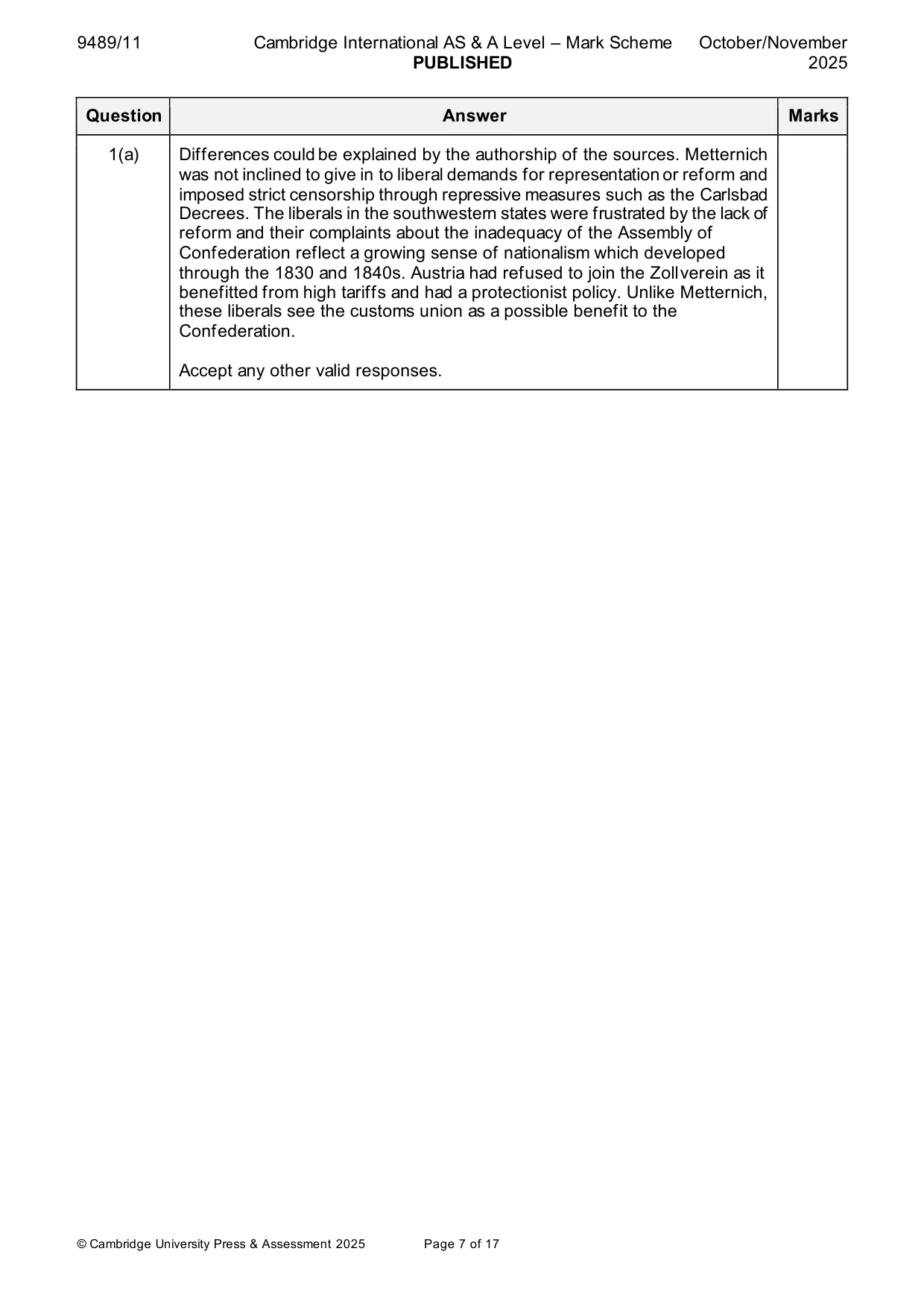
9489/11 Cambridge International AS & A Level – Mark Scheme PUBLISHED October/November 2025 © Cambridge University Press & Assessment 2025 Page 7 of 17 Question Answer Marks 1(a) Differences could be explained by the authorship of the sources. Metternich was not inclined to give in to liberal demands for representation or reform and imposed strict censorship through repressive measures such as the Carlsbad Decrees. The liberals in the southwestern states were frustrated by the lack of reform and their complaints about the inadequacy of the Assembly of Confederation reflect a growing sense of nationalism which developed through the 1830 and 1840s. Austria had refused to join the Zollverein as it benefitted from high tariffs and had a protectionist policy. Unlike Metternich, these liberals see the customs union as a possible benefit to the Confederation. Accept any other valid responses.
Mark scheme, page 8
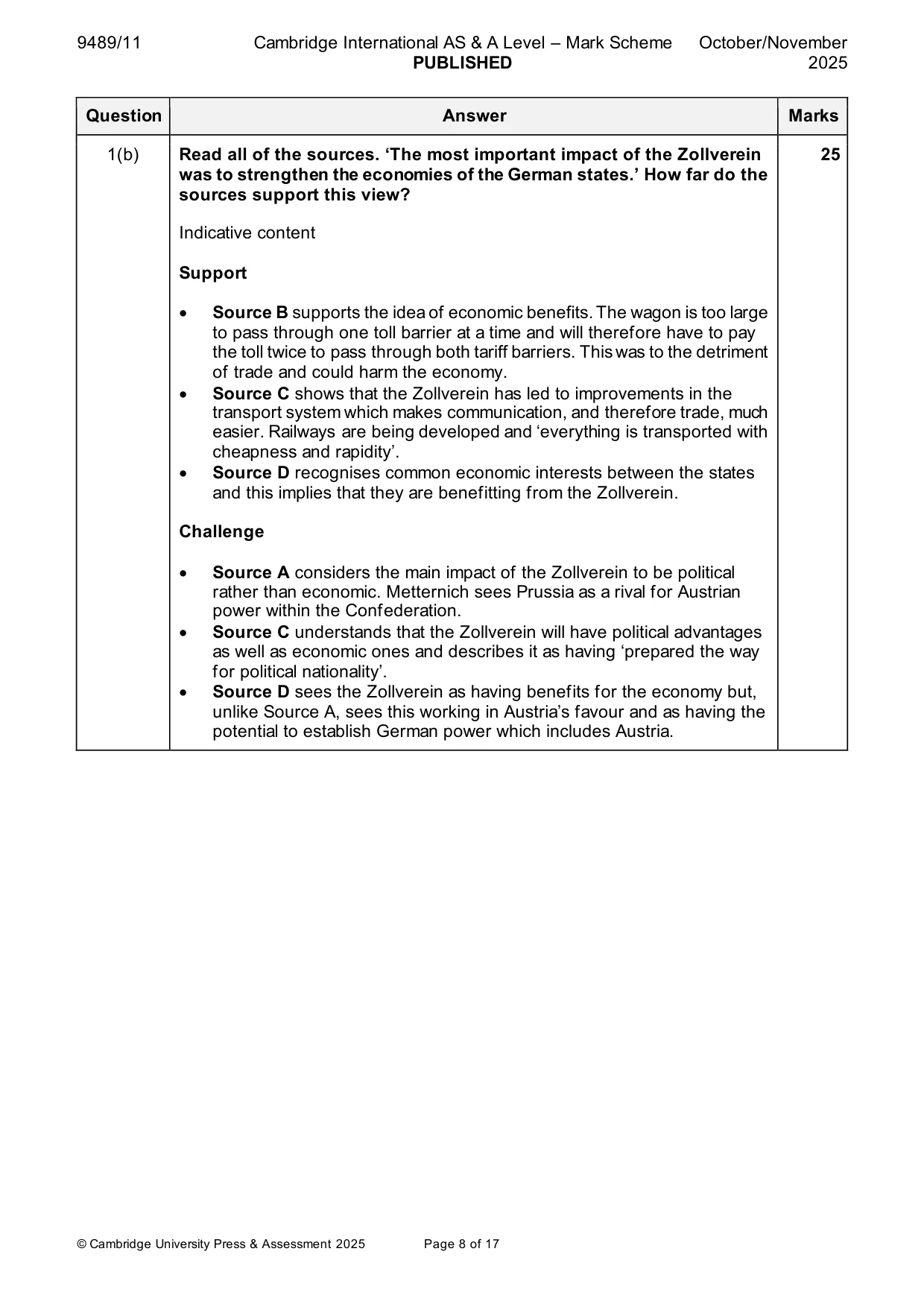
9489/11 Cambridge International AS & A Level – Mark Scheme PUBLISHED October/November 2025 © Cambridge University Press & Assessment 2025 Page 8 of 17 Question Answer Marks 1(b) Read all of the sources. ‘The most important impact of the Zollverein was to strengthen the economies of the German states.’ How far do the sources support this view? Indicative content Support • Source B supports the idea of economic benefits. The wagon is too large to pass through one toll barrier at a time and will therefore have to pay the toll twice to pass through both tariff barriers. This was to the detriment of trade and could harm the economy. • Source C shows that the Zollverein has led to improvements in the transport system which makes communication, and therefore trade, much easier. Railways are being developed and ‘everything is transported with cheapness and rapidity’. • Source D recognises common economic interests between the states and this implies that they are benefitting from the Zollverein. Challenge • Source A considers the main impact of the Zollverein to be political rather than economic. Metternich sees Prussia as a rival for Austrian power within the Confederation. • Source C understands that the Zollverein will have political advantages as well as economic ones and describes it as having ‘prepared the way for political nationality’. • Source D sees the Zollverein as having benefits for the economy but, unlike Source A, sees this working in Austria’s favour and as having the potential to establish German power which includes Austria. 25
Mark scheme, page 9
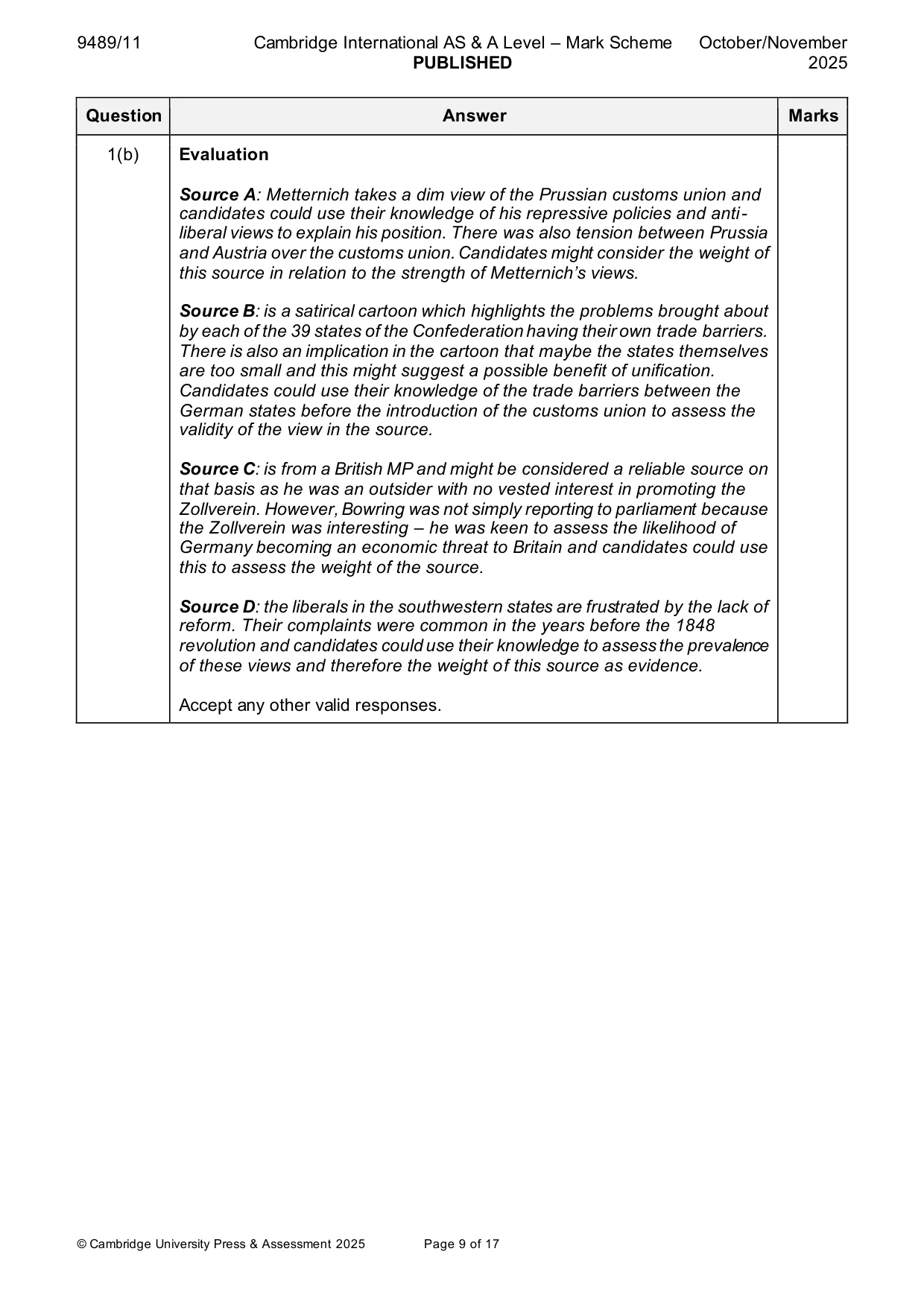
9489/11 Cambridge International AS & A Level – Mark Scheme PUBLISHED October/November 2025 © Cambridge University Press & Assessment 2025 Page 9 of 17 Question Answer Marks 1(b) Evaluation Source A: Metternich takes a dim view of the Prussian customs union and candidates could use their knowledge of his repressive policies and anti- liberal views to explain his position. There was also tension between Prussia and Austria over the customs union. Candidates might consider the weight of this source in relation to the strength of Metternich’s views. Source B: is a satirical cartoon which highlights the problems brought about by each of the 39 states of the Confederation having their own trade barriers. There is also an implication in the cartoon that maybe the states themselves are too small and this might suggest a possible benefit of unification. Candidates could use their knowledge of the trade barriers between the German states before the introduction of the customs union to assess the validity of the view in the source. Source C: is from a British MP and might be considered a reliable source on that basis as he was an outsider with no vested interest in promoting the Zollverein. However, Bowring was not simply reporting to parliament because the Zollverein was interesting – he was keen to assess the likelihood of Germany becoming an economic threat to Britain and candidates could use this to assess the weight of the source. Source D: the liberals in the southwestern states are frustrated by the lack of reform. Their complaints were common in the years before the 1848 revolution and candidates could use their knowledge to assess the prevalence of these views and therefore the weight of this source as evidence. Accept any other valid responses.
Mark scheme, page 10
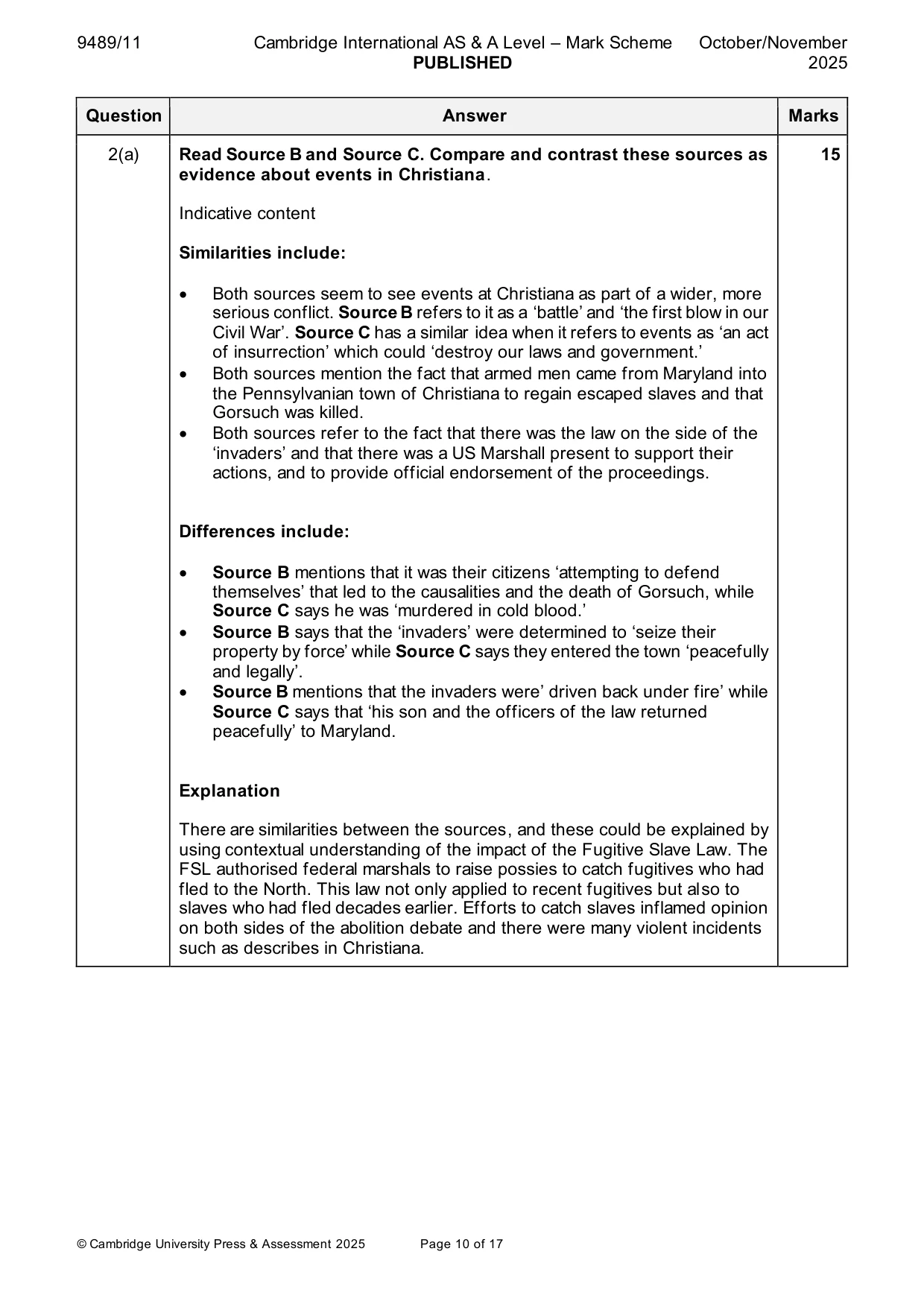
9489/11 Cambridge International AS & A Level – Mark Scheme PUBLISHED October/November 2025 © Cambridge University Press & Assessment 2025 Page 10 of 17 Question Answer Marks 2(a) Read Source B and Source C. Compare and contrast these sources as evidence about events in Christiana. Indicative content Similarities include: • Both sources seem to see events at Christiana as part of a wider, more serious conflict. Source B refers to it as a ‘battle’ and ‘the first blow in our Civil War’. Source C has a similar idea when it refers to events as ‘an act of insurrection’ which could ‘destroy our laws and government.’ • Both sources mention the fact that armed men came from Maryland into the Pennsylvanian town of Christiana to regain escaped slaves and that Gorsuch was killed. • Both sources refer to the fact that there was the law on the side of the ‘invaders’ and that there was a US Marshall present to support their actions, and to provide official endorsement of the proceedings. Differences include: • Source B mentions that it was their citizens ‘attempting to defend themselves’ that led to the causalities and the death of Gorsuch, while Source C says he was ‘murdered in cold blood.’ • Source B says that the ‘invaders’ were determined to ‘seize their property by force’ while Source C says they entered the town ‘peacefully and legally’. • Source B mentions that the invaders were’ driven back under fire’ while Source C says that ‘his son and the officers of the law returned peacefully’ to Maryland. Explanation There are similarities between the sources, and these could be explained by using contextual understanding of the impact of the Fugitive Slave Law. The FSL authorised federal marshals to raise possies to catch fugitives who had fled to the North. This law not only applied to recent fugitives but also to slaves who had fled decades earlier. Efforts to catch slaves inflamed opinion on both sides of the abolition debate and there were many violent incidents such as describes in Christiana. 15
Mark scheme, page 11
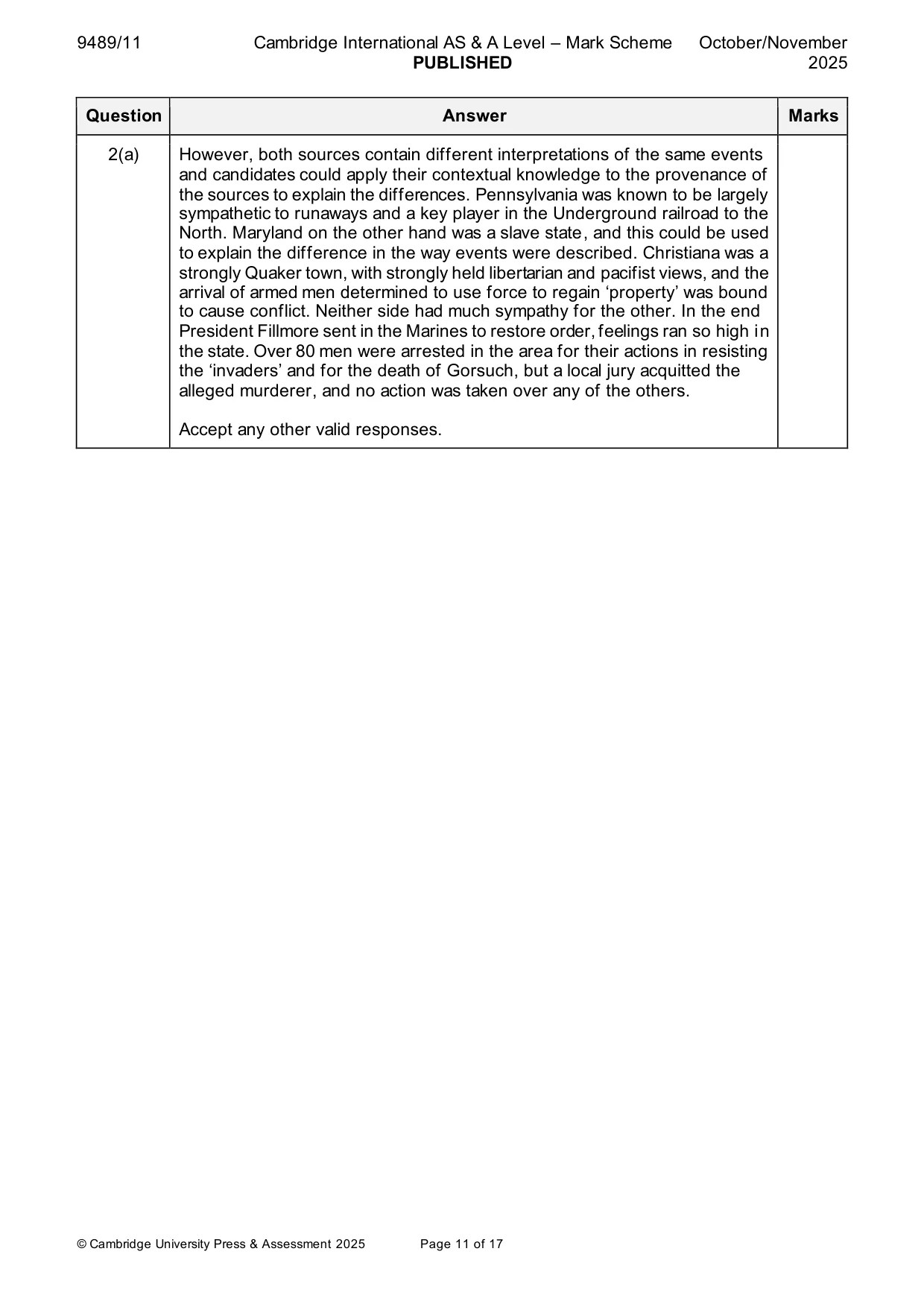
9489/11 Cambridge International AS & A Level – Mark Scheme PUBLISHED October/November 2025 © Cambridge University Press & Assessment 2025 Page 11 of 17 Question Answer Marks 2(a) However, both sources contain different interpretations of the same events and candidates could apply their contextual knowledge to the provenance of the sources to explain the differences. Pennsylvania was known to be largely sympathetic to runaways and a key player in the Underground railroad to the North. Maryland on the other hand was a slave state, and this could be used to explain the difference in the way events were described. Christiana was a strongly Quaker town, with strongly held libertarian and pacifist views, and the arrival of armed men determined to use force to regain ‘property’ was bound to cause conflict. Neither side had much sympathy for the other. In the end President Fillmore sent in the Marines to restore order, feelings ran so high in the state. Over 80 men were arrested in the area for their actions in resisting the ‘invaders’ and for the death of Gorsuch, but a local jury acquitted the alleged murderer, and no action was taken over any of the others. Accept any other valid responses.
Mark scheme, page 12
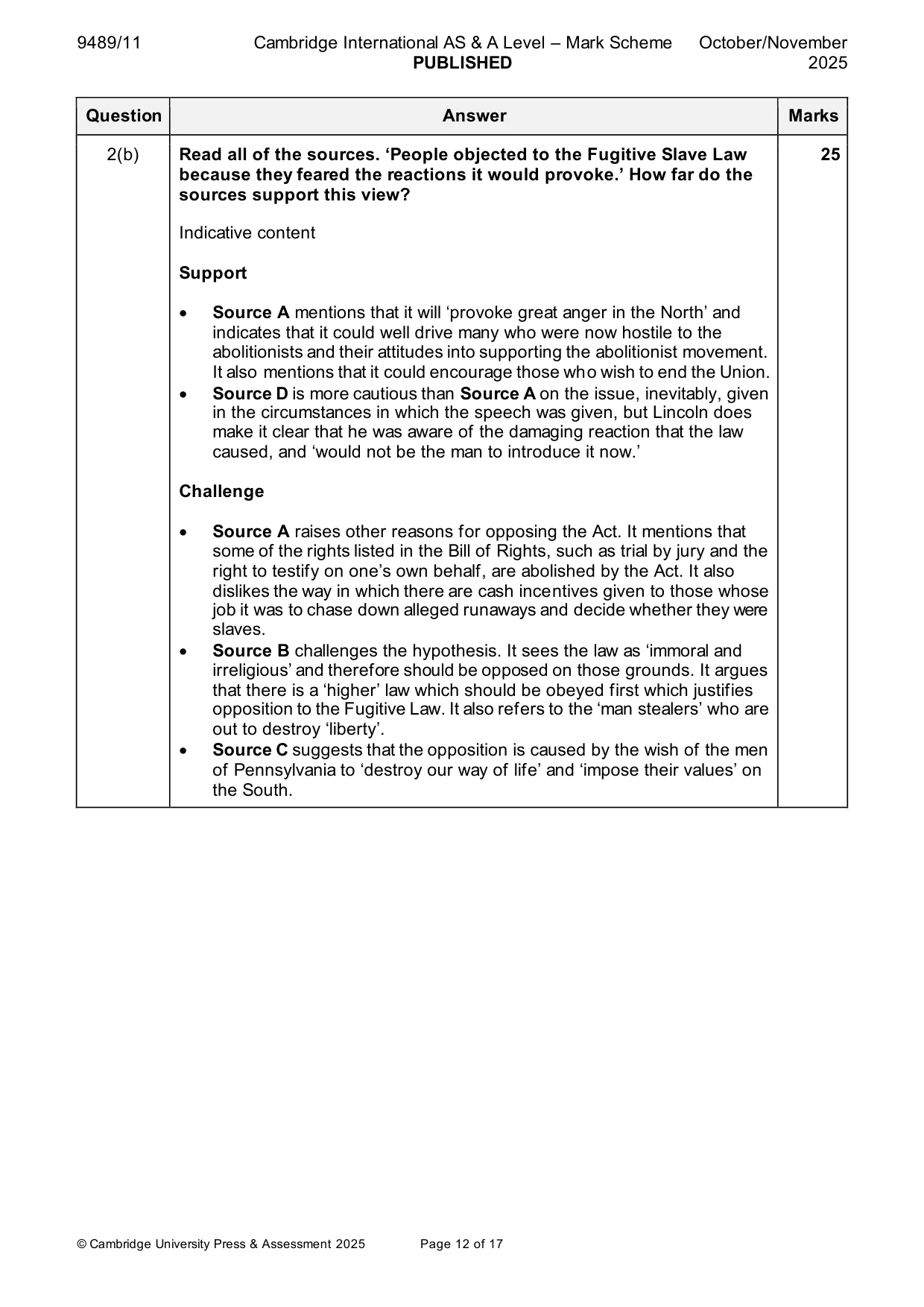
9489/11 Cambridge International AS & A Level – Mark Scheme PUBLISHED October/November 2025 © Cambridge University Press & Assessment 2025 Page 12 of 17 Question Answer Marks 2(b) Read all of the sources. ‘People objected to the Fugitive Slave Law because they feared the reactions it would provoke.’ How far do the sources support this view? Indicative content Support • Source A mentions that it will ‘provoke great anger in the North’ and indicates that it could well drive many who were now hostile to the abolitionists and their attitudes into supporting the abolitionist movement. It also mentions that it could encourage those who wish to end the Union. • Source D is more cautious than Source A on the issue, inevitably, given in the circumstances in which the speech was given, but Lincoln does make it clear that he was aware of the damaging reaction that the law caused, and ‘would not be the man to introduce it now.’ Challenge • Source A raises other reasons for opposing the Act. It mentions that some of the rights listed in the Bill of Rights, such as trial by jury and the right to testify on one’s own behalf, are abolished by the Act. It also dislikes the way in which there are cash incentives given to those whose job it was to chase down alleged runaways and decide whether they were slaves. • Source B challenges the hypothesis. It sees the law as ‘immoral and irreligious’ and therefore should be opposed on those grounds. It argues that there is a ‘higher’ law which should be obeyed first which justifies opposition to the Fugitive Law. It also refers to the ‘man stealers’ who are out to destroy ‘liberty’. • Source C suggests that the opposition is caused by the wish of the men of Pennsylvania to ‘destroy our way of life’ and ‘impose their values’ on the South. 25
Mark scheme, page 13
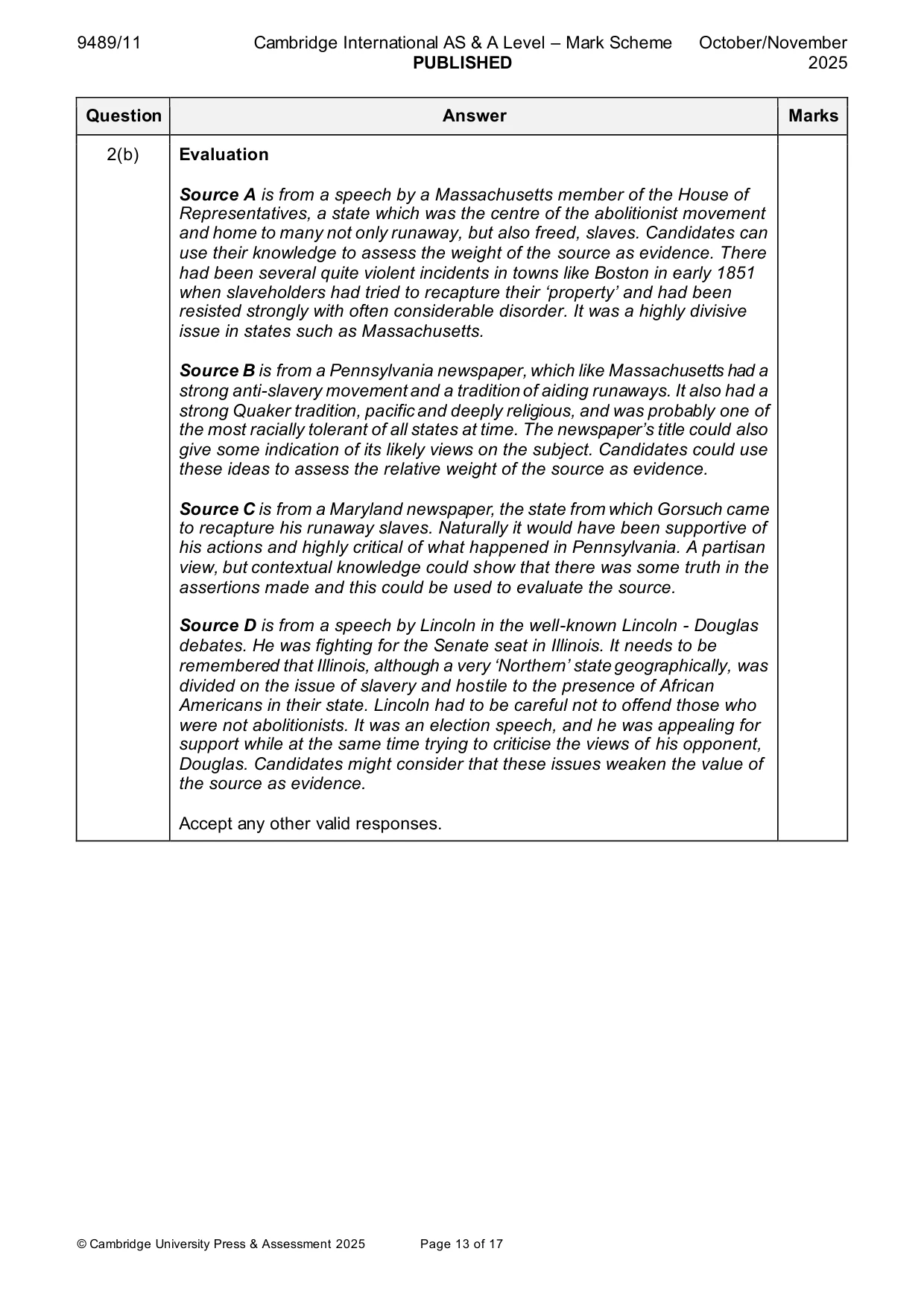
9489/11 Cambridge International AS & A Level – Mark Scheme PUBLISHED October/November 2025 © Cambridge University Press & Assessment 2025 Page 13 of 17 Question Answer Marks 2(b) Evaluation Source A is from a speech by a Massachusetts member of the House of Representatives, a state which was the centre of the abolitionist movement and home to many not only runaway, but also freed, slaves. Candidates can use their knowledge to assess the weight of the source as evidence. There had been several quite violent incidents in towns like Boston in early 1851 when slaveholders had tried to recapture their ‘property’ and had been resisted strongly with often considerable disorder. It was a highly divisive issue in states such as Massachusetts. Source B is from a Pennsylvania newspaper, which like Massachusetts had a strong anti-slavery movement and a tradition of aiding runaways. It also had a strong Quaker tradition, pacific and deeply religious, and was probably one of the most racially tolerant of all states at time. The newspaper’s title could also give some indication of its likely views on the subject. Candidates could use these ideas to assess the relative weight of the source as evidence. Source C is from a Maryland newspaper, the state from which Gorsuch came to recapture his runaway slaves. Naturally it would have been supportive of his actions and highly critical of what happened in Pennsylvania. A partisan view, but contextual knowledge could show that there was some truth in the assertions made and this could be used to evaluate the source. Source D is from a speech by Lincoln in the well-known Lincoln - Douglas debates. He was fighting for the Senate seat in Illinois. It needs to be remembered that Illinois, although a very ‘Northern’ state geographically, was divided on the issue of slavery and hostile to the presence of African Americans in their state. Lincoln had to be careful not to offend those who were not abolitionists. It was an election speech, and he was appealing for support while at the same time trying to criticise the views of his opponent, Douglas. Candidates might consider that these issues weaken the value of the source as evidence. Accept any other valid responses.
Mark scheme, page 14
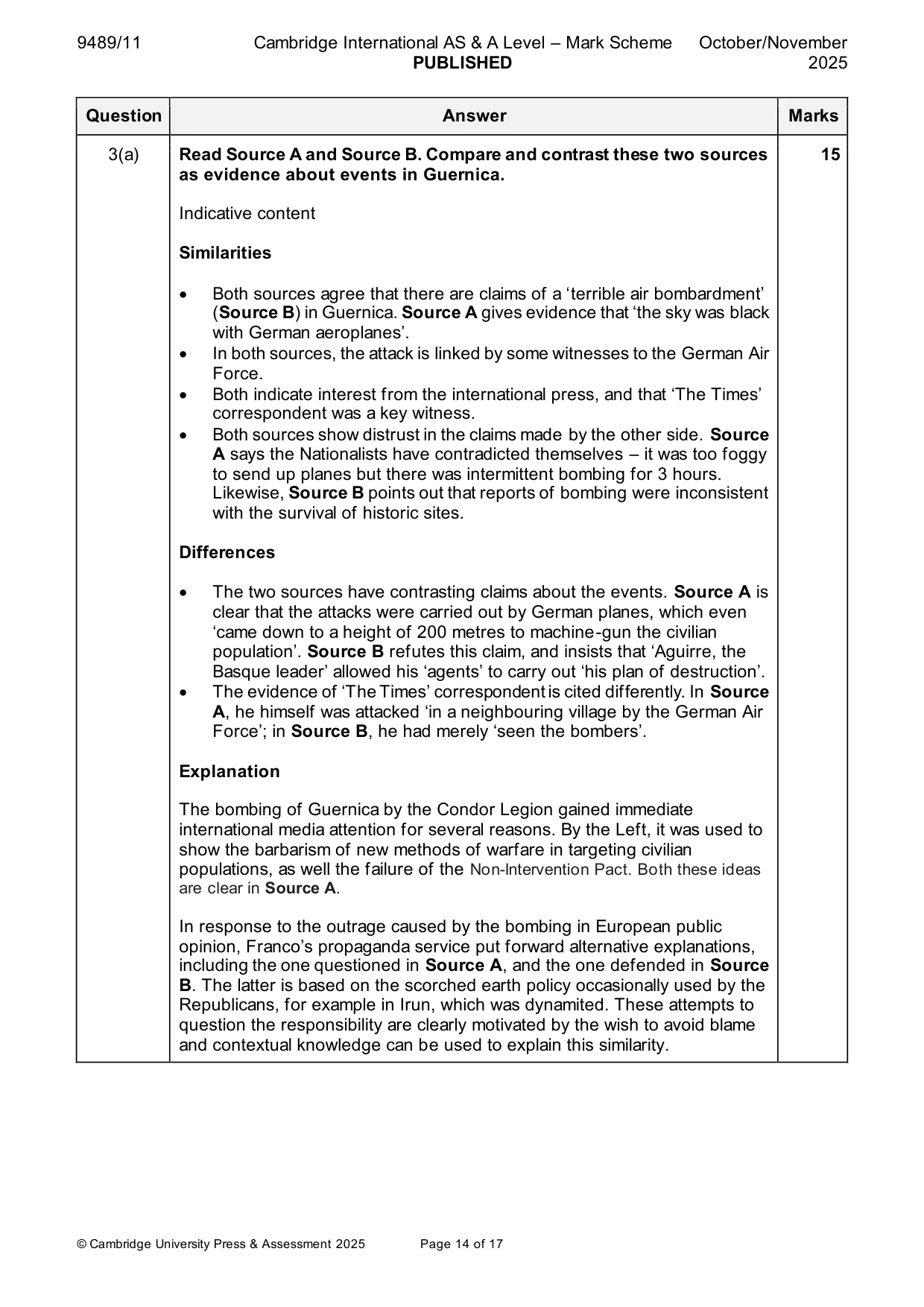
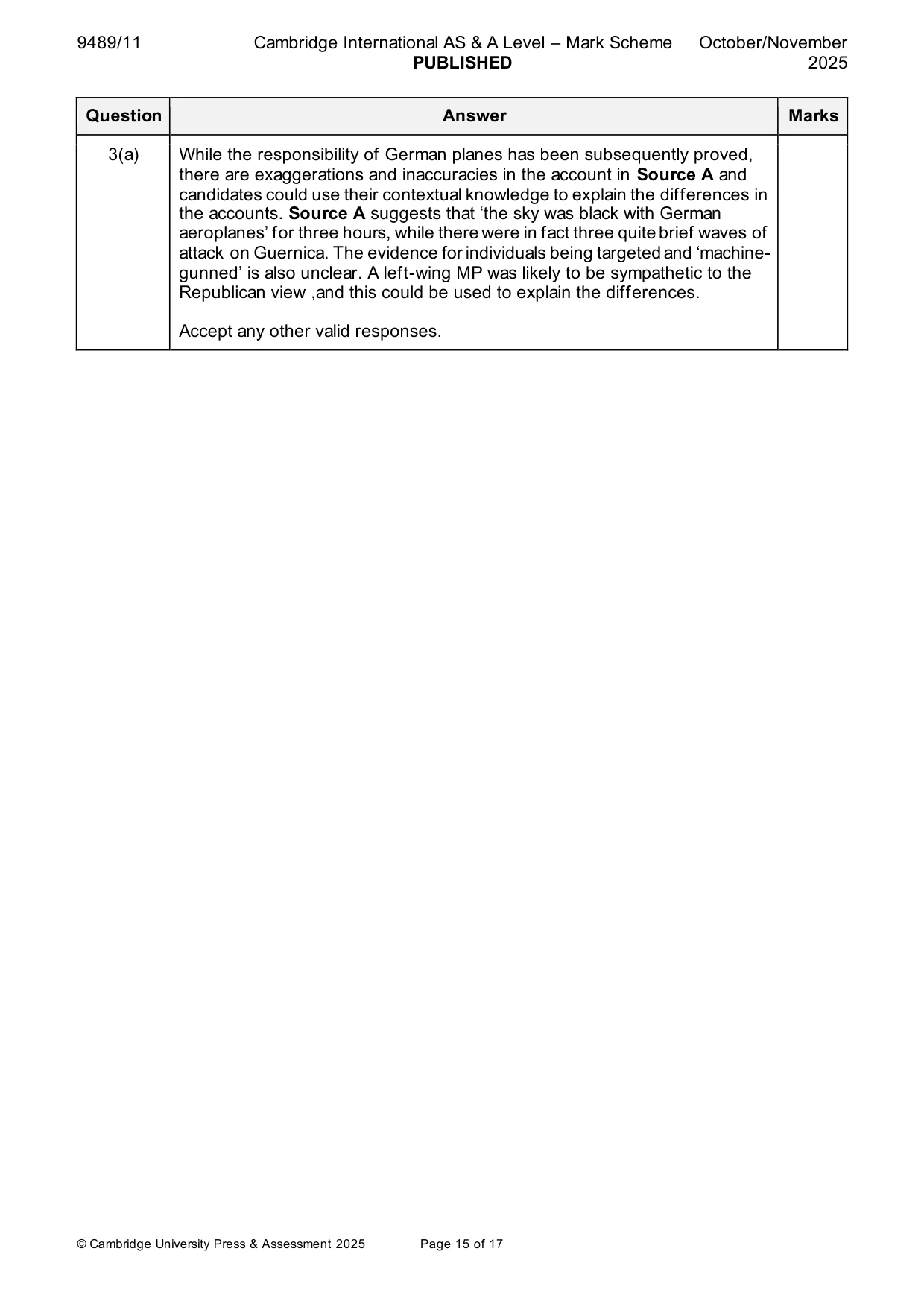
9489/11 Cambridge International AS & A Level – Mark Scheme PUBLISHED October/November 2025 © Cambridge University Press & Assessment 2025 Page 14 of 17 Question Answer Marks 3(a) Read Source A and Source B. Compare and contrast these two sources as evidence about events in Guernica. Indicative content Similarities • Both sources agree that there are claims of a ‘terrible air bombardment’ (Source B) in Guernica. Source A gives evidence that ‘the sky was black with German aeroplanes’. • In both sources, the attack is linked by some witnesses to the German Air Force. • Both indicate interest from the international press, and that ‘The Times’ correspondent was a key witness. • Both sources show distrust in the claims made by the other side. Source A says the Nationalists have contradicted themselves – it was too foggy to send up planes but there was intermittent bombing for 3 hours. Likewise, Source B points out that reports of bombing were inconsistent with the survival of historic sites. Differences • The two sources have contrasting claims about the events. Source A is clear that the attacks were carried out by German planes, which even ‘came down to a height of 200 metres to machine-gun the civilian population’. Source B refutes this claim, and insists that ‘Aguirre, the Basque leader’ allowed his ‘agents’ to carry out ‘his plan of destruction’. • The evidence of ‘The Times’ correspondent is cited differently. In Source A, he himself was attacked ‘in a neighbouring village by the German Air Force’; in Source B, he had merely ‘seen the bombers’. Explanation The bombing of Guernica by the Condor Legion gained immediate international media attention for several reasons. By the Left, it was used to show the barbarism of new methods of warfare in targeting civilian populations, as well the failure of the Non-Intervention Pact. Both these ideas are clear in Source A. In response to the outrage caused by the bombing in European public opinion, Franco’s propaganda service put forward alternative explanations, including the one questioned in Source A, and the one defended in Source B. The latter is based on the scorched earth policy occasionally used by the Republicans, for example in Irun, which was dynamited. These attempts to question the responsibility are clearly motivated by the wish to avoid blame and contextual knowledge can be used to explain this similarity. 15
Mark scheme, page 15
9489/11 Cambridge International AS & A Level – Mark Scheme PUBLISHED October/November 2025 © Cambridge University Press & Assessment 2025 Page 15 of 17 Question Answer Marks 3(a) While the responsibility of German planes has been subsequently proved, there are exaggerations and inaccuracies in the account in Source A and candidates could use their contextual knowledge to explain the differences in the accounts. Source A suggests that ‘the sky was black with German aeroplanes’ for three hours, while there were in fact three quite brief waves of attack on Guernica. The evidence for individuals being targeted and ‘machine- gunned’ is also unclear. A left-wing MP was likely to be sympathetic to the Republican view ,and this could be used to explain the differences. Accept any other valid responses.
Mark scheme, page 16
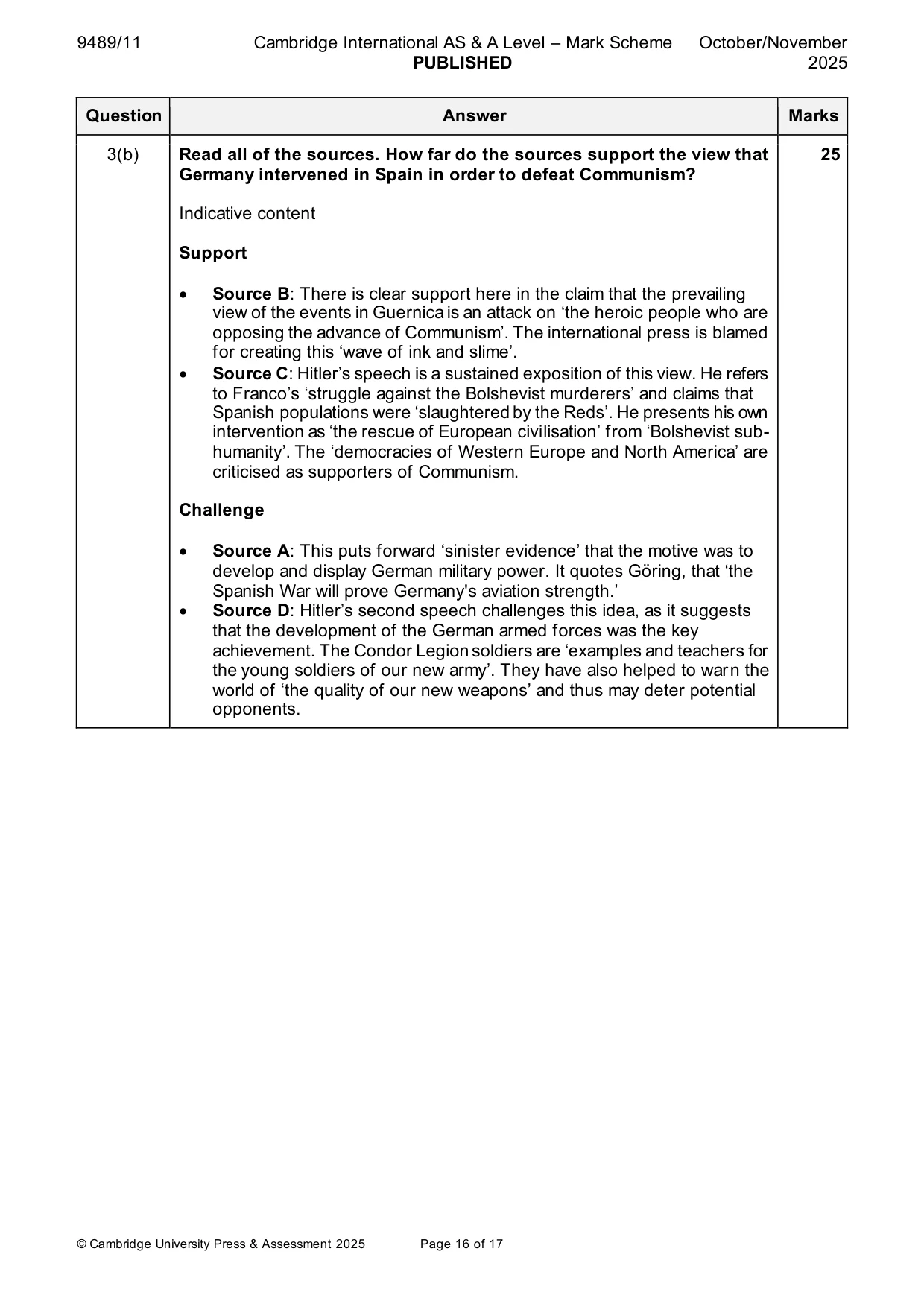
9489/11 Cambridge International AS & A Level – Mark Scheme PUBLISHED October/November 2025 © Cambridge University Press & Assessment 2025 Page 16 of 17 Question Answer Marks 3(b) Read all of the sources. How far do the sources support the view that Germany intervened in Spain in order to defeat Communism? Indicative content Support • Source B: There is clear support here in the claim that the prevailing view of the events in Guernica is an attack on ‘the heroic people who are opposing the advance of Communism’. The international press is blamed for creating this ‘wave of ink and slime’. • Source C: Hitler’s speech is a sustained exposition of this view. He refers to Franco’s ‘struggle against the Bolshevist murderers’ and claims that Spanish populations were ‘slaughtered by the Reds’. He presents his own intervention as ‘the rescue of European civilisation’ from ‘Bolshevist sub- humanity’. The ‘democracies of Western Europe and North America’ are criticised as supporters of Communism. Challenge • Source A: This puts forward ‘sinister evidence’ that the motive was to develop and display German military power. It quotes Göring, that ‘the Spanish War will prove Germany's aviation strength.’ • Source D: Hitler’s second speech challenges this idea, as it suggests that the development of the German armed forces was the key achievement. The Condor Legion soldiers are ‘examples and teachers for the young soldiers of our new army’. They have also helped to warn the world of ‘the quality of our new weapons’ and thus may deter potential opponents. 25
Mark scheme, page 17
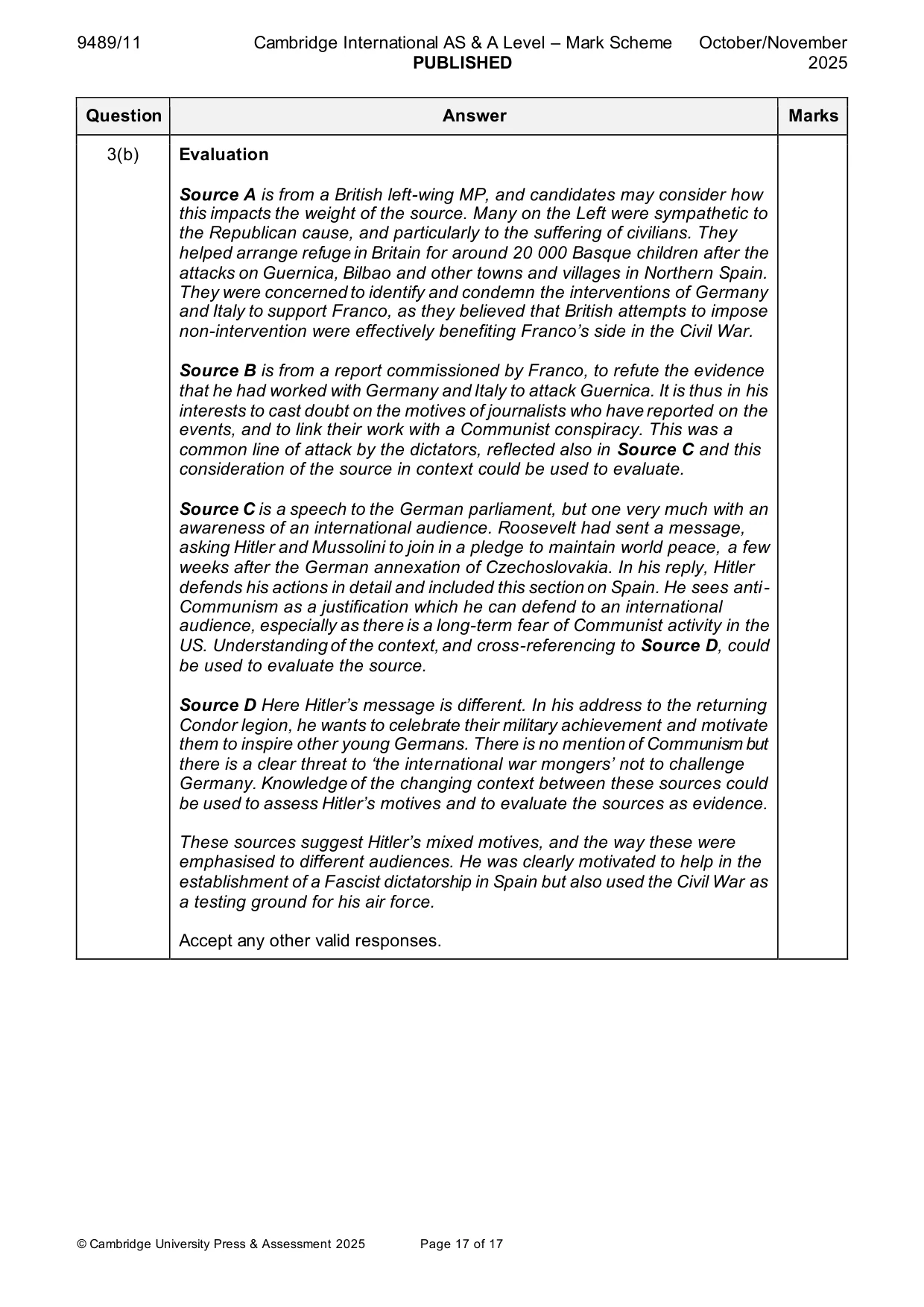
9489/11 Cambridge International AS & A Level – Mark Scheme PUBLISHED October/November 2025 © Cambridge University Press & Assessment 2025 Page 17 of 17 Question Answer Marks 3(b) Evaluation Source A is from a British left-wing MP, and candidates may consider how this impacts the weight of the source. Many on the Left were sympathetic to the Republican cause, and particularly to the suffering of civilians. They helped arrange refuge in Britain for around 20 000 Basque children after the attacks on Guernica, Bilbao and other towns and villages in Northern Spain. They were concerned to identify and condemn the interventions of Germany and Italy to support Franco, as they believed that British attempts to impose non-intervention were effectively benefiting Franco’s side in the Civil War. Source B is from a report commissioned by Franco, to refute the evidence that he had worked with Germany and Italy to attack Guernica. It is thus in his interests to cast doubt on the motives of journalists who have reported on the events, and to link their work with a Communist conspiracy. This was a common line of attack by the dictators, reflected also in Source C and this consideration of the source in context could be used to evaluate. Source C is a speech to the German parliament, but one very much with an awareness of an international audience. Roosevelt had sent a message, asking Hitler and Mussolini to join in a pledge to maintain world peace, a few weeks after the German annexation of Czechoslovakia. In his reply, Hitler defends his actions in detail and included this section on Spain. He sees anti- Communism as a justification which he can defend to an international audience, especially as there is a long-term fear of Communist activity in the US. Understanding of the context, and cross-referencing to Source D, could be used to evaluate the source. Source D Here Hitler’s message is different. In his address to the returning Condor legion, he wants to celebrate their military achievement and motivate them to inspire other young Germans. There is no mention of Communism but there is a clear threat to ‘the international war mongers’ not to challenge Germany. Knowledge of the changing context between these sources could be used to assess Hitler’s motives and to evaluate the sources as evidence. These sources suggest Hitler’s mixed motives, and the way these were emphasised to different audiences. He was clearly motivated to help in the establishment of a Fascist dictatorship in Spain but also used the Civil War as a testing ground for his air force. Accept any other valid responses.
What you needed in this session
Cambridge’s own grade thresholds for 2025 Oct/Nov, Paper 1 · Variant 1. A higher threshold means an easier paper — the bar moves with how the cohort did.