Cambridge A Level History 9489 — 2025 Oct/Nov Paper 1 · Variant 2
9489/12/O/N/25 · 40 marks · ≈45 min
The question paper and its mark scheme, free to read here and free to download. This is Cambridge’s own paper, exactly as it was sat.
Question paper8 pages

Mark scheme15 pages
Answers below. Sit the paper first if you are practising.
Paper as text
Question paper, page 1
[Turn over Cambridge International AS & A Level DC (WW/CGW) 342935/1 © UCLES 2025 This document has 8 pages. Any blank pages are indicated. * 4 7 6 1 0 7 6 8 7 7 * HISTORY 9489/12 Paper 1 Document Question October/November 2025 1 hour 15 minutes You must answer on the enclosed answer booklet. You will need: Answer booklet (enclosed) INSTRUCTIONS ● Answer one question from one section only. Section A: European option Section B: American option Section C: International option ● Follow the instructions on the front cover of the answer booklet. If you need additional answer paper, ask the invigilator for a continuation booklet. INFORMATION ● The total mark for this paper is 40. ● The number of marks for each question or part question is shown in brackets [ ].
Question paper, page 2
2 9489/12/O/N/25 © UCLES 2025 Answer one question from one section only. Section A: European option Liberalism and nationalism in Germany, 1815–71 1 Read the sources and then answer both parts of the question. Source A From various platforms, moving speeches were made representing the sad condition of Germany and its insignificance in the council of European nations. The depression in trade and commerce is caused by the division into thirty‑eight states, with different laws, different currencies and customs borders surrounding every state. All this is owing to the lack of national union. Speakers complained of the pressure which Austria and Prussia exercised over the German Diet at Frankfurt. Even liberal‑minded princes are forced to adopt unconstitutional and illegal measures. Bruggemann, whose speech was one of the most eloquent, addressed the meeting as the representative of German youth which, in spite of criminal persecution, has kept the idea of the liberty and unity of the Fatherland alive. An account of the Hambach Festival in 1832. It was by a radical lawyer who had been a member of a student nationalist society and was involved in the events depicted in Source C. Source B No newspaper containing political content, written in German, and published in a state not belonging to the German Confederation, may be distributed in a member state without prior approval of the government. Proceedings will be taken against the distributors of prohibited published writings. Popular assemblies and festivals, whose time and place were previously neither customary nor permitted, may not take place, no matter under what name and to what purpose, without prior approval of the competent authority. Even at permitted popular assemblies, public speeches with political content will not be tolerated. Police surveillance will be carried out on all local residents who have made known at any time, through public speeches, writings, or actions, their revolutionary activities. The resolutions of September 1819 concerning disciplinary measures towards student political societies in the universities, will be unfailingly applied. From the Ten Articles, issued by Austrian Chancellor Metternich, July 1832, to be enforced throughout the German Confederation.
Question paper, page 3
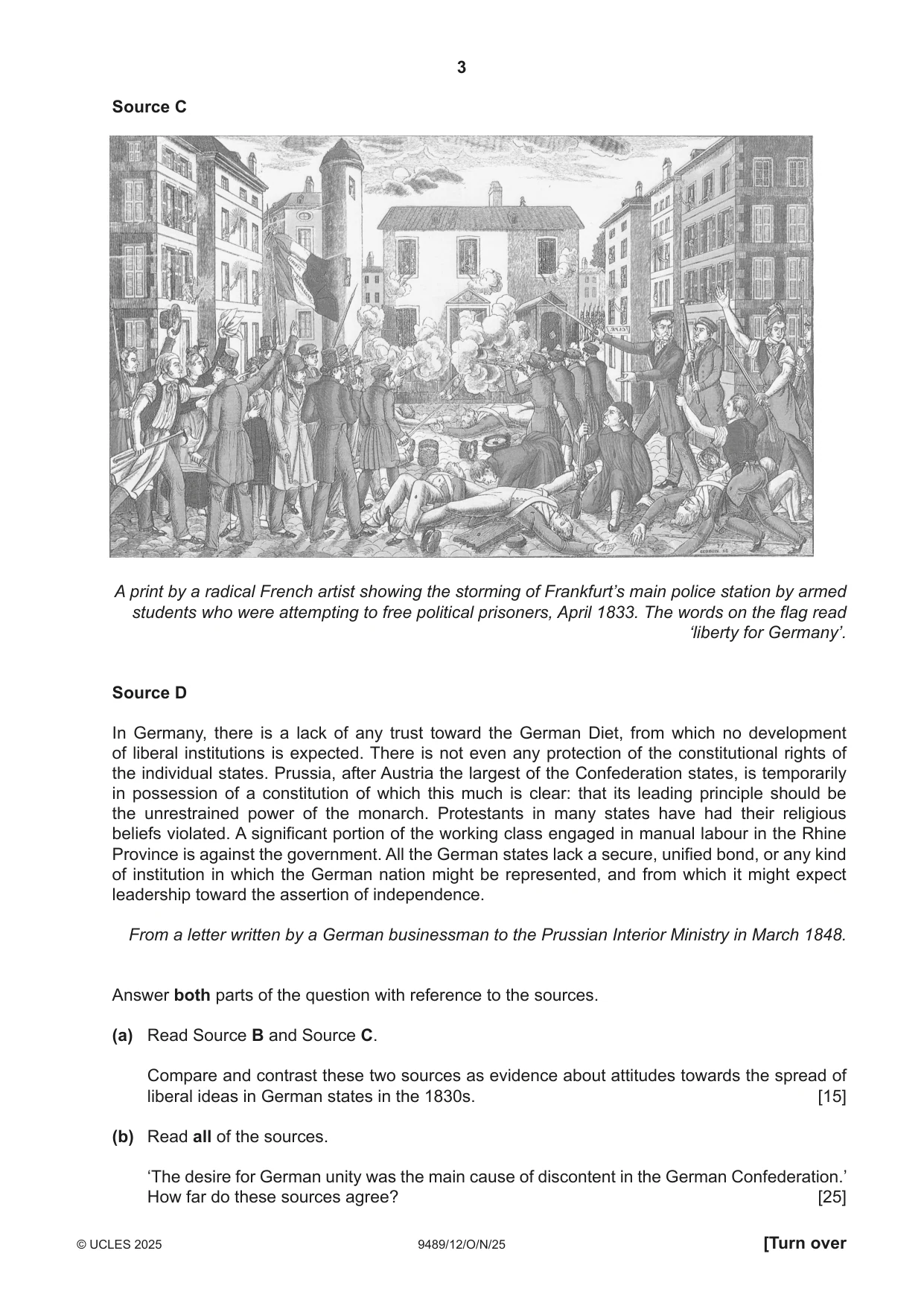
3 9489/12/O/N/25 © UCLES 2025 [Turn over Source C A print by a radical French artist showing the storming of Frankfurt’s main police station by armed students who were attempting to free political prisoners, April 1833. The words on the flag read ‘liberty for Germany’. Source D In Germany, there is a lack of any trust toward the German Diet, from which no development of liberal institutions is expected. There is not even any protection of the constitutional rights of the individual states. Prussia, after Austria the largest of the Confederation states, is temporarily in possession of a constitution of which this much is clear: that its leading principle should be the unrestrained power of the monarch. Protestants in many states have had their religious beliefs violated. A significant portion of the working class engaged in manual labour in the Rhine Province is against the government. All the German states lack a secure, unified bond, or any kind of institution in which the German nation might be represented, and from which it might expect leadership toward the assertion of independence. From a letter written by a German businessman to the Prussian Interior Ministry in March 1848. Answer both parts of the question with reference to the sources. (a) Read Source B and Source C. Compare and contrast these two sources as evidence about attitudes towards the spread of liberal ideas in German states in the 1830s. [15] (b) Read all of the sources. ‘The desire for German unity was the main cause of discontent in the German Confederation.’ How far do these sources agree? [25]
Question paper, page 4
4 9489/12/O/N/25 © UCLES 2025 Section B: American option The origins of the Civil War, 1820–61. 2 Read the sources and then answer both parts of the question. Source A I believe that the Republicans are a party of ethnic hatred and cultural tyranny. Much of their support comes from anti‑immigrant extremists. I see the Republican Party as similar to another party that has emerged recently, the anti‑immigrant, anti‑Catholic party, better known as the Know‑Nothings. Both aim to exclude the foreign‑born from political life in the United States. I see Abolitionism, Know‑Nothingism and Republicanism and all other ‘isms’ to be in alliance. The growth of Republicanism demonstrates the powerful influence of sheer prejudice in much of the northern electorate. We must end our own destructive divisions and unite to defeat this new and growing force. From a letter by Stephen Douglas to a leading Southern Democrat, October 1858. Source B Despite the fact that this new party is one of dishonourable coalitions, shallow expediency and bad leadership by dishonest politicians, it should still be a success. Their Philadelphia Platform of 1856 is to be praised as a statement of essential truths. They did not turn a deaf ear to the millions of blacks in chains. They supported the beliefs of our Founding Fathers and argued that slavery and freedom cannot exist together under the Constitution. They laid down a few clear principles and proposed a few practical measures. These were sufficiently broad for all anti‑slavery men, as well as those who were wary of the idea of emancipation of black people, to agree on. They therefore deserve my support and I now stand with the Republican Party. From a speech by a member of the House of Representatives from Pennsylvania, who had been a member of both the Whig and the Free‑Soil parties, October 1858. Source C In the past I felt that southern slaves were happier and better off than the free black people in the North. I also considered the principles of the abolitionists false, foolish, wicked and unchristian. However, since the brutal attack on Senator Sumner on the floor of the Senate, which has left him near death, by a supporter of slavery, I have reconsidered my views. I fear the shameless brutality of the Southern aristocratic slave‑owners may drive me into not only abolitionism but also into supporting the Republican ticket. The barbarism demonstrated by the Fugitive Slave Law has also driven me into this view. I now see Southern slavery as the greatest crime of modern history. My feelings go out to those men and women who are enslaved. Emancipation should be the outcome, together with the rights and privileges that accompany citizenship of this country. I will join with the angry working class of the North who are arming against an arrogant Southern aristocracy, and contribute to, and vote for, the Republican Party. From the private diary of a prominent New York lawyer, August 1859.
Question paper, page 5
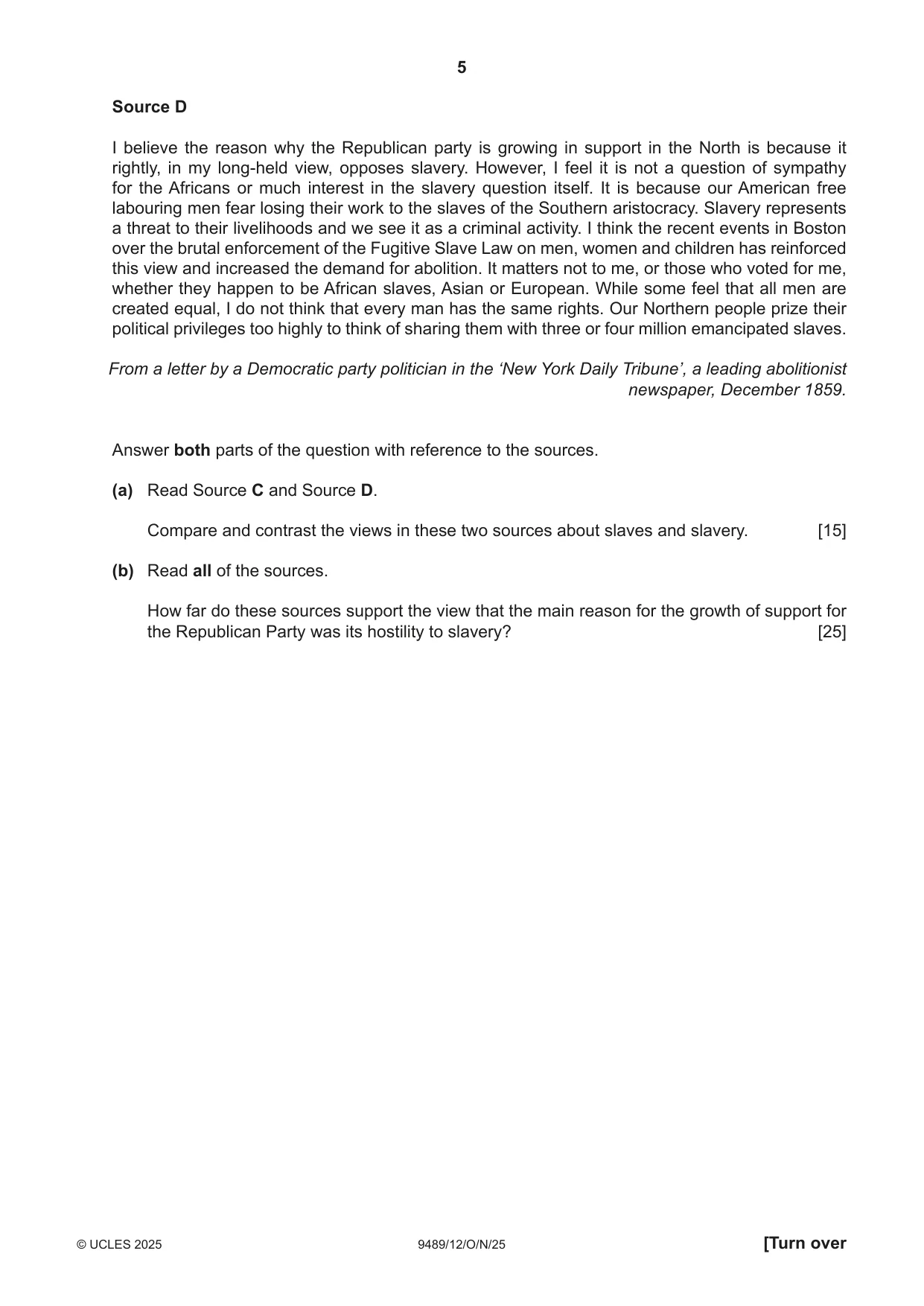
5 9489/12/O/N/25 © UCLES 2025 [Turn over Source D I believe the reason why the Republican party is growing in support in the North is because it rightly, in my long‑held view, opposes slavery. However, I feel it is not a question of sympathy for the Africans or much interest in the slavery question itself. It is because our American free labouring men fear losing their work to the slaves of the Southern aristocracy. Slavery represents a threat to their livelihoods and we see it as a criminal activity. I think the recent events in Boston over the brutal enforcement of the Fugitive Slave Law on men, women and children has reinforced this view and increased the demand for abolition. It matters not to me, or those who voted for me, whether they happen to be African slaves, Asian or European. While some feel that all men are created equal, I do not think that every man has the same rights. Our Northern people prize their political privileges too highly to think of sharing them with three or four million emancipated slaves. From a letter by a Democratic party politician in the ‘New York Daily Tribune’, a leading abolitionist newspaper, December 1859. Answer both parts of the question with reference to the sources. (a) Read Source C and Source D. Compare and contrast the views in these two sources about slaves and slavery. [15] (b) Read all of the sources. How far do these sources support the view that the main reason for the growth of support for the Republican Party was its hostility to slavery? [25]
Question paper, page 6
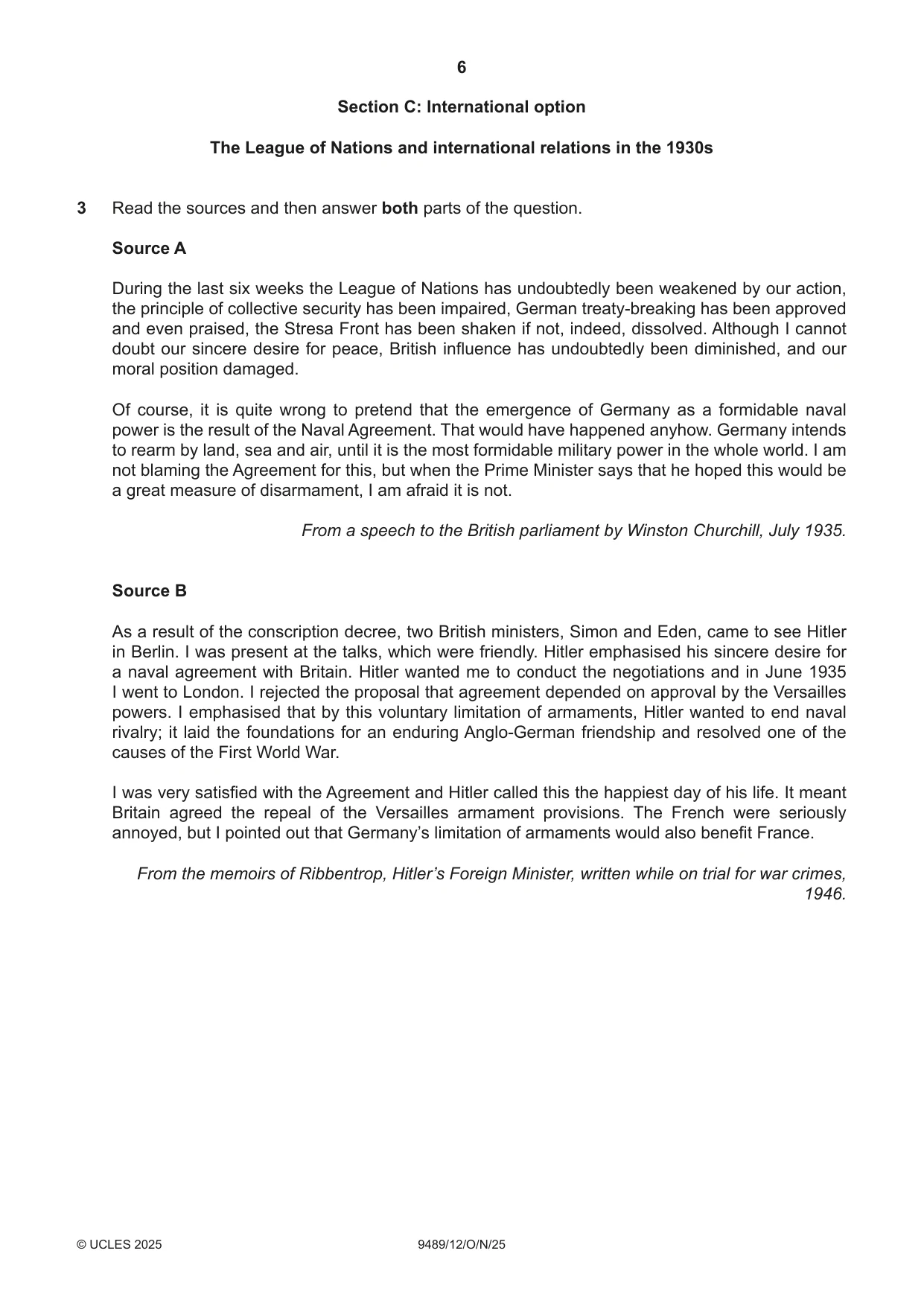
6 9489/12/O/N/25 © UCLES 2025 Section C: International option The League of Nations and international relations in the 1930s 3 Read the sources and then answer both parts of the question. Source A During the last six weeks the League of Nations has undoubtedly been weakened by our action, the principle of collective security has been impaired, German treaty‑breaking has been approved and even praised, the Stresa Front has been shaken if not, indeed, dissolved. Although I cannot doubt our sincere desire for peace, British influence has undoubtedly been diminished, and our moral position damaged. Of course, it is quite wrong to pretend that the emergence of Germany as a formidable naval power is the result of the Naval Agreement. That would have happened anyhow. Germany intends to rearm by land, sea and air, until it is the most formidable military power in the whole world. I am not blaming the Agreement for this, but when the Prime Minister says that he hoped this would be a great measure of disarmament, I am afraid it is not. From a speech to the British parliament by Winston Churchill, July 1935. Source B As a result of the conscription decree, two British ministers, Simon and Eden, came to see Hitler in Berlin. I was present at the talks, which were friendly. Hitler emphasised his sincere desire for a naval agreement with Britain. Hitler wanted me to conduct the negotiations and in June 1935 I went to London. I rejected the proposal that agreement depended on approval by the Versailles powers. I emphasised that by this voluntary limitation of armaments, Hitler wanted to end naval rivalry; it laid the foundations for an enduring Anglo‑German friendship and resolved one of the causes of the First World War. I was very satisfied with the Agreement and Hitler called this the happiest day of his life. It meant Britain agreed the repeal of the Versailles armament provisions. The French were seriously annoyed, but I pointed out that Germany’s limitation of armaments would also benefit France. From the memoirs of Ribbentrop, Hitler’s Foreign Minister, written while on trial for war crimes, 1946.
Question paper, page 7
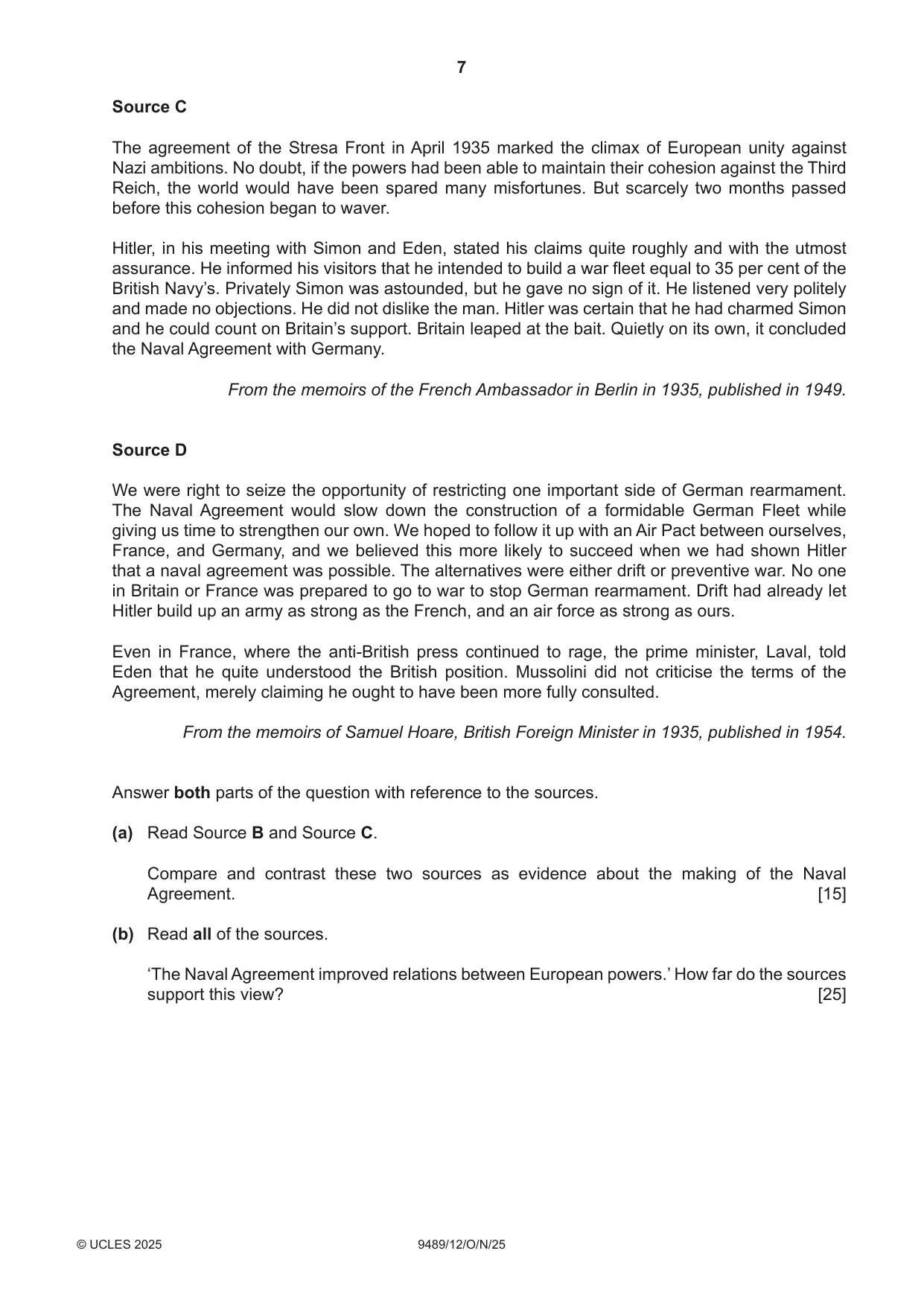
7 9489/12/O/N/25 © UCLES 2025 Source C The agreement of the Stresa Front in April 1935 marked the climax of European unity against Nazi ambitions. No doubt, if the powers had been able to maintain their cohesion against the Third Reich, the world would have been spared many misfortunes. But scarcely two months passed before this cohesion began to waver. Hitler, in his meeting with Simon and Eden, stated his claims quite roughly and with the utmost assurance. He informed his visitors that he intended to build a war fleet equal to 35 per cent of the British Navy’s. Privately Simon was astounded, but he gave no sign of it. He listened very politely and made no objections. He did not dislike the man. Hitler was certain that he had charmed Simon and he could count on Britain’s support. Britain leaped at the bait. Quietly on its own, it concluded the Naval Agreement with Germany. From the memoirs of the French Ambassador in Berlin in 1935, published in 1949. Source D We were right to seize the opportunity of restricting one important side of German rearmament. The Naval Agreement would slow down the construction of a formidable German Fleet while giving us time to strengthen our own. We hoped to follow it up with an Air Pact between ourselves, France, and Germany, and we believed this more likely to succeed when we had shown Hitler that a naval agreement was possible. The alternatives were either drift or preventive war. No one in Britain or France was prepared to go to war to stop German rearmament. Drift had already let Hitler build up an army as strong as the French, and an air force as strong as ours. Even in France, where the anti‑British press continued to rage, the prime minister, Laval, told Eden that he quite understood the British position. Mussolini did not criticise the terms of the Agreement, merely claiming he ought to have been more fully consulted. From the memoirs of Samuel Hoare, British Foreign Minister in 1935, published in 1954. Answer both parts of the question with reference to the sources. (a) Read Source B and Source C. Compare and contrast these two sources as evidence about the making of the Naval Agreement. [15] (b) Read all of the sources. ‘The Naval Agreement improved relations between European powers.’ How far do the sources support this view? [25]
Question paper, page 8
8 9489/12/O/N/25 © UCLES 2025 Permission to reproduce items where third‑party owned material protected by copyright is included has been sought and cleared where possible. Every reasonable effort has been made by the publisher (UCLES) to trace copyright holders, but if any items requiring clearance have unwittingly been included, the publisher will be pleased to make amends at the earliest possible opportunity. To avoid the issue of disclosure of answer‑related information to candidates, all copyright acknowledgements are reproduced online in the Cambridge Assessment International Education Copyright Acknowledgements Booklet. This is produced for each series of examinations and is freely available to download at www.cambridgeinternational.org after the live examination series. Cambridge Assessment International Education is part of Cambridge Assessment. Cambridge Assessment is the brand name of the University of Cambridge Local Examinations Syndicate (UCLES), which is a department of the University of Cambridge. BLANK PAGE
Mark scheme, page 1
This document consists of 15 printed pages. © Cambridge University Press & Assessment 2025 [Turn over Cambridge International AS & A Level HISTORY 9489/12 Paper 1 Document Question October/November 2025 MARK SCHEME Maximum Mark: 40 Published This mark scheme is published as an aid to teachers and candidates, to indicate the requirements of the examination. It shows the basis on which Examiners were instructed to award marks. It does not indicate the details of the discussions that took place at an Examiners’ meeting before marking began, which would have considered the acceptability of alternative answers. Mark schemes should be read in conjunction with the question paper and the Principal Examiner Report for Teachers. Cambridge International will not enter into discussions about these mark schemes. Cambridge International is publishing the mark schemes for the October/November 2025 series for most Cambridge IGCSE, Cambridge International A and AS Level components, and some Cambridge O Level components.
Mark scheme, page 2
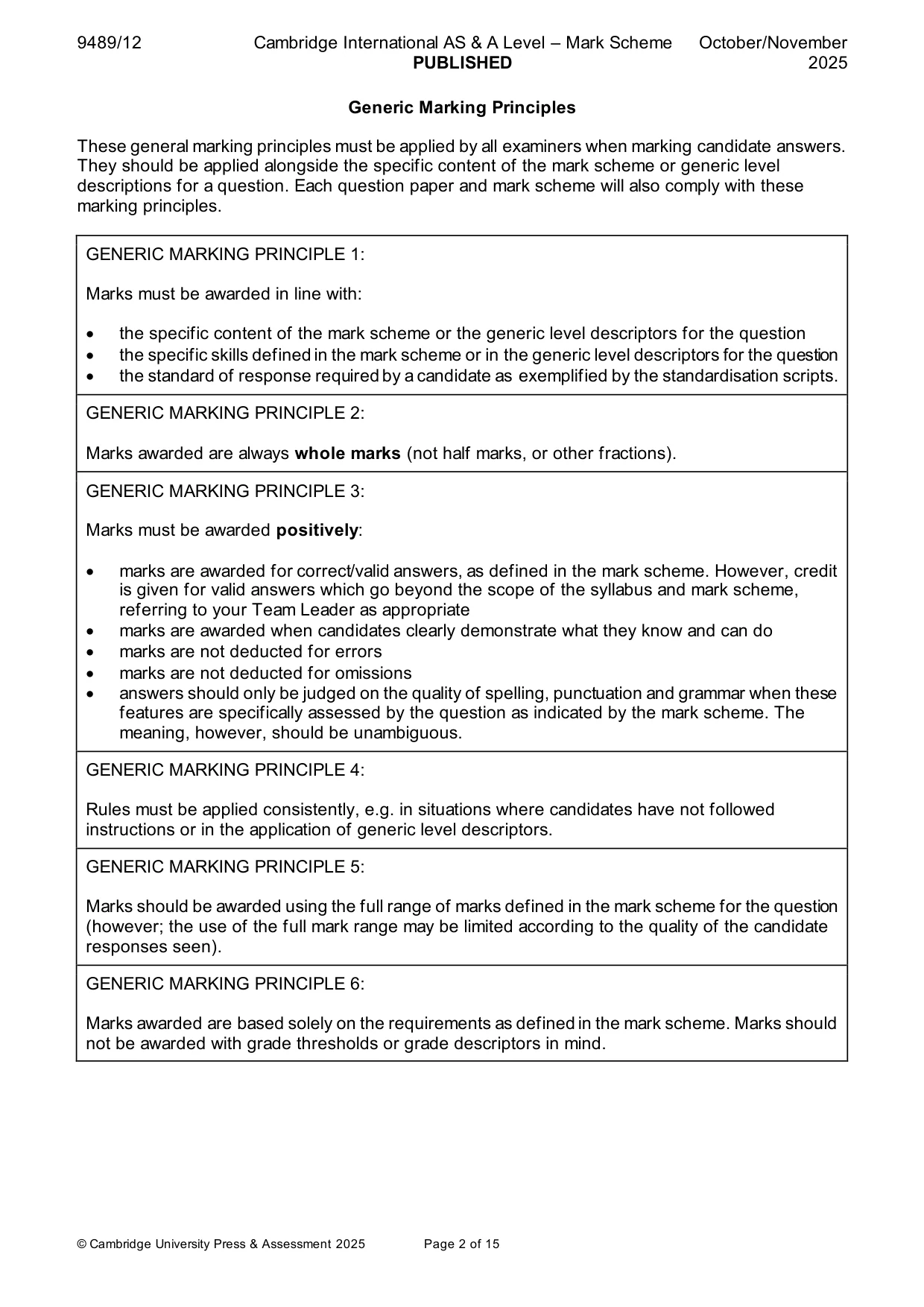
9489/12 Cambridge International AS & A Level – Mark Scheme PUBLISHED October/November 2025 © Cambridge University Press & Assessment 2025 Page 2 of 15 Generic Marking Principles These general marking principles must be applied by all examiners when marking candidate answers. They should be applied alongside the specific content of the mark scheme or generic level descriptions for a question. Each question paper and mark scheme will also comply with these marking principles. GENERIC MARKING PRINCIPLE 1: Marks must be awarded in line with: • the specific content of the mark scheme or the generic level descriptors for the question • the specific skills defined in the mark scheme or in the generic level descriptors for the question • the standard of response required by a candidate as exemplified by the standardisation scripts. GENERIC MARKING PRINCIPLE 2: Marks awarded are always whole marks (not half marks, or other fractions). GENERIC MARKING PRINCIPLE 3: Marks must be awarded positively: • marks are awarded for correct/valid answers, as defined in the mark scheme. However, credit is given for valid answers which go beyond the scope of the syllabus and mark scheme, referring to your Team Leader as appropriate • marks are awarded when candidates clearly demonstrate what they know and can do • marks are not deducted for errors • marks are not deducted for omissions • answers should only be judged on the quality of spelling, punctuation and grammar when these features are specifically assessed by the question as indicated by the mark scheme. The meaning, however, should be unambiguous. GENERIC MARKING PRINCIPLE 4: Rules must be applied consistently, e.g. in situations where candidates have not followed instructions or in the application of generic level descriptors. GENERIC MARKING PRINCIPLE 5: Marks should be awarded using the full range of marks defined in the mark scheme for the question (however; the use of the full mark range may be limited according to the quality of the candidate responses seen). GENERIC MARKING PRINCIPLE 6: Marks awarded are based solely on the requirements as defined in the mark scheme. Marks should not be awarded with grade thresholds or grade descriptors in mind.
Mark scheme, page 3
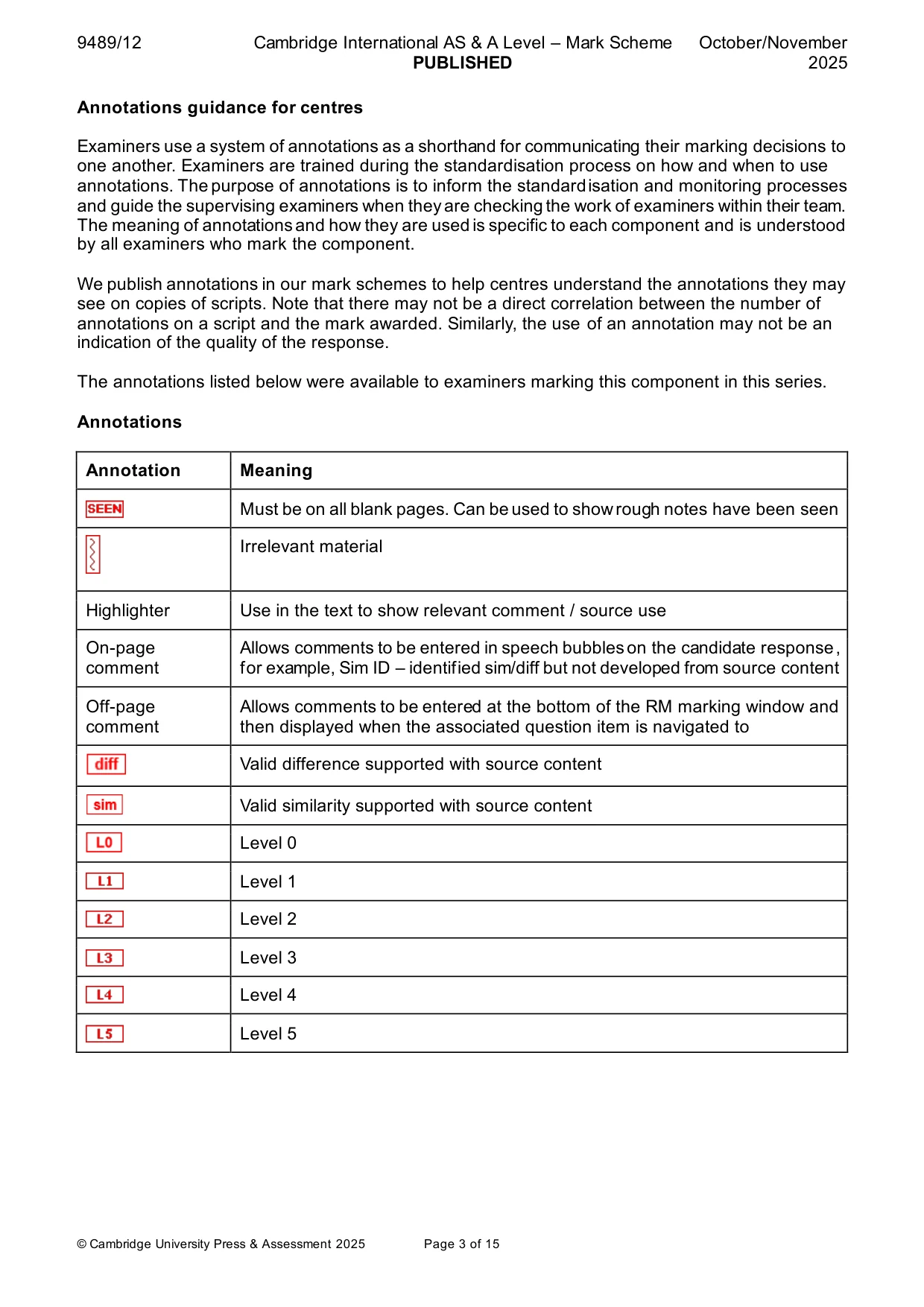
9489/12 Cambridge International AS & A Level – Mark Scheme PUBLISHED October/November 2025 © Cambridge University Press & Assessment 2025 Page 3 of 15 Annotations guidance for centres Examiners use a system of annotations as a shorthand for communicating their marking decisions to one another. Examiners are trained during the standardisation process on how and when to use annotations. The purpose of annotations is to inform the standardisation and monitoring processes and guide the supervising examiners when they are checking the work of examiners within their team. The meaning of annotations and how they are used is specific to each component and is understood by all examiners who mark the component. We publish annotations in our mark schemes to help centres understand the annotations they may see on copies of scripts. Note that there may not be a direct correlation between the number of annotations on a script and the mark awarded. Similarly, the use of an annotation may not be an indication of the quality of the response. The annotations listed below were available to examiners marking this component in this series. Annotations Annotation Meaning Must be on all blank pages. Can be used to show rough notes have been seen Irrelevant material Highlighter Use in the text to show relevant comment / source use On-page comment Allows comments to be entered in speech bubbles on the candidate response, for example, Sim ID – identified sim/diff but not developed from source content Off-page comment Allows comments to be entered at the bottom of the RM marking window and then displayed when the associated question item is navigated to Valid difference supported with source content Valid similarity supported with source content Level 0 Level 1 Level 2 Level 3 Level 4 Level 5
Mark scheme, page 4
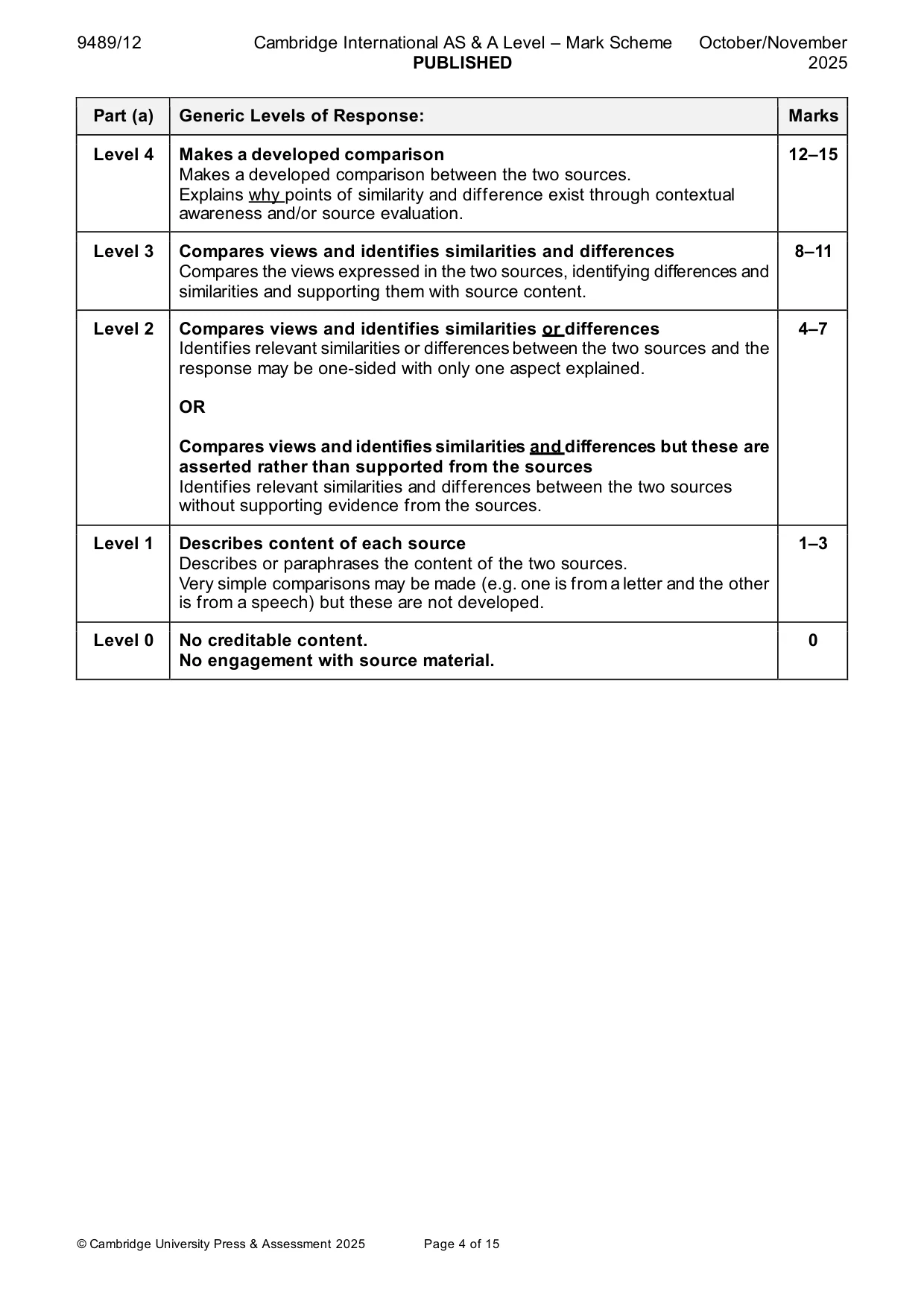
9489/12 Cambridge International AS & A Level – Mark Scheme PUBLISHED October/November 2025 © Cambridge University Press & Assessment 2025 Page 4 of 15 Part (a) Generic Levels of Response: Marks Level 4 Makes a developed comparison Makes a developed comparison between the two sources. Explains why points of similarity and difference exist through contextual awareness and/or source evaluation. 12–15 Level 3 Compares views and identifies similarities and differences Compares the views expressed in the two sources, identifying differences and similarities and supporting them with source content. 8–11 Level 2 Compares views and identifies similarities or differences Identifies relevant similarities or differences between the two sources and the response may be one-sided with only one aspect explained. OR Compares views and identifies similarities and differences but these are asserted rather than supported from the sources Identifies relevant similarities and differences between the two sources without supporting evidence from the sources. 4–7 Level 1 Describes content of each source Describes or paraphrases the content of the two sources. Very simple comparisons may be made (e.g. one is from a letter and the other is from a speech) but these are not developed. 1–3 Level 0 No creditable content. No engagement with source material. 0
Mark scheme, page 5
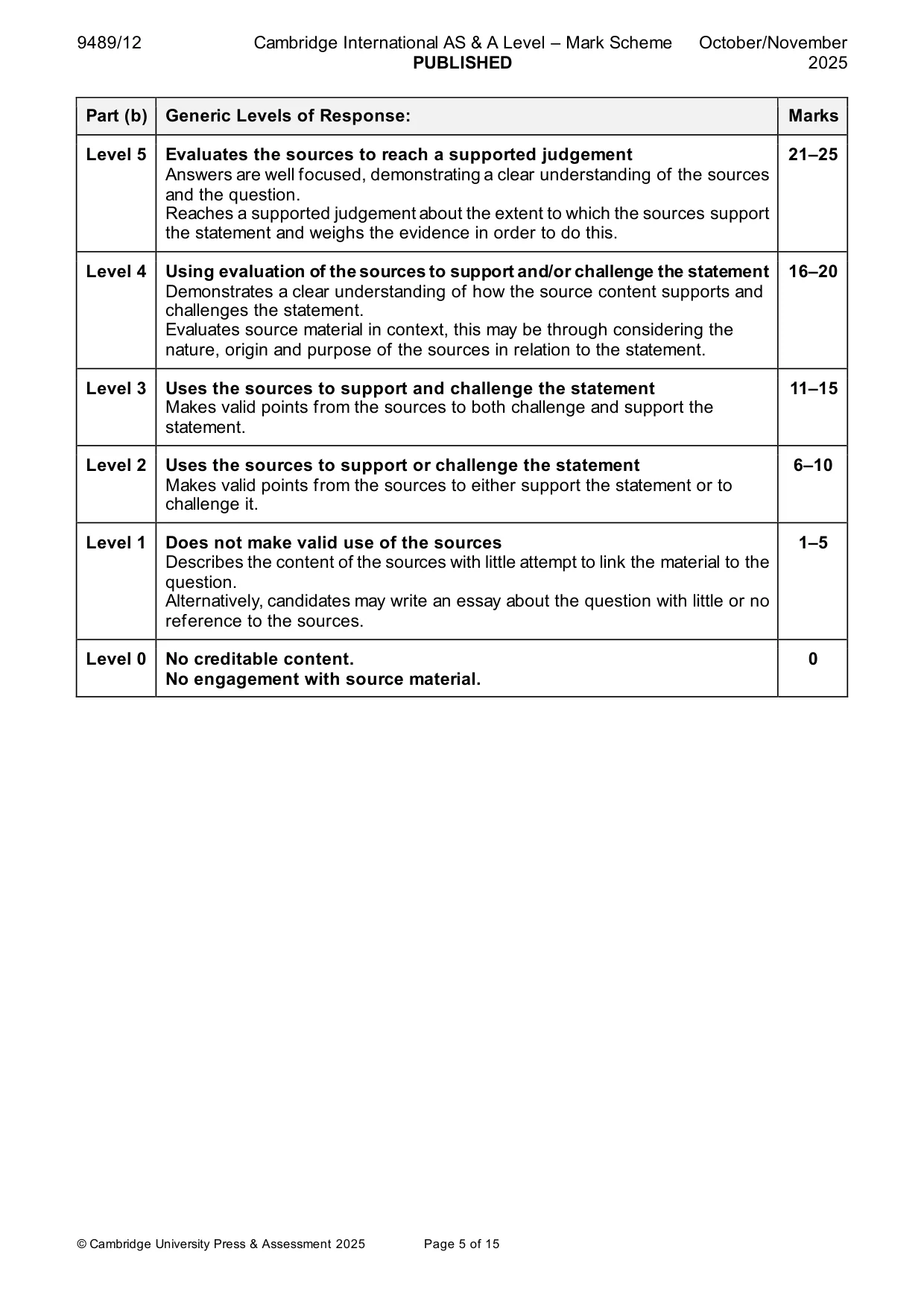
9489/12 Cambridge International AS & A Level – Mark Scheme PUBLISHED October/November 2025 © Cambridge University Press & Assessment 2025 Page 5 of 15 Part (b) Generic Levels of Response: Marks Level 5 Evaluates the sources to reach a supported judgement Answers are well focused, demonstrating a clear understanding of the sources and the question. Reaches a supported judgement about the extent to which the sources support the statement and weighs the evidence in order to do this. 21–25 Level 4 Using evaluation of the sources to support and/or challenge the statement Demonstrates a clear understanding of how the source content supports and challenges the statement. Evaluates source material in context, this may be through considering the nature, origin and purpose of the sources in relation to the statement. 16–20 Level 3 Uses the sources to support and challenge the statement Makes valid points from the sources to both challenge and support the statement. 11–15 Level 2 Uses the sources to support or challenge the statement Makes valid points from the sources to either support the statement or to challenge it. 6–10 Level 1 Does not make valid use of the sources Describes the content of the sources with little attempt to link the material to the question. Alternatively, candidates may write an essay about the question with little or no reference to the sources. 1–5 Level 0 No creditable content. No engagement with source material. 0
Mark scheme, page 6
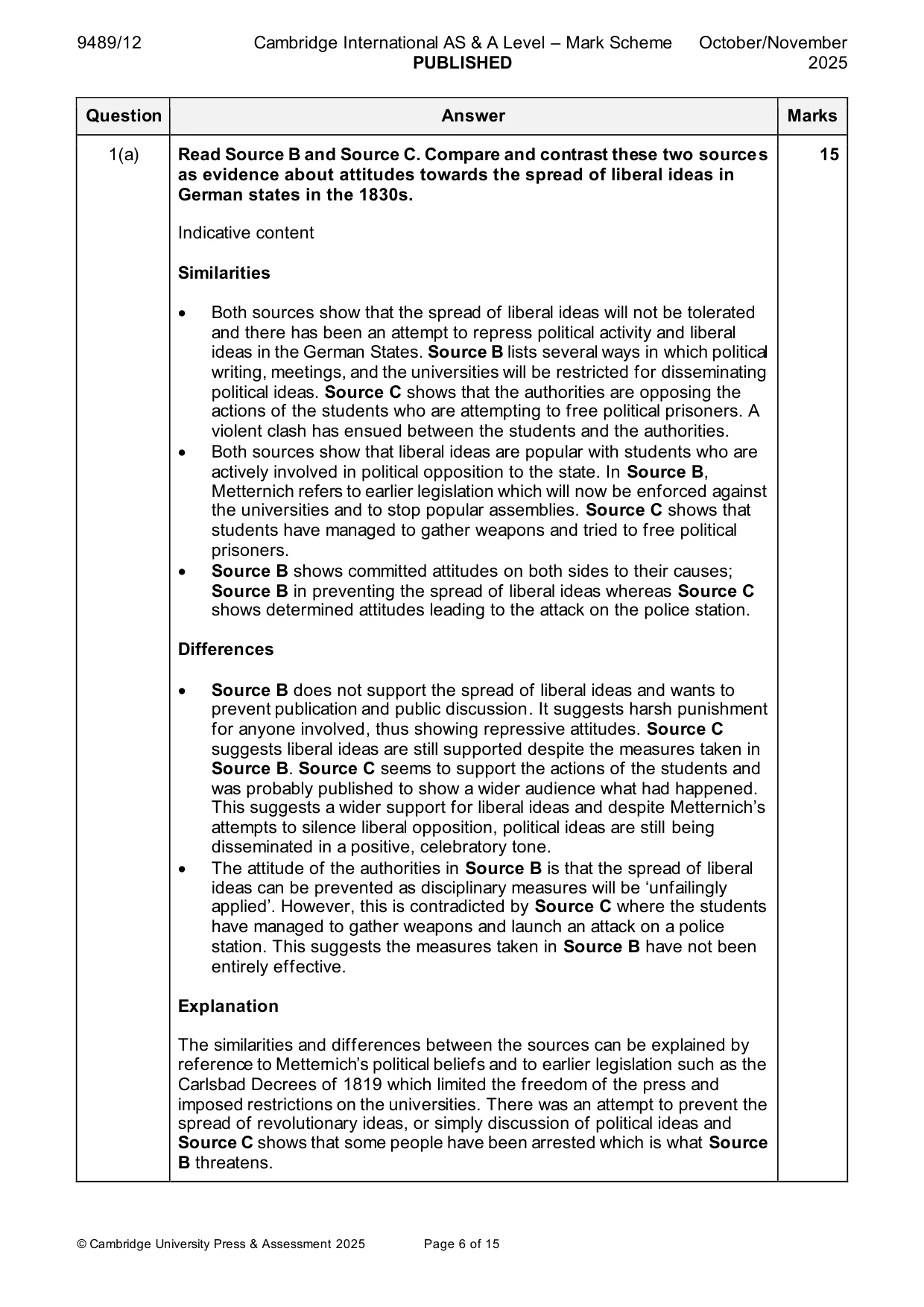
9489/12 Cambridge International AS & A Level – Mark Scheme PUBLISHED October/November 2025 © Cambridge University Press & Assessment 2025 Page 6 of 15 Question Answer Marks 1(a) Read Source B and Source C. Compare and contrast these two sources as evidence about attitudes towards the spread of liberal ideas in German states in the 1830s. Indicative content Similarities • Both sources show that the spread of liberal ideas will not be tolerated and there has been an attempt to repress political activity and liberal ideas in the German States. Source B lists several ways in which political writing, meetings, and the universities will be restricted for disseminating political ideas. Source C shows that the authorities are opposing the actions of the students who are attempting to free political prisoners. A violent clash has ensued between the students and the authorities. • Both sources show that liberal ideas are popular with students who are actively involved in political opposition to the state. In Source B, Metternich refers to earlier legislation which will now be enforced against the universities and to stop popular assemblies. Source C shows that students have managed to gather weapons and tried to free political prisoners. • Source B shows committed attitudes on both sides to their causes; Source B in preventing the spread of liberal ideas whereas Source C shows determined attitudes leading to the attack on the police station. Differences • Source B does not support the spread of liberal ideas and wants to prevent publication and public discussion. It suggests harsh punishment for anyone involved, thus showing repressive attitudes. Source C suggests liberal ideas are still supported despite the measures taken in Source B. Source C seems to support the actions of the students and was probably published to show a wider audience what had happened. This suggests a wider support for liberal ideas and despite Metternich’s attempts to silence liberal opposition, political ideas are still being disseminated in a positive, celebratory tone. • The attitude of the authorities in Source B is that the spread of liberal ideas can be prevented as disciplinary measures will be ‘unfailingly applied’. However, this is contradicted by Source C where the students have managed to gather weapons and launch an attack on a police station. This suggests the measures taken in Source B have not been entirely effective. Explanation The similarities and differences between the sources can be explained by reference to Metternich’s political beliefs and to earlier legislation such as the Carlsbad Decrees of 1819 which limited the freedom of the press and imposed restrictions on the universities. There was an attempt to prevent the spread of revolutionary ideas, or simply discussion of political ideas and Source C shows that some people have been arrested which is what Source B threatens. 15
Mark scheme, page 7
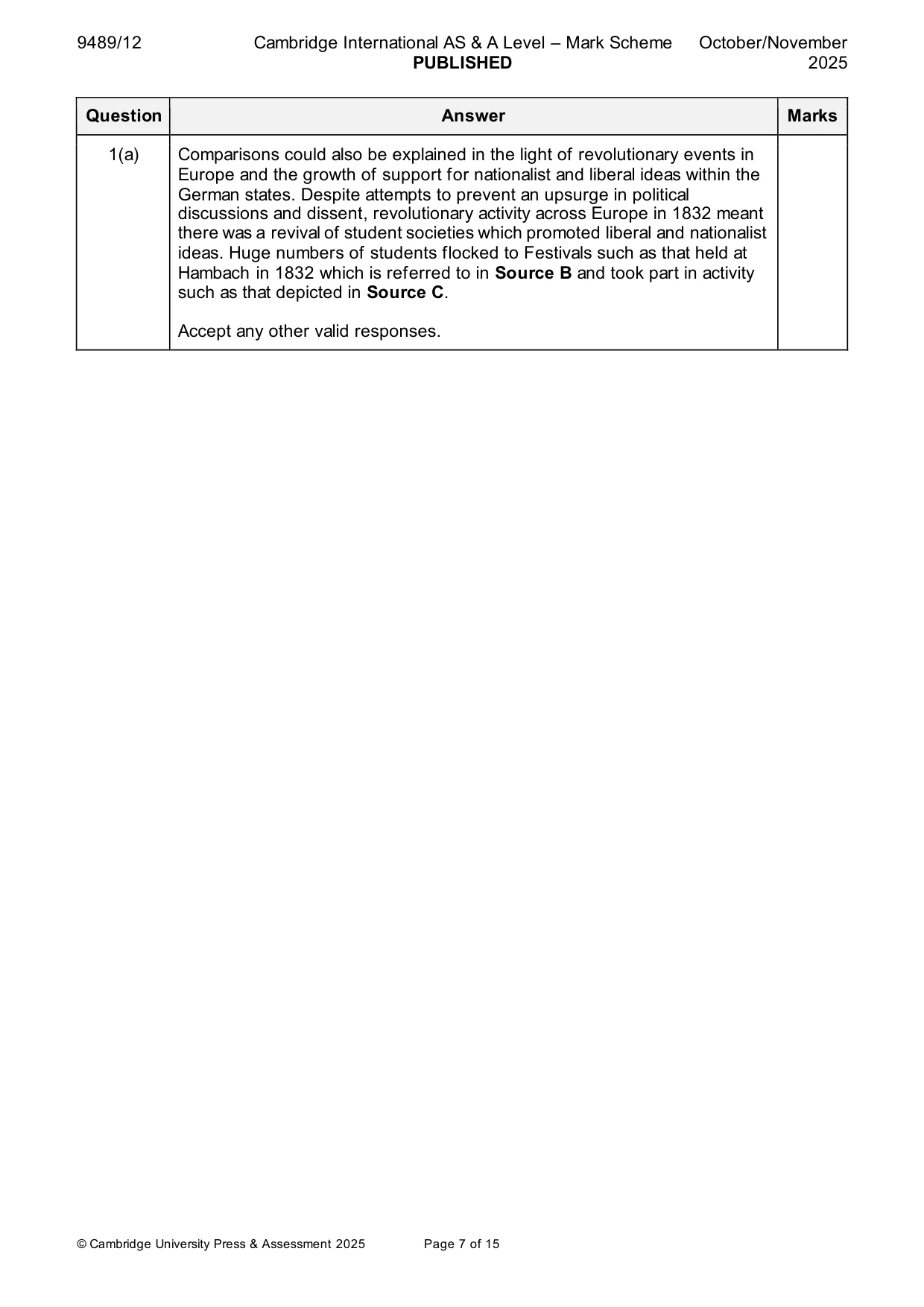
9489/12 Cambridge International AS & A Level – Mark Scheme PUBLISHED October/November 2025 © Cambridge University Press & Assessment 2025 Page 7 of 15 Question Answer Marks 1(a) Comparisons could also be explained in the light of revolutionary events in Europe and the growth of support for nationalist and liberal ideas within the German states. Despite attempts to prevent an upsurge in political discussions and dissent, revolutionary activity across Europe in 1832 meant there was a revival of student societies which promoted liberal and nationalist ideas. Huge numbers of students flocked to Festivals such as that held at Hambach in 1832 which is referred to in Source B and took part in activity such as that depicted in Source C. Accept any other valid responses.
Mark scheme, page 8
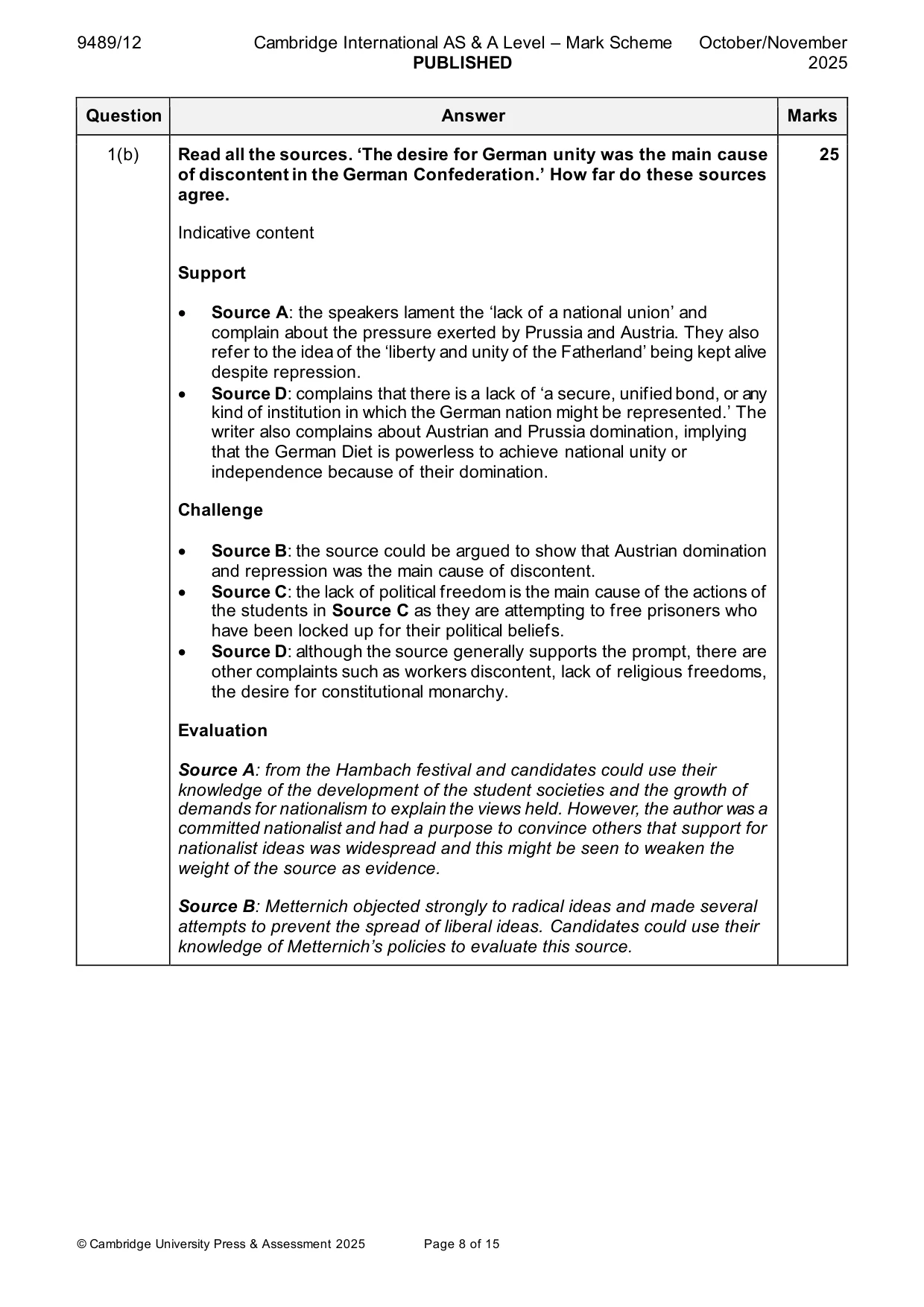
9489/12 Cambridge International AS & A Level – Mark Scheme PUBLISHED October/November 2025 © Cambridge University Press & Assessment 2025 Page 8 of 15 Question Answer Marks 1(b) Read all the sources. ‘The desire for German unity was the main cause of discontent in the German Confederation.’ How far do these sources agree. Indicative content Support • Source A: the speakers lament the ‘lack of a national union’ and complain about the pressure exerted by Prussia and Austria. They also refer to the idea of the ‘liberty and unity of the Fatherland’ being kept alive despite repression. • Source D: complains that there is a lack of ‘a secure, unified bond, or any kind of institution in which the German nation might be represented.’ The writer also complains about Austrian and Prussia domination, implying that the German Diet is powerless to achieve national unity or independence because of their domination. Challenge • Source B: the source could be argued to show that Austrian domination and repression was the main cause of discontent. • Source C: the lack of political freedom is the main cause of the actions of the students in Source C as they are attempting to free prisoners who have been locked up for their political beliefs. • Source D: although the source generally supports the prompt, there are other complaints such as workers discontent, lack of religious freedoms, the desire for constitutional monarchy. Evaluation Source A: from the Hambach festival and candidates could use their knowledge of the development of the student societies and the growth of demands for nationalism to explain the views held. However, the author was a committed nationalist and had a purpose to convince others that support for nationalist ideas was widespread and this might be seen to weaken the weight of the source as evidence. Source B: Metternich objected strongly to radical ideas and made several attempts to prevent the spread of liberal ideas. Candidates could use their knowledge of Metternich’s policies to evaluate this source. 25
Mark scheme, page 9
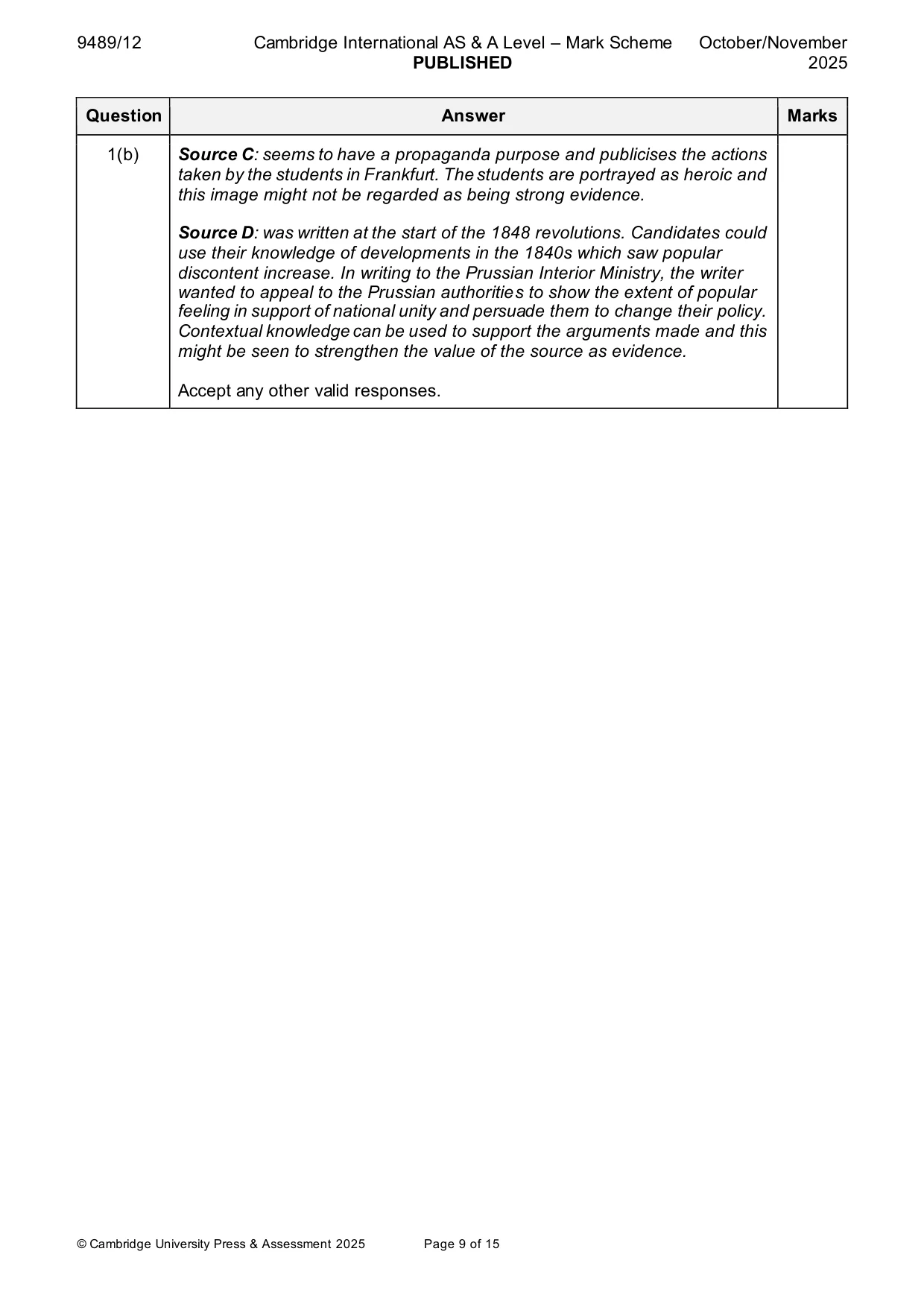
9489/12 Cambridge International AS & A Level – Mark Scheme PUBLISHED October/November 2025 © Cambridge University Press & Assessment 2025 Page 9 of 15 Question Answer Marks 1(b) Source C: seems to have a propaganda purpose and publicises the actions taken by the students in Frankfurt. The students are portrayed as heroic and this image might not be regarded as being strong evidence. Source D: was written at the start of the 1848 revolutions. Candidates could use their knowledge of developments in the 1840s which saw popular discontent increase. In writing to the Prussian Interior Ministry, the writer wanted to appeal to the Prussian authorities to show the extent of popular feeling in support of national unity and persuade them to change their policy. Contextual knowledge can be used to support the arguments made and this might be seen to strengthen the value of the source as evidence. Accept any other valid responses.
Mark scheme, page 10
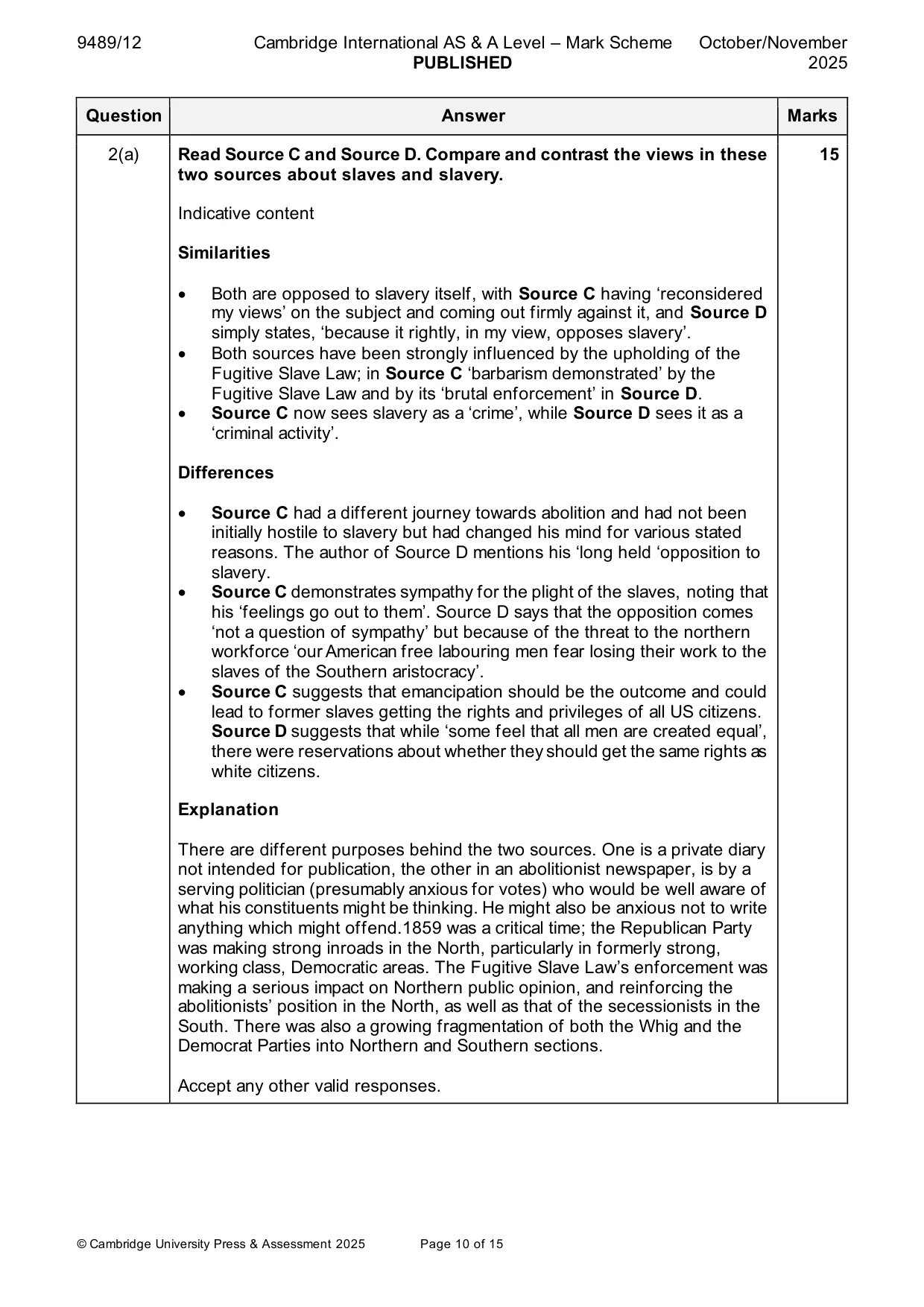
9489/12 Cambridge International AS & A Level – Mark Scheme PUBLISHED October/November 2025 © Cambridge University Press & Assessment 2025 Page 10 of 15 Question Answer Marks 2(a) Read Source C and Source D. Compare and contrast the views in these two sources about slaves and slavery. Indicative content Similarities • Both are opposed to slavery itself, with Source C having ‘reconsidered my views’ on the subject and coming out firmly against it, and Source D simply states, ‘because it rightly, in my view, opposes slavery’. • Both sources have been strongly influenced by the upholding of the Fugitive Slave Law; in Source C ‘barbarism demonstrated’ by the Fugitive Slave Law and by its ‘brutal enforcement’ in Source D. • Source C now sees slavery as a ‘crime’, while Source D sees it as a ‘criminal activity’. Differences • Source C had a different journey towards abolition and had not been initially hostile to slavery but had changed his mind for various stated reasons. The author of Source D mentions his ‘long held ‘opposition to slavery. • Source C demonstrates sympathy for the plight of the slaves, noting that his ‘feelings go out to them’. Source D says that the opposition comes ‘not a question of sympathy’ but because of the threat to the northern workforce ‘our American free labouring men fear losing their work to the slaves of the Southern aristocracy’. • Source C suggests that emancipation should be the outcome and could lead to former slaves getting the rights and privileges of all US citizens. Source D suggests that while ‘some feel that all men are created equal’, there were reservations about whether they should get the same rights as white citizens. Explanation There are different purposes behind the two sources. One is a private diary not intended for publication, the other in an abolitionist newspaper, is by a serving politician (presumably anxious for votes) who would be well aware of what his constituents might be thinking. He might also be anxious not to write anything which might offend.1859 was a critical time; the Republican Party was making strong inroads in the North, particularly in formerly strong, working class, Democratic areas. The Fugitive Slave Law’s enforcement was making a serious impact on Northern public opinion, and reinforcing the abolitionists’ position in the North, as well as that of the secessionists in the South. There was also a growing fragmentation of both the Whig and the Democrat Parties into Northern and Southern sections. Accept any other valid responses. 15
Mark scheme, page 11
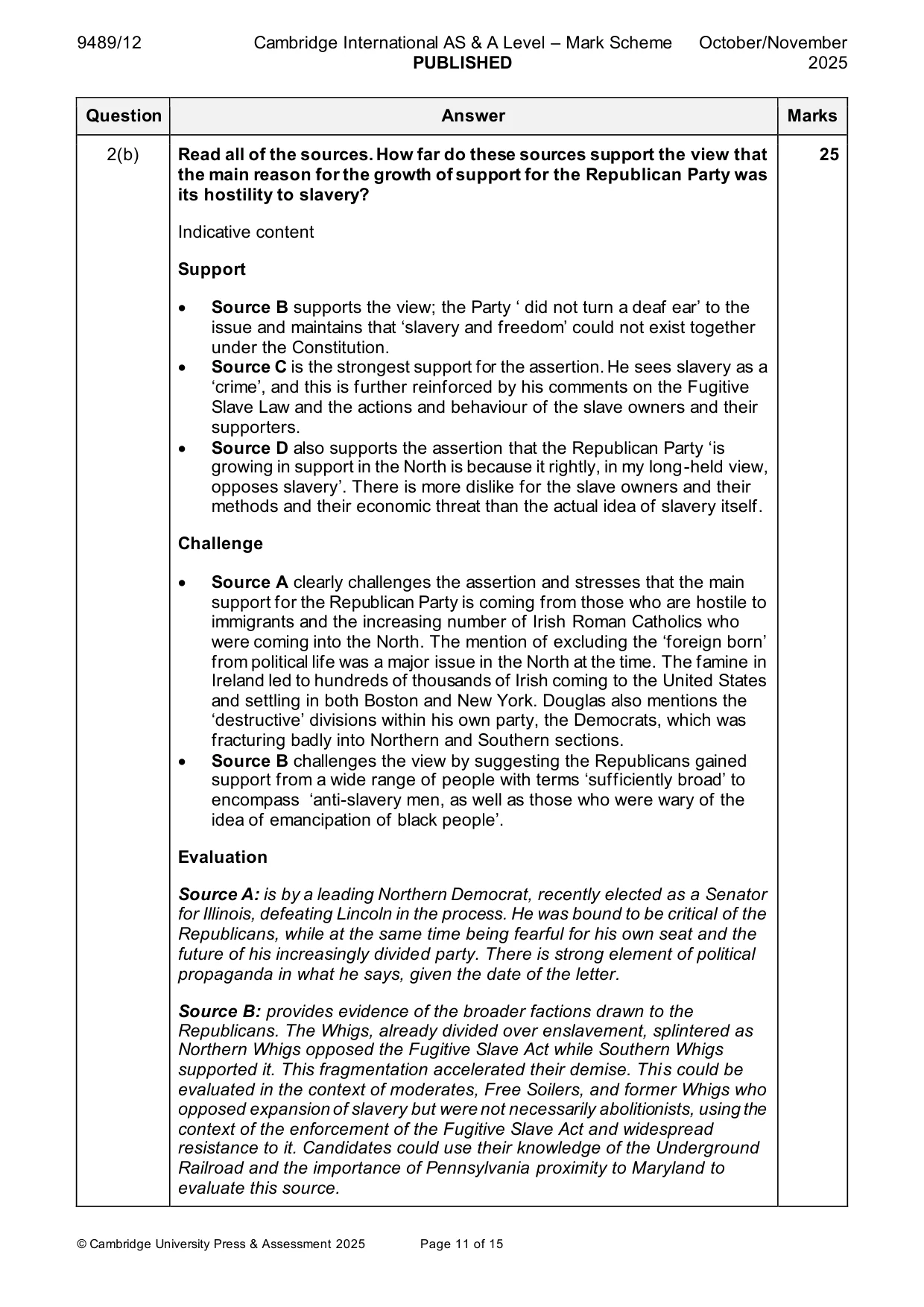
9489/12 Cambridge International AS & A Level – Mark Scheme PUBLISHED October/November 2025 © Cambridge University Press & Assessment 2025 Page 11 of 15 Question Answer Marks 2(b) Read all of the sources. How far do these sources support the view that the main reason for the growth of support for the Republican Party was its hostility to slavery? Indicative content Support • Source B supports the view; the Party ‘ did not turn a deaf ear’ to the issue and maintains that ‘slavery and freedom’ could not exist together under the Constitution. • Source C is the strongest support for the assertion. He sees slavery as a ‘crime’, and this is further reinforced by his comments on the Fugitive Slave Law and the actions and behaviour of the slave owners and their supporters. • Source D also supports the assertion that the Republican Party ‘is growing in support in the North is because it rightly, in my long-held view, opposes slavery’. There is more dislike for the slave owners and their methods and their economic threat than the actual idea of slavery itself. Challenge • Source A clearly challenges the assertion and stresses that the main support for the Republican Party is coming from those who are hostile to immigrants and the increasing number of Irish Roman Catholics who were coming into the North. The mention of excluding the ‘foreign born’ from political life was a major issue in the North at the time. The famine in Ireland led to hundreds of thousands of Irish coming to the United States and settling in both Boston and New York. Douglas also mentions the ‘destructive’ divisions within his own party, the Democrats, which was fracturing badly into Northern and Southern sections. • Source B challenges the view by suggesting the Republicans gained support from a wide range of people with terms ‘sufficiently broad’ to encompass ‘anti-slavery men, as well as those who were wary of the idea of emancipation of black people’. Evaluation Source A: is by a leading Northern Democrat, recently elected as a Senator for Illinois, defeating Lincoln in the process. He was bound to be critical of the Republicans, while at the same time being fearful for his own seat and the future of his increasingly divided party. There is strong element of political propaganda in what he says, given the date of the letter. Source B: provides evidence of the broader factions drawn to the Republicans. The Whigs, already divided over enslavement, splintered as Northern Whigs opposed the Fugitive Slave Act while Southern Whigs supported it. This fragmentation accelerated their demise. This could be evaluated in the context of moderates, Free Soilers, and former Whigs who opposed expansion of slavery but were not necessarily abolitionists, using the context of the enforcement of the Fugitive Slave Act and widespread resistance to it. Candidates could use their knowledge of the Underground Railroad and the importance of Pennsylvania proximity to Maryland to evaluate this source. 25
Mark scheme, page 12
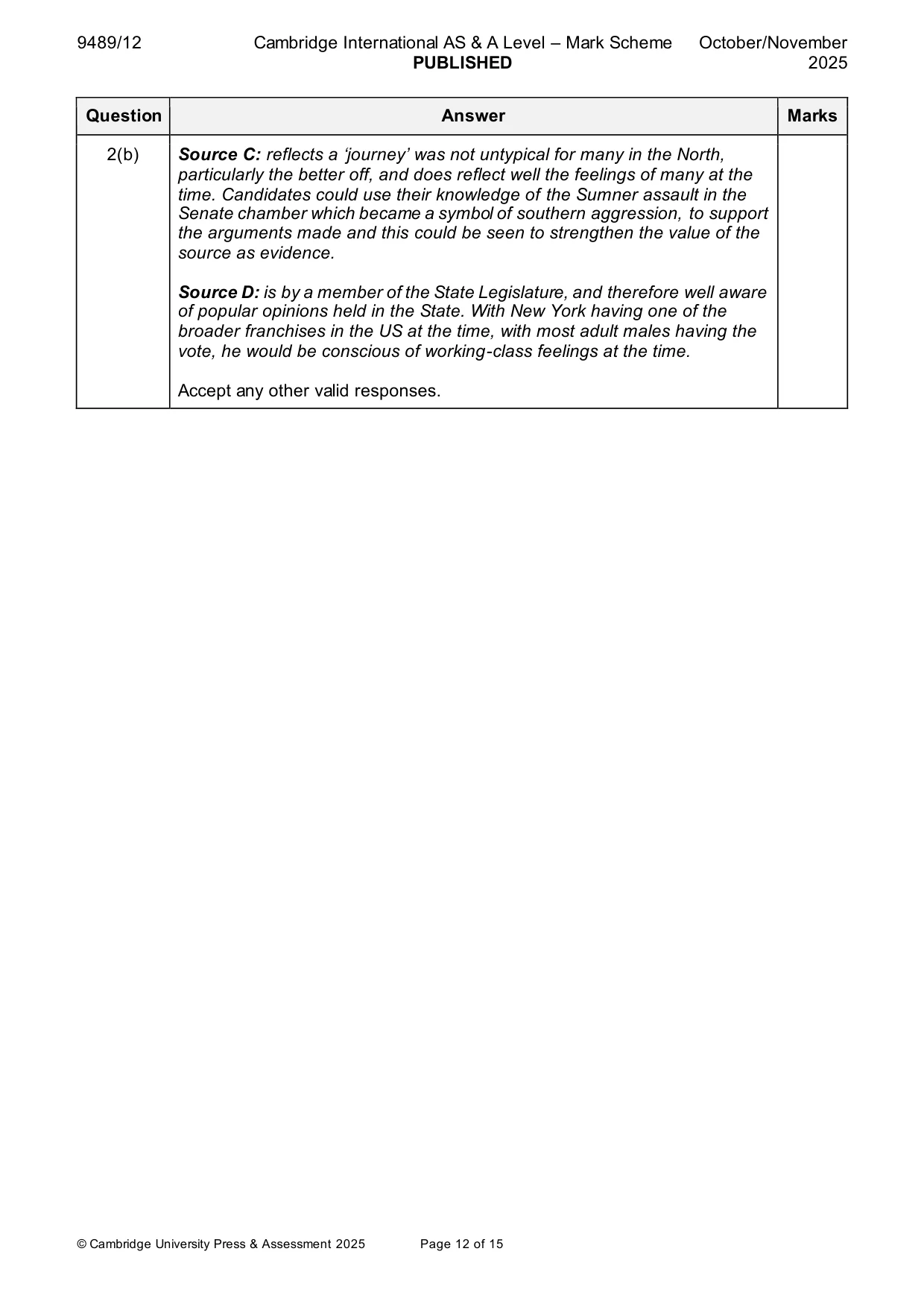
9489/12 Cambridge International AS & A Level – Mark Scheme PUBLISHED October/November 2025 © Cambridge University Press & Assessment 2025 Page 12 of 15 Question Answer Marks 2(b) Source C: reflects a ‘journey’ was not untypical for many in the North, particularly the better off, and does reflect well the feelings of many at the time. Candidates could use their knowledge of the Sumner assault in the Senate chamber which became a symbol of southern aggression, to support the arguments made and this could be seen to strengthen the value of the source as evidence. Source D: is by a member of the State Legislature, and therefore well aware of popular opinions held in the State. With New York having one of the broader franchises in the US at the time, with most adult males having the vote, he would be conscious of working-class feelings at the time. Accept any other valid responses.
Mark scheme, page 13
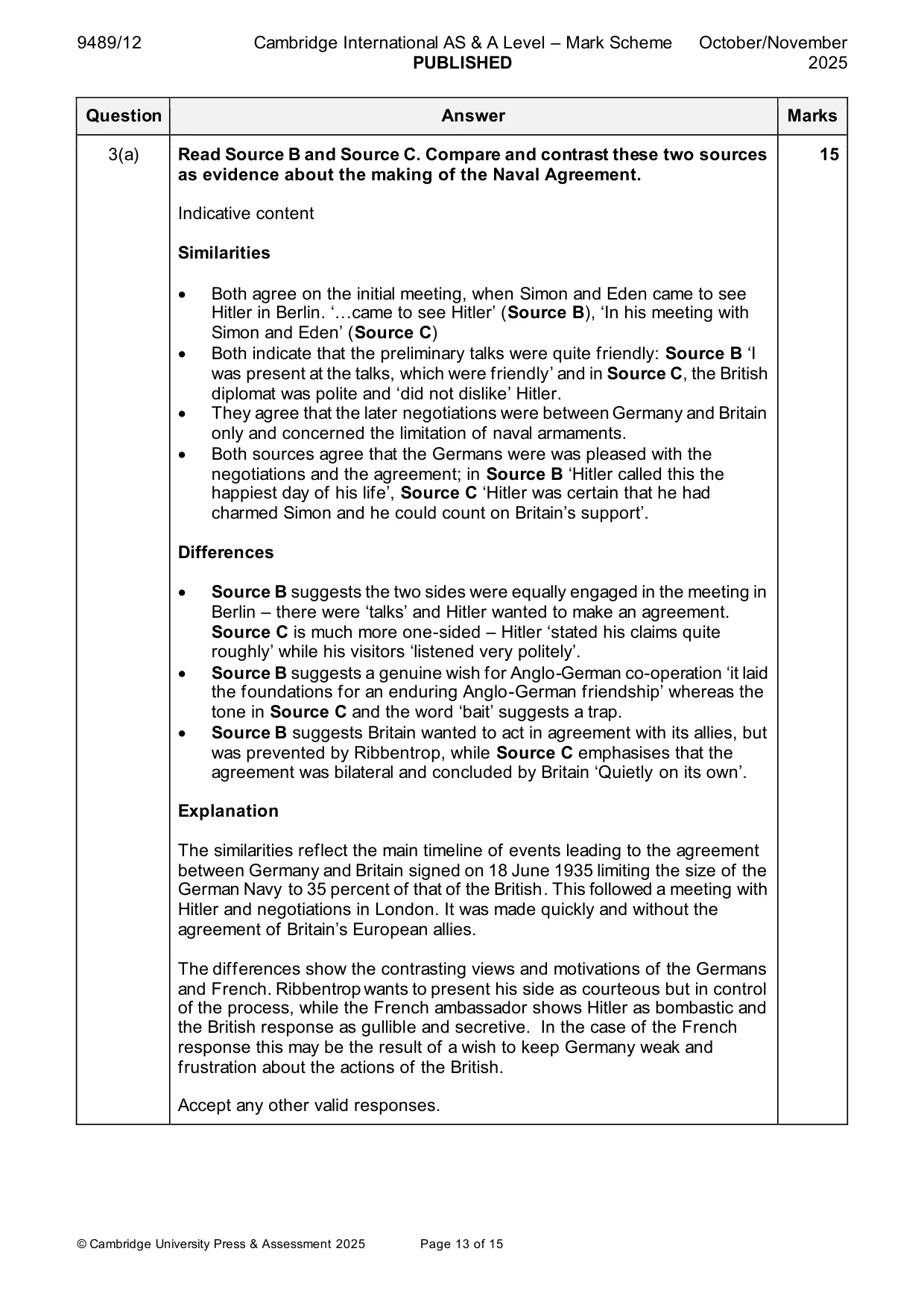
9489/12 Cambridge International AS & A Level – Mark Scheme PUBLISHED October/November 2025 © Cambridge University Press & Assessment 2025 Page 13 of 15 Question Answer Marks 3(a) Read Source B and Source C. Compare and contrast these two sources as evidence about the making of the Naval Agreement. Indicative content Similarities • Both agree on the initial meeting, when Simon and Eden came to see Hitler in Berlin. ‘…came to see Hitler’ (Source B), ‘In his meeting with Simon and Eden’ (Source C) • Both indicate that the preliminary talks were quite friendly: Source B ‘I was present at the talks, which were friendly’ and in Source C, the British diplomat was polite and ‘did not dislike’ Hitler. • They agree that the later negotiations were between Germany and Britain only and concerned the limitation of naval armaments. • Both sources agree that the Germans were was pleased with the negotiations and the agreement; in Source B ‘Hitler called this the happiest day of his life’, Source C ‘Hitler was certain that he had charmed Simon and he could count on Britain’s support’. Differences • Source B suggests the two sides were equally engaged in the meeting in Berlin – there were ‘talks’ and Hitler wanted to make an agreement. Source C is much more one-sided – Hitler ‘stated his claims quite roughly’ while his visitors ‘listened very politely’. • Source B suggests a genuine wish for Anglo-German co-operation ‘it laid the foundations for an enduring Anglo-German friendship’ whereas the tone in Source C and the word ‘bait’ suggests a trap. • Source B suggests Britain wanted to act in agreement with its allies, but was prevented by Ribbentrop, while Source C emphasises that the agreement was bilateral and concluded by Britain ‘Quietly on its own’. Explanation The similarities reflect the main timeline of events leading to the agreement between Germany and Britain signed on 18 June 1935 limiting the size of the German Navy to 35 percent of that of the British. This followed a meeting with Hitler and negotiations in London. It was made quickly and without the agreement of Britain’s European allies. The differences show the contrasting views and motivations of the Germans and French. Ribbentrop wants to present his side as courteous but in control of the process, while the French ambassador shows Hitler as bombastic and the British response as gullible and secretive. In the case of the French response this may be the result of a wish to keep Germany weak and frustration about the actions of the British. Accept any other valid responses. 15
Mark scheme, page 14
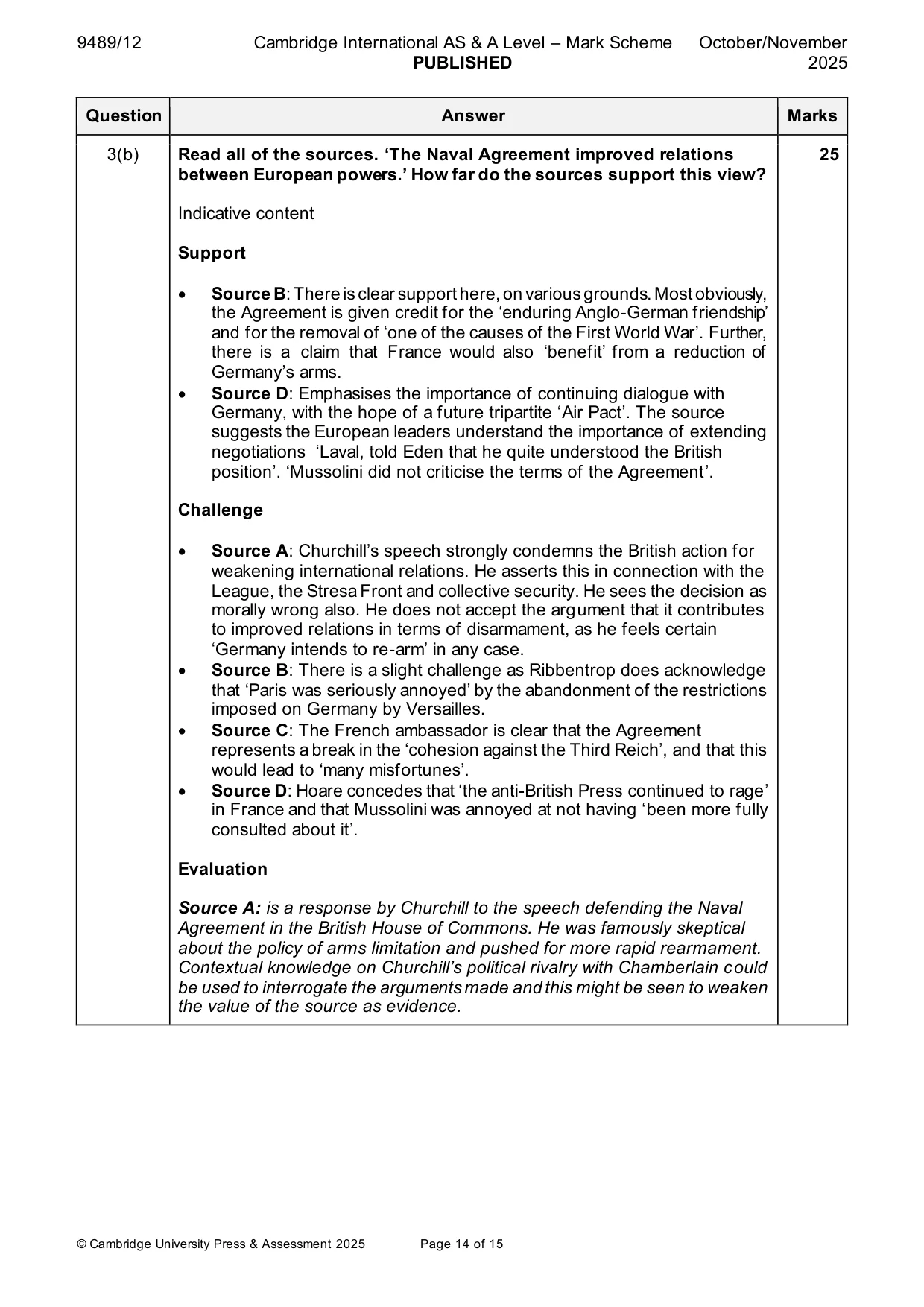
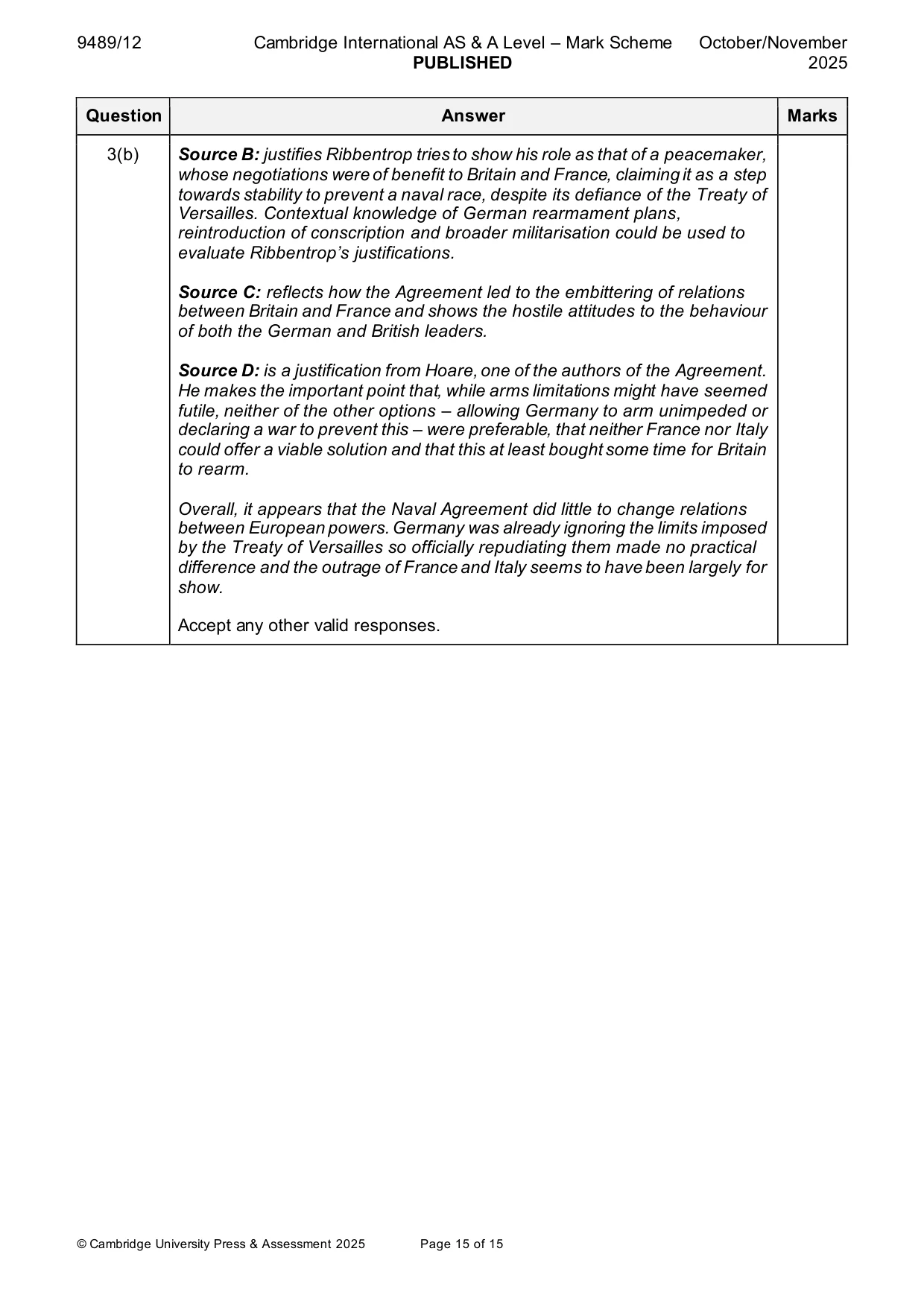
9489/12 Cambridge International AS & A Level – Mark Scheme PUBLISHED October/November 2025 © Cambridge University Press & Assessment 2025 Page 14 of 15 Question Answer Marks 3(b) Read all of the sources. ‘The Naval Agreement improved relations between European powers.’ How far do the sources support this view? Indicative content Support • Source B: There is clear support here, on various grounds. Most obviously, the Agreement is given credit for the ‘enduring Anglo-German friendship’ and for the removal of ‘one of the causes of the First World War’. Further, there is a claim that France would also ‘benefit’ from a reduction of Germany’s arms. • Source D: Emphasises the importance of continuing dialogue with Germany, with the hope of a future tripartite ‘Air Pact’. The source suggests the European leaders understand the importance of extending negotiations ‘Laval, told Eden that he quite understood the British position’. ‘Mussolini did not criticise the terms of the Agreement’. Challenge • Source A: Churchill’s speech strongly condemns the British action for weakening international relations. He asserts this in connection with the League, the Stresa Front and collective security. He sees the decision as morally wrong also. He does not accept the argument that it contributes to improved relations in terms of disarmament, as he feels certain ‘Germany intends to re-arm’ in any case. • Source B: There is a slight challenge as Ribbentrop does acknowledge that ‘Paris was seriously annoyed’ by the abandonment of the restrictions imposed on Germany by Versailles. • Source C: The French ambassador is clear that the Agreement represents a break in the ‘cohesion against the Third Reich’, and that this would lead to ‘many misfortunes’. • Source D: Hoare concedes that ‘the anti-British Press continued to rage’ in France and that Mussolini was annoyed at not having ‘been more fully consulted about it’. Evaluation Source A: is a response by Churchill to the speech defending the Naval Agreement in the British House of Commons. He was famously skeptical about the policy of arms limitation and pushed for more rapid rearmament. Contextual knowledge on Churchill’s political rivalry with Chamberlain could be used to interrogate the arguments made and this might be seen to weaken the value of the source as evidence. 25
Mark scheme, page 15
9489/12 Cambridge International AS & A Level – Mark Scheme PUBLISHED October/November 2025 © Cambridge University Press & Assessment 2025 Page 15 of 15 Question Answer Marks 3(b) Source B: justifies Ribbentrop tries to show his role as that of a peacemaker, whose negotiations were of benefit to Britain and France, claiming it as a step towards stability to prevent a naval race, despite its defiance of the Treaty of Versailles. Contextual knowledge of German rearmament plans, reintroduction of conscription and broader militarisation could be used to evaluate Ribbentrop’s justifications. Source C: reflects how the Agreement led to the embittering of relations between Britain and France and shows the hostile attitudes to the behaviour of both the German and British leaders. Source D: is a justification from Hoare, one of the authors of the Agreement. He makes the important point that, while arms limitations might have seemed futile, neither of the other options – allowing Germany to arm unimpeded or declaring a war to prevent this – were preferable, that neither France nor Italy could offer a viable solution and that this at least bought some time for Britain to rearm. Overall, it appears that the Naval Agreement did little to change relations between European powers. Germany was already ignoring the limits imposed by the Treaty of Versailles so officially repudiating them made no practical difference and the outrage of France and Italy seems to have been largely for show. Accept any other valid responses.
What you needed in this session
Cambridge’s own grade thresholds for 2025 Oct/Nov, Paper 1 · Variant 2. A higher threshold means an easier paper — the bar moves with how the cohort did.